Oscar Rabin (Russian, 1928–2018), Flight into Egypt, 1977. Oil on canvas, 49 × 70 cm.
Now when they had departed, behold, an angel of the Lord appeared to Joseph in a dream and said, “Rise, take the child and his mother, and flee to Egypt, and remain there until I tell you, for Herod is about to search for the child, to destroy him.” And he rose and took the child and his mother by night and departed to Egypt and remained there until the death of Herod. This was to fulfill what the Lord had spoken by the prophet, “Out of Egypt I called my son.”
Then Herod, when he saw that he had been tricked by the wise men, became furious, and he sent and killed all the male children in Bethlehem and in all that region who were two years old or under, according to the time that he had ascertained from the wise men. Then was fulfilled what was spoken by the prophet Jeremiah:
“A voice was heard in Ramah,
weeping and loud lamentation,
Rachel weeping for her children;
she refused to be comforted, because they are no more.”
When was he born? When was he born?
When was he born? On a cold dark night.
The king said, “Kill every baby boy that you can find.
There’s been too much talk about a new king born,
And this throne is mine.”
When was he born? When was he born?
When was he born? On a cold dark night.
He wasn’t born to be a king. He wasn’t born to fight.
He knew this world can get so dark that when you can
You’ve got to turn on the light.
When was he born? When was he born?
When was he born? On a cold dark night.
+++
A Russian painter and activist, Oscar Rabin was one of the founders of the Soviet Nonconformist Art movement. After being stripped of his citizenship in 1978 for political dissidence, he emigrated to Paris, where he lived until his death last year at age ninety. He is the subject of the feature-length documentaries Oscar (2018) and, with his wife and fellow artist Valentina Kropivnitskaya, In Search of a Lost Paradise (2015).
This post belongs to the weekly series Artful Devotion. If you can’t view the music player in your email or RSS reader, try opening the post in your browser.
To view all the Revised Common Lectionary scripture readings for the First Sunday after Christmas Day, cycle A, click here.
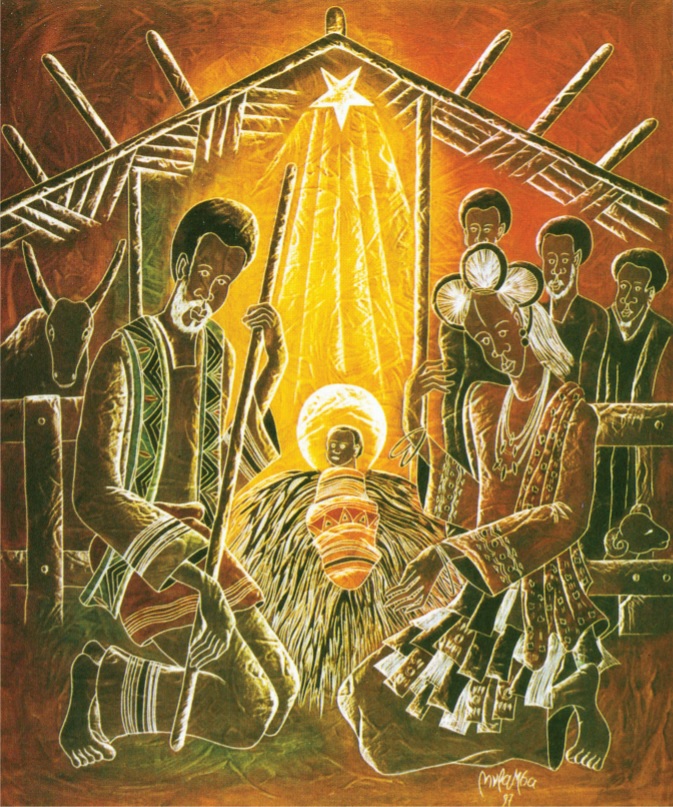
Noel, Noel
Yesu me kwisa ku zinga ti beto
Noel, noel
Yesu me kwisa ku zinga ti beto
Kana nge zola ku zaba mwana
Nge fwiti kwisa ku fukama
Kana nge zola ku zaba mwana
Nge fwiti kwisa ku fukama
English translation:
Noel, Noel
Jesus has come to live with us
Noel, Noel
Jesus has come to live with us
If you want to know the Child
You have to come kneel
If you want to know the Child
You have to come kneel
Kituba is the official language of the Democratic Republic of the Congo, where singer-songwriter Todd Smith grew up, from 1978 to 1986, as a missionary kid. (The country was then known as Zaire.) Smith is one of three members of the award-winning band Selah, which helped initiate a hymn revival in Christian music that is still thriving today.
+++
See the Artful Devotions for the last two Christmases:
This post belongs to the weekly series Artful Devotion. If you can’t view the music player in your email or RSS reader, try opening the post in your browser.
To view all the Revised Common Lectionary scripture readings for Christmas Day, cycle A, click here.
Yaroslava Tkachuk (Ukrainian, 1981–), Expectant, 2014. Linen, silk, seeds, copper, and acrylic, 100 × 40 cm. Photo courtesy of the artist. [Original for sale; click photo for more info]
Therefore the Lord himself will give you a sign. Behold, the virgin shall conceive and bear a son, and shall call his name Immanuel.
—Isaiah 7:14
+++
SONG: “Maria” by David Maloney, on A Christmas Album by Reilly & Maloney (1984, reissued 2012)
Christmas Day, it’s coming fast
Bringing joy to the world at last
Joy to the world
Maria . . .
This post belongs to the weekly series Artful Devotion. If you can’t view the music player in your email or RSS reader, try opening the post in your browser.
To view all the Revised Common Lectionary scripture readings for the Fourth Sunday of Advent, cycle A, click here.
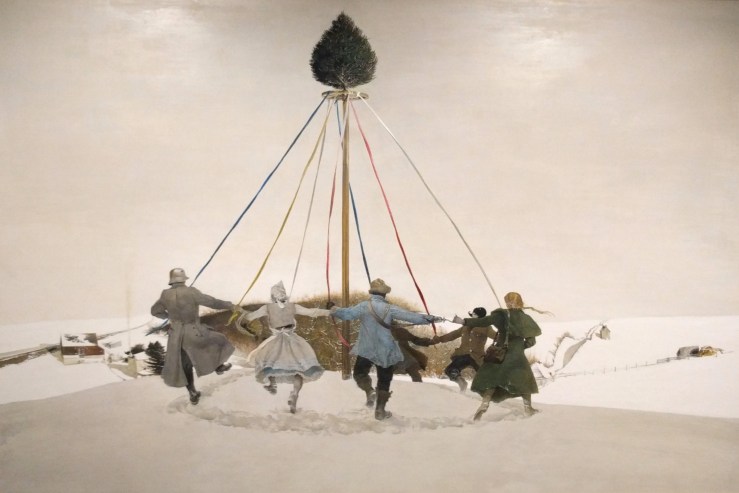
Andrew Wyeth (American, 1917–2009), Snow Hill, 1989. Tempera on hardboard panel, 48 × 72 in. (121.9 × 182.9 cm). Andrew and Betsy Wyeth Collection. Photo: Victoria Emily Jones (at the Brandywine River Museum of Art 2017 retrospective).
. . .
Then the eyes of the blind shall be opened,
and the ears of the deaf unstopped;
then shall the lame man leap like a deer,
and the tongue of the mute sing for joy.
. . .
And the ransomed of the Lord shall return
and come to Zion with singing;
everlasting joy shall be upon their heads;
they shall obtain gladness and joy,
and sorrow and sighing shall flee away.
—Isaiah 35:5–6a, 10
+++
SONG: “Therefore the Redeemed” by Ruth Lake, 1972 | Performed by Kim McLean, on Soul Solace, 2008
+++
Snow Hill by Andrew Wyeth [previously] is “a conscious summary of his artistic life that is both somber memoir and playful recalibration” (John Wilmerding). It shows six of his friends and neighbors, who modeled for him many times throughout his career, dancing around a beribboned Maypole in winter in Chadds Ford, Pennsylvania. Their coats, earflaps, and braids fly in the wind, as does one untouched white ribbon, which, it has been posited, could represent Christina Olson (who had a degenerative muscle disorder and could not walk), the artist’s wife Betsy, or the artist himself.
This painting, one of Wyeth’s last, was the finale of a major retrospective at the Brandywine River Museum of Art in 2017, which has been one of the most memorable art exhibitions I’ve ever attended. The wall text there read,
Painted over a two-year period, Snow Hill is both fantasy and memorial, a visual summation of the iconic places and people of Chadds Ford that occupied [Wyeth] for the previous fifty years. Wyeth looks backward and inward, bringing together many of these subjects from his past, a number of them now deceased. Depicted are Karl Kuerner (dressed in his German uniform), holding the hand of Anna Kuerner, who is in turn linked to William Loper, whose prosthetic hook is held by Helga Testorf, rounding the circle to Allan Lynch (of Winter 1946) and Adam Johnson (partially obscured). They are surrounded by a landscape that shows, left to right: the railroad tracks where Wyeth’s father, N. C. Wyeth, was killed in 1945; the Kuerner farmhouse and barn; the remains of Mother Archie’s octagonal church; the Ring family home in the distance; and Adam Johnson’s shed and haystack.
Wyeth’s models are shown holding ribbons—although one white ribbon is symbolically floating free—and dancing atop Kuerner Hill—a site at once iconic for its recurrence in Wyeth’s work and for its proximity to the site of his father’s death. . . .
I love how the dead and the living join together in this Yuletide circle dance, in which suffering is taken up into joy. Wyeth had lived through Karl Kuerner, a World War I veteran, succumbing to cancer, Allan Lynch to suicide, and Bill Loper to mental illness, as well as the early death of his father and nephew in a car accident. And while such darkness is not fully dissipated in this gray-day scene, a mood of celebration and hope and friendship does take over.
This post belongs to the weekly series Artful Devotion. If you can’t view the music player in your email or RSS reader, try opening the post in your browser.
To view all the Revised Common Lectionary scripture readings for the Third Sunday of Advent, cycle A, click here.
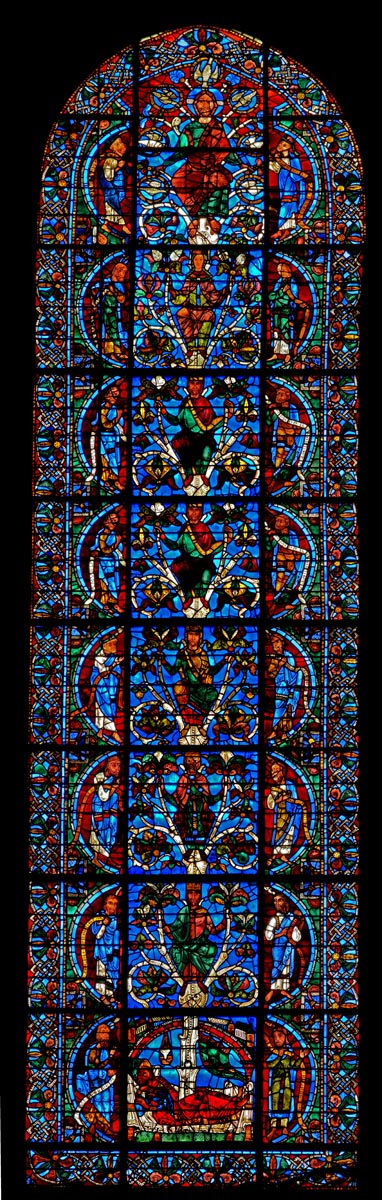
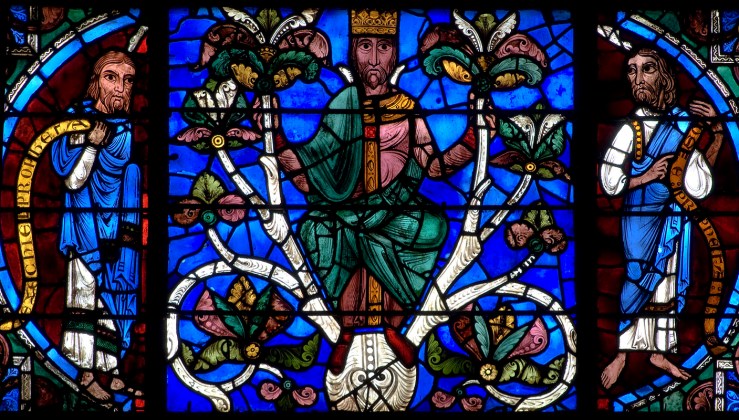
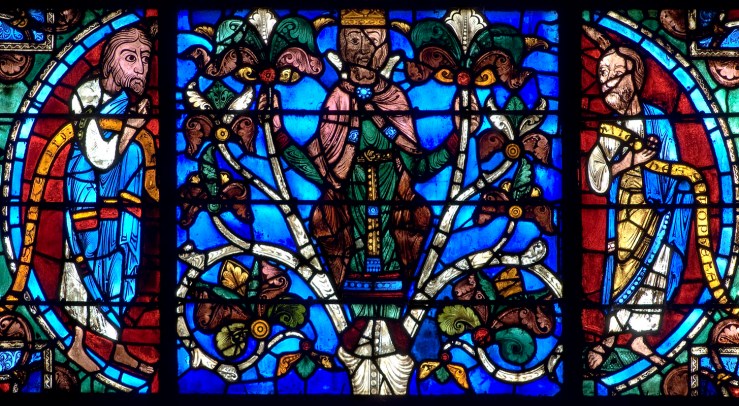
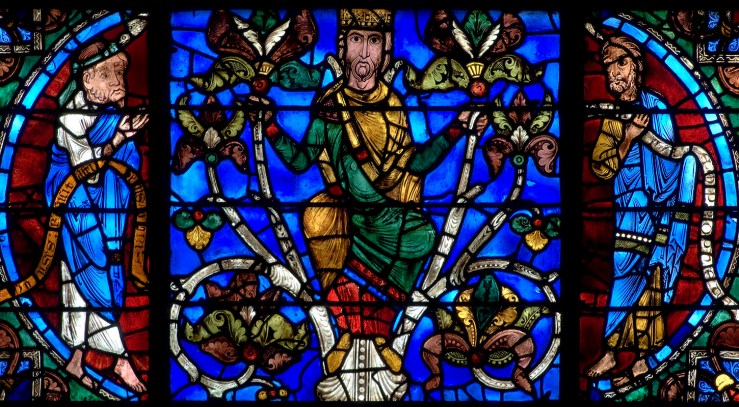
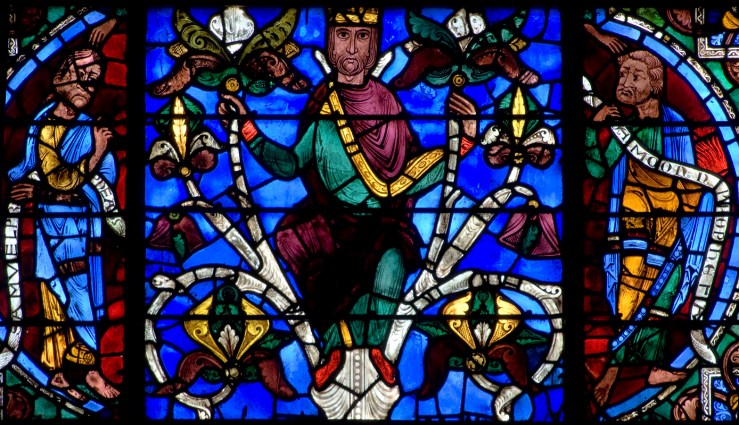
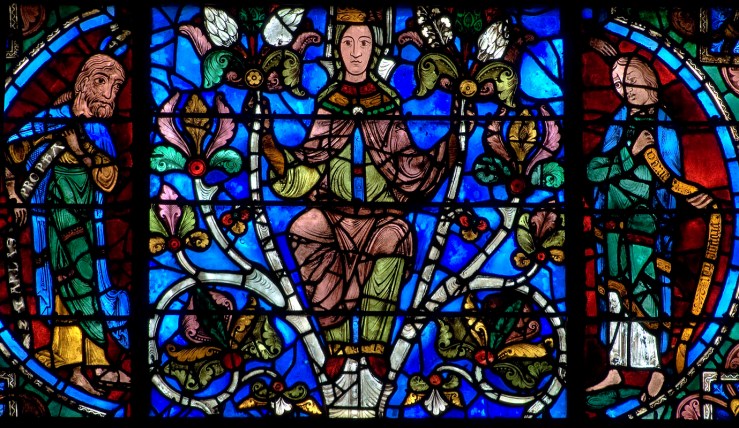
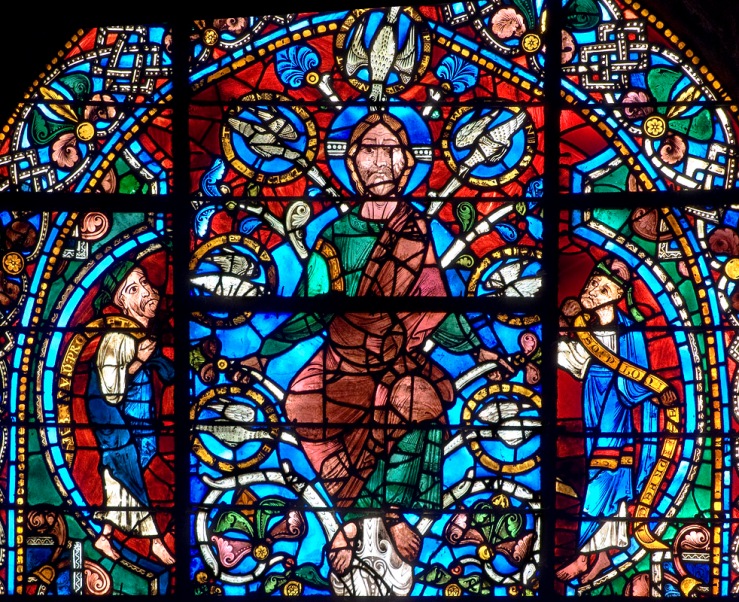
The Tree of Jesse, 12th century. Stained glass window (Bay 49), Chartres Cathedral, France. Photo: Painton Cowen.
There shall come forth a shoot from the stump of Jesse,
and a branch from his roots shall bear fruit.
And the Spirit of the Lord shall rest upon him,
the Spirit of wisdom and understanding,
the Spirit of counsel and might,
the Spirit of knowledge and the fear of the Lord.
And his delight shall be in the fear of the Lord.
He shall not judge by what his eyes see,
or decide disputes by what his ears hear,
but with righteousness he shall judge the poor,
and decide with equity for the meek of the earth;
and he shall strike the earth with the rod of his mouth,
and with the breath of his lips he shall kill the wicked.
Righteousness shall be the belt of his waist,
and faithfulness the belt of his loins.
. . .
In that day the root of Jesse, who shall stand as a signal for the peoples—of him shall the nations inquire, and his resting place shall be glorious.
—Isaiah 11:1–5, 10
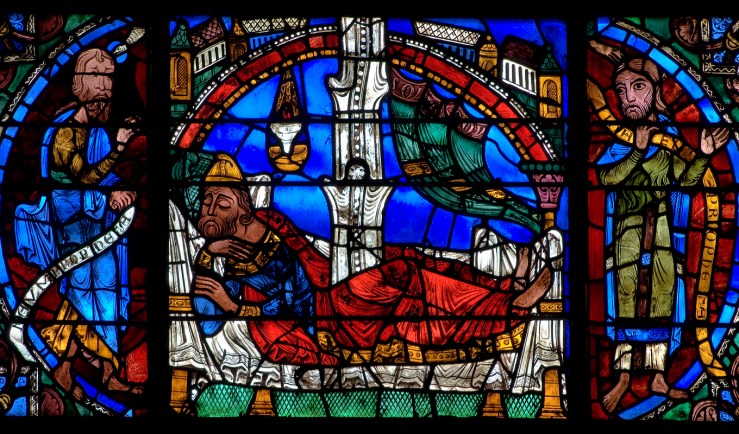
The bottom panel depicts Nahum, Jesse, and Joel. This and all the following detail photos are by Dr. Stuart Whatling.Ezekiel, David, HoseaIsaiah, Solomon, MicahMoses, generic king, BalaamSamuel, generic king, AmosZechariah, the Virgin Mary, DanielHabakkuk, Christ with the Seven Gifts of the Spirit (wisdom, understanding, counsel, fortitude, knowledge, piety, and fear of the Lord, per Isa. 11:2), Zephaniah
+++
SONG: “O Root of Jesse” | Text: Latin original from the sixth through eighth centuries, English translation from the Church of England’s Common Worship liturgy | Music by Ole Schützler (b. 1976) | Performed by the Junger Kammerchor Rhein-Neckar (Rhine-Neckar Youth Chamber Choir), under the direction of Mathias Rickert, on Advent (2014)
Latin: O Radix Jesse, qui stas in signum populorum, super quem continebunt reges os suum, quem Gentes deprecabuntur: veni ad liberandum nos, jam noli tardare.
English:
O Root of Jesse, standing as a sign among the peoples;
before you kings will shut their mouths,
to you the nations will make their prayer:
Come and deliver us, and delay no longer.
“O Radix Jesse” (O Root of Jesse) is one of the seven O Antiphons, names for Christ that are sung during Advent. (The others are O Wisdom, O Lord, O Key of David, O Dayspring, O King of Nations, and O God-with-Us.) Their precise origin is unknown, but their use in the eighth century is substantiated.
+++
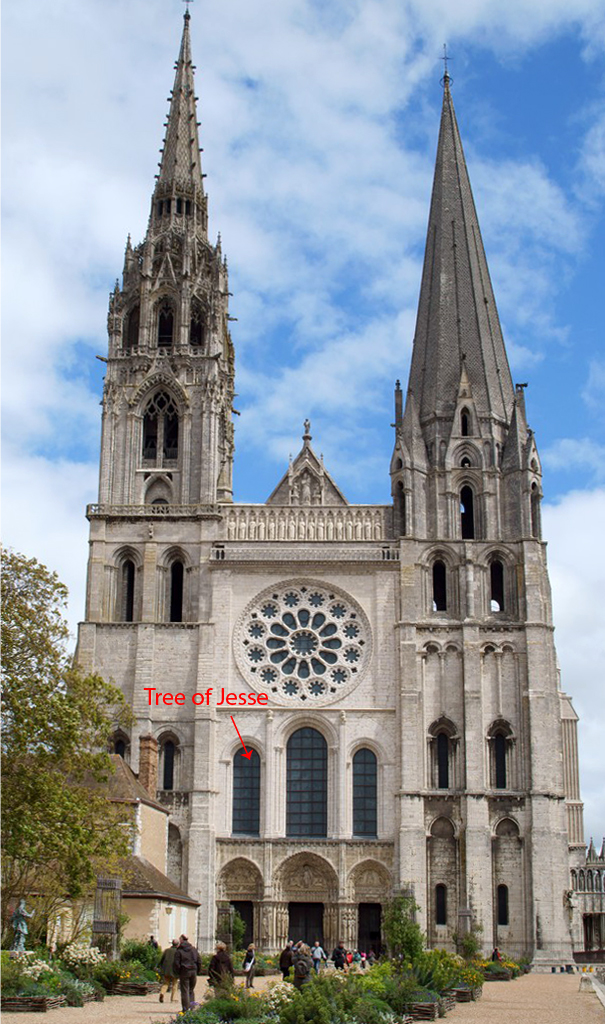
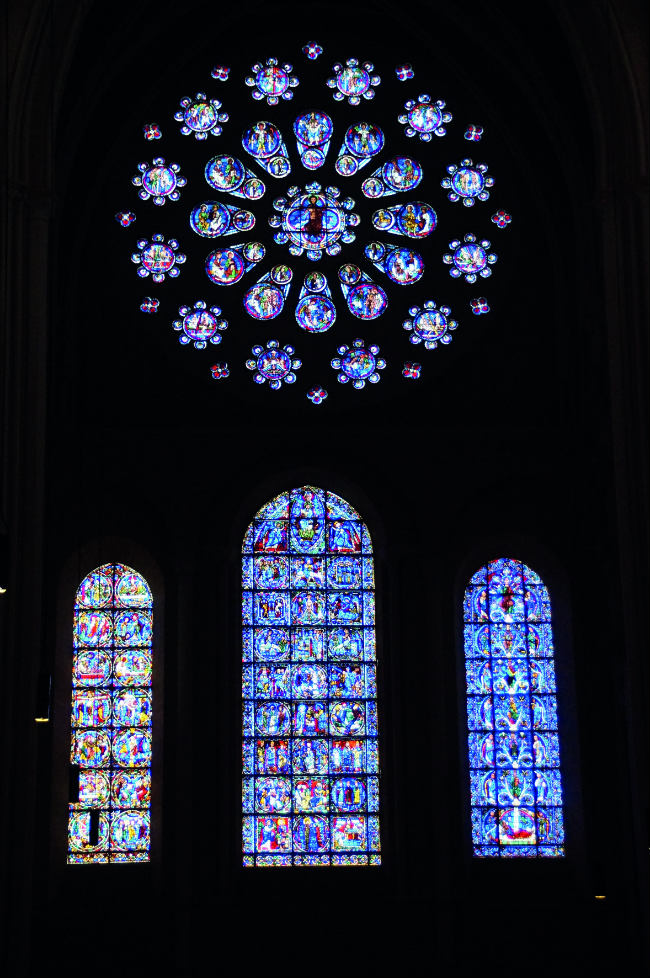
Chartres Cathedral is “the high point of French Gothic art” (UNESCO) and one of my must-sees before I die. Its portals boast many exquisite figural sculptures, and its interior is renowned for, among other things, its stained glass windows. The Tree of Jesse, showing the royal lineage of Jesus, is one of three large, rounded lancet windows at the west end—the other two depicting the Life of Christ (center) and the Passion of Christ.
This post belongs to the weekly series Artful Devotion. If you can’t view the music player in your email or RSS reader, try opening the post in your browser.
To view all the Revised Common Lectionary scripture readings for the Second Sunday of Advent, cycle A, click here.
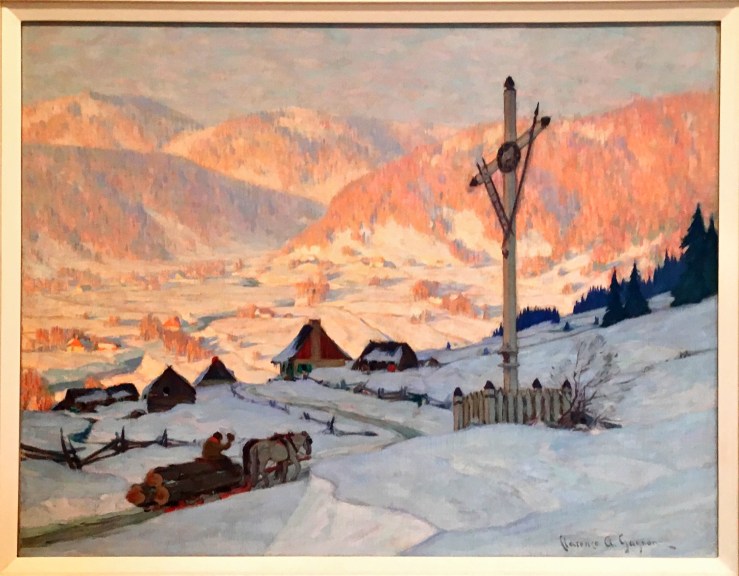
Clarence Gagnon (French Canadian, 1881–1942), The Wayside Cross, Winter, ca. 1916–17. Oil on canvas, 28 × 37 in. (71.1 × 94 cm). Art Gallery of Ontario, Canada. Photo: Jim Forest.
You know the time; it is the hour now for you to awake from sleep. For our salvation is nearer now than when we first believed; the night is advanced, the day is at hand.
This post belongs to the weekly series Artful Devotion. If you can’t view the music player in your email or RSS reader, try opening the post in your browser.
To view all the Revised Common Lectionary scripture readings for the First Sunday of Advent, cycle A, click here.
Toros Taronatsi (Armenian, 1276–ca. 1346), Tree of Jesse, 1318. Ink, pigments, and gold on parchment, 10 1/4 × 7 1/16 in. (26 × 18 cm). “Matenadaran” Mesrop Mashtots Institute of Ancient Manuscripts, Yerevan, Armenia (MS 206, fol. 258v).
“Behold, the days are coming, declares the LORD, when I will raise up for David a righteous Branch, and he shall reign as king and deal wisely, and shall execute justice and righteousness in the land. In his days Judah will be saved, and Israel will dwell securely. And this is the name by which he will be called: ‘The LORD is our righteousness.’”
—Jeremiah 23:5–6
+++
SONG: “Jesus, Name Above All Names” | Words and music by Naida Hearn, 1974 | Arranged and performed by Nick Smith, feat. Liz Vice, 2015
The song’s original lyrics are:
Jesus, name above all names
Beautiful Savior, glorious Lord
Emmanuel, God is with us
Blessed Redeemer, living Word
Jesus, loving Shepherd
Vine of the branches, Son of God
Prince of Peace, Wonderful Counselor
Lord of the universe
Light of the world
Praise him, Lord above all lords
King above all kings, God’s only Son
The Prince of Peace, who by his Spirit
Comes to live in us, Master and Friend
Smith’s arrangement uses the first verse, plus adds this bridge:
O holy Lord
Praise be to your name
O risen Son
Hear us as we sing
+++
In 1318 Esayi Nch‘ets‘i (1260/65–1338), abbot of the Monastery of Gladzor in Armenia, commissioned three scribes to copy a Bible for the monastery, and T‘oros of Taron to illuminate it. The sumptuous illumination above, showing a genealogical tree sprouting from Jesse’s reclining body, serves as the frontispiece to the book of Psalms. Jesse was the father of King David and hence an ancestor of Jesus, who is enthroned at the end of the tree’s central branch, at the top of the composition. Various prophets with their scrolls are perched on the side branches. (We’ll revisit this iconography in the second week of Advent.)
According to Sirarpie Der Nersessian, this is the first example of a Tree of Jesse found in Armenian art; the inspiration for this image is derived from Western European manuscripts, where it was portrayed as early as the mid-twelfth century. However, T‘oros has modified the traditional Western European iconography: the top of the tree normally depicts the Virgin and Child, but in this example he has placed a youthful Christ in a mandorla holding a book in his left hand and blessing with his right. In the center of the trunk is the head of David, whereas in Western European traditions he is usually represented by a bust. In addition, T‘oros added an image of Samuel anointing the young David in the lower right, a scene not usually included with the Tree of Jesse. He also depicted the prophets and other figures seated cross-legged, a posture not commonly depicted in Western European manuscripts. (119)
This post belongs to the weekly series Artful Devotion. If you can’t view the music player in your email or RSS reader, try opening the post in your browser.
To view all the Revised Common Lectionary scripture readings for Proper 29 (Reign of Christ), cycle C, click here.
Romare Bearden (American, 1912–1988), New Orleans: Ragging Home (from the Of the Blues series), 1974. Collage of plain, painted, and printed papers, with acrylic, lacquer, graphite, and marker, mounted on Masonite panel, 36 1/8 × 48 in. (91.8 × 121.9 cm). North Carolina Museum of Art, Raleigh. Photo: Victoria Emily Jones.
You will say in that day:
“I will give thanks to you, O LORD,
for though you were angry with me,
your anger turned away,
that you might comfort me.
“Behold, God is my salvation;
I will trust, and will not be afraid;
for the LORD GOD is my strength and my song,
and he has become my salvation.”
With joy you will draw water from the wells of salvation. And you will say in that day:
“Give thanks to the LORD,
call upon his name,
make known his deeds among the peoples,
proclaim that his name is exalted.
“Sing praises to the LORD, for he has done gloriously;
let this be made known in all the earth.
Shout, and sing for joy, O inhabitant of Zion,
for great in your midst is the Holy One of Israel.”
For another Artful Devotion featuring the Uptown Worship Band, see “Exalted Trinity.”
This post belongs to the weekly series Artful Devotion. If you can’t view the music player in your email or RSS reader, try opening the post in your browser.
To view all the Revised Common Lectionary scripture readings for Proper 28, cycle C, click here.
Great is the LORD, and greatly to be praised,
and his greatness is unsearchable.
One generation shall commend your works to another,
and shall declare your mighty acts.
On the glorious splendor of your majesty,
and on your wondrous works, I will meditate.
—Psalm 145:3–5
Young Harriet Tubman (born Araminta Ross) was shaped, among other things, by stories of the mighty acts of God in history, especially his bringing his people into freedom. Her parents, who were devout Methodists, and others in her Maryland slave community fired her imagination with stories of the Red Sea crossing, Pharaoh overthrown, and a land flowing with milk and honey. Harriet craved that kind of freedom for her people and, as we all know, later led many into it.
In the 1960s, Windmill Books founder Robert Kraus commissioned the famous New York artist Jacob Lawrence to paint a series of pictures on any subject in American history to serve as the basis of a new children’s book. Lawrence chose Harriet Tubman (whom he had also painted a series on in 1939–40, The Life of Harriet Tubman [previously]). After Lawrence completed seventeen new paintings, Kraus wrote rhymed verse to go along with them, and the book was published in 1968 as Harriet and the Promised Land. (It was reissued in 1993 by Simon and Schuster; Kraus’s contribution is uncredited by choice in both editions.) It was the first children’s book to be reviewed in the Art section of the New York Times. The book emphasizes Harriet’s faith in God and his provision along the Underground Railroad, and Harriet’s role as a Moses figure.
Jacob Lawrence is one of my favorite artists, and I particularly love this painting of his that shows little Harriet sitting on a rock in rapt attention as an elder woman gives a performative telling of the biblical exodus story, recounting in detail how God brought his children up out of Egypt. In this nighttime scene, abnormally large bugs creep around on leaf and ground as the North Star shines bright above, a light that beckons and that will come to guide Harriet and others in a nineteenth-century exodus. Kraus’s text for the painting reads,
Harriet, hear tell
About “The Promised Land”:
How Moses led the slaves
Over Egypt’s sand.
How Pharaoh’s heart
Was hard as stone,
How the Lord told Moses
He was not alone.
SONG: “I Love to Tell the Story” | Words by Kate Hankey, 1866; refrain by William G. Fischer, 1869 | Music by William G. Fischer, 1869 | Performed by Emmylou Harris and Robert Duvall, on The Apostle soundtrack, 1998
Arabella Katherine Hankey (1834–1911) was a contemporary of Harriet Tubman’s (ca. 1822–1913), but she grew up in a much different context, as the (white) daughter of a wealthy English banker. Her family, though, used their wealth and influence to serve others. Her father, Thomas Hankey, was a leading member of the Clapham Sect, a group of evangelical Anglican social reformers whose avid campaigning, in society and in Parliament, led to the abolition of slavery in the British Empire in 1833. Though the group was waning as Kate was growing up, social justice (alongside personal conversion) remained a key aspect of the gospel her parents taught her, which impelled her to embark on ministry to young female factory workers in London, teaching them the Bible and, I presume, advocating for better working conditions, as her father had a generation earlier.
In her early thirties, a serious illness left Kate bedridden for a year. During her convalescence she wrote a long poem in two parts that she called “The Old, Old Story,” which tells the story of redemption, from the Garden of Eden to Jesus Christ’s life, death, and resurrection to the Spirit’s outpouring, in fifty-five quatrains. “I Love to Tell the Story,” as well as her other famous hymn, “Tell Me the Old, Old, Story,” are derived from this longer work.
I like the paradox of “old” and “new” in Kate’s hymn, underscoring the enduring relevance and impact of Jesus’s self-giving. His sacrifice for sin was planned since the foundation of the world and accomplished in first-century Palestine but continues to resound anew today as it’s received into countless hearts and lives. It reminds me of Augustine’s famous exclamation to God in his Confessions: “O Beauty so ancient and so new!”
“I Love to Tell the Story” features in the 1997 movie The Apostle, starring Robert Duvall as a charismatic preacher, with many flaws, who starts a church in the Louisiana bayou. Jeffrey Overstreet writes that it “may be the most unapologetic, intimate portrayal of a religious man in the history of American cinema.” Duvall wrote, directed, and, since Hollywood wasn’t interested, produced the movie himself. He said it was important to him to show Sonny as a complex character with a genuine faith rather than as a caricature of southern Christianity.
+++
Sunday’s reading from Psalm 145 celebrates the “wondrous works” of God, told down through the ages. Whether it’s God’s work through Moses or Harriet or the Clapham abolitionists to bring people out of literal enslavement, or God’s salvation of an individual soul from the bondage of sin, these are wonders to proclaim, stories that are part of God’s story, that we should love to tell.
This post belongs to the weekly series Artful Devotion. If you can’t view the music player in your email or RSS reader, try opening the post in your browser.
To view all the Revised Common Lectionary scripture readings for Proper 27, cycle C, click here.
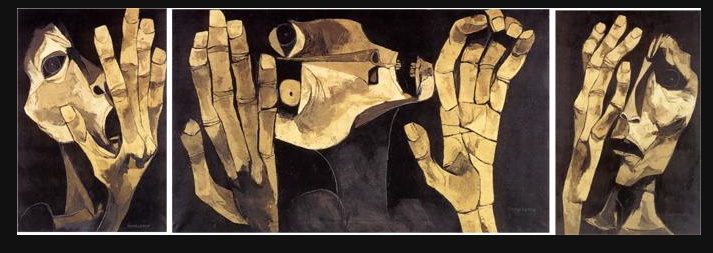
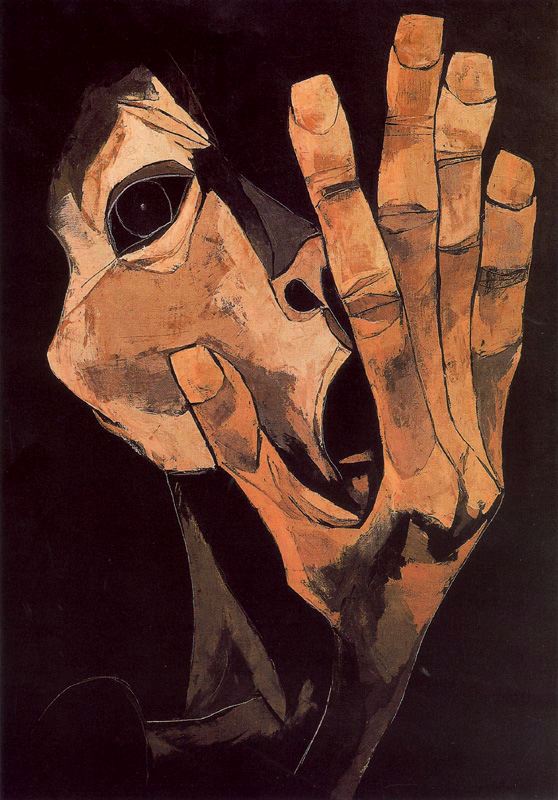
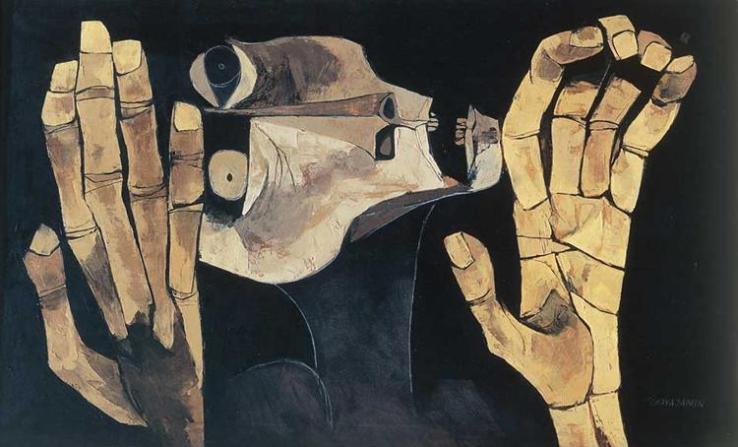
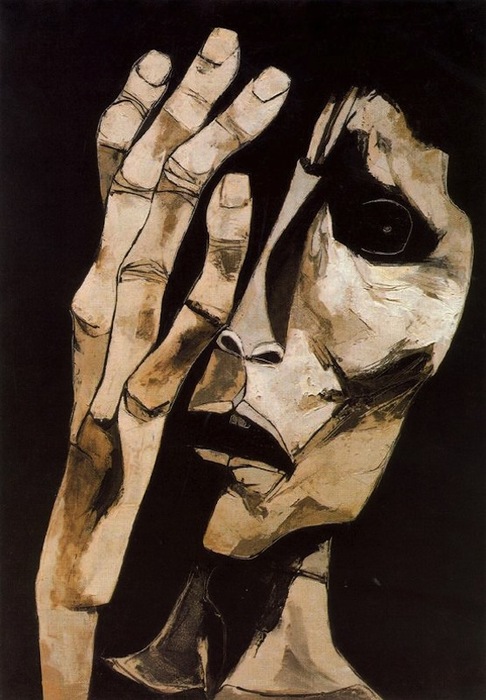
Oswaldo Guayasamín (Ecuadorian, 1919–1999), El Grito [The Cry], 1983. Oil on three canvases. Fundación Guayasamín, Quito, Ecuador.
O Lord, how long shall I cry for help,
and you will not hear?
Or cry to you “Violence!”
and you will not save?
Why do you make me see iniquity,
and why do you idly look at wrong?
Destruction and violence are before me;
strife and contention arise.
So the law is paralyzed,
and justice never goes forth.
For the wicked surround the righteous;
so justice goes forth perverted.
I haven’t really known what to say about the violence in our nation and around the world. There are specific events that I’m grieving, and then there’s just the toll of senseless violence stacked on senseless violence. I’m exhausted, and I’m not even a member of any of the affected communities. Lord have mercy. This lament just kind of poured out of me last week. How long O Lord?
Justin Ruddy is the founding pastor of Resurrection Church in East Boston, which just launched this fall. As a former minister at Citylife Boston, where I attended for five years, he has been influential in shaping my faith—especially my appreciation of liturgy and my practice of lament. When he wasn’t preaching or singing/playing music in worship, he often served as “presider” over the service, connecting together the various liturgical elements, weaving a narrative through line that illuminated the gospel for me week after week. When he spoke theology, he did so in such thoughtful and relevant ways. He also occasionally led us in responding to national or global tragedies or crises. His prayers in the wake of such events, such as the Boston Marathon bombings in 2013, have taught me a way to pray through suffering. His song “How Long, O Lord?” exemplifies his approach—a biblical one—of bringing pain, grief, anger, exasperation fully before God.
+++
A theology that has no place for lament is left only with thin, inadequate murmurings. The covenantal relationship is reduced to a mere shell, maneuvered about with smoke and mirrors rather than serious and faithful engagement. . . . A theology which takes our covenantal relationship with God seriously must then also take the laments seriously. One cannot happen without the other.
—Logan C. Jones, The Psalms of Lament and the Transformation of Sorrow
Oswaldo Guayasamín, El Grito IOswaldo Guayasamín, El Grito IIOswaldo Guyasamín, El Grito III
This post belongs to the weekly series Artful Devotion. If you can’t view the music player in your email or RSS reader, try opening the post in your browser.
To view all the Revised Common Lectionary scripture readings for Proper 26, cycle C, click here.






 Art & Theology