
Each item in a roundup represents hours of combing through and evaluating other possibilities to feature, to find that one I deem will be of most value to readers of Art & Theology. None of these spots are ever bought or coerced, but rather represent sincere recommendations on my part. If you appreciate the resources I curate, would you consider making a donation to make this continued work possible? Or buying me a book from my Amazon wish list (to support my research)? Regardless, I really appreciate you being here!
+++
SONGS:
>> Ambai Praise Medley: This summer Palmer Keen, an American ethnomusicologist based in Yogyakarta who runs the online repository Aural Archipelago, visited the Christian village of Kawipi in the Ambai Islands of Papua, Indonesia, to learn more about songgeri, a worship music tradition indigenous to that area. When he arrived, the villagers formed a welcome party to greet him at the church steps with much music making! That is what this clip is from:
Palmer writes,
Songgeri is a gospel string band tradition from the Ambai archipelago of Papua. The Ambai people, fervent Pentecostals since mass conversion in the mid-20th century, have taken the string band format popular across Melanesia . . . and embraced it as a vehicle for a unique gospel sound unlike anything else in Indonesia.
The name songgeri itself means “joy” in the Ambai language, and every bit of the music is designed to channel a particularly Pentecostal religious ecstasy: handmade lutes (four-string “ukulele” and five string “gitar”) stick to just three easy chords, while giant double bass-like stembas are turned towards the players and plucked with both hands and hand-carved wooden picks to get a thunderous sound. Musicians play a non-stop medley of “praise and worship” verses sung in Ambai and Indonesian—in one piece, “Nemunu Doana Kamia Wowong,” for example, they sing: “His house is built on coral / The gates of heaven are open / He awaits us!”
For more on the history, form, and instruments of songgeri, including additional videos, see Palmer’s recent blog post. (Shout-out to Sam Connour for alerting me to this fantastic music!)
>> “Campfire Coritos,” performed by Israel and New Breed: This corito [previously] medley features the songs “Con mis manos y mi vida” (With My Hands and My Life), “Alabaré” (Oh, Come and Sing), “Te alabarán oh Jehová” (They Will Praise You, O Jehovah), “Quién como tú” (Who Is Like You?), “Hay poder” (There Is Power), and “Ven, ven, ven, Espíritu Divino” (Come, Come, Come, Holy Spirit). The first female soloist is Israel Houghton’s wife, Adrienne Bailon-Houghton, and the second female soloist (with dark hair) is Adrienne’s sister, Claudette Bailon.
And here’s another corito medley sung by the same group:
+++
ART: 44 Plates from a Christian illuminated album, Ethiopia: When I was at the Minneapolis Institute of Art a few years ago, I saw on display three paintings on vellum from seventeenth-century Ethiopia, in the First Gondarene style, featuring Ethiopian saints and Bible stories. They are from a set of forty-four pages that were at one time sewn together and used as a prayerbook. The inscriptions are in Ge‘ez, an ancient language that originated in northern Ethiopia and is now only used in religious ceremonies.
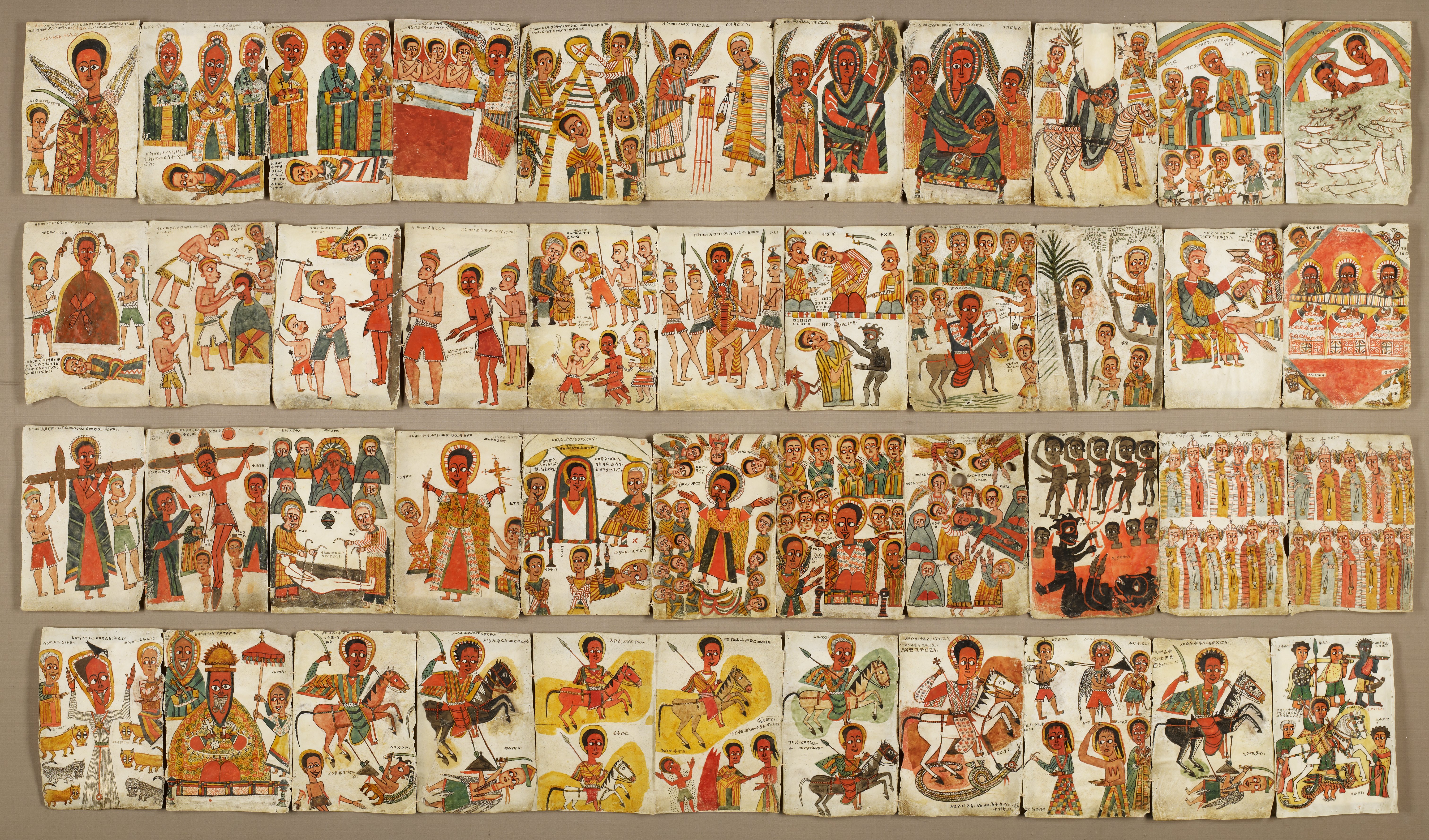
Learn more about this illuminated album through ArtStories, an interactive multimedia feature on MIA’s website that allows for in-depth exploration of select objects from the museum’s collection. On the “More” tab is a video on “Connecting with World Religions,” a photo of each individual page with accompanying descriptions, and a behind-the-scenes video with Ethiopian manuscript cataloger Getatchew Haile.
I encourage you to further peruse ArtStories, which spotlights art objects from around the world in all sorts of media, including an ancient Egyptian instrument, an Islamic prayer mat, a Somali wedding basket, an Osage friendship blanket, a snake jug that pokes fun of the Confederacy, a brass leopard-shaped water pitcher from Nigeria, a pair of folding screens from Japan, an illusionistic marble sculpture, El Greco’s Expulsion of the Money-Changers, Rembrandt’s Lucretia, one of Monet’s grain stacks, and more. The interface directs you to specific details of the work and teaches about content, context, technique, and influences.
+++
PODCAST EPISODES: The first season of the podcast Visually Sacred: Conversations on the Power of Images, hosted by Arthur Aghajanian, wrapped this summer, altogether featuring conversations with thirteen luminaries in the field of religion and the arts. These were two of my favorite episodes:
>> “William Dyrness: Protestant Aesthetics, Modernism, and Theopoetics”: Theologian William Dyrness from Fuller Theological Seminary discusses the importance of art to spirituality, and the history and theology of images in Protestantism versus Catholicism. He also shares how Christianity influenced many canonical modern artists, and introduces theopoetics, a Christian movement that seeks to broaden our understanding of orthodoxy by bridging art forms and connecting art to daily life.
>> “Natalie Carnes: Iconoclasm, Beauty, and Aesthetics”: Theologian Natalie Carnes [previously], a professor at Baylor University, discusses iconoclasm, particularly the controversy around public monuments; the ambivalence of images as mediators of the Divine (giving us access and blocking access); suffering and beauty; feminist theology; and Christian asceticism as a form of abundance.

 Art & Theology