
Blogger’s note: I’m fascinated by the history of hymns—all the creative hands they pass through (lyricists, translators, composers, harmonizers, arrangers, hymnal editors, church musicians, worship pastors, recording artists, etc.) to become what we use in our churches today. In this essay, poet, translator, and literary critic Kimberly Johnson traces in fragments the history of “All Creatures of Our God and King” [previously], interweaving that history with snippets of the authors’ biographies, musical analysis, personal confession, and observations from the time she spent in and around the hymn’s origin place of Assisi in the Umbria region of Italy.
Copyright credit: The essay “On ‘Laudes Creaturarum’ (‘All Creatures of Our God and King’): A Polyphony” by Kimberly Johnson is from Stars Shall Bend Their Voices: Poets’ Favorite Hymns and Spiritual Songs, edited by Jeffrey L. Johnson (Asheville, NC: Orison Books, 2018). It is reproduced here by permission of the publisher. I’ve added the photos for visual reference.
Laudes Creaturarum
Altissimu onnipotente bon signore
tue so le laude la gloria e l’ onore e onne benedictione.
Ad te solo altissimo se konfano
e nullu homo ene dignu te mentovare.
Laudatu si mi signore cum tucte le tue creature
spetialmente messor lu frate sole
lu quale iorno et allumini per loi.
E ellu è bellu e radiante cum grande splendore
de te altissimu porta significatione.
Laudatu si mi signore per sora luna e le stelle
in celu l’ ai formate et pretiose e belle.
Laudatu si mi signore per frate vento
e per aere e nubilo e sereno et onne tempu
per lu quale a le tue creature dai sustentamentu.
Laudatu si mi signore per sor aqua
la quale è multo utile e humele e pretiosa e casta.
Laudatu si mi signore per per frate focu
per lu quale n’ allumeni la nocte
e ellu è bello e iucundo e robusto e forte.
Laudatu si mi signore per sora nostra matre terra
la quale ne sustenta e governa
e produce diversi fructi e coloriti fiore e erba.
Laudatu si mi signore per quilli ke perdonano per lo tue amore
e sostengono infirmitate e tribulation
beati quelli ke ‘l sosterranno in pace
ke da te altissimu sirano incoronati.
Laudatu si mi signore per sora nostra morte corporale
da la quale nullu homo vivente po skappare
guai a quilli ke morranno in peccata mortale.
Beati quelli ke troverà ne le tue sanctissime voluntati
ke la morte secunda no ’l poterà far male.
Laudate e benedicete lu mi signore e rengratiate
e servite a lui cum grande humilitate. Amen.
Francis of Assisi, c. 1225
Praises of the Creatures
Highest, omnipotent, good our Lord,
yours are the praises, the glory, the honor, and all blessing.
To you alone, Most High, they are owed,
and no mortal is worthy to mention you.
Be praised, my Lord, through all your creatures,
especially through my Lord Brother Sun,
who brings the day, and you shed light through him.
And he is beautiful and radiant in his grand splendor!
Of you, Most High, he bears the likeness.
Be praised, my Lord, through Sister Moon and the stars;
in heaven you formed them, bright and precious and beautiful.
Be praised, my Lord, through Brother Wind
and through the air, cloudy and serene, and through all weathers
by which you give your creatures sustenance.
Be praised, my Lord, through Sister Water,
who is so useful and humble and precious and chaste.
Be praised, my Lord, through Brother Fire,
through whom you illuminate the night;
and he is lovely and playful and robust and strong.
Be praised, my Lord, through our Sister Mother Earth,
who sustains and governs us
and who brings forth varied fruits with vibrant flowers and herbs.
Be praised, my Lord, through those who give pardon for love of you,
and bear infirmity and tribulation;
blessed are those who persevere in peace,
for they will be, by you Most High, endowed a crown.
Be praised, my Lord, through our sister, Death-of-the-Flesh,
from whom no living mortal can escape.
Woe to those who die in mortal sin!
Blessed whom death finds abiding in your most sacred will,
for the second death shall do them no harm.
Praise and bless my Lord, and render thanks to Him,
and serve Him with great humility. Amen.
Translated from the Italian by Kimberly Johnson, 2018
All Creatures of Our God and King
All creatures of our God and King,
lift up your voice and with us sing:
Alleluia, alleluia!
O burning sun with golden beam,
and shining moon with silver gleam,
O praise Him, O praise Him,
Alleluia, alleluia, alleluia!
O rushing wind so wild and strong,
white clouds that sail in heaven along:
Alleluia, alleluia!
New rising dawn in praise rejoice;
you lights of evening find a voice,
O praise Him, O praise Him,
Alleluia, alleluia, alleluia!
Cool flowing water, pure and clear,
make music for your Lord to hear:
Alleluia, alleluia!
Fierce fire, so masterful and bright,
providing us with warmth and light,
O praise Him, O praise Him,
Alleluia, alleluia, alleluia!
Earth ever fertile, day by day,
bring forth your blessings on our way:
Alleluia, alleluia!
All flowers and fruits that in you grow,
let them his glory also show,
O praise Him, O praise Him,
Alleluia, alleluia, alleluia!
All you who are of tender heart,
forgiving others, take your part:
Alleluia, alleluia!
All you who pain and sorrow bear,
praise God and on him cast your care,
O praise Him, O praise Him,
Alleluia, alleluia, alleluia!
And thou most kind and gentle death,
waiting to hush our latest breath:
Alleluia, alleluia!
Thou leadest home the child of God,
and Christ our Lord the way hath trod.
O praise Him, O praise Him,
Alleluia, alleluia, alleluia!
Let all things their Creator bless,
and worship Him in humbleness:
Alleluia, alleluia!
Praise, praise the Father, praise the Son,
and praise the Spirit, Three in One!
O praise Him, O praise Him,
Alleluia, alleluia, alleluia!
Translated from the Italian by William Henry Draper, 1919
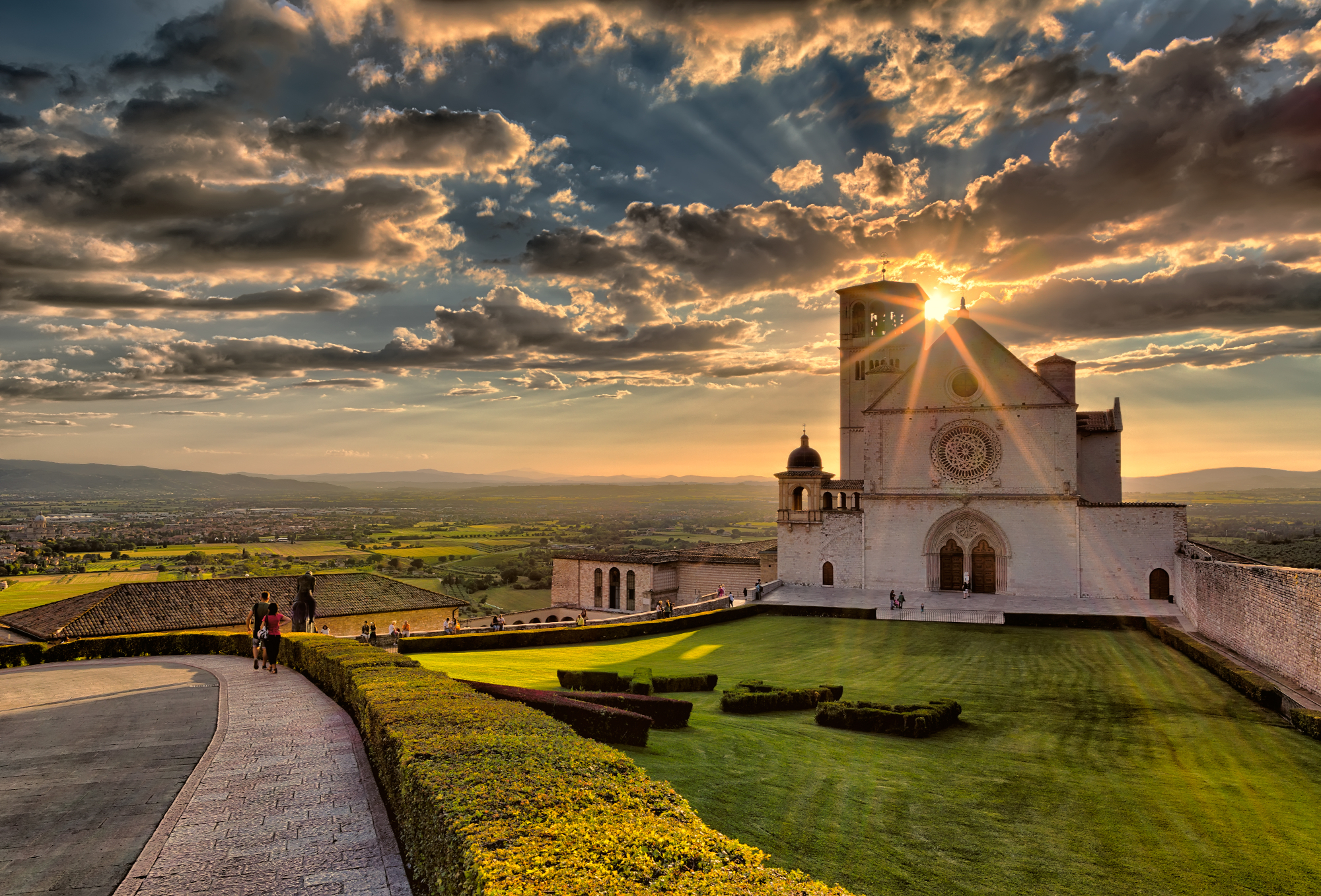
In Assisi, the sky vaults clouded and serene against the foothills.
*
Pietro, known as Francesco, devoted brother of his order, put quill to thirteenth-century parchment and began to praise. His inspiration was Psalm 148, whose Hebrew exhortations spur the sun and moon, the stars and highest heavens, tempests and mountains and wingèd birds to sing their Lord’s splendid name. Barchu and Hallelu.
*
In the trees that ring the great cathedral at Assisi, birds trill an antiphon in the innumerable dialects of their collected species.
*
“Laudatu si mi signore per sora nostra morte corporale,” Francis wrote in his backwater dialect, “da la quale nullu homo vivente po skappare.” Be praised, my Lord, through our sister, Death-of-the-Flesh, from whom no living mortal can escape.
*
William Henry Draper lost his first wife in childbirth. He lost his second wife in her youth. He lost three sons in World War I and a daughter in her childhood.
*
In Francesco’s hymn, the psalm’s call to worship forges familial bonds, each voice enfolded into the household: My Lord Brother Sun. Sister Moon and Sister Water, Brother Fire and Brother Wind.
*
Twice widowed, four times unfathered, William Henry Draper served as rector of the parish church in Leeds, where, in 1919, he translated a centuries-old poem by an Umbrian monk for a Whitsunday children’s concert.
*
On Whitsunday, the Assisi cathedral is afire with cloven tongues, pilgrims murmuring a babel of prayer.
*
Thou rushing wind that art so strong
*
At the wind of the day I walked the fortress wall on Assisi’s hilltop as the houselights came on below. “A mighty fortress is our God,” another word-dazzled monk would write three centuries after Francesco threw open the enclosures of monastic care to the lazar-house, the beggars, the birds.
*
At a piazza dinner in the hilltop town of Perugia, against which the young soldier Pietro called Francesco marched impenitent and won a year in prison for his pains, I overhear a tourist family at the next table. In New Jersey cadence, the mother suggests a next day’s trip to the basilica in Assisi. She sells it: “It’s where St. Francis is from.” Her son whines, “Who’s St. Francis?” The mother pauses. The pavement birds are belled into the evening sky. “He’s this really famous Franciscan monk.”
*
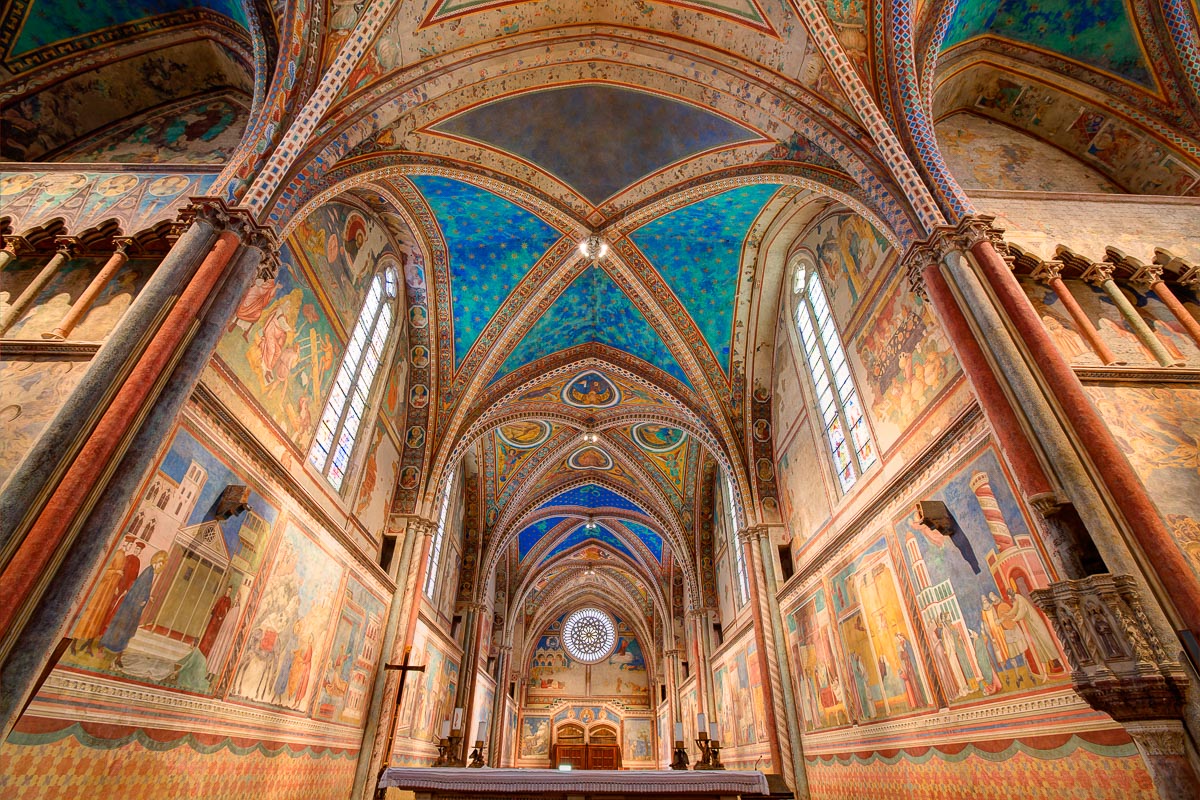
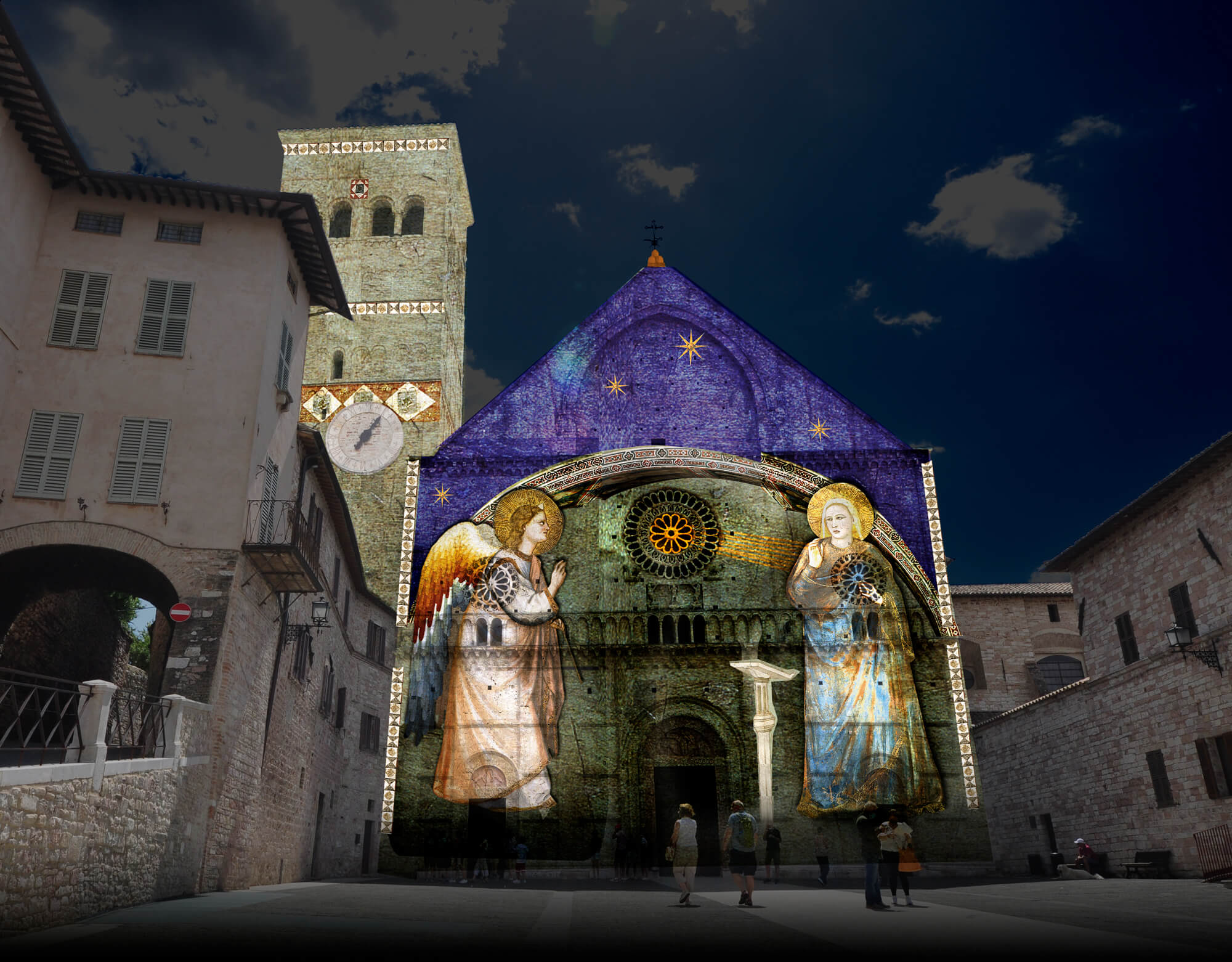
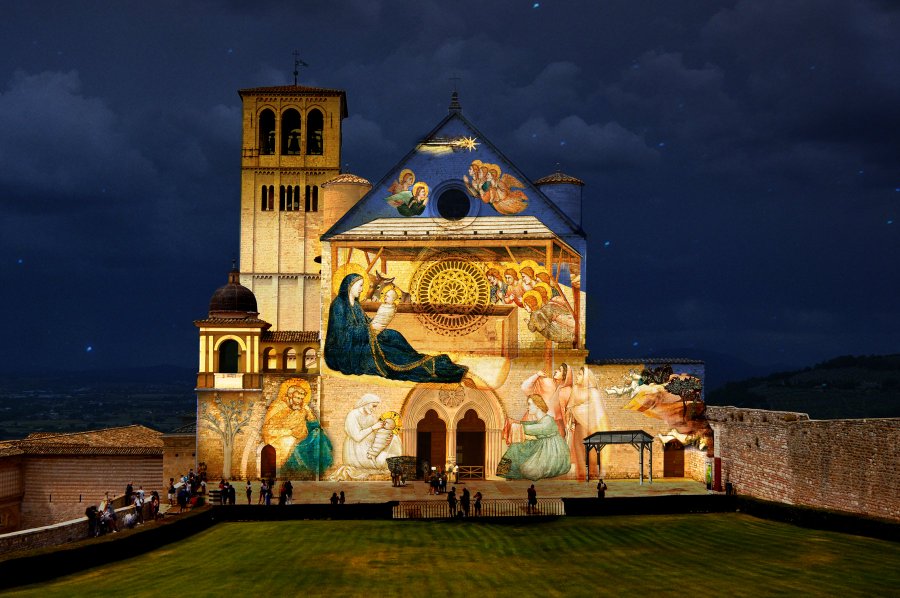
In the basilica, the nave vaults with sky, a gloaming blue clouded with verdant green. Gold stars fan out like finches. Like gilt notes on an ethereal staff.
*
Ralph Vaughan Williams, son of a vicar, took up an old German tune, “Lasst uns Erfreuen” (“Let Us Rejoice”), harmonizing his Anglican to that melody’s spare Jesuit. And how hear we every man in our own tongue, wherein we were born?
*
It’s not the repeated alleluia. It’s not the catalogue of earthy beauty. It’s not the open-throated Ptolemaic chime. What undoes me is the single minor chord.
*
Undone. Unfathered. Lazar-house. Lost. Tempest. Prison. Babel. Evening. “Sora nostra morte corporale.”
*
The minor chord: unheard in the tune’s Teutonic plainchants, unheard before Vaughan Williams’s harmonies. It falls at the end of the penultimate line of each verse—in some versions of Draper’s English text, the minored syllable is Him, and in some it is Jah; either way, God takes the fall.
*
Vaughan Williams’s minor chord is the musical cognate of Francesco’s steadfast praise in and through the death of the flesh: a gut punch that refuses to be redeemed by the next line’s joy.
*
Confiteor: The next line’s return to D major requires a resolve that, many days, I don’t have.
*
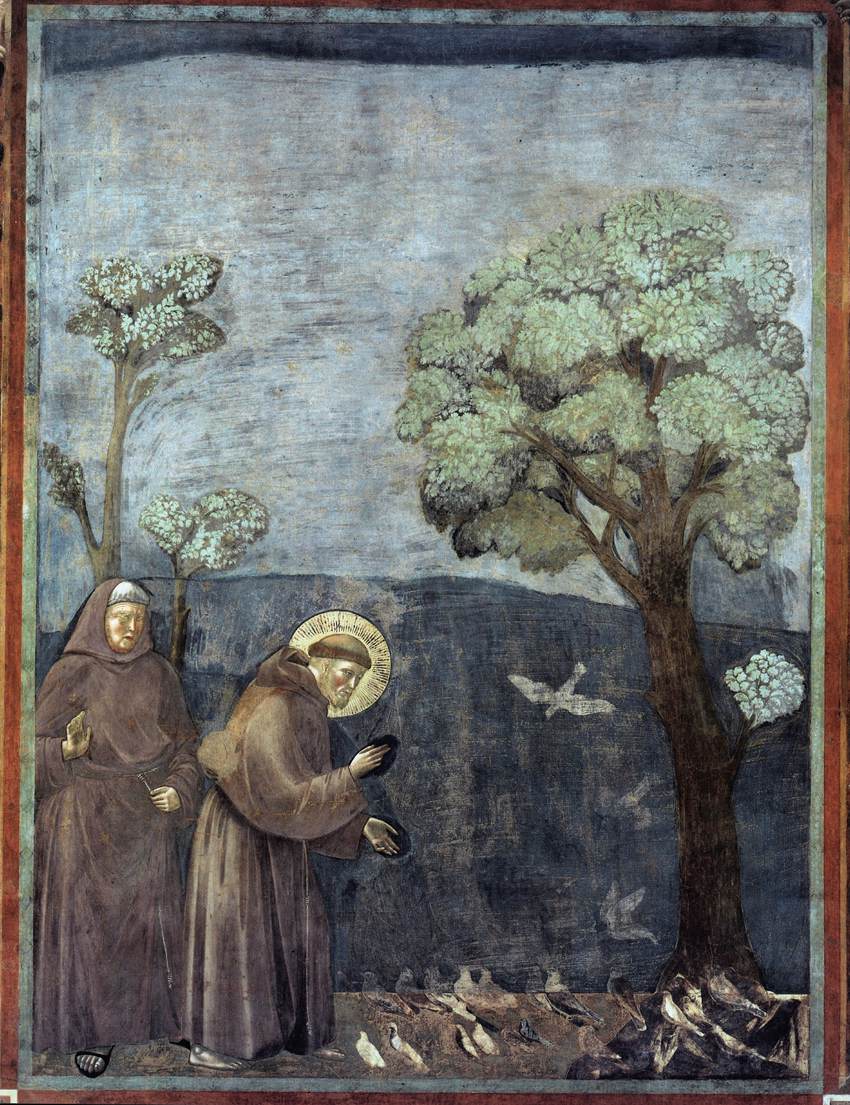
In the Upper Church in Assisi, the fresco cycle attributed (probably wrongly) to Giotto includes San Francesco d’Assisi predica agli uccelli. There are doves, of course, in the saint’s congregation. There is a woodcock, I think. A robin. They will not fly until his sermon is finished. Until he follows the downpour with worms.
*
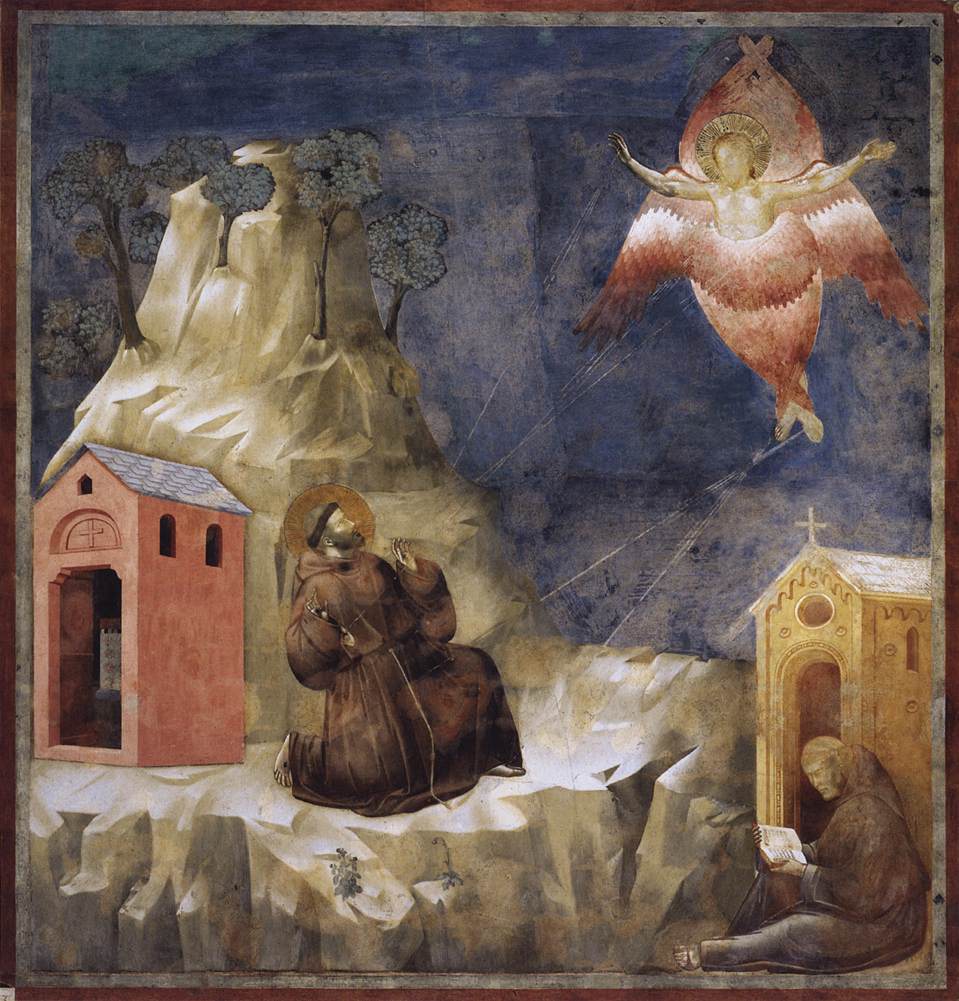
Nearby, another fresco shows Francis struck with stigmata; each wound an asterisk, a caveat. A flurry of wings above his head.
*
You lights of evening
*
At the altar in Assisi, my vespers are belled into the vault, where they flock and cloud.
*
Outside, rain. The birds tangle among the leaves, sustain their refractory antiphon. All with one accord in one place.
*
“perdonano per lo tue amore / infirmitate e tribulatione”
*
Pardon and love, weakness and wrack. Blame and whine, and worms and no escape. O praise Him.
*
A creaturely hymn for us creatures: Pietro called Francesco, faux Giotto, bereft William, Ralph, the variant birds, and myself. Each of us cloven by major and minor, each our own Pentecost.
 Art & Theology