
Roundup: “Beauty Is Oxygen,” SparkShorts, and more

SPOTIFY PLAYLIST: August 2024 (Art & Theology): An assortment of psalms, hymns, and spiritual songs, old and new.

+++

OBITUARIES:

>> Jürgen Moltmann (1926–2024): Jürgen Moltmann, one of the leading Christian theologians of the twentieth century, died June 3 at age ninety-eight. His conversion to Christianity began while he was a German soldier in a POW camp in Belgium during World War II, and he afterward spent most of his career as a theology professor at the University of Tübingen, confronting the theological implications of Auschwitz, among other topics. The pastors of the first church I joined as an adult were deeply influenced by Moltmann (and his protégé Miroslav Volf), so I have been shaped by his theology, especially in the areas of theodicy (which he binds inextricably to Christology) and eschatology.

Moltmann challenged the classical doctrine of divine impassibility, which says God does not feel pain or have emotions, in his seminal book The Crucified God (1974), articulating how God the Father, not just God the Son, is a being who feels and is moved and who also suffered on Good Friday; understanding this, he says, is key to understanding how God relates to the suffering of the world. In Theology of Hope (1964), Moltmann tackled eschatology, which he defines not as the theology of last things but as the theology of hope; not of the end of time but of the fullness of time toward which God is moving all creation, even now. The gospel, he says, must be taken as good news not just of a past event (the birth, life, death, and resurrection of Jesus Christ) but also of a promised future, with vast implications for the present.

>> Bernice Johnson Reagon (1942–2024): Bernice Johnson Reagon [previously], a civil rights activist who cofounded The Freedom Singers and later started the African American vocal ensemble Sweet Honey in the Rock, died July 16 at age eighty-one. I’m so inspired by her Christian witness through nonviolent resistance and music—her songs are on regular rotation in my house.

+++

PODCAST EPISODES:

>> “Beauty Is Oxygen with Wesley Vander Lugt,” Maybe I’m Amazed, June 21, 2024: Dr. James Howell speaks with Dr. Wes Vander Lugt—a pastor, theologian, writer, educator, Kinship Plot cofounder, and director of the Leighton Ford Center for Theology, the Arts, and Gospel Witness at Gordon-Conwell Theological Seminary in Charlotte—about his new book, Beauty Is Oxygen: Finding a Faith That Breathes.

Beauty isn’t necessarily pretty, pleasant, soothing, Vander Lugt says. Beauty is whatever makes our being gasp a little—whether in delight, or in terrified awe. Beauty demands attention. It also dislodges us from the center of the story, Vander Lugt continues—it unselfs us, in a way, curving us outward. It can be present in what’s torn. (“God goes belonging to every riven thing,” as the poet Christian Wiman puts it.)

I was struck by a remark that Howell, the host, who is a pastor, made near the beginning of the conversation: he said preachers should be less like an instructor imparting moral lessons and more like a docent at an art museum who points out the beauty of the paintings, drawing people’s eyes to its various aspects. What a compelling way to frame the ministry of preaching!

>> Malcolm Guite on Poetry and the Imagination, The Habit: Conversations with Writers about Writing (Rabbit Room), May 7, 2020: In the eleventh poem of his “Station Island” cycle, Seamus Heaney writes about “the need and chance // To salvage everything, to re-envisage / The zenith and glimpsed jewels of any gift / Mistakenly abased.” In this podcast episode, poet-priest Malcolm Guite [previously] talks with host Jonathan Rogers about the “salvaging of the mistakenly abased gift of imagination.” Imagination, Guite says, is as much a truth-bearing faculty as reason; in order to know things well, wemust engage the imagination. It’s not about a private, subjective world or inward fantasies devised to compensate for the cruelty of the world; it’s about truly seeing.


One of the gifts mistakenly abased by our culture for about the last two or three hundred years is the gift of the imagination. We’ve sidelined it so it’s only about the subjective, [whereas] out there is the objective world of dry, rational facts. And we’ve abased that gift of intuitively knowing the truth and value of things and expressing that in warm and poetic imagery, rather than simply reducing everything to a set of tiny particles or mathematical formulae.

—Malcolm Guite


The Romantic poets, for example, Guite says, “aimed at awakening the mind’s attention, removing the film of familiarity and restoring to us that vision of the freshness and depth of nature for which we have eyes that see not, ears that hear not, and hearts that neither feel nor understand. So they weren’t trying to make stuff up. They were trying to take away this film which [Samuel Taylor Coleridge] says our selfishness and solicitousness have cast over the world, and unveil a deeper but equally real truth about nature which is more than just the surfaces we see.”

Also in this conversation, Guite reveals the poet who made him want to be a poet, the poem that prompted his reconversion to Christianity, what we lost when poetry changed from oral to written, and why he writes poetry in meter.

+++

SHORT FILM SERIES: SparkShorts, produced by Pixar, streaming on Disney+: Did you know Pixar Animation Studios launched an experimental shorts initiative in 2017, giving employees the opportunity, through funding and resourcing, to flex their creative muscles with a great measure of freedom? “The SparkShorts program is designed to discover new storytellers, explore new storytelling techniques, and experiment with new production workflows,” says Pixar President Jim Morris. “These films are unlike anything we’ve ever done at Pixar, providing an opportunity to unlock the potential of individual artists and their inventive filmmaking approaches on a smaller scale than our normal fare.”

Eleven SparkShorts have been released since 2019, all streaming on Disney+. Here are my favorites:

>> Self, dir. Searit Kahsay Huluf: Released February 2, 2024, this stop-motion–CGI hybrid is about a woman who self-sabotages to belong. Writer-director Searit Kahsay Huluf says it was inspired by her family story: her mother immigrated to the US from Ethiopia to escape a civil war and had to learn how to assimilate without losing herself, and as a second-generation African immigrant growing up in Los Angeles, she herself wrestled with identity issues. The way in which Huluf tells the story is beautiful, clever, and kind of dark! Notice the differentiation of textures and sound between the wood of the main character (portrayed by a puppet) and the metal of the “Goldies.”

Self SparkShort

>> Float, dir. Bobby Rubio: A father discovers his infant son has a unique characteristic that differentiates him from others and then tries to hide him to avoid judgment—but when doing so visibly deflates his son’s spirit, he vulnerably releases him out into the world to be who he is. Writer-director Bobby Rubio created Float for his son, Alex, who is on the autism spectrum. As a dad, Rubio initially struggled with the diagnosis, and this is his story of learning to embrace the beauty of it. It’s one of the few portrayals of a Filipino American family on film, and a warmhearted celebration of neurodivergence—or any other type of divergence.

Float SparkShort

>> Nona, dir. Louis Gonzales: Nona is looking forward to a day to herself to just chill in front of the TV, watching her favorite show, E.W.W. Smashdown Wrestling. But when her five-year-old granddaughter is unexpectedly dropped off, she has to adapt her plans—begrudgingly at first. Writer-director Louis Gonzales says Nona is based on his own grandma, with whom he shared a love of wrestling. I appreciate how the film addresses dealing with disruptions to a cherished routine; it’s honest about the frustration (even if the disrupter is someone you love dearly!) while also showing how a gracious, go-with-the-flow attitude can unlock surprising new joys. What a fitting watch for the current season of Ordinary Time!
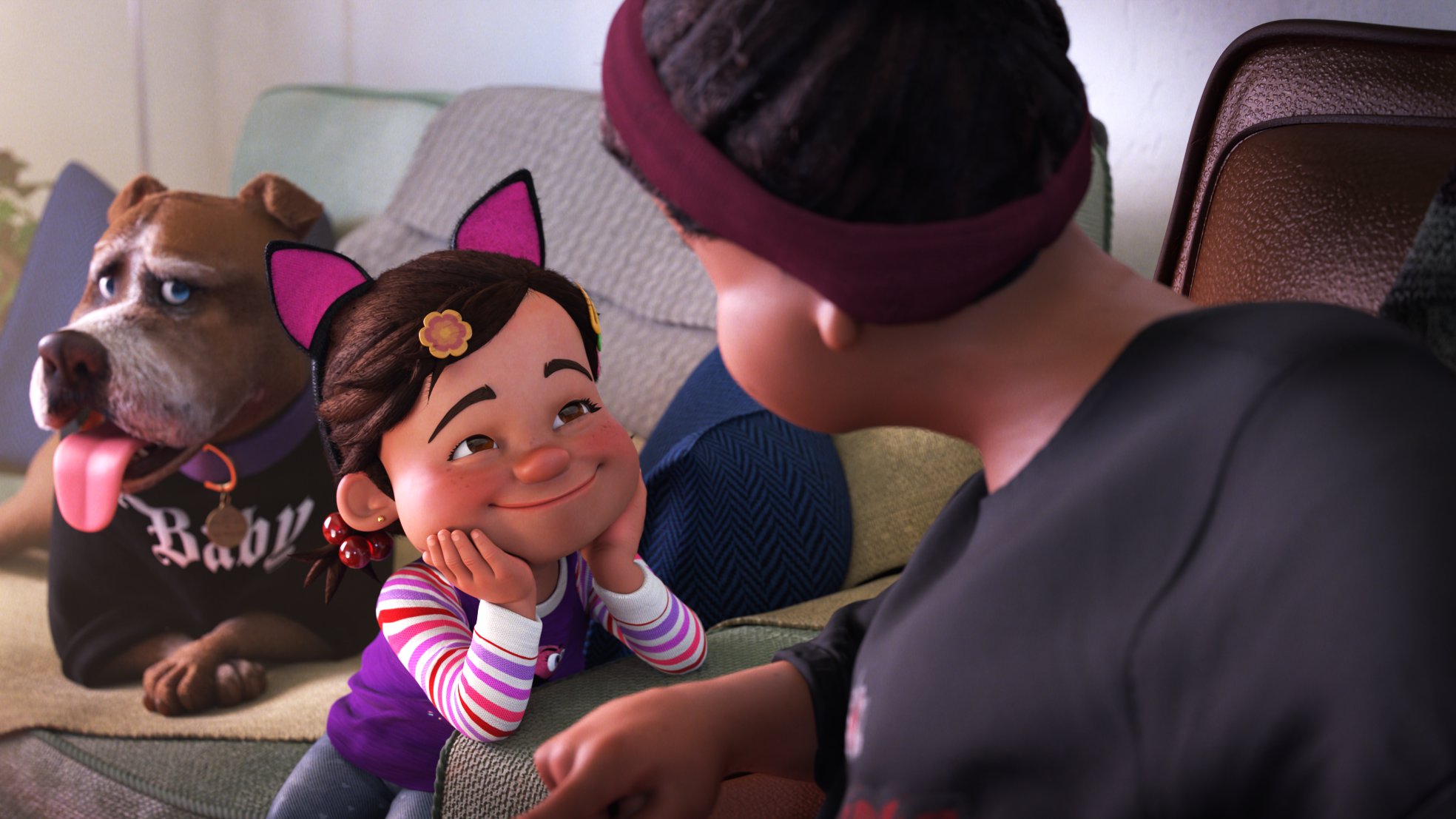

Nona SparkShort

Favorite Films of 2022, Part 2

Read part 1 here.

11. After Yang, dir. Kogonada. Set in the near future, After Yang is a patiently minimalist, transcendent film about learning to treasure those moments of mundane beauty that make up our lives. When Jake (Colin Farrell) and Kyra (Jodie Turner-Smith) adopt their daughter Mika (Malea Emma Tjandrawidjaja) from China, they purchase a preowned “technosapien,” a humanoid robot, named Yang (Justin H. Ming) to educate her about her cultural roots and to be an older sibling to her. But one day Yang malfunctions and shuts down, and Mika is devastated.

When Yang is opened up at the repair shop to be diagnosed, Jake discovers Yang’s memory bank, where Yang stored all the memories he thought important. He unlocks it. By viewing the world, especially his family life, as processed by Yang, Jake realizes he has failed to engage meaningfully with the small daily gifts he has been given. He also becomes aware of more of Yang’s history—of his previous families and loves.

Streaming on Showtime.

12. Petite Maman, dir. Céline Sciamma. In this poignant French drama, eight-year-old Nelly (Joséphine Sanz) accompanies her parents (Nina Meurisse and Stéphane Varupenne) on a trip to clear out her mother’s childhood home following her grandmother’s death. As she explores the nearby woods, she meets a neighbor girl her own age (Gabrielle Sanz), and the two strike up a bond. There’s a fantasy element I won’t reveal—it’s better to let the movie unfold it for you—but suffice it to say, I love the imaginative way that writer-director Céline Sciamma tells this mother-daughter tale of grief and loss.

Streaming on Hulu.

13. The Wonder, dir. Sebastián Lelio. Inspired by the nineteenth-century phenomenon of the “fasting girls” and based on Emma Donoghue’s celebrated novel of the same name, this psychological drama is set in a rural Irish Catholic community in 1862. Eleven-year-old Anna O’Donnell (Kíla Lord Cassidy) has allegedly not eaten anything for four months but has been miraculously sustained by “manna from heaven.” As pilgrims begin flocking to witness the miracle and rumors swirl about possible sainthood, a council of local dignitaries initiates an investigation to determine whether Anna’s survival without food is indeed a holy feat, or a hoax perpetrated by Anna and her family.

The council hires Lib Wright (Florence Pugh)—a scientifically minded English nurse—and a nun to independently observe Anna over two weeks in alternating eight-hour shifts and to report back. Lib grows increasingly concerned for Anna’s health and safety, and when Anna reveals to her the reason for her fast, she knows she must act drastically.

Streaming on Netflix.

14. Apollo 10½: A Space Age Adventure, dir. Richard Linklater. Apollo 10½ is writer-director Richard Linklater’s nostalgic homage to growing up in a Houston suburb in the 1960s, the youngest of six. This was during the Space Race, and Linklater uses that context to interweave real childhood memories with his childhood fantasy of being an astronaut. So in a tongue-in-cheek revision of history, he has NASA recruit fourth-grader Stan (Milo Coy) to fly a secret mission to the moon to test out a landing module shortly before Apollo 11 goes up. The film uses an animation technique known as rotoscoping, which layers animation over live performances.

While I can appreciate the blend of dream and reality, I was much more interested in the real-life portions of the movie, which are substantial, than the revisionist space stuff. Playing kickball on the school blacktop, getting disciplined, eating Frito pies at the pool, watching cheesy TV shows with family, listening to the Monkees and the Archies and the 5th Dimension, riding to the beach in the bed of a pickup truck, braving the Black Dragon at AstroWorld, fighting Roman candle wars in the backyard on New Year’s Eve, competing in Little League, stealing plywood from home construction sites with his cheapskate father, listening to Grandma’s conspiracy theories—ordinary memories like these are narrated with such fondness by adult Stan (voiced by Jack Black) and so meticulously rendered, and it’s here where the movie really shines. If you like The Wonder Years, you’ll like this.

Streaming on Netflix.

15. Decision to Leave, dir. Park Chan-wook. A slow-burn crime drama with a heavy dose of romance, this film follows the married police detective Hae-joon (Park Hae-il), who, when investigating the death of a mountain-climber, becomes infatuated with the prime murder suspect, the climber’s widow, Seo-rae (Wei Tang). In an interview, the director said his goal was “to make a love story that does not say the words, ‘I love you.’” The film is all about what’s not said, what’s observed. For much of the movie we question whether Seo-rae is manipulating Hae-joon or is actually falling for him too.

I have to admit, I didn’t like either of the characters; I struggled to understand them or to be invested in their “love” story, which to me seems more like simply lust or intrigue. Seo-rae’s inscrutability is, I think, part of the point; she is a mystery to be solved, as much as the murders happening around her. And attraction is rarely rational, I suppose. (But c’mon, Hae-joon, you’ve got a loving wife back home!) Despite my failure to connect with it on all levels, this is a beautifully shot, craftily edited, engrossing film with a sustained, understated sensuality that is to be commended.

Streaming on MUBI.

16. God’s Creatures, dir. Saela Davis and Anna Rose Holmer. Aileen (Emily Watson) works as a shift manager at a seafood processing plant, alongside most of the other local women, in a remote Irish fishing village. When one of her coworkers, Sarah (Aisling Franciosi), files a rape claim against her son, Brian (Paul Mescal), Aileen fabricates an alibi to protect him. Is she incredulous that he could be capable of sexual assault, or is her denial more sinister? Atmospheric and tense, the film centers on Aileen’s psychological grappling with the limits of maternal love and her duty to what’s right and just.

17. Elvis, dir. Baz Luhrmann. Frenetic and flashy, this music biopic traces the meteoric rise and fall of rock and roll’s biggest legend, Elvis Presley (Austin Butler). The story is narrated by Elvis’s exploitative manager, Colonel Tom Parker (Tom Hanks), and examines their complex, twenty-plus-year relationship. Butler is amazing in the role, embodying Elvis’s energy and sex appeal while also showing his emotional vulnerability.

I appreciate how the movie shows the influence of Black artists on Elvis’s music, even dispelling the myth that he was the founder of rock and roll—a credit that he himself, in multiple interviews, rejected, instead crediting his Black predecessors. Elvis grew up in a Black neighborhood in Tupelo, Mississippi, and when he moved to Memphis as a teenager, he frequented Beale Street, a hub of African American culture. From these environments he absorbed the sounds of Pentecostal gospel and rhythm and blues.

Elvis features stunning performances by historical Black characters. An early scene intercuts bluesman Arthur Crudup (Gary Clark Jr.) performing his original song “That’s All Right” in a juke joint—which would become Elvis’s first single—with “I’ll Fly Away” sung by a Black congregation at a tent revival; preteen Elvis observes one through a hole in the wall and participates, Spirit-caught, in the other. As a young aspiring recording artist, prior to mounting the Louisiana Hayride stage, his first big premiere, he pumps himself up by singing “I’ll Fly Away.”

Later, Elvis hears Big Mama Thornton (Shonka Dukureh) perform the raunchy “Hound Dog” (written for her by a Jewish songwriting duo, Jerry Leiber and Mike Stoller) in a bar on Beale Street, which is then sampled and interpolated in a song by Doja Cat commissioned for the movie. At Club Handy, Elvis hangs out with his friend B.B. King (Kelvin Harrison Jr.) and is blown away by the vitality and genius of the young Little Richard (Alton Mason), who performs his original and then-unknown “Tutti Frutti” for the crowd; the conversation Elvis has about it with King, and what King says and doesn’t say, speaks volumes. As people shuffle out for the night, the pioneering rock singer-guitarist Sister Rosetta Tharpe (Yola) sings “Working on the Building” and “Strange Things Happening Every Day.”

All these and more were part of Elvis’s music education. They came before. His use of Black source material has always been controversial, deemed “cultural appropriation” (i.e., theft) by some. He profited greatly from the creative contributions of Black women and men, many of whom failed to attain proper recognition and compensation for their work. They lacked the platform and the acceptance across racial lines, whereas Elvis’s whiteness opened doors for him. And so he brought rock and roll—developed in Black churches, juke joints, streets, and nightclubs—to the masses. For sure, he added his own stamp, synthesized it with other influences, and was a majorly talented performer in his own right. Elvis celebrates the title character’s inventiveness but also recognizes his indebtedness to Black musicians. It’s not a central concern of the movie, but it is present. More central is, as one might expect of the genre, the toll of fame.

Streaming on HBO Max.

18. Nope, dir. Jordan Peele. In this neo-western sci-fi thriller, OJ (Daniel Kaluuya) and his sister, Em (Keke Palmer), own a family ranch in California, where they train and handle horses for television and film productions. But their business is struggling, and to keep it afloat they sell some horses to Jupe (Steven Yeun), a former child actor who operates a nearby theme park that capitalizes on his surviving an infamous violent attack on the set of a nineties sitcom. (Best opening scene of the year?) Then their ranch becomes a site of abduction—a UFO takes some of their horses. They attempt to capture video evidence with the help of tech salesman Angel Torres (Brandon Perea) and documentarian Antlers Holst (Michael Wincott). The film’s epigraph is a quotation of Nahum 3:6, a pronouncement of divine judgment: “I will cast abominable filth upon you, make you vile, and make you a spectacle.”

Nope is not as concise as Peele’s other two films, Get Out and Us; I couldn’t follow all the threads. But surely a major thread is an indictment of our voracious need for spectacle. Another is the traumas that the film industry can inflict on people. Another, or maybe a subset of the previous, is the erasure of Black cowboys from our stories of the American West. Nope pokes and prods at these issues and raises questions rather than providing answers. For example, there’s a tension here between the magic of spectacle and its insidiousness. Peele participates in what he condemns. As film critic Thomas Flight articulates, “Nope is a spectacular horror film about the danger of spectacle. It’s a big-budget Hollywood film that critiques the Hollywood industry. It’s not a movie that can draw a clear resolution to those dualities. Instead, it’s a film that explores the queasiness that arises when we’re not sure if something’s good or bad but we find ourselves in the midst of it.”

Entertaining; suspenseful; riveting sound design by Johnnie Burn; and an infectious performance by Palmer as the charismatic Emerald, her live-wire personality a perfect foil to the taciturn OJ’s.

19. Cha Cha Real Smooth, dir. Cooper Raiff. Andrew (Cooper Raiff), a Gen Zer, is a recent college grad who lives with his mom, stepdad, and younger brother and works as a party starter at bar mitzvahs. At one he meets Domino (Dakota Johnson) and her daughter, Lola (Vanessa Burghardt), who has autism, and strikes up a friendship. This movie is sweet and maybe slight, and it takes a few missteps, but I enjoyed it a lot.

I find Raiff’s onscreen persona—essentially the same one he adopted in his debut feature, which I also really liked—charming, though I know others find it insufferable! Andrew is vulnerable, quippy, awkward, real. He loves his mom. He cries openly. He lacks direction. He seeks connection. He’s trying to figure life out, and growth comes slowly. He’s someone I recognize and have empathy for.

Streaming on Apple TV+.

20. Causeway, dir. Lila Neugebauer. This quiet drama follows the physical and emotional recovery of Lynsey (Jennifer Lawrence), a US military veteran who returns home to New Orleans after suffering a traumatic brain injury serving in Afghanistan. In the process, she develops a friendship with her auto mechanic, James (Brian Tyree Henry), who bears his own wounds from a tragic event—some visible, some not. The two help each other work through the lingering effects of their traumas and move closer to wholeness. Their gentle, easy vibe with one another is really beautiful to witness.

Streaming on Apple TV+.

HONORABLE MENTIONS: Sr.; Hustle; Marcel the Shell with Shoes On; The Sea Beast