Roundup: “Beauty Is Oxygen,” SparkShorts, and more

SPOTIFY PLAYLIST: August 2024 (Art & Theology): An assortment of psalms, hymns, and spiritual songs, old and new.

+++

OBITUARIES:

>> Jürgen Moltmann (1926–2024): Jürgen Moltmann, one of the leading Christian theologians of the twentieth century, died June 3 at age ninety-eight. His conversion to Christianity began while he was a German soldier in a POW camp in Belgium during World War II, and he afterward spent most of his career as a theology professor at the University of Tübingen, confronting the theological implications of Auschwitz, among other topics. The pastors of the first church I joined as an adult were deeply influenced by Moltmann (and his protégé Miroslav Volf), so I have been shaped by his theology, especially in the areas of theodicy (which he binds inextricably to Christology) and eschatology.

Moltmann challenged the classical doctrine of divine impassibility, which says God does not feel pain or have emotions, in his seminal book The Crucified God (1974), articulating how God the Father, not just God the Son, is a being who feels and is moved and who also suffered on Good Friday; understanding this, he says, is key to understanding how God relates to the suffering of the world. In Theology of Hope (1964), Moltmann tackled eschatology, which he defines not as the theology of last things but as the theology of hope; not of the end of time but of the fullness of time toward which God is moving all creation, even now. The gospel, he says, must be taken as good news not just of a past event (the birth, life, death, and resurrection of Jesus Christ) but also of a promised future, with vast implications for the present.

>> Bernice Johnson Reagon (1942–2024): Bernice Johnson Reagon [previously], a civil rights activist who cofounded The Freedom Singers and later started the African American vocal ensemble Sweet Honey in the Rock, died July 16 at age eighty-one. I’m so inspired by her Christian witness through nonviolent resistance and music—her songs are on regular rotation in my house.

+++

PODCAST EPISODES:

>> “Beauty Is Oxygen with Wesley Vander Lugt,” Maybe I’m Amazed, June 21, 2024: Dr. James Howell speaks with Dr. Wes Vander Lugt—a pastor, theologian, writer, educator, Kinship Plot cofounder, and director of the Leighton Ford Center for Theology, the Arts, and Gospel Witness at Gordon-Conwell Theological Seminary in Charlotte—about his new book, Beauty Is Oxygen: Finding a Faith That Breathes.

Beauty isn’t necessarily pretty, pleasant, soothing, Vander Lugt says. Beauty is whatever makes our being gasp a little—whether in delight, or in terrified awe. Beauty demands attention. It also dislodges us from the center of the story, Vander Lugt continues—it unselfs us, in a way, curving us outward. It can be present in what’s torn. (“God goes belonging to every riven thing,” as the poet Christian Wiman puts it.)

I was struck by a remark that Howell, the host, who is a pastor, made near the beginning of the conversation: he said preachers should be less like an instructor imparting moral lessons and more like a docent at an art museum who points out the beauty of the paintings, drawing people’s eyes to its various aspects. What a compelling way to frame the ministry of preaching!

>> Malcolm Guite on Poetry and the Imagination, The Habit: Conversations with Writers about Writing (Rabbit Room), May 7, 2020: In the eleventh poem of his “Station Island” cycle, Seamus Heaney writes about “the need and chance // To salvage everything, to re-envisage / The zenith and glimpsed jewels of any gift / Mistakenly abased.” In this podcast episode, poet-priest Malcolm Guite [previously] talks with host Jonathan Rogers about the “salvaging of the mistakenly abased gift of imagination.” Imagination, Guite says, is as much a truth-bearing faculty as reason; in order to know things well, wemust engage the imagination. It’s not about a private, subjective world or inward fantasies devised to compensate for the cruelty of the world; it’s about truly seeing.


One of the gifts mistakenly abased by our culture for about the last two or three hundred years is the gift of the imagination. We’ve sidelined it so it’s only about the subjective, [whereas] out there is the objective world of dry, rational facts. And we’ve abased that gift of intuitively knowing the truth and value of things and expressing that in warm and poetic imagery, rather than simply reducing everything to a set of tiny particles or mathematical formulae.

—Malcolm Guite


The Romantic poets, for example, Guite says, “aimed at awakening the mind’s attention, removing the film of familiarity and restoring to us that vision of the freshness and depth of nature for which we have eyes that see not, ears that hear not, and hearts that neither feel nor understand. So they weren’t trying to make stuff up. They were trying to take away this film which [Samuel Taylor Coleridge] says our selfishness and solicitousness have cast over the world, and unveil a deeper but equally real truth about nature which is more than just the surfaces we see.”

Also in this conversation, Guite reveals the poet who made him want to be a poet, the poem that prompted his reconversion to Christianity, what we lost when poetry changed from oral to written, and why he writes poetry in meter.

+++

SHORT FILM SERIES: SparkShorts, produced by Pixar, streaming on Disney+: Did you know Pixar Animation Studios launched an experimental shorts initiative in 2017, giving employees the opportunity, through funding and resourcing, to flex their creative muscles with a great measure of freedom? “The SparkShorts program is designed to discover new storytellers, explore new storytelling techniques, and experiment with new production workflows,” says Pixar President Jim Morris. “These films are unlike anything we’ve ever done at Pixar, providing an opportunity to unlock the potential of individual artists and their inventive filmmaking approaches on a smaller scale than our normal fare.”

Eleven SparkShorts have been released since 2019, all streaming on Disney+. Here are my favorites:

>> Self, dir. Searit Kahsay Huluf: Released February 2, 2024, this stop-motion–CGI hybrid is about a woman who self-sabotages to belong. Writer-director Searit Kahsay Huluf says it was inspired by her family story: her mother immigrated to the US from Ethiopia to escape a civil war and had to learn how to assimilate without losing herself, and as a second-generation African immigrant growing up in Los Angeles, she herself wrestled with identity issues. The way in which Huluf tells the story is beautiful, clever, and kind of dark! Notice the differentiation of textures and sound between the wood of the main character (portrayed by a puppet) and the metal of the “Goldies.”

Self SparkShort

>> Float, dir. Bobby Rubio: A father discovers his infant son has a unique characteristic that differentiates him from others and then tries to hide him to avoid judgment—but when doing so visibly deflates his son’s spirit, he vulnerably releases him out into the world to be who he is. Writer-director Bobby Rubio created Float for his son, Alex, who is on the autism spectrum. As a dad, Rubio initially struggled with the diagnosis, and this is his story of learning to embrace the beauty of it. It’s one of the few portrayals of a Filipino American family on film, and a warmhearted celebration of neurodivergence—or any other type of divergence.

Float SparkShort

>> Nona, dir. Louis Gonzales: Nona is looking forward to a day to herself to just chill in front of the TV, watching her favorite show, E.W.W. Smashdown Wrestling. But when her five-year-old granddaughter is unexpectedly dropped off, she has to adapt her plans—begrudgingly at first. Writer-director Louis Gonzales says Nona is based on his own grandma, with whom he shared a love of wrestling. I appreciate how the film addresses dealing with disruptions to a cherished routine; it’s honest about the frustration (even if the disrupter is someone you love dearly!) while also showing how a gracious, go-with-the-flow attitude can unlock surprising new joys. What a fitting watch for the current season of Ordinary Time!

Nona SparkShort

“River” by Eugene McDaniels (song)

There’s a river somewhere
That flows through the lives of everyone
I know it flows through the valleys
And the mountains and the meadows of time
Yes, it do

There’s a star in the sky
That shines in the lives of everyone
You know it shines in the valleys
And the mountains and the meadows of time
Yes, it do

There’s a voice from the past
That speaks through the lives of everyone
You know it speaks through the valleys
And the mountains and the meadows of time
Yes, it do

There’s a smile in your eyes
That brightens the lives of everyone
It brightens the valleys
And the mountains and the meadows of time
Yes, it do

There is a short song of love
That sings through the lives of everyone
You know it sings through the valleys
And the mountains and the meadows of time
Yes, it do

There’s a river somewhere
That flows through the lives of everyone
I know it flows through the valleys
And the mountains and the meadows of time
Yes, it do

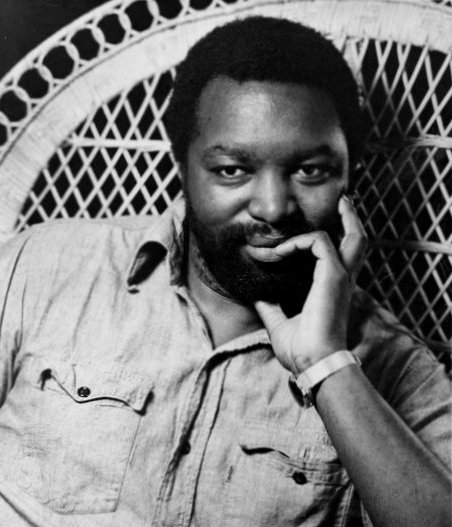
The folk-funk song “River” is by the American singer-songwriter and music producer Eugene McDaniels (1935–2011). He first recorded it with his band Universal Jones on a self-titled album (the group’s only output) in 1972, and he recorded it again, with a synth, on his solo album Natural Juices in 1975.

McDaniels grew up in Omaha, Nebraska, singing gospel music in church. He gained fame in the early 1960s as a clean-cut soul singer—he went by “Gene” at the time—and then surprised everyone in 1970 and 1971 with Outlaw and Headless Heroes of the Apocalypse, containing antiwar, antiestablishment songs performed in a much more experimental style. Universal Jones (1972) is innocuous by comparison, though it still embraces the counterculture. The genres of folk, rock, jazz, gospel, soul, funk, and even proto-rap—often creatively mixed—are all represented in McDaniels’s oeuvre.

Universal Jones cover
From left to right: Eugene McDaniels, Sister Charlotte, Leon Pendarvis, Maurice McKinley, Bob Woos

In the Bible, water connotes blessing, refreshment, life, hope, and abundance. “Flowing streams,” writes the Rev. J. Stafford Wright, “are parables of the flowing life of God.” Wright was referring in particular to one of Ezekiel’s visions, where an unnamed guide leads the prophet through a river that issues forth from the temple in Jerusalem (Ezek. 47:1–12). The guide says,

This water flows toward the eastern region and goes down into the Arabah, and when it enters the sea, the sea of stagnant waters, the water will become fresh. Wherever the river goes, every living creature that swarms will live, and there will be very many fish once these waters reach there. It will become fresh, and everything will live where the river goes.

He then goes on to describe the verdant trees on either side of the riverbank:

Their leaves will not wither nor their fruit fail, but they will bear fresh fruit every month, because the water for them flows from the sanctuary. Their fruit will be for food and their leaves for healing.

Sounds a lot like John’s eschatological vision in Revelation 22, where a river flows down from God’s throne, watering the tree of life, which is for the healing of nations. There are also similar passages in the Minor Prophets: “A fountain shall flow from the house of the LORD” (Joel 3:18); “And in that day it shall be that living waters shall flow from Jerusalem” (Zech. 14:8). God is understood as the source of these waters, which signify an invisible, spiritual reality.

(Related posts: https://artandtheology.org/2022/04/02/lent-28/; https://artandtheology.org/2022/12/11/advent-day-15-great-joy-river/)

When Jesus comes onto the scene, he talks about “rivers of living water” flowing out of the hearts of believers (John 7:38–39), “spring[s] of water welling up to eternal life” (John 4:13–14). God dwells in humanity, and thus the life God gives springs up from within us and vitalizes the wider world.

I don’t know whether McDaniels had any of these biblical texts in mind when he wrote “River.” But a river, a star, a voice, a song of love—these signal to me the Divine moving, shining, speaking, singing into the lives of humanity. Through the ups and downs of history, the ancient will has worked and is continuing to work, revealing itself to those who look, listen, and follow. Ecclesiastes 3:11 says that God has “set eternity in the human heart.” We possess a moral consciousness and spiritual yearning.

To me, “River” is about recognizing the blessing poured out on the world from the heart of God, about tuning in to the unseen truths embedded in the fabric of the universe. It speaks of God’s all-brightening smile (God’s pleasure in his creation), his whispers of our belovedness, and the river-flow of his goodness.

The song has been covered a handful of times over the years and across the globe, including by:

Further, in 1975 the California bluesman J. C. Burris adapted it both lyrically and musically and recorded it under the title “River of Life” on his album Blues Professor:

Bernice Johnson Reagon, a song leader and civil rights activist, uses Burris’s lyrics in her cover on River of Life: Harmony One (1986), overdubbing her voice singing multiple parts in an a cappella tour de force:

There’s a river somewhere
That flows through the life
Of everyone
And it flows through the mountains
And down through the meadow
Under the sun

There’s a star in the sky
That brightens up the life
Of everyone
They can see the life of happiness
Along with the future
Of the lonely one

Yes, it is

There’s a voice from the valley
That speaks to the mind
Of everyone
And it talks about the future
Along with the joy
Of the sorrowed one

Put a smile on your face
And brighten up the day
For everyone
And live your life of happiness
Along with the sick and lonely
And sorrowed one

Yes, it is

There’s a river somewhere
That flows through the life
Of everyone
And it flows from the mountain
Down through the meadow
Under the sun

There’s a sky full of diamonds
That brightens up the life
Of everyone
Then they can see the life of happiness
Along with the future
Of the lonely one

Yes, it is

The main revision by Burris comes at the end of each verse, where he mentions the lonely, the sick, and the sorrowful. They have a special place of belonging in God’s heart and plans. Jesus’s ministry was to such as these. Blessed are the poor and those who mourn, he said, for theirs is the kingdom of heaven.

Burris encourages us to come alongside those who are hurting with love and inclusion, and to look with them into God’s promised future, where the oppressed are liberated, the sick are healed, the silenced go out singing, and mourning is turned to dancing. Contra the cynicism of “the Preacher” who penned Ecclesiastes, there is something new under the sun! For those with eyes to see it, God is in the process of making all things new (Rev. 21:5).

The Beatitudes (Artful Devotion)

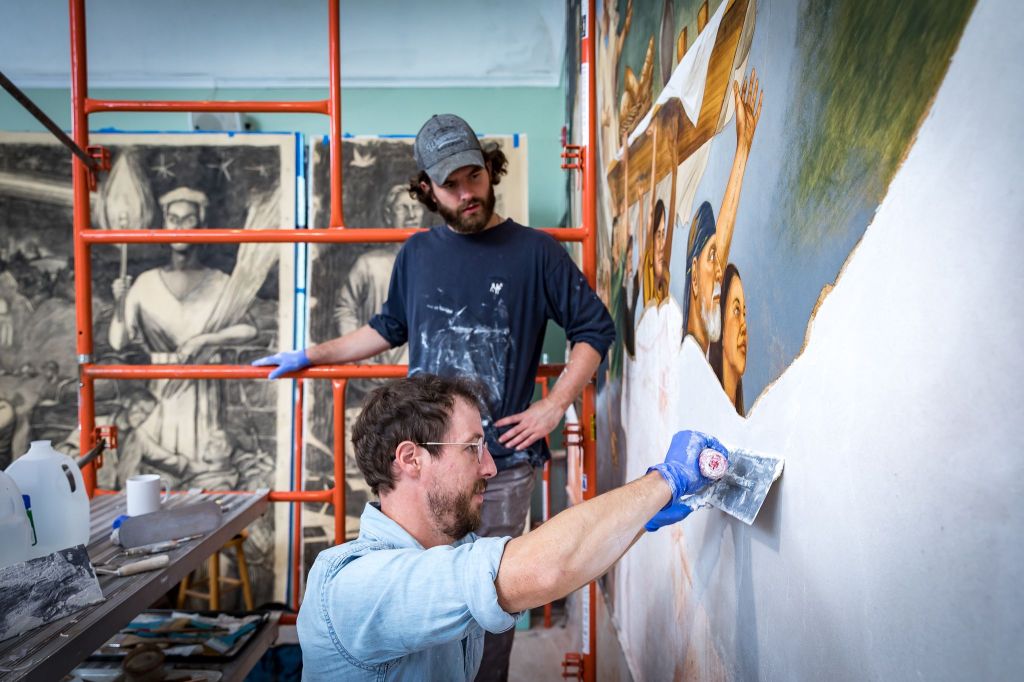
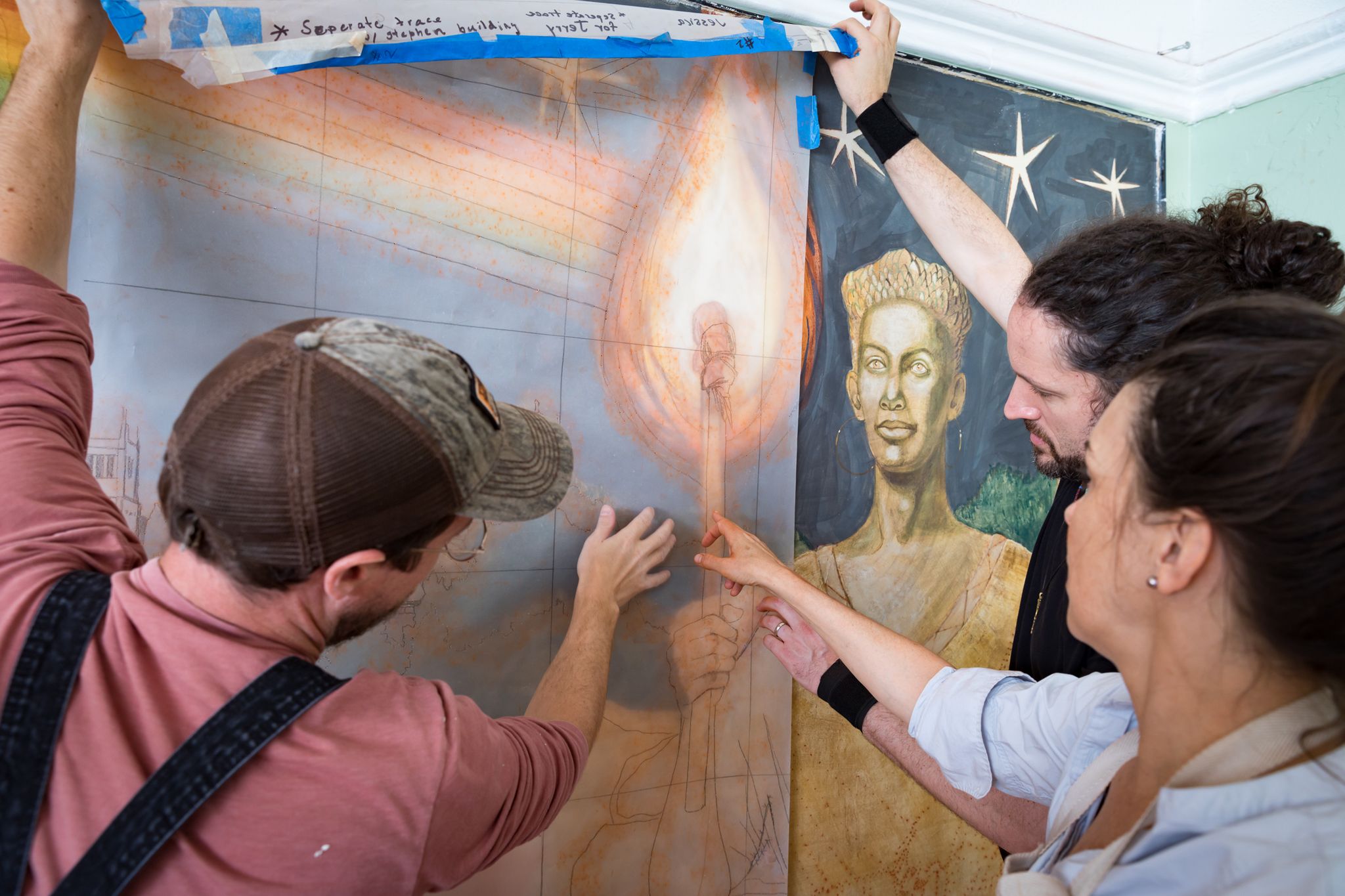
Finished Haywood Street Fresco
Christopher Holt (American, 1977–), Haywood Street Beatitudes, 2018–19. Fresco, 9 1/2 × 27 ft. Haywood Street Congregation, Asheville, North Carolina. Photo: John Warner.

“Blessed are the poor in spirit, for theirs is the kingdom of heaven.

“Blessed are those who mourn, for they shall be comforted.

“Blessed are the meek, for they shall inherit the earth.

“Blessed are those who hunger and thirst for righteousness, for they shall be satisfied.

“Blessed are the merciful, for they shall receive mercy.

“Blessed are the pure in heart, for they shall see God.

“Blessed are the peacemakers, for they shall be called sons of God.

“Blessed are those who are persecuted for righteousness’ sake, for theirs is the kingdom of heaven.

“Blessed are you when others revile you and persecute you and utter all kinds of evil against you falsely on my account. Rejoice and be glad, for your reward is great in heaven, for so they persecuted the prophets who were before you.”

—Matthew 5:3–11

+++

SONG: “Beatitudes” by Bernice Johnson Reagon | Performed by Sweet Honey in the Rock, live at Carnegie Hall, November 7, 1987

Bernice Johnson Reagon (born October 4, 1942) is a song leader, composer, scholar, and social activist who in the early 1960s was a founding member of the Student Nonviolent Coordinating Committee’s Freedom Singers in the Albany Movement in Georgia. In 1973 she founded the all-black female a cappella ensemble Sweet Honey in the Rock, based in Washington, DC. Reagon, along with other members of the SNCC Freedom Singers, realized the power of collective singing to unify the disparate groups who began to work together in the 1964 Freedom Summer protests in the South. ‘After a song,’ Reagon recalled, ‘the differences between us were not so great. Somehow, making a song required an expression of that which was common to us all. . . . This music was like an instrument, like holding a tool in your hand.’” [source]

Reagon was the creator and host of the Peabody Award–winning NPR series Wade in the Water: African American Sacred Music Traditions, which originally aired in 1994 in twenty-six parts. (All the episodes are freely accessible online!) Under Reagon’s guidance, the production team traveled all over the country to record baptismal and congregational services, concerts, and interviews with a range of performers, composers, and community members. A four-CD set was released as a companion to the series.

+++

The Haywood Street Beatitudes fresco was completed last year in the sanctuary of Haywood Street Congregation in Asheville, part of whose mission is “breaking down barriers that divide the ‘haves’ from the ‘have-nots’ and reminding each person of their worth, their goodness.” The principal artist is Christopher Holt, and he worked with a team of four others. To learn more about the fresco, visit the interactive website https://visit.haywoodstreetfresco.org/, which includes many photos and sketches that document the making process in detail, information about the people pictured and an interpretive guide, and comments from participants in the project. All the quotes and photos in this section I’ve sourced from there.

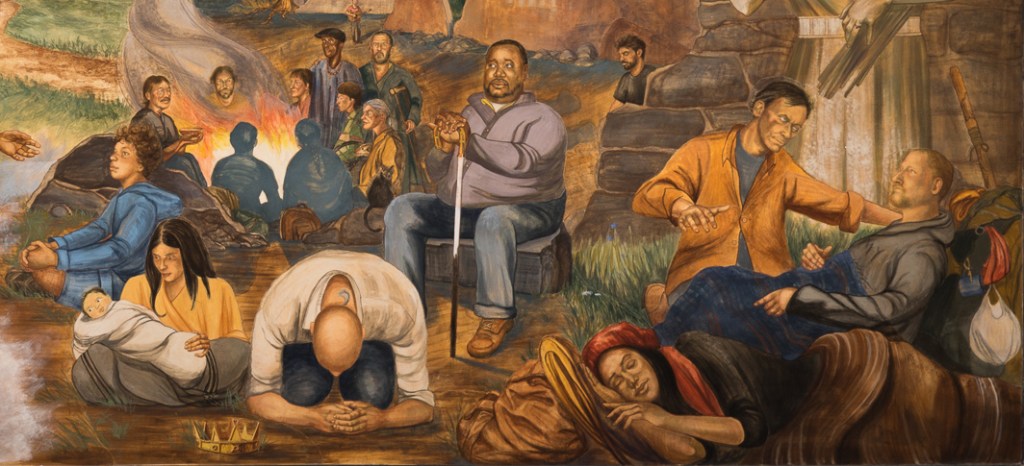
The Rev. Brian Combs, who is shown emerging from behind the stone wall on the right, founded Haywood Street Congregation in 2009 to be a place of welcome for those struggling with addiction and/or homelessness. “The most painful part of holding a cardboard sign at the intersection,” he says, “is not the humiliating public declaration of helplessness or having trash thrown at you, or watching the automatic doors lock down. By far, from what I’ve heard after a decade of listening, is the refusal of so many drivers, idling just feet away at the red light, to even make eye contact.”

Commissioning this fresco—a permanent medium in which paint joins with plaster, making the image inseparable from the church architecture—is one way in which Haywood Street is “affirming sacred worth, restoring human dignity, and sabotaging the shame of poverty.” Fresco painting reached its zenith in the Italian Renaissance, but “too often . . . religious art . . . was made over in the image of those in power who were paying for it. God was rendered European and male. Jesus was more prince than peasant. Salvation meant being upper class.” The Haywood Street Beatitudes contains a more racially and socioeconomically diverse set of individuals that is reflective of the makeup of the community. Its message is that “God continues to show up in everyday life among the unhoused and the housed, the poor and poor in spirit, the meek, the merciful, and the hungry.” 

The skyline, with its Appalachian Mountain vista, offers an idealized portrait of Asheville. Some historical buildings are visible in the background, such as the racially segregated Stephens-Lee High School (on the top of the hill), which opened in 1923 and became a center for culture and arts and a source of pride for the Black community; it closed in 1965 as part of the county school board’s integration plan, and in 1975 most of it was bulldozed.

Haywood Street is most known for its Downtown Welcome Table ministry: family-style meals are served—with cloth napkins and on china plates!—on Wednesdays and Sundays in the church’s dining room, where people from all backgrounds are encouraged to come and eat together and enjoy fellowship. (Due to COVID-19 restrictions, meals are currently served to-go.) “We are a ministry that acknowledges each of us has gifts and each of us has needs. While some come with hunger from the body, others come with a hunger in their souls.” The website goes on to explain that visitors can “expect roles to be reversed. If you are coming to give, you might be asked to receive, to simply sit and have lunch. . . . If you are coming to receive, you might be called upon to serve.”

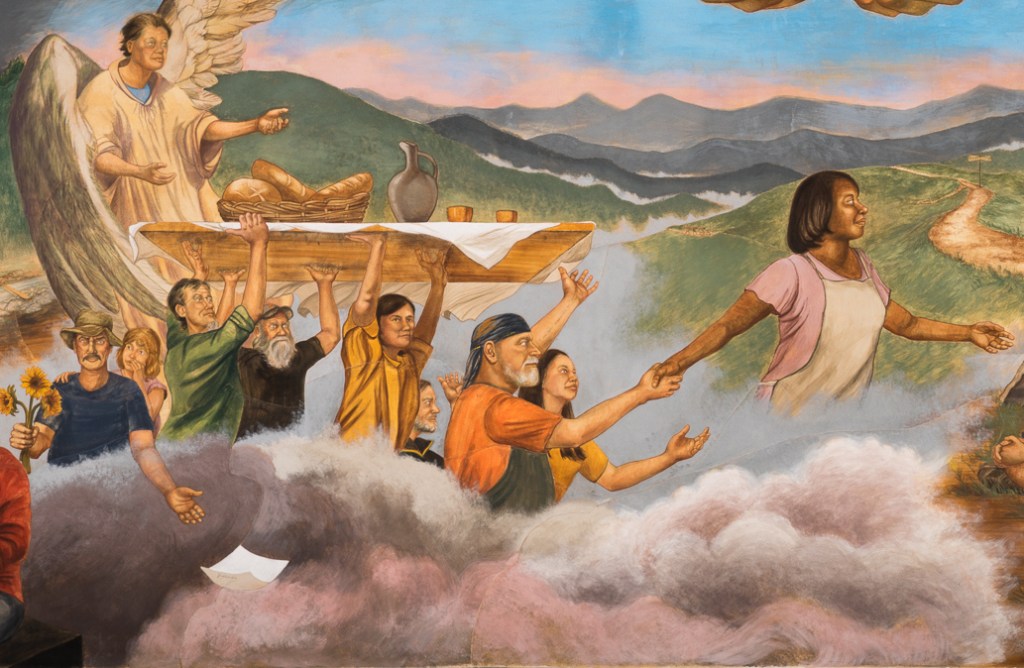
Haywood Street fresco
Haywood Street fresco (detail)

“Table is the defining metaphor at Haywood Street,” signifying relationship and togetherness. In the fresco, community members prepare the table and hold it up, led by Miss Mary (center); “keep the house open and be generous with your life,” she says. Holding her hand is Dave, a US Air Force veteran who grew up in Alabama in a culture where he was told never to touch a Black person. At Haywood he has overcome the prejudice he was formerly steeped in.

Other pictured individuals include Edward, the church organist; Robert, a gardener who arranges flowers for the altar and dining room tables each week; Soleil, a little girl who loves coming to Haywood Street for the desserts and who is whispering into Robert’s ear; Wayne (bottom right), who initially came to Haywood Street through its Respite ministry, which provides a safe place for homeless adults to rest, recover, and be cared for following a hospital discharge; and so on.

Haywood Street fresco (detail)

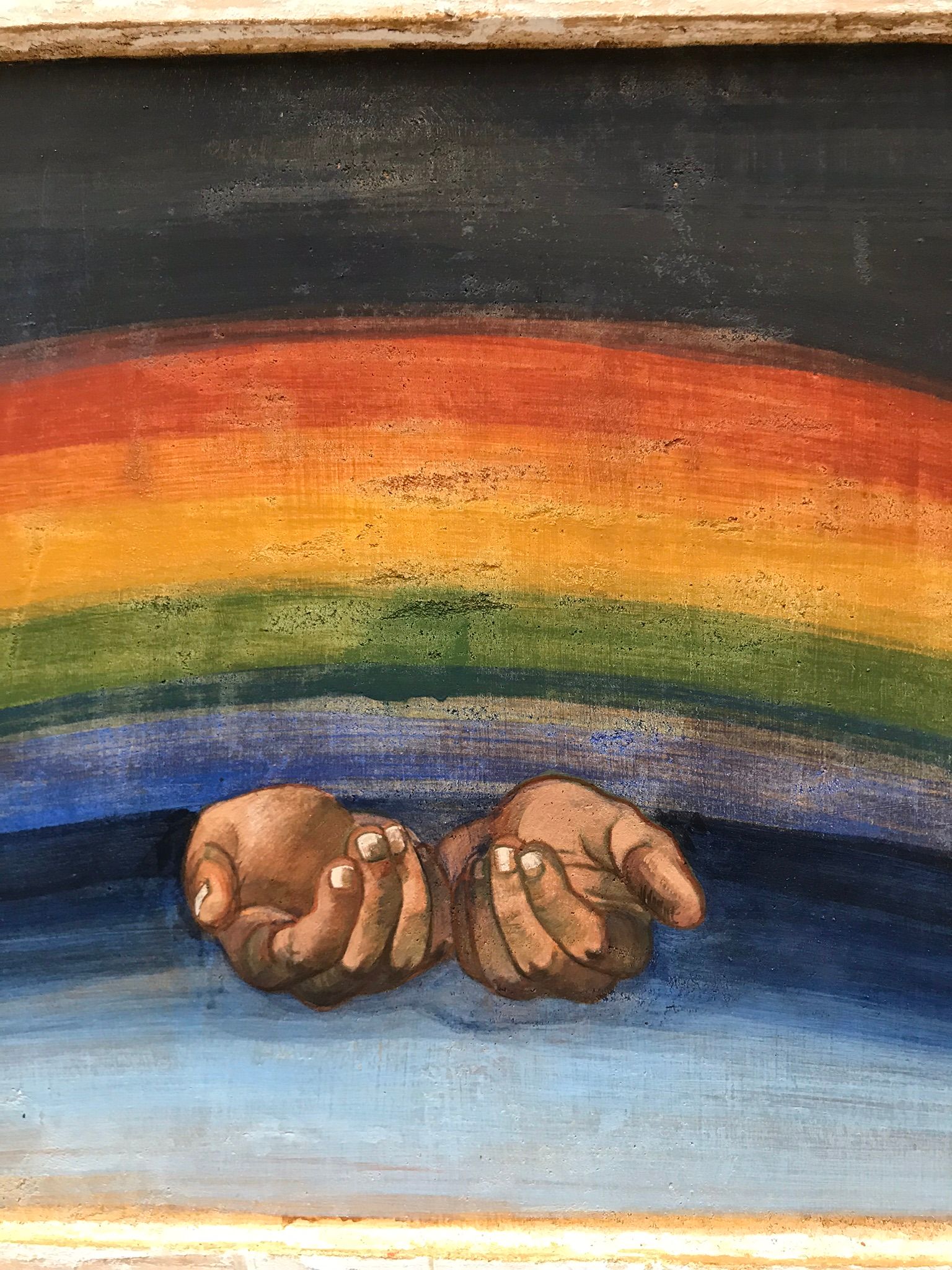
All are underneath the blessing hands of God and the rainbow of God’s promise.

Flanking the scene are two sentinel figures, each holding a light so that those in the darkness can find their way. The one on the left is modeled after Charles, a community member who died of cancer in May 2019, a few months before the fresco was completed. He was foundational to the church, as he lived on the streets and vouched for Haywood Street to all his friends when it was just getting started. His dog, Emma, sits in front of him, next to an open pouch of his woodworking tools. The other light-bearer, on the right, is Jeanette, a single mom who “came for lunch” one day between job interviews “and found love.” She is a care minister at Haywood Street and is on the board of directors. The two hold the Communion elements: Charles, a wine flask, and Jeanette, a sheaf of wheat.

Shout-out to Alexandra Davison, director of Culture Care RDU and a docent at the North Carolina Museum of Art, whose blog post “Lent, COVID-19 & the Beatitudes on Haywood Street” introduced me to this fresco.

+++

I’ve addressed the Beatitudes in previous Artful Devotions, which feature

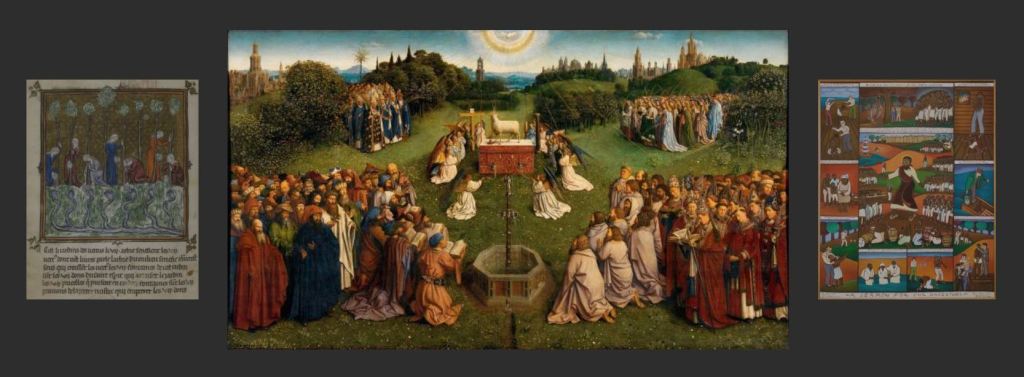
For more Beatitudes-related art, see the Visual Commentary on Scripture exhibition “Blessed,” curated by Rebekah Eklund, a professor of New Testament, theology, and ethics at Loyola University Maryland. I appreciate how she addresses descriptive versus prescriptive interpretations of the Beatitudes. She examines (1) an illumination from a French medieval moral treatise that shows seven women in a “virtue garden,” each representing a different beatitude; (2) an Ethiopian-inspired canvas painting by contemporary American artist Laura James, which places the Beatitudes in the context of chattel slavery; and (3) the central panel of the Ghent Altarpiece [previously], where seven groups of saints gather round a bleeding Lamb.

Blessed (VCS exhibition)

“All three artworks place a Christ-figure in the centre: the tallest tree in the middle of the garden tended by prayer, an African Jesus with open arms delivering the Sermon on the Mount, or the slaughtered Lamb standing triumphantly on the altar of his sacrifice and surrounded by angels. This centrality suggests Christ’s role not only as the speaker of the Beatitudes but also as their embodiment and fulfilment.”


This post belongs to the weekly series Artful Devotion. If you can’t view the music player in your email or RSS reader, try opening the post in your browser.

To view all the Revised Common Lectionary scripture readings for All Saints’ Day, cycle A, click here.

“Oh Mary, Don’t You Weep”: Death, Resurrection, and the New Exodus

Moses and the Sea by Zak Benjamin
Zak Benjamin (South African, 1951–), Moses and the Sea, 1982. Hand-colored etching.

The exodus of the Israelites from Egypt, where they had been held in bondage for at least two hundred years, through the miraculously parted waters of the Red Sea is the archetypal salvation event in the Hebrew scriptures. Throughout its books, one of the primary epithets for God is “he who brought us up out of Egypt,” or some variation thereof, for this action defined God’s character, assured the Israelites of his strength and will to save.

In addition to its historical sense, Christians have long understood the Old Testament exodus story as a prefigurement of the “new exodus” led by Christ, whereby we are liberated from the bondage of sin. As the New Moses, Jesus confronts evil—institutional evil, but also the evil inside each of us—and leads us out of its clutches. He stretched out his hands on a cross to create for us a clear path to freedom, then he stretched out his hands again three days later in resurrection victory, burying our former oppressors. Liturgical tradition acknowledges the link between the Exodus and the Resurrection by prescribing the reading of Exodus 14 at Easter Vigil.

In the farm fields of the antebellum South, African American slaves resonated strongly with the story of the Israelites. They looked to the Exodus—that literal, historic flight—in hopes that God would one day accomplish the same feat for them, and they even encoded this hope into the songs they sang. “Oh Mary, Don’t You Weep” is one such example. The verses vary by performer, but the chorus is this:

Oh Mary, don’t you weep, don’t you mourn
Pharaoh’s army got drownded
Oh Mary, don’t you weep

One might be tempted to assume that the Mary referred to here is Moses’s sister, for narrative coherence. (“Miriam” is the Hebrew equivalent of the English “Mary.”) However, the more logical choice, given the weeping detail, is either Mary of Bethany or Mary Magdalene, both of whom the Bible records as weeping in response to death—Mary of Bethany, at the death of her brother, Lazarus (John 11:31–33), and Mary Magdalene, at the death of Jesus (John 20:11–13). In both stories, though, Christ demonstrates power over the grave. He brings Lazarus back to life, and he himself returns to life three days after his Crucifixion.

Melancholy by Odilon Redon
Odilon Redon (French, 1840–1916), Melancholy, 1876. Charcoal on paper. Art Institute of Chicago.

The chorus applies equally well to either Mary, and perhaps the dual reference is intentional. Their stories are similar, the one a precursor to the other. Mary of Bethany, however, seems to be the more popular interpretation, as evidenced by adaptations of the song that add Martha’s name to the chorus, such as the Swan Silvertones’ version (“Oh Mary, don’t you weep / Oh Martha, don’t you mourn”). Either way, the song creates a link between God’s victory over the Egyptians in the Old Testament and his victory over death in the New. The chorus is a consolatory reminder that God is mighty to save.

As with most spirituals, “Oh Mary, Don’t You Weep” operates on three levels:

  1. as Jewish history;
  2. as spiritual metaphor; and
  3. as an expression of present circumstances and/or anticipations.

Continue reading ““Oh Mary, Don’t You Weep”: Death, Resurrection, and the New Exodus”