
Roundup: “Rothko in Florence,” disabled minister portraits, Shaker songs, and more

EXHIBITIONS:

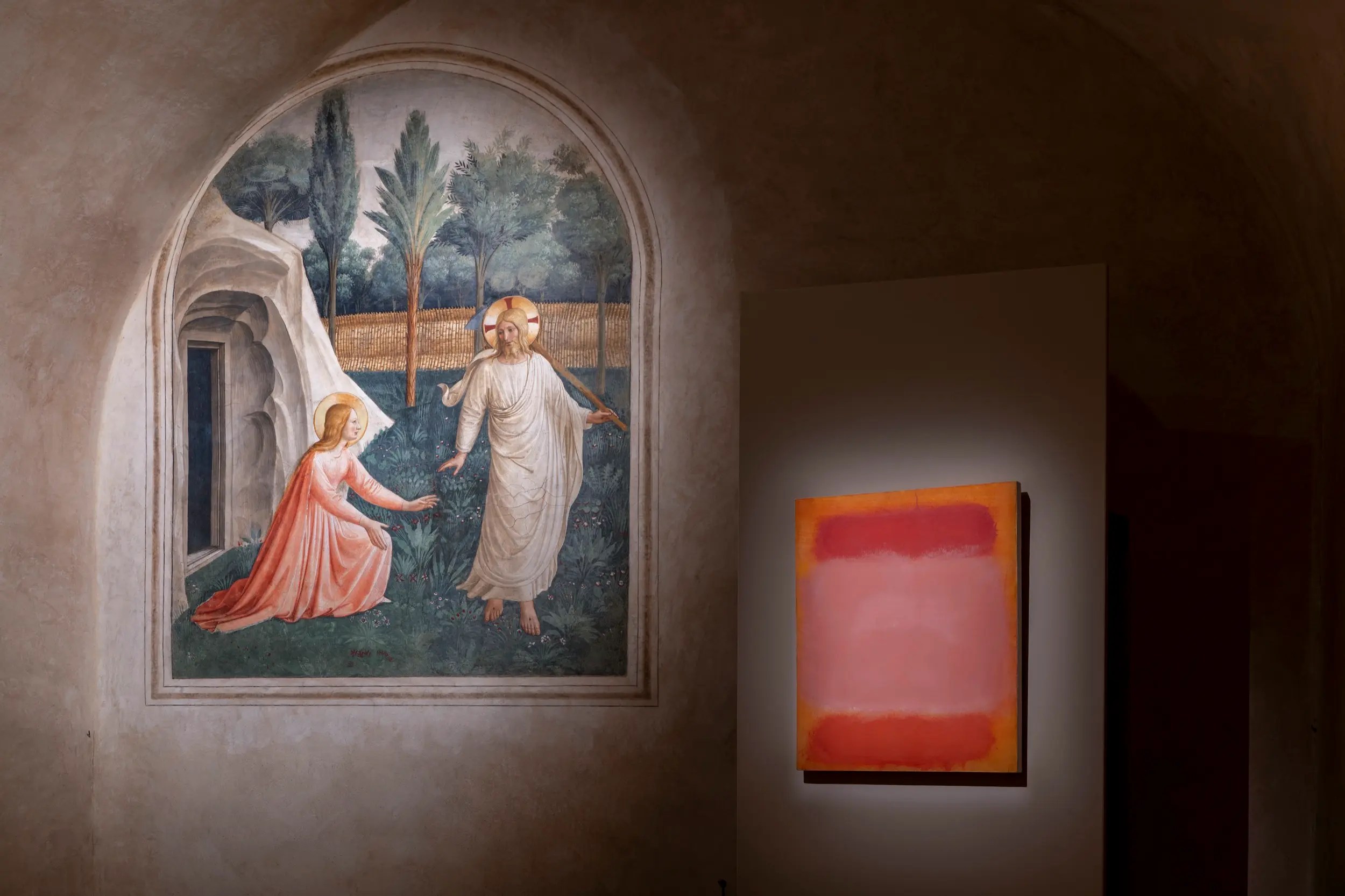
>> Rothko in Florence, multiple sites in Florence, Italy, March 14–August 23, 2026: Presented by the Fondazione Palazzo Strozzi and curated by Christopher Rothko and Elena Geuna, Rothko in Florence explores the influence of the city on Mark Rothko’s art, especially in terms of space and color. Rothko visited Florence in 1950, 1959, and 1966 and was particularly taken by the monastery-turned-museum San Marco, its cells frescoed with devotional scenes by Fra Angelico, and the vestibule of the Biblioteca Medicea Laurenziana, designed by Michelangelo. Now those two Renaissance sites are host to a display of Rothko’s works: five of his paintings hang alongside Fra Angelico’s monastic frescoes, and two studies for his Seagram Murals hang in the Laurentian Library.
Rothko in Florence
Installation view: Rothko in Florence, San Marco Museum, Florence, 2026. Photo: Ela Bialkowska, OKNO Studio. (Read Georges Didi-Huberman’s reflection on the Fra Angelico painting at left.)

But the primary site of the exhibition is the fifteenth-century Palazzo Strozzi, which shows over seventy of Rothko’s works from private collections and international museums, spanning the different stylistic phases of his career, from figurative to neo-surrealist to color field. And in dialogue with the exhibition, the sacristy of the Chapel of San Nicolò, inside the complex of the Officina Profumo-Farmaceutica di Santa Maria Novella, one of the oldest pharmacies in the world, has been converted into a “listening room”; Rothko Chapel, a composition for chorus, celesta, cello, and percussion written by Morton Feldman in 1971 at Rothko’s commission, plays through speakers, washing over frescoed scenes of Christ’s passion painted by Mariotto di Nardo di Cione between 1385 and 1408.

You can read reviews of the exhibition in The New York Times and The Brooklyn Rail and view photos, including of all five relevant cells in San Marco, on Ruth Philo’s Instagram page.

>> Called as We Are, York Minster, July 12–August 10, 2026 (then to other locations): Presented by the Church of England’s Disability Project in partnership with Art and Christianity, this exhibition consists of twelve photographic portraits by Ruth Samuels of leaders in the Church of England who are Deaf, disabled, and/or neurodivergent. “Called As We Are brings Deaf, disabled and neurodivergent people in ordained and lay ministries into focus and explores the enriching and dynamic contribution that difference brings to their personal ministries and the ministry of the church,” says Rev. John Beauchamp, a blind priest who serves as disability ministry enabler in the Diocese of London. Samuels, the photographer, herself has chronic fatigue syndrome.
Vanessa Thornborough
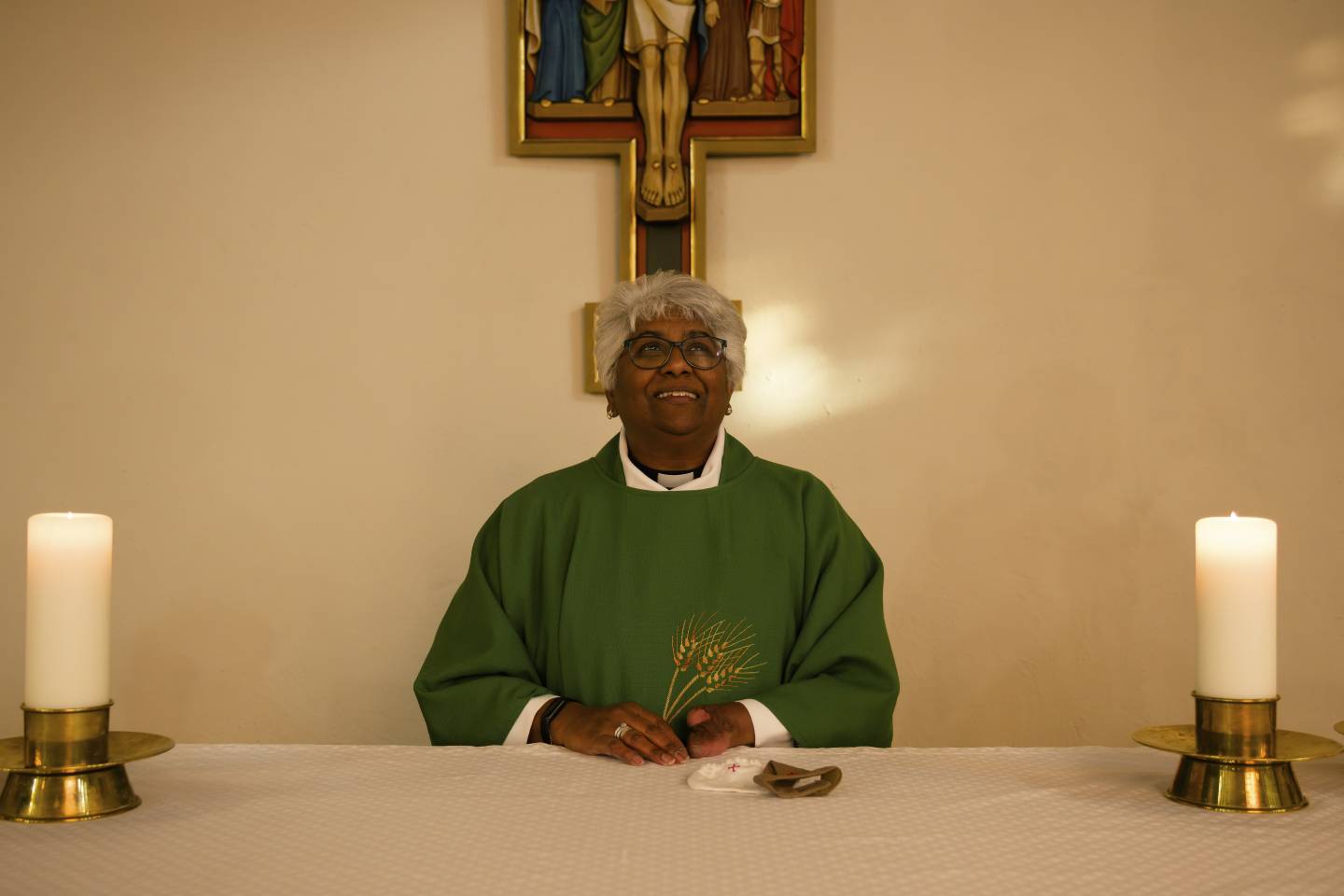
Rev. Vanessa Thornborough, curate at St. Edmund of Canterbury, Hayes, who has a hand difference. Photo by Ruth Samuels.

Each photograph is accompanied by insights and observations from the subject, telling us about their disability, their faith journey, and adaptations that have helped them along their way. There are also audio descriptions, as well as BSL (British Sign Language) interpretation. After its time at York Minster, the exhibition will travel to the following locations:

  • Exeter Cathedral, August 12–19, 2026
  • Liverpool Cathedral, September 14–October 4, 2026
  • Chelmsford Cathedral, October 12–November 9, 2026
  • St Alban’s Cathedral, November 10–26, 2026
  • St Giles Cripplegate, London, January 18–February 8, 2027

Read the press release here.

+++

CALL FOR ART: St. Francis Exhibition, Creo Arts Gallery, Wilmore, Kentucky: “This November, Creo Arts invites you to explore the life, legacy, and spiritual vision of St. Francis through the arts. Whether inspired by his care for creation, his radical hospitality, his pursuit of peace, or the beauty of a life fully surrendered to God, we welcome works that engage with the enduring themes of his witness. Through painting, sculpture, poetry, photography, music, and more, this exhibition celebrates a life that continues to inspire artists and believers across generations.” Submission deadline: September 13, 2026. Selection emails will be sent out by September 21. The exhibition opening is November 6, and participating artists are encouraged but not required to attend.

+++

ARTICLE: “Take me to church: Ecclesiology and Hulu’s The Bear by Beth Felker Jones: “I want a church like a fine dining restaurant with a pickup window serving Chicago style beef sandwiches.” This is how theologian Beth Felker Jones opens her latest Substack post, drawing the hit television drama The Bear into conversation with ecclesiology, the study of the church. She critiques the either/or mentality that says the church has to either devote itself to beauty, depth, liturgy, theology, and careful formation or be accessible and meet practical needs; be specialized and transporting or down-to-earth, ordinary. Why can’t it be both? She then proceeds to reflect on hospitality, family (born and found), and giftedness.

+++

SHAKER SONGS:

Saro Lynch-Thomason is a song leader and folklorist living in Asheville, North Carolina. She identifies as pagan, but a number of songs in her repertoire are from the Christian tradition, including these two from Shakerism, a near-extinct sect whose distinctive practices include celibacy, communal living, and gender equality.

>> “In Yonder’s Valley”: This is the most widely remembered of the early Shaker songs. Written at Enfield, Connecticut, by Father James Whittaker (1751–1787), the second leader of the Shaker sect after Mother Ann Lee, it draws on the paradisal imagery in the second chapter of the Song of Songs (a reference shared by two other songs I’ve recently featured!), bidding the community to enter into unity with God, each other, and the rest of creation—to “take [their] fill” of heaven on earth, living in the cosmic harmony that has been ordained from the beginning. A variation of the song has “yonder” instead of “yonder’s” and “flows” instead of “grows.”

In yonder’s valley there grows sweet union
Let us arise and take our fill
The winter’s past and the spring appears
The turtledove is in our land
In yonder’s valley there grows sweet union
Let us arise and take our fill

>> “Ode to Contentment”: This Shaker hymn has been passed down with varying attributions of authorship and places of origin, but it was most likely written by Richard Pelham (words) and Issachar Bates (music) at the North Union Shaker village in Ohio in 1835. It apostrophizes the Christian virtue of contentment, asking her to come dwell in our hearts, bringing a stabilizing peace, endurance, and bliss. Lynch-Thomason sings three of the original nine verses.

Come, contentment, lovely guest!
Reign unrivaled in my breast;
Thou alone wilt do.
Thou alone canst fill the soul,
Every passion canst control;
When the stormy billows roll,
Thou canst bear me through.

All the lordlings of the earth,
All their boasts, what is it worth?
Nothing but a show.
All the wealth that kings possess,
All their vain and gaudy dress,
All is splendid wretchedness;
Peace they never know.

Nothing on this earth below,
Naught that heaven can bestow,
Fills the soul with peace,
If contentment dwell not there.
All is dreary, dark, and bare;
She alone makes heavenly fare,
She alone is bliss.
Roundup: Multilingual Paschal greeting, Easter sermon by N. T. Wright, the Myrrhbearers and the Magi, and more

VIDEO: “The Lord is Risen! Proclaimed by people from 29 countries”: This video was put out in 2020 by ICF Rotterdam, an intercultural church in the Netherlands whose congregation consists of members from over forty nations! They asked a handful of them to recite the Paschal greeting in their native tongue, so represented here are Indonesian, Chinese, Zulu, Igbo, Urdu, Nepali, Kurdish, Romanian, and more. [HT: Global Christian Worship]

Wycliffe Bibliafordítók (Wycliffe Bible Translators) in Hungary produced a similar video last year:

+++

SERMON: “Let Beauty Awake” by N. T. Wright: One of the things I love about the Anglican cleric N. T. Wright’s preaching and teaching is the importance he places on beauty. (I actually met Wright once—and it was at an arts conference.) In this sermon, which he preached at Durham Cathedral on Easter Sunday 2009, he takes as his text what I’ve heard him say is his favorite chapter in the Bible, John 20, and discusses how in Jesus’s rising, the glory of God was let loose in all the world.

“Easter carries with it a strange and powerful beauty,” he says. “I hope that, by exploring the biblical roots of why this is so, I may have surprised some of you at least into asking, afresh, What can we do to celebrate, more consciously and deliberately, the reawakening of beauty which comes with the light of Easter Day? How can we take this forward, as an explicit project, so that a world so full of ugliness and functionality, and in consequence so full of unbelief or false belief, can once again be wooed into belief and love?”

He opens the sermon by quoting a stanza from a poem by Robert Louis Stevenson, and near the close, he reprises it in his own words, which were developed into a song by Steve Bell:

Let Beauty awake in the morn from the cool of the grave,
Beauty awake from death;
Let Beauty awake,
For Jesus’ sake,
In the hour when the angels their silence break
And the garden is bright with His Breath.

+++

RECIPE: “Tsoureki: The Symbolic Greek Easter Bread”: On her blog The Liturgical Home (and on Instagram), Ashley Tumlin Wallace shares a recipe for tsoureki, a brioche-like sweet bread made by many Greek Christians on Easter. It is soft and fluffy, flavored with citrus, and decorated with red-dyed eggs!

+++

SPOKEN WORD + SONG: “Because He Lives” by Sharon Irving: Singer-songwriter, worship leader, and spoken word artist Sharon Irving [previously] recorded this video for City First Church Spring Creek’s virtual worship service for Easter 2020. It begins with an original spoken word piece, and then is followed by her singing the Gaither classic “Because He Lives.”

+++

SONG: “Sbab Dia Hidup” (Because He Lives) by Prison Akustik: The song “Because He Lives,” written in 1971 by Bill and Gloria Gaither, has made its way all around the world and has been translated into many languages. Here is the group Prison Akustik [previously] singing it in Indonesian.

+++

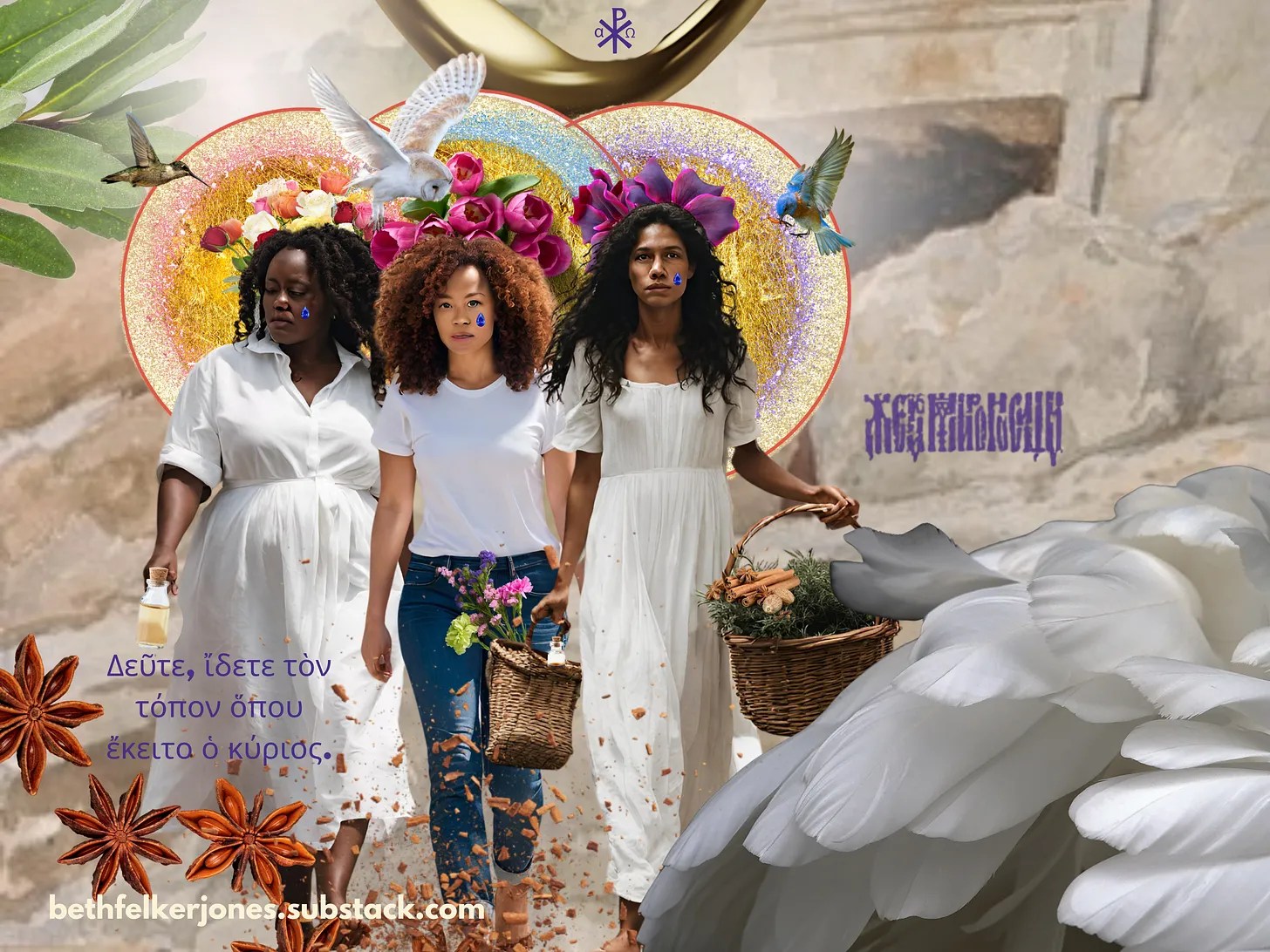
SUBSTACK POST: “Myrrhbearers & Magi” by Beth Felker Jones: In her Church Blogmatics post from last week, theologian Beth Felker Jones [previously] shares three new digital collages she made: one of the three myrrh-bearing women who discovered Jesus’s empty tomb, one of the three magi who brought gifts to the newborn Christ, and one that combines both groups of devoted witnesses. She provides descriptions of each and two original prayers, including the one below.

Myrrhbearers
Digital collage (with AI-generated elements) by Beth Felker Jones, 2025

Holy Father, who accompanied your daughters on their way to the tomb, and in the power of your Spirit, turned their sorrow into joy, bring us too into the joy of those who found the tomb empty, and incorporate us, with them, into your resurrection life. With our sisters at the tomb that day, help us to say, “I have seen the Lord!” Amen.

Advent, Day 15: Among Us

LOOK: Visitation by Beth Felker Jones

Jones, Beth Felker_Visitation
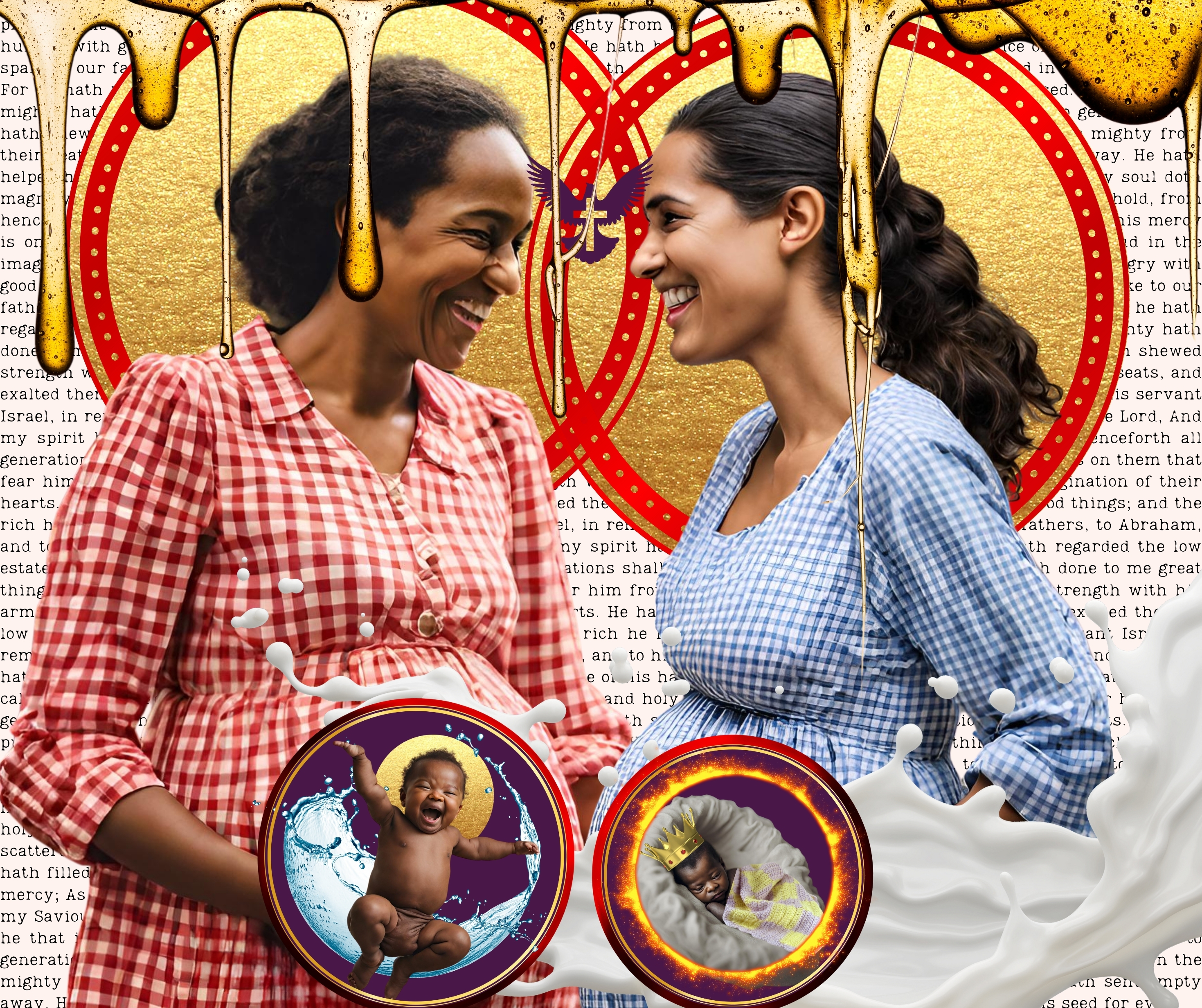
Beth Felker Jones (American, 1976–), Visitation, 2024. Digital collage with AI-generated elements.

Dr. Beth Felker Jones is a theologian who teaches at Northern Seminary near Chicago. This past year she has been making digital collages of biblical figures, especially women, with the assistance of AI technology. She shares them on her Substack, Church Blogmatics, and offers them for free with watermark or just $10 for a high-resolution, watermark-free download.

Her Visitation, she says, “imagines Mary’s visit to Elizabeth in Luke 1, flowing with milk and honey,” symbols of abundance and nourishment. (The promised land is often referred to in scripture using this poetic expression; see Exod. 3:8, Num. 14:8, Deut. 31:20, and Ezek. 20:15.) With the coming of a Savior, a great spiritual bounty awaits God’s people.

Luke the Evangelist describes Elizabeth as “filled with the Holy Spirit” (1:41). The Spirit is present in the center of this collage, silhouetted in purple, the color of Advent. His wings touch the women’s foreheads as if to bless or to join them together in celebration.

Luke also says that John the Baptist “leaped for joy” inside Elizabeth upon hearing Mary’s greeting (1:44), already recognizing that the one she bore was the Messiah. Jones shows this exultation of the in utero prophet. He splashes in the waters of his mama’s womb, as he will one day in the river Jordan, baptizing the repentant. Meanwhile, the great I AM, enfleshed as a preborn baby, sleeps inside a fiery ring in Mama Mary, crowned as king.

The words of Mary’s Magnificat form the backdrop of the scene.

LISTEN: “Among Us” by Nick Chambers, on Advent Songs by Incarnation Music (2023)

My soul will magnify
The Lord who looked on my
Lowliness with grace
My soul will magnify
My neighbor’s precious life
I see Christ in their face

Refrain:
God is among us
In human disguise
Born as one of us
To open our eyes

My soul will magnify
The Lord who took on my
Lowliness in flesh
My soul will magnify
My neighbor’s desperate cry
For in Christ they are blessed [Refrain]

Based on the Magnificat (Luke 1:46–55), “Among Us” by singer-songwriter Nick Chambers highlights how God’s becoming flesh helps us see the imago Dei (image of God) in our fellow humans. There’s an old Orthodox hymn that says, “Christ was born to raise the image that fell of old. Christ came to restore the beautiful image of God within humankind,” the image that had become obscured through sin.

With Mary, Elizabeth, and baby John, let us celebrate the Lord who brings salvation, raising up the lowly, restoring the broken, and reminding us of the dignity and belovedness of our embodied selves.

This is one of eighteen Visitation-themed songs on the Art & Theology Advent Playlist.