Today’s format is a little bit different, in that the visual art and music are part of a singular video piece which also prominently features dance—so, multiple media all wrapped up into one.
Every year in the church calendar, December 28 commemorates the Massacre of the Innocents—the boys of Bethlehem slain by agents of the state, deployed by Herod, who feared the perceived threat they posed. The story is told in Matthew 2:16–18 and quotes the prophet Jeremiah:
A voice was heard in Ramah, wailing and loud lamentation, Rachel weeping for her children; she refused to be consoled, because they are no more.
While the remembrance marks this ancient event specifically, the church also takes the occasion to pray for present-day innocents who have been victimized by the powerful. For example, the collect (succinct prayer) for this day from the Book of Common Prayer reads:
We remember today, O God, the slaughter of the holy innocents of Bethlehem by King Herod. Receive, we pray, into the arms of your mercy all innocent victims; and by your great might frustrate the designs of evil tyrants and establish your rule of justice, love, and peace; through Jesus Christ our Lord, who lives and reigns with you, in the unity of the Holy Spirit, one God, for ever and ever. Amen.
The artists of today’s piece, made in 2019, confront the unjustified killing of Black men in America by police. They do not make the explicit connection to Herod’s massacre, but I do, as I hear, in the many Black mothers who have lost their children to state violence, Rachel weeping and refusing to be comforted. And I see Herod-like rulers who want to silence those wails and reverse the progress made in awareness and reform.
LOOK & LISTEN: The Ritual of Being, a site-specific dance performance by T. Lang in front of the Mothers March On mural by Sheila Pree Bright, 2019
The 2010s was a decade of racial reckoning in America. In response to neighborhood watchman George Zimmerman’s killing of the unarmed Black teen Trayvon Martin and subsequent acquittal, the Black Lives Matter movement was founded in 2013, demanding policing and criminal justice reform and the safety of marginalized Black communities. BLM activism and the continual miscarriages of racial justice that prompt it received ample media coverage all the way through the movement’s peak in 2020 with the murder of George Floyd. That coverage has lessened in the last few years, but the movement is still active, and mothers still bear the wound of their slain children.
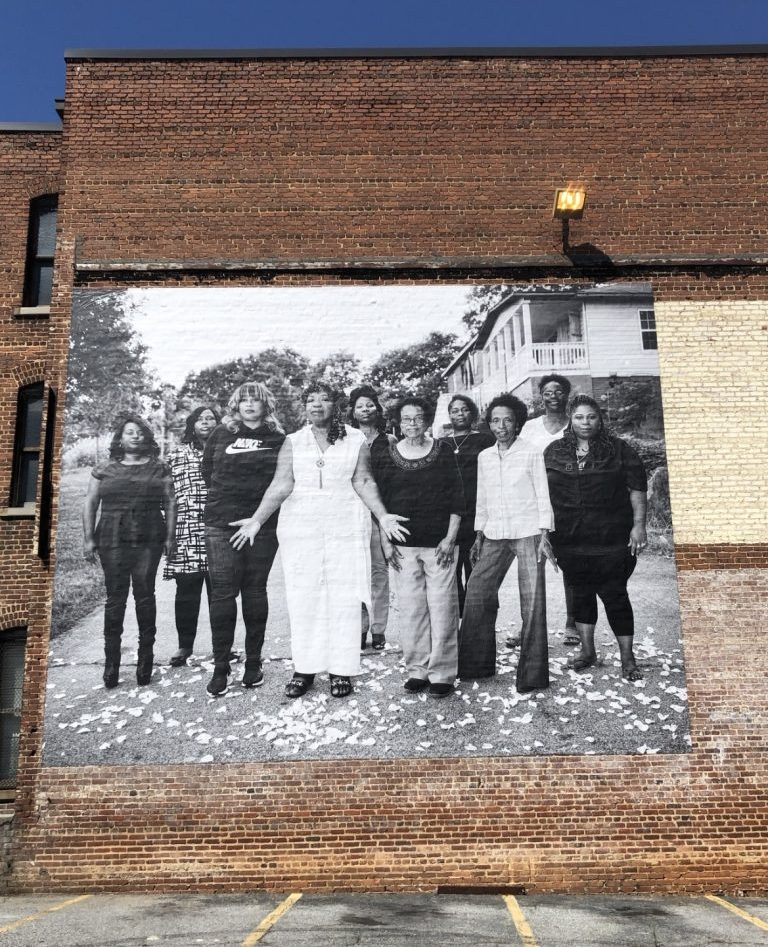
In 2019, the lens-based artist Sheila Pree Bright, author of #1960Now: Photographs of Civil Rights Activists and Black Lives Matter Protests, brought together nine mothers who are fighting for justice for their boys whose lives were taken from them by police. She wanted to give them a safe space to talk, and to photograph them. The portrait Mothers March On depicts, from left to right, Tynesha Tilson (mother of Shali Tilson), Wanda Johnson (mother of Oscar Grant), Felicia Thomas (mother of Nicholas Thomas), Gwen Carr (mother of Eric Garner), Monteria Robinson (mother of Jamarion Robinson), Dr. Roslyn Pope (author of An Appeal for Human Rights), Dalphine Robinson (mother of Jabril Robinson), Patricia Scott (mother of Raemawn Scott), Montye Benjamin (mother of Jayvis Benjamin), and Samaria Rice (mother of Tamir Rice).
Sheila Pree Bright (American, 1967–), Mothers March On, 2019. Vinyl-print photo mural installed at 190 Pryor Street, Atlanta, Georgia, 30 × 60 ft. (9.1 × 18.3 m).
Carr, whose son died in the chokehold of an NYPD officer who ignored his cries of “I can’t breathe,” is the focal point of the image, with her arms outstretched and fingers spread. This body language connotes an offering of self to the cause of justice and a readiness to receive it. That her hands are open rather than clenched in a fist indicates unguardedness, while her planted feet indicate firmness.
The woman in glasses beside Carr is Roslyn Pope, who died in 2023. A mother to two daughters, she had not herself lost a child to police violence, but she was part of Mothers March On on account of her seminal civil rights work in Atlanta. In 1960, while serving as president of the student government at Spelman College, she drafted the manifesto An Appeal for Human Rights, announcing the formation of the Atlanta Student Movement, whose campaign of civil disobedience would contribute to the dissolution of racist Jim Crow laws across the region. In a 2020 interview for the sixtieth anniversary of the manifesto’s publication, Pope expressed concern that some of the students’ hard-fought gains were being eroded, telling the Associated Press, “We have to be careful. It’s not as if we can rest and think that all is well.”
The Mothers March On photographic project is about Black women who have witnessed the tragic loss of their children who have fallen to police brutality. . . . This project pays homage to the sacrifices, wisdom, and guidance of Black mothers as nurturers and protectors who are passing on a legacy of determination and love, showing how they are fierce and tender, protective and vulnerable, and strong and soft. I’m honoring the struggles of Black mothers, celebrating the beauty of their strength and resilience. These mothers continue to march on for Human rights for their children to bring attention to the urgent need for police reform and the systemic racism that continues to fuel police brutality against Black bodies since slavery.
Bright’s depiction . . . stresses Black mothers’ memory, determination, love, and corporeality. Through the repetition of standing figures, the portrait insists on the integrity of Black bodily form. The women speak back to lynching culture. With rose petals at their feet, like fallen bodies of their murdered sons, these mothers, on the front-lines of state violence, refuse to relent. They know who and what has been taken from them; they will never forget. . . .
Bright printed the portrait in large scale and pasted it on the side of a brick retail building at 190 Pryor Street in Atlanta, Georgia, near the Georgia State Capitol. Then, for ProtectYoHeART Day in Atlanta, she and the performance artist T. Lang collaborated on a video piece at that site, where T. Lang dances before the mural to the aching instrumental jazz piece “Alabama” by the saxophonist John Coltrane. (Coltrane wrote the music as a memorial for the four girls who were murdered by Ku Klux Klansmen at Sixteenth Street Baptist Church in Birmingham in 1963; learn more here.) Clothed in a fringe dress, T. Lang spins, jerks, reaches, heaves, throws herself against the wall, crouches, withers, bursts, climbs, pulls, and walks forward, movements of grief and struggle capped by resolve.
A temporary installation, the Mothers March On mural is no longer on Pryor Street.
I first learned about Sheila Pree Bright’s photography from a compelling series of hers that I saw at the Wadsworth Atheneum in Hartford, Connecticut, titled Young Americans. In it she invited people across the US between the ages of eighteen and twenty-five to pose with the American flag in whatever way they felt most comfortable. “My practice moves between documentary and conceptual work, from portraiture to constructed realities—always grounded in truth, history, and lived experience,” Bright says.
. . . each day a misery and a marvel, each person also.
—Rachel E. Hicks, from “Accumulated Lessons in Displacement”
A white American born in the foothills of the Himalayas to international school educators, Rachel E. Hicks is a second-generation third-culture kid (TCK) whose writing reflects decades of living as a global nomad, exploring themes of memory, connection, suffering, exile (both physical and spiritual), hospitality, and hope. She grew up in six countries—India, Pakistan, the United States, Jordan, the Democratic Republic of the Congo, and Hong Kong—and spent seven years as an adult in Chengdu, China, where she worked for the relief and development organization Food for the Hungry.
In 2013, she, her husband, and their two kids repatriated to the US, settling in Baltimore, where they live today. Hicks has lived in Baltimore longer than in any other city. But even with this rootedness, “the soil of each place in which I’ve lived still clings,” she says.
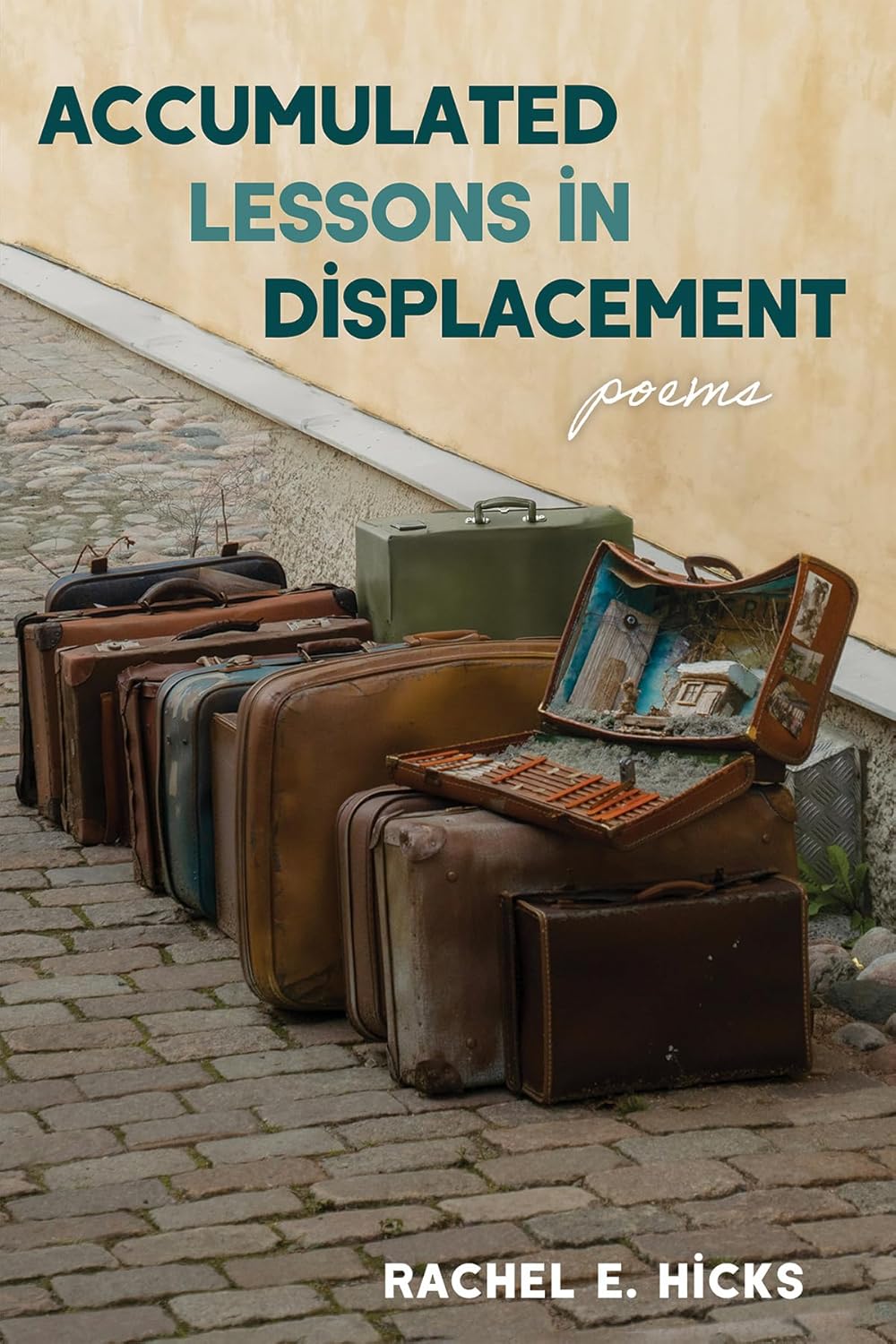
In her debut poetry collection, Accumulated Lessons in Displacement (Wipf & Stock / Resource Publications, 2025), Hicks grapples with the experience of being a “perpetual pilgrim”—on her way to a particular place but also attuned to the significance of each moment along the way. “Pilgrims learn to walk a life of paradox: even though their hearts are set on their final destination, they walk through each day alive to its possibilities, people and lessons,” she wrote in a 2014 blog post.
What is “home”? How can we bear to leave home, whether forced to do so by war, famine, or natural disaster, or we choose to for opportunity or ministry? What do we do with feelings of alienation when we find ourselves in a culture not our own or in which we don’t fit well? How do we live cross-culturally? How do we make a home where we’re at? What are our responsibilities to place? Who is our neighbor?
“I believe that many—all?—of us live our lives with some sense of exile,” Hicks writes on her blog. “We experience it and are aware of it to varying degrees, but it’s there. So many of our quests, our longings, our purpose-seeking, and the stories we create and tell are about trying to find our way home. Home being that place—literal or figurative—in which we feel wholeness and true belonging.”
Accumulated Lessons is divided into two parts: “Bright Sadness, Bitter Joy” and “A Deeper Knowing.” The term “bright sadness”—a translation of the Greek word charmolypê—comes from the Eastern Orthodox tradition, and it describes the paradoxical state of mourning over sin while rejoicing in God’s grace. It can also describe the paradox of living a life of joy amid suffering.
I was trying to learn the word for joy
that settles awkwardly in grief’s nest, an oversized bird. I didn’t want to scare it away.
So says the speaker in the book’s title poem, “Accumulated Lessons in Displacement.” Unfolding over eight sections, this persona poem draws on Hicks’s own experience of abrupt displacement from Kinshasa as a teenager, as well as the experiences of Bosnian refugee friends, and Syrian refugees she had only read about in the news.
It opens with a reflection on “home” in all its ordinariness—the yellow coffee cup, the dusty houseplant, the sunlit window seat—and laments that “no footpath exists leading back to these things,” which, the reader is led to presume, have been destroyed by armed conflict, or its residents blocked from returning by threat of death.
The poem contains several arresting images, like the green threads of a sweater on barbed wire tracing a path across miles. A boy who collects bullet casings to make a necklace for his sister. Charred diary pages dancing around a blown-out living room, “ma[king] a strange poem in my heart.”
Hicks wrestles with the savage violence humans are capable of:
It makes no sense that a soldier can press a button
and somewhere a baby ignites into flame. And he goes home and brushes his teeth.
What we do to each other, to other created souls. Always I carry this burden like a child on my hip.
Another powerful poem in the collection is “Visit to Sarajevo,” where Hicks describes visiting the Bosnian-Herzegovinan capital with her friend Dragan, who was forced to flee it as a young married adult with a child in the 1990s after the city was besieged by Serbian forces. Hicks had met Dragan and his family in 2000 through her husband, Jim, who worked alongside him at a refugee resettlement agency in Phoenix, Arizona, and the families became close. Meeting up years later in Dragan’s hometown, Dragan leads Hicks through the once-familiar streets “in a haze of pride, nostalgia, nightmare,” giving her a tour of sites both historically significant and deeply personal.
Hicks’s passport country too has its national traumas, one of which was precipitated by 9/11, when in 2001, terrorists flew planes into the World Trade Center in New York City, killing almost three thousand people. In “Disaster Chaplaincy Training,” she describes a course she took, taught by a Ground Zero worker, to become further equipped for her work in China, which was focused on disaster preparedness and response. In the course, she learned how to “loiter with intent” in zones of disaster, “acclimat[ing] to [suffering’s] pungency.” Make sure, said the instructor, to “let them see you cupping a small ball / of hope—toss it up, catch it.”
Nationwide crisis struck the US again when on April 12, 2015, a young Black man from Baltimore, Freddie Gray, died of a spinal cord injury while in police custody, allegedly due to police brutality—though none of the six involved officers was ultimately held responsible. Gray’s death led to civil unrest in Baltimore (which Hicks had recently made her home) and throughout the country, as citizens demanded recognition, in word and practice, that “Black lives matter.”
Hicks wrote “The Morning After Freddie Gray’s Funeral” while Baltimore was on lockdown. Fumbling for words, she tries to explain to her children what’s going on as she, too, tries to educate herself more deeply about the history of racism in America and the longstanding grievances of the Black community she lives in. In the poem, she harvests mint from her garden to brew a gallon of black mint tea to share with her neighbor—
as what? An offering, apology?
A way to say I’m trying—learning about all that fuels these fires still smoldering this hushed morning?
The staining of the clear water as the tea steeps becomes a metaphor.
Accumulated Lessons in Displacement addresses global suffering, more localized suffering, as well as personal and family suffering.
One example of the latter has to do with Hicks’s daughter’s diagnosis, following an ankle sprain, with complex regional pain syndrome (CRPS), Ehlers-Danlos syndrome (EDS), and postural orthostatic tachycardia syndrome (POTS), chronic conditions that cause extreme nerve pain. “Bright Sadness” describes a return car ride from a fruitless medical visit, her daughter crying and gasping in agony in the back seat, when offhandedly, Hicks insists, “Turn your cries into opera!” This unexpected and ridiculous suggestion defuses, if for just a moment, the intense situation, resulting in “joy-laughing” amid plaintive contralto tones all the way home.
“Post-Miracle (I)” celebrates her daughter’s miraculous healing, holds the strange, tentative, empty-handed feeling of a fervent prayer request graciously granted. But then comes “Post-Miracle (II),” written when, after two months of her daughter being pain-free, the CRPS returned. Hicks wrestles with gratitude for the brief reprieve and anger at God’s “undoing” the miracle. She wonders about some of the healings Jesus performed in the Gospels, and whether they stuck.
“Post-Miracle (II)” is one of the few poems in the collection with end rhyme, each quatrain following an abba pattern. Perhaps the choice to work with a rhyme scheme for this particular subject represents, consciously or subconsciously, her attempt to make things rhyme again, to harmonize the reality of chronic pain with a good and loving God, to impose structure on the chaos.
Several of Hicks’s poems engage with biblical stories: the Suffering of Job, the Parable of the Prodigal Son, the Massacre of the Innocents, Zacchaeus encountering Jesus, the Walk to Emmaus. She performs poetic midrash, imaginatively interpreting and expanding the texts to connect with them on a deeper level.
Besides the biblical authors, some of her literary conversation partners in this collection are Frederick Buechner, Henri Nouwen, Simone Weil, Czesław Miłosz, Dostoevsky, G. K. Chesterton, Gregory of Nyssa, Paul Kingsnorth, and Karen Blixen.
Although there’s a heaviness to much of the material, it’s not overwhelming, as small graces are woven throughout: complimentary walnuts from a fruit shop owner on a winter Sunday; laughter over language barriers; refreshment from a water hose; the scent of turmeric and cardamom at a Punjab store in Baltimore, reminders of the poet’s birthplace; “the comfort of the priest’s thick thumb / upon my forehead, the signature of / Jesus,” on Ash Wednesday; dandelions and buttercups brushing ankles; a cairn at West Clear Creek; the monks at Great Lavra, Greece, making room for the dispossessed; bundles of sheep ascending limestone slopes at dawn in the Cotswolds; the delightful word cusp; her son’s euphoria upon gliding down a mountain on skis; the slow labor of opening a pomegranate and obtaining its ruby-red seeds for her daughter to eat.
The book is shot through with joy—a joy that coexists with suffering and that is sustained through faith.
“These are poems to live by—to help you stay human, love people, find joy in sorrow, pay attention to the world around you, open yourself to God, welcome mystery, and understand our times at a deeper level,” Hicks wrote in an email announcing the launch of the book. “You’ll journey all around the world and find it—in spite of its sorrow—full of beauty and worth loving.”
One of my favorite poems is “Just Before,” a perfect reading for the upcoming Advent season. It spans four cities of the world—places where people work, play, pray, and rest; places of economic disparity, of spiritual longing as well as mundane concerns—in each imagining the moment just before Jesus returns. In the midst of our threshing corn or lighting a lamp or settling a legal dispute or herding sheep, Jesus will come with a beauty that blossoms all the way out to the horizon, calling all nomads home.
“Just Before” by Rachel E. Hicks
When Jesus comes again in all his glory, somewhere in the Sichuan mountains tires will crackle over corn spread out on the road— easy threshing—while a small child urinates in the gutter, absorbed in watching the car shoot by.
As the first rent opens a fingernail tear in the hazy sky, a woman in the foothills above Rishikesh will lay down her firewood burden and light the clay Diwali lamp in the chilling dusk, circling her cupped hands in blessing.
In the pause before the clamor of heaven’s trumpets, the jurors’ waiting room in Baltimore’s civic court will throb with the quiet turning of pages, a buzzing phone in the hand of a tired man, berating himself for forgetting to bring coffee.
Just before we are aware of him, Jesus will pause to survey the view; two shepherd boys amidst boulders in the Wadi Rum hills south of Amman wipe sleep from their eyes and stand amazed at the blood-red poppies at their feet stretching to the eastern horizon.
Purchase Accumulated Lessons in Displacement here. (Update, 11/14/25: Wipf & Stock is offering a 50% discount through November 30, 2025; use code CONFSHIP at checkout. Media mail shipping is free.)
“Just Before” is reproduced with permission from Wipf and Stock Publishers, www.wipfandstock.com.
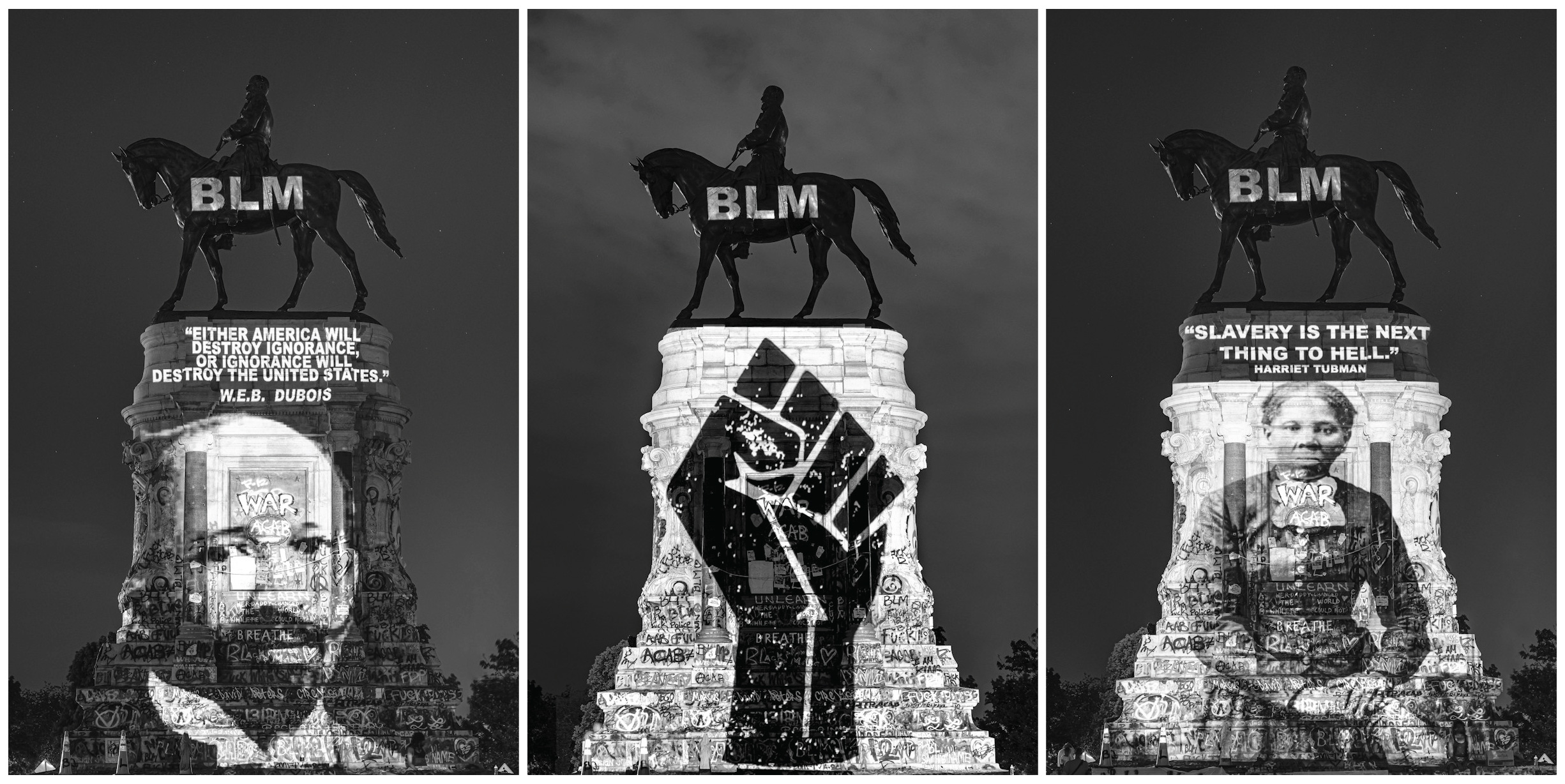
In summer 2020, artists Dustin Klein and Alex Criqui projected images of Black lament and empowerment onto the Robert E. Lee Monument at Marcus-David Peters Circle in Richmond, Virginia, part of their Reclaiming the Monument project. Read more at bottom of post.
Song of the Agitators
“Cease to agitate!” we will, When the slave whip’s sound is still; When no more on guiltless limb Fetters print their circlet grim; When no hound athirst for blood Scours the thorny Georgian wood; When no mother’s pleading prayer, On the sultry Southern air, Quivereth out in accents wild, “Master, give me back my child!” In the day when men shall be Brethren, equal-born, and free— Day for which we work and wait— We will “cease to agitate”!
When our statute books proclaim To the world no more our shame, And a freeman’s rights shall hold Dearer than the Judas gold; When the Polar Star shall give Light to the last fugitive; When our border lakes shall rise On the last lone bondman’s eyes, And their waves for him no more Haste to clasp the Northern shore; In the day when men shall be Brethren, equal-born, and free— Day for which we work and wait— We will “cease to agitate”!
Written by an anonymous abolitionist during the days of race-based chattel slavery in the United States, this poem was originally published in the Ohio Star (Ravenna, OH) in 1852 and was reprinted shortly after in the Anti-Slavery Bugle (Oct. 9, 1852) (Lisbon, OH), the Liberator (Nov. 19, 1852) (Boston), and the Voice of the Fugitive (Dec. 16, 1852) (Windsor, Ontario).
The poem addresses those who, with the status quo working in their favor, would tell the enslaved to stop complaining about the injustices being perpetuated against them, stop ruffling feathers and demanding change, and instead just sit back and be content with the way things are.
The speaker of the poem responds with a defiant no; they and their fellow activists will stop agitating only when their cause is won. When the enslaver’s whip ceases to crack the air, and shackles no longer imprint themselves on ankles and wrists. When bloodhounds are no longer unleashed on freedom seekers, and children are no longer forcibly separated from their parents. When the country’s founding documents are scrubbed of their racism, and its legislation protects the rights of all Americans in equal measure. When the North Star and the Great Lakes are no longer needed to guide people, and offer passage, out of bondage, because everyone is already home and free.
Those who work for justice today still often encounter the demand “Cease to agitate!” “Stop stirring up trouble.” “Don’t be such a downer.” “Why are you so angry?” “Why can’t you just be grateful for the progress we’ve made?” “When will you ever be satisfied?”
Struck by its contemporary relevance, Detroit-born, Vancouver-based musical artist Khari Wendell McClelland adapted the above poem and set it to music. “I sing this song for all those who are living under tyranny, escaping tyranny, and searching for peace,” he wrote in a 2015 Facebook post sharing a demo video.
McClelland’s “Song of the Agitator” appears on his 2018 album, Freedom Singer. The album is dedicated to his great-great-great-grandmother Kizzy, who fled US slavery through the Underground Railroad to Windsor, Ontario, settling in Detroit after slavery was abolished.
While the first stanza he sings almost verbatim from the nineteenth-century source material, the second stanza he reworks to highlight present-day grievances:
Now here we are today Still pushing for equal pay And these treaty rights don’t hold They’re shiny like the Judas gold The stain of blood remains A mother’s only son slain Our kids are crying out for more Continually being ignored
And here’s how he’s adapted the refrain:
On that day we will be Family, equal-born, and free Dawn will come, night will cease We’ll rejoice, mind at ease For that day we’ll work and wait That’s when we’ll cease to agitate
In a Geopoetics podcast interview that aired February 25, 2023, McClelland said, “For some of us, it’s been hundreds of years of incredible terror. And, you know, it’s a great luxury to feel in this moment like something’s wrong.” He continues, “It’s good to be agitated—to want to make things be different. When we start to become a little too comfortable with things being out of sort, being unjust, that’s where . . . it’s a problem. . . . Agitation is actually . . . good fuel.”
About the images above:
The Robert E. Lee Monument in Richmond, Virginia, was erected in 1890 during the Jim Crow era to glorify the Confederate general (who fought against the Union to preserve slavery). A bronze equestrian statue atop a giant plinth in the center of one of the historic city’s traffic circles, it had been controversial from the beginning, with many of Richmond’s Black residents regarding it as an oppressive and traumatic presence.
After the murder of George Floyd, the monument became an epicenter of Black Lives Matter protests as well as a site of vandalism, and Virginia governor Ralph Northam announced on June 4, 2020, that it would be removed. While the legality of that intent was being litigated, light projection artist and Richmonder Dustin Klein, later joined by collaborator Alex Criqui, cast nightly image projections onto the statue—first of Black victims of police violence, and then of Black activists, writers, theologians, artists, and politicians and associated quotes. In October 2020, the graffiti-covered, image-lit Robert E. Lee Monument was declared the most influential American protest artwork since World War II by the New York Times.
On September 2, 2021, the Virginia Supreme Court upheld Northam’s decision, and the statue was removed shortly after.
To view more photos and learn more about Klein and Criqui’s Reclaiming the Monument project, see www.reclaimingthemonument.com.
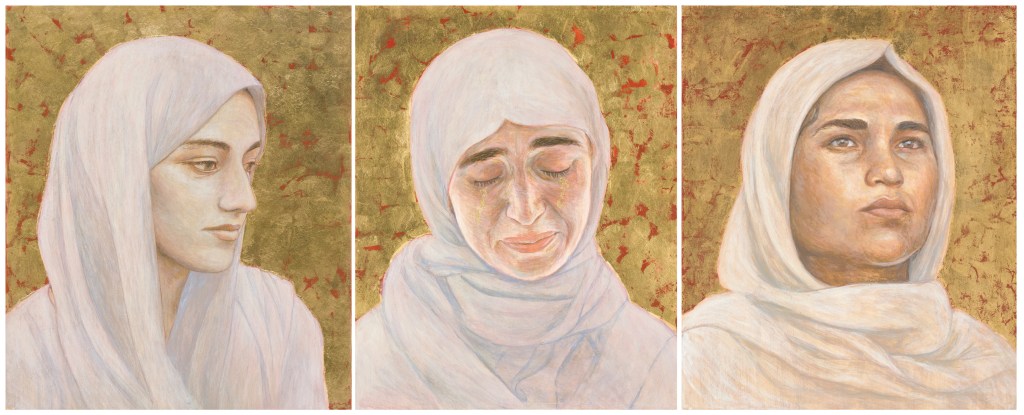
Hannah Rose Thomas, paintings from the Tears of Gold series, 2017. Click image to learn more, and see the Google Arts & Culture exhibition.Nicola Ravenscroft, With the Heart of a Child, 2016. Sculpture installation comprising seven life-size bronze children. The artist calls the figures “eco-earthling-warrior-mudcubs.” Click image for artist interview, and here for a theological reflection.
+++
VISUAL COMMENTARIES: Elijah’s Ascent by Victoria Emily Jones: My latest contribution to the Visual Commentary on Scripture was published this month. It’s a mini-exhibition on 2 Kings 2:1–12, featuring a seventeenth-century Russian icon, a 1944 painting by African American artist William H. Johnson, and a 1985 painting (a Jewish chapel commission) by Polish-born Israeli artist Shlomo Katz. (For more context on the Katz painting, see here.)
+++
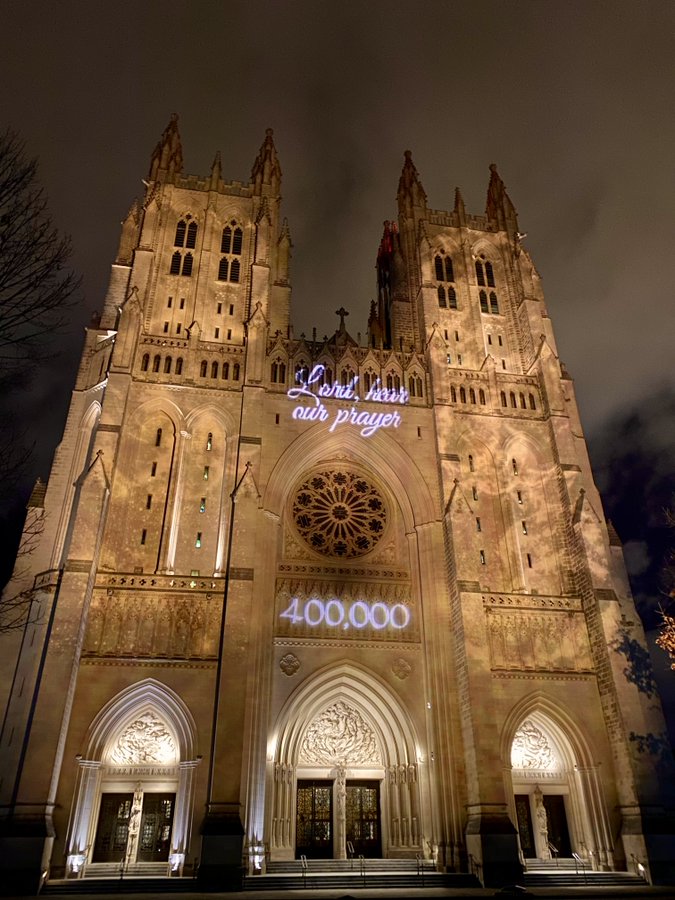
NATIONAL MOURNING:Washington National Cathedral tolled its mourning bell four hundred times Tuesday evening in remembrance of the 400,000 lives lost from COVID in the United States thus far—each ring representing one thousand dead. I spent the thirty-eight-minute livestream lamenting this enormous loss, praying for all those who are grieving and for patients and health care workers, and pleading with God for an end to this virus.
The origami paper doves you see in the video are part of the Les Colombes installation by Michael Pendry [previously], erected in December in the cathedral’s nave to symbolize hope and the Holy Spirit.
+++
MUSIC VIDEO: “For the Sake of Old Times” (Auld Lang Syne): Directed by Tyler Jones of the narrative studio 1504, this short film premiered December 30, 2020, by NPR. “From the pews of a church where white deacons once refused to seat African Americans, a group of Black singers in Alabama reminds us why preserving our memories of this historic year is vital—even if we’d rather just leave 2020 behind.” [HT: ImageUpdate]
“To me the piece is a personal encouragement going into the future,” Jones says, “that we hopefully strive to work together for a kinder future, especially at a time where we are so distanced.” Read about the making of the film at https://n.pr/3n6d8Ct.
+++
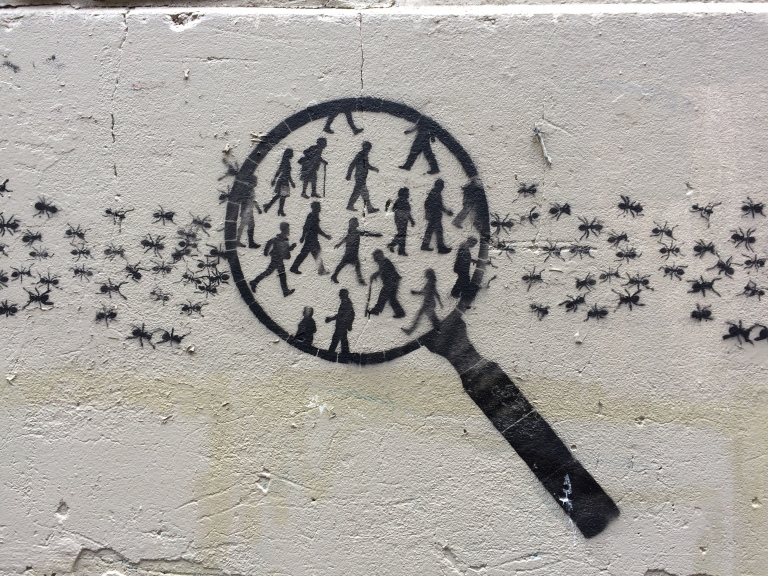
ARTICLE: “On the Gifts of Street Art” by Jason A. Goroncy, Zadok: The Australasian Religious Press Association awarded silver prize for “Best Theological Article” to Jason Goroncy [previously] for this piece. (How cool that it won in the theology category!) Like all art, street art can function as a form of civic dialogue, protest, play, hope, remembrance, etc., but Goroncy discusses how some of its particular qualities uniquely position it to perform those functions: its (usually) unsanctioned and interventionist nature, its fragility and impermanence, its celebration and development of culture, its inseparability from place, and its redefinitions of proprietorship. [HT: Art/s and Theology Australia]
Human Ants, Liverpool Street, Melbourne, Australia. Photo: Jason Goroncy.
“Among the many gifts that street artists offer,” Goroncy writes, “is a proclivity to bear witness to how things are and not merely to how they might appear to be. Such a proclivity involves a telling of the truth about those largely-untampered-with and untraversed spaces of our urban worlds, about what is present but underexposed or disregarded; and even, as Auden hints, to lead with ‘unconstraining voice’ the way toward healing and toward a renewed sense of enchantment, freedom and praise beyond the pedestrian and clamorous. Such a proclivity is also a form of urban spirituality. It can even be a form of public theology.”
This week I’ve been editing and captioning a backlog of photos from my camera, and I’ve come to a batch I took last August from Every Day: Selections from the Collection at the Baltimore Museum of Art, a reinstallation of the museum’s contemporary collection centered on the Black artistic imagination. I thought I’d share some of these photos here as a way to introduce you to some of today’s leading Black American artists.
+++
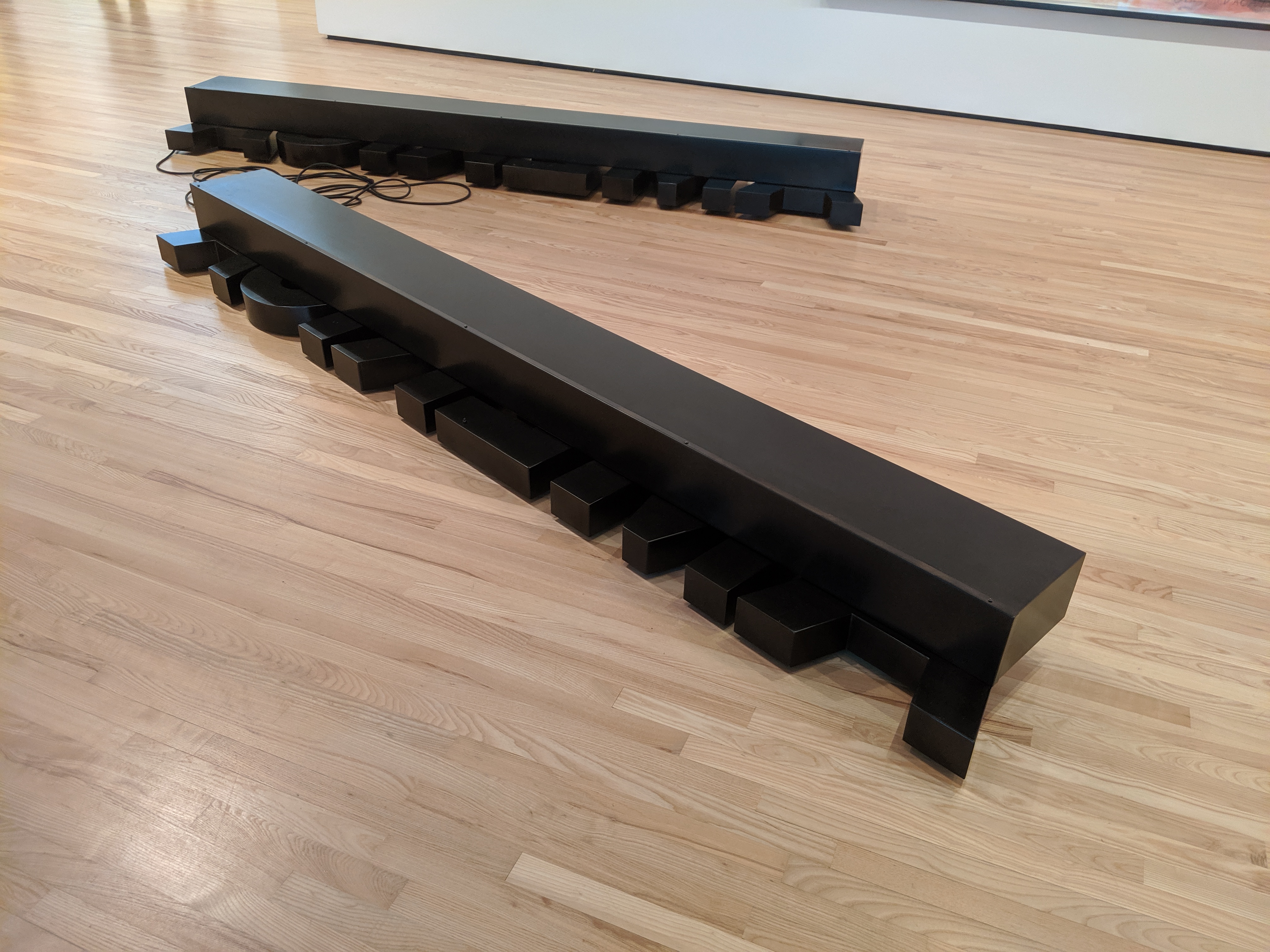
In the first gallery, an untitled neon sculpture by Glenn Ligon confronts the viewer, consisting of two black lightbox letter signs lying face-down on the floor, which each read, with some difficulty, “America.” They emit a flickering white light that pulsates at random. The piece is part of a series of variations on that word—a word, Ligon says, that means different things to different people.
Foreground: Glenn Ligon (American, 1960–), Untitled (America America), 2015. Neon and blackened steel, 22 × 125 × 10 in. each. Baltimore Museum of Art, Maryland. Photo: Victoria Emily Jones.
He said his “double America” motif was inspired by the opening lines of Charles Dickens’s A Tale of Two Cities: “It was the best of times, it was the worst of times, it was the age of wisdom, it was the age of foolishness . . . it was the spring of hope, it was the winter of despair . . .” The wall text continues: “Dickens used a series of opposing statements to capture a moment in European history [1775–92] in which wealth coexisted with poverty, war with leisure and comfort, and aspirational ideals with harsh realities. Ligon sees similar extremes at work in the twenty-first century: ‘There is this sense that America, for all its dark deeds, is still this shining light.’”
In the age of MAGA I’m reminded of a poem by Langston Hughes published in July 1936, “Let America Be America Again,” in which he laments that as a country, we’ve never been what we’ve aspired to be: a place of liberty and justice for all. He loves America and the ideals on which it was founded but is forced to reckon with its failures, pointing out the hypocrisy of a nation that proclaims in its founding document that “all men are created equal” while segregating, disenfranchising, and brutalizing African Americans. (And the poem goes on to cite inequalities experienced by other groups too.) It’s very much in the spirit of Frederick Douglass’s speech less than a century earlier, “What to the Slave Is the Fourth of July?”
Let America be America again.
Let it be the dream it used to be.
Let it be the pioneer on the plain
Seeking a home where he himself is free.
(America never was America to me.)
Let America be the dream the dreamers dreamed—
Let it be that great strong land of love
Where never kings connive nor tyrants scheme
That any man be crushed by one above.
(It never was America to me.)
O, let my land be a land where Liberty
Is crowned with no false patriotic wreath,
But opportunity is real, and life is free,
Equality is in the air we breathe.
(There’s never been equality for me,
Nor freedom in this “homeland of the free.”)
. . .
O, let America be America again—
The land that never has been yet—
And yet must be—the land where every man is free.
. . .
Hear Ligon discuss his art practice in the “A Closer Look” interview from the BMA, below, and zoom in on some of his artworks at Google Arts & Culture.
+++
Behind Ligon’s neon sculpture was a large gouache by Kara Walker titled Terrible Vacation. It was impossible to get a decent photo with the glare on the glass, so here is a professional photo of the painting, unframed, from Sikkema Jenkins & Co.
Kara Walker (American, 1969–), Terrible Vacation, 2014. Gouache on paper, 72 1/2 × 159 1/2 in. Baltimore Museum of Art, Maryland.
Best known for her room-size tableaux of cut-paper silhouettes addressing the history of race in America, here she pays homage to J. M. W. Turner’s 1840 Slave Ship, the Romantic painter’s abolitionist response to the Zong massacre of 1781, in which the captain of a British slave ship en route to Jamaica threw 133 sick enslaved people overboard to collect insurance on them as property “lost at sea.” Human and elemental violence converge in Turner’s painting, as a ship sails through a stormy ocean filled with flailing human limbs in chains.
Walker’s painting after Turner brings this mass murder to the attention of a new public, and though it references the past of England in particular, America, as a fellow player in the transatlantic slave trade, is implicated too.
+++
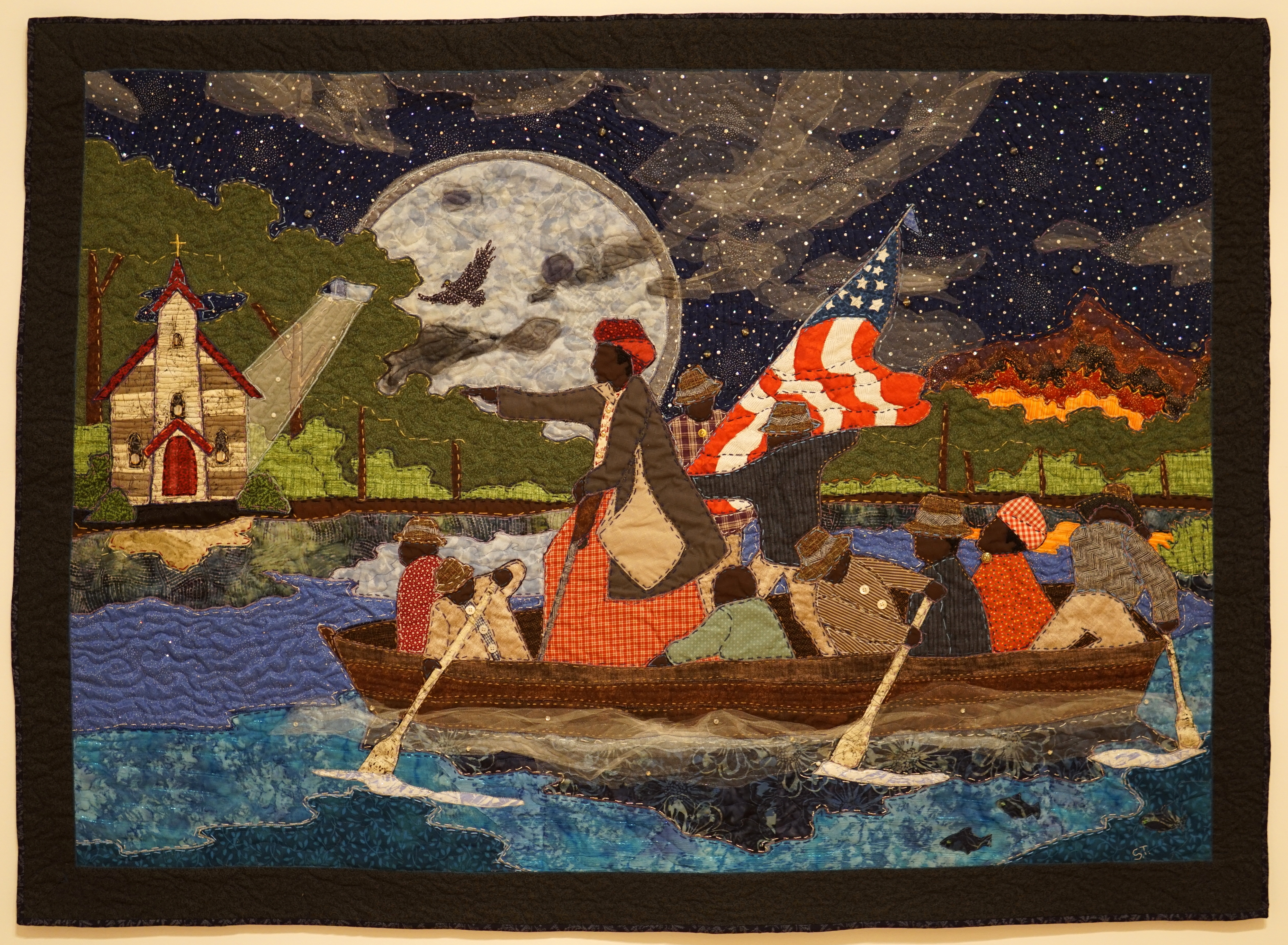
On the left wall was a story quilt by Baltimore artist Stephen Towns [previously], one is a series paying tribute to Harriet Tubman.
Stephen Towns (American, 1980–), We Shall Pass through the Combahee, 2019. Natural and synthetic fabric, nylon tulle, polyester and cotton thread, metallic thread, crystal glass beads, and resin and metal buttons. Baltimore Museum of Art, Maryland. Photo: Victoria Emily Jones.
Titled We Shall Pass through the Combahee, it records the historic military operation, led by Harriet Tubman, known as the Raid on Combahee Ferry, which succeeded in freeing seven hundred-plus slaves. During the Civil War, on June 1–2, 1863, Tubman guided two of Lincoln’s gunboats, peopled with Union Army soldiers, along the Combahee in South Carolina to strategic points near the shore where slaves awaited rescue, avoiding rebel torpedoes along the way.
Towns modeled the scene after Emanuel Leutze’s famous 1851 painting Washington Crossing the Delaware, set during the Revolutionary War, but he recasts Tubman as the American hero, bravely leading her people and her nation to victory. The church in the background likely represents the historic Tabernacle Baptist Church in Beaufort, where the escapees gathered after the raid, further up the river, before being relocated to St. Helena Island. It is illuminated as if by divine light because Tubman always said it was God who gave her direction in making certain critical moves during her many rescue operations—as Underground Railroad conductor and as military leader.
Towns describes the piece, and his complicated relationship to history and patriotism:
To learn about another body of Towns’s work, A Path Between Two Continents, see this video by York College Galleries:
+++
New York–based Afro-Dominican artist Firelei Báez examines through her art the historical narratives of the Afro-Caribbean diaspora, focusing on the politics and cultural ambiguities of place, writes ArtDaily. May 19, 2017, 6:05 p.m. (an idiom playing out its history) at the Baltimore Museum of Art commemorates New Orleans’s removal of its monument to Confederate general Robert E. Lee, erected in 1884, from “Lee Circle.” “It’s a gesture that reacts in time both forward and backwards, almost like a prayer, in solidarity with the people who had to suffer through that space and the resistance moving forward,” Báez said.
Firelei Báez (Dominican American, 1981–), May 19, 2017, 6:05 p.m. (an idiom playing out its history), 2018. Oil, oil stick, and graphite on canvas, 92 × 120 in. Baltimore Museum of Art, Maryland. Photo: Victoria Emily Jones.
Katie A. Pfohl, a curator at the New Orleans Museum of Art, writes about the series to which this piece belongs, which focuses on key chapters from New Orleans’s past:
In these new paintings, Báez overlays figures, symbolic imagery, and calligraphic gestures onto architectural surveys from the 1930s-era Historic American Buildings Survey, a project of the Works Progress Administration, of significant sites across New Orleans. Blurring the lines between past, present, and future, Báez paints new imagery upon these archival drawings, and in the process overwrites the often divisive history these older documents represent. Báez carries portraiture into a space where identity is rooted in history, but can likewise become untethered—and liberated—from it.
Another Báez piece in the BMA’s collection is Convex (recalibrating a blind spot), which consists of a diagram of the American Sugar Refinery in New Orleans overpainted with vibrant colors.
+++
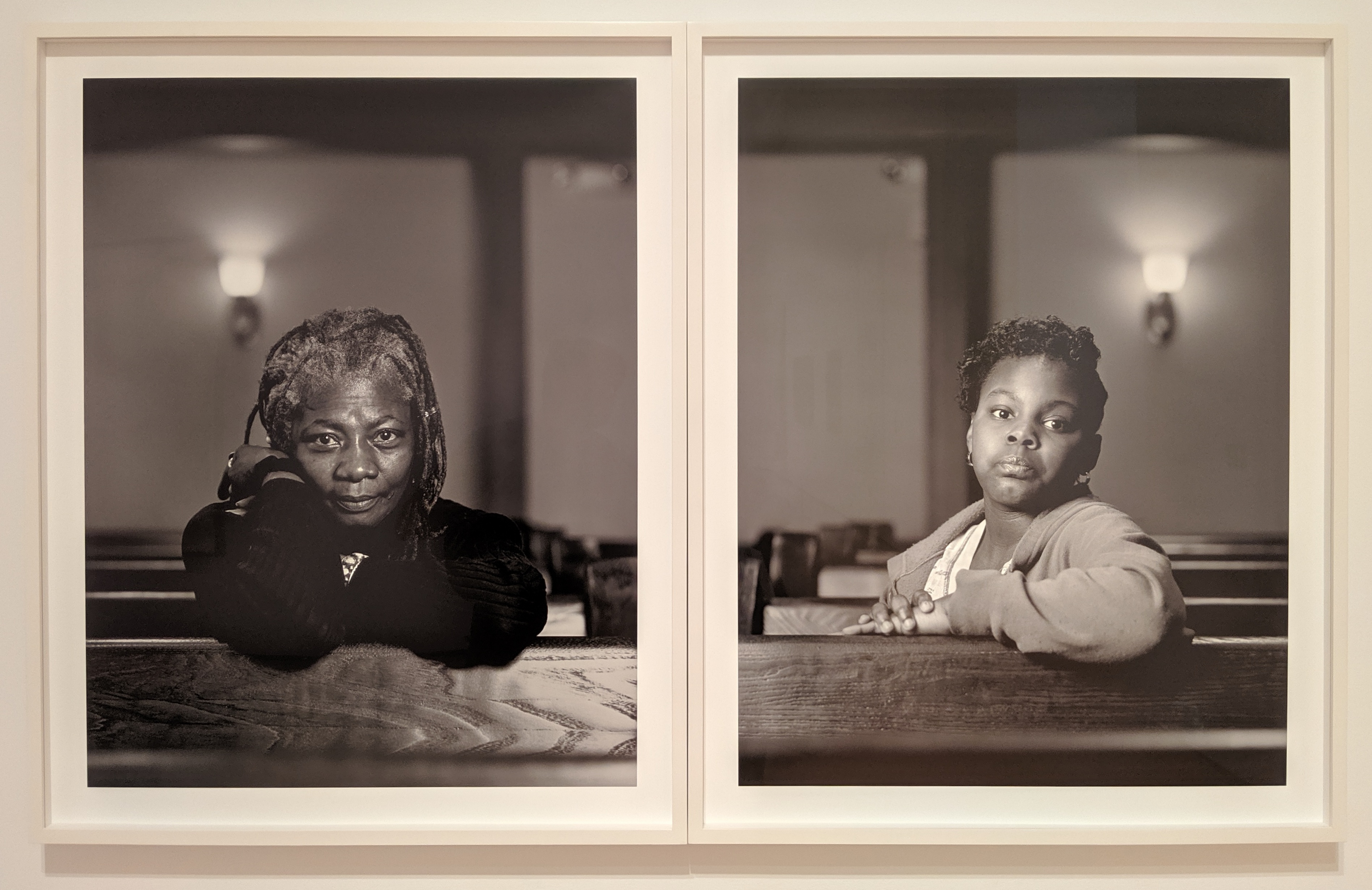
Dawoud Bey (American, 1953–), The Birmingham Project: Mathes Manafee and Cassandra Griffen, 2012. Inkjet prints, pigment-based, 40 × 32 in. each. Baltimore Museum of Art, Maryland. Photo: Victoria Emily Jones.
In the same gallery as the previous four pieces was a photograph diptych by Dawoud Bey, from his Birmingham Project series.
On September 15, 1963, four young black girls—Addie Mae Collins, Denise McNair, Carole Robertson, and Cynthia Wesley—were killed when white supremacists bombed the Sixteenth Street Baptist Church in Birmingham, Alabama. Fifty years later, Dawoud Bey worked with Birmingham residents to memorialize them, to pay “tribute to those who were in Birmingham at that difficult moment and those who have been born since.” He photographed adolescents the same ages as those who had died, and men and women in the fifties and sixties, the ages those young people would be had they lived.
+++
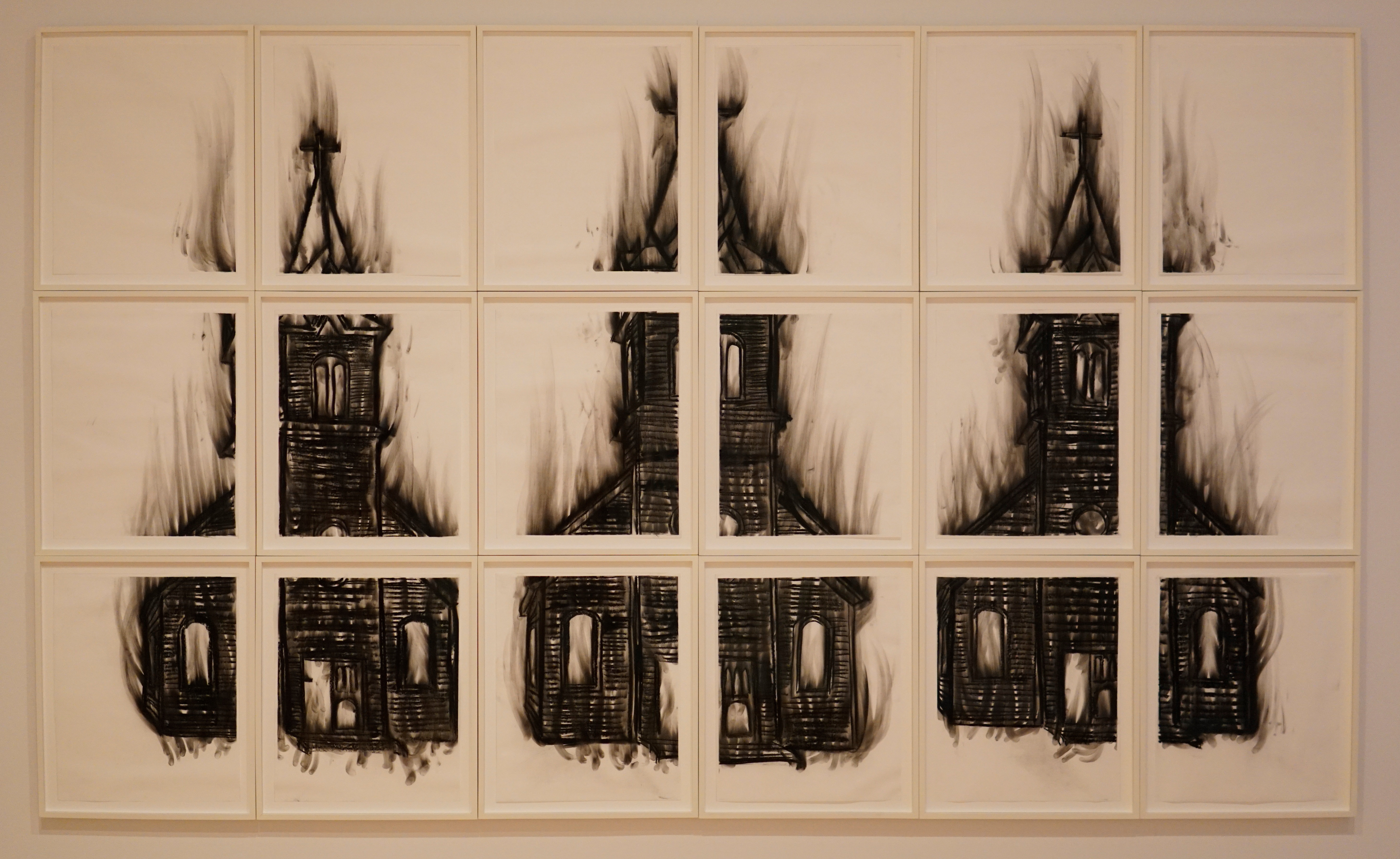
Gary Simmons (American, 1964–), Triple Burn, 2003. Charcoal with smudging on paper, 66 3/4 × 110 1/4 in. Baltimore Museum of Art, Maryland. Photo: Victoria Emily Jones.
Over and over again, white supremacists have sought to terrorize black communities by setting fire to black churches. The 1990s saw an increase in such terrorist acts and images circulated widely of burning churches, past and present. In this drawing, Gary Simmons blended his recollections of these images into a composite picture of a single church, repeated three times. He used his fingers to smudge trails of charcoal dust across the paper, creating ghostly impressions of flames of smoke. “I do this as a way of creating a feeling of something familiar but displaced,” the artist explains. “The image is intended to hang in one’s memory . . . the further one gets from an experience, the more it becomes abstracted.”
Ernest Shaw, a local artist and art educator, points out how the white frames around the paper create crosses, representing crossroads as well as Black spirituality:
+++
How long is a chain?
How long is a change?
How heavy is a chain?
How heavy is a change?
—Melvin Edwards, 1970
Melvin Edwards (American, 1937–), Scales of Injustice, 2017/2019. Barbed wire, chain, and steel. Baltimore Museum of Art, Maryland. Photo: Victoria Emily Jones.
In Scales of Injustice, a steel platform resembling one half of a weighted scale holds a tangle of barbed wire. It is suspended over a length of chain sprawled out on the floor, and the whole scene, sited in a corner, is separated from the viewer by a barbed-wire barrier. This conceptual sculpture by Melvin Edwards is an adaptation of a site-responsive work he exhibited at the Whitney Museum in 1970, Corner for Ana, the title a reference to his young daughter and to the notion of “timeout.”
The materials—steel chain, barbed wire—evoke brutality and oppression. Perhaps it’s change, in a larger sense, that hangs in the balance, precarious and unsure.
Edwards said this re-creation was in response to the death of Pateh Sabally, a twenty-two-year-old Gambian refugee who drowned in the Grand Canal of Venice on January 21, 2017, as onlookers taunted and filmed his struggles and offered no help.
+++
Lorna Simpson (American, 1960–), Easy to Remember (still), 2001. 16 mm film transferred to DVD (black and white, sound); 2:35 min. Baltimore Museum of Art, Maryland.
For this video, Lorna Simpson recorded fifteen professional singers separately humming along to jazz saxophonist John Coltrane’s haunting interpretation of Rogers and Hart’s “It’s Easy to Remember.” Simpson then combined the recordings to create a choir of voices. This layered tune becomes the soundtrack for a grid of moving images, each focused tightly on one singer’s lips. The individuality of each participant emerges in variations among the mouths, a part of the body integrally linked to expression and physicality. The video demonstrates that even within a collective experience, including one of songs and the emotions they conjure, independent voices persist and disrupt.
+++
David Hammons grew up in Springfield (Illinois), studied art in Los Angeles, and then settled in New York City in 1974, where he still lives. Traveling is one of his many “basketball drawings,” which he made by bouncing a Spalding around the streets of Harlem and onto a nine-foot-tall sheet of paper, creating atmospheric gray pebbling that resembles clouds in the sky or light and shadow on the ground.
David Hammons (American, 1943–), Traveling, 2001–2. Harlem dirt on paper and suitcase, 109 5/16 × 41 3/4 × 9 1/2 in. Baltimore Museum of Art, Maryland. Photo: Victoria Emily Jones.
I love the love of place this piece promotes. “Harlem dirt” is listed as the primary material! Hammons is sanctifying the dust of his neighborhood (“the ephemeral stuff of black urban experience”) by bringing it into a high-art context, essentially saying, “My background, my experiences, are worthy.” Martin Herbert, writing for Frieze, discusses the multivalence of the title:
The title of this work, Traveling, evokes many things: the eponymous rule of basketball that says you can’t take the ball and run with it; Hammons’ own movement across the Atlantic and that of the grimy orange sphere across the room; the upward mobility of dirt-into-art, and its direct social analogue—the ‘coming up from the streets’ dream/boast of a million aspiring rappers and pro-court players in environments where, as hip-hopper Mos Def put it, ‘you can either get paid or get shot’.
The artwork juts out from the wall at a slight angle, and one discovers propped behind it a thin brown suitcase.
+++
Like Stephen Towns, Amy Sherald lives in Baltimore. She is known for her large-scale portrait paintings that use grisaille to portray skin tones as a way of “challenging the concept of color-as-race,” and was chosen to paint the official portrait of First Lady Michelle Obama.
Amy Sherald (American, 1973–), Planes, rockets, and the spaces in between, 2018. Oil on canvas, 100 × 67 in. Baltimore Museum of Art, Maryland. Photo: Victoria Emily Jones.
About Planes, rockets, and the spaces in between, Sherald writes,
I wanted the environment to be in what would be perceived as an American landscape. These two figures are witnesses of a very American moment in history. . . . One key thing to note in all of my paintings is that the figures in the work will never be passive participants. Eye contact plays an extraordinary and crucial role in human connection. The figure gazing off at the rocket as she holds her friend’s hand solidifies the moment, as the second figure looks back to meet the gaze of the viewer.
I’ve appreciated how conscientious the Baltimore Museum of Art has been, in the past two years especially, in expanding its collection to better reflect the city it’s in. In 2018 it deaccessioned redundancies in its contemporary holdings to enable the purchase of new works by female artists and artists of color. Such acquisitions “enhance our ability to tell the uniquely varied and layered narratives that exist across the history of art and into the present,” said BMA director Christopher Bedford in a press release.
I also appreciate the video interviews with artists that the museum has been producing, which I hope to see more of.
INTERVIEW:“Singing the Songs of Injustice” with David M. Bailey and W. David O. Taylor: David Bailey is the director of the reconciliation ministry Arrabon and founder of its music-making and liturgical resource arm, Urban Doxology, and David Taylor is an assistant professor of theology and culture at Fuller Theological Seminary. In this conversation the two men discuss how “biblical, angry, congregational worship can help transform our hearts and churches.” “God has given us the psalms to be an ‘anger school’ for us and I’ve discovered that when we skip class, we aren’t emotionally equipped to deal with difficult stuff we’re experiencing now,” Taylor says. “The extraordinary gift of the psalms is that they show us how to pray angry prayers without being overcome by our anger, how to hate without sinning (to borrow from Saint Paul’s language), or, as Eugene Peterson once put it, how to ‘cuss without cussing.’”
Bailey and Taylor talk about the constant simmer of race relations in America, faithful versus unfaithful expressions of anger, the language of “enemy” in the Psalms, the importance of lament in Sunday gatherings and the need for language that expresses the horizontal aspects of what it means to be a Christian, and leading without moderation during turbulent times.
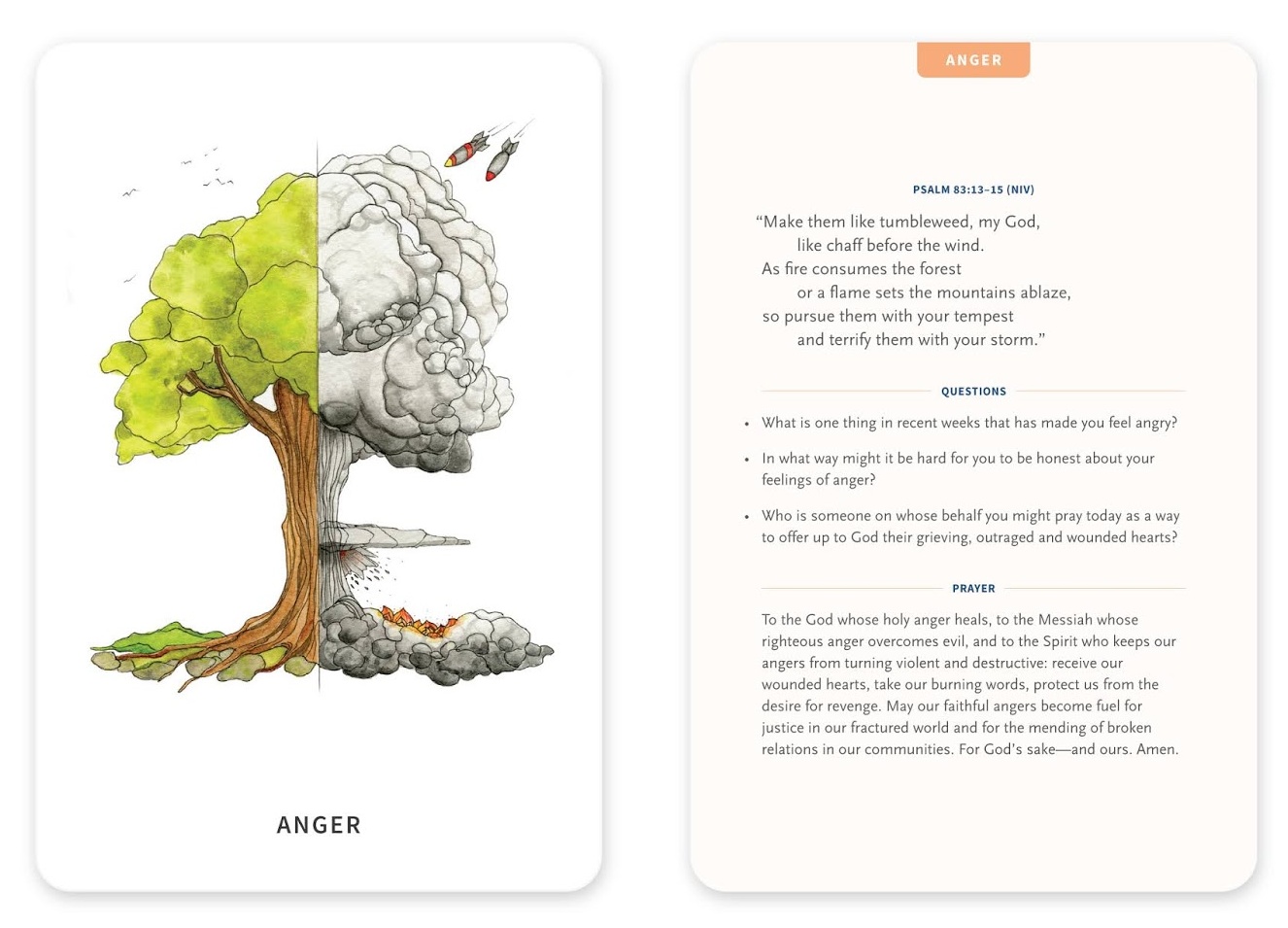
The Psalms of Anger: Prayer Card (illustration by Phaedra Taylor)
Taylor’s latest book, Open and Unafraid: The Psalms as a Guide to Life, contains a chapter on “The Psalms of Anger.” Read an excerpt here, or view this video talk. To coincide with the release in March, he and his wife Phaedra created a set of fifteen prayer cards. His prayer on the “Anger” card reads, “To the God whose holy anger heals, to the Messiah whose righteous anger overcomes evil, and to the Spirit who keeps our angers from turning violent and destructive: receive our wounded hearts, take our burning words, protect us from the desire for revenge. May our faithful angers become fuel for justice in our fractured world and for the mending of broken relations in our communities. For God’s sake—and ours. Amen.”
“I Just Wanna Live” by Johnnetta Bryant, performed by Keedron Bryant: Twelve-year-old gospel singer Keedron Bryant posted a video on Instagram last week of himself singing a song his mom wrote in response to the killing of George Floyd. “God gave me those lyrics” for Keedron, she said in a joint interview on Today. Keedron said he prayed the song, meditated with it, then hit record. It’s a heart-baring, heartbreaking lament, a plea for divine protection in a world that is especially dangerous for young black males.
“It Is Enough!” by R. DeAndre Johnson: R. DeAndre Johnson is the pastor of music and worship life at Christ Church Sugar Land outside Houston. He wrote the lyrics for “It Is Enough!” in July 2016 following the deaths of Alton Sterling and Philando Castile but hadn’t set them to music until now. The nine verses bear the refrain “Kyrie eleison” (Lord, have mercy!), or “Christe eleison” (Christ, have mercy!), a common cry of lament. “There are no words that can contain / The depth of sorrow, grief, and pain / That mothers, sons, and all exclaim: / Kyrie eleison!” Johnson sang the song for his church’s livestreamed service on May 31. A lead sheet is available on his Facebook page. [HT: Global Christian Worship]
“I Want Jesus to Walk with Me”: Sharon Irving is a singer-songwriter, spoken-word artist, and worship leader from Chicago who was also a semifinalist on season 10 of America’s Got Talent. In this video from 2015 she sings a spiritual that expresses deep sorrow—“When my strength is failing,” “When my heart is aching,” “When my life feels like a burden”—but also trust in the companionship of Christ, who walks with us through valleys of death. Having likely originated as an improvisation, the song has several lyrical variations and can be easily adapted to voice a range of feelings: “In my rage,” “In my frustration,” “In my exhaustion,” “In my confusion,” etc.
“O This Night Is Dark” by Tom Wuest: Last Sunday my congregation sang Isaac’s Wardell’s setting of Psalm 126 [previously], whose refrain is “Although we are weeping, Lord, help us keep sowing the seeds of your kingdom . . .” Seeds of love, truth, justice, hope. I just learned that Wardell’s song was inspired by Tom Wuest’s “O This Night Is Dark,” released in 2008 on Rain Down Heaven. In addition to Psalm 126, Wuest’s song also references 1 Corinthians 15, Isaiah 2, Amos 9, and Isaiah 65.
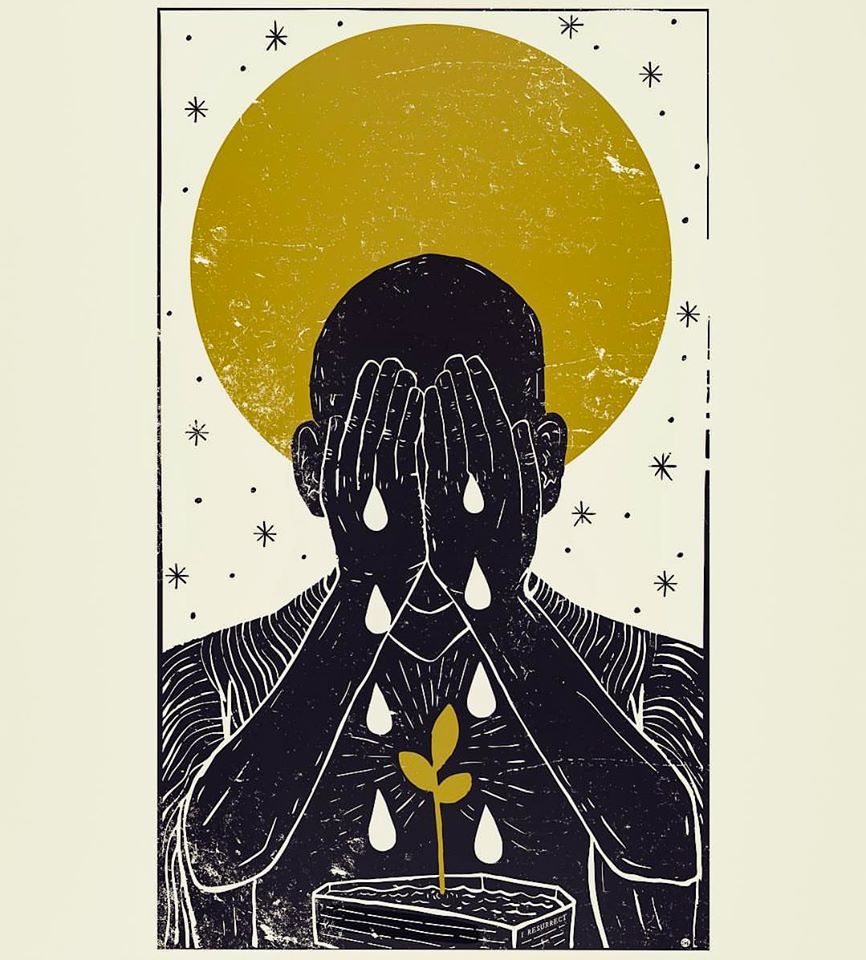
And this week as I was listening to the song, the following image by Scott Erickson showed up on my Instagram feed, with the caption “If one part suffers, all the parts suffer with it” (1 Cor. 12:26).
Scott Erickson (American, 1977–), The Sorrowful Saint, 2016
Erickson painted the image in July 2016 in response to the fatal shootings of Sterling and Castile. It suggests that tears of grief can be generative, that new life can rise out of death. That’s not at all to say that death is good because it catalyzes a movement of change, but that our mourning the evils of racism and murder, our publicly crying out “Enough!,” is not fruitless, though it often seems so. Growth will come.
+++
VIDEO ART: Weight by André Daughtry: “Weight is an attempt to visualize societal projections on the black male body,” writes André Daughtry, a Brooklyn-based interdisciplinary photography and media artist, writer, and performer. The piece is from 2014, and last year PBS’s AllArts station commissioned Daughtry to restage it in New York City as part of a larger video work. [HT: ImageUpdate]
Daughtry has a master’s degree in theology and the arts from Union Theological Seminary and serves as community minister of the arts at Judson Memorial Church, which has a long history of nurturing artists. “We believe that artists have the potential to serve as our modern-day prophets,” the church website reads. “They show us where we’ve been, who we are, and what we can become.”
+++
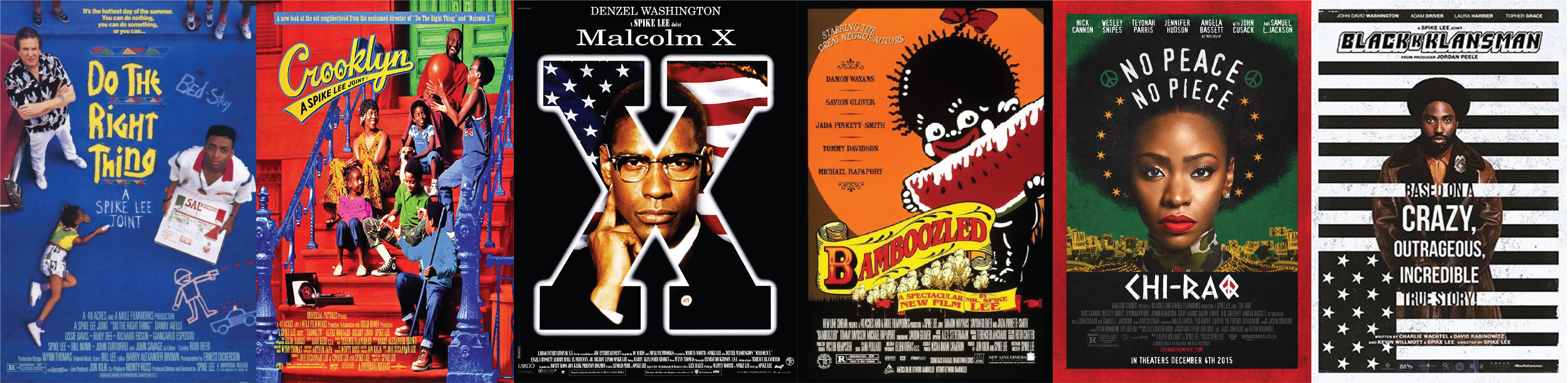
PODCAST EPISODE: “The SPU Conversation About Spike Lee Films,”North by Pacific Northwest: In this Seattle Pacific University conversation released April 11, 2019, two cinephiles, Jeffrey Overstreet and Josh Hornbeck, discuss some of the films of writer-director Spike Lee, “the boldest and brashest auteur in American film” (Guardian). The first several minutes, though, are spent decrying the then recent Oscar win of Green Book, which popular audiences loved but critics were generally sour on because it perpetuates the simplistic and ultimately false notion that to solve racism, white people just need to realize that “we’re all the same” and find a black friend.
Best known for Do the Right Thing (1989), Lee is one of several filmmakers they cite who deals with race in more complex ways, and while some people dismiss him as an “angry black man,” many celebrate him for forcing audiences to reckon with the problem of racism. “I think there should be rage inside of every conscious human being in the world, because there’s stuff that’s just not right,” he said in a 2000 interview. “Anger can be constructive.” Lee’s films are heavy-handed, in-your-face; they shout and unsettle. Heavy-handedness usually makes for bad art, but Overstreet and Hornbeck show how the approach works for Lee.
Starting at 16:44, they focus on the satirical comedy-drama Bamboozled (2000), which joined the prestigious Criterion Collection just this March. (It’s also been the subject of much scholarly study across fields, one instance I’ve come across being an essay by art theorist W. J. T. Mitchell, titled “Living Color: Race, Stereotype, and Animation in Spike Lee’s Bamboozled,” in What Do Pictures Want? The Lives and Loves of Images.) “Under pressure to help revive his network’s low rating, television writer Pierre Delacroix (Damon Wayans) hits on an explosively offensive idea: bringing back blackface with The New Millennium Minstrel Show. The white network executives love it, and so do audiences, forcing Pierre and his collaborators to confront their public’s insatiable appetite for dehumanizing stereotypes.”
From 25:54 onward, Overstreet and Hornbeck discuss more generally their passion for cinema and the importance of revisiting films.
People have been expressing frustration that The Help, a civil rights era drama that sidelines the perspectives of its black characters, is the number one most-streamed movie on Netflix right now. Film critic Alissa Wilkinson gives a list of fifteen movies to watch instead on racial injustice and being black in America. A mix of dramas and documentaries by such filmmakers as Barry Jenkins, Ava DuVernay, Spike Lee, and others, these are black-centered stories that help illuminate where we’re at right now. All are available for online streaming, and Wilkinson provides links to her reviews.










 Art & Theology