The heavens bespeak the glory of God.
The firmament ablaze, a text of his works.
Dawn whispers to sunset.
Dark to dark the word passes: glory glory.

All in a great silence,
no tongue’s clamor—
yet the web of the world trembles
conscious, as of great winds passing.

The bridegroom’s tent is raised,
a cry goes up: He comes! a radiant sun
rejoicing, presiding, his wedding day.
From end to end of the universe his progress.
No creature, no least being but catches fire from him.
This paraphrase of Psalm 19:1–6 by Daniel Berrigan is from Uncommon Prayer: A Book of Psalms(University of Michigan Press, 1978; Orbis, 1998).Used by permission of the Daniel Berrigan Literary Trust. www.danielberrigan.org
The first section of Psalm 19 is about how the natural world declares the glories of its Maker. The night sky, the psalmist describes, is like a tent that spreads its cover over the sun, parting open every morning to release it on the world. The sun is compared to a bright-eyed, handsome, and happy bridegroom emerging from his chamber, and to a vigorous runner who tracks a massive course.
I like to read Psalm 19:1–6 for Advent, especially the poet-priest Fr. Daniel Berrigan’s paraphrase of it, as his use of he/him/his pronouns instead of it/its draws out a Christological connection I hadn’t seen before in this text, made even more pronounced by the apocalyptic tone Berrigan adopts and the sense of excitement he conveys. The poem can, of course, be read as simply the glorious waking of a day, as the psalmist intended. But there’s another layer I want to explore: signs in the heavens, and the coming of Christ.
In the Christian tradition, Jesus is compared to both a sun and a bridegroom, and he, too, like the skies, “bespeak[s] the glory of God.” “Oriens”—Dawn or Dayspring—is one of the traditional titles of Christ, typically invoked in liturgies on December 21 as part of the O Antiphons cycle. From the Church of England’s Common Worship: “O Morning Star, splendor of light eternal and sun of righteousness: come and enlighten those who dwell in darkness and the shadow of death” (cf. Luke 1:78–79; John 8:12; Mal. 4:2). The coming of Jesus—in Bethlehem, in human hearts, and on the last day—illuminates and sets ablaze, revealing who God is and who we ourselves most truly are and exciting the world, flinging abroad the divine light.
As for the bridegroom, Jesus uses this metaphor for himself in his parable of the ten bridesmaids (Matt. 25), as God does in Isaiah 62:5, and indeed one of the major motifs in the book of Revelation is a wedding between Christ and his people. Christ will return to us, scripture suggests, like a husband coming to bring home his new bride.
One of the antiphons for First Vespers of Christmas, I’ve just learned, sung the evening of December 24, connects the bridegroom of Psalm 19 with Jesus. Cum ortus fuerit sol de caelo, the church chants, videbitis Regem regum procedentem a Patre, tanquam sponsum de thalamo suo. (“When the sun shall have risen in the heavens, ye shall see the King of kings coming from the Father, as a Bridegroom from his bride-chamber.”)
Tanja Butler (American, 1955–), Woman Clothed with the Sun, 2008. Acrylic paint, collaged painted paper, and cotton fabric on gessoed acid-free paper, 14 × 5 in. Collection of Victoria Emily Jones.
Artist Tanja Butler further extends Psalm 19’s fittingness for Advent by drawing the passage into conversation with Revelation 12:1–6. This section of John’s Apocalypse introduces us to “a woman clothed with the sun, with the moon under her feet, and on her head a crown of twelve stars”; she gives birth to a baby boy “who is to rule all the nations” but whom a great dragon seeks to devour. In most Christian interpretations, this Woman of the Apocalypse is associated with the Virgin Mary, and there’s a robust iconographic tradition in this vein.
Butler innovates on that tradition with her mixed-media work Woman Clothed with the Sun by showing the infant Jesus busting out of his mother’s womb like the strong athlete of Psalm 19:5. (Ready. Set. Go!) He has a race to run, a mission to fulfill. He is also shown as the sun that clothes his mother and that emerges from a dark (uterine) tent. He is the source and center point of the explosive rays of colorful light in the painting.
In an ArtWay profile, Butler describes her piece as follows:
Mary is represented with the unborn Christ, Light of the World, ready to “come forth from his pavilion, like a champion rejoicing to run his course” (Psalm 19:5). She holds a ladder, referencing both Jacob’s vision and the cross, the ladder of ascent between earth and heaven.
This is a cosmic birth necessitated by a cosmic struggle that will resolve in a cosmic victory: the reunion of God and humanity.
Daniel Joseph Berrigan, SJ, (1921–2016) was an American Jesuit priest, peace activist, award-winning poet, and professor of theology and biblical studies. Through his writings and public witness, he endorsed a consistent life ethic, opposing war, nuclear armament, abortion, capital punishment, and the causes of poverty in the name of Jesus Christ and his holy gospel. Fr. Berrigan, along with his brother Philip, was one of the Catonsville Nine, imprisoned in 1968 for destroying draft files in a protest against the Vietnam War. Later, he spent much of the eighties ministering to AIDS patients in New York City. He is the author of some fifty books.
Tanja Butler (born 1955) is a painter and liturgical artist based in the Albany, New York, area. Her subjects are devotional in character, and her sources of inspiration include Byzantine icons, medieval art, and folk art. Her work is included in the collections of the Vatican Museums, the Hammer Museum in Los Angeles, the Portland Museum of Art in Maine, and the Boston Public Library. “My aim is to develop imagery that has the simplicity and clarity of a child-like vision,” she says, “required, we’re told, if we are to see the kingdom of God.”
To him who loves us and freed us from our sins by his blood and made us a kingdom, priests serving his God and Father, to him be glory and dominion forever and ever. Amen.
Look! He is coming with the clouds; every eye will see him, even those who pierced him, and all the tribes of the earth will wail on account of him.
So it is to be. Amen.
—Revelation 1:5b–7
LOOK: The Last Judgment by Jan van Eyck
Jan van Eyck (Netherlandish, ca. 1390–1441), The Last Judgment, ca. 1436–38. Oil on canvas, transferred from wood, 22 1/4 × 7 2/3 in. (56.5 × 19.7 cm). Metropolitan Museum of Art, New York.
What is your reaction to this image? Terror? Awe? Gratitude? Disgust? Intrigue? Indifference?
I’m often repulsed by how the Last Judgment was interpreted by medieval and Renaissance artists, with graphic displays of torture intending to compel people to righteous living through fear. To be sure, the subject has made for some truly remarkable paintings, full of fantastical grotesqueries and masterfully executed—like this one—but I worry that the scare tactics such paintings use are not helpful and are even harmful.
Nonetheless, the Last Judgment is an unavoidable topic in scripture. The Bible refers several times to God as judge and describes a final accounting of sin upon Christ’s return, resulting in reward for the righteous and punishment for the unrighteous. It’s also in our creeds: “He [Jesus Christ] will come again to judge the living and the dead” (see 2 Tim. 4:1; 1 Pet. 4:5). Those who seek to be faithful to scripture must reckon with the idea of the Last Judgment. Advent, which is penitential in character, has historically been a period for the church to do that. As the Episcopal priest and author Fleming Rutledge points out in her published collection of Advent sermons, judgment is one of the four traditional themes of the season—the other three being death, heaven, and hell.
The early Northern Renaissance master Jan van Eyck’s Last Judgment from ca. 1436–38 is one of history’s most famous and most gruesome. “The diabolical inventions of Bosch and Brueghel,” writes art historian Bryson Burroughs, “are children’s boggy lands compared to the horrors of the hell [van Eyck] has imagined.”
The midground portrays the resurrection of the dead, who rise up out of their graves on land or at sea to be judged by Christ. One of the inscriptions on the frame is Revelation 20:13: “And the sea gave up the dead which were in it; and death and hell delivered up the dead which were in them: and they were judged every man according to their works.”
In the center Saint Michael the Archangel, dressed in his jewel-studded armor and with sword unsheathed, stands atop the giant batlike wings of Death personified, which are inscribed with the words CHAOS MAGNVM (“great chaos”) and UMBRA MORTIS (“shadow of death”). Death is a skeletal figure who excretes the damned through his bowels into hell’s dark slime, where bestial demons tear at, choke, devour, crush, and impale them. One man’s legs are being ripped apart at the anus.
Even kings and clergymen are part of the tragic death-heap—see the bishop’s miter, the cardinal’s galero, the royal crown. Not all who say, “Lord, Lord,” will enter heaven (Matt. 7:21); even the most outwardly pious will have their sins exposed on the last day, and those who prove to be hypocrites, who have harmed others and shamed God without repentance, will be thrown into the pit.
Shooting down like arrows into this pit is the double inscription ITE VOS MALEDICTI IN IGNEM ETERNAM (“Go, ye cursed, into everlasting fire”), taken from Matthew 25:41. And Deuteronomy 32:23–24, a warning from God via Moses to the people of God in their disobedience, is one of the inscriptions on the frame:
I will heap mischiefs upon them; I will spend mine arrows upon them. They shall be burnt with hunger, and devoured with burning heat, and with bitter destruction: I will also send the teeth of beasts upon them, with the poison of serpents of the dust.
Perhaps your chest is tightening right now, your stomach churning. How does this picture cohere with the God of love and mercy?
Look up.
See Jesus Christ, the Son of Man, coming in glory. See his glowing stigmata, beacons of love and mercy. He is dressed in a long, red, open mantle and is barefoot, revealing all five wounds. All around him, angels bear the instruments of his passion: the cross, the three nails, the crown of thorns, the lance, the sponge-tipped reed. See him flanked by all the ranks of the redeemed, including, on a larger scale, the Virgin Mary and John the Baptist, the first two witnesses of Jesus’s divinity.
VENITE BENEDICTI PATRIS MEI, read the inscriptions fanning out from Christ’s elbows: “Come, ye blessed of my Father” (Matt. 25:34). This good word is taken from Jesus’s parable of the sheep and the goats, in which he teaches that those who feed the hungry, clothe the naked, shelter the immigrant, care for the sick, and visit the imprisoned will be honored by God on the last day.
Another benediction is inscribed on the picture’s frame:
And I heard a loud voice from the throne saying,
“See, the home of God is among mortals. He will dwell with them; they will be his peoples, and God himself will be with them and be their God; he will wipe every tear from their eyes. Death will be no more; mourning and crying and pain will be no more, for the first things have passed away.” (Rev. 21:3–4 NRSV)
Van Eyck’s Last Judgment does not stand alone. For centuries it has been configured as a diptych (two-paneled artwork) with a Crucifixion on the left and is thus intended to be read in light of God’s supreme act of vulnerable love and self-giving:
Jan van Eyck (Netherlandish, ca. 1390–1441), The Crucifixion; The Last Judgment (with recently conserved frame), ca. 1436–38. Oil on canvas, transferred from wood, each panel 22 1/4 × 7 2/3 in. (56.5 × 19.7 cm). Metropolitan Museum of Art, New York.
Originally these two paintings very likely served as the wings of a triptych with a painted or sculpted centerpiece, or as the doors to a tabernacle or reliquary shrine. In 2019 the Metropolitan Museum of Art had the frames restored from their modern brass color to their original red.
So, what are we to make of this image today? Is there value in meditating on it?
I’ve presented it here, so I think it’s definitely worth knowing about. It’s a stunning art object that gives us a glimpse into the religious imagination of late medieval Christians. But I would also advise caution, especially to those who have been traumatized by hell teachings in the past. While Christians are called to cultivate a holy fear of God, a soberness around the weight of our sin and the power of God’s justice, this fear is not supposed to be the kind of fear that induces anxiety or paralyzes. That kind of fear will never lead us to love God.
We are never meant to think on hell apart from the grace Christ extends to us with his pierced and outstretched hands, which plead our case before God. Van Eyck holds both together in this painting, but the more visually immersive bottom half seems to indulge some pretty sick fantasies that could well generate an unhealthy fear of God if one were to stay stuck there, not to mention create the false impression that God is monstrously vindictive.
There is debate within Christianity, and has been since the patristic era, whether Jesus’s justice is merely punitive or ultimately restorative—that is, whether hell is a place of eternal conscious torment or a place where one is purged of evil and that will in the end be emptied. (There is biblical support for both views, which I won’t get into here.) There is also disagreement as to whether the Bible’s language about hell, such as its being a place of “fire” and “brimstone” (sulfur) (e.g., Rev. 21:8), is meant to be taken literally or figuratively.
Whatever the duration, physical nature, and ultimate purpose of hell, I want to emphasize that biblical passages about the Last Judgment ought not drive us to despair; they should drive us into the arms of Christ, who receives into his presence all those who trust in his merits and turn from their wickedness. The wounds that Christ so prominently displays in van Eyck’s painting are tokens of divine forgiveness as well as a model of the kind of selfless love we are to follow, a love vulnerable enough to receive injury but never to inflict it. Those who tumble into the depths of the underworld to be ravaged by externalizations of their own destructive evils have rejected the call to “do justice, love mercy, and walk humbly with [their] God” (Mic. 6:8). Many of them are ones who on earth bore much power but used it to abuse others or were neglectful.
For more on the characterization of Jesus as judge in the art and theology of the Middle Ages (whose influence was felt in the Renaissance and later eras), see chapter 2, “The Judge,” of Jesus through Medieval Eyes by Grace Hamman. “The promise of answering unanswered evil, acknowledging the recognized and unrecognized wrongs of the mortal world—everlasting justice and compassion—is ultimately what Christ the Judge signifies. It’s a promise, a prophecy, and a call for action now,” Hamman writes (28). She discusses how neighborliness and fear of God are twinned: “Am I seeing the immortal being, the image of God, Jesus himself, in every person I encounter?” medieval imagery prompted viewers to ask (37). “Jesus the Judge reminds us of our divine community and invites a fear that guides us to love our neighbor as we love ourselves. . . . Fear of Jesus the Judge becomes a gift for our practice of justice, in the radiant light of his justice. Such a fear softens flinty hearts” (21, 36). In the chapter Hamman does also acknowledge the complications and misuses of fear in the medieval church and its legacy today.
I urge you to consider the van Eyck diptych in light of the retuned hymn below as you meditate on Christ’s return and his role as judge.
LISTEN: “Lo! He Comes with Clouds Descending” | Words by Charles Wesley, 1758 | Music by Thomas Vito Aiuto, 2012 | Performed by the Welcome Wagon on Precious Remedies Against Satan’s Devices, 2012
Lo! he comes with clouds descending, once for favored sinners slain; thousand, thousand saints attending swell the triumph of his train.
Ev’ry eye shall now behold him, robed in dreadful majesty; those who set at naught and sold him, pierced, and nailed him to the tree, deeply wailing, deeply wailing, shall the true Messiah see.
Ev’ry island, sea, and mountain, heav’n and earth, shall flee away; all who hate him must, confounded, hear the trump proclaim the day: Come to judgment, come to judgment! Come to judgment, come away! Alleluia, alleluia! God appears on earth to reign.
The dear tokens of his passion Still his dazzling body bears, Cause of endless exultation To his ransomed worshippers. With what rapture, with what rapture Gaze we on those glorious scars! Alleluia, alleluia! God appears on earth to reign.
Yea, amen! Let all adore thee, high on thine eternal throne; Savior, take the pow’r and glory, claim the kingdom for thine own. O come quickly, O come quickly; everlasting God, come down. O come quickly, O come quickly; everlasting God, come down. O come quickly, O come quickly; everlasting God, come down.
I’m struck by the bright, celebratory, homey tone of the new tune Rev. Vito Aiuto gave this old Wesley hymn about Christ’s second coming. One might expect, with its verses about judgment, to have a dark or foreboding tone. But for those who are in Christ, his return, and even the day of judgment, will be an occasion of rejoicing!
Note that “dreadful” here is used in the archaic sense of inspiring awe or reverence.
This post is part of a daily Advent series from December 2 to 24, 2023 (with Christmas to follow through January 6, 2024). View all the posts here, and the accompanying Spotify playlist here.
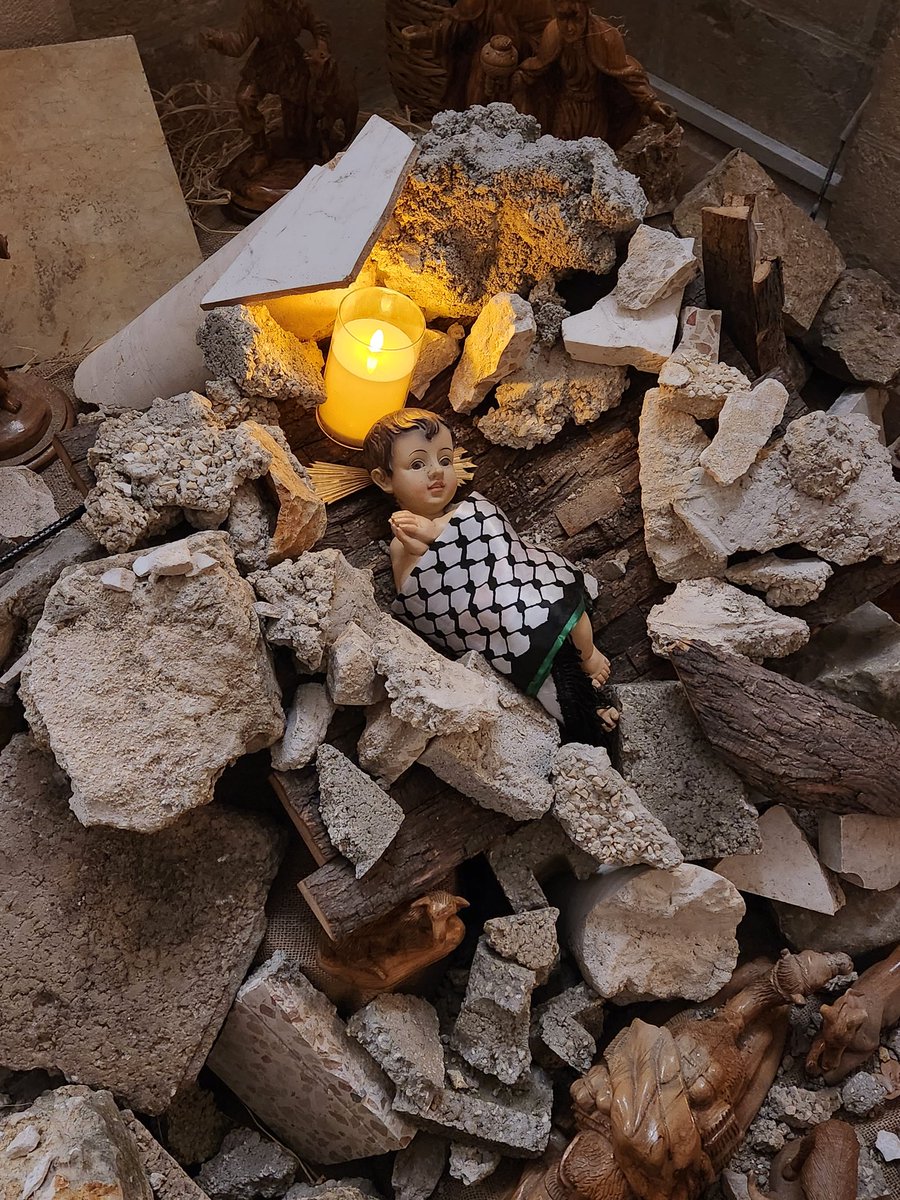
It shows the baby Jesus wrapped in a black-and-white checkered keffiyeh (Palestinian headdress) and lying in a pile of rubble while Mary, Joseph, the shepherds, the wise men, and the animals search for him. It is situated at the side of the altar in Bethlehem’s Evangelical Lutheran Christmas Church, which Rev. Dr. Munther Isaac, a prominent Palestinian Christian peacemaker, pastors. He said he wants the world to know that this is what Christmas looks like in Palestine this year, and for his own congregation to know the solidarity of Christ with the oppressed. Al Jazeera ran a news segment on the crèche on Tuesday, which features an interview with Isaac:
Since October 7, over 16,000 Palestinians have been killed by Israeli forces, and almost 1.9 million Palestinians (over 80 percent of the population) have been displaced. Morgues and hospital halls are overflowing in Gaza, and many people remain trapped under buildings felled by air strikes.
“In Gaza today, God is under the rubble. He is in the operating room,” Isaac wrote on Instagram. “If Christ were to be born today, he would be born under the rubble. We see his image in every child killed and pulled from under the rubble. In every child in incubators.” He expanded on these sentiments in a sermon preached October 22, titled “God Is Under the Rubble in Gaza,” reproduced in Sojourners. See also this video clip of Isaac explaining why his church chose to display such a scene in their sanctuary.
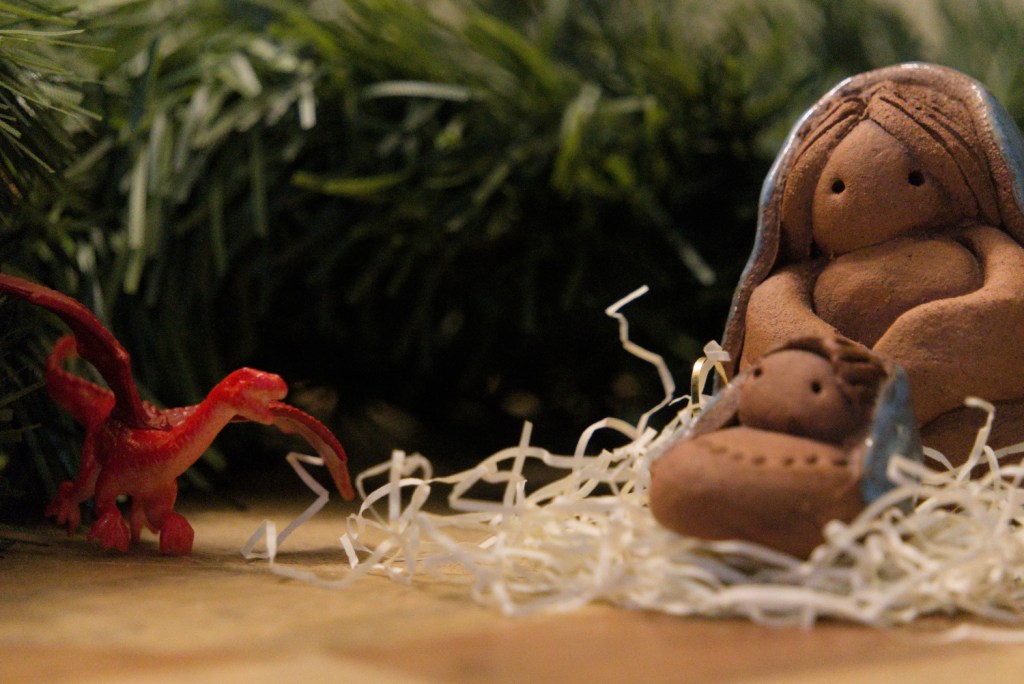
BLOG POST: “When a Dragon Tried to Eat Jesus: The Nativity Story We Don’t Talk About” by Chad Bird: “I’m still searching for a Christmas card with a red dragon in the nativity, lurking amidst the cows and lambs, waiting to devour the baby in the manger,” writes Bible scholar Chad Bird [previously]. “None of the Gospels mention this unwelcome visitor to Bethlehem, but the Apocalypse does. John paints a seven-headed, ten-horned red dragon onto the peaceful Christmas canvas. You can read all about it in Revelation 12. It’s the nativity story we don’t talk about. A dragon trying to eat our Lord . . .”
I’ve been wanting to write a long-form essay on this topic for some time—the dragon as a character in the Christmas story; a cosmic battle underlying our cozy little crèches. I would pull in iconography of the Woman of the Apocalypse and the treading of the beasts, as well as some Christmas songs and poems that reference the dragon. I won’t get around to it this season . . . but it’s coming sometime!
For now, I simply offer Chad Bird’s wonderful blog post to get you thinking about it. Since it was published in 2016, I’ve started seeing more people bringing it up. In 2019, Glen Scrivener, a minister in the Church of England, released the kids’ video “There’s a Dragon in My Nativity,” with illustrations by Alex Webb-Peploe and animation by Diego M. Celestino:
In 2020, Rev. Yohanna Katanacho, a Bible professor in Nazareth, wrote “The Christmas Dragon” for Radix, a retelling of the Nativity story through the lens of Revelation 12. And in a Christianity Today article published last December, Julie Canlis recommended adding a red dragon to your nativity set! Apparently some families have been doing this for years, such as the Gowins and the Palpants:
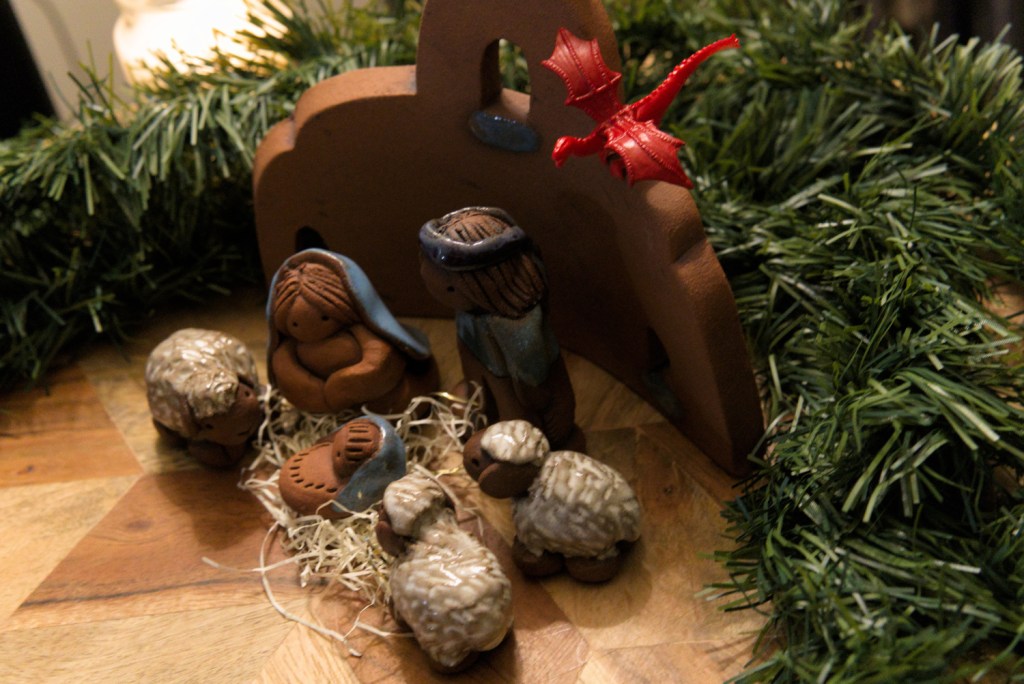
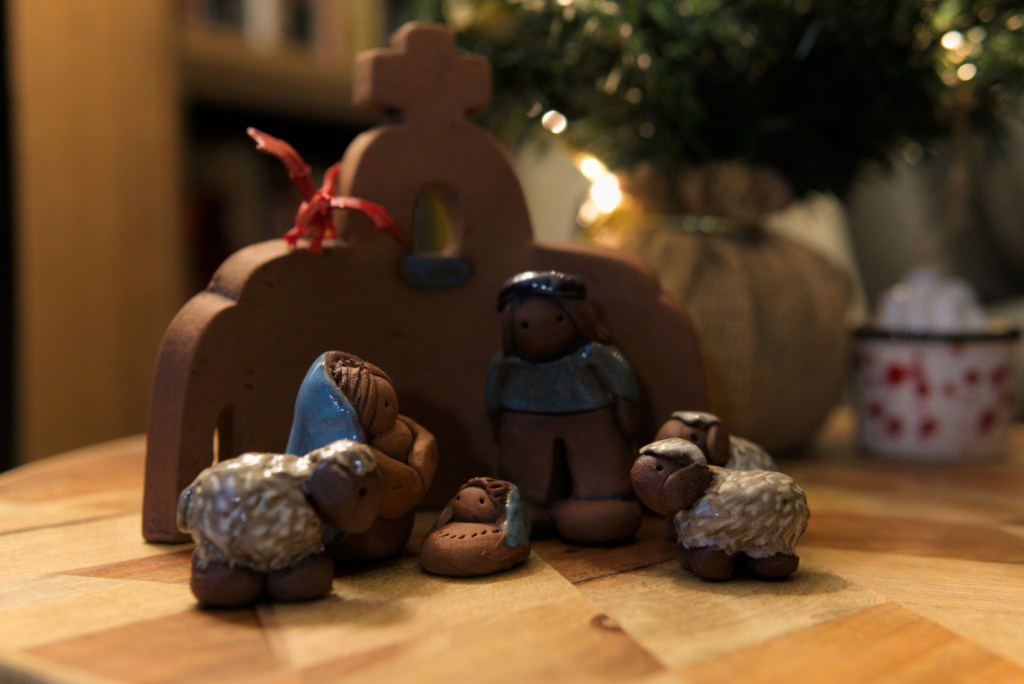
This year I bought a little plastic dragon myself to add to my household nativity! Below are some photos my husband and I took. The clay figurines and adobe-style backdrop were made by Barbara Boyd, an artisan from New Mexico. (I bought them in 2016 at a festival in Albuquerque.)
The dragon was part of a cheap multipack from Amazon, and there are twenty-three other dragons that I don’t know what to do with—so if you live in the US and you want one, shoot me an email at victoria.emily.jones@gmail.com and your physical mailing address and I’ll send you one! The first three respondents get a red one. None of them are seven-headed or horned per Revelation (a gap in the Christmas market, perhaps?!), but they still convey the gist.
+++
LECTURE: “What Is God’s Future for the World?: An Eschatological Vision for the Kingdom on Earth” by N. T. Wright: This talk on inaugurated eschatology, on heaven and earth coming together redemptively and new-creatively, was delivered at the Fuller Forum at Fuller Theological Seminary on May 3, 2014. Any time we talk, sing, or preach about the return of Christ and the end, Wright says, we’re really using signposts that point into a bright mist. But we need those signposts. Wright seeks to dispel the popular belief that humans’ ultimate destination is some disembodied existence “up there” and instead have us embrace the ancient vision of this world as the site of the Messiah’s eternal reign and these bodies as participants, a vision of creation made new from the old. To believe that God will eventually abandon the world to the forces of human wickedness or entropy and decay instead of claiming it as his own undermines the entire narrative of scripture. Wright makes his case by way of the books of Genesis, Isaiah, Ezekiel, Daniel, the Psalms, the Gospels, Romans, and Revelation—the whole gamut.
“The Jewish vision of God’s ultimate future was never that people would leave this world and end up somewhere else called heaven in the company of God. . . . When eschatology comes into full focus, . . . it is all about God’s kingdom being set up on earth as in heaven, and indeed on earth by means of heaven.” He continues, “Heaven is the place where God’s future purposes are stored. And the New Jerusalem comes down from heaven to earth so that the dwelling of God is with humans.”
There’s so much more I could say—but instead of reading my takeaways, listen to the talk itself! It ends at 1:04:45 and is followed by an hour of Q&A. Here is a list of the questions with time stamps:
1:05:33: What is your reading of 2 Peter 3:10–12, which says that the earth will be burned up?
1:08:18: What does Paul mean in 1 Thessalonians 4:17: “Then we who are alive, who are left, will be caught up in the clouds together with them to meet the Lord in the air, and so we will be with the Lord forever”?
1:13:05: Where do you land on premillennialism, amillennialism, postmillennialism?
1:15:42: If earth is already crowded, how will everyone fit in the renewed creation after the resurrection?
1:21:42: If this world is going to be renewed, why should we make economic and lifestyle sacrifices now to protect endangered species and such?
1:24:18: How do you interpret John 14:3: “I go and prepare a place for you; I will come again and take you to myself”?
1:27:48: How do you understand hell? What are your thoughts on the teaching of universal restoration, the idea that everyone will eventually be saved?
1:33:48: Since you take issue with Michelangelo’s Last Judgment, what would you have painted at the east end of the Sistine Chapel instead?
1:34:17: How does Paul’s “now and not yet” correlate with Jesus’s teaching that “this generation will not have passed away before all this has happened” (Matt. 24:34; Mark 13:30; Luke 21:32)?
1:36:59: What is the role of departed saints (the “cloud of witnesses”)? What are your thoughts on the intercession of the saints?
1:41:17: What are your words of advice for preaching on these subjects and for pastorally caring for congregants who come with certain stock images of and language about heaven?
1:44:30: Since we believe in Jesus’s bodily resurrection, where is Jesus now?
1:46:28: Please give us some guidance on Paul’s view on homosexuality and how to address this complex issue in the church.
1:52:16: Is there any sense in which the State of Israel founded in 1948 could be the fulfillment of biblical prophecy?
1:56:40: What impact do you hope your work has on Christian discipleship?
2:10:34: What’s the relationship between faith and action?
Oh, and at 1:18:58, Wright offers this rousing sidebar on Christian art:
We are starved imaginatively as Christians. Christian art easily collapses into sentimentalism, just as contemporary postmodern art easily collapses into brutalism. Both of those are ways of seeing something but not the whole picture. Sentimentalism is what you get when you’re determined to smile even if the whole world is falling apart; it becomes inane, this sort of silly grin, and sadly, there’s a lot of Christian art like that.
But actually, Christians ought to be at the forefront of the art and the music, because that creates the imaginative world within which it’s possible to think differently about things. I think the secular world has done a pretty good job, and we’ve colluded with that, of keeping our imaginative levels down to the level of eighteenth- and nineteenth-century Epicureanism or deism, so that heaven is just this odd place, etc., etc. We need the new art and the new music which will create a world in which it makes sense to think of these things.
+++
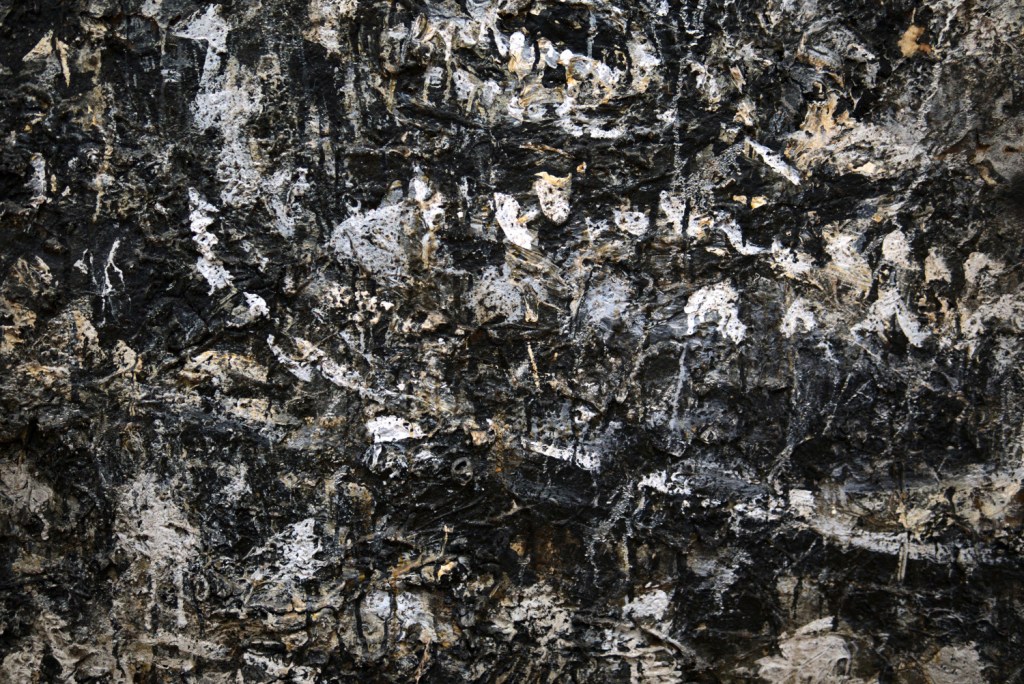
BLOG POST: “Advent Love and Anselm Kiefer’s Alchemist” by Alexandra Davison: I grew up, and my parents and sibling still live, in a suburb of Raleigh, North Carolina, so I’m a somewhat frequent visitor to the North Carolina Museum of Art. Their untitled triptych by Anselm Kiefer is one of my favorite pieces in their collection—it transfixes me every time—so I was delighted to see that Alexandra Davison [previously], a creative director of Artists in Christian Testimony International whom I bump into at arts conferences now and again, wrote about it a few years ago. She describes it as an image of “cosmic drama that waits for resolution,” conveying “an unflinching Advent longing.” I sense that too when I stand in front of it.
Anselm Kiefer (German, 1945–), Untitled, 1980–86. Oil, acrylic, emulsion, shellac, lead, charcoal, and straw on photograph, mounted on canvas, with stones, lead, and steel cable, overall 130 1/4 × 218 1/2 in. North Carolina Museum of Art, Raleigh. Photo: Victoria Emily Jones.
Kiefer is the subject of an acclaimed new documentary by Wim Wenders (which I’m eager to see when it comes to streaming!). He was born in Germany at the tail end of World War II, and his art, which often incorporates materials such as lead, ash, and straw, is inextricably connected to the ravaged landscapes and haunted history of his country.
Jacques Richard Sassandra (French, 1932–), Le buisson ardent (The Burning Bush), late 1980s. Oil on canvas, 110 × 272 cm. Collection of the artist.
Last year when I was corresponding with the artist Sassandra about the New Jerusalem collage from his Apocalypse series, he sent me some photos of this painted triptych on the same subject. It’s called The Burning Bush. When open, it’s about nine feet across, and it shows Christ as the Good Shepherd standing in the river of life, which waters the roots of the tree of life, whose leafy branches extend all around. This is a depiction of the new heaven and new earth described in the book of Revelation, with angels posted at its twelve gates. (See Advent, Day 15.)
The image references other biblical passages as well. The lion and the lamb lying down together in peace—the lion having given up its carnivorous diet to eat straw instead of fellow creatures—is an allusion to the messianic kingdom prophesied in Isaiah 11. And the French inscription on the arch above Jesus and the bottom gatepost is the text of John 10:9: Je suis la porte. Si quelqu’un entre par moi il sera sauvé. (“I am the gate. If anyone enters by me, he will be saved.”) Jesus is the doorway through which we enter this glorious future.
Sassandra, Le buisson ardent (central panel)
It’s worth quoting the John passage in full, which rings loudly with the theme of sacrifice:
So again Jesus said to them, “Very truly, I tell you, I am the gate for the sheep. All who came before me are thieves and bandits, but the sheep did not listen to them. I am the gate. Whoever enters by me will be saved and will come in and go out and find pasture. The thief comes only to steal and kill and destroy. I came that they may have life and have it abundantly.
“I am the good shepherd. The good shepherd lays down his life for the sheep. The hired hand, who is not the shepherd and does not own the sheep, sees the wolf coming and leaves the sheep and runs away, and the wolf snatches them and scatters them. The hired hand runs away because a hired hand does not care for the sheep. I am the good shepherd. I know my own, and my own know me, just as the Father knows me, and I know the Father. And I lay down my life for the sheep. I have other sheep that do not belong to this fold. I must bring them also, and they will listen to my voice. So there will be one flock, one shepherd. For this reason the Father loves me, because I lay down my life in order to take it up again. No one takes it from me, but I lay it down of my own accord. I have power to lay it down, and I have power to take it up again. I have received this command from my Father.”
Two of the seven I AM statements that Jesus speaks in the Gospel of John are present here: “I AM the gate of the sheepfold,” “I AM the good shepherd.” The others are “I AM the bread of life,” “I AM the light of the world,” “I AM the resurrection and the life,” “I AM the way, the truth, and the life,” and “I AM the true vine.” Biblical scholars say that with these statements, Jesus was ascribing to himself the divine, if somewhat cryptic name that God disclosed to Moses in Exodus 3:14–15: I AM THAT I AM.
Sassandra, Le buisson ardent (closed)
Sassandra makes that connection in this triptych. When the wings are closed, the outer scene shows Moses before the burning bush, his shoes reverently removed, his arms raised in worship before the fiery Voice that calls him. Inscribed along the sides of these two exterior panels is Saint, saint, saint est le seigneur de l’univers! Toute la terre est pleine de sa gloire! (“Holy, holy, holy is the Lord of the universe! All the earth is full of his glory!”) (Isa. 6:3).
The artwork thus links Yahweh’s revelation to Moses as the great I AM with Christ’s apocalyptic appearing at the end of time. The wispy leaves on the tree of life on the interior panels appear as little flames, and Christ stands among them, the full revelation of God, who beckons us.
“Adonai” is one of the seven traditional O Antiphons, titles for Christ taken from the Old Testament and turned into short Advent refrains. It’s a Hebrew word that translates to “my Lord,” and it was used by the ancient Israelites to refer to God, as they regarded the divine name, I AM, as too sacred to be uttered. The “O Adonai” antiphon of Christian tradition recognizes that the God who spoke to Moses in the burning bush is the same God who speaks through Christ, and it entreats God to come deliver us from bondage, as he did the Israelites from Egypt:
O Adonai and ruler of the house of Israel, who appeared to Moses in the burning bush and gave him the Law on Sinai: come with an outstretched arm and redeem us.
Sassandra’s Burning Bush shows that deliverance—a landscape of liberation, where Christ, having given himself, holds us at rest in his arms and we are refreshed unceasingly by living water, and all creation sings God’s glory.
LISTEN: “All Glory Be to Christ” | Words by Dustin Kensrue, 2012 | Scottish folk melody, probably 17th century | Arranged and performed by The Petersens on Christmas with the Petersens, 2020
Should nothing of our efforts stand No legacy survive Unless the Lord does raise the house In vain its builders strive [Ps. 127:1] To you who boast tomorrow’s gain Tell me, what is your life? A mist that vanishes at dawn [James 4:13–14] All glory be to Christ!
Refrain: All glory be to Christ our king! All glory be to Christ! His rule and reign we’ll ever sing, All glory be to Christ!
His will be done, his kingdom come On earth as is above Who is himself our daily bread [Matt. 6:10–11] Praise him, the Lord of love Let living water satisfy The thirsty without price [Isa. 55:1; John 4:10; 7:37; Rev. 21:6] We’ll take a cup of kindness yet All glory be to Christ! [Refrain]
When on the day the great I Am [Exod. 3:14] The faithful and the true [Rev. 19:11] The Lamb who was for sinners slain [Rev. 5:6] Is making all things new [Rev. 21:5] Behold our God shall live with us And be our steadfast light [Rev. 22:5] And we shall e’er his people be All glory be to Christ! [Refrain]
This traditional folk melody from Scotland is one of the most recognizable in the world. It is most associated with Robert Burns’s Scots poem “Auld Lang Syne,” a staple of New Year’s Eve parties. As the old year passes, it’s common to pause and consider what passes away with it and what will last, and to cast a renewed vision for the new year.
In December 2011 the American singer-songwriter Dustin Kensrue [previously] was inspired to write new lyrics for the tune AULD LANG SYNE. “The idea is that—especially at the beginning of the new year—we would dedicate all our efforts to bringing glory to Jesus Christ,” he said, “to acknowledge that anything else would be of no value, and to celebrate our redemption in him.” Kensrue’s lyrics are full of biblical allusions, whose chapter-verse references I’ve cited in brackets above.
Kings Kaleidoscope recorded “All Glory Be to Christ,” sung by Chad Gardner, on their Christmas EP Joy Has Dawned (2012). The music video was filmed on a carousel at a fair, a metaphor for the passage of time. The years go round and round as our world revolves around the sun. When the ride stops, will we have ridden wisely and well?
Rather than feature the original recording, I’ve chosen to feature a more recent version by The Petersens, a family bluegrass band from Branson, Missouri, because I absolutely love how they have reharmonized it, including starting it in a minor key. Ellen Petersen Haygood sings lead, and harmonizing vocals are supplied by her siblings Matt Petersen and Katie Petersen and her mom, Karen Petersen.
Larain Briggs (British, 1960–), Alpha and Omega, 2019. Oil over acrylic underpainting on stretched canvas, 100 × 100 cm.
“Behold, I am coming soon. . . . I am the Alpha and the Omega, the first and the last, the beginning and the end.”
—Revelation 22:12–13
This apocalyptic landscape painting by British artist Larain Briggs was on display at London’s gallery@oxo as part of the 2021 Chaiya Art Awards exhibition “God Is . . .” Briggs’s creative practice is centered on Jungian theory, and in Alpha and Omega she addresses the current “metacrisis,” the complexity of global issues (ecological, cultural, economic, etc.) that interrelate and present an existential threat of unknown magnitude. “The archetypal imagery in the book of Revelation offers the means to understand and process the dark times in which we live,” Briggs told me.
In the exhibition catalog Briggs explains, “Although I perceived the painting to be a vision of the end, it is full of light and hope. The end can equally be viewed as a beginning.”
When I saw this work, I was intrigued. Its title evokes Jesus’s self-declaration in the book of Revelation as the first and the last, and visually, it appears that something significant is in process.
In the center of the composition a faint circular form rests on a heavily textured, curved platform of cloud and smoke (“Behold, he is coming with the clouds . . .” [Rev. 1:7]). At this focal point, turbulence resolves into tranquility and darkness gives way to light. I see the image as the earth being transfigured by the arrival of the King.
The body of water at the bottom may be a reference to the “sea of glass mingled with fire” in Revelation 15:2.
LISTEN: “The King Shall Come” | Words by John Brownlie, based on miscellaneous Greek sources, 1907 | Music: American folk tune from Kentucky Harmony, 1816; arr. Minna Choi, 2020 | Performed by Tiffany Austin, 2020
The King shall come when morning dawns And light triumphant breaks; When beauty gilds the eastern hills And life to joy awakes.
Not as of old, a little child To bear, and fight, and die, But crowned with glory like the sun That lights the morning sky.
O brighter than the rising morn, When He victorious rose, And left the lonesome place of death, Despite the rage of foes;—
O brighter than that glorious morn Shall this fair morning be, When Christ, our King, in beauty comes, And we His face shall see.
The King shall come when morning dawns And earth’s dark night is past;— O haste the rising of that morn, That day that aye shall last.
And let the endless bliss begin, By weary saints foretold, When right shall triumph over wrong, And truth shall be extolled.
The King shall come when morning dawns, And light and beauty brings;— Hail! Christ the Lord; Thy people pray, ‘Come quickly, King of kings.’
“The King Shall Come” expresses hopeful longing for the return of Christ, which will bring about a new and lasting morn and the final passing of “earth’s dark night.” Stanza 2 contrasts Jesus’s first coming in suffering and struggle and sacrifice, his glory mostly veiled, with his second, when his glory will be unmistakable, his rule uncontested. The victory of that day, the hymnist writes, will be even more exhilarating than that of Christ’s resurrection, because it is total.
This hymn was written in the early twentieth century by the Scottish Presbyterian minister John Brownlie (1859–1925), who cites inspiration from the hymns of the Greek Orthodox Church. It was originally published in 1907 in Hymns from the East. In the introduction Brownlie writes, “The hymns are less translations or renderings, and more centos and suggestions. . . . The Greek has been used as a basis, a theme, a motive.” He differentiates this approach from that used in his previous volumes, which contain “truthfully rendered translations from the originals.”
Though the hymn is often attributed to an anonymous ancient Greek writer, most scholars consider it an original text by Brownlie that reflects his wide knowledge of Greek hymnody, as no Greek original has ever been found. It’s possible that the lines are a composite and expansion of fragments found in the Greek, but really, it’s a pastiche that nods to the centrality of light in Orthodox theology.
This wistful arrangement by City Church San Francisco worship arts assistant Minna Choi is performed by guest artist Tiffany Austin, a Bay Area jazz vocalist. The other musicians are Adam Shulman on piano, Jeff Marrs on drums, Jason Muscat on bass, and Wil Blades on organ. Their version omits stanzas 5–6, as do several hymnals.
Then I saw a new heaven and a new earth, for the first heaven and the first earth had passed away, and the sea was no more. And I saw the holy city, the new Jerusalem, coming down out of heaven from God . . .
It has a great, high wall with twelve gates, and at the gates twelve angels, . . . and the twelve gates are twelve pearls. . . .
I saw no temple in the city, for its temple is the Lord God the Almighty and the Lamb. And the city has no need of sun or moon to shine on it, for the glory of God is its light, and its lamp is the Lamb. The nations will walk by its light, and the kings of the earth will bring their glory into it. Its gates will never be shut by day—and there will be no night there. . . .
Then the angel showed me the river of the water of life, bright as crystal, flowing from the throne of God and of the Lamb through the middle of the street of the city. On either side of the river is the tree of life with its twelve kinds of fruit, producing its fruit each month, and the leaves of the tree are for the healing of the nations. Nothing accursed will be found there any more. But the throne of God and of the Lamb will be in it, and his servants will worship him; they will see his face, and his name will be on their foreheads. And there will be no more night; they need no light of lamp or sun, for the Lord God will be their light, and they will reign forever and ever.
—Revelation 21:1–2, 12, 21–25; 22:1–5
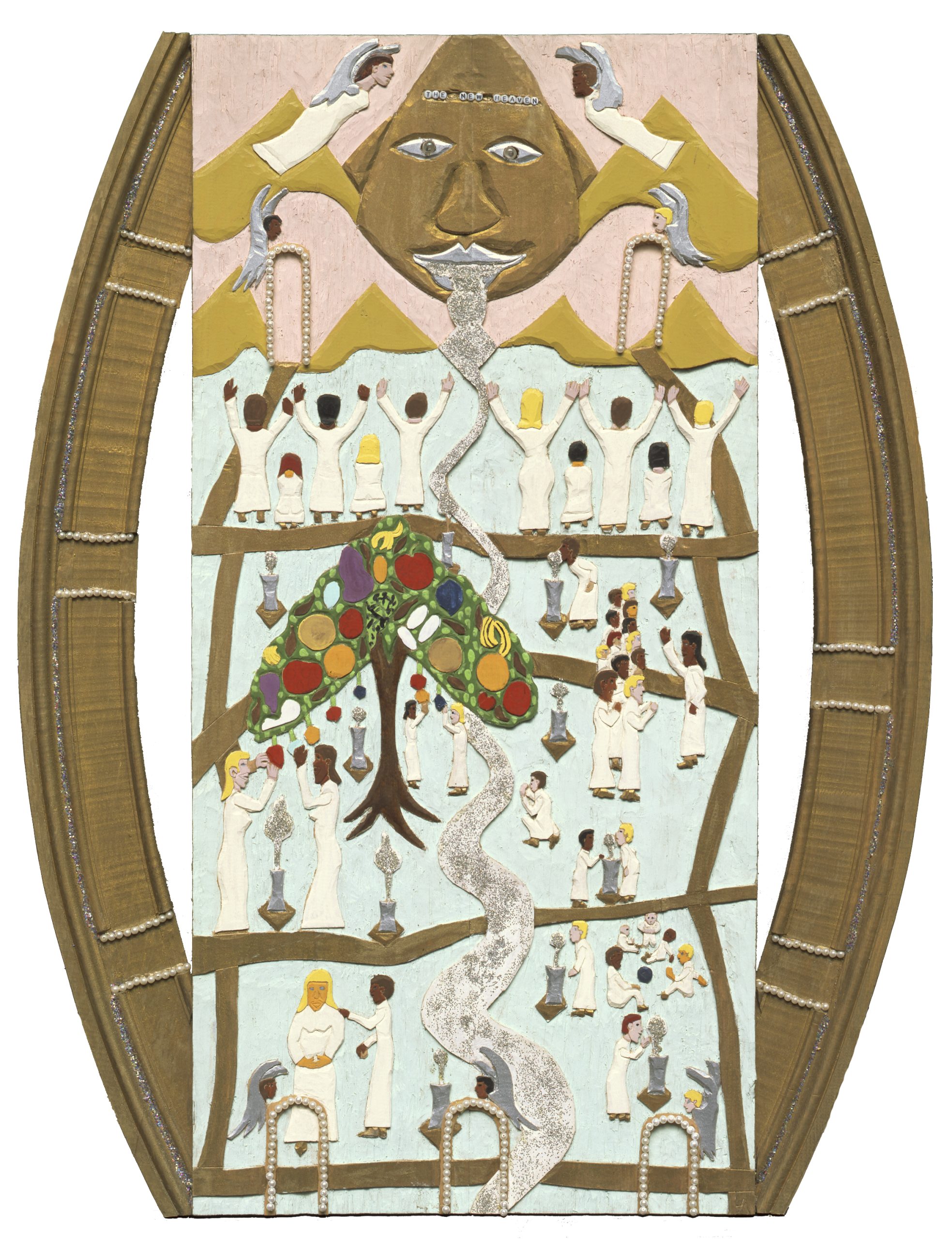
LOOK: The New Heaven by Leroy Almon
Leroy Almon (American, 1938–1997), The New Heaven, 1984. Carved wood, light bulbs, artificial pearls, glue, glitter, plastic letters, paint, 36 × 28 in. (91.4 × 71.1 cm). Toledo Museum of Art, Ohio. [object record]
This mixed-media depiction of heaven by African American folk artist Leroy Almon draws on imagery from the book of Revelation, showing centrally a crystal-bright river, the water of life, flowing forth from the mouth of God (Rev. 22:1–2). It courses through the paradisal scene, past the tree with its twelve fruits and healing leaves, and is pumped into twelve fountains, from which Black and white people drink together. Across lines of race, the new-city dwellers unite in worship, fellowship, and play. Notice the group of children with the ball in the bottom register!
For a framing device, Almon has used two wooden doors that bow out, as if the scene in all its fullness cannot be contained; as if the borders of the new city must bend to embrace the multitudes and their joy. The shape communicates an expansiveness that is the heart of God.
God is shown as majestic, mountain-like, and yet bearing a tender expression. The plastic beads on his forehead are printed with letters that read, “THE NEW HEAVEN,” and his eyes (not lit in this photo) are battery-powered light bulbs! He is, as John the Revelator tells us, the unending light dispelling all darkness.
Almon was born in 1938, so for about the first three decades of his life, he lived in a country where racial segregation was enforced legally in many states and socially in others. By and large, Blacks and whites were made to live in separate neighborhoods, attend separate schools, swim in separate pools, eat at separate restaurants, drink from separate water fountains, pass through separate public building entrances, wait in separate waiting rooms, sit in separate sections of the bus and the theater and even (woe is us) the church, and so on. Even after the passage of the Civil Rights Act in 1964, mandating desegregation, racial prejudices and hostilities continued to persist, as they do today. And because sinful human beings create and run systems (criminal legal, economic, educational, medical, etc.), it’s no surprise that the sin of racism can be found there as well.
Almon longed to see racial justice and (re)conciliation, and he knew Jesus has the power to make it happen. Almon’s preaching ministry went hand-in-hand with his art making. Through both, he shared the good news that Jesus, through his life, death, and resurrection, calls us to a new way of being in the world, which involves repentance of sin and turning to the divine light of love that knows no bounds. His New Heaven envisions a world saved and transformed by Christ’s love, where power is shared equally, forgiveness sought and granted, and friendship is the order of the day, as is a shared rejoicing in the greatness of God. In The New Heaven, Black and white praise Jesus side-by-side, eat at the tree of life together, and put their lips to the same bubbling fount of living water.
And not only are relationships healed and humanity restored to its original harmony in the new heaven, but also personal sorrows and hardships are no more. Physically, mentally, emotionally, spiritually, socially, we flourish in the light of God that never dims.
LISTEN: “Great Rejoicing” by Thad Cockrell, on To Be Loved (2009) | Performed by Rain for Roots, feat. Sandra McCracken and Skye Peterson, on Waiting Songs (2015)
There’s gonna be a great rejoicing (2×)
The troubles of this world Will wither up and die That river of tears made by the lonely Someday will be dry There’s gonna be a great rejoicing
There’s gonna be a great joy river (2×)
Questions of this world Someday will be known Who’s robbing you of peace And who’s the giver
There’s gonna be a great joy river
Someday you will find me Guarded in His fortress Open heart and wings That never touch the ground Someday we will gather In a grand reunion Debts of this old world Are nowhere to be found Nowhere to be found
There’s gonna be a great rejoicing (5×)
We are now halfway through Advent! Many of the songs featured in this Advent series, including today’s, appear on my Advent Playlist. I also have a companion Christmastide Playlist, which has been revised and expanded since last year to include some choral selections.
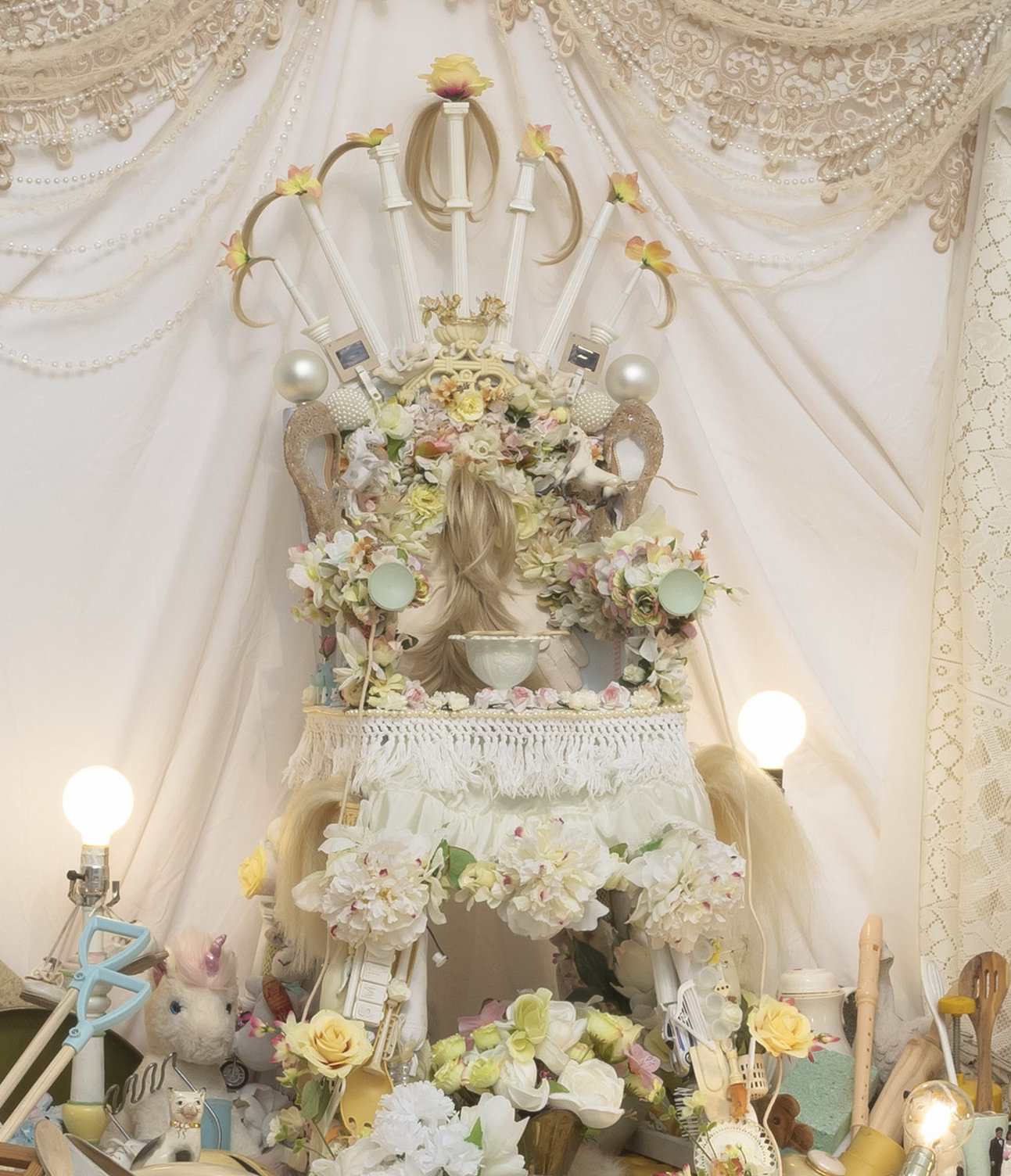
LOOK: Dim Gold (Feast of Brides) by Mandy Cano Villalobos
Mandy Cano Villalobos (American, 1979–), Dim Gold (Feast of Brides), 2022. Miscellaneous found objects, dimensions variable. Installation at Bridge Projects, Los Angeles. Photo courtesy of the artist.
Mandy Cano Villalobos is an interdisciplinary artist whose projects span installation, painting, drawing, performance, sculpture, and video. She lives in Grand Rapids, Michigan.
Drawing on the archetype of the waiting bride, the found-object installation Dim Gold (Feast of Brides) was commissioned by Bridge Projects for Here After, an exhibition exploring humanity’s hope for paradise. The artist writes,
Dim Gold is an allegory of marital covenant, bodily death, and the hope of love’s consummation in afterlife. The throne heap consists of discarded clothing, broken appliances, old lamps, unwanted toys, bruised furniture, fake flowers, stained curtains, human and synthetic hair, scratched glasses, deflated soccer balls, faded photographs, worn shoes, chipped figurines, kitchen utensils, costume jewelry, yellowed wedding decorations, cracked dishes, Christmas ornaments, mildewed books, and bathtub plugs.
From baby bottles and children’s playthings to a cane and a pillbox, the pile contains a life. (In fact, Cano Villalobos said she acquired most of the items from an old woman’s estate sale.) It’s a full life, but one of brokenness and decay. There is no permanence in this world. The otherworld—the new heaven, the new earth (a transfigured thisworld)—is what endures.
The Dim Gold construction is throne-like, all its components leaning in toward a central chair topped by seven white, ribbed shafts that fan out and that are suggestive, with the flame-colored flowers at the terminals, of a menorah. Lace, silk, and draped strings of pearls form the throne’s backing. With its dressed but empty seat that calls forth a presence, the piece evokes the hetoimasia (prepared throne of the second coming) of Eastern Orthodox icons.
The scattered, lit bulbs on shadeless lampstands allude to the burning oil lamps in Jesus’s parable of the ten bridesmaids (Matt. 25:1–13), which signify readiness for the Bridegroom’s return.
Cano Villalobos combines earthly and heavenly imagery in Dim Gold, an Advent ensemble that pictures the church-as-bride’s waiting with lights on, amid the ephemera of this life, for her groom to come take her home, where an eternal feast is spread in bright, delicious glory, and the two of them will become one at last.
LISTEN: “When the Bridegroom Comes”| Words by David Omer Bearden, 1973 | Music by Judee Sill, 1973 | Performed by Judee Sill on Heart Food, 1973
See the bride and the Spirit are one. Then won’t you who are thirsty invite him to come? With your door open wide, Won’t you listen in the dark for the midnight cry? And see, when your light is on, that the Bridegroom comes.
Into cold outer darkness are gone Guests who would not their own wedding garment put on. Though the chosen are few, Won’t you tarry by your lamp till he calls for you? And pray that your love endure till the Bridegroom comes.
When the halt and the lame meet the Son, And he sees for the blind and he speaks for the dumb, Let their poor hearts’ complaint, Like the leper turned around who has kissed the saint, Lift like a trumpet shout, and the Bridegroom come.
See the builders despising the stone, See the pearl of great price and the dry desert bones. By the Pharisees cursed, Be exultant with the rose when the last are first, And see how his mercy shines as the Bridegroom comes.
Hear the bride and the Spirit say, “Come!” Then won’t you who are weary invite in the Son? When your heart’s love is high, Won’t you hasten to the place where the hour is nigh? And see that your light is on, for the Bridegroom comes. See that your light is on, for the Bridegroom comes.
Judee Sill (1944–1979) was an American singer-songwriter whose genre of music Rolling Stone refers to as “mystic Christian folk.” Themes of temptation, rapture, redemption, and the search for higher meaning permeate her work.
Sill survived ongoing physical and verbal abuse in childhood from her mother and stepfather. As a teenager, she committed a series of armed robberies that landed her in reform school, where she learned to play the organ for church and became interested in gospel music. Upon her release, after briefly attending a junior college and working in a piano bar, she got caught up in the California drug culture, developing a crippling heroin addiction and resorting to prostitution and check forgery to fund it.
While she was serving a prison sentence for narcotics and forgery offenses, her only sibling, Dennis, died of an illness, and she was devastated. But this seems to have given her the impetus to pursue a career in songwriting and performing. She gigged in clubs around Los Angeles while living in a Cadillac, and she was eventually signed by the new Asylum Records. Graham Nash (of Crosby, Stills, Nash & Young) produced her first single, “Jesus Was a Cross Maker.” Her two albums, Judee Sill (1971) and Heart Food (1973), received some acclaim but failed to chart. Discouraged, and suffering back pain from a car accident and later a fall, she returned to hard drugs. She died of a cocaine and codeine overdose at age thirty-five.
Why do I rehearse Sill’s turbulent biography? Because songs don’t come out of a vacuum. The longing in “When the Bridegroom Comes”—those piano chords, that voice—is real. Her thirst, her questing, her waiting and hoping. Though she herself didn’t write the lyrics (David Omer Bearden, her romantic partner at the time, did, though she likely gave input), she sings them with fervency, makes them her prayer.
The song melds together the parable of the ten bridesmaids from Matthew 25 with the bridal theology of Revelation. In one, which has more of an individual focus, we are put in the place of the bride’s attendants and warned to be prepared for the imminent wedding celebration, lest we get locked out in the dark; in the other, Christ’s church as a collective is likened to the bride herself, eagerly anticipating the arrival of her groom and the sweet union that will follow.
The song’s primary referent is Revelation 22:17, from the final chapter of the Bible:
The Spirit and the bride say, “Come.” And let everyone who hears say, “Come.” And let everyone who is thirsty come. Let anyone who wishes take the water of life as a gift.
In this verse, the voice of the bride (the church) through whom the Spirit speaks calls out, “Come.” Because of the interchange of speakers and subjects in the broader passage, it’s unclear whether the addressee of this imperative is Christ or the masses. The church could be crying out for Jesus’s return, as they do in verse 20, or they could be inviting people far and wide to the gospel feast, bidding them come and eat. I think the latter, which would make it continuous with the third and fourth lines, but it could really go either way. Because as sure as there’s the final coming of Christ to the world, there’s also the coming of the world to Christ. He comes to us, and we come to him.
Sill’s whole song is full of biblical references—Jesus’s healing ministry, Jesus as the rejected cornerstone (Matt. 21:42), Jesus as the pearl of great price (Matt. 13:45–46), the Spirit breathing life into dry bones (Ezek. 37:1–14), Jesus’s upside-down kingdom in which the last are first and the first are last (Matt. 19:30). It celebrates divine mercy and grace and encourages us to respond in the affirmative to Christ’s wedding invitation, and to persevere in love while he tarries.
LOOK: Adoration of the Lamb from the Escorial Beatus
Adoration of the Lamb, from the Escorial Beatus, Spain, 10th century
This folio is from an illustrated copy of Beatus of Liébana’s (d. ca. 800) hugely influential Commentary on the Apocalypse. The Beatus manuscripts (take a look on Pinterest for some real wacky, Revelation-based imagery) are one of the most significant book genres of the Middle Ages in northern Spain, and the Escorial Beatus (named after its current location) is a preeminent example. It probably originated in the famous scriptorium of San Millán de la Cogolla in La Rioja, Spain. Today it is kept in the Real Biblioteca del Monasterio de El Escorial, part of a royal complex situated at the foot of Mount Abantos in the Sierra de Guadarrama.
LISTEN: “Glory Hallelujah to the Risen Lamb” by Victor C. Johnson, 2009 | Performed by De Angelis Capella, 2019
Glory, glory, glory hallelujah to the risen Lamb! (×4)
Jesus hung on the cruel tree (Glory hallelujah to the risen Lamb!) He gave his life for the likes of me (Glory hallelujah to the risen Lamb!) Women came at the break of day (Glory hallelujah to the risen Lamb!) The angel rolled the stone away (Glory hallelujah to the risen Lamb!)
Glory, glory, glory hallelujah to the risen Lamb! (×4)
Glory, glory hallelujah Glory to the risen Lamb Glory, glory hallelujah Glory to the risen Lamb Glory, glory hallelujah Glory to the risen Lamb Glory, glory hallelujah Glory to the risen Lamb Glory, glory hallelujah Glory to the risen Lamb
Glory, glory, glory hallelujah to the risen Lamb! (×4)
For as the lightning comes from the east and flashes as far as the west, so will be the coming of the Son of Man.
—Matthew 24:27
Then I saw heaven opened, and there was a white horse! Its rider is called Faithful and True, and in righteousness he judges and makes war. His eyes are like a flame of fire, and on his head are many diadems; and he has a name inscribed that no one knows but himself. He is clothed in a robe dipped in blood, and his name is called The Word of God.
—Revelation 19:11–13
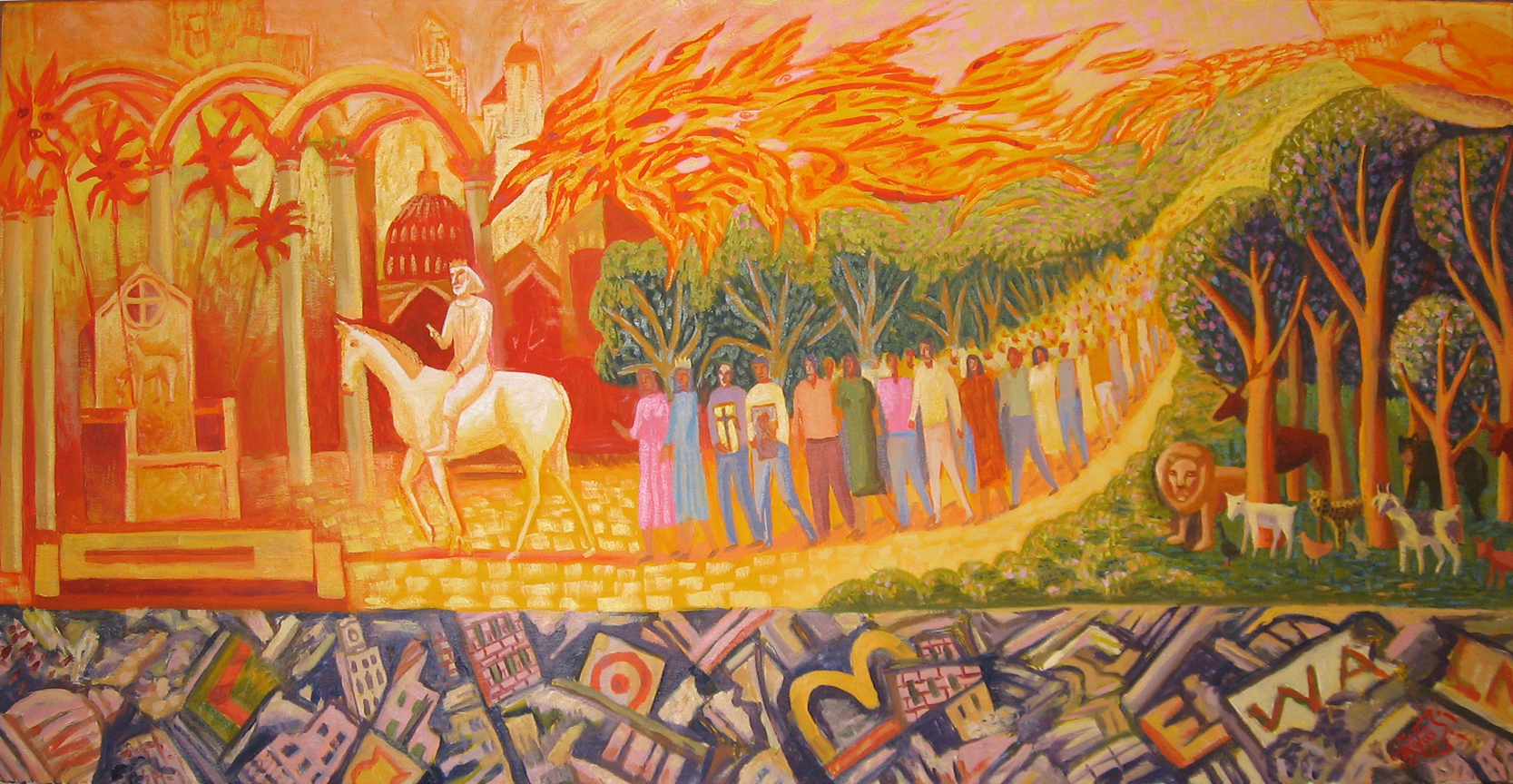
LOOK: Jesus Rides a White Horse by James B. Janknegt
And I saw the holy city, the new Jerusalem, coming down out of heaven from God, prepared as a bride adorned for her husband. And I heard a loud voice from the throne saying,
“See, the home of God is among mortals. He will dwell with them; they will be his peoples, and God himself will be with them; he will wipe every tear from their eyes. Death will be no more; mourning and crying and pain will be no more, for the first things have passed away.”
And the one who was seated on the throne said, “See, I am making all things new.”
—Revelation 21:2–5a
LOOK: The New Jerusalem by Sassandra
Jacques Richard Sassandra (French, 1932–), The New Jerusalem (Rev. 21:1–4a), 1970–80. Paper collage with AquaLac, 86 × 110 cm.
Jacques Richard, whose artist name is Sassandra, was born in 1932 to a French missionary family in Sassandra, Ivory Coast, where he spent his youth. Upon returning to France, he studied art, followed by theology, and soon became an art teacher in Paris public schools while also maintaining a studio art practice of drawing, painting, collaging, and woodblock printing.
It shows the hands of God lovingly lowering the heavenly city to earth—the two realms reunited at last. The cross is at the center, forming the trunk of the tree of life, and the Holy Spirit spreads her wings over all.
LISTEN: “New World Coming” by Barry Mann and Cynthia Weil, 1969 | Performed by Nina Simone on Here Comes the Sun, 1971
There’s a new world comin’ And it’s just around the bend There’s a new world comin’ (joy, joy, joy . . .) This one’s comin’ to an end
There’s a new voice callin’ And you can hear it if you try And it’s growing stronger With every day that passes by (yeah, yeah, yeah . . .)
There’s a brand-new mornin’ Rising clear and sweet and free There’s a new day dawning That belongs to you and me
Yes, a new world’s comin’ You know the one I’m talking about The one we’ve had visions of And it’s comin’ in peace, comin’ in joy Comin’ in peace, comin’ in joy Come in peace, come in joy Comin’ in love
And I saw another sign in heaven Great and marvelous Seven angels having the seven last plagues For in them is filled up the wrath of God And I saw, as it were, a sea of glass mingled with fire And them that had gotten the victory over the beast And over his image And over his mark And over the number of his name Stand on the sea of glass Having the harps of God all around them
There’s a new world comin’ And it’s just around the bend There’s a new world comin’ This one’s comin’ to an end
There’s a new voice callin’ And you could hear it if you would just give it a try And it’s growing stronger With every day that passes by
And there’s a brand-new mornin’ Rising clear and sweet and free There’s a new day dawning That belongs to you and me
Yes, a new world’s comin’ The one we’ve had visions of
Comin’ in peace, yeah Comin’ in joy, yeah Comin’ in peace now, yeah Comin’ in love now, yeah Comin’ in peace now, yeah Comin’ in joy now, yeah Comin’ in peace now, yeah Comin’ in love, yeah Comin’ in peace . . . Comin’ in joy . . . Comin’ in love (joy)
This song, as you may have noticed, includes a recitation of Revelation 15:1–2:
Then I saw another portent in heaven, great and amazing: seven angels with seven plagues, which are the last, for with them the wrath of God is ended.
And I saw what appeared to be a sea of glass mixed with fire, and those who had conquered the beast and its image and the number of its name, standing beside the sea of glass with harps of God in their hands. (NRSV)
After a cosmic battle between good and evil, peace, love, and joy come to roost.













.jpg)

 Art & Theology