Book Review: Beholding Christ and Christianity in African American Art, ed. James Romaine and Phoebe Wolfskill

Typically when scholars interpret African American art, they do so through the primary lens of racial identity, often glossing over overt Christian themes, expressions of religious identity. Beholding Christ and Christianity in African American Art (Penn State University Press, 2017), edited by James Romaine and Phoebe Wolfskill, seeks to redress that dearth by examining the Christian content, including theological significance, of works by fourteen African American artists who came to maturity between the Civil War and the civil rights era: Mary Edmonia Lewis, Henry Ossawa Tanner, Aaron Douglas, Malvin Gray Johnson, Archibald Motley Jr., William H. Johnson, James Richmond Barthé, Allan Rohan Crite, Sister Gertrude Morgan, William Edmondson, Horace Pippin, James VanDerZee, Romare Bearden, and Jacob Lawrence. Many of these artists were themselves devout Christians, working out of internalized religious convictions and not merely outward tradition or market expectations.
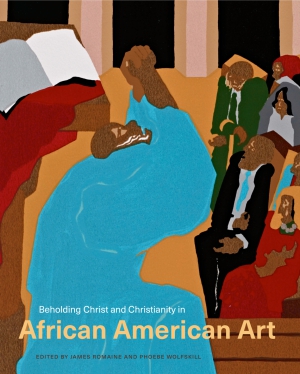
Beholding Christ and Christianity in African American ArtThe essayists certainly take race into account as a factor in the works discussed, but not the only factor; political, socioeconomic, and biographical circumstances are also considered. Christianity, however, as the title suggests, is given pride of place in the selection and examination of the fifty-five images reproduced in the book.

One of the hallmarks of Beholding Christ is the diversity of styles, media, and denominational affiliations represented. As the book shows, African American art is no monolith, and neither is African American Christianity. While there is so-called primitive art and visionary art created by self-taught individuals with crayons, cardboard, or salvaged limestone, there is also neo-classical sculpture, as well as other academically informed works that tend toward impressionism or expressionism. Among the pages are rough-hewn stone sculptures, abstract watercolors, naturalistic oil paintings, and portrait photographs. While there are many depictions of Christ as black, there are also, per tradition, white Christs, and even a Middle Eastern one. What was most surprising to me was to see examples of art by African Americans from high-church traditions, like Catholicism and Anglicanism, who distinguish themselves from low-church Baptists, Pentecostals, and Holiness Christians. The editors are to the applauded for resisting the urge to perpetuate a narrow vision of “Negro art” in line with what the artists’ contemporary critics and viewers principally sought.

Another hallmark of the book is the rigorous formal evaluation and content analysis of specific artworks that make up the bulk of almost every essay, encouraging readers to look deeply. Biographical information about the artists is well integrated and does not overwhelm the focus on the works themselves. Given this image-forward approach, I must say, I’m disappointed that a handful of works, for which color photographs should be available, are reproduced in black and white—for example, Motley’s Tongues (Holy Rollers), Edward Hicks’s Peaceable Kingdom, and Lawrence’s Sermon II and Sermon VII. Luckily these can be found online, but seeing as the entire book is printed in full color with glossy pages, I wonder why color photographs of these were not obtained.

Lastly, I really appreciate the connections between artists made possible by the bringing together of these essays—some made explicitly by the authors, others implied. Douglas and Lawrence both dignified the art of black preaching by visualizing sermons. Crite and Johnson visualized the spirituals, but using very different approaches. Edmondson and Morgan were both motivated by a belief that they were divinely ordained to create by supernatural visions. Episcopal Crite and Catholic Motley intertwined class and religion in their works.

This book is essential reading for anyone in the fields of Christianity and the arts or African American studies. As one belonging to the former category, I see these artworks as part of not only art history but Christian history, and as worthy of being studied by Christians as any theological treatise, written scripture commentary, saint’s biography, or church trend. These artworks teach theology; they encapsulate hopes and fears; they comment on public issues; they expose sin; they lead us in celebration and in lament; they help us to re-member the works of Christ, and invite us into communion with him; they tell us who we are and from whence we’ve come; they cast a biblically grounded vision for the future.

What follows is a brief summary of each chapter.

In chapter 1, Kirsten Pai Buick traces the network of patronage that supported Catholic sculptor Mary Edmonia Lewis, as well as the multiple geographic moves she made to further her career: from Boston to Rome (1865), Rome to Paris (1893), and Paris to London (1901). Because many of Lewis’s religious works have been lost, little attention is given in this chapter to the art itself; the only art illustration is her conventional-looking Bust of Christ (1870), mentioned cursorily in the text.

In chapter 2, James Romaine demonstrates the shift in Henry Ossawa Tanner’s paintings from the visual clarity favored by nineteenth-century academic art to a mood of personalized spiritual mystery favored by the twentieth-century symbolists. He examines four paintings as representative of this move—The Resurrection of Lazarus (1896), Nicodemus (1899), The Two Disciples at the Tomb (ca. 1906), and The Disciples See Christ Walking on the Water (ca. 1907)—revealing how each explores the complex exchange between vision and belief.

Nicodemus by Henry Ossawa Tanner
Henry Ossawa Tanner (American, 1859–1937), Nicodemus, 1899. Oil on canvas, 85.5 × 100.3 cm (33.7 × 39.5 in.). Pennsylvania Academy of the Fine Arts, Philadelphia.

In chapter 3, Caroline Goeser examines the seven gouaches Aaron Douglas made in response to James Weldon Johnson’s God’s Trombones: Seven Negro Sermons in Verse. These images align biblical narrative with modern black experience to tell socially resonant stories. In its attention to the African Simon of Cyrene, for example, The Crucifixion (1927) promotes an “Ethiopianist” narrative, influenced by the late nineteenth-century biblical scholar Edward W. Blyden. Simon looms large as the most prominent figure, heaving Christ’s heavy cross over his shoulders, heroized by his vigorous stride and his active gaze toward God’s light above. Bearing similarities to that of the trudging African American migrant in Douglas’s On de No’thern Road (1926), this pose subtly associates the Great Migration north with the burdensome road to Calvary.

Crucifixion by Aaron Douglas
Aaron Douglas (American, 1899–1979), The Crucifixion, 1927. Oil on Masonite, 121.9 × 91.4 cm (48 × 36 in.) Private collection.

Up Golgotha’s rugged road
I see my Jesus go.
I see him sink beneath the load,
I see my drooping Jesus sink.
And then they laid hold on Simon,
Black Simon, yes, black Simon;
They put the cross on Simon,
And Simon bore the cross.

In chapter 4, Jacqueline Francis examines the dozen or so paintings Malvin Gray Johnson created between 1927 and 1934, the final years of his life, as visual interpretations of Negro spirituals. Modernist in style, these paintings, she says, united old and new and high and popular expressions, helping to revive and elevate this genre of black folk music that saw diminishing audiences during the Great Depression. Swing Low, Sweet Chariot (1928), a night scene painted in thick, dark hues and mounted in a gold lunette frame reminiscent of medieval icons, received the most critical attention in Johnson’s time, eliciting comparisons to Albert Pinkham Ryder. The artist said,

I have tried to show the escape of emotion which the plantation slaves felt after being held down all day by the grind of labor and the consciousness of being bound out. Set free from their tasks by the end of the day and the darkness, they have gone from their cabin to the river’s edge and are calling upon their God for the freedom for which they long. (qtd. 56)

Swing Low, Sweet Chariot by Malvin Gray Johnson
Malvin Gray Johnson (American, 1896–1934), Swing Low, Sweet Chariot, 1928. Oil on canvas, 124.5 × 73.5 cm (49 × 29 in.). Studio Museum in Harlem, New York.

Continue reading “Book Review: Beholding Christ and Christianity in African American Art, ed. James Romaine and Phoebe Wolfskill”

Book Review: Movies Are Prayers by Josh Larsen

I love movies. My husband shares this love, and it’s one of our primary forms of bonding. I’m thankful that he bucks the stereotype of men who like only shoot-’em-up action flicks or buddy comedies. We do have a few of those in our collection . . . but Eric is game for any genre. He can enjoy a silent horror film, a children’s adventure, a foreign-language drama, a Golden Age Hollywood musical, an art-house sci-fi, or the latest Jane Austen adaptation just as much as any male-marketed blockbuster. And thankfully he has none of the criteria I often get from friends who join us for movie nights: no black-and-white, no subtitles, nothing sad, nothing scary, nothing “slow,” and nothing that makes me have to think too hard. (!)

Many Christians I know forgo TV and movie watching altogether, and demand the same abstinence from their kids, so as to not “waste time” with “mindless entertainment” or foster a screen addiction. A more extreme, but no less common, motive I’ve encountered is to avoid subjecting oneself to immoral filth and supporting Hollywood’s “liberal agenda.” While I agree that indoor-outdoor balance and a variety of play is important, especially for developing young brains, and that you should never violate your conscience (e.g., if it forbids you from seeing or hearing certain things), I want to push against the notion that movies are of limited to no value unless they educate or support a Christian worldview.

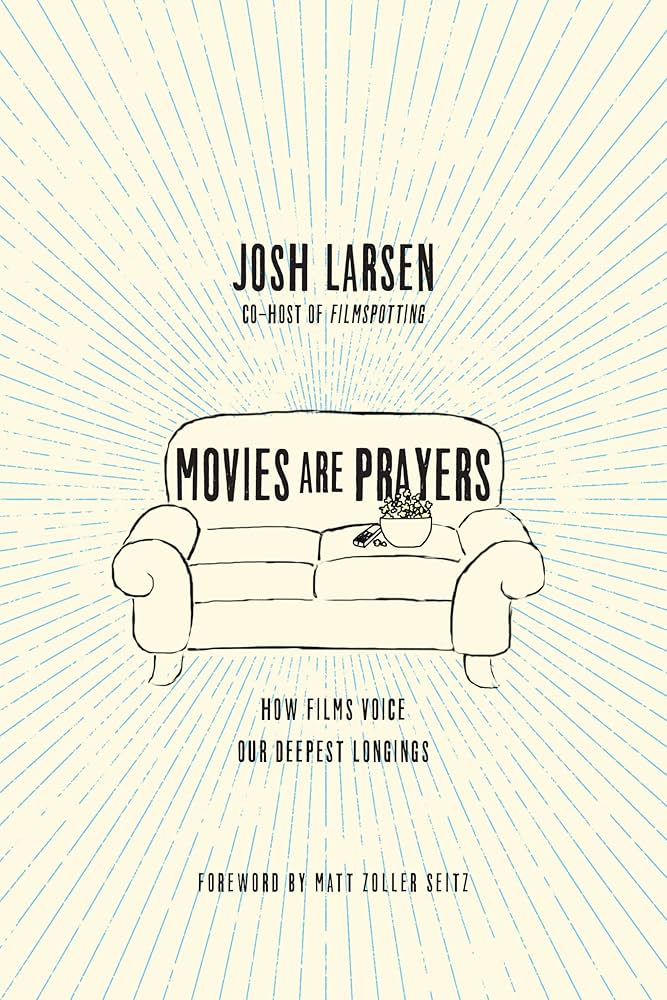
Fortunately, film critic Josh Larsen, editor of Think Christian and cohost of Filmspotting, offers a redeeming perspective on film in his new book Movies Are Prayers: How Films Voice Our Deepest Longings (InterVarsity Press, 2017). Many movies are expressions of the burdens and desires of the soul, he says, that can take the shape of praise/wonder, petition, confession, lament—in a word, prayer. Prayers are “instinctive recognitions of good (of things worthy of praise) and evil (of things inexplicably bent and broken)” (6), and they need not be restricted to liturgical formats.

This human instinct to reach out in praise or lament or supplication or confession to the divine does not take place only in church, guided by liturgy and pastors. It isn’t limited to early morning devotions, in that serene space before silence gives way to the day. It isn’t strictly the domain of dinner tables, where families gather to recite familiar words (“God is great, God is good . . .”). and it isn’t an instinct shared only by Christians. Prayer can be expressed by anyone and can take place everywhere. Even in movie theaters. (7)

Movies Are Prayers

Through picture and sound, filmmakers offer up prayers and invite us not only to listen in, but to pray along—to respond in kind, with whatever words or medium or action we feel prompted to use. Therefore, rather than regarding movies as time spent apart from God or a distraction from more important things, we would do well, Larsen suggests, to let them enrich our awareness of the world’s beauty and suffering and, consequently, guide us into prayer.

Larsen covers diverse genres and styles spanning from the silent era through today, including a mix of popular classics and lesser known gems. Below are just three I’ve added to my watch list since reading Movies Are Prayers.

Freaks (1932) is a revenge drama set against a circus backdrop, starring professional sideshow performers. At a time when people paid money to see and gawk at those with biological anomalies, director Tod Browning intended to show their humanity, that they have the same emotional needs as everyone else. He never filmed his actors’ “acts” (so as not to exploit them) but instead depicts them backstage, living their everyday lives. Although the film features an able-bodied romantic pairing of trapeze artist and strongman, Browning isn’t that interested in it; it is the interior life of Hans, a little person who’s used by Cleopatra for his money, that constitutes the main focus.   Continue reading “Book Review: Movies Are Prayers by Josh Larsen”

Book Review: Painting the Gospel: Black Public Art and Religion in Chicago by Kymberly N. Pinder

Members of the majority white culture may not realize it, but white Jesus is a fraught symbol. According to black theologian Major J. Jones, when European colonialists came to Africa and began treating its people as less than human because of their color, it became “psychologically impossible” for Africans not to have problems with God’s color. How could they ever conceive of a God who looked just like their oppressor? This legacy of black oppression, of course, traveled to the Americas, where white Jesus is omnipresent in visual culture.

Painting the Gospel book coverIn her book Painting the Gospel: Black Public Art and Religion in Chicago (University of Illinois Press, 2016), art historian Kymberly N. Pinder unpacks some of the ways that twentieth- and twenty-first-century Christians have countered the dominance of white Jesus with alternative sacred imagery that is black-affirming. Lavishly illustrated with sixty color photographs and eight black-and-whites, the book explores African American religious images—murals, mosaics, stained glass, sculptures, even T-shirt designs—from Chicago churches and their neighborhoods between 1904 and the present, focusing on their intersection with the social, political, and theological climates of the times. The image of a black Christ, Pinder argues, participated in some of the most significant movements in black history, including gospel music, sermon broadcasts/televangelism, the Chicago Black Renaissance, the civil rights movement, Black Liberation Theology, and the Mural Movement. The stream of influence flowed both ways, as each church’s preaching and outreach, musical, and visual cultures fed into one another.

A collection of case studies rather than a comprehensive guide, Painting the Gospel features churches whose pastors consciously nurtured a strong visual culture. “These sites,” Pinder writes, “enable me to chart how the arts interact with each other in the performance of black belief in each space, explain how empathetic realism structures these interactions for a variety of publics, and observe how this public art sits within a larger history of mural histories” (2). “Empathetic realism” is a term Pinder develops throughout the book as she considers how religious images have the power to assert political agendas of equality and humanity and thereby empower viewers, providing social and spiritual uplift. “Christ’s own difference, for which he was persecuted, becomes a source of empathy and identity for the African American,” she writes (8).

Christ as a dreadlocked black man on the cross, hip-hop youth kneeling at his feet, and Mary as an African woman in traditional Nigerian dress activate personal narratives for a black audience where private and public, the personal and the holy, the real and the represented, all meld, allowing for a spiritually transformative experience. (22–23)

The book covers works of art that have been largely excluded from art historical, theological, and sociological scholarship because of their racial or religious particularity. Working at the confluence of these disciplines, Pinder is concerned not with the artistic merit of the images but rather how they make meaning, how they “work” for an individual or a community—and especially how they interacted with and impacted certain milestones in black history. Her approach, her angle of inquiry, is much in the vein of David Morgan and Sally Promey.

Holy Angels mural by Engelbert Mveng
Mural by Engelbert Mveng, 1990, Holy Angels Catholic Church. The scenes depict moments when angels have intervened in the lives of Christ and the saints: (counterclockwise, from top center) The Star of Bethlehem; St. Michael Slaying the Dragon; The Three Men in the Fiery Furnace; The Liberation of St. Peter; The Annunciation; The Resurrection; The Agony in the Garden; Judgment Day; The Hospitality of Abraham; The Healing of Tobit; The Nativity. Photo courtesy of Holy Angels Catholic Church.

In many ways, Painting the Gospel is an extension of an article Pinder wrote in 1997, titled “‘Our Father, God; our Brother, Christ; or are we bastard kin?’: Images of Christ in African American Painting.” This article addresses black-Jesus images in the world of twentieth-century fine art, which were produced by such artists as Jacob Lawrence, William H. Johnson, Aaron Douglas, Archibald Motley Jr., Frederick C. Flemister, Romare Bearden, John Biggers, David Hammons, and more. Pinder wondered whether black Christians consumed this imagery in the public sphere.   Continue reading “Book Review: Painting the Gospel: Black Public Art and Religion in Chicago by Kymberly N. Pinder”

Book Review: 75 Masterpieces Every Christian Should Know by Terry Glaspey

Whenever I meet new people and they ask what I do, I always tell them I’m a writer on Christianity and the arts. The follow-up question is often, “Oh, are you an artist?,” to which I respond with something like “No, but I love to study art, and I want to make Christians aware of the church’s rich artistic heritage.”

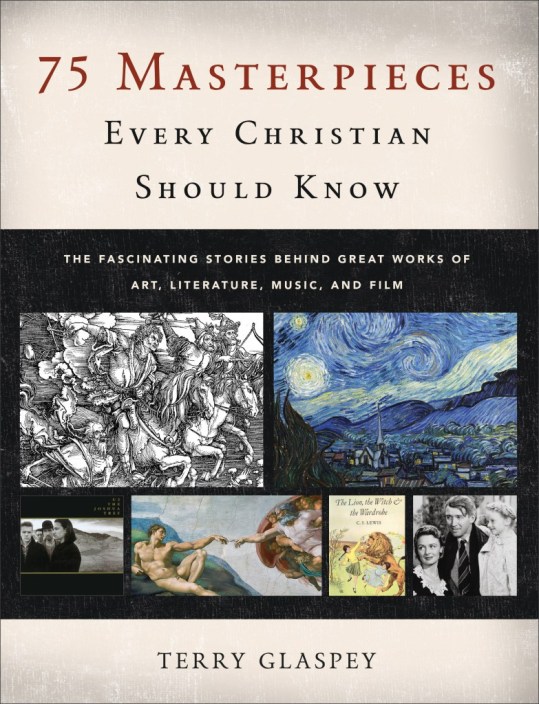
When I read the introduction to Terry Glaspey’s latest book—75 Masterpieces Every Christian Should Know: The Fascinating Stories behind Great Works of Art, Literature, Music, and Film (Baker Books, 2015)—I couldn’t believe how much like me it sounds! Not because Glaspey has lifted anything I’ve written or vice versa but because we share the same desire to see Christians more educated about art, especially art that’s rooted in the Christian tradition.

75-masterpieces-every-christian-should-know

In this full-color survey, Glaspey—curator and tour guide—invites us to be “inspired, entertained, and challenged” as we encounter artists’ material witness to their faith through the ages. An Eastern Orthodox icon, a Renaissance altarpiece, a metaphysical poetry collection, a jazz suite, a rock album, children’s fantasy stories, an Italian neorealist film, a radio drama, and contemporary nihonga are just some of the many creative works featured. Organized chronologically from the Roman catacomb paintings to Terrence Malick’s The Tree of Life, the book encompasses almost all the major artistic disciplines (dance is conspicuously absent) and a variety of styles and eras, with a focus on Western art. (Sadao Watanabe’s Last Supper stencil print, Japanese American artist Makoto Fujimura’s illuminated Gospels project, and a few works from Russia are the only exceptions.) I’m impressed by how fluent Glaspey is in each area. He can speak just as easily about silent film as he can about Gothic architecture and contemporary folk art!

The author says his selection process was guided by these criteria:

  1. works that are universally esteemed for their craftsmanship and creativity, admired not only by Christians but also by those outside the faith
  2. works that stand up well to repeated exposure, the kind of art that can be visited again and again, because there is always something new to discover
  3. works that speak to people across time, cultures, national boundaries, and denominational divides

Preempting readers’ tendencies to object to certain omissions, Glaspey adds,

This is most emphatically not a list of the absolute best or greatest works, nor does it imply any ranking system. Instead, it attempts to represent the breadth and depth of what Christians have accomplished in the arts, and is an intentionally quirky mix of the widely known and the mostly unknown.

Each of the seventy-five entries contains not only discussion of the content, formal qualities, and historical context of the highlighted work but also an overview of the artist’s oeuvre and a mini spiritual biography. These are not generic glosses or rote info dumps. On the contrary, Glaspey devotes individualized care to each one in the space of about four pages, giving us both concision and substance. He likens his offerings to movie trailers: they are meant to give you a sense of the artwork’s flavor and entice you to explore it more fully on your own.

La Sagrada Familia ceiling
Ceiling detail of La Sagrada Familia Cathedral in Barcelona, designed by Antoni Gaudí, begun 1882

Continue reading “Book Review: 75 Masterpieces Every Christian Should Know by Terry Glaspey”

Book Review: The Image of God in an Image Driven Age, ed. Beth Felker Jones and Jeffrey W. Barbeau

The Image of God in an Image Driven AgeThe doctrine of the imago Dei—which states that human beings were uniquely created in the image of God and continue to bear that image—is central to Christian theology, for it tells us who (and Whose) we are. The book The Image of God in an Image Driven Age: Explorations in Theological Anthropology (Downers Grove, Illinois: InterVarsity Press, 2016), edited by Beth Felker Jones and Jeffrey W. Barbeau, delves into that doctrine, examining its implications for relationships, ethics, sexuality, consumer visual culture, art making, dissemination of the gospel, and more. Comprising twelve essays that resulted from the 2015 Wheaton Theology Conference, the book explores what it means to be made in God’s image and issues a challenge: that we resist all the false images that try to topple the one true image in our lives.

Two of the chapters revolve around visual images. In chapter 5, “Culture Breaking: In Praise of Iconoclasm,” Matthew J. Milliner starts out by stating that we live in an optocracy—that is, we are ruled by what our eyes see. Advertisements (billboards, commercials, magazines, web banners), celebrity coverage, and product packaging and store displays are high up on the throne, and we think and act according to their influence.

To illustrate the takeover of unedifying imagery, he cites Limelight Shops, a mini-mall in New York City that inhabits the deconsecrated Church of the Holy Communion. Where a Christian community once thrived, signage and shop displays now parody Christianity, beckoning shoppers to “be transformed,” to try on True Religion jeans in confession-booth dressing rooms, and to indulge in a “slice of heaven” at the pizzeria.

Milliner calls for opposition to the deleterious aspects of our optocracy, a reclamation of our iconoclastic heritage (which, he notes later with examples, belongs to all three branches of Christianity, not just Protestantism):

Evangelicals have spent the last half of the century embarrassed of their iconoclastic heritage and attempting to make themselves culturally serious. But the challenge that is so clear in the case of Limelight Shops might spur us to reactivate our iconoclastic heritage as well. Our charge may be not only to go about culture making but to do some culture breaking as well, for breaking is what the people of God do when they find themselves in Babylon. (112)

He endorses not a literal breaking but a mental and rhetorical breaking, much as the Israelites did when they were in Babylon (e.g., Jeremiah 10:5). We need to break the power certain images hold over us, say no to their attempts to shape and define us. God alone can tell us who we truly are, and we bear his imprint.

Many contemporary artists in the macro–art world would claim to share Milliner’s iconoclastic impulse, but in practice, most of them fail to effectively break anything, and Milliner gives a few examples of those failures. Then he recounts several successes from within his own immediate sphere: works by his art faculty colleagues at Wheaton College. Among the commendable works he discusses are Jeremy Botts’s Bee in Hand; Greg Halvorsen Schreck’s Lambertian photograph The Shroud and his American Trinity and the Cry of the Deer (I covered Botts’s and Schreck’s Via Dolorosa cycle in February); David J. P. Hooker’s Corpus (pictured on the book’s cover); and Joel Sheesley’s Camels and his Good Shepherd mural at the local All Souls Anglican Church—all of which are reproduced as halftones in the book. These artists demonstrate different ways to break by making and vice versa—to engage in “creative destruction,” as Philip Jenkins puts it in the final chapter (259).

Camels by Joel Sheesley
Joel Sheesley (American, 1950–), Camels, 1993. Oil on canvas, 58 × 53 in. In the narthex of All Souls Anglican Church, Wheaton, Illinois.

Continue reading “Book Review: The Image of God in an Image Driven Age, ed. Beth Felker Jones and Jeffrey W. Barbeau”