Roundup: Apache Christ icon, the Bible in photography, deer in church, and more

SPOTIFY PLAYLIST: September 2024 (Art & Theology)

+++

NEW ALBUMS:

>> Live On by the Good Shepherd Collective: The fourteen songs on this seventh full-length album by the Good Shepherd Collective are a mix of gospel, pop, and indie covers (Natalie Bergman, Harry Connick Jr., Aaron Frazer, Joni Mitchell, the Alabama Shakes, Celine Dion, Valerie June, Toulouse, Wilder Adkins) and two originals. Here’s “Look Who I Found” by Harry Connick Jr., sung by Charles Jones, followed by “Peace in the Middle” by Dee Wilson, Asaph Alexander Ward, and David Gungor, sung by Wilson, Gungor, and Rebecca McCartney. For more video recordings of songs from the album, see the Good Shepherd New York YouTube channel, which also features weekly digital worship services. Released July 12.

>> Facing Eden by Hope Newman Kemp: I heard Kemp perform at last year’s Square Halo conference and was compelled by her style, spirit, and songwriting. So I’m excited to see that several of the songs she shared live have now been recorded and released on her brand-new album! Produced by Jeremy Casella and tracked with a session band at the storied Watershed Studio in Nashville, Facing Eden leans toward café jazz but also bears influences from the Jesus Folk music of the 1960s that she was immersed in growing up. “Encompassing expansive sonic territory, the record isn’t afraid to wander into blue cocktail hours (‘My Inflatable Heart’), gospel riversides (‘Mercy,’ ‘Come Home,’ ‘Let It Rise’), ballad-style acoustic hymnody (‘Maria’s Song’), and even the free rubato motion of a musical theatre sound (‘Take Them Home’).” Released August 30.

+++

ARTICLE: “Apache Christ icon controversy sparks debate over Indigenous Catholic faith practices” by Deepa Barath, Associated Press: In 1989, a new icon by the Franciscan artist-friar Robert Lentz was installed behind the altar of St. Joseph Apache Mission church in Mescalero, New Mexico. According to the artist’s statement, the painting shows Christ as a Mescalero holy man, standing on the sacred Sierra Blanca (White Mountains). A sun symbol is painted on his left palm, and in his right hand he holds a deer hoof rattle. A basket at his feet holds an eagle feather, a grass brush, and bags of tobacco and cattail pollen, items used in Native rituals. Behind him flies an eagle, the guide who led the nomadic hunter-gatherer Apaches to their “promised land” of the Tularosa Basin in southern New Mexico some seven hundred years ago. The inscription at the bottom reads, “Bik’egu’inda’n,” Apache for “Giver of Life.” The Greek letters in the upper corners are an abbreviation for “Jesus Christ.”
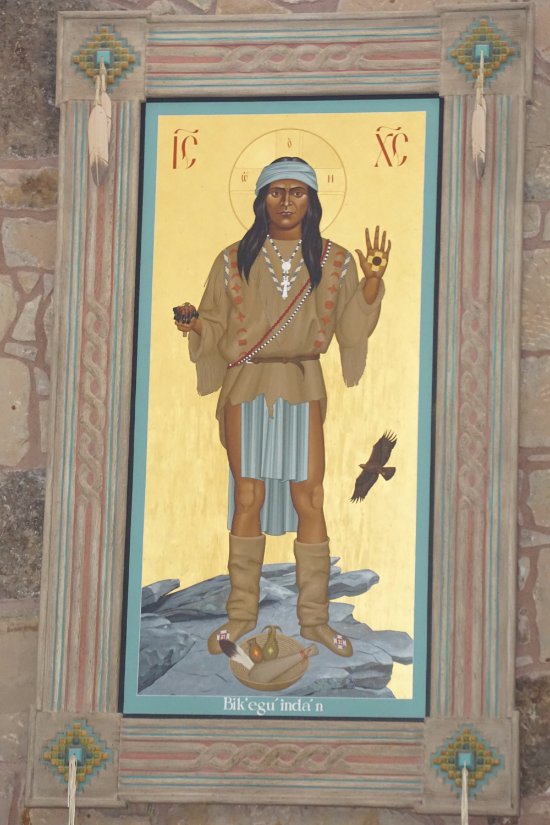
Lentz, Robert_Apache Christ
Br. Robert Lentz (American, 1946–), OFM, Apache Christ, 1989. Egg tempera and gold leaf on gessoed panel, 8 × 4 ft. St. Joseph Apache Mission Church, Mescalero, New Mexico. Photo: Colin Archibald.

Fr. Dave Mercer, a former priest at St. Joseph’s, describes the image and its significance:

When Franciscan Br. Robert Lentz painted his Apache Christ icon, he did so with great care for Apache traditions and sacred customs and with dialogue with tribal spiritual leaders, the medicine men and women. With their approval, he painted Jesus as a medicine man, including symbols and sacred items for which our Apache friends needed no explanation. They understood the message that our Lord Jesus had been with them all along and that he is one of them as he is one with the people of every land.

But on June 26, the church’s then-priest, Father Peter Chudy Sixtus Simeon-Aguinam, who had been installed in December 2023, removed the icon and a smaller painting depicting a sacred Indigenous dancer. Also taken were ceramic chalices and baskets given by the Pueblo community for use during the Eucharist. Neither Father Chudy nor the Diocese of Las Cruces, which oversees the mission, have provided a statement, but in July Father Chudy departed and, due to the demands of the congregation, the icon and other objects were returned. Presumably the removal was due to a fear of syncretism.

I’m not able to address that complicated charge in this roundup format, but I wanted to put this news item out there to show how art so often shapes religious communities—in this case affirming the Apache Christian identity (contrary to the claims of some, the two are not mutually exclusive) and conveying a sense of God-with-us and God-for-us. Click here to watch a five-minute video interview with the artist from 2016, who says the icon of the Apache Christ is an effort to heal the wounds that Christian missionaries inflicted on Native people in the past.

+++

NEW BOOK: The Bible in Photography: Index, Icon, Tableau, Vision by Sheona Beaumont: Artist and scholar Sheona Beaumont [previously] is a visiting research fellow at King’s College London and cofounder of Visual Theology. In this book published by T&T Clark, she discusses, with critical depth, a range of “photographs that depict or refer to biblical subject matter, asking how the reception of the Bible by photographers and their audiences reveals their imaginative interpretation,” she writes. “I hope to show that, far from being an outdated, idiosyncratic or dead referent, the Bible’s many afterlives in photographs are uniquely qualified to show up the workings of a modern religious imagination” (1).
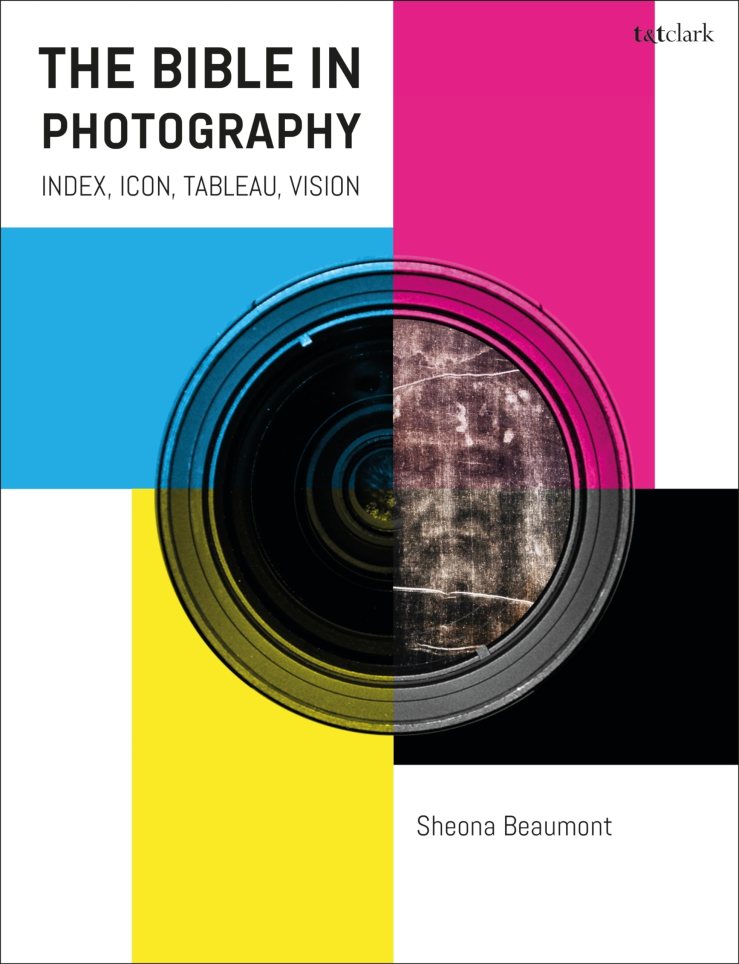
The Bible in Photography

In preparation for this project, Beaumont comprehensively scoped the representations of biblical characters, scenes, and texts through the whole of photographic history, from Fred Holland Day and Julia Margaret Cameron to Gilbert & George and Bettina Rheims. For the book she chose fifty-five such images and interviewed twenty living photographers. In addition to fine-art photography, she covers documentary photography, advertising photography, propaganda, diableries, and spirit photography.

The Bible in Photography is highly academic; nonscholars will probably find part 1, where the author establishes the conceptional and methodological footing for her inquiry, too dense (it’s in dialogue with Hans-Georg Gadamer, Marshall McLuhan, Walter Benjamin, and Anthony Thiselton). For me, the highlight of the book is the selection of images and the grappling with the literal and the spiritual—the difficulties of representing historically real persons using contemporary models, and of conveying a “something more” beyond the surface, an element of transcendence. Some of the photographic pieces I’ve never encountered before, such as Corita Kent’s arrangement of journalistic photographs as Stations of the Cross from the Spring 1966 issue of Living Light. There’s much to savor here!

My research interests center on the figure of Christ, a figure that, Beaumont notes, still has cultural currency in fine-art photography. “Even if our predominantly secular culture has largely abandoned its inheritance of a (Christian) hermeneutic tradition, the heritage-infused currents of visual culture in combination with the return of religion in global terms, demands its voice” (225). She encourages us to consider where and how and why Jesus is showing up in the medium of photography.
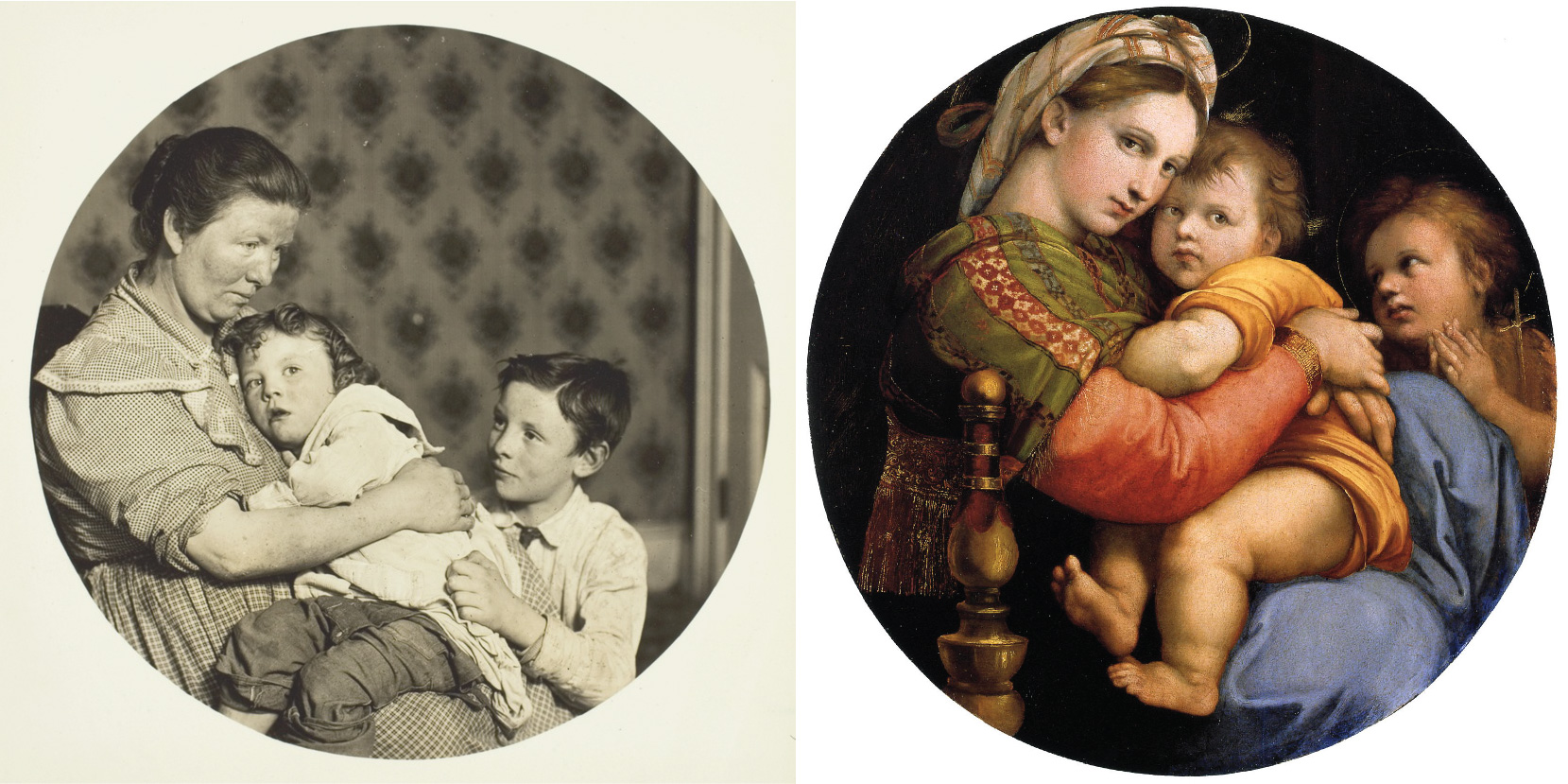
Tenement Madonna
Left: Lewis Hine (American, 1874–1940), A Madonna of the Tenements, 1904. Gelatin silver print, diameter 10 in. Right: Raphael (Italian, 1483–1520), Madonna of the Chair, 1513–14. Oil on panel, diameter 28 in. Palazzo Pitti, Florence.

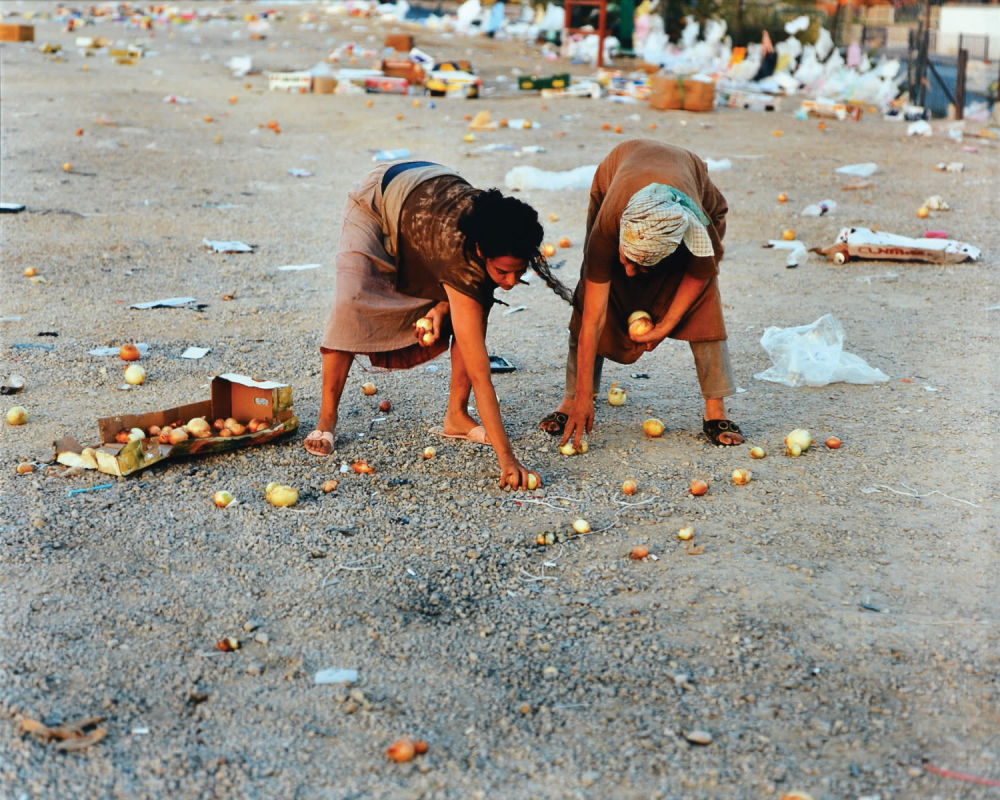
Nes, Adi_Ruth and Naomi
Adi Nes (Israeli, 1966–), Untitled (Ruth and Naomi), 2006. C-print, 140 × 177 cm.

Mach, David_The Money Lenders
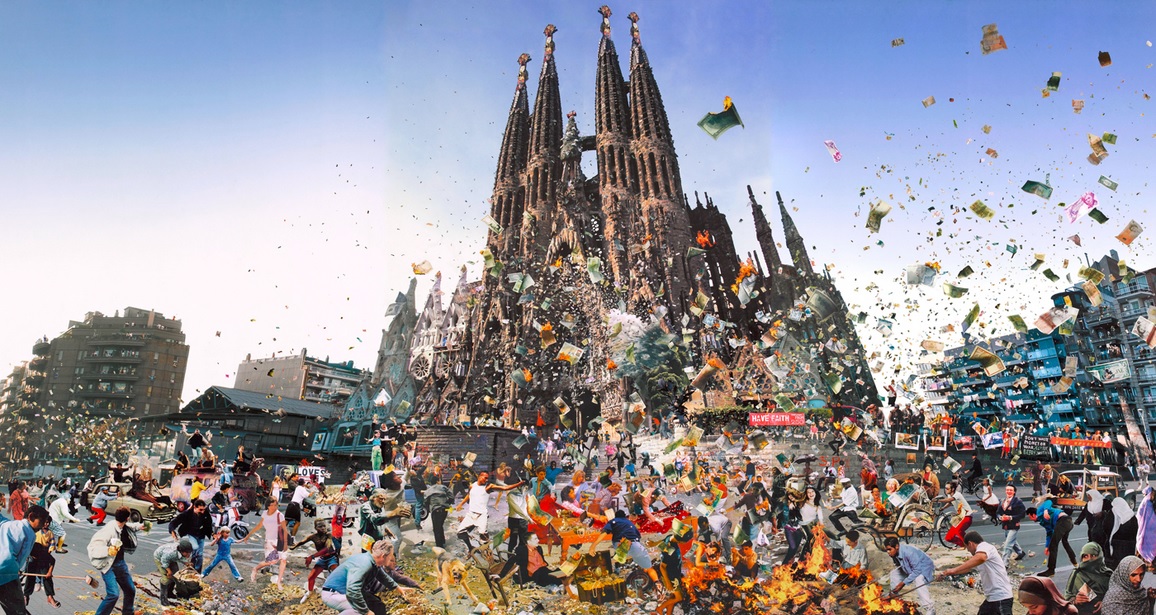
David Mach (Scottish, 1956–), The Money Lenders – Barcelona, 2011. Press print collage, 10 × 18 ft.

+++

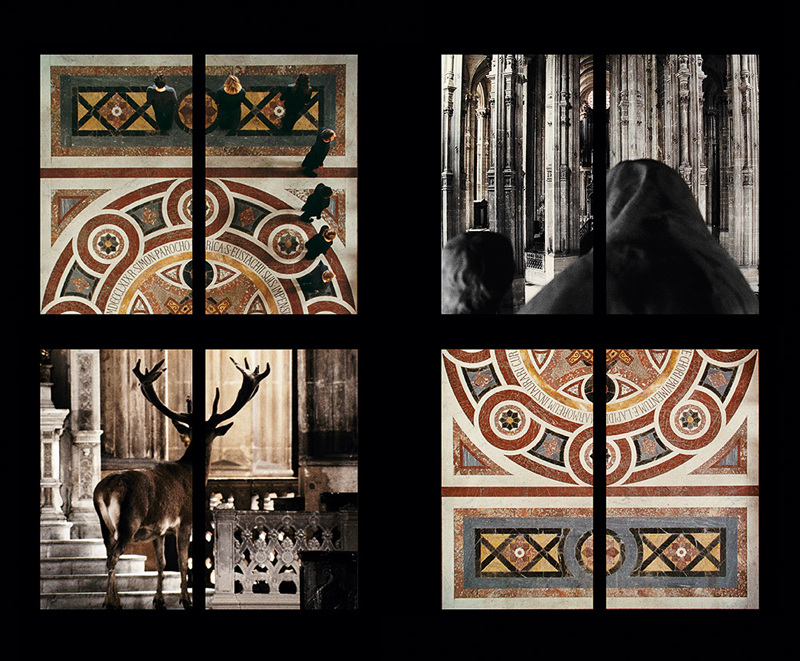
VIDEO: Deer in a Church: This short clip is one of the test scenes filmed on July 23, 2014, at the Église Saint-Eustache (Church of Saint Eustace) in Paris in preparation for a site-specific video installation commissioned for the church from Leonora Hamill, a photographic artist born in Paris and based in London and New York. The church is named after a Roman general who converted from paganism to Christianity during a hunt, after the stag he was pursuing turned to him and a cross appeared between its antlers, and he heard God speak, commanding him to be baptized. Eustace was martyred for his faith by Emperor Trajan in AD 118. His feast day is celebrated on September 20 in the Catholic Church and November 2 in the Orthodox Church.

The magnificent red deer (Cervus elaphus) in the video, a trained stag, is named Chambord. The installation he was filmed for, which was on view from December 4, 2014, to January 18, 2015, is titled Furtherance; a “making of” video can be seen here, and Hamill has posted another test scene on Instagram. Her director of photography for the project was Ghasem Ebrahimian.

From the artist’s website: “Shot on 35mm, the work weaves together traces of everyday activities within the church, unusual architectural points of view and a live stag . . . wandering through the space. Hamill transcribes the collective energy specific to this place of worship by retracing the steps of the church’s various occupants: priests, parishioners, tourists, soup-kitchen volunteers (on duty at the West Entrance every evening during winter) and their ‘guests’. These crossing paths constitute the social essence of the site. Their minimalist and precise choreography merges the human and spiritual sap of St Eustache.”

The footage of the majestic deer inside the majestic seventeenth-century sacred space—looking curiously around the high altar, the soaring candles reminiscent of trees in a forest—is breathtaking! Reminds me of Josh Tiessen’s Streams in the Wastelands painting series. Even nonhuman creatures praise the Creator.
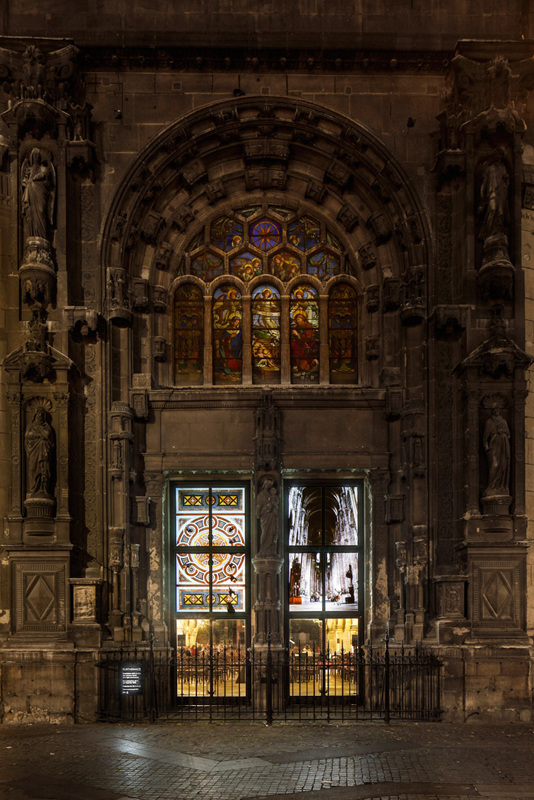
Hamill, Leonora_Furtherance (installation)
Leonora Hamill (French, 1978–), Furtherance, installation view, St. Eustache Church, Paris, 2014. Two-channel HD projection, color. 35 mm transferred to 2K. Duration: 8 mins, 26 secs. Commissioned by the Rubis Mécénat cultural fund. Photo: Liz Eve.

Hamill, Leonora_Furtherance
Production still from Furtherance by Leonora Hill

Roundup: Coventry Cathedral HENI Talk, dilapidated migrant boats transformed into musical instruments, and more

SONGS:

>> “Empty Grave” by Zach Williams: Some southern rock!

>> “Overcome with Light” by Bowerbirds, performed by Daniel Seavey and Liz Vice:

>> “Look Who I Found” by Harry Connick Jr., performed by the Good Shepherd Collective, feat. Charles Jones: This song cover premiered at Good Shepherd New York’s online Easter service last month. The original is from Harry Connick Jr.’s 2021 album Alone with My Faith, a mix of new songs he wrote (like this one) and classic hymns.

+++

ART VIDEO: “Coventry Cathedral: A Journey Through Art” (HENI Talks), written and presented by James Fox: While my husband was presenting at a science conference at Oxford in 2013, I took a train to Coventry and spent the whole day at the city’s cathedral, wandering through its chapels and grounds, sitting in front of its various artworks as the light changed, praying, and even talking with a few locals, including one man who had lived in Coventry since before its bombing in World War II. That bombing destroyed the original St. Michael’s from the fourteenth century, but when the cathedral was rebuilt after the war, it provided the occasion for new commissions from modern architects and artists. Here’s a wonderful video introduction to the history, art, and design of Coventry Cathedral:

In it the art historian and BAFTA-nominated broadcaster Dr. James Fox explores some of the cathedral’s modernist masterpieces: St. Michael’s Victory over the Devil by Jacob Epstein; the West Screen by John Hutton; the Tablets of the Word by Ralph Beyer; the stained glass windows in the nave by Lawrence Lee, Keith New, and Geoffrey Clarke; the lectern eagle by Elisabeth Frink; the high-altar cross of nails by Geoffrey Clarke; the monumental tapestry Christ in Glory in the Tetramorph by Graham Sutherland (which I wrote about for ArtWay); Angel of Agony by Steven Sykes; the Crown of Thorns by Geoffrey Clarke; the Chapel of Unity floor mosaics by Einar Forseth; and the Baptistery Window by John Piper. The latter Fox calls the pinnacle of the entire complex, and I agree—it’s extraordinary. Explore more at www.coventrycathedral.org.uk.

Coventry Cathedral interior
Coventry Cathedral in the West Midlands, England. Photo: David Iliff (CC BY-SA 3.0).

West Screen by John Hutton
Detail of the large glass “west” screen at Coventry Cathedral, designed and hand-engraved by John Hutton, 1962. This view looks out over the ruins of the Old Cathedral. Photo: Victoria Emily Jones.

For more HENI Talks, see heni.com/talks. See also a feature I ran about this video series back in 2021.

+++

SONG: “See What a Morning (Resurrection Hymn)” by Stuart Townend and Keith Getty, sung by the Coventry Cathedral choirs and congregation: Although Coventry Cathedral attracts tourists, it’s also an active church, home to a regular worshipping community! Here’s a video of the beginning of the entrance rite on Easter Day 2012, a procession carried out to the 2003 hymn “See What a Morning.” I appreciate the versatility of Stuart Townend and the Gettys’ hymns, which tend to work equally well if led by a contemporary worship band or a traditional choir with piano/organ accompaniment. I’m used to hearing their hymns sung in low-church contexts (“low church” refers to Christian traditions, such as evangelicalism, that place less emphasis on ritual and sacrament, as opposed to “high church”), so it was a delight to see one used as part of the Anglican liturgy and in such a majestic space!

+++

ARTICLE: “La Scala concert features violins that inmates made from battered migrant boats” by Colleen Barry, AP News, February 13, 2024: “The violins, violas and cellos played by the Orchestra of the Sea in its debut performance at Milan’s famed Teatro alla Scala carry with them tales of desperation and redemption. The wood that was bent, chiseled and gouged to form the instruments was recovered from dilapidated smugglers’ boats that brought migrants to Italy’s shores; the luthiers who created them are inmates in Italy’s largest prison. The project, dubbed Metamorphosis, focuses on transforming what otherwise might be discarded into something of value to society: rotten wood into fine instruments, inmates into craftsmen, all under the principle of rehabilitation . . .” This is a beautiful story of repurposing, of new life—for weathered wood that carried families out of danger zones, and for men who have been convicted of crimes but who seek to engage their hands and hearts in creative projects.

Reclaimed violin
February 9, 2024: A violin made from the wood of wrecked migrants’ boats lies in the instrument workshop at Opera maximum-security prison outside Milan. Photo: Antonio Calanni / Associated Press.

Reclaimed cellos
Two members of the Orchestra of the Sea play cellos made by inmates from reclaimed wood at the orchestra’s debut performance in Milan on February 12, 2024. Photo: Antonio Calanni / Associated Press.

Ten Songs of Joy for Gaudete Sunday

The third Sunday of Advent is known as Gaudete Sunday, gaudete (pronounced GOW-deh-tay) (Latin for “rejoice”) being the first word of the introit of the day’s Mass, taken from Philippians 4:4–6 and Psalm 85:1:

Gaudete in Domino semper íterum díco, gaudéte: modéstia véstra nóta sit ómnibus homínibus: Dóminus prope est. Nihil sollíciti sítis: sed in ómni oratióne petitiónes véstrae innotéscant apud Déum. Benedixísti, Dómine, térram túam: avertísti captivitátem Jácob.

Rejoice in the Lord always; again I say, rejoice. Let your forbearance be known to all men. The Lord is at hand. Do not be anxious over anything; but in all manner of prayer, let your requests be made known unto God. Lord, you have blessed your land; you have put an end to Jacob’s captivity.

It is customary for priests to swap out their purple vestments for pink today, and for those who use an Advent wreath to light not a purple candle but a pink one. Some churches favor a spare aesthetic in their sanctuaries for the first two weeks of Advent but break out the flowers for this the third. The approximate halfway point of the penitential Advent season, Gaudete Sunday is a special time to rejoice in the nearness of God’s coming as well as God’s presence with us here even now in the waiting, and to receive a foretaste of the bigger celebration to come on Christmas Day.

Here are ten songs for you to enjoy this Gaudete Sunday. If you’d rather listen to them as a YouTube playlist, click here.

Richardson, Jan_Visitation
The Hour of Lauds: Visitation by Jan Richardson [for sale]

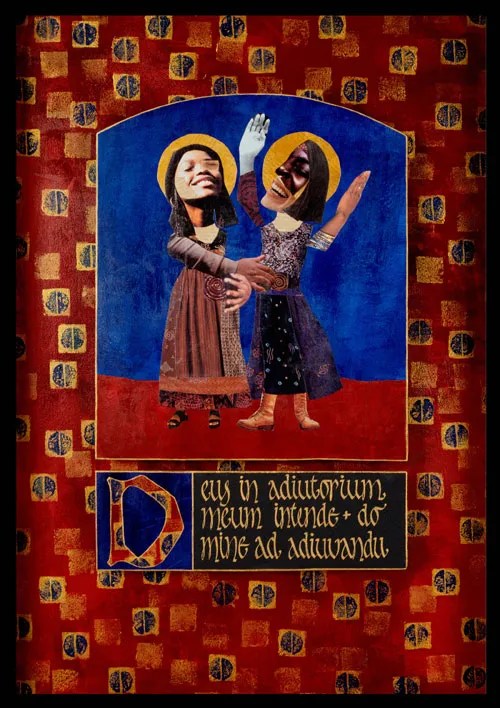
1. “Songs of Joy” by Garrison Doles, written late 1990s, on A Songmaker’s Christmas, 2012: “Songs of joy we hopefully sing, expanding our spirits, the season to know . . .” So opens this song by the late singer-songwriter Garrison Doles (d. 2013) [previously]. In 2009 his wife, the artist Jan Richardson, created a video combining the song with five of the seven collages from her Advent Hours cycle (which can be purchased as reproductions). Read the lyrics and songwriter’s statement here.

2. “My Soul Doth Magnify the Lord” by O’Landa Draper and the Associates, on Live…A Celebration of Praise, 1994: A trailblazing gospel choir director, O’Landa Draper was one of the top gospel artists of the nineties. This song of his is based on the Magnificat, the praise song Mary sings in the company of her cousin Elizabeth following the conception of Christ (see Luke 1).

3. “El burrito de Belén” (The Little Donkey of Bethlehem) by Hugo Cesar Blanco, 1972, performed by the band Matute, 2020: This is a Venezuelan carol about a person riding their donkey, with hurried excitement, from the sabanero (savanna) to Bethlehem to see the newborn Christ. Read the lyrics and translation here.

4. “Ecce mundi gaudium” (Behold the Joy of the World), England, 13th century, arranged and performed by the Mediæval Bæbes on Worldes Blysse, 1998: Written in Latin, this thirteenth-century carol is about the Virgin giving birth to the Son, our joy—announced to the shepherds by an angel and to the magi by a star. Despite the upbeat tempo throughout, the last two verses are about Herod’s raging and the Massacre of the Innocents. The soloist is Katharine Blake, the founder and musical director of Mediæval Bæbes. Read the original lyrics here, clicking on individual lines for the English translation.

5. “Kya Din Khushi Ka Aaya” (क्या दिन खुशी का आया) (What a Happy Day), performed by Akshay Mathews, 2021: A Hindi Christmas carol from India. Read the lyrics here.

6. “Repeat the Sounding Joy,” a fragment from “Joy to the World” arranged by Craig Courtney, performed by the Capital University Chapel Choir, 2019: A super-fun, one-minute choral work.

7. “Now Let Us Sing,” traditional, adapt. John L. Bell, 1995, performed by Katarina Ridderstedt, 2015: Katarina Ridderstedt (née Lundberg) is a rhythm teacher, musician, cantor, and choir director from Gotland, Sweden, who records music under the name Musikat. This video of hers introduced me to a charming little quatrain whose origins I don’t know (it’s credited as “Traditional”), but this version comes from Scotland’s Iona Community [previously]: “Now let us sing with joy and mirth, / praising the one who gave us birth. / Let every voice rise and attend / to God whose love shall never end.”

(Update, 1/6/25: “Now let us sing” is of Scottish origin, first appearing during the Protestant Reformation in the congregational song collection The Gude and Godlie Ballatis; the earliest extant edition of this book is from 1567, but it is thought to have been originally published in 1540. The tune was originally a drinking tune. For his rendition, published in Come All You People: Shorter Songs for Worship, John L. Bell essentially rewrote the first stanza, retaining only the first line of the original.)

8. “Brother” by Jorge Ben Jor, on A Tábua de Esmeralda, 1974: Known by the stage name Jorge Ben or (since the 1980s) Jorge Ben Jor, Jorge Duílio Lima Menezes (b. 1939) is a Brazilian singer-songwriter and musician whose characteristic style fuses elements of samba, funk, rock, and bossa nova. In this song he enjoins us to prepare a joyful path for the coming Christ—who is both Lord and friend—with love, flowers, and music.

9. “Alleluia, He Is Coming (I Looked Up)” by Martha E. Butler, 1979: This song is sometimes used in church services for Palm Sunday or Easter, but I think it makes a fitting Advent song as well—especially with the newer last verse that is sometimes used, as in the first video below. “Alleluia, he [Christ] is coming! Alleluia, he is here,” the refrain proclaims. Read about the inspiration behind the song, in the words of the songwriter, here. Allow me to sneak in two different performances. The first is by Donna Rutledge, Becky Buller, and Todd Green of First Baptist Church of Manchester, Tennessee, from 2020; theirs is a lovely rendition with strong vocals and a poignant violin part, but I do prefer a brisker pace (listening to the video at a playback speed of 1.25 is perfect, in my estimation):

The second is by the South African group Worship House, from their 2016 album Project 5 (Live in Johannesburg):

10. “Joy Will Come” by Paul Zach: The refrain of this song by Paul Zach of Virginia is based on Psalm 30:5b: “Weeping may linger for the night, but joy comes with the morning.” I also hear echoes of Psalms 18 and 121 throughout. The song is a reminder that through the dark nights we experience, we have hope; we have a Savior who will not abandon us.

Online Glen Workshop: July 25–31, 2021

Organized by Image journal every summer, the Glen is equal parts craft workshop, arts festival, and spiritual retreat. It’s framed by the Christian tradition but welcomes spiritual wayfarers of all stripes. This year, due to the pandemic, it’s entirely online, with twelve different classes on offer, taught by renowned artists, writers, and critics. Visit https://imagejournal.org/the-glen-workshop-2021/ for more information.

“The last year has invited many of us into a thicker relationship with place: with the homes where we quarantine, the public spaces we navigate with new caution, the vacation destinations we dream about, and the neighborhood streets we walk to avoid going stir-crazy in the meantime. Even our computers have transformed from objects to places, ushering us into the homes of loved ones, yoga studios, concert halls, museums, and countless other virtual gatherings, including the 2021 Glen Workshop! This year we’ll be exploring the ways in which our surroundings feed our creative vision. And we’ll also consider how art—both making it and sitting with it—sharpens our capacity for attention to the places we live and move and have our being.”

Each class costs $950 and is open to all experience levels. The schedule is such that attendees can choose just one. Registration to any class gives you full access not only to five days (about three hours each) of expert instruction, in-depth conversation, and practice, but also to additional programming that includes faculty presentations, “experiments with poetry and place” with artist in residence Billy Mark, chapel services led by musician Charles Jones and chaplain Marilyn McEntyre, coffee hours, open-mic nights, centering prayer sessions, and yoga sessions. Again, it’s all online.

If you don’t want to register for a class but want access to the other content or just a sneak peek, there are “retreat registration” and “festival pass” options. Click here to view registration options. You can get a 25% off discount if you register in a group of three or more.

What follows is a full list of the workshops (hands-on, craft-based classes) and seminars (immersive, discussion-based classes). I’m considering registering for either the Rosen seminar on contemporary biblical art or the Overstreet seminar on film. The cost is reasonable, but it’s still high, so I have to see if I can make it work.

Workshops

“Poetic Text as Provocation” with Scott Cairns: “We will embrace an approach to poetry that privileges poetic text as a scene of meaning-making, distinct from any approach that would understand the poem as a site of meaning already made. We will begin most days with a reading of a great and provocative poem and discuss the provocations each of us registers in response to that poem. Then, we will share our works-in-progress, and each of us will offer our ideas about what might make each draft a richer, more suggestive, provocative occasion for the reader.”

“The Attention We Owe Each Other” with Shane McCrae: “It is important to almost every poet to find a community of fellow poets with whom they can share their work, and from whom they can expect serious and good-humored attention, and honest and direct critiques. Together, we will make that community. Our poetry workshop will not operate according to any particular idea save the idea that poetry is serious—that it is, in fact, among the most serious things in our lives—and that, consequentially, we owe each other seriousness, and intelligence, and sensitivity when we workshop each other’s poems. We will read and critique each other’s poems closely; we will prioritize whatever particular issues each poem asks us to prioritize while keeping in mind the issues its author has asked us to consider; and we will have fun together, the highest seriousness being joy.”

“Writing the Moveable Feast” with Alissa Wilkinson: “Food is what binds us together as humans. We all eat it. We all make it, or someone makes it for us. We all have opinions about it and preferences for it, which often come from the things that make us, well, us: our families of origin, our nationalities and ethnicities, our individual tastes, our beliefs about God and ethics, and our access to it. Food is the gateway to every aspect of human life; when we eat it, we’re participating in history, culture, and the economy.

“Feasting is one of the most important activities we can do as people. It’s an act of community-building, celebration, and even resistance to the forces that try to tear us apart. Many religious and spiritual traditions are built around feasting; the Bible ends at a wedding feast.

“So in this class, we’re going to talk about food, think about food, make food, and eat food. We’ll talk about how writers have interacted with food and food writing. We will try to understand what it might mean to feast together even when we can’t actually be together. And then we’ll do our own food writing, with the goal of exploring that common experience through our writing (in any genre).”

“Strange Countries: Writing the Inner and Outer Journey” with Fred Bahnson: “In sixth-century Ireland, groups of monks began the practice of peregrinatio, “going forth into strange countries.” The peregrini set off alone or in small groups in tiny coracles made of willow and animal hide, abandoning themselves to the winds and currents of the North Atlantic. A journey into the unknown.

“We moderns find it difficult to grasp the enormity of such an undertaking. Given how frequently we travel, we barely notice the existential threshold crossed upon leaving home. The peregrini remind us that we go on pilgrimage not to consume experience, but to be consumed. To feel again the porous borders between our inner and outer lives. If our rational age has obscured what Seamus Heaney called ‘a marvelous or magical view of the world,’ pilgrimage helps us find it again.

“In this class we will take a very ancient metaphor—the journey—and use it to explore our lives in the age of climate change, pandemics, and fragile democracies. We’ve all gone forth into a strange country, a journey in which we measure distance in time and cortisol levels rather than miles. Setting off in our coracles of narrative—essay, memoir, literary journalism, travel writing, nature writing—we’ll use our peregrinations to map our inner lives against the great stories of our age. We will write our physical journeys (working from memory), and we will write about shelter, intimacy with place, our yearning to be at home. As we traverse the continuum between pilgrimage and place-making, we will discuss various craft topics of literary nonfiction: form, character development (including place-as-character), narrative arc, and, perhaps most important, how to create the fictional ‘I’ that is your nonfiction narrator.”

“The Landscape of the Lyric Essay” with Molly McCully Brown: “The lyric essay combines the density, muscle, and music of the poem with the expansiveness, narrative momentum, and overt desire to engage with information of the essay form. Tied to the original notion of an essay as an effort, a trying, an attempt at making sense, its combined allegiances to the fragment and the whole, the actual and the imaginative, the image and the story, make it the perfect form for exploring and charting the landscapes—both exterior and interior—that make and mark our lives.

“Designed as an opportunity for poets craving a little space to move around, for essayists hungry to drill down to the core of language, or for any writer longing for a chance to experiment, investigate, and attempt, this generative workshop will serve as an introduction to the associative logic of the lyric essay and a chance to try your own hand at the form.

“In class we’ll read and unpack lyric essays from a variety of writers; work together to identify some unique features and possibilities of the form; write in response to prompts designed to help us explore a variety of geographical, sociological, emotional, and intellectual landscapes; and share and discuss our work as it develops. My hope is that you leave the workshop with many attempts and beginnings which might prove fertile ground for later work, and with at least one piece that feels more complete, or further along in its development.”

“Writing Research-Based Narratives for Young Adults” with Marilyn Nelson: “Our curiosity can nourish our reading and our writing, which can nourish the curiosity of our young readers and encourage them to ask questions and follow their own research paths. In this class we will examine some books recently published for middle-grade and young adult readers and based to varying degrees on historical events, asking what questions led to the necessary research, how the research was conducted, and how the material was organized and presented so it is appropriate for younger readers. How do we write for younger readers? How might an author write over their heads? How might an author write down to them? What questions does an author allow to linger? How much information is too much? How does an author find the right voice?”

“Developing Your Authentic Voice” with Charles Jones: “This workshop will focus on teaching artists how to bring their authentic selves to the craft of songwriting and successfully communicate what they want their audiences to hear and feel. We will listen to the music of some of the greatest songwriters of all time and examine what we feel when we listen back. We will explore why we connect deeply with some music, look at the connective tissue these masters created in their songs, and learn how we apply these techniques and tools to our own craft in service of our own unique stories and voices.”

“The Creative and Spiritual Practice of Calligraphy” with David Chang: “From the practical to the ethereal, writing a letter by hand offers a deeper connection to the text and to the viewer. We will cover both aspects of the art form of calligraphy as we learn the basics—including developing your own personal handwriting style—and learn to use handwriting as a creative practice that can also forge a deeper spiritual practice. Through meditational writing we will explore the art of handwriting as a tool for personal expression and as a means to connect with ourselves and also with others.”

“Landscapes and the Art of Seeing” with Suzanne Dittenberg: “In Sargy Mann’s article ‘On Cezanne’ he opposes the popular notion that Paul Cezanne was intentionally distorting the landscape through superimposed affectated abstraction, re-tooling visual information to titillating effect. Instead, Mann makes the case that Cezanne’s painting practice was more straightforward. He describes Cezanne as a relatively unremarkable draftsman who gave himself intensely to the act of looking. ‘As dedicated a realist as you could ever find.’ In Cezanne’s letters, we are given a window into his motivations when painting. He writes, ‘Now the theme to develop is that, whatever our temperaments or power in the presence of nature may be, we must render the image of what we see, forgetting every-thing that existed before us. Which, I believe, must permit the artist to give his entire personality whether great or small.’

“This is a class about seeing. Observational painting serves as a means to explore one’s individual spirit when encountering nature. Each day we will gather together on Zoom and also venture out to work en plein air in our own vicinities. Painting and drawing will serve as a mechanism for finding a new lens with which to view the natural world. A better understanding of nature’s underlying frameworks will result.

“Through daily discussion of drawing and painting techniques, we will cover basic strategies for seeing relative proportions, identifying values structure and understanding color in context. We will also address the use of limited palettes, strategies for achieving harmonious color and methods of paint application. Each afternoon will include time for reflection on the day’s process, experience and results.”

Seminars

“Contemporary Visual Artists Read the Bible” with Aaron Rosen: “The mere mention of a contemporary artist reading the Bible summons competing stereotypes. On one side stands the artist as clamoring missionary, producing pious kitsch. On the other sits the talented but godless iconoclast, scorning the Bible to the applause of intellectuals. It’s high time to get beyond these stereotypes, rooted in the culture wars of the 1980s, yet sadly back in fashion. There are brilliant artists of faith working with the Bible who have the power to challenge even the most ardent atheists, aesthetically and theologically. And there are artists without a spiritual bone in their bodies who engage scripture in ways that can teach devout viewers a thing or two about faith.

“In this seminar, we will see the Bible with fresh eyes, with the help of cutting-edge art across multiple media, from painting to video to virtual reality. Not only will they look at art, they’ll talk to top-notch artists themselves, who will join us by video from their studios around the world, from Los Angeles to London to Lahore. As one of the world’s foremost experts on religion and art, as well as a practicing curator, Dr. Rosen brings together scholarly and practical insights. And as a Jew married to an Episcopal priest, he has a special interest in how art can help us see difference more clearly and creatively at the same time.”

“How Place Becomes Poetry in Cinema” with Jeffrey Overstreet: “For most filmmakers, place is just a backdrop. But great artists of cinema know that place is as influential and as eloquent as any character. Whether he’s in the heat of Texas or the despair of a divided Berlin, director Wim Wenders is listening to what his location has to say. Martin Scorsese and Spike Lee both read New York City closely, but they see very different cities and zones defined by differing forms of prejudice. We’ll consider how one story, told by both Yasujiro Ozu and Claire Denis in different locations, is transformed by the context in which it is told. And we’ll watch the world opened up by the cinematographers of Terrence Malick as well as the animators Tomm Moore and Martin Rosen. A variety of special guests—filmmakers, film critics, and scholars—will join us for these journeys as we watch how human beings are shaped by the ground beneath their feet. The current guest list [subject to change] includes Scott Derrickson (Doctor StrangeSinister), Justin Chang (film critic for the Los Angeles Times), Dr. Yelena Bailey (author of How the Streets Were Made: Housing Segregation and Black Life in America), and Doug Strong (My Angel LarryRiver Road).”

“The Art of Contemplative Reading” with Richard Chess: “In this seminar, we’ll explore reading practices (poetry and prose) that may help us cultivate a contemplative mind. As we practice directing our attentions to different aspects of our experiences as readers—noting our physical experience, quieting our inner voices to enable us to hear more clearly the voice of a text, discerning the difference between noting elements of the text itself and commenting on, reacting to, or interpreting the text—we may also discover ways of engaging with texts (mostly literary) that will help us with our practice as artists and/or our spiritual practices. We’ll also do some writing—reflective writing and generative creative writing—to explore writing itself as a contemplative practice.”

New Easter Music

As the church continues in this fifty-day season of Eastertide to celebrate the resurrection of Christ, here are some songs I’ve come across for the occasion and really enjoyed. A few are brand-new, while others are new performances.

Good Shepherd New York, a church in Manhattan, has a phenomenal team of in-house musicians and collaborators from coast to coast. They provide music for weekly digital worship services as well as release recordings under the name Good Shepherd Collective. Check out their Easter service from April 4! The songs are listed below.

  • MEDLEY: “Christ the Lord Is Risen Today” by Charles Wesley / “Celebrate Jesus” by Gary Oliver (1:35)
  • “Here Comes the Sun” by the Beatles (3:50)
  • “Morning Has Broken” by Eleanor Farjeon (6:59)
  • “Easter Dawn” by David Gungor (11:31)
  • “Because He Lives” by Bill Gaither (15:27)
  • “Waymaker” by Donald Vails (20:45)

The GSC has posted “Here Comes the Sun” as a standalone video on Instagram. It features Brennan Smiley on lead vocals and acoustic guitar; Liz Vice on harmonizing vocals; Charles Jones on Hammond organ; John Arndt on piano; Jesse Chandler on flute, clarinet, and saxophone; Joseph M on electric guitar; Tyler Chester on bass guitar; and McKenzie Smith on drums. The art and stop-motion animation are by Boston-based artist Soyoung L Kim.

+++

“Hallelujah” (Chorus) from the Messiah by George Frideric Handel, 1742 | Performed by the Orquesta Barroca Catalana (Catalan Baroque Orchestra), the Barcelona Ars Nova choir, and 352 other singers, 2020 [HT: Global Christian Worship]

Last year the Fundación la Caixa in Barcelona launched project #YoCanto Aleluya, soliciting professional and amateur singers alike throughout Spain and Portugal to be part of a “virtual choir,” a phenomenon that has exploded since the pandemic has made live musical concerts a health risk. Participants were asked to submit a video of themselves singing Handel’s famous “Hallelujah” chorus. Igor Cortadellas of Igor Studio then developed a concept for digitally merging all 352 submissions by projecting them on the interior architecture of Barcelona’s Basilica of Santa Maria del Mar (or overlaying them in postproduction?), and he directed a small team to execute this vision. What a feat! The final video was released a few months ago at Christmastime.

“Hallelujah” concludes part 2 of 3 of the oratorio, which covers Christ’s passion and death, resurrection, ascension, and the first spreading of the gospel. The words of the chorus are taken from Revelation 19:6, 11:15, and 19:16. For another blog post featuring an excerpt from Handel’s Messiah, see the Artful Devotion “Worthy Is the Lamb.”

+++

“Easter Dawn” | Words by Malcolm Guite, 2012 | Music by Zebulon M. Highben, 2021: A conductor, composer, and scholar of sacred music, Dr. Zebulon M. Highben serves as director of chapel music at Duke University. This year he wrote a choral setting of Malcolm Guite’s sonnet “Easter Dawn,” about Mary Magdalene’s encountering the risen Christ on Easter morning. Sung by the Duke Chapel Choir, it premiered last Sunday as part of the chapel’s Easter service and will be part of the online spring concert “Faith & Hope & Love Abide: Meditations on Resurrection,” which goes live tomorrow (April 11) at 4 p.m. EDT (view the program).

+++

“Keep the Feast (Pascha Nostrum)” by Ryan Flanigan: For this new song, Ryan Flanigan of Liturgical Folk adapted the words of the Pascha Nostrum (“Our Passover”), a traditional Christian hymn for Eastertide that, after the Reformation, was preserved in English in the Book of Common Prayer. It is based on 1 Corinthians 5:7–8, Romans 6:9–11, and 1 Corinthians 15:20–22. Flanigan wrote a fun new melody for it, which he demos here.

+++

“Zinda Yeshua (Jesus Is Alive)” by Blesson Varghese and James Bovas: This Hindi-language Easter song is from Grace Ahmedabad, an Assemblies of God church in the Indian state of Gujarat. James Bovas sings lead, with Priscilla Mozhumannil on supporting vocals. See the YouTube description for a full list of credits. [HT: Global Christian Worship]

+++

“Judah’s Lion” | Words by Fulbert of Chartres, ca. 975–1028, and Rick Barnes, 2016 | Music by Rick Barnes, 2016 | Performed by Covenant Presbyterian Virtual Choir and Orchestra, Birmingham, Alabama, 2021

Roundup: The Crucifixion in modern art, “Lift Every Voice” ballet solo, and more

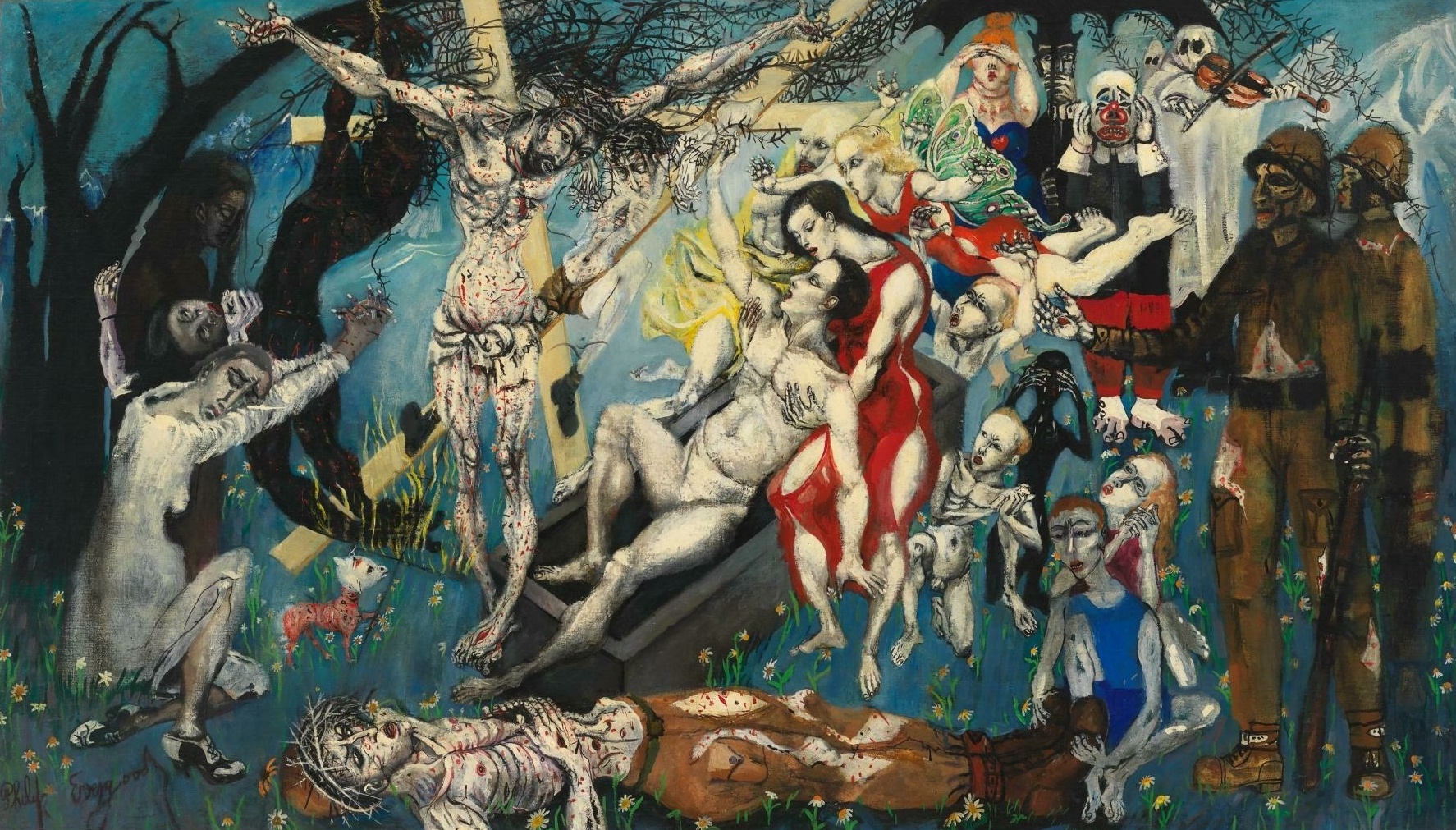
VISUAL MEDITATION: “Waking Up from Apathy,” on Philip Evergood’s The New Lazarus: My latest visual meditation for ArtWay has just been published. It’s on a crowded, noisy, garish painting that, honestly, is distressing to look at. And it’s supposed to be. Because it exposes what Martin Luther King Jr. called the triple evils of society: racism, militarism (war), and economic exploitation (aka extreme materialism, a systematic cause of poverty). Though Philip Evergood was not a Christian, he draws on Christian narrative and iconography, with the figures of Lazarus and Christ, to protest the cycles of violence that we need to rise out of before we self-destruct.

Evergood, Philip_The New Lazarus
Philip Evergood (American, 1901–1973), The New Lazarus, 1927–54. Oil and enamel on canvas mounted on wood, 148 × 237.2 cm. Whitney Museum of American Art, New York.

The see-nothing, hear-nothing, say-nothing figures in the background remind me of people today who insist that racism does not exist and therefore tune out the cries of Black Lives Matter, for instance. I’m implicated too by these symbols of willful ignorance, because I admit that I do not often care to question where my food, clothes, coffee, chocolate, and other conveniences come from, or how the businesses I regularly support with my dollars treat their employees.

Evergood was politically engaged in both his art and his life, espousing egalitarian ideals. He participated in strikes and demonstrations for workers’ rights and was jailed more than once and beaten by police. He was greatly influenced by Mexican muralism, and he embraced the label of “propaganda” for his art, acknowledging that he was trying persuade the public to join the cause of social justice. “He was a figurative painter when much of the art world placed greater value on abstraction,” writes the University of Kentucky Art Museum, “and he was a moralist when moralizing was not considered an option for serious painters.” Nevertheless, he had a successful career, and his work is in many major museum collections, including the Tate Gallery, the Los Angeles County Museum of Art, the Art Institute of Chicago, the Hirshhorn Museum, the Museum of Modern Art, and the Whitney Museum of American Art.

+++

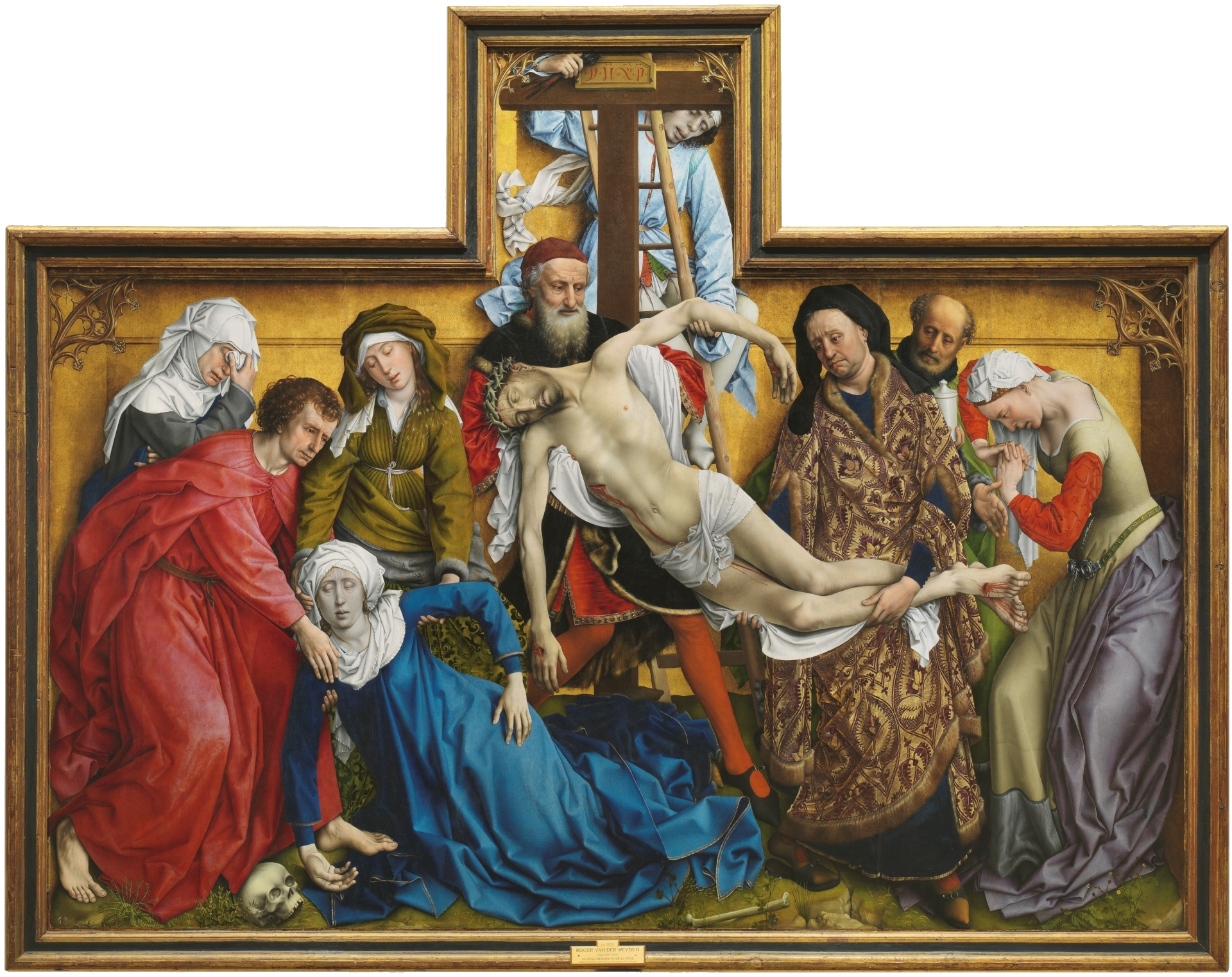
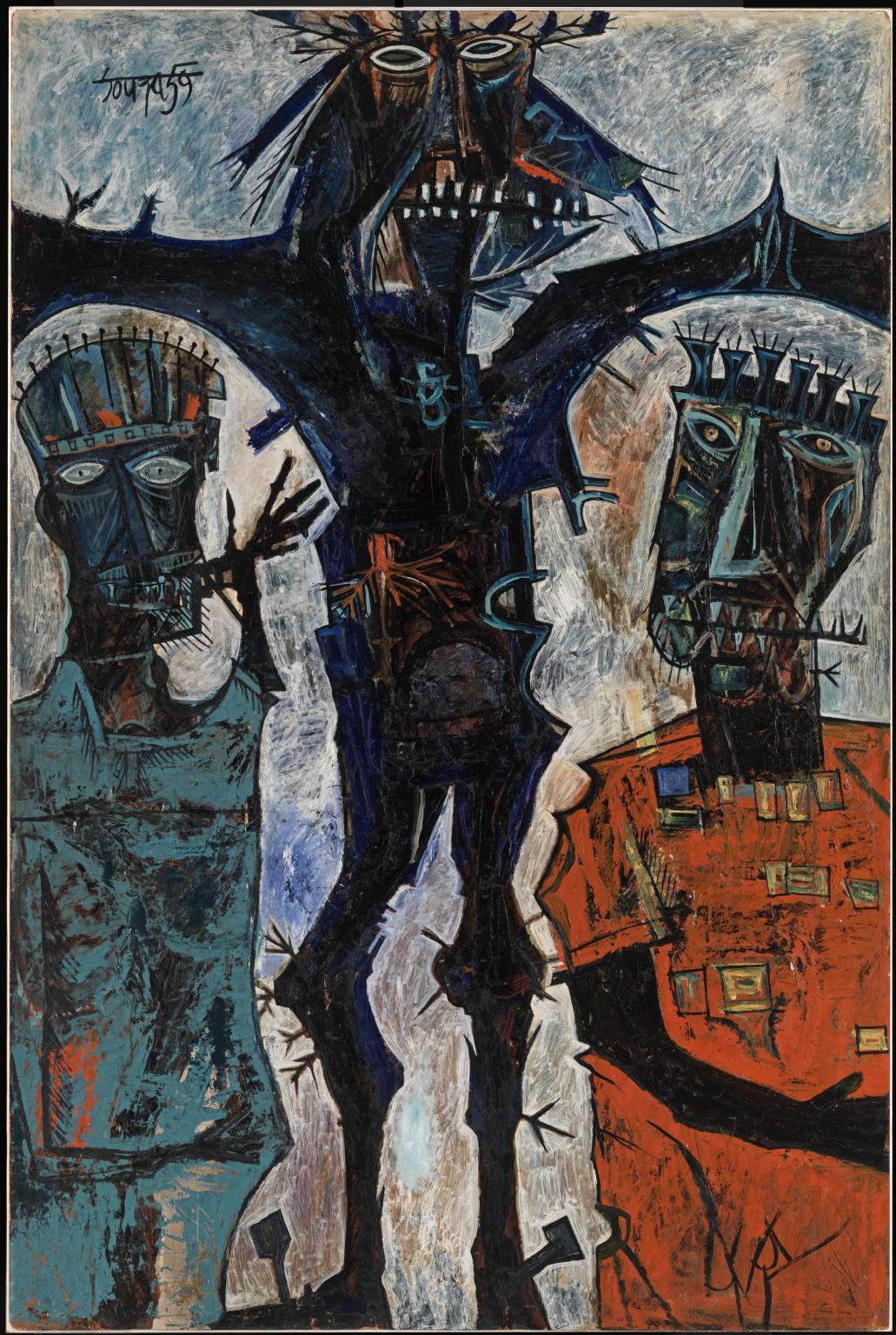
PODCAST EPISODE: “How a ‘biblically illiterate’ generation can discover Christian art,” Holy Smoke, July 28, 2020: I love hearing Ben Quash [previously] discuss specific artworks in detail! He brings such reverence, inquiry, wonder, curiosity, and openness to his looking and interpreting. For this interview with Carmel Thompson he has selected six Christ images spanning the early Renaissance through contemporary eras: the side-by-side Byzantine-inspired Healing of the Man Born Blind and Transfiguration panels of the Maestà Altarpiece by Duccio, the classically beautiful Descent from the Cross by Rogier van der Weyden at the Prado (“probably the painting that put realistic tears on the map of Western art”), Albrecht Dürer’s daring self-portrait as Christ, a homely Christ in the Wilderness: Consider the Lilies by Stanley Spencer, a grotesque Crucifixion by F. N. Souza (with reference to crucifixions by Grünewald, Picasso, Sutherland, and Bacon), and Michael Landy’s kinetic sculpture Doubting Thomas.

In addition to providing individual commentaries, Quash also talks about reading art theologically instead of just aesthetically, art as developing physical sight toward spiritual insight (external and internal seeing), the persistence of Christian iconography in the art of today, and the ways in which art can implicate the viewer.

Weyden, Rogier van der_Descent from the Cross
Rogier van der Weyden (Netherlandish, 1399–1464), Descent from the Cross, before 1443. Oil on panel, 204.5 × 261.5 cm. Museo Nacional del Prado, Madrid.

Crucifixion by F. N. Souza
F. N. Souza (Indian, 1924–2002), Crucifixion, 1959. Oil on board, 183.1 × 122 cm. Tate Modern, London.

There’s so much that’s quotable in the conversation, but because it applies to the ArtWay meditation I linked to above, I’ll just highlight part of his discussion of nonreligious artists’ attraction to Crucifixion imagery in the twentieth century. The Isenheim Altarpiece (1515), he says, a visual reference point for many modern artists,

shows an agonized Christ whose tongue is swollen and protruding from his mouth, whose body is covered in sores, whose skin is tinged green, whose fingers are curled up in agony. There’s no idealization here of what a death like that might have been. Instead there’s a strong assertion that the extremes of human pain and suffering are not alien to the Christian message. And yet it’s a religious image—this is a Christian image painted for a Christian context.

When that work comes into contact with the new traumas of the twentieth century—we talked about [Stanley] Spencer and the Second World War, here [Francis Newton] Souza experiencing colonialism in India—when that painting comes into contact with those sorts of extremes of human experience, it activates, it speaks to them, and calls forth new artistic responses, because it feels as though Christianity can still speak, even in those extremes. And I think Souza, like [Graham] Sutherland and [Francis] Bacon, while they may not have felt comfortable with traditional Christianity, saw the power of that Christian tradition to in some way help them articulate the traumas and the horrors of their own time.

So that’s a very interesting work, and typical of several examples of the extraordinary way in which we might think we’re in a secular age, but Christian iconography is probably as lively as ever—although it’s doing new things—in the work of modern and contemporary artists.

+++

SONGS . . .

from the GOOD SHEPHERD COLLECTIVE: Spearheaded by David Gungor and Tyler Chester, the Good Shepherd Collective [previously] “creates liturgical art to inspire the Christian imagination, that we may embody the love of Christ for the good of our neighbors.” They’ve just released an album of ten hymns. One of them is “Joyful, Joyful, We Adore Thee,” queued up in the liturgical service video below, and though it didn’t make the final album cut, I also really like their version of “His Eye Is on the Sparrow.”

from Family Company: Charles Jones, the lead singer on both of the above videos, is also a part of Family Company, an LA-based music collective celebrating the traditions of soul, blues, and R&B. You might enjoy these seventies covers of theirs: “Heaven Help Us All” (popularized by Stevie Wonder), featuring Charles Jones, and “Let Us Love” by Bill Withers, featuring Teddy Grossman. See more on their YouTube channel.

+++

BALLET SOLO: “Lift Every Voice and Sing”: Premiering at the Lincoln Center in 2019, Ounce of Faith is a contemporary ballet choreographed by Darrell Grand Moultrie, the score a mix of jazz standards, original music, and spoken word. This excerpt is performed by Khalia Campbell of the Alvin Ailey American Dance Theater, with movements suggestive of both struggle and pride.

Known as the Black National Anthem, “Lift Every Voice and Sing” was written in 1899 by writer and activist James Weldon Johnson and set to music by his brother, John Rosamond Johnson. The hymn is sung here, just the first of its three verses, by Aisha Jackson, with Dante Hawkins on piano. It’s a song of historical remembrance and lament but also of hope, a rallying cry to move forward together, in unity, out of our “dark past,” into the truth of God, continuing to fight injustice wherever we find it so that everyone can live free. It acknowledges that God is the one who leads his people in love and who wills liberty, and it supplicates: “Keep us forever in the path [of Your light], we pray.” Learn more about the hymn in this NPR feature. See also this UMC Discipleship article, especially the part where Dr. James Abbington, a choir director and a scholar of African American sacred music, answers the question, “Is this a hymn just for African Americans or is it for all people?”

+++

LITERARY ESSAY: “To Sit with an Onion” by Elizabeth Harwell: God “is tethered to this world in delight” and does not weary of it as we do, writes Elizabeth Harwell after having sat with a mussel shell for one hour, upon the advice of Robert Farrar Capon. (An exercise in wonder! Any inanimate object will do.) Harwell marvels at how the shell—blueberry-blue and milk-white, cold, curvaceous, smooth—was “an entire world to the mussel who called [it] home,” and now, since she picked it up off a Maine beach, it sits in a silver dish in her dining room, a reminder of the Creator’s quiet mirth. And there’s much more where that came from. “That shell represented one of thousands (millions?) of pearly homes that will never lay bare in front of human eyes—miles of ocean floor, covered in secret delights, that began as thoughts in my Father’s mind. We humans can be so self-important that we’ve never considered that God is enjoying parts of creation that none of us will ever see.” Read the whole essay at The Rabbit Room.

(Quash’s discussion of Stanley Spencer’s Wilderness series in the abovementioned podcast, in which Christ gets down on the ground like a curious child to observe wildflowers, scorpion, hen, dovetails nicely with this essay!)