Father, Son, Spirit

Thamburaj, A. J._The Holy Trinity
Fr. A. J. Thamburaj, SJ (Indian,, 1939–), The Holy Trinity, before 1982. Oil painting, 23 × 33 in.

The grace of the Lord Jesus Christ and the love of God and the fellowship of the Holy Spirit be with you all.

—2 Corinthians 13:14

+++

SONG: “Om Bhagwan” | Song from the Saccidananda Ashram songbook, composer unknown | Arranged by Chris Hale and Miranda Stone | Performed by Yeshu Satsang Toronto, on Bhakti Geet, vol. 4 (2019)

This Trinitarian song in Hindi comes from a Benedictine monastery in Tamil Nadu. It is performed here by married couple Chris Hale (who grew up in Nepal and India) and Miranda Stone and others from Yeshu Satsang Toronto, a community whose expression of Yeshu Bhakti (Jesus devotion) is “distinctly urban and Canadian, yet informed by the simplicity of the village, honouring what is handmade, humble, and real . . . , navigating . . . between what is traditional and what is progressive.” A transliteration, with English translation, follows. The sacred syllable Om, or Aum, isn’t really translatable.

Om Bhagawan, Om Bhagawan, Om Bhagawan, Prabhu Pita Bhagawan
Om God, Om God, Om God, Lord Father God

Om Bhagawan, Om Bhagawan, Om Bhagawan, Prabhu Putra Bhagawan
Om God, Om God, Om God, Lord Son God

Om Bhagawan, Om Bhagawan, Om Bhagawan, Prabhu Aatma Bhagawan
Om God, Om God, Om God, Lord Spirit God

Om Bhagawan, Om Bhagawan, Om Bhagawan, Prabhu Yeshu Bhagawan
Om God, Om God, Om God, Lord Jesus God

[Related posts: “Exalted Trinity (Artful Devotion)”; “Namaste Sate (Artful Devotion)”]

+++

Painted by the Jesuit artist-priest Father A. J. Thamburaj, The Holy Trinity expresses a complex theological doctrine through mudras (Indian hand gestures) and color. I scanned the image from the excellent book Christian Art in India by Herbert E. Hoefer (Chennai: Gurukul Lutheran Theological College and Research Institute, 1982), which features art by thirty-five artists and essay contributions by Jyoti Sahi. Hoefer describes the painting:

Green is the colour of creativity and fertility. Red is the colour of activity. Blue is the colour of the sea and sky, symbols of mystery and eternity. Yellow [saffron] is an auspicious and joyful colour in Indian custom.

The upraised hand [abaya mudra] is a symbol of protection in Indian art and dance. It represents the Father. Its message is ‘Fear not’. The fish denotes the ever-watching eye of God, for the eyelids of the fish never close.

The downward hand [varada mudra] represents Christ. This gesture is common in Indian sculpture and dance. God is said to point his devotees to hide under the arch of his foot for refuge. The red wound reminds us that the risen Lord bears the redemptive marks of the crucifixion.

The red hand symbolizes the purifying fire, the Holy Spirit. The spiral line indicates the wind, connecting all three Persons in unity. Fire and wind are power.

Our life is in the ever-present protecting, redeeming, purifying and empowering hands of the Triune God.

+++

In the church’s year, Trinity Sunday is the day when we stand back from the extraordinary sequence of events that we’ve been celebrating for the previous five months—Advent, Christmas, Epiphany, Lent, Good Friday, Easter, Ascension, Pentecost—and when we rub the sleep from our eyes and discover what the word “god” might actually mean. These events function as a sequence of well-aimed hammer-blows which knock at the clay jars of the gods we want, the gods who reinforce our own pride or prejudice, until they fall away and reveal instead a very different god, a dangerous god, a subversive god, a god who comes to us like a blind beggar with wounds in his hands, a god who comes to us in wind and fire, in bread and wine, in flesh and blood: a god who says to us, “You did not choose me; I chose you.”

You see, the doctrine of the Trinity, properly understood, is as much a way of saying “we don’t know” as of saying “we do know.” To say that the true God is Three and One is to recognize that if there is a God then of course we shouldn’t expect him to fit neatly into our little categories. If he did, he wouldn’t be God at all, merely a god, a god we might perhaps have wanted. The Trinity is not something that the clever theologian comes up with as a result of hours spent in the theological laboratory, after which he or she can return to announce that they’ve got God worked out now, the analysis is complete, and here is God neatly laid out on a slab. The only time they laid God out on a slab he rose again three days afterwards.

On the contrary: the doctrine of the Trinity is, if you like, a signpost pointing ahead into the dark, saying: “Trust me; follow me; my love will keep you safe.” Or, perhaps better, the doctrine of the Trinity is a signpost pointing into a light which gets brighter and brighter until we are dazzled and blinded, but which says: “Come, and I will make you children of light.” The doctrine of the Trinity affirms the rightness, the propriety, of speaking intelligently that the true God must always transcend our grasp of him, even our most intelligent grasp of him.

—N. T. Wright, For All God’s Worth: True Worship and the Calling of the Church


This post belongs to the weekly series Artful Devotion. If you can’t view the music player in your email or RSS reader, try opening the post in your browser.

To view all the Revised Common Lectionary scripture readings for Trinity Sunday, cycle A, click here.

Namaste Sate (Artful Devotion)

Puccio, Pietro di_God Holding the Universe
Pietro di Puccio da Orvieto (Italian, active 14th century), “Universe Supported by God with the Signs of the Planets,” 1389–91. Fresco, north gallery, Camposanto Monumentale, Pisa, Italy.

He is the image of the invisible God, the firstborn of all creation. For by him all things were created, in heaven and on earth, visible and invisible, whether thrones or dominions or rulers or authorities—all things were created through him and for him. And he is before all things, and in him all things hold together. And he is the head of the body, the church. He is the beginning, the firstborn from the dead, that in everything he might be preeminent. For in him all the fullness of God was pleased to dwell, and through him to reconcile to himself all things, whether on earth or in heaven, making peace by the blood of his cross.

—Colossians 1:15–20

+++

SONG: “Namasté Saté” by Aradhna, on Namasté Saté (2011)

Namasté saté sarvalok-ashrayaya
Namasté chité vishwarup-atmakaya
Namo adwait tatwaya muktipradaya
Namo brahmane vyapiné shashwataya

Ultimate Reality, we greet You
In you the whole Universe is held together
Your life fills every nucleus that has ever been created
You dwell in our flesh and bones
Your Great Liberation is to bring us into loving oneness with you
So full, that we can no longer feel any separation between us
We greet you, O Supreme One, all-pervading, and eternal

Founded in 2000 by Chris Hale and Pete Hicks, Aradhna (Hindi for adoration) is a band that writes and performs Christ-centered bhajans, Indian devotional songs. (Bhajans, says Hale, have been welcomed by Indian Christians for centuries; every Indian hymnal has a section devoted to the genre.) Both men are American but have roots in South Asia—Hicks was born in India, and Hale was raised in Nepal, where his parents served as medical missionaries. He developed fluency in Hindi and Nepali and, while attending boarding school in India, began training in sitar. After graduating from Berklee College of Music in the US, he returned to Lucknow, India, for further training in sitar and voice. He now lives in Toronto’s Little India with his wife, Miranda Stone, with whom he leads a monthly gathering of Christ-followers called Yeshu Satsang Toronto.

Many of the lyrics of Aradhna’s songs are derived from the writings of Yeshu bhaktas, Hindu devotees of Jesus.

To learn more about Hale and his ministry through contextualized music, read this Comment interview or listen to his lecture from Southern Baptist Theological Seminary—both from 2009.

+++

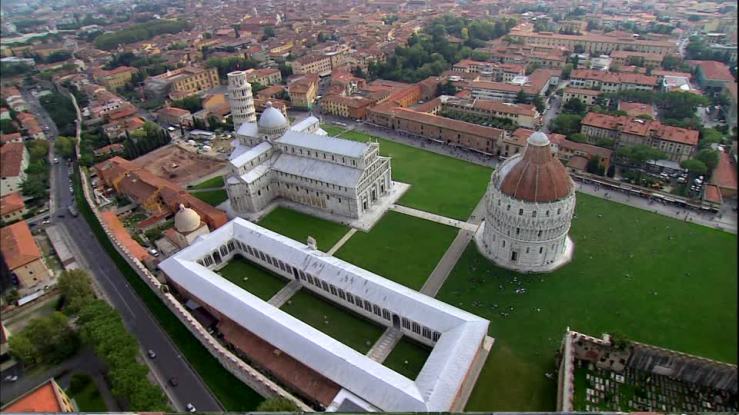
The Campo Santo, or Camposanto Monumentale (“monumental cemetery”), is an oblong Gothic cloister that, alongside Pisa’s cathedral, baptistry, and leaning tower, forms one of the finest architectural complexes in the world.

Camposanto Monumentale aerial view
Aerial view of the Piazza dei Miracoli (Square of Miracles) in Pisa. The Campo Santo is the rectangular edifice with the open courtyard at the bottom.

Camposanto Monumentale interior courtyard

Completed in 1464, it is filled with funerary monuments, many of which reuse ancient Roman sarcophagi, as well as a classical art collection. In addition, its long walls are covered with frescoes painted during the transitional period between the Middle Ages and the Renaissance. These were badly damaged during World War II, but some have been restored.

Puccio, Pietro di_God Holding the Universe

The fresco that shows Christ holding the universe, sometimes referred to by the title Theological Cosmography, was painted by a minor artist named Pietro di Puccio. In the second volume of his History of Mediaeval Christianity and Sacred Art in Italy, published in 1872 (well before the Allied bombing), Charles Isidore Hemans writes that the fresco

mystically sets forth the origin of the universe and its dependence upon the Almighty Creator. A colossal figure of Deity, with the aspect proper to the Second Person, supports an immense disk containing numerous concentric circles, with figures, emblems, inscriptions: first in order, the nine Angelic Hierarchies; next, the three Heavens—the first (empyreal) without sign or symbol, the second (crystalline) with the signs of the Zodiac, the third (the firmament) with the starry host; internal to these, a succession of other circles enclosing at the centre a miniature view of the three known continents. At the angles below are the two illustrious Doctors, severally representatives of the theological mind of ages, S. Augustine and S. Thomas Aquinas.

This geocentric model of the universe, with several earthly and (further out) heavenly spheres circling around a motionless earth, was conceived by Ptolemy, who based it on Aristotle. It was the dominant model during the classical, medieval, and Renaissance eras and can be found in the work of other visual artists.

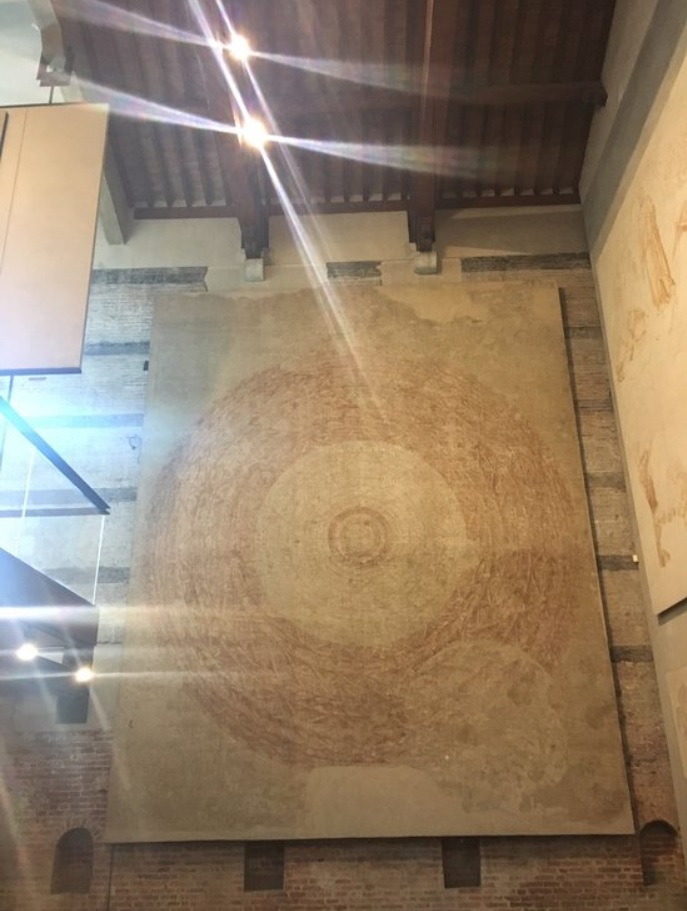
During an extensive restoration process, this and other frescoes were detached from the walls and placed on panels. This led to the discovery of sinopie, or preparatory drawings, underneath, which were also detached and are now kept on display in the Museo delle Sinopie, of special interest to art historians.

Theological Cosmography sinopia
Sinopia (red underdrawing in plaster) of the Theological Cosmography fresco from the Campo Santo, relocated to the Sinopia Museum, also in the cathedral square.

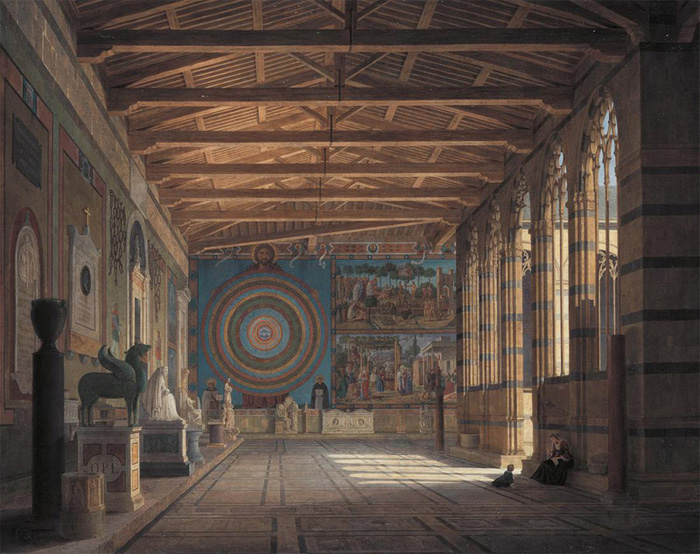
Puccio’s Theological Cosmography has since been returned to its original location in the north gallery of the Campo Santo—at the end of the left hallway in the panoramic shot below. The neoclassicist architect and painter Leon van Kleunze, on a visit to Italy in the mid-nineteenth century, painted a view of the Campo Santo’s north gallery in all its prewar glory.

Camposanto Monumentale

Camposanto, north gallery
Leo von Klenze (German, 1784–1864), The Camposanto in Pisa, 1858. Oil on canvas, 38 1/10 × 57 4/5 in. (97 × 147 cm). Neue Pinakothek, Munich.

This post belongs to the weekly series Artful Devotion. If you can’t view the music player in your email or RSS reader, try opening the post in your browser.

To view all the Revised Common Lectionary scripture readings for Proper 11, cycle C, click here.