Roundup: Traditional Balinese painting, Fijian hymn, and more

BROADCAST NEWS SEGMENT: “Ketut Lasia: The Last Generation of Ubud Traditional Painters,” UTV Televisi Indonesia, January 7, 2025: This three-minute video was filmed in the home studio of Ketut Lasia (born 1945), one of the last traditional Balinese painters, who studied under I Wayan Turun (1935–1986) and is still active at age eighty. As an adult, Lasia converted from Hinduism to Christianity, and he paints primarily biblical scenes. The video shows his visual interpretations of Jesus calming the storm, Jesus’s entry into Jerusalem, the miraculous catch of fish, the Crucifixion, Jesus in the house of Mary and Martha, and the Ascension.
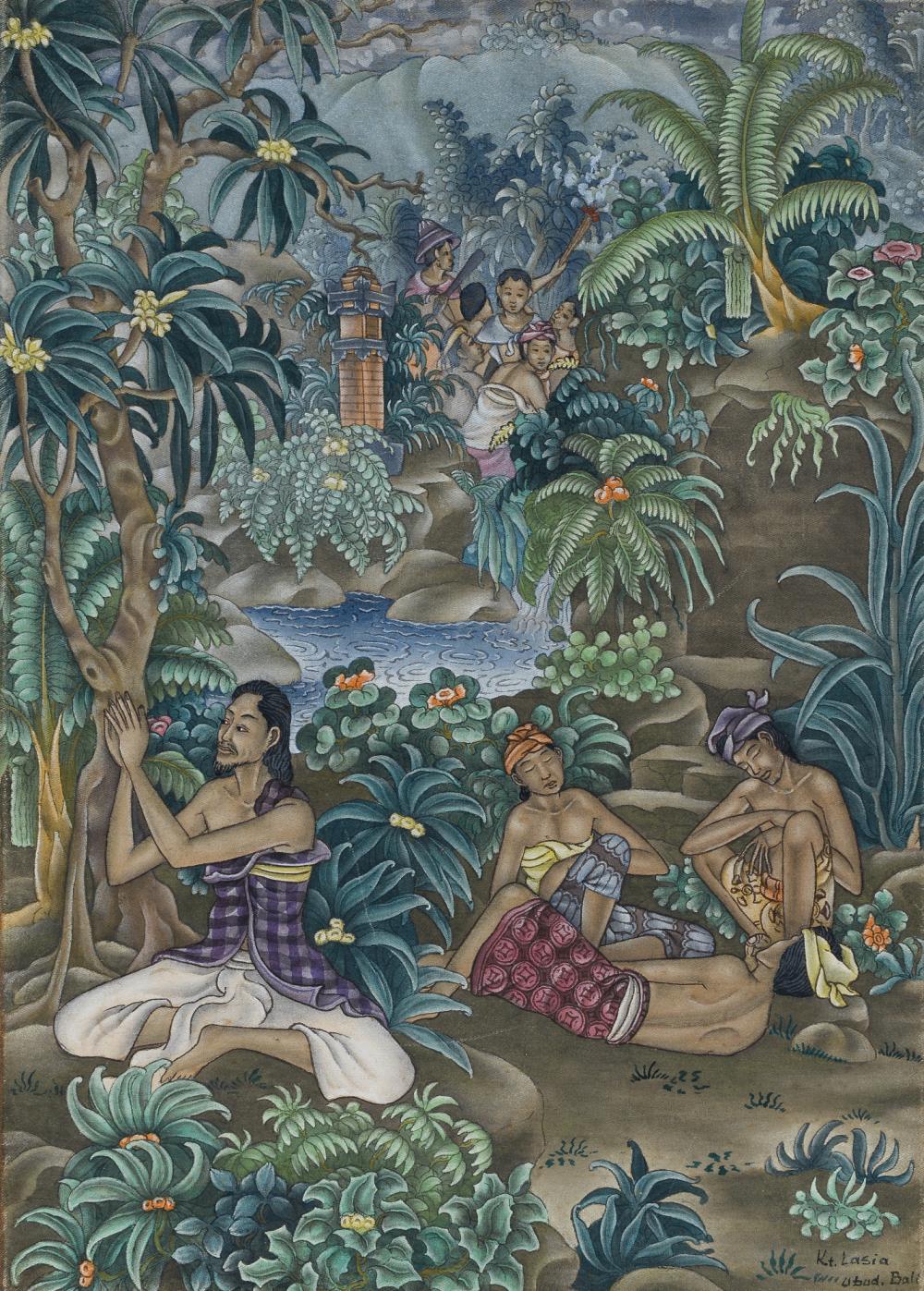
Lasia, Ketut_Gethsemane
Ketut Lasia (Indonesian, 1945–), Gethsemane, n.d. Acrylic on canvas, 61 × 43 cm.

+++

ESSAY: “Christian Art in Indonesia” by Volker Küster, Karel Steenbrink, and Rai Sudhiarsa: This chapter is from the thousand-page, open-access book A History of Christianity in Indonesia, edited by Karel A. Steenbrink and Jan S. Aritonang (Brill, 2008). The authors discuss the development of an indigenized Indonesian Christian art, starting with the West Javanese sculptor Iko, a Muslim who worked in both wood and stone and fulfilled commissions for the (Catholic) Sacred Heart Chapel on the premises of the Joseph Schmutzer sugar estate in Ganjuran in the 1920s. They then cover a handful of artists who came in the wake of the Second Vatican Council in the 1960s and amid the global trend toward contextual theology promoted by international Protestantism—focusing especially on the most famous two, Bagong Kussudiardja (1929–2004) [previously] and Nyoman Darsane (1939–2024), both Christian converts.

Javanese King Jesus
Iko, Christ the King with Angels, 1924–27. Jati wood. Missiemuseum Steyl, Limburg Province, Netherlands. Photo: Fred de Soet, 2019.

Kussadiardja, Bagong_Crucifixion
Crucifixion batik by Bagong Kussudiardja, Yogyakarta, Indonesia. Private collection, Geneva. Jesus is rendered in the style of a Javanese shadow puppet. Source: On a Friday Noon by Hans-Ruedi Weber (Eerdmans / World Council of Churches, 1979)

Darsane, Nyoman_Creation of Sun and Moon
Nyoman Darsane, Creation of Sun and Moon, 1979

(This essay is not to be confused with the one I shared in 2022, where Volker Küster profiles five Christian artists from Yogyakarta, including one overlap with this present essay.)

+++

VIDEO PROMO: “OMSC Artist in Residence Program”: “Each year, the director of the Overseas Ministries Study Center at Princeton Theological Seminary (OMSC@PTS) invites one Artist in Residence to the Princeton campus to stay with us for a full academic year (September to May). Since its inauguration in 2001, the OMSC Artist in Residence program has hosted outstanding artists from the global South. Today, OMSC’s art collection is comprised of over one hundred fifty pieces, many of which are now on display throughout the campus of Princeton Theological Seminary. They represent some of the finest work being done by contemporary artists who are Christian.” Artists include Sawai Chinnawong (Thailand), Nalini Jayasuriya (Sri Lanka), Wisnu Sasongko (Indonesia), and Emmanuel Garibay (Philippines), among others.

The current OMSC artist in residence is KimyiBo, a Korean American artist based in Berlin. Explore more at http://www.omsc.org/.

+++

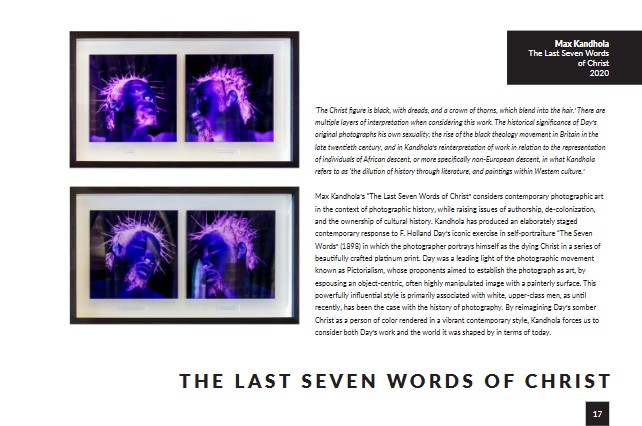
EXHIBITION CATALOG: Global Images of Christ: Challenging Perceptions: This free digital catalog documents an art exhibition that ran from September 25 to October 30, 2021, at Chester Cathedral in the UK. Artists include Lorna May Wadsworth, Max Kandhola, Silvia Dimitrova, John Muafangejo, Solomon Raj, Jyoti Sahi, and more.
+++

FIJIAN HYMN: “Oqo Na Noqu Masu” (This Is My Prayer): This Christian hymn is sung regularly in Fiji in churches and at rugby training camps and matches. The lyrics translate roughly to: “Lord, this is my prayer. I need your help in my time of need. I will always praise your name, and I ask that you grant me the desires of my heart. I sing and cry to you, Lord—to you and you alone. Hallelujah.” Here are some examples:

>> From the Rugby League World Cup, Fiji v. USA, 2017:

(Watch a similar video with subtitles.)

>> Again, the Fiji Bati rugby team singing before a match, this time against Papua New Guinea in 2022:

>> And here’s the hymn in a church context—sung by the Nawaka Methodist Village Choir in Nadi, Fiji:

Awareness of the deep-rooted Fijian tradition of four-part Christian hymn singing increased last summer when videos of the country’s Olympic team went viral. In the Christianity Today article “Yes, Fiji Olympians Are Singing Hymns,” Kelsey Kramer McGinnis writes,

Although Fijian hymnody grew out of Methodist songs brought by 19th-century missionaries, it has become a deeply rooted tradition that makes space for indigenous practices across the diverse country. Christianity’s connection to the legacy of colonialism in Fiji (which was a British colony from 1847 to 1970) is undeniable, but Fijian vocal music stands as an example of the ways Fijians have been contextualizing Christian worship and integrating it into their communities for nearly two centuries.

Here’s a 2024 video from a Sunday worship service at the Team Fiji camp in the Olympic Games Village in Paris, showing the team singing a different hymn, whose title and words I don’t know:

Playlist: Christ the King

The final Sunday of the liturgical year—which this year is November 24—marks the Feast of Christ the King. This festival celebrates the reign of Jesus Christ over all of creation and every aspect of our lives.

“The belief in Christ as King finds its roots in the Christian understanding of Jesus as the Messiah, whose reign exists as both a present reality and a future hope,” writes Ashley Tumlin Wallace on her blog The Liturgical Home. “In the here and now, his reign manifests in the lives of believers who seek to live under his lordship. But the Feast of Christ the King also carries a sense of eschatological anticipation, signaling the ultimate culmination of time when the reign of Christ is fully realized.”

Unlike some who sit on earthly thrones, Christ is no tyrant; he’s a benevolent ruler who leads with love and perfect wisdom. He is high and lifted up, and yet he stoops down to us and attends to our cries. He’s so committed to our flourishing that he became one of us and sacrificed himself to save us from the Evil One and reconcile us to God. We owe him our praise, our deference, our all.

For Christ the King Sunday, I put together a Spotify playlist of songs that extol Christ as king of the cosmos and of our own hearts.

It includes traditional hymns like “All Hail the Power of Jesus’ Name” (below, sung by Paul Zach), “Come, Christians, Join to Sing,” “All Creatures of Our God and King,” “All People That on Earth Do Dwell,” “Praise to the Lord, the Almighty,” “O Worship the King,” “Crown Him with Many Crowns” . . .

In looking up hymns, I was delighted to find a new-to-me one from the nineteenth century by Josiah Conder called “The Lord Is King,” which Navy Jones set to a buoyant new tune:

There’s one song on the list whose text dates all the way back to the fifth century. Written in Latin by the Christian poet Sedulius, “Regnavit Dominus” (The Lord Is King) combines praises to the One who conquered death and feeds us with himself with the humble plea, “Kyrie eleison” (Lord, have mercy). Owen and Moley Ó Súilleabháin sing it to a twelfth-century melody:

The playlist also features several psalm settings, including two of Psalm 93, which opens,

The LORD is king; he is robed in majesty;
    the LORD is robed; he is girded with strength.
He has established the world; it shall never be moved;
    your throne is established from of old;
    you are from everlasting.

One is by Jacob Mwosuko, a member of the Abayudaya (People of Judah) Jewish community near Mbale in eastern Uganda. The text is in Luganda. Though Jews would read “LORD” as referring to God the Father, ever since the early church Christians have confessed Jesus not only as Lord (Master) but also as LORD (YHWH), consubstantial and co-eternal with the Father, sharing with him all rule, authority, power, and dominion.

Also from Africa, there’s the Resurrection-rooted salsa song “Jesus Reigns” by Joe Mettle of Ghana, which I learned while attending worship at a Nigerian friend’s church plant for African Christians in Maryland:

On a softer note, there’s the piano ballad “Wondrous Things” by Sandra McCracken, Patsy Clairmont, and JJ Heller of FAITHFUL, a collective of female Christian authors and artists formed in 2019. It lauds Jesus as king to the poor, the oppressed, and the brokenhearted. Heller and McCracken perform it with Sarah Macintosh in the following video:

This next one is more of a nostalgic pick for me: “Make My Heart Your Throne”:

Over two decades ago, when I was a young high schooler, I attended a Christian retreat. The worship leader for the weekend was a man named Carl Cartee, and I remember being struck by this original song of his that we all sang one night. Its words and melody imprinted on me, and all these years later I still find myself sometimes singing them in private as a prayer that Christ would be foremost in my affections and that I would cede control to him.

One of the keenest depictions of Christ’s kingship in scripture is in the book of Revelation, where his glory and triumph are on full display and he’s surrounded by worshipping throngs. Chapter 19, where the exiled John describes “the loud voice of a great multitude in heaven,” is the source text of the song “He Is Wonderful,” sung by Lowana Wallace with Lana Winterhalt and Josh Richert:

These three overlaid, harmonized vocal lines are so enthralling!

Wallace’s song is a simplified arrangement of “Revelation 19:1” by A. Jeffrey LaValley, who wrote it in 1984 for the gospel choir of New Jerusalem Baptist Church in Flint, Michigan, where he served as music director. You can listen to a more recent performance of “Revelation 19:1” on the album Jesus Is King (2019) by the Sunday Service Choir under the direction of Jason White, or in this Mav City Gospel Choir video from 2021, which features soloist Naomi Raine. The choir is directed by Jason McGee:

The build to such fullness of sound . . . wow! It really is evocative of the ample rejoicing in heaven around God’s throne that John the Revelator narrates—“like the sound of many waters and like the sound of mighty thunderpeals” (Rev. 19:6).

For a multilingual (English-Korean-Spanish) arrangement performed by students and staff at Fuller Theological Seminary in California, see here.

This is just a sampling of the eighty-plus songs on Art & Theology’s “Christ the King” playlist, exalting the One who lives and reigns supreme in the heavens and who will one day bring his kingdom to full fruition on earth.

Christ the King playlist cover

Cover art: John Piper (British, 1903–1992), Christ in Majesty, 1984, East Window, Chapel of St John Baptist without the Barrs, St John’s Hospital, Lichfield, Staffordshire, England

Christmas, Day 11: Love Is King

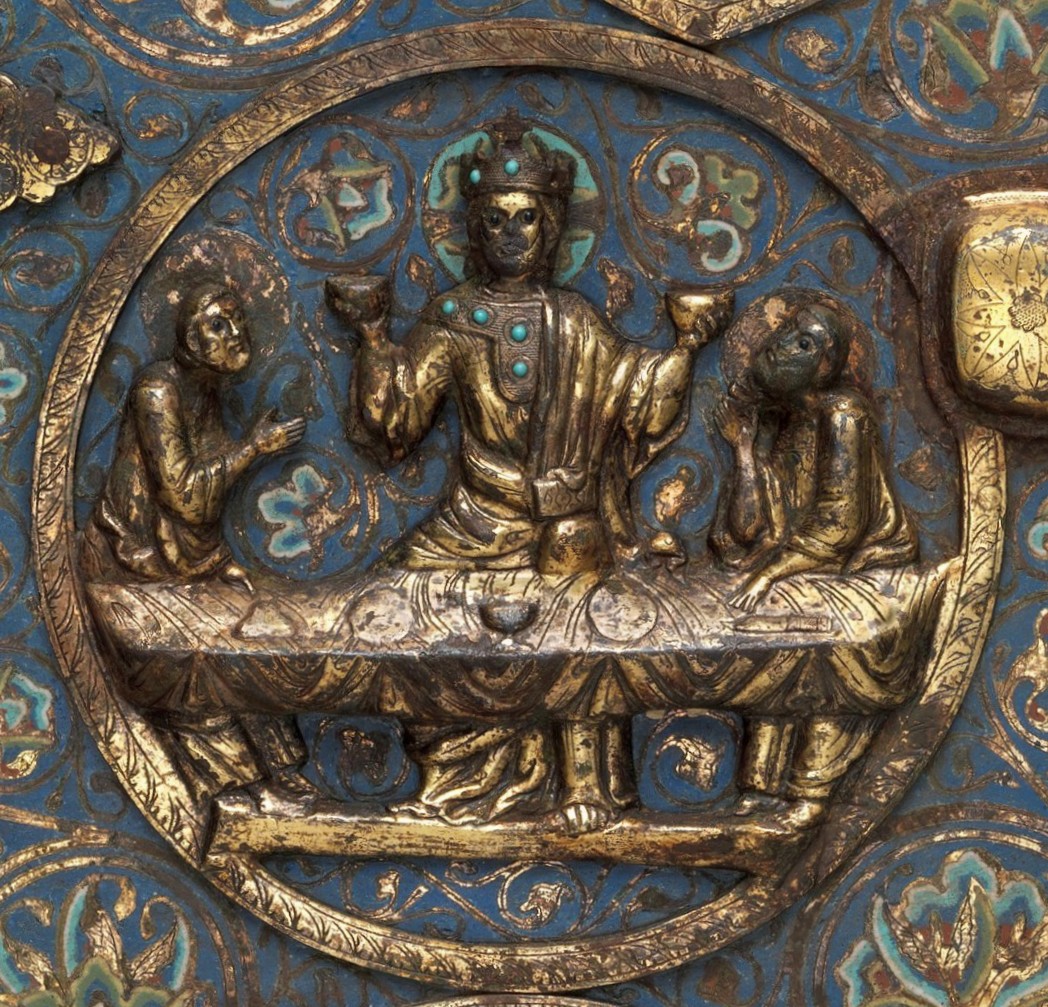
LOOK: Supper at Emmaus medallion from the Tabernacle of Cherves

The Supper at Emmaus
Detail of The Supper at Emmaus from the Tabernacle of Cherves, Charente, France, ca. 1220–30. Champlevé enamel and copper, overall 33 × 37 3/4 × 10 3/4 in. (83.8 × 95.9 × 27.3 cm). Metropolitan Museum of Art, New York.

To learn about the elaborately decorated champlevé enamel tabernacle that this scene comes from, see https://artandtheology.org/2020/05/14/the-tabernacle-of-cherves-limoges-enamel-13th-century/.

LISTEN: “El Niño (Love Is King)” by Willie Nelson, on Hill Country Christmas (1997)

He is born
There’s a reason now to carry on
Toot your horns
Write another song
Love is here
Seated at your table now
Not livin’ in a stable now
Love is king

So let us sing
Let us sing
Love is king
Love is king
(Repeat)

He is born
There’s a reason now to carry on
Toot your horns
Write another song
Love is here
Seated at your table now
Not livin’ in a stable now
Love is king

Angels sing
About the king
Let it ring
Love is king

So let us sing
Let us sing
Love is king
Love is king


This post is part of a daily Christmas series that goes through January 6. View all the posts here, and the accompanying Spotify playlist here.

Whole World in His Hands (Artful Devotion)

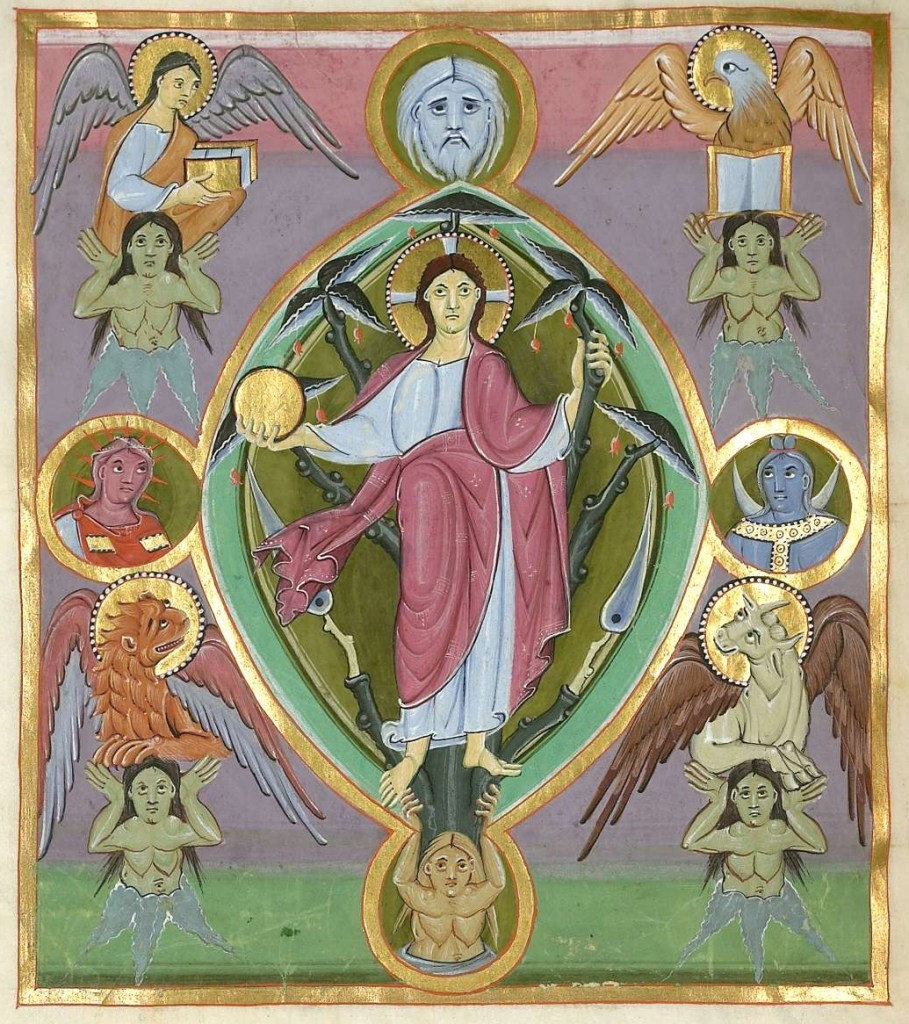
Christ in Glory (Gospel-book of Bamberg Cathedral)
“Christ in Mandorla with evangelists,” Reichenau, Germany, early 11th century. BSB Clm 4454, fol. 20v, Bayerische Staatsbibliothek, Munich.

Oh come, let us sing to the LORD;
    let us make a joyful noise to the rock of our salvation!
Let us come into his presence with thanksgiving;
    let us make a joyful noise to him with songs of praise!
For the LORD is a great God,
    and a great King above all gods.
In his hand are the depths of the earth;
    the heights of the mountains are his also.
The sea is his, for he made it,
    and his hands formed the dry land.
Oh come, let us worship and bow down;
    let us kneel before the LORD, our Maker!
For he is our God,
    and we are the people of his pasture,
    and the sheep of his hand.

—Psalm 95:1–7

This is the Psalm reading for the last Sunday of the liturgical year, Christ the King Sunday. I’ve paired it with an Ottonian miniature from around 1015, which shows Christ, framed by a mandorla (an almond-shaped aureole), standing in a branched tree of life. The gold-leaf outline of this glory cloud encompasses heaven (Caelus, the top figure) and earth (Terra, aka Terrus, at bottom), two realms connected by Christ himself. (Earth is his footstool! That is, part of his throne.) He holds a globe in his right hand and is surrounded by symbols of the four evangelists (the tetramorph)—each supported by a water nymph representing one of the four rivers of paradise—and Sol (sun) and Luna (moon). I love how this image emphasizes the life-giving nature of Christ’s rule, and how it extends over all of creation.

From our limited human perspective, it can be hard to see the divine reality that this artist is pointing to. It sometimes doesn’t feel like Jesus is on the throne, holding together everyone and everything in love. But I look at that little orb, and I think of all the sin and suffering and love and grace and stress and beauty swirling around in that one small part of the cosmos, and I see that it’s rendered in precious gold, and is gripped firmly by the hand of God, who—zoom out—is “a great King above all,” who made the heights and the depths and who gives us his word and indeed his very self, a tree of life for the healing of the nations. As we head into Advent, may we not lose this vision of the Christ who reigns.

More about the art: In the tenth and eleventh centuries, the Benedictine abbey on the island of Reichenau in Lake Constance in southern Germany was the site of one of Europe’s largest and most influential schools of manuscript illumination, known as the Reichenau school. The painting above is from a Gospel-book produced there, commissioned by Holy Roman Emperor Henry II (r. 1002–24) for the cathedral he founded in Bamberg. The book is now housed at the Bayerische Staatsbibliothek (Bavarian State Library) in Munich, along with two other similar illuminated manuscripts from Bamberg Cathedral: the Gospel-book of Otto III (Clm 4453) and the evangeliary of Henry II (Clm 4452). Find out more about this particular manuscript at the World Digital Library. You can also browse the images here by selecting the links in the “Content” sidebar at the left.

For other artworks from Art & Theology that show, in a literal manner, “the whole world in [God’s] hands,” see this medieval Pisan fresco with signs of the zodiac; How God loves his People all over the World by John Muafangejo; Creation of the World by Lyuba Yatskiv; Salvator Mundi by Leonardo da Vinci, a common image type; and a Florentine panel painting of God the Father.

Do you know of any good nonliteral images that say to you, “The world is in God’s hands”? That is, a visual artwork that helps you sense God’s sovereignty? I often fall back on traditional visual conceptualizations of theological teachings like this, but I’d like to expand my repertoire!

+++

SONG: “He’s Got the Whole World in His Hands,” African American spiritual

There are hundreds of professional recordings and live performance videos of this traditional song. It was first published in the paperbound hymnal Spirituals Triumphant, Old and New in 1927 and became an international pop hit in 1957 when it was recorded by thirteen-year-old English singer Laurie London.

First off, I want to feature a fairly recent two-part video compilation released by TrueExclusives. Back in March, as the first wave of the coronavirus hit the US, Tyler Perry posted a video of himself singing one verse of “He’s Got the Whole World in His Hands” to provide a word of assurance in the face of rising death tolls and social isolation. He called on his fellow musicians and other friends to likewise video-record a verse or two, in whatever key or style they wished—just a simple, unpolished phone recording—tagging it #tylerperrychallenge. These were then collected into two videos, a string of contributions from people like Mariah Carey, Usher, Patti Labelle, Jennifer Hudson, Shirley Caesar, LeAnn Rimes, Aubrey Logan, Israel Houghton, and many more. For a list of all the singers with time stamps, see the comment by YouTube user benzmusiczone for the first video and the comment by The Cherie Amour Show for the second.

(Update, January 2023: The original two YouTube videos from the TrueExclusives channel have been removed—not sure why—but you can view the originals on Tyler Perry’s Facebook page: part 1 and part 2.)

Some participants sing in other languages—for example, Nicole Bus in Dutch, Jencarlos Canela in Spanish. Others adapt the lyrics to more specifically address the context of our global pandemic. Kelly Rowland, for example, sings, “He’s got the doctors and the nurses in his hands.” Stevie Mackey names specific countries and virus hot spots. And not only does God have the itty bitty babies in his hands, Ptosha Storey reminds us; he also has the elderly. BeBe Winans spans the cosmic to the small in his verse, emphasizing that God’s sovereign care is both expansive and intimate: “He’s got the moon and the stars in his hands / He’s got Pluto and Mars in his hands / And as I’m sitting in this car, I’m in his hands / He’s got the whole world in his hands.”

I love me some harmonies, so I particularly enjoyed hearing sisters Chloe and Halle Bailey (2:32) and The Walls Group (16:54).

What follows are a handful of other renditions I want to highlight.

Jeanne Lee [previously], 1961:

Ruth Brown, 1962 (classic gospel):

A live 2006 performance in Johannesburg—with hand motions!—by the African Children’s Choir:

A lush choral and orchestral arrangement by Mack Wilberg, featuring Alex Boyé [previously] and the Mormon Tabernacle Choir, from 2010:

Similarly lush, a duet performed by operatic sopranos Jessye Norman and Kathleen Battle, backed by the Metropolitan Opera Chorus, the New York Philharmonic, and the Metropolitan Opera Orchestra. The performance was conducted by James Levine at Carnegie Hall in 1990 and is included on the album Spirituals in Concert (1991). The arrangement is by Robert de Cormier:


This post belongs to the weekly series Artful Devotion. If you can’t view the music player in your email or RSS reader, try opening the post in your browser.

To view all the Revised Common Lectionary scripture readings for Proper 29 (Reign of Christ), cycle A, click here.

Savior-King (Artful Devotion)

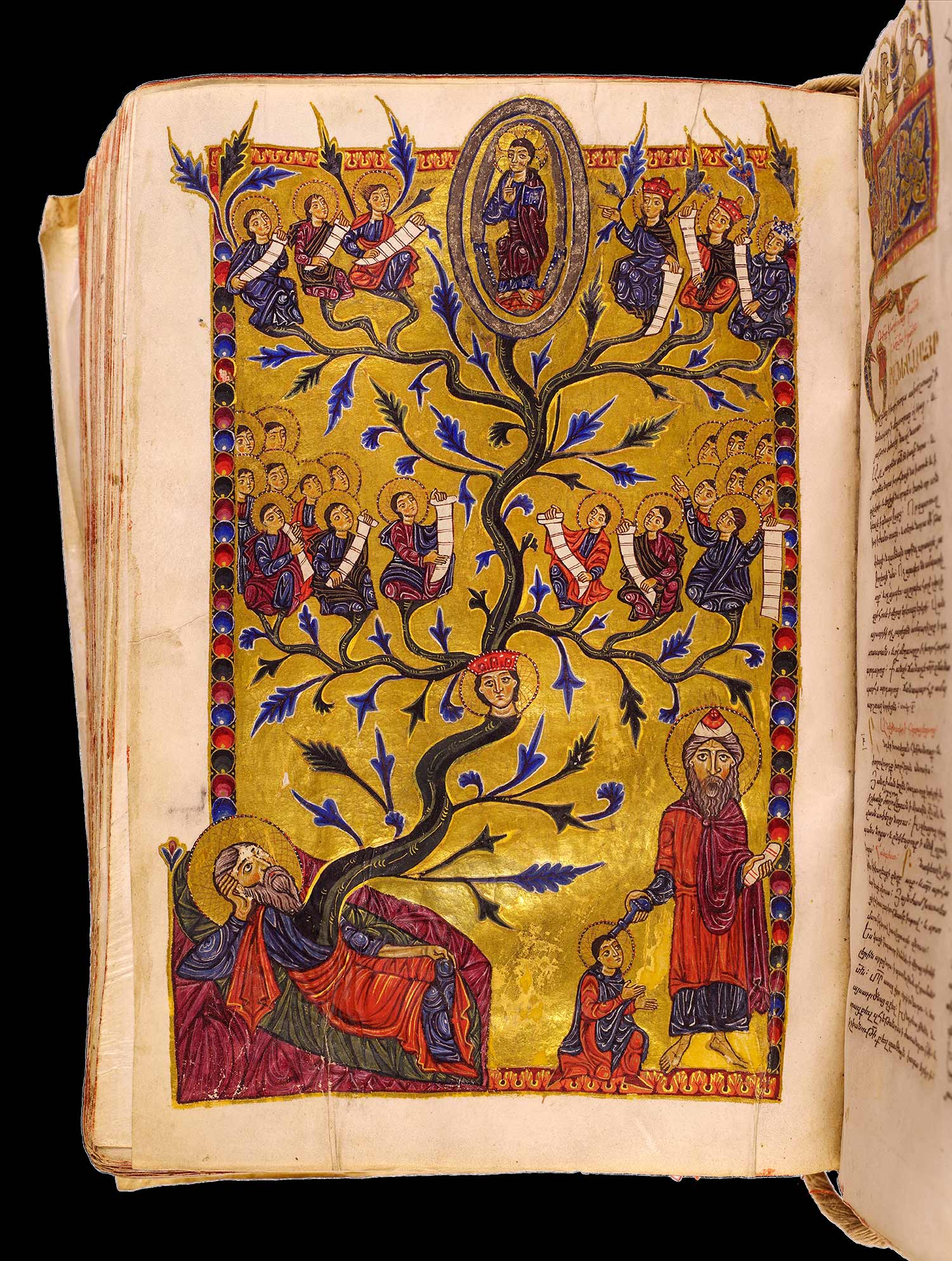
Tree of Jesse (Armenian)
Toros Taronatsi (Armenian, 1276–ca. 1346), Tree of Jesse, 1318. Ink, pigments, and gold on parchment, 10 1/4 × 7 1/16 in. (26 × 18 cm). “Matenadaran” Mesrop Mashtots Institute of Ancient Manuscripts, Yerevan, Armenia (MS 206, fol. 258v).

“Behold, the days are coming, declares the LORD, when I will raise up for David a righteous Branch, and he shall reign as king and deal wisely, and shall execute justice and righteousness in the land. In his days Judah will be saved, and Israel will dwell securely. And this is the name by which he will be called: ‘The LORD is our righteousness.’”

—Jeremiah 23:5–6

+++

SONG: “Jesus, Name Above All Names” | Words and music by Naida Hearn, 1974 | Arranged and performed by Nick Smith, feat. Liz Vice, 2015

The song’s original lyrics are:

Jesus, name above all names
Beautiful Savior, glorious Lord
Emmanuel, God is with us
Blessed Redeemer, living Word

Jesus, loving Shepherd
Vine of the branches, Son of God
Prince of Peace, Wonderful Counselor
Lord of the universe
Light of the world

Praise him, Lord above all lords
King above all kings, God’s only Son
The Prince of Peace, who by his Spirit
Comes to live in us, Master and Friend

Smith’s arrangement uses the first verse, plus adds this bridge:

O holy Lord
Praise be to your name
O risen Son
Hear us as we sing

+++

In 1318 Esayi Nch‘ets‘i (1260/65–1338), abbot of the Monastery of Gladzor in Armenia, commissioned three scribes to copy a Bible for the monastery, and T‘oros of Taron to illuminate it. The sumptuous illumination above, showing a genealogical tree sprouting from Jesse’s reclining body, serves as the frontispiece to the book of Psalms. Jesse was the father of King David and hence an ancestor of Jesus, who is enthroned at the end of the tree’s central branch, at the top of the composition. Various prophets with their scrolls are perched on the side branches. (We’ll revisit this iconography in the second week of Advent.)

In Armenia: Art, Religion, and Trade in the Middle Ages, Sylvie L. Merian writes of this image,

According to Sirarpie Der Nersessian, this is the first example of a Tree of Jesse found in Armenian art; the inspiration for this image is derived from Western European manuscripts, where it was portrayed as early as the mid-twelfth century. However, T‘oros has modified the traditional Western European iconography: the top of the tree normally depicts the Virgin and Child, but in this example he has placed a youthful Christ in a mandorla holding a book in his left hand and blessing with his right. In the center of the trunk is the head of David, whereas in Western European traditions he is usually represented by a bust. In addition, T‘oros added an image of Samuel anointing the young David in the lower right, a scene not usually included with the Tree of Jesse. He also depicted the prophets and other figures seated cross-legged, a posture not commonly depicted in Western European manuscripts. (119)


This post belongs to the weekly series Artful Devotion. If you can’t view the music player in your email or RSS reader, try opening the post in your browser.

To view all the Revised Common Lectionary scripture readings for Proper 29 (Reign of Christ), cycle C, click here.

Born a Child and Yet a King (Artful Devotion)

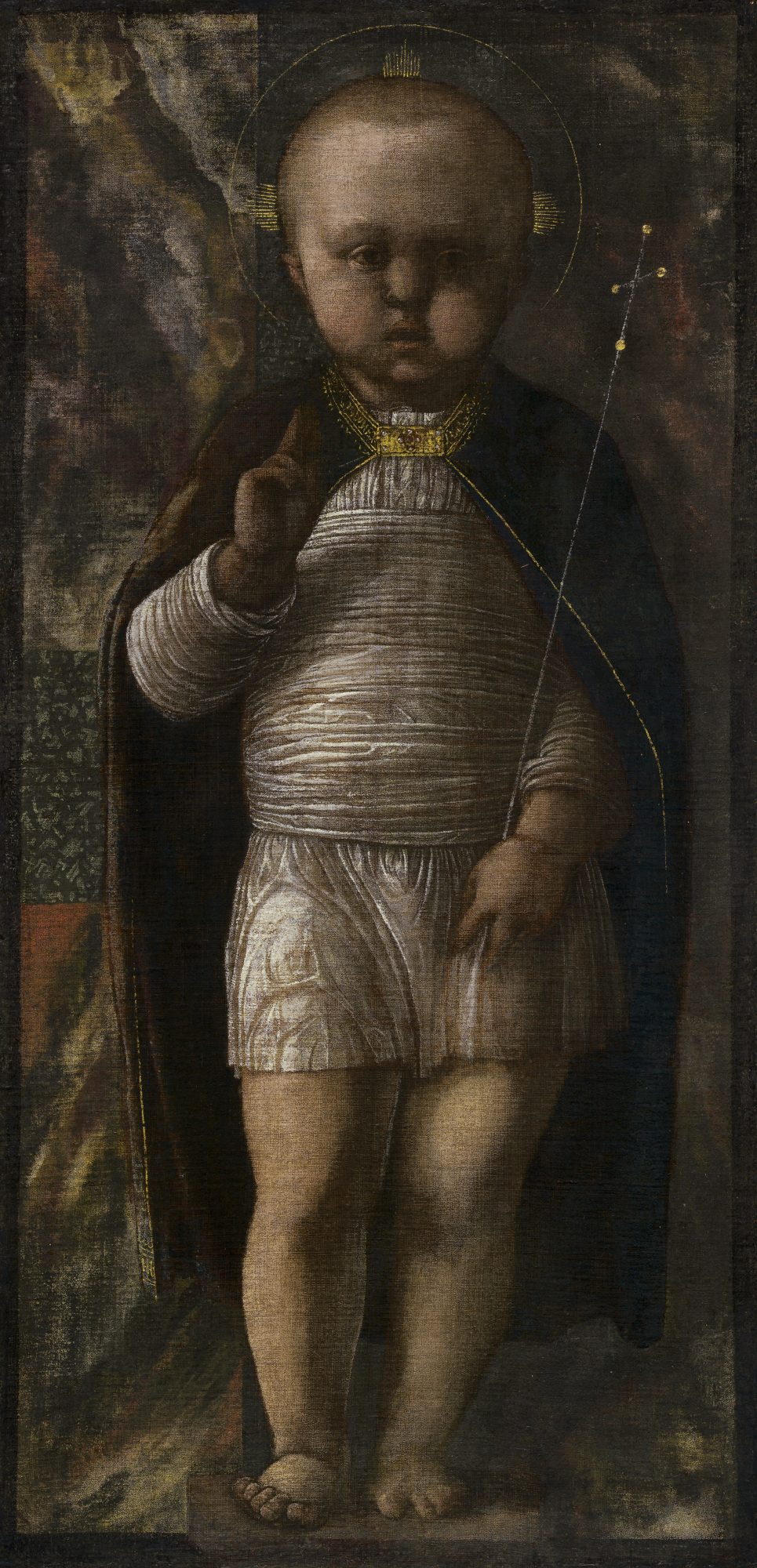
The Infant Savior by Andrea Mantegna
Andrea Mantegna (Italian, ca. 1431–1506), The Infant Savior, ca. 1460. Tempera on canvas, 70.2 × 34.3 cm (27 5/8 × 13 1/2 in.). National Gallery of Art, Washington, DC.

But you, O Bethlehem Ephrathah,
who are too little to be among the clans of Judah,
from you shall come forth for me
one who is to be ruler in Israel,
whose coming forth is from of old,
from ancient days.
Therefore he shall give them up until the time
when she who is in labor has given birth;
then the rest of his brothers shall return
to the people of Israel.
And he shall stand and shepherd his flock in the strength of the LORD,
in the majesty of the name of the LORD his God.
And they shall dwell secure, for now he shall be great
to the ends of the earth.
And he shall be their peace.

—Micah 5:2–5

+++

SONG: “Come, Thou Long-Expected Jesus / Joy to the World,” adapted and arranged by Folk Angel, on Live at Green Lux: Christmas Songs, vol. 6, 2014 | Words by Charles Wesley, 1744, with refrain and bridge by Isaac Watts, 1719 | Music by Rowland Hugh Prichard, 1830, and Folk Angel

The backbone of this Folk Angel song is the Advent classic “Come, Thou Long-Expected Jesus,” but into this the band has integrated lines from “Joy to the World,” traditionally sung at Christmastime. While the verses plead, “Come!,” the chorus declares, “He has come,” holding together the cries of both seasons. He whom the nations desire is here, “born to reign in us forever.” May earth receive him.

Come, thou long-expected Jesus,
Born to set thy people free;
From our fears and sins release us,
Let us find our rest in thee.
Israel’s strength and consolation,
Hope of all the earth thou art;
Dear desire of every nation,
Joy of every longing heart.

Joy to the world!
The Lord has come;
Let earth receive her king.

Born thy people to deliver,
Born a child and yet a king,
Born to reign in us forever,
Now thy gracious kingdom bring.
By thine own eternal spirit
Rule in all our hearts alone;
By thine all-sufficient merit,
Raise us to thy glorious throne.

Joy to the world!
The Lord has come;
Let earth receive her king.

Let every heart prepare him room,
And heaven and nature sing!

Come, thou long-expected Jesus,
Born to set thy people free.
We are free.
We are free.
We are free.
We are free.

The verse melody is, of course, that well-loved Welsh tune HYFRYDOL, composed by Rowland Hugh Prichard. The chorus and bridge, however, employ an original tune by Folk Angel, resetting key excerpts from Isaac Watts’s carol that emphasize the kingly nature of the infant Christ. This crescendos into a triumphant repeat of the song’s first two lines, and a grateful acknowledgment of God’s fulfilled purposes: a people set free from their fears and sins, granted eternal rest under the loving rule of Christ. Even so, Lord, thy kingdom come.

+++

The Infant Savior by the great Renaissance painter Andrea Mantegna brings me such delight—that little rosy, chubby-cheeked baby blessing me, blessing the world, this Christmas. You might call the painting a Christ Pantocrator, but it doesn’t fit the standard iconography, because instead of a half-length adult it shows a full-length child of about one year. Still, this is Jesus, “born a child and yet a king”: he wears a velvet robe with a golden clasp and lining, but underneath, his humble swaddling cloths are revealed, and he’s barefoot. His right hand is raised in a gesture of blessing, and in his left hand he holds, instead of a book (as is traditional in Pantocrator images), a cross-shaped scepter. A cross shape also comprises his “crown”—the three streams of light emitted from his bald little head.

Mantegna’s painting suggests that Christ’s kingship was established at his birth, and that it would be furthered by way of the cross.


This post belongs to the weekly series Artful Devotion. If you can’t view the music player in your email or RSS reader, try opening the post in your browser.

To view all the Revised Common Lectionary scripture readings for the Fourth Sunday of Advent, cycle C, click here.

Every Right to Receive My Praise (Artful Devotion)

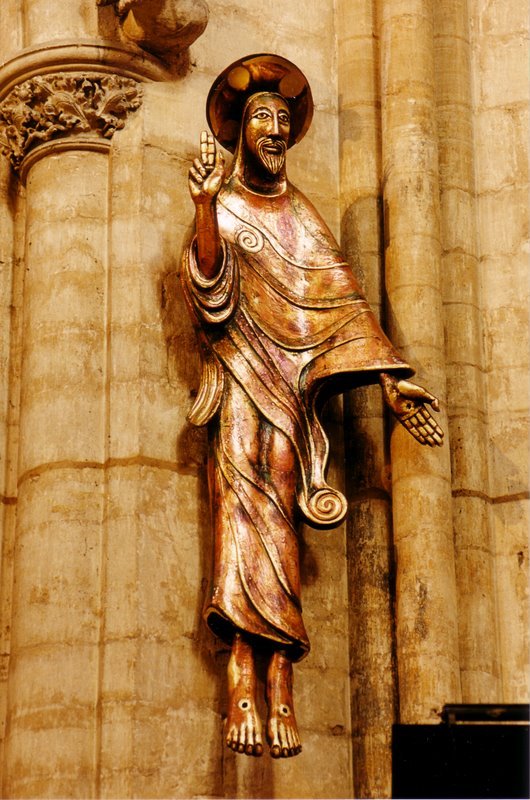
Christus Rex by Peter Eugene Ball
Peter Eugene Ball (British, 1943–), Christus Rex, 1999. Wood sculpture covered in copper and embellished with silver and gold leaf. Ely Cathedral, Cambridgeshire, England.

The final Sunday in the 2016–17 lectionary year, November 26 is designated in the Western church as the feast of Christ the King, known formally as the Solemnity of Our Lord Jesus Christ, King of the Universe. One of the scripture readings for the conclusion of cycle A is as follows:

I pray that the God of our Lord Jesus Christ, the Father of glory, may give you the Spirit of wisdom and of revelation in the knowledge of him, having the eyes of your hearts enlightened, that you may know what is the hope to which he has called you, what are the riches of his glorious inheritance in the saints, and what is the immeasurable greatness of his power toward us who believe, according to the working of his great might that he worked in Christ when he raised him from the dead and seated him at his right hand in the heavenly places, far above all rule and authority and power and dominion, and above every name that is named, not only in this age but also in the one to come. And he put all things under his feet and gave him as head over all things to the church, which is his body, the fullness of him who fills all in all.

—Ephesians 1:17–23

+++

SONG: “Every Right” | Words and music by Josh Davis, Dawn Anthony, and Billy Anthony | Performed by Josh, Dawn, and others from Proskuneo Ministries, on With One Heart (2009)

+++

If to Christ our Lord is given all power in heaven and on earth; if all people, purchased by his precious blood, are by a new right subjected to his dominion; if this power embraces all people, it must be clear that not one of our faculties is exempt from his empire. He must reign in our minds, which should assent with perfect submission and firm belief to revealed truths and to the doctrines of Christ. He must reign in our wills, which should obey the laws and precepts of God. He must reign in our hearts, which should spurn natural desires and love God above all things, and cleave to him alone. He must reign in our bodies and in our members, which should serve as instruments for the interior sanctification of our souls, or to use the words of the Apostle Paul, as instruments of justice unto God.

Encyclical of Pope Pius XI on the Feast of Christ the King (1925)


This post belongs to the weekly series Artful Devotion. If you can’t view the music player in your email or RSS reader, try opening the post in your browser.

To view all the Revised Common Lectionary scripture readings for Proper 29, cycle A, click here.