SUBSTACK POST: “Advent and Love” by Micha Boyett, The Slow Way: “There was a mother and man who loved her. There was a baby. The baby was the story God was telling, and that story became a seven-pound human and wailed. His mother cleaned his body with cloth and water, and fed him at her breast. She hoped he would latch on. It took a while. She bled and napped. He napped and cried again. He was God’s story and human. This is how he made a home with us. His making a home with us was love, and that love created a way for peace, hope, and joy.” Micha Boyett is an excellent spiritual writer, and I’m thrilled to learn that she has an Advent book coming out next year!
+++
CHILDBIRTH PHOTOGRAPHY: “2019 Birth Becomes Her Image Contest Winners” and “2020 IAPBP Competition Winners”: I’ve never birthed a baby or witnessed a live birth, but whenever I see photographs of the process and its outcome, it makes me emotional with joy. Seriously, I tear up as I smile. I don’t know these people, and yet I’m awed and overwhelmed.
Photograph by Belle Verdiglione, 2019
Since Christmas is about the BIRTH of Jesus, I find it meaningful to spend some time with childbirth photographs to remind myself how God chose to come to us—through a woman’s birth canal. It’s a wonder that never ceases to amaze me. Althoughthereareafewexceptions, it’s a picture of birth that artists interpreting the Nativity typically don’t want to touch (in part because women’s bodies are still largely taboo, in part because the Catholic Church teaches the birth was quick, painless, and bloodless), and so in the artistic canon, we get mostly clean, calm images of postpartum bliss, not the laborious and messy before. But isn’t that, too, part of the miracle and the glory of Christmas?
>> “Love Came Down” by Joanna Forbes L’Estrange: For her 2024 album Winter Light, the British choral composer Joanna Forbes L’Estrange wrote a new setting of this beloved Christmas poem by Christina Rossetti.
>> “Yeshu Thungea Ningla” (On the Day Jesus Was Born) by James Lhomi: Released by Lareso Music, this song was written by James Lhomi, a significant Lhomi Christian musician in Nepal. The Lhomi are a Tibetan people living in India, China, and Nepal. Lhomi is also the name of their language. The song opens, “Let us a sing a sweet song on the day of Christ’s birth, let us rejoice with a joyful heart, for Emmanuel has been born unto us.” [HT: Global Christian Worship]
>> “What a Day It Is” by Evan Thomas Way: Singer-songwriter Evan Thomas Way, cofounder (with Josh White) of the Deeper Well record label, released this song on his 2014 debut album, Only Light. At the time, he was the worship pastor at Door of Hope Church in Portland, Oregon; now he’s an executive pastor there.
>> “Talj, Talj” (Snow, Snow) by Fairuz: The Lebanese singer Fairuz (فيروز,) is one of the most celebrated singers in the Arab world. Born to Christian Maronite and Syriac Orthodox parents, she is now a member of the Greek Orthodox Church. She popularized the Arabic Christmas carol “Talj, Talj” on her 1977 album Christmas Hymns, which you can watch her perform on a television special in the video below (I can’t find the year or name of the show or broadcaster). The lyrics paint a wintry scene of snow falling and hearts flowering, for “there is a baby awake in the cave, and his sweet eyes are full of love.” [HT: Global Christian Worship]
This is the third installment of my annual “25 Poems for Christmas” series. Included too, on the front end, are poems for Advent, the four-week season of preparation, hope, and expectation leading up to Christmas.
1. “Advent (III)” by W. H. Auden, from For the Time Being: Voiced by the Chorus, who cry out from “a dreadful wood / Of conscious evil,” this is the third section of part 1 of Auden’s book-length Christmas poem in nine parts, For the Time Being—“the only direct treatment of sacred subjects I shall ever attempt,” he said. He wrote the poem in 1941–42. He had originally conceived it as the libretto of an oratorio that Benjamin Britten would write the music for, but the text turned out to be too complex, and Britten abandoned the project. The final two lines of this section set us up for the seemingly impossible feat of divine incarnation: “Nothing can save us that is possible: / We who must die demand a miracle.”
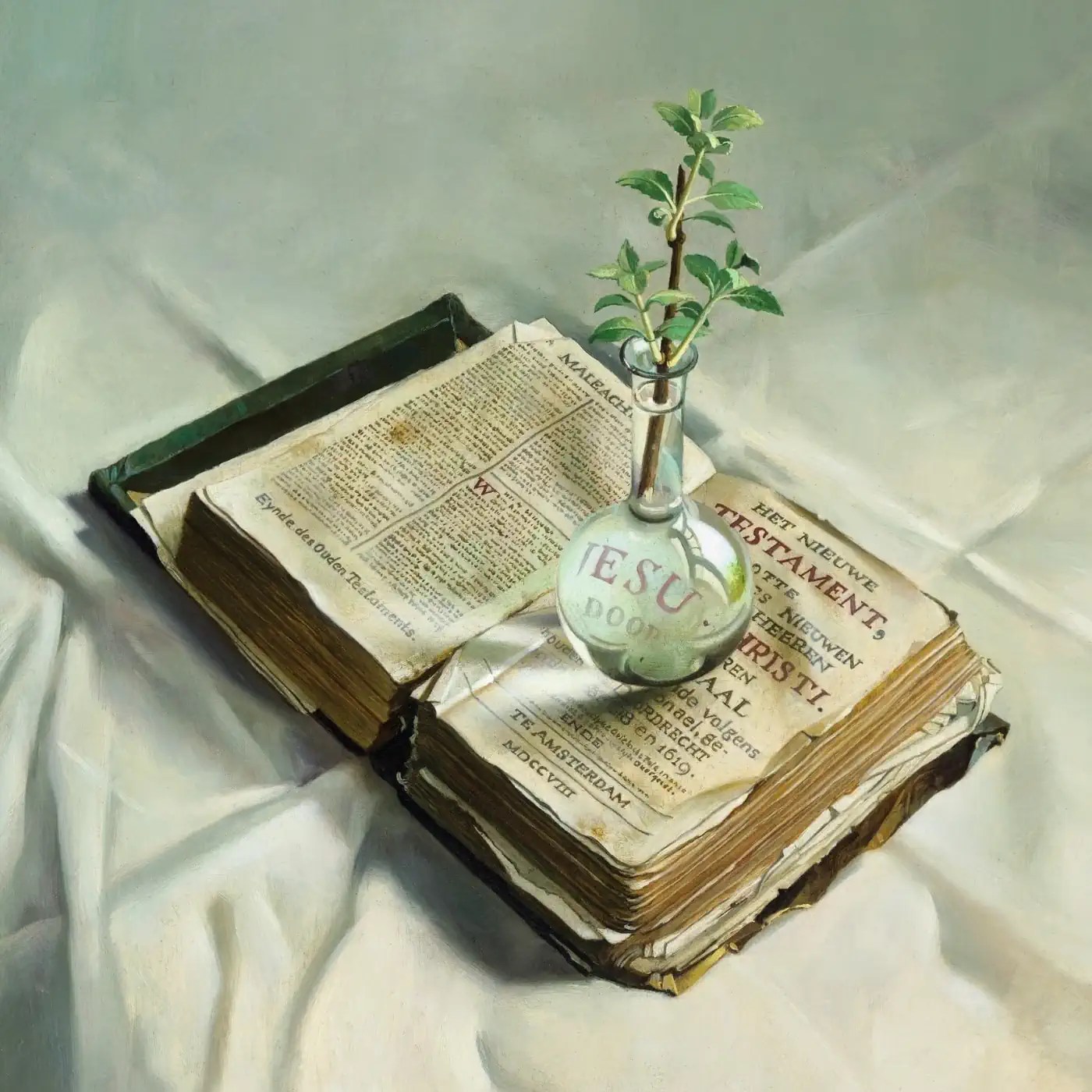
3. “O Orient Light” by James Ryman: Loosely influenced by the O Antiphons (a set of short chants used in medieval Advent liturgies), this Middle English lyric is by the fifteenth-century Franciscan friar James Ryman of Canterbury; it’s one of 166 sacred poems he published in a 1492 collection. Each stanza consists of one rhyme repeated six times, and the Latin refrain translates to “O Christ, king of the nations, / O life of the living.” The fourth stanza is a standout, connecting the salvation wrought by Christ to the healing properties of plants: “O Jesse root, most sweet and sote, / In rind and root most full of bote, / To us be bote, bound hand and foot, / O vita viventium.”
Source: Cambridge University Library, MS Ee. 1.12; compiled in The Early English Carols, ed. Richard Leighton Greene, 2nd ed., revised and enlarged (The Clarendon Press, 1977). Public Domain.
Henk Helmantel (Dutch, 1945–), Nieuw Leven II (New Life II), 1999 (after the 1972 original that was stolen). Oil on canvas, 27 × 24 cm.
4.“Merger Poem”by Judy Chicago: “Merger Poem” is an aspiration that artist Judy Chicago wrote to accompany her 1979 monumental artwork The Dinner Party, a celebration of the richness of women’s heritage, expressed as place settings around a table, that is housed at the Brooklyn Museum. Her vision in the poem is not theistic, at least not explicitly so, but she uses the language of “Eden,” and her descriptions evoke passages from Isaiah about a future harmony, a merging of heaven and earth, in which justice and equity are achieved at last—not to mention the strong eschatological tones that feasting has in Christianity. Each line begins with “And then,” cumulatively generating a longing in the reader for “then” to arrive.
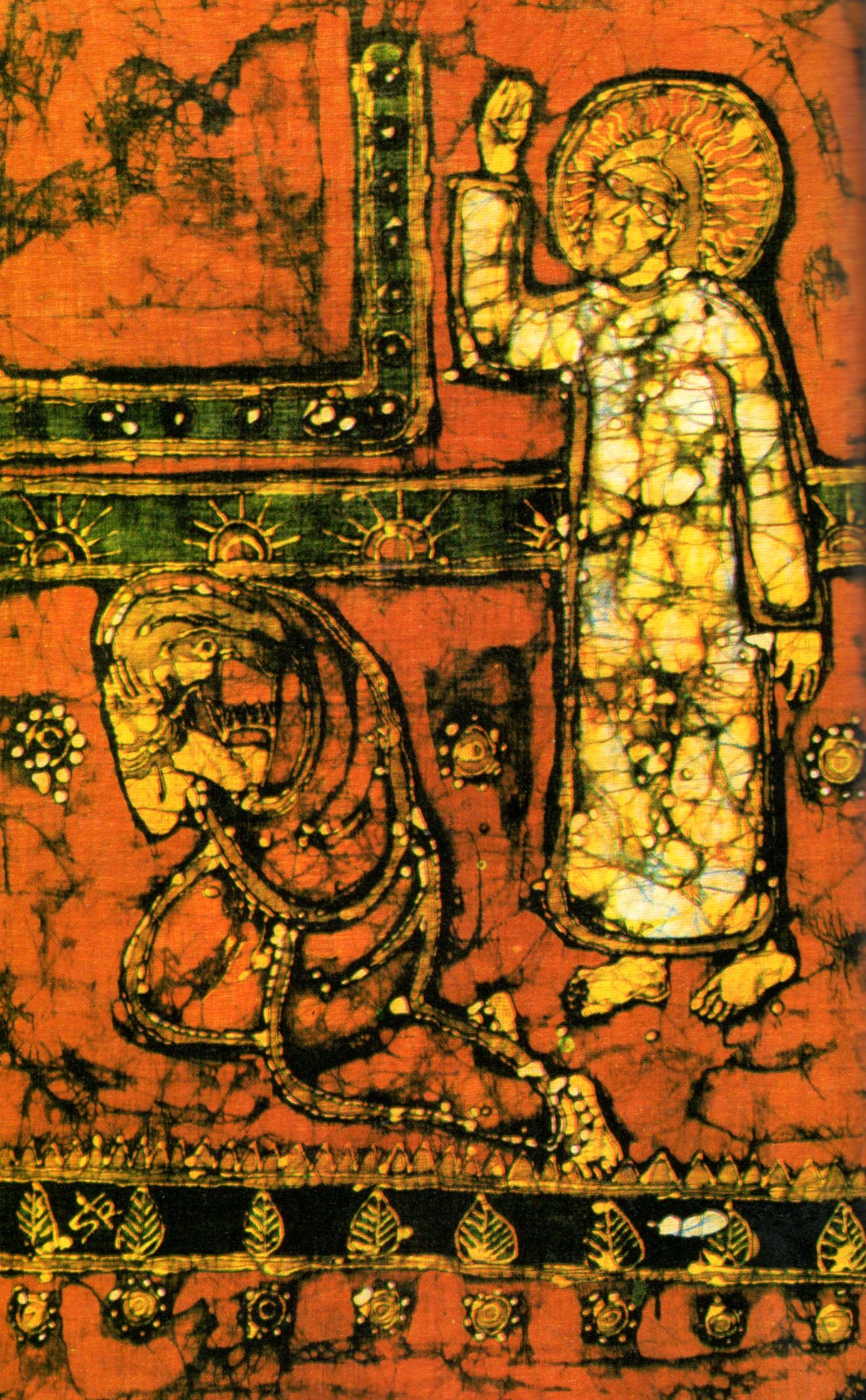
5.“truth”by Gwendolyn Brooks: “And if sun comes / How shall we greet him?” the speaker asks at the opening of this poem. The sun here represents truth, revelation, illumination, which we may seek with weeping and prayer but which can be dreadful when it actually comes. It’s often more comfortable to stay asleep in the dark than to confront the stark brightness of day. But oh, what we miss when we do! Gwendolyn Brooks uses the pronoun “him” for the sun, and it’s easy to read the poem Christologically: you can read it in the sense of any of Christ’s three comings—as a baby in Bethlehem, in personal, inner ways (he reveals himself, and seeks entrance, to human hearts), or as a king and judge at the end of time. Did you catch the reference to Revelation 3:20?
Source: Annie Allen (Harper & Row, 1949); compiled in Blacks (Third World Press, 1987)
P. Solomon Raj (Indian, 1921–2019), Waiting for My Lord, batik, published in Living Flame and Springing Fountain (ISPCK, 1993)
6. “Advent” by Mary Jo Salter: In this poem a mother and daughter are building a gingerbread house when a wintry gust tears a shutter on their actual house off its hinges, the shock of the thud causing, inside, a gingerbread wall to split. I think “house,” here, could be a metaphor for a faith structure; a house of belief. Shutters are doing a lot of work in the text: one falls off in a storm, and the daughter’s Advent calendar consists of twenty-five shutters, one opened each day until Christmas to reveal a Bible verse or narrative scene.
I’m not quite sure how to interpret the poem overall, but it seems to be addressing themes of (in)stability, brokenness and repair, the desire to believe versus the impulse to shut out belief, openness (“The house cannot be closed”), (dis)enchantment, the mother-child bond, and safety and danger (the Christmas story, like faith itself, characterized by both). I can’t decide if the “blank” in the final tercet sounds hopeful or bleak: does it connote possibility or lack? And is the mother suggesting in the final line (a repurposing of the final line from stanza 15) that what’s most real to her is not Mary and the baby Jesus but herself and her own child, right there in that moment?—or is she finding a point of kinship with Mother Mary in the love she feels for her offspring?
7. “Nativity”by Li-Young Lee: “What is the world?” asks a little boy in the darkness; and again as an adult. A poem of spiritual questing, Li-Young Lee’s “Nativity” deals with existential questions, ending with a tercet that evokes Isaac Watts’s famous carol line “Let every heart prepare him room.” Within us we must make a manger, a “safe place,” to receive the wild God.
8.“Nazareth” by Drew Jackson: Ancient Nazareth, where Jesus grew up, was an insignificant village that many believed no good could come out of (see John 1:46). This poem by public theologian Drew Jackson accentuates Jesus’s origins there, his identity as a “southsider” (Nazareth is in southern Galilee). Today some urban neighborhoods on the “South Side” are disparaged, their residents dismissed as poor and lacking education and potential. God chose to incarnate in a rural neighborhood with a similar reputation, not simply dropping in and then leaving but, as the second person of the Trinity, being formed and nurtured in that environment. “Nazareth” is from Jackson’s debut poetry collection, in which he works his way through the first eight chapters of Luke’s Gospel, drawing out the theme of liberation and making contemporary connections.
9. “The Visitation”by Calvin B. LeCompte Jr.: The poet imagines the fields that Mary passes on her way to her cousin Elizabeth’s house joining in the Magnificat, praising the Savior in her womb.
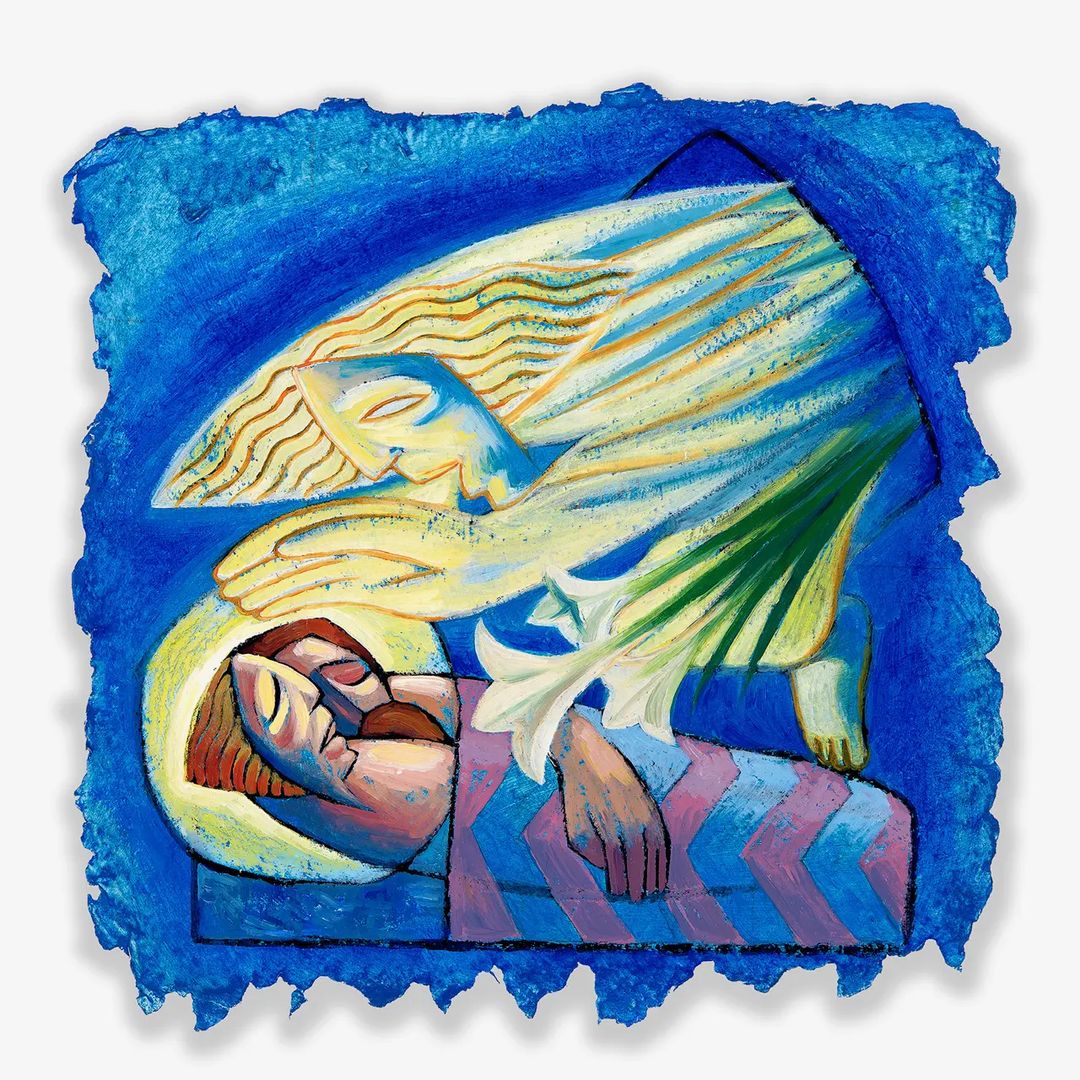
10.“My Darling” by Alexandra Barylski: Mary and Joseph are cuddling in bed as she reflects on the divine interventions that brought and kept them together. The poem references the legend, originating in the second-century Protoevangelium of James and repeated in the seventh-century Gospel of Pseudo-Matthew, that Joseph was chosen to wed Mary when from his staff, submitted to the high priest along with those of other single men, there miraculously emerged a dove. Mary expresses appreciation for Joseph’s “visionary love,” patience, and courage in their relationship, his spiritual leadership and support.
Source: Reformed Journal, May 11, 2021
Nicholas Mynheer (British, 1958–), Annunciation, 2017. Oil on handmade paper, 20 × 20 cm.
11. “A Blessing for the New Baby” by Luci Shaw: The speakers of this poem give a lovely benediction over Christ—preincarnate and then embryonic in the first stanza, then out of the womb in the second and third.
12.“Love’s Delights” by Meister Eckhart, rendered by Jon M. Sweeney and Mark S. Burrows: The medieval German mystic Meister Eckhart didn’t write poetry, but many of his sermons have a poetic quality to them, so contemporary poet Mark S. Burrows and writer Jon M. Sweeney, working from an English translation of the Middle High German by Frank Tobin, reworked select excerpts into verse. Adapted from a sermon Meister Eckhart preached on Isaiah 60:1, this poem meditates on the downward movement of love that raises up.
13. “Word Become Flesh” by Seth Wieck: Pregnancy, childbirth, and nursing take a toll on the body. Voiced by Mary, this poem highlights the bodily realities of Jesus’s first coming—Mary swollen, bruised, cracked, and bleeding. She was wounded for our transgressions, in the sense that she endured kicks to the ribs, postpartum hemorrhoids, etc., in order to bring forth our Savior, and by these wounds, because they gave life to Jesus, our healing was made possible. The last sentence is a zinger. Mary gives (physical) birth to Jesus, and he gives (spiritual) birth to her.
14.“Prince of Peace” by Brian Volck: The poet provides his own introduction to this poem on his website: “Octavian Augustus, first emperor of Rome, was known by many titles, including Divi Filius (Son of God) and Princeps Pacis (Prince of Peace). An inscription in Asia Minor states that Augustus’s birth ‘has been for the whole world the beginning of the gospel (εύαγγέλιον) concerning him.’ How strange, then, to use the same names for a contemporaneous but obscure Palestinian Jew, whose understanding of peace, politics, and power was so radically different. How strange to have so long diluted the scandal of the gospel (good news) with accommodations to an Augustan vision of a peace built on the use or threat of lethal violence. Here’s a Christmas poem calling attention to that contrast in a conscious act against forgetting.”
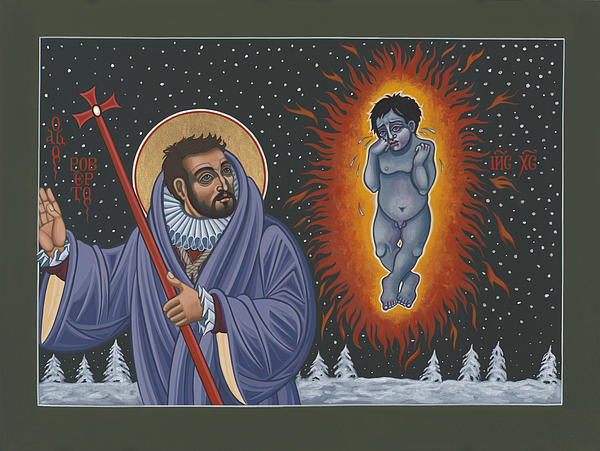
15.“The Burning Babe” by Robert Southwell: Consisting of sixteen lines in iambic heptameter, this poem by the Jesuit martyr-saint Robert Southwell [previously] relates a mystical vision of the Christ child, who appears to the narrator on a cold winter’s night, enflamed and hovering in midair. The poem develops the metaphor of the love of Christ as a fiery furnace that both warms and purifies.
Source: St Peter’s Complaint, and Other Poems (London, 1595). Public Domain.
William Hart McNichols (American, 1949–), Holy Poet-Martyr St. Robert Southwell and the Burning Babe, 2015. Acrylic on wood. [purchase reproduction]
16.“Advent 1966” by Denise Levertov: This poem is shocking in its horror. Written in 1966, it picks up Southwell’s image of the Burning Babe and transposes it to the napalmed villages of Vietnam, where children were being physically (not symbolically or ethereally, as in Southwell’s poem) set on fire by chemical weapons deployed by the US military. Denise Levertov [previously], who was an antiwar activist as well as a poet, uses repetition to strong effect, conveying a sense of the seemingly relentless carnage (the war produced an estimated two million civilian casualties, more than half the total number). Though addressing a specific historical event, this elegy for the innocent provokes us to consider where similar atrocities are happening today.
Source: To Stay Alive (New Directions, 1971); compiled in Making Peace, ed. Peggy Rosenthal (New Directions, 2006)
17.“Christmas Eve”by Christina Rossetti: The Victorian poet Christina Rossetti [previously] opens this lyric with two paradoxes that characterize Christmas—bright darkness and chilly warmth—referencing the general mood of cheer and comfort that coexists with the bleak English midwinter. Why this mirth? Because “Christmas bringeth Jesus, / Brought for us so low.” Jesus was brought down from heaven in the Incarnation, but he would be brought lower still: his spirits sunken in Gethsemane, his body buried in a grave. The second stanza evokes a wedding: dressed in a bridal gown of gauzy snow, earth receives her heavenly Bridegroom.
Source: Time Flies: A Reading Diary (London, 1885); compiled in The Complete Poems (Penguin, 2001). Public Domain.
18. “Hill Christmas” by R. S. Thomas: In a poor rural Welsh village, parishioners make their way across snowy fields, weather-beaten, on Christmas to feed their bodies and souls with a snow-white bread loaf and crimson wine. In the celebration of the Eucharist, they hear love cry “in their heart’s manger.” Then they return to the day’s chores. I think the last line refers to a wayside crucifix.
Source: Laboratories of the Spirit (Macmillan, 1975); compiled in Collected Poems, 1945–1990 (Dent, 1993)
19.“back in the day” by Carl Winderl: In a practice known as “settinglambs on,” when a baby lamb dies in birth, sheep farmers will often take a live lamb (an orphan, or a twin or triplet from another ewe) and cover it in the skin of the deceased one so that, when the grieving mother smells the familiar scent of her deceased offspring, she accepts the lamb as her own. In Carl Winderl’s poem, Mother Mary reflects on that practice and has a premonition of a dead lamb.
Source: Christian Century, December 27, 2023
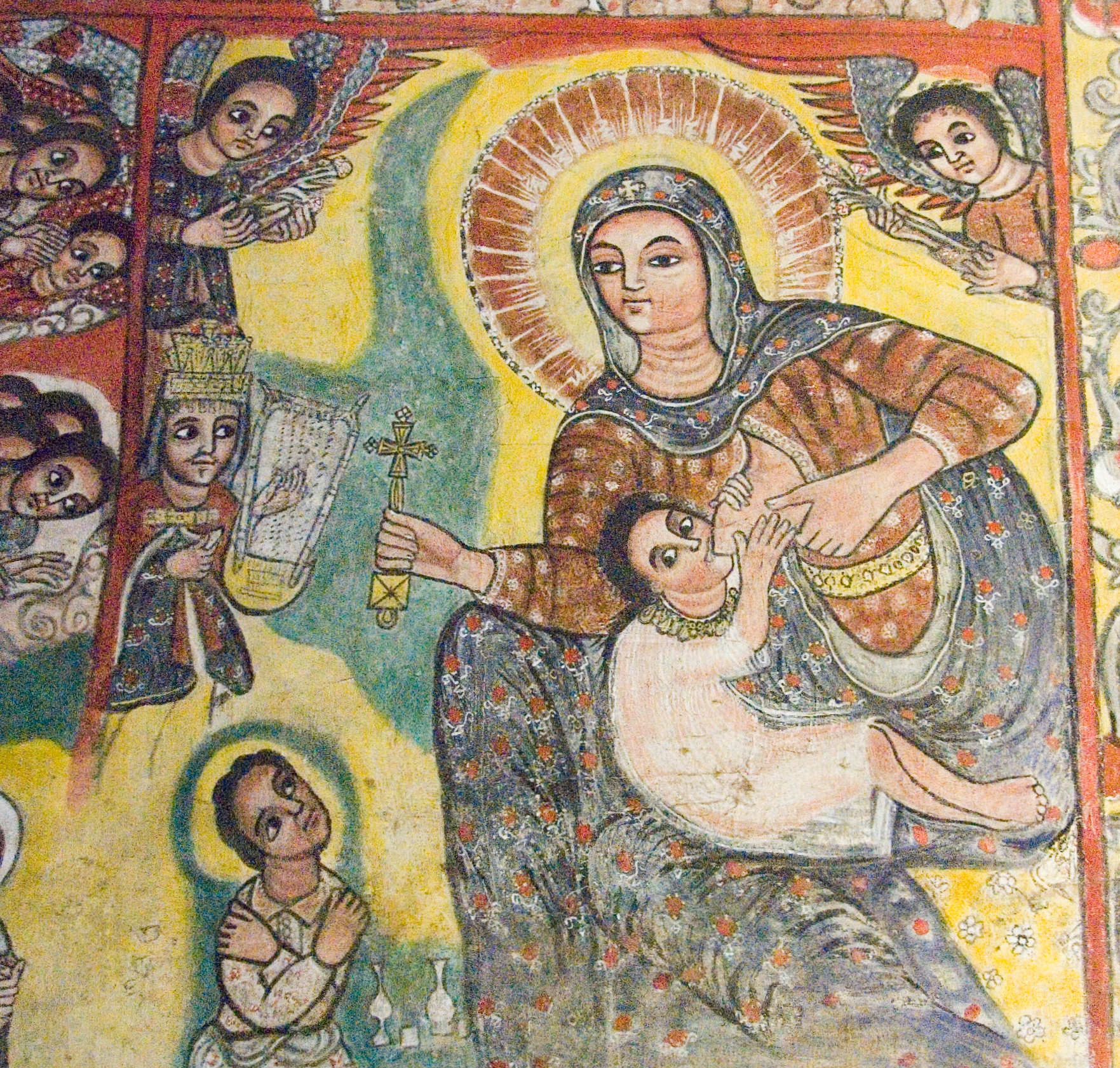
20.“Hymn 4 on the Nativity of Christ” by Ephrem the Syrian: St. Ephrem, a church father from the fourth century, wrote his theology in verse and is one of the most significant Early Christian hymnists. His Nativity hymns are my favorite; I’m particularly struck in Hymn IV by his meditation on how the Christ who suckles at Mary’s breast also gives suck to the whole world. “He is the Living Breast of living breath,” as Kathleen E. McVey translates the Syriac.
Source: Ephrem the Syrian: Hymns, trans. Kathleen E. McVey (Classics of Western Spirituality) (Paulist Press, 1989)
Maria lactans, late 18th century. Fresco, Church of Narga Selassie, Dek Island, Lake Tana, Ethiopia. Photo: Alan Davey.
21. “Nativity” by Scott Cairns: This is the first in a pair of ekphrastic poems called “Two Icons,” in which the poet, who is Greek Orthodox, describes an icon from his home prayer corner. The first three stanzas engage in constructive wordplay: Jesus is wrapped in swaddling bands by his mother, and she is rapt—enraptured, wholly absorbed—by him. She holds him in her gaze and in her hands, and is beholden to him. Icons are about just that: beholding Christ and the sacred mysteries and deepening our affection for the One who holds us in affection. In Nativity icons our gaze is directed to “the core / where all the journeys meet, appalling crux and hallowed cave and womb,” where we are beckoned, like the magi, to bow before the incarnate God.
22.“Star of the Nativity” by Joseph Brodsky: The Nobel Prize–winning Russian poet Joseph Brodsky was born into a Jewish family, but he was captivated by the story of Jesus’s birth and wrote many poems about it. The final stanza of this one gives us the unique perspective of the Star of Bethlehem, looking down—the Father’s beaming pride.
Source: Nativity Poems (Farrar, Straus and Giroux, 2001)
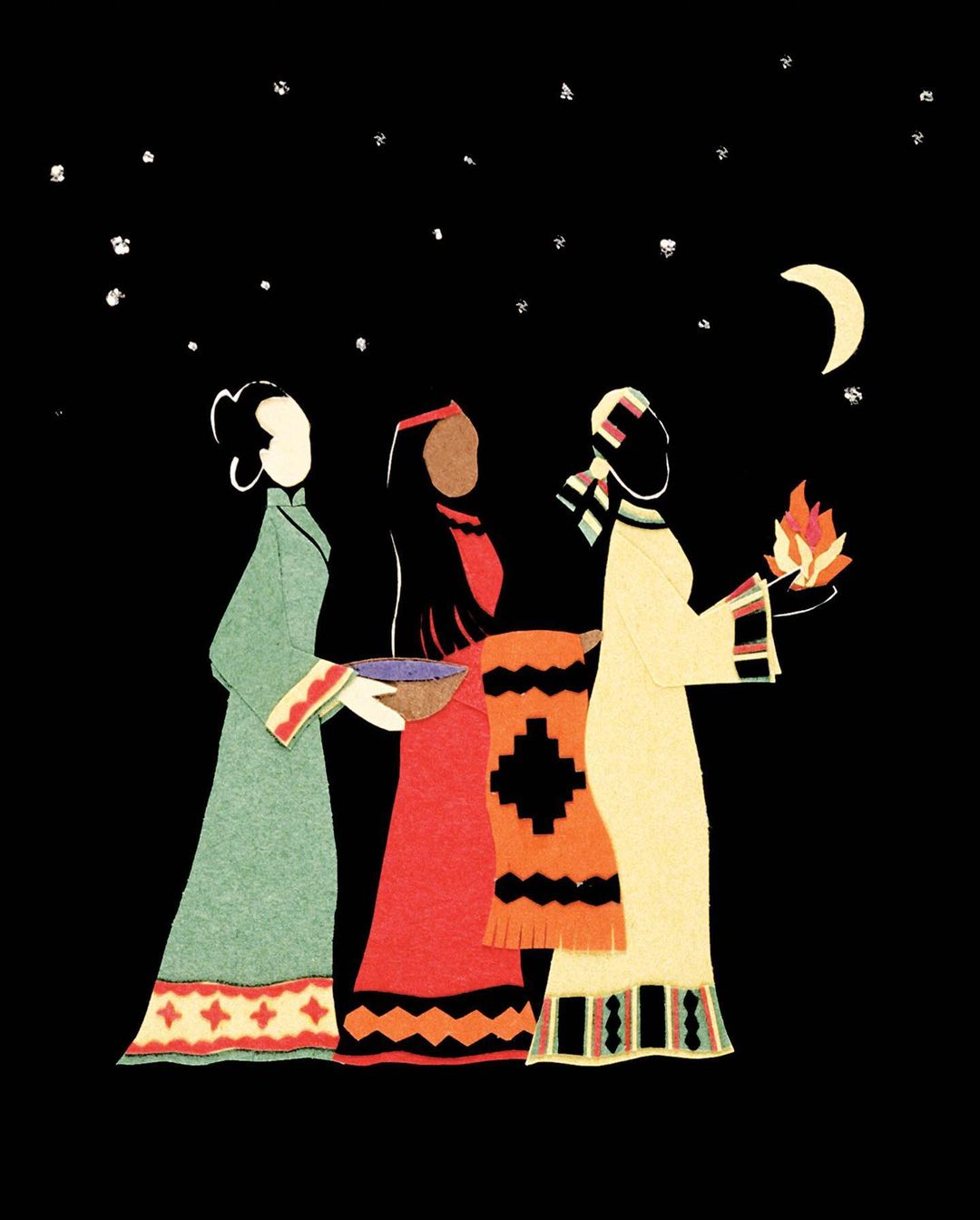
23. “Wise Women Also Came” by Jan Richardson: The Gospel of Matthew tells us that when Jesus was born, wise men came from the east to worship him. But wise women came too, Jan Richardson surmises. They came during Mary’s labor—midwives assisting with the birth. They came with lamps, fresh water, and blankets.
Jan Richardson (American, 1967–), Wise Women Also Came, 1995. Collage. [purchase reproduction]
24.“Green River Christmas” by John Shea: Theologian and storyteller John Shea reflects on how, after experiencing something scary or unpleasant (like getting a shot or a teeth cleaning), mothers often give their child a treat. Christmas is a kind of supreme treat after the penitential season of Advent, during which we confronted the state of our spiritual health and remedied any shortfalls. Think, too, of the liturgy of (somber) confession and (sweet) pardon every Sunday at church, a prelude to the feast of bread and wine. At the Lord’s Table, we are fed—the gifts of God for the people of God. The Eucharist is the subtext of the final stanza, where Shea describes the presentation of Jesus in the temple forty days after his birth. There he is received by “the long-starved arms / of Simeon and Anna.” They had hungered for salvation, endured a long period of waiting; now they are filled.
25.“Taking Down the Tree” by Jane Kenyon: “Tick, tick, the desiccated needles drop.” This poem is about the passing of time—the death of another year—and the glumness that often sets in after the holidays are over, but it’s also about the storage of memories. In many households, Christmas ornaments are a multigenerational collection of memories. As with hanging them on the tree, taking them off and packing them away is a ritual that may prompt us to revisit certain past experiences or periods in our life. After we unplug the stringed lights and wrap up the baubles for safekeeping, then what? How will we inhabit the twelve months until next Christmas?
Woman gathering flowers, first century CE. Detached fresco, 38 × 32 cm, from the Villa Arianna in Stabiae, Campania, Italy, now in the Collection of the Museo Archeologico Nazionale di Napoli, Naples, Italy. The woman may be Primavera (a personification of spring) or Flora (the Roman goddess of flowers, fertility, and abundance), or simply a generic maiden at leisure.
Spring bursts today,
For Christ is risen and all the earth’s at play.

Flash forth, thou Sun,
The rain is over and gone, its work is done.

Winter is past,
Sweet Spring is come at last, is come at last.

Bud, Fig and Vine,
Bud, Olive, fat with fruit and oil and wine.

Break forth this morn
In roses, thou but yesterday a Thorn.

Uplift thy head,
O pure white Lily through the Winter dead.

Beside your dams
Leap and rejoice, you merry-making Lambs.

All Herds and Flocks
Rejoice, all Beasts of thickets and of rocks.

Sing, Creatures, sing,
Angels and Men and Birds and everything.

All notes of Doves
Fill all our world: this is the time of loves.
This poem was originally published in A Pageant, and Other Poems(London, 1881) and is in the public domain.
One of the most celebrated poets of the Victorian era, Christina Georgina Rossetti (1830–1894) was an English writer of Romantic, devotional, and children’s poems. She was the youngest of four siblings, among them the Pre-Raphaelite artist Dante Gabriel Rossetti, several of whose paintings she sat for, famously modeling for the Virgin Mary. A devout Anglican whose verse gives vivid expression to the life of faith and to spiritual longing, she is recognized as a saint by the Church of England and the Episcopal Church, who celebrate April 27 as her feast day.
“Lift up your hearts.” “We lift them up.” Ah me!
I cannot, Lord, lift up my heart to Thee:
Stoop, lift it up, that where Thou art I too may be.
“Give Me thy heart.” I would not say Thee nay,
But have no power to keep or give away
My heart: stoop, Lord, and take it to Thyself today.

Stoop, Lord, as once before, now once anew
Stoop, Lord, and hearken, hearken, Lord, and do,
And take my will, and take my heart, and take me too.
This poem was originally published in Time Flies: A Reading Diary (1885) and subsequently Verses (1893) and is in the public domain.
A devout Anglican from Victorian England and one of my favorite spiritual writers, Christina Rossetti (1830–1894) opens her poem “Sursum Corda” with a quotation from the ancient Eucharistic prayer compiled in the Book of Common Prayer: “Lift up your hearts . . .”
The Sursum corda, Latin for “Lift up your hearts,” is a Christian liturgical dialogue between priest/pastor and congregation that dates at least as far back as the third century (it’s mentioned in the Early Christian treatise Apostolic Tradition, as well as by Cyprian, Augustine, and Cyril of Jerusalem) and that is still used in Catholic, Orthodox, and Protestant churches today. Most, like my Presbyterian church, recite it as part of the celebration of the Eucharist, aka the Lord’s Supper, though some place it after the Call to Worship.
Here are the words used in the Roman Rite:
Priest: Dominus vobiscum.
People: Et cum spiritu tuo.
Priest: Sursum corda.
People: Habemus ad Dominum.
Priest: Gratias agamus Domino Deo nostro.
People: Dignum et iustum est.
Priest: The Lord be with you.
People: And with your spirit.
Priest: Lift up your hearts.
People: We lift them up to the Lord.
Priest: Let us give thanks to the Lord our God.
People: It is right and just.
Folio 1r from the Cambrai Missal, made in northern France, ca. 1120. Collection of Notre-Dame Cathedral, Cambrai, France. This page starts mid-liturgy with “Per omnia saecula saeculorum, amen” (Forever and ever, amen; or World without end, amen)—the inhabited initial P has a lion and a fantastical bird inside!—and then proceeds to the Sursum corda. The tildes indicate omitted letters.
The following is what my church uses—you’ll see it concludes with the Memorial Acclamation:
Pastor: The Lord be with you. People: And also with you. Pastor: Lift up your hearts! People: We lift them up to the Lord. Pastor: Let us lift up our hearts to the Lord our God. People: It is right to give him thanks and praise. Pastor: Therefore we proclaim the mystery of faith: All: Christ has died. Christ is risen. Christ will come again.
The phrase “Lift up your hearts” is taken from biblical passages such as Psalm 86:4—“Gladden the soul of your servant, for to you, O Lord, I lift up my soul”—and Lamentations 3:41, which says, in the context of confession and repentance, “Let us lift up our hearts as well as our hands to God in heaven.” The Sursum corda expresses an inclining of the whole self toward God in praise and offering.
Rossetti responds to this jubilant call with an admission of personal weakness. She lacks the power to lift up her heart, she says (perhaps because it’s so heavy); she needs God to lift it for her. She begs him four times to “stoop,” to condescend to her level, so that she might ascend to his throne. Line 4 contains a partial quotation of Proverbs 23:26: “My son, give me thine heart, and let thine eyes observe my ways.” She wants to give God her heart, but in her frail spiritual state, all she can do is bid him “take it.”
I often pray Rossetti’s poems, as I find her such a sensitive seeker, full of longing that so frequently reflects my own. You can find other Rossetti poems from the Art & Theology archives on my new Poetry Index tab. All her poems are accessible online, scattered across various volumes on Google Books, but if you want to read them all in one place and in physical book form, I recommend the Penguin Classics edition of her Complete Poems (which stands at a whopping 1221 pages!).
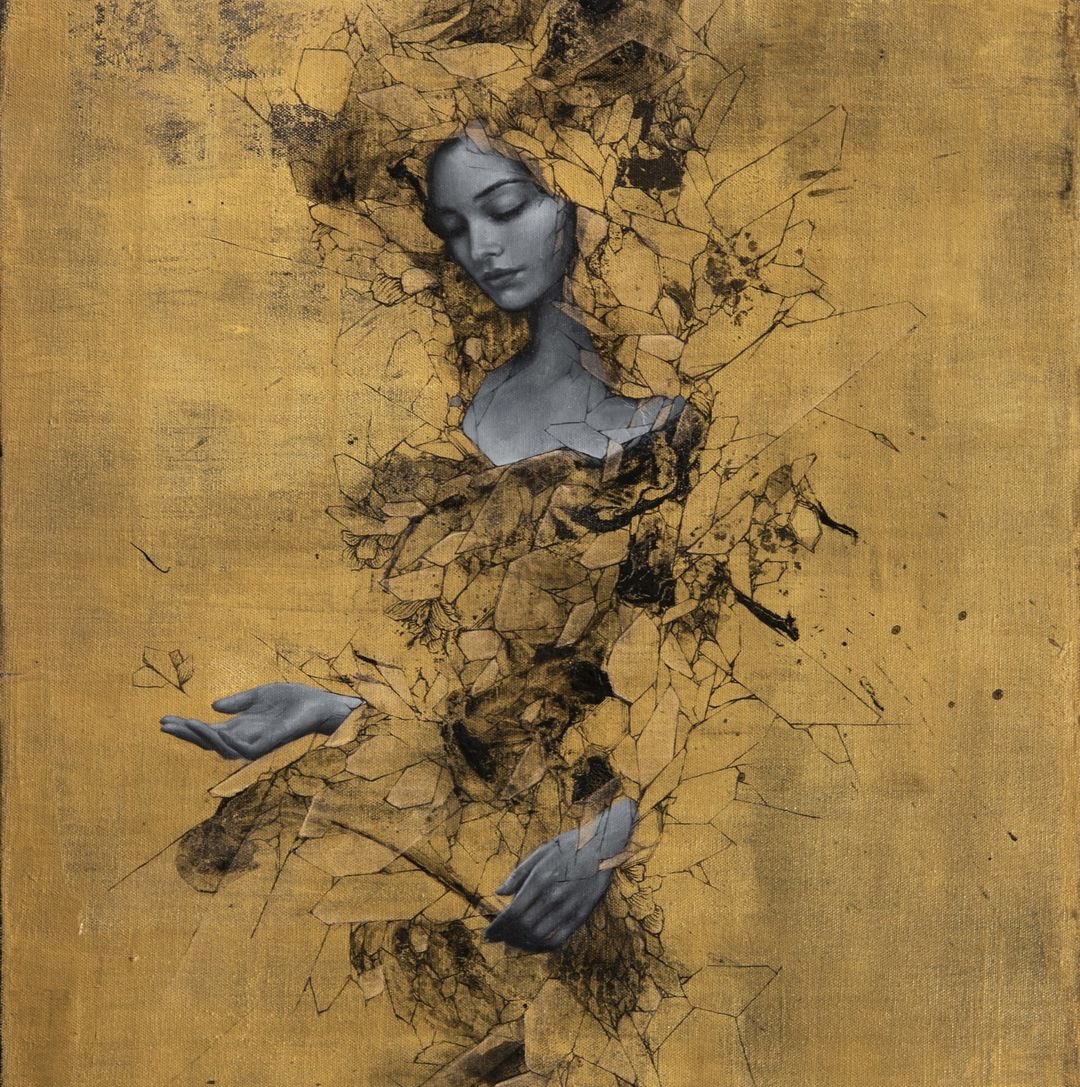
Aiden Kringen (American, 1992–), Opulence 4 (detail), 2022. Oil and acrylic on canvas, 36 × 18 in. [for sale]
I have no wit, no words, no tears;
My heart within me like a stone
Is numbed too much for hopes or fears;
Look right, look left, I dwell alone;
I lift mine eyes, but dimmed with grief
No everlasting hills I see;
My life is in the falling leaf:
O Jesus, quicken me.

My life is like a faded leaf,
My harvest dwindled to a husk:
Truly my life is void and brief
And tedious in the barren dusk;
My life is like a frozen thing,
No bud nor greenness can I see:
Yet rise it shall—the sap of Spring;
O Jesus, rise in me.

My life is like a broken bowl,
A broken bowl that cannot hold
One drop of water for my soul
Or cordial in the searching cold;
Cast in the fire the perished thing;
Melt and remould it, till it be
A royal cup for Him, my King:
O Jesus, drink of me.
One of the most celebrated poets of the Victorian era, Christina Georgina Rossetti (1830–1894) was an English writer of Romantic, devotional, and children’s poems. She was the youngest of four siblings, among them the Pre-Raphaelite artist Dante Gabriel Rossetti, several of whose paintings she sat for, famously modeling for the Virgin Mary. Her father was an Italian political exile to London and instilled in her a love of Dante Alighieri and the Italian language, which he taught at King’s College until being struck ill and rendered blind. He died when Christina was thirteen, and from then onward she suffered bouts of depression and physical illness. Loss and death, heaven, renunciation, the need for grace, and the perfection of divine love are recurring themes in her poetry. A devout Anglican whose verse gives vivid expression to the life of faith and to spiritual longing, she is recognized as a saint by the Church of England and the Episcopal Church, who celebrate April 27 as her feast day.
ADVENT MEDITATION: “Love is . . .” by the Rev. Jonathan Evens: Evens shared this brief written meditation last week at Advent Night Prayer at St Catherine’s Wickford in England, pondering the love Mary demonstrated at various points along the way from the announcement of Jesus’s conception to her and her family’s resettlement in Egypt.
+++
SONGS:
>> “I Pray on Christmas”(cover)by the Good Shepherd Collective: This song was written by Harry Connick Jr. and is performed here by Benjamin Kilgore with Terence Clark, Liz Vice, and Charles Jones of the Good Shepherd Collective, an interdenominational group of musicians collaborating across the US. The video is directed by Jeremy Stanley.
>> “Mary Was the First One to Carry the Gospel” by the Gaither Vocal Band: I grew up in a Baptist church in North Carolina, so southern gospel music is a very familiar genre for me! But I hadn’t heard this song before, until my mom sent me a link last week. It was written by Mark Lowry and Bill Gaither (they took the title from a 1978 song by Dottie Rambo), who sing it here with David Phelps and Guy Penrod at the Alabama Theatre in Birmingham in 2000 as part of the Gaithers’ Christmas in the Country concert. It’s about how Mary was the first person to carry the good news enfleshed—first in her womb, and then in her arms.
>> “Late Upon a Starry Night” by David Benjamin Blower:David Benjamin Blower is an “apocalyptic folk musician, poet, writer, theologian, podcaster, and sound artist” from the UK whose work emphasizes the liberative strains of the gospel. He just released this original Christmas song yesterday, and it will be available only through January 5, 2023, on Bandcamp, with 50 percent of proceeds going to Safe Passage UK, an organization working toward safe routes for refugees. Blower said he wrote the song after hearing a friend talk about her experience of Moria refugee camp in Greece.
The stanzas tell the story of the Annunciation to Mary, Mary and Joseph’s Journey to Bethlehem, the Annunciation to the Shepherds, the Journey of the Magi, and the Flight to Egypt. The refrain draws a line from the first book of the Bible to the last, referencing God’s prophecy in Eden about the serpent’s head being crushed by a descendant of Adam and Eve (Gen. 3:15) (the serpent being representative of sin and death) as well as, implicitly, the image in Revelation 12 of the woman in labor and the dragon. Read the lyrics on the song’s Bandcamp page.
+++
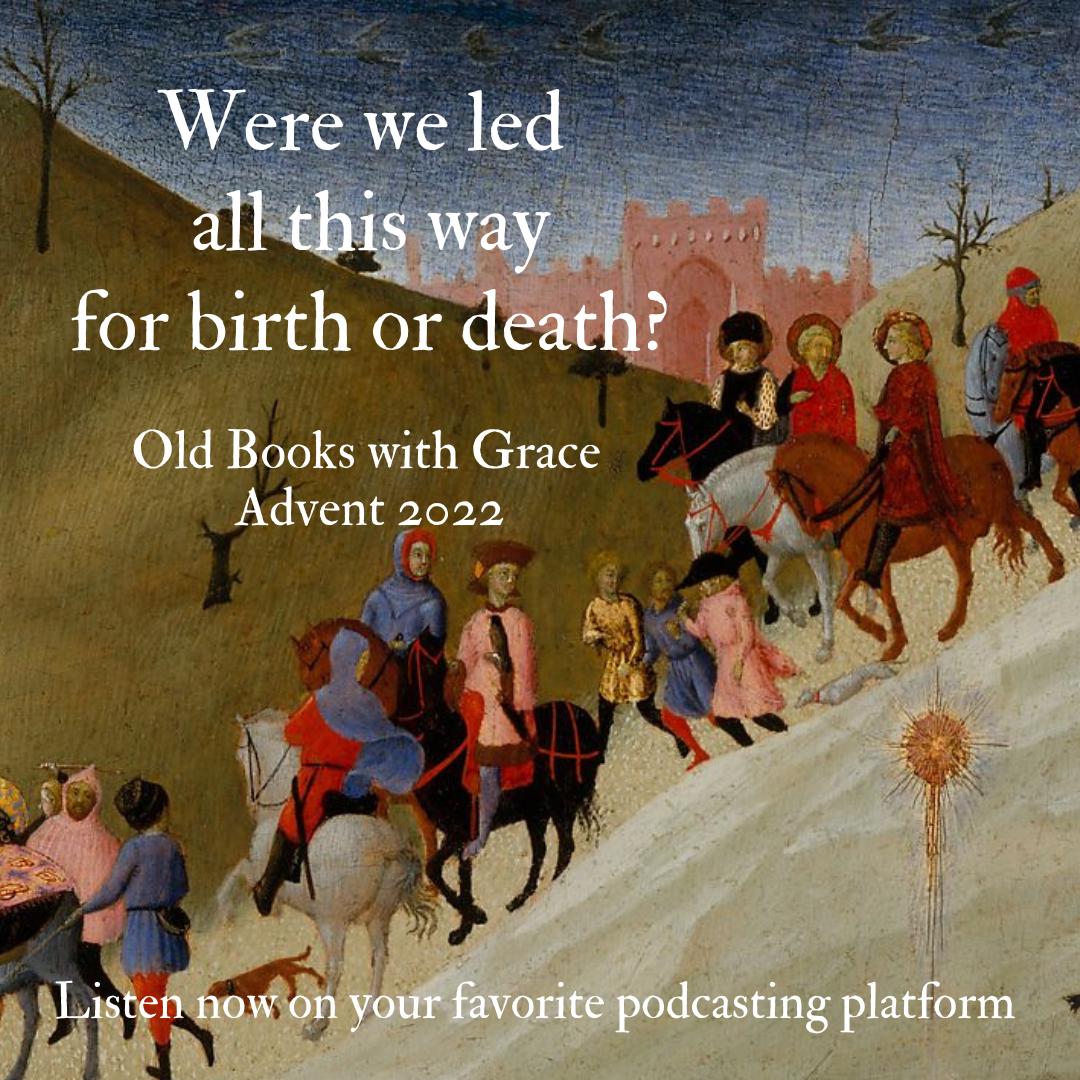
PODCAST SERIES: Advent 2022, Old Books with Grace: I’ve been loving Dr. Grace Hamman’s four-part Advent podcast series, consisting of roughly twenty-minute episodes that discuss seasonal poems. Hamman is a specialist in medieval literature and theology and has the rare gift of being able to translate her extensive knowledge to nonspecialists in engaging and personal ways. She can speak with facility on lit and theology from other eras too. In this series she talks about our status as pilgrims in this world, how Christ carries our prayers in his body, nature-inspired images of the Incarnation, and more. I frequently come away from her podcast with new insight, and always having been spiritually nourished. If you’re traveling for Christmas, queue these up for the car, plane, train, or bus ride! Or work them into your week some other way, perhaps over breakfast, or while you’re doing dishes. Old Books with Grace is available wherever you listen to podcasts. (I use Google Podcasts, but Apple Podcasts or PodBean are the most popular providers.)
Episode 3: Heaven Cannot Hold Him (“A Christmas Carol” by Christina Rossetti and excerpt from Piers Plowman by William Langland)
Episode 4: Dayspring (releases December 21; will cover an Old English version and Middle English version of one of the O Antiphons)
+++
DANCING ANGEL:This video from a church Christmas pageant in Porter, Indiana, went viral in 2019, but I’m just now seeing it (thanks to @upworthy!). It shows then-four-year-old Isabella Grace Webb dancing it up freestyle in her angel costume to “O Come, All Ye Faithful.” So adorable!
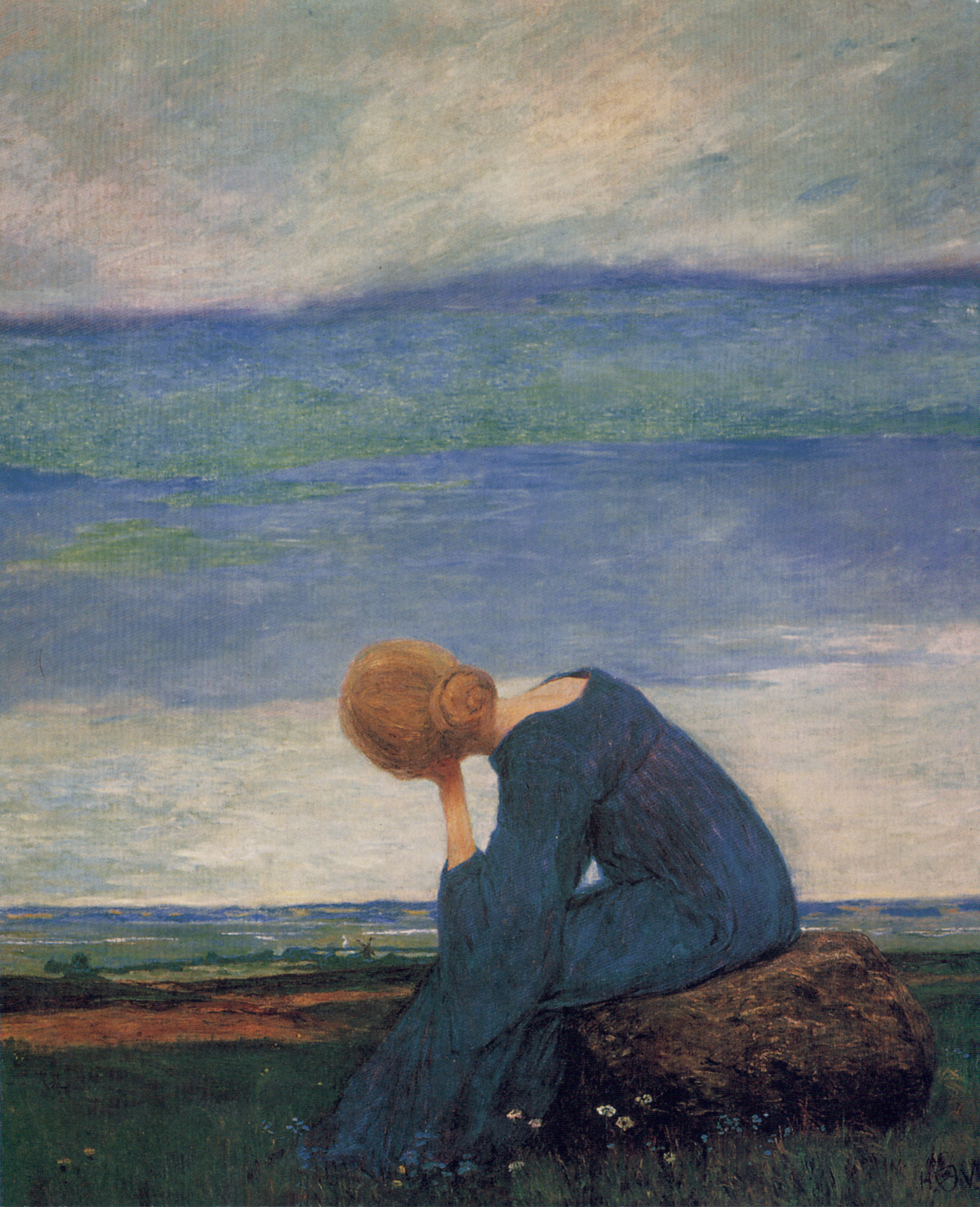
Heinrich Vogeler (German, 1872–1942), Reverie, ca. 1900. Oil on canvas.
               1.
New Year met me somewhat sad:
     Old Year leaves me tired,
Stripped of favourite things I had,
Baulked of much desired:
     Yet farther on my road today
God willing, farther on my way.

New Year coming on apace,
     What have you to give me?
Bring you scathe, or bring you grace,
Face me with an honest face;
     You shall not deceive me:
Be it good or ill, be it what you will,
It needs shall help me on my road,
My rugged way to heaven, please God.

               2.
Watch with me, men, women, and children dear,
You whom I love, for whom I hope and fear,
Watch with me this last vigil of the year.
Some hug their business, some their pleasure scheme;
Some seize the vacant hour to sleep or dream;
Heart locked in heart some kneel and watch apart.

Watch with me, blessed spirits, who delight
All thro’ the holy night to walk in white,
Or take your ease after the long-drawn fight.
I know not if they watch with me: I know
They count this eve of resurrection slow,
And cry, “How long?” with urgent utterance strong.

Watch with me, Jesus, in my loneliness:
Tho’ others say me nay, yet say Thou yes;
Tho’ others pass me by, stop Thou to bless.
Yea, Thou dost stop with me this vigil night;
Tonight of pain, tomorrow of delight:
I, Love, am Thine; Thou, Lord my God, art mine.

               3.
Passing away, saith the World, passing away:
Chances, beauty and youth sapped day by day:
Thy life never continueth in one stay.
Is the eye waxen dim, is the dark hair changing to grey
That hath won neither laurel nor bay?
I shall clothe myself in Spring and bud in May:
Thou, root-stricken, shalt not rebuild thy decay
On my bosom for aye.
Then I answered: Yea.

Passing away, saith my Soul, passing away:
With its burden of fear and hope, of labour and play;
Hearken what the past doth witness and say:
Rust in thy gold, a moth is in thine array,
A canker is in thy bud, thy leaf must decay.
At midnight, at cockcrow, at morning, one certain day
Lo the bridegroom shall come and shall not delay:
Watch thou and pray.
Then I answered: Yea.

Passing away, saith my God, passing away:
Winter passeth after the long delay:
New grapes on the vine, new figs on the tender spray,
Turtle calleth turtle in Heaven’s May.
Tho’ I tarry, wait for Me, trust Me, watch and pray.
Arise, come away, night is past and lo it is day,
My love, My sister, My spouse, thou shalt hear Me say.
Then I answered: Yea.
This poem was originally published in Goblin Market and Other Poems (Macmillan, 1862) and appears inThe Complete Poemsby Christina Rossetti (Penguin, 2001). It is in the public domain.
Maari Christante (American, 1982–), Anchored for Flight, 2019. Digital photograph, 30 × 24 in. [available as a print]
Everything that is born must die;
   Everything that can sigh may sing;
Rocks in equal balance, low or high,
   Everything.

   Honeycomb is weighed against a sting;
Hope and fear take turns to touch the sky;
   Height and depth respond alternating.

O my soul, spread wings of love to fly,
   Wings of dove that soars on home-bound wing:
Love trusts Love, till Love shall justify
   Everything.
This untitled poem was originally published in Time Flies: A Reading Diary (SPCK, 1885) and appears inThe Complete Poemsby Christina Rossetti (Penguin, 2001). It is in the public domain.
Wednesday, February 17, is the start of Lent, a forty-day season of penitence and renewal. It’s not so much about making resolutions as it is about drawing near to God and encountering his grace afresh—at the foot of the cross.
That closeness entails confronting, confessing, and repenting of sin—sins of commission and omission. (The Book of Common Prayer reminds us that we sin “by what we have done, and by what we have left undone.”) It’s an uncomfortable process, but one that grows us, makes us healthy. It makes our relationships and communities healthier too. Jesus’s grace is not just warm fuzzies in the hearts of private individuals but, rather, works itself out in the world.
As a companion for the Lenten journey, I’ve curated a Spotify playlist of songs for the season, a mix of prayers and praises to the Triune God whose strength avails to meet us in our weakness and our need. Some are invitational, others are penitential, and others are celebratory. Along with images of dust, blood, wilderness, and death, there are themes of victory and rising, healing and wholeness, rivers that cleanse, rivers that quench thirst, agricultural metaphors of planting and growth, calls to lay down one’s burden and to rest in the Savior’s love. There are songs of pursuing and of being pursued (us calling out to God, God calling out to us), for as we deepen our desire for God, we come to realize how deep God’s desire is for us.
The playlist opens with “That We Might See” by Indianapolis folk duo Sister Sinjin, a setting (with slight modifications) of this Christina Rossetti poem:
Lord, purge our eyes to see Within the seed a tree, Within the glowing egg a bird, Within the shroud a butterfly:
Till taught by such, we see Beyond all creatures Thee; And hearken for Thy tender word, And hear it, “Fear not: it is I.”
I chose this as the introductory song because, first, it expresses how out of “death” or dormancy can come great life and beauty—as with the buried seed that, once germinated, brings forth lushness. This is one of the prime metaphors of Lent, and this song is a supplication that we would have eyes to see it and, what’s more, participate in it (see Rom. 6). Second, I like how it reminds us of the tenderness and approachability of Jesus. Some people enter Lent with a sense of dread, fearing that their sins are too great, or that they will never measure up to some set standard of piety. But Jesus tells us not to be afraid. His love and mercy know no bounds. He wants to set us free from our illusions of self-sufficiency and for us to rely on his Spirit to work good things in and through us.
Let me share just a handful of other song highlights.
“Simple Gifts” is a one-verse Shaker hymn from 1848, performed here by the amazing female trio Mountain Man (Alexandra Sauser-Monnig, Amelia Randall Meath, and Molly Erin Sarle). The Shakers, a Christian sect, were known for their use of dance during worship, and “bowing,” “bending,” and “turning” are dance instructions as much as they are instructions for life. Simplicity is another hallmark of the Shakers, a virtue and a discipline that Lent summons us to.
Another Lenten virtue is silence. In 2018 Paul Zach released the EPGod Is the Friend of Silence, whose title track is inspired by a Mother Teresa quote: “We need to find God, and God cannot be found in noise and restlessness. God is the friend of silence.”
There are many originals from the past decade on the playlist, but there are also a lot of classic hymns: “Amazing Grace” (to the tune of “House of the Rising Sun”), “Softly and Tenderly” (intriguingly reharmonized by the Wilderness of Manitoba), “I Am Thine, O Lord,” “Just a Closer Walk with Thee,” “I Need Thee Every Hour,” “Grace That Is Greater,” “Nothing but the Blood,” “Near the Cross,” “Just as I Am,” “Jesus Paid It All,” “Turn Your Eyes Upon Jesus,” “Where He Leads Me.” And a beautiful adaptation of “I Surrender All” by Chanda Rule, who revised the first verse to this:
O Beloved, I surrender All my heart I freely give Ever open, ever trusting Breathing with my Source, I live
Also included are several settings of the ancient liturgical prayer Kyrie (“Lord, have mercy”)—by Hildegard of Bingen, Josquin des Prez, Isaac Wardell, and the monks of Keur Moussa Abbey in Senegal (sung in Wolof). Plus the fourteenth-century prayer known as the Anima Christi, with music composed by jazz master Mary Lou Williams using a 6/8 rhythm pattern and a bass clarinet.
Soul of Christ, be my sanctification Body of Christ, be my salvation Blood of Christ, fill my veins Water of Christ’s side, wash out my stains
Passion of Christ, my comfort be O good Jesus, listen to me Lord, have mercy on me
. . .
The entire Lent album by Liturgical Folk is inspired by specific Lenten readings from the Book of Common Prayer. My favorite song is “Willing Minds,” based loosely on the collect (succinct prayer) for the Fifth Sunday in Lent:
Almighty God, you alone can bring into order the unruly wills and affections of sinners: Grant your people grace to love what you command and desire what you promise; that, among the swift and varied changes of the world, our hearts may surely there be fixed where true joys are to be found; through Jesus Christ our Lord, who lives and reigns with you and the Holy Spirit, one God, now and for ever. Amen.
The melismatic phrases (in which one syllable is stretched out across multiple successive notes) underscore the flightiness of the human will, our inconstancy, our lack of rootedness.
“Create in Me” by Terry Talbot, covered by The Acappella Company in the video below, is a prayer that’s pieced together from various verses of scripture, starting with Psalm 51:10:
Other favorites, which I’ve featured on the blog before, are Leon Bridges’s “River” [previously] and “Hallelujah” by MaMuse [previously]. “I’m gonna let myself be lifted,” the latter asserts.
As much as Lent is about dying to sin, it’s also about rising with Christ, so resurrection is present throughout—in biblical narrative songs about Jonah, Lazarus, Jairus’s daughter, and Ezekiel in the valley of dry bones, for example (foretastes of Easter), but also in songs of personal testimony and aspiration. The theme is especially punctuated in the final few selections. “Where All New Life Begins” by John Lucas seeks to define faith, landing on “Faith is laying your body down / And believing new life will come up from the ground.” Carrie Newcomer’s “Lean in Toward the Light” opens with a similar image of buried seeds, which stretch out underneath the cold winter earth as they prepare to sprout (that is, resurrect), their growth enabled by the light; “keep practicing resurrection!” exclaims the second stanza.
The last two songs are centered on Romans 8. “The Spirit of Life” by Psallos is a contemporary setting of verses 1–17 and part of a larger project. For the final, “sending forth” song I’ve chosen “Conquerors” by Hiram Ring, which is quieter, less anthemic, than the previous one, but its chorus rings of Romans 8:37 and makes for a powerful closing:
We are more than conquerors Heading out into this world Freed from chains and strengthened now ’Cause his love is all around
This is just a sampling of the 150 songs on Art & Theology’s Lent playlist, which I will probably build on indefinitely. Later in the season I plan to publish a different list specifically for Holy Week.
To add the playlist to your account, open the link, then click on the More (…) icon and select “Save to Library.”
Playlist cover art: Vincent van Gogh, Rain (detail), Saint-Rémy, 1889, Philadelphia Museum of Art
+++
I recently started accepting donations to help support the running of this blog ministry. If the Lent playlist has value to you, please consider leaving a gift of $5 through PayPal. If you have already given, thank you. https://www.paypal.me/artandtheology


_-_Napoli_MAN_8834.jpg)


 Art & Theology