Roundup: Literary Lent, Psalm 90 virtual art exhibition, and more

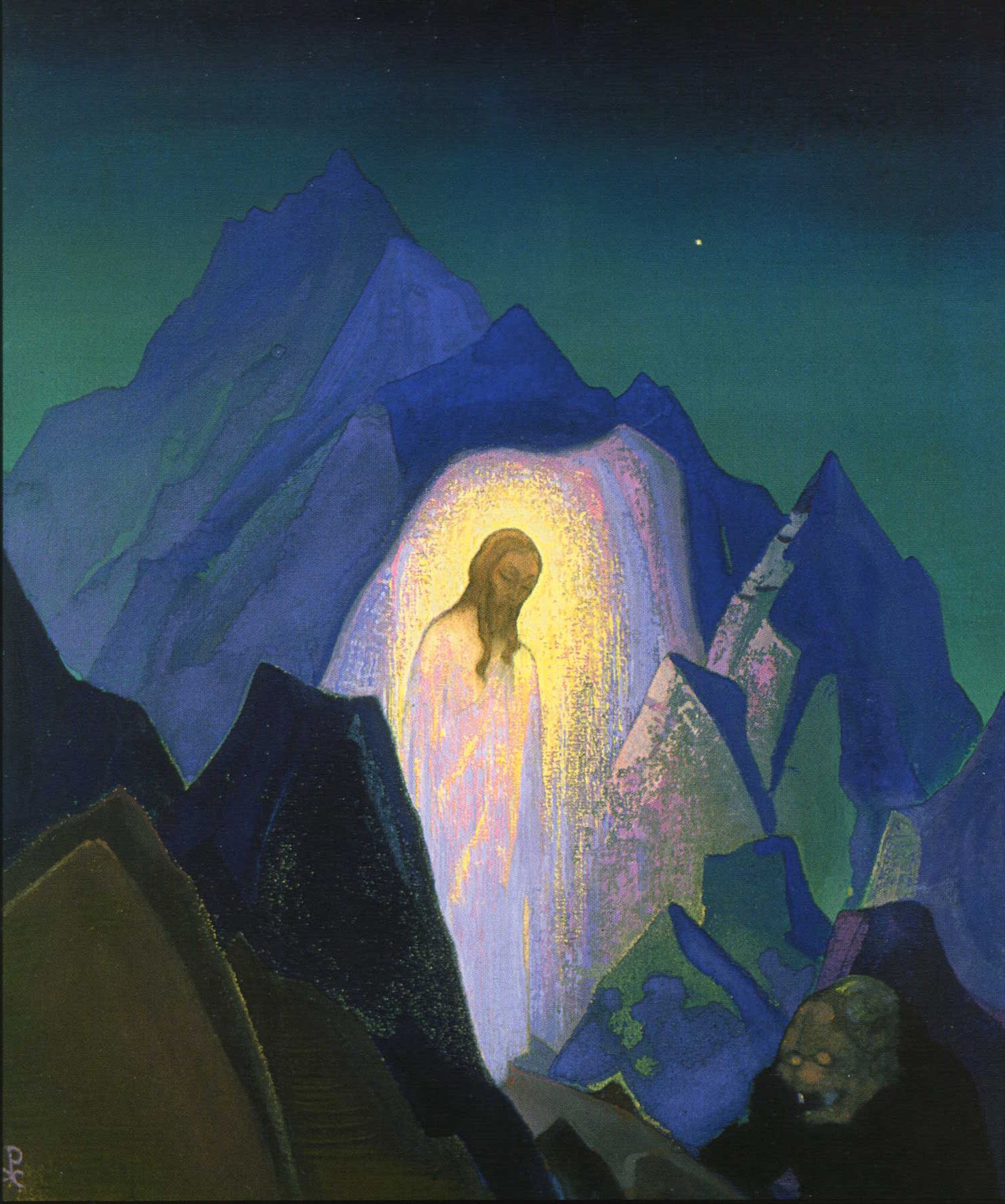
Roerich, Nicholas_Christ in the Desert
Nicholas Roerich (Russian, 1874–1947), Christ in the Desert, 1933. Tempera on canvas, 60 × 50.9 cm. Nicholas Roerich Museum, Moscow.

QUOTE:

The tradition of Lent means many different things to many different people. I honour the traditions and wisdom of the ages—and I’m interested in discerning what these practices mean [today].

At [my church], Lent is about learning from Jesus, particularly Jesus’ path through the real-life wilderness experiences we all face. We are interested in emulating and discovering a Jesus-shaped life in the hard things, the growing things, and the uncomfortable things. We believe not in an idealized plane of existence no one can quite attain; instead we believe in knowing and living out a Jesus way in the grey areas, the dirt and dust of our earthly lives here and now. . . .

Together and for you, this is our prayer (by Ann Siddall): “May this Lenten journey, with its stories about the hard places of Jesus’ experience, give strength and courage to all whose journey is far from easy. And may it inspire us to risk Christ’s Way of love as we share the journey with other travelers. We make this prayer in his name. Amen.”

—Rielly McLaren, pastor, Windsor Mennonite Fellowship, Windsor, Ontario [source]

+++

ARTICLES:

>> “Ash Wednesday and the Practice of Truth-Telling” by Christine Valters Paintner: In this introduction to the season of Lent, spiritual writer and retreat leader Christine Valters Paintner discusses lament as a Lenten practice—lament as truth-telling, resistance, solidarity, and the release of God’s power. We need to touch those places of grief that we carry, and open ourselves in compassion to the grief of others. Paintner also unpacks the word “repentance,” visiting its Hebrew and Greek root words to further illuminate its meaning.

>> “Forty for 40: A Literary Reader for Lent” by Nick Ripatrazone: Nick Ripatrazone, the culture editor for Image journal and columnist at The Millions, offers suggestions and blurbs for forty stories, poems, essays, and books appropriate for Lent. Some pieces are inspired by feast days and Gospel readings, while others capture the discernment of the season. From Flaubert’s The Temptation of Saint Anthony and Hemingway’s one-act play Today Is Friday to Love & Salt: A Spiritual Friendship Shared in Letters and Karr’s “Disgraceland,” the selections are varied and intriguing. The dates are off because this was published in 2017, but the list is still valid, and many of the poems can be read online.

+++

LIVING ROOM EVENT: “Poetry of Lent”: On March 4, under the aegis of the local arts nonprofit the Eliot Society, I’m moderating an evening of crowdsourced Lenten poetry at a friend’s home in Crownsville, Maryland. If you’re in the Baltimore-Washington metro area, I’d love to see you there! The themes of this season are so expansive, and I’m looking forward to hearing what people share. Of course, I will have many poems in my back pocket as well. Some words I’ve been thinking of in preparation: pilgrimage; hunger; emptying; grace; greening; solitude; beloved; blood.

+++

SONGS:

>> “Circles” by Tow’rs: Tow’rs, an indie-folk band out of Flagstaff, Arizona, is made up of Gretta and Kyle Miller, drummer Dan Bagle, guitarist Kyle Keller, and cellist Emma Riebe. This song of theirs is about how God lovingly pursues us and clothes our shame.

>> “Parce Domini” by Jacob Obrecht: The Gesualdo Six perform a motet by the Flemish composer Jacob Obrecht (1457/58–1505), which sets a traditional Latin liturgical text based on Joel 2:17, 13.

Parce Domine, parce populo tuo quia pius es et misericors. Exaudi nos in aeternum, Domine.

Spare, O Lord, spare thy people, for Thou art gracious and merciful. Hear us for ever, O Lord.

+++

VISUAL COMMENTARY: “Handling Our Fragility, Seeking a Wise Heart” by Rachel Muers: As part of the Visual Commentary on Scripture project, theologian Rachel Muers has selected and comments on three artworks that resonate with Psalm 90 [previously], a song that combines communal lament with a meditation on wisdom. The psalm ends with the cry “Prosper for us the work of our hands—O prosper the work of our hands!”—which guided Muer in her curation. She gives us nine-thousand-year-old handprints on an Argentinian cave wall, a hospital drawing by Barbara Hepworth, and a cat’s-cradle sculpture by Mitzi Cunliffe. This mini-exhibition is a great way to enter into and engage with this typically Lenten psalm.

Cave of Hands
Cueva de las Manos (Cave of Hands), began ca. 7,000 BCE. Mural, UNESCO World Heritage Site, Santa Cruz, Argentina.

On a related note: For this Lent, the VCS is dipping into its archives to bring you “Lent Stations: Repentance and Forgiveness,” fourteen artworks with commentary (two per week) that relate to the stated theme. Follow the link to sign up.

Behold That Star (Artful Devotion)

Hunter, Clementine_The Annunciation and the Adoration of the Wise Men
Clementine Hunter (American, 1886/87–1988), The Annunciation and the Adoration of the Wise Men, 1957. Oil on board, 48 × 78 in. Photo courtesy of Neal Auction Company.

Arise, shine, for your light has come,
and the glory of the LORD has risen upon you.

—Isaiah 60:1

May the kings of Tarshish and of the coastlands
render him tribute;
may the kings of Sheba and Seba
bring gifts!
May all kings fall down before him,
all nations serve him!

—Psalm 72:10–11

Now after Jesus was born in Bethlehem of Judea in the days of Herod the king, behold, wise men from the east came to Jerusalem, saying, “Where is he who has been born king of the Jews? For we saw his star when it rose and have come to worship him.” When Herod the king heard this, he was troubled, and all Jerusalem with him; and assembling all the chief priests and scribes of the people, he inquired of them where the Christ was to be born. They told him, “In Bethlehem of Judea, for so it is written by the prophet:

‘And you, O Bethlehem, in the land of Judah,
are by no means least among the rulers of Judah;
for from you shall come a ruler
who will shepherd my people Israel.’”

Then Herod summoned the wise men secretly and ascertained from them what time the star had appeared. And he sent them to Bethlehem, saying, “Go and search diligently for the child, and when you have found him, bring me word, that I too may come and worship him.” After listening to the king, they went on their way. And behold, the star that they had seen when it rose went before them until it came to rest over the place where the child was. When they saw the star, they rejoiced exceedingly with great joy. And going into the house, they saw the child with Mary his mother, and they fell down and worshiped him. Then, opening their treasures, they offered him gifts, gold and frankincense and myrrh. And being warned in a dream not to return to Herod, they departed to their own country by another way.

—Matthew 2:1–12

+++

SONG: “Behold That Star” or “Behold the Star” | African American spiritual | Performed by various artists (see below)

I first heard this song years ago on Pete Seeger’s Traditional Christmas Carols (1967; reissued 1989), one of my favorite Christmas albums.

William L. Dawson’s choral arrangement, recorded by the St. Olaf Choir in 1997, has become the standard for choirs all over the country. The recording features, as soloist, African American operatic soprano Marvis Martin:

For a gospel version, check out Fred Waring and the Pennsylvanians’ album Christmas Time (1955, reissued 2015), which combines the song with “Carol of the Bells”:

Or the version by James Cleveland with the Angelic Choir and the Cleveland Singers on Merry Christmas (1969, reissued 1987):

One of the most upbeat gospel renditions is by the Patterson Singers from 1963:

There’s also a much slower R&B rendition from Black Nativity: A Gospel Christmas Musical Experience, a musical produced by Dominion Entertainment Group in Atlanta and adapted from the 1961 song play by Langston Hughes. (“Behold That Star” is not in the Hughes original.) I couldn’t find who arranged this version, but the performers are Lawrence Flowers, Benjamin Moore, and Brandin Jay. Oddly (and perhaps under the influence of the song “Rise Up, Shepherd, and Follow”), this production has the song being sung by shepherds rather than wise men:

You can also find numerous recordings of “Behold That Star” being performed by children’s choirs, its simplicity making it accessible to young ages. It was one of several spirituals and other classics the kiddos at my church sang in our 2018 Christmas play (see video below). I’m at the piano playing from the African American Heritage Hymnal, no. 216, transposed down three half-steps to D; the arrangement is by Nolan Williams Jr. (I’m still woefully lacking in the ability to embellish in a gospel style, I’m afraid!)

+++

Clementine (pronounced KLEH-mehn-teen) Hunter was a self-taught Afro-Creole artist known for depicting life in the Cane River region of central Louisiana, especially in and around Melrose Plantation, where she worked as a farm laborer for most of her life, even into old age. She didn’t begin painting until she was in her fifties, and she would do it at night on whatever surfaces she could find—window shades, jugs, bottles, gourds, snuff boxes, iron pots.

During her early art career she would sell her paintings at the local drugstore for a dollar or less, but by the time of her death, her paintings were selling to dealers for thousands. She received significant recognition during her lifetime, including from US presidents. Today her work can be found in the collections of the Smithsonian, the Los Angeles County Museum of Art, the Minneapolis Institute of Art, and other prestigious institutions.

In the Christmas-/Epiphanytide painting reproduced above, Christ is born on Melrose Plantation in the southern US, surrounded by sheep and chickens and horses and palm trees. On the left a black angel leads a pregnant black Mary down a footpath to a farmhouse, while on the other side Mary sits on a stool with the newborn Jesus in her lap and Joseph behind her, as three men in wide-brimmed hats come bearing gourds as gifts. Above the scene is the giant yellow star that led these men to the spot, and two white-clad angels (with a scattered choir of others) trumpeting the good news of the Savior’s birth.

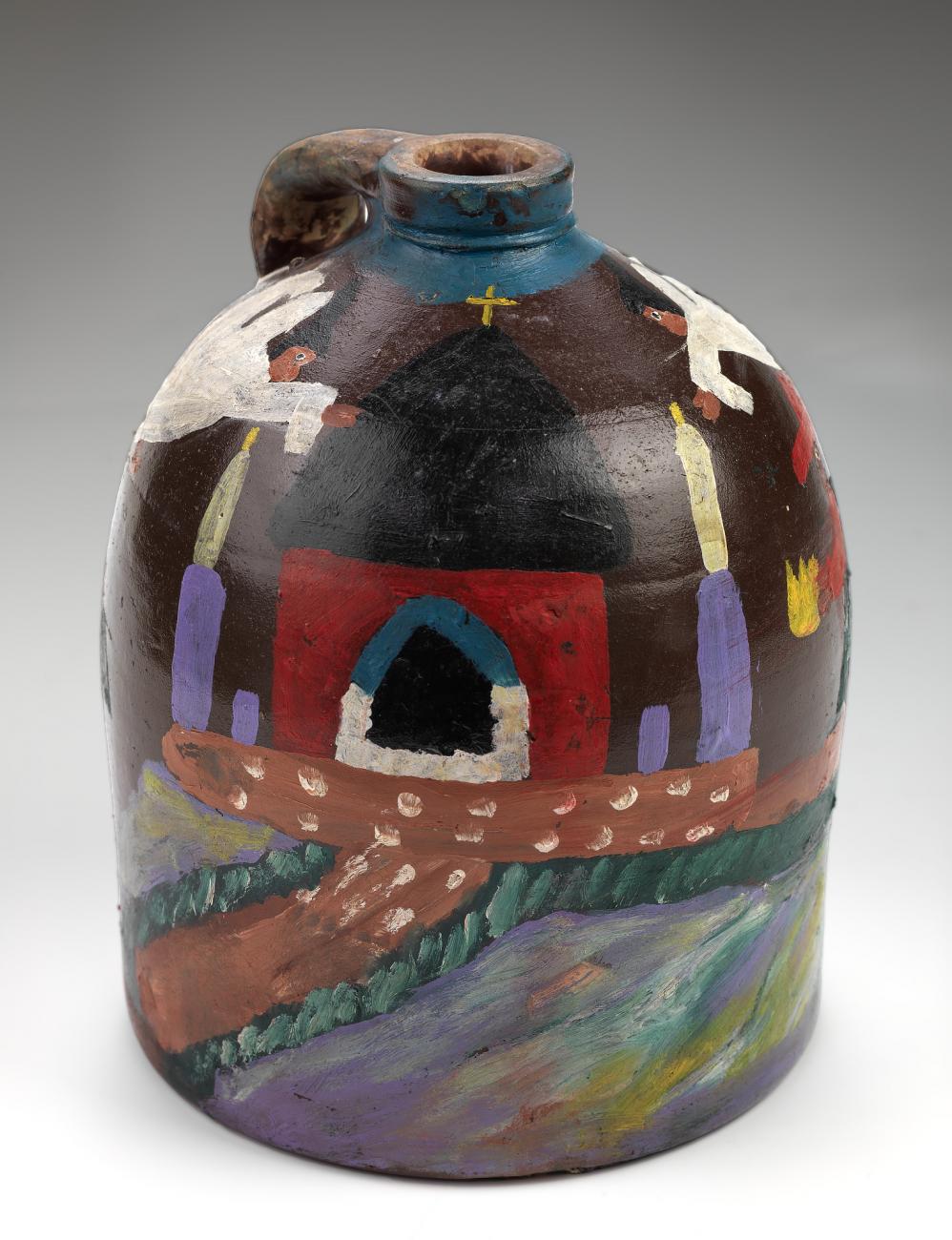
The magi were a subject Hunter turned to in many of her paintings. Here’s another fine example:

Hunter, Clementine_Magi Bearing Gifts
Clementine Hunter (American, 1886/87–1988), Untitled (Magi Bearing Gifts), ca. 1970–80. Paint on an albany slip whiskey jug, approx. 10 in. (25.4 cm) high. Smithsonian American Art Museum, Washington, DC.

Hunter, Clementine_Magi Bearing Gifts

I love how Hunter was able to see the sacred in the everyday—God’s grand story unfolding in her immediate environs. It reminds me of a poem by Wendell Berry from A Timbered Choir that begins,

Remembering that it happened once,
We cannot turn away the thought,
As we go out, cold, to our barns
Toward the long night’s end, that we
Ourselves are living in the world
It happened in when it first happened,
That we ourselves, opening a stall
(A latch thrown open countless times
Before), might find them breathing there,
Foreknown: the Child bedded in straw,
The mother kneeling over Him,
The husband standing in belief
He scarcely can believe . . .

+++

For Artful Devotions from previous years’ feast of the Epiphany, see “‘And nations shall come to your light . . .’” (featuring a Mughal miniature and an Arabic hymn) and “Three Kings Day” (featuring a Puerto Rican bulto and aguinaldo).

Also, see Christine Valters Paintner’s spiritual reflections on the story of Epiphany as an archetypal journey we are all invited to make. Her advice?

  1. Follow the star to where it leads.
  2. Embark on the journey, however long or difficult.
  3. Open yourself to wonder along the way.
  4. Bow down at the holy encounters in messy places.
  5. Carry your treasures and give them away freely.
  6. Listen to the wisdom of dreams.
  7. Go home by another way.

This post belongs to the weekly series Artful Devotion. If you can’t view the music players in your email or RSS reader, try opening the post in your browser.

To view all the Revised Common Lectionary scripture readings for Epiphany, cycle A, click here.