December 4:“For God So Loved the Cosmos: A Service of Lessons and Carols,” Calvin Institute of Christian Worship, Grand Rapids, Michigan
December 11: “A Dawning Light” service, Grace Mosaic, Washington, DC
December 14: (Virtual) Advent Art Salon, organized by Image journal
More info below!
STORY & SONG SERVICES:
>> “A Dawning Light,” Grace Mosaic, Washington, DC: On December 12 last year, I attended Grace Mosaic’s fourth annual “Dawning Light” service, an evening of Advent and Christmas gospel music and scripture readings. It was wonderful, progressing from darkness to light together, feeling collectively our longing and our joy. The service was organized by the church’s pastor of worship and formation, Joel Littlepage, who’s at the keys. The song list is below. My favorite is probably the “Emmanuel” medley around fifty-two minutes in, or the medley that follows.
Processional: “Wait for the Lord” by Jacques Berthier, Taizé Community
9:06: “The Truth Sent from Above,” traditional English carol with music by Joel Littlepage
15:50: “Come, O Redeemer, Come” by Fernando Ortega
19:14: “O Come, O Come, Emmanuel,” arr. Kimberly Williams | Soloist: Kimberly Williams
26:17: “Tenemos Esperanza” by Federico J. Pagura (words) and Homero R. Perera (music), Argentina | Soloist: Melissa Littlepage
35:51: “Lift Up Your Voices” by Nikki Grier, as performed by the Sunday Service Choir
44:10: “O Holy Night” by Adolphe Charles Adam, Placide Cappeau, John S. Dwight, arr. Kimberly Williams | Soloist: Kimberly Williams
52:13: “Emmanuel” by Solly Mahlangu, South Africa, sung in Sotho
55:10: “Emmanuel” by Norman Hutchins | Soloist: Russ Whitfield
59:20: “Christmas Worship Medley” (“Alpha and Omega,” “Be Unto Your Name,” “Magnificent and Holy,” “The Almighty Reigns”), as performed by Israel Houghton, arr. Dan Galbraith
1:15:10: “Jesus Is the Reason” by Kirk Franklin
1:20:19: “Joy to the World” by Isaac Watts (words) and George Frideric Handel (music) (congregational hymn)
1:23:24: Recessional: “Joy to the World” (instrumental)
This year’s “Dawning Light” service will be held December 11 at 5:30 p.m. at Grace Mosaic in Northeast Washington, DC. A catered reception will follow. RSVP here.
>> “For God So Loved the Cosmos: A Service of Lessons and Carols,” December 4, 2022, LaGrave Avenue Christian Reformed Church, Grand Rapids, Michigan: This Sunday at 3 p.m. and 6 p.m. Eastern, the Calvin Institute of Christian Worship is holding a Lessons & Carols service (in-person and livestreamed) celebrating the Bible’s all-creation vision of redemption. The program is posted, and it looks great! If you’re remote, you can tune in on YouTube.
+++
2021 ADVENT ART SALON: Organized by Image journal, this virtual hour-long salon took place on December 14, 2021. The two highlights for me are Christopher J. Domig’s performance of the Shepherd’s monologue from “The Birth” by Frederick Buechner (12:54–18:33), in Secrets in the Dark: A Life in Sermons, and the Rev. Dr. Lauren Winner’s reflection on Mary’s pregnancy (43:44–49:26), in which she shares, in addition to two images, an unusual Advent practice she follows, recommended to her by a Baptist pastor who is also a doula!
Lorie Dodge Leininger (American, 1926–2016), Infinite Riches in a Little Room, 1968. Woodblock print, 14 × 11 1/2 in.
Image is hosting another virtual Advent Art Salon this year on December 14 at 5 p.m. Eastern (2 p.m. Pacific). It will feature an Advent meditation by Amy Peterson, poetry readings by Karen An-hwei Lee and Jonathan Chan, a performance of Annie Dillard’s “God in the Doorway” by Rachel Ingram, a musical performance by Eric Marshall of Young Oceans (who is on my Advent playlist!), and a reading on feasting by Kendall Vanderslice. View more info here, and register here.
+++
NEW ADVENT/CHRISTMAS ALBUMS: All three of these are available on Spotify andother streaming services.
>> We Wait: Advent and Christmas, vol. 2 by The Many: An EP of two traditional songs and two originals by The Many, an intentionally diverse collective gathered around their “shared love of music and commitment to honest expressions of faith, peace-making, economic and racial justice, and LGBTQ+ inclusion.” They draw on indie-pop and gospel influences.
>> The Soil and The Seed Project, vol. 5: Advent, Christmas, Epiphany: The Soil and The Seed Project is a liturgical collective based in Harrisonburg, Virginia, writing music and at-home liturgies structured around the church year. They’ve just released their fifth collection, available for free through their website. The music portion includes, among other songs, retunes of a few traditional Advent hymns; the electro-hop “Restore Us,” a lament by Greg Yoder; a setting of the Beatitudes; and a setting of Psalm 96:1–2 in its original Hebrew by the late Rev. Dr. Anil Solanki, a former seminary professor of TSATSP director Seth Crissman’s (Crissman said Professor Solanki would often open his Hebrew exegesis classes by leading students in this song).
>> Christmas Hymns by Paul Zach: Four originals and twelve traditionals from one of my favorite sacred singer-songwriters. Most are for Christmas, but a few are more Advent-y. Taylor Leonhardt, Lauren Plank Goans, Keiko Ying, and Noah Zach provide supporting vocals. [Apple Music]
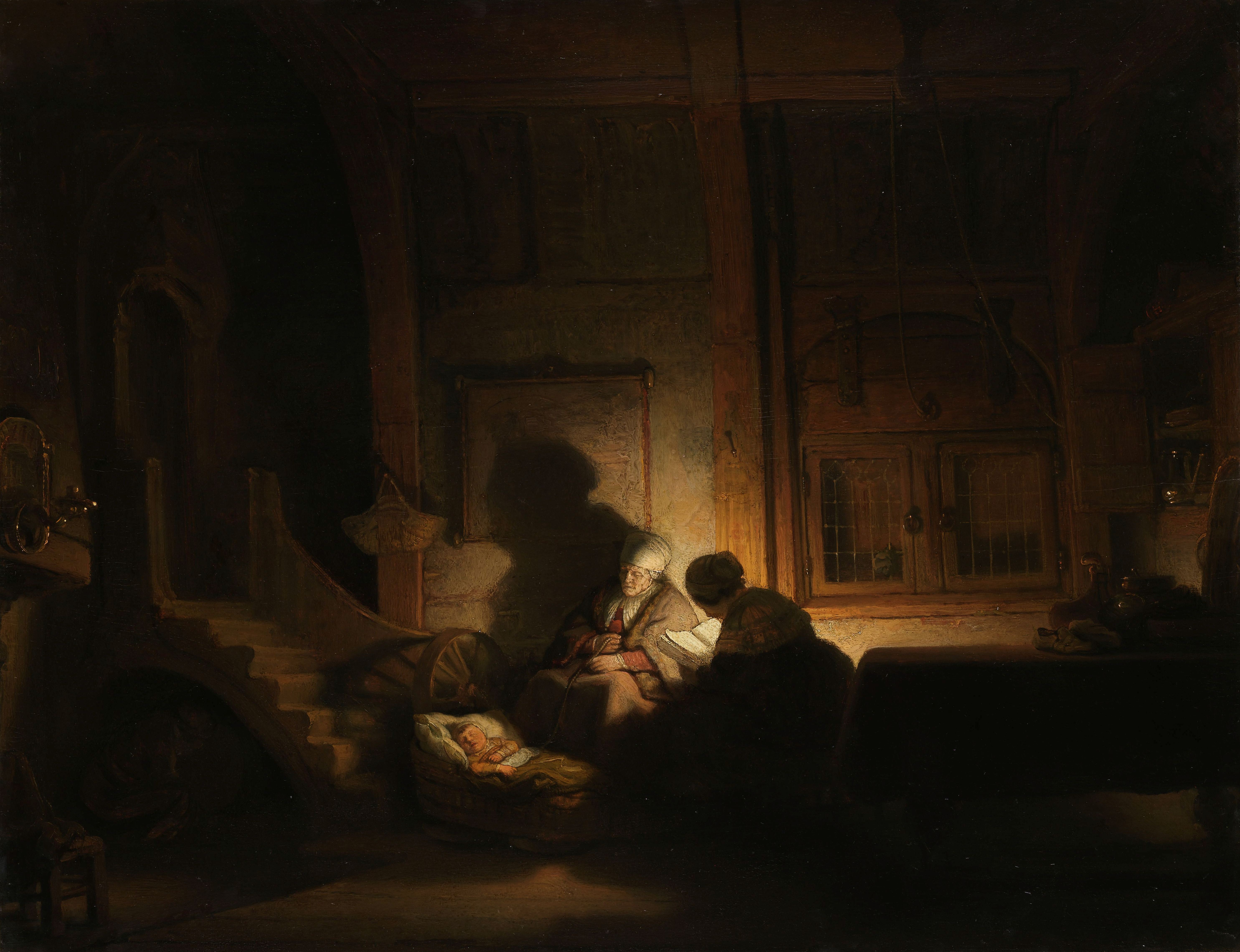
Workshop of Rembrandt van Rijn, Holy Family at Night, ca. 1642–48. Oil on panel, 66.5 × 78 cm. Rijksmuseum, Amsterdam.
During the Dutch Golden Age, the master artist Rembrandt van Rijn (1606–1669) ran a flourishing workshop in Amsterdam, overseeing the production of students’ paintings that continued the deep chiaroscuro and distinctive application of paint seen in his own work.
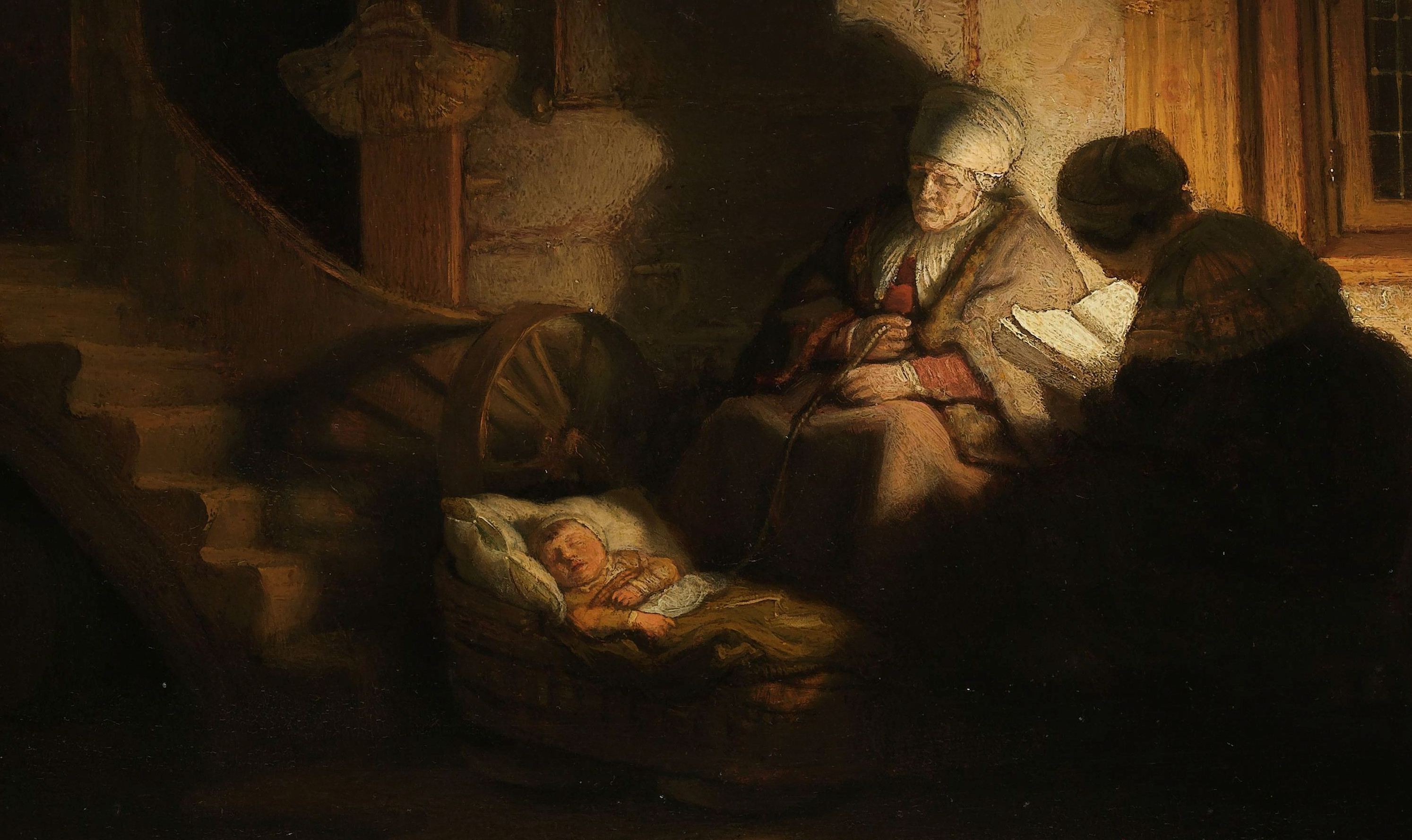
This painting from his workshop shows the Holy Family in a sparsely lit domestic interior at night. The Christ child lies asleep in a wicker cradle at the foot of a half staircase, his grandma Anne likewise nodding off as she rocks him gently with the cradle rope. Relieved by the quiet, Jesus’s mom, Mary, catches up on some reading, and Joseph taps liquid from a barrel on the left under the stairs (he’s very difficult to make out through the shadows).
This lived-in room is full of everyday objects from seventeenth-century Holland. Over the hearth on the left a copper candlestick holder is affixed to the wall. Behind Anne is a map, and beside her a spinning wheel, and a wicker basket hangs from the nail of a curved wooden beam. On the table to the right are a pair of old shoes, a flask attached to a leather belt, and a mortar and pestle, and a Jan Steen jug and other kitchenware are stored in the cupboard above. The shutters are drawn closed over the window. How utterly ordinary!
Although scholarly opinion since 1900 has identified the figures as biblical ones (the title is not the artist’s, as artists did not title their paintings at the time), for much of the painting’s history viewers interpreted it as simply a genre scene—that is, a scene showing regular people going about their daily lives. It lacks the “distinction, nobility, and loftiness” owed to biblical subject matter, it was believed, especially the Holy Family. There are no angels, no haloes. The only hint of sacredness is the pouring of light from a mysterious unknown source.
But the ordinariness of the scene depicted is precisely what makes it so glorious. Jesus was born into a working-class family. For most of his life he labored as a carpenter, adopting Joseph’s trade. He wasn’t surrounded by lavish things. His upbringing looked much like that of all the other Jewish boys in Nazareth. That he was God incarnate would be revealed in time, to those who had eyes to see. But in the meantime, he cooed and pooed and cried and slept and fed and spit up like any other baby! And his mom was exhausted like any other mom, forced to sneak in some time for herself (including private devotional time, as she’s probably reading her Bible here) wherever she could, between childcare, chores, and other obligations.
That God chose to come to us as an ordinary human being born to an ordinary family (albeit conceived in an extraordinary way!) surprised everyone. The song that follows extends the surprise of the Incarnation into God’s other interventions in our lives, on a more personal scale. Just as he defied expectations in his first coming, so he often continues to surprise us in the ways he comes to us now—that is, not according to our own prescriptions, but down his “own secret stair,” when and where we’re least expecting it.
LISTEN: “That Holy Thing” | Words by George MacDonald, 1877 | Music by Katy Wehr, on In Others’ Words, 2008
They all were looking for a king, To slay their foes, and lift them high: Thou cam’st a little baby thing That made a woman cry.
O Son of Man, to right my lot Naught but thy presence can avail; Yet on the road thy wheels are not, Nor on the sea thy sail.
My how or when thou wilt not heed, But come down thine own secret stair, That thou mayst answer all my need, Yea, every bygone prayer.
This song is a setting of a poem written by George MacDonald (1824–1905) in December 1877 and sent by letter to a handful of friends.* When it was first published in 1893 in the two-volume Poetical Works of George MacDonald, it was with this revised final stanza:
My fancied ways why shouldst thou heed? Thou com’st down thine own secret stair; Com’st down to answer all my need, Yea, every bygone prayer!
The poem appears in the highly influential Oxford Book of English Verse (1900), compiled and edited by Arthur Quiller-Couch, but in its original form.
“That holy thing” is a translation of the Greek word hagios, which appears in Gabriel’s speech to Mary in Luke 1:35: “that holy thing which shall be born of thee shall be called the Son of God.” Educator Missy Andrews unpacks the poem:
In “That Holy Thing,” MacDonald meditates on man’s expectations and God’s will. In the first line of the poem, the poet remembers the first-century Jews who suffered under Roman occupation, waiting for the Messiah who would restore the throne of David to Israel. He acknowledges their plight and their expectation, contrasting it with what they in fact received. The baby Christ represented both a gracious answer to their need, and an immediate disappointment. He satisfied the deepest intentions of their prayer and Yahweh’s ancient prophecies, but frustrated their earthy expectations for geographic kingdoms and vindication. Not only that, but the baby King “made a woman cry.” This references not only the immediate suffering and travail of the Christ Child’s mother, Mary, but ultimately the suffering that would rend her heart when He himself was lifted high upon the cross in answer to their desperate prayer for triumph over their foes.
The poet notes that his own travails and petitions, his own desperate need of God’s intervening help, is denied in its immediacy as well. For, although the Son of Man’s own presence alone can help to “right the lot” of the poet, his coming is not visible by road or sea. In this way, MacDonald acknowledges that his own expectations, like those of his spiritual forebears, eclipse his ability to see the Lord’s coming in his own circumstances. He acknowledges the differences between God’s ways and man’s, in faith acknowledging that the Lord answers man in his own ways and times, keeping secret His approach, but stealthily accomplishing man’s every need, answering his every prayer through the mystery of incarnation. This incarnate Child, the Son of Man, replete with humanity and no stranger to suffering, suggests a remedy for all who wait and suffer.
Andrews is a founding director of CenterForLit, whose goal is “to bring readers face to face with the world’s best books so they can know themselves more fully as God’s creatures.” The center has a special emphasis on equipping parents to teach the classics to their kids.
The commentary above is excerpted, with Andrews’s permission, from the first post of twenty-five published in Advent 2015 for the CenterForLit’s “Literary Advent” blog series (which is excellent!). Andrews provides interpretations of poems by John Donne, Madeleine L’Engle, Gerard Manley Hopkins, T. S. Eliot, W. H. Auden, and more, combining literary analysis and theological reflection. You can enjoy Andrews’s series in print form with the book Wild Bells: A Literary Advent.
Kathryn Wehr, PhD, is a singer-songwriter whose most recent album, which leans folk rock in style, is And All the Marys: Women Encountering Christ in the Gospels (2018).
Besides being a musical artist, Wehr is also a scholar whose interests include theology and the arts, spiritual formation, and church history. Her specialization is the religious drama of Dorothy L. Sayers, and as such, she is the editor of the forthcoming book The Man Born to be King, Wade Annotated Edition(IVP Academic, 2023). In addition, she is the managing editor of Logos: A Journal of Catholic Thought and Culture at the Center for Catholic Studies at the University of St. Thomas in Saint Paul, Minnesota.
* Thank you to the Special Collections & University Archives at Taylor University, through whose British Author Collections I discovered this earlier composition date for the poem, as well as an authoritative version of stanza 3 from MacDonald’s own hand. They provided me with a scan of one of MacDonald’s handwritten copies of “That Holy Thing” (Ref. ID 482), which contains the headnote “Written for my friends—Christmas, 1877.”
Wassily Kandinsky (Russian, 1866–1944), Three Sounds, 1926. Oil on canvas, 23 5/8 × 23 1/2 in. Solomon R. Guggenheim Museum, New York.
the silent stars descend to us
come angel seraph sheep pear-tree

o holy o cold
dawn come in snow

offspring of day
light is lily above us

glory birds, calling birds
sun, the fields shining

the day, the earth, skies
peace, contemplation and music

hosanna, no, holly stand
suddenly tree displayed

the yonder star our comfort
bring time again

joy, excelsis a-leaping
world and hope embrace

lullay image and sing sing
a happy new begin
“seasonal ghazal” by Harry Gilonis appears in the chapbook The Twelve Poems of Christmas, vol. 3, ed. Carol Ann Duffy (Candlestick Press, 2011), and in Haphazard by Starlight: A Poem a Day from Advent to Epiphany by Janet Morley (SPCK, 2013). Used by permission of Harry Gilonis.
A ghazal is a traditional Arabic verse-form originating in seventh-century Arabia and spreading in the medieval era into Africa, Spain, Persia, South Asia, and Turkey, where it has continued to develop. It is made up of five to fifteen self-contained couplets connected loosely by mood or theme, however allusive. The poet Agha Shahid Ali compares each ghazal couplet to “a stone from a necklace” that should continue to “shine in that vivid isolation.”
Harry Gilonis’s “seasonal ghazal” doesn’t adhere to all the principles of the classic form (which involve rhyme and refrain), but it does give us autonomous couplets of roughly equal length that unfold without linearity, and these all center on the twinned seasons of Advent and Christmastide. Gilonis composed the poem using a cut-up technique, in which he printed out pages’ worth of sacred and secular English carol texts, excised words or short phrases that stood out to him, and rearranged those excised fragments into varying combinations, creating a medley of seasonal keywords that strikes a new chord.
By separating the words from their original syntactic contexts and collaging them together in new ways, he defamiliarizes and thus revivifies them. Traditional elements of the Christmas story are playfully refreshed.
The poem captures the magic and wonder of the season and a hint of its yearning and lament. For example, the exultant excelsis, Latin for “highest,” from the angels’ song to the shepherds is followed one stanza later by lullay, an archaic word used to soothe children to sleep and voiced in the “Coventry Carol” by mothers of ancient Bethlehem who lullaby into eternal rest their infant sons who are about to be slain by Herod. Elevated choral anthems contrasted with deep, mournful groans. Christmastide is full of “light” and “glory,” but there’s also “cold.”
The line “world and hope embrace” is particularly compelling—a picture of hope throwing its arms around a weary and skeptical world, and the world hugging back.
Because of the poem’s fragmentary nature, the grammatical mood of some of the verbs can’t be definitively discerned, but I read the following, in addition to the Hebrew-derived “hosanna” (“save us, please!”), as imperatives addressed to God: “descend,” “come,” “bring,” and the final word, open and expansive, “begin”—a curtailment of the noun “beginning.”
Jesus’s birth was a new and universal beginning. Can you hear echoes of Isaiah?: “See, I am doing a new thing! Now it springs up; do you not perceive it?” (Isa. 43:19a NIV). Many Christians see in this Hebrew Bible passage the promise of a messianic kingdom inaugurated by Jesus’s birth but not yet brought to completion. The speaker of “seasonal ghazal” seems to recognize the salvation project that’s in motion but longs for “the day” of the Lord, “the earth, skies” reunited. “Begin,” he beckons. Bring in the new era.
What word combinations in this poem stick out to you? What meaning(s) do you see?
William L. Hawkins (American, 1895–1990), Nativity Scene, 1987. Oil on canvas, 48 × 48 in. Newark Museum of Art, Newark, New Jersey.
1.“Remembering that it happened once”by Wendell Berry: For the last forty-plus years, Kentucky farmer Wendell Berry has been writing what he calls “Sabbath poems,” which emerge from his spiritual practice of walking outdoors on Sundays without any to-do’s. “I go free from the tasks and intentions of my workdays,” he says, “and so my mind becomes hospitable to unintended thoughts: to what I am very willing to call inspiration.” This Sabbath poem from 1986 explores how the sacred permeates the mundane and how Christ is, in a sense, always being born. For an SATB choral setting by Doug Brandt, see here.
Source: A Timbered Choir: The Sabbath Poems 1979–1997 (Washington, DC: Counterpoint, 1998); compiled in This Day: Collected and New Sabbath Poems (Washington, DC: Counterpoint, 2014)
2.“BC:AD” by U. A. Fanthorpe: Ursula Askham Fanthorpe (1929–2009), CBE, FRSL, was an English poet who is well loved by both critics and the general public. She was also a practicing Quaker. Each year she wrote a new Christmas poem to send to friends, of which “BC:AD” is the best known. It considers Jesus’s birth as the pivotal point in history, dividing time into epochs, into “before” and “after.” At this nativity, kairos invaded chronos—and we’re still singing about it millennia later.
3.“Making the House Ready for the Lord”by Mary Oliver: For many of us who succumb to cultural pressures, December is a time of rushing around, making sure the house is decorated like a magazine, the Christmas cards sent out, the cookies baked to perfection, the gifts individually selected and bought and wrapped. But in all this flurry of activity, are we missing “the better part” (Luke 10:42)? The speaker of this poem, Martha-like, is busy making preparations for Jesus, who’s coming to visit, but as she’s cleaning, outdoor critters keep popping in. At first she bemoans their presence—they’re not on the guest list!—but eventually she comes to accept, even welcome, them, surrendering her fussy desire for orderliness to a charitable embrace of whatever is. And on another level, this poem is about how all of creation longs for Christ (Rom. 8:19–22); the animals, too, want to see him, want to join the party.
5.“Second Advent”by Anya Krugovoy Silver: Memorializing a friend (Ishiuan Hargrove) who died of metastatic brain tumors, “Second Advent” unsettlingly combines stark hospital-room and anatomical language with language that is soft, gentle, lyrical. Recounting one of Ishiuan’s several neurosurgeries, the poet remarks how her head was nimbed by surgical lights and then swaddled in gauze. The title refers to Ishiuan’s waking up on the second Sunday of Advent, but also to the hope of Christ’s second coming, when pain, disease, and sorrow will be done away with. Anya Silver was herself a cancer patient, an experience she wrote much about in her four volumes of poetry, before dying of breast cancer in 2018.
Source: Second Bloom (Eugene, OR: Cascade Books, 2017)
6.“The Nativity”by Henry Vaughan: “Peace!” rang the angels’ song the night of Christ’s birth—and yet what irony, that he who came to bring peace was himself no beneficiary of it in this life, being born among animals in a borrowed stable, then made a refugee, then later disbelieved, betrayed, mocked, tortured, and crucified. The darkness that bred such unwelcome of the Son of God still persists—violence, ignorance. Referencing the Genesis 1 creation narrative as well as the journey of the magi, the poem ends with an invocation for God’s light to manifest once again, leading us to Christ.
Source: Thalia Redivina: The Pass-Times and Diversions of a Countrey-Muse (London: Robert Pawlet, 1678). Public Domain.
7. [little tree] by E. E. Cummings: One of E. E. Cummings’s earliest published poems (it came out in the January 1920 issue of The Dial), “little tree” was intended to appear as one of five “chansons innocentes” in Cummings’s first book of verse, Tulips and Chimneys, but his editor, Thomas Seltzer, cut it (along with sixty-five others!). In it a young child consoles a recently felled evergreen tree—enlisted for the holiday festivities—with promises of glory and love. Though it runs the danger of being read as twee, Cummings remained fond of the poem and even had it printed and sent it as his family Christmas card in 1960, two years before he died.
8. “Messiah (Christmas Portions)”by Mark Doty: The speaker of this poem is unexpectedly transported by a local community choir performance of Handel’s Messiah. He marvels at how these ordinary, flawed neighbors of his can produce such beauty with their collective voices. The last line is probably a reference to the accompagnato and air sung by the bass toward the end of the oratorio, taken from 1 Corinthians 15:51–54—about how we will all be changed in a moment at the last trump, and the corruptible will put on incorruption.
9. “What the Body Knows” by Jean Janzen: The anonymous scribes and illuminators of the Book of Kells spent countless hours copying and beautifying God’s word amid Viking raids. In this ekphrastic poem, Jean Janzen reflects on the Gospel-book’s five whimsically painted folios of Luke’s genealogy of Christ, commenting on the continual inbreaking of God into our world and the “wild safety” of God’s love.
10.“Confession”by Leila Chatti: The Tunisian American poet Leila Chatti was raised by a Muslim father and a Roman Catholic mother, and both religious traditions have shaped her faith and her writing. Islam and Christianity hold many sacred figures in common, including Mary (Maryam), whose conception and delivery of Jesus (Isa) are narrated in the Quran 19:16–34. Chatti confesses to being more compelled by the Islamic characterization of Mary as grunting and sweating in the pangs of labor (in contrast to Catholic teaching, which says her birthing experience was effortless, her contractions painless, though the Bible itself doesn’t specify). Chatti finds comfort in picturing Mary not as someone exempt from the effects of the fall and set apart on a pedestal of supreme virtue, but as one who suffered the same physical and emotional toll as other childbearing women—and who probably did have the occasional selfish thought, which, in moments of intensity and vulnerability, she deigned to vocalize!
11. “Two Carols”by Evelyn Underhill: An English Anglo-Catholic writer and mystic, Evelyn Underhill meditates in this double poem on how Christ set foot on the long, hard road we travel to be a balm for our wounds and those of the earth. The epigraph to part 1 is from the Latin Vulgate of Song of Solomon 2:12: “The flowers appear on the earth.” What follows are several Catholic titles for Mary: rose without thorn, queen, generatrix. The epigraph to part 2 is a quotation of Romans 8:22: “The whole creation groaneth and travaileth in pain together until now.” The refrain, Dominus tecum!, translates to “The Lord is with you!,” words spoken by the angel Gabriel to Mary and, by virtue of the Incarnation, to all humanity. The other Latin phrases translate to “He who is in the heavens,” “A King is born,” and “Let the kingdom come!” Adveniat regnum!
Source: Immanence: A Book of Verses (London: J. M. Dent, 1912). Public Domain.
12. “The Christmas Babe”by Fr. John Banister Tabb: Written by a Catholic priest from Virginia, this simple quatrain marvels at the paradox of God’s simultaneous largeness and smallness.
Source: Poems (London: John Lane, 1894). Public Domain.
13.“Snowflakes” by Jennifer Grotz: When the world is viewed through a sacramental lens, we recognize God in commonplace wonders like falling snow, and such things can be a sort of wordless prayer that we offer back to God through our enjoyment of them.
14. [The Savior must have been a docile Gentleman]by Emily Dickinson: In these two compact stanzas, Dickinson reflects on how kind Jesus was (an understatement!) to have made the far journey to Bethlehem, “a rugged billion Miles” from heaven, especially in the cold month of December, all “for little Fellowmen.” She refers to him as “docile”—obedient, submissive—harking to Philippians 2, to his yielding to the will of the Father in the Incarnation, taking on human limitations, suffering, and death for the life of the world.
15.[Wilt thou love God, as he thee? Then digest](Holy Sonnet No. 15) by John Donne: A self-address to the soul, this poem by the English poet-priest John Donne, first published in 1633, two years after this death, celebrates the Triune God’s salvific workings: we’re adopted by the Father, redeemed by the Son, indwelt and regenerated by the Spirit. The closing couplet, referencing the imago Dei, packs a wallop: “’Twas much, that man was made like God before, / But, that God should be made like man, much more.”
Source: Poems (London: M.F. [Miles Fletcher], 1633). Public Domain.
16. “The Little Towns of Bethlehem”by John Terpstra: All over Canada, Christ is being reborn this Christmas, in the sense that the Story has taken root, is retold, and continues to have impact. The speaker imagines the Christ child “wrapped in cast-off flannel” in a boxcar stopped on the tracks in Esther, Alberta, or feeding at his mother’s breast in a broken-down car on the shoulder of a road in Englehart, Ontario—actual sights that one might encounter today. Localizing the Story can help us to see it afresh, and to see the sacred humanity of families experiencing homelessness or other hardships.
17. “Song of the Shepherds” by Richard Bauckham: Richard Bauckham, FRSE, FBA, is best known as a biblical scholar—he’s one of today’s tops, in fact—but he also writes poetry! (I featured one of his poems last year.) In this poem, the shepherds on Bethlehem’s hillsides recall an ancient tale about the stars singing at the creation of the universe, which they thought merely a poetic embellishment, until they experienced something of the like for themselves: “a song of solar glory” eclipsing the lesser lights and exorcising the dark, creating the world anew. Unforgettable.
18. “Those Magi”by Kathleen O’Toole: What exactly were the magi seeking? What compelled them to leave their treasure behind in that cattle shed? Whence their strength to defy Herod? Besides musing on these questions, the poem also contains a passing metaphor that I found striking and new: cow breath as incense.
19. “Carol of the Brown King”by Langston Hughes: Tradition names one of the wise men who visited the Christ child “Balthazar” and says he’s from Africa. Langston Hughes, a preeminent poet of the Harlem Renaissance, exults that there was “one dark like me—part of His Nativity.” This poem is included in Hughes’s musical play Black Nativity and is one of six Nativity poems by Hughes that make up a children’s book illustrated by Ashley Bryan.
20. “Mosaic of the Nativity: Serbia, Winter, 1993”by Jane Kenyon: I couldn’t find the particular church mosaic program that Kenyon is writing about, but here’s my interpretation. Set inside a Serbian Orthodox church during the Bosnian War, this poem imagines a mosaic of Christ Pantocrator hovering in the dome, lamenting the violence that goes on beneath. Under the gaze of the I AM is another mosaic, portraying Jesus’s birth, but also, in a way, Mary’s, as she herself is being reborn in Christ, her mind increasingly shaped in accordance to his. Nativity icons often show Mary framed by a red blanket that she’s reclining on at the mouth of a cave, which Kenyon reads as embryonic.
21. “Breath” by Luci Shaw: This poem reflects on the contraction of the infinite God who breathed the universe into existence into a finite human being needing oxygen, who, as is foreshadowed at his birth, will finally ex-pire (“breathe out” his last) on a cross before entering his “next dark cave,” a prelude to resurrection.
22.“Mary’s Vision”from medieval Ireland: Mary foresees the future suffering of her infant son and dialogues with him about it in this poem translated from Middle Irish by Eleanor Hull (the same woman whose versification of a medieval Irish lorica, working from a translation by Mary Elizabeth Byrne, gave us the hymn “Be Thou My Vision”!).
Source: The Poem-Book of the Gael (London: Chatto & Windus, 1912). Public Domain.
23.“Joseph at the Nativity”by Tania Runyan: Staring at the “shriveled pod” that Mary just birthed, Joseph grapples with his complicated feelings—doubt, embarrassment, jealousy, helplessness, confusion, pride—and with figuring out what role he should play in the life of this child going forward.
24.“Waiting in Line After Christmas”by Sharron Singleton: (Scroll down to fourth poem) Rather than exchanges of refunded money for unwanted items, Singleton ponders what a mutually life-giving exchange of intangibles might look like.
25. “Burning the Old Year”by Naomi Shihab Nye: Through the act of forgetting, we must destroy the worthless trivialities of the year, and we must let that which is solid, that which matters—the “stones”—be revealed and remain.
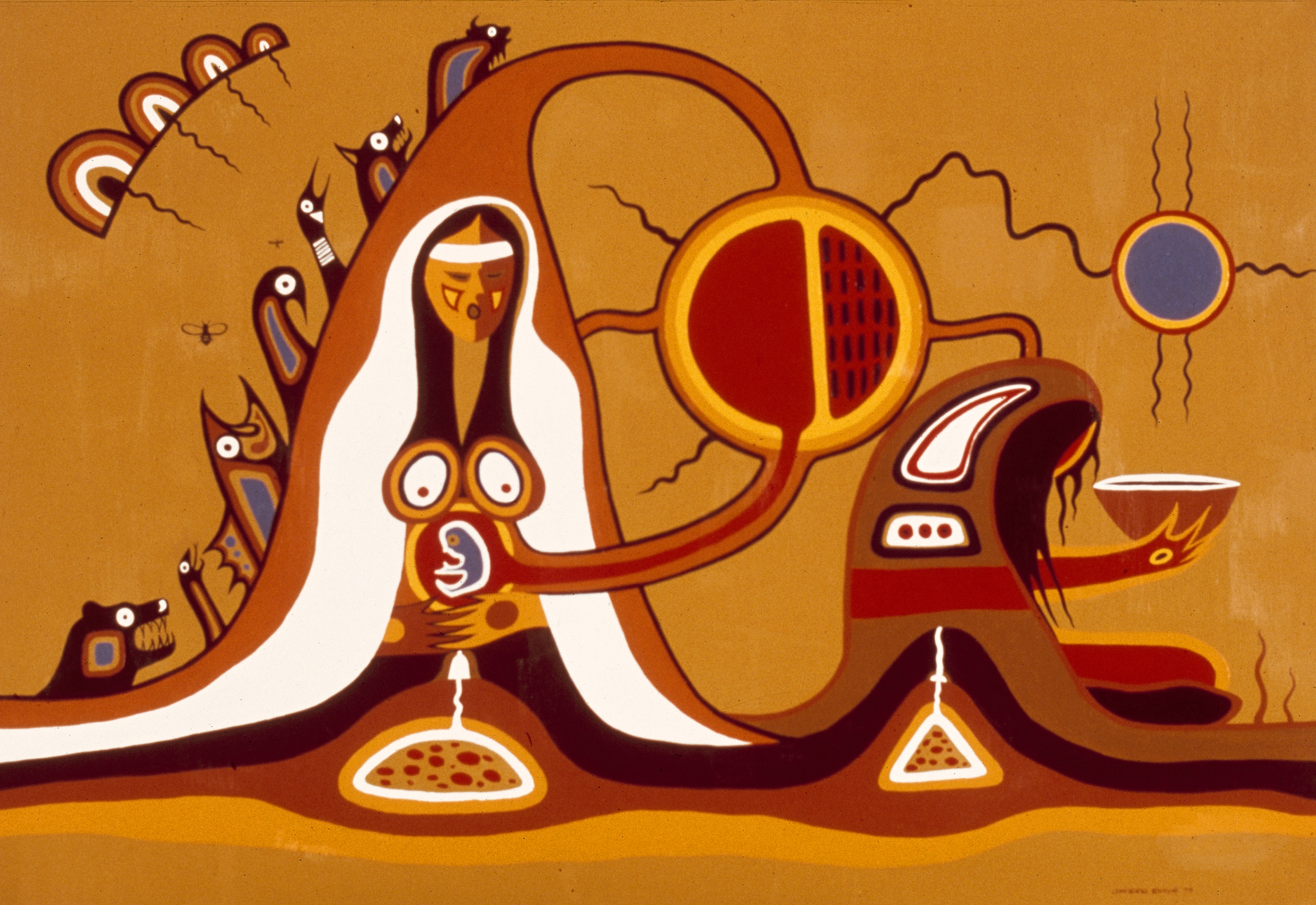
Jackson Beardy (1944–1984) was an Anishinaabe artist born on the Garden Hill Reserve in Manitoba. He belonged to the Woodland school of art [previously], adopting its distinctive style of Indigenous expression characterized by thick black outlines and vivid, compartmentalized color. His paintings draw on Ojibwe and Cree oral traditions and often express cosmological and spiritual concepts.
Beardy is one of twenty Canadian artists commissioned by the Canadian Conference of Catholic Bishops in 1975 to convey the Christian message using whatever idiom they wished. Beardy chose to portray the Virgin Mary pregnant with the Word, the sun’s fire pouring into her and yet she is not consumed. He provided the following artist’s statement:
It is my personal belief that a messenger from the Great Spirit came to earth in the form of His image after Him through a virgin birth in unrecorded history. Through this man, knowledge was passed on to man from the Great Spirit. Many of the teachings of this man have been kept by word of mouth through the ages by the elders of all tribes.
We see the virgin mother-to-be holding on to an embryo connected to the sun symbol (the Great Spirit) [center] who has deemed it necessary to send his messenger to his people. The mother is also connected to Mother Earth, who is nursing her [see the breast shape below]. She too is connected by a lifeline to the sun symbol. Around her are all the orders of creatures who come to see the messenger. He is born to explain their existence, [to restore] harmony between humanity and the elements, physically, mentally, and spiritually.
On the other side of the sun symbol we see an elder in prayer, ritually offering a bowl filled with sacred things. You can see the sun symbol is resting on his hunched frame, bearing him down with doubts, fear, depression, and all the ills of his time, his back to the very miracle he is praying for. It will take time for all to fully comprehend this phenomenon which has come to pass.
The four semicircles represent the elements of the air: snow, rain, tornadoes, heat. The moon [the blue circle] is painted above the elder. We regard the moon as our Grandmother who keeps vigil over all creatures during the night.
Though titled The Nativity, the painting is actually a prebirth scene, as Jesus is still in utero. Beardy shows the Christ child taking root in Mary’s womb (having been conceived by the power of the Great Spirit) and growing to full term as people and animals alike long for his arrival. They groan, they watch, they wrestle and seek. Creator Sets Free—as the First Nations Version of the New Testament translates the name Jesus—is almost here.
(Note: There’s a flipped version of this image floating around online. I confirmed with the CCCB that the file posted here, which I licensed directly from them, represents the correct orientation.)
Leaning into that Advent yearning, here is a performance of “O Come, O Come, Emmanuel” in Ojibwe—“Ondaas, Ondaas, Emaanooyen”—performed by E Halverson:
Now, I have a crowdsourcing request: I am searching for Advent or Christmas songs originally written in Indigenous Canadian or Native American languages, preferably by an Indigenous person. If you know of any, please let me know in the comments below, or in an email. Thanks!
The season of Advent begins Sunday, November 27, this year and is followed by the Twelve Days of Christmas, culminating on Epiphany, January 6. During these six weeks I will be publishing daily posts, each centered on a visual artwork and a piece of music that I hope will promote contemplation and prayer around the seasons’ themes, around the narrative of Christ’s coming. If you’d like to receive these posts in your inbox, enter your email address on the Subscribe page. This will subscribe you to the blog as a whole, but you can always unsubscribe afterward if you want to stick around for just this one series.
Some people erroneously consider Advent to be simply an extension of Christmas. Not so! The two seasons are, of course, related, but Advent is a four-week period that focuses not just on Christ’s first coming and the signposts leading up to it, but also his second, as well as his coming, as Spirit, into our hearts, lives, and communities. It is an opportunity for us to lean into the deep longing we feel for God’s presence.
“Advent is a season of hope,” writes the Rev. Tish Harrison Warren, “and part of practicing hope is noticing where we need it”—so many of the Advent selections have a tone of lament. But still others are celebratory, marked by a joyful anticipation of the new dawn and all that it will usher in.
Included in this year’s edition of the Advent-Christmas series are a community art project in Lima; a jazz setting of a poem by Malcolm Guite, plus settings of Emily Dickinson and George MacDonald; ancient hymns from Prudentius of Spain and Ephrem of Syria; an antiphon by Hildegard of Bingen that references Mary as the New Eve; a light installation in an abandoned warehouse in Malaysia; a South African Nativity linocut with native wildlife; a Chinese watercolor on silk of the Annunciation to the Shepherds; a parable-inspired spiritual with roots in Jamaica; an acoustic-folk adaptation of Hannah’s song, a likely influence on Mary’s Magnificat; and more. The assurance that “All shall be well,” popularized by Julian of Norwich, bookends the series.
Oh, and there will be a “prelude” post on November 26.
Bridegrooms and oil lamps, clouds and snowdrifts, trumpets and butterflies, rivers and stairs—these are some of the images, verbal and/or visual, that we’ll encounter as we journey from Genesis to Revelation, from humanity’s fall and God’s covenant with Abraham to the incarnation of the promised Savior to the new heavens and the new earth, where that Savior reigns in love over all the redeemed.
Many of the songs will be drawn from my two Spotify playlists:
I look forward to walking with you all through this wonder-full, ancient, ongoing Story that enfolds us.
—Victoria
P.S. Want a better sense of what to expect before sharing or subscribing? You can peruse last year’s posts here and here.
I am committed to making all Art & Theology content free for everyone, but that means my income takes a hit. I have been working on this series since August, saying no to some paid freelance offers to make it happen. If you find the posts meaningful and it is within your means, would you please consider donating whatever amount you feel the product is worth? (You can use the form below, or PayPal.) I will also include a donation link at the bottom of the final post, if you’d rather wait and decide then. Thank you!
WEBSITE LAUNCH: The Foundation for Spirituality and the Arts: From a September 20 press release: “The Foundation for Spirituality and the Arts is pleased to announce the debut of our new website, fsa.art. Complementing in-person programming in Charleston and New York City, fsa.art functions as FSA’s online curatorial wing. It hosts both commissioned and curated content as well as a selection of features spotlighting significant artists, scholars, exhibitions, and publications from recent decades. We hope this site will be a valuable and inspiring resource that fosters dialogue, community, and innovation in the field of spirituality and the arts.”
FSA is “devoted to nurturing connections between spirituality and contemporary art. . . . By encouraging a mutual flow of creativity and faith from both artists and scholars, we hope to initiate fresh channels of spiritual enrichment from new depths of artistic expression. Nurturing innovative and experimental collaborations between a wide range of communities, we aspire to integrate estranged voices together in a spirit of harmony, openness, and inquisitiveness.”
At the heart of their programming is their annual series of residencies, open to visual artists, performers, composers, choreographers, curators, writers, and theologians. Visit their website to find out more, and follow them on Instagram @foundation.spirituality.arts. Below are four artworks I’ve encountered through their social media postings.
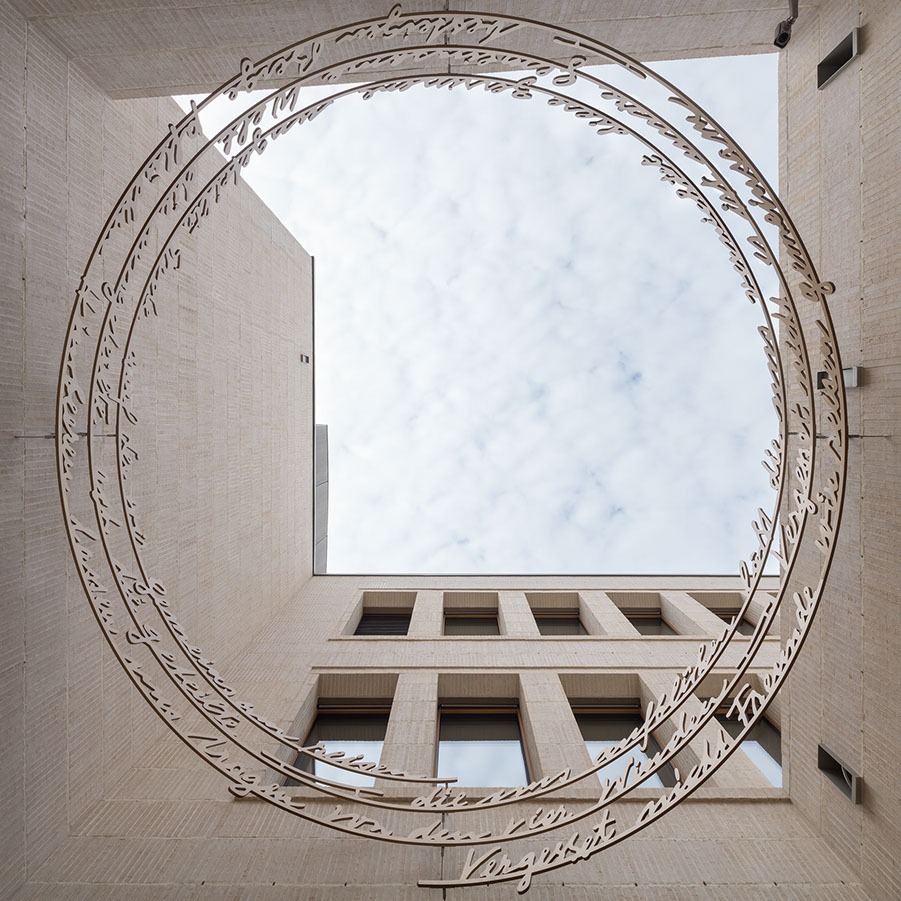
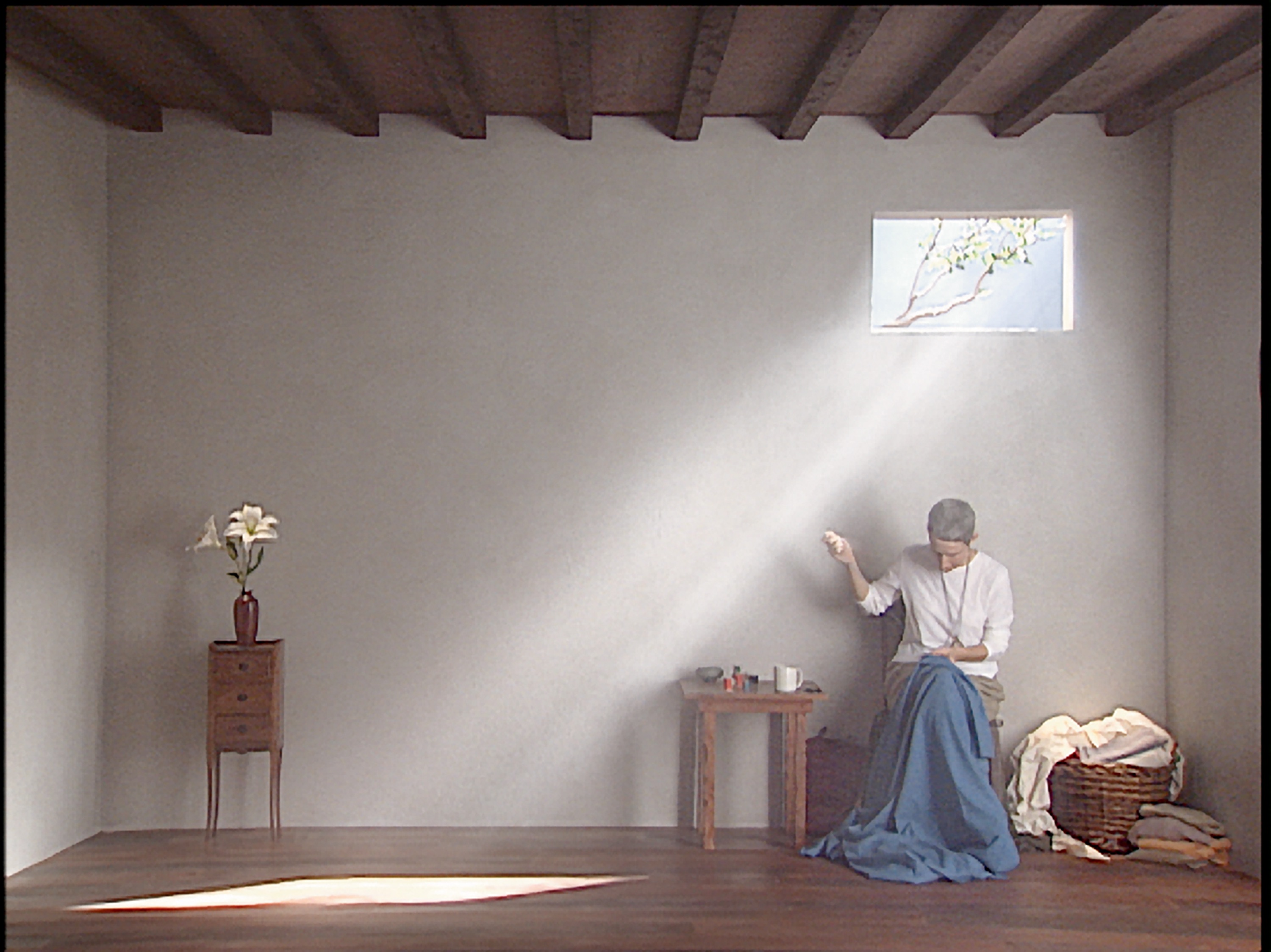
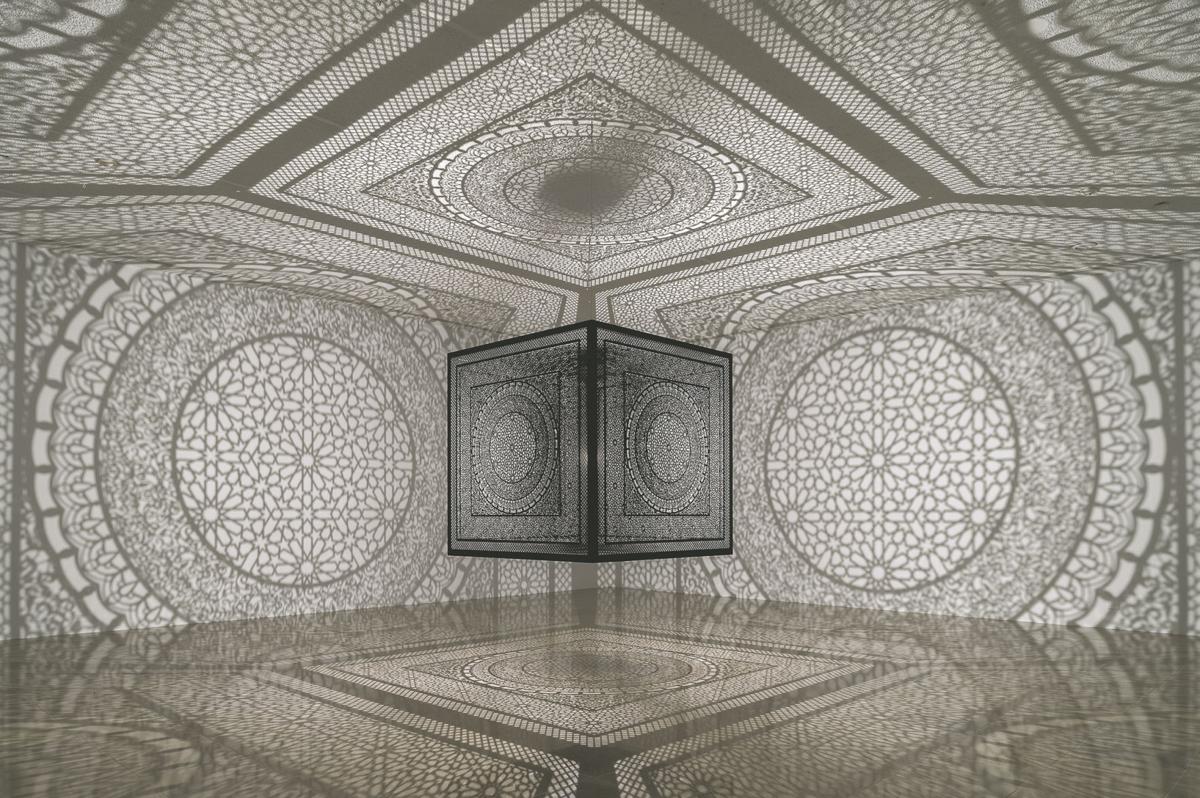
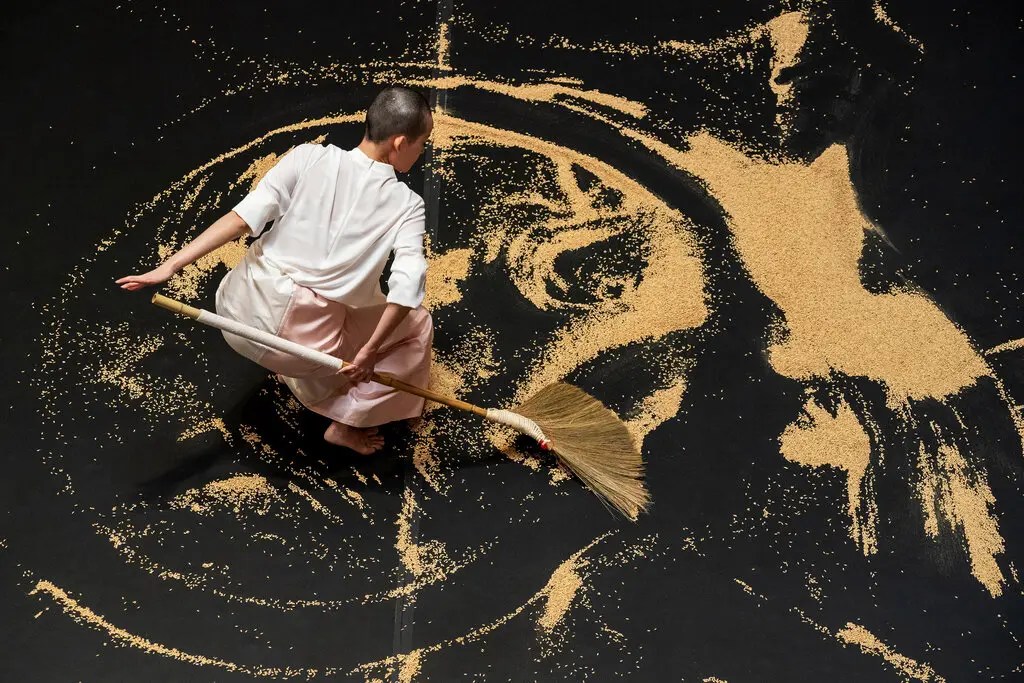
Tom Kristen (German, 1968–), Gemeinsam (Together), 2019. Jewish Synagogue and Community Center, Regensburg, Bavaria. Photo: Marcus Eben. Floating above the center’s atrium, this gilded bronze spiral text is taken from Rose Ausländer’s poem “Gemeinsam”: “Vergesst nicht, Freunde, wir reisen gemeinsam. . . . Es ist unsre gemeinsame Welt.” (“Don’t forget, friends: we travel together. . . . It is our common world.”)Bill Viola (American, 1951–), Still from Catherine’s Room, 2001. Color video polyptych on five flat panel displays, 18:39 minutes, performer: Weba Garretson. Photo: Kira Perov, courtesy Bill Viola Studio.Anila Quayyum Agha (Pakistani American, 1965–), Intersections, 2013. Lacquered wood and halogen bulb, 78 × 78 × 78 in. (cast shadows: 43.5 × 43.5 × 16 ft.). Installation view at Rice Gallery, Houston, Texas, 2015.Lee Mingwei (Taiwanese American, 1964–), Our Labyrinth, 2015–present. Photo: Stephanie Berger. In this performance work, single dancers, dressed in floor-length sarongs and wearing ankle bells, take turns sweeping a mound of rice in patterns on the floor in a designated gallery space. This iteration from 2020 at the Metropolitan Museum of Art was a collaboration with choreographer Bill T. Jones, and the performer in the photo is I-Ling Liu. [Watch on YouTube]
+++
LECTURE: “The New Visibility of Religion in Contemporary Art” by Jonathan A. Anderson: Religion is becoming more visible in contemporary art and more discussable, says artist, art critic, and theologian Jonathan Anderson in his September 17 talk sponsored by Bridge Projects in Los Angeles. Danh Vo, Kris Martin, Andrea Büttner, Deana Lawson, Arthur Jafa, Genesis Tramaine, Hossein Valamanesh, Theaster Gates, Zarah Hussain, Francis Alÿs, Louise Bourgeois, Sol LeWitt, Sean Kelly, Gerhard Richter, James Turrell—these are just some of the many contemporary artists who have engaged substantively with religion in their work, either through form or content or through the ways in which they frame the work’s central questions. Curators and art historians are recognizing this more and more, and it’s being reflected in exhibitions and scholarship. Anderson highlights several such instances from the past two decades, celebrating religion’s increased visibility but also pointing out where there’s room for improvement. The talk starts at 6:36:
At 28:58, Anderson outlines four interpretive horizons, or fundamental hermeneutics, within which religion is becoming visible, intelligible, and meaningful in contemporary art: anthropological (31:00), political (37:43), spiritual (42:51), and theological (48:42). He discusses the problems and possibilities of each—ways in which it has been productive or insightful, and ways in which it’s limiting. The fourth horizon, the theological, is the least developed in the art world and the most contested, he says.
He concludes,
A more concentrated and well-developed mode of theological inquiry has much to contribute to the history, theory, and criticism of contemporary art without being reductive, but instead opening much of what’s going on in contemporary art. And so going forward, I do envision a mode of study that keeps all these horizons in view, and a mode of discourse that keeps all these horizons in view, while especially developing the potential for the modes of critical writing capable of addressing theological conceptualities, genealogies, and implications that are in play in so much of the art being made today. And that involves thinking better from both directions, developing concepts and capacities—skills, really—where art criticism might operate with a more agile, historically sensitive understanding of religion and theology (a richer theological intelligence), and theology might operate with a more agile, historically sensitive understanding of art and criticism (a richer art historical intelligence, or visual intelligence).
The last half hour is Q&A. What he says at 1:03:59 is fascinating! If you enjoyed this talk, check out, too, the one he gave ten years ago, “The (In)visibility of Theology in Contemporary Art Criticism,” which I published detailed notes on and which became a chapter in the book Christian Scholarship in the Twenty-First Century: Prospects and Perils, edited by Thomas M. Crisp, Steve L. Porter, and Gregg A. Ten Elshof.
As a side note, Anderson teaches two courses at Duke Divinity School, where he is a postdoctoral associate in the DITA program: “Contemporary Art and Theology” and “Visual Art as Theology.” The latter looks at the history of primarily Christian art as a domain of primary theological reasoning and biblical commentary, done in visual-spatial terms rather than in verbal-written terms. His hope is that divinity students—future biblical scholars, theologians, pastors, etc.—will become more literate in the visual-spatial forms of theology. I mention this because it’s what I’m about too!
+++
PODCAST EPISODE: “Jacquiline Creswell: Curating in Sacred Spaces,”Exhibiting Faith: Hosted by critic and art historian David Trigg, this is the first episode of a brand-new podcast about the intersection of art and faith, featuring a range of guests for whom those two elements have played a significant role. First up is Jacquiline Creswell, a visual arts adviser and curator who has, since 2009, organized more than forty-five exhibitions in sacred spaces. She has been central to the development of the visual arts programs at Salisbury, Ely, and Chichester Cathedrals. She discusses some of the projects she has worked on and how they’ve been received by the congregation and the wider public, how the setting of an artwork can alter its meaning and the way people engage with it, the logistical challenges of placing art in historic churches, and more.
I was interested to learn that she is from a Jewish background, even though most of her jobs have been with Christian institutions. Check out the eight objectives she lists on her website, which have guided her curatorial work and which I find exciting; the first is “To present artwork which is engaging, that encourages a spiritual response and may at times challenge conventional perceptions.”
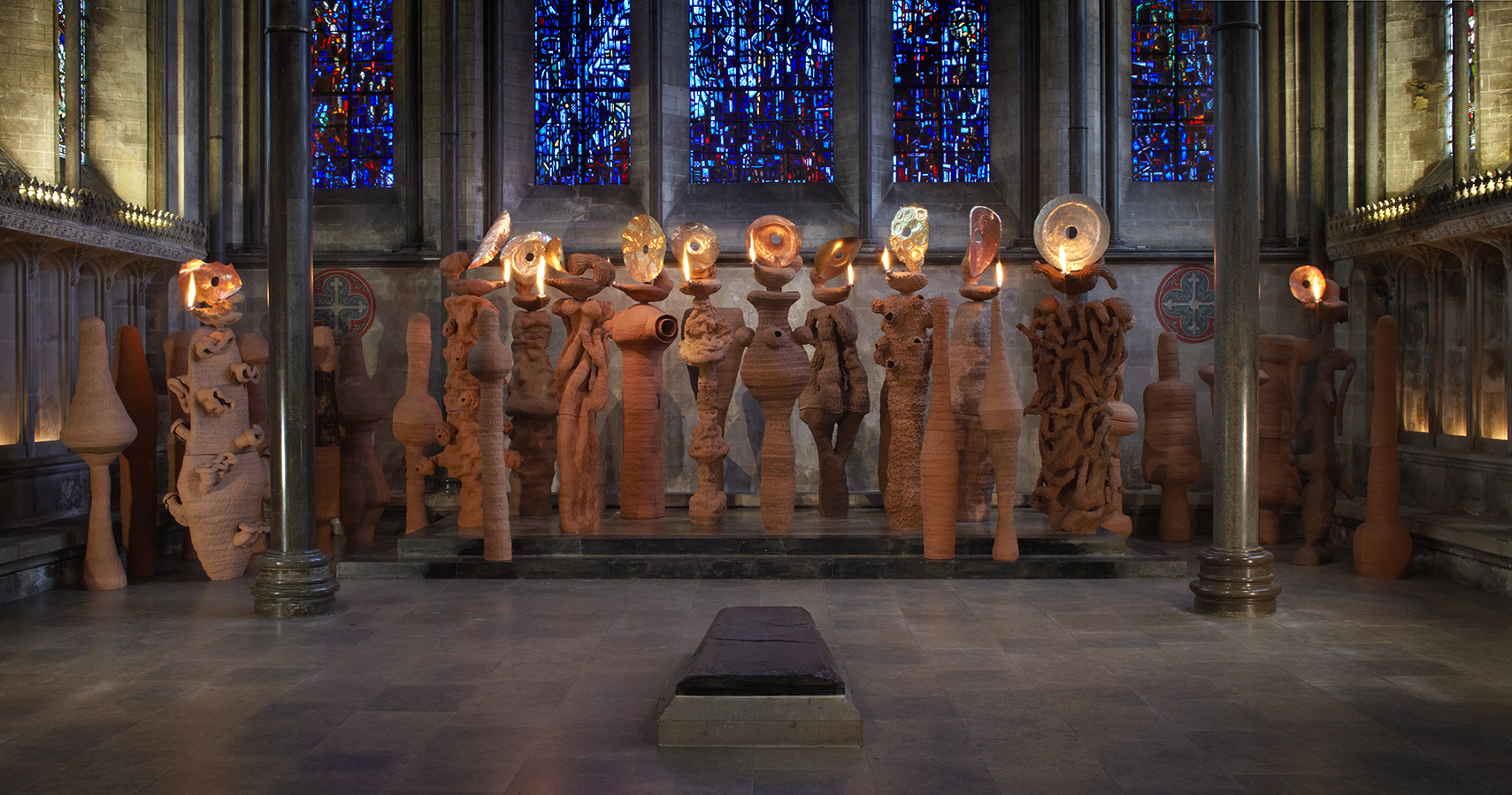
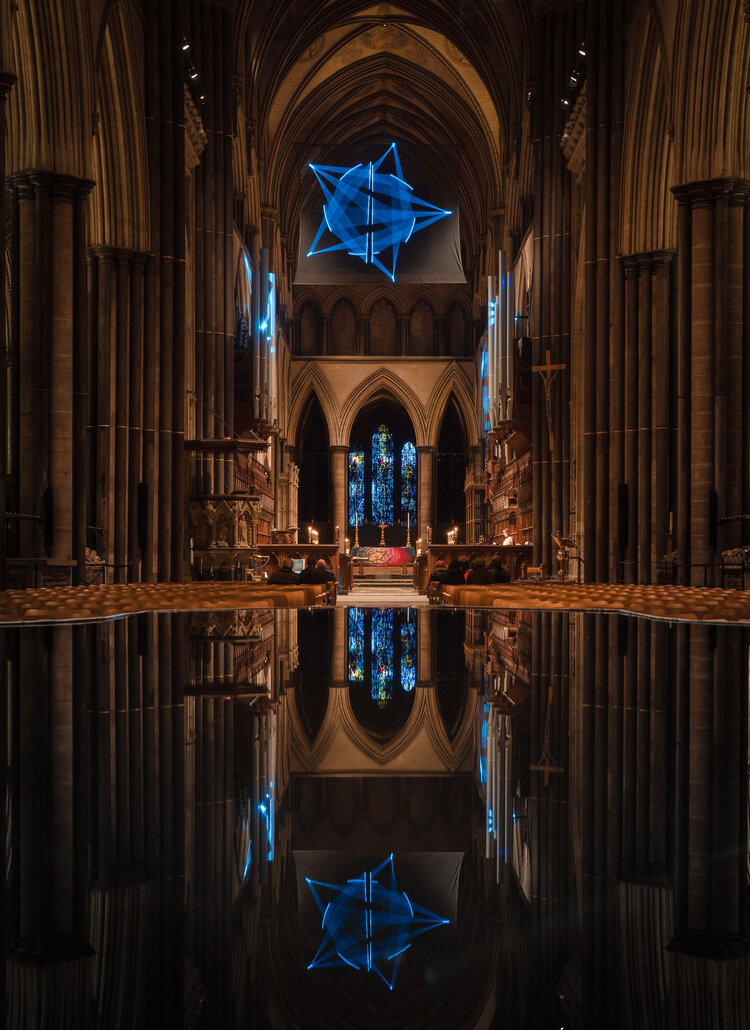
Nicholas Pope (British, 1949–), The Apostles Speaking in Tongues Lit By Their Own Lamps, 1996, installed 2014. Thirty-three figures in terracotta, metal, wick, paraffin, and flame. Trinity Chapel, Salisbury Cathedral. Photo: FXP, London.Jayson Haebich (born in Australia, living in Hong Kong and London), Star of Bethlehem, 2016. Interactive laser installation at Salisbury Cathedral, England.
New episodes of Exhibiting Faith are released once a month. The second (and latest) episode is an interview with Dubai-born, Birmingham-based textile artist Farwa Moledina, whose Women of Paradise (2022) scrutinizes the portrayal of Muslim women in the canon of Western art. Moledina also discusses her experience of Ramadan during lockdown and how it resulted in By Your Coming We Are Healed (2020), two sufras (floor mats for communal dining) made up of photographs of plated dishes submitted to her by participants in the virtual iftars she hosted, arranged according to Islamic design principles of symmetry, abstraction, and recurrence.
+++
SHORT FILM SERIES: At the Threshold: Theology on Film, dir. Sean Dimond:At the Threshold is the latest project from UNTAMED, a documentary film studio in Seattle that “pursue[s] stories of spiritual and narrative depth, with a bias for hope, risk, and redemption.” Filmed in Belgium, Germany, and the UK, it profiles six Christian theologians from Europe, each one humble, open-hearted, and reflective.
“The Open Narrative of Love” with Lieven Boeve, Leuven, Belgium: Boeve reflects on how God interrupts people’s self-enclosed stories. Christianity, he says, is itself an open narrative, not a closed one, and it leads us not away from the world but right into it. One of the filming locations in this short is a rural landscape in Borgloon where Pieterjan Gijs and Arnout van Vaerenbergh built Reading between the Lines, an open-air chapel created to imagine a church inseparable from the world around it.
“The Greater Part” with David Brown, St Andrews, Scotland: Brown talks about prayer, the Bible as part of a living tradition, the church’s call to be creatively other, and the only time he ever saw his father cry. He also cites some of the poets, novelists, and composers/singer-songwriters he admires.
“The Radiance” with Perry Schmidt-Leukel, Muenster, Germany: “The fractcal structure of religious diversity” is of deep interest to Schmidt-Leukel, a Christian who draws insights from Buddhism and who was criticized by Cardinal Joseph Ratzinger for doing so.
“Danseuse” with Ann Loades, Durham, England: A feminist theologian, Loades is one of only two people ever to be awarded a CBE for services to theology. The Christian tradition is responsible for the devaluation of women, she says, but that tradition also contains resources for its own transformation. She also discusses dance as prefiguring the resurrection body.
“To Imagine That” with Garrick Allen, Glasgow, Scotland: Allen sees the book of Revelation as being about how to live in a system that is unjust. “This is John’s response to an oppressive system, and it gives us space to rethink what a just system would look like in our world—to begin to imagine that.”
“Begin with the End” with Judith Wolfe, St Andrews, Scotland: “We have to take seriously the claim that we do not yet live in the world as it will be, and as we will be, and that we have to live towards an eschaton, a presence of God in the world, which is not only not yet apparent, but is not even comprehensible to us. So how do we live authentically in this life?”
From the studio: “Theology offers a home for the vast and the intimate. No question is foreclosed. Visually immersive, poetic, and global in scale, these narrative and theological short films invite viewers into a conversation about life and its limits which is as vibrant as it is challenging. This series isn’t about promoting theological ideas we necessarily agree with, but rather we are exploring the connections between vulnerable life, big questions, and the diversity of theological work being done today. It’s not that we are on the threshold of discovering God, but that perhaps God is already on the threshold of our lives, knocking to enter through our wounds, deepest desires, and questions.”
Arise, shine; for your light has come, and the glory of the LORD has risen upon you. For darkness shall cover the earth, and thick darkness the peoples; but the LORD will arise upon you, and his glory will appear over you.
—Isaiah 60:1–2
LOOK: Comet by Antonello Silverini
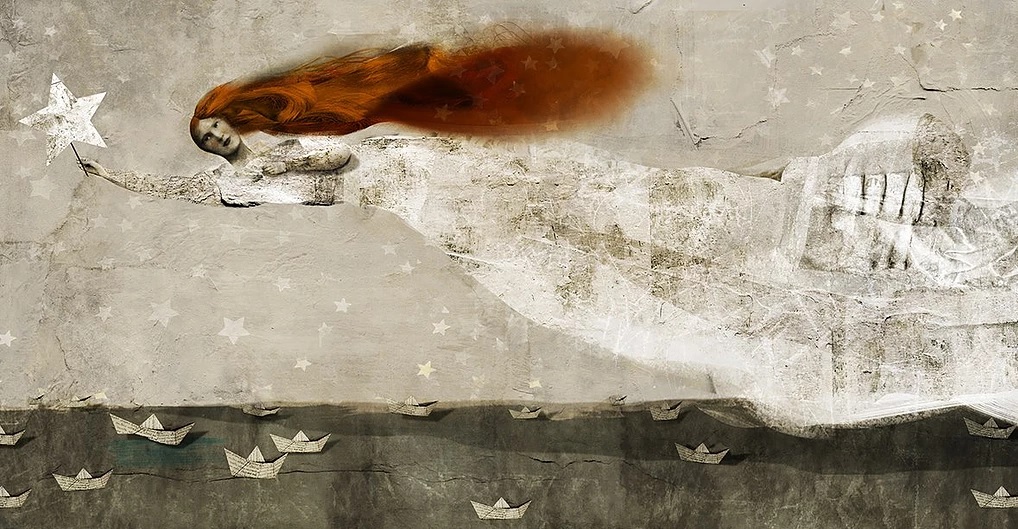
Comet, a digital collage by Antonello Silverini (Italian, 1966–). Used with permission.
LISTEN: “May It Be” | Words by Roma Ryan, 2001 | Music by Enya, 2001 | Performed by Voces8, 2018
May it be an evening star Shines down upon you May it be when darkness falls Your heart will be true You walk a lonely road Oh, how far you are from home
Mornië utúlië Believe and you will find your way Mornië alantië A promise lives within you now
May it be the shadow’s call Will fly away May it be you journey on To light the day When the night is overcome You may rise to find the sun
Mornië utúlië Believe and you will find your way Mornië alantië A promise lives within you now A promise lives within you now
At the behest of composer Howard Shore, film director Peter Jackson approached Enya to write a song for his 2001 epic fantasy adventure The Lord of the Rings: The Fellowship of the Ring, the first in a trilogy. Enya brought her lyricist Roma Ryan on board, and together they wrote “May It Be.” The song, which plays during the movie’s end credits, contains two lines in the fictional Elvish language Quenya that J. R. R. Tolkien invented: “Mornië utúlië” and “Mornië alantië,” which translate to “Darkness has come” and “Darkness has fallen.”
Why am I sharing this “secular” song (inspired by a tale of hobbits, elves, and wizards) on today’s feast of Epiphany, the grand finale of the Christmas season? I could have chosen one of the church’s many beautiful works of music written explicitly for this day (and I have in previous years, such as here, here, and here, not to mention yesterday’s festive feature)—perhaps something louder, brighter, more triumphant—but instead I wanted to cap off the Twelve Days of Christmas with a benediction. It’s from an unlikely source, sure, but it speaks well, I think, to where we’re at in the liturgical year.
According to Christianity, darkness entered the world with humanity’s rebellion against their Creator in the garden of Eden. Sin and death became a reality that, millennia later, we still grapple with. But a promise was spoken in the beginning, was born in a manger at Christmas, walked the dusty streets of Israel-Palestine teaching the Way and performing wonders, was nailed to a cross and buried but then rose from the grave and now lives in the hearts of millions. Jesus Christ is the embodiment of God’s promise of salvation and holistic restoration—shalom, the world set right again.
The light of Christ shone on the small Jewish town of Bethlehem at the Nativity and on the wider Gentile world at Epiphany (when the magi traveled from afar to receive personal revelation, an experience they brought back with them to their homelands), and it continues to shine, often in unexpected places.
Advent is a journey through the dark into the light that breaks at Christmas/Epiphany. Although in one sense morning has broken, in another sense this earth is still very much in darkness. Even the “children of light” (1 Thess. 5:5), those who have been reborn in Christ, experience (and sometimes, sadly, inflict) ache and horror as much as anyone else.
But hope has come. The Word has been spoken, redemption won, even if it’s not yet been consummated. We walk in the valley of shadows, but eventually the night will be vanquished, as Enya’s song says, and we will rise and greet the sun—or, to put a Christian inflection on it, the Son!
May we walk forward into 2022 true to our calling as sons and daughters of God. May we welcome God’s light and bear it to others, and trust the Promise that indwells us.
This is the final post in the 2021–22 Advent/Christmas series. Thanks for following! You can find a collation here (Advent) and here (Christmas). I will now return to my regular publication schedule of roughly one post a week.
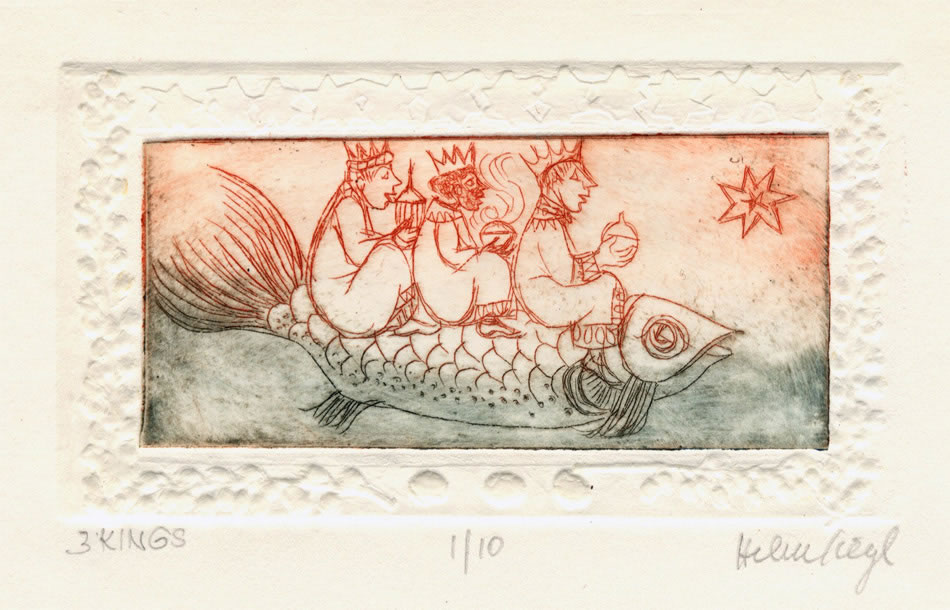
Helen Siegl (Austrian American, 1924–2009), 3 Kings, n.d. Etching and collagraph, 3 × 5 in. (7.6 × 12.7 cm).
Ah, such whimsy!
LISTEN: “We Three Cool Kings” | Words and music by John H. Hopkins, 1857 | Arranged by Eugene Gwozdz, 2015 | Sung by Alan H. Green, Mykal Kilgore, Dennis Stowe, Nili Bassman, Josh Davis, Kevin Smith Kirkwood, Linda Mugleston, Brian O’Brien, Mary Michael Patterson, Mike Schwitter, and Rashidra Scoti on Broadway’s Carols for a Cure, vol. 17, 2015
We three kings of Orient are; bearing gifts, we traverse afar, field and fountain, moor and mountain, following yonder star.
O star of wonder, star of light, star with royal beauty bright, westward leading, still proceeding, guide us to thy perfect light.
Born a king on Bethlehem’s plain, gold I bring to crown him again, King forever, ceasing never, over us all to reign.
Frankincense to offer have I; incense owns a Deity nigh; prayer and praising, voices raising, worshipping God most high.
Myrrh is mine; its bitter perfume breathes a life of gathering gloom; sorrowing, sighing, bleeding, dying, sealed in the stone-cold tomb.
Glorious now behold him arise, King and God and Sacrifice: Alleluia, Alleluia, sounds through the earth and skies.
This jazzified version of the Christmas classic “We Three Kings” is performed by the Broadway cast of At This Performance… Written in the voices of the magi (whose traditional names are Caspar, Melchior, and Balthazar), it propounds the symbolic significance of the three gifts they give to the Christ child. I love how the arranger has layered those middle three verses!
Launched in 1999, Carols for a Cure is an annual collection of seasonal songs sung by members of the Broadway and Off-Broadway theater community to raise money for the charity Broadway Cares / Equity Fights AIDS. Its latest volume, number 21, was released in 2019.
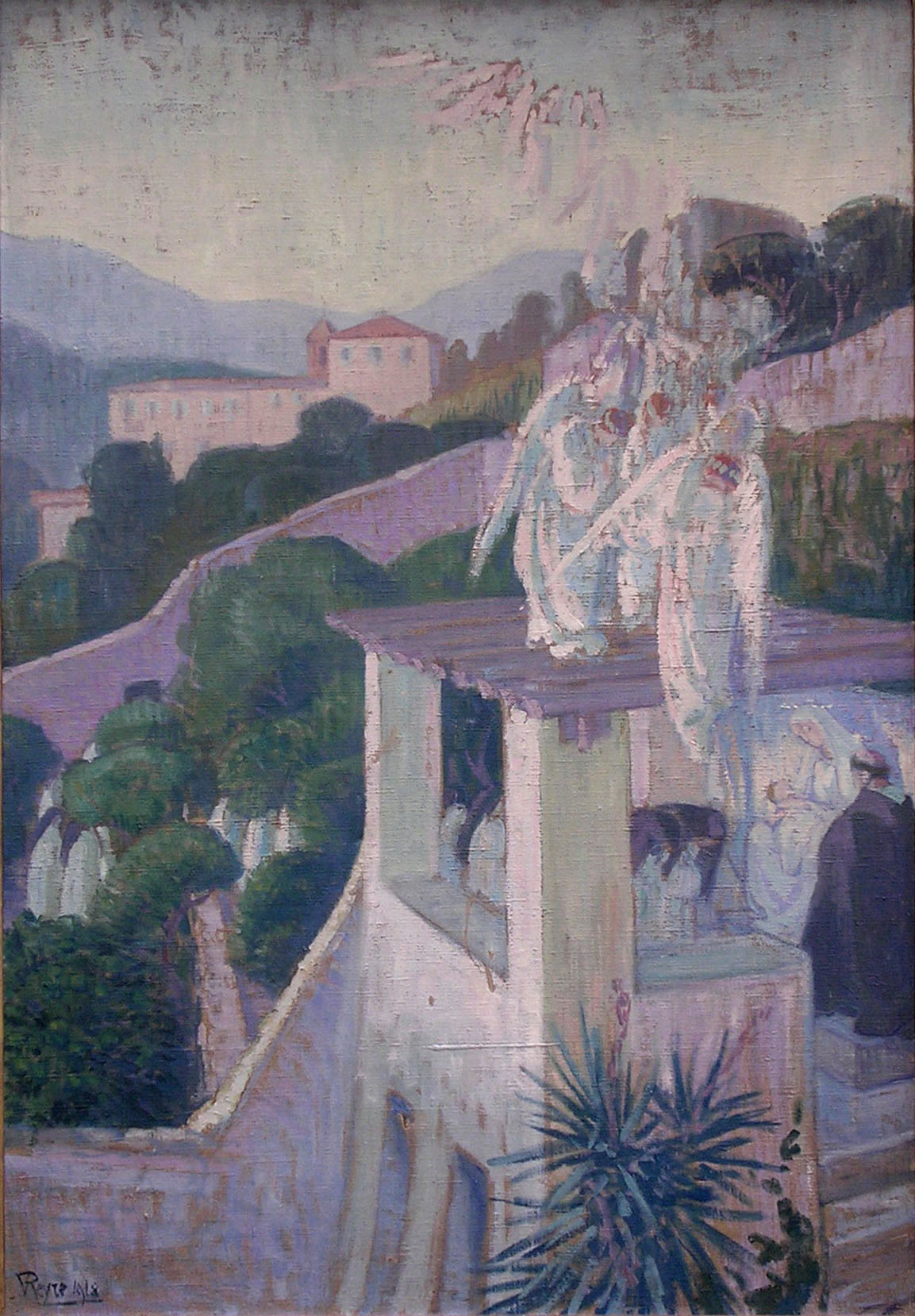
Valentine Reyre was a French artist who participated in the revival of religious art in the first half of the twentieth century. She was the cofounder, with Maurice Storez and Henri Charlier, of L’Arche, a group of Catholic artists and architects active from 1919 to 1934. She also participated in the Ateliers d’art sacré, a movement that sought to reconcile tradition and modernity, art and craft, in the decoration of church interiors, especially those devastated by World War I. Members of the Ateliers—the most famous of which were Maurice Denis and George Desvallières—rejected academism on the one hand and the avant-garde (e.g., futurism, cubism) on the other, seeking a third way forward for religious art.
Reyre’s Dominican Nativity is set outside a Dominican convent in the hills of France. The focal point is the Virgin Mary and the infant Jesus, clothed in white and seated under a small, open, roofed structure. It’s deliberately ambiguous as to whether these figures are meant to be present in the flesh in this space or are a statue; in other words, is this the holy birth transplanted to another time and place, occurring as if for the first time, or is it the birth memorialized? Either way, a procession of nuns winds through the tree-studded landscape to offer their worship and devotion to Christ, their shaping mirrored by the ribbon of angels that unfurls from distant sky to the foregrounded rooftop. The adult male figure at the right is probably Saint Dominic, the medieval Castilian priest who founded the Dominican order, as he is tonsured and wears a habit.
I love the intersection of time and eternity in this image—heaven breaking into the everyday. A community of sisters bows in prayer and re-members Christ’s Nativity.
LISTEN: Hymns and Sacred Songs, FS 83: No. 1. Förunderligt at sige | Words by Nikolai F. S. Grundtvig, 1845 (reworked from “Mit hierte altid vanker” [“My Heart Always Wanders”] by Hans Adolph Brorson, 1732) | Music by Carl Nielsen, 1919 | Performed by the Svanholm Singers, dir. Sofia Söderberg Eberhard, on December, 2010
Forunderligt at sige, Og sært at tænke paa, At Kongen til Guds Rige I Stalden fødes maa, At Himlens Lys og Ære, Det levende Guds Ord, Skal huusvild blandt os være, Som Armods Søn paa Jord!
Selv Spurven har sin Rede, Kan bygge der og boe; En Svale ei tør lede Om Nattely og Ro; De vilde Dyr i Hule Har hver sin egen Vraa: Skal sig min Frelser skjule I fremmed Stald paa Straa?
Nei, kom! jeg vil oplukke Mit Hjerte, Sjæl og Sind, Ja, bede, synge, sukke: Kom, Jesus, kom herind! Det er ei fremmed Bolig, Du den har dyrekiøbt! Her skal du hvile rolig, I Kiærligheden svøbt!
How wonderful to sing of, And strange to think at all, The sovereign of God’s kingdom Is born within a stall, All heaven’s light and honour, God’s living word, e’en he, On earth shall homeless wander, The son of poverty.
The sparrow, with her nesting, Can build herself a home; We find the swallow resting, At night she needn’t roam. The wild beasts abide in The burrows where they stay. Shall then my Saviour hide in An unknown stall on hay?
No, come, I’ll open to thee My heart, my soul, my mind. I’ll pray and sing and sue thee, “Come, Jesus, come inside!” For here thou art no stranger; This home thou dearly bought. Rest now within this manger In swaddling love has wrought.
Jenny Rebecca Rytting describes this Danish carol’s complex textual history, starting with its origins in an eighteenth-century carol by the Danish bishop and hymn-writer Hans Adolph Brorson. Brorson’s text has eleven verses; Nikolai F. S. Grundtvig cut it down to six in 1837, adapting these verses but following Brorson’s wording fairly closely. In 1845 Grundtvig made “extensive changes” to his initial reworking of the carol and published it in a booklet of his hymns. Much later, in 1939, the editors of Højskolesangbogen (The Folk High School Songbook) published Grundtvig’s text with only three verses (verses 1, 5, and 6 of his 1845 version). That’s the version that’s most often used today. Rytting has produced an English translation, posted above. For a translation of all six verses, albeit one that’s a bit clumsy, see here (scroll down to #50, “How wonderful to ponder”).
Carl Nielson, widely recognized as Denmark’s most prominent composer, wrote a musical setting for “Förunderligt at sige” in 1914 (in a letter to his wife at the time, he described it as “the most beautiful I have yet composed”), and it was first published in 1919. Cataloged as CNW 165, it is now considered the standard tune for the carol.
The text is inspired in part by Jesus’s words in Matthew 8:20: “Foxes have holes, and birds of the air have nests; but the Son of Man has nowhere to lay his head.” He was born in an out-of-town stable, lived as a stranger in Egypt, and spent years as an itinerant preacher, never staying for too long in any one place. The speaker invites the wandering Christ to take up permanent residence within her, as he has already bought her (Gal. 3:13; 1 Cor. 6:20). Her love, she says, will provide the swaddling, a cozy warmth.




 Art & Theology