Roundup: Nativity story told by Kenyan children, Annie Moses Band Christmas Special, industrious Joseph, and more

Some of you may wonder why I’m still posting Christmas content. It’s because it’s still Christmastime! Christmas is a twelve-day feast extending from December 25 to January 5. So keep the celebration going with parties, carols, decoration, storytelling, worship, and meditation on the amazing historic event of the Incarnation.

VIDEO: “The Nativity Story (as Imagined by Children in Kenya)”: Released in 2021, this video produced in Kenya by the faith-based child sponsorship organization Compassion International tells the story of Jesus’s birth with localized details, narrated and enacted by children. I was struck by how Mary is pounding yams when the angel Gabriel comes to her, like in one of Nigerian artist George Bandele’s wood carvings of the Annunciation, and how the shepherds literally run to see Jesus, so excited are they to meet him! [HT: Global Christian Worship]

As far as I can tell, this is the first installment in a series of children’s retellings of the Nativity story from around the world that Compassion International releases annually. Subsequent videos—all of them worth watching!—are from Indonesia (2022), Bolivia (2023), and the Philippines (2024).

+++

CONCERT RECORDING: O Holy Night: An Annie Moses Band Christmas Special: Named after their great-grandmother, the Annie Moses Band is an Americana string band of six siblings, raised by award-winning Nashville songwriters Bill and Robin Wolaver, who are committed to godly excellence in the arts. This Christmas concert of theirs, featuring outstanding arrangements of a range of classic carols and one original, was released on DVD in 2018 and just made available by the band for free on YouTube!

Here’s the set list. Links are to standalone videos, excerpted from the performance above. My favorites are probably the opener, “On This Day,” and “We Three Kings”:

+++

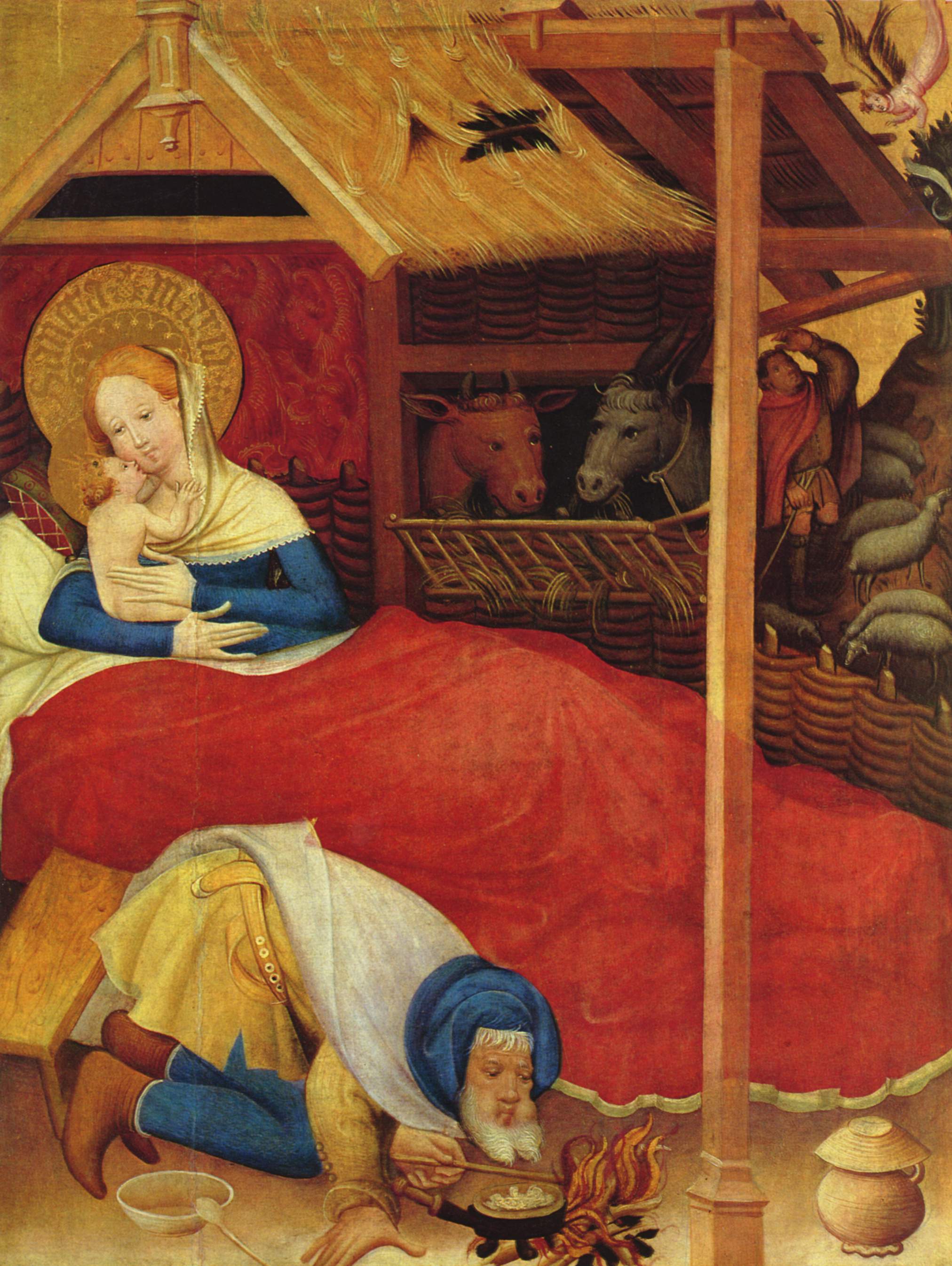
ARTICLE: “Saint Joseph as Baby Daddy: An Illustrated Medieval Guide” by Ela Bobek, DailyArt Magazine: In 2021 on Instagram I shared a small compilation of images that show Joseph as helpful and industrious at the Nativity, as opposed to the more classic depiction of him sitting off to the side with his head in his hands. I’ve since collected over a dozen more and have been wanting to develop a reflection on this motif into a full-fledged article (and probably still will someday), but Ela Bobek has beaten me to it! Check out the images she has compiled that show Joseph cooking, doing laundry, sewing clothes, preparing a bath, and swaddling or holding the baby—allowing Mary some much-needed rest. What a loving, caring, actively involved father and husband!
Konrad von Soest_Nativity
Conrad von Soest (German, ca. 1370–ca. 1422), Nativity, panel in the left wing of the Niederwildungen Altarpiece, 1403. Tempera on wood, 73 × 56 cm. Stadtkirche St. Nikolaus, Bad Wildungen, Germany. [view full altarpiece]

+++

SONGS:

>> “Christmas Ko Ramjham Ma” by Milan Bhujel and Surya Rasaili: This Nepali Christmas song was written by Milan Bhujel (words) and Surya Rasaili (music) in 2022 and is performed here (with dancing!) by Bhujel and friends. I couldn’t find a translation of the Nepali lyrics, but the gist of it is “Let’s dance and rejoice, let’s celebrate the birth of Jesus, who has come to save us. Jesus is a light dispelling all darkness.” [HT: Global Christian Worship]

>> “Christ Is Born (This Day)” by Todd Family Hymnal: This song by Jason B. Todd and Sara K. Todd, a married couple who make music together, is the second track of their Christmas EP from 2020. Jason (who goes by “JB”) is the pastor of administration and music at Westport Baptist Church in Denver, North Carolina.

>> “Funky Little Drummer Boy” by the Good Shepherd Collective: A cover of the funk arrangement of “The Little Drummer Boy” by Sharon Jones & the Dap-Kings, this performance video premiered last week at Good Shepherd New York’s Christmas Eve digital service. The soloist is Stephany Mora. Watch the standalone video on Instagram, or listen on YouTube at this cued-up link.

[Related post: “The Little Drummer Boy: Four Versions (Nigeria, India, Cuba, Norway)]

Christmas, Day 6: A Little Baby

LOOK: Nativity by Ivan Večenaj

Vecenaj, Ivan_Nativity
Ivan Večenaj (Croatian, 1920–2013), Nativity, 1970. Oil on glass. Galerija Ivan Večenaj, Gola, Croatia.

Ivan Večenaj (1920–2013) was a self-taught artist from Croatia, a representative of the Hlebine school of naive painting. He loved nature and folk culture—many of his paintings depict local village life or biblical scenes set in Croatia’s rural countryside. His works are in the collections of the Croatian Museum of Naïve Art in Zagreb and the Vatican Museums, among others. There is also a museum dedicated to his work: the Galerija Ivan Večenaj (Ivan Večenaj Gallery) in his home village of Gola in the Prekodravlje region.

Večenaj’s 1970 Nativity sets Jesus’s birth in Gola. Mary bounces the boy Jesus on her knee under a makeshift shelter roofed with a purple blanket that resembles a mountain. Emerging from the snowy ground behind them is a red cross, a crown of thorns hanging from the center and blood dripping from a wedged nail on both terminals onto a barren tree and Mary’s cloak. But this sign of death is counterbalanced with signs of life—flowers, wheat, and a grapevine sprouting up around the two, references to the Eucharist and to the blossoming of salvation.

The scene emphasizes Jesus’s humble birth into a peasant family—the artist, too, had a peasant background—and foreshadows his atoning death.

LISTEN: “Ar gyfer heddiw’r bore” (For the sake of this very morning), aka “Faban Bach” (A Little Baby) | Words by David Hughes, early nineteenth century | Tune: MENTRA GWEN, traditional Welsh | Performed by Parti Fronheulog, 1967

Ar gyfer heddiw’r bore’n faban bach, faban bach,
y ganwyd gwreiddyn Iesse’n faban bach;
y Cadarn ddaeth o Bosra,
y Deddfwr gynt ar Seina,
yr Iawn gaed ar Galfaria’n faban bach, faban bach,
yn sugno bron Maria’n faban bach.

Caed bywiol ddŵfr Eseciel ar lin Mair, ar lin Mair,
a gwir Feseia Daniel ar lin Mair;
Caed bachgen doeth Eseia,
’r addewid roed i Adda,
yr Alffa a’r Omega ar lin Mair, ar lin Mair;
mewn côr ym Meth’lem Jiwda, ar lin Mair.

Diosgodd Crist o’i goron, o’i wirfodd, o’i wirfodd,
er mwyn coroni Seion, o’i wirfodd;
i blygu’i ben dihalog
o dan y goron ddreiniog
i ddioddef dirmyg llidiog, o’i wirfodd, o’i wirfodd,
er codi pen yr euog, o’i wirfodd.

Am hyn, bechadur, brysia, fel yr wyt, fel yr wyt,
i ’mofyn am dy Noddfa, fel yr wyt
i ti’r agorwyd ffynnon
a ylch dy glwyfau duon
fel eira gwyn yn Salmon, fel yr wyt, fel yr wyt,
gan hynny, tyrd yn brydlon, fel yr wyt.

English translation by Richard B. Gillion, 2008:

For the sake of this very morning, as a little baby, a little baby
Was born the root of Jesse, as a little baby;
The Strong one who came from Bosra,
The Lawmaker of old on Sinai,
The Redemption to be had on Calvary, as a little baby, a little baby,
Suckling the breast of Mary, as a little baby.

The life-giving water of Ezekiel is found on Mary’s knee, on Mary’s knee,
And the true Messiah of Daniel on Mary’s knee;
Here is the wise boy-child of Isaiah,
The promise made to Adam,
The Alpha and Omega on Mary’s knee, on Mary’s knee;
In the stall in Bethlehem of Judah, on Mary’s knee.

Christ took off his crown, of his freewill, of his freewill,
In order to crown Zion, of his freewill;
To bow his undefiled head
Under the thorny crown,
To suffer enraged derision, of his freewill, of his freewill,
To raise the head of the guilty, of his freewill.

Therefore, sinner, hurry, as thou art, as thou art,
To ask for his sanctuary, as thou art;
For thee the well was opened
Which washes thy wounds
Like the snow on Salmon, as thou art, as thou art.
For that, come promptly, as thou art.

With roots dating back to the pre-Reformation era, the plygain service is a Welsh Christmas tradition in which Christians gather at church from 3 a.m. to 6 a.m. on Christmas morning for community-led carol singing. One of the popular carols that’s sung is “Ar gyfer heddiw’r bore,” its text by the Welsh poet David Hughes (ca. 1794–1862), known by his bardic name of Eos Iâl. It’s twelve stanzas in all, which start with the Nativity and then move through various stages of Christ’s passion, from Gethsemane to Pilate’s hall to Golgotha to the garden of the tomb, commemorating the incarnation, the atonement, and Christ’s ascension and intercession for sinners.

The recording here is by Parti Fronheulog, a folk trio of brothers from southeast Denbighshire, Wales—Tom Williams (lead), Osmond Williams (tenor), and Ted Williams (bass)—who were active in the 1960s. They sing stanzas 1, 2, 5 and 12.

Christmas, Day 5: His Hair Alight

LOOK: Maryam and Isa, Mughal India

Mughal Nativity
Maryam and Isa (Mary and Jesus), miniature from a Falnama, Mughal India, 1550–1600. Opaque paint, gold, and silver on paper, 49 × 35 cm. Wereldmuseum, Rotterdam, Netherlands, Inv. 07180329.

This delicate painting is from an Islamic manuscript made in India during the Mughal era. It shows Mary sitting outside with her son, Jesus, on her lap, whose flaming halo identifies him as a prophet. Enclosed by a gate, they are seated on a mat, and Jesus hands his mother a fruit that looks to me like a pomegranate—though a date would cohere better with the Qur’an’s Nativity account (19:25–26). Verdant pink hills rise up behind them, as does a palm tree, under which sits a pitcher of water. From the left, an anthropomorphized sun gazes down on the sacred pair. The inscriptions are in Persian.

Like Christians, Muslims revere Jesus—his birth is recounted in the Qur’an 19:16–34 and 3:45–53, and in that book he is also described as the Messiah, the Word of God, and the Spirit of God—but unlike Christians, Muslims do not regard Jesus as divine.

LISTEN: “A Christmas Carol” | Words by G. K. Chesterton, 1900 | Music by Deanna Witkowski, 2017 | Performed by the ChoralArt Camerata, dir. Robert Russell, 2018

The Christ-child lay on Mary’s lap,
His hair was like a light.
(O weary, weary were the world,
But here is all aright.)

The Christ-child lay on Mary’s breast
His hair was like a star.
(O stern and cunning are the kings,
But here the true hearts are.)

The Christ-child lay on Mary’s heart,
His hair was like a fire.
(O weary, weary is the world,
But here the world’s desire.)

The Christ-child stood on Mary’s knee,
His hair was like a crown,
And all the flowers looked up at Him,
And all the stars looked down.

Christmas, Day 4: The Innocents

We remember today, O God, the slaughter of the holy innocents of Bethlehem by King Herod. Receive, we pray, into the arms of your mercy all innocent victims; and by your great might frustrate the designs of evil tyrants and establish your rule of justice, love, and peace; through Jesus Christ our Lord, who lives and reigns with you, in the unity of the Holy Spirit, one God, for ever and ever. Amen.

—Collect from the Book of Common Prayer

Western church calendars mark December 28 as the Feast of the Holy Innocents, or Childermas, a day set aside to remember the slaughter of male Bethlehemites aged two and under by Herod the Great, king of Judea, as recounted in Matthew 2:16–18. Historians estimate there were probably ten to twenty children of that age in Bethlehem at the time.

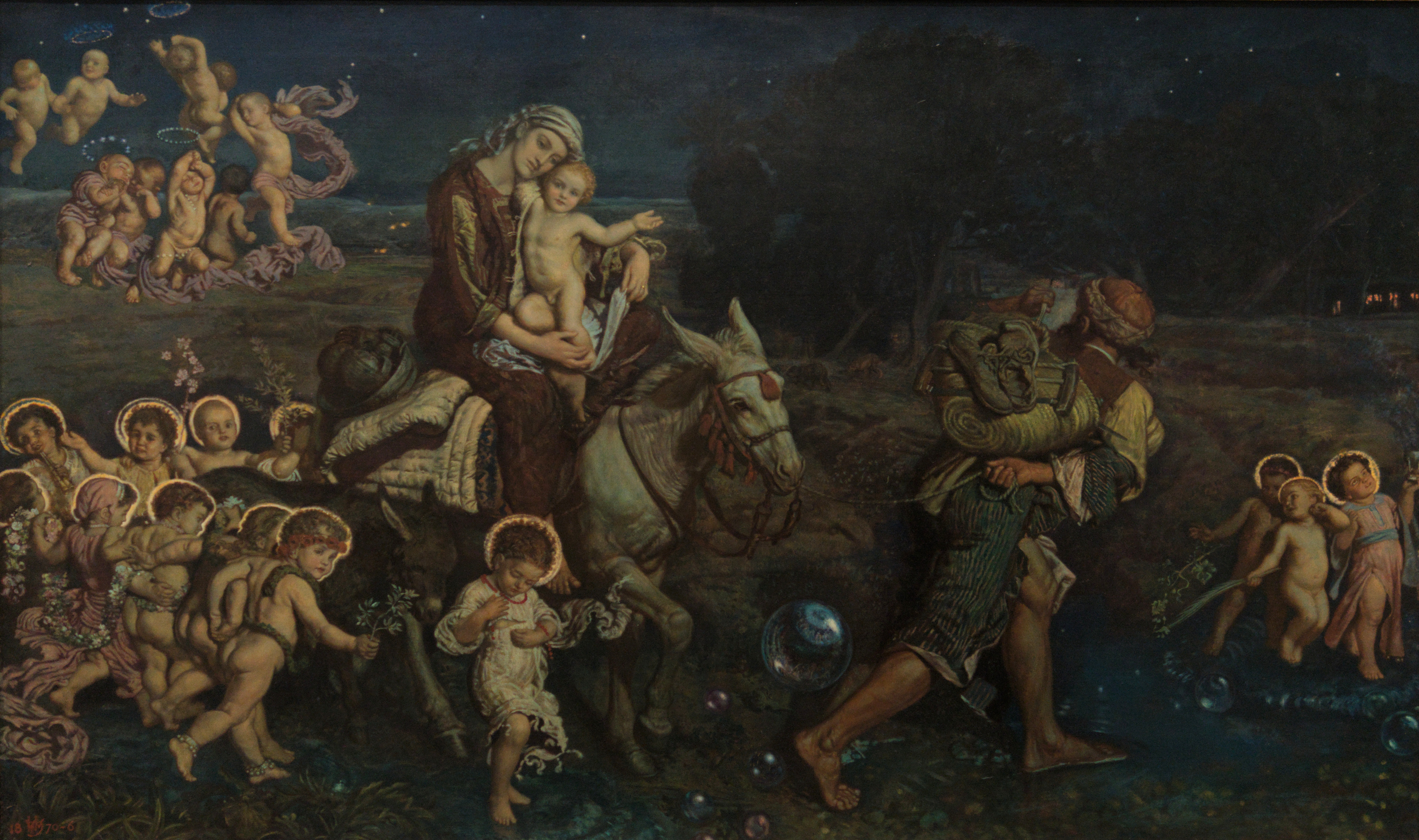
LOOK: The Triumph of the Innocents by William Holman Hunt

Hunt, William Holman_The Triumph of the Innocents
William Holman Hunt (British, 1827–1910), The Triumph of the Innocents, 1870–1903. Oil on canvas, 75.3 × 126 cm. Harvard Art Museums, Cambridge, Massachusetts. Photo: Victoria Emily Jones. [object record]

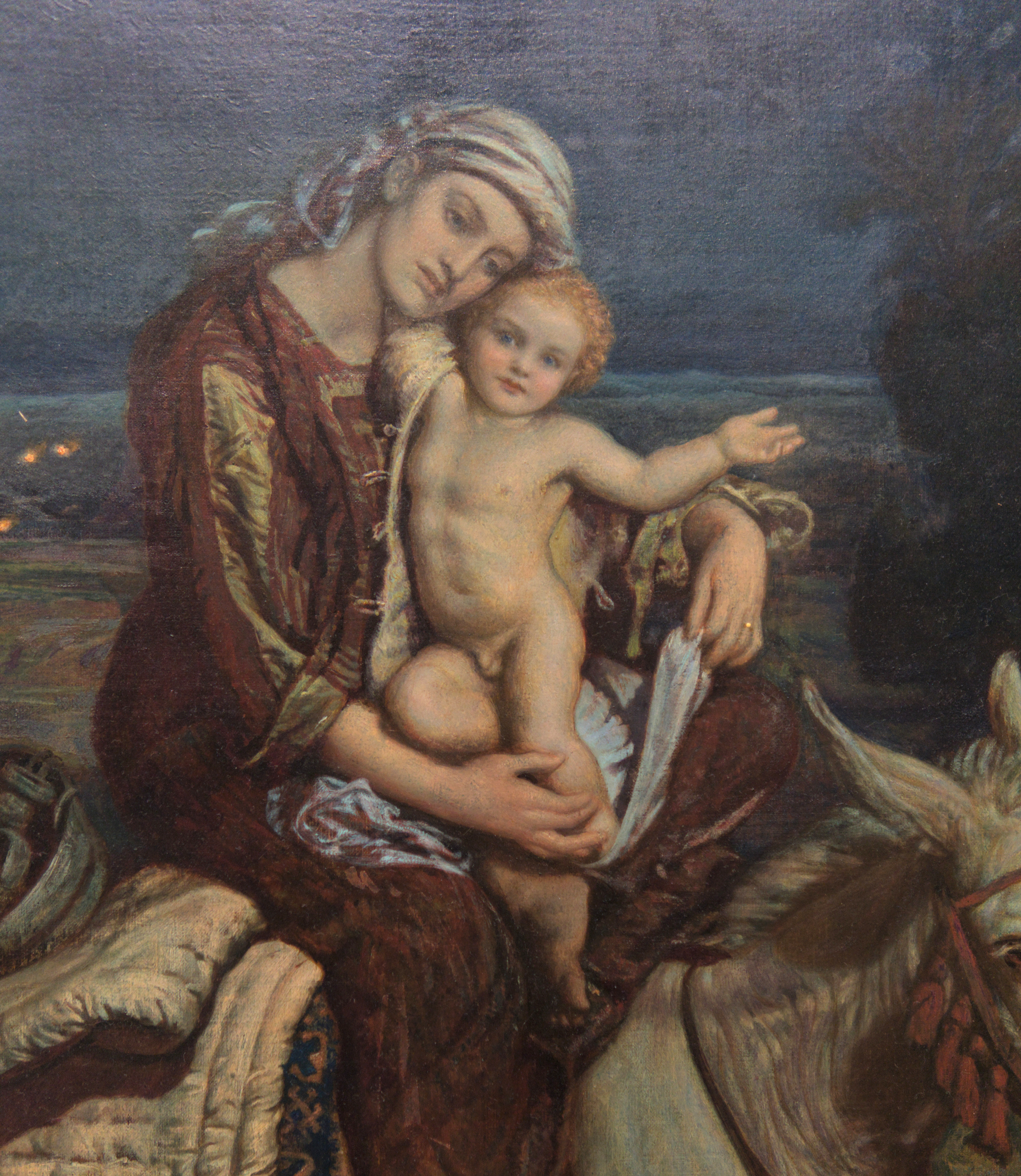
This visionary realist painting by the Pre-Raphaelite artist William Holman Hunt is a unique interpretation of the Flight to Egypt. It shows, surrounding the Holy Family on the run, the embodied spirits of all the little boys in Bethlehem—the “innocents”—who were slain at Herod’s behest. It’s the first of three versions Hunt painted of the subject, mostly completed by 1876, but with some of the background left unfinished until 1903. The other two versions are in the Tate Britain in London and the Walker Art Gallery in Liverpool.

The early church understood these boys as the first Christian martyrs. Though they were not conscious witnesses for Christ, they were killed because of him, casualties of a persecuting tyrant’s brooking no rival. Their death prefigures that of future Christian martyrs, starting with Stephen, as well as Christ’s own death.

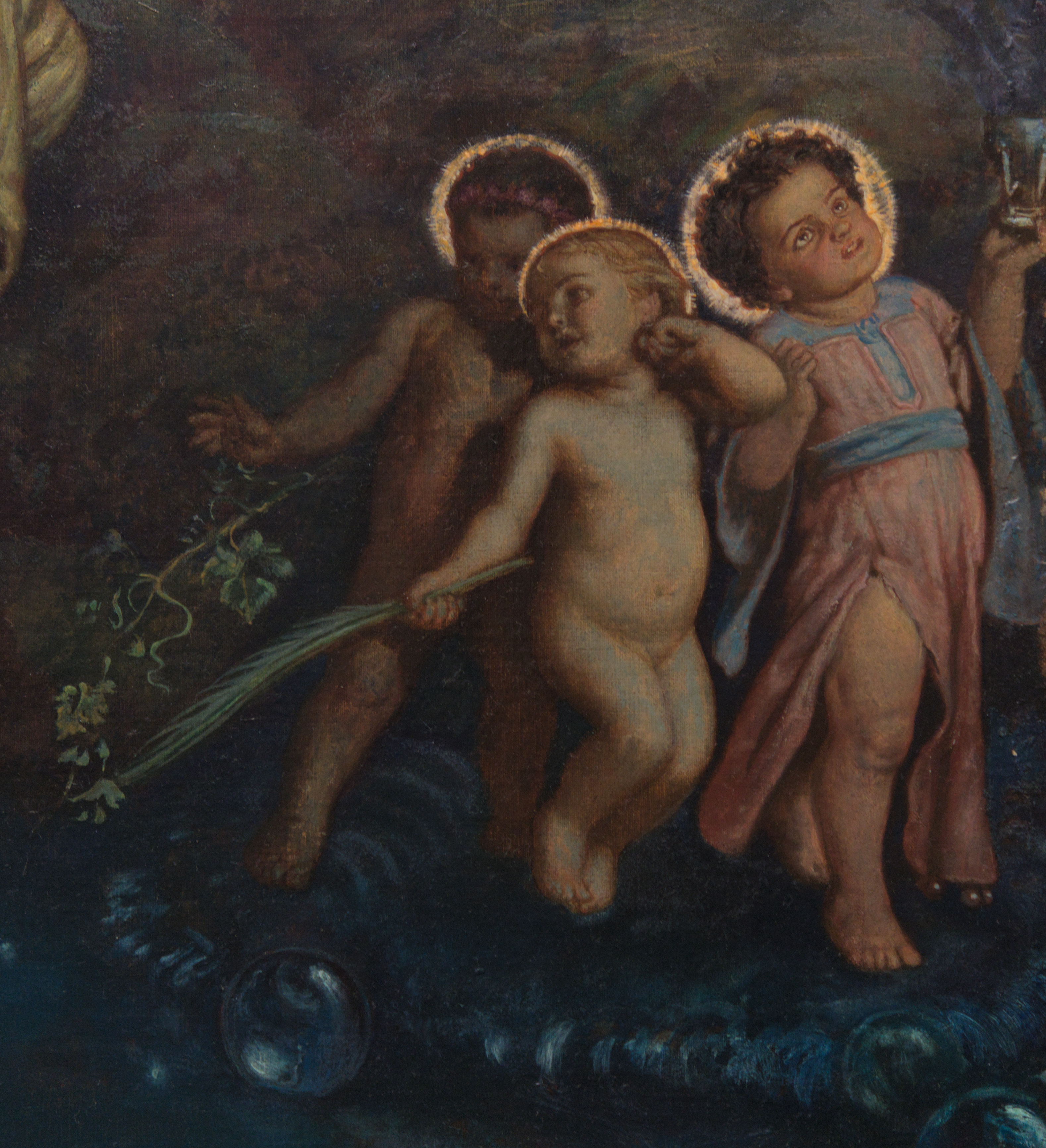
Despite the solemnity of this episode, Hunt casts it in a triumphant light. Instead of showing the infants dismembered or impaled in a bloodbath with their mothers wailing in helpless grief, as artists have historically done, Hunt shows them in the light of glory, carrying palms and other branches and wearing floral crowns and garlands. They are, in the words of John Powell Lenox, the “first of that glorious company whose shining ranks are nearest the throne of the Slain One.”

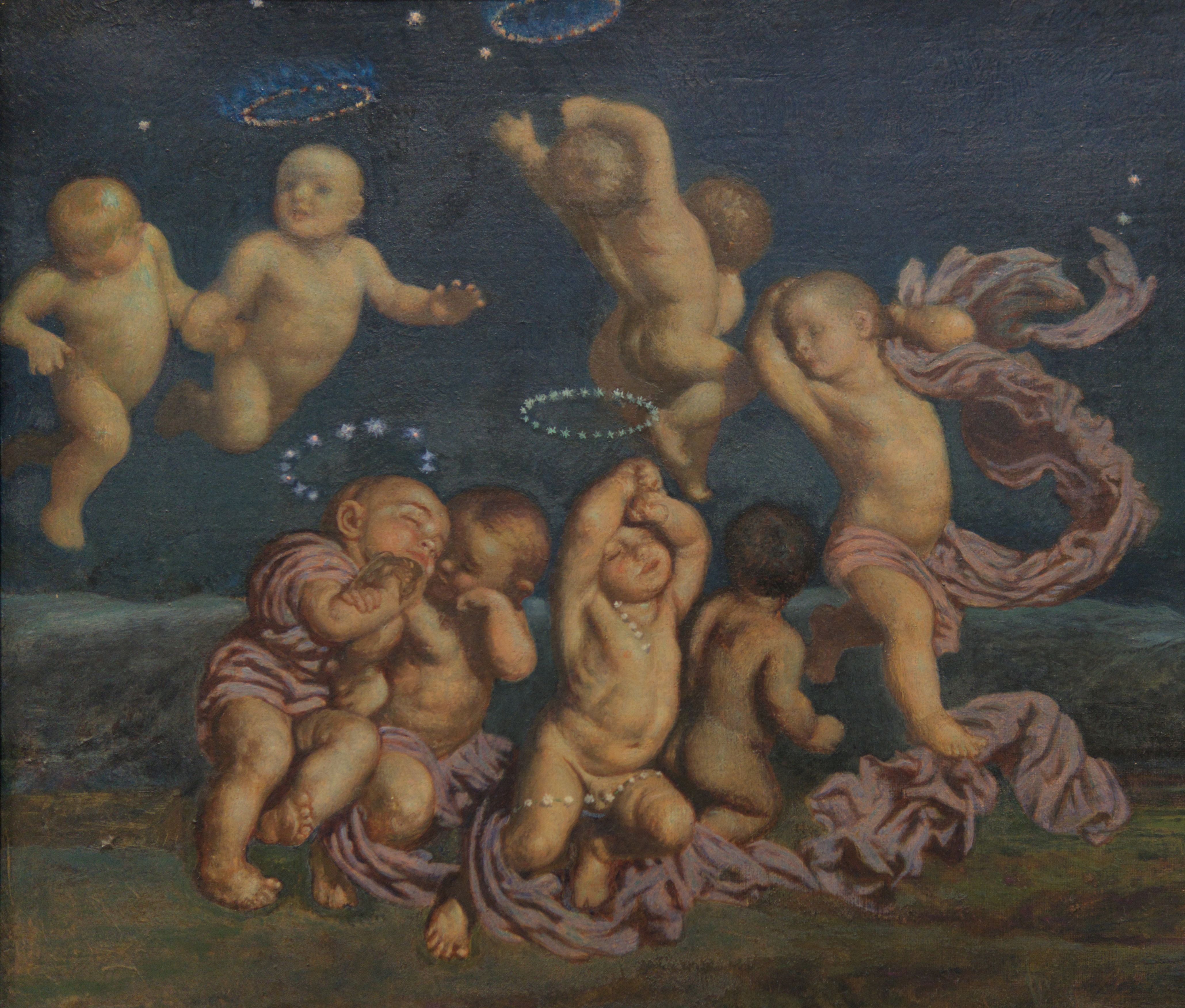
Floating in air, those at the upper left are just waking up to their new spiritual life—they open their eyes and stretch.

Triumph of the Innocents (detail)

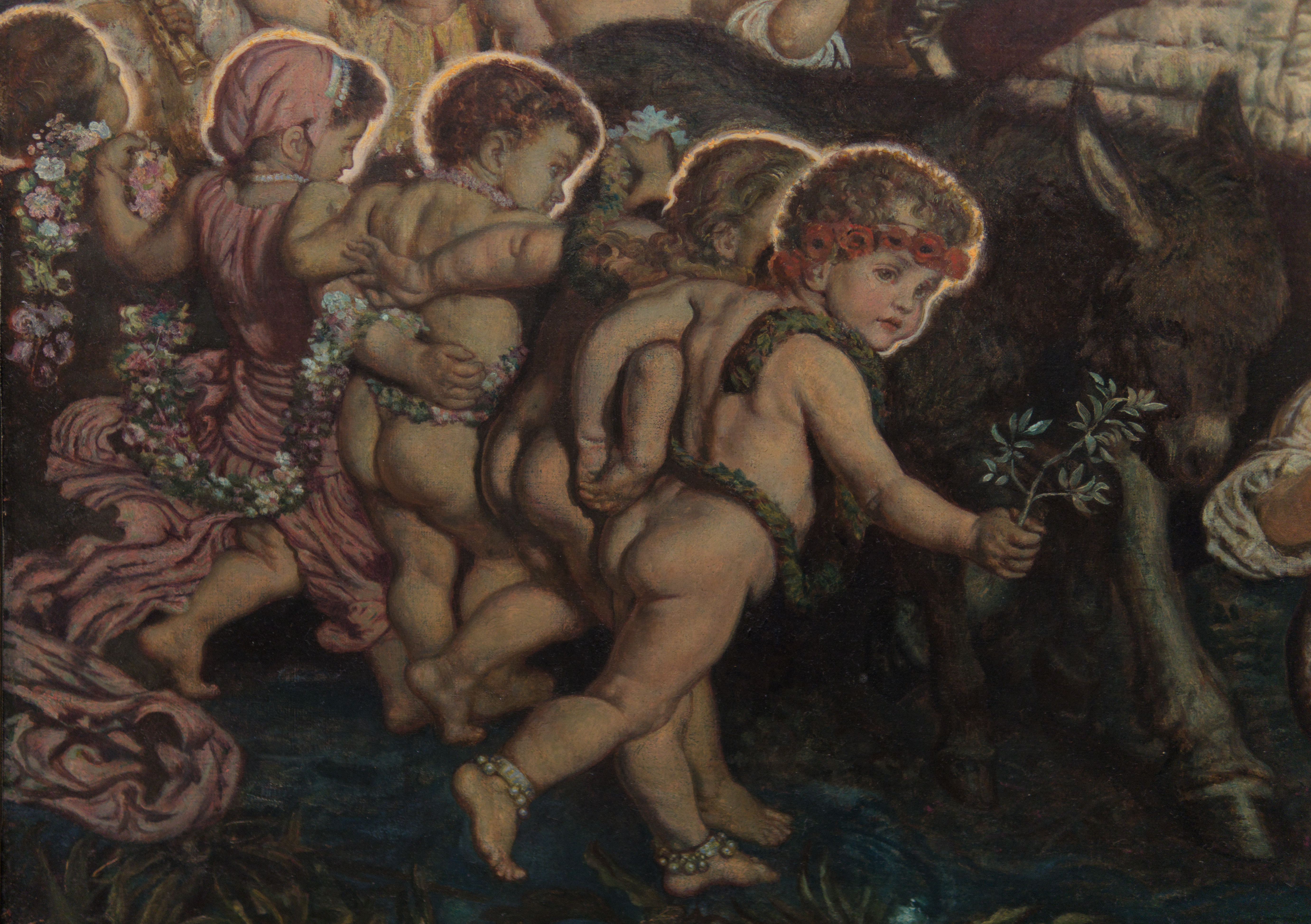
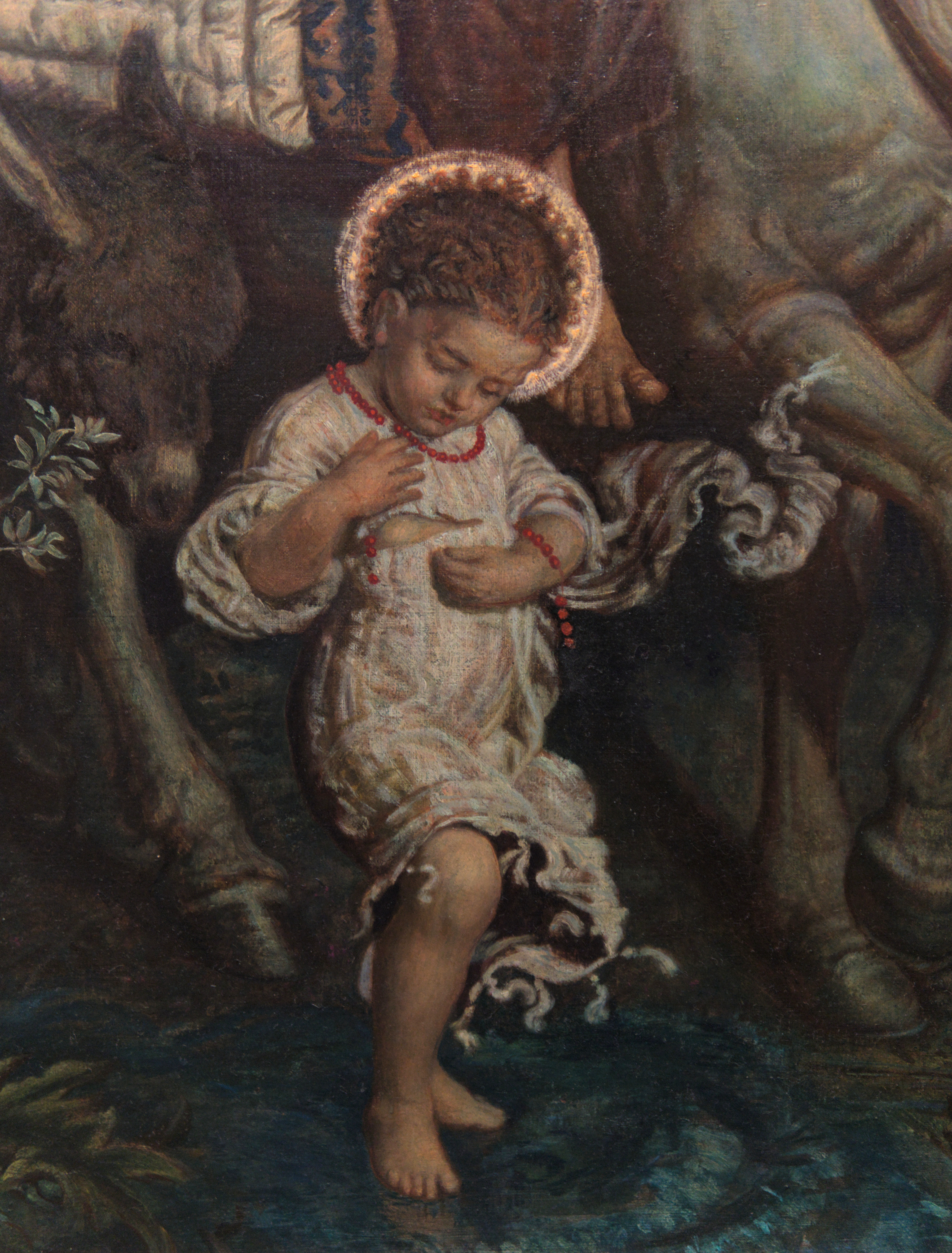
Those on the ground lock arms in solidarity and play, surrounding a little foal. One curly-locked lad wears a red necklace, the beads spilling from the chain reminiscent of blood drops. But the fatal chest wound that one of Herod’s soldiers had inflicted by sword is no more, as he looks down with wonder to discover through a tear in his tunic. Healed flesh!

Triumph of the Innocents (detail)

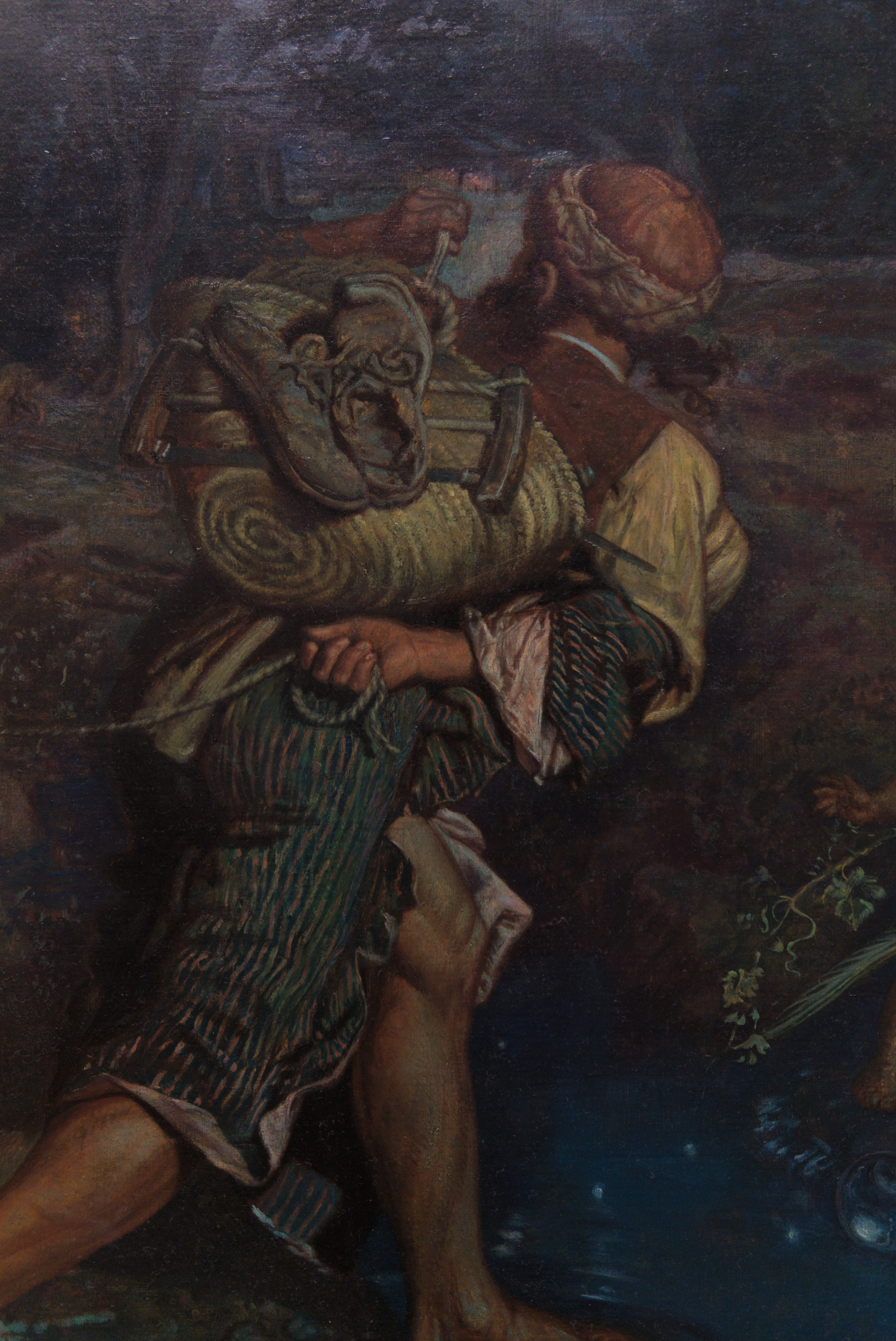
In the center Mary rides a mule, holding Jesus, who greets his playmates with a wave and a smile. He’s the only one who’s aware of them, these mystic brothers accompanying him into exile. Joseph leads the way forward, staying alert to potential threats. His tool basket is slung over his shoulder, which he’ll use to make a living for his family in Egypt.

Triumph of the Innocents (detail)

At the far right one of the child-martyrs, “in priestly office” and holding a censer, leads the celestial band, while his two companions “cast down their tokens of martyrdom in the path of their recognised Lord,” as Hunt wrote in the catalog for the 1885 exhibition of the Tate version by the Fine Art Society in London.

Triumph of the Innocents (detail)

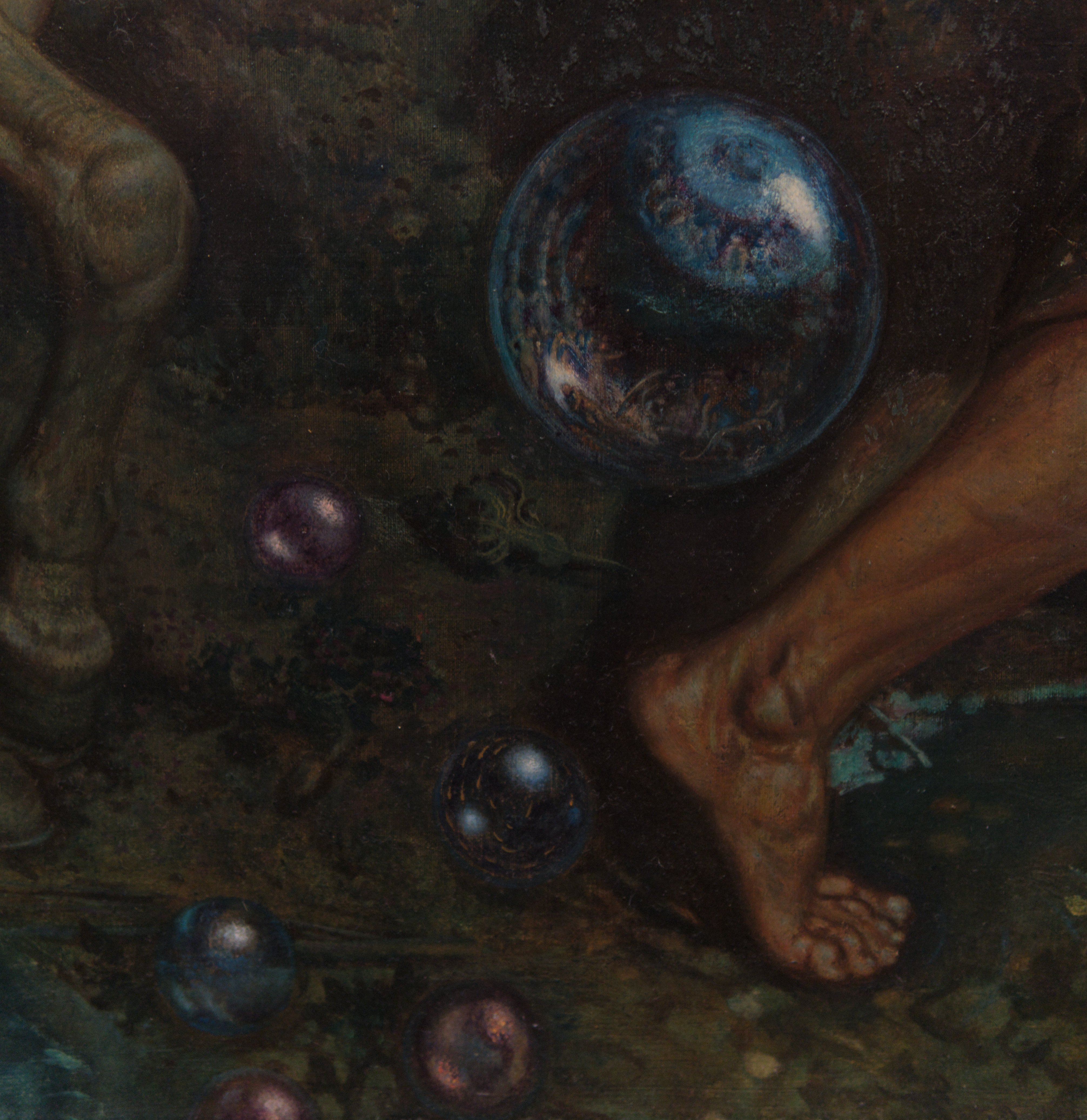
The children tread through “the living fountains of water, the streams of eternal life . . . ever rolling onward and breaking—where it might if real water be dissipated in vapour—into magnified globes which image the thoughts rife in that age in the minds of pious Jews . . . of the millennium which was to be the mature outcome of the advent of the Messiah.” The large bubble above Joseph’s right calf reveals Jacob’s dream at Bethel, which “first clearly speaks of the union of Earth and Heaven” that Christ will one day make total and permanent.

Triumph of the Innocents (detail)

To read the artist’s thirteen-page statement about the painting, see here.

LISTEN: “Salvete Flores Martyrum” (Hail, Martyr Flowers) | Words by Aurelius C. Prudentius, early fifth century | Music by Claudio Dall’Albero, 2022 | Performed by the Choir of Sidney Sussex College, Cambridge, dir. David Skinner, on Vespertina Hymnodia: Sacred Music by Claudio Dall’Albero, 2022

Salvete flores Martyrum
Quo lucis ipso in limine
Christi in secutur sustulit
Ceu turbo nascentes rosas.

Vos prima Christi victima
Grex immolatorum tener
Aram ante ipsam simplices
Palma et coronatis luditis.

Jesu tibi sit Gloria
Qui natus es de Virgine
Cum Patre et almo Spiritu
In sempiterna saecula
All hail, ye little Martyr flowers,
Sweet rosebuds cut in dawning hours!
When Herod sought the Christ to find,
Ye fell as bloom before the wind.

First victims of the Martyr bands,
With crowns and palms in tender hands,
Around the very altar, gay
And innocent, ye seem to play.

All honor, laud, and glory be,
O Jesu, Virgin-born, to Thee;
All glory, as is ever meet,
To Father and to Paraclete.

Trans. Athelstan Riley

“Salvete flores martyrum” is the office hymn for Lauds on the Feast of the Holy Innocents. It is a cento from the 208-line Epiphany poem in the Cathemerinon by the ancient Latin Christian poet Prudentius, first assembled in the 1568 Breviary of Pope Pius V.

This text has been set to music by many composers ever since the Renaissance. My favorite setting is probably by the contemporary Italian composer Claudio Dall’Albero, from his cycle Five Hymns for Vespers, shared above.

Other notable settings include those by Tomás Luis de Victoria and Michael Haydn (Joseph Hadyn’s brother).

Athelstan Riley’s is one of several metrical English translations, but here’s a prose translation provided by John Carden in his compilation A Procession of Prayers:

God keep you, O finest flowers of martyrs, who, at the dawn of life, were crushed by the persecutor of Christ and flung like petals before a furious wind.

You, the first to die for Christ, tender flocks of martyrs, now dance before the altar, now laugh candidly with your palms and gardens.

“The Vigil of Joseph” by Elsa Barker (poem)

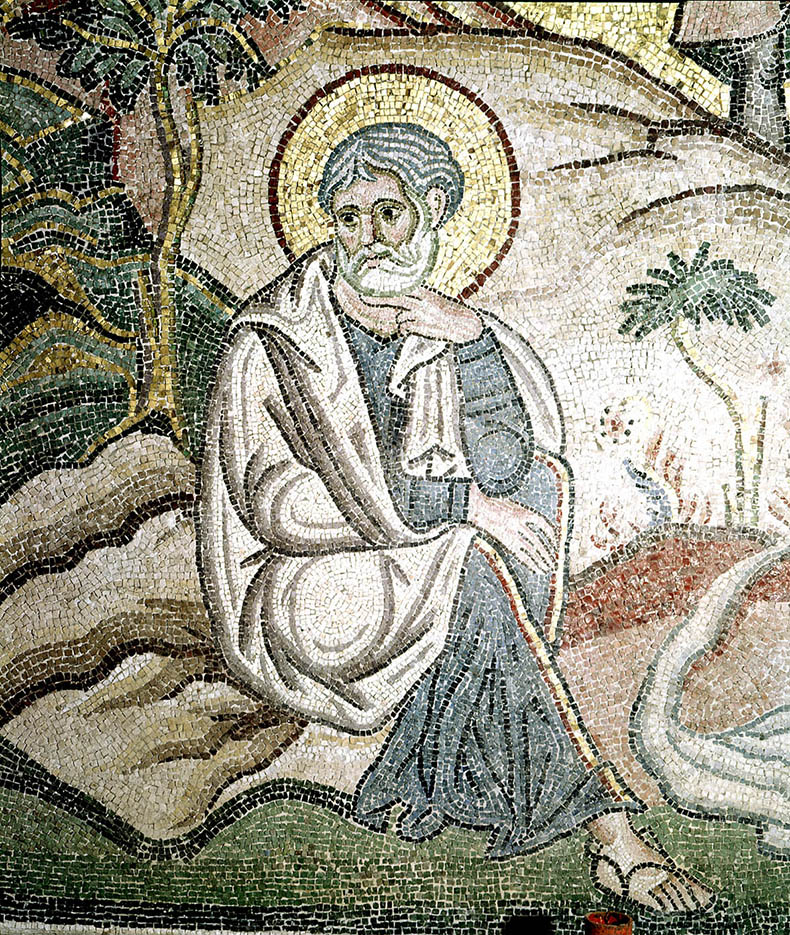
Saint Joseph at the Nativity
Saint Joseph at the Nativity, ca. 1100, mosaic detail from Daphni Monastery, Haidari (outside Athens), Greece [ view full scene ]

After the Wise Men went, and the strange star
Had faded out, Joseph the father sat
Watching the sleeping Mother and the Babe,
And thinking stern, sweet thoughts the long night through.

“Ah, what am I, that God has chosen me
To bear this blessed burden, to endure
Daily the presence of this loveliness,
To guide this Glory that shall guide the world?

“Brawny these arms to win Him bread, and broad
This bosom to sustain Her. But my heart
Quivers in lonely pain before that Beauty
It loves—and serves—and cannot understand!”

from The Frozen Grail and Other Poems by Elsa Barker (Duffield & Company, 1910)

Elsa Barker (1869–1954) was a novelist, short story writer, and poet from New England. She lived for extended periods in London and Paris and was a member of the Theosophical Society.

Christmas, Day 3: A Cradle in Bethlehem

LOOK: Nativity relief sculpture from Chartres Cathedral

Nativity (Chartres)
The Nativity, ca. 1230–40. Limestone fragment from the now destroyed rood screen of Chartres Cathedral, France, 93 × 133 cm.

LISTEN: “A Cradle in Bethlehem” by Alfred Bryan (words) and Larry Stock (music), 1952 | Performed by Gregory Porter and the Jazz at Lincoln Center Orchestra with Wynton Marsalis, on Big Band Holidays, 2015

Watch the live performance on the Blue Engine Records Facebook page.

Sing sweet and low a lullaby till angels say, “Amen”
A mother tonight is rocking a cradle in Bethlehem
While wise men follow through the dark a star that beckons them
A mother tonight is rocking a cradle in Bethlehem

A little child will lead them, the prophets said of old
In storm and tempest heed him until the bell is tolled
Sing sweet and low your lullaby till angels say, “Amen”
A mother tonight is rocking a cradle in Bethlehem

A mother tonight is rocking a cradle in Bethlehem
A mother tonight is rocking her baby in Bethlehem

This song was popularized by Nat King Cole on his 1960 album, The Magic of Christmas. In addition to the live recording above featuring singer-songwriter Gregory Porter and legendary jazz trumpeter Wynton Marsalis, here are two other recordings I like:

>> By the Lower Lights, feat. Debra Fotheringham, on Sing Noel (2013):

>> By Son of Cloud (Jonathan Seale), on Glad Tidings, vol. 1, by Mason Jar Music (2019):

Christmas, Day 2: A Child Is Born

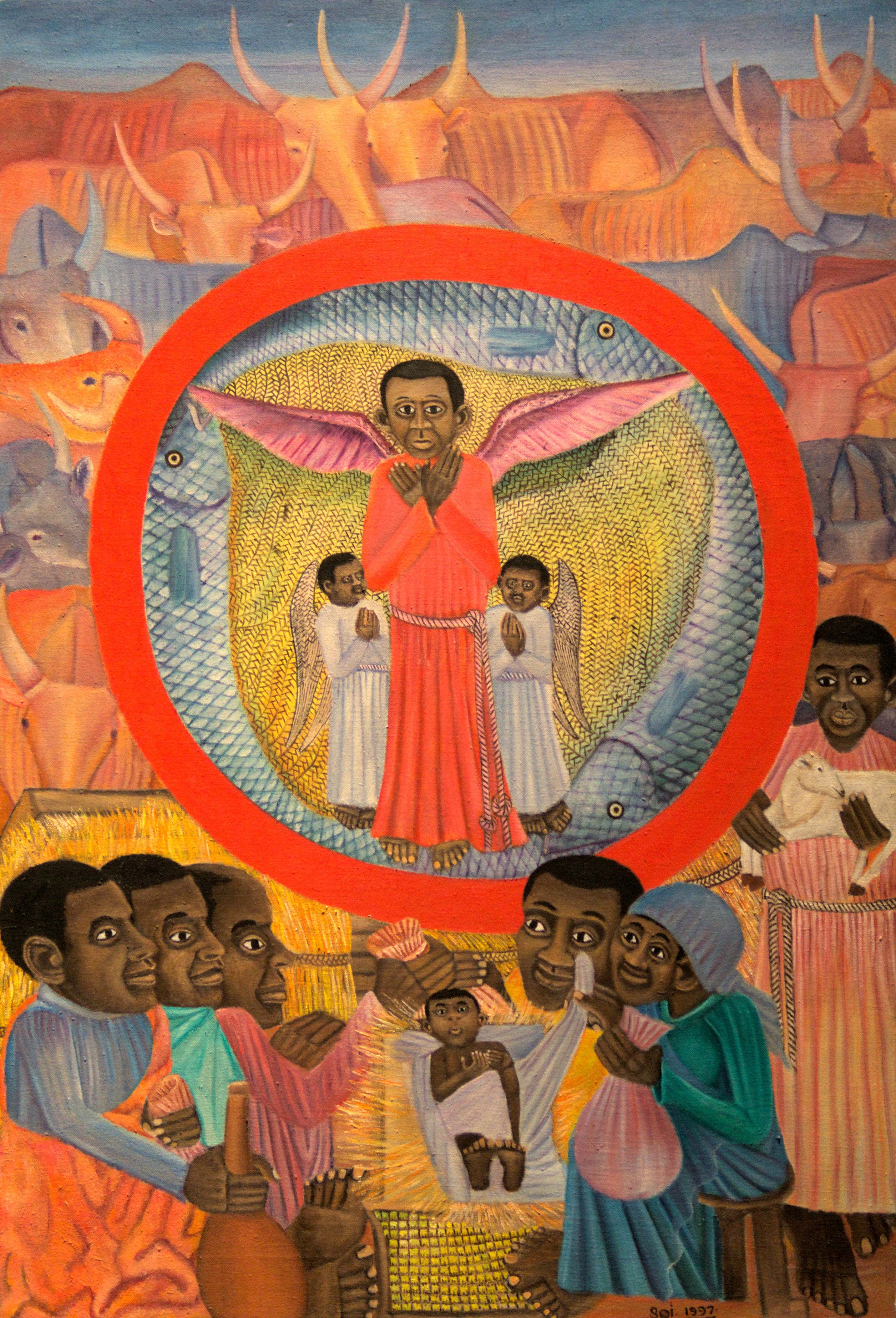
LOOK: Birth of Jesus with Magi and Celestial Observers by Ancent Soi

Soi, Ancent_Birth of Jesus
Ancent Soi (Kenyan, 1939–2022), Birth of Jesus with Magi and Celestial Observers, 1997. Oil on canvas, 34 × 23 in. (86.4 × 58.4 cm). North Carolina Museum of Art, Raleigh. Photo: Victoria Emily Jones. [object record]

LISTEN: “Nyathi Onyuol” (A Child Is Born) | Traditional Luo spiritual, arr. Enrico Oweggi, 1990 | Performed by the Nairobi Chamber Chorus, 2021

Isaya ne okoro k’owacho niya
“Kuomwa nyathi onyuol.”
Nyathi ma wuoyi, no luonge Hono,
Jabura, Nyasaye ma Jateko, Wuonwa, Emmanuel.

Chieng’o nogo piny neolil piny neo kuwe,
Sulwe ne rieny, Nyathi n’o nyuol.
Kanyna n’oting’o Maria, yawa, kodhiyoe piny mar
Daudi kwargi kanyna n’oting’o
Maria yawa Maria ne pek Yesu Jawar
Kar nindo n’otamo Maria yudo
Bethlehem ne opon’g ting ma pek
Josef chwore n’o manyo ot tone ot otamo
Kuom hawi Josef n’onyis kund dhok
Gotieno nogo muoch neoyako Maria.

Isaya ne okoro . . .

ENGLISH TRANSLATION:

Isaiah prophesied and said:
“Unto us a child is born!”
He shall be called Wonderful Counselor,
the Mighty God, our Father, Emmanuel!

On that day
it was dark and silent.
There was no place
in Bethlehem for
Mary and Joseph.
By chance
they were shown
a shed, and that night
Mary gave birth
to the child.

Isaiah prophesied . . .

This song of unknown authorship is written in the Luo language of the Luo people, who traditionally live on the shores of Lake Victoria in western Kenya and northern Tanzania. It was popularized by Muungano National Choir, who recorded it on their 1990 album Missa Luba: An African Mass—10 Kenyan Folk Melodies, as arranged by one of their members, Enrico Oweggi (sometimes rendered “Owegi”).

The Luo lyrics and loose English translation above are sourced from the liner notes of Christmas a Cappella: Songs from Around the World by Chicago a Capella (2008).

Other performance videos available on YouTube include those by Christ the King Church Choir in Kampala and the Choir of ACK St. Stephen’s Bamburi in Mombasa.

Christmas Day: Hark!

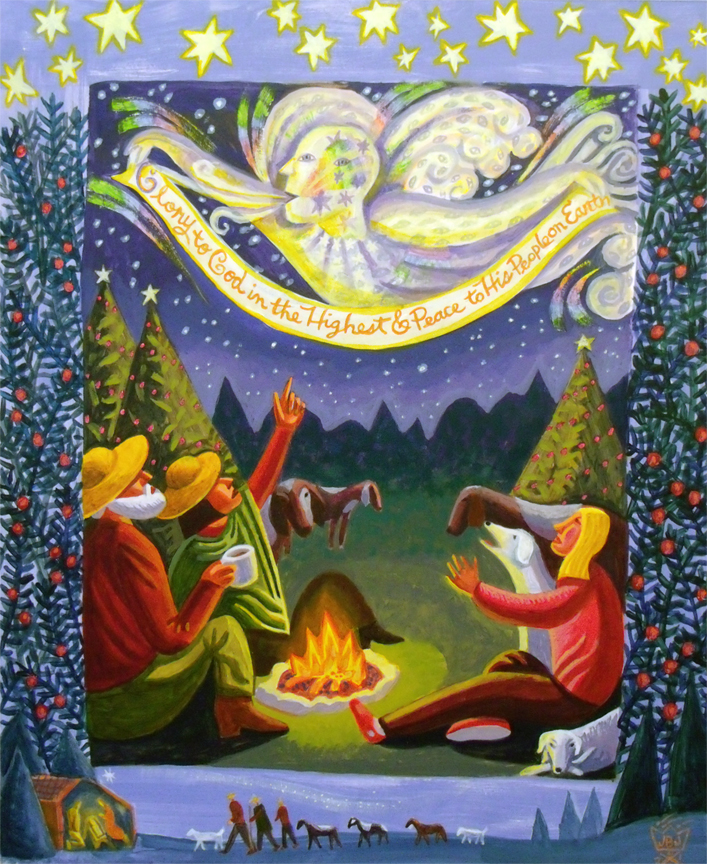
LOOK: Shepherds by James B. Janknegt

Janknegt, James B._Shepherds
James B. Janknegt (American, 1953–), Shepherds, 2011. Acrylic on paper, 17 × 13 in.

LISTEN: “Hark! Hark What News” | English folk carol from Cornwall or South Yorkshire, 17th or 18th century | Performed by Maddy Prior and the Carnival Band, on Gold, Frankincense & Myrrh, 2001

Hark! Hark what news the angels bring:
Glad tidings of a newborn King.
Born of a maid, a virgin pure,
Born without sin, from guilt secure.

Hail, mighty Prince, eternal King!
Let heaven and earth rejoice and sing!
Angels and men with one accord
Break forth in songs: “O praise the Lord!”

Behold! he comes, and leaves the skies:
Awake, ye slumbering mortals, rise!
Awake to joy, and hail the morn,
The Savior of this world was born!

Echoes shall waft the strains around
Till listening angels hear the sound,
And all the heavenly host above
Shall join to sing redeeming love.

Advent, Day 24 (Christmas Eve): Genealogy of Christ

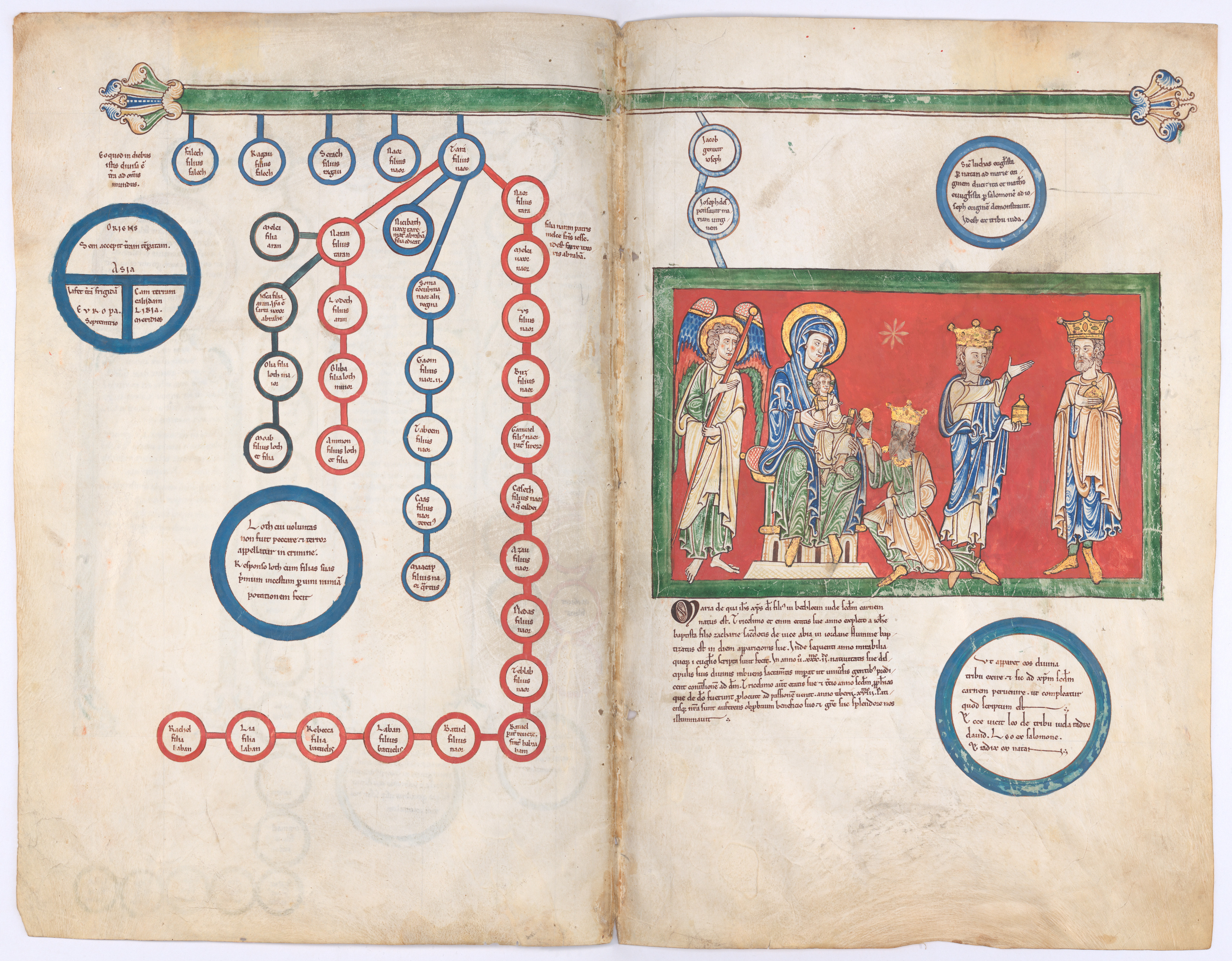
LOOK: Genealogy of Christ and the Adoration of the Magi, from a Beatus manuscript

Genealogy with Adoration of the Magi
Bifolium with part of the Genealogy of Christ and the Adoration of the Magi, from a Beatus manuscript, Spain, ca. 1180. Tempera, gold, and ink on parchment, each folio 17 1/2 × 11 13/16 in. (44.4 × 30 cm). Metropolitan Museum of Art, New York.

LISTEN: “Christ” by Poor Bishop Hooper, on Firstborn (2018)

Abraham fathered Isaac
Isaac fathered Jacob
Then Jacob fathered Judah and his brothers
Judah, he fathered Perez
Who fathered Hezron, who fathered Aram
Aram fathered Amminadab
Who fathered Nahshon, who fathered Salmon

Salmon fathered Boaz by Rahab
Boaz fathered Obed by Ruth
And Obed fathered Jesse, and Jesse was the father of King David
Then David fathered Solomon by Uriah’s own wife

Solomon, he was the father of Rehoboam, who fathered Abijah
Who fathered Asa and then Jehoshaphat
Jehoram fathered Uzziah
Who fathered Jotham
Jotham, he fathered Ahaz, who was the father of Hezekiah

Manasseh, he fathered Amon (who fathered Josiah)
And Jeconiah (and his brothers) amidst the exile
Shealtiel fathered Zerubbabel (who fathered Abihud)
Who fathered Eliakim (who fathered Azor), who fathered Zadok
Zadok fathered Achim (who fathered Eliud), who fathered Eleazar
(Who fathered Matthan) Who fathered Jacob

And Jacob was the father of Joseph
And Joseph took a virgin for his wife
And Mary was the one who gave birth to the Son of God
(Mary was the one who gave birth to the Son of God)
Mary was the one who gave birth to the Son of God
(Mary was the one who gave birth)

And his name is Jesus
Who is called the Christ (Jesus)
Wonderful Counselor (And his name is Jesus)
Almighty God, the everlasting Father (And his name is Jesus)
Prince of Peace, Almighty God (And his name is Jesus)
Who is called the Christ

Who knew a sung genealogy could be so captivating? Jesse and Leah Roberts are a married couple from Missouri who write, sing, and record songs together as Poor Bishop Hooper. The lyrics of “Christ”—a list of Jesus’s ancestors—come straight from Matthew 1. This recording from their home studio premiered at the virtual Songs for Hope: A TGC Advent Concert on December 6, 2020.

Roundup: Bolivian Christian art, Ukrainian folk carol, and more

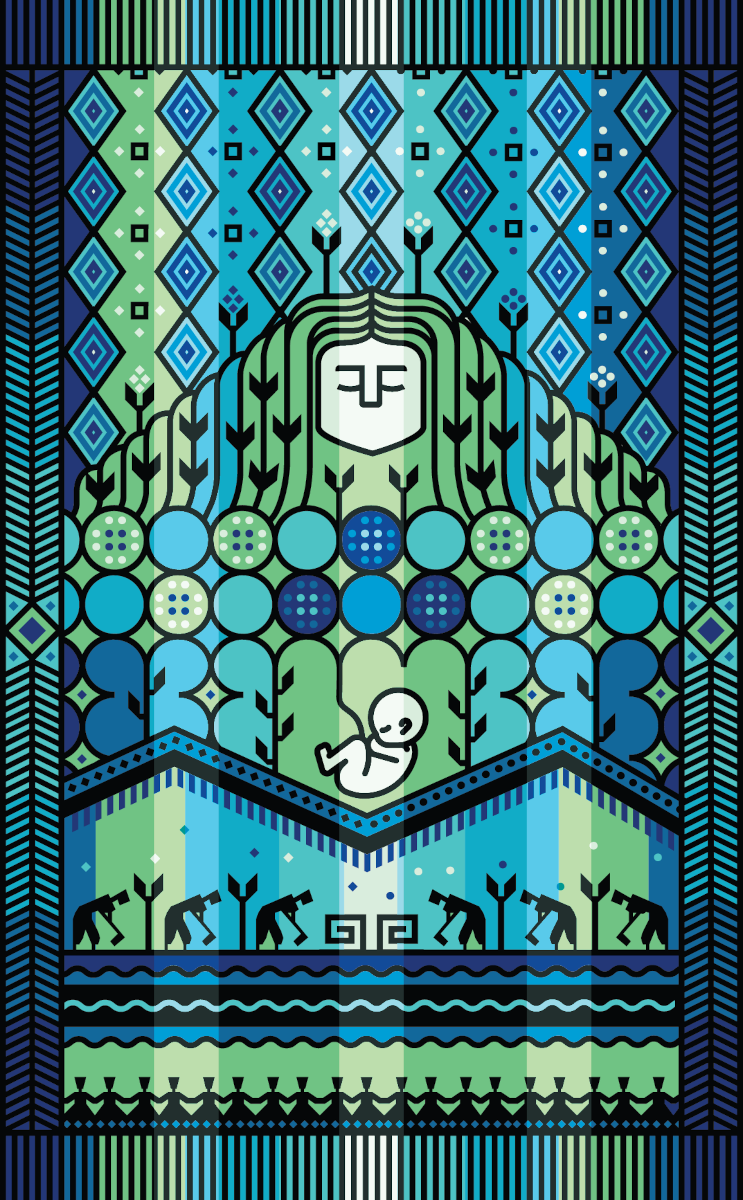
ART SERIES: Pallay: Andean Weaving of Liturgy and Design by Daniela Améstegui: Daniela Améstegui is a graphic designer from Cochabamba, Bolivia, who holds a master’s degree in theological studies from Regent College in Vancouver, with a specialization in Christianity and the arts. Her work “revolves around exploring faith, social justice, and Christian contextualization through design” and “reflects her commitment to using design as a tool for expressing and exploring theological concepts,” she says. She currently lives in Langley, British Columbia, with her husband and two young children, working as a freelancer.

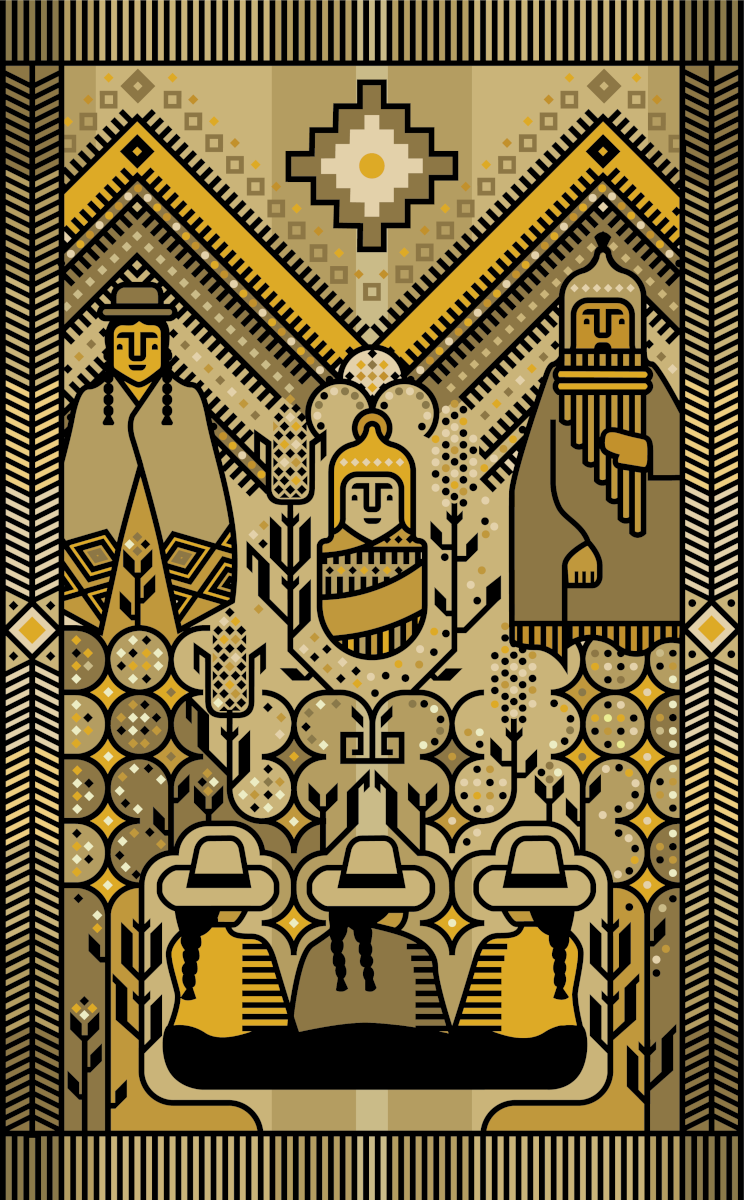
Améstegui’s final Integrative Project in the Arts and Theology for her master’s program was Pallay: Andean Weaving of Liturgy and Design, a series of seven digital illustrations, one for each of the major seasons/feasts of the liturgical year: Advent, Christmas, Epiphany, Lent, Easter, Pentecost, and Ordinary Time. The designs are inspired by Andean textile art and culture. You can view the full series at the link above from Regent College’s Dal Schindell Gallery, where the works were first exhibited in early 2022, but also listen to this wonderful online talk Améstegui gave about Pallay in 2020 for INFEMIT’s Stott-Bediako Forum, where she discusses not only her motivation and influences but also the content of each specific piece:

Whereas those of us in the northern hemisphere associate Advent with cold, darkness, and the onset of winter, in the southern hemisphere Advent falls in early summer, a time when the earth is most fertile and farmers plant their seeds. In her Advent design, Améstegui connects Mary carrying the seed of new life within her with Pachamama (Mother Earth).

Amestegui, Daniela_Advent
Daniela Améstegui (Bolivian, 1990–), Adviento (Advent), 2019–20, from the digital illustration series Pallay: Andean Weaving of Liturgy and Design. Used with permission.

In Bolivia, Christmas takes place during a season of harvest, so in her Christmas design, Améstegui places Jesus in the center between crops of corn and quinoa, the two main agricultural foods cultivated in the country. Mary wears braids and a bowler hat and Joseph plays the zampoña (Andean panflute), and at the bottom three cholitas, Indigenous women from the Bolivian countryside, gather reverently to greet the Christ child.

Amestegui, Daniela_Christmas
Daniela Améstegui (Bolivian, 1990–), Navidad (Christmas), 2019–20, from the digital illustration series Pallay: Andean Weaving of Liturgy and Design. Used with permission.

Améstegui does not have a website just yet but tells me she plans to launch one in 2025. If you would like to purchase one or more of her Pallay pieces, you can contact her at daniela@amestegui.com.

Thank you to blog reader Nicole J. for alerting me to this striking series!

+++

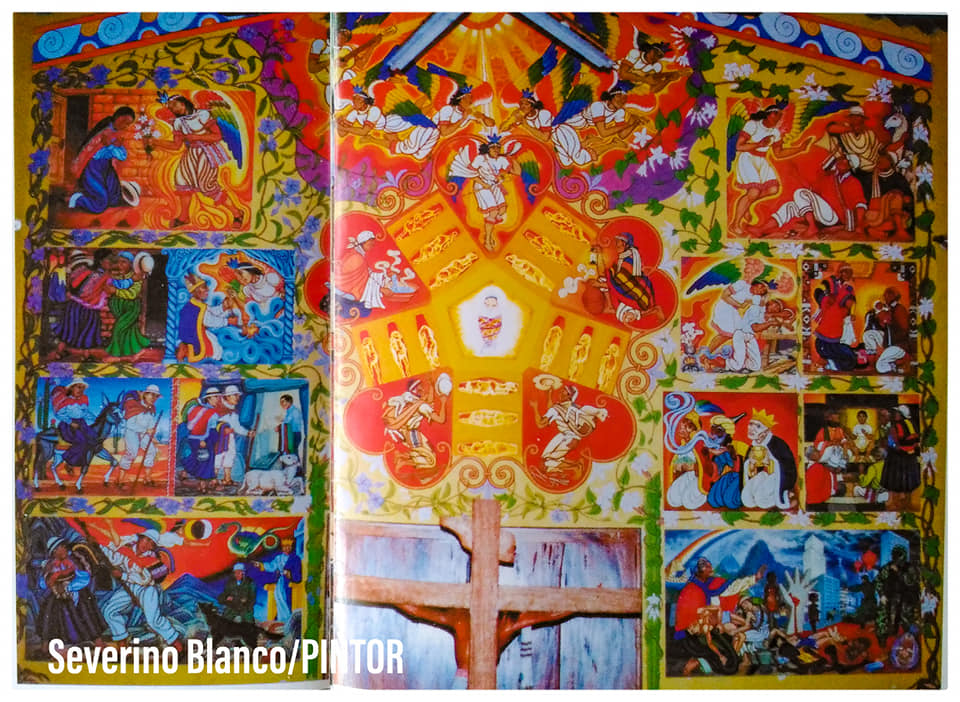
VIDEO COLLECTION: Casa del Catequista (CADECA) chapel paintings: As chance would have it, the same week I learned about Daniela Améstegui’s work, a different blog reader, Mark M., emailed me a link to some videos his Langham Partnership colleague Paul Windsor took during a recent trip to Bolivia. They record the many paintings, most by the late Quechua artist Severino Blanco [previously], inside the chapel of CADECA in Cochabamba, a place where men and women are trained as Christian leaders who then go out to serve their rural communities. They portray scenes from the Old and New Testaments, the parables of Jesus, and Latin American church history, including a remarkable liberation theology–inspired Resurrection, in which Jesus breaks down the doors of death and hell, holding high a cacique’s staff and leading the people of Bolivia into their future. Here’s a 360-degree view captured by Windsor, but visit the boldface link to see additional videos that narrow in on particular portions.

Blanco, Severino_Nativity
Severino Blanco (Quechua [Bolivian], 1951–2020), Infancy of Christ painting cycle, 1985. Chapel of the Casa del Catequista (CADECA), Cochabamba, Bolivia.

On the west end of the chapel (where people enter the space) is an Infancy of Christ cycle—reproduced here from a scan of a pamphlet, it appears. In the center is a Nativity, the Christ child painted over a pane of glass through which natural light comes gleaming in (see a closer view). The oblong shapes radiating out from the center are also glass, onto which the artist has (I think) etched lambs in various stages of prostration. On the sides, two villagers come with hot water and towels, and at the bottom two shepherds kneel before the Savior, removing their hats as a sign of respect. At the top, a host of angels with rainbow-colored wings and indigenous instruments sing Christ’s praises.

To the left of the Nativity are six scenes: (1) The Annunciation to Mary, (2) The Visitation, (3) The Annunciation to Zechariah, (4) The Journey to Bethlehem, (5) No Room at the Inn, and (6) The Flight to Egypt. To the right are (7) The Annunciation to the Shepherds, (8) The Annunciation to Joseph, (9) The Presentation in the Temple, (10) The Adoration of the Magi, (11) Jesus with the Scholars in the Temple, and (12) The Massacre of the Innocents.

+++

SONGS:

>> “Admirable Consejero” (Wonderful Counselor) by Santiago Benavides: Santiago Benavides is a Colombian singer-songwriter living in Toronto. On his Facebook page he describes his musical style as “trova-pop-bossa-carranga worship.” This song he wrote is a setting of Isaiah 9:2, 6–7 in Spanish. In the video, he’s the guitarist with the red-tinted glasses.

>> “The Word Became Flesh” by John Millea: John Millea is “a storyteller with a guitar,” singing in the tradition of Americana, folk, and gospel “about life and all of its joys, sorrows, and struggles.” He’s one of the artists I support through Patreon. This was the first song of his I encountered, and it’s one of my favorites, engaging with John 1:1–3, 14 in a wholly unique way!

In contrast to everyone and everything else in the universe, Millea explains, God had no beginning point, and all that is can in some way be traced back to him, the first link in a massive chain of cause and effect. So here Millea playfully traces his guitar all the way back to God—from the store he bought it at in Illinois, to the factory in Pennsylvania they ordered it from, to the mill in Washington that supplied the wood, to the Alaskan forests whence the tree was logged, and so on and so forth, imagining many thousands of years of fallen and dispersed tree seeds that traversed seas and continents, with an ultimate source in a tree planted in Eden by the Word of God.

When he hits on Eden, he starts moving forward again, through the story of creation, fall, and redemption in Christ, the divine beginningless One who graciously and mysteriously entered human history, born of a woman named Mary.

>> “Mary Had a Baby”: Arranged by Roland Carter, this African American spiritual is performed by the Nathaniel Dett Chorale, featuring the amazing mezzo-soprano Melissa Davis. It’s from their 2003 album An Indigo Christmas, the tracks taken from two live concerts given at the Church of St. George the Martyr in Toronto.

>> “Що то за предиво” (Shcho to za predyvo) (Behold a Miracle): This Ukrainian folk carol is performed by Trioda (Тріода), a musical group consisting of Andrii Gambal, Volodymyr Rybak, and Pavel Chervinskyi.

What is this awe-inspiring miracle?
There is great news on earth!
That the Virgin Mary gave birth to a son.
And upon birthing him, she declared,
“Jesus—my son!”

And the aging Joseph stands nearby in awe
Of Mary having given birth to a son.
And he prepares the swaddling for Jesus Christ.
And Mary swaddles him, and scoops him to her heart—
The pure Virgin Mary!

Trans. Joanna (Ivanka) Fuke [source]