LISTEN: “Joseph mon cher fidèle” (Joseph, My Dear Faithful One), traditional carol from the French West Indies | Performed by Robert Mavounza on Bakwa Nwel (2005)
Marie:
Joseph, mon cher fidèle,
Cherchons un logement,
Le temps presse et m’appelle
A mon accouchement.
Je sens le fruit de vie,
Ce cher enfant des cieux,
Qui d’une sainte vie,
Va paraître à nos yeux.

Joseph:
Dans ce triste équipage,
Marie allons chercher,
Par tout le voisinage,
Un endroit pour loger.
Ouvrez, voisin la porte,
Ayez compassion
D’une vierge qui porte
Votre rédemption.

Les voisins de Bethléem:
Dans toute la bourgade,
On craint trop les dangers,
Pour donner le passage
A des gens étrangers,
Au logis de la lune,
Vous n’avez qu’à loger,
Le chef de la commune
Pourrait bien se venger.

Marie:
Ah! Changez de langage,
Peuple de Bethléem,
Dieu vient chez nous pour gage,
Hélas! Ne craignez rien.
Mettez-vous aux fenêtres,
Ecoutez ce destin,
Votre Dieu, votre Maître,
Va sortir de mon sein.

Les voisins de Bethléem:
C’est quelque stratagème
On peut faire la nuit,
Quelque tour de bohème,
Quand le soleil ne luit.
Sans voir ni clair, ni lune,
Les méchants font leurs coups,
Gardez votre infortune,
Passants, retirez-vous!

Joseph:
O ciel quelle aventure,
Sans trouver un endroit,
Dans ce temps de froidure,
Pour coucher sous le toit.
Créature barbare,
Ta rigueur te fait tort,
Ton coeur déjà s’égare
En ne plaignant mon sort.

Marie:
Puisque la nuit s’approche
Pour nous mettre à couvert,
Ah! Fuyons ce reproche,
J’aperçois au désert
Une vieille cabane,
Allons mon cher époux,
J’entends le boeuf et l’âne
Qui nous seront plus doux.

Joseph:
Que ferons-nous Marie,
Dans un si méchant lieu,
Pour conserver la vie
Au petit Enfant-Dieu?
Le monarque des anges
Naîtra dans un bercail
Sans feu, sans drap, sans langes
Et sans palais royal.

Marie:
Le ciel, je vous assure,
Pourrait nous secourir,
Je porte bon augure,
Sans crainte de périr.
J’entends déjà les anges
Qui font d’un ton joyeux,
Retentir les louanges,
Sous la voûte des Cieux.

Joseph:
Trop heureuse retraite,
Plus noble mille fois,
Plus riche et plus parfaite
Que le louvre des rois!
Logeant un Dieu fait homme,
L’auteur du paradis,
Que le prophète nomme
Le Messie promis.

Marie:
J’entends le coq qui chante,
C’est l’heure de minuit,
O ciel! Un dieu m’enchante,
Je vois mon sacré fruit,
Je pâme, je meurs d’aise,
Venez mon bien-aimé!
Que je vous serre et baise!
Mon coeur est tout charmé.

Joseph:
Vers Joseph votre père
Nourrisson plein d’appas,
Du sein de votre mère
Venez entre mes bras!
Ah! Que je vous caresse,
Victime des pêcheurs,
Mêlons, mêlons sans cesse,
Nos soupirs et nos pleurs.
Mary:
Joseph, my dear faithful one,
Let us search for lodging;
Time is pressing and calling me
To give birth.
I feel the fruit of life,
This dear child from heaven
Who, with a holy life,
Will appear before our eyes.

Joseph:
In this sad predicament,
Let us search, Mary,
Throughout the neighborhood
For a place to stay.
Open the door, neighbor;
Have compassion
For a virgin who carries
Your redemption.

The people of Bethlehem:
Throughout the town,
There is too much fear of danger
To offer shelter
To strangers.
Under the moonlight
Is where you can go lodge;
The town’s ruler
Might seek revenge [on us].

Mary:
Ah! Change your words,
People of Bethlehem;
God comes to us as a pledge.
Alas! Do not fear.
Stand by your windows,
Listen to this destiny:
Your God, your Master,
Will come forth from within me.

The people of Bethlehem:
It’s some kind of ploy,
Which they can work at night,
Some vagabond trick,
When the sun isn’t shining.
Without seeing clearly, without the moon,
The wicked carry out their deeds.
Keep your misfortune;
Passersby, be gone!

Joseph:
Oh heavens, what a hardship,
To not find a place
In this cold weather,
A roof to sleep under.
Barbaric creatures,
Your harshness does you wrong;
Your heart is gone astray,
Not sympathizing with my fate.

Mary:
As the night draws near
To wrap us with its cover,
Ah! let us escape this reproach.
I see in the desert
An old shed.
Come, my dear husband:
I hear the ox and the donkey
Who will be kinder to us.

Joseph:
What shall we do, Mary,
In such a wretched place,
To preserve the life
Of the little Child of God?
The king of angels
Will be born in a manger,
Without fire, without sheets,
And without a royal palace.

Mary:
Heaven, I assure you,
Will come to our aid;
I carry good omens,
And no fear of perishing.
I already hear the angels,
In a joyful tone,
Resounding with praises
Under the vault of heaven.

Joseph:
What a blessed retreat,
A thousand times nobler,
Richer, and more perfect
Than the abode of kings!
Lodging a God made man,
The author of paradise,
Whom the prophet calls
The promised Messiah.

Mary:
I hear the rooster singing;
It’s the hour of midnight.
Oh heavens! A god enchants me.
I see my sacred fruit;
I faint, and am overcome with joy.
Come, my beloved [son]!
Let me hold you and kiss you!
My heart is completely charmed.

Joseph:
Come to Joseph, your father,
Darling boy;
Come into my arms
From your mother’s breast!
Ah! Let me caress you,
Sacrifice for sinners!
Let’s mingle, let’s mingle without ceasing,
Our sighs and our tears.
* This English translation by Djasra Ratébaye was commissioned in 2023 by Art & Theology.
Written as a dialogue between Mary, Joseph, and the people of Bethlehem as the couple first arrives in town, this traditional Christmas carol is from the French Caribbean islands of Guadeloupe and Martinique. As for its approximate date of origin, I found several of its verses appearing as far back as 1703, with a complete version showing up in an 1817 carol collection, but it very well could have circulated prior to that.
The song was famously recorded by Manuela Pioche, Henri Debs, and Guy Alcindor in 1969 on Noël Aux Antilles (reissued on CD in 1993), but overall, I prefer Robert Mavounza’s recording from 2005. In Mavounza’s version, a chorus of voices sings what sounds like “waylo” after every line. The person who translated the song for me is neither Guadeloupean nor Martinican and wasn’t sure of the meaning of the word; he suggested that it’s either a wordless vocable used for embellishment, or else a creole word.
“Joseph mon cher fidèle” is part of the popular repertoire of the Chanté Nwel, the tradition of communal carol singing (with live percussion accompaniment!) that takes place throughout December in Guadeloupe and Martinique. It’s one of the most convivial times of the year.
The Holy Couple’s anxious search for lodging as Mary’s labor pangs begin is a feature of many retellings of the Christmas story, though it’s not present in either of the two Gospel narratives of Christ’s birth. Luke simply says that Joseph “went to be registered [in Bethlehem for the census] with Mary, to whom he was engaged and who was expecting a child. While they were there, the time came for her to deliver her child. And she gave birth to her firstborn son and wrapped him in bands of cloth and laid him in a manger, because there was no place in the guest room” (Luke 2:5–7 NRSV).
Centuries of misinterpretation of the Greek word kataluma as “inn” (instead of the more accurate “guest room”) has led to the invention of an innkeeper character who coldly refuses the needy parents the accommodations they seek. By extension, the whole of Bethlehem is often characterized as inhospitable, for how dare they let the King of the universe be born in a lowly stable? In all historical likelihood, Mary and Joseph were welcomed by family when they got to Bethlehem, but the house where they were staying was full because of the large number of out-of-towners present for the census registration. Adapting to space limitations, Mary and Joseph stayed with their baby in the room where the animals were kept, which would have been attached to the family’s living quarters. Mary most likely would have been assisted by one or more midwives in giving birth and surrounded by family afterward.
Nevertheless, “Joseph mon cher fidèle” is a part of the tradition that imagines a more tense and harrowing birth narrative. When Joseph and Mary arrive in Bethlehem and, hurried by Mary’s increasingly regular contractions, desperately knock on doors to ask for lodging, they are turned away again and again. The townspeople know how suspicious Herod is of strangers, how easily threatened, and they don’t want to risk his ire by harboring one, so they tell the strange couple to go sleep outside somewhere. When Mary tells them she is about to give birth to God, they accuse the couple of trickery and lies; if “God” comes forth from this woman, they chide, it would be some kind of wicked conjuration they produced under the dark cover of shadows.
Joseph reprimands the people of Bethlehem for their rejection and mistrust while Mary resourcefully sets her sights on a distant stable. Joseph laments its unsuitability for such a son as theirs, but Mary reassures him that it will suit Jesus just fine and that God will protect them all through the night. The humble shelter, Joseph concedes, will be made magnificent and holy by the Holy One who inhabits it.
At the hour of midnight, Jesus starts to crown. Mary is ecstatic to meet her son at last, and Joseph sweeps him up into her arms to be showered with love and kisses.
I love that Joseph gets more treatment in this carol than in most others. He gets the last word—the final stanza is in his voice—which is full of such fatherly affection. He and Mary sigh together in relief for a safe delivery and cry together tears of joy, which mingle with the wails of their newborn.
Despite the conflict and stress in the narrative, the music is bright and upbeat throughout. This is, after all, a party carol! Mary maintains a steadfast faith in the God who called and empowered her for the task of bringing God-in-flesh into the world.
This post is part of a daily Advent series from December 2 to 24, 2023 (with Christmas to follow through January 6, 2024). View all the posts here, and the accompanying Spotify playlist here.
>> “How Asian Artists Picture Jesus’ Birth from 1240 to Today” by Victoria Emily Jones, December 18, 2023, Christianity Today: My first CT article was published this week! I was asked to curate and introduce a sampling of Nativity art from across Asia. By representing Jesus as Japanese, Indonesian, or what have you, these artists convey a sense of God’s immanence, his “with-us–ness,” for their own communities—and for everyone else, the universality of Christ’s birth.
I Wayan Turun (Indonesian, 1935–1986), In Bethlehem, 1958. Acrylic on canvas, 46 × 64 cm. Collection of Stichting Zendingserfgoed (Missionary Heritage Foundation), Zuidland, Netherlands.
>> “The Story of Christ in Chinese Art: Scholars at Peking University Make a Christmas Portfolio for LIFE,”Life, December 22, 1941, pp. 40–49: In doing research for my Christianity Today article, I found this old article from Life magazine that features eight Chinese watercolors on silk from the collection of Dr. William Bacon Pettus (1880–1959), an American educator and president of the California College of Chinese Studies in Peking (Beijing) in the 1920s and ’30s, which were being exhibited at New York’s American Bible Society at the time. With the ordination of six Chinese bishops by Pope Pius XI in 1926, the Chinese Catholic Church was transitioning from a mission church to an indigenous local church, and Chinese-style religious art—much of it coming out of the art department of the new Catholic University of Peking (Beiping Furen Daxue)—was part of that localization. Productivity seems to have continued at Furen during the Japanese occupation, as this article attests. Many of the students and faculty were recent converts to Christianity, though the article reports that non-Christians also enrolled and taught in the art program.
Lu Hongnian (Lu Hung-nien) ( 陸鴻年) (Chinese, 1914–1989), The Birth of Jesus, ca. 1941. Chinese watercolor on silk.
Here is one of the paintings by Lu Hongnian, who sometime after this article was published, in part through his having engaged the New Testament as inspiration for his paintings, became a Christian and took the name John. It shows the Holy Family in a mountainside cave, Mary gazing adoringly at her newborn son as Joseph brings more straw to cushion him. Beside them, an angel holds up a lantern for light, while two shepherd children approach from the entrance, eager to meet their Savior.
+++
SONGS:
>> “Philippians 2:5–11” by HARK Music: This song takes a traditional Thai melody, arranged by Tirasip Kraitirangul, and puts it to a Thai translation of the famous Christ Hymn from Philippians 2. It’s performed by the HARK Duriya Tasana Singers (feat. Somchairak Sriket and Damrongsak Monprasit) and Dancers, filmed on location at Chaloem Kanchanaphisek Park in Bangkok. The song is from HARK’s Thai Hymns Album (2014), which can be downloaded for free at https://harkpublications.com/?product=thai-hymns-album-2. The two-stringed bowed instrument you see at 3:21 is a saw u.
The Duriya Tasana (“Curators of the Arts”) ensemble was formed in 2012 under the commission of the Thai-Psalms Project, an endeavor to create Thai traditional and classical music settings for the psalms of the Bible. Many of the members are affiliated with the Bunditpatanasilpa Institute of Fine Arts in Bangkok. Thanks to my friend Janet, whose sister is preparing a move to Thailand, for alerting me to this group!
>> “Jesus You Come” by Tenielle Neda, performed with Jon Guerra: This song by the Australian singer-songwriter Tenielle Neda [previously], which she sings with Jon Guerra, makes a nice complement to the Thai song above. The performance is from “Songs for Hope: A TGC Advent Concert” on December 6, 2020.
+++
MIDDLE ENGLISH LULLABY: “As I lay upon a night”: Medievalist Eleanor Parker introduces a charming Christmas lullaby from fourteenth-century England, a dialogue between Mary and the Christ child, and provides a modern English translation of its thirty-seven stanzas. In the Middle Ages, says Rosemary Woolf, the subject matter of lullabies was often a prophecy of the baby’s future—presumably a romantic promise of great and happy achievements. But here it is the child who relates the future to his mother, thus providing the material for his own lullaby.
+++
ART VIDEO: “Third Sunday of Advent: Ethiopian Art: Gospel Book” by James Romaine: Every December, my friend James Romaine, an art historian who teaches at Lander University, publishes four videos on his Seeing Art History YouTube channel related to the themes of the season, part of his annual Art for Advent series. This year he’s chosen to focus on Ethiopian art, covering illuminations from two different manuscripts, a diptych icon, and a rock-hewn church.
In this video Romaine discusses the formal qualities of two paintings from a sixteenth-century Ethiopian Gospel-book, the identity of the figures, and the liturgical context of the book, including the use of the red veil that’s attached at the top, which, Romaine says, “both protects and sanctifies the icon,” creating a sense of anticipation for the Orthodox believer who, in faith, lifts the veil to see what is revealed.
The third Sunday of Advent is known as Gaudete Sunday, gaudete (pronounced GOW-deh-tay) (Latin for “rejoice”) being the first word of the introit of the day’s Mass, taken from Philippians 4:4–6 and Psalm 85:1:
Gaudete in Domino semper íterum díco, gaudéte: modéstia véstra nóta sit ómnibus homínibus: Dóminus prope est. Nihil sollíciti sítis: sed in ómni oratióne petitiónes véstrae innotéscant apud Déum. Benedixísti, Dómine, térram túam: avertísti captivitátem Jácob.
Rejoice in the Lord always; again I say, rejoice. Let your forbearance be known to all men. The Lord is at hand. Do not be anxious over anything; but in all manner of prayer, let your requests be made known unto God. Lord, you have blessed your land; you have put an end to Jacob’s captivity.
It is customary for priests to swap out their purple vestments for pink today, and for those who use an Advent wreath to light not a purple candle but a pink one. Some churches favor a spare aesthetic in their sanctuaries for the first two weeks of Advent but break out the flowers for this the third. The approximate halfway point of the penitential Advent season, Gaudete Sunday is a special time to rejoice in the nearness of God’s coming as well as God’s presence with us here even now in the waiting, and to receive a foretaste of the bigger celebration to come on Christmas Day.
Here are ten songs for you to enjoy this Gaudete Sunday. If you’d rather listen to them as a YouTube playlist, click here.
The Hour of Lauds: Visitation by Jan Richardson [for sale]
1. “Songs of Joy” by Garrison Doles, written late 1990s, on A Songmaker’s Christmas, 2012: “Songs of joy we hopefully sing, expanding our spirits, the season to know . . .” So opens this song by the late singer-songwriter Garrison Doles (d. 2013) [previously]. In 2009 his wife, the artist Jan Richardson, created a video combining the song with five of the seven collages from her Advent Hours cycle (which can be purchased as reproductions). Read the lyrics and songwriter’s statement here.
2. “My Soul Doth Magnify the Lord” by O’Landa Draper and the Associates, on Live…A Celebration of Praise, 1994: A trailblazing gospel choir director, O’Landa Draper was one of the top gospel artists of the nineties. This song of his is based on the Magnificat, the praise song Mary sings in the company of her cousin Elizabeth following the conception of Christ (see Luke 1).
3. “El burrito de Belén” (The Little Donkey of Bethlehem) by Hugo Cesar Blanco, 1972, performed by the band Matute, 2020: This is a Venezuelan carol about a person riding their donkey, with hurried excitement, from the sabanero (savanna) to Bethlehem to see the newborn Christ. Read the lyrics and translation here.
4. “Ecce mundi gaudium” (Behold the Joy of the World), England, 13th century, arranged and performed by the Mediæval Bæbes on Worldes Blysse, 1998: Written in Latin, this thirteenth-century carol is about the Virgin giving birth to the Son, our joy—announced to the shepherds by an angel and to the magi by a star. Despite the upbeat tempo throughout, the last two verses are about Herod’s raging and the Massacre of the Innocents. The soloist is Katharine Blake, the founder and musical director of Mediæval Bæbes. Read the original lyrics here, clicking on individual lines for the English translation.
6. “Repeat the Sounding Joy,”a fragment from “Joy to the World” arranged by Craig Courtney, performed by the Capital University Chapel Choir, 2019: A super-fun, one-minute choral work.
7. “Now Let Us Sing,” traditional, adapt. John L. Bell, 1995, performed by Katarina Ridderstedt, 2015: Katarina Ridderstedt (née Lundberg) is a rhythm teacher, musician, cantor, and choir director from Gotland, Sweden, who records music under the name Musikat. This video of hers introduced me to a charming little quatrain whose origins I don’t know (it’s credited as “Traditional”), but this version comes from Scotland’s Iona Community [previously]: “Now let us sing with joy and mirth, / praising the one who gave us birth. / Let every voice rise and attend / to God whose love shall never end.”
(Update, 1/6/25: “Now let us sing” is of Scottish origin, first appearing during the Protestant Reformation in the congregational song collection The Gude and Godlie Ballatis; the earliest extant edition of this book is from 1567, but it is thought to have been originally published in 1540. The tune was originally a drinking tune. For his rendition, published in Come All You People: Shorter Songs for Worship, John L. Bell essentially rewrote the first stanza, retaining only the first line of the original.)
8. “Brother” by Jorge Ben Jor, on A Tábua de Esmeralda, 1974: Known by the stage name Jorge Ben or (since the 1980s) Jorge Ben Jor, Jorge Duílio Lima Menezes (b. 1939) is a Brazilian singer-songwriter and musician whose characteristic style fuses elements of samba, funk, rock, and bossa nova. In this song he enjoins us to prepare a joyful path for the coming Christ—who is both Lord and friend—with love, flowers, and music.
9. “Alleluia, He Is Coming (I Looked Up)” by Martha E. Butler, 1979: This song is sometimes used in church services for Palm Sunday or Easter, but I think it makes a fitting Advent song as well—especially with the newer last verse that is sometimes used, as in the first video below. “Alleluia, he [Christ] is coming! Alleluia, he is here,” the refrain proclaims. Read about the inspiration behind the song, in the words of the songwriter, here. Allow me to sneak in two different performances. The first is by Donna Rutledge, Becky Buller, and Todd Green of First Baptist Church of Manchester, Tennessee, from 2020; theirs is a lovely rendition with strong vocals and a poignant violin part, but I do prefer a brisker pace (listening to the video at a playback speed of 1.25 is perfect, in my estimation):
The second is by the South African group Worship House, from their 2016 album Project 5 (Live in Johannesburg):
10. “Joy Will Come” by Paul Zach: The refrain of this song by Paul Zach of Virginia is based on Psalm 30:5b: “Weeping may linger for the night, but joy comes with the morning.” I also hear echoes of Psalms 18 and 121 throughout. The song is a reminder that through the dark nights we experience, we have hope; we have a Savior who will not abandon us.
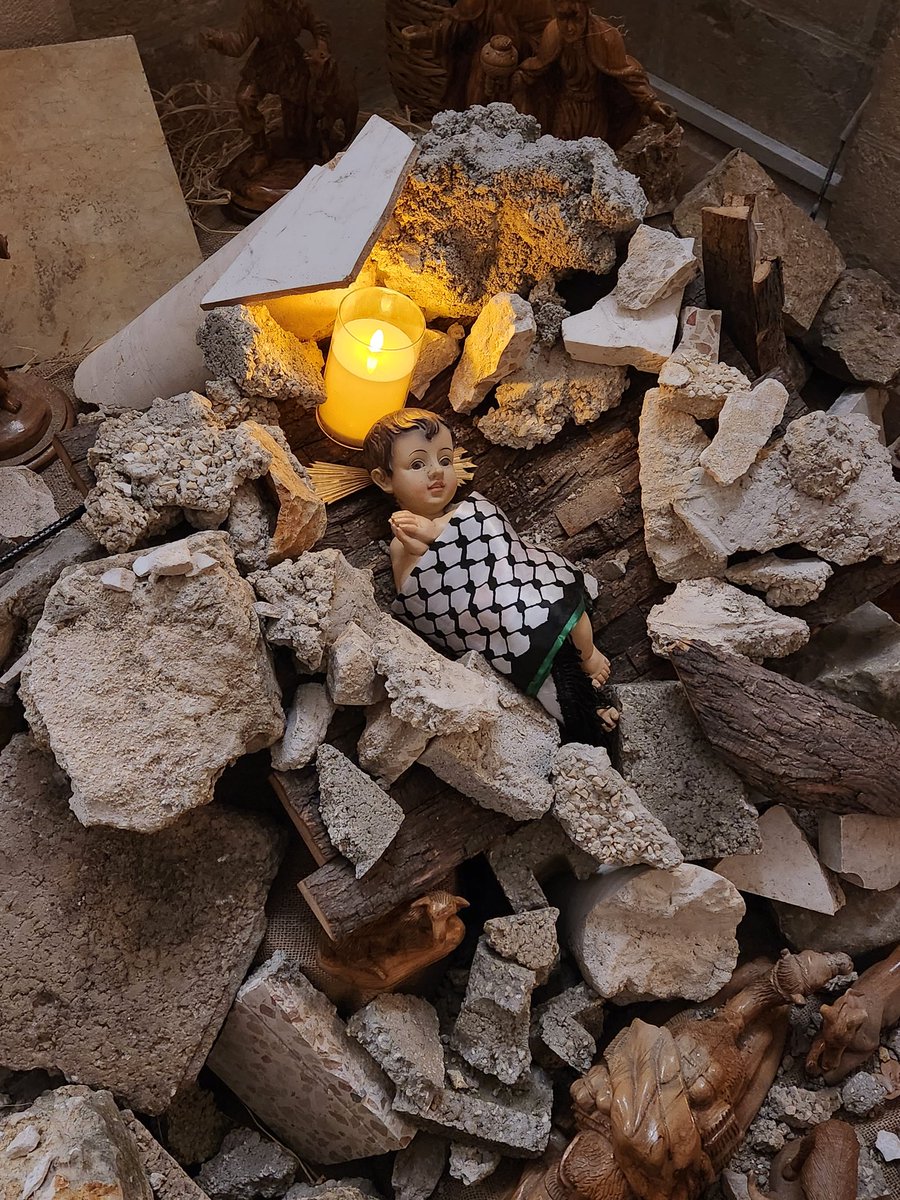
It shows the baby Jesus wrapped in a black-and-white checkered keffiyeh (Palestinian headdress) and lying in a pile of rubble while Mary, Joseph, the shepherds, the wise men, and the animals search for him. It is situated at the side of the altar in Bethlehem’s Evangelical Lutheran Christmas Church, which Rev. Dr. Munther Isaac, a prominent Palestinian Christian peacemaker, pastors. He said he wants the world to know that this is what Christmas looks like in Palestine this year, and for his own congregation to know the solidarity of Christ with the oppressed. Al Jazeera ran a news segment on the crèche on Tuesday, which features an interview with Isaac:
Since October 7, over 16,000 Palestinians have been killed by Israeli forces, and almost 1.9 million Palestinians (over 80 percent of the population) have been displaced. Morgues and hospital halls are overflowing in Gaza, and many people remain trapped under buildings felled by air strikes.
“In Gaza today, God is under the rubble. He is in the operating room,” Isaac wrote on Instagram. “If Christ were to be born today, he would be born under the rubble. We see his image in every child killed and pulled from under the rubble. In every child in incubators.” He expanded on these sentiments in a sermon preached October 22, titled “God Is Under the Rubble in Gaza,” reproduced in Sojourners. See also this video clip of Isaac explaining why his church chose to display such a scene in their sanctuary.
BLOG POST: “When a Dragon Tried to Eat Jesus: The Nativity Story We Don’t Talk About” by Chad Bird: “I’m still searching for a Christmas card with a red dragon in the nativity, lurking amidst the cows and lambs, waiting to devour the baby in the manger,” writes Bible scholar Chad Bird [previously]. “None of the Gospels mention this unwelcome visitor to Bethlehem, but the Apocalypse does. John paints a seven-headed, ten-horned red dragon onto the peaceful Christmas canvas. You can read all about it in Revelation 12. It’s the nativity story we don’t talk about. A dragon trying to eat our Lord . . .”
I’ve been wanting to write a long-form essay on this topic for some time—the dragon as a character in the Christmas story; a cosmic battle underlying our cozy little crèches. I would pull in iconography of the Woman of the Apocalypse and the treading of the beasts, as well as some Christmas songs and poems that reference the dragon. I won’t get around to it this season . . . but it’s coming sometime!
For now, I simply offer Chad Bird’s wonderful blog post to get you thinking about it. Since it was published in 2016, I’ve started seeing more people bringing it up. In 2019, Glen Scrivener, a minister in the Church of England, released the kids’ video “There’s a Dragon in My Nativity,” with illustrations by Alex Webb-Peploe and animation by Diego M. Celestino:
In 2020, Rev. Yohanna Katanacho, a Bible professor in Nazareth, wrote “The Christmas Dragon” for Radix, a retelling of the Nativity story through the lens of Revelation 12. And in a Christianity Today article published last December, Julie Canlis recommended adding a red dragon to your nativity set! Apparently some families have been doing this for years, such as the Gowins and the Palpants:
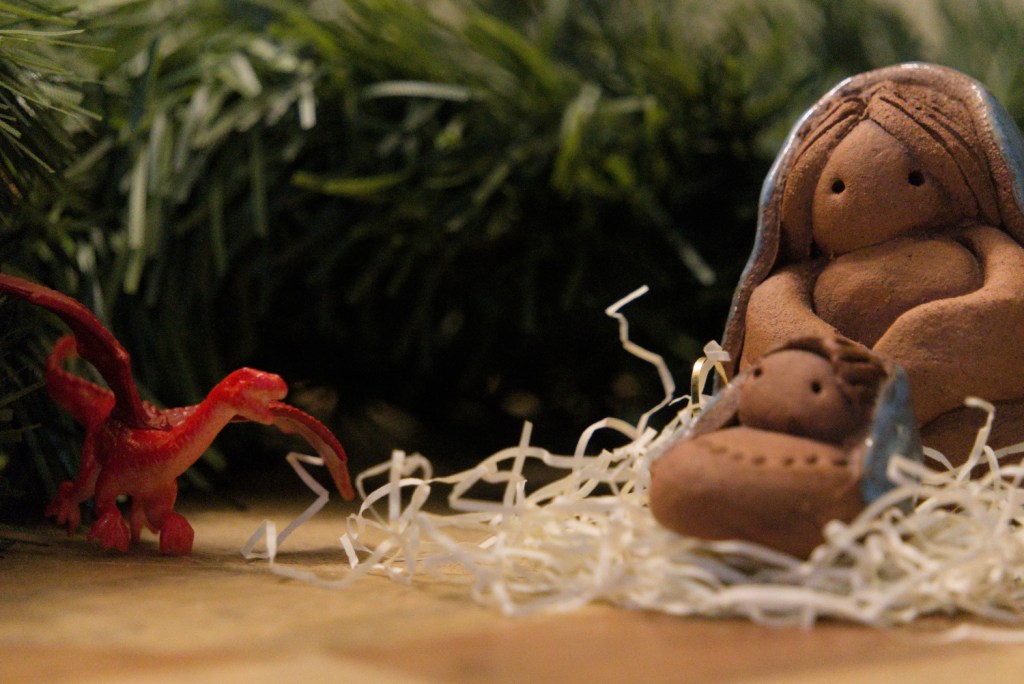
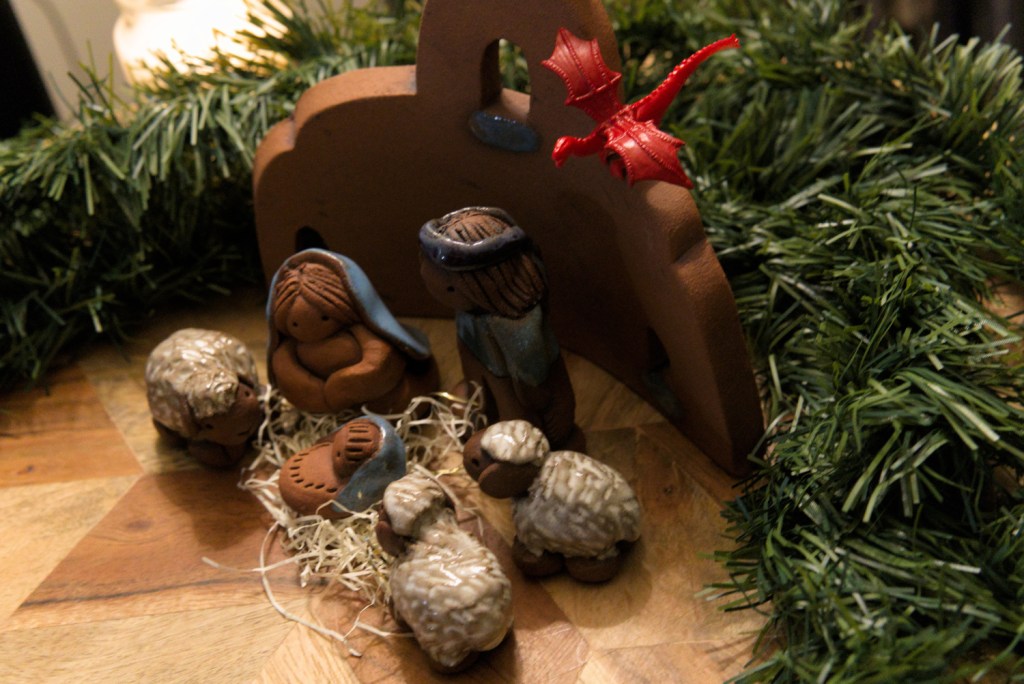
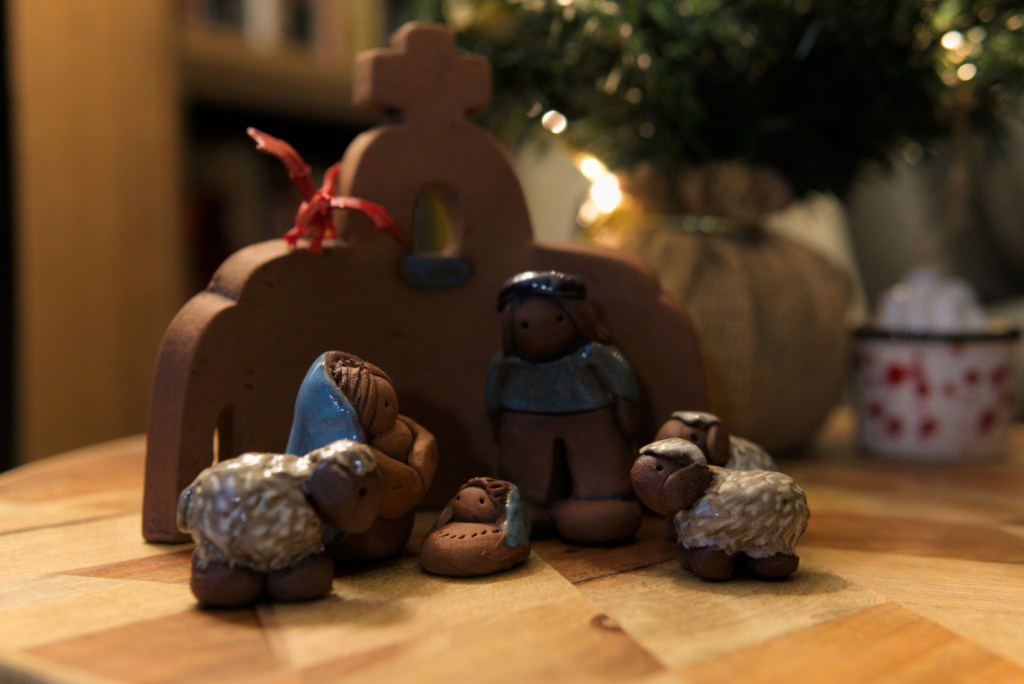
This year I bought a little plastic dragon myself to add to my household nativity! Below are some photos my husband and I took. The clay figurines and adobe-style backdrop were made by Barbara Boyd, an artisan from New Mexico. (I bought them in 2016 at a festival in Albuquerque.)
The dragon was part of a cheap multipack from Amazon, and there are twenty-three other dragons that I don’t know what to do with—so if you live in the US and you want one, shoot me an email at victoria.emily.jones@gmail.com and your physical mailing address and I’ll send you one! The first three respondents get a red one. None of them are seven-headed or horned per Revelation (a gap in the Christmas market, perhaps?!), but they still convey the gist.
+++
LECTURE: “What Is God’s Future for the World?: An Eschatological Vision for the Kingdom on Earth” by N. T. Wright: This talk on inaugurated eschatology, on heaven and earth coming together redemptively and new-creatively, was delivered at the Fuller Forum at Fuller Theological Seminary on May 3, 2014. Any time we talk, sing, or preach about the return of Christ and the end, Wright says, we’re really using signposts that point into a bright mist. But we need those signposts. Wright seeks to dispel the popular belief that humans’ ultimate destination is some disembodied existence “up there” and instead have us embrace the ancient vision of this world as the site of the Messiah’s eternal reign and these bodies as participants, a vision of creation made new from the old. To believe that God will eventually abandon the world to the forces of human wickedness or entropy and decay instead of claiming it as his own undermines the entire narrative of scripture. Wright makes his case by way of the books of Genesis, Isaiah, Ezekiel, Daniel, the Psalms, the Gospels, Romans, and Revelation—the whole gamut.
“The Jewish vision of God’s ultimate future was never that people would leave this world and end up somewhere else called heaven in the company of God. . . . When eschatology comes into full focus, . . . it is all about God’s kingdom being set up on earth as in heaven, and indeed on earth by means of heaven.” He continues, “Heaven is the place where God’s future purposes are stored. And the New Jerusalem comes down from heaven to earth so that the dwelling of God is with humans.”
There’s so much more I could say—but instead of reading my takeaways, listen to the talk itself! It ends at 1:04:45 and is followed by an hour of Q&A. Here is a list of the questions with time stamps:
1:05:33: What is your reading of 2 Peter 3:10–12, which says that the earth will be burned up?
1:08:18: What does Paul mean in 1 Thessalonians 4:17: “Then we who are alive, who are left, will be caught up in the clouds together with them to meet the Lord in the air, and so we will be with the Lord forever”?
1:13:05: Where do you land on premillennialism, amillennialism, postmillennialism?
1:15:42: If earth is already crowded, how will everyone fit in the renewed creation after the resurrection?
1:21:42: If this world is going to be renewed, why should we make economic and lifestyle sacrifices now to protect endangered species and such?
1:24:18: How do you interpret John 14:3: “I go and prepare a place for you; I will come again and take you to myself”?
1:27:48: How do you understand hell? What are your thoughts on the teaching of universal restoration, the idea that everyone will eventually be saved?
1:33:48: Since you take issue with Michelangelo’s Last Judgment, what would you have painted at the east end of the Sistine Chapel instead?
1:34:17: How does Paul’s “now and not yet” correlate with Jesus’s teaching that “this generation will not have passed away before all this has happened” (Matt. 24:34; Mark 13:30; Luke 21:32)?
1:36:59: What is the role of departed saints (the “cloud of witnesses”)? What are your thoughts on the intercession of the saints?
1:41:17: What are your words of advice for preaching on these subjects and for pastorally caring for congregants who come with certain stock images of and language about heaven?
1:44:30: Since we believe in Jesus’s bodily resurrection, where is Jesus now?
1:46:28: Please give us some guidance on Paul’s view on homosexuality and how to address this complex issue in the church.
1:52:16: Is there any sense in which the State of Israel founded in 1948 could be the fulfillment of biblical prophecy?
1:56:40: What impact do you hope your work has on Christian discipleship?
2:10:34: What’s the relationship between faith and action?
Oh, and at 1:18:58, Wright offers this rousing sidebar on Christian art:
We are starved imaginatively as Christians. Christian art easily collapses into sentimentalism, just as contemporary postmodern art easily collapses into brutalism. Both of those are ways of seeing something but not the whole picture. Sentimentalism is what you get when you’re determined to smile even if the whole world is falling apart; it becomes inane, this sort of silly grin, and sadly, there’s a lot of Christian art like that.
But actually, Christians ought to be at the forefront of the art and the music, because that creates the imaginative world within which it’s possible to think differently about things. I think the secular world has done a pretty good job, and we’ve colluded with that, of keeping our imaginative levels down to the level of eighteenth- and nineteenth-century Epicureanism or deism, so that heaven is just this odd place, etc., etc. We need the new art and the new music which will create a world in which it makes sense to think of these things.
+++
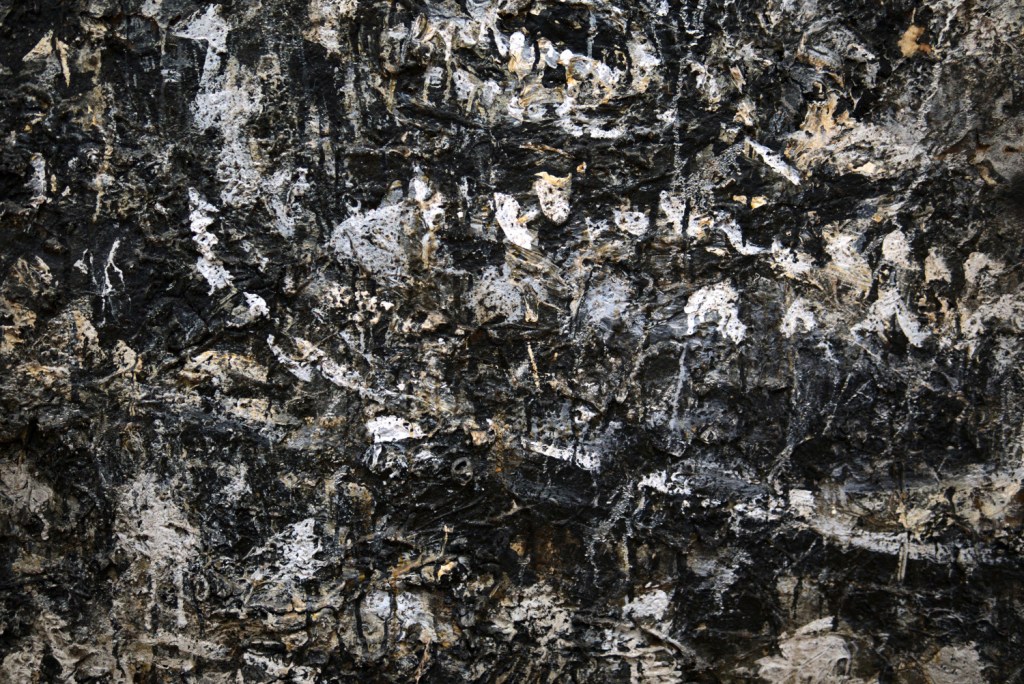
BLOG POST: “Advent Love and Anselm Kiefer’s Alchemist” by Alexandra Davison: I grew up, and my parents and sibling still live, in a suburb of Raleigh, North Carolina, so I’m a somewhat frequent visitor to the North Carolina Museum of Art. Their untitled triptych by Anselm Kiefer is one of my favorite pieces in their collection—it transfixes me every time—so I was delighted to see that Alexandra Davison [previously], a creative director of Artists in Christian Testimony International whom I bump into at arts conferences now and again, wrote about it a few years ago. She describes it as an image of “cosmic drama that waits for resolution,” conveying “an unflinching Advent longing.” I sense that too when I stand in front of it.
Anselm Kiefer (German, 1945–), Untitled, 1980–86. Oil, acrylic, emulsion, shellac, lead, charcoal, and straw on photograph, mounted on canvas, with stones, lead, and steel cable, overall 130 1/4 × 218 1/2 in. North Carolina Museum of Art, Raleigh. Photo: Victoria Emily Jones.
Kiefer is the subject of an acclaimed new documentary by Wim Wenders (which I’m eager to see when it comes to streaming!). He was born in Germany at the tail end of World War II, and his art, which often incorporates materials such as lead, ash, and straw, is inextricably connected to the ravaged landscapes and haunted history of his country.
Every warrior’s boot used in battle and every garment rolled in blood will be destined for burning, will be fuel for the fire. For to us a child is born, to us a son is given, and the government will be on his shoulders. And he will be called Wonderful Counselor, Mighty God, Everlasting Father, Prince of Peace.
—Isaiah 9:5–6 NIV
LOOK: Nativity by Irenaeus Yurchuk
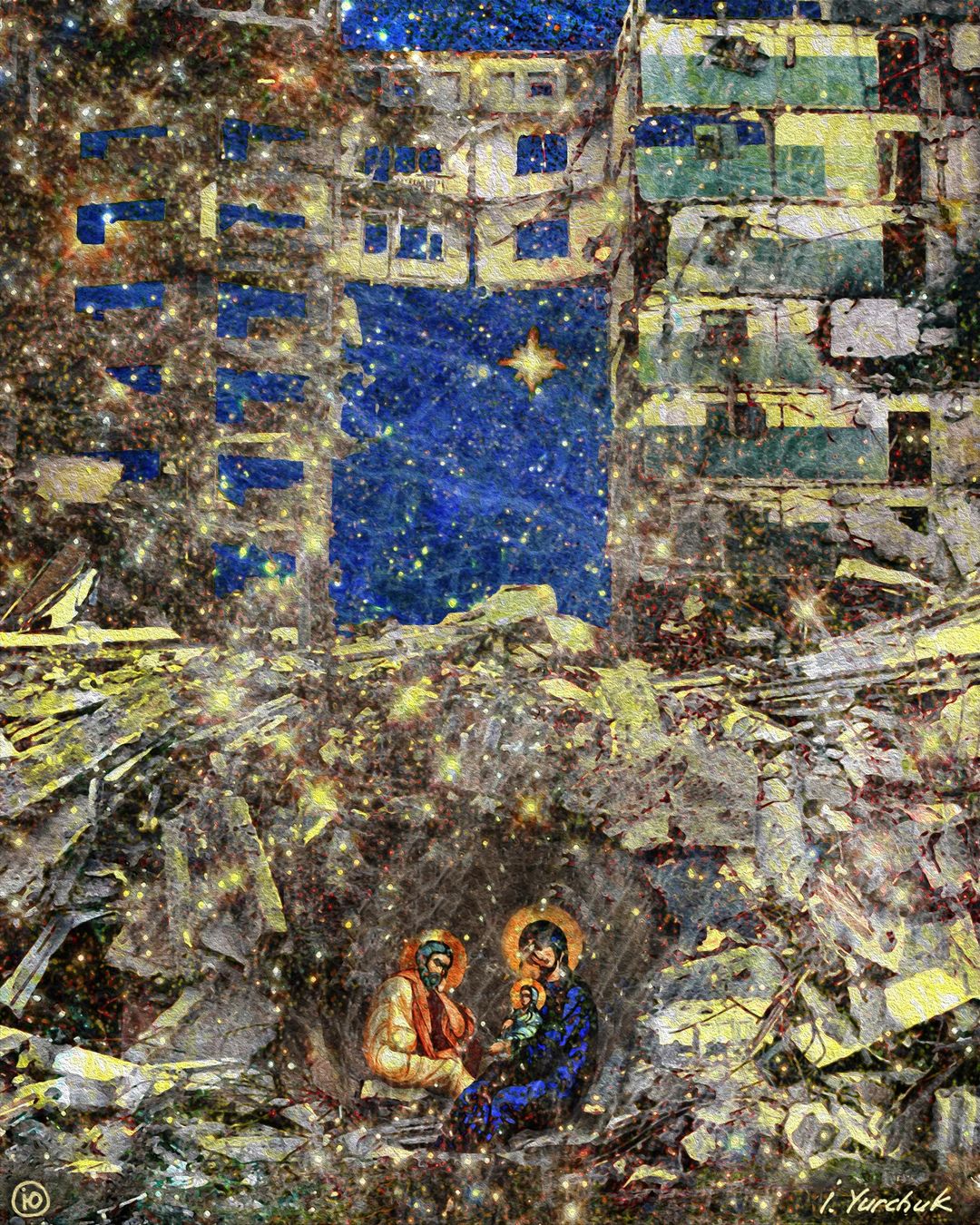
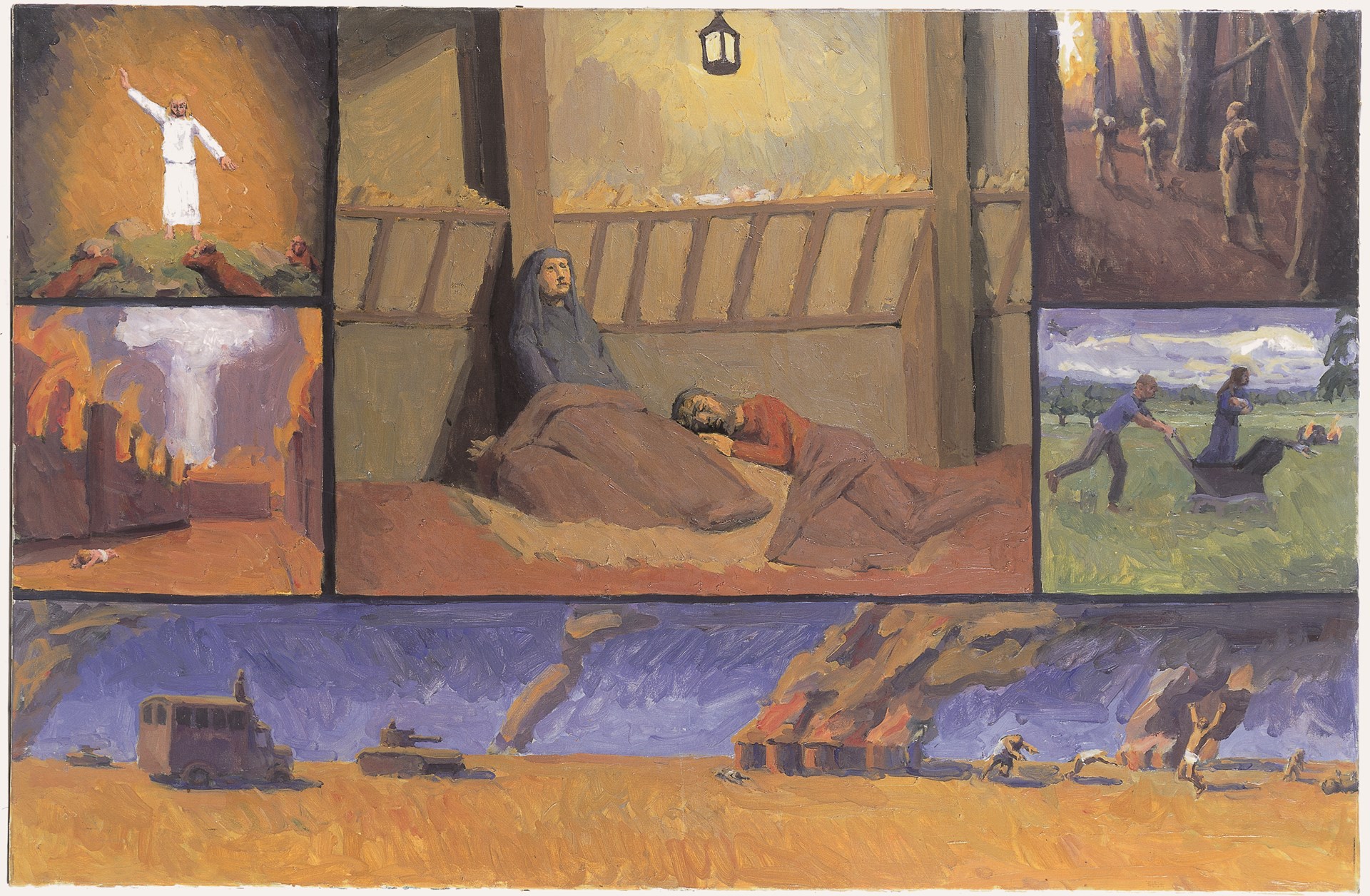
Irenaeus Yurchuk (Іриней Юрчук), Nativity, 2022. Mixed media on canvas. Used with permission.
Irenaeus Yurchuk was born in Ukraine during World War II and raised in central New York, where he still resides. He worked professionally as an urban planner until 2010, when he turned to art full-time.
“Over the years my work has evolved to combine multiple-image photography with drawing and painting, using a variety of digital editing and physical montage techniques,” Yurchuk says. “This includes adjusting inkjet images by applying acrylics, watercolors, pastels, markers, colored pencils together with selected collage materials to achieve a desired effect.”
Yurchuk’s Nativity is a response to Russia’s 2022 military invasion of Ukraine. This is no facile depiction of that historic birth, no cozy winter idyll. It is a war-zone Nativity. It shows the Holy Family, rendered in iconic style, sheltering at night in the rubble of a bombed-out apartment complex. Surrounded by fallen steel beams, concrete, and broken glass, Mother Mary holds the newborn Jesus while a downcast Joseph sits beside them with head in hands. Though their circumstances are dire, through the building’s shell shines one particularly bright star, signifying hope in the horror.
One of the biblical names for Jesus is Emmanuel, Hebrew for “God with us.” By showing the Christ child being born amid the ruins of a contemporary Ukrainian city, Yurchuk reinforces the ongoing relevance of the Incarnation, meditating on God’s descent into our world of woe to dwell with and to deliver. Jesus is “God with us” in our suffering. When everything around us is crumbling, God is there too, hurting alongside and calling all oppressors to account.
Do you recall the famous Christmas text from Isaiah, further immortalized by Handel, that begins “Unto us a child is born . . .”? Well, it is immediately preceded by a prophecy of war’s final demise, of soldiers’ uniforms and accoutrements and all their bloody violence being consigned to one great big burning trash heap. In the new world government established by Christ, the Prince of Peace, tyrants will be overthrown (Luke 1:51–52), and the nations will study war no more (Isa. 2:4).
May this artwork and the song below prompt you to intercede for those suffering under war today, in Ukraine and elsewhere.
LISTEN: “Drive Out the Darkness” by Paul Zach, Isaac Wardell, Dan Marotta, and John Swinton, on Lament Songs by the Porter’s Gate (2020)
Refrain: Come, O come Be our light Drive out the darkness Come, Jesus, come
Every year under the thorn Every wrong that we have known Every valley will be raised Ancient ruins will be remade [Refrain]
Every weapon made for war Every gun and every sword Will be melted in the flame To be used for gardening [Refrain]
In the emptiness of grief Through the night of suffering In the loss and in the tears God of comfort, O be near [Refrain]
Coda: Come, and end all the violence Come, do not be silent Come, we cling to your promise Come, you’ll break all injustice Come, Jesus, come
For my review of the Lament Songs album by the Porter’s Gate, see here.
In addition to these words that the Porter’s Gate has given us to pray, I commend to you this prayer by Rev. Kenneth Tanner, which he posted October 13 in response to recent atrocities in Israel and Gaza (I’ve been returning to it a lot over the past month):
This post is part of a daily Advent series from December 2 to 24, 2023 (with Christmas to follow through January 6, 2024). View all the posts here, and the accompanying Spotify playlist here.
Following the popularity of last year’s “25 Poems for Christmas,” I’ve decided to publish a brand-new installment, and will perhaps make this a yearly tradition! All the selections can be read online—just follow the links.
Despite the pithy title of this post, not all the poems are “Christmas” poems, strictly speaking, but rather they encompass the season of Advent too, as well as Epiphany. Advent is a four-week season leading up to Christmas that is characterized by a mood of longing and expectation; it is oriented not only toward Jesus’s first coming but also toward his second. Christmas, of course, celebrates the birth of Jesus, the Word of God made flesh. And Epiphany, on January 6, commemorates the visit of the magi to the crib, representing God’s self-revelation to the wider world.
Each poem is accompanied by a micro-commentary or short descriptive blurb, which I suggest you read after reading the poem itself. There’s a benefit to first entering a poem without having any context—then after registering your initial impressions and questions, to consider another person’s framing or analysis or highlights, and reread. And then a third time! Each reading can potentially reveal new meaning.
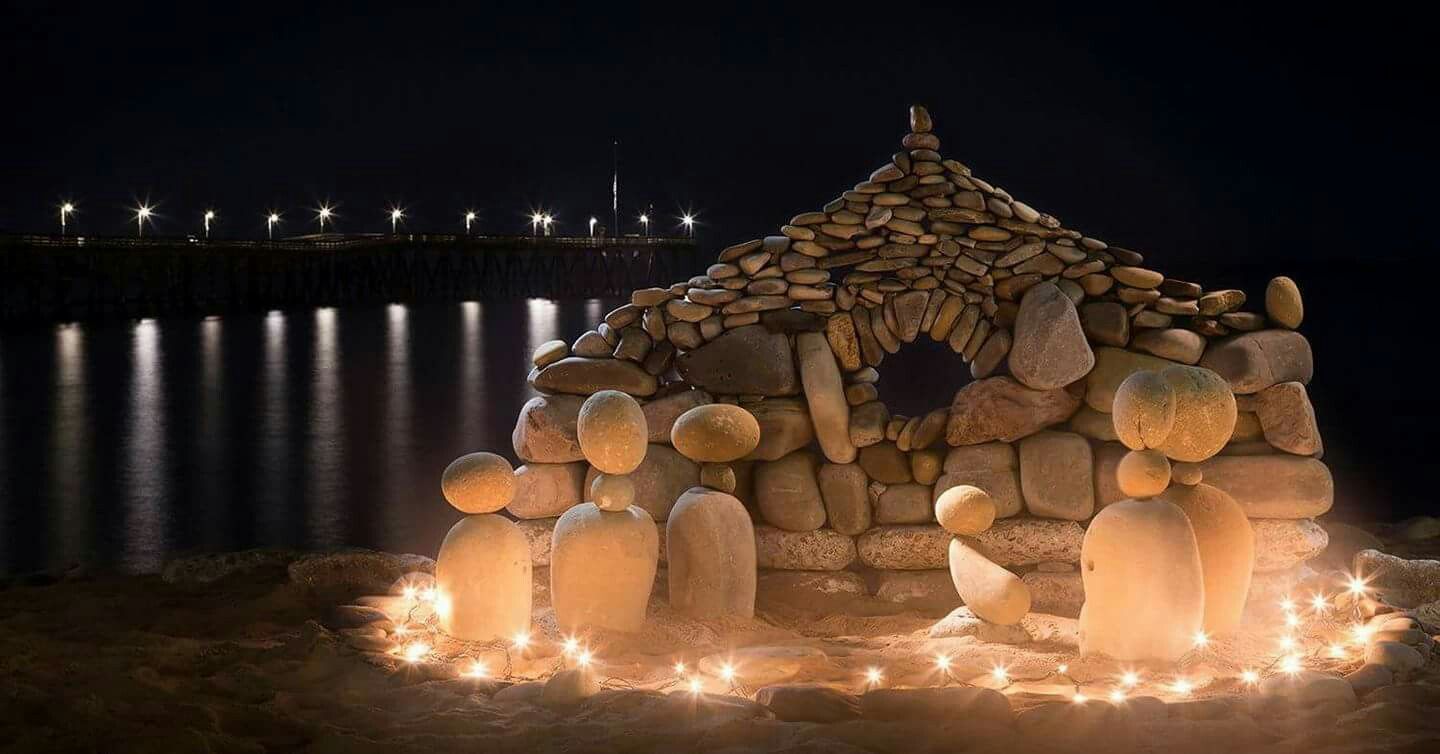
Stone Nativity by Juan Manuel Cisneros, Ventura, California, December 2016 [learn more]
1.“Haiku for an Advent Calendar” by Richard Bauckham: Church services during Advent tend to focus on messianic prophecies from the Hebrew Bible, rumblings of a coming savior. In this sequence of twenty-four haiku, Richard Bauckham pulls a detail from each book of the Jewish scriptures, finding anticipations of Christ. For example, Isaiah: “In the wilderness / a voice cries for centuries / seeking an echo.” Or Job: “God answered Job but / not his question. Maybe he / will do that again.”
2. “How Christ Shall Come” (anonymous): The cosmological Christ blew in from the four cardinal directions, coming as lover, knight, merchant, and pilgrim. So says this fourteenth-century Middle English lyric, rich in metaphor, compiled in a book of preaching aids and sermons by John Sheppey (d. 1360), bishop of Rochester. (It is unclear whether he is the author of the poem.) The great medieval literature scholar Carleton Brown gave it the title “How Christ Shall Come” in his landmark Religious Lyrics of the XIVth Century (1924), and Grace Hamman brought it to my attention recently in her wonderful monthly Substack, Medievalish, providing a modern English translation and commentary.
3.“Hawk Lies Down with Rabbit” by Seth Wieck: What would it look like for death to no longer have dominion in the animal world? Grappling with Isaiah’s end-time vision of a peaceable kingdom void of predation, this poem describes in graphic terms a bird of prey making its kill, feeding on flesh, and wonders how a hawk could still be itself with rewired impulses. Hear the author read and provide context for the poem on the Reformed Journal Podcast.
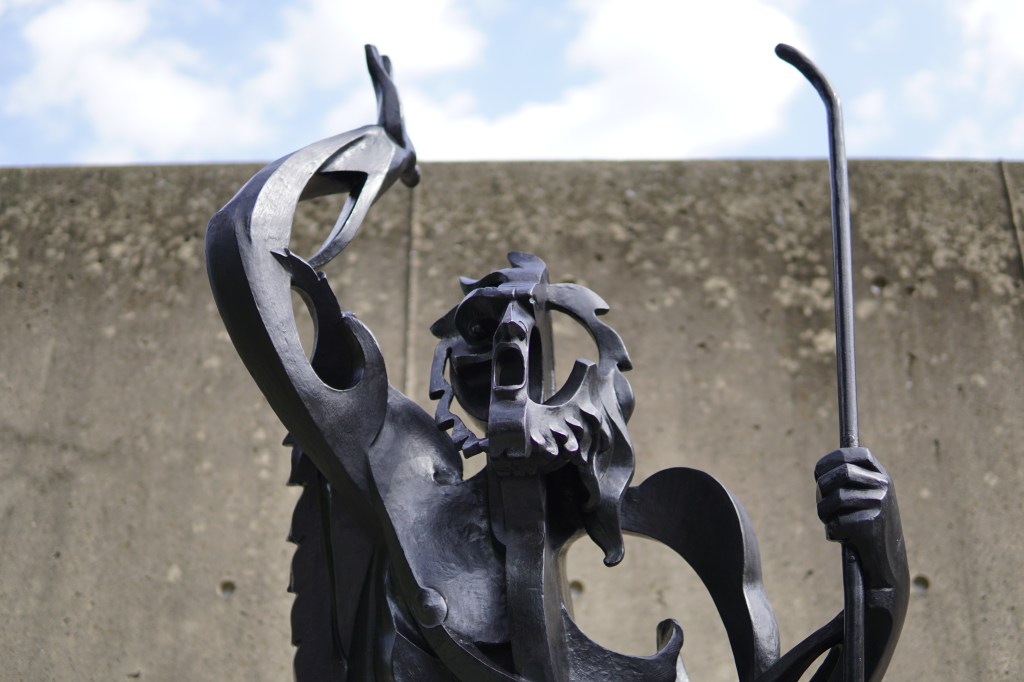
4.“john” by Lucille Clifton: Written in the voice of John the Baptist, this poem is part of an extraordinary sixteen-poem sequence titled “some jesus,” which features a range of biblical characters. In her retelling of his ministry as forerunner to the Messiah, Lucille Clifton casts John as a Black Baptist preacher, preparing his listeners to receive the one who “com[es] in blackness / like a star.” Clifton’s larger body of work would suggest that “blackness” here is multivalent, describing what Jesus comes into and as: the word suggests the darkness of the world that Christ entered, on the one hand, but also functions as a positive racial identifier. In Clifton’s revisioning, Christ comes as a Black man, wearing “a great bush / on his head”—which, again, could be read as an Afro, and/or as a mystical reference to the site at which God revealed himself to Moses in the Sinai desert. Luminous with truth, Christ comes, “calling the people brother.”
Pablo Gargallo (Spanish, 1881–1934), The Prophet (St. John the Baptist) (detail), 1933. Bronze, 91 3/4 × 29 1/2 × 19 in. Wurtzburger Sculpture Garden, Baltimore Museum of Art. Photo: Victoria Emily Jones.
5. “Christmas Mail” by Ted Kooser: Every December the story of an ancient birth comes alive again in couriers’ mailbags, in tin boxes at the ends of driveways, on mantels and fridges. This poem honors those postal workers who deliver good tidings in the form of Christmas cards, the magic spilling out the envelopes to make even the most tiresome routes sparkle a bit.
6. “December 25” by George MacDonald: Through the mid-nineteenth century, denominations influenced by the Reformed tradition, including the Church of Scotland in which George MacDonald was raised, typically did not observe Christmas, the rationale being that no one day should be thought of as holier than any other. But in his book-length dramatic poem Within and Without, MacDonald refers to December 25 as “this one day that blesses all the year”—and in this seven-liner from his Diary of an Old Soul, he describes Christmas as a gleaming blue sapphire, a structural center around which all the other jewels of the church calendar are oriented.
7. “On a Cardinal Climbing Down a Manhole to Restore Power to 400 Homeless People” by Michael Stalcup: On May 11, 2019, Cardinal Konrad Krajewski, the papal almoner (Pope Francis’s special appointee to distribute charity), crawled into a manhole and broke a police seal to personally restore power to a homeless shelter in Rome whose electricity had been shut off due to its failure to pay its bills. The shelter was occupied by some 450 people at the time, 100 of them children, who had been without electric light, hot water, and refrigeration for nearly a week. In this poem, which can be read Christologically, Michael Stalcup celebrates this defiant humanitarian act that brought light to a people living in darkness.
8. “Incarnation” by Amit Majmudar: “Inheart yourself, immensity. Immarrow, / Embone, enrib yourself.” So begins the five-poem sequence “Seventeens.” Musical and witty, this first poem is a plea to the great I AM to take on a body and “be all we are, and all we aren’t.”
9.“The Lord Is with Thee” by Micha Boyett: Written in 2010 as the third in a five-poem sequence commissioned by John Knox Presbyterian Church in Seattle, this poem centers on the Visitation episode described in Luke 1:39–58. It’s about Mary finding belonging in God’s story, especially through the companionship of her elder cousin Elizabeth, who has nurtured Mary’s faith since infancy and continues to do so in this her moment of crisis. “How easily she spoke of God, / as if he were a neighbor, a fish vendor on the street,” Mary admires. Elizabeth supports Mary physically, emotionally, and spiritually, holding her hair back as she vomits, protecting her from vicious rumors, affirming the work of God in her life, and accompanying her at the start of this wild path God has set them both on.
Odilon Redon (French, 1840–1916), Mystical Conversation, ca. 1896. Oil on canvas, 65 × 46 cm. Museum of Fine Arts, Gifu, Japan.
10.“Our Lady” by Mary Elizabeth Coleridge: The great-grandniece of the Romantic poet Samuel Taylor Coleridge, Mary Elizabeth Coleridge (1861–1907) grew up in a home visited by family friends Alfred Lord Tennyson, Anthony Trollope, John Ruskin, and Robert Browning, among others. In this poem she marvels at how God chose the common-born Mary for such a task as mothering the Christ, singing along with Mary’s Magnificat about how God raises up the lowly.
Source: Fancy’s Following (privately published, 1896). Public Domain.
11. “Traveling Man”by Marjorie Maddox: With his pregnant wife alongside, Joseph plods down south to Bethlehem, “convinced of the predestined / roll of dice chrismated with Miracle.” An epigraph from a Leonard Cohen song sets the tone.
12.“Sonnet in the Shape of a Potted Christmas Tree” by George Starbuck: This charming shape poem contrasts the extravagance of our popular celebrations of Christmas with the poverty of the first-century event it marks. The first half describes the furious wind of decorative activity that uproots evergreens from their natural habitats to bring them indoors and deck them with baubles and ribbon. I don’t know how to interpret “no scapegrace of a sect,” but “Daughter-in-Law Elect” refers to a duet from the Gilbert and Sullivan opera The Mikado. The turn comes with “a son born / now / now,” the latter two lines styled as the visible trunk of the tree; here the scene shifts to the simple stable of old, where Mary lies “spent” next to her newborn along with a cow and donkey, a sole “firework” guiding the magi and us all to the spot.
13.“Christmas (I and II)” by George Herbert: George Herbert (1593–1633) is one of the most celebrated poets of the English language. In part 1, a sonnet, of this two-part poem, he imagines himself a weary traveler who chances upon a humble inn where he unexpectedly finds his Lord, the infant Christ. It’s the inn of Bethlehem. Having then received rest from Christ his host, in the closing couplet he expresses his desire to reciprocate—to offer his own soul, lowly though it is, as a residence for Christ, praying that God first adorn it to make it hospitable. In the second part of the poem, Herbert uses a metaphysical conceit (extended metaphor) comparing his soul to a shepherd whose flock of thoughts, words, and deeds pastures on God’s word and who, like the shepherds of Bethlehem, sings glory to God. His shepherd-soul seeks eternal daylight, which he finds in the Son/sun, whose beams so intertwine with his song that the beams sing and his song shines.
14. “Descending Theology: The Nativity” by Mary Karr: The physicality of childbirth, from the contractions (which pierce the Virgin like a star, Karr writes) to the bodily fluids, is heavily featured in this poem. Jesus emerges from his mother “a sticky grub” with a “lolling head” and “sloppy mouth” that seeks out her breast for food. And as she feeds him physically, he feeds her spiritually. Then he falls asleep. His first nap, Karr writes, is a foretaste of the sleep of death he will eventually come to taste. But for now, he wakes up crying—as all babies do.
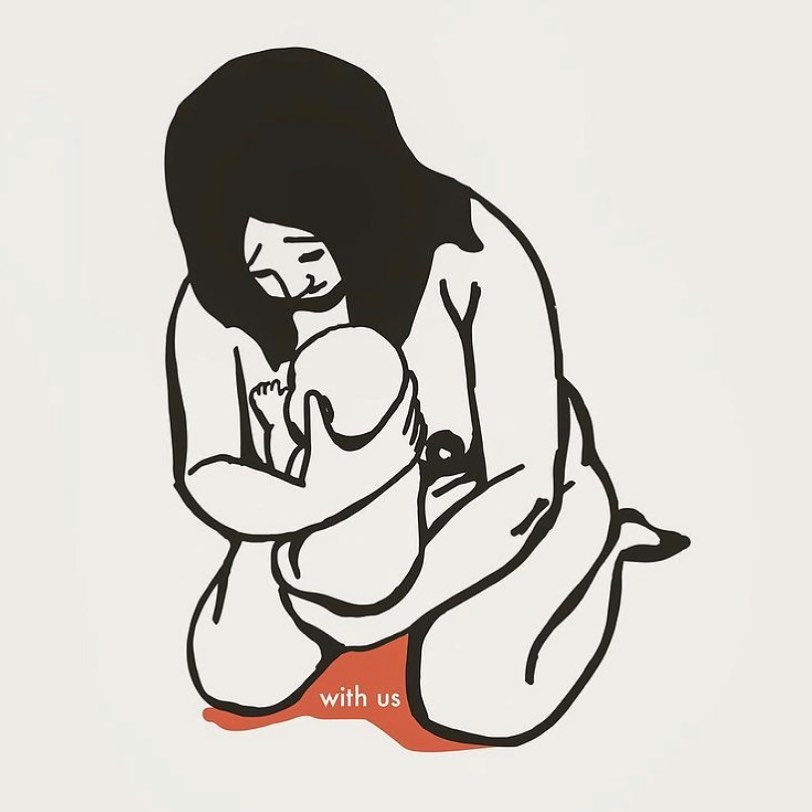
Scott Erickson (American, 1977–), With Us, Face to Face, 2016. Digital art. [available for purchase]
15.“from spiralling ecstatically this”by E. E. Cummings: What a fantastic opening line! The heavenly spheres whirling, twirling, down into the “proud nowhere”—Bethlehem—“of earth’s most prodigious night.” Heretofore living in mundanity, the domestic animals, hungry for miracle, for newness, are vouchsafed to be witnesses of this supernatural event, before which they kneel “humbly in their imagined bodies.” Overhead floats the “perhapsless mystery of paradise,” a phrase suggesting that heaven is beyond human understanding but not without certainty; it’s a declarative reality, not subjunctive, even if it can’t quite be put into words. Mary herself has no words—she silently, knowingly smiles, while the created world erupts in song around her. The “mind without soul” is a reference to Herod, who seeks to snuff out this new life, but to no avail.
The omission of spaces after punctuation marks (e.g., “a newborn babe:around him,eyes”) is not a mistake; that’s how E. E. Cummings liked it. Scholars say it’s to create a faster rhythm, but in this poem I don’t think that choice is as effective, as pauses and slow savoring seem more appropriate to its contemplative mood.
16.“How the Natal Star Was Born”by Violet Nesdoly: Narrated by the angel Gabriel, this poem imaginatively describes heaven’s nervously awaiting the birth of Jesus during the nine months following Gabriel’s dispatch to Mary, and then busting out in celebration when at last they hear his infant-cry. When his Son is born, instead of cigars, the Father passes out trumpets to his company of friends, who sound them all the way to Bethlehem’s fields, and pops open a bottle of champagne whose bubbles spray far and wide.
17. Sections 9–10 of “The Child” by Rabindranath Tagore: Hinduism was the religion of Rabindranath Tagore’s birth and upbringing, but he also held deep respect for Jesus Christ. (For more on the influence of Christianity on Tagore’s thought and writing, see chapter 4 of Rabindranath Tagore and Interfaith Dialogue by Manas Kumar Ghosh [DMin thesis, Charles Sturt University, 2010].) “The Child” is a free-verse poem that Tagore wrote in English in 1930 after seeing a passion play in Germany and then translated into Bengali in 1932 with the title “Sishutirtha” (Pilgrimage to Childhood). In it a “Man of faith” gathers people from all walks of life to join him on a “pilgrimage of fulfilment,” to “struggle [through the dark] into the Kingdom of living light.” Initially met with enthusiasm, the Man later becomes a target of the people’s anger and distrust, and they kill him. Disorientation ensues. But a man in the crowd is able to rally the others to repent and resume their quest, following the spirit of “the Victim.”
The final two sections, 9 and 10, are the selection I’ve chosen. (Scroll right to read the last.) At “the first flush of dawn,” when the time is ripe, the pilgrims arrive at a thatched hut in a palm grove, where they finally meet the eternal Light they’ve been seeking: “the mother . . . seated on a straw bed with the babe on her lap, / . . . the morning star.” Here is the Child of the title, humanity’s redeemer.
Source: The Child (London: George Allen and Unwin, 1931)
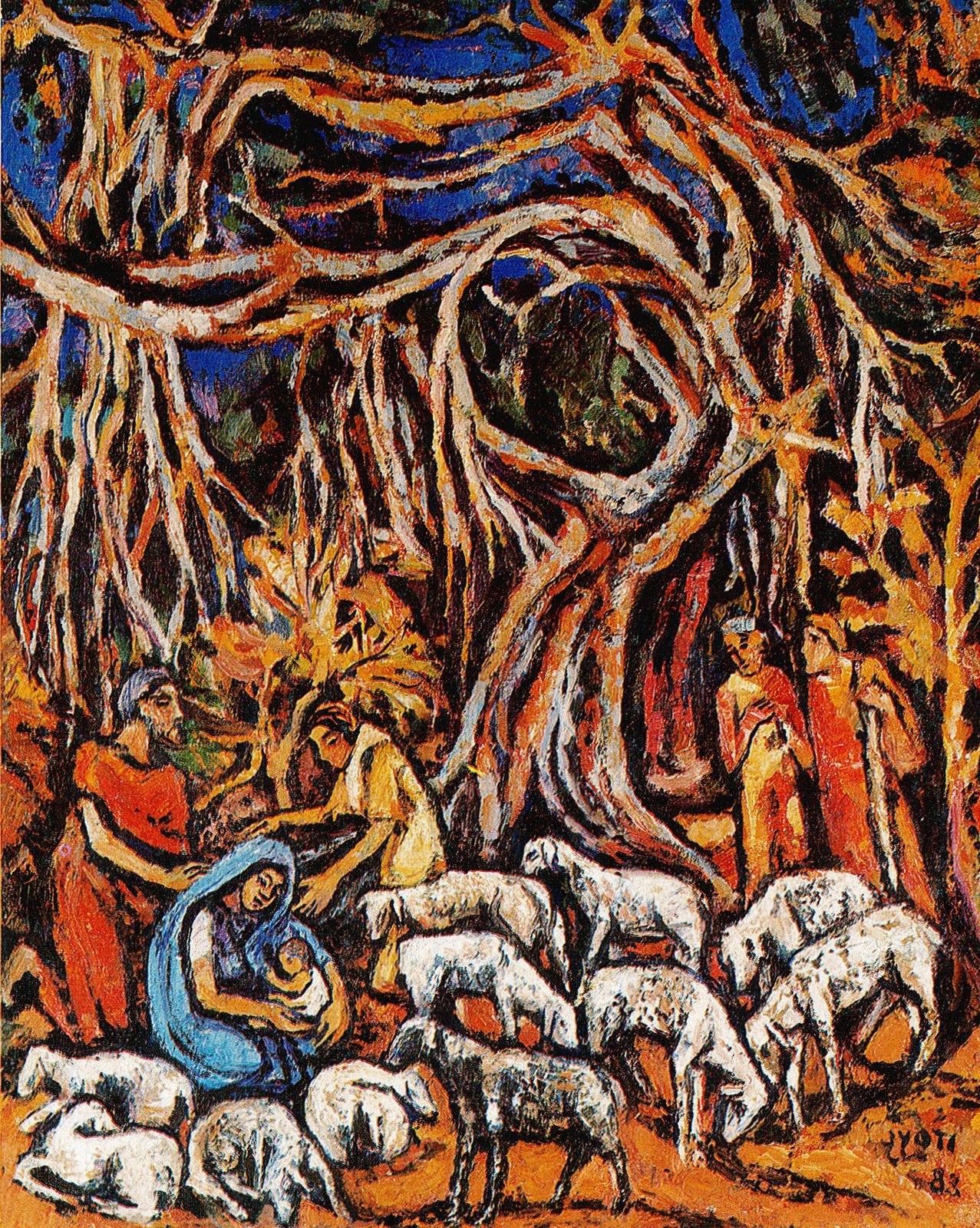
Jyoti Sahi (Indian, 1944–), Adoration of the Shepherds, 1983. Oil and acrylic on canvas.
18. “Love’s Bitten Tongue (11)”by Vassar Miller: This poem, “You, my God, lonesome man, Love’s bitten tongue,” is from a crown of twenty-two sonnets, a type of sequence in which the last line of each sonnet is repeated as the first line of the next, but each time with a new twist of syntax and sense. The crown as a whole expresses the poet-speaker’s struggle against her ego, and her desire for Christ (whom she gives such an evocative name in the title!). In this particular sonnet she describes waiting at the edge of her bed every Christmas Eve as a child in anticipation of both Santa’s arrival with gifts and the holy mystery of Christ’s birth, an admixture of sacred and profane longings that fill her still as an adult.
19. “Gloria in Profundis” by G. K. Chesterton: G. K. Chesterton’s poems are of variable quality, but this one is brilliant, emphasizing God’s descent from the rich heights of heaven into an obscure cave in a simple town. “Glory to God in the lowest!” it exclaims, a clever inversion of the angels’ song to the shepherds in Luke 2:14. The poem was originally published in a 1927 Christmas pamphlet with wood engravings by Eric Gill. The Latin title translates to “Glory in the Depths.”
Source: Gloria in Profundis by G. K. Chesterton (Ariel series pamphlet) (London: Faber and Gwyer, 1927); compiled in The Spirit of Christmas (New York: Dodd, Mead, 1985)
20.“Silent Night” by Bonnie Bowman Thurston: Rev. Dr. Bonnie Thurston invokes a tradition that says the night of Christ’s birth, there was a whole hour in which time stood still and all was silent. What a fascinating legend! Thurston told me its origin is northern European, said she remembers reading it in some scholarly Celtic studies; I wasn’t able to locate any such mentions, but the second-century Protoevangelium of James, chapter 18, probably written in Egypt or Syria, does describe everything momentarily freezing in place around Joseph as he steps out to find a midwife for Mary. Anyway, the poem ends with a striking metaphor! Word, flesh: fire. (Reminds me of this digital artwork by Scott Erickson.)
21. “After Luke 2:19” by Michelle Ortega: When the shepherds recounted to Mary what the angels had told them in the fields about Jesus being the promised Messiah, “Mary treasured all these words and pondered them in her heart,” Luke narrates in his Gospel. Poet Michelle Ortega expounds on this verse, emphasizing the relationship of Mary’s body to her son’s from conception to birth and now postpartum—an intimacy known well by mothers across the centuries. As wondrous as it was to be part of a cosmic story writ large in the skies, Ortega suggests that Mary treasured just as much as the grand pronouncements those small moments of being just an ordinary mama.
22. “Christmas: 1924”by Thomas Hardy: “We the civilized world have given Christianity a fair trial for nearly 2000 years, & it has not yet taught countries the rudimentary virtue of keeping peace,” lamented the British novelist and poet Thomas Hardy (1840–1928) in a letter to Florence Henniker dated February 25, 1900, during the Boer War. World War I only increased his cynicism, which is on display in this sour little epigram that opens with an ironic quotation of the angels’ proclamation to the shepherds the night of Jesus’s birth.
Francis Hoyland (British, 1930–), Nativity, 1961. Oil on canvas, 90 × 120 cm. Methodist Modern Art Collection, HOY/1963/1.
23. “Eating Baklava on New Year’s Eve” by Anya Krugovoy Silver: Poet Anya Silver (1968–2018) reads a spiritual benediction in her piece of baklava, layered and sweet and consumed on the eve of a new year.
Source: Second Bloom (Eugene, OR: Cascade Books, 2017)
24. “A Ballad of Wise Men”by George M. P. Baird: Jesus so often confounds the wisdom of the wise, starting with his birth. With gentle humor and in iambic rhythm and rhyme, this poem celebrates the simple access we all have to Christ.
Source: Rune and Rann (Pittsburgh: Aldine Press, 1916). Public Domain.
25. “Excrucielsis”by Hannah Main-van der Kamp: Originally published at ArtWay.eu as a response to the contemporary Romanian sculpture The Spring by Liviu Mocan, this poem alternates between the weary journeying toward truth of one of the biblical magi and that of a modern-day seeker similarly “longing for / the something more.” It can be a trudge, finding the Light—it involves risk, a willingness to follow the signs, and the tenacity to hold on to your “vision burden,” “clutch[ing] the weight” of it all the way over rough and varied terrain. But the epiphanic moment awaits, to sound like a trumpet blast. The title of the poem is a neologism combining the words “excruciating” and “excelsis” (Latin for “the heights”); “every excelsis contains something excruciating, that’s how we get to genuine excelsis,” the poet told me in an email. Read a related prose reflection by Main-van der Kamp here.
Source: The Slough at Albion (Victoria, BC: Ekstasis Editions, forthcoming)
Disclosure: This post contains Amazon affiliate links, meaning I earn a small commission from qualifying Amazon purchases originating from clicks on this site.
Advent is a season of waiting with deep longing and hope for that long-looked-for day when fear and pain will be no more because Christ will reign and set this world free. These songs tap into that.
>> “Redemption Draweth Nigh”by Gordon Jensen (1970), performed by Rumbi Lee (2018): The title and refrain of this contemporary hymn are drawn from Luke 21:28: “And when these things begin to come to pass, then look up, and lift up your heads; for your redemption draweth nigh” (KJV).
+++
STREET ART SERIES: Medicinal Flowers of Lebanon by Faith XLVII: In September 2021, South African artist Faith XLVII (Liberty Du) traveled to Beirut to paint curative flowers across the rubble of the Lebanese city in the wake of the August 4, 2020, port explosion that caused at least 218 deaths, 7,000 injuries, and $15 billion in property damage, as well as leaving an estimated 300,000 people homeless. Rosehips, horned poppies, chicory, African carline thistle—all these botanicals are used in remedies for common ailments. “Each flower urges us, in a sense, towards healing as they grow out of the concrete,” the artist said.
Faith XLVII (South African, 1979–), Glaucium flavum, from the Medicinal Flowers of Lebanon series, Beirut, Lebanon, 2021. Photo courtesy of the artist.
+++
NEW ALBUMS:
>> The Soil and The Seed Project, vol. 8: Advent-Christmas-Epiphany: For the Advent-Christmas-Epiphany triad of the church year comes this new album from The Soil and The Seed Project, a ministry of Virginia Mennonite Missions—and recently Lilly-Endowed! All their music is free—for download, and even as physical CDs while supplies last. Below are two of my favorite tracks, both written by new contributors to the project. The first verse of Philip Fisher Rhodes’s “Bethlehem One” is in the voice of the in utero Christ; the second, the shepherds; the third, the wise men. The song is sung by Ben Luna. And “Peace Prayer” by Susan Gascho-Cooke is a plea that God would hold his arms around “this tilting planet,” the world’s wounds, and all people.
Each TSATP album is part of a larger project that also includes “Little Liturgies” booklets perfect for families with small kids (but that can also be used by individuals and small groups). Each booklet includes litanies, prayers, reflection questions, suggested activities, and visual art—and again, they’re free! Request a digital or physical copy here.
>> Kindness Is Solid Stone, Violence Is a Heavy Loan to Pay by David Benjamin Blower: Released November 3 and available on Bandcamp only, this album features nine original songs by writer, poet, theologian, and podcaster David Benjamin Blower of Birmingham, UK. I appreciate the minimalist sound and the stark lyricism. My favorite track is probably “Meet Me Where I Sing and Stamp My Feet”:
And when Christ, who is your life, is revealed to the whole world, you will share in all his glory.
—Colossians 3:4
Epiphany, meaning “revelation,” is the capstone of the Christmas season. In this final post of this year’s Christmas series, I leave you with a striking, light-flecked painting from Japan and a slow-tempo Black gospel song from the US. What marvel, that God’s glory fills such places as ours, and that he invites us not only to behold his glory but also to participate in it.
May God’s light continue to guide and enfold you throughout the year, and may you never stop seeking his face.
To view a compilation of this season’s numbered Christmas posts, click here; for Advent, here.
LOOK: Morning Star by Hiroshi Tabata
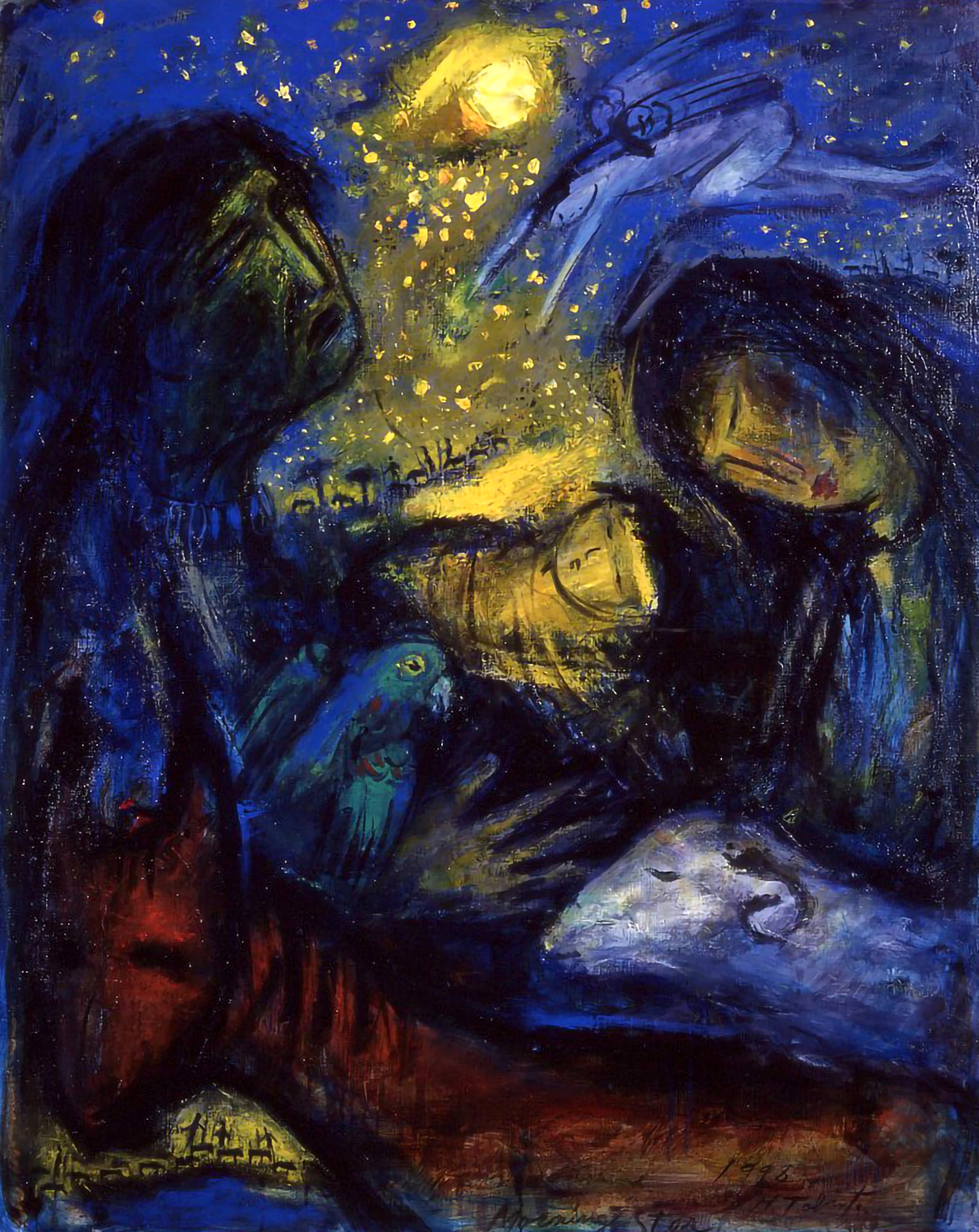
Hiroshi Tabata (田畑弘) (Japanese, 1929–2014), Morning Star, 1998. Oil on canvas, 90.9 × 72.7 cm. Private collection. Photo courtesy of the Estate of Hiroshi Tabata.
Born in Takaoka City, Hiroshi Tabata (1929–2014) studied art at the University of Toyama, later moving to France for two years for further art education. He exhibited his work throughout Japan and at Parisian salons. From 1966 to 1972 he lived intermittently in Brazil among the Xingu people, which led to his conversion to Christianity. From then on until his death, he painted biblical subjects. “The Bible is the ultimate theme for me,” he said; its world is “infinitely deeper” than we can comprehend.
In Tabata’s expressionistic Morning Star, starlight falls in a luminescent sheen over the face of the Christ child, whom Mary looks upon in tender adoration as Joseph wonders at the angelic activity above. The tight cropping around the Holy Family heightens the sense of intimacy. A sheep, donkey, and Amazon parrot (the latter a callback to his time in Brazil) crowd into the foreground, while on distant hills shepherds behold the glorious light display, hear the announcement that will propel them to their newborn Messiah. The wise men, too, are on their way. Epiphany is at hand. Heaven’s raining down (Isa. 45:8).
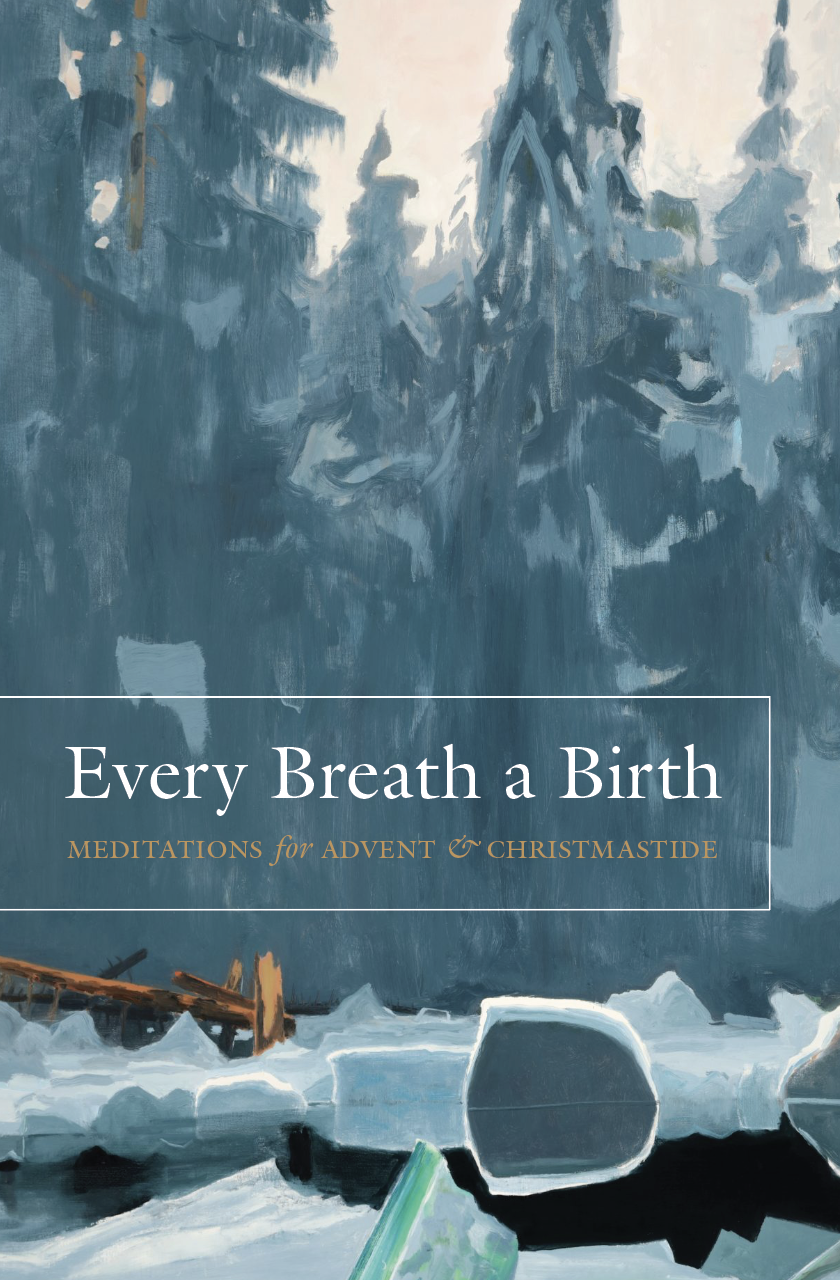
This visual reflection (by me) originally appeared in the Christmas/Epiphany 2022–23 edition of the Daily Prayer Project. Tabata’s art appears on the cover, by kind permission of his son-in-law. To view more biblical art by Tabata, see the beautifully produced, full-color book 田畑弘作品集 一つの星 (Hiroshi Tabata Works: Morning Star); the text is all Japanese.
LISTEN: “A Star Stood Still (Song of the Nativity)” | Words and music by Barbara Ruth Broderick and Johnny Broderick, 1956 | Performed by Mahalia Jackson with the Falls-Jones Ensemble, conducted by Johnny Williams, on Silent Night: Songs for Christmas, 1962
And we shall share In the glorious light
In Bethlehem The wind had ceased The Lamb lay sleeping On the hill
When all the earth Was stilled with peace Then lo, a star stood still
A star stood still On yonder hill Praise God that star still Shining still
And we shall share In the glory of love Because a star stood still That night a star stood still
A star stood still On yonder hill Praise God that star still Shining still
And we shall share In the glory of love Because a star stood still That night a star stood still
Note to readers: Art & Theology is noncommercial, but I do accept donations (monetary, or in-kind books!) to help keep it running.Learn more here.
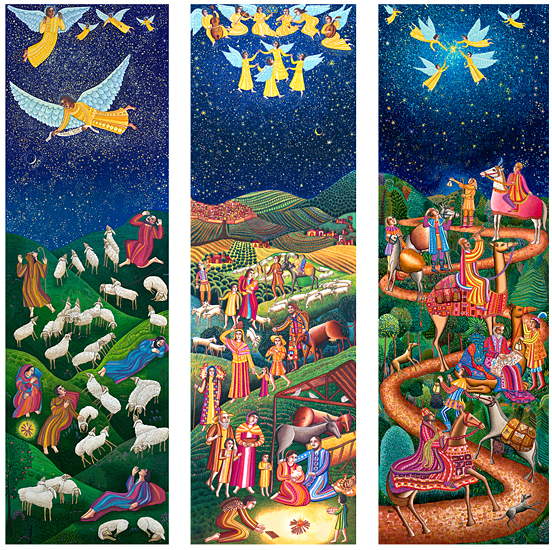
John August Swanson (American, 1938–2021), Epiphany, 1988. Serigraph, 38 × 12 in. Edition of 210. [for sale]
Tomorrow, January 6, is the feast of Epiphany, commemorating the visit of the magi to the infant Christ, an episode that represents God’s manifestation to the nations beyond Israel. Printmaker John August Swanson visualizes their journey in a starkly vertical composition that was conceived as the right wing of a triptych (three-paneled artwork), the other two panels depicting the Annunciation to the Shepherds and the Nativity. In subsequent years he addedA Visit (depicting the Annunciation to Mary), Flight into Egypt, and Presentation in the Temple to the set.
Epiphany depicts the journey of the three Magi as they travel up a serpentine trail. One of the Wise Men is seated as he looks at a map of the constellations with his magnifying glass; his servant holds a lamp so that he can see. Another Magi searches with his telescope into the sky. They look up in search of their beautiful guiding star as angels surround and point to it. They have exotic birds, peacocks, and dogs among their animals. I have tried to capture the details of the many plants, bushes, and trees and to create a variety of colors of green.
I used many symbols within the tapestries draping the animals. These patterns depict the Lion of Judah, the lamp in the darkness, the rain falling on the parched ground, the key to the locked door, the crown and the heart, and the gates to the city.
This is part of a series of three images (triptych). They were inspired by the Mexican tradition that I am familiar with for Christmas. Families will each create a beautiful crèche (nacimiento) with many figures and animals, creating a whole environment with landscaping in miniature around the Nativity figurines.
His other inspirations for this set include the opera Amahl and the Night Visitors by Gian Carlo Menotti and the medieval stained glass windows in Chartres Cathedral.
John August Swanson, Advent Triptych, 1985–88 [for sale as poster or card]
John August Swanson (1938–2021) [previously] was born in Los Angeles of a Mexican mother and Swedish father. His father died when he was young, and he was raised in a multigenerational Mexican Catholic home. He studied serigraphy under Corita Kent [previously], and it became his primary medium. A serigraph is a type of print in which each color is individually layered by applying ink through a silkscreen onto paper. Epiphany has forty-eight individual colors.
LISTEN:“Bright and Glorious” | Original Danish text (“Deilig Er Den Himmel Blaa”) by Nikolai F. S. Grundtvig, 1810 | English translation by Jens Christian Aaberg, 1927; first stanza adapted by the editors of the Lutheran Service Book and Hymnal, 1958 | Music by Seth Thomas Crissman and Greg J. Yoder, 2017 | Performed by the Walking Roots Band on Hark! A Walking Roots Band Christmas, 2017
Bright and glorious is the sky Radiant are the heavens high Where the golden star is shining All its rays to earth inclining Leading to the newborn king Leading to the newborn king
Him they found in Bethlehem Yet he wore no diadem They but saw a maiden lowly With an infant pure and holy Resting in her loving arms Resting in her loving arms
Guided by the star, they found Him whose praise the ages sound We, too, have a star to guide us That forever will provide us With the light to find our Lord With the light to find our Lord
As a star, God’s holy word Leads us to our King and Lord Brightly from its sacred pages Shall this light throughout the ages Shine upon our path of life Shine upon our path of life
The Walking Roots Band (TWRB) is an acoustic folk/bluegrass-ish music group steeped in Anabaptist hymn-singing traditions and based in Harrisonburg, Virginia. Several of its members are the creative forces behind The Soil and The Seed Project, a liturgy and arts initiative that launched in 2021.
Here they’ve retuned an Epiphany hymn from Denmark, which compares the star that led the magi to Jesus to the Bible, God’s word, which serves as a guiding light for spiritual seekers, leading us to Christ himself. Its pages offer countless epiphanies—revelations of God’s glory, opportunities for divine encounter. Its wisdom and truth can illuminate our paths if we let it.
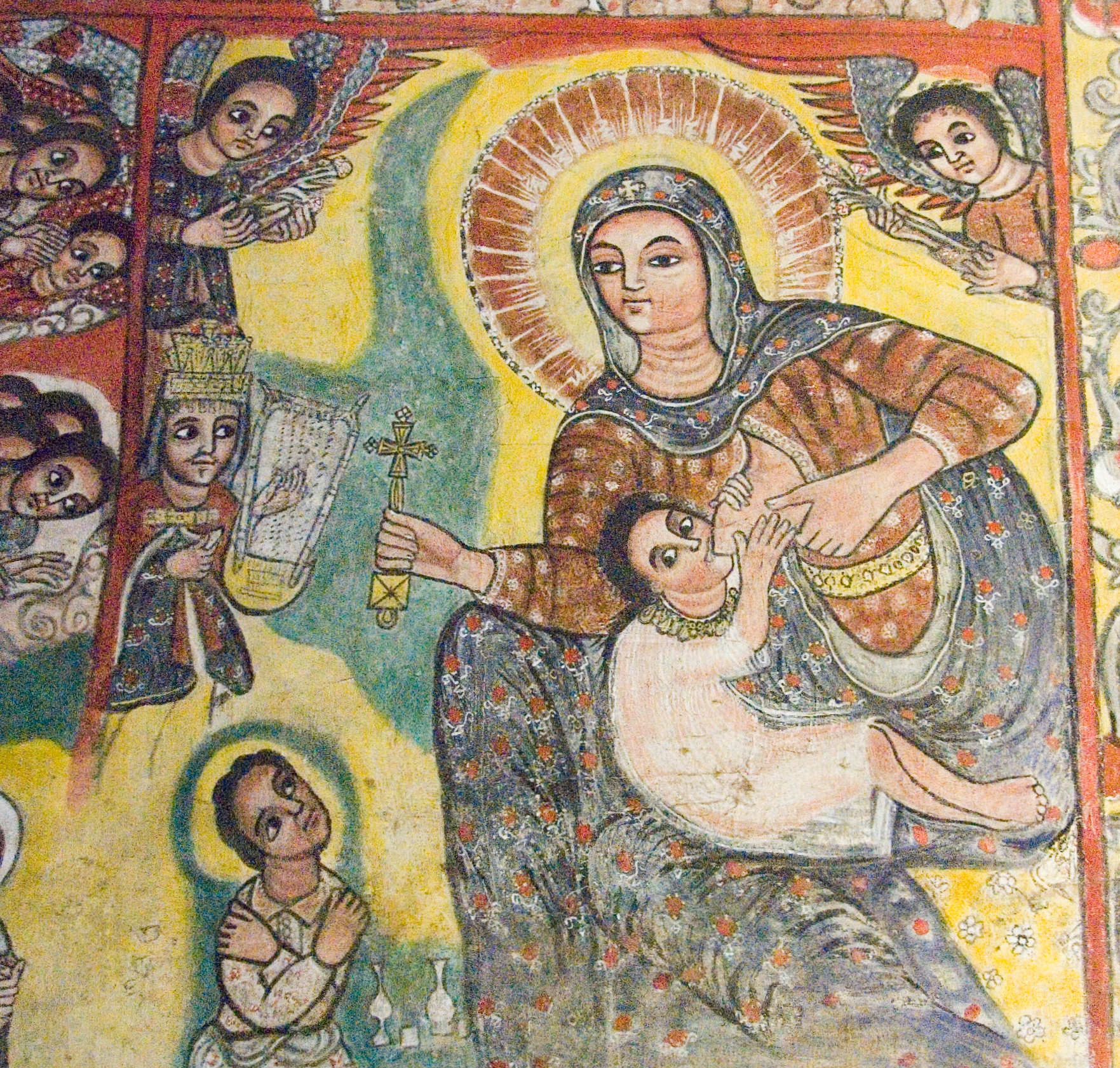
Maria lactans, late 18th century. Fresco, Church of Narga Selassie, Dek Island, Lake Tana, Ethiopia. Photo: Alan Davey.
Glory to that Voice that became a body,
and to the lofty Word that became flesh.
Ears even heard Him, eyes saw Him,
hands even touched Him, the mouth ate Him.
Limbs and senses gave thanks to
the One Who came and revived all that is corporeal.
Mary bore a mute Babe
though in Him were hidden all our tongues.
Joseph carried Him, yet hidden in Him was
a silent nature older than everything.
The Lofty One became like a little child,
yet hidden in Him was a treasure of Wisdom that suffices for all.
He was lofty but he sucked Mary’s milk,
and from His blessings all creation drinks.
He is the Living Breast of living breath;
by His life the dead were suckled, and they revived.
Without the breath of air no one can live;
without the power of the Son no one can rise.
Upon the living breath of the One Who vivifies all
depend the living beings above and below.
As indeed He sucked Mary’s milk,
He has given suck—life to the universe.
As again He dwelt in His mother’s womb,
in His womb dwells all creation.
Mute He was as a babe, yet He gave
to all creation all His commands.
For without the First-born no one is able
to approach Being, for He alone is capable of it.
Translated from the Syriac by Kathleen E. McVey in Ephrem the Syrian: Hymns (Classics of Western Spirituality) (Mahwah, NJ: Paulist Press, 1989), 100–101














 Art & Theology