
LOOK: Norwegian Wood by Yuri Yuan
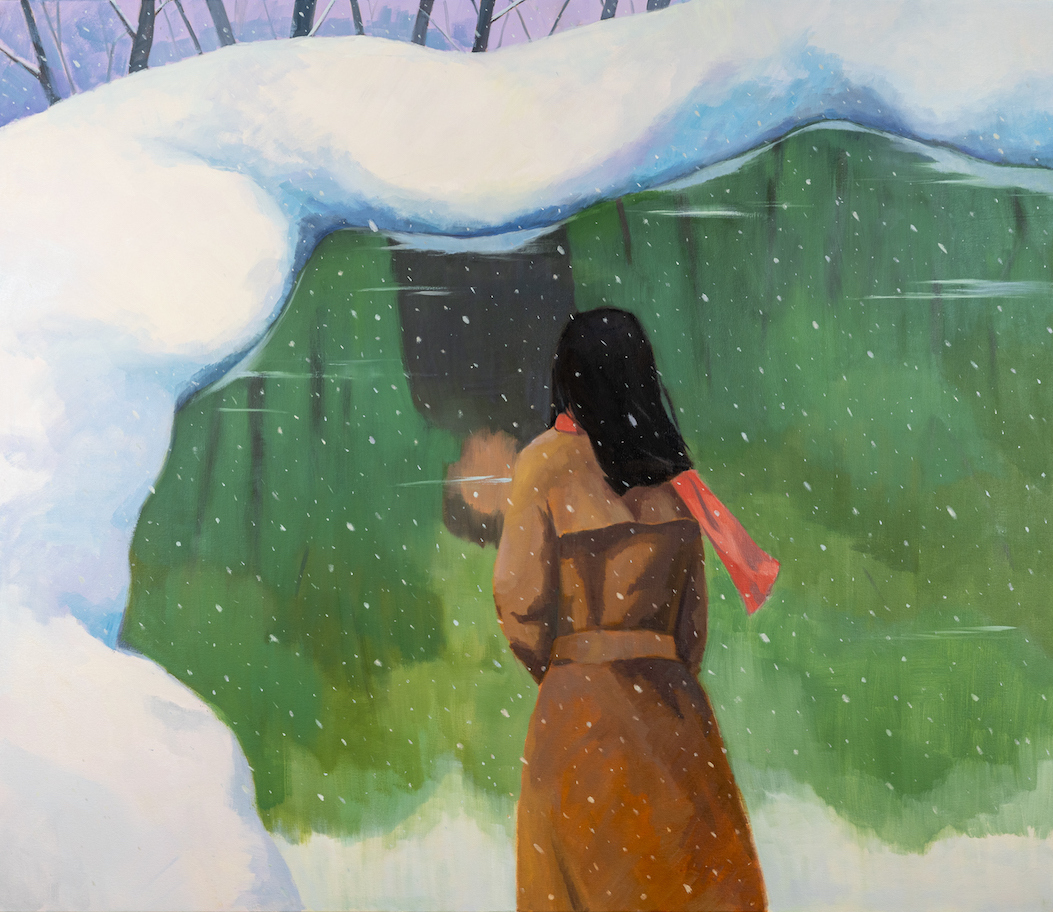
This painting by New York–based artist Yuri Yuan shows a woman in a belted brown trench coat, her back to us, standing at the edge of a frozen pond. A small gust of snowy wind whips her hair and scarf. Though her face isn’t visible, she appears to be deep in thought.
Reflected on the pond’s surface is a man dressed in black. We don’t see his physical form, and his features are indistinguishable in the mirroring ice. Who is he? Does he wish to speak to the woman? Does he come with news, or an invitation, perhaps? Or simply to wait with her in silence?
There’s a mystic quality to the image that’s heightened by the incongruity between the environment and its reflection. In the upper left, the trees are barren and dusted with the white of winter, and indeed the woman is dressed for the cold. And yet in the trees’ reflection in the pond, they are in full foliage, leafy green, as if it were summer.
It’s as if two worlds are converging here in this wood. Or the woman foresees, with the eyes of her spirit, a lushness that has not yet come to pass.
Notice how the snowbanks piled up along the water’s edge could almost double as clouds, particularly in the bottom left, where the white mass meets the sky’s reflection. The heavens and the earth becoming one.
I chose this image to kick off the Advent season (which begins tomorrow) because it captures the sense of longing that the church leans into most especially during these four weeks, but also the sense of promise, the possibility, that’s just as characteristic of the season. In the eschatological reality that Israel’s prophets foresaw, the barren becomes verdant and the dead come to life. “The wilderness and the dry land shall be glad; the desert shall rejoice and blossom” (Isa. 35:1).
Strangely, Norwegian Wood is a painting of both absence and presence, distance and nearness.
If you like, imagine Yuan’s mystery man as God coming close—which is what the Incarnation is: God coming closer than close!
What invitation might God have for you this Advent? What heartache from the past year, or even further back, do you need to bear to the Healer? What hopes do you need to speak out loud?
LISTEN: “When God Comes Close” by Tara Ward of Church of the Beloved, on Adventus (2010)
We wait, we hope
We yearn, prepare
For who or how or what or where?
Maybe the changing of the tide
Maybe the turning of someone’s eye
Maybe the falling of the snow
Only heaven knows
What happens when God comes closeWe wait, we hope
We yearn, prepare
For who or how or what or where?
Maybe the healing of a heart
Maybe reunion of a drift apart
Maybe a child’s coming home
Only heaven knows
What happens when God comes closeWe wait, we hope
We yearn, prepare
For who or how or what or where?
Maybe the song, a place to belong
Maybe some faith, just a touch of grace
Maybe love, it’s rarely what we think of
Only heaven knows
What happens when God comes close
For another Advent song by Tara Ward, see https://artandtheology.org/2021/12/19/advent-day-22/.
This is the first post in a daily series that will extend to January 6. You are welcome to subscribe via email or RSS, but posts are optimized for viewing on a web browser. (And note that Gmail sends WordPress posts to your Social tab, unless you create a filter to tell it otherwise.) Links will be shared on Facebook and Twitter.
 Art & Theology