Not only are humans tired and stressed and in need of deliverance; so is the environment. Today’s two featured works function as a call to care for the earth—the one a performative enactment of said care, tender and consoling, and the other an urgent lament by choir.
The gospel is for more than just humanity; it’s for all the earth—animals and insects, plants and soil, skies and oceans. All creation groans for redemption, Paul says in his letter to the early church in Rome. And in the final book of the Bible, John the Revelator’s vision is of the whole world renewed.
LOOK: Earth Rite by Holly Slingsby
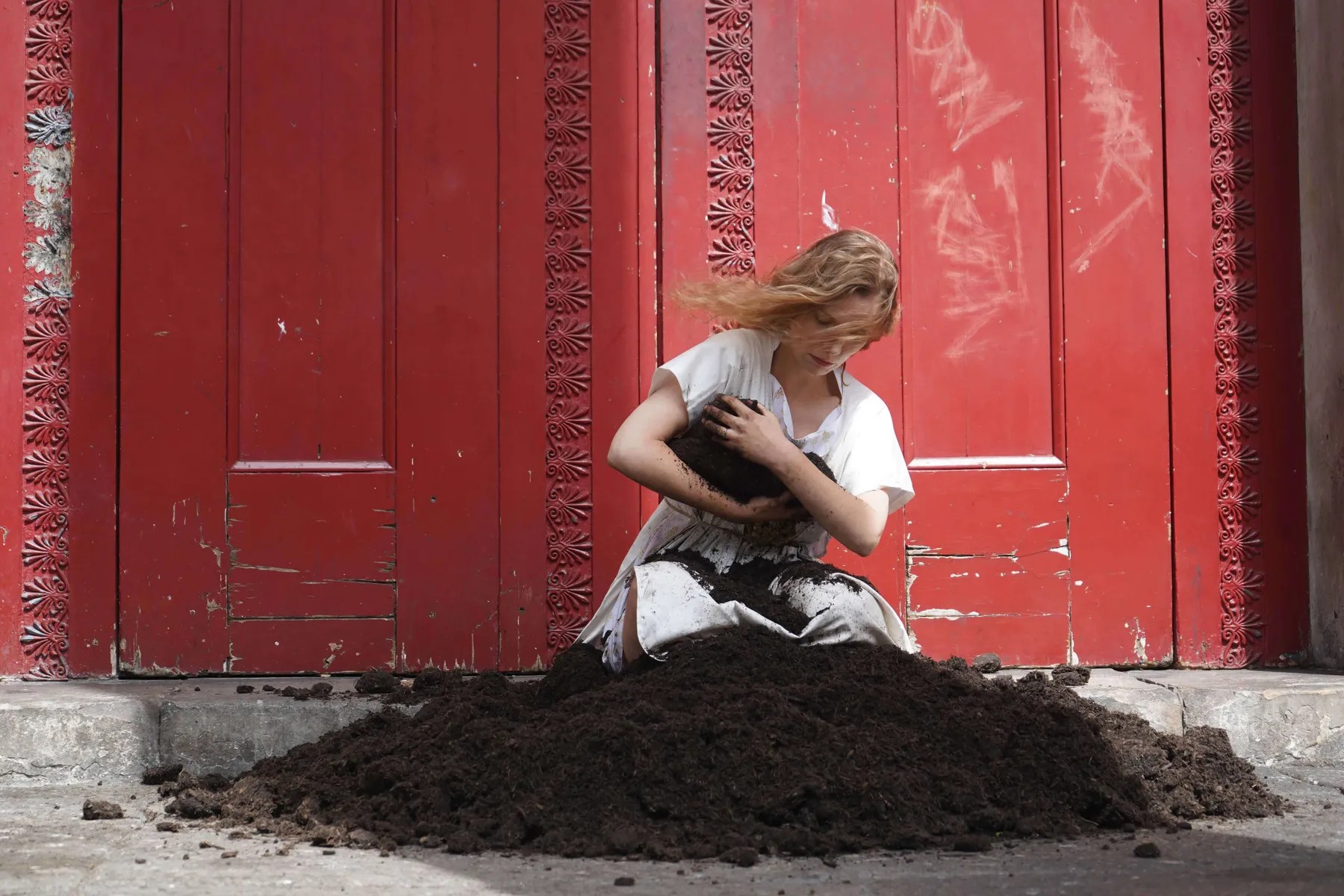
Holly Slingsby (British, 1983–), Earth Rite, performance at St Pancras Church, London, July 6, 2024. Duration: 1 hour. Photo: Adam Papaphilippopoulos.
Artist Holly Slingsby’s Earth Rite premiered at the Ritual/Bodies live performance event that took place at St Pancras Church in London on July 6, 2024, organized by Dr. Kate Pickering. It was one of eight performance works by eight different artists (one work was by two performers; two works were by one) that collectively spanned some three hours, followed by a ninety-minute panel discussion.
In Earth Rite, “a solo performer sits atop a mound of earth, cradling it in her arms. The earth slips away only to be regathered, in a continuous act of generating, losing, and regenerating.” Charles Pickstone, an Anglican priest, reviewed the work in the Autumn 2024 issue of Art + Christianity journal, writing:
Holly Slingsby, in a loose white dress, sat on the church steps on a mound of rich soil, arms folded in embrace. Where one might have expected a baby, the artist was embracing armfuls of soil, constantly replenishing her burden as the soil slipped away from her. Part earth mother, part mourner, on the edge of the busy and noisy Euston Road, the artist made what could have been rather a moralistic revisiting of a well-known theme (compare William-Adolphe Bouguereau’s Charity, perhaps an influence on this work) into a courageous and compelling glimpse of the earth’s abused and vulnerable soil.
Slingsby reprised the performance on September 27, 2025, at the International Forum of Performance Art in Drama, Greece.
LISTEN: “Kasar mie la Gaji” (The Earth Is Tired) by Alberto Grau, 1987 | Performed by Stellenbosch University Choir, dir. André van der Merwe, 2024
“Kasar mie la gaji” is a Hausa saying from the Sahel region of Africa that means roughly “The earth is tired.” In 1987 leading contemporary Venezuelan composer Alberto Grau (b. 1937) set it to music, creating a magnetic choral composition for, in his words, “an international mobilization to save THE EARTH.”
In their performance notes, the Stellenbosch University Choir from South Africa writes: “The composition is designed on hypnotic repetition, with a steady reiteration of the text. Plaintive glissandos and layered ostinato patterns create a compelling chant, begging for justice and rebirth.”
Kathy Romey, the director of choral activities at the University of Minnesota, offers further description:
The work is broken into three distinct sections, of which the first and third incorporate short melodic motives combined with rhythms from traditional South American dance music intensified by clapping and stomping. The middle section is a slow lament and utilizes various special effects for a cappella chorus, including glissandi, whispering, talking, and hissing.
Why is the earth tired? Because we are depleting her resources. We are disrupting her ecosystems. The carbon emissions from our burning of fossil fuels for energy and transportation are trapping heat in her atmosphere and causing extreme weather.
Lord, have mercy. Please help us restore our planet to health and treat her with respect, recognizing that she, as part of your creation, is precious to you.
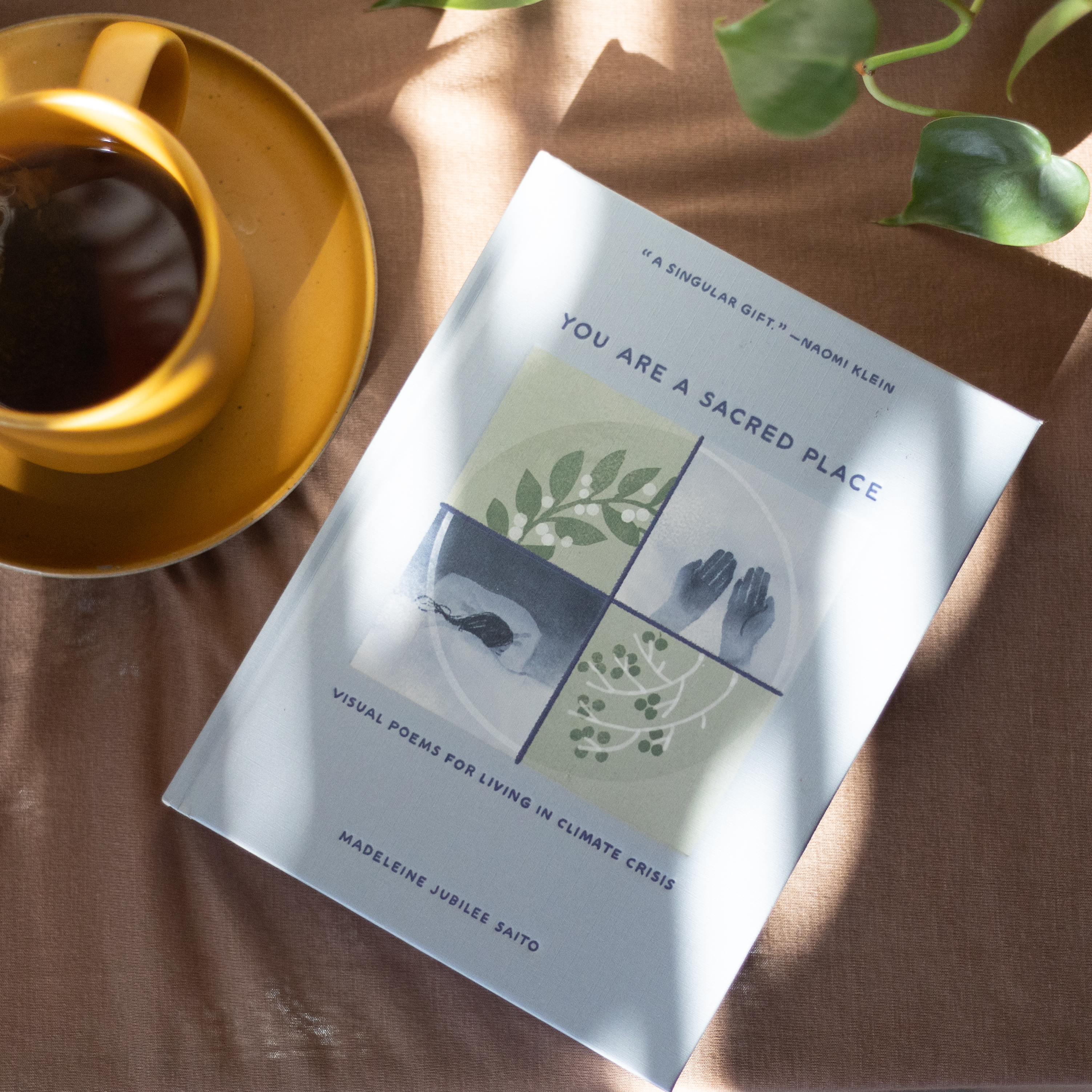
I’ve been following the work of comics artist Madeleine Jubilee Saito for several years (you may recall me featuring her here and here), and I’m thrilled that her debut collection of comics, You Are a Sacred Place: Visual Poems for Living in Climate Crisis, has now hit shelves! It’s gorgeous, you all. To coincide with the book’s release date today, I asked if she’d be willing to write a guest post providing some background and insight on comics as an art form and how Christians, including herself, have used the form. Before sharing two of her own comics, she explores three earlier examples by others—an Italian Gothic devotional painting, a late nineteenth-century African American quilt, and (where my mind typically goes when I hear “Christian comics”) a popular series of evangelistic tracts—expanding my sense of what a comic can be.
—Victoria Jones
A guest post by Madeleine Jubilee Saito
Comics have always been an art form for ordinary people—the medium of children, the illiterate, and the learning-to-read.
Since the 1960s, underground comix have been a scrappy, democratic, DIY art form: anyone with access to a black-and-white printer can make their own eight-page zine. And many Christians have found that humblest of publications, the self-published evangelistic tract, in that humblest of locations: the bathroom stall.
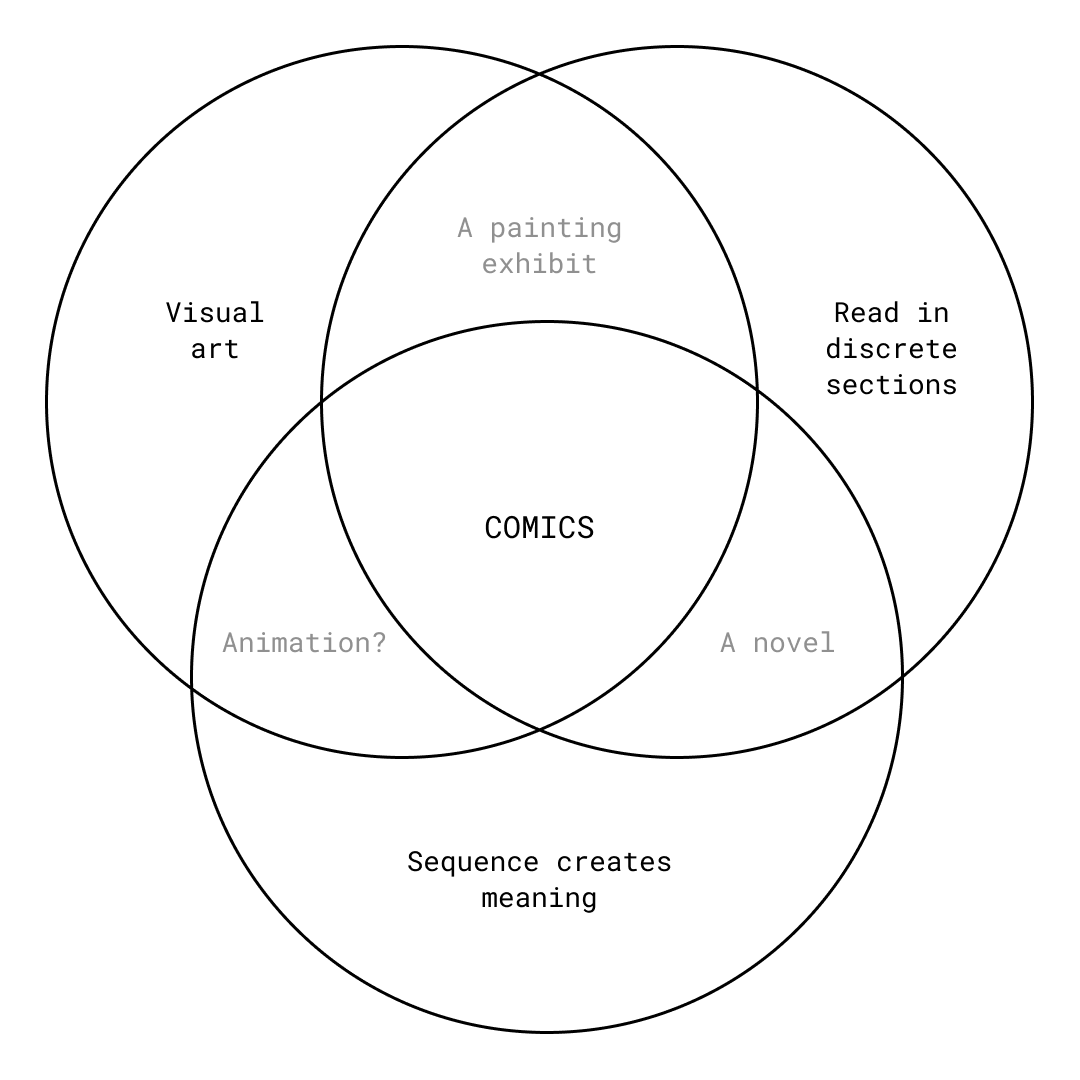
I am a Christian artist, and my medium is experimental comics. I define comics expansively as any visual artwork where meaning comes from the viewer reading discrete sections in sequence.
Breaking down my definition of comics
To put it more simply, comics are pictures (and sometimes text) that you read across panels.
Christian artists throughout time have been drawn to working in this medium. And because comics have always been a popular medium, often directed at those on the margins, reading Christian comics from the past can tell us something about how Christians of a particular time viewed ordinary people.
Three very different examples:
1. Pacino di Bonaguida, 14th century, Italy
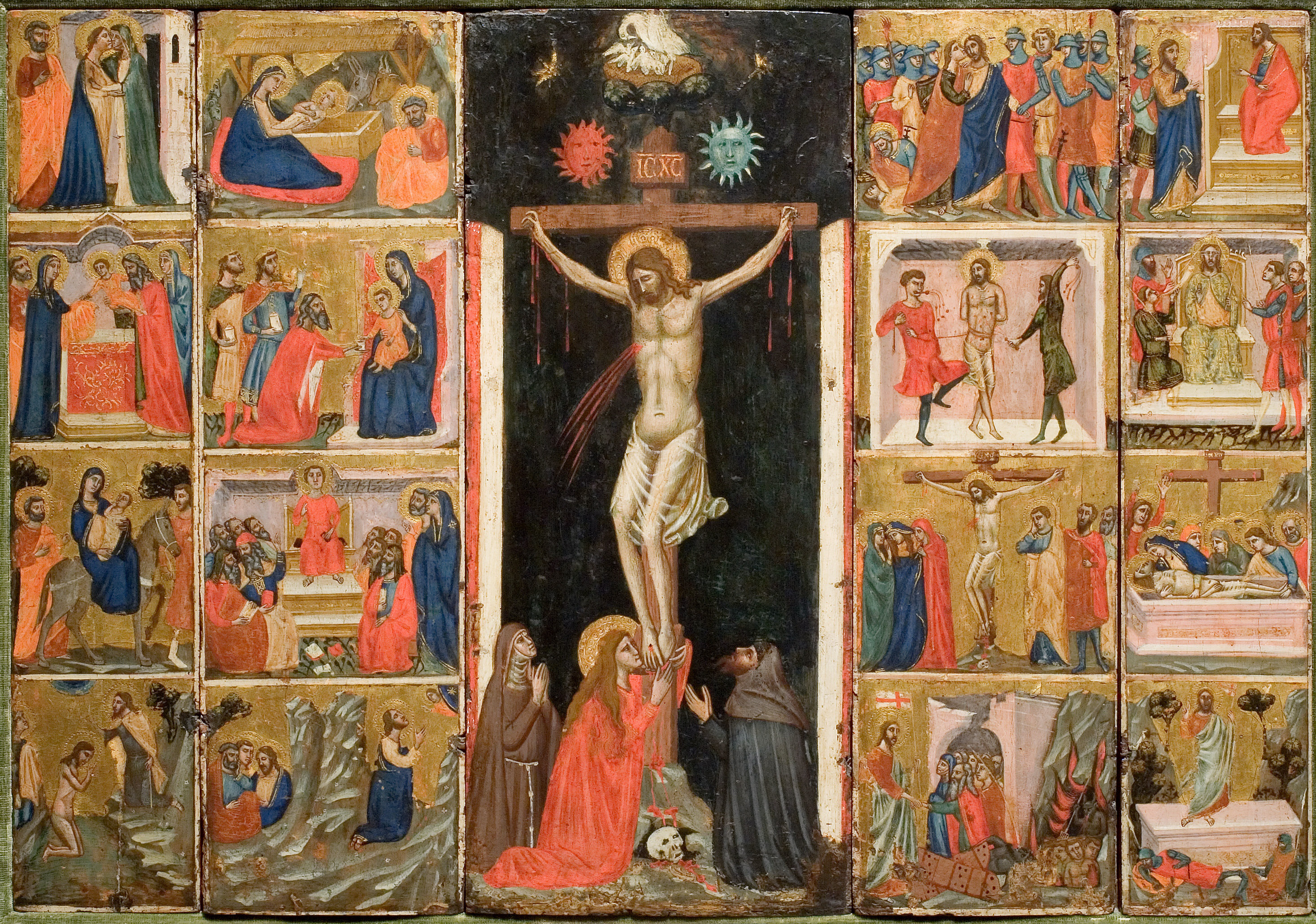
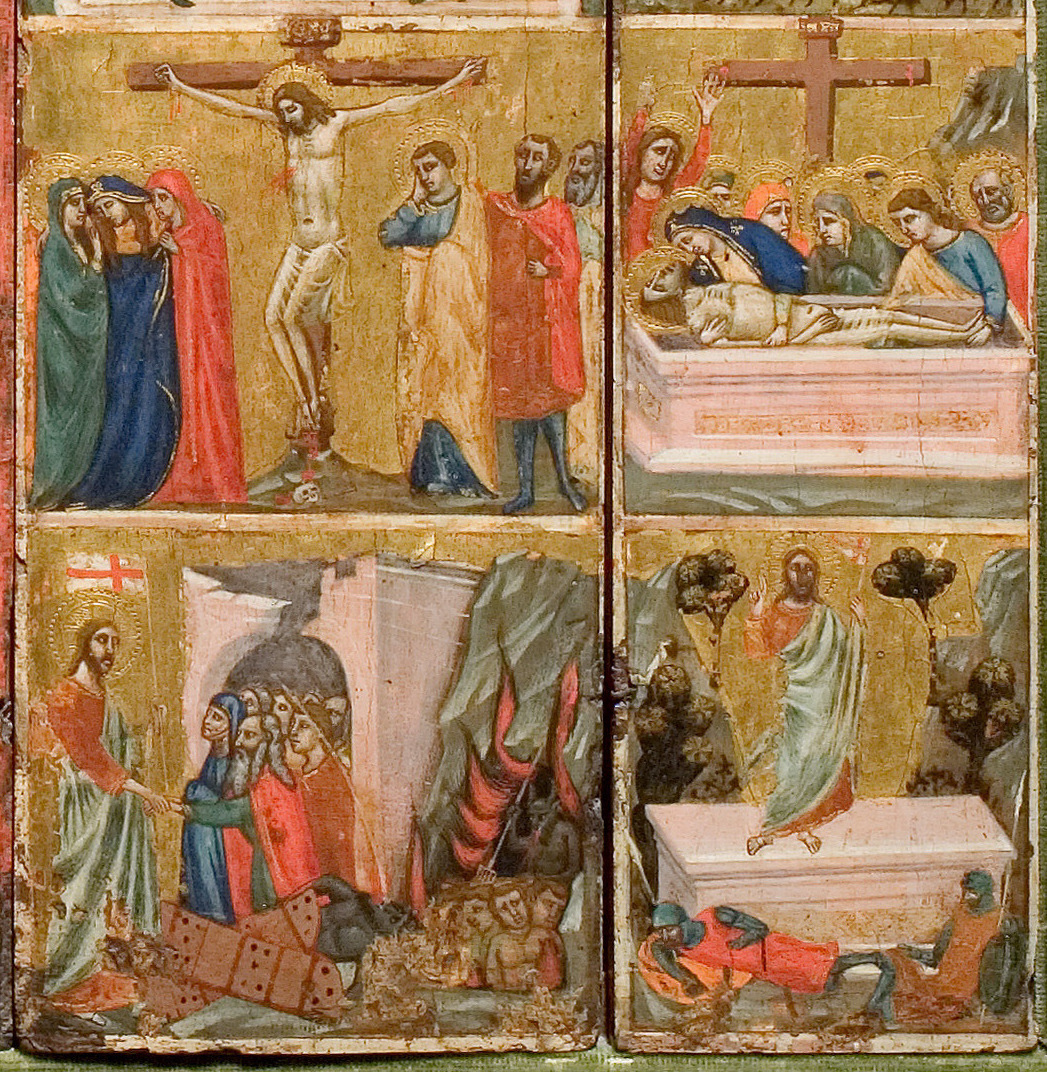
Pacino di Bonaguida (Italian, active 1302–ca. 1340), Tabernacle with Scenes from the Life of Christ, ca. 1325. Tempera and gold leaf on panel, 44.5 × 63.5 cm. University of Arizona Museum of Art, Tucson.
Pacino di Bonaguida is one example of an Italian artist making sacred comics alongside the rise of the Dominican and Franciscan mendicant orders in the thirteenth through fifteenth centuries.
Panels showing sequential scenes from the life of Christ were a popular choice for altarpieces. (An example of artworks in this tradition is the Stations of the Cross—I made my own entry into that tradition a few years ago.)
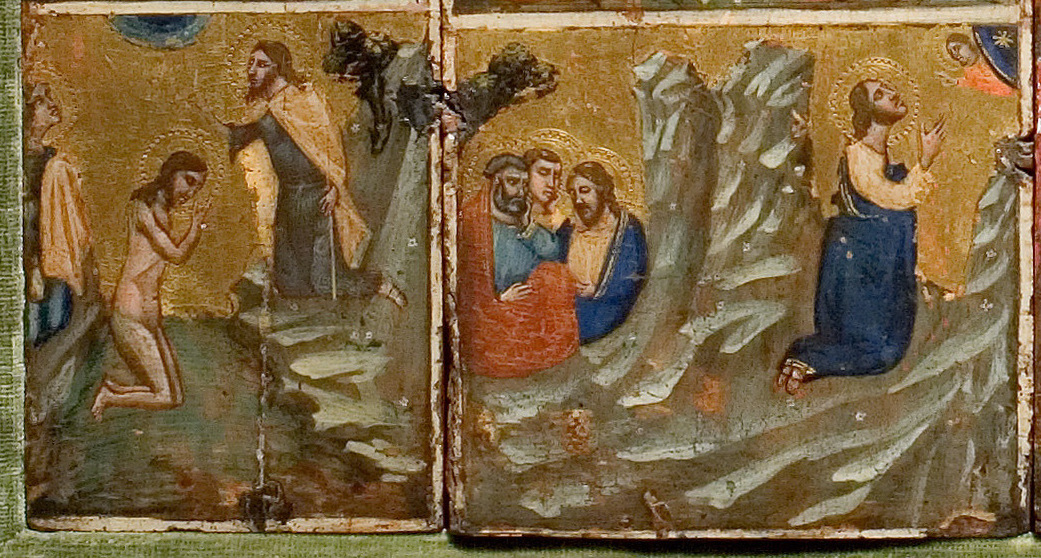
Pacino di Bonaguida, Tabernacle with Scenes from the Life of Christ, bottom left detail. Note the way that the rock forms echo between the two panels, creating rhythmic repetition between the Baptism of Christ and the Agony in the Garden.
In this period, Dominicans and Franciscans helped launch a movement in the church emphasizing preaching to and teaching common people and seeing oneself in the biblical story.
While we don’t have any writing from Pacino, we can look to the theological trends of the time to understand his comics.
The Dominicans and Franciscans encouraged ordinary Christians, including the illiterate, to move sequentially, systematically, through the story of Christ. The anonymously authored manual The Garden of Prayer (1454) instructs:
Alone and solitary, excluding every external thought from your mind, start thinking of the beginning of the Passion, starting with how Jesus entered Jerusalem on the ass. Moving slowly from episode to episode, meditate on each one, dwelling on each single stage and step of the story. And if at any point you feel a sensation of piety, stop: do not pass on as long as that sweet and devout sentiment lasts.
Pacino di Bonaguida, Tabernacle with Scenes from the Life of Christ, bottom right detail
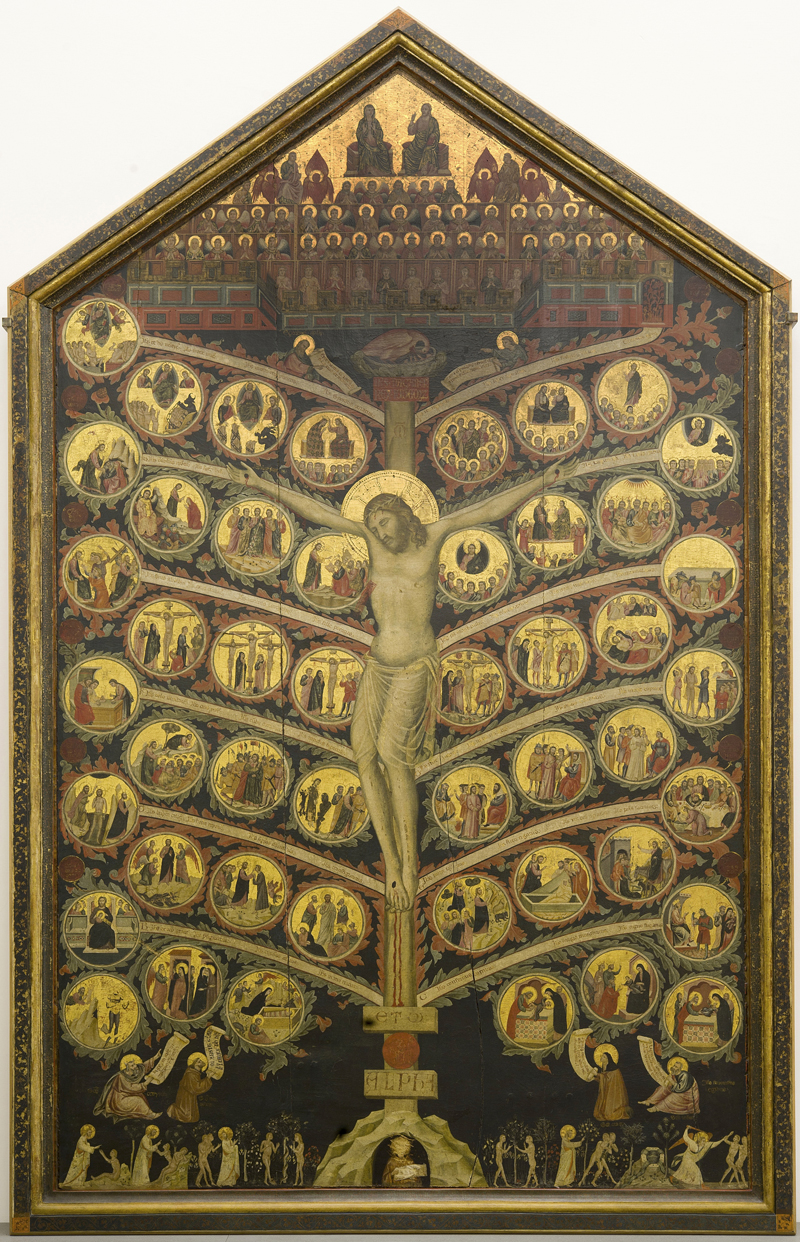
We see this sequential movement reflected in the sacred comics of the time—sometimes in square panels, other times in more creative shapes.
Pacino di Bonaguida, The Tree of Life, 1320. Tempera and gold leaf on wood panel, 248 × 151 cm. Galleria dell’Accademia, Florence. Note the round panels extending from a central point.
Sermons from the time extolled the usefulness of images depicting scenes from the life of Christ as a way to expand access to the gospel narrative. In 1492, for example, the Dominican friar Michele da Carcano, citing a famous letter of Pope Gregory’s from around 600, preached that images were introduced in churches “first, on account of the ignorance of simple people, so that those who are not able to read the scriptures can yet learn by seeing the . . . faith in pictures.”
These comics were intended to expand ordinary Christians’ access to the biblical story—making it more present and compelling, especially for those who couldn’t read.
2. Harriet Powers, 19th century, American South
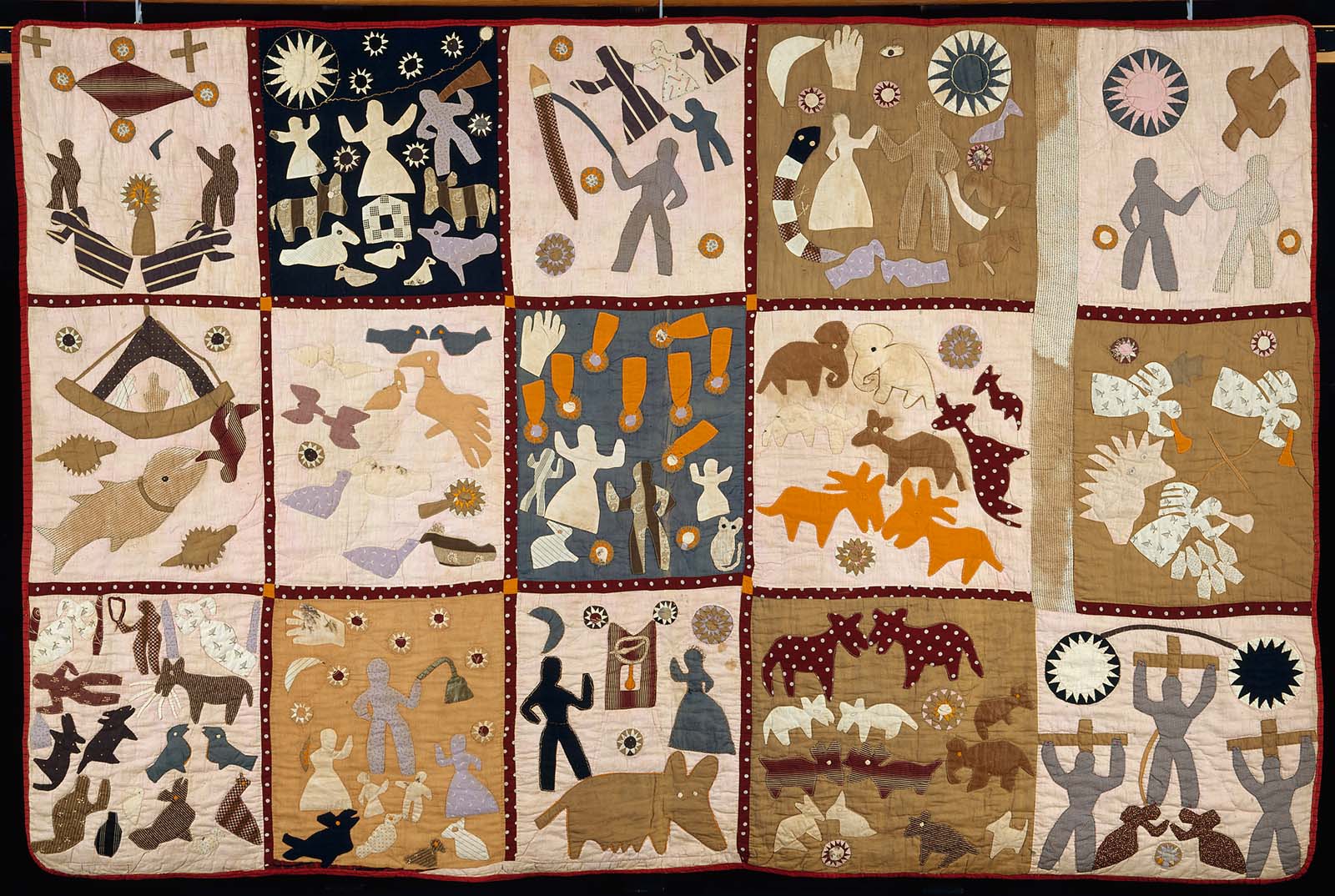
Harriet Powers (American, 1837–1910), Pictorial Quilt, 1895–98. Cotton plain weave, pieced, appliqued, embroidered, and quilted, 175 × 266.7 cm. Museum of Fine Arts, Boston.
Harriet Powers was a Black American quilter and folk artist who was born into slavery in 1837 and lived near Athens, Georgia.
Like the Dominicans and Franciscans several centuries earlier, Powers saw her comics as a more-than-verbal way to preach the gospel. She described her work as “a sermon in patchwork,” saying she intended to “preach the gospel in patchwork, to show my Lord my humility” and to “show where sin originated, out of the beginning of things.”
Rather than preaching a discursive message, [Powers] offers one that is “archaic,” or “predicated on the priority of something already there, something given.” Her symbols and textures facilitate a process of “crawling back” to a deeper level of consciousness or evoking knowledge that is already within but encumbered. . . .
Powers focuses on what her audience already knows by nurturing memory and offering faith-enlivening symbols that will embolden their Christian imagination.
Powers’s quilts weave historical scenes from the recent past with biblical scenes—visually and metaphorically linking the biblical story and her immediate reality.
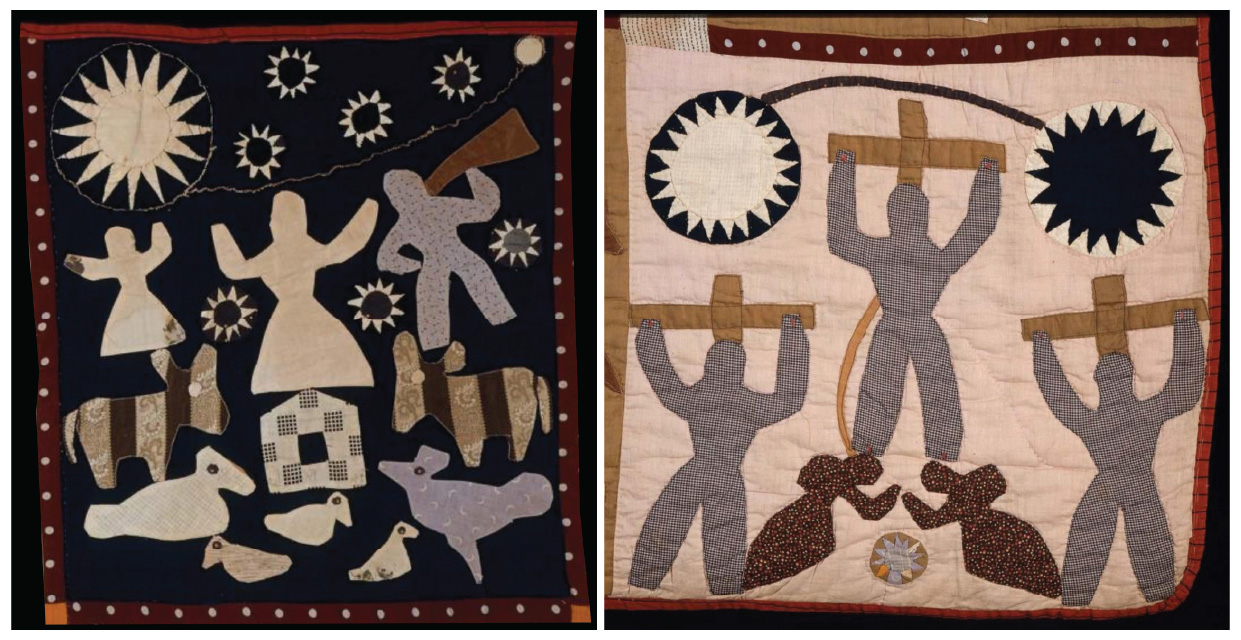
In her Pictorial Quilt, five of the fifteen panels depict recent historical and climatological events. The remaining ten depict stories from scripture.
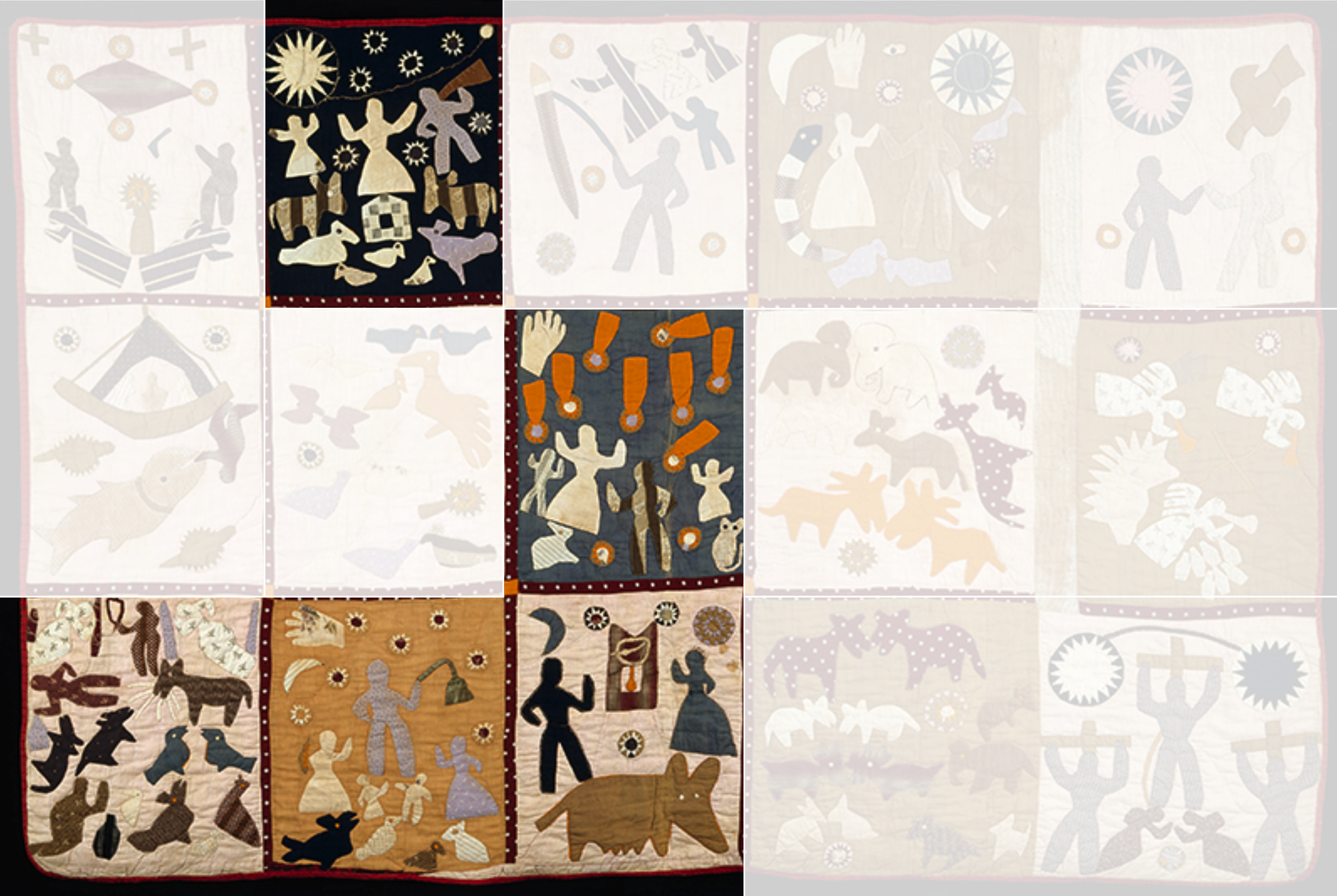
Harriet Powers, Pictorial Quilt, edited by the author to highlight historical and climatological panelsPanels from Pictorial Quilt by Harriet Powers
Left: “The dark day of May 19, 1780. The seven stars were seen 12 N. in the day. The cattle wall went to bed, chickens to roost and the trumpet was blown. The sun went off to a small spot and then to darkness.“
Right: “The crucifixion of Christ between the two thieves. The sun went into darkness. Mary and Martha weeping at his feet. The blood and water run from his right side.”
Note the way that the visual repetition of celestial bodies creates a link between the scene of recent history and Christ’s passion.
Powers’s comics, written from the margins (Powers was a formerly enslaved woman in Reconstruction-era Georgia) and for those on the margins, reflect a vision of a world where biblical stories and lived reality are not distant or separate, but already intertwined.
God is already fully present on the margins. In “Quilting the Sermon,” McCray remarks:
A vibrant spirituality drives Powers’ preaching. She envisions God as a mighty sovereign who intervenes in earthly affairs and is known primarily through obedience to scripture and attentiveness to divine revelation. This revelation is not limited to scripture but continues to unfold in human history through climatological events, celestial occurrences, and everyday activities.
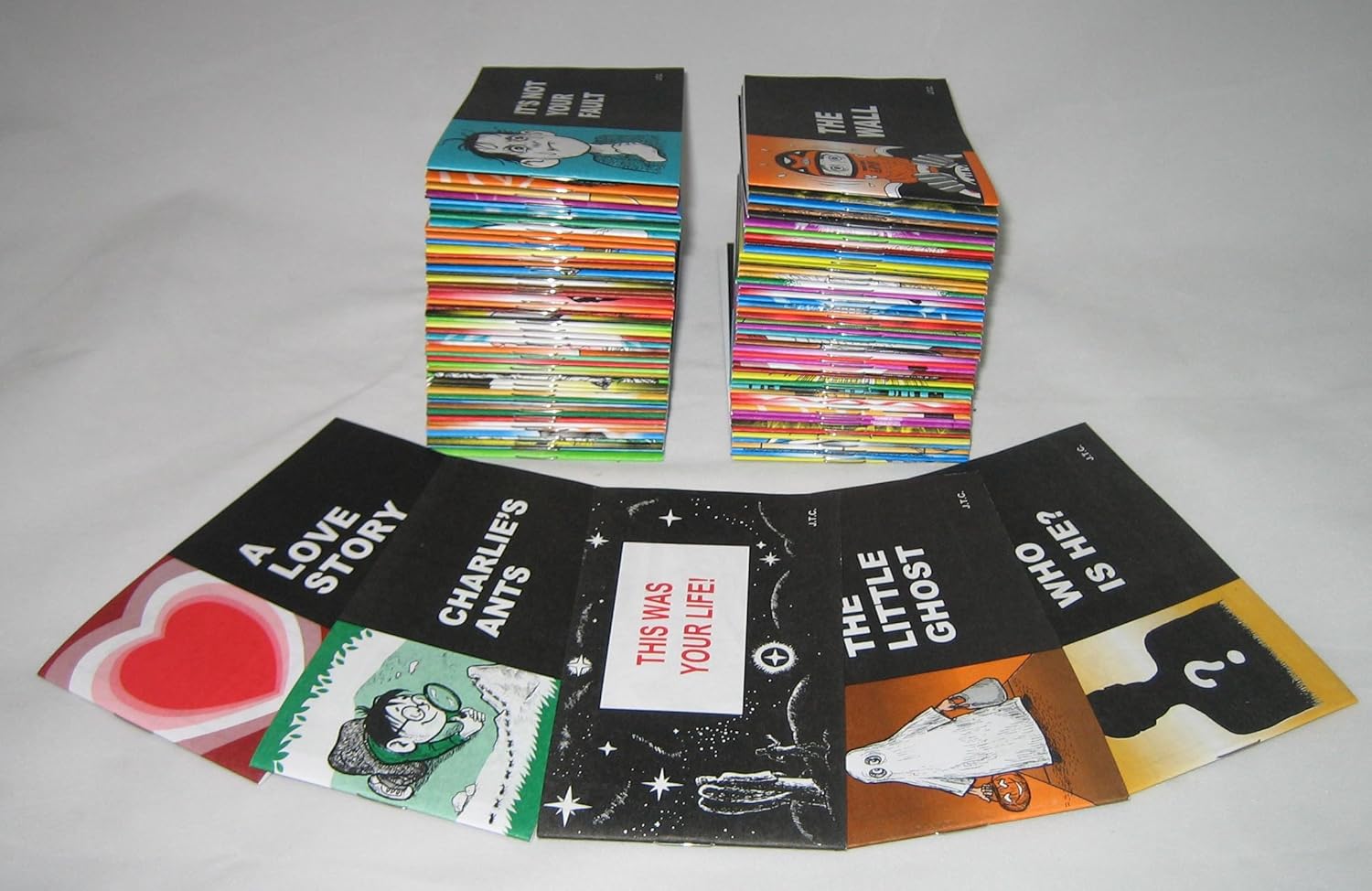
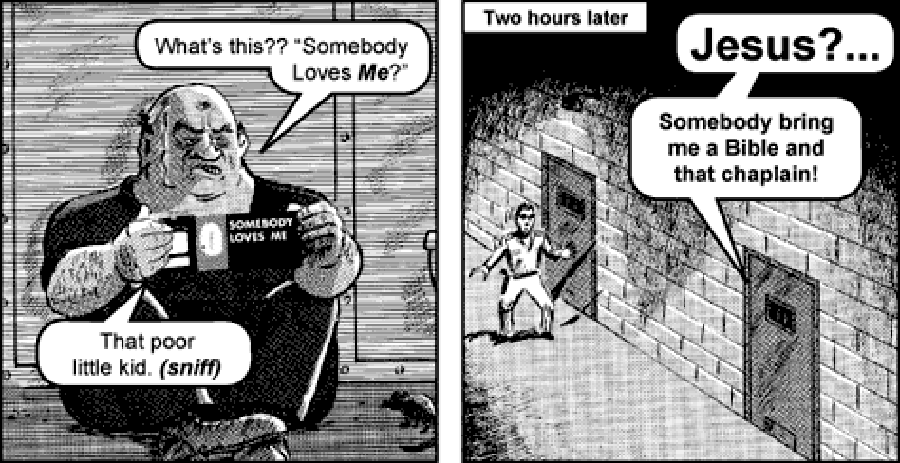
Chick tracts are broadly viewed as hate literature because of their anti-Semitic and anti-Catholic content. And Jack Chick (and his collaborators) are likely among the best-selling cartoonists in human history, with one billion tracts sold (according to Chick.com’s numbers).
While I don’t commend Chick’s work for distribution or personal meditation, I think that a critical reading of his comics reveals something interesting about a particular tradition of American Christianity—and how that tradition views the ordinary people who encounter Chick tracts in their mailboxes and workplaces and on public bathroom floors.
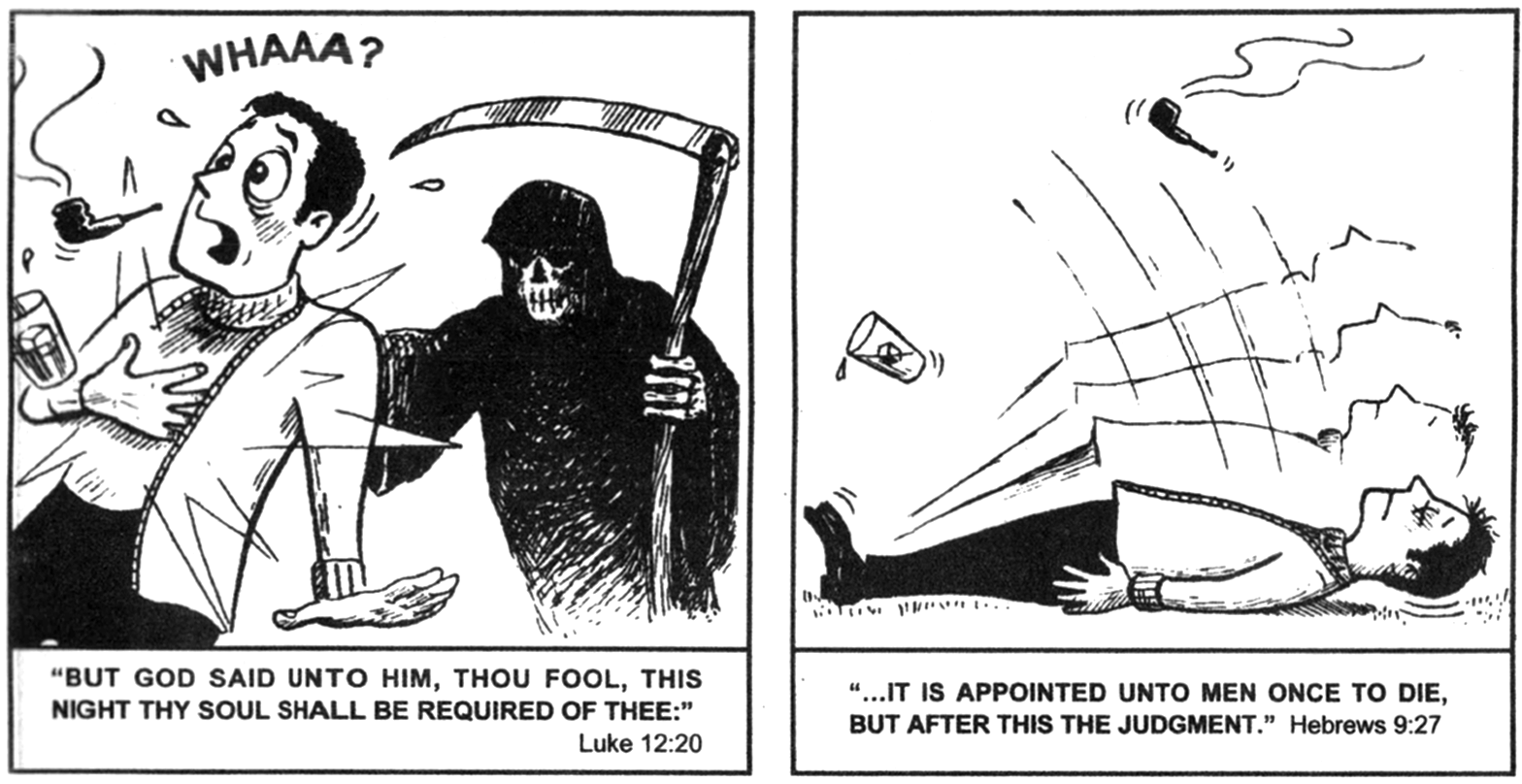
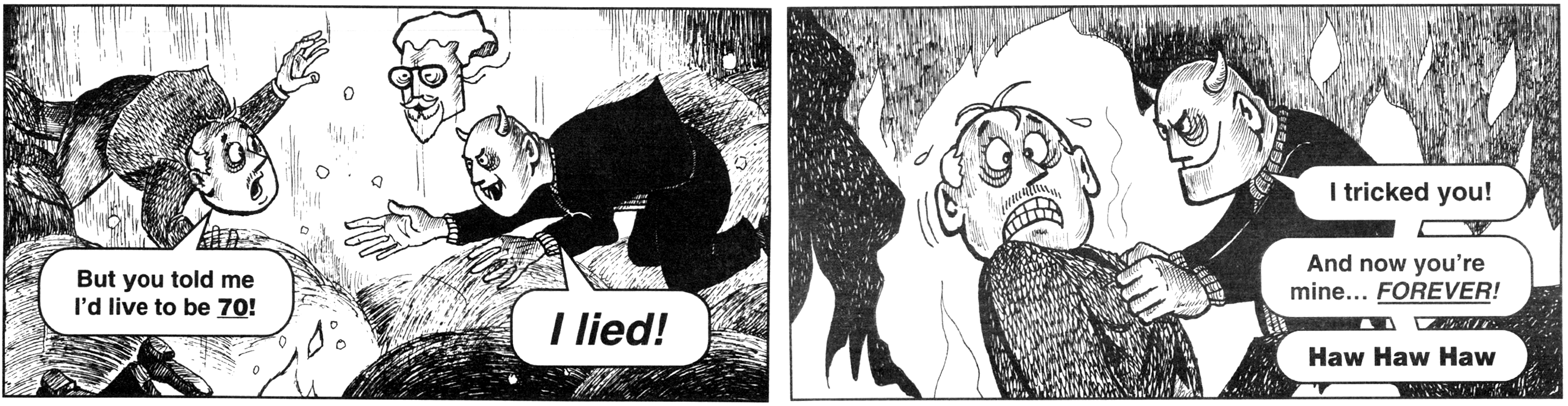
Each tract is a little larger than a business card (3″ × 5″), and usually around twenty pages long. Most tracts have a consistent rhythm: a setup, a shocking encounter, and a dramatic conversion.
If reading the Stations of the Cross feels like solemnly walking behind Christ as he makes his way through Jerusalem, Chick tracts feel like being pushed off a cliff.
In Chick’s imagination, the reader’s encounter with Christ is flat, rote, and tightly choreographed: Chick gives his readers the words to say. The reader’s encounter with God is compressed and mass-produced—an industrial object, like the tracts themselves.
Detail from The Bull, in which the titular character has a conversion experience while reading a Chick tract
For all three artists—Pacino di Bonaguida, Harriet Powers, and Jack Chick—the form’s legibility, irresistibility, and overall accessibility made comics a compelling tool to facilitate their readers’ encounters with God.
When I started making comics in high school, I was drawn to the medium for similar reasons: there is something irresistible and magical about the format.
My first comics were influenced by the autobiographical cartoonists of the early 2000s, especially Kate Beaton and Marjane Satrapi. In recent years, I’ve begun working more experimentally, influenced by the tradition of Christian comics described above.
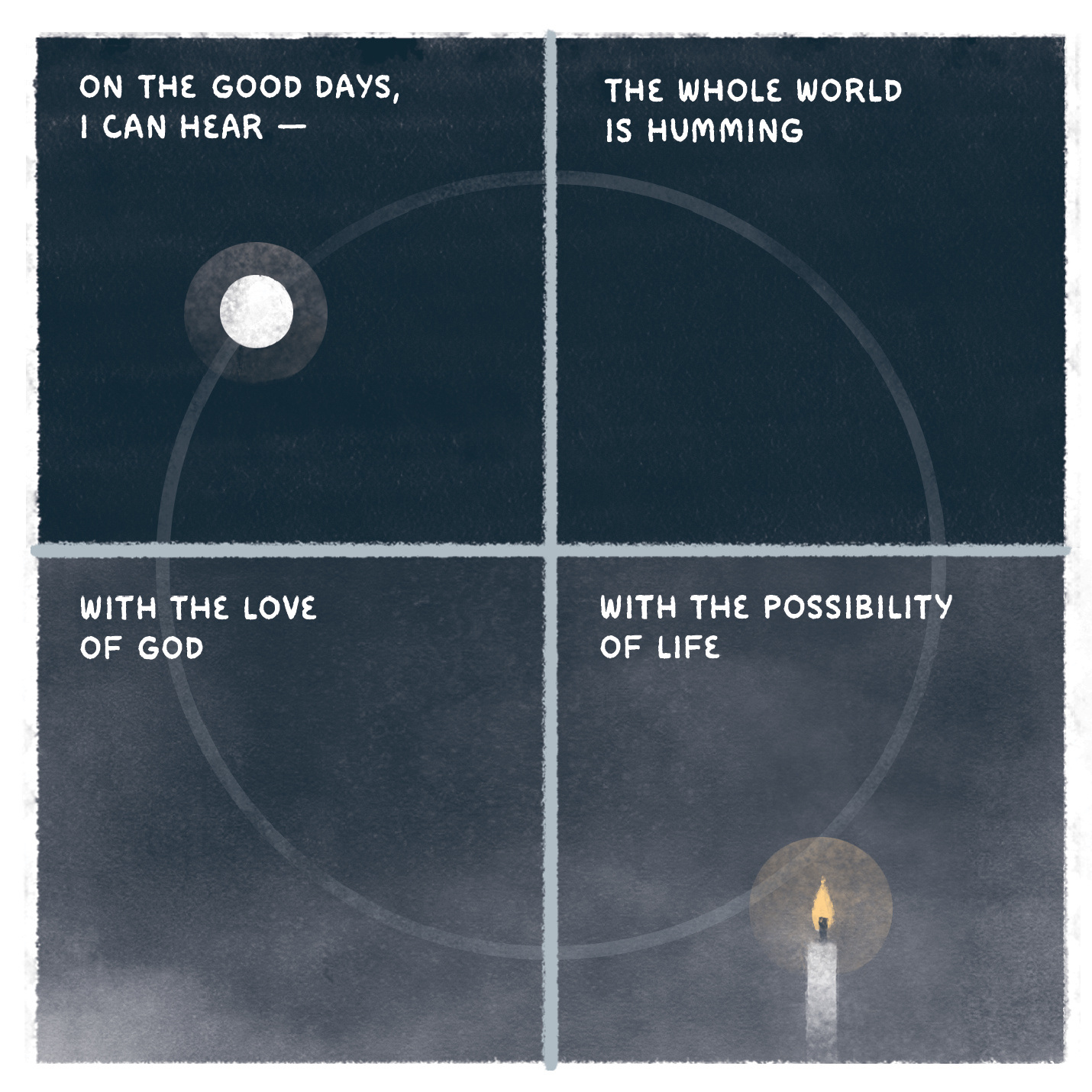
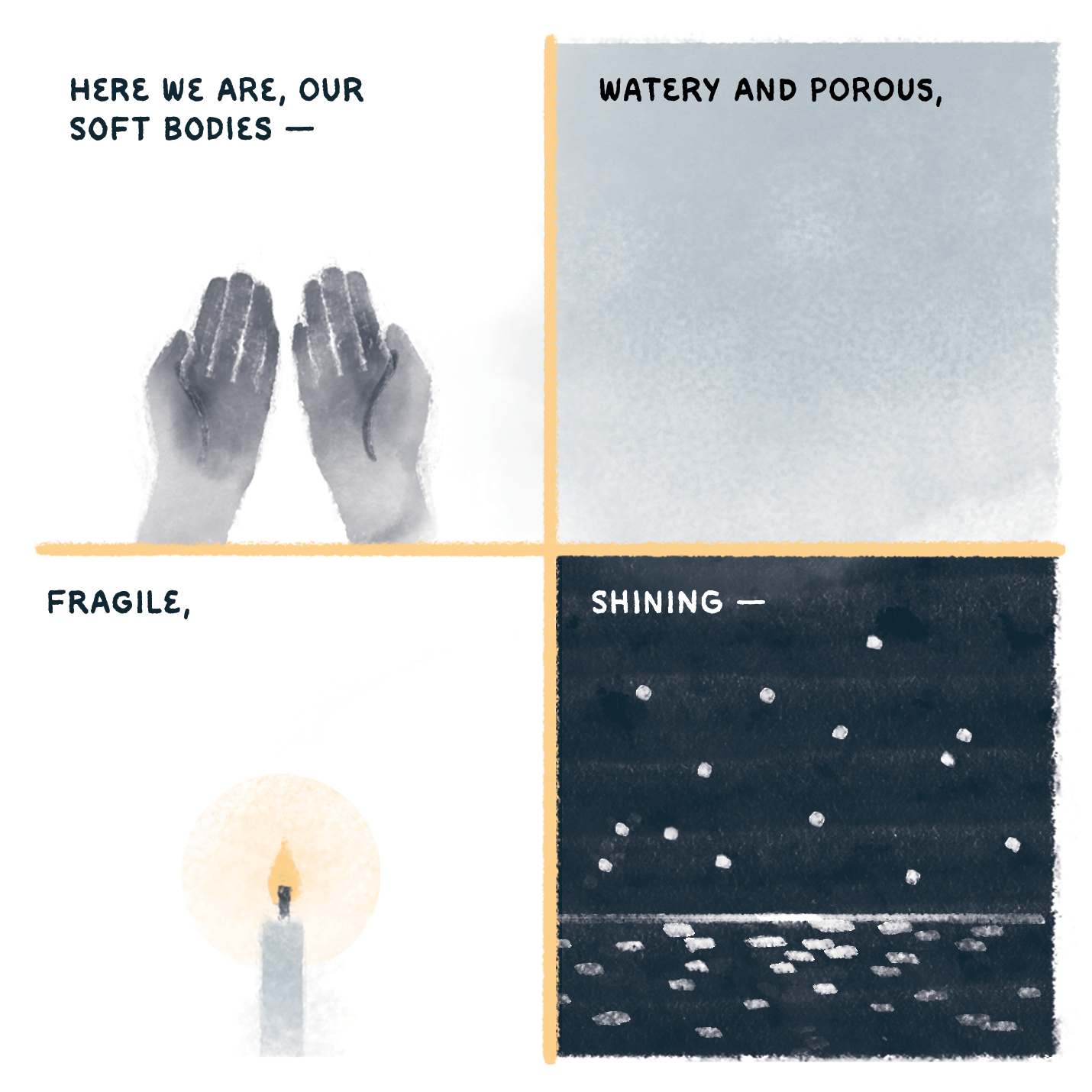
I’ve always loved the poetry and repetition of the Psalms and the Prophets. Comics, especially poetry comics, can have poetic resonances on multiple levels at once: in the text, in the imagery, and in the interplay between the text and imagery.
My first book, You Are a Sacred Place: Visual Poems for Living in Climate Crisis (out from Andrews McMeel March 25, 2025), is my attempt to bring the comics medium’s unique complexity into questions about the climate crisis, God’s justice, and how it feels to live in our moment in history.
Madeleine Jubilee Saito is a cartoonist and artist from rural Illinois living in Seattle and the author of You Are a Sacred Place (Andrews McMeel, 2025). In 2022, she was an inaugural artist-in-residence at On Being. Her comics open each section of the best-selling anthology of women’s writing about climate, All We Can Save (One World, 2020), and her work was recognized in Best American Comics 2019. Follow her on Instagram @madeleine_jubilee_saito.
From the publisher: “In her debut collection of comics, artist and climate activist Madeleine Jubilee Saito offers a quietly radical message of hope. Framed as a letter in response to a loved one’s pain, this series of ethereal vignettes takes readers on a journey from seemingly inescapable isolation and despair, through grief and rage, toward the hope of community and connection. Drawing on the tradition of climate justice, Saito reminds readers that if we’re going to challenge fossil fuel capitalism, we must first imagine what lies beyond it: the beauty and joy of a healed world.”
PHOTO COMPILATION: “Alternative Advent 2022” by Kezia M’Clelland: Kezia M’Clelland [previously] is the children in emergencies specialist and people care director for Viva and a child protection consultant for MERATH, the Lebanese Society for Educational and Social Development’s community development and relief arm. She is a British citizen, but her work brings her around the world, seeking to safeguard the rights and well-being of children globally.
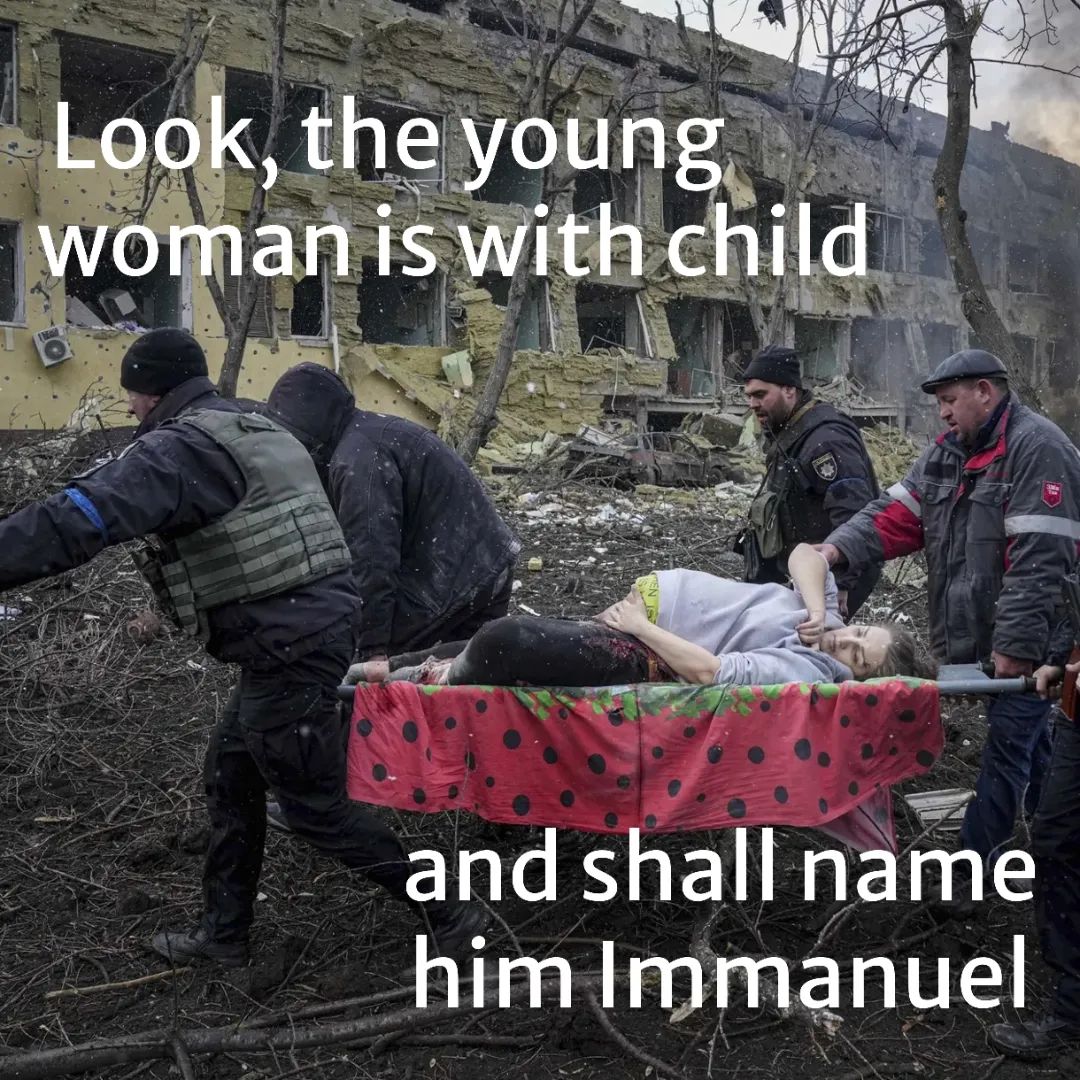
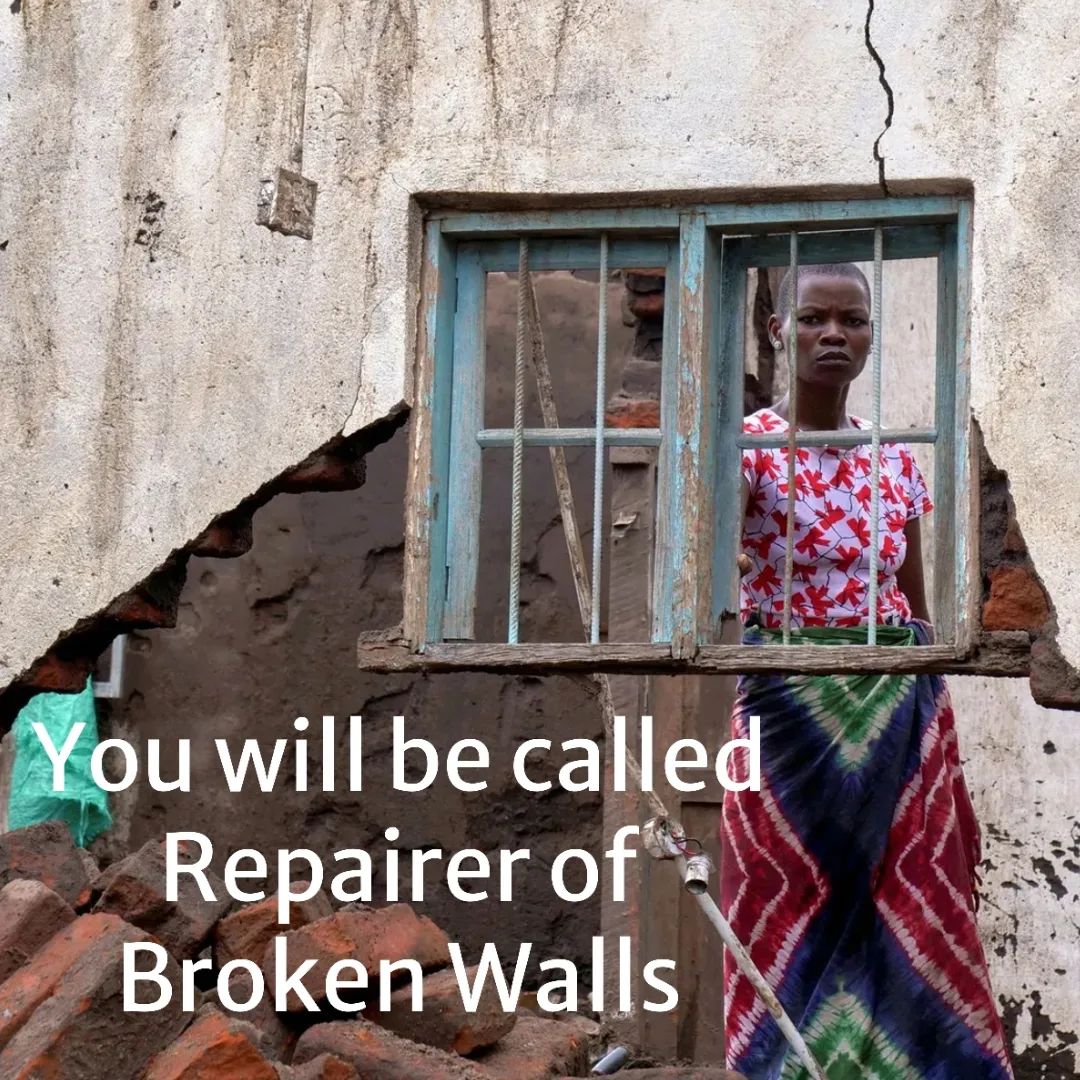
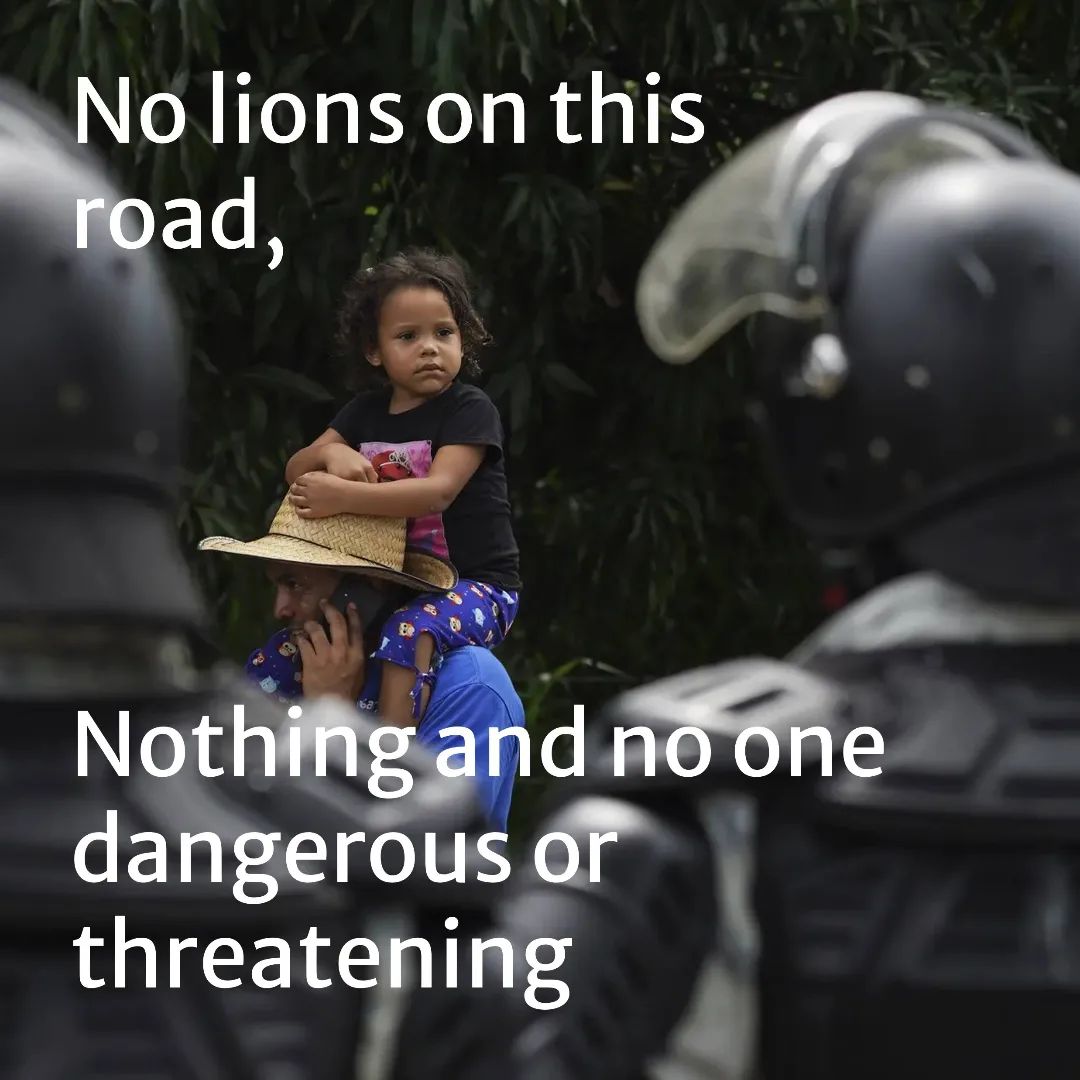
Every December M’Clelland compiles photos from that year’s news, showing people affected by natural disasters, violence, and injustice, and overlays them with Advent promises. There’s sometimes a disjunction between image and text that’s grievous and challenging, a reminder that our long-looked-for deliverance is not yet fully here, even though we receive foretastes. The twenty-eight photos M’Clelland gathered from 2022 include throngs of people making their way to Aichi cemetery in Saqqez, Iran, to attend a memorial for twenty-two-year-old Mahsa Amini, allegedly beaten to death by the country’s religious morality police for not wearing her hijab properly; a police officer helping a child flee artillery on the outskirts of Kyiv, and a baby being born in a bomb shelter; women carrying pans of granite up the side of a mine in Ouagadougou, Burkina Faso, for meager wages; a woman comforting a neighbor who lost her home to flooding in Tejerias, Venezuela; children playing in a sandstorm at the Sahlah al-Banat camp for displaced people in the countryside of Raqa in northern Syria; children clearing trash from a river in Tonlé Sap, Cambodia; and more.
March 9, 2022: An injured pregnant woman is rescued from a maternity hospital in Mariupol, Ukraine, that was bombed by Russian forces. The following week it was reported that she and her child, delivered in an emergency C-section, did not survive. Photo: Evgeniy Maloletka/AP. Scripture: Isaiah 7:14.January 26, 2022: A young woman looks on from her house destroyed by tropical storm Ana in the village of Kanjedza in Malawi. Photo: Eldson Chagara/Reuters. Scripture: Isaiah 58:12.June 7, 2022: A man and child, part of a migrant caravan consisting mostly of Central Americans, are blocked by members of the Mexican National Guard on a Huixtla road in Chiapas state, Mexico. They seek transit visas from the National Migration Institute so that they can continue their thousand-plus-mile journey north to the US. Photo: Marco Ugarte/AP. Scripture: Isaiah 35:9 MSG.
The sequence of images is a visual prayer of lament and intercession. I appreciate how M’Clelland—via the work of photojournalists, and her sensitive curation—raises awareness about these places of suffering, putting faces to the headlines, but also spotlights moments of empowerment and joy amid that suffering. We are encouraged to seek God’s coming into these situations of distress and to see the subtle ways he does come—for example, through the consoling embrace of a friend, the nurturance of an elder sibling, the protective aid of an officer, a jug of clean water, a child’s glee, or acts of protest.
For photo credits and descriptions, see the Instagram page @alternative_advent. (Start here and scroll left if you’re on your computer, or up if you’re on your phone.) Follow the page to receive new posts in your feed starting next Advent.
+++
SONGS by Rev Simpkins, an Anglican priest and singer-songwriter from Essex previously featured here:
>> “Hallelu! (Love the Outcast)”: This song was originally released on The Antigen Christmas Album (2014) with the byline “Ordinand Simpkins & Brother De’Ath”; it was reissued in 2016 on Rev Simpkins’s album Love Unknown, “a cornucopia of non-LP tracks, studio experiments, ingenious live re-workings, radio sessions, off-the-wall demos, obscure b-sides, & pissings about.” The music video was recorded on an iPhone 4 in the Edward King Chapel at Ripon College Cuddesdon in Oxford. [Listen on Bandcamp]
>> “Poor Jesus” (Traditional): Here the Rev. Matt Simpkins performs the African American spiritual “Oh, Po’ Little Jesus” with a soft banjo accompaniment. Harmonizing vocals are supplied by his daughter, Martha Simpkins. It’s the opening track of his EP Poor Child for Thee: 4 Songs for Christmastide(all four songs are wonderful!), released December 11, 2020, to support St Leonard’s Church, Lexden, where he serves as priest-in-charge. [Listen on Bandcamp]
+++
NEW PAINTING: Tent City Nativity by Kelly Latimore:Kelly Latimore is an Episcopalian artist from St. Louis, Missouri, who “rewonders” traditional iconography, especially with an eye to social justice. This Christmas he painted an icon called Tent City Nativity, which shows the Christ child being born in a homeless encampment. A streetlight shines directly over the Holy Family’s tent, like the star of Bethlehem, and neighbors bring gifts for warmth and sustenance: coffees, a blanket, a cup of chili. View close-ups on Instagram, and read the artist’s statement on his website. Proceeds from print and digital sales of the icon will support organizations serving the unhoused in St. Louis.
Kelly Latimore (American, 1986–), Tent City Nativity, 2022. Acrylic, Flashe, and golf leaf on birch board, 27 × 32 in.
SONG MEDLEY: YouTube user African Beats spliced together excerpts from three songs performed at a church in Germany at Christmastime by South African singer Siyabonga Cele and an unnamed woman, including “Akekho ofana no Jesu” (There’s No One like Jesus) and “He’s Got the Whole World in His Hands.” I couldn’t find the name of the last song, and attempts to contact the singer for information were unsuccessful, but it’s in Zulu, as is the first one. Lyrics to the first song, sourced from here, are below.
Akekho ofana no Jesu (There’s no one like Jesus) Akekho ofana naye (There’s no one like him) Akekho ofana no Jesu (There’s no one like Jesus) Akekho ofana naye (There’s no one like him)
Sahamba, hamba, lutho, lutho (I’m walking, walking, nothing, nothing) Safuna, funa, lutho, lutho (I’m searching, searching, nothing, nothing) Sajika, jika, lutho, lutho (I’m turning, turning, nothing, nothing) Akekho afana naye (There is no one like him)
PRAYER COMPILATION: “Prayers for a Violent World” by W. David O. Taylor: “How exactly do we pray in the aftermath of violence? What words should we put on our lips? What can the whole people of God say ‘amen’ to and what might only one of us be able to say amen to in good conscience? These questions are, of course, far from easy to answer, but over the past couple of years I have attempted to give language to such matters and I have included here a number of those prayers, in the hope that they might prove useful, and perhaps comforting, to people who face the terrors and traumas of violent activities on a regular basis.” Included are prayers After a Mass Shooting, Against Bloodthirstiness, For Loving a Hurting Neighbor, For Enemies, For Bitter Lament, For Peace in a Time of War, For Those Who Weary of Doing Justice, and more.
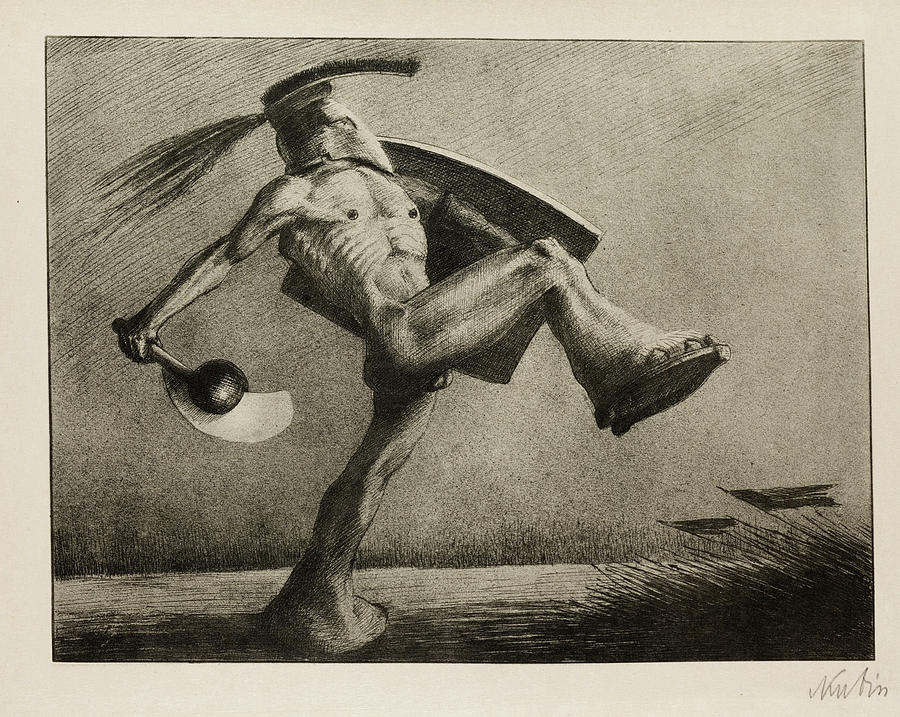
Alfred Kubin (Austrian, 1877–1959), War, 1903
Here’s Taylor’s Prayer of Allegiance to the Prince of Peace:
O Lord, you who deserve all our loyalties, we pledge allegiance this day to the Lamb of God and to the upside-down Kingdom for which he stands, one holy nation under God, the Servant King and the Prince of Peace, with liberty and justice for all without remainder. We pray this in the name of the Holy Trinity. Amen.
+++
NEW ALBUMS:
>> Sorrow’s Got a Hold on Me by Paul Zach: On May 20, singer-songwriter Paul Zachwrote on his Instagram, “My new album of thirteen sad church songs is out today! Many of these songs were written right after one of my weekly EMDR therapy sessions, as I have been working through the sorrow, trauma, and grief of the past few years. I’m learning to bring all of myself to God in prayer and songwriting, which includes my sorrow and anger. I’ve always heard that God shows up in a unique way in times of grief but that has not been my experience. These songs are an invitation for the ‘man of sorrows’ to join me in my grief.”
Zach often writes collaboratively (including as part of the Porter’s Gate! see below), and the cowriters on some of the songs here are Kate Bluett, Latifah Alattas (Page CXVI), Nick Chambers, Orlando Palmer (IAMSON), Jessica Fox, Alex Johnson, and Philip Zach. There are also a few guest vocalists.
>> Climate Vigil Songs by the Porter’s Gate:The Porter’s Gate is a collective of fifty-plus songwriters, musicians, scholars, pastors, and music industry professionals from a variety of Christian worship traditions and cultural backgrounds, making music for churches. This sixth album of theirs, made in partnership with the #ClimateVigil movement, is themed around environmental justice and creation care. Below are videos for “Brother Son (Giving Glory!)” and “Jubilee.”
Besides “Brother Sun,” my favorite tracks are “Satisfied,” a prayer that we would stop seeking to build our wealth (a motive that drives a lot of environmental injustices) and instead be grateful for God’s provision; “The Kingdom Is Coming,” a marchlike call-and-response song that rallies us to pray, wait, and work for an end to creation’s groaning; and “Water to Wine,” which wonders at the miraculous process of planting and growing grapes for harvest. There’s also “All Creatures Lament,” a minor-key arrangement of “All Creatures of Our God and King” with new lyrics that enjoin the animals to mourn habitat loss, air pollution, and other results of humans’ power abuses and irresponsible stewardship.
To learn more about the album, listen to this great interview with Porter’s Gate cofounder and producer Isaac Wardell; it’s from the RESOUNDworship Songwriting Podcast, hosted by Joel Payne. Wardell discusses the vision for Climate Vigil Songs, and especially the difficulty, with thematic albums, of avoiding the pitfalls of being too heavy-handed with the messaging on the one hand, and on the other, being so vague that people don’t see the connection. There’s also a need for tonal balance, and for songs that fill different functions.
We wanted to write for this album at least three different kinds of songs. One kind is essentially songs of lament—songs lamenting the state of creation because of human sin and the brokenness of the world. Secondly, we wanted to write hopeful, you might even call them eschatological, songs—songs that are joyful, that are about this is the world that God has made, this is God’s creative work, this is how God calls us into his creative work. . . . And lastly, we wanted to write mobilization songs—songs that have some kind of an ethical component of calling people to action in some way. . . . We want to make sure the record is not too much of a downer, like all lament songs; we want to make sure that it’s not too much of a happy-clappy “Isn’t creation beautiful!”; and we also don’t want to let it just delve into being a 100 percent political action record. . . . We want to balance those things.
Wardell also talks about the group’s collaborative songwriting approach (including all the theological and editorial work that’s put in), Te Fiti’s stolen (and later, restored) heart in Disney’s Moana, personified nature in the Psalms, creation as an experiencer of the fall and redemption, the role of provocation in church, and biblical imagery he wishes they could have included on the album but had to leave out for length.
+++
POEM + CHORAL SETTING: “when god decided to invent” by E. E. Cummings: “Here’s a brief powerhouse of a poem from E. E. Cummings, two stanzas that draw a sharp distinction between God’s inventive, joyful creativity on the one hand, and our too-frequent turn toward violence on the other. As the mass shootings in Buffalo, Uvalde, and elsewhere continue to reverberate, Cummings’ poem helps us feel and think about what’s at stake – and what the way forward looks like.”
SALT Project reproduces the poem, provides brief commentary, and links to a musical setting by Joshua Shank—a composition for SATB, soprano saxophone, and finger cymbals that premiered in 2005. Shank says the arc of his piece is creation-destruction-recreation. “This final chord is the creator taking control of the creation again.”
+++
RADIO EPISODE: “Belief in Poetry: John Donne”: John Donne (1572–1631) is one of my favorite poets, and looking back on the blog, I can’t believe I’ve not yet featured any of his poems! (I’ll have to rectify that . . .) In this BBC Radio 4 segment from March 13, poet and theologian Pádraig Ó Tuama considers Donne’s complex faith life through his poetry. He speaks with Julie Sanders, professor of English literature and drama at Newcastle University; Mark Oakley, writer and dean of St. John’s College, Cambridge; and Michael Symmons Roberts, poet and professor of poetry at Manchester Metropolitan University. Sir Simon Russell Beale reads the four featured Donne poems: “Death, be not proud” and “Batter my heart, three-person’d God” from his Holy Sonnets series, “Hymn to God, My God, in My Sickness,” and “A Hymn to God the Father.”
Here are two of the quotes that stood out to me:
“It’s easy to think of John Donne’s life falling neatly into two parts: the worldly man, and the spiritual seeker; the lover of women, and the lover of God; Catholic, then Protestant; before Anne, and after Anne; love poet, and religious poet. But life is rarely that clear. And rather, it’s the tension between these dynamics of him that gives birth to so much of his work.”—Pádraig Ó Tuama
“There’s an assumption that a poet working in this territory is sure of their ground and knows what they’re writing about. I don’t think that’s ever true, because why would you write the poems, if that were true? You’d just bathe in your certainty! The whole act of sitting down to write a poem is not to dress up something you already know in a way that makes it an enticing package for other people to be convinced by—and if you attempted that, it’s going to fall like the deadest thing on the page. Making a poem is an exploratory process. You don’t know where it’s going to end when you start it.”—Michael Symmons Roberts
SONG: “Put out into the deep” by David Bednall (2008), performed by The Gesualdo Six (2020): A verbatim setting of Luke 5:1–11 (RSV), the calling of the disciples, which is the Revised Common Lectionary reading for February 6.
+++
ESSAYS:
>> “Ghosts in Los Angeles” by Arthur Aghajanian, Ekstasis: The author of this essay reflects on Andres Serrano’s Nomads (1990), a humanizing series of portrait photographs of men and women experiencing homelessness in New York City. “Serrano titled each photograph with its subject’s first name, suggesting a familiarity with those portrayed while retaining their anonymity. . . . The images mimic the visual style of fashion and advertising, while also referencing historical portraits of the wealthy and powerful. The work restores the visibility along with the dignity of its subjects. . . . His diverse group reflects the vulnerabilities we all share, and the grace that sustains us in adversity.”
Andres Serrano (American, 1950–), Bertha, from the Nomads series, 1990. Cibachrome, 152 × 125 cm.
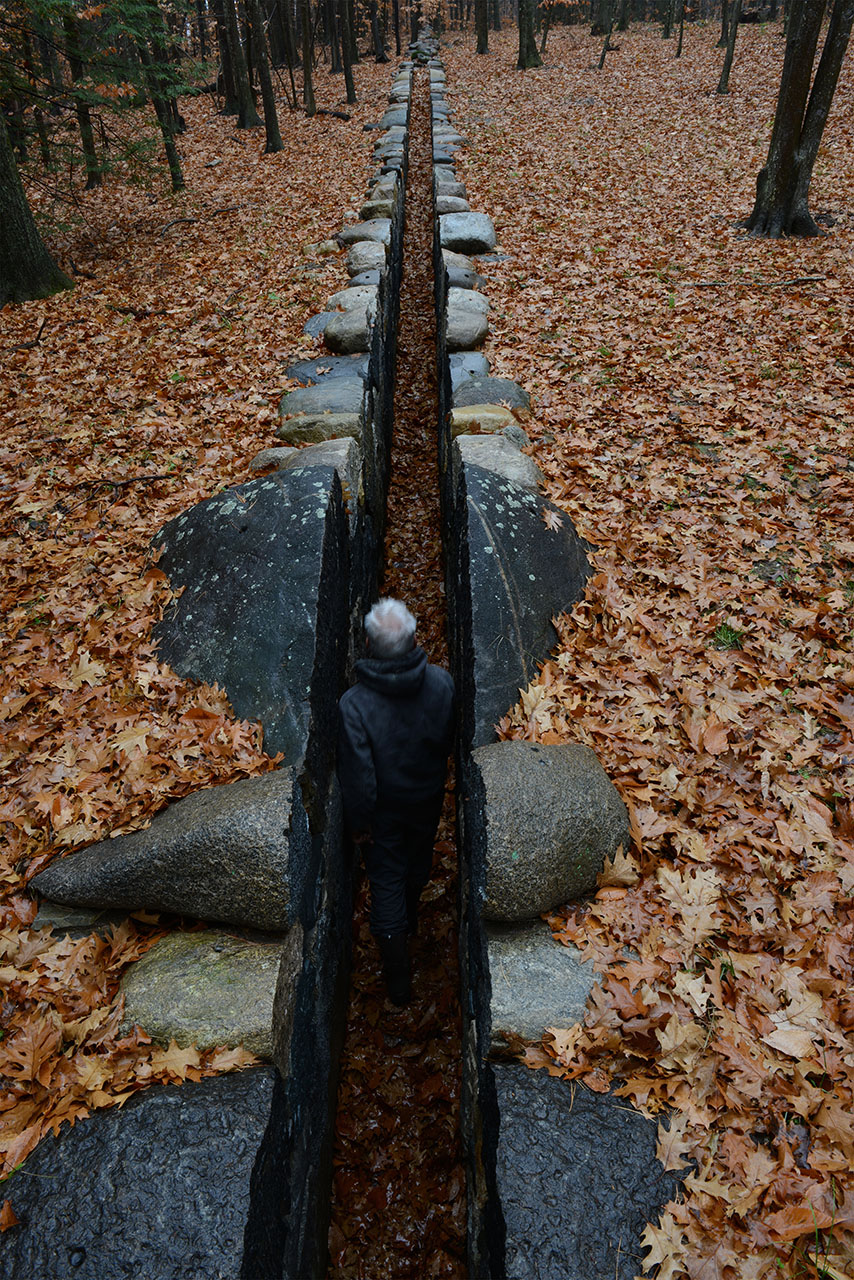
>> “The Cleft in the Rock: A Theology of Negative Spaces” by Daniel Drage, Image: This Image journal essay explores profound negative spaces in scripture—the first Sabbath, exile, the passage opened up by the parting of the Red Sea, empty wombs, tombs, nail wounds, the cleft of a rock, the space between the gold cherubim’s wings above the mercy seat—bringing them into conversation with works by contemporary British sculptors David Nash, Rachel Whiteread, and Andy Goldsworthy. Emptinesses that are full and presence via absence are key ideas.
Andy Goldsworthy (British, 1956–), Passage, 2015. Granite. Private collection, New Hampshire. Copyright of the artist.
+++
ANIMATED SHORT FILMS:
>> Migrants, dir. Hugo Caby, Antoine Dupriez, Aubin Kubiak, Lucas Lermytte, and Zoé Devise: The graduation project of five film students from the Pôle 3D school in France, this short follows a mother polar bear and her cub who are displaced from their Arctic home. When their ice float runs aground a new habitat and they’re forced to learn a new way of life, the native brown bears treat them with hostility. The filmmakers said the project was initially inspired by the story of the Aquarius, a watercraft filled with refugees that grabbed global headlines when it was refused entry at Italian ports in 2018. [HT: Colossal]
>> Tokri (The Basket), dir. Suresh Eriyat: A father-daughter story set in Mumbai, this stop-motion animated short from Studio Eeksaurus is about mistakes and forgiveness, and how meaningful a kind extended hand from a stranger can be . . . or not. [HT: Colossal]
Ears to the Ground Family is a group of friends in their early thirties, making music together in and around their hometown of Harrisonburg, Virginia. Minimalist and totally acoustic, they sing songs of hope, sustaining faith, and resistance to oppression and empire. Their stylistic influences include the spirituals, soul, hip-hop, R&B, folk/Americana, chant, Taizé, and Anabaptist hymns, especially from the Mennonite tradition, to which they belong.
The core members of Ears to the Ground Family are, from left to right, Jake Cochran, percussionist; Matt Dog, trumpeter; Nichole Barrows, lead vocalist; Hannah Win, vocalist; and Dimitris Campos, lead vocalist, classical guitarist, and multi-instrumentalist.
The band formed in 2010 and has “always preferred the outdated and peculiar model of the elusive traveling troubadour,” sharing their music in small settings, unplugged, locally or regionally. Its members first met during the Petrol-Free Jubilee, an annual two-week bicycle-powered music and art tour of the mid-Atlantic, which they went on to participate in as a group for seven years. Its purpose was “to promote peace, social justice, and a healthy planet.”
“We biked two hundred to three hundred miles with ten to twenty people on average, often several bands or musicians with us at a time, and our regular stops and show locations included a lot of farms, community centers, and Catholic Worker houses,” band member Nichole Barrows told me. “Just imagine twenty people rolling down Main Street in your city in the middle of a hot summer afternoon on their bikes, with drums and guitars in tow, ringing their bike bells and singing at the top of their voices! I mean, it was like summer camp on wheels; we brought the show with us!”
This small-scale approach and casual touring schedule, Barrows said, “enables us to root ourselves deeply within our home community and invest in the valuable work that inspires our music.” That valuable work includes church ministry, community organizing, farming, and outdoor education.
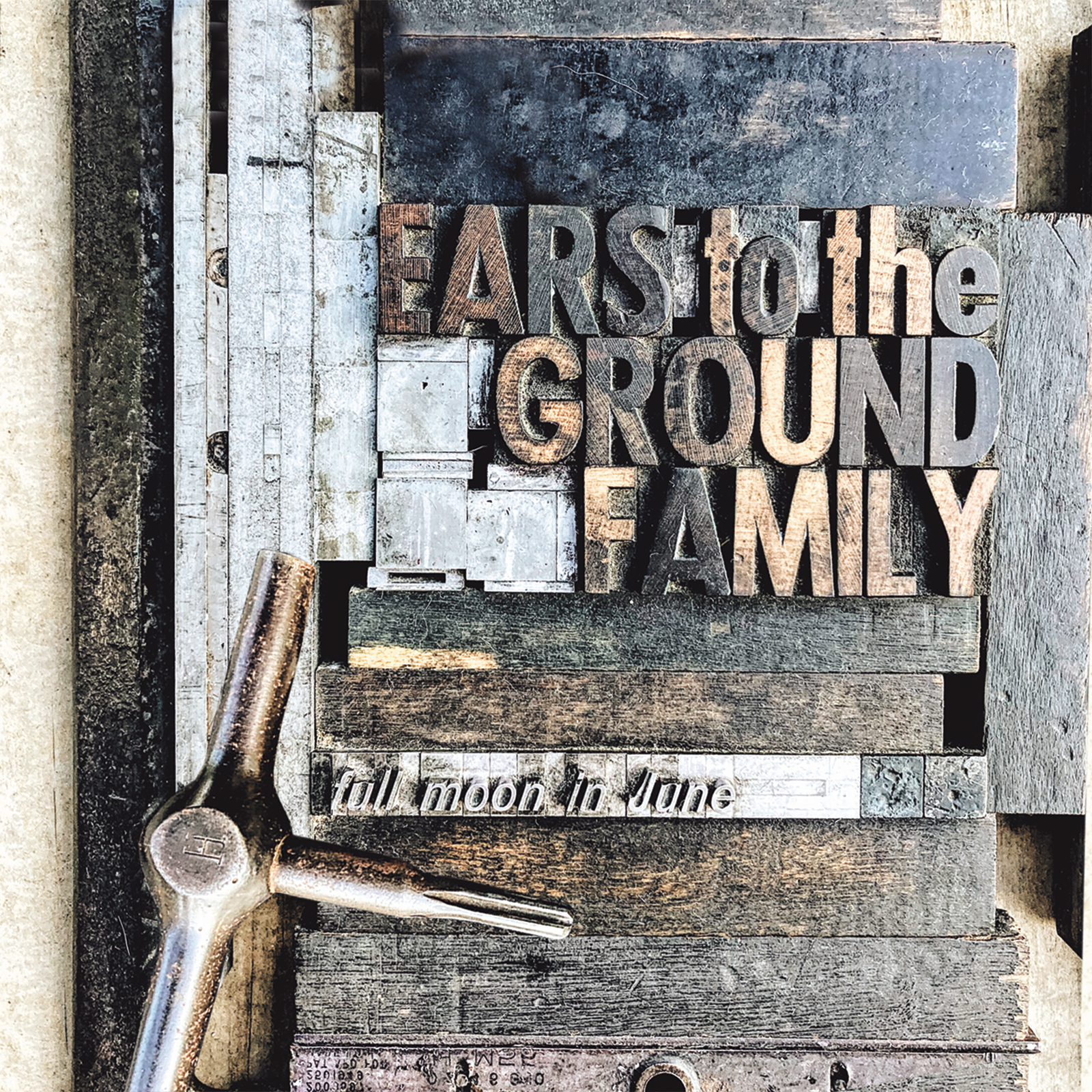
In June 2017 Ears to the Ground Family recorded eight original songs (written between 2007 and 2013) plus a traditional African American spiritual, but jobs, family, and other projects prevented them from being able to mix, master, and self-release until recently. Finally, on December 18, 2020, their debut album, Full Moon in June, came into the world, making their music available to a much wider audience for the first time.
“It’s funny,” Barrows said, “some people talk about ‘slow music’ (you know, slow food, etc.) to describe homegrown, independently released local music. But we’re so ‘slow’ that it takes us about ten years to release our first album!”
Infused with prophetic imagination, Full Moon in June denounces the forces of evil at work in the world on a grand scale—things like war, environmental exploitation, predatory lending practices, and the prison industrial complex—and casts a beautiful vision of all things new under Christ. Stop participating in that which is destructive, the album invites, and join instead with the creative work of the Spirit, which is love, joy, peace, patience, kindness, generosity, faithfulness, gentleness, and self-control (Gal. 5:22–23). These songs awaken my enthusiasm for the promised future of all that is and for our journey toward it, sowing seeds of Christ’s kingdom all along the way.
An exploration of “Almond Blossom”
My favorite song on Full Moon in June is the first one, “Almond Blossom” by Dimitris Campos, which uses the image of a tree to signal abundance and renewal. “There’s an almond blossoming in Jerusalem,” it opens. Almond blossoms are a harbinger of springtime, and in fact Israel’s almond trees are the first to bloom each year. The song’s second line, “The buds on a fig tree becoming tender again,” evoke the recurring comparison of God’s people to a fig tree in the Hebrew Bible (e.g., Hosea 9:10; Jer. 8:13; Jer. 24) as well as the story of Jesus cursing a fig tree for failing to bear fruit, a symbolic act of judgment against those who reject his ways. The image here, though, is of a withered fig tree becoming healthy and vibrant once again.
The lyrics go on to note how the trees and other parts of the natural world appear to worship God; the “mountains are clapping their hands” (cf. Psa. 98:8; Isa. 55:12), and the trees reach toward the heavens. Humanity, by contrast, turns in on itself, and rather than living into the flourishing it was created for, invents new means of destruction—bombs dropped from drones, for example, leaving orphans in their wake.
In the song, Campos recalls a visit to the National Air and Space Museum in Washington, DC, the horror of families posing happily for photos in front of bombers, fighter jets, missiles, military avionics, and other tools of combat, celebrating national might. Campos contrasts the heaviness of those metal death-traps with the light feeling of floating on the “river of life” (cf. Rev. 22:1), and their sterility with a fructifying olive vine, delicately tended (cf. Rom. 11:11–24).
Empires fall—Egypt, Rome; America one day will too, and another will rise in its place. “I proclaim that Jesus, he will decide / If it is that Rome is on I-95”—the highway that the US capital is located off of. Earthly kingdoms that put their trust in arsenals and that deal in death rather than life may be in for a divine toppling. The same goes for corrupt systems.
Jesus himself said as much. For example, in Mark 13:2, he says regarding the Jewish temple complex, “Do you see these great buildings? Not one stone will be left here upon another; all will be thrown down.” It’s because the religious establishment at the time had become oppressive and was rejecting Jesus as the Christ. They were trusting in all their rules and learned interpretations of scripture while failing to see the plain revelation of God right in front of them.
The penultimate stanza of “Almond Blossom” is excerpted from “Canticle of the Turning” by Rory Cooney, a paraphrase of Mary’s Magnificat, which is one of the Bible’s most radical songs:
From the halls of the power to the fortress tower Not a stone will be left upon a stone Let the king beware, for your justice tears Every tyrant from his throne
The song concludes with a reprise of the first two lines, circling back to the image of trees and their eschatological (end times) resonances. In Matthew 24:32–33, Jesus tells his disciples, “From the fig tree learn its lesson: as soon as its branch becomes tender and puts forth its leaves, you know that summer is near. So also, when you see all these things, you know that [the Son of Man] is near, at the very gates.”
“Almond Blossom” is a clever interweaving of biblical allusions, spanning Genesis to Revelation, that calls America to account for its warmongering while inviting her citizens into the beautiful, lasting, life-giving way of Christ.
The following poem from the book of Isaiah, about the messianic age, was resounding in my mind as I listened to this song:
For you shall go out in joy and be led back in peace; the mountains and the hills before you shall burst into song, and all the trees of the field shall clap their hands. Instead of the thorn shall come up the cypress; instead of the brier shall come up the myrtle; and it shall be to the Lord for a memorial, for an everlasting sign that shall not be cut off.
—Isaiah 55:12–13
Other songs
All but two of the songs on Full Moon in June were written (or cowritten) by Dimitris Campos. Half Greek and half Peruvian, he was raised in a Latino culture in the United States, which itself has mixed Spanish, Indigenous, and African influences. His musical compositions are informed by this background.
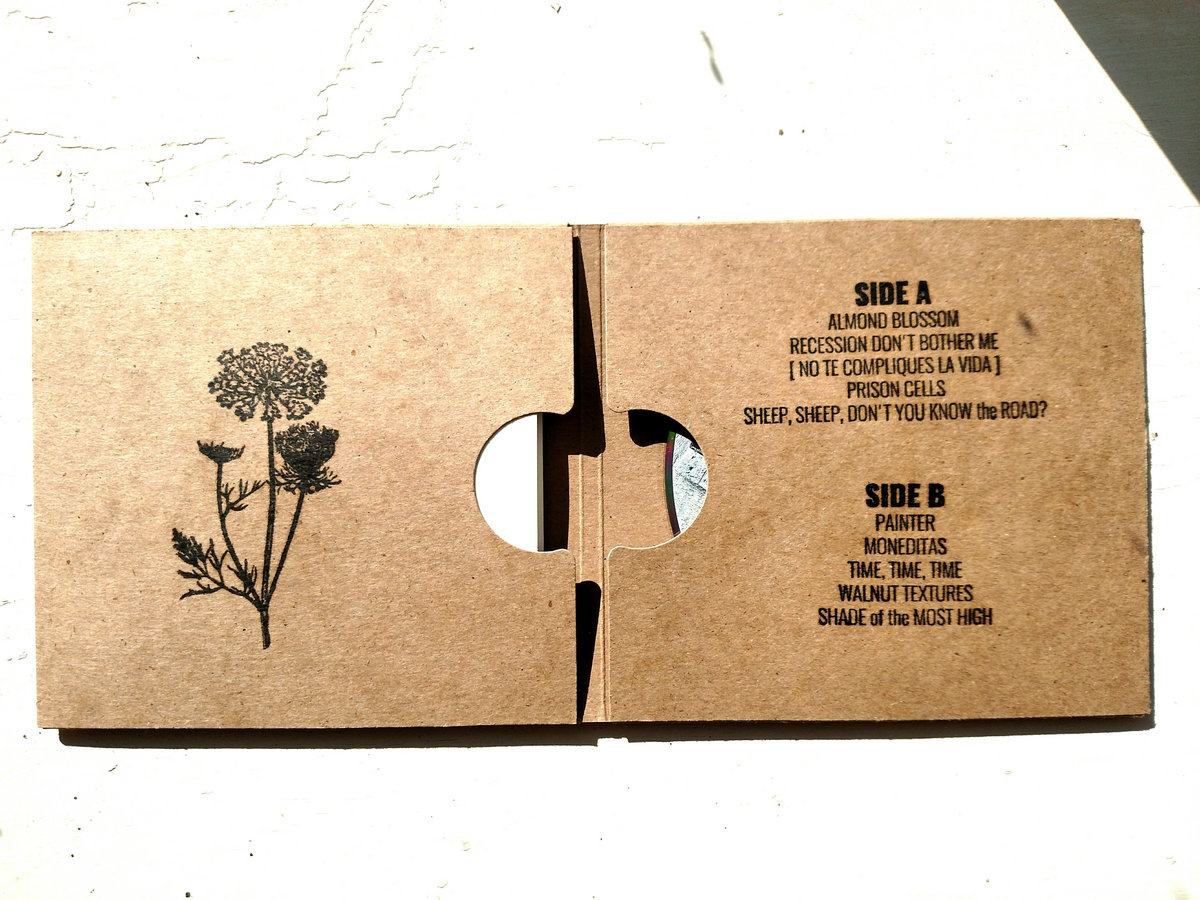
“Recession Don’t Bother Me,” subtitled “No te compliques la vida” (Don’t complicate your life), reflects on a mother’s words of advice regarding not staking your identity on material things, and not climbing over others to get ahead. It was released with this statement:
We are releasing this album in the midst of the historic COVID-19 pandemic. The virus has left record numbers of people without work and we realize that in this moment, working-class people are suffering. With that in mind, we want to note that our song “Recession Don’t Bother Me” (which was written during the Great Recession of 2007 and 2008) is not saying “the recession don’t affect me,” because as the current pandemic has shown us, the circumstances and effects of the current situation do indeed have profound consequences for us all. Nor is this song saying that we are insulated from the economic effects of recession because of our wealth or privilege—although we acknowledge that in this current context, many people have had it much harder than we have. What this song is saying is that our current destructive and dehumanizing economy must, one day, collapse. And that we hope to be among those who welcome and rejoice at an exodus from an Egypt to a promised land, even if it means a journey through the desert to get there. We are praying for providence for all those suffering during these deeply trying times.
In downtown Harrisonburg, amidst hip college-town cafés, sits the Rockingham County Jail, right across the street from the courthouse. At certain times of day, men in jumpsuits and chains are very visibly marched to and from these locations. Disgusted by this flagrancy and following the arrest of one of his undocumented friends, Campos wrote “Prison Cells.” It’s a condemnation of America’s for-profit prison system and retributive (as opposed to restorative) model of justice. How does our lust for punishment cohere with Jesus’s blessing on the merciful (Matt. 5:7) and the apostle Paul’s insistence that “love keeps no record of wrongs” (1 Cor. 13:5)? We teach our kids to forgive offenses and to let go of grudges, and yet our criminal law teaches the opposite. Lord, have mercy.
Fourth up on the album is a new interpretation of the spiritual “Sheep, Sheep, Don’t You Know the Road?” from the Georgia Sea Islands, popularized in the 1960s by folk singer and African American music preservationist Bessie Jones, who learned it from her formerly enslaved grandfather. Ears to the Ground Family has expressed the indebtedness of their work to “centuries of creative Black resistance against slavery and oppression,” of which this song is just one example. Its lyrics describe the road of faith as one of pain but also bridges, a road where “there’s no price tag” (cf. Isa. 55:1) and “the sword’s beat down” (cf. Isa. 2:3–4).
On this track the djembe and shekere are played by Jay Beck and Tevyn East, two of the lead organizers of the Carnival de Resistance. “A traveling carnival, village, and school for social change bridging the worlds of art, activism and faith,” this organization seeks to throw off sanitized pieties and “provide a raucous expression of grief and longing and hope for Creation.”
“Painter” is a parable that shows how indulging in sin cuts us off from ourselves and can inhibit us from showcasing God’s glory.
“Moneditas” (Coins), which Campos wrote with Ana Maria Febres, is a Spanish-language song about the emptiness of riches. It echoes Matthew 6:19–20: “Do not store up for yourselves treasures on earth, where moth and rust consume and where thieves break in and steal; but store up for yourselves treasures in heaven, where neither moth nor rust consumes and where thieves do not break in and steal.”
The whimsical “Time, Time, Time,” with its coffee-mug and glass-bottle percussion, seems to me to be a celebration of the unfolding of time just as it is. May we not wish for time to move any faster or slower, but instead appreciate the now and live with an openness to whatever’s next.
“Walnut Textures,” by Campos and Lightning Lucas, encourages a closer relationship with the natural world. It remarks with regret how we have such a strong desire to explore the far reaches of the universe, and yet many of us hardly know the beauty and wonders of our own planet, or even our immediate environs—or if we do, we don’t care enough to protect them. Instead of stewarding nature we squander and abuse it, building highways (dirty paved “rivers”) through forests and then packing cars onto them, increasing air pollution and contributing to global warming. This dominating stance over God’s creation is vanity, and God urges us toward a better way—one of friendship with creation, in which we recognize our mutual groaning for redemption (Rom. 8:22–23) and take up our responsibility as caretakers, which includes adopting sustainable environmental practices.
Spending time in nature is refreshing and even liberating, a chance to experience the givenness of life. Living in right relationship with her now is great practice for the age to come, when all will be reconciled.
The last song, “Shade of the Most High,” was written by Nichole Barrows amid her grief following the death of her mother. It was inspired by the promise in Psalm 91 that we will find rest in the “shadow” of the Almighty God. She says,
I found great comfort in this image of grief as a dark place where God can still find us and bring us rest, because although we feel that we don’t deserve the bad things that are happening to us, we can trust that we are still in his “shade.” And this gift of trust in God’s faithfulness helps us not to fear disease or darkness or even death. I sang these words over myself that year [of my mother’s decline] and I sing them over you now: “With a hope like this, we are fearless, and with a love like this, I will not despair.”
Loss is wrenching and often unexplainable, but it can also be an occasion “to find new life, to find new eyes,” and to lean all the more firmly on the One who bears our sorrows in love.
Already and not yet
When I was talking to Barrows, she expressed emphatically one of the great paradoxes in Christian teaching: “that the kingdom of God is not yet here and that we are together longing for Christ to come make all things new, and also that he is already here, now, on this earth, in this place.” She mentioned how Ears to the Ground Family wishes to affirm not just the spiritual elements of faith (which, I will add, are the central preoccupation of the vast majority of faith-based music) but the physical elements as well, “such as care for the earth and the peace witness and the works of mercy.” This commitment is certainly reflected on their album, which is centered on holistic liberation. I love how it so joyously embraces the broadness of the good news of Jesus Christ, which is not just for individual souls but also for bodies and communities and for the whole created world—presently as well as futurely!
Full Moon in Juneis available for digital download or as a CD in a cardboard sleeve with handprinted letters (produced by Campos’s vintage, treadle-powered letterpress) and stamped with handmade rubber stamp art. The latter option is a limited edition of 200.
This is the final part of my commentary on Art Stations of the Cross: Troubled Waters, a multisite exhibition in Amsterdam running from March 6 to April 22. (Read parts one and two.) Unless otherwise noted, all photos are by Eric James Jones/ArtandTheology.org.
+++
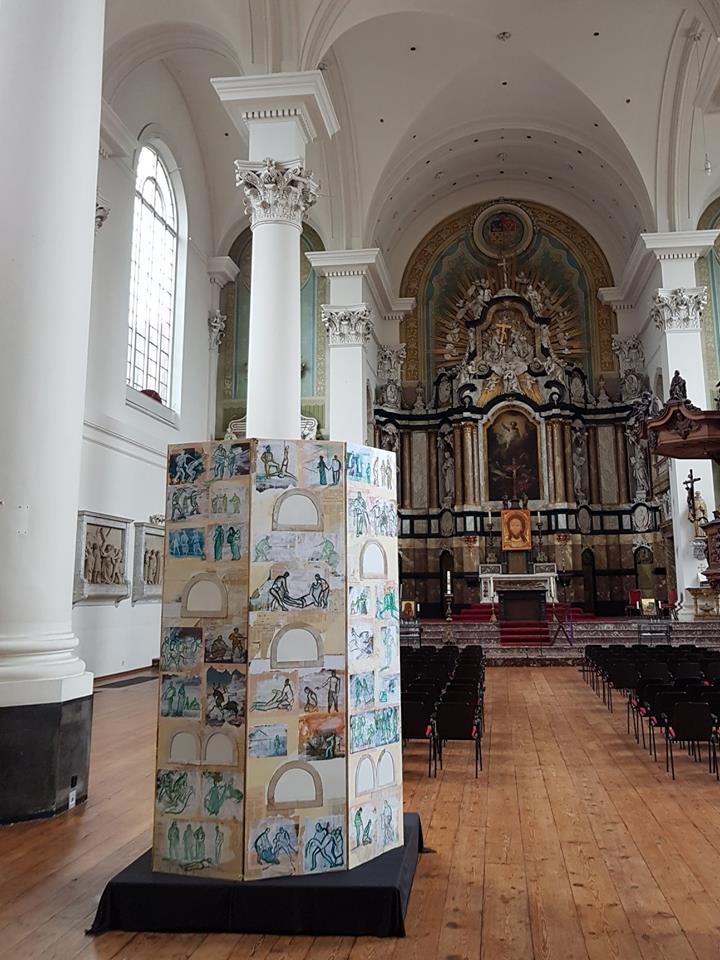
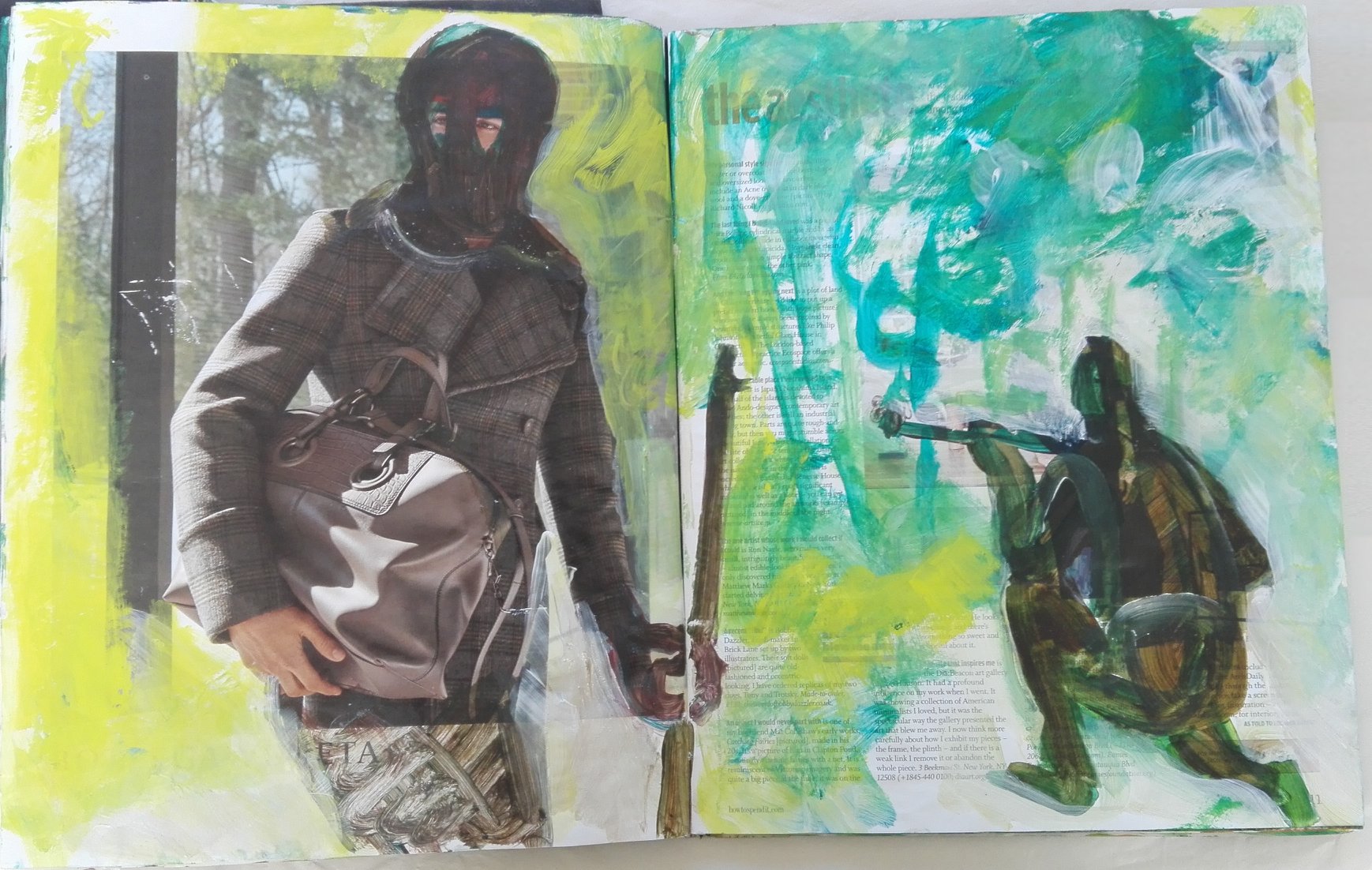
STATION 10. This is the one station I did not get a chance to see, due to its more limited opening hours. Anywhere, Anytimeby Masha Trebukova is a temporary installation in the Mozes en Aäronkerk (Church of Moses and Aaron) in Amsterdam’s Waterlooplein neighborhood. It consists of a nine-foot-tall octagonal structure (a “columbarium”) covered with paintings on newspaper, as well as six large-format “books” of paintings on glossy magazine pages.
Masha Trebukova (Russian, 1962–), Anywhere, Anytime, 2019. Temporary installation at the Moses and Aaron Church, Amsterdam, consisting of an eight-paneled “columbarium” with paintings on newsprint, each panel 60 × 290 cm, and “How to spend it,” six painted-over magazines. Photo courtesy of Sant’Egidio Nederland.
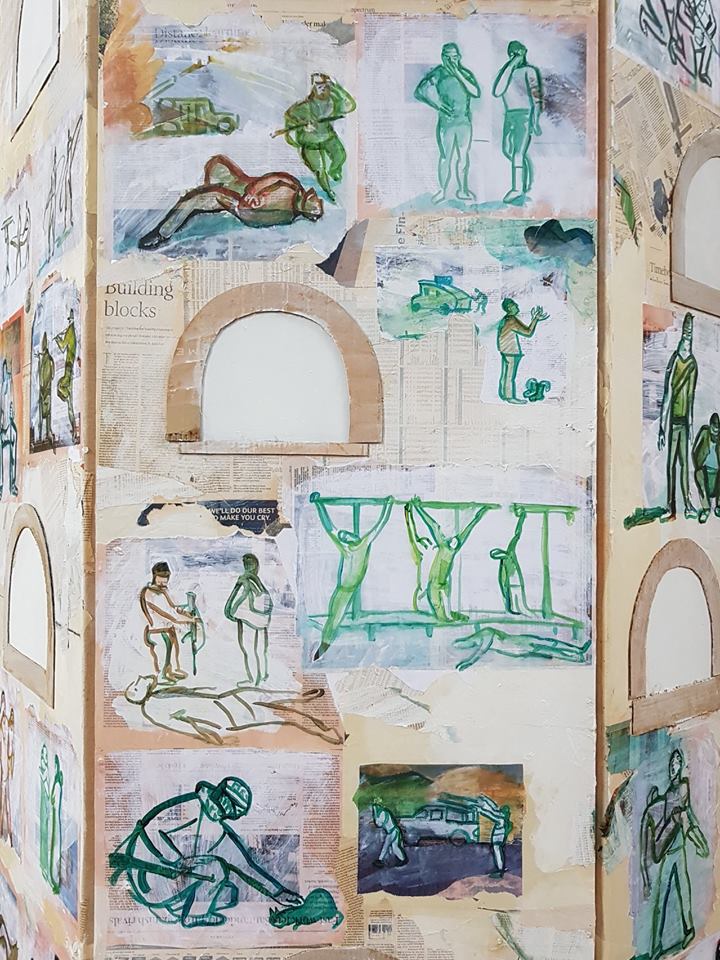
A columbarium is a room, building, or freestanding structure with niches for the public storage of funerary urns (which hold the ashes of the deceased). Ancient Romans decorated theirs with frescoes, often of peaceful scenes of the hereafter. Trebukova, on the other hand, has painted this columbarium with images of war and violence, exposing the savagery that causes death. This is not a celebration of paradise gained; it’s a lament for paradise lost.
Hear the artist briefly introduce the piece:
Masha Trebukova, Anywhere, Anytime (detail). Photo courtesy of Sant’Egidio Nederland.
Trebukova used as her painting surface pages from newspapers and magazines, the headlines often creating consonance with the images while the ads create dissonance. The sleek photos selling vacations and luxury goods, enticing you to treat yourself, contrast starkly with Trebukova’s slashes and smears of color that depict masked gunmen terrorizing families, mass executions, refugees on the run, and individuals huddled over the corpses of loved ones. This contrast urges viewers to consider how our own self-absorption might be restricting our view of what’s going on in the larger world. What incinerations are being carried out as we casually engage in our leisure reading and other entertainments? The vaults in Anywhere, Anytime are fictive, but they prompt us to imagine the many bodies and places being turned to ash as armed conflict and acts of terrorism persist globally. [Images below sourced from the artist’s website]
The books are too fragile to be handled by visitors, so they are displayed open in glass cases, laid flat on a black-clothed table, and a video screen nearby loops through all the images in succession. Here is an excerpt from the video, a showcase of book five:
The book appears to have originally been a dance magazine, but Trebukova subverts the elegance associated with controlled bodily movement by recontextualizing these found images of dancers. A woman walking down a rustic road in pointe shoes is given a heavy burden on her back—a child—and a head scarf, recasting her as one of the many mothers fleeing violence in the Middle East. On the following page spread, another dancer’s graceful backbend is re-envisioned as an involuntary response to his having been shot; unlike on stage, this movement will end with a fall.
The Moses and Aaron Church is home to the Amsterdam chapter of the Community of Sant’Egidio, a Catholic lay association committed to prayer, the poor, and peace. Existing in over seventy countries, Sant’Egidio seeks especially to serve the sick, the homeless (including displaced persons), the elderly, and the imprisoned. “War is the mother of every poverty,” they say, and they have been key players in peace initiatives in Mozambique, Algeria, the Balkans, the Democratic Republic of Congo, and other areas.
Masha Trebukova, page spread from “How to spend it.” Photo courtesy of Sant’Egidio Nederland.
+++
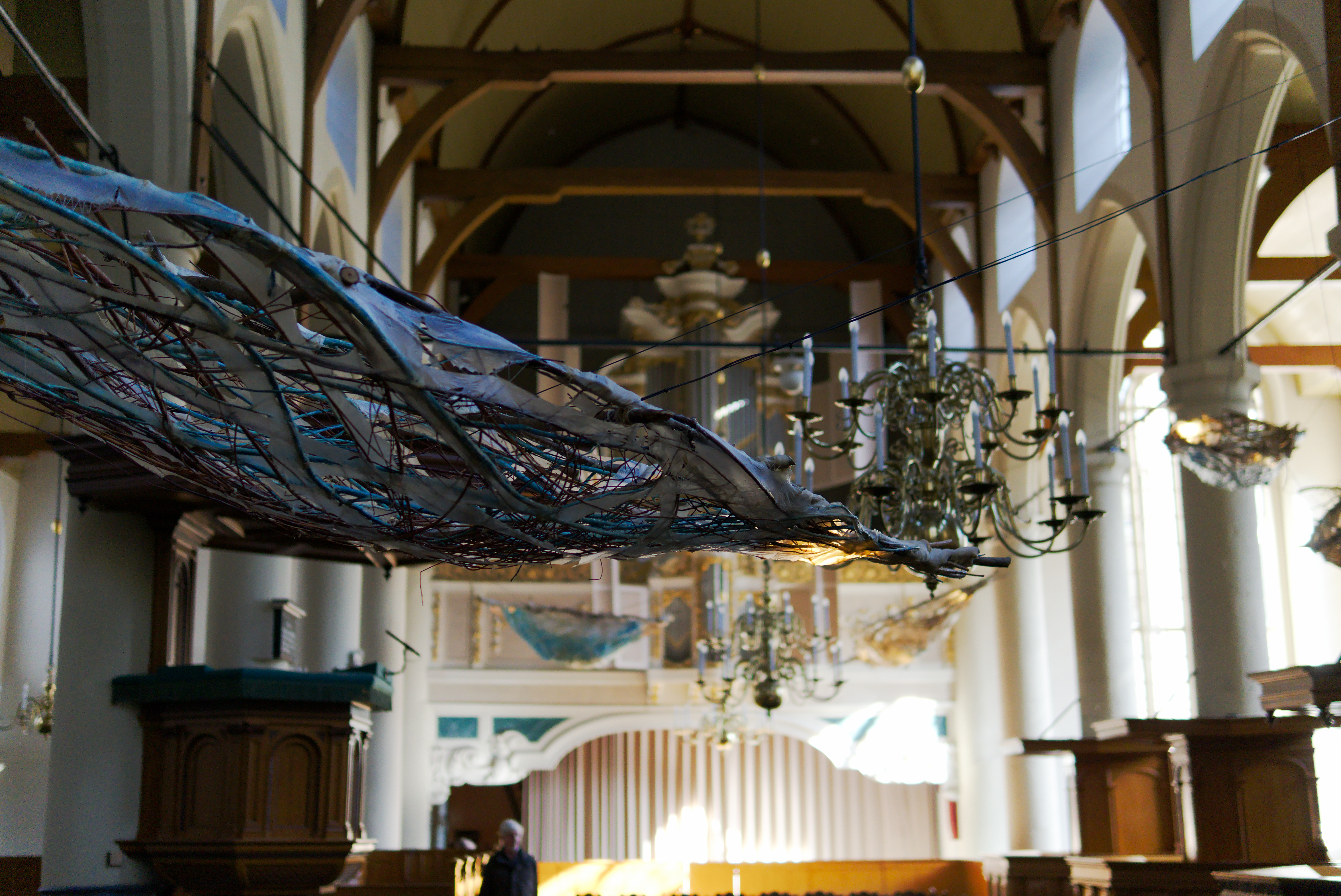
STATION 11.Erica Grimm’s Salt WaterSkin Boats, a collaboration with artist and arborist Tracie Stewart and soundscape specialist Sheinagh Anderson, is an installation of five sculptural coracles made of interwoven willow, dogwood, fig, and cedar branches; animal skin and gut; cheesecloth; and bathymetric ocean maps imprinted with scientific measurements of things like glacial melt, sea-level rise, and ocean acidification. These are suspended from the ceiling along the nave of the Waalse Kerk and are lit from inside, and they are accompanied by an ambient soundscape that viewers activate by scanning a QR code.
Erica L. Grimm (Canadian, 1959–), Salt Water Skin Boats, 2018. Willow, dogwood, fig, and cedar branches; cheesecloth; animal skin and gut; bathymetric ocean maps; layers of wax; earbuds; LED lights. Installation view at Waalse Kerk, Amsterdam, in March 2019, part of Art Stations of the Cross.
Small lightweight boats without rudder, anchor, or keel, coracles are unstable watercraft, easily carried by currents and wind. Back in the day, Celtic Christian pilgrims would set sail in them, not having any destination in mind but rather trusting that God would steer their little boats to wherever he saw fit. In a sense, we are all “skin boats” afloat on a vast ocean, not knowing where we’ll end up. But Grimm’s incorporation of numerical data that highlight the dangerous warming, acidifying, and expanding of the world’s oceans pushes this metaphor in a new direction; the work “proposes an analogy,” writes curator Marleen Hengelaar-Rookmaaker, “between our bodies and the vast ecology of the global ocean: between the life-sustaining, precariously balanced ocean chemistry and the chemistry of our own salt-water-filled bodies.” Continue reading “Walking the Via Dolorosa through Amsterdam (Part 3)”→






 Art & Theology