Cor Jesu amanti sacrum: An emblematic print series of Christ setting up house in the heart of the believer

In Antwerp sometime around 1600, the Flemish printmaker Anton Wierix II (whose name is alternatively rendered as Antonie, Anthony, Antoine, or Antonius) engraved a series of seventeen* cardiomorphic emblems called the Cor Jesu amanti sacrum (The Heart Consecrated to the Loving Jesus), which portray the human heart as the dwelling-place, schoolroom, and throne of Christ. Commissioned by the Jesuit order, the series shows the Christ child cutting through the net that has ensnared the heart, knocking at the heart’s door, shining a light inside, sweeping out the monsters and vices, purging it with his blood, establishing his throne therein, teaching it, adorning it, making music in it, defending it from hostile invasion, piercing it with the arrows of love, and setting it aflame with desire.

These prints circulated as loose sheets and inside books, and various artists copied Wierix’s designs throughout the seventeenth century. The most famous book that uses the Cor Jesus images is Le coeur dévot, throsne royal de Iesus, Pacifique Salomon (The Devout Heart, Royal Throne of Jesus, Pacific Salomon) by Etienne Luzvic, SJ, originally written for a religious community, perhaps one devoted to the Sacred Heart. The book’s initial publication—in Paris in 1626—was without illustrations, but an enlarged edition was reissued in Douai and Antwerp the following year, containing twenty Cor Jesu engravings adapted by Martin Baes from Wierix’s originals, as well as additional meditations called “Incentives” by Fr. Etienne Binet, SJ.

Also in 1627, Le coeur dévot was translated into Latin, which became the basis for a number of vernacular translations throughout Europe, including an English version translated by Henry Hawkins in 1634, titled The Devout Hart, or Royal Throne of the Pacifical Salomon. This English edition includes a hymn by Hawkins for each emblem.

The odd-sounding subtitle of the book is a reference to King Solomon of the Old Testament, whom Luzvic apparently read a type of Christ in his majesty. “Pacifical” is an archaic word meaning conciliatory, peaceable.

Below I reproduce Wierix’s seventeen emblems, a loose-leaf edition held by the Wellcome Collection in London; you can click on the image to be taken to its object page.

Each engraving contains at the bottom a rhyming Latin verse in two stanzas of three lines each, interpreting the picture. The English translations provided below are sourced from the Wellcome Collection website, unless otherwise noted.

The engravings are not numbered, and their order was not fixed; they show up in variable sequences in different books. I’ve ordered them as they appear in Hawkins’s The Devout Hart. Scholars and editors have given them different descriptive titles over the years. I use Hawkins’s titles, only I’ve modernized the spellings. I’ve also provided a few quotes from Hawkins’s translation of Luzvic’s meditational texts that accompany the images in The Devout Hart, with page numbers provided in parentheses.

1. The world, the flesh, and the devil assail the heart, but Jesus saves it for himself
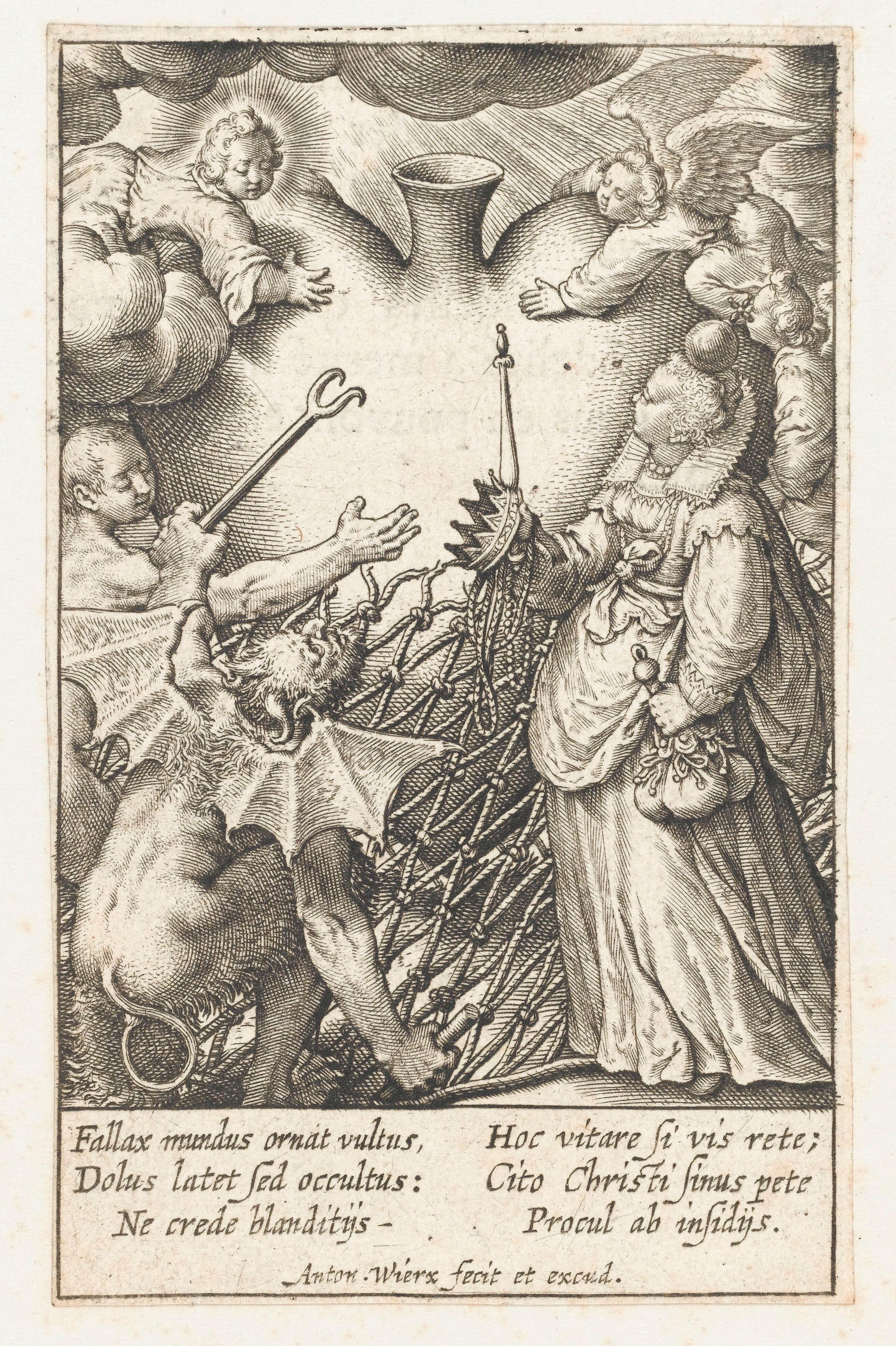
The world, the flesh, the devil
Anton Wierix II (Flemish, ca. 1555–1604), The world, the flesh, and the devil assail the heart, but Jesus saves it for himself, ca. 1600. Engraving, with etching, image 7.7 × 5.6 cm.

Fallax mundus ornat vultus,
dolus latet sed occultus:
ne crede blanditiis.

Hoc vitare si vis rete;
cito Christi sinus pete
procul ab insidiis.

(The deceptive world makes up its face, yet trickery lurks concealed. Do not trust in blandishments if you want to avoid this net! Quickly seek the breast of Christ, far from ambushes.)

2. The most amorous Jesus knocks at the door of the heart
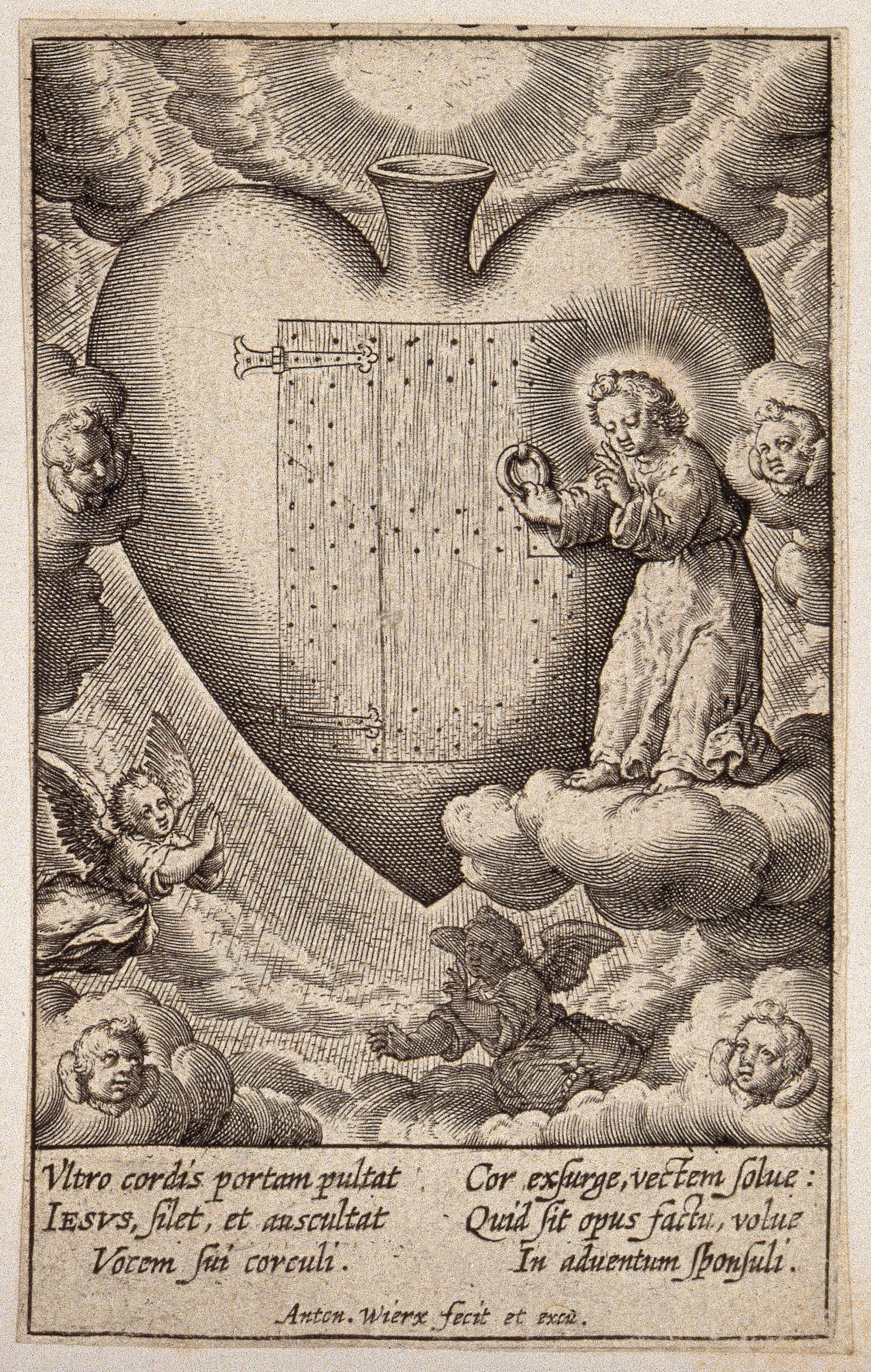
Jesus knocking
Anton Wierix II (Flemish, ca. 1555–1604), The most amorous Jesus knocks at the door of the heart, ca. 1600. Engraving, image 7.8 × 5.5 cm.

Ultro cordis portam pultat
Iesus, silet et auscultate
vocem sui corculi.

Cor exsurge, vectem solve:
Quid sit opus factu, volve
in adventum sponsuli.

(Outside the door of the heart Jesus knocks, is silent, and listens for the voice of his little heart. Heart, rise up! throw back the bolt! think what needs to be done at the arrival of the little betrothed one!)

This image is rooted in Revelation 3:20: “Behold, I stand at the door, and knock: if any man hear my voice, and open the door, I will come in to him . . .” (KJV).

If you cannot hear the knocking, Etienne Luzvic encourages you to consider,

Is it the noise perhaps of the guests thou hast admitted in already, which so tacked up, and stupefies thine ears, as thou canst not hear thy beloved’s voice? Oh guests, or haunting ghosts, I may call you, rather! Oh sinister affections! Oh inordinate appetites! What a tumult have you made here? (49)

He further exhorts:

Hasten, therefore, O fairest of all beauties; what? Sleepest thou yet? Shake off this sluggishness. Is there a mutiny at home, then quiet the tumults, command silence, bid the door be set open. And if thy spouse now wearied with thy demurs should chance to divert from thee, and go his ways, follow him at the heels with cries, and prayers, and tiring him outright, urge him hard, that he would deign to return again to his sanctuary. (50)

3. Jesus searcheth out the monsters lurking in the dark corners of the heart
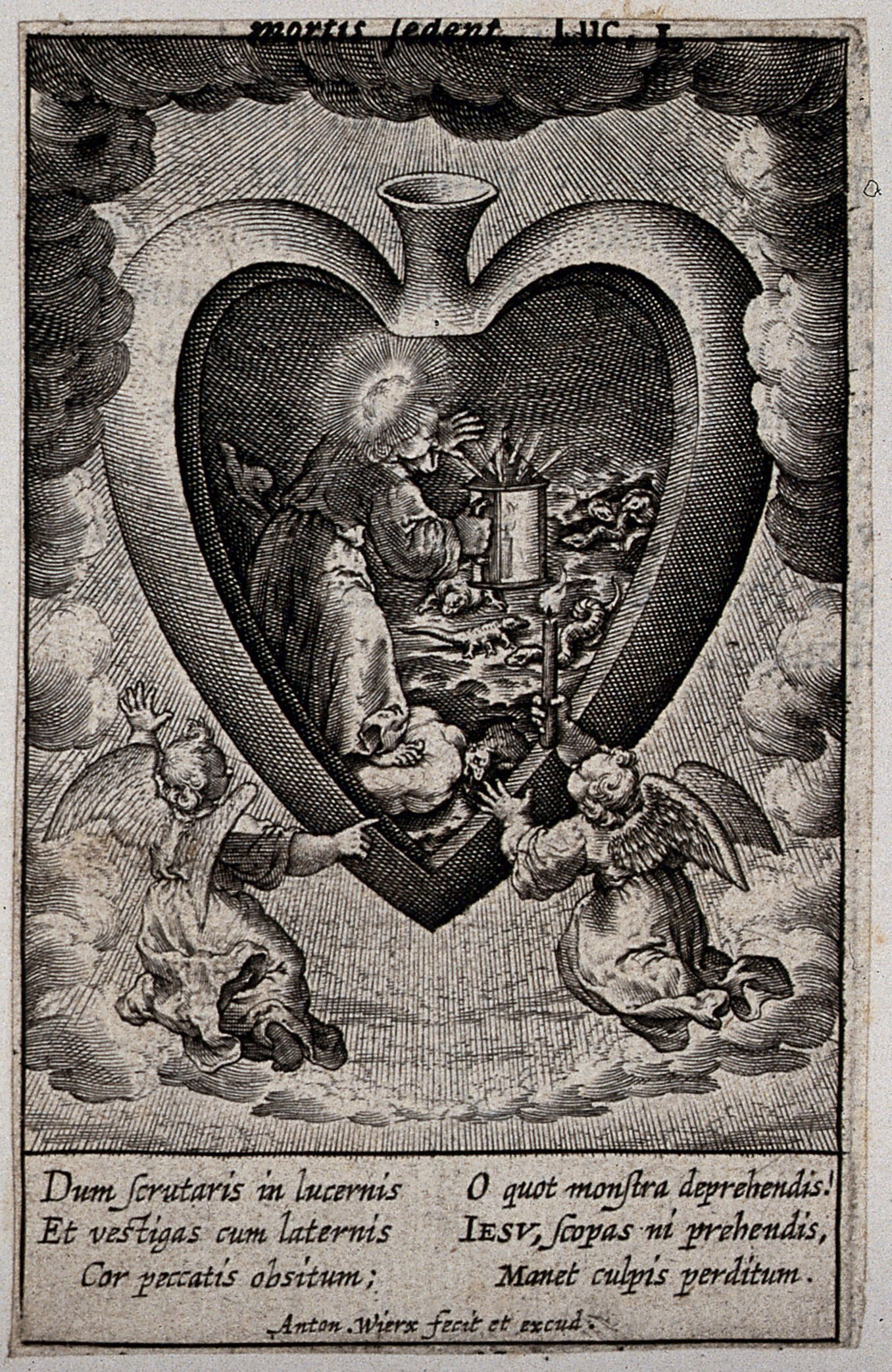
Jesus searches out the heart
Anton Wierix II (Flemish, ca. 1555–1604), Jesus searcheth out the monsters lurking in the dark corners of the heart, ca. 1600. Engraving, image 7.8 × 5.7 cm.

Dum scrutaris in lucernis
et vestigas cum laternis
cor peccatis obsitum;

o quot monstra deprehendis!
Iesus, scopas ni prehendis,
manet culpis perditum.

(While you search among the lights and track the heart besieged by sins, oh how many monsters do you find! Jesus, if you do not find a broom, [the heart] remains lost in wrongs.)

From Luzvic:

So long as Jesus is absent from my heart. Ah me! what monsters? what sordidies? what Gorgons? what wicked fiends? what hells are centered there?

When Jesus enters into the heart, and therein pours his light, good God? what foul, what horrible prodigies of vices the mind discovers there which the eyes had never yet detected? I say while Jesus puts forth his rays, what bestial manners? what perfidiousness? what blots of an ungrateful mind? what heinous crimes are represented in this detestable heart?

At these portents the very angels tremble. Yet go thou on, my most sweet Jesus: illuminate the darksome corners of the soul; cleanse this foul, infamous stable. Amid this Cimmerian darkness, with glimpse of thy light bewray [reveal] me to myself that . . . at length [I] may fly to thee, love nothing else but thee. Oh the only Darling of my soul! O only love of my heart, my little Jesus! (60–61)

Oh how I tremble at it, to see how many snakes there are! What spiders, what scorpions, and other such like plagues . . . (65)

Consider, then, how powerfully Jesus, as soon as admitted to enter into the heart, expels and banisheth all sins from the secretes nooks thereof. (68)

4. Jesus sweeps the dust of sins from the heart
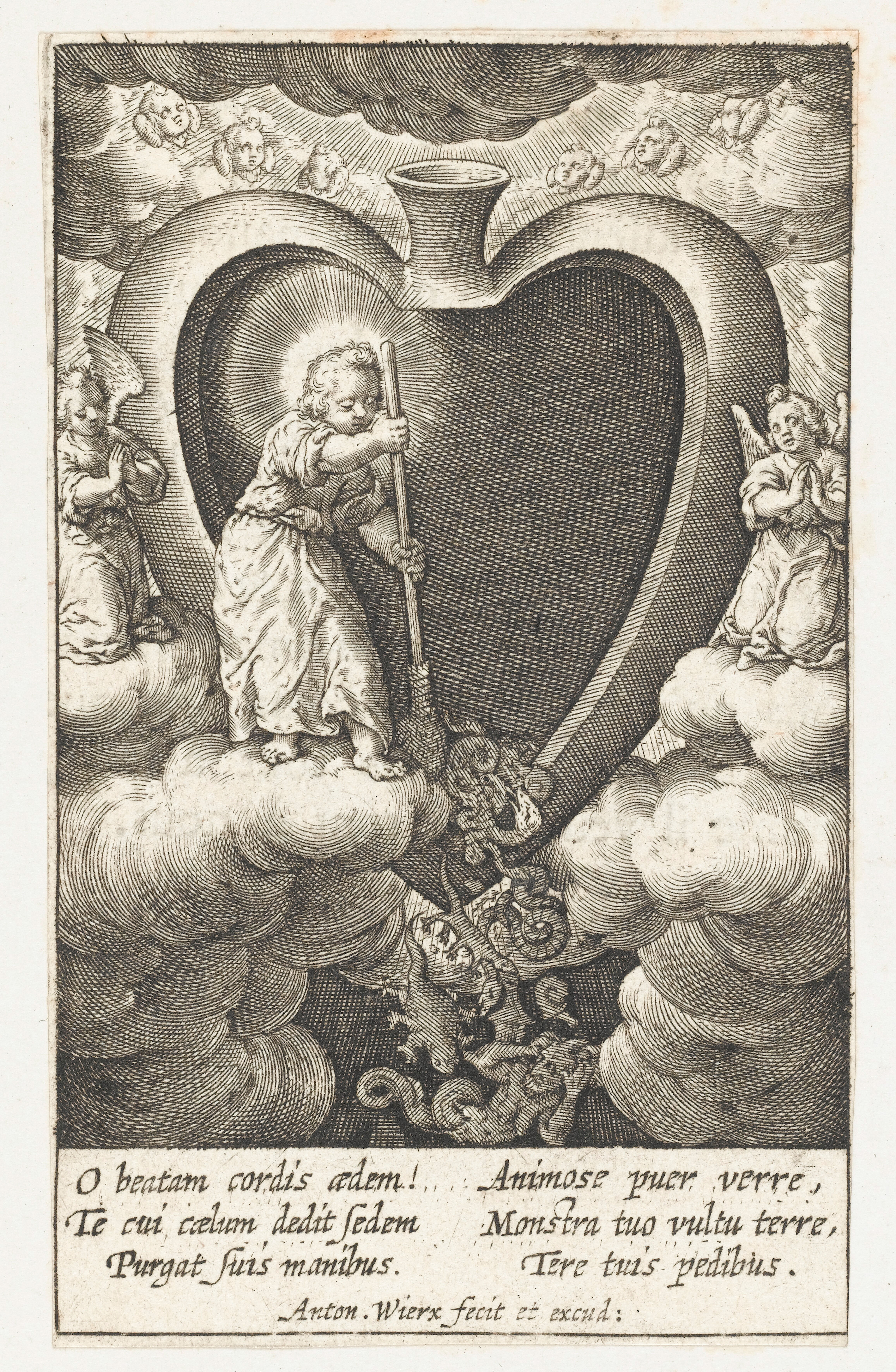
Jesus sweeps out sin
Anton Wierix II (Flemish, ca. 1555–1604), Jesus sweeps the dust of sins from the heart, ca. 1600. Engraving, 7.8 × 5.6 cm.

O beatam cordis aedem!
Te cui caelum dedit sedem
purgat suis manibus.

Animose puer verre,
monstra tuo vultu terre,
tere tuis pedibus.

(O blessed temple of the heart! Let him to whom heaven has given his abode clean you with his own hands. Spirited boy, sweep away! Frighten the monsters with your look! Crush them under your feet!)

Once Jesus locates the toads, snakes, and other slimy creatures (symbols of sin) hiding in the heart’s cave, he sweeps them out. Luzvic welcomes this purging:

Go on, my little Jesus, and oh! expel, tread, crush under thy holy feet this poisonous virulence of serpents, which with their venom intoxicate and kill my soul. Destroy them quite, and so frame me a heart wholly according to thy heart. (73–74)

He asks Jesus that, once he banishes the monsters, he keep them out for good:

Thou, most Blessed Darling of my heart, fortify and prevent all the ways and passages of the enemy, and place strong guards at the entrance and gates thereof, lest happily they steal or rush in anywhere . . . (77)

But he also owns his own responsibility in keeping them out:

Oh what dullness of mind is this, what stupidity of heart, that we should so long suffer these monsters to rest and abide with us, as if they were some friends and familiars of ours! Oh truly admirable goodness of God! who hath attended and expected us so long to return to the duty and office of good men; and now at last most powerfully hath brought us into liberty, wherefore we will steadfastly purpose, and determine hereafter, to die rather than once to afford any place in our heart to sins. (82)

5. Jesus the Living Fountain in the heart
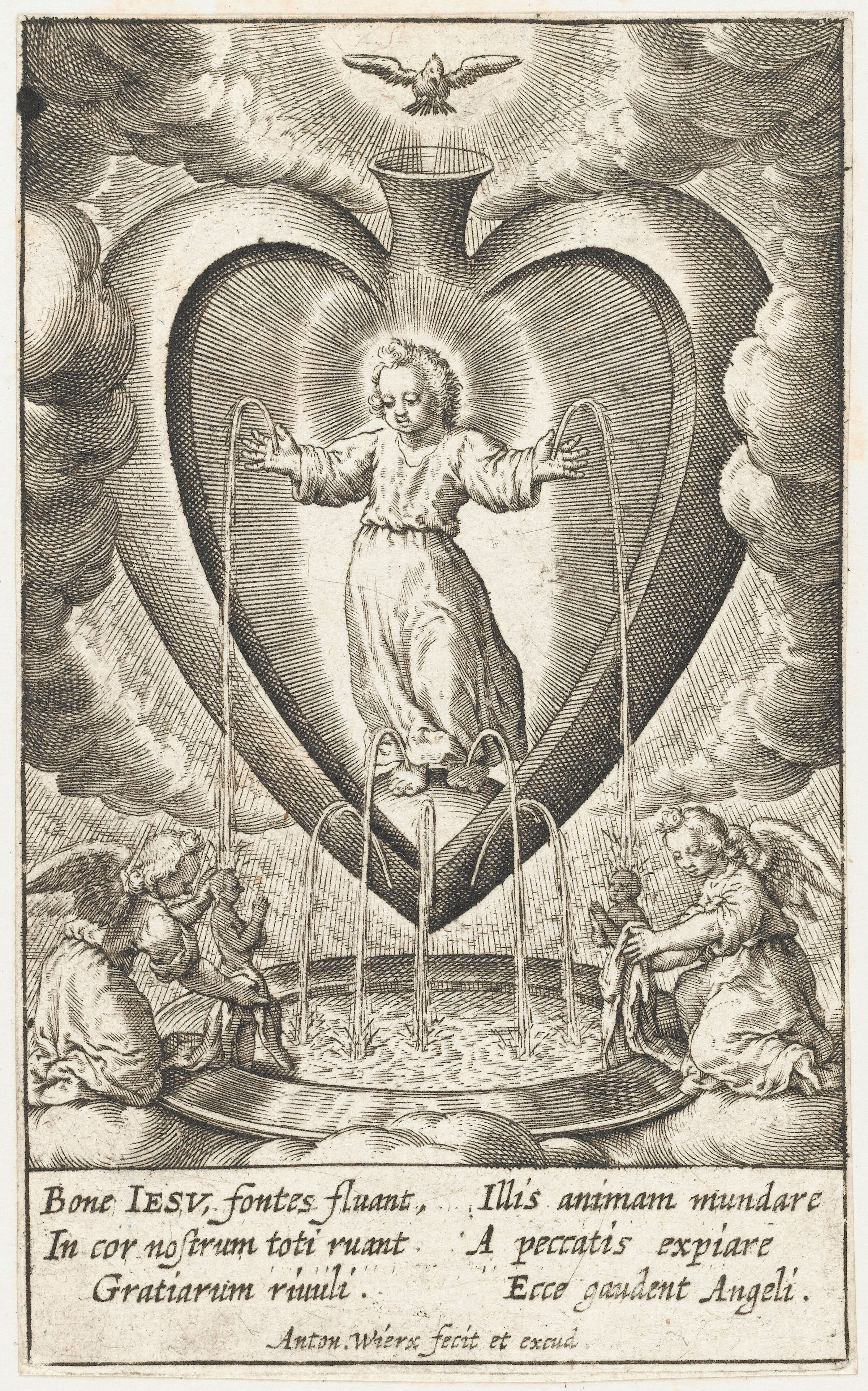
Jesus the Living Fountain in the heart
Anton Wierix II (Flemish, ca. 1555–1604), Jesus the Living Fountain in the heart, ca. 1600. Engraving, with etching, image 7.9 × 5.6 cm.

Bone Iesu fontes fluant,
in cor nostrum toti ruant,
gratiarum rivuli.

Illis animam mundare,
a peccatis expiare,
Ecce gaudent angeli.

(Good Jesus, into the heart let fountains flow, let all the streams of graces [flow]. With them to clean the soul and expiate [it] from sin, behold angels rejoice.)

In this image, blood flows out of the nail wounds in Christ’s hands and feet—a cleansing, refreshing fount.

Luzvic rhapsodizes,

If Jesus be absent, I am arid, dry, and without juice, so as neither I feel God, nor anything of God. Oh cruel aridity! O fatal drought!

If Jesus be present, he sheds divine dews of graces; he opens springs of incredible sweetness; the heart floats only and swims and sinks in these torrents of celestial delights. Oh grateful dews! O blessed springs! O ineffable delights!

Angelical hands laid hither those waters of life; sprinkle therewith my heart and soul, cleanse, and water them with endless springs of paradise. (85)

He asks God’s angels to “plunge this my dry and thirsty heart, drown it in the ocean of love” (91).

6. Jesus purgeth the heart with expiatory blood
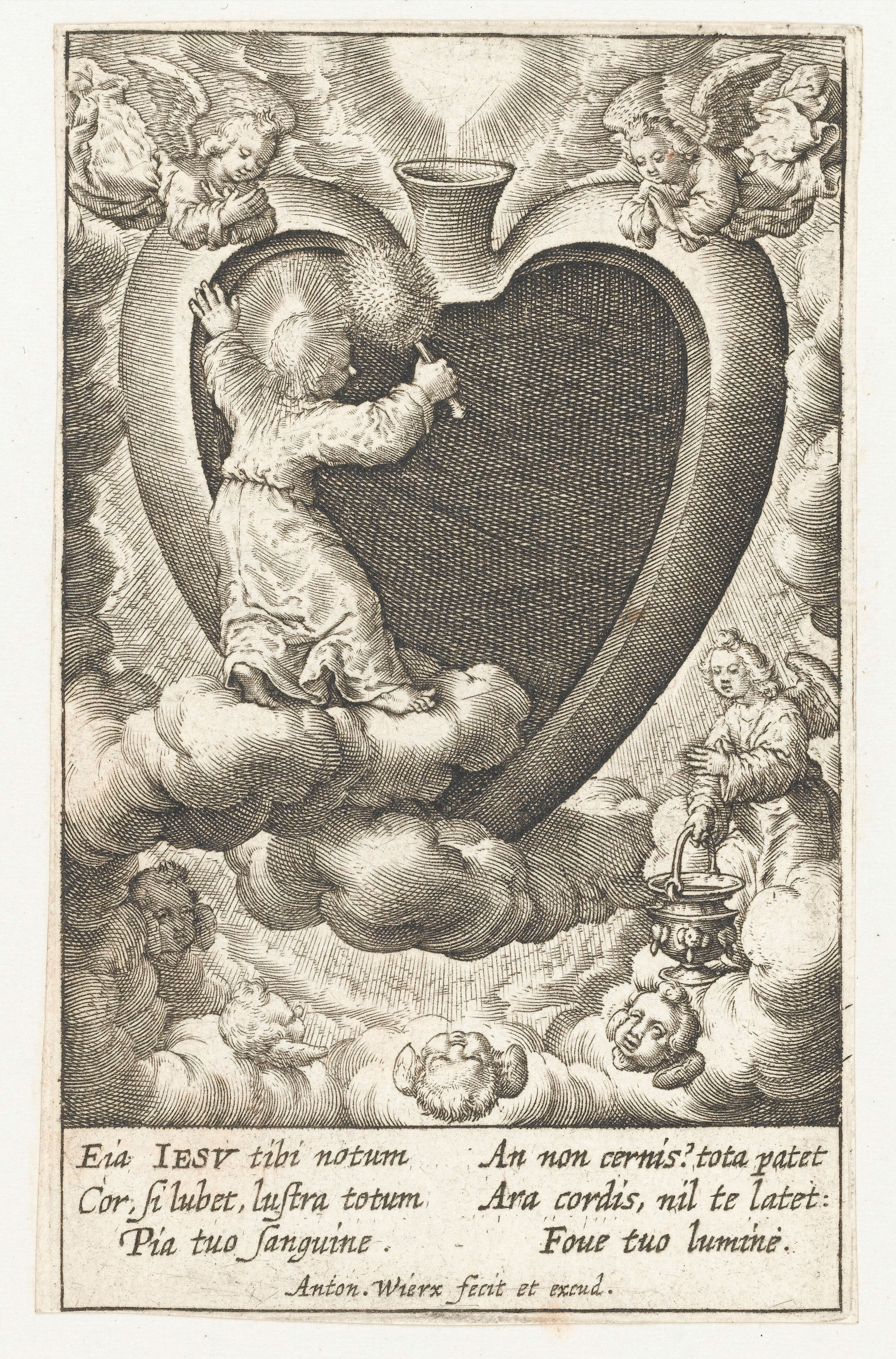
Jesus purges the heart with his blood
Anton Wierix II (Flemish, ca. 1555–1604), Jesus purgeth the heart with expiatory blood, ca. 1600. Engraving, with etching, image 7.8 × 5.6 cm.

Eia Iesu tibi notum
cor, si lubet, lustra totum,
pia tuo sanguine.

An non cernis? tota patet
ara cordis, nil te latet:
Fove tuo lumine.

(Ahh, Jesus, the heart which you know, clean it all, if you like, purify it with your blood! Or do you not see? The whole altar of the heart lies open, nothing is hidden from you. Sustain it with your light.)

“Purge me with hyssop,” prays David the psalmist (Ps. 51:7). In this image Jesus uses an aspergillum to sprinkle his blood on the believer’s heart, much like Moses did with the blood of oxen (Exod. 24:1–8)—sprinkling it on the altar and on God’s covenant people—and like the Levitical priests did with the blood of bulls and goats before the mercy seat (Lev. 16).

Binet writes of the immediate effect: “Lo, the heart came presently to itself again, as soon as it felt but one little drop of thy divine love to be sprinkled on it” (98). I love that phrase: “the heart came presently to itself again.” Jesus reconciles us not only to God but also to ourselves, taking away our guilt so that we can live in the freedom we were always meant to have. He brings us home to our truest selves.

There’s power in the blood! Luzvic beseeches Jesus for just a few drops:

Take, therefore, O Jesus, love of my soul, from this infinite bath of thine some few little drops, at least, and sprinkle thy sanctuary therewith, I say—the ample field of my heart, whose sure possession thou hast taken to thyself long since. (99–100)

7. Jesus rules and reigns in the loving and devout heart
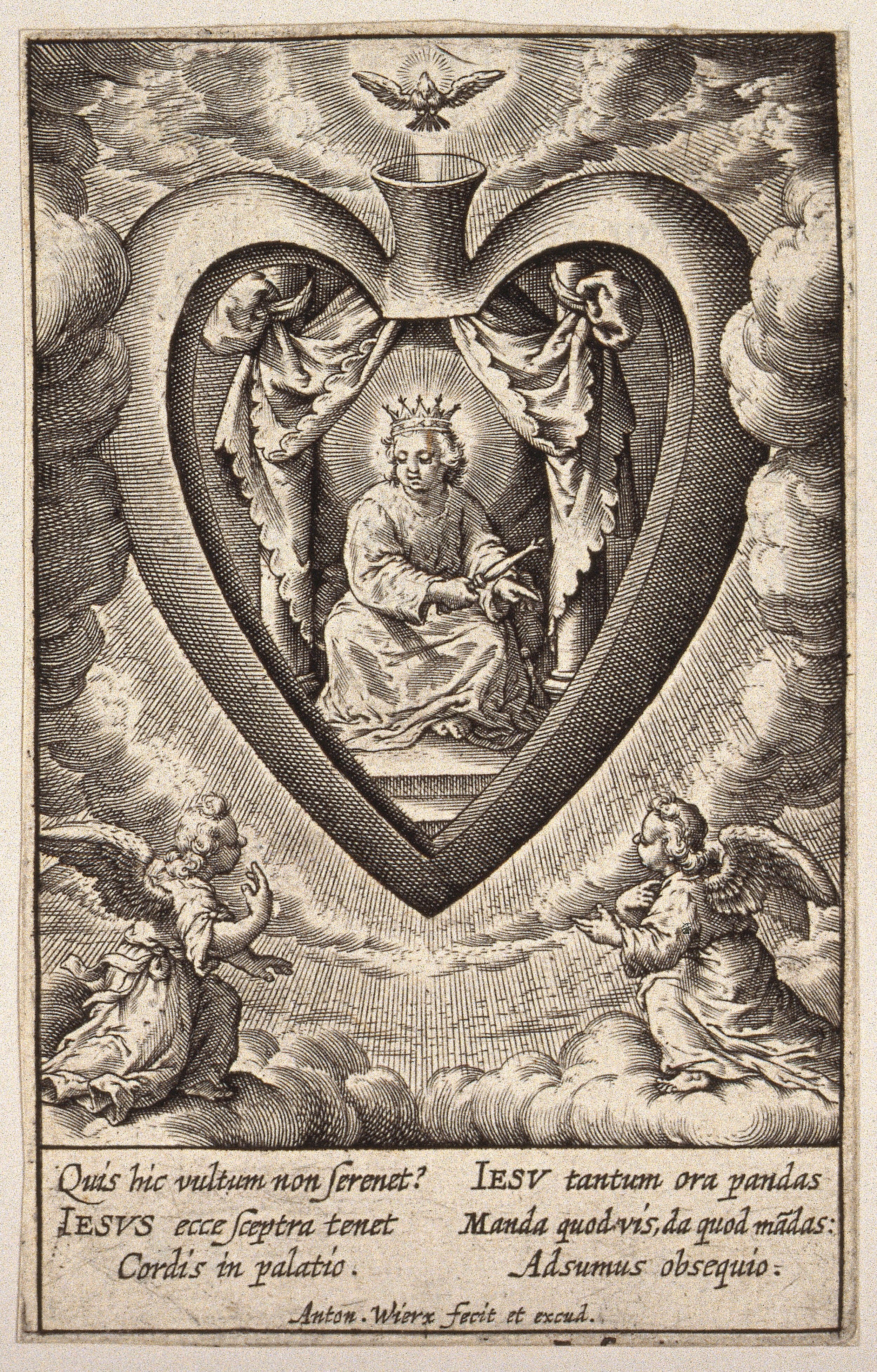
Jesus on the throne of the heart
Anton Wierix II (Flemish, ca. 1555–1604), Jesus rules and reigns in the loving and devout heart, ca. 1600. Engraving, with etching, image 7.8 × 5.7 cm.

Quis hic vultum non serenet?
Iesus ecce sceptra tenet
cordis in palatio.

Iesu tantum ora pandas,
manda quod vis, da quod mandas;
adsumus obsequio.

(Who would not here have a serene expression? Behold, Jesus holds the scepter in the palace of the heart. Jesus, just open your mouth, order what you want, give what you order: we are present to obey.)

Here’s a beautiful prayer by Luzvic. Its last line is a quotation from Song of Solomon 6:3, a book that Christians have read, on one level, as an allegory of the love between Christ and the human soul:

The heart . . . is hungry and thirsty, nor lives contented with any owner, unless thou fix the seat of thy kingdom in its precincts. If thou beest present with, it desires no more; if absent, come in all created things at once and woo it never so much, there will yet be place enough for more. If thou gettest from thence, all felicity departs with thee: if thou abides, all beatitude comes suddenly thither. Reign, therefore, and eternally reign in my heart, O love of my heart. Quiet the motion of perturbations, nor ever suffer the unhappy heart to thrust the king out of his seat, then which cannot happen a greater disaster to it. Nor suffer, I say, O darling and delight of my heart, that one heart should be shared into many parts. For thou sufferest no rival. Oh suffer it not ever to be enticed with the allurements of worldly pleasure, which gate being once set open, I see how easily the enemy will rush in. Be thou to it a brazen, yea, a wall of fire, which may so roundly girt the tower, as that no passage may be found unto it. But that only the Holy Ghost may come down from heaven, whereto the heart lies open, and enter therein with a full gale, and occupy the whole heart, that so I may truly profess and glory, My beloved to me and I to him. (116–18)

8. Jesus teacheth the devout heart

Anton Wierix II (Flemish, ca. 1555–1604), Jesus teacheth the devout heart, ca. 1600. Engraving, with etching, image 7.7 × 5.5 cm.

Sunt auscultent qui Platoni,
aut facundo Ciceroni,
aut mundi stultitiae.

Tu ne verba vitae sperne:
Audi patris aeviterne
dicta sapientiae.

(Some listen to Plato or to eloquent Cicero, or to the stupidity of the world. [But] you, do not scorn the words of life! Listen to the Father’s sayings of everlasting wisdom!)

In this image Christ is portrayed as the heart’s instructor. He sits with an open book that reads, “Erunt omnes docibiles Dei” (All shall be the pupils of God).

Luzvic imagines one of the directives he gives:

Hear, my child (for so Jesus advises from the pulpit of the heart): Do thou give thyself to me. Let me be thy possession, thy nurse, thy food, for nothing can satiate thine appetite without me. My child, throw away those leeks and garlic of Egypt, turn thy face from the stinking waters of [vain] pleasure, and put thy mouth rather to my side, the wine-cellar of graces, whence at ease thou mayest draw and derive to thyself most sovereign and incomparable joys. (128–29)

9. Jesus paints the images of the last things in the table of the heart

Jesus painting on the heart
Anton Wierix II (Flemish, ca. 1555–1604), Jesus paints the images of the last things in the table of the heart, ca. 1600. Engraving, with etching, image 7.8 × 5.7 cm.

Sume Iesu penicilla,
corque totum conscribilla
piis imaginibus:

sic nec Venus prophanabit,
nec Voluptas inquinabit
vanis phantasmatibus.

(Take, Jesus, your paintbrushes and daub over the whole heart with holy images. Thus neither shall Venus profane it nor shall pleasure pollute it with empty fantasies.)

The four last things, clockwise from bottom left inside the heart, are death, judgment, heaven, and hell. The image asks Jesus to make these future realities vivid in our minds so that we would live blamelessly until then.  

10. Jesus brings the cross into the heart, and easily imprints it in the lover
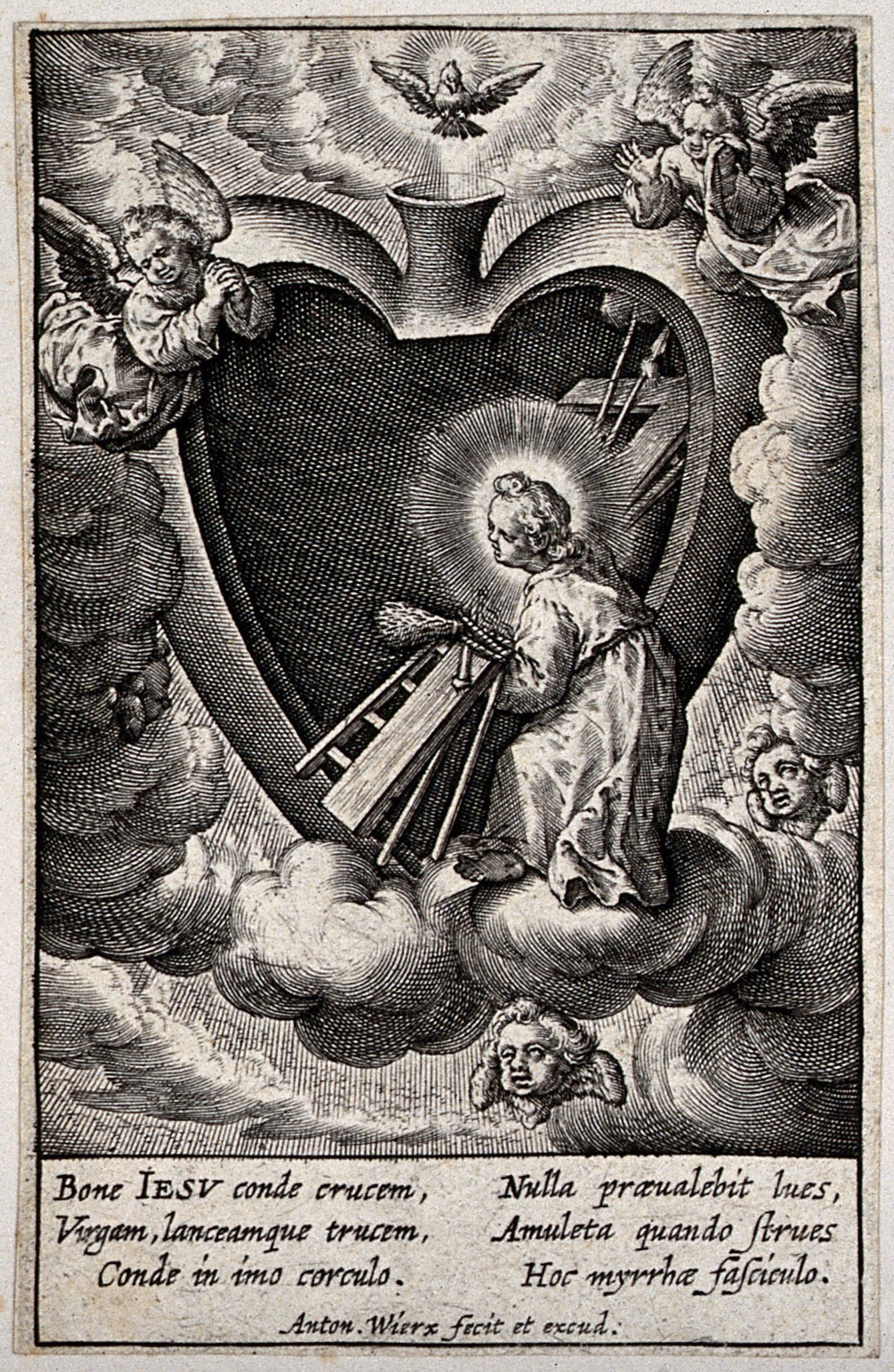
Jesus brings the cross into the heart
Anton Wierix II (Flemish, ca. 1555–1604), Jesus brings the cross into the heart, and easily imprints it in the lover, ca. 1600. Engraving, with etching, image 7.8 × 5.6 cm.

Bone Iesu conde crucem,
virgam, Ianceamque trucem,
conde in imo corculo.

Nulla praevalebit lues,
amuleta quando strues
hoc myrrhae fasciculo.

(Good Jesus, stow the cross, the lash, and the cruel lance, stow it at the bottom of the little heart. No sin shall prevail when you pile up this preservative on a gathering of myrrh.)

In this image, Christ deposits the instruments of his passion in the heart of the believer, where they serve as a reminder of the cross-shaped ethic we are to adopt—giving ourselves for others—as well as a call to gratitude for Christ’s sacrifice and a source of strength in times of suffering.

Go in, lovely cross; enter, lance, sponge, nails, scourge; bloody thorns, get you into the closet of the heart. Welcome still, but on this condition that Jesus bring you in himself; for myrrh with Jesus is admirable, and mere sweetness.

Thou sayest thou lovest Jesus; then needs must thou his cross, for if otherwise thou boast to love Jesus, thou deceivest thyself and others.

Most sweet child, what have you and I to do with this lumber here? Scarce art thou come into the world, but thou art oppressed with the weight of punishments. Oh plant thy seat in my heart! and then shall I challenge hell itself: for if Jesus and I hold together, what Hercules can stand against us both? (150–51)

11. The heart consecrated to the love of Jesus is a flourishing garden
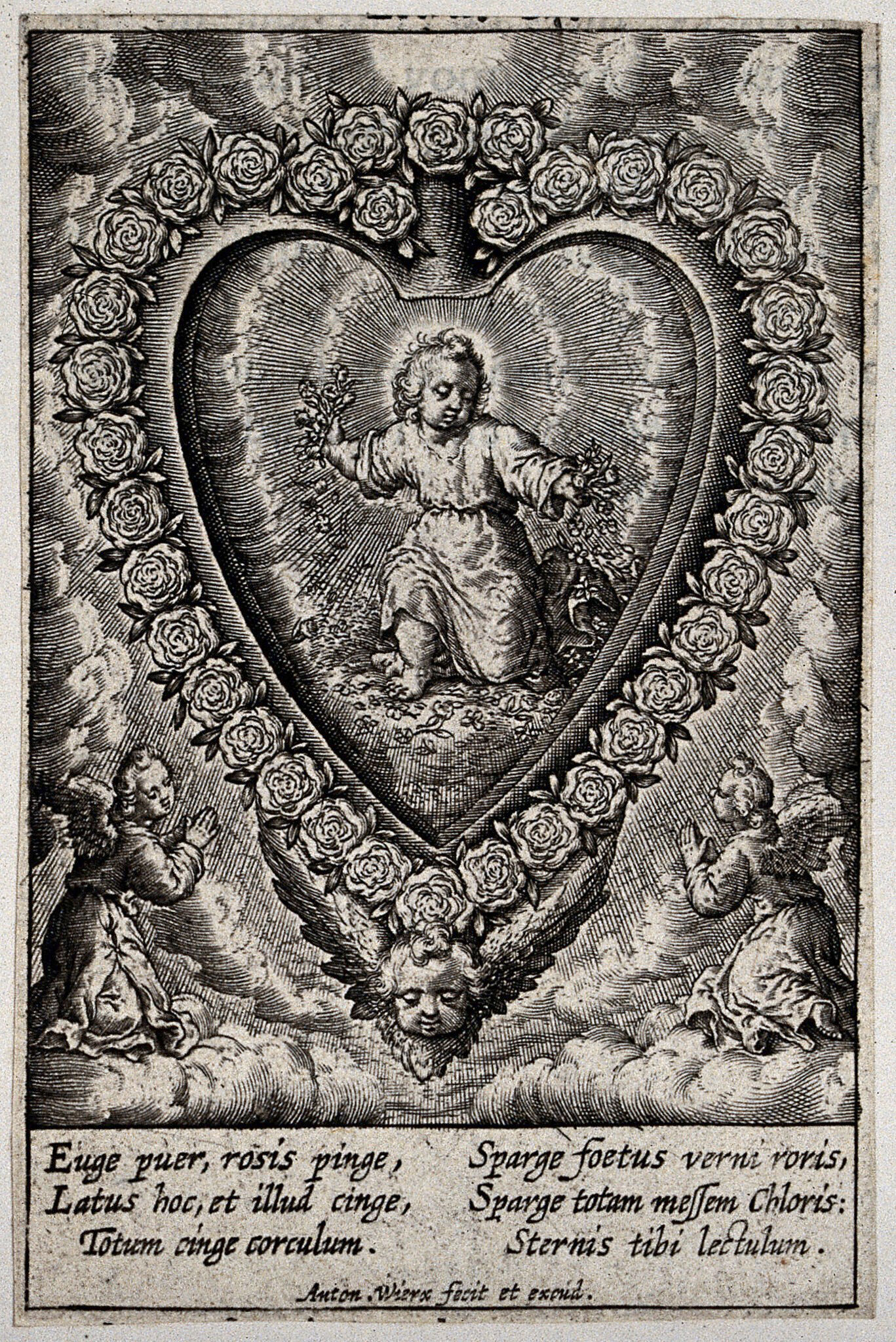
Jesus strews the heart with roses
Anton Wierix II (Flemish, ca. 1555–1604), The heart consecrated to the love of Jesus is a flourishing garden, ca. 1600. Engraving, with etching, image 7.7 × 5.9 cm.

Euge puer, rosis pinge,
latus hoc, et illud cinge,
totum cinge corculum.

Sparge foetus verni roris,
sparge totam messem Chloris:
sternis tibi lectulum.

(Bravo, boy! paint this side and that and surround it with roses, surround the entire little heart! Spread the fruit of the spring dew, spread the entire harvest of the realm of flowers: you are [thus] laying a cot for yourself.)

(Alt translation by Walter S. Mellion: Bravo, lad! Embroider with roses now this side, now that, encompass them. Wreath the little heart, all of it. Strew it with the progeny of the springtime dew, with the whole harvest of Chloris: spread for yourself a [flowery] bed.)

Jesus bedecks the heart with roses in this image—makes it beautiful and fragrant. Again, this image evokes the Song of Solomon, with its scenes of lovers in the garden.

12. Jesus sings in the choir of the heart, to the angels playing on musical instruments
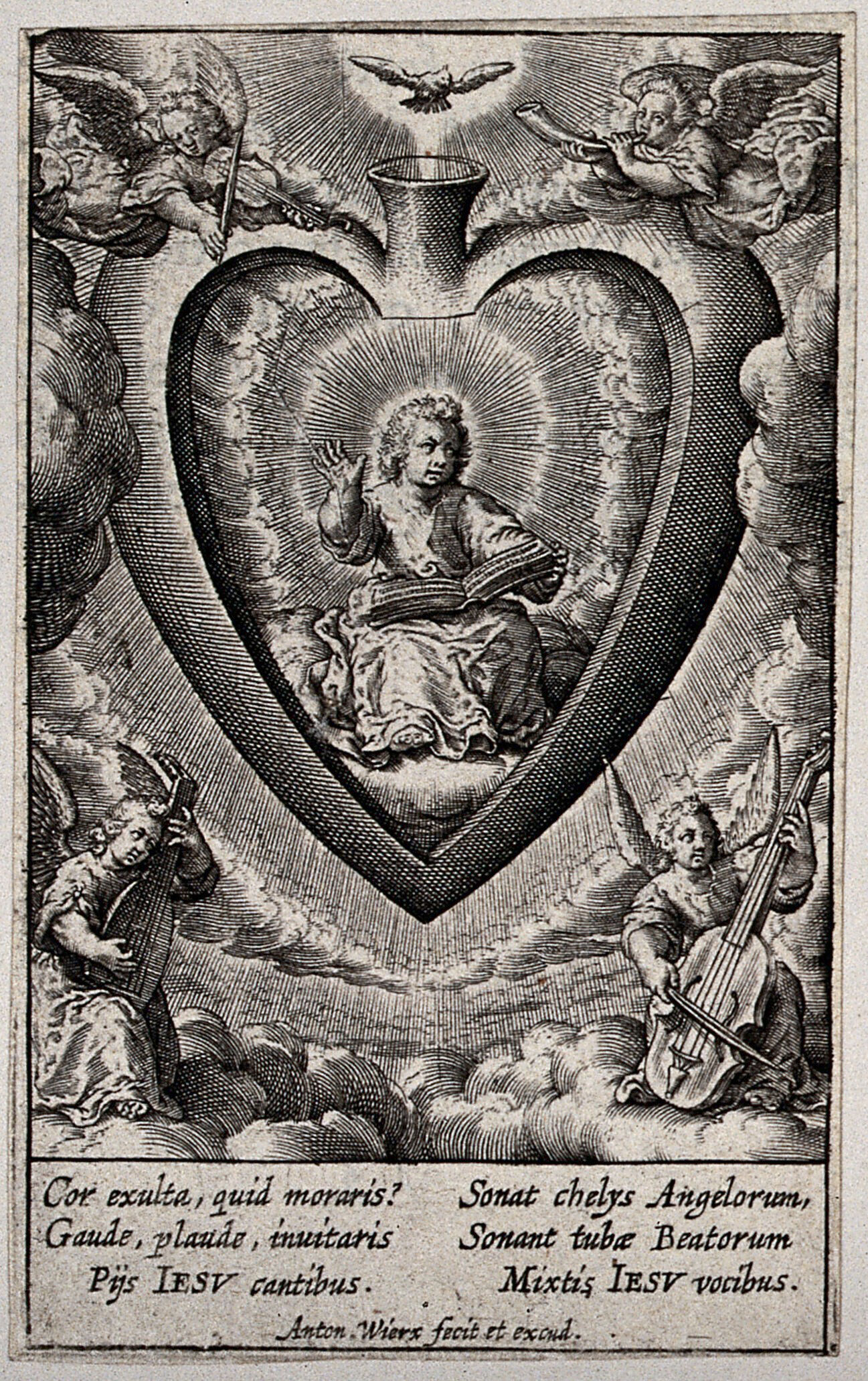
Jesus sings in the heart
Anton Wierix II (Flemish, ca. 1555–1604), Jesus sings in the choir of the heart, to the angels playing on musical instruments, ca. 1600. Engraving, with etching, image 7.8 × 5.5 cm.

Cor exulta quid moraris?
Gaude, plaude, invitaris
piis Iesu cantibus.

Sonat chelys angelorum,
sonant tubae beatorum
mixtis Iesu vocibus.

(Heart, exult! Why do you hesitate? Rejoice! Applaud! Invite Jesus with sacred songs! The [name of] Jesus sounds forth in the lyre of angels, it sounds in the trumpets of the blessed mixed with voices [singing].)

Luzvic fancifully develops the image of Jesus as singer and choir conductor in the sanctum of our hearts, making sweet, melodious music:

I will chant the mercies of the Lord forever. For to this purpose Jesus, the prime Christ, records his ancient loves to the human heart, and now mixing with admirable skill flats with sharps, sharps with flats, the tenor with the bass, and running diversely divisions he touches with a sweet remembrance now with a moderate, now remiss, now slow, and now with a quick voice, the innumerable number of his benefits wherewith heretofore he hath wooed the heart . . . (176)

13. Jesus, the son of David, plays on the harp in the heart, while angels sing

Jesus plays the harp in the heart
Anton Wierix II (Flemish, ca. 1555–1604), Jesus, the son of David, plays on the harp in the heart, while angels sing, ca. 1600. Engraving, with etching, image 7.5 × 5.7 cm.

Pulsa chordas, sonet chelys,
dum nos recreas de caelis
Iesu cordis gaudium.

Dulce melos intonabunt,
novum nobis excitabunt
angeli tripudium.

(Strike the strings! Let the lyre sound forth! While from heaven you renew us, Jesus, joy of the heart. A sweet tune angels shall intone [and they] shall arouse a new dance within us.)

14. Jesus rests in the lover’s heart

Jesus rests in the heart
Anton Wierix II (Flemish, ca. 1555–1604), Jesus rests in the lover’s heart, ca. 1600. Engraving, with etching, image 7.8 × 5.6 cm.

Frustra Boreas minatur,
frustra fulmen debacchatur,
frustra spumant caerula:

dum in corde lectum stravit,
atque sponsus dormitavit,
tuta ridet sponsula.

(In vain the north wind threatens, in vain the thunder runs wild, in vain the sea foams: while in the heart the betrothed has spread his bed and gone to sleep, the bride elect smiles in safety.)

What a moving image—the heart as a place of rest for Jesus. From the four corners the four winds blow, but Jesus is not perturbed, so why should we be? He still has the world in his hands (well, in his lap!).

The image is an allusion to the episode in all three Synoptic Gospels where a storm arises on the Sea of Galilee while Jesus and the disciples are in a boat; the disciples are frantic, and exasperated that Jesus is snoozing, but he tells them not to worry, and then he silences the wind and waves with a command: “Peace, be still!”

The image projects peace and stillness onto our troubled hearts.

15. Jesus wounds and pierces the heart with the shafts of love
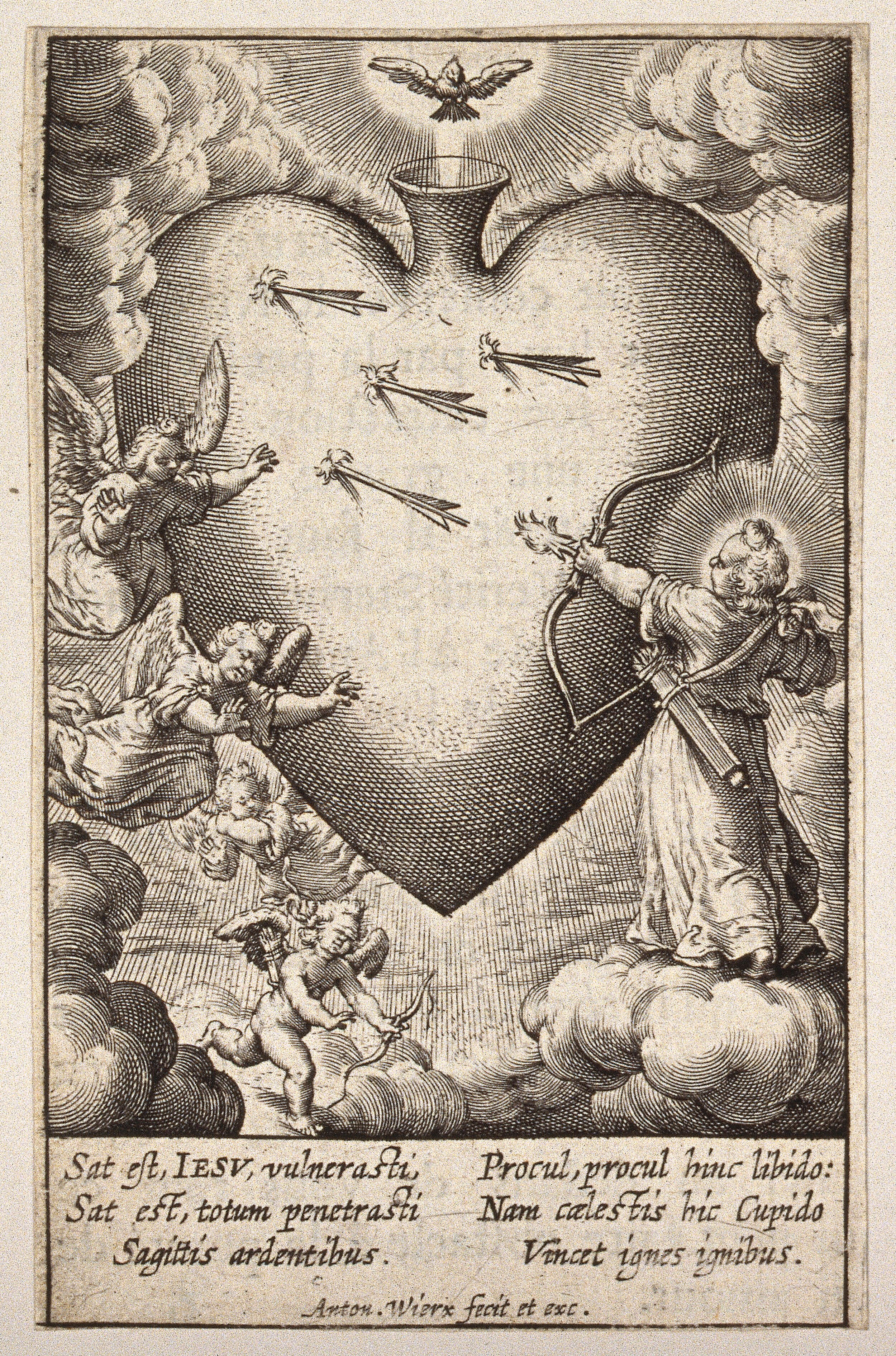
Jesus pierces the heart with love
Anton Wierix II (Flemish, ca. 1555–1604), Jesus wounds and pierces the heart with the shafts of love, ca. 1600. Engraving, image 7.8 × 5.7 cm.

Sat est, Iesu, vulnerasti,
sat est, totum penetrasti
sagittis ardentibus.

Procul, procul hinc libido:
nam caelestis hic Cupido
vincet ignes ignibus.

(Enough, Jesus, enough! You have shot through the whole heart with flaming arrows. Lust, [be gone] far, far from here! For here is a heavenly Cupid who will conquer fire with fire.)

Luzvic quotes from chapter 2 of Augustine’s Confessions in this section: “Lord, thou hast pierced our hearts with thy charity.”

He elaborates with his own ecstatic words:

My good Archer, shoot, ah, shoot again! shoot through this heart of mine, with a million shafts, this refractory and rebellious heart, to thy divine love: slay and kill all love that is not thine, or is adversary to it. O sweet wounds! O dear to me! O arrows dipped and tipped with honey. . . .

The heart is never in so good a plight as when it is transfixed with a thousand points of sharpest love. (216)

16. The heart enflamed with the love of Jesus shines with light and flames

Jesus sets the heart alight
Anton Wierix II (Flemish, ca. 1555–1604), The heart enflamed with the love of Jesus shines with light and flames, ca. 1600. Engraving, with etching, image 7.8 × 5.7 cm.

En armatas flammis tendit
Iesus manus, cor accendit
hinc et illinc facibus.

Age, totum comburatur,
in favillam redigatur
cor amoris ignibus.

(Behold, Jesus holds out his hands armed with flames, and sets alight the heart with torches on this side and that. Come, let it all burn, let the heart be reduced to an ember by the fires of love.)

17. Jesus crowns his dear heart with palms and laurels
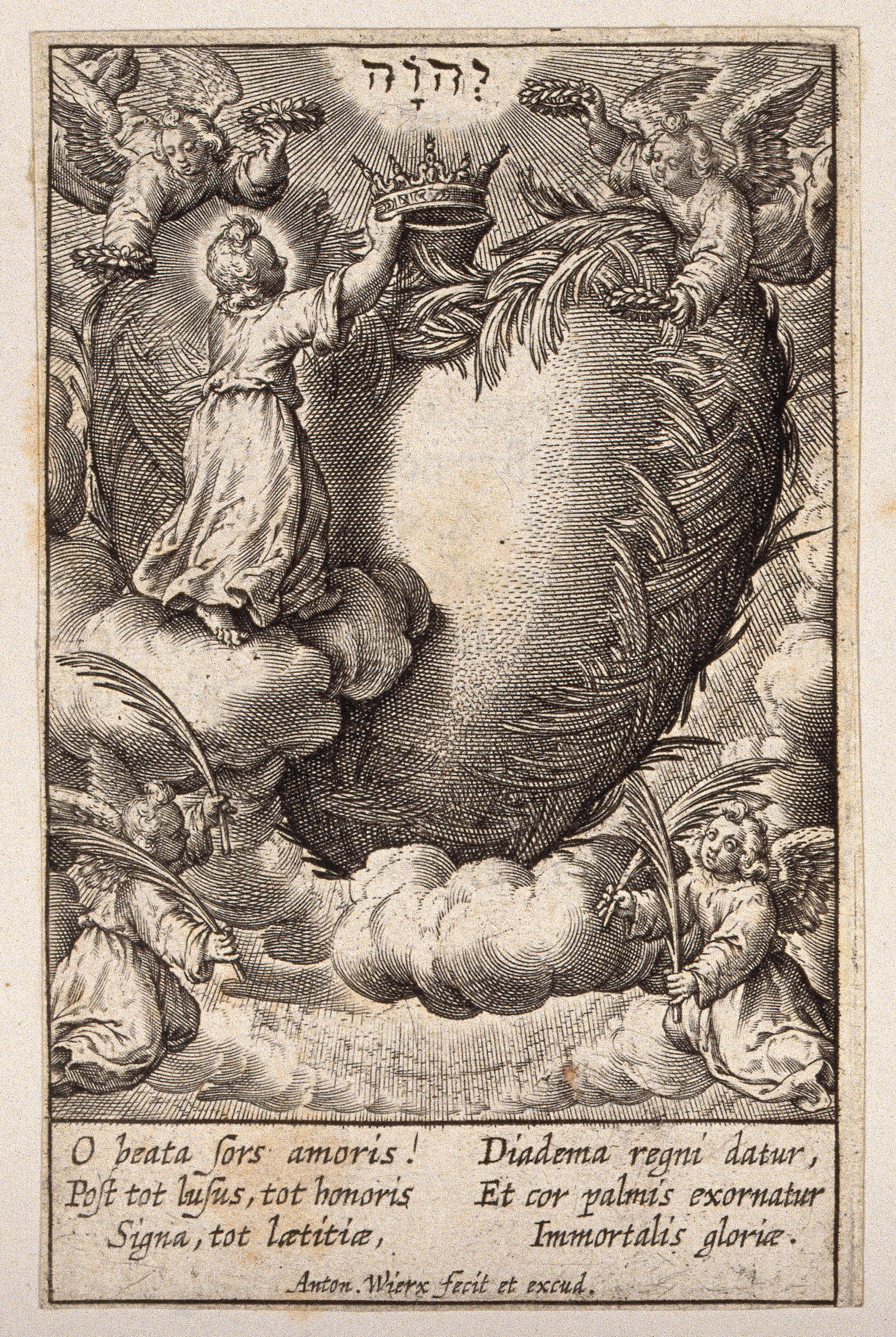
Jesus crowns the heart
Anton Wierix II (Flemish, ca. 1555–1604), Jesus crowns his dear heart with palms and laurels, ca. 1600. Engraving, with etching, image 7.8 × 5.5 cm.

O beata sors amoris!
Post tot lusus, tot honoris
signa, tot laetitiae,

diadema regni datur,
et cor palmis exornatur
immortalis gloriae.

(O blessed fortune of love! After so many games, so many tokens of honor, so many of joy, the crown of the kingdom is bestowed, and the heart is adorned with the palms of immortal glory.)

* I am excluding the title page engraving from the count, which shows a flaming heart, inscribed with the words Cor Jesu amanti sacrum, held up by a Jesuit and a Franciscan friar; Jesus is not pictured, and there is no corresponding verse. And it appears that the Wellcome Collection does not own (or has not digitized) this print.


FURTHER READING

Daly, Peter M. The Emblem in Early Modern Europe: Contributions to the Theory of the Emblem. Surrey, UK: Ashgate, 2014.

Grześkowiak, Radosław, and Paul Hulsenboom. “Emblems from the Heart: The Reception of the Cor Iesu Sacrum Engravings Series in Polish and Netherlandish 17th-Century Manuscripts.” Werkwinkel 10, no. 2 (2015): 131–54.

Menegon, Eugenio. “Jesuit Emblematica in China: The Use of European Allegorical Images in Flemish Engravings Described in the Kouduo Richao (ca. 1640).” Monumenta Serica 55 (2007): 389–437.

Metzger, Franziska, ed. Sacred Heart Devotion: Memory, Body, Image, Text—Continuities and Discontinuities. Cologne: Böhlau Verlag, 2020.

Špániová, Marta. “Cor castum Dei speculum: Emblematics and the Heart Emblem in Jesuit Literature.” Z Badań nad Książką i Księgozbiorami Historycznymi (Studies into the History of the Book and Book Collections) 16, no. 3 (2022): 340–57.

Young, Louisa. The Book of the Heart. New York: Doubleday, 2003.
Roundup: Artists convene at Vatican, “crucified with Christ” artworks, and more

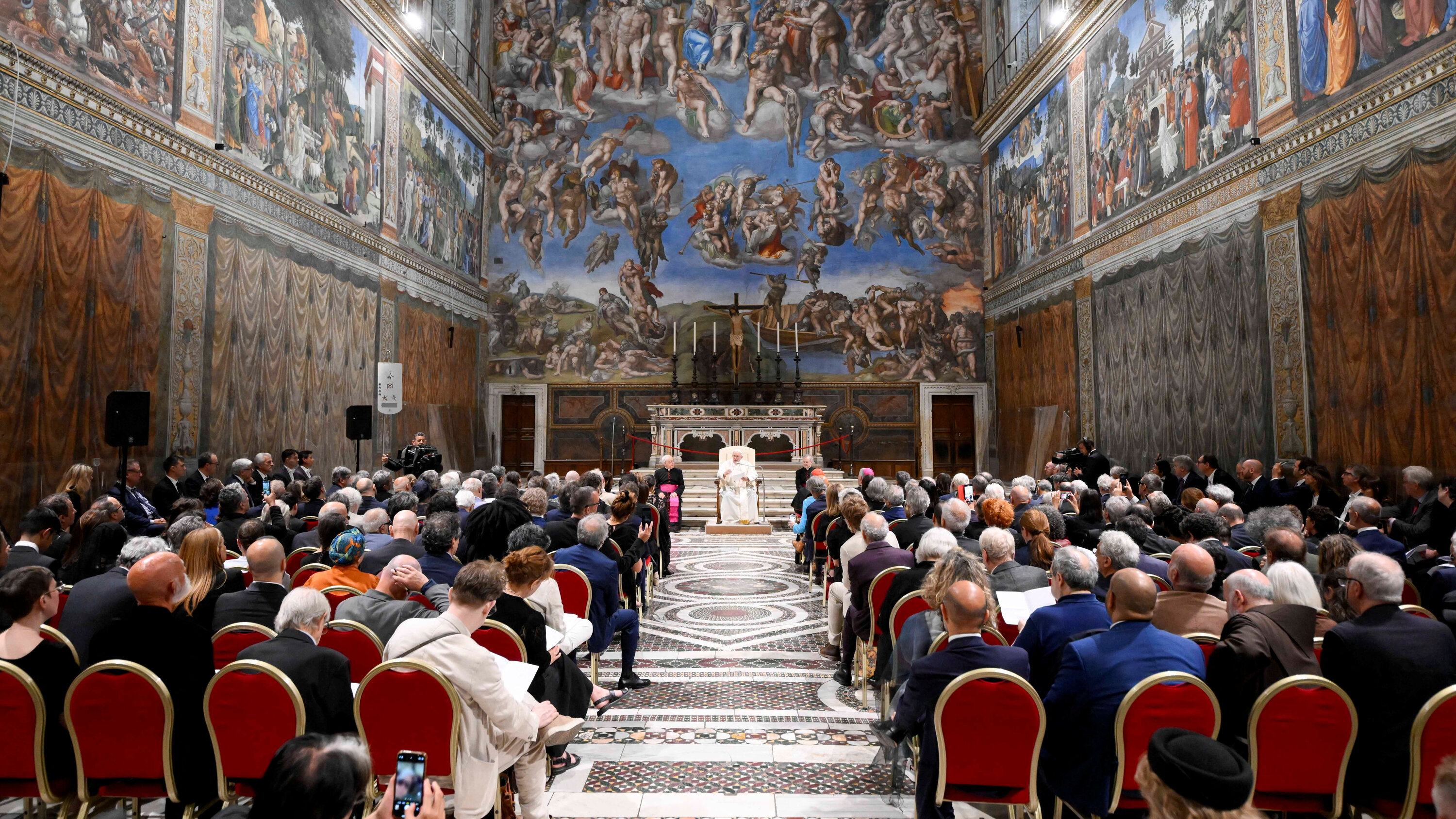
SPEECH: “Address of His Holiness Pope Francis to Artists for the 50th Anniversary of the Inauguration of the Vatican Museums’ Collection of Modern Art”: On June 23, at the invitation of Pope Francis, some two hundred select visual artists, filmmakers, composers, poets, and other creatives gathered at the Sistine Chapel to commemorate the fiftieth anniversary of the Vatican Museums’ Collection of Modern and Contemporary Art, inaugurated in 1973 by Pope John Paul VI. “One of the things that draws art closer to faith is the fact that both tend to be troubling,” Pope Francis said last Friday. “Neither art nor faith can leave things simply as they are: they change, transform, move and convert them.” He applauded how “artists take seriously the richness of human existence, of our lives and the life of the world, including its contradictions and its tragic aspects. . . . Artists remind us that the dimension in which we move, even unconsciously, is always that of the Spirit. Your art . . . propel[s] us forward.” For reporting on this event by the New York Times, see here.

Pope Francis meeting artists
Pope Francis addresses a group of artists, June 23, 2023. Photo: Vatican Media, via Reuters.

This papal address came less than a month after the pope addressed another gathering of artists at the Vatican for the conference The Global Aesthetics of the Catholic Imagination, sponsored by La Civiltà Cattolica with Georgetown University (read that address here).

+++

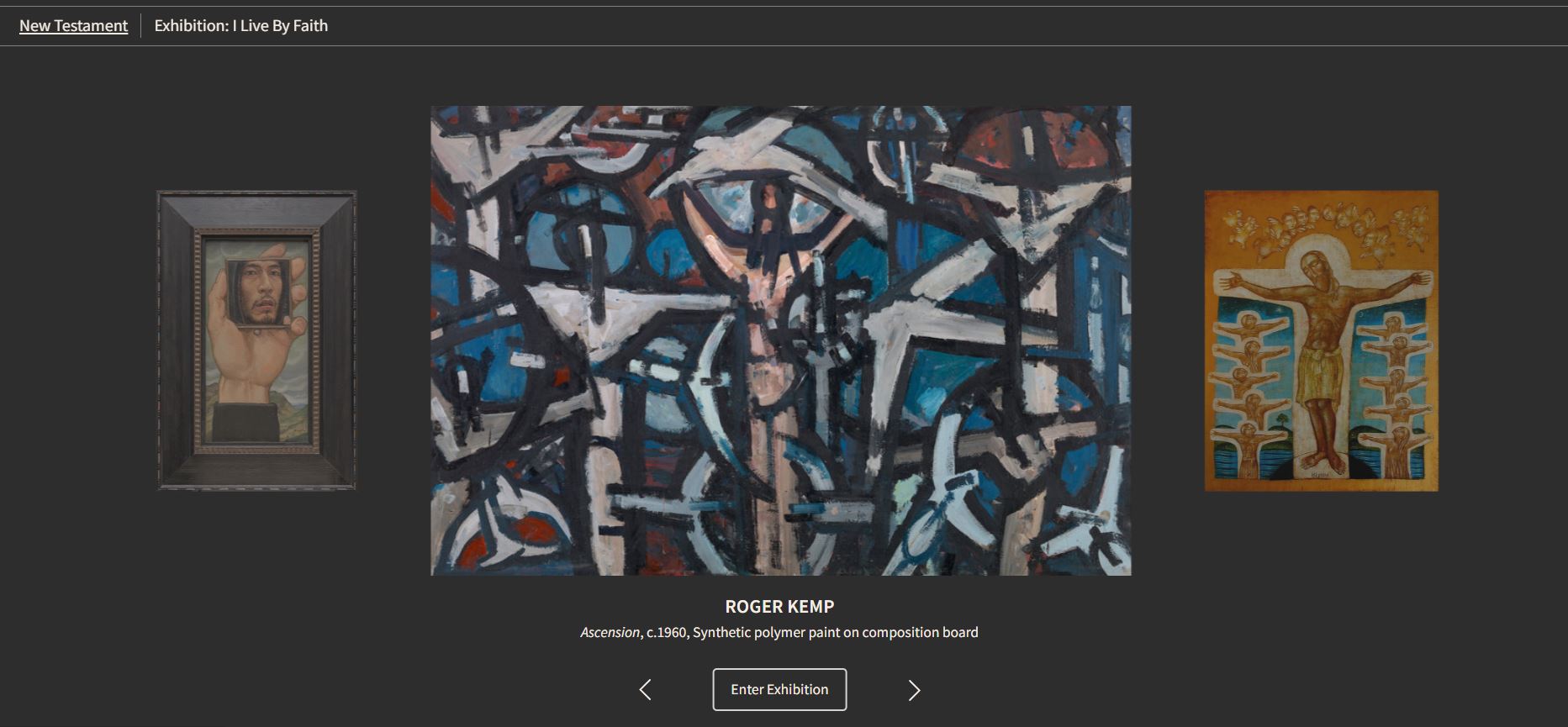
VISUAL COMMENTARY ON SCRIPTURE: “I Live by Faith (Galatians 2:15–21)” by Victoria Emily Jones: My latest set of commentaries for the VCS went live this month! It centers on one of Paul’s famous sayings: “I have been crucified with Christ, and it is no longer I who live, but it is Christ who lives in me.” I was bummed that one of the three commentaries I originally wrote had to be scrapped because the image permission was ultimately denied; I thus had to reconfigure and replace, and I ended up with two artworks in the three-piece exhibition that aren’t as diverse from each other as I had hoped. But still, each artwork brings a unique and compelling lens through which to examine this passage. (Note: If you’re viewing the exhibition on your phone, after you “Enter Exhibition,” you’ll need to expand the “Exhibition Menu” to access the “Show Commentary” button.)

Crucified with Christ (VCS)

The VCS was covered by The Art Newspaper in a recent article by Anna Somers Cocks. “Theology is making a comeback as an important tool for interpreting art,” reads the URL.

+++

VIDEO: “Abraham: An Interfaith Discussion at the Bode-Museum, Berlin”: Besides publishing written commentaries on works of art in dialogue with Bible passages, the Visual Commentary on Scripture also produces videos. This one brings together an Anglican Christian priest (who directs the VCS), a Jewish rabbi, and a Muslim theologian around a fifth-century ivory pyxis depicting Abraham, a figure held in common by all three faith traditions.

+++

POEM: “Gate A-4” by Naomi Shihab Nye: I’ve always loved this heartwarming poem about an unexpected moment of communion shared with strangers at an airport, made possible through kindness and the letting down of one’s guard. Listen to commentary by Joanne Diaz and Abram Van Engen on the Poetry for All podcast, episode 19; they answer the question “Why is this a poem?” Here’s a video of Nye reading it herself:

+++

NEW ALBUMS:

>> April 21: Worship for Workers by the Porter’s Gate: “In 2022 a group of songwriters, pastors, and professionals gathered in Nashville, Tennessee to write a series of worship songs for workers. Over three days they discussed the spiritual, emotional, and material struggles facing workers around the world today. Soon enough, they began to compose a series of songs specifically designed to help Christians carry their daily work before the Lord.” Here’s one of the thirteen songs on the album, “You Hold It All”:

The Worship for Workers album is part of a larger project, sponsored by the Brehm Center and a number of other institutions, to provide music, prayers, art, liturgies, and training to the church around the topic of work. It grew out of the book Work and Worship: Reconnecting Our Labor and Liturgy by Matthew Kaemingk and Cory Willson.

>> May 5: Glory Hour by Victory: Victory Boyd [previously] is a Grammy-winning soul and gospel artist who got her start singing with her siblings in the group Infinity Song but whose career really kicked into high gear when she worked as a songwriter for Kanye West’s Jesus Is King (2019). Glory Hour is her second full-length album as a solo artist; its title refers to the time of the morning when the sun rises. Most of the tracks are original songs or spoken word, but there are also three classic hymns/gospel songs: “His Eye Is on the Sparrow,” “Great Is Thy Faithfulness,” and “I Know It Was the Blood.” Here’s the music video for “Just like in Heaven,” based on the Lord’s Prayer:

>> May 19: Seven Psalms by Paul Simon: Paul Simon released this original seven-movement composition about doubt and belief as a single thirty-three-minute track, as it is meant to be listened to in one sitting. I’m a Simon fan; one of my early blog posts is a review of his and Garfunkel’s debut album, Wednesday Morning, 3 A.M. But if I’m honest, I was underwhelmed by this much-anticipated release. I’m in the minority there, so I think I’ll need to give it another listen. What do you think of it? Here’s the trailer:

>> June 2: Byrd: Mass for Five Voices by the Gesualdo Six: One of my favorite vocal ensembles has just come out with an album of songs by William Byrd—his setting of the Mass along with a handful of motets. A Catholic composer in Protestant England in the late Renaissance, Byrd wove together musical “notes as a garland to adorn certain holy and delightful phrases of the Christian rite,” as he wrote in the preface to his second book of Gradualia (1607). Here’s the Gesualdo Six’s performance of his “Afflicti pro peccatis nostris,” a Latin prayer, a desperate plea for sanctification, that translates to “Afflicted by our sins, each day with tears we look forward to our end: the sorrow in our hearts rises to thee, O Lord, that you may deliver us from those evils that originate within us”:

Roundup: Les Mis, blood collages, Esau McCaulley on Lent, and more

I’ve received a few requests from followers to resume my monthly thirty-song playlists. I had previously thought I’d stick to publishing these during Ordinary Time, since I have longer, thematic playlists for the seasons of Advent, Christmas, Lent (our current place in the calendar), and Easter—which you can find on my Spotify profile. But I’m happy to oblige! Here’s a new playlist for March:

+++

ESSAY: “Victor Hugo’s Masterpiece of Impossibility” by Caitrin Keiper, Plough: A wonderful essay on how competing vows in the novel and musical Les Misérables reveal the paradox of grace. I’ve been captivated by this story of mercy, forgiveness, and transformation set in revolutionary France ever since I saw the 1998 film adaptation starring Liam Neeson in middle school. The faith-inspired actions of Bishop Myriel at the beginning set the life of the protagonist Jean Valjean, an escaped convict, on a trajectory that is beautiful to watch unfold, and the downfall of the law-obsessed Inspector Javert, who cannot bring himself to accept the grace offered him, is most tragic.

+++

PODCAST EPISODES:

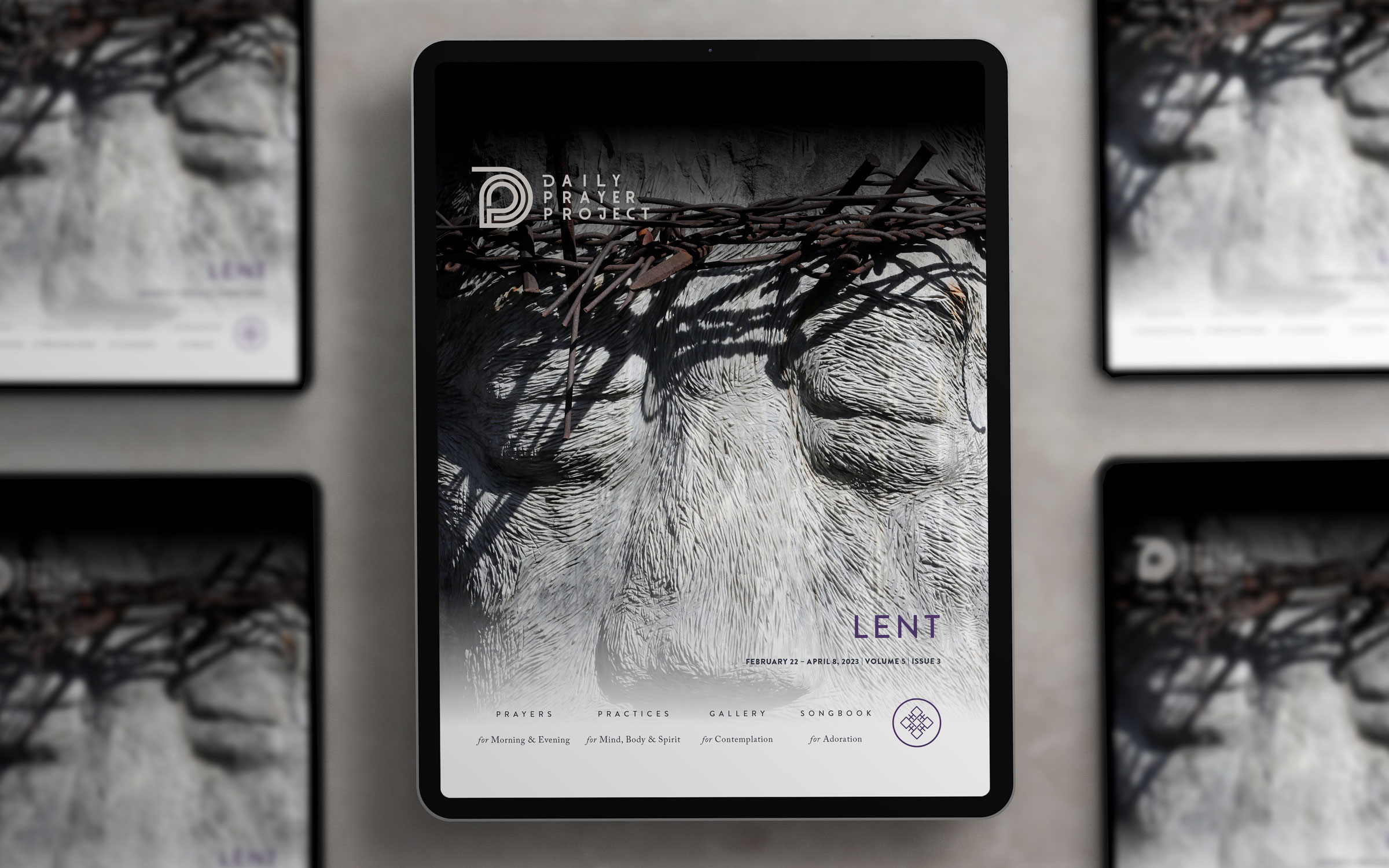
>> Season 2, episode 2, of Gather Round, on the DPP’s Lent 2023 Living Prayer Periodical: On the in-house podcast of Grace Mosaic in Washington, DC, three of my four Daily Prayer Project colleagues and I walk listeners through the latest edition of our prayer periodical, which covers the six weeks of Lent. The conversation starts at 3:46. Rev. Joel Littlepage, curator of the liturgies and songs, highlights a litany to the Servant-Christ from Andhra Theological College in Hyderabad, India, and a song by Pastor Antonio Rivera González of Mexico (see below). Ashley Williams, who commissions or secures reproduction rights for the practice-based essays and curates the photographs throughout, shares some teasers for “Calling Out to God in Lament” by Nina Barnes and “Intractable Sin, Preemptory Prayer” by Alicia Akins.

Daily Prayer Project, Lent 2023
The Daily Prayer Project’s Lent 2023 booklet, featuring scripture, prayers, practical essays, art, and music from diverse contributors, is available in print and digital formats.

As curator of the art on the cover and in the Gallery section, I discuss the marble sculpture Condemned to Death by Chang Dong Ho (장동호) (see more by the artist), the mixed-media piece Gathering Fragments 1 by C. F. John, the photograph Untitled #10, Flushing, NY from the Stranger Fruit series by Jon Henry, and the painted woodcarving Qwi:qwelstom (Halkomelem, a Coast Salish language, for “Balance and Harmony”) by Don Froese.

At 32:44–35:06, our theological editor, Rev. Russ Whitfield, discusses a theological method that has informed our work at the DPP called triperspectivalism (or multiperspectivalism), which says that we can enrich our perspective, limited on its own, by looking at things from different angles, especially those revealed to us by other people and cultures. For a snippet of the Herman Bavinck quote, see here. What Russ says is SO GOOD! I believe our prayerbooks stand out from other similar projects in that they are deliberately cross-cultural—not because it’s trendy, but because there is so much beauty and wisdom we are missing by not availing ourselves of the many resources of the global church. Our content is also cross-historical.

There are subscription options for individuals (you receive a print edition and a digital download link) and groups (digital access, with bulk-printing options). You can also buy a single copy, but it’s cheaper to purchase a monthly subscription and then cancel after you receive your edition if you don’t wish to continue. We publish six editions a year, each following the same format but filled with new content for the given season.

>> “Lent: Season of Repentance, Renewal . . . and Rebellion” with Esau McCaulley, For the Life of the World: Here Rev. Dr. Esau McCaulley—associate professor of New Testament at Wheaton College, contributing opinion writer for the New York Times, and award-winning author of Reading While Black—talks about the Christian practice of Lent as a collective wisdom passed down through generations of Jesus followers, as well as a spiritual rebellion against mainstream American culture, which has its own established rhythms that shape how we spend our money, when we feast, and what we celebrate.

McCaulley spent the first twenty-one years of his life in the Black Baptist church and the past twenty in a high-liturgical tradition, both of which have been formative for him. One thing he appreciates about liturgy (both the yearly calendar and the elements within a worship service), he says, is how it helps him more fully inhabit the story of Christ. He construes Lent as a season of repentance and grace; he points out the justice practices of Lent; he walks through a Christian understanding of death, and the beautiful practice of stripping the altars on Maundy Thursday; and he’s emphatic about how Lent is a guided season of pursuing the grace to find, or perhaps return to, yourself as God has called you to be. These ideas are expanded upon in his new book, Lent: The Season of Repentance and Renewal, from IVP’s Fullness of Time series.

+++

SONGS:

>> “Divino compañero del camino” (O Lord, Divine Companion): Written in 1964 by Antonio Rivera of Mexico, this popular Spanish-language song is performed here by Karina Moreno and Joseph Espinoza. It’s based on Luke 24:28–32, from the postresurrection story of the walk to and supper at Emmaus, but its pilgrimage aspect—the idea of Jesus as a companion on our life journey—makes it appropriate for Lent. [HT: The Daily Prayer Project]

>> “Yeshu Ji Mere Paap Kshama Kar Do” (Lord Jesus, Forgive My Sins): A Hindi song of confession with words by the late Shri Jalal Masih and music by his granddaughter, Mercy Sharon Masih. Mercy sings it here with her father, Hanook Masih. For an English translation, click the “CC” button. [HT: Global Christian Worship]

+++

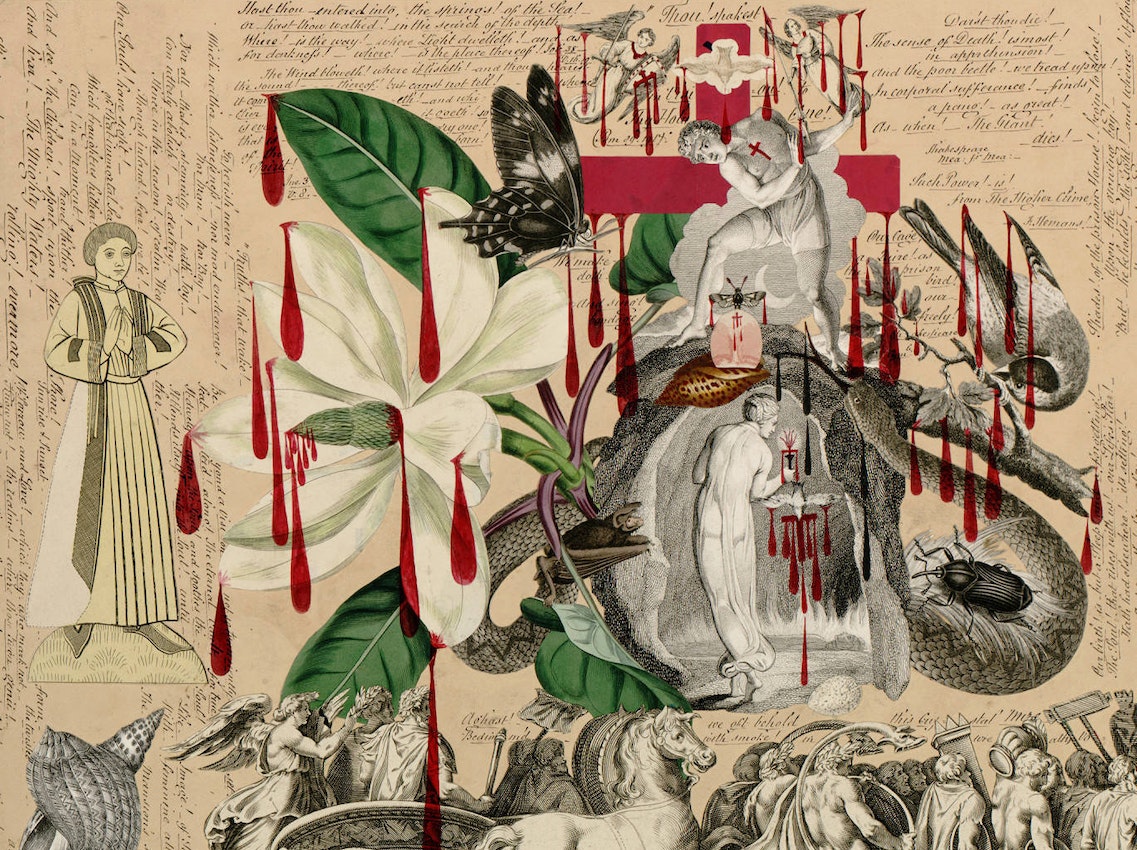
ARTICLE: “The Blood Collages of John Bingley Garland (ca. 1850–60),” Public Domain Review: Peruse the so-called Victorian Blood Book, an eccentricity made by the British politician and fishmonger John Bingley Garland as a wedding gift for his daughter Amy in 1854. It consists of forty-one collages whose sources are engravings by William Blake and various other religious artists, botanical and zoological illustrations, photographs of medieval tombs, and other images from nineteenth-century books, but with one distinguishing decorative addition by Garland’s hand: drops of blood in red India ink, presumably signifying the blood of Christ. The pages also bear extensive handwritten religious commentary.

Garland, John Bingley_Blood Book
Detail from a page of John Bingley Garland’s “Blood Book” (ca. 1850–60), featuring a cut-out from a reproduction of William Blake’s engraving The Soul exploring the recesses of the Grave.

The Blood Book transferred from the collection of novelist Evelyn Waugh to the Harry Ransom Center at the University of Texas at Austin upon Waugh’s death, and they identify it as “the single most curious object in the entire library.” Though modern eyes may see the collages as surreal or even grotesque, Garland’s descendants regarded them as nothing other than “a precious reminder of the love of family and Our Lord,” as they have written. The Harry Ransom Center has digitized the full book.

“Undo thy door, my spouse dear” (Middle English lyric)

Bouts, Aelbert_Man of Sorrows
Aelbert Bouts (Netherlandish, ca. 1451/54–1549), Man of Sorrows, mid-1490s. Oil on oak wood, 14 15/16 × 10 7/16 in. (37.9 × 26.5 cm). Harvard Art Museums / Fogg Museum, Cambridge, Massachusetts.

ORIGINAL MIDDLE ENGLISH:

Vndo þi dore, my spuse dere,
Allas! wy stond i loken out here?
     fre am i þi make.
Loke mi lokkes & ek myn heued
& al my bodi with blod be-weued
     For þi sake.

Allas! allas! heuel haue i sped,
For senne iesu is fro me fled,
     Mi trewe fere.
With-outen my gate he stant alone,
Sorfuliche he maket his mone
     On his manere.

Lord, for senne i sike sore,
Forʒef & i ne wil no more,
With al my mith senne i forsake,
& opne myn herte þe inne to take.
For þin herte is clouen oure loue to kecchen,
Þi loue is chosen vs alle to fecchen;
Mine herte it þerlede ʒef i wer kende,
Þi suete loue to hauen in mende.
Perce myn herte with þi louengge,
Þat in þe i haue my duellingge. 
Amen.
MODERN ENGLISH TRANSLATION:

“Undo thy door, my spouse dear,
Alas! why stand I locked out here?
     For I am thy mate.
Look, my locks and also my head
And all my body with blood bedewed,
     For thy sake.”

“Alas! alas! evil have I sped,
For sin Jesus is from me fled,
     My true companion.
Without my gate he standeth alone,
Sorrowfully he maketh his moan
     In his manner.”

Lord, for sin I sigh sore,
Forgive, and I’ll do so no more,
With all my might I forsake my sin,
And open my heart to take thee in.
For thy heart is cleft our love to catch,
Thy love has chosen us all to fetch;
My heart it pierced if I were kind,
Thy sweet love to have in mind.
Pierce my heart with thy loving,
That in thee I may have my dwelling. 
Amen.

This poem appears in the 1372 “commonplace book” of the Franciscan friar John of Grimestone, who lived in Norfolk, England. Commonplace books were notebooks used to gather quotations and literary excerpts, with entries typically organized under subject headings. Preachers often kept them for homiletic purposes, gathering potential material for sermons. Grimestone’s is remarkable because it includes, in addition to much Latin material, 239 poems in Middle English. (English friars at the time regularly used vernacular religious verse in their sermons.) It is unknown whether Grimestone composed these verses himself or merely compiled them; likely, it is some combination. The first two stanzas of this particular poem are found, transposed, in another manuscript from almost a century earlier. Grimestone revised them slightly and added the third stanza.

Belonging to the Christ-as-lover tradition, “Undo thy door” is based primarily on Song of Solomon 5:2, cited in Grimestone’s manuscript: “I sleep, but my heart waketh: it is the voice of my beloved that knocketh, saying, Open to me, my sister, my love, my dove, my undefiled: for my head is filled with dew, and my locks with the drops of the night.” In a clever interpretation of the Old Testament source, the poet imagines the dewdrops on the Beloved’s brow as blood, thus identifying him with the thorn-crowned Christ. His bride is the human soul. Revelation 3:20 is provided as a further gloss by Grimestone: Jesus says, “Behold, I stand at the door, and knock: if any man hear my voice, and open the door, I will come in to him, and will sup with him, and he with me.”

So in the poem, the speaker is keeping company with sin and has locked out her true lover, Christ. Christ stands at the gate of her heart and implores her with great ardor to let him in and to send sin packing. Wet with the wounds of sacrifice, tokens of his love, he is persistent in his longing for her.

Christ’s entreaties provide the impetus for the speaker’s repentance, expressed in the final stanza, which changes awkwardly in form and meter. His love has pierced her to the core, undoing her resistance. She resolves to break the sin-lock—to turn away from wrongful deeds—and answer Christ’s call so that they can enjoy sweet union together, dwelling in one another’s love. It was his heart that opened first—it was cleft by the centurion’s spear as he hung on the cross—and she is compelled to respond with similar openness, receiving what he has given, requiting his desire.


SOURCES:

This poem is #6108 in the Digital Index of Middle English Verse. It is preserved in Edinburgh, National Library of Scotland, Adv.MS.18.7.21, fol. 121v. A shorter, earlier version, from the late thirteenth century, appears in London, Lambeth Palace Library 557, fol. 185v.

Middle English transcription: Carleton Brown, ed., Religious Lyrics of the XIVth Century (Oxford: Clarendon Press, 1924), 86

Modern English translation: David C. Fowler, The Bible in Middle English Literature (Seattle: University of Washington Press, 1984), 85–86

For further reading, see chapters 4–5 of Siegfried Wenzel, Preachers, Poets, and the Early English Lyric (Princeton, NJ: Princeton University Press, 1986), especially pages 140–41; and chapter 7, “The Theme of Christ the Lover-Knight in Medieval English Literature,” in Rosemary Woolf, Art and Doctrine: Essays on Medieval English Literature (London: The Hambledon Press, 1986), especially pages 109–10.

Roundup: Facing up to our faults, “How Prayer Works,” and more

Sundays are not counted toward the forty days of Lent (as they are feast days, not fast days), so I’m taking a break from my usual Lenten format today and for the next four Sundays to offer some supplemental content, such as a roundup of video, article, podcast, and event links, or a poem. Tomorrow I’ll resume with “Day 5” of the music-art pairings.

+++

DANCE VIDEO: “Lord, Forgive Me,” choreographed by Keone Madrid: A short dance number to a penitential song by hip-hop/R&B artist Mali Music, choreographed by Keone Madrid. The dancers embody stumbling, floundering, aching, weakness, shame, and pleading, as well as openness, humility, surrender, and peace—various postures/feelings associated with the act of confession. Starting at 42 seconds in, a succession of individuals stand or kneel in relative stillness at the right side of the frame, as if receiving the forgiveness they seek, while their dancing form is visible in the mirror.  

Keone, the man in the maroon shirt in the opening shot of the video, is one-half of the choreo, dancing, and directing duo Keone and Mari [previously], whose other recent work includes choreographing the adorable (!) 2021 Disney animated short Us Again (see trailer). Storytelling is at the root of their work, with themes including marriage, family, faith, and struggle.

+++

NEW SONG: “No More Hiding” by Ben Thomas: For the past few years singer-songwriter and spiritual teacher Ben Thomas has been writing what he calls “Mantrasongs,” songs “infused with intention” that are meant to get stuck in our head and connect us more fully to ourselves, others, and the Divine. Inspired by Fr. Richard Rohr’s book Breathing Under Water: Spirituality and the Twelve Steps, this January Thomas started releasing a series of Mantrasongs on YouTube based on the Twelve Steps of Recovery, a tool developed in 1938 for Alcoholics Anonymous. “The 12 Steps of Recovery aren’t just for those addicted to substances,” Thomas writes. “They’re for all of us learning how to create lives of health and wholeness, free of the addictive patterns of thinking, seeing, and being that keep us living at a fraction of our capacity.”

“No More Hiding” is the fifth song in Thomas’s Twelve Steps series. It corresponds to step 5 of the twelve-step program: “Admit to God, to yourself, and to another human being the exact nature of your wrongs.” Christians would call this process “confessing our sins.” It can be a scary thing to do. It requires tremendous vulnerability and honesty. But oh, what freedom comes from confession! He sings here with Jenny Miller. The preceding songs in the series are:

  1. “A New Level of Let Go” (Admit that you are powerless over your addiction—that your life has become unmanageable.)
  2. “Make Me Whole Again” (Believe that a Power greater than yourself can restore you to sanity.)
  3. “To Know What Is” (Make a decision to turn your will and your life over to the care of God.)
  4. “Freedom in the Light” (Make a searching and fearless moral inventory of yourself.)

Look out for a new Mantrasong each week. You can receive free song downloads from Ben Thomas by becoming a Patreon supporter.

+++

VIRTUAL EVENT: “Writing on Music, Meaning, and the Ineffable,” March 24, 2022, 6 p.m. ET: It’s been said that writing about music (or visual art, for that matter) is as pointless and impossible as dancing about architecture. Music and art need only be experienced; studied analysis or explanation lessens their impact and is reductive. While I can see the reasoning behind this assertion, and I often debate whether to comment on specific pieces that I post here versus let the art do its work without my intervention, I do (obviously!) feel that there is value in writing about the arts, and music writer Joel Heng Hartse does too. In this virtual launch event for his new book Dancing about Architecture Is a Reasonable Thing to Do, Hartse will be joined in conversation with poet Mischa Willett and musician John Van Deusen about art, faith, and criticism. Organized by Image journal.

+++

POETRY UNBOUND PODCAST EPISODES:

Poet and theologian Pádraig Ó Tuama hosts these wonderful fifteen-minute immersive readings of contemporary poems selected from diverse sources. Here are two from last season that I particularly appreciated.

>> “How Prayer Works” by Kaveh Akbar: Kaveh Akbar is an Iranian American Muslim poet and scholar. In this narrative prose poem of his, two brothers, seven years apart, turn to face east in their small shared room when their prayer is interrupted by a surprising noise, setting off an eruption of laughter. “This poem holds the idea of prayer, which can often be an abstract one, with the physical sensation of what’s right in front of you, what’s happening, who’s right in front of you, how are you being with each other, what’s going on, how can you be drawn towards each other—and that that itself is the answer to prayer.”

>> “The Only Cab Service of Farmington, Maine” by Aria Abner: “This is a poem, really, that’s an exploration of place and all of the emotion and pain and beauty that can be gathered into memory of place,” Ó Tuama says. “A poem about conversation and about how you reach the edge of conversation.” Poet Aria Abner was born in Germany to Afghan parents but has lived in the United States since age eighteen. She writes about being picked up in a cab by a man who served in Afghanistan in the US Marines, and how he tries to connect with her through that geographic commonality but to little avail. “She is feeling estranged by the ways foreigners are speaking about a place that she’s from but hasn’t been able to grow up in.”

Lent Playlist

Wednesday, February 17, is the start of Lent, a forty-day season of penitence and renewal. It’s not so much about making resolutions as it is about drawing near to God and encountering his grace afresh—at the foot of the cross.

That closeness entails confronting, confessing, and repenting of sin—sins of commission and omission. (The Book of Common Prayer reminds us that we sin “by what we have done, and by what we have left undone.”) It’s an uncomfortable process, but one that grows us, makes us healthy. It makes our relationships and communities healthier too. Jesus’s grace is not just warm fuzzies in the hearts of private individuals but, rather, works itself out in the world.

As a companion for the Lenten journey, I’ve curated a Spotify playlist of songs for the season, a mix of prayers and praises to the Triune God whose strength avails to meet us in our weakness and our need. Some are invitational, others are penitential, and others are celebratory. Along with images of dust, blood, wilderness, and death, there are themes of victory and rising, healing and wholeness, rivers that cleanse, rivers that quench thirst, agricultural metaphors of planting and growth, calls to lay down one’s burden and to rest in the Savior’s love. There are songs of pursuing and of being pursued (us calling out to God, God calling out to us), for as we deepen our desire for God, we come to realize how deep God’s desire is for us.

The playlist opens with “That We Might See” by Indianapolis folk duo Sister Sinjin, a setting (with slight modifications) of this Christina Rossetti poem:

Lord, purge our eyes to see
Within the seed a tree,
Within the glowing egg a bird,
Within the shroud a butterfly:

Till taught by such, we see
Beyond all creatures Thee;
And hearken for Thy tender word,
And hear it, “Fear not: it is I.”

I chose this as the introductory song because, first, it expresses how out of “death” or dormancy can come great life and beauty—as with the buried seed that, once germinated, brings forth lushness. This is one of the prime metaphors of Lent, and this song is a supplication that we would have eyes to see it and, what’s more, participate in it (see Rom. 6). Second, I like how it reminds us of the tenderness and approachability of Jesus. Some people enter Lent with a sense of dread, fearing that their sins are too great, or that they will never measure up to some set standard of piety. But Jesus tells us not to be afraid. His love and mercy know no bounds. He wants to set us free from our illusions of self-sufficiency and for us to rely on his Spirit to work good things in and through us.

Let me share just a handful of other song highlights.

“Simple Gifts” is a one-verse Shaker hymn from 1848, performed here by the amazing female trio Mountain Man (Alexandra Sauser-Monnig, Amelia Randall Meath, and Molly Erin Sarle). The Shakers, a Christian sect, were known for their use of dance during worship, and “bowing,” “bending,” and “turning” are dance instructions as much as they are instructions for life. Simplicity is another hallmark of the Shakers, a virtue and a discipline that Lent summons us to.

Another Lenten virtue is silence. In 2018 Paul Zach released the EP God Is the Friend of Silence, whose title track is inspired by a Mother Teresa quote: “We need to find God, and God cannot be found in noise and restlessness. God is the friend of silence.”

There are many originals from the past decade on the playlist, but there are also a lot of classic hymns: “Amazing Grace” (to the tune of “House of the Rising Sun”), “Softly and Tenderly” (intriguingly reharmonized by the Wilderness of Manitoba), “I Am Thine, O Lord,” “Just a Closer Walk with Thee,” “I Need Thee Every Hour,” “Grace That Is Greater,” “Nothing but the Blood,” “Near the Cross,” “Just as I Am,” “Jesus Paid It All,” “Turn Your Eyes Upon Jesus,” “Where He Leads Me.” And a beautiful adaptation of “I Surrender All” by Chanda Rule, who revised the first verse to this:

O Beloved, I surrender
All my heart I freely give
Ever open, ever trusting
Breathing with my Source, I live

Also included are several settings of the ancient liturgical prayer Kyrie (“Lord, have mercy”)—by Hildegard of Bingen, Josquin des Prez, Isaac Wardell, and the monks of Keur Moussa Abbey in Senegal (sung in Wolof). Plus the fourteenth-century prayer known as the Anima Christi, with music composed by jazz master Mary Lou Williams using a 6/8 rhythm pattern and a bass clarinet.

Soul of Christ, be my sanctification
Body of Christ, be my salvation
Blood of Christ, fill my veins
Water of Christ’s side, wash out my stains

Passion of Christ, my comfort be
O good Jesus, listen to me
Lord, have mercy on me

. . .

The entire Lent album by Liturgical Folk is inspired by specific Lenten readings from the Book of Common Prayer. My favorite song is “Willing Minds,” based loosely on the collect (succinct prayer) for the Fifth Sunday in Lent:

Almighty God, you alone can bring into order the unruly wills and affections of sinners: Grant your people grace to love what you command and desire what you promise; that, among the swift and varied changes of the world, our hearts may surely there be fixed where true joys are to be found; through Jesus Christ our Lord, who lives and reigns with you and the Holy Spirit, one God, now and for ever. Amen.

The melismatic phrases (in which one syllable is stretched out across multiple successive notes) underscore the flightiness of the human will, our inconstancy, our lack of rootedness.

“Create in Me” by Terry Talbot, covered by The Acappella Company in the video below, is a prayer that’s pieced together from various verses of scripture, starting with Psalm 51:10:

Other favorites, which I’ve featured on the blog before, are Leon Bridges’s “River” [previously] and “Hallelujah” by MaMuse [previously]. “I’m gonna let myself be lifted,” the latter asserts.

As much as Lent is about dying to sin, it’s also about rising with Christ, so resurrection is present throughout—in biblical narrative songs about Jonah, Lazarus, Jairus’s daughter, and Ezekiel in the valley of dry bones, for example (foretastes of Easter), but also in songs of personal testimony and aspiration. The theme is especially punctuated in the final few selections. “Where All New Life Begins” by John Lucas seeks to define faith, landing on “Faith is laying your body down / And believing new life will come up from the ground.” Carrie Newcomer’s “Lean in Toward the Light” opens with a similar image of buried seeds, which stretch out underneath the cold winter earth as they prepare to sprout (that is, resurrect), their growth enabled by the light; “keep practicing resurrection!” exclaims the second stanza.

The last two songs are centered on Romans 8. “The Spirit of Life” by Psallos is a contemporary setting of verses 1–17 and part of a larger project. For the final, “sending forth” song I’ve chosen “Conquerors” by Hiram Ring, which is quieter, less anthemic, than the previous one, but its chorus rings of Romans 8:37 and makes for a powerful closing:

We are more than conquerors
Heading out into this world
Freed from chains and strengthened now
’Cause his love is all around

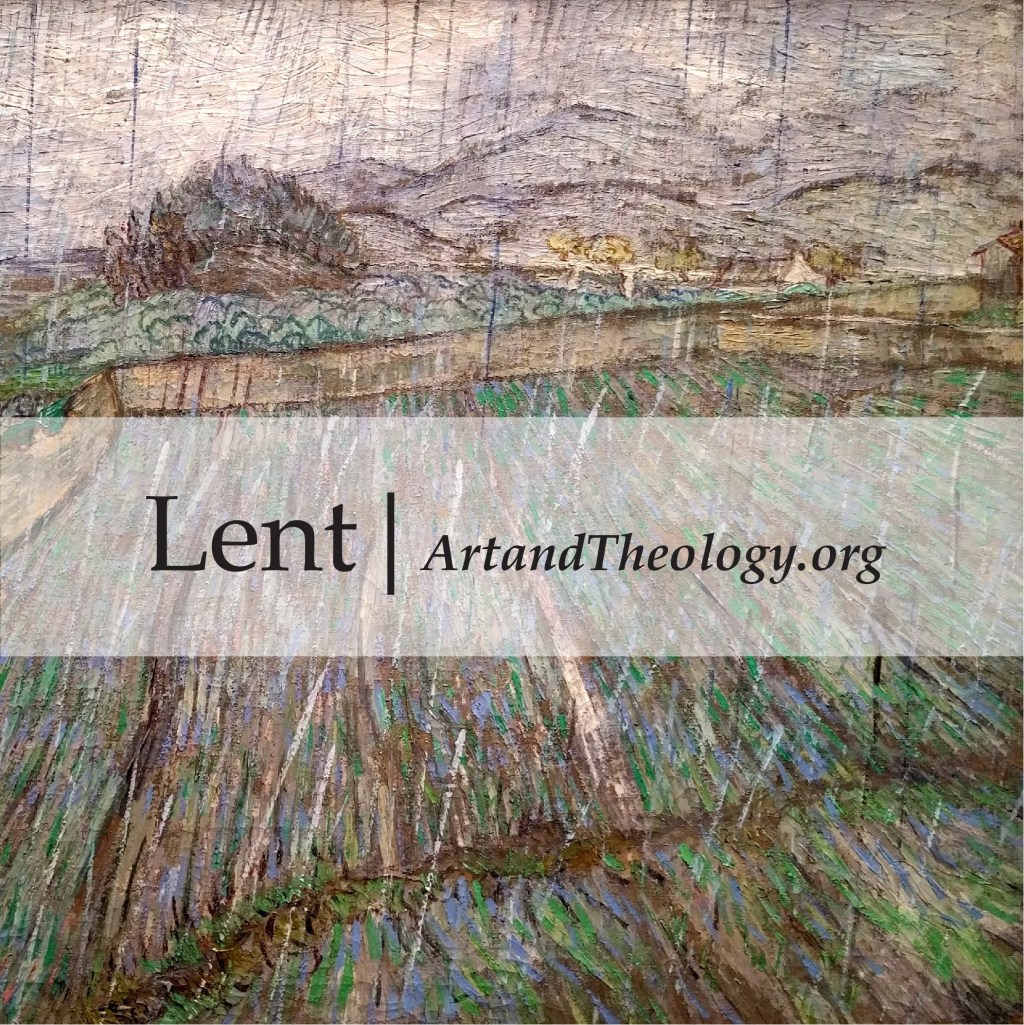
Lent playlist cover (Van Gogh)

This is just a sampling of the 150 songs on Art & Theology’s Lent playlist, which I will probably build on indefinitely. Later in the season I plan to publish a different list specifically for Holy Week.

To add the playlist to your account, open the link, then click on the More (…) icon and select “Save to Library.”

Playlist cover art: Vincent van Gogh, Rain (detail), Saint-Rémy, 1889, Philadelphia Museum of Art

+++

I recently started accepting donations to help support the running of this blog ministry. If the Lent playlist has value to you, please consider leaving a gift of $5 through PayPal. If you have already given, thank you. https://www.paypal.me/artandtheology

MUSIC VIDEO: “River” by Leon Bridges

A song of confession and cleansing, “River” is from the Grammy-nominated debut album Coming Home (2015) by retro-style soul singer Leon Bridges. The music video, set during the 2015 Baltimore race riots and filmed on location less than a year later, brings together three separate redemption narratives that culminate in a neighborhood baptism via rain and water hose.

The story lines are very allusive, giving a wide berth to viewer interpretations, but here’s what I see. Three different families: a father who has perpetrated some act of violence, fleeing the site of the crime to be with his infant son; a grieving mother and her preteen boy, who lost a family member to violence; and an overworked single mother struggling to make ends meet, whose daughter longs for a better life for them both. Outside these story lines are Bridges and Brittni Jessie, who meet in a motel room after a long car ride to lift up this plea on behalf of the hurting. Into all these situations, they trust, God will bring forgiveness, healing, and hope.

At the end of the video, Bridges too enters the shower of divine grace, lifting his head high in wonder, then bowing it in humility.

Been traveling these wide roads for so long
My heart’s been far from you
Ten thousand miles gone
Oh, I wanna come near and give you
Every part of me
But there’s blood on my hands
And my lips are unclean
In my darkness I remember
Mama’s words reoccur to me:
“Surrender to the good Lord
And he’ll wipe your slate clean”

Take me to your river
I wanna go
. . .

“The river in my song is a metaphor for being born again,” Bridges told Uncut. He elaborates on his Facebook page:

A river has historically been used in gospel music as symbolism for change and redemption. My goal was to write a song about my personal spiritual experience. It was written during a time of real depression in my life, and I recall sitting in my garage trying to write a song which reflected this struggle. I felt stuck working multiple jobs to support myself and my mother. I had little hope and couldn’t see a road out of my reality. The only thing I could cling to in the midst of all that was my faith in God and my only path towards baptism was by way of the river.

When thinking about how to best visually represent this universal battle, I reflected on the depiction of black communities in our media and particular experiences within my own life. This video showcases the unique struggle many black men and women face across this country. However, unlike the captured images which tend to represent only part of the story, I wanted to showcase that through all the injustice, there’s real hope in the world.

I want this video to be a message of light. I believe it has the power to change and heal those that are hurting.

The speaker of the song acknowledges the personal guilt that separates him from God: “I wanna come near . . . but there’s blood on my hands” and, referencing Isaiah 6:5, “my lips are unclean.” But he also acknowledges the One who alone has the power to wash away sin, and to him he surrenders.

The actor with blood on his shirt in the video is Genard “Shadow” Barr (I recognized him from the recent HBO documentary Baltimore Rising) with his real-life son, Jaylin. He’s a former gang member, now community activist, whom Baltimore Police commissioner (at the time) Kevin Davis reached out to after the riots to better understand the needs and frustrations of the black community. “I got a bullet hole in my head, Chief, and that will not happen to my children,” Barr said in one of their meetings. “I will die doing this”—that is, advocating for the betterment of the city, which, as another on the film said, is underserved and overpoliced.

When asked how cops can help diffuse tensions and build the trust of the people, Barr and others suggested as a starting point a flag football game—cops versus the residents of Penn North and Sandtown-Winchester. Billed as the “Unity Bowl,” the game took place on November 29, 2015, the eve of the first trial for Freddie Gray’s death, and helped both sides get to know each other in a different light.

Besides facilitating conversations between police and Baltimore’s black community, Barr also works as a peer advocate and referral specialist for Penn North Recovery Center, which provides intensive outpatient treatment for substance abuse.

I’m not sure whether the other actors in “River” have personal connections to Baltimore—do you know?

(Related posts: “‘Stephen Towns: A Migration’ exhibit”; “From my private collection: ‘Wailing Wall: Song for Quin’ by Steve Prince”)

This music video has received over 17.5 million views on YouTube and lots of mainstream playtime—a rare feat for new gospel songs. “River” is essentially an invitation: Are you ready to be washed? Then come to the river. Experience the new birth offered through Jesus Christ.

For a live performance of “River,” see this excerpt from Saturday Night Live’s December 4, 2015, episode:

For another original gospel song from the same album, check out “Shine.” And consider catching Bridges somewhere on his world tour this year.

Coming Home album cover

Click on the album cover to preview and purchase. [Note: This is an Amazon affiliate link, meaning that a percentage of purchases made through it will go to support this blog.]