Roundup: Advent poetry discussion, graffiti at Canterbury Cathedral, “Dios con Nosotros” print series, and more

ONLINE DISCUSSION: “Poems of Advent, Christmas, and Epiphany” led by Brian Volck, December 13, 2025, 12–1:30 p.m. ET: Poet Brian Volck (whose work I’ve shared here and here) is leading a free online discussion on Advent, Christmas, and Epiphany poetry next Saturday. Sponsored by the Ekklesia Project, it will bring together diverse poetic styles and voices. “Each poem is read by a volunteer and then the group discusses what stood out, what struck them, and what questions the poem raises,” Volck says. “My goal is to encourage a diversity of responses rather than impose mine. No preparation is required.” Register here to receive the Zoom link and the poems in advance.

+++

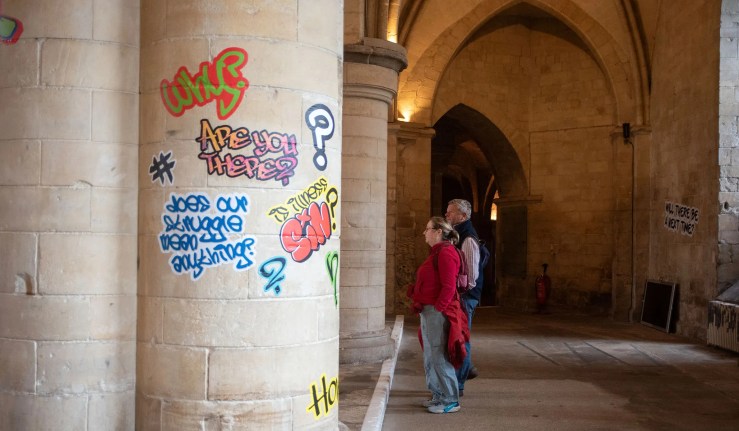
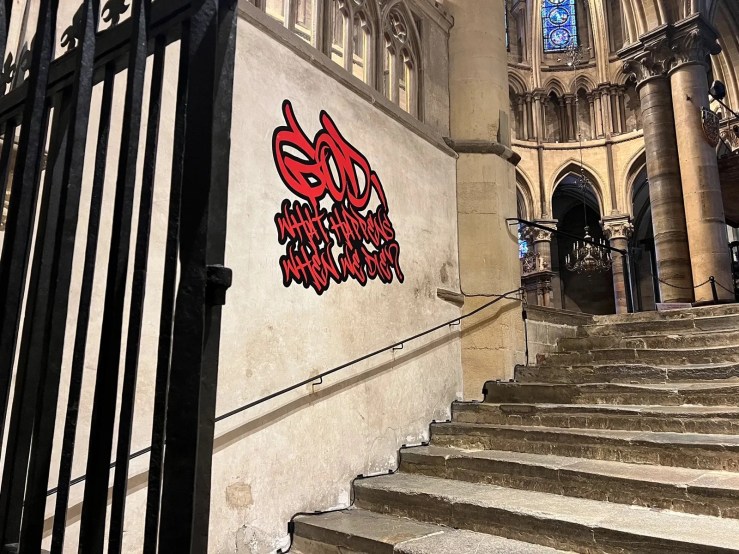
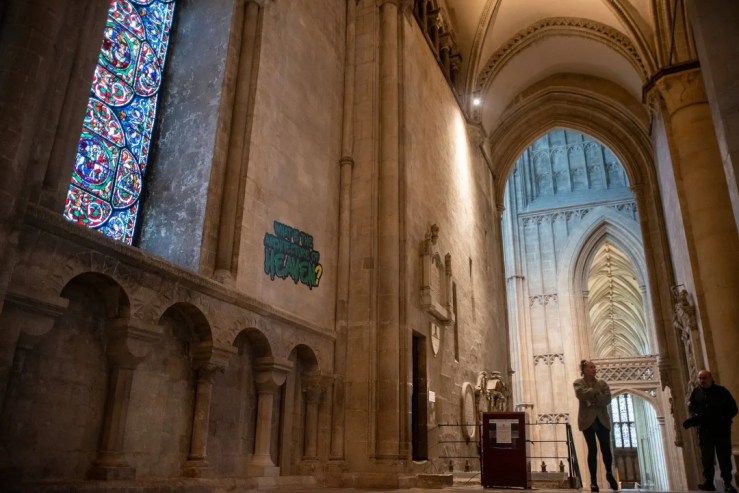
INSTALLATION: Hear Us, Canterbury Cathedral, October 17, 2025–January 18, 2026: Graffiti-style stickers are affixed to the medieval walls, floors, and pillars of England’s Canterbury Cathedral in the temporary installation Hear Us, voicing questions to God collected from local marginalized individuals, such as:

  • Why is there so much pain and destruction?
  • Is this all there is?
  • Are you there?
  • Does everything have a soul?
  • Do you ever regret your creations?
  • How do I break the cycle?
  • Does our struggle mean anything?
  • How is my dog Bear doing?
  • God, do you know me?
  • Hear Us
  • Hear Us
  • Hear Us

Curator Jacquiline Creswell [previously], collaborating with poet Alex Vellis, organized a series of workshops led by artists Sven Stears, Henry Madd, Jasbir Dhillon, Adam Littlefield, Alice Gretton, and Callum Farley, which invited people who felt the cathedral was not for them to gather together and delve into discussions about their lives, experiences, and aspirations. Among the participants were members of the Black and Brown diasporas, LGBTQIA+ people, neurodivergent people, people in addiction recovery, and people with mental health disorders. They were asked to respond to the prompt “If you could ask God a question, what would it be?”

Many of the responses were then translated into big, colorful word graphics that cannot be overlooked. “All of the questions are prayers. All of the questions are already sacred,” Vellis says. “So by putting the questions into an already existent sacred space, we are saying you are valid, your words are valid, your prayers are in a place in which they can be heard and they can be seen and they can be supported.”

I learned about this installation from the Exhibiting Faith podcast’s interview with Creswell and Vellis—an episode I heartily commend. They explain how the exhibition was developed, how they persuaded the cathedral to agree to it, and how they have dealt with the storm of criticism it has generated. Many have called it an act of vandalism (even though the stickers were authorized by the dean and will leave no trace when they’re removed next month) and irreverence, desecration. US Vice President JD Vance said the exhibition “mak[es] a beautiful historical building really ugly,” and Elon Musk called it a “suiciding” of Western culture.

I have not seen the exhibition in person, and I am neither British nor Anglican, so I don’t possess the same sense of my identity or heritage being threatened that many Church of Englanders have expressed. But I personally like the confrontational clash of aesthetics: traditional juxtaposed with modern; majestic Gothic architecture, staid limestone, garishly “spray-painted” in a street style, bringing contemporary spiritual and theological questions into a nearly millennium-old church building. I also like the concept of amplifying rather than diminishing the voices of those who feel marginalized by the church but who still want to engage, who are curious—bringing their questions into the space where we gather as a community of Christ followers and using them as a portal into further faith conversations, as Creswell put it in a media interview.

+++

BLOCKPRINT SERIES: Dios con Nosotros (God with Us) by Kreg Yingst: Kreg Yingst [previously] is my favorite contemporary printmaker working on religious themes. Last December he shared a series of hand-colored linocut prints that he started in 2019 and that is ongoing, collectively titled Dios con Nosotros (God with Us)—“a modern-day American Christmas story which takes place somewhere south of the U.S. border,” he writes.
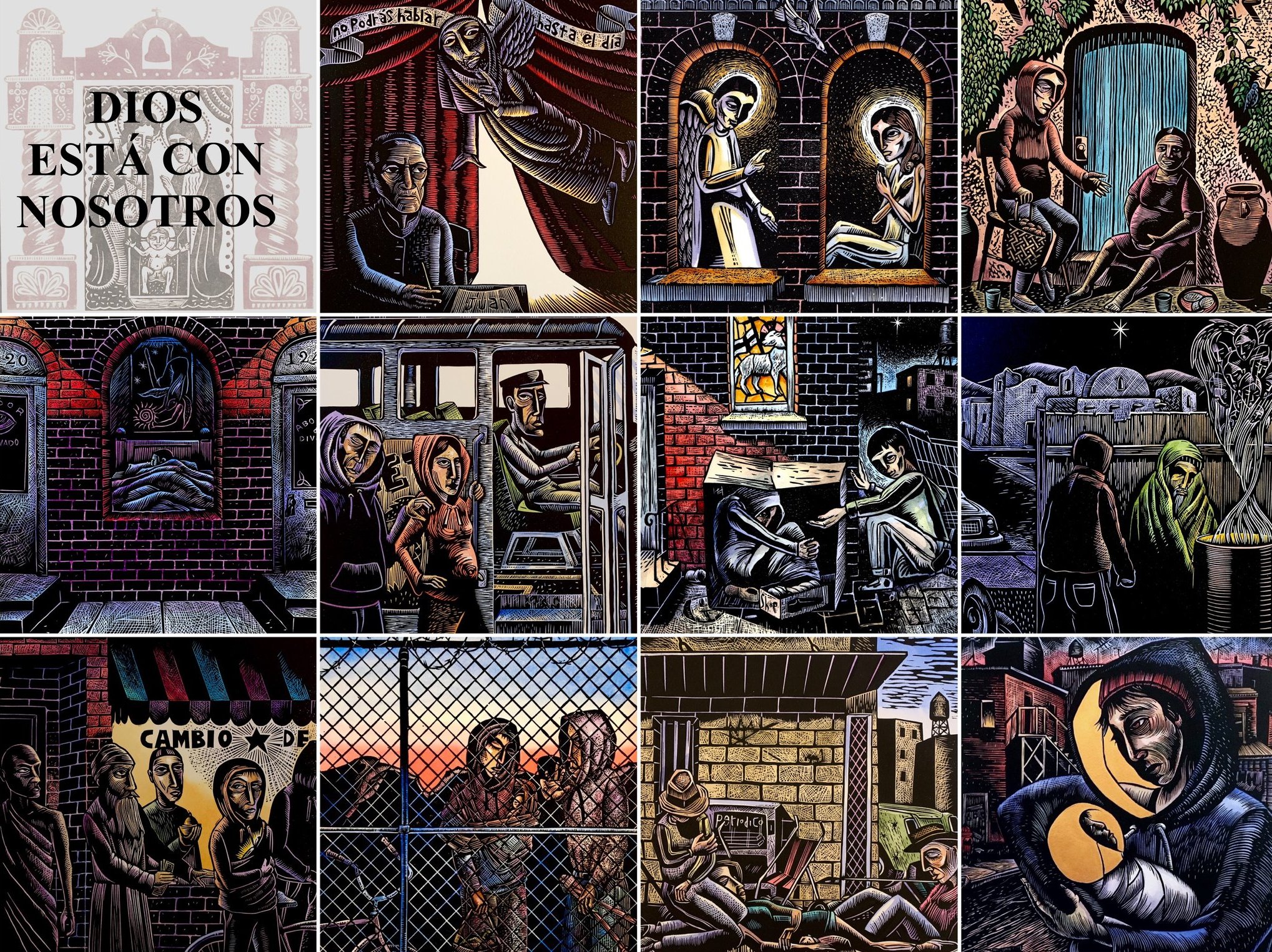
Yingst, Kreg_God with Us series

Several of the linocuts are for sale at Yingst’s Etsy shop, as is a set of twelve identical Christmas cards featuring Madona y Niño as the primary image. You can browse the rest of the series as it currently stands on his PsalmPrayers Facebook page; I’ve linked to the individual images below:

  1. El Encuentro: Zacarías y el Ángel Gabriel (The Encounter: Zechariah and the Angel Gabriel)
  2. La Anunciación (The Annunciation)
  3. La Visitación (The Visitation)
  4. El Dilema de José (Joseph’s Dilemma)
  5. Viaje a la Ciudad Natal (Journey to the Hometown)
  6. La Natividad (The Nativity)
  7. Una Multitud de Ángeles del Cielo (A Multitude of Angels from Heaven)
  8. Unos Sabios Procedentes del Oriente (Some Magi from the East)
  9. Los Refugiados (The Refugees)
  10. Matanza de los Inocentes (Massacre of the Innocents)
  11. Madona y Niño (Madonna and Child)

+++

SONGS:

>> “Un Cuento de Navidad” (A Song of Christmas): This original song by Adrian Roberto and Melissa Romero is about a town that had lost its wonder—until a child discovered a Bible, and his reading aloud its story of a Savior sparked revival.

>> “What Child Is This / Child of the Poor”: The Hound + The Fox are Reilly and McKenzie Zamber, a husband-wife musical duo from Oregon. This song of theirs interleaves the classic Christmas carol “What Child Is This” by William Chatterton Dix with a new song that emphasizes Christ’s solidarity with the poor.

Here are the Zambers’ new lyrics:

Helpless and hungry, lowly, afraid,
Wrapped in the chill of midwinter;
Comes now, among us, born into poverty’s embrace,
New life for the world.

Who is this who lives with the lowly,
Sharing their sorrows,
Knowing their hunger?
This is Christ revealed to the world
In the eyes of a child, a child of the poor.

Who is the stranger here in our midst,
Looking for shelter among us?
Who is the outcast? Who do we see amidst the poor,
The children of God?

So bring all the thirsty, all who seek peace;
Bring those with nothing to offer.
Strengthen the feeble;
Say to the frightened heart,
“Fear not: here is your God!”

(Related posts: https://artandtheology.org/2023/12/29/christmas-day-5-poor-little-jesus/; https://artandtheology.org/2021/12/17/advent-day-20/)

>> “Everybody Ought to Treat a Stranger Right”: Arranged and expanded by Dan Damon [previously], this traditional blues song is performed here by the Dan Damon Quartet, featuring guest vocalist Sheilani Alix, at a concert at Community Church of Mill Valley in California on December 10, 2023. “Blind Willie Johnson recorded this song in 1930 with two Christmas verses mixed in. I separated them out, added two verses to tell a fuller Christmas story, and recorded the Christmas version with my band on the album No Obvious Angels,” Damon explains. “According to the writer of Hebrews, some have entertained angels unawares.”

Four site-specific art installations in churches for Pentecost

I’m always intrigued by how artists respond creatively to sacred Christian spaces when invited to do so by the owning ecclesial bodies. Such invitations tend to appeal to artists, even those of different or no faith backgrounds, because of the chance to work with a (often) grand architectural space already charged with meaning and to make something that will live with a community over time, either temporarily or permanently, likely forming them in some way.

Because the feast of Pentecost is coming up on June 8, in which the church celebrates its “birthday,” effectuated by the descent of the Holy Spirit after Jesus’s ascension (see Acts 2), here are four striking artistic interventions in active or former churches that reference that spectacular event of wind and fire. Only the first was commissioned specially for Pentecost, but the other three bear Pentecostal resonances.

1. Tongues of Fire by Nancy Chinn, Grace Cathedral, San Francisco

Chinn, Nancy_Pentecost
Nancy Chinn (American, 1940–), Tongues of Fire, 1988. Fifty painted nylon-net strips, 18 in. × 10–50 ft. (dimensions variable). Temporary installation at Grace Cathedral, San Francisco.

Nancy Chinn is a liturgical artist and lay feminist theologian living in California, working in fibers and mixed media. Her Tongues of Fire was originally installed in Grace (Episcopal) Cathedral in San Francisco for Pentecost 1988, and she has since reprised it in a handful of other churches throughout her career.

It consists of fifty strips of nylon netting, painted in red, orange, and gold and suspended along the expansive neo-Gothic nave. She chose that number based on the etymology of the word “Pentecost,” which means “fiftieth” in Koine Greek; it was the name Hellenistic Jews used to refer to the Jewish festival of Shavuot, celebrated fifty days after Passover, but it also became a Christian festival in the first century CE when, fifty days after Jesus rose from the dead, his Spirit descended to empower his nascent community of followers.

Draped in a mighty sweeping movement and overlapping one another, the streamers respond to air flow in the space, furthering the sense of dynamism.

2. Tilting at Giants by Dayton Castleman and Fall to Flight by Alison Dilworth, Broad Street Love, Philadelphia

Castleman, Dayton_Tilting at Giants
Dayton Castleman (American, 1975–), Tilting at Giants, 2006. Aluminum, steel, votive candles, glass votive holders, braided fishing line, steel cable, and rigging hardware. Permanent site-specific sculpture, Broad Street Love, Philadelphia.

Tilting at Giants was commissioned by Broad Street Ministry (renamed Broad Street Love in 2024), a nonprofit organization in downtown Philadelphia providing stabilizing services to individuals experiencing deep poverty. It’s housed inside the former Chambers-Wylie Memorial Presbyterian Church, a historic turn-of-the-century Gothic Revival church that closed its doors in 1999 due to dwindling membership and the death of its pastor. The Presbytery of Philadelphia (PCUSA) leased the building for a few years to the University of the Arts, who used it for classes and events.

Then in May 2005, Rev. Bill Golderer rejuvenated the dormant church by opening Broad Street Ministry, billed as “an innovative Christian faith community that emphasizes the Gospel imperatives of extending generous hospitality, demonstrating justice and compassion, and providing a ground for artistic expression.” He removed the pews and set communal dining tables in their place, inviting in guests off the streets to enjoy chef-prepared meals all week long. The organization also provides legal help, fresh clothes, medical assistance, and a mailbox for those who lack a permanent address.

In its first year, Golderer issued an open call for proposals for a site-specific art installation that would be funded by the city’s Percent for Art program. Multidisciplinary artist Dayton Castleman, who lived in Philly at the time but who is now based in Northwest Arkansas, was awarded the commission.

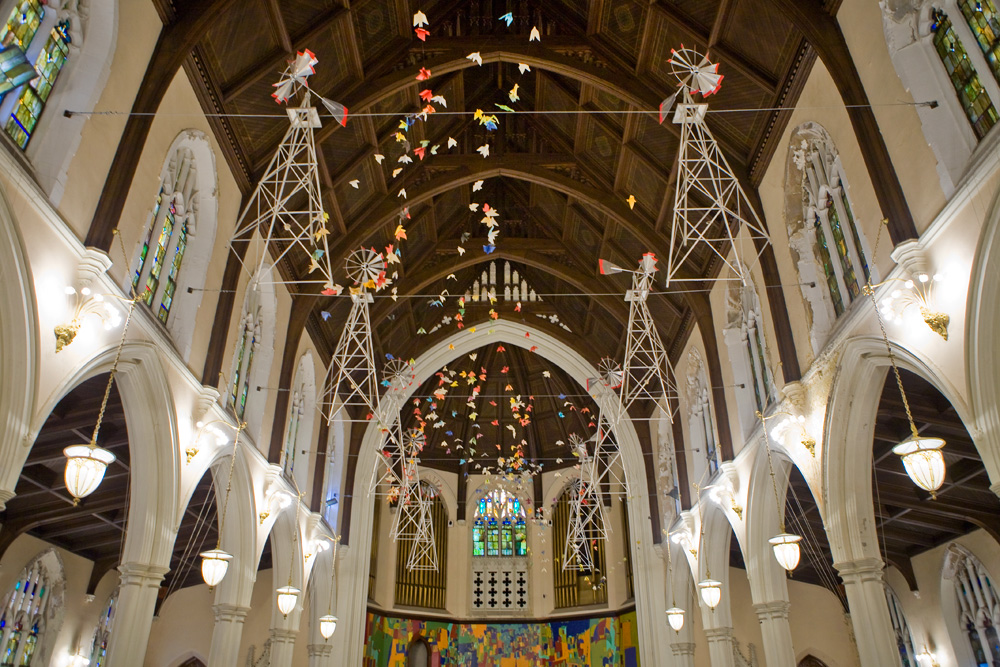
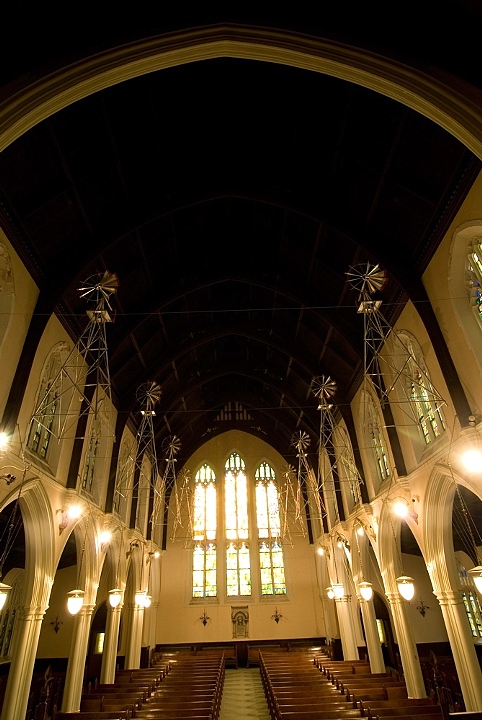
His project comprises twelve large windmills that hover in the air, six in a line down each side of the vault—“unexpected, anachronistic, misplaced . . . [and] completely still,” Castleman says. He elaborates:

This stillness infuses the atmosphere with a sense of uneasy expectation. The brilliant towers, tall and clean, flash against the dark, vaulting canopy above. Like sentinels keeping watch, the sun-burst fans are poised, brimming with potential energy, waiting for a mysterious, transcendent wind to fill the space and make it sacred. Cradled within each tower, nearly lost in the spectacle, hover votive candles, glowing, unflickering, in prayer. This sanctuary is a living prayer—an aching, tense, expectant prayer—and a hair pulled taut, waiting to snap. . . .

The air is rich with suggestions and intimations of the invisible.

His artist’s statement also mentions Pentecost. On that seminal day two millennia ago, the disciples were gathered in Jerusalem with anticipation, as Jesus had told them, just before returning to the Father, to remain in the city until they received their new baptism, “for John baptized with water, but you will be baptized with the Holy Spirit not many days from now” (Acts 1:5).

Broad Street Love
Broad Street Love in Philadelphia, with art installations by Dayton Castleman (windmills) and Alison Dilworth (swallows). Photo: Bradley Maule.

Broad Street Love (upward view)

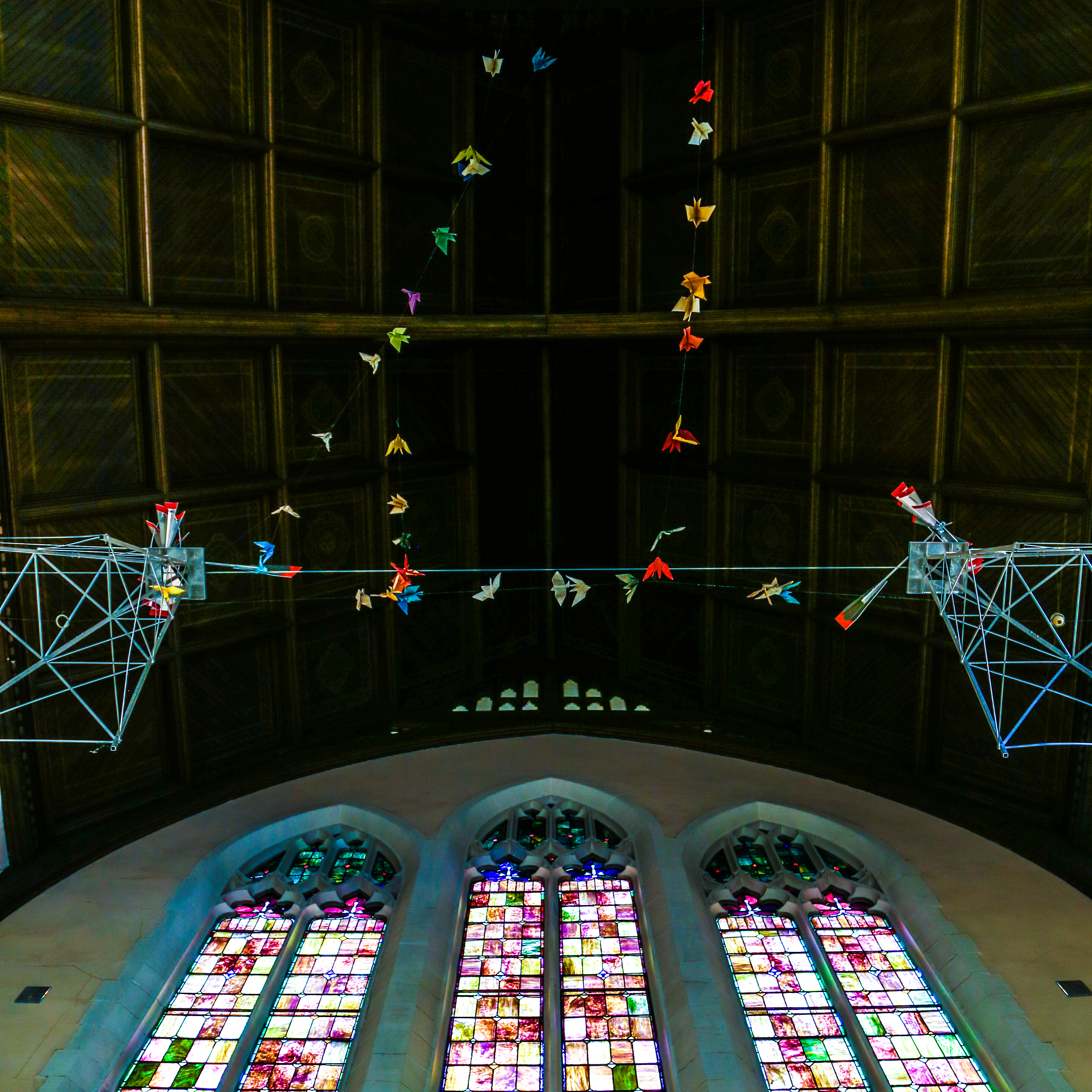
Shortly after Castleman’s Tilting at Giants was installed, it was joined by Fall to Flight, a flock of approximately six hundred origami swallows suspended from the ceiling, containing written prayers of the community. Created by Philadelphia-based artist Alison Dilworth, the multicolored birds winging overhead evoke the unleashed joy of the Holy Spirit, who is sometimes compared in scripture to a dove, but also Jesus’s encouragement in the Sermon on the Mount that God will provide for the needs of his children, just as he provides for our avian friends who neither sow nor reap nor gather.

3. HS by Maciej Urbanek, St. Michael’s Church, Camden Town, London

Urbanek, Maciej_HS
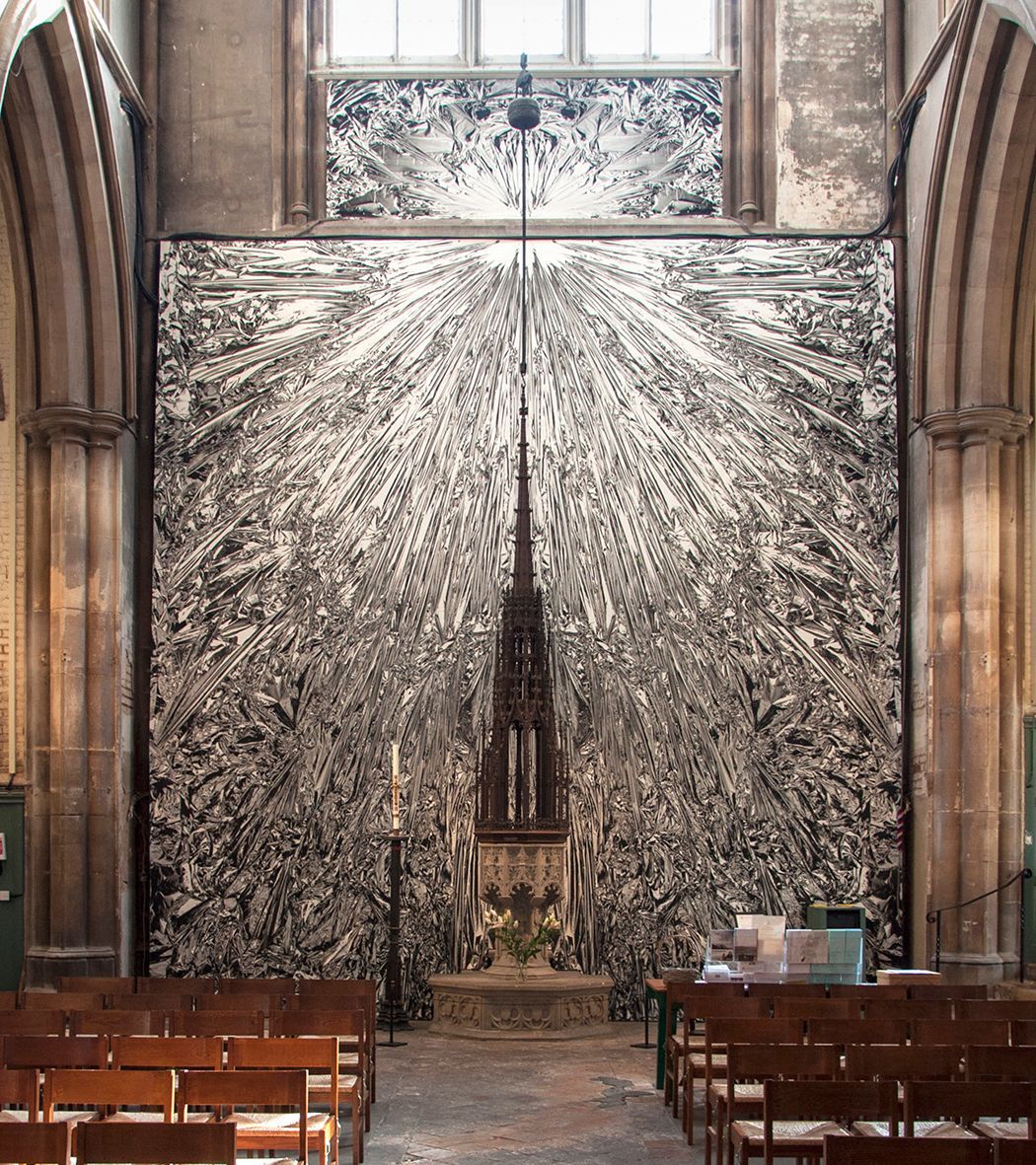
Maciej Urbanek (British, 1979–), HS, 2014. Digital photographic print, 10 × 7.5 m. St. Michael’s Church, Camden Town, London.

HS by the Polish-born British artist Maciej Urbanek is a monumental composite digital print installed on the west wall of St. Michael’s (Anglican) Church in Camden Town, London, covering up damaged plasterwork in need of restoration. What appears to be an explosion of silvery light is an effect produced with black plastic trash bags, which the artist crumpled up, lit, photographed, digitally reworked, and inkjet-printed on a large scale. Winner of the 2015 Art+Christianity Award for Art in a Religious Context, the work brings a baroque aesthetic to the Victorian interior.

“I am interested in elevating the banal and prosaic elements of life and turning them into powerful and rich visual statements,” Urbanek has said. A sign at the church says that Urbanek’s use of an everyday material to make something so beautifully radiant is “a metaphor for God’s work in taking ordinary human lives and making them extraordinary.”

Commissioned by Father Philip North (then the team rector of the parish of Old St Pancras) and privately funded by John Booth, HS was intended to be a temporary installation, but it was so well received by the parish that it has become a permanent fixture. According to the church’s X account, it “represent[s] the Holy Spirit breaking in from the outside world.”

The artwork’s location just behind the church’s baptismal font creates a linkage between the sacrament of baptism—in the Church of England, marking the beginning of a journey with God and the baptizand’s membership in the community of faith—and the work of the Spirit, who came at Pentecost with great power to set ablaze and send out. Indeed, HS can be read as that dramatic moment of the Spirit’s outpouring, and that parishioners walk past it when they exit the sanctuary is a reminder that they leave empowered by the Spirit to live and proclaim Christ’s gospel.

Thank you to Sheona Beaumont for introducing me to this work in her book The Bible in Photography: Index, Icon, Tableau, Vision. It is also the subject of a 2021 essay by Jonathan A. Anderson, “Bin bag visions: Theological horizons in Maciej Urbanek’s HS,” which I don’t have access to.

Roundup: Animal church service, “Life/Blood” installation, and more

Have you been delighted or inspired by the Art & Theology blog this year or its Instagram offshoot, @art_and_theology? If so, please consider donating to the work through a secure online form or PayPal, or by buying me a book from my Amazon wish list (my address is privately stored). Thank you to my five regular monthly supporters, and others who have blessed me with one-off donations of funds and books. These gifts not only provide important material assistance but also serve as an emotional boost, a validation that my work has value and is worth continuing.

My blog-related expenses this year have included a replacement of my old laptop, a conference registration and travel fees, a trip to New York, museum admissions, books, licensing fees for two images (I occasionally pay for images when good photos are not available online), and the yearly WordPress Premium fee to keep this site ad-free and mapped to a custom domain. Donations will go toward covering these, and if there is any left over, toward a new camera lens that will enable me to take wider shots, great for cathedrals and for larger artworks in tight quarters.


SPOTIFY PLAYLIST: October 2024 (Art & Theology): Every month I create a digital mixtape of Christian and Christian-adjacent music that deserves attention, consisting of old and brand-new recordings alike. Two hours of beautiful, soulful expressions of praise, prayer, and lament for your ears and heart.

+++

VIDEO: Animal Service at Ely Cathedral: On September 22, Ely Cathedral in England held its annual animal service, attended by some 450 animal lovers and their pets and service animals, mainly dogs. “Our annual Animal Service is an opportunity to give thanks for the animal companions with whom we share our lives and our planet, to bring them into our Cathedral, to ponder how best to care for animals and to ask God to bless them.” Marley the donkey, from the Donkey Sanctuary, led a procession up the nave. The liturgy was led by Canon James Garrard, and, in addition to several congregational hymns, including “All Creatures of Our God and King,” the cathedral’s children’s choir, the Ely Imps, sang “The Barnyard Song” by Rhonda Gowler Greene and “Look at the World” by John Rutter.

In addition to a special prayer of confession, act of commitment, and benediction, the service included this litany from the Book of Common Prayer:

God said, “Let the waters bring forth living creatures, and let birds fly across the sky.”

We thank you for the teeming life of the seas,
And the flight of the birds.
Help us to protect the environment
So that all life may flourish.
God of life: Hear our prayer.

God said, “Let the earth bring forth living creatures of every kind.”

We rejoice in the variety of animal life.
Grant us grace to treat all animals with respect and care;
To protect endangered species,
To preserve the variety of habitats,
And to honor the delicate balance of nature.
God of life: Hear our prayer.

Heavenly Father, you have filled the world with beauty.
Open our eyes to behold your gracious hand in all your works,
That, rejoicing in your whole creation,
We may learn to serve you with gladness,
For the sake of him through whom all things were made,
Jesus Christ our Lord.
God of life: Hear our prayer.

Two volunteer representatives from the charity Medical Detection Dogs were invited to share about the work of dogs who are trained to detect the odor of human disease.

Several churches worldwide hold animal services around this time of the year, the Feast of St. Francis (known for his love and care of animals) being on October 4. These are usually in addition to the regular Sunday morning worship service and are not eucharistic. UMC’s Discipleship Ministries provides a sample liturgy for “A Service for the Blessing of Animals.” Many such services are held outdoors, such as the one organized annually by Washington National Cathedral, which is taking place this Sunday, October 6, at 2 p.m.

+++

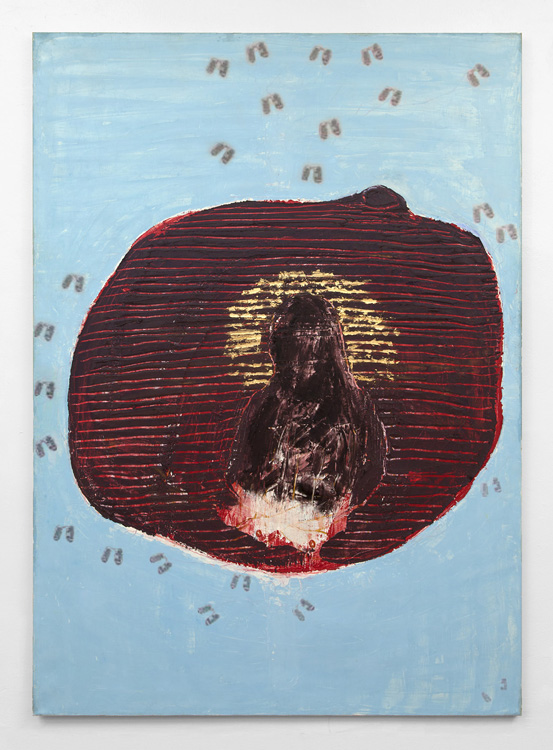
ART INSTALLATION VIDEOS + PHOTOS: In July I mentioned the Vessel art trail organized by Art + Christianity, which places contemporary artworks in rural churches along the Welsh-English border (see here). On commission from A+C, Mud and Thunder has taken some wonderful photos and video of the seven sites on the trail, including interview footage with the artists. What follows are videos for Life/Blood by Lou Baker, Grace Vessel by Jane Sheppard, and Centre by Steinunn Thórainsdóttir. (The remaining videos are on pieces by Lucy Glendinning, Andrew Bick, Barbara Beyer, and Robert George.)

The art trail continues through October 31. Visit https://artandchristianity.org/vessel to view in situ photographs, and see the following links for information on free creative workshops led by the participating artists: on making sculptures of found natural materials, working with clay as a meditative practice, social knitwork, and drawing.

+++

POEMS:

>> “There’s a Special Providence” by Seth Wieck, Texas Poetry Assignment: Seth Wieck [previously] is a writer from Amarillo, Texas. Published the week of the last US presidential inauguration, this poem muses on the impermanence of earthly empires, contrasting such with the steady, indifferent labor of birds, which continues on through administration changes and the passing of generations. The title and opening line are a clever rhyming twist on a line from the final act of Shakespeare’s Hamlet, “There’s a special providence in the fall of a sparrow.” For the poetic speaker, there’s a sense of comfort in God’s sovereignty and an orientation toward Christ’s lordship that puts election poll results, though not negligible, in proper perspective.

In a Substack post from February 2021, Wieck wrote, “I am no politician’s acolyte; they’re public servants, not saviors. I catch some heat in private conversation when I say that I couldn’t care less about national politics. That’s not a true statement, but the tense conversations in which I claim my ambivalence usually leave me no room for nuance. Those conversations demand my total wide-eyed attention to the firehouse of information being created by national elections. But as Mary Oliver said, ‘The beginning of devotion is attention.’ Forgive me if I am unwilling to develop devotion for those people whose only interest in my community is the exploitation of our devotion and resources.”
>> “Jesus Heals a Paralytic” by Ryan Keating, Reformed Journal: Ryan Keating is a pastor on the Mediterranean island of Cyprus (he preaches in Turkish and English), an academic writer and poet, and the owner of Exile Coffee and Wine. This poem retells the miracle from Mark 2:1–12 in the voice of the paralyzed man whom Jesus heals. Whereas many artists depict the episode with ropes used as a lowering mechanism, Keating says it’s much more likely, given the typically low ceilings of Middle Eastern homes, that the man would have been received by “a net of hands” raised up by the people in the room.

The poem repeats the word “temple” three times, remarking how the man was “suspended / in a temple by a temple / and landed on holy ground / as a temple . . .” The temple is the place where the crowd is gathered because Jesus is in it, and the four faith-filled friends who bring the paralyzed man there themselves constitute a temple, and the man too becomes a temple, a dwelling-place of God, after being made whole by Jesus. Drawing on Old Testament imagery of the garden of Eden and the exodus, the final stanza is one of restoration. The sea of people parts as the man steps outside into a garden, his friends buoyed by amazement.

+++

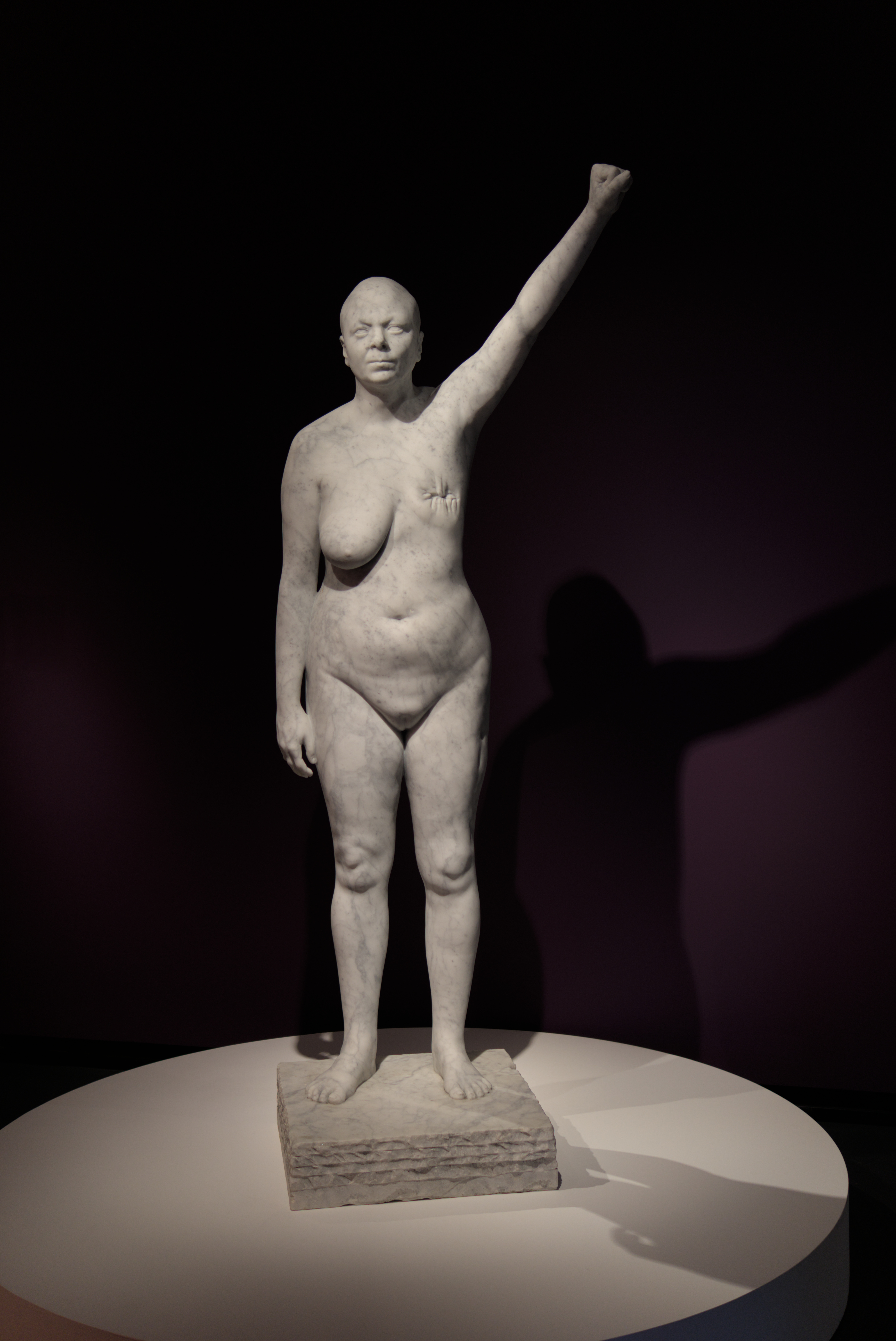
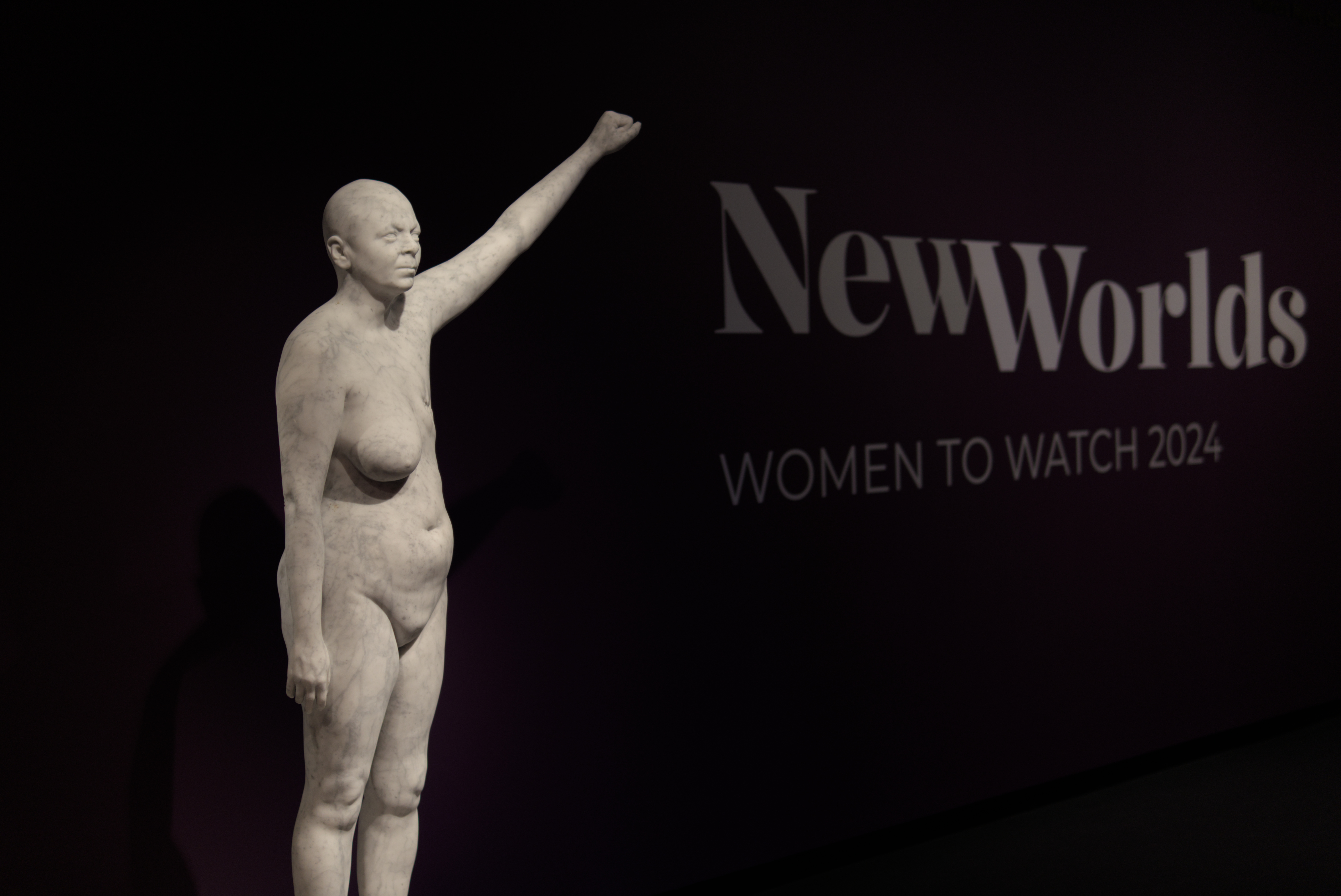
ARTWORK: Intra-Venus by Marina Vargas: October is Breast Cancer Awareness Month, so I wanted to share an artwork I encountered on the subject this summer at the New Worlds: Women to Watch 2024 exhibition at the National Museum of Women in the Arts. Intra-Venus is a nude self-portrait in marble by Spanish artist and breast cancer survivor Marina Vargas, frankly depicting her body after a mastectomy, chemotherapy, and radiation. Owning her scars and her baldness, she uses the language of classical sculpture to monumentalize a common female experience. (The chance of a woman in the US getting breast cancer in her lifetime is 1 in 8, and more than 100,000 US women undergo some form of mastectomy each year; global statistics are harder to come by.) Vargas lost the use of her left arm for a time during treatment, but here she shows herself with her left arm raised in triumph. The sculpture highlights the heroism of women who endure breast cancer and the dignity of their changed form.

Vargas, Marina_Intra-Venus
Marina Vargas (Spanish, 1980–), Intra-Venus, 2019–21. Carrara marble, 77 1/2 × 26 3/4 × 26 in. Photo: Victoria Emily Jones.

Vargas, Marina_Intra-Venus

Roundup: Laura James unveils new painting series, Vessel art trail puts contemporary art in rural churches, and more

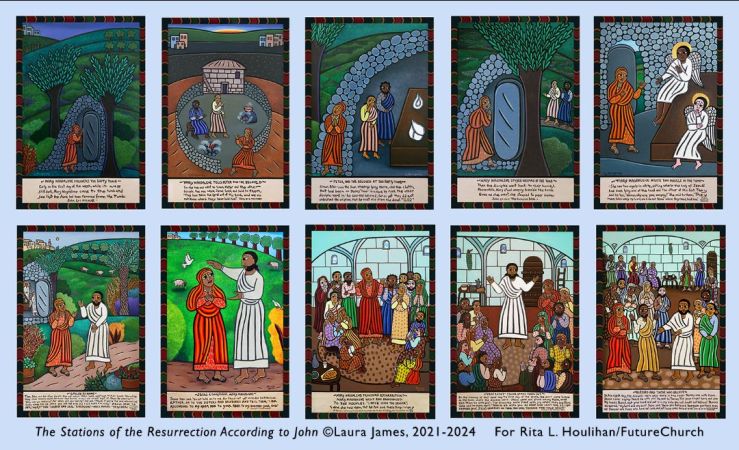
VIRTUAL ARTIST’S TALK: “The Stations of the Resurrection according to John” with Laura James, July 30, 2024, 7:00–8:15 p.m. ET: Next Tuesday, Bronx-based artist Laura James will discuss her latest painting series, The Stations of the Resurrection according to John, in a live online conversation with patron Rita L. Houlihan. Register at the link above.

James, Laura_Stations of the Resurrection

The series began in 2021 with four paintings—Called by Name, Jesus Commissions Mary Magdalene, Mary Magdalene Proclaims Resurrection, and Pentecost: Jesus Sends Them Out, collectively the Mary Magdalene and the Risen Jesus series (which you can purchase as a set of cards)—and then expanded to include the full resurrection narrative from John 20. View details of all ten paintings for the first time, and hear from the artist about the artistic choices she made.

The daughter of immigrants from Antigua in the Caribbean, Laura James is especially celebrated for her vibrant paintings that depict biblical figures, including Jesus, as dark-skinned, influenced in part by the long tradition of Ethiopian Christian art. Rita Houlihan, who commissioned the Stations of the Resurrection series from James, is a founding member of FutureChurch’s Catholic Women Preach and Reclaim Magdalene projects and a longtime advocate for the restoration of historical memory regarding early Christian women leaders, especially Mary Magdalene.

Update, 8/4/24: You can view the series and purchase reproductions of individual pieces from it, or the complete set, at https://shop.laurajamesart.com/the-stations-of-the-resurrection/. And the video recording of the July 30 event is here:

+++

VIRTUAL BOOK LAUNCH: Refractions, 15th anniversary edition, by Makoto Fujimura, August 6, 2024, 3:00 p.m. ET: Artist, speaker, writer, and IAMCultureCare founder Makoto Fujimura is one of the most prominent voices in the “art and faith” conversation in the US. On Tuesday, August 6, he’s hosting a Zoom event to celebrate the release of the fifteenth anniversary edition of his essay collection Refractions: A Journey of Faith, Art, and Culture, which is updated and expanded. He will read new selections from the book and host a time of Q&A and sharing. Register for the event at the above link, and you will receive a 30% discount on copies of the book preordered before the end of July.

+++

ART TRAIL: Vessel, miscellaneous locations along the Welsh-English border, August 8*–October 31, 2024: An exciting new art trail has been curated by Jacquiline Creswell [previously] for the group Art and Christianity. From the press release: “Vessel is a curated art trail in remote rural churches near the Black Mountains between Usk and Hay-on-Wye [in the border country between South Wales and England]. Seven artworks by seven [contemporary] artists will be shown in seven churches, six of which are maintained by the Friends of Friendless Churches who keep them open all year round. The theme of ‘vessel’ references bodies, boats, secretions and receptacles; each of the artworks will be sited in a particular relationship to the church and its material culture.”

*Lou Baker’s installation at Dore Abbey opens August 21.

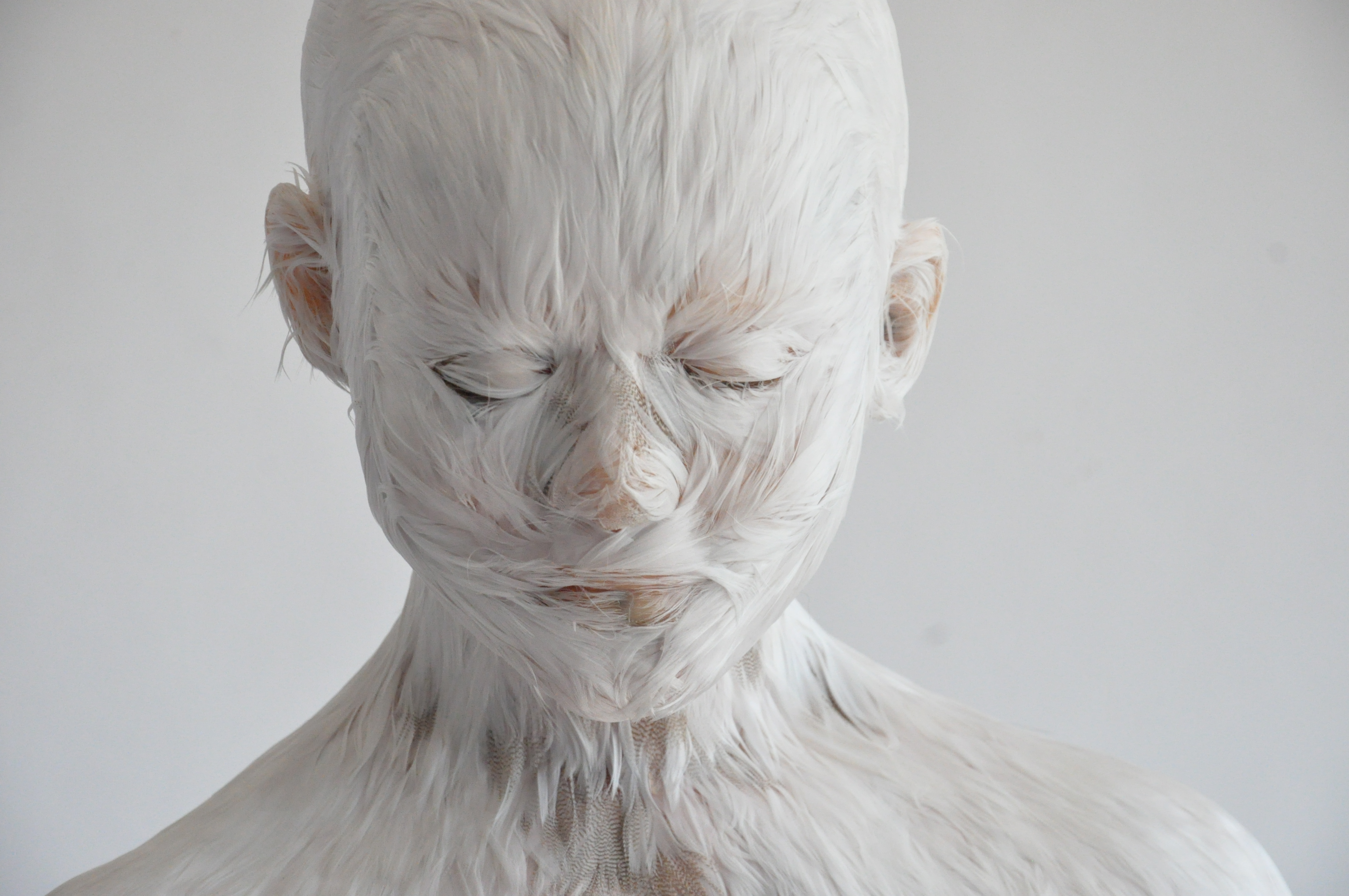
Glendinning, Lucy_White Hart (detail)
Lucy Glendinning (British, 1964–), White Hart (detail), 2018. Wax, Jesmonite, timber, duck feathers, 175 × 73 × 58 cm. Photo courtesy of Art and Christianity. [artist’s website]

Here is the list of venues, artists, and artworks:

  • St Michael and All Angels’, Gwernesney, Monmouthshire, Wales: Grace Vessel by Jane Sheppard
  • St Cadoc, Llangattock Vibon Avel, Monmouthshire, Wales: Wiela by Barbara Beyer
  • St Mary the Virgin, Llanfair Kilgeddin, Monmouthshire, Wales: Centre by Steinunn Thórainsdóttir
  • St Jerome, Llangwm Uchaf, Monmouthshire, Wales: White Hart by Lucy Glendinning
  • St David, Llangeview, Monmouthshire, Wales: Compendium by Andrew Bick
  • Dore Abbey, Herefordshire, England: Life/Blood by Lou Baker
  • Castle Chapel, Urishay, Herefordshire, England: Simmer Down I by Robert George

Art + Christianity is offering a weekend retreat September 13–15, based in Abergavenny, that will include a guided minibus tour (led by the curator) to all seven sites, a lecture by Fr. Jarel Robinson-Brown titled “Living Stones: Buildings, Bodies and Spirit,” a presentation and panel discussion on curating and organizing art in rural churches and chapels, and a performance by Holly Slingsby, Felled, Yet Unfurling, that draws on the iconography of the Tree of Jesse. (St Mary’s Priory in Abergavenny houses an extraordinary fifteenth-century oak carving of the Old Testament figure of Jesse that once formed the base of an elaborate sculpture depicting Jesus’s ancestry; to contextualize this artwork, in 2016 a Jesse Tree Window designed by Helen Whittaker was installed in the church’s Lewis Chapel.) Ticket pricing starts at £35 and does not include accommodations.

+++

VIDEO: “Art and Transcendence: Alfonse Borysewicz”: This month the Templeton Religion Trust released a new video profile on Brooklyn-based artist Alfonse Borysewicz (pronounced Boruh-CHEV-itz), a 2022 recipient of a Templeton Foundation Grant on the topic of “Art and Transcendence,” part of the foundation’s Art Seeking Understanding initiative [previously].

“As religious affiliation declines, can art provide fresh ways of exploring the questions posed by theology?” Borysewicz asks. “Might art—its creation as well as reception—lead to the discovery of new spiritual information? What do faith traditions lose when they overemphasize the written word and neglect the role of images?

“Historically, faith traditions have focused on both the written word and images as sources of knowledge and meaning. Some would claim that words have taken undue precedence as theologies have developed, while images seem to have been left behind. Has this shift in focus left us wanting?”

Borysewicz, Alfonse_Pomegranate
Alfonse Borysewicz (American, 1957–), Pomegranate, 2010–11. Oil and wax on linen, 70 × 50 in. The artist said, “When I see a pomegranate at the market, I see it as a visible sign of the resurrection of Christ; or a hive, the community of Christ.”

+++

SONGS:

>> “Kasih Tuhan” (God’s Love) by Abraham Boas Yarona, performed by Prison Akustik: This video shows, from what I can gather, a group of inmates from Lapas Abepura (Abepura Prison) in Papua, Indonesia, playing and singing an Indonesian Christian song together. It’s one of many lagu rohani (spiritual songs) uploaded to the Prison Akustik YouTube channel (the group is also active on Instagram and TikTok).

>> “Del amor divino, ¿quién me apartará?” (Who Can Separate Me from the Love of God?) by Enrique Turrall and José Daniel Verstraeten, performed by Coro del Seminario Internacional Teológico Bautista: Based on Romans 8:31–39, the lyrics of “Del amor divino” are by Enrique Turrall (1867–1953) of Spain, and the music is by José Daniel Verstraeten (b. 1935). The song was performed in 2018 by a vocal and instrumental ensemble from Seminario Internacional Teológico Bautista (International Baptist Theological Seminary) in Buenos Aires [previously], under the direction of Constanza Bongarrá. The instrumentalists are Jimena Garabaya (guitar), Marcelo Villanueva (charango), and Samy Mielgo (bombo). [HT: Daily Prayer Project]

>> “Caritas abundat in omnia” (Love Aboundeth in All Things) with “O virtus Sapientie” (O Virtue of Wisdom) by Hildegard of Bingen, sung by St. Stanislav Girls’ Choir of the Diocesan Classical Gymnasium, feat. Julija Skobe: Combining two Latin antiphons by the medieval German polymath Hildegard of Bingen [previously], who wrote both the words and music, this song is performed a cappella inside St. Joseph’s Church in Ljubljana, Slovenia, by a student choir with some forty singers between the ages of sixteen and nineteen, directed by Helena Fojkar Zupančič. Mesmerizing! Turn on closed captioning for English subtitles, or see here and here.

Into Air, a meditation on impermanence

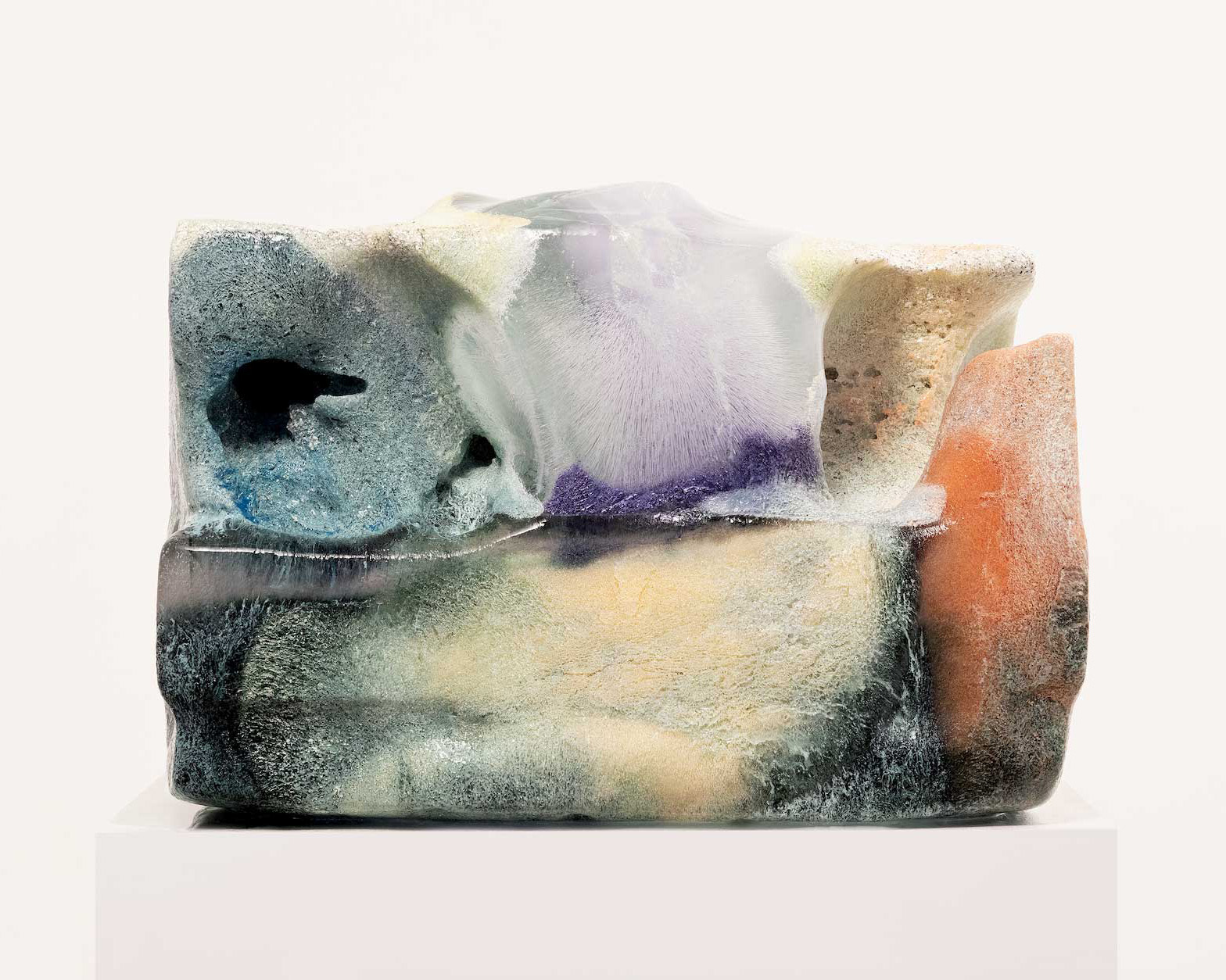
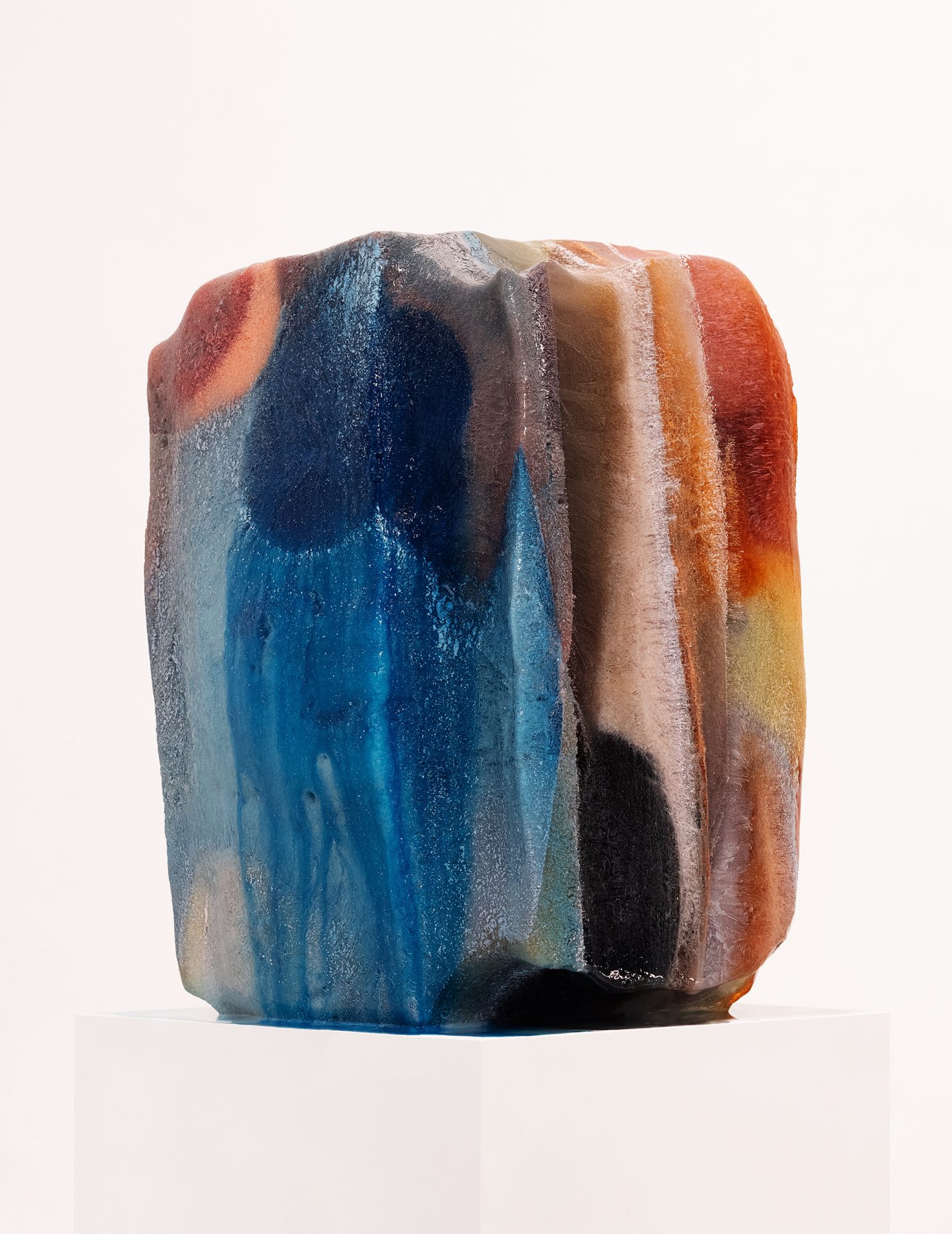
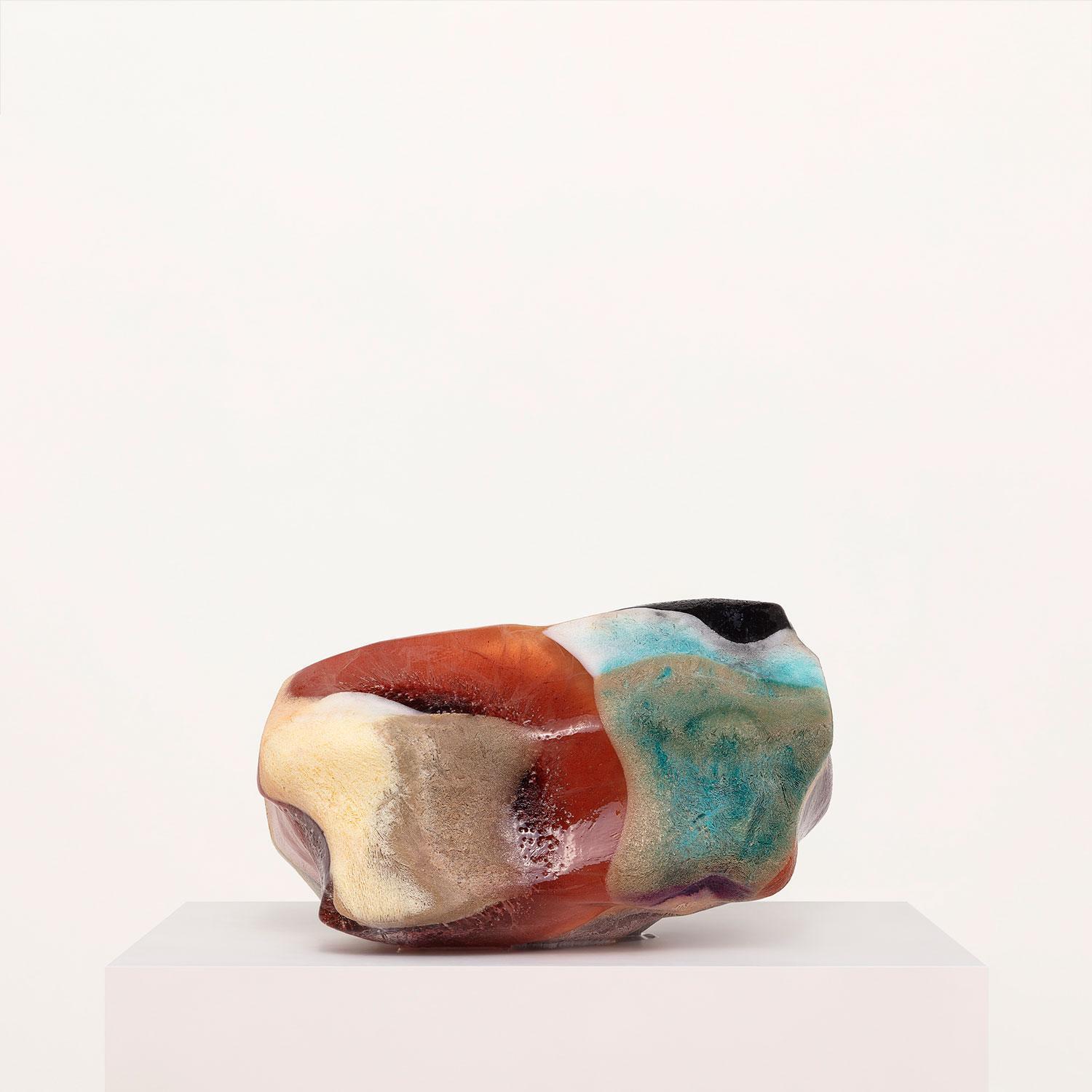
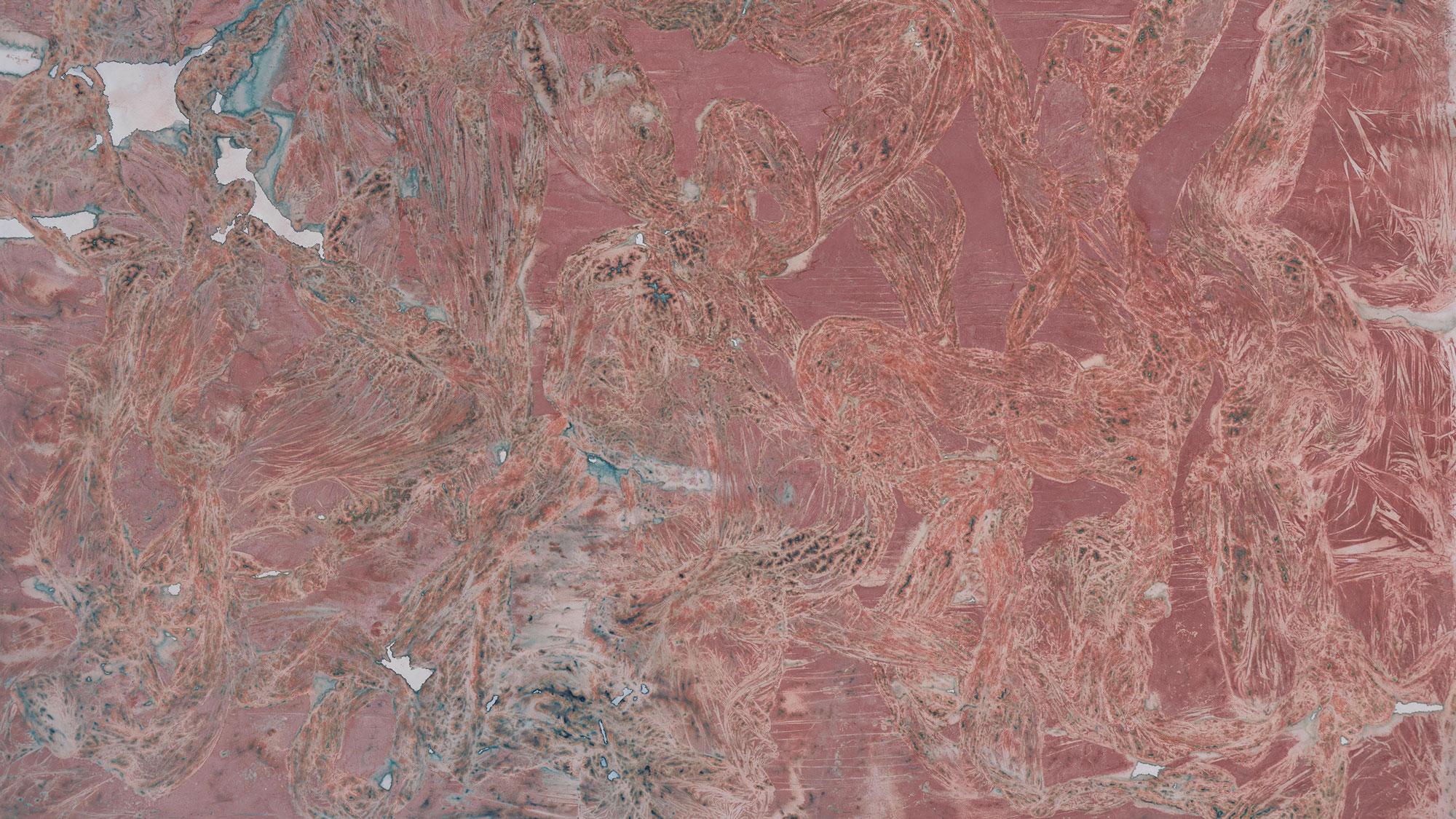
Dawn Ng is a Singaporean multidisciplinary artist whose practice deals with time, memory, and the ephemeral. For her recent body of work Into Air, Ng has crafted nearly 150 large sculptural blocks of frozen pigment and documented their dissolution in the form of photographs, film, and residue paintings. A poetic visual meditation on time and its passing, Into Air captures the metamorphosis of colored ice from solid to liquid to air, physicalizing transience. Presented by Sullivan+Strumpf, it premiered at a derelict ship factory in Singapore in January 2021 and from there traveled to Seoul, London, and Sydney. See the six-minute documentary below for more on the process and meaning behind the work.

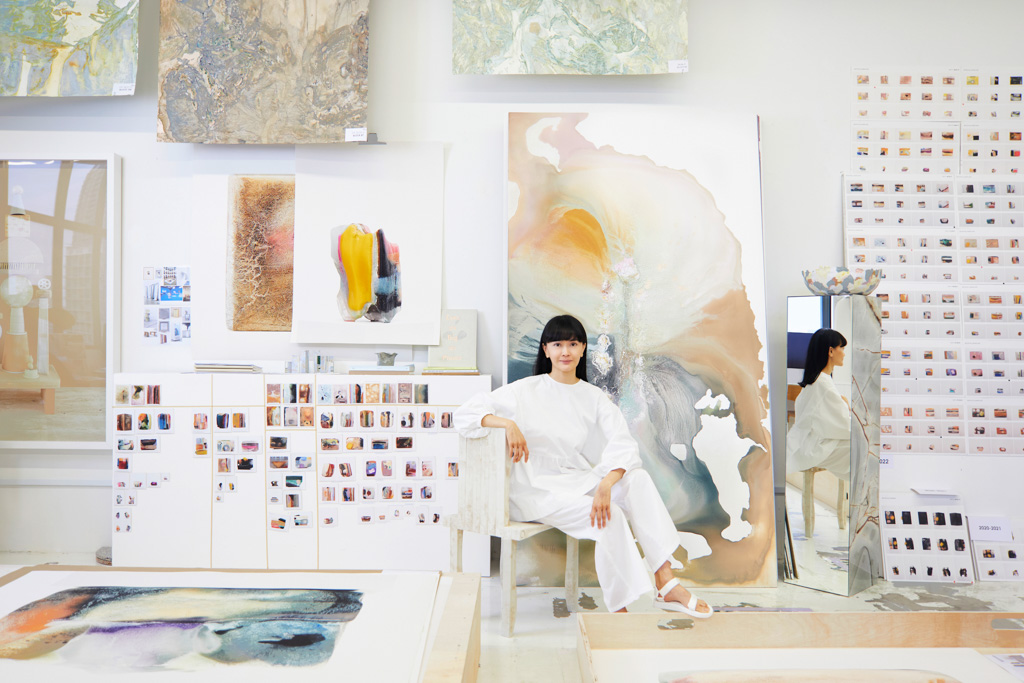
Dawn Ng in her studio
Dawn Ng in her studio in Singapore, surrounded by studies and artworks from Into Air. Photo: Sean Lee. All photos courtesy of the artist.

Ng started working on Into Air in 2018, and it’s ongoing. The project encompasses three distinct series:

  1. Clocks
  2. Time Lost Falling in Love
  3. Ash

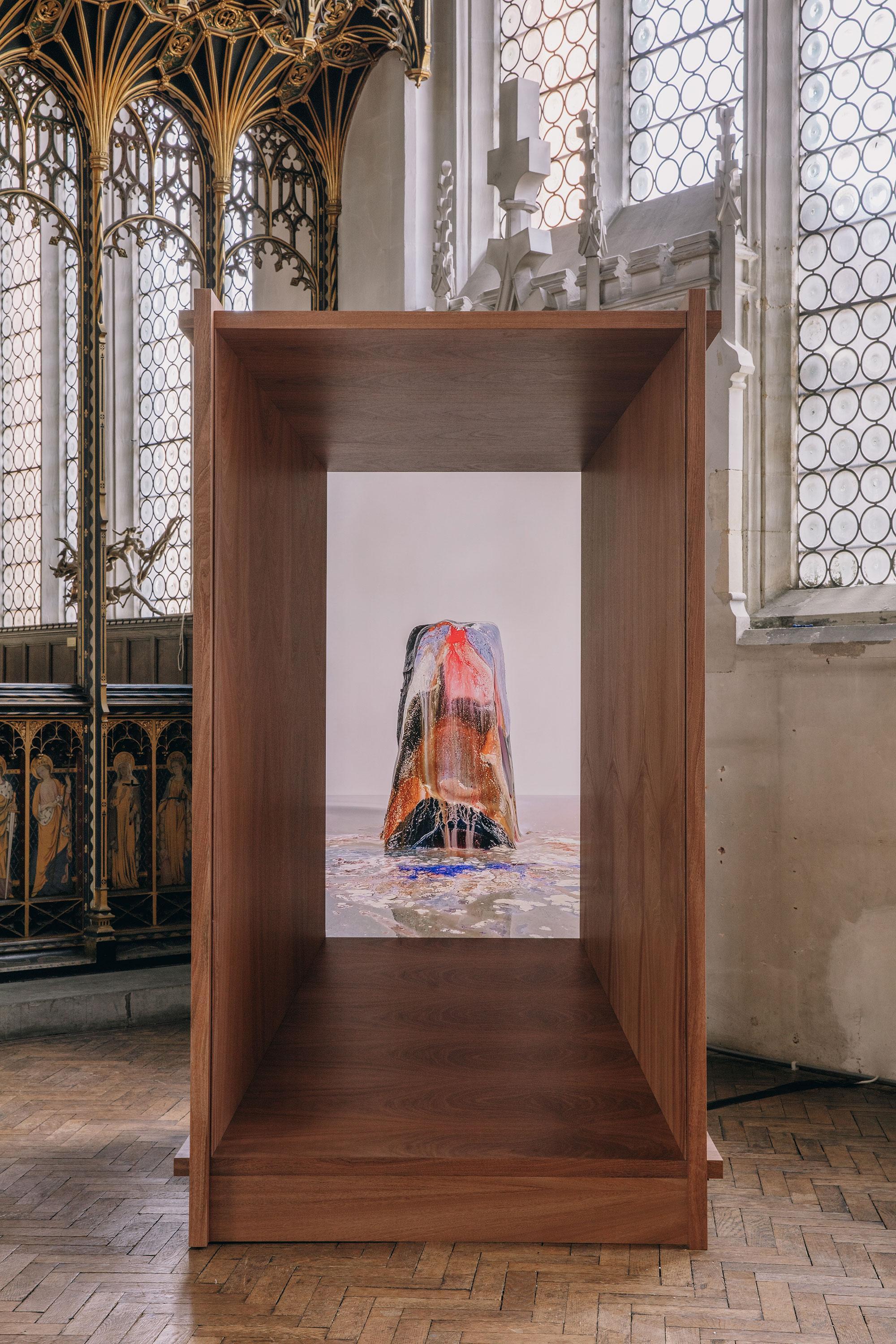
Clocks is the name Ng gives to the photo portraits of her colored glacier blocks at various stages of disintegration. Weighing about 132 pounds each, the blocks were constructed from acrylic paints, dyes, and inks that she froze together in her studio. After removing each block from the freezer, she and her team photographed it from ten different angles every four hours until it entirely eroded. “Like kaleidoscopic lodestones, the portraits visualize the shape, colour and texture that time inhabits in an ephemeral form,” Ng writes.

Ng, Dawn_If I could find (CLOCKS)
Dawn Ng (Singaporean, 1982–), If I could find a souvenir just to prove the world was here, from CLOCKS, 2021. Archival pigment print, 115 × 149 cm.

Ng, Dawn_Some will fall in love (CLOCKS)
Dawn Ng (Singaporean, 1982–), Some will fall in love with life and drink it from a fountain that is pouring like an avalanche coming down the mountain, from CLOCKS, 2021. Archival pigment print, 153 × 118 cm.

Ng, Dawn_Don't they know (CLOCKS)
Dawn Ng (Singaporean, 1982–), Don’t they know it’s the end of the world, from CLOCKS, 2022. Archival pigment print, 95 × 95 cm.

Time Lost Falling in Love is the collective title of the time-lapse videos Ng filmed of the thawing blocks. The collapse of each block into a puddle of liquid took fifteen to twenty hours, a process compressed into twenty to thirty minutes for each film. Ng says she wants to portray the fluidity of time—time as a “riot of colors” that swell and ebb, that form rivers and pools. By speeding up the frame rate of the film, Ng manipulates time, fast-tracking the dissolution of the blocks while simultaneously providing a calming evocation of a waterfall in slow motion. Time melting on. Here’s Avalanche II:

The third and final component of the Into Air project is Ash, a series of paintings created by blanketing the liquid remains of each melted pigment block with a large sheet of canvas-like paper. Ng leaves the paper there for weeks until all the liquid evaporates through it, creating marbled textures and thick buildups that she then peels away. Ng describes Ash as her attempt to “sieve time.”

Many of the photographs and residue paintings take their titles from song lyrics—by the Beatles, Genesis, the White Stripes, Death Cab for Cutie, Sufjan Stevens, and others.

Ng, Dawn_The Earth Laughs in Flowers I
Dawn Ng (Singaporean, 1982–), The Earth Laughs in Flowers I, 2020. Residue painting (acrylic, dye, ink) on paper, 165 × 142 cm.

Ng, Dawn_Ever see, ever be (detail)
Dawn Ng (Singaporean, 1982–), Ever see, ever be, ever know my heart (detail), from ASH, 2022. Residue painting (acrylic, dye, ink) on paper, 199.5 × 150.3 cm.

As much as Into Air is about time, it is also about death. In an interview with Nicholas Stephens for CoBo Social, Ng said,

There is an inescapable relationship between beauty and death. Death gives meaning to all of time. I don’t necessarily see death as something tragic, sad or final. It is that structure that gives true worth and true value to what comes before it. In Asia, especially as a Chinese Asian, we don’t like to talk about death. We feel it is bad luck. But in the paintings, I see death as something beautiful. Even in that last transition to nothingness, the pigments explode. They have a way of clinging on, they try to form tributaries, they flood a space. There is something very beautiful about that last gasp. It is not meek. It can be as strong as fireworks.

I would actually not use the word “nothingness” to describe the blocks’ final state. There’s definitely a “somethingness” still there after the melt! Behold the Ash paintings, which have a glory of their own. Although death is an end of sorts, it’s also a passing from this to that. Ng acknowledges as much. She even describes how “the melted pigments receive a form of resurrection through their incarnation as painterly formulae” in the Ash series. Resurrection!

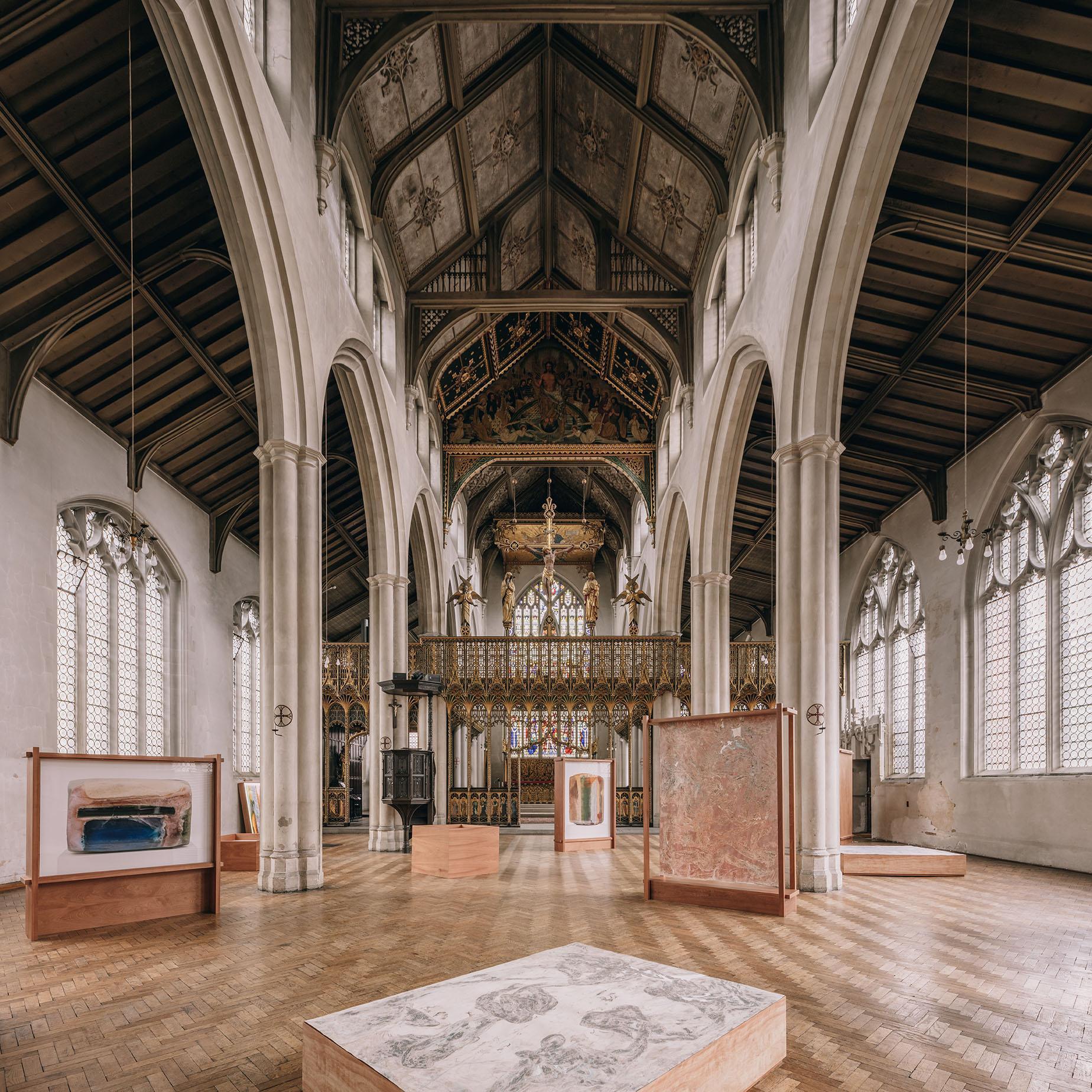
From July 7 to 23, 2022, Into Air was exhibited, under the curation of Jenn Ellis, at St Cyprian’s, Clarence Gate, a historic church in London’s Marylebone district. The midcentury pews, pulpit, and altar inside the Gothic revival interior inspired Ng to design, in collaboration with EBBA architects, new wooden box structures to house the works, some of which stand vertically, and others which lay parallel to the floor.

Ng, Dawn_Into Air installation
Exhibition view of Into Air by Dawn Ng, St Cyprian’s Church, London, July 7–23, 2022. Photo: James Retief.

Ng, Dawn_Waterfall VII (installation view)
Installation shot of Waterfall VII, 2022. Single-channel 4K video, 25 mins, 24 sec. Photo: James Retief. [watch video]

By displaying these works inside a sacred space, their spiritual implications become even more pronounced.

Impermanence is a theme that shows up in the sacred texts of all major religions, not least in the Bible, where we humans are reminded again and again of our mortality. Our days are like grass, which sprouts up and then withers (Isa. 40:6–7; Ps. 103:15–16; 1 Pet. 1:24). Our lives, but a sigh (Ps. 90:9–10), a shadow (Ps. 102:11), a mist (James 4:14), a breath (Ps. 39:5; Job 7:7; 7:16). We are made of dust and return to dust (Eccles. 3:20).

And not only are we finite; so is the present order of things. Even heaven and earth will pass away, Jesus says (Matt. 24:35; Mark 13:31; Luke 21:33; cf. Heb. 1:10–12). But, crucially, God and God’s word stand forever (Isa. 40:8; Matt. 7:24–27). True stability and unchangingness can be found only in God, Christians believe. God is a Rock that does not crumble, a strong foundation on which to stand, in life and in death.

The brevity of life may sound like a fearsome reality, but actually, it can serve to make our moments here on earth more precious and purposeful. Because our lives are but a short span, we must make the most of them while we can. Christians believe that everyone will one day have to give an account of what we did with the time God gifted to us. Did we share it freely with others, or keep it all for ourselves? Did we use it to cultivate virtue or to pursue vice?

The exhibition at St Cyprian’s also involved the premiere of a site-specific choral work by the London-based Welsh composer Alex Mills. A direct response to Ng’s art, his composition is also called Into Air and lasts about twenty-five minutes, the length of Ng’s Waterfall VII.

“In the piece,” Mills writes,

five singers undergo a musical meditation where each moves through the music to the rhythm of their own breaths, one bar of music for every exhale. Musical structures slowly build and disintegrate, evolve and transform, melt and evaporate. Textures, harmonies and colours – some delicate, others more pronounced – appear, disappear and re-emerge. Combing different singers’ breathing patterns gives the piece an indeterminate quality: the piece will never be the same twice and may even be radically different from one performance to the next. As such, the piece is not a fixed musical object that can be ‘performed’. Instead, it is a transient, ephemeral and elusive moment in time to be experienced.

The debut performance featured singers Jess Dandy, Rebecca Hardwick, Feargal Mostyn-Williams, James Robinson, and Ben Rowarth. It was recorded and turned into a gorgeous film by Bobby Williams, embedded above.*

The first singer stands at a kneeler. The second, at a pulpit. They establish the solemn mood. Two male singers sing from the organ loft, and another stands behind the rood screen with his arms crossed over his chest, as if in prayer. Haunting and mesmerizing, the five voices reflect off the stone architecture and meld together, sometimes harmoniously, sometimes in dissonance.

To everything there is a season. Starting at around 10:35, Mills incorporates keywords from Ecclesiastes 3:1–8, a biblical passage made especially famous by the Byrds: “gather,” “scatter,” “heal,” “kill,” “dance,” “mourn.” The author of Ecclesiastes is describing the tide of events that make up a life.

Periodically throughout the performance, a metal singing bowl resounds—a tool commonly used to deepen meditation. It is struck alternately by Ng and Mills, who are seated cross-legged at the front side of the church.  

Dawn Ng and Alex Mills at the premiere of Mills’s Into Air, St Cyprian’s Church, London, July 8, 2022. Photo: Damian Griffiths and Sarah Isabelle Tan.

Mills’s Into Air received a second performance just last week on February 8 at the launch of Music & Being, an initiative he founded with Jess Dandy. Music & Being is an open laboratory space in London exploring the intersection of art, music, psychology, spirituality, ecology, and movement.

As we near Ash Wednesday, the start of Lent, Ng’s and Mills’s works remind us of how time slips and slides and ultimately ceases, at least time as we know it. What will we do with our fleeting lives? As they dissipate, what will remain? When our breath stops, will a resonance linger?

* Additional video credits: Special thanks to Apsara Studio, Rose Lejeune, Performance Exchange, Ursula Sullivan, and Sullivan+Strumpf.

Roundup: Andrew Wyeth’s Pentecost, moon in a cathedral, dandelion wishes, and more

VISUAL MEDITATION: Pentecost by Andrew Wyeth, written by Victoria Emily Jones: In 2017 I took a day trip up to Chadds Ford, Pennsylvania, to attend the major Andrew Wyeth retrospective organized by the Brandywine River Museum of Art. Though some critics dismiss him as a “regional nostalgist” who, in sticking to realism, failed to keep with the times, I was enthralled by his hundred-plus paintings on display, not least of which was Pentecost. Created in 1989, it shows a pair of old fishing nets blowing in the wind on the Maine island his wife purchased and revitalized. Wyeth was not religious, but he was fascinated by the supernatural, and his paintings are often celebrated for their spiritual quality, for the sense of presence they evoke. Click on the link to read my reflection on this painting, named after the annual Christian feast that the church celebrates today (June 9) in honor of the Holy Spirit’s descent.

Pentecost by Andrew Wyeth
Andrew Wyeth (American, 1917–2009), Pentecost, 1989. Tempera with pencil on panel, 20 3/4 × 30 5/8 in. Private collection. Photo © Artists Rights Society (ARS).

+++

SONG: “Come, Holy Ghost,” arranged and performed by Nichlas Schaal and friends: The ninth-century Latin invocation “Veni Creator Spiritus,” attributed to Rabanus Maurus, has been translated into English more than fifty times since the English Reformation, under such titles as “Come, Holy Ghost, our souls inspire” and “Creator Spirit, by whose aid.” Originally seven verses sung in Gregorian chant, the hymn is usually condensed to four verses in modern hymnals and paired with one of three tunes. This super-fun arrangement by the Schaals, so full of joy (and “la-da-da-das”!), uses a nineteenth-century translation by Edward Caswell and tune by Louis Lambillotte. I’ve been listening to it on repeat all week as I’ve been gearing up for Pentecost. [HT: Liturgy Letter]

Come, Holy Ghost, Creator blest,
And in our hearts take up thy rest;
Come with thy grace and heav’nly aid
To fill the hearts which thou hast made,
To fill the hearts which thou hast made.

O Comforter, to thee we cry,
Thou heav’nly gift of God most high,
Thou fount of life, and fire of love,
And sweet anointing from above,
And sweet anointing from above.

O Holy Ghost, through thee alone
Know we the Father and the Son;
Be this our firm unchanging creed,
That thou dost from them both proceed,
That thou dost from them both proceed.

Praise we the Lord, Father and Son,
And Holy Spirit with them one;
And may the Son on us bestow
All gifts that from the Spirit flow,
All gifts that from the Spirit flow.

+++

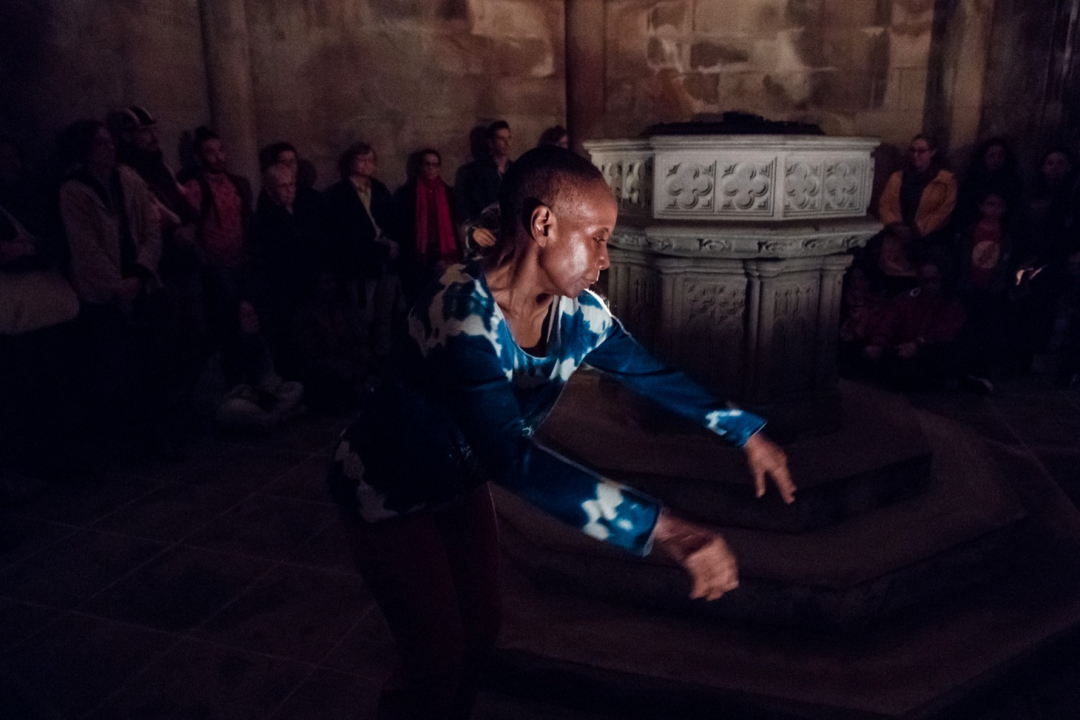
DANCE PERFORMANCES: Grounds That Shout!, curated by Reggie Wilson: It interests me to see how sacred spaces, especially Christian ones, inspire new artistic creations. Here’s one example from last month: “Curated by award-winning choreographer Reggie Wilson, Grounds that Shout! (and others merely shaking) is a series of performances that respond to the layered histories of Philadelphia’s religious spaces through contemporary dance, reflecting on the relationships and connections between practices of movement and worship. Over two weeks, eight choreographers and performance groups . . . perform[ed] in four historic Philadelphia churches, drawing from site and spirit to present original and re-situated works of dance.”

For “Souls a-Stirring” by Germaine Ingram, two female dancers shuffled around the large stone baptismal font at Church of the Advocate, sounding out rhythms as Ingram joined them and sang, “When temptation calls out to me / When dark clouds merge and follow me / I ask god to take my hand / Can he not / Can she not / Inspire a woman to teach God’s love?” Photo: Daniel Kontz/Hyperallergic.

+++

ART INSTALLATIONS

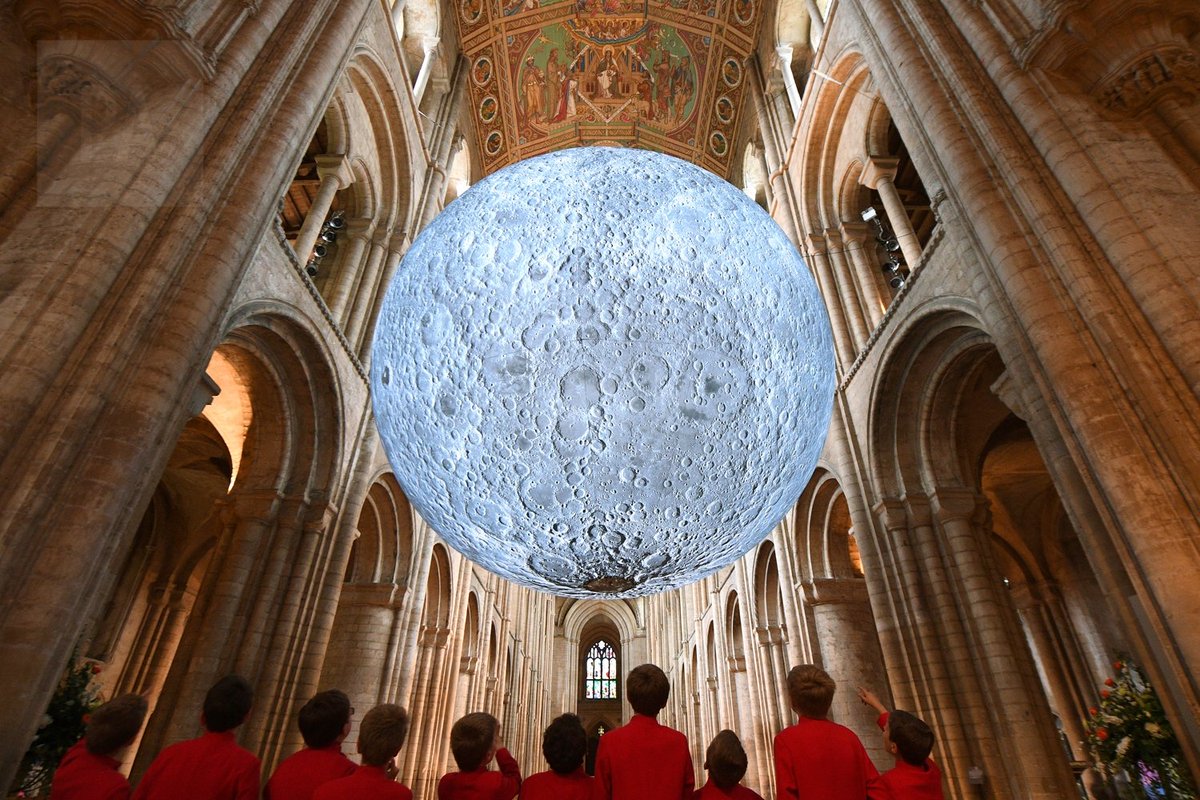
Museum of the Moon at Ely Cathedral: Today’s the last day to see Luke Jerram’s Museum of the Moon installation at Ely Cathedral in Cambridgeshire, a twenty-three-foot replica of the moon that utilizes high-resolution NASA satellite imagery and a sound composition by Dan Jones. The internally lit spherical sculpture hovers under the cathedral’s painted nave ceiling and is the main attraction of the cathedral’s science festival, “The Sky’s the Limit,” celebrating the fiftieth anniversary of the first moon landing (July 16, 1969). Jerram has produced several moons, which are touring the world, hoisted up in churches and other spaces, indoor and outdoor. For some really stunning photos as well as a tour schedule, check out https://my-moon.org/.

Museum of the Moon by Luke Jerram
Installation view of Luke Jerram’s Museum of the Moon at Ely Cathedral, May 2019. Photo: Joe Giddens/Press Association.

Jerram has also created replicas of Earth, scaled down by a factor of 1.8 million and titled Gaia. They are currently being displayed inside Salisbury and Liverpool cathedrals and will thereafter continue their world tours. (The bronze font by William Pye at Salisbury, designed to reflect and extend the surrounding architecture, makes for some truly amazing photographs of Gaia! Not to mention the significant meaning generated by the interaction of the two.)

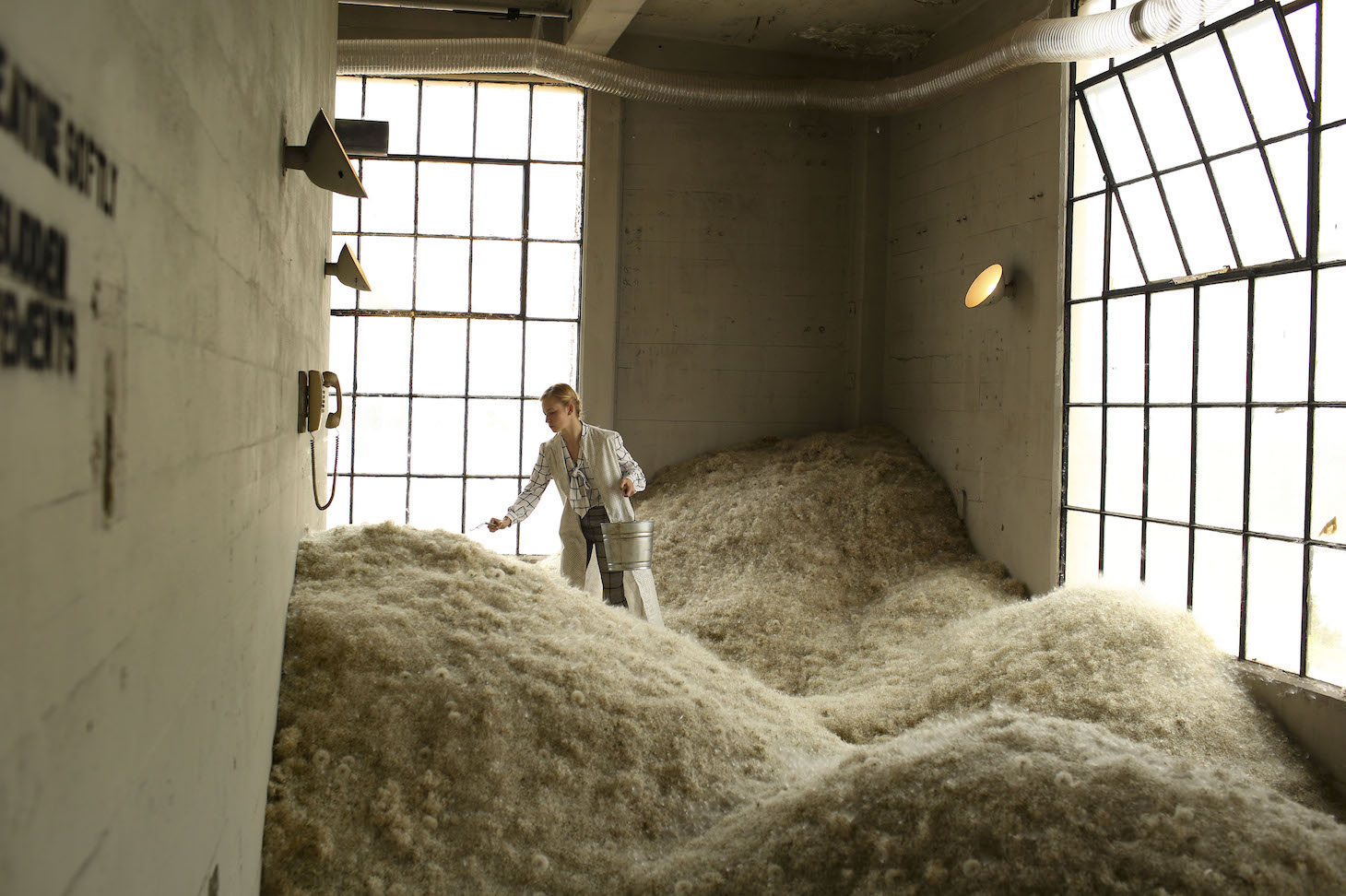
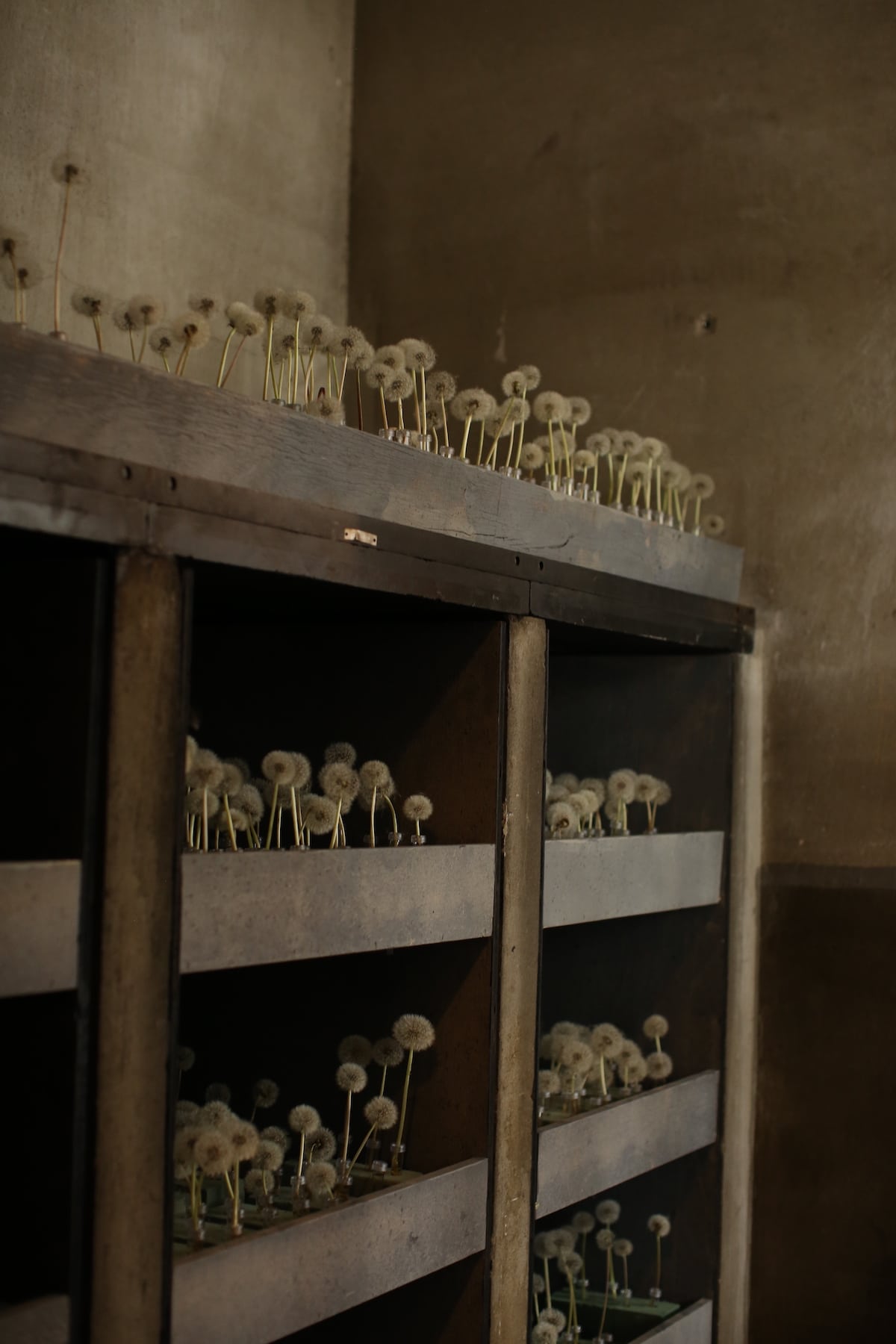
Dandelions by The Art Department: From May 11 to 12, a decommissioned building at the Laguna Bell electrical substation in Commerce, California, was transformed into a “wish-processing facility,” where visitors submitted their wishes for questioning and analysis before taking a dandelion and blowing its seeds down a chute. Part installation, part performance, Dandelions was put together by the anonymous collective The Art Department. When asked to define wish, the collective replied, “For some, a wish is a prayer fulfilled by a higher power. For some, a wish is an aspiration imbued with rational optimism. For some, wishes represent unfulfilled longing.”

Art often gives us occasion to confront who we are and what we desire, and with this piece, that was done in a playful way, with a mock bureaucracy that included the Department of Small Things That Float and various logistical assessments. View more photos and read an interview with the creators at My Modern Met, and see also the Hyperallergic review.

Dandelions
Photo: Michèle M. Waite, courtesy of The Art Department

Dandelions installation
Photo: Michèle M. Waite, courtesy of The Art Department

+++

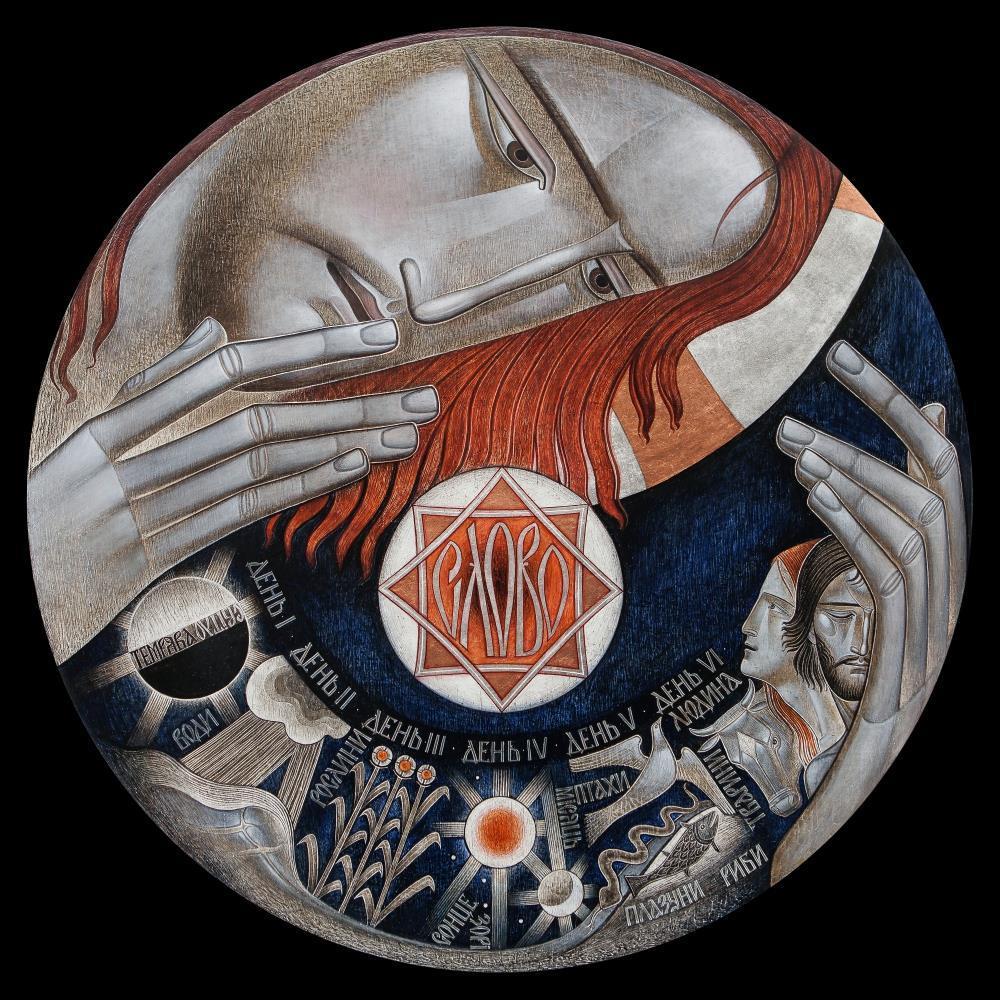
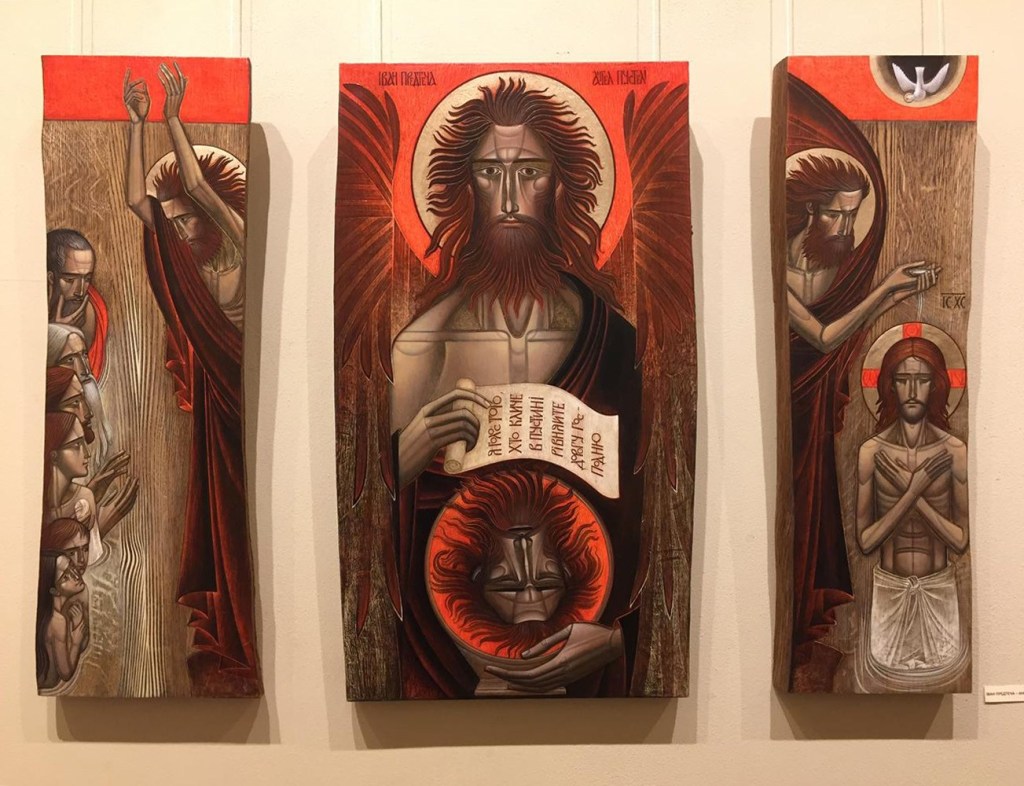
EXHIBITION: “Renewal: Icon Paintings by Lyuba Yatskiv”: Through June 30, the Iconart Contemporary Sacred Art Gallery in Lviv, Ukraine, is hosting a solo show of new work by Lyuba Yatskiv, one of the country’s several experimental iconographers. Among the subjects on display are the Creation of the World (he’s got the whole world in his hands!), Noah’s Ark, David the Psalmist, the Annunciation, the Flight to Egypt, John the Baptist, and the Holy Women at the Tomb.

Creation of the World by Lyuba Yatskiv
Lyuba Yatskiv (Ukrainian, 1977–), Creation of the World, 2019. Acrylic and gold on gessoed board.

John the Baptist triptych by Lyuba Yatskiv
Lyuba Yatskiv (Ukrainian, 1977–), St. John the Forerunner, Angel of the Desert, 2019. Acrylic and gold on gessoed boards.

I’ve featured Yatskiv’s work several times before on this website: in an Artful Devotion, a compilation of baptism icons, a roundup, and here by association.

Roundup: Sister Wendy, Quaker Skyspace, Bach on the street, and more

OBITUARY: “Sister Wendy Beckett, Nun Who Became a BBC Star, Dies at 88”: A nun since the age of sixteen, Sister Wendy spent most of her life living in silence in a windowless trailer on the grounds of the Carmelite monastery in East Anglia, England. She read voraciously about art but had never set foot in a museum or seen any great paintings in person—until in 1991, a BBC producer persuaded her to do a documentary about the paintings in London’s National Gallery. She agreed, thinking it would be a flash in the pan, but it was very successful, and so throughout the nineties she presented several other documentaries on the history of art, including Sister Wendy’s Odyssey, Sister Wendy’s Grand Tour, and Sister Wendy’s Story of Painting. She quickly became the world’s best-loved art critic, as her unscripted commentaries, so full of wonder and enthusiasm, connected well with the general public, making high art accessible. She also authored some thirty-five books.

Sister Wendy

“One of the ways, for me, of looking at God is by looking at art,” she says in the intro to Odyssey. Not that art is God but that art can lead us to a deeper understanding of who, and Whose, we are.

Sister Wendy was a major influence on my path to becoming a writer on Christianity and the arts. I first encountered her in high school through her Story of Painting series, which a studio art teacher made our class watch excerpts from. This was my entrée into art history, a subject that captivated me then and that inspired me to pursue some such coursework in college, including a semester abroad in Florence, Italy. Without this initial incitement of interest from Sister Wendy, I doubt I would be writing about art today.

What attracts me to her is what attracts most people: her utter joy and rapture as she discusses art. She is the first person who taught me how to look at a painting and read it. I appreciate her charitable stance toward modern and contemporary art (movements that large swaths of Christians reject), and her unabashed delight in the nude body. Over the years, people have tended to be either amused or shocked, or both, by her frankness in talking about sexuality in art, but she was always insistent on the goodness of the human body and of sex. When Bill Moyers asked her back in 2000 whether she’s scandalized by the carnality, the sensuality, of so much art, she really stumps him with her matter-of-fact response! (See 4:15 of the video below.)

+++

INTERVIEW: “Why You Should Read Devotional Poetry in 2019” by Leland Ryken: In this interview with Collin Huber, Ryken cites three reasons why Christians should read devotional poetry, elaborating on each one: (1) devotional poets express our spiritual experiences, (2) it sets our affections “in right tune,” and (3) it will take us to corners of the spiritual life that might otherwise remain unvisited. He also discusses how poetry has shaped him; the obstacles that keep people from enjoying poetry, and how to overcome them; what makes poetry distinctive as a genre; and the prevalence of poetry in the Bible. “Mastering a devotional poem by a famous English or American poet requires nothing beyond what mastering a psalm requires,” he says. “If you can possess Psalm 23, you can possess Milton’s sonnet on his blindness.”

Leland Ryken is an emeritus professor of English at Wheaton College and the author or editor of some fifty books, most recently the anthology The Soul in Paraphrase: A Treasury of Classic Devotional Poems. Other titles of his include How to Read the Bible as Literature, The Christian Imagination: The Practice of Faith in Literature and Writing, The Liberated Imagination: Thinking Christianly about the Arts, and several volumes in the Christian Guides to the Classics series.

+++

STREET PERFORMANCE: Toccata and Fugue in D minor (BWV 565) by J. S. Bach: Bach’s Toccata and Fugue is probably the most famous organ work in existence. But last fall in Cologne, a group of four musicians, whose names I cannot find, performed it on two accordions, a violin, and a tuba! It’s uncanny how closely the collective timbre approximates that of an organ. The tuba grants sonority, and the other instruments contribute to the full-bodied sound.

This performance took place between Hohe Straße and Theo-Burauen-Platz in Cologne, Germany, but a few commenters on the video have reported witnessing near-identical performances in other parts of the country, so either this group travels, or the arrangement is circulating.

+++

SACRED ARCHITECTURE

I frequently encounter articles on or photos of contemporary religious architecture. Here are just two notable buildings I’ve come across recently—the first one, thanks to Michael Wright’s Still Life newsletter (to which you should subscribe!).

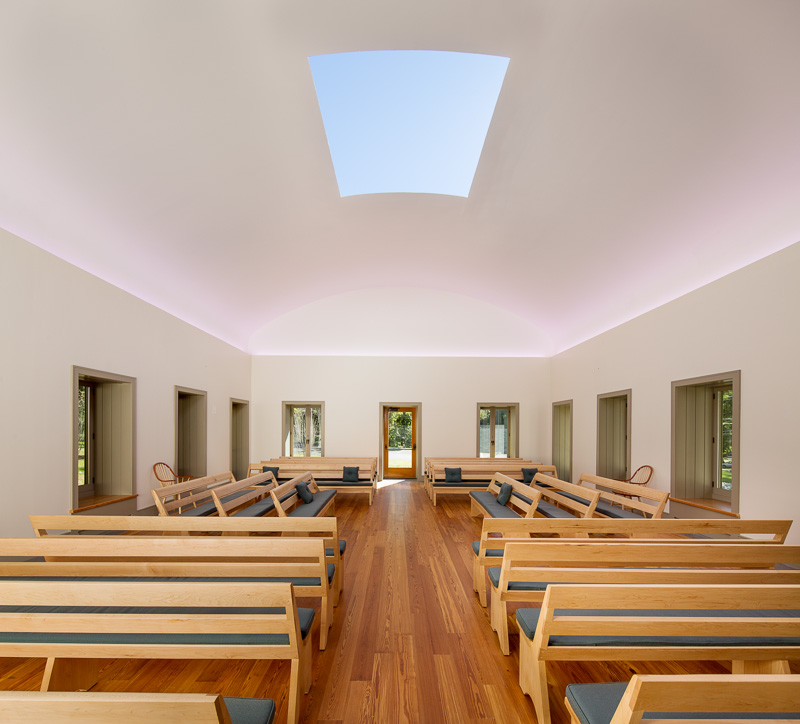
Chestnut Hill Friends Meeting (2013): When the Chestnut Hill Friends Meeting in northwest Philadelphia was building a new meetinghouse, they invited contemporary light artist James Turrell, himself a Quaker, to design one of his famous “Skyspaces” for the meeting room—that is, an aperture in the ceiling that’s open to the sky. From the beginning, Turrell collaborated with architect James Bradberry to achieve this permanent art installation; for example, Turrell wanted the aperture to have no perceptible thickness, so Bradberry and his team developed a sophisticated steel roof structure and “knife’s edge” opening. The achieved effect of paper thinness is impressive: when I first saw photos, I assumed the “sky” on the ceiling was just a painted patch! (Visitors have reported similar surprise.) Turrell calls this Skyspace Greet the Light, a reference not only to the light of the sun but to the Quaker doctrine of the “Inner Light,” God within.

Greet the Light by James Turrell
Chestnut Hill Friends Meeting Room, Philadelphia, Pennsylvania, featuring a permanent Skyspace installation, titled Greet the Light (2013), by James Turrell.

Greet the Light by James Turrell

The meeting room is open to the public, for free, on select days (more info here). Visitors are invited to bring a yoga mat, pillow, and blankets (when the retractable roof is open, the room is unheated) and to lie on their backs on the floor or benches. Silence is requested. Turrell’s installation also makes use of artificial light: over the course of fifty minutes or so, the vaulted ceiling is bathed in turn in four color variations—green, red, blue, and white—which augments the natural light projected by the opening.

View other Skyspaces by James Turrell at http://jamesturrell.com/work/type/skyspace/, and read Bradberry’s perspective on the project at Faith & Form.

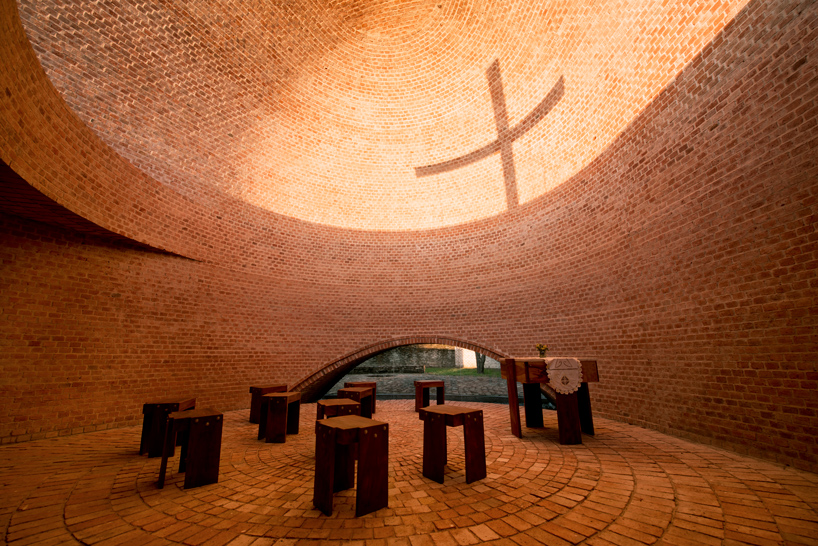
San Bernardo Chapel (2015): Located in a wooded grove in Argentina’s Pampas lowlands, just east of Córdoba, Capilla San Bernardo (St. Bernard Chapel) was designed by Nicolás Campodonico. It was constructed using hundred-year-old bricks that had been dismantled from the rural home and courtyard that previously stood on the site. There is no electricity in the area, so natural light plays a huge role, especially in the chapel’s most unique feature: two perpendicular beams, independently suspended from a large exterior opening, cast shadows onto an interior wall, which glide progressively toward each other throughout the day, ultimately overlapping to form a cross (see time lapse). Campodonico said he had in mind Jesus’s journey to Golgotha with the transverse beam, which, upon arrival at the execution site, was attached to the vertical mount; it’s as if the passion is being reenacted daily through the shadows, he said. See more photos at designboom.

San Bernardo Chapel
Capilla San Bernardo (St. Bernard Chapel), La Playosa, Córdoba Province, Argentina. Photo: Nicolás Campodonico.

San Bernardo Chapel

+++

FREE ALBUM: Into the Light by Joel LeMaire: Fans of Josh Garrels, Iron and Wine, and John Mark Pantana will probably enjoy Joel LeMaire’s 2015 EP, which is about finding hope in the letting go and stepping into the unknown. Download your own copy from NoiseTrade, and read more about the meaning behind the songs on LeMaire’s blog.


Roundup: New books and conferences; refugee memorial removed; icon against animal cruelty

PUBLIC ART CONTROVERSY: Olu Oguibe’s Monument to Strangers and Refugees, commissioned for last year’s major quinquennial art exhibition Documenta, was removed on October 3 by order of the Kassel City Council after, it is presumed, mounting pressure from Germany’s anti-immigrant Alternative for Germany (AfD) party. Designed as a site-specific work for Königsplatz (King’s Square), a pedestrian zone in the city center, where it had stood since June 2017, the fifty-three-foot concrete obelisk prominently features an excerpt of Jesus’s words from Matthew 25:35—“I was a stranger and you took me in”—inscribed in gold letters in German, English, Arabic, and Turkish. This quote reflects Jesus’s revolutionary ethic of love at the expense of personal comfort, of disadvantaging the self for others, so it’s no surprise that even today, it still offends. (Later in the passage, Jesus issues a sobering warning for those who fail to heed his command to welcome strangers.)

Monument to Strangers and Refugees by Olu Oguibe
Olu Oguibe (Nigerian American, 1964–), Monument to Strangers and Refugees, 2017. Concrete, about 53 ft. tall (3 × 3 × 16.3 m). Installation in King’s Square, Kassel, Germany.

Immigrant memorial removed
Olu Oguibe’s Monument to Strangers and Refugees was dismantled early on October 3 following orders by the city of Kassel. Photo: Regina Oesterling.

Germany has become increasingly polarized since 2015, when Chancellor Angela Merkel initiated an open-door immigration policy, leading to an influx of over one million refugees and asylum seekers at the height of the European refugee crisis. The city council had raised funds to purchase Oguibe’s monument for permanent display, and negotiations with the artist were in motion, but on September 24 they changed course, voting to remove the monument instead. According to Councilman Thomas Materner, a member of the AfD party, the obelisk is “ideologically polarizing, disfigured art.”

[Update, 10/12/18: The city and the artist have agreed on a new public location for the monument: Treppenstrasse, a nearby pedestrian area (via). 4/18/19: The monument was installed today at its new location (via).]

+++

CONFERENCES

“The Saddleback Visual Arts / CreativeChurch Arts Conference is a unique, full three-day conference and retreat October 18–20, 2018 at the beautiful Saddleback Rancho Capistrano Retreat Center. Creative leaders, arts ministry practitioners, and renowned artists will share visionary ideas and practical applications during sessions, workshops, creative and interactive performances and experiences. Attendees will explore applications for the arts and creativity in the local church, discover creative inspiration, experience refreshing and empowering ministry, connect with their creative tribe, and have the opportunity for personal or team retreat time in a beautiful setting. . . . For more information, and to register, please visit the CreativeChurch Arts website, here.”

[Update, 10/26/18: Below is a short video debrief of the conference.]

Another conference taking place that same weekend, October 19–20, 2018, is “Visual Theology I: Transformative Looking Between the Visual Arts and Christian Doctrine (1850–Now).” The inaugural conference of the Visual Theology Symposia, it’s being held in Chichester, England, and it may sound familiar to you, since I publicized the call for papers back in April. One of my favorite writers and thinkers in the field, Jonathan A. Anderson, will be speaking there, along with others. The focus will be scholarly, whereas Saddleback’s conference will be more practical, hands-on, and ministry-focused.

+++

LECTURE: “Cathedrals from the Outside: Questions of Art, Engagement, Commemoration and Celebration” by Sandy Nairne: At the National Cathedrals Conference in Manchester last month, Nairne, who served as director of London’s National Portrait Gallery from 2002 to 2015, spoke on the spiritual in art—in public spaces, galleries, and cathedrals. His starting questions: “How does contemporary art function in museums in ways that are of interest to cathedrals? And are there new ways in which art is playing a part in cathedrals that is important to the cultural world as a whole?” Click on the link to read the transcript.

The White Doves by Michael Pendry
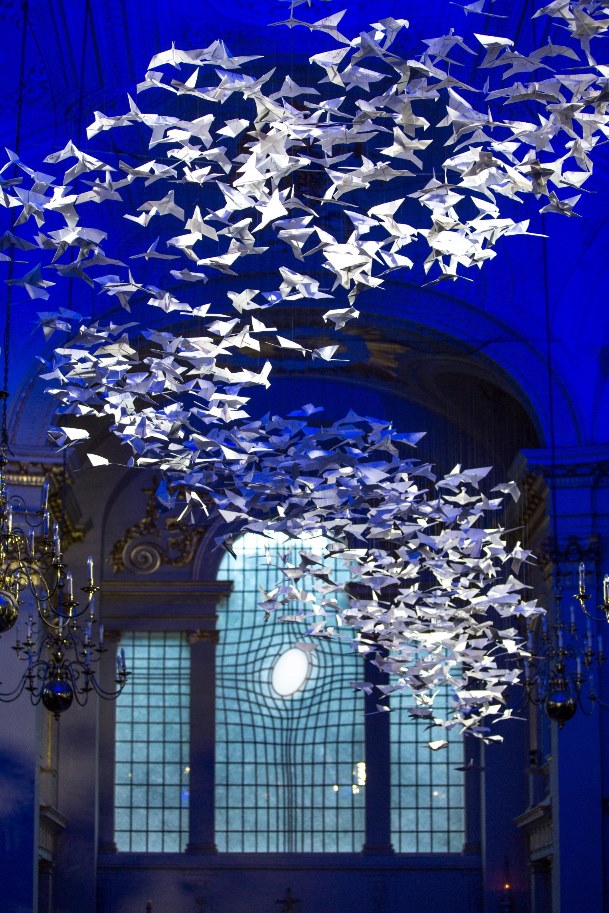
Michael Pendry (German, 1974–), Les Colombes – The White Doves, 2017. 2,000 white paper doves, 49 ft. (15 m). Pentecost installation at St. Martin-in-the-Fields, London. (Shirazeh Houshiary’s East Window is in the background.) Photo: Marc Gascoigne.

+++

NEW ICON: Christ Breaking the Bonds of Animal Suffering: Iconographer Aidan Hart writes, “Sometimes I am commissioned to paint an icon of a saint for whom nothing yet exists, or at least no satisfactory icon. This is usually a pre-schism Western saint. But more rarely, the subject is a new theme, a new emphasis or combination. This was the case when Dr Christine Nellist approached me to create an icon that embodied some of the Orthodox Church’s teaching about our relationship with animals. The icon was to be used as flagship for her newly founded organisation Pan-Orthodox Concern for Animals and to illustrate her pending book on the subject. This article tells the story of its genesis and explains its design.” Fascinating!

Breaking the Bonds of Animal Suffering by Aidan Hart
Aidan Hart (British, 1957–), Breaking the Bonds of Animal Suffering, 2018. Tempera on wood.

+++

BOOK REVIEWS

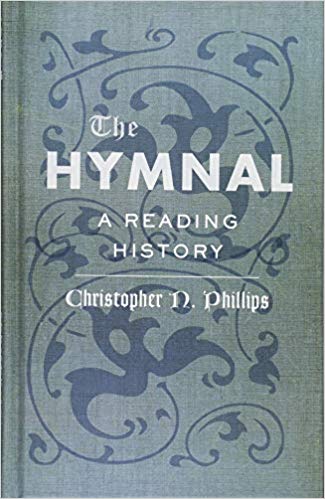
The Hymnal: A Reading History by Christopher N. Phillips, reviewed by Leland Ryken: Who knew hymnals didn’t take the form of a songbook until the 1870s! Before then, says Phillips, they were essentially volumes of poetry, used in family and private devotions. “The focus [of this book] . . . is an exploration of the hymnbooks that preceded our familiar hymnal. These were books containing the texts of the hymns without accompanying music. . . . [The author] doesn’t deal with the history of hymn-singing in church services but with the private reading of hymns as poems. I can’t imagine a more original approach to hymns for our generation.” Definitely adding this one to my to-read list.

The Hymnal: A Reading History

Everything Tells Us about God by Katherine Bolger Hyde, with illustrations by Livia Coloji, reviewed by Amanda McGill: This children’s book from Ancient Faith Publishing begins, “The world is like a giant puzzle God made to tell us about Himself—the Father, the Son, and the Holy Spirit. Every piece whispers one of His secrets—all we need to do is listen.” “I love the message of the book,” writes McGill: “finding God in the ordinary elements of creation. I think it affirms what children already suspect: that the world is meaningful, personal and infused with specialness. One of the first things I was thankful for was the inclusion of baptism and the Eucharist at the beginning of the book. It situates the sacraments within the normal experiences of life.”

Everything Tells Us about God

Upcoming lectures

“The Perils and Peculiarities of Visually Depicting the Trinity”
Speakers: Dr. Ben Quash, Professor of Christianity and the Arts at King’s College London; Dr. Scott Nethersole, Senior Lecturer in Italian Renaissance Art at the Courtauld Institute of Art
Date: February 21, 2018
Location: Courtauld Institute of Art, Somerset House, Strand, London
Organizer: Department of Theology and Religious Studies at King’s College and the Courtauld Institute of Art
Cost: Free
Description: Nethersole will discuss Botticelli’s Trinity Altarpiece, with special attention paid to its unsettling disjunctions of scale and space—a theological decision on the part of the artist. Then Quash “will examine some of the larger theological problems that are raised by trinitarian visual imagery, and look at . . . some of the successes and failures of various artistic experiments, including one or two very recent ones.” Q&A and informal reception to follow.

Holy Trinity by Sandro Botticelli
Sandro Botticelli (Italian, ca. 1445–1510), Holy Trinity with Mary Magdalene, John the Baptist, and Tobias and the Angel, 1491–93. Tempera on panel, 215 × 192 cm. Courtauld Gallery, London.

“Religion in Museum Education” (conference)
Speakers: Dr. Caroline Widmer, Dr. Anna Chiara Cimoli, et al. (see link for full list)
Date: February 23, 2018
Location: Lorenzo de’ Medici Institute, Florence
Organizer: Forum on Museums and Religion, an initiative of the Lorenzo de’ Medici Institute’s Museum Studies MA program
Cost: Free
Description: This one-day conference will bring together museum educators and religious authorities to discuss how secular museums housing religious objects might develop educational programming that highlights sacred functions without risking the impression of a religious agenda. Lecture topics include “Understanding Religion through Art,” “Sharing the Sacred with Schools,” “Teaching from Paintings with Religious Subject Matter,” “Churches as Living Museums,” and more, and case studies will come from the British Museum, the Uffizi in Florence, Museum Rietberg in Zurich, the National Museum for the History of Immigration in Paris, and the Shoah Memorial and Pinateca di Brera in Milan. The conference will conclude with a roundtable discussion.

“The New Iconoclasm: A Christological Reflection on Making and Breaking Images”
Speaker: Dr. Natalie Carnes, Associate Professor of Theology at Baylor University
Date: February 28, 2018
Location: Alumni Memorial Common Room, Duke Divinity School, Durham, North Carolina, USA
Organizer: Duke Initiatives in Theology and the Arts (DITA)
Cost: Free
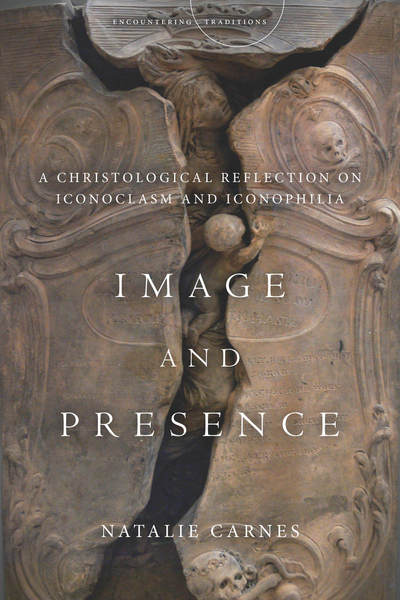
Description: Carnes’s lecture will draw on the content of her new book from Stanford University Press, Image and Presence: A Christological Reflection on Iconoclasm and Iconophilia. “Christians of many epochs—glutted with images, shocked by them—have resorted to the iconoclast’s hammer or its successor, the authoritarianism of empty space. Natalie Carnes proposes a better way to live through our senses” (Mark D. Jordan, Harvard University). “A major contribution to the discussion of image as and in theology” (Judith Wolfe, University of St. Andrews).

Image and Presence (book cover)

“‘In the manner of smoke’: Leonardo, Art, and Faith” (5-hour mini-course)
Lecturer: Rev. Iain Lane, Tutor in Christian Doctrine and the Visual Arts
Date: March 3, 2018
Location: Holywell Lodge, St. Albans, Hertfordshire, England
Organizer: St. Albans Cathedral
Cost: £25
Description: “Leonardo da Vinci produced some of the most compelling images in the history of Christian art. . . . This study day explores each of Leonardo’s surviving, overtly Christian works in detail, exploring their meaning and setting them in context. The picture which is revealed is of an artist of profound religious sensibility rooted in both scientific rationality and a deep awareness of the human condition: a man who embodied a unity of vision which has arguably been lost in our own age.”

Annunciation by Leonardo da Vinci
Leonardo da Vinci (Italian, 1452–1519), Annunciation, ca. 1472. Oil on panel, 98 × 217 cm. Uffizi Gallery, Florence.

“Swords into Ploughshares: The Ambivalent Role of the Arts and Religion in Building Peace”
Lecturer: Dr. Jolyon Mitchell, Professor of Communication, Arts, and Religion at the University of Edinburgh
Date: March 7, 2018
Location: Sarum College, Salisbury, England
Organizer: Centre for Theology, Imagination, and Culture at Sarum College
Cost: Free (advance booking required)
Description: This lecture will explore the role of different media arts in both inciting violence and promoting peace, drawing on examples from countries such as Israel-Palestine, Mozambique, Rwanda, and the UK.

“Scandal and Glory: The Cross in the Bible and Poetry”
Speakers: Paula Gooder, Director of Mission, Learning, and Development in the Birmingham Diocese; Mark Oakley, Canon Chancellor of St. Paul’s Cathedral
Date: March 13, 2018
Location: St. Paul’s Cathedral, London
Organizer: St. Paul’s Cathedral (Adult Learning initiative)
Cost: Free
Description: “Is Christ on the cross our brother in suffering or our King in triumph? Jesus’ death is at the heart of Christianity, but the four Gospel accounts are very different and the cross has been seen as both the throne of God’s glory and the place of ultimate desolation and defeat. In addition we have 2,000 years of interpretations, paintings, poems, theologies, and liturgies that add to the complexity, and sometimes to the confusion. . . . Paula Gooder and Mark Oakley will look at different aspects of the cross through the Gospels and poetry, exploring some of what we might learn from it not only of sin and reconciliation, but also of new life, love, freedom, and creation made new.” Q&A to follow.

“Art and the Apocalypse: The Book of Revelation and Visual Exegesis”
Speakers: Dr. Natasha O’Hear, Lecturer in Theology and Visual Art at ITIA, University of St. Andrews, Scotland; Dr. Anthony O’Hear, Professor of Philosophy at the University of Buckingham
Date: March 16, 2018
Location: The Gallery, 70 Cowcross Street, London
Organizer: Art and Christianity
Cost: £12
Description: Drawing on their recent award-winning book Picturing the Apocalypse: The Book of Revelation in the Arts over Two Millennia, the O’Hears will explore the visual history of the book of Revelation as well as the notion of the artist as biblical exegete. The focus will be on the Four Horsemen of the Apocalypse (Rev. 6) and the Rider on the White Horse (Rev. 19).

Picturing the Apocalypse

“Women Artists and the Modern Church in Britain”
Lecturer: Dr. Ayla Lepine, Visiting Fellow in Art History at the University of Essex
Date: April 4, 2018
Location: The Gallery, 70 Cowcross Street, London
Organizer: Art and Christianity
Cost: £14.21
Description: “From the turn of the twentieth century to the present, women have produced diverse and complex works of art for and in response to the Church. This talk explores the relationship between Christian sacred spaces, from vast and well-known cathedrals to rural chapels, and women artists in a period in which feminism, culture, and Christianity engaged in new dialogues.” Artists include Winifred Knights, Elizabeth Frink, Enid Chadwick, and Tracey Emin.

For You by Tracey Emin
Tracey Emin (British, 1963–), For You, 2008. Neon. Liverpool Cathedral, England.

+++

Many of these events I found out about through the weekly Arts and the Sacred at King’s (ASK) e-bulletin compiled by Dr. Chloë Reddaway. If you would like to be added to the ASK listserv or announce a relevant event through it, contact her at chloe.1.reddaway@kcl.ac.uk.

Note: The two book cover images on this webpage are Amazon affiliate links, meaning that Art & Theology will earn a small commission on any purchase that originates here.

Roundup: Alabaster Gospels, the lone cathedral-builder, Pacheco at Chichester, lamenting racial injustice

Alabaster page spread

New Gospel-book set promotes aesthetic reading experience: Photographer Bryan Chung and designer Brian Chung, both campus ministers (and no relation), believe that beauty is fundamental to understanding who God is. So they’ve teamed up for project Alabaster: a brand-new design of the holy Gospels, in four volumes, integrated with contemplative photographs. They’ve already well exceeded their funding goal on Kickstarter, which means there’s already a lot of interest in having Bible reading be a visual experience—and at a 7½ × 9½ trim, the books are definitely wieldy, meant to be regularly handled and read! If you want a guaranteed copy, be sure to back the project on Kickstarter, as the number of names in the system will determine the size of the print order. You have until October 7; the publication month is April 2017. This project aligns so well with my mission here at Art & Theology, and I’m thrilled to see it in the works.

+++

90-year-old man spends lifetime building a cathedral by hand: From Great Big Story: “For 53 years, Justo Gallego has been building a cathedral by hand on the outskirts of Madrid almost entirely by himself. Gallego has no formal architecture or construction training, but that hasn’t stopped him from toiling on this herculean task. At 90 years old, Gallego knows that he will not be able to finish the project in his lifetime. But he keeps at it anyway, day after day, driven by his faith.”

+++

Shadows of the Wanderer by Ana Maria Pacheco
Ana Maria Pacheco (Brazilian, 1943–), Shadows of the Wanderer, 2008. Polychromed wood sculpture, 260 × 390 × 605 cm. Installation view at Norwich Cathedral, 2010, via Pratt Contemporary Art.

Art installation at Chichester Cathedral speaks to the refugee experience: Shadows of the Wanderer by Brazilian-born artist Ana Maria Pacheco is on display in the north transept of Chichester Cathedral through November 14. A multipiece figurative sculpture in polychromed wood, it has as its centerpiece a young man carrying an elderly man on his back—a reference to the Aeneid’s Aeneas carrying his lame father out of the ruins of Troy. The cathedral has organized events around the installation, including a lecture by Christopher Wintle on the representation of suffering in Pacheco’s art (audio here, transcript here); a series of workshops for schools and colleges exploring the refugee experience, developed in partnership with Amnesty International; a debate titled “Refugees: Problem or Gift?”; an interview with the artist; and a woodcarving workshop. The photo above is an installation view from 2010 inside Norwich Cathedral; to see photos of the work in its current location at Chichester, click here.

+++

Addressing racial injustice as a church: Paul Neeley at Global Christian Worship has compiled an excellent list of resources for churches looking for ways to address racial tensions in America with an eye toward healing, including a prayer service of lament by Paul Burkhart; two litanies by Fran Pratt; a list of relevant hymns, curated by the Hymn Society; an article by Sandra Van Opstal, “Reconciling Witness And Worship: Six Ways To Begin”; and materials from the 2016 Reconciliation and Justice Network conference. I’d like to add to it the lecture series “Race and the Church,” especially Jemar Tisby’s “Understanding the Heart Cry of #BlackLivesMatter,” which I live-streamed with my church back in July. (It definitely sparked fruitful conversation.) For common objections to the movement, like “What about black-on-black crime?” and “Don’t #AllLivesMatter?,” he refers listeners to the video below, produced by MTV.

+++

SONG: “Light a Candle”: Also on Neeley’s website I found a video performance of the song “Light a Candle” by Mary Louise Bringle (words) and Lori True (music). It’s sung here, to a ukulele accompaniment, by Becky Gaunt, director of music and liturgy at St. Jude of the Lake Catholic Church in Mahtomedi, Montana.

She posted it on her Facebook page in July along with this note:

We cannot continue to let language divide us. We cannot continue to let language distract us from loving one another. We cannot continue to let words like “black lives matter” or “all lives matter” cause us to keep missing the point!

I’m sad and tired. And you probably are too. But now is NOT the time to be neutral! The Sun may be shining outside, but we need to come together and light a candle in this oppressive darkness. This beautiful song by Lori True (amazing text by Mary Louise Bringle) is my prayer right now. I invite you to pray this with me.

Boy with a Candle by Gerard Sekoto
Gerard Sekoto (South African, 1913–1993), Boy with a Candle, 1943. Oil on canvas, 46.2 × 36 cm.