Roundup: New books and conferences; refugee memorial removed; icon against animal cruelty

PUBLIC ART CONTROVERSY: Olu Oguibe’s Monument to Strangers and Refugees, commissioned for last year’s major quinquennial art exhibition Documenta, was removed on October 3 by order of the Kassel City Council after, it is presumed, mounting pressure from Germany’s anti-immigrant Alternative for Germany (AfD) party. Designed as a site-specific work for Königsplatz (King’s Square), a pedestrian zone in the city center, where it had stood since June 2017, the fifty-three-foot concrete obelisk prominently features an excerpt of Jesus’s words from Matthew 25:35—“I was a stranger and you took me in”—inscribed in gold letters in German, English, Arabic, and Turkish. This quote reflects Jesus’s revolutionary ethic of love at the expense of personal comfort, of disadvantaging the self for others, so it’s no surprise that even today, it still offends. (Later in the passage, Jesus issues a sobering warning for those who fail to heed his command to welcome strangers.)

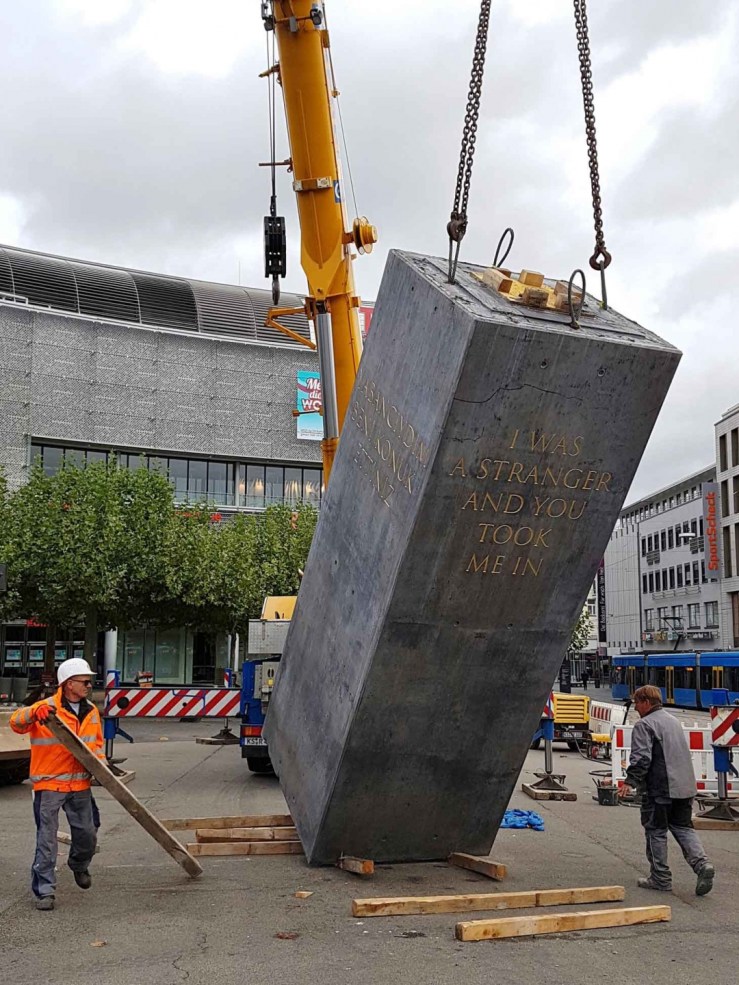
Monument to Strangers and Refugees by Olu Oguibe
Olu Oguibe (Nigerian American, 1964–), Monument to Strangers and Refugees, 2017. Concrete, about 53 ft. tall (3 × 3 × 16.3 m). Installation in King’s Square, Kassel, Germany.
Immigrant memorial removed
Olu Oguibe’s Monument to Strangers and Refugees was dismantled early on October 3 following orders by the city of Kassel. Photo: Regina Oesterling.

Germany has become increasingly polarized since 2015, when Chancellor Angela Merkel initiated an open-door immigration policy, leading to an influx of over one million refugees and asylum seekers at the height of the European refugee crisis. The city council had raised funds to purchase Oguibe’s monument for permanent display, and negotiations with the artist were in motion, but on September 24 they changed course, voting to remove the monument instead. According to Councilman Thomas Materner, a member of the AfD party, the obelisk is “ideologically polarizing, disfigured art.”

[Update, 10/12/18: The city and the artist have agreed on a new public location for the monument: Treppenstrasse, a nearby pedestrian area (via). 4/18/19: The monument was installed today at its new location (via).]

+++

CONFERENCES

“The Saddleback Visual Arts / CreativeChurch Arts Conference is a unique, full three-day conference and retreat October 18–20, 2018 at the beautiful Saddleback Rancho Capistrano Retreat Center. Creative leaders, arts ministry practitioners, and renowned artists will share visionary ideas and practical applications during sessions, workshops, creative and interactive performances and experiences. Attendees will explore applications for the arts and creativity in the local church, discover creative inspiration, experience refreshing and empowering ministry, connect with their creative tribe, and have the opportunity for personal or team retreat time in a beautiful setting. . . . For more information, and to register, please visit the CreativeChurch Arts website, here.”

[Update, 10/26/18: Below is a short video debrief of the conference.]

Another conference taking place that same weekend, October 19–20, 2018, is “Visual Theology I: Transformative Looking Between the Visual Arts and Christian Doctrine (1850–Now).” The inaugural conference of the Visual Theology Symposia, it’s being held in Chichester, England, and it may sound familiar to you, since I publicized the call for papers back in April. One of my favorite writers and thinkers in the field, Jonathan A. Anderson, will be speaking there, along with others. The focus will be scholarly, whereas Saddleback’s conference will be more practical, hands-on, and ministry-focused.

+++

LECTURE: “Cathedrals from the Outside: Questions of Art, Engagement, Commemoration and Celebration” by Sandy Nairne: At the National Cathedrals Conference in Manchester last month, Nairne, who served as director of London’s National Portrait Gallery from 2002 to 2015, spoke on the spiritual in art—in public spaces, galleries, and cathedrals. His starting questions: “How does contemporary art function in museums in ways that are of interest to cathedrals? And are there new ways in which art is playing a part in cathedrals that is important to the cultural world as a whole?” Click on the link to read the transcript.
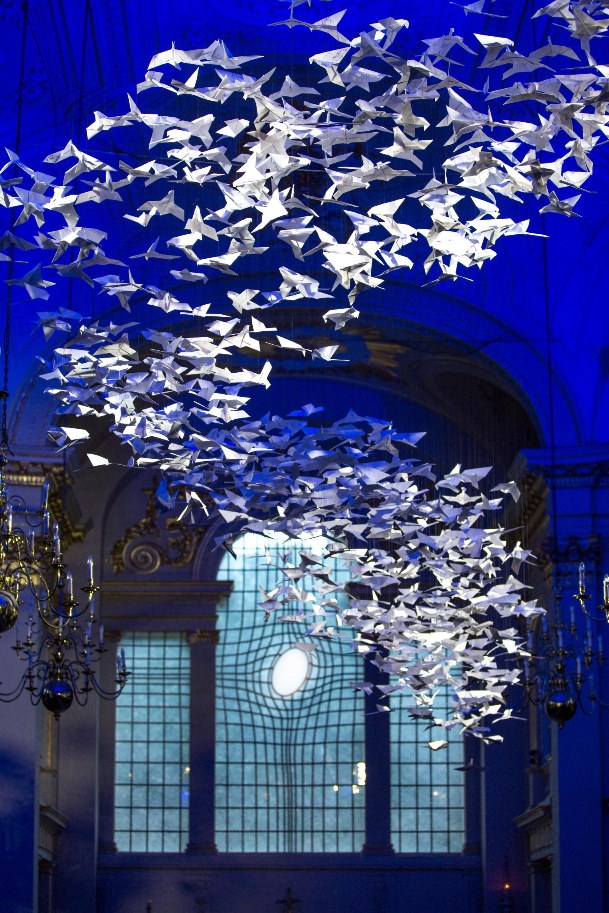
The White Doves by Michael Pendry
Michael Pendry (German, 1974–), Les Colombes – The White Doves, 2017. 2,000 white paper doves, 49 ft. (15 m). Pentecost installation at St. Martin-in-the-Fields, London. (Shirazeh Houshiary’s East Window is in the background.) Photo: Marc Gascoigne.

+++

NEW ICON: Christ Breaking the Bonds of Animal Suffering: Iconographer Aidan Hart writes, “Sometimes I am commissioned to paint an icon of a saint for whom nothing yet exists, or at least no satisfactory icon. This is usually a pre-schism Western saint. But more rarely, the subject is a new theme, a new emphasis or combination. This was the case when Dr Christine Nellist approached me to create an icon that embodied some of the Orthodox Church’s teaching about our relationship with animals. The icon was to be used as flagship for her newly founded organisation Pan-Orthodox Concern for Animals and to illustrate her pending book on the subject. This article tells the story of its genesis and explains its design.” Fascinating!

Breaking the Bonds of Animal Suffering by Aidan Hart
Aidan Hart (British, 1957–), Breaking the Bonds of Animal Suffering, 2018. Tempera on wood.

+++

BOOK REVIEWS

The Hymnal: A Reading History by Christopher N. Phillips, reviewed by Leland Ryken: Who knew hymnals didn’t take the form of a songbook until the 1870s! Before then, says Phillips, they were essentially volumes of poetry, used in family and private devotions. “The focus [of this book] . . . is an exploration of the hymnbooks that preceded our familiar hymnal. These were books containing the texts of the hymns without accompanying music. . . . [The author] doesn’t deal with the history of hymn-singing in church services but with the private reading of hymns as poems. I can’t imagine a more original approach to hymns for our generation.” Definitely adding this one to my to-read list.

The Hymnal: A Reading History

Everything Tells Us about God by Katherine Bolger Hyde, with illustrations by Livia Coloji, reviewed by Amanda McGill: This children’s book from Ancient Faith Publishing begins, “The world is like a giant puzzle God made to tell us about Himself—the Father, the Son, and the Holy Spirit. Every piece whispers one of His secrets—all we need to do is listen.” “I love the message of the book,” writes McGill: “finding God in the ordinary elements of creation. I think it affirms what children already suspect: that the world is meaningful, personal and infused with specialness. One of the first things I was thankful for was the inclusion of baptism and the Eucharist at the beginning of the book. It situates the sacraments within the normal experiences of life.”

Everything Tells Us about God

Upcoming lectures

“The Perils and Peculiarities of Visually Depicting the Trinity”
Speakers: Dr. Ben Quash, Professor of Christianity and the Arts at King’s College London; Dr. Scott Nethersole, Senior Lecturer in Italian Renaissance Art at the Courtauld Institute of Art
Date: February 21, 2018
Location: Courtauld Institute of Art, Somerset House, Strand, London
Organizer: Department of Theology and Religious Studies at King’s College and the Courtauld Institute of Art
Cost: Free
Description: Nethersole will discuss Botticelli’s Trinity Altarpiece, with special attention paid to its unsettling disjunctions of scale and space—a theological decision on the part of the artist. Then Quash “will examine some of the larger theological problems that are raised by trinitarian visual imagery, and look at . . . some of the successes and failures of various artistic experiments, including one or two very recent ones.” Q&A and informal reception to follow.

Holy Trinity by Sandro Botticelli
Sandro Botticelli (Italian, ca. 1445–1510), Holy Trinity with Mary Magdalene, John the Baptist, and Tobias and the Angel, 1491–93. Tempera on panel, 215 × 192 cm. Courtauld Gallery, London.

“Religion in Museum Education” (conference)
Speakers: Dr. Caroline Widmer, Dr. Anna Chiara Cimoli, et al. (see link for full list)
Date: February 23, 2018
Location: Lorenzo de’ Medici Institute, Florence
Organizer: Forum on Museums and Religion, an initiative of the Lorenzo de’ Medici Institute’s Museum Studies MA program
Cost: Free
Description: This one-day conference will bring together museum educators and religious authorities to discuss how secular museums housing religious objects might develop educational programming that highlights sacred functions without risking the impression of a religious agenda. Lecture topics include “Understanding Religion through Art,” “Sharing the Sacred with Schools,” “Teaching from Paintings with Religious Subject Matter,” “Churches as Living Museums,” and more, and case studies will come from the British Museum, the Uffizi in Florence, Museum Rietberg in Zurich, the National Museum for the History of Immigration in Paris, and the Shoah Memorial and Pinateca di Brera in Milan. The conference will conclude with a roundtable discussion.

“The New Iconoclasm: A Christological Reflection on Making and Breaking Images”
Speaker: Dr. Natalie Carnes, Associate Professor of Theology at Baylor University
Date: February 28, 2018
Location: Alumni Memorial Common Room, Duke Divinity School, Durham, North Carolina, USA
Organizer: Duke Initiatives in Theology and the Arts (DITA)
Cost: Free
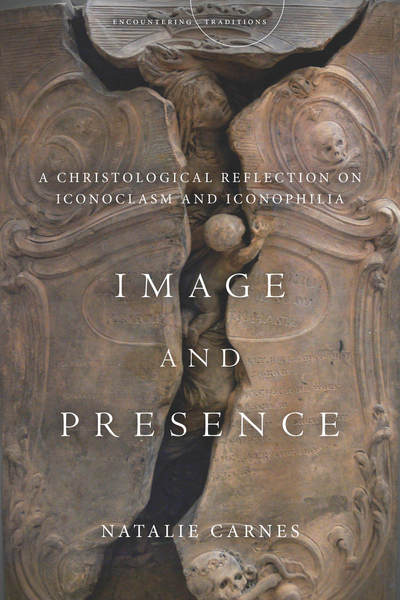
Description: Carnes’s lecture will draw on the content of her new book from Stanford University Press, Image and Presence: A Christological Reflection on Iconoclasm and Iconophilia. “Christians of many epochs—glutted with images, shocked by them—have resorted to the iconoclast’s hammer or its successor, the authoritarianism of empty space. Natalie Carnes proposes a better way to live through our senses” (Mark D. Jordan, Harvard University). “A major contribution to the discussion of image as and in theology” (Judith Wolfe, University of St. Andrews).

Image and Presence (book cover)

“‘In the manner of smoke’: Leonardo, Art, and Faith” (5-hour mini-course)
Lecturer: Rev. Iain Lane, Tutor in Christian Doctrine and the Visual Arts
Date: March 3, 2018
Location: Holywell Lodge, St. Albans, Hertfordshire, England
Organizer: St. Albans Cathedral
Cost: £25
Description: “Leonardo da Vinci produced some of the most compelling images in the history of Christian art. . . . This study day explores each of Leonardo’s surviving, overtly Christian works in detail, exploring their meaning and setting them in context. The picture which is revealed is of an artist of profound religious sensibility rooted in both scientific rationality and a deep awareness of the human condition: a man who embodied a unity of vision which has arguably been lost in our own age.”

Annunciation by Leonardo da Vinci
Leonardo da Vinci (Italian, 1452–1519), Annunciation, ca. 1472. Oil on panel, 98 × 217 cm. Uffizi Gallery, Florence.

“Swords into Ploughshares: The Ambivalent Role of the Arts and Religion in Building Peace”
Lecturer: Dr. Jolyon Mitchell, Professor of Communication, Arts, and Religion at the University of Edinburgh
Date: March 7, 2018
Location: Sarum College, Salisbury, England
Organizer: Centre for Theology, Imagination, and Culture at Sarum College
Cost: Free (advance booking required)
Description: This lecture will explore the role of different media arts in both inciting violence and promoting peace, drawing on examples from countries such as Israel-Palestine, Mozambique, Rwanda, and the UK.

“Scandal and Glory: The Cross in the Bible and Poetry”
Speakers: Paula Gooder, Director of Mission, Learning, and Development in the Birmingham Diocese; Mark Oakley, Canon Chancellor of St. Paul’s Cathedral
Date: March 13, 2018
Location: St. Paul’s Cathedral, London
Organizer: St. Paul’s Cathedral (Adult Learning initiative)
Cost: Free
Description: “Is Christ on the cross our brother in suffering or our King in triumph? Jesus’ death is at the heart of Christianity, but the four Gospel accounts are very different and the cross has been seen as both the throne of God’s glory and the place of ultimate desolation and defeat. In addition we have 2,000 years of interpretations, paintings, poems, theologies, and liturgies that add to the complexity, and sometimes to the confusion. . . . Paula Gooder and Mark Oakley will look at different aspects of the cross through the Gospels and poetry, exploring some of what we might learn from it not only of sin and reconciliation, but also of new life, love, freedom, and creation made new.” Q&A to follow.

“Art and the Apocalypse: The Book of Revelation and Visual Exegesis”
Speakers: Dr. Natasha O’Hear, Lecturer in Theology and Visual Art at ITIA, University of St. Andrews, Scotland; Dr. Anthony O’Hear, Professor of Philosophy at the University of Buckingham
Date: March 16, 2018
Location: The Gallery, 70 Cowcross Street, London
Organizer: Art and Christianity
Cost: £12
Description: Drawing on their recent award-winning book Picturing the Apocalypse: The Book of Revelation in the Arts over Two Millennia, the O’Hears will explore the visual history of the book of Revelation as well as the notion of the artist as biblical exegete. The focus will be on the Four Horsemen of the Apocalypse (Rev. 6) and the Rider on the White Horse (Rev. 19).

Picturing the Apocalypse

“Women Artists and the Modern Church in Britain”
Lecturer: Dr. Ayla Lepine, Visiting Fellow in Art History at the University of Essex
Date: April 4, 2018
Location: The Gallery, 70 Cowcross Street, London
Organizer: Art and Christianity
Cost: £14.21
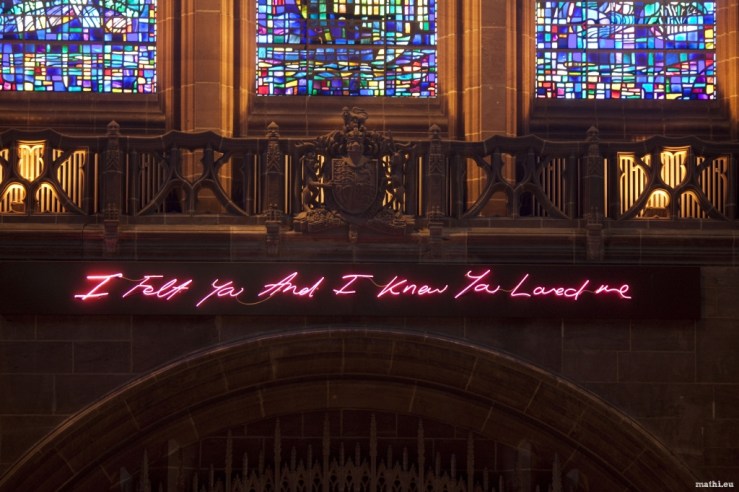
Description: “From the turn of the twentieth century to the present, women have produced diverse and complex works of art for and in response to the Church. This talk explores the relationship between Christian sacred spaces, from vast and well-known cathedrals to rural chapels, and women artists in a period in which feminism, culture, and Christianity engaged in new dialogues.” Artists include Winifred Knights, Elizabeth Frink, Enid Chadwick, and Tracey Emin.

For You by Tracey Emin
Tracey Emin (British, 1963–), For You, 2008. Neon. Liverpool Cathedral, England.

+++

Many of these events I found out about through the weekly Arts and the Sacred at King’s (ASK) e-bulletin compiled by Dr. Chloë Reddaway. If you would like to be added to the ASK listserv or announce a relevant event through it, contact her at chloe.1.reddaway@kcl.ac.uk.

Note: The two book cover images on this webpage are Amazon affiliate links, meaning that Art & Theology will earn a small commission on any purchase that originates here.

Roundup: Alabaster Gospels, the lone cathedral-builder, Pacheco at Chichester, lamenting racial injustice

Alabaster page spread

New Gospel-book set promotes aesthetic reading experience: Photographer Bryan Chung and designer Brian Chung, both campus ministers (and no relation), believe that beauty is fundamental to understanding who God is. So they’ve teamed up for project Alabaster: a brand-new design of the holy Gospels, in four volumes, integrated with contemplative photographs. They’ve already well exceeded their funding goal on Kickstarter, which means there’s already a lot of interest in having Bible reading be a visual experience—and at a 7½ × 9½ trim, the books are definitely wieldy, meant to be regularly handled and read! If you want a guaranteed copy, be sure to back the project on Kickstarter, as the number of names in the system will determine the size of the print order. You have until October 7; the publication month is April 2017. This project aligns so well with my mission here at Art & Theology, and I’m thrilled to see it in the works.

+++

90-year-old man spends lifetime building a cathedral by hand: From Great Big Story: “For 53 years, Justo Gallego has been building a cathedral by hand on the outskirts of Madrid almost entirely by himself. Gallego has no formal architecture or construction training, but that hasn’t stopped him from toiling on this herculean task. At 90 years old, Gallego knows that he will not be able to finish the project in his lifetime. But he keeps at it anyway, day after day, driven by his faith.”

+++

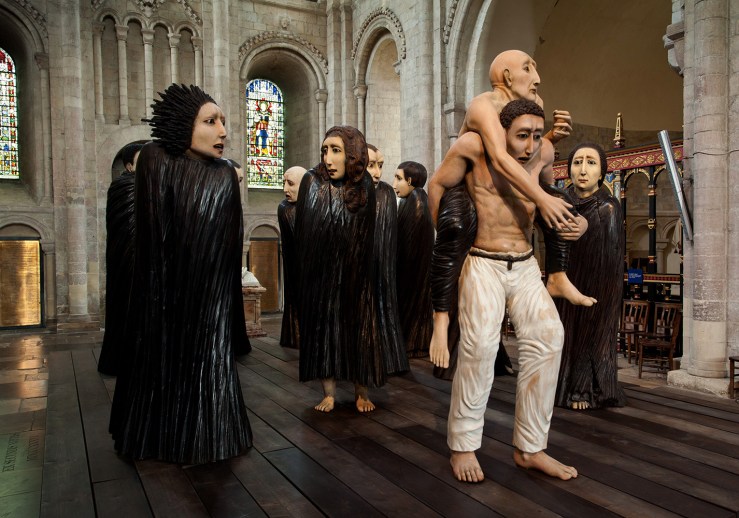
Shadows of the Wanderer by Ana Maria Pacheco
Ana Maria Pacheco (Brazilian, 1943–), Shadows of the Wanderer, 2008. Polychromed wood sculpture, 260 × 390 × 605 cm. Installation view at Norwich Cathedral, 2010, via Pratt Contemporary Art.

Art installation at Chichester Cathedral speaks to the refugee experience: Shadows of the Wanderer by Brazilian-born artist Ana Maria Pacheco is on display in the north transept of Chichester Cathedral through November 14. A multipiece figurative sculpture in polychromed wood, it has as its centerpiece a young man carrying an elderly man on his back—a reference to the Aeneid’s Aeneas carrying his lame father out of the ruins of Troy. The cathedral has organized events around the installation, including a lecture by Christopher Wintle on the representation of suffering in Pacheco’s art (audio here, transcript here); a series of workshops for schools and colleges exploring the refugee experience, developed in partnership with Amnesty International; a debate titled “Refugees: Problem or Gift?”; an interview with the artist; and a woodcarving workshop. The photo above is an installation view from 2010 inside Norwich Cathedral; to see photos of the work in its current location at Chichester, click here.

+++

Addressing racial injustice as a church: Paul Neeley at Global Christian Worship has compiled an excellent list of resources for churches looking for ways to address racial tensions in America with an eye toward healing, including a prayer service of lament by Paul Burkhart; two litanies by Fran Pratt; a list of relevant hymns, curated by the Hymn Society; an article by Sandra Van Opstal, “Reconciling Witness And Worship: Six Ways To Begin”; and materials from the 2016 Reconciliation and Justice Network conference. I’d like to add to it the lecture series “Race and the Church,” especially Jemar Tisby’s “Understanding the Heart Cry of #BlackLivesMatter,” which I live-streamed with my church back in July. (It definitely sparked fruitful conversation.) For common objections to the movement, like “What about black-on-black crime?” and “Don’t #AllLivesMatter?,” he refers listeners to the video below, produced by MTV.

+++

SONG: “Light a Candle”: Also on Neeley’s website I found a video performance of the song “Light a Candle” by Mary Louise Bringle (words) and Lori True (music). It’s sung here, to a ukulele accompaniment, by Becky Gaunt, director of music and liturgy at St. Jude of the Lake Catholic Church in Mahtomedi, Montana.

She posted it on her Facebook page in July along with this note:

We cannot continue to let language divide us. We cannot continue to let language distract us from loving one another. We cannot continue to let words like “black lives matter” or “all lives matter” cause us to keep missing the point!

I’m sad and tired. And you probably are too. But now is NOT the time to be neutral! The Sun may be shining outside, but we need to come together and light a candle in this oppressive darkness. This beautiful song by Lori True (amazing text by Mary Louise Bringle) is my prayer right now. I invite you to pray this with me.

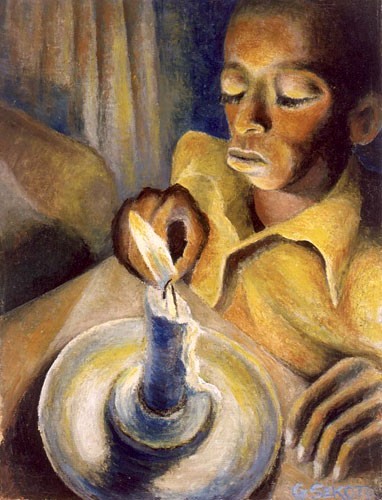
Boy with a Candle by Gerard Sekoto
Gerard Sekoto (South African, 1913–1993), Boy with a Candle, 1943. Oil on canvas, 46.2 × 36 cm.

In Antwerp Cathedral’s latest art acquisition, a skeptic weighs the truth of Christianity

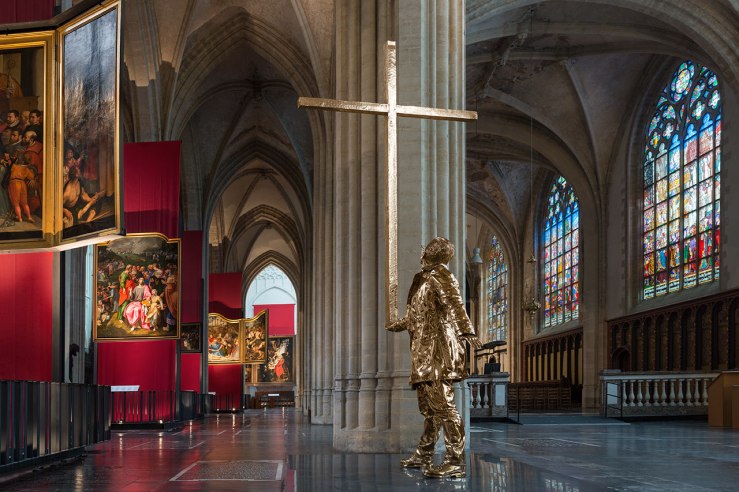
The sixteenth-century Cathedral of Our Lady in Antwerp, Belgium, home to Peter Paul Rubens’s famous Elevation of the Cross and Descent from the Cross, is now also home to a bronze sculpture by contemporary artist Jan Fabre, called The Man Who Bears the Cross. It is a self-portrait of the artist surveying a large cross that he balances in the palm of his hand.

The Man Who Bears the Cross by Jan Fabre
Jan Fabre (Belgian, 1958–), The Man Who Bears the Cross, 2015. Bronze, 394 × 200 × 100 cm. Permanently installed in the Cathedral of Our Lady, Antwerp, Belgium, on November 18, 2015. Photo by Attilio Maranzano © Angelos bvba.
The Man Who Bears the Cross by Jan Fabre
Photo by Attilio Maranzano © Angelos bvba.

Open ended rather than declamatory, The Man Who Bears the Cross was originally shown in wax in the 2014 exhibition “The Spiritual Skeptic” at Antwerp’s At The Gallery. There it was spotted by parish priest Bart Paepen, who had been “looking for a way of making a connection between the world of the church and that of contemporary art” for some time, and thought this piece would be a perfect fit for Our Lady. The last time the cathedral acquired a new piece of art was in 1924.

This six-minute film by Wannes Peremans shows the sculpture being installed and includes interviews with Paepen and local art historian Joanna De Vos.   Continue reading “In Antwerp Cathedral’s latest art acquisition, a skeptic weighs the truth of Christianity” →