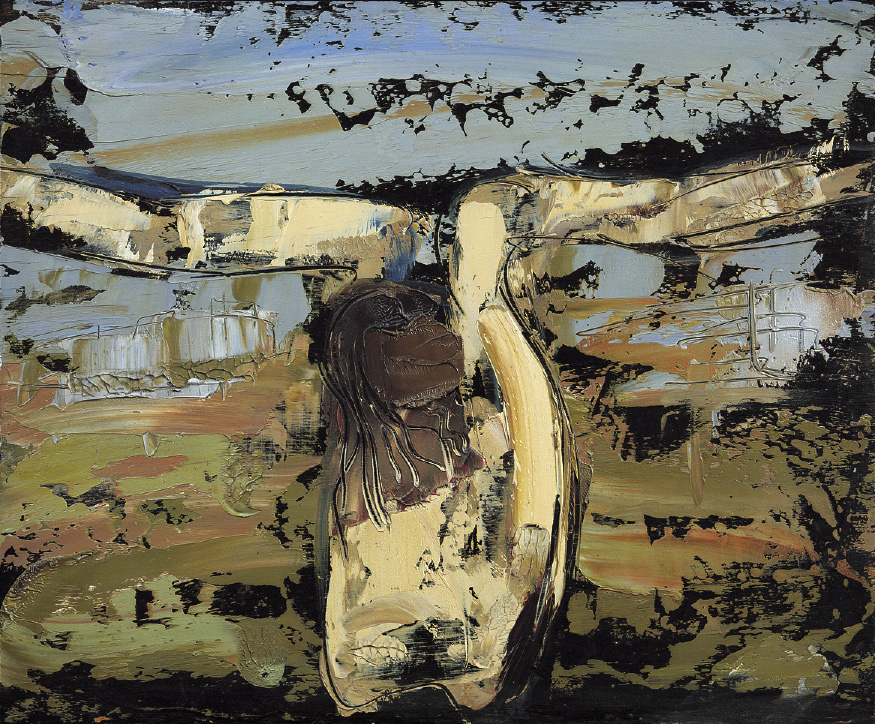
William Grosvenor Congdon (1912–1998) was a modern American artist, often classified as an abstract expressionist, who spent much of his life in Italy after World War II. He converted to Catholicism in 1959 and for the next two decades painted dozens of Crucifixions, which became more and more abstract as he went on. The one above is one of his earliest, and the subject is still easily recognizable.
Christopher Reardon explains how Congdon achieved the thick surface textures of his paintings:
Typically Congdon applied paint with a palette knife, then incised the encrustations of oil with a jackknife or awl. The technique suited him to the end. “With a brush, it’s a kiss,” he said after painting one of his final landscapes last winter [1997]. “You have to fight with a knife.”
This technique contributes to the agitated feel of many of his Crucifixion paintings.
Coleridge-Taylor Perkinson (1932–2004) was a prodigious American composer whose work spans many genres, including classical, jazz, pop, film, television, and dance. After receiving his bachelor’s and master’s degrees from the Manhattan School of Music, he cofounded the Symphony of the New World in New York in 1965 and later became its music director. He was also music director of Jerome Robbins’s American Theater Lab and the Alvin Ailey American Dance Theater.
Perkinson composed his first string quartet when he was twenty-three, basing it on the melody of the African American spiritual “Calvary.” It’s in three movements, which together capture the light and shade of the Crucifixion event:
I. Allegro II. Quarter note = 54 (video time stamp: 5:40) III. Rondo: Allegro vivace (video time stamp: 10:36)
The performance above is by the Grammy-winning Catalyst Quartet. It was part of the “Uncovered” series they played last year at The Greene Space at WNYC & WQXR, comprising three free concerts of work by five historically important Black composers: Florence B. Price, Jessie Montgomery, Coleridge-Taylor Perkinson, George Walker, and Samuel Coleridge-Taylor (Perkinson’s namesake!). View the full concert series here.
I wanted to show a performance caught on video so that you can better see how the instruments interact with one another, but for an album recording, see Perkinson: A Celebration (2000), where the piece is performed by the New Black Music Repertory Ensemble Quartet. I include two of the movements, in addition to the Calvary Ostinato from Perkinson’s Black Folk Song Suite, on my Holy Week Playlist.
Craigie Aitchison (Scottish, 1926–2009), Sheep in the Moonlight, 1999. Screenprint in colors, edition of 75 in white ink, on black wove paper, 17 7/8 × 15 in. (45.5 × 38 cm) (full sheet, framed).
LISTEN: “There Is a Green Hill Far Away” | Words by Cecil Frances Alexander, 1848
There is a green hill far away, Without a city wall, Where the dear Lord was crucified, Who died to save us all.
We may not know, we cannot tell, What pains he had to bear, But we believe it was for us He hung and suffered there.
There was no other good enough To pay the price of sin. He only could unlock the gate Of heav’n and let us in.
Oh, dearly, dearly has he loved! And we must love him too, And trust in his redeeming blood, And try his works to do.
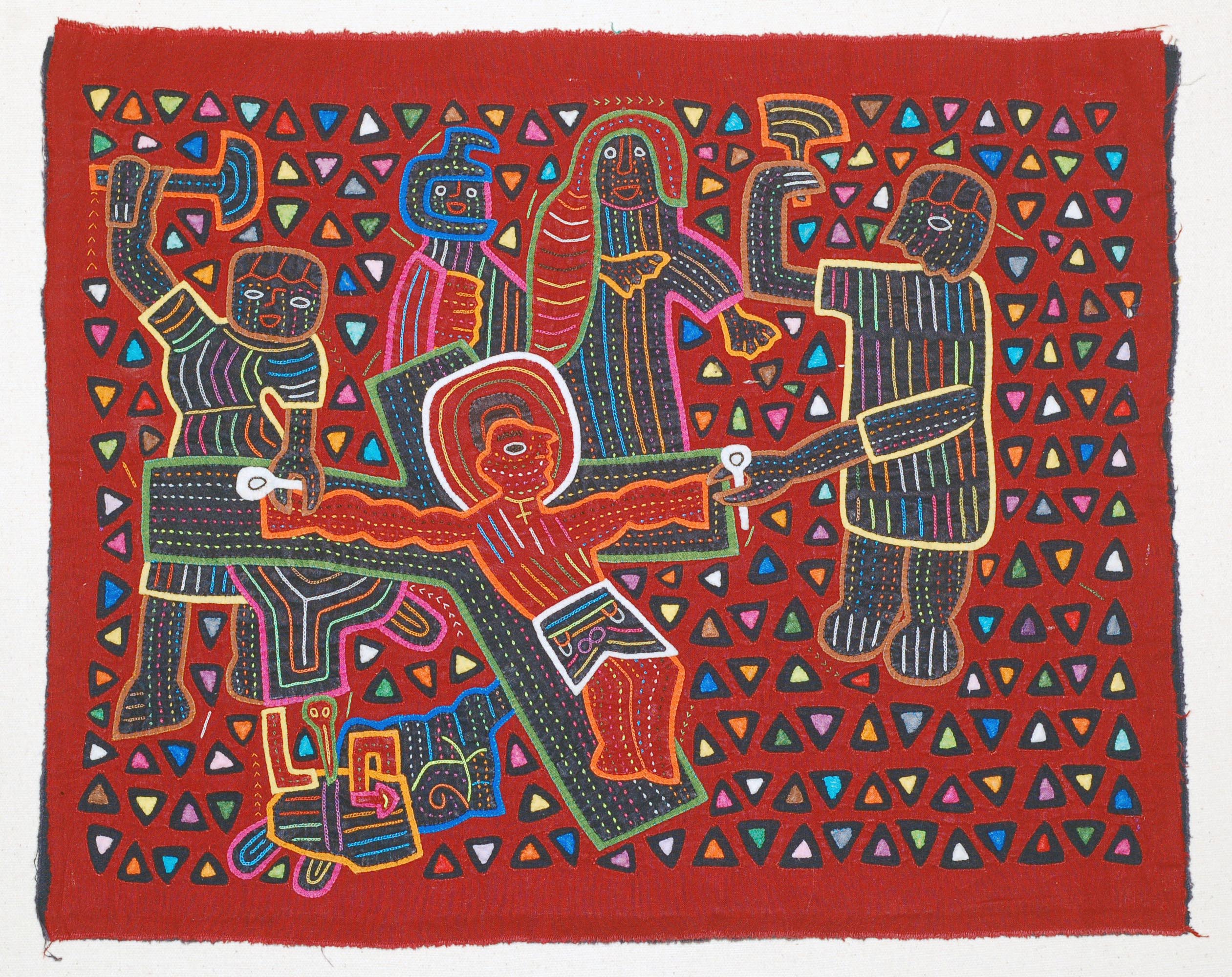
Christ Nailed to the Cross, mola (reverse appliqué panel) from the San Blas Islands, late 20th century. Bowden Collections.
The Kuna (also spelled Guna or Cuna) Indians live on the San Blas archipelago off the east coast of Panama, a cluster of some 378 islands in the Caribbean Sea. They are politically autonomous, and much of their traditional culture is intact.
Since the late nineteenth century, Kuna women have been making what are called molas, reverse appliqué panels made in pairs for the front and back of women’s blouses. As mola collector Jane Gruver describes, “several layers of cloth are stacked together and the design is made by cutting through the different layers of fabric to expose the desired color. Once the specific shape is achieved, the area is stitched around. Sometimes embroidery and applique are also used to add detail.” This colorful, wearable textile art is an integral part of Kuna culture.
The earliest molas featured geometric designs, which the Kunas translated from their customary body painting designs, but now a vast variety of representational subjects are common, including animals, plants, domestic scenes, political satire, dragons, mermaids, superheroes, spacecraft—and biblical stories!
The first Christian missionary to the San Blas Islands was Annie Coope, a single woman from the United States who arrived in the first decade of the 1900s and established a school on the island of Nirgana in 1913. A significant number of the Kuna embraced Christianity, such that there are now churches on thirty of the islands, as well as eighteen Kuna churches in and around Panama City, according to Wycliffe. A Kuna translation of the New Testament was published in 1995, at the behest of Kuna pastor Lino Smith Arango, and a Kuna Old Testament was completed in 2014.
The mola above shows two men hammering nails into Christ’s palms as two mourning figures—presumably John and Mary—stand behind. This piece is from the collection of Sandra and Bob Bowden in Chatham, Massachusetts, who are among today’s major collectors of modern biblical art. It is one of forty molas in the traveling exhibition Eden to Eternity: Molas from the San Blas Islands, available for rental for a nominal fee.
How condescending and how kind Was God’s eternal Son! Our mis’ry reached his heav’nly mind, And pity brought him down.
When justice, by our sins provoked, Drew forth its dreadful sword, He gave his soul up to the stroke Without a murmuring word.
He sunk beneath our heavy woes, To raise us to his throne; There’s ne’er a gift his hand bestows But cost his heart a groan.
This was compassion like our God, That when the Savior knew The price of pardon was his blood, His pity ne’er withdrew.
Now though he reigns exalted high, His love is still as great: Well he remembers Calvary, Nor should his saints forget.
Here we behold his bowels roll, As kind as when he died; And see the sorrows of his soul Bleed through his wounded side.
Here we receive repeated seals Of Jesus’ dying love; Hard is the heart that never feels One soft affection move.
Here let our hearts begin to melt While we his death record, And with our joy for pardoned guilt, Mourn that we pierced the Lord.
Virginia musician Timothy Seaman plays a variety of instruments, including the hammered dulcimer, mountain dulcimer, various flutes and whistles, bowed and plucked psalteries, and guitar. He has recorded fifteen albums featuring his instrumental arrangements of traditional music (especially American mountain and Scots-Irish tunes), as well as original compositions, many of them inspired by local wildlife and nature and by the Christian faith. He has eight years’ worth of videos on his YouTube channel, a mix of tutorials and informal performances. For this time of year especially, I’d also commend to you another of his Appalachian folk hymn arrangements, “Behold the Lamb of God” on hammered dulcimer.
Of “Condescension,” he writes,
In 1986 I found this profound folk hymn in an old book, and I’ve loved to play and sing it ever since—but not till now have I recorded it. I’ve considered ensemble arrangements with intriguing chords and rhythms, etc., but I keep coming back to a cappella bamboo flute, or voice. Here it is in its instrumental form! The tune is anonymous, and the words are by the master hymn writer Isaac Watts.
The mention of rolling bowels in the sixth stanza may sound strange to us today (sounds like a digestive issue!), but traditionally, the bowels were regarded as the seat of tender and sympathetic emotions—felt in the gut. Several of the biblical authors mention the moving of that organ in relation to yearning, anguish, compassion, or mercy (e.g., Gen. 43:30; Isa. 63:15; Jer. 4:19; 1 John 3:17). The KJV translation preserves the expression, still commonly used in the seventeenth century, with literalness, translating the Hebrew mēʿêand Greek splagchnon as either “bowels,” “belly,” or “inward parts.” Today we locate such emotions in the heart instead.
This stanza is actually my favorite in the hymn. There’s such a poetic quality to it! Watts is meditating on Christ exalted, who is not at all impassive in that high estate, but rather is still moved to compassion for humanity, every bit as much as when he hung on the cross. He still bears the wounds of crucifixion, and, in a figurative sense, those wounds still bleed for us.
Here we behold his bowels roll, As kind as when he died; And see the sorrows of his soul Bleed through his wounded side.
Fernando Botero (Colombian, 1932–), Cabeza de Cristo (Head of Christ), 1976. Oil on canvas, 185 × 179 cm. Museo de Antioquia, Medellín, Colombia.
Colombian painter and sculptor Fernando Botero is South America’s best-known artist. He is influenced by the Old Masters, which he studied in his twenties in Madrid, Paris, and Florence, and by the Mexican muralists. But his style—marked by plump, often childlike figures—is distinctively his own and has even been given the name “Boterismo.”
Throughout his career he has remained adamant that he does not paint “fat people” or “chubbies.” What he paints, he insists, is exaggerated volumes that highlight the body’s natural shape and the “sensuality of form.” In addition to religious subjects, he also paints Latin American street scenes, domestic life, nudes, and political portraits.
At age eighty-nine, Botero continues to be active as an artist, living and working between Paris, New York, and Tuscany.
LISTEN: “Legend (The Crown of Roses),” Op. 54, No. 5, by Pyotr Ilyich Tchaikovsky, 1883/89 | Based on a text by Richard Henry Stoddard, 1856 | Performed by the University of Pretoria Camerata, dir. Michael Barrett, on Written in the Stars, 2021
When Jesus Christ was yet a child He had a garden small and wild, Wherein he cherished roses fair, And wove them into garlands there.
Now once, as summer-time drew nigh, There came a troop of children by, And seeing roses on the tree, With shouts they plucked them merrily.
“Do you bind roses in your hair?” They cried, in scorn, to Jesus there. The Boy said humbly: “Take, I pray, All but the naked thorns away.”
Then of the thorns they made a crown, And with rough fingers pressed it down. Till on his forehead fair and young Red drops of blood like roses sprung.
In 1877 Tchaikovsky found a Russian poem by Aleksey Pleshcheyev published in a journal; it was a translation of the English-language poem “Roses and Thorns” (1856) by American poet Richard Henry Stoddard, an allegory of the Crucifixion. It’s about the boy Jesus who tends a rose garden and dreamily weaves together crowns from the branches’ yield. One day a bunch of rowdy children comes by and carelessly yanks the flowers off the bushes, scoffing at Jesus for being soft, a flower lover. In a spirit of gentleness, he tells them they may have the flowers, but to leave the thorns. Continuing their derision, the children bend the bare, thorny stems into a crown and press it into Jesus’s head. From his flesh then bloom “roses” of blood.
Tchaikovsky first set the Russian poem to music in 1883, arranging it for solo voice and piano and publishing it as part of his Sixteen Songs for Children, Opus 54. In 1884 he arranged it for solo voice and orchestra, and in 1889 for unaccompanied choir.
When English-language choirs sing the song, instead of using Stoddard’s original text, they typically use a 1913 adaptation by British poet Geoffrey Dearmer—which I believe is the superior version. See a side-by-side presentation of the song’s textual history.
Abba Macarius was asked, ‘How should one pray?’ The old man said, ‘There is no need at all to make long discourses; it is enough to stretch out one’s hands and say, “Lord, as you will, and as you know, have mercy.” And if the conflict grows fiercer say, “Lord, help!” He knows very well what we need and he shews us his mercy.
English translation: Jesus, Jesus, Son of God, have mercy, have mercy on us.
I don’t know the name of this vocal ensemble, when the recording was made, or the origin of the melody they sing. (Can anyone help me out there?)
The text, though, is a famous one, used regularly in the Eastern Orthodox tradition and known as the Jesus Prayer, or the Prayer of the Heart. It originated with the early Christian monks of the Egyptian desert around the fifth century, and was first written down in Greek. Another variation is “Lord Jesus Christ, Son of God, have mercy on me, a sinner.”
An invocation of Christ’s name and presence, the Jesus Prayer is meant to be recited in repetition as a form of meditative prayer. Some Christians use it in conjunction with a breath prayer, breathing in as they say internally, “Jesus, Son of God,” and breathing out on “have mercy.”
It’s most often prayed in the first-person singular—“have mercy on me”—and used in private devotions, but in this corporate chant on the video, it’s prayed in the first-person plural, “us.” In light of Russia’s recent invasion of Ukraine and the war being fought there, I hear in these Ukrainian women’s voices a lament for their country.
Lord, have mercy. Spare the Ukrainian people. Stop the violence and destruction. Protect, provide. Heal the wounded and the traumatized, and comfort the grieving. Thwart the evildoers; turn their hearts to you in repentance. Grant wisdom to the leaders working for peace. In short: “Lord, help!”
The folk icon featured above is by contemporary Ukrainian artist, art historian, and curator Roman Zilinko, who works at the Andrey Sheptytsky National Museum in Lviv. “My artworks continue the tradition of the Ukrainian icon painting of the Carpathian region, which flourished in the 16th and 19th centuries,” Zilinko says. Its distinctive features are “naive and flat painting, but rich in colors and ornaments.” To view more of Zilinko’s icons, click here.
The above icon shows a religious procession, with two people carrying khorugvs (religious banners)—one of the Virgin Mary and Child, one of Christ Pantocrator. Foregrounded in the center is Christ, crucified on a tree that recalls the tree of life from Revelation 22, whose leaves are for the healing of nations. The suffering Christ goes before the people and is right in their midst. He is their companion, their deliverer, their wounded healer, their life.
Zilinko has named the icon The Parable of the Mustard Seed, after Jesus’s saying about how the kingdom of heaven starts out small but then grows into something enormous and lush (Matt. 13:31–32). Christ has indeed grown his church mightily in Ukraine; Christianity has been the primary religion there since the tenth century. Zilinko portrays the Christians of Ukraine as a sea of people who stand behind their Savior with hands clasped in prayer and faces radiant with hope.
Let us join them in intercession for a swift end to the war and lasting peace in the region, and for the ability of refugees to return home.
If you find yourself at a loss for words, I suggest praying the Jesus Prayer from the video.
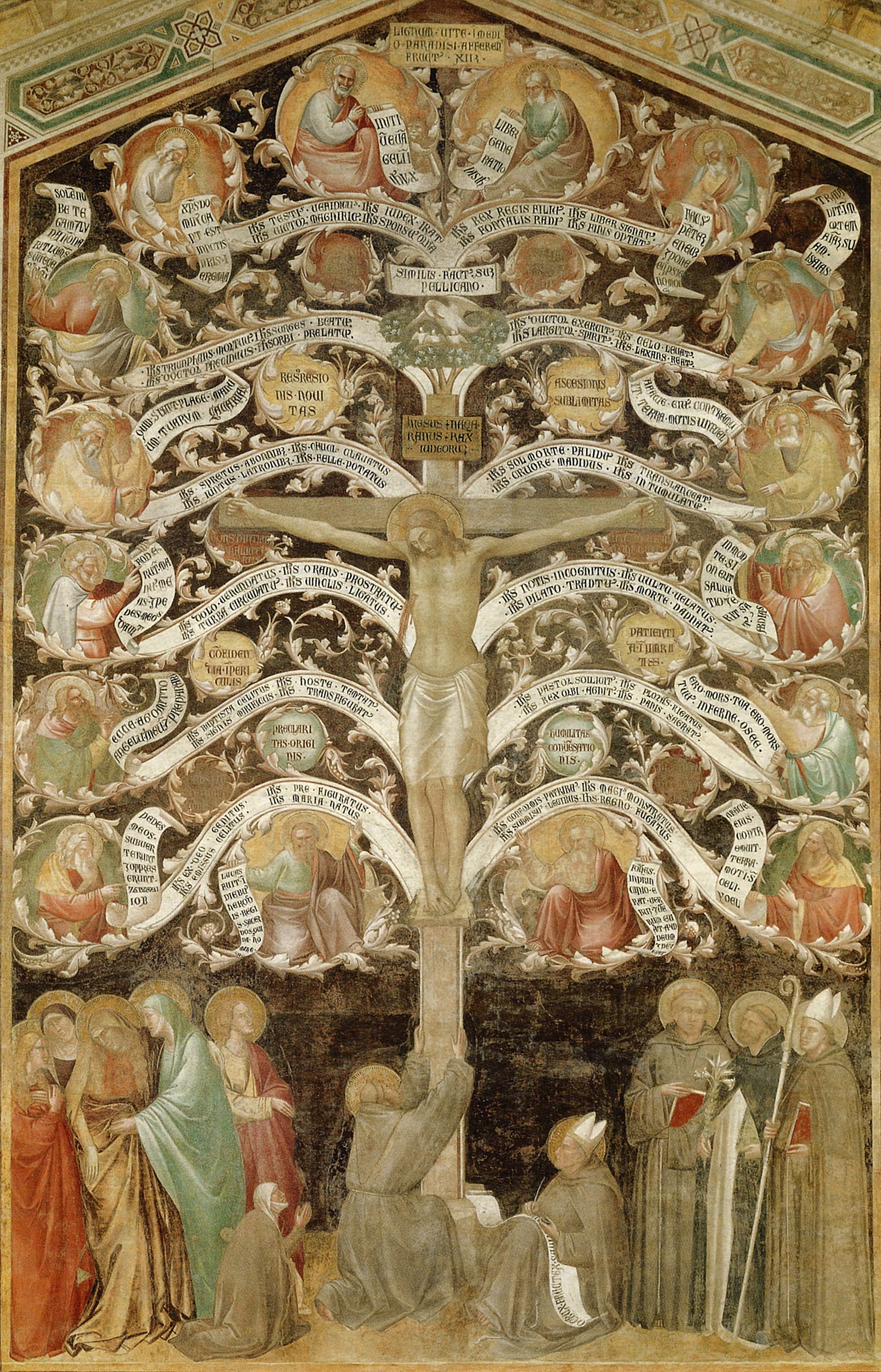
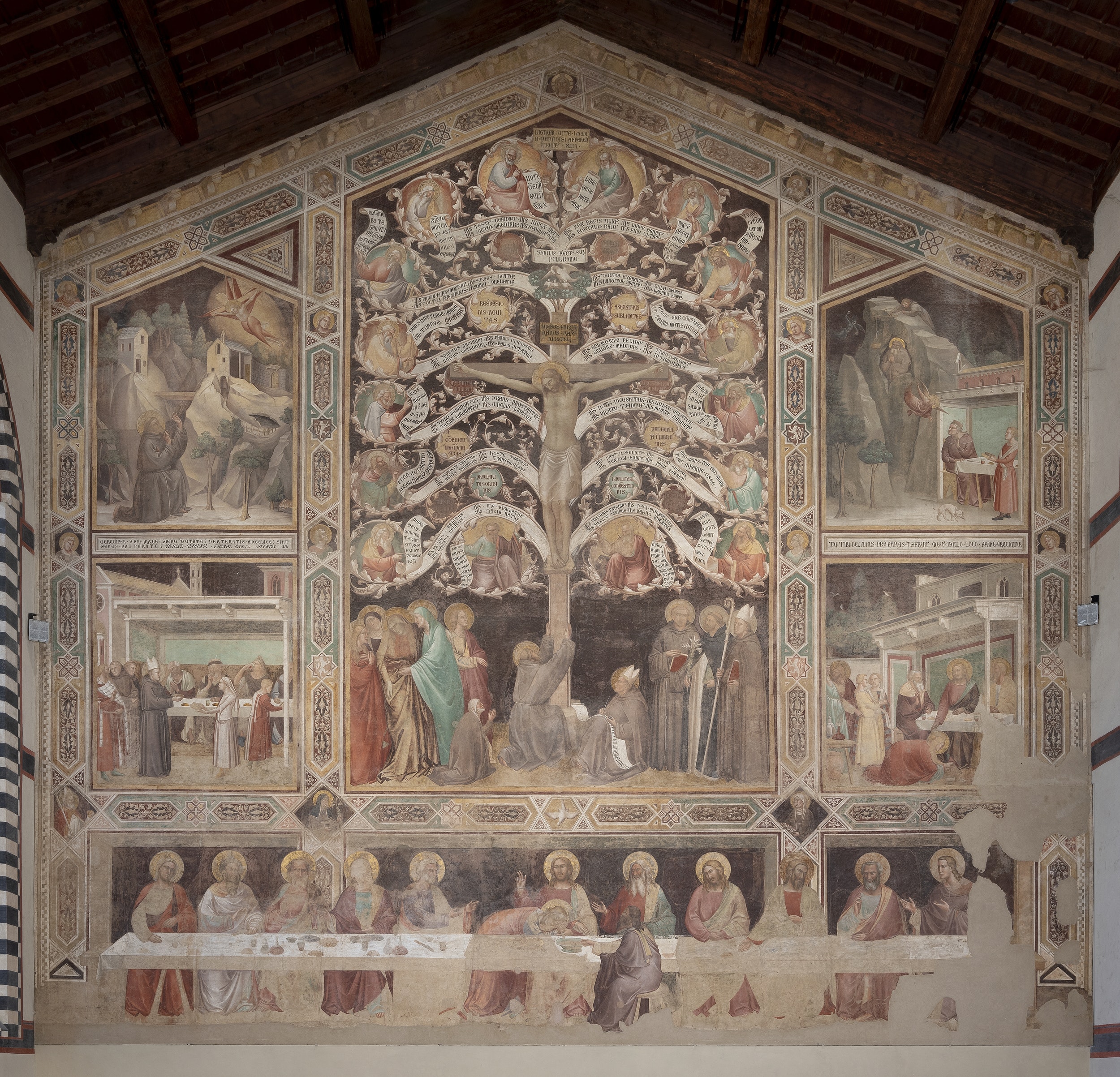
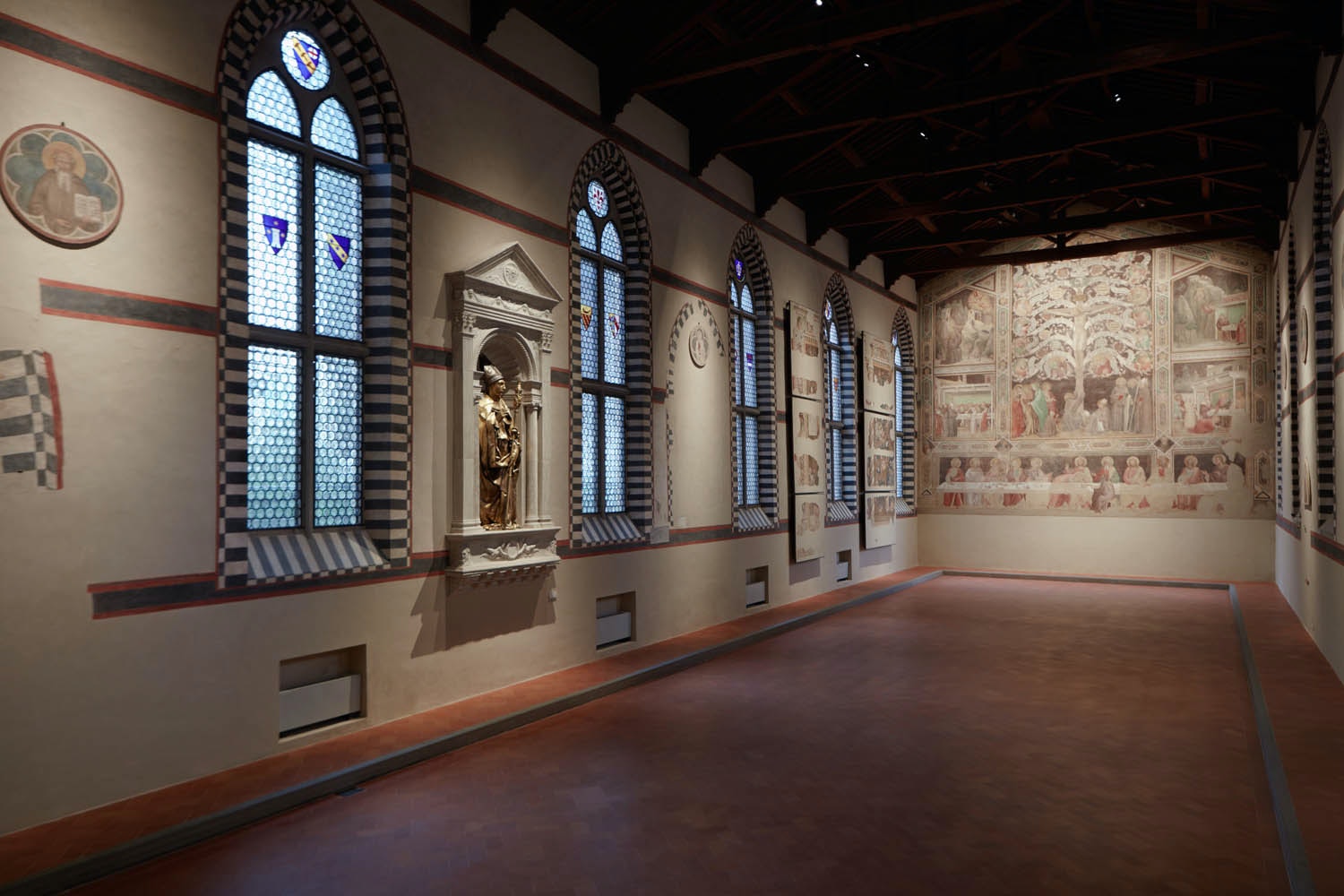
Taddeo Gaddi (Italian, 1290–1366), Tree of Life, ca. 1350. Fresco painted for the refectory of the Franciscan church of Santa Croce in Florence (now a museum).
The Lignum Vitae (Tree of Life) by Bonaventure, an early Franciscan theologian from Bagnoregio, Italy, is a meditational treatise on the life of Christ. It asks readers to picture in their minds a tree bearing twelve fruits (cf. Rev. 22:2), its roots watered by an ever-flowing stream. Standing for specific attributes of Christ or events from the Gospels, “this fruit is offered to God’s servants to be tasted so that when they eat it, they may always be satisfied, yet never grow weary of its taste,” Bonaventure writes. “I call these fruits because they delight with their rich sweetness and strengthen with their nourishment the soul who meditates on them and diligently considers each one.” The chapter outline, organized by “fruit,” is as follows (translation by Ewert Cousins):
PART I. ON THE MYSTERY OF HIS ORIGIN
First Fruit: His Distinguished Origin
Jesus Begotten of God Jesus Prefigured Jesus Sent from Heaven Jesus Born of Mary
Second Fruit: The Humility of His Mode of Life
Jesus Conformed to His Forefathers Jesus Shown to the Magi Jesus Submissive to the Law Jesus Exiled from His Kingdom
Third Fruit: The Loftiness of His Power
Jesus, Heavenly Baptist Jesus Tempted by the Enemy Jesus Wonderful in His Miracles Jesus Transfigured
Fourth Fruit: The Plenitude of His Piety
Jesus, the Solicitous Shepherd Jesus Bathed with Tears Jesus Acclaimed King of the World Jesus, Consecrated Bread
PART II. ON THE MYSTERY OF HIS PASSION
Fifth Fruit: His Confidence in Trials
Jesus Sold through Guile Jesus Prostrate in Prayer Jesus Surrounded by the Mob Jesus Bound with Chains
Sixth Fruit: His Patience in Maltreatment
Jesus Denied by His Own Jesus Blindfolded Jesus Handed Over to Pilate Jesus Condemned to Death
Seventh Fruit: His Constancy Under Torture
Jesus Scorned by All Jesus Nailed to the Cross Jesus Linked with Thieves Jesus Given Gall to Drink
Eighth Fruit: Victory in the Conflict of Death
Jesus, Sun Dimmed in Death Jesus Pierced with a Lance Jesus Dripping with Blood Jesus Laid in the Tomb
PART III. ON THE MYSTERY OF HIS GLORIFICATION
Ninth Fruit: The Novelty of His Resurrection
Jesus Triumphant in Death Jesus Rising in Blessedness Jesus, Extraordinary Beauty Jesus Given Dominion over the Earth
Tenth Fruit: The Sublimity of His Ascension
Jesus, Leader of His Army Jesus Lifted Up to Heaven Jesus, Giver of the Spirit Jesus Freeing from Guilt
Jesus, King, Son of the King Jesus, Inscribed Book Jesus, Fountain-Ray of Light Jesus, Desired End
Written in Latin around 1260, the Tree of Life became an instant classic, giving rise to many visual representations—first in manuscript miniatures, then in panel paintings and large-scale frescoes, including one by the Florentine artist Taddeo Gaddi.
Painted in the mid-fourteenth century in the refectory (dining room) of the Franciscan church of Santa Croce in Florence, the fresco depicts, in its central register, Christ crucified, with twelve scrolls unfurling from the vertical shaft like branches on a tree. On these scrolls, inscribed in Latin, are all the subheadings from Bonaventure’s treatise—IHS EX DEO GENITUS, IHS PREFIGURATUS, and so on, where “IHS” is an abbreviation for the name Jesus. Leafy roundels bear the names of the twelve “fruits,” and others feature busts of prophets.
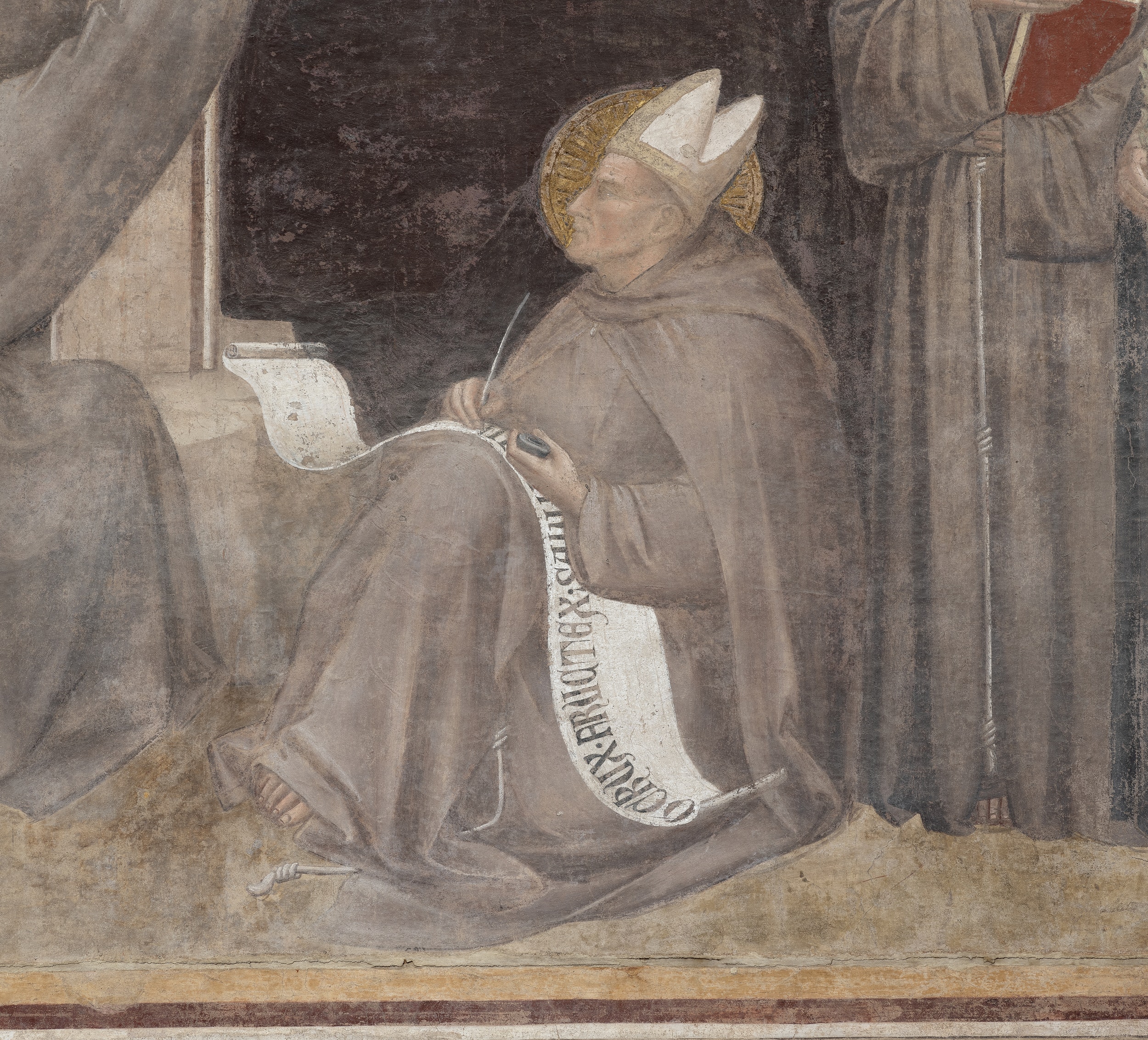
At the bottom of the cross is the Virgin Mary supported by three other women; St. John the Evangelist; the fresco’s patron, probably Vaggia Manfredi, kneeling in prayer; St. Francis, hugging the cross; St. Bonaventure, writing, “O crux, frutex salvificus, / Vivo fonte rigatus, / Quem flos exornat fulgidus, / Fructus fecundat gratus”; St. Anthony of Padua; St. Dominic; and St. Louis of Toulouse.
LISTEN: “O Crux (Frutex Salvificus)” | Original Latin words by Bonaventure, 13th century; translated into English by James Monti | Music by Elizabeth Duffy | Performed by Sister Sinjin on Incarnation (2016; reissued 2019)
O Cross, salvific stem, The watering, living fount, Whose blossom is fragrant, Whose fruit is longed for.
Jesus, begotten of God, Jesus foreshadowed, Jesus sent from heaven, Jesus born of Mary.
Jesus with the patriarchs, Jesus shown the magi, Jesus subject to the law, Jesus from your kingdom.
Jesus holy in the womb, Jesus tempted by Satan, Jesus wondrous in the signs, Jesus transfigured.
Jesus the good shepherd, Jesus sprinkled with tears, Jesus King of the world, Jesus Sacred Bread.
The Sister Sinjin song “O Crux (Frutex Salvificus)” layers the sixteen subheadings from part 1 of Bonaventure’s Tree of Life, “On the Mystery of His Origin,” with the first stanza of a poem that appears in different forms in the various manuscripts of Bonaventure’s works, including the Tree of Life. Another translation of this refrain’s source text, by José de Vinck, is “O cross, tree bearing the fruit of salvation / Refreshed by a living stream / Your blossom so sweetly scented / Your fruit so worthy of desire.”
Detail from Taddeo Gaddi’s Tree of Life. Contemplating the Crucifixion, Bonaventure pens one of his famous poetic lines, “O CRUX FRUTEX SALVIFICUS” (“O cross, tree bearing the fruit of salvation”).
The melody and stylings of the song are evocative of the Middle Ages. Elizabeth Duffy, Kaitlyn Ferry, and Elise Erikson Barrett sing to their own gentle guitar, mandolin, and banjo accompaniment.
For another Advent devotion featuring Sister Sinjin and an even older Italian fresco, see here.
NEW PLAYLIST: October 2021 (Art & Theology): This month’s playlist includes a benediction from the book of Jude; a percussion-driven setting of Francis of Assisi’s “Canticle of the Sun” by the Camaldolese monk Cyprian Consiglio; an Exodus-inspired song in Yorta Yorta, an indigenous Australian language, from the feature film The Sapphires; “Prodigal Son,” a little-known hymn by John Newton, from The Sacred Harp; a sixties gospel song by Shirley Ann Lee (famously covered by Liz Vice on her debut album); and closing out, in anticipation of All Saints’ Day on November 1, the jazz standard “When the Saints Go Marching In.” To save the playlist to your Spotify account, click the ellipsis and select “Add to Your Library.”
+++
IN-PERSON LECTURE: “The Works of Art in the Work of the Church” by John Skillen, October 16, 2021, Crownsville, MD: The Eliot Society, an organization I work for, is hosting our first event in over a year and a half! It’s an art talk by Dr. John Skillen [previously], director of the Studio for Art, Faith & History in Orvieto, Italy. It will be at the home of two of our board members, so if you’re in the Washington–Baltimore metropolitan area two weekends from now, consider coming by! The event starts with hors d’oeuvres at 6:30 p.m., and an RSVP is requested.
In recent decades, a growing number of Christians—even those from church traditions formerly suspicious of the arts—are warming up to the idea that artworks can serve in the various practices of the life of faith, and not only in iconographic form as images of Jesus in worship. Scripturally sound and aesthetically sophisticated works of art can guide our prayer, help catechize our children, and shape the environments of our missional work. Many of us will welcome some pointers for putting art back in its place in the settings where we live and work.
To help us imagine possibilities, John Skillen will offer examples from a long period of Christian history when the arts were put to work in the collective life of the church in more places and in more ways than most of us nowadays can imagine. Not only churches but also hospitals, orphanages, the meeting rooms of parachurch organizations, baptisteries and bell towers, dining halls and cloisters in monasteries, town halls and civic fountains and public squares—all were places of serious decoration and design expected to be compatible with Christian faith.
No sphere of religious and civic life was off-limits for imagery able to instruct, to prompt memory, and to inspire emotion and action—the three functions of art most commonly cited during the Middle Ages to defend its value.
+++
UPCOMING ONLINE CONVERSATIONS:
Marc Padeu (Cameroonian, 1990–), Le souper a Penja, 2019. Acrylic on canvas, 82 7/10 × 106 3/10 in. (210 × 270 cm).
>> “Caravaggio in Cameroon: Marc Padeu and Jennifer Sliwka in Conversation,” October 14, 2021,11 a.m. EST (4 p.m. BST): I spoke about Padeu’s Le souper a Penja at a recent seminar on “Picturing Jesus,” so I’m looking forward to hearing the artist himself discuss it along with the larger body of work it’s a part of. Hosted by the National Gallery in London.
Artist Marc Padeu lives and works in Cameroon. Intriguingly, his monumental paintings – exploring tender and complex relationships between family, friends, lovers and working communities – often draw on Italian Baroque compositions and especially those of Caravaggio.
Marc Padeu joins Dr Jennifer Sliwka, specialist in Italian Renaissance and Baroque art. Her research explores how 17th-century painters developed innovative approaches to religious painting, imbuing their works with an immediacy, power, and dynamism.
Together, the speakers will take Padeu’s Le Souper a Penja and its relationship to Caravaggio’s Supper at Emmaus as a jumping-off point for conversation, exploring Padeu’s wider interest and understanding of historical works, his adoption and adaptation of the visual language of the Baroque and how these inform his evocations of contemporary life in Cameroon.
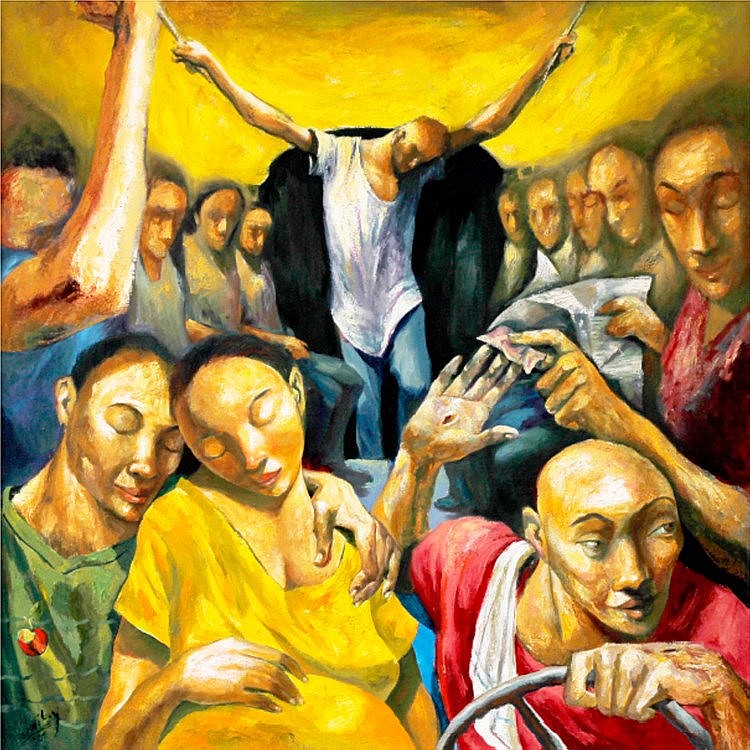
>> “In the Studio with Emmanuel Garibay,” November 11, 2021, 8:30 a.m. EST: The Overseas Ministries Study Center at Princeton Theological Seminary is hosting a conversation with Filipino artist Emmanuel “Manny” Garibay, a social realist painter who served as the 2010–2011 OMSC artist in residence. “It is the richness of the poor that I am drawn to and which I am a part of, that I want to impart,” he says. His paintings often portray Jesus among the marginalized and dispossessed and critique the church’s “compliance with greed, corruption, and social inequality.” Garibay’s children Alee, Nina, and Bam, who are also accomplished artists, will be present for the conversation as well. For more on Garibay, see this Q&A from the OMSC and the Image journal essay “Recognizing the Stranger: The Art of Emmanuel Garibay” by Rod Pattenden.
Emmanuel Garibay (Filipino, 1962–), Kaganapan, 2006. Oil on canvas, 48 × 48 in. (122 × 122 cm).
>> “Psalm 91” by Poor Bishop Hooper, released as part of the EveryPsalm project, through which the duo offers original weekly Psalm-based songs for free download:
MAVCORJournal is an open-access, peer-reviewed digital publication published by the Center for the Study of Material and Visual Cultures of Religion at Yale University. Its “Object Narrative” division is for explicating religious images, objects, monuments, buildings, spaces, performances, or sounds in 1500 words or less.
Visual culture encompasses not just “art” but also ephemera and what we might call “kitsch.” Because my field is art, I gravitate more to research in that vein, which is reflected in the five object narratives I’ve selected to highlight below. In addition to describing the object’s content, each writer also addresses, if applicable, its liturgical or devotional uses and includes relevant historical or cultural context. Click on the links to read more, and spend some time perusing the other offerings on MAVCOR’S website, https://mavcor.yale.edu.
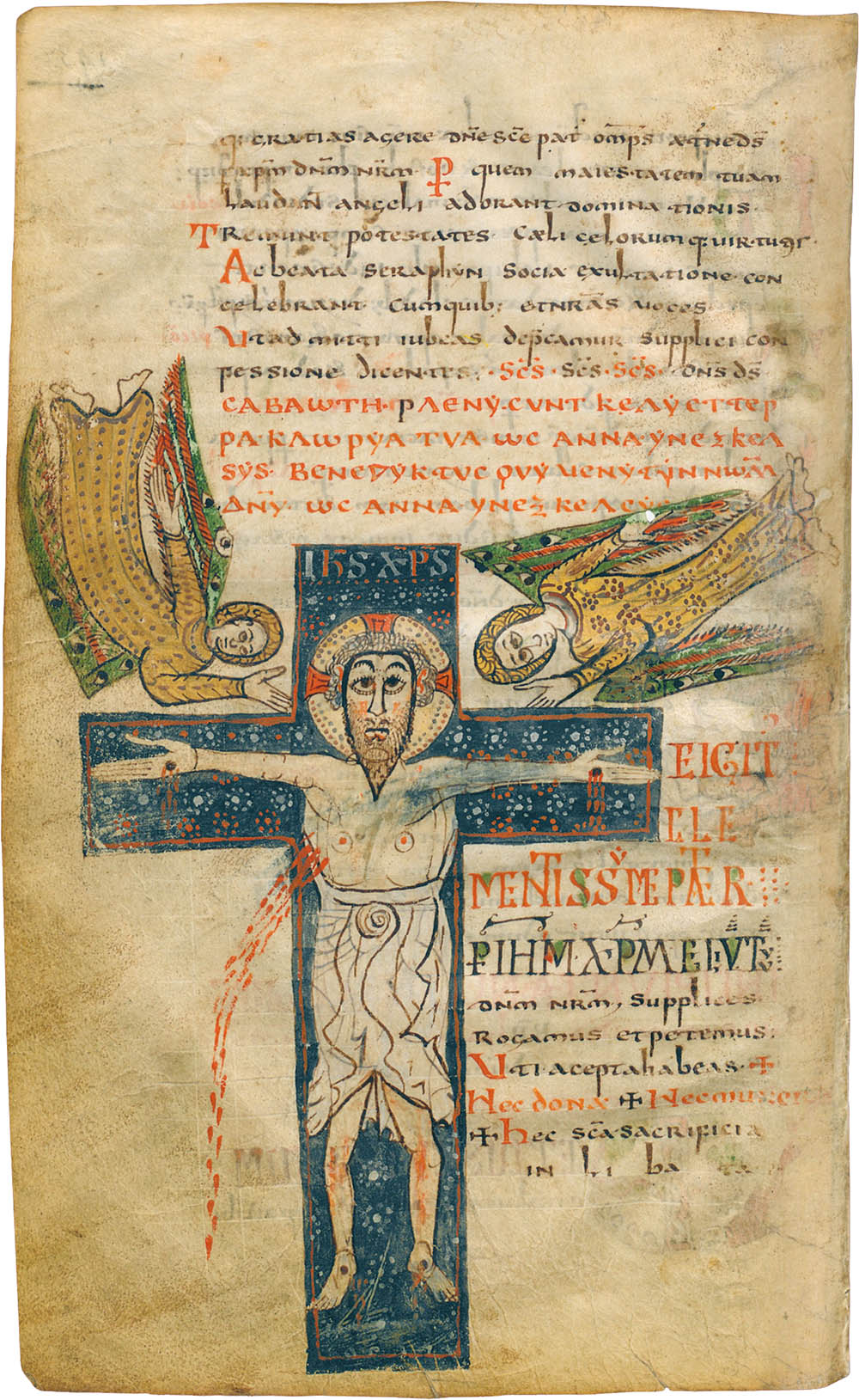
“Christ Crucified in the Gellone Sacramentary” by Lawrence Nees: This eighth-century manuscript illumination from the Frankish kingdom of Charlemagne is one of the earliest surviving images of Jesus on the cross, its viewership restricted to clergy. “He is . . . shown as if nailed to a cross, but this is no wooden cross and indeed no cross at all. It is colored deep blue, studded with white and red flower-like shapes suggesting stars, and indeed it actually is the letter T of the opening words of the Canon of the Mass, the consecration of bread and wine as the body and blood of Christ, in the Latin version here ‘Te igitur clementissime Pater . . . rogamus’ (‘Therefore we beseech Thee, most merciful Father’) . . .”
Crucifixion from the Gellone Sacramentary (Latin 12048, fol. 143v), made in France, ca. 790. Housed at the Bibliothèque nationale de France, Paris.
+++
“Kongo Triple Crucifix” by Cécile Fromont: The west central African kingdom of Kongo, which emerged in the fourteenth century, declared Christianity its official religion in 1509. Kongo participated in the commercial, political, and religious networks of the early modern Atlantic world, and its artists reformulated Christian figures from Europe into objects that are distinctly African—including the many brass crucifixes produced from the sixteenth through nineteenth centuries. (Read more in Fromont’s 2014 book The Art of Conversion: Christian Visual Culture in the Kingdom of Kongo, which I reviewed here.)
Triple Crucifix, central figure 16th–17th century; top and bottom figures 18th–19th century. Brass, iron nails, copper, wood, ultramarine pigment, 10 1/4 × 5 3/4 × 1 in. (26 × 14.5 × 2.5 cm). Metropolitan Museum of Art, New York.
+++
“Death Cart (La Muerte en su Carreta)” by Miguel de Baca: “Death carts” were instruments of penance used by the Penitente brotherhood of northern New Mexico and southern Colorado in the second half of the nineteenth century and the first half of the twentieth; this is the earliest known one. They were built in the style of an old oxcart, and seated inside was Doña Sebastiana, an allegorical figure of Death, wielding her bow and arrow. Each Good Friday, “an elected brother attached the heavy chassis to his torso with a horsehair rope and dragged it from the morada (meetinghouse) along the path to the calvario (Calvary site), inflicting abrasions upon his body as a demonstration of his faith and desire for closer union with God.” I must say, this skeletal figure with the close-set eyes and large forehead (and is that human hair and teeth?) terrifies me!
Nasario López, Death Cart (La Muerte en su Carreta), ca. 1860. Gesso, leather, cottonwood, pine, 51 × 24 × 32 in. (129.5 × 61 × 81.3 cm). Colorado Springs Fine Arts Center, Colorado Springs, Colorado.
“Georgia O’Keeffe, Black Cross with Stars and Blue”by Jeffrey Richmond-Moll: During a four-month stay in Taos, New Mexico, in the summer of 1929—her first visit to the Southwest—Georgia O’Keeffe painted four canvases of Penitente crosses with Taos Mountain visible in the distance. The Penitentes were a lay Catholic brotherhood whose rituals centered on the remembrance of Christ’s passion. They erected crosses all over the region, outside their moradas (meetinghouses) and along roadsides, which they picked up and carried on holy days.
Georgia O’Keeffe (American, 1887–1986), Black Cross with Stars and Blue, 1929. Oil on canvas, 40 × 30 in. (101.6 × 76.2 cm). Private collection.
+++
“James Latimer Allen, Madonna and Child” by Camara Dia Holloway: “Allen operated a studio in Harlem between 1926 and 1943, producing artistic and commercial photographs. . . . By contributing to the development of a new racial iconography, Allen’s Madonna and Child and other black Madonnas offered positive visual and material rejoinders to widely reproduced images that represented black women’s failure to parent their own children. The Mammy stereotype, the legend of Margaret Garner (known as the Black Medea), and portraits of white children held by their black nannies belong to this latter and negative set of portrayals.” This is a religious icon by and for African Americans, Latimer writes—one that reflects and affirms their own self-image.
James L. Allen (American, 1907–1977), Madonna and Child, 1930s. Photograph, 24.4 × 18.7 cm. New York Public Library.
In September 2019 I visited Atlanta, Georgia, and one of the two art stops I made was the Clark Atlanta University Art Museum, whose purpose is “to collect, preserve, research, and exhibit fine art works that document the role of African Americans in American history and culture.” When I got there I was bummed to see that the museum was closed in preparation for three exhibitions that were to open that Sunday. But graciously, even though the signage and lighting hadn’t been installed and some of the objects were still being moved around, the curator allowed me in for a little glimpse.
I was stopped in my tracks by a mixed media sculpture in the gallery of recent acquisitions: Float by Alfred Conteh.
Alfred Conteh (American, 1975–), Float, 2014. Steel, epoxy dough, thermoadhesive plastic, atomized steel dust, atomized bronze dust, urethane plastic, steel chain, 93 × 46 × 35 in. Clark Atlanta University Art Museum, Atlanta, Georgia. Photo: Victoria Emily Jones.
It shows a Black female Christ figure rising up in a whirl of energy, her hat blown aloft. Wounds are visible on her hands and feet, but these are taken up into new, greening life. At the bottom is a broken chain, indicating that she has been set free. The piece expresses the exhilaration of emancipation, of being shackled no more.
I would classify Float as a resurrection image, which its staging reinforces. To its far left is a wooden crucifix by Dilmus Hall, followed by The Mourners by Frederick C. Flemister, from 1942. (Note that the two crucifix photos in this post are courtesy of the Souls Grown Deep Foundation, who donated the pieces to the museum.)
Dilmus Hall (American, 1896–1987), Untitled, n.d. Wood, wood putty, plastic beads, and paint, 12 × 9 in. Clark Atlanta University Art Museum, Atlanta, Georgia. Photo: Stephen Pitkin / Pitkin Studio.Frederick C. Flemister (American, 1916–1976), The Mourners, 1942. Oil on canvas, 39 3/4 × 31 1/4 in. Clark Atlanta University Art Museum, Atlanta, Georgia. Photo: Victoria Emily Jones.
Drawing on iconography of the Lamentation over the Dead Christ, Flemister’s The Mourners shows a mother holding the corpse of her grown son, who has just been deposed from a lynching tree. Behind her a woman in a pink dress throws up her arms in grief, and a preteen boy runs into his own mother’s arms for comfort. Like many artists before and after him, Flemister connects the killings of innocent Black men to the killing of Jesus—not because their deaths are salvific but because both they and Jesus were unjustly “crucified,” and because Black men bear God’s image, which the visual conflation reminds us of. As Jesus told his disciples, “Truly, I say to you, as you did it to one of the least of these my brothers, you did it to me” (Matt. 25:40).
Death and resurrection, suffering and hope, are the theme of this temporary exhibition. A second wooden crucifix, by Thornton Dial Jr., adorns the opposite wall. It’s titled I’ll Be Back, which, as the sculpture was made a few years after The Terminator came out, may be a playful reference to Arnold Schwarzenegger’s famous line, but it is first and foremost an affirmation that Jesus will return to earth, as promised, to fully set things right. (By the way, I wonder if Conteh, in making Float, was inspired by the hubcap component of another of Dial’s crucifixes . . .)
Thornton Dial Jr. (American, 1953–), I’ll Be Back, 1988. Wood, metal, barbed wire, string, fabric, industrial sealing compound, enamel, nails, 35 × 32 × 6 3/4 in. Clark Atlanta University Art Museum, Atlanta, Georgia. Photo: Stephen Pitkin / Pitkin Studio.
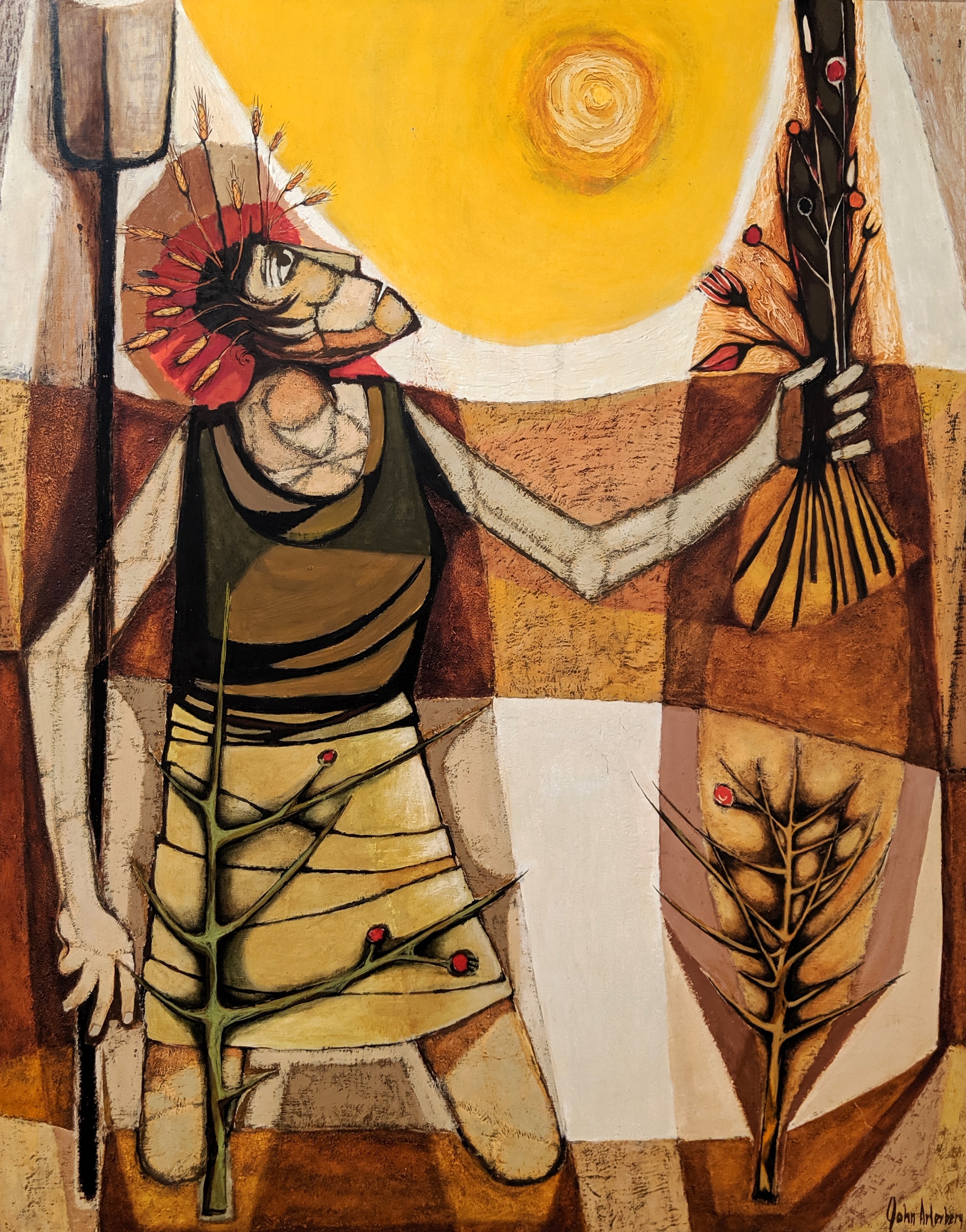
The last piece in the room is Ceres by John W. Arterbery. Ceres was the Roman goddess of agriculture, grain crops, and fertility, the equivalent of the Greek mother-goddess Demeter. In Arterbery’s painting she wears a crown of sprouting wheat stalks and holds a pitchfork in one hand and a leafless plant with buds and berries in the other. I think the flowers may be poppies, as Ceres is associated with those.
John W. Arterbery (American, 1928–1977), Ceres, 1963. Oil on Masonite, 60 × 47 1/2 in. Clark Atlanta University Art Museum, Atlanta, Georgia. Photo: Victoria Emily Jones.
It appears as though Arterbery is depicting the imminence of spring, when Ceres will be reunited with her daughter Proserpine (Persephone) and life will grow and flourish. It shows Ceres looking toward the sun in anticipation of such a time. Read in conjunction with the other pieces in the room, Ceres could be interpreted as an Advent image—a waiting for the final fulfillment of God’s good purposes for his creation, which includes a definitive end to suffering and oppression and a universal thriving.
The Clark Atlanta University Art Museum is typically open Tuesday through Friday from 11 a.m. to 4 p.m., as well as by appointment, but you may want to email ahead of time (cauArtMuseum@gmail.com) to confirm. It’s definitely worth a visit, though I can’t guarantee that the works featured here will be on display. If you wish to browse photos of pieces from the museum’s collection, see In the Eye of the Muses: Selections from the Clark Atlanta University Art Collection (2012).







 Art & Theology