Lent, Day 18

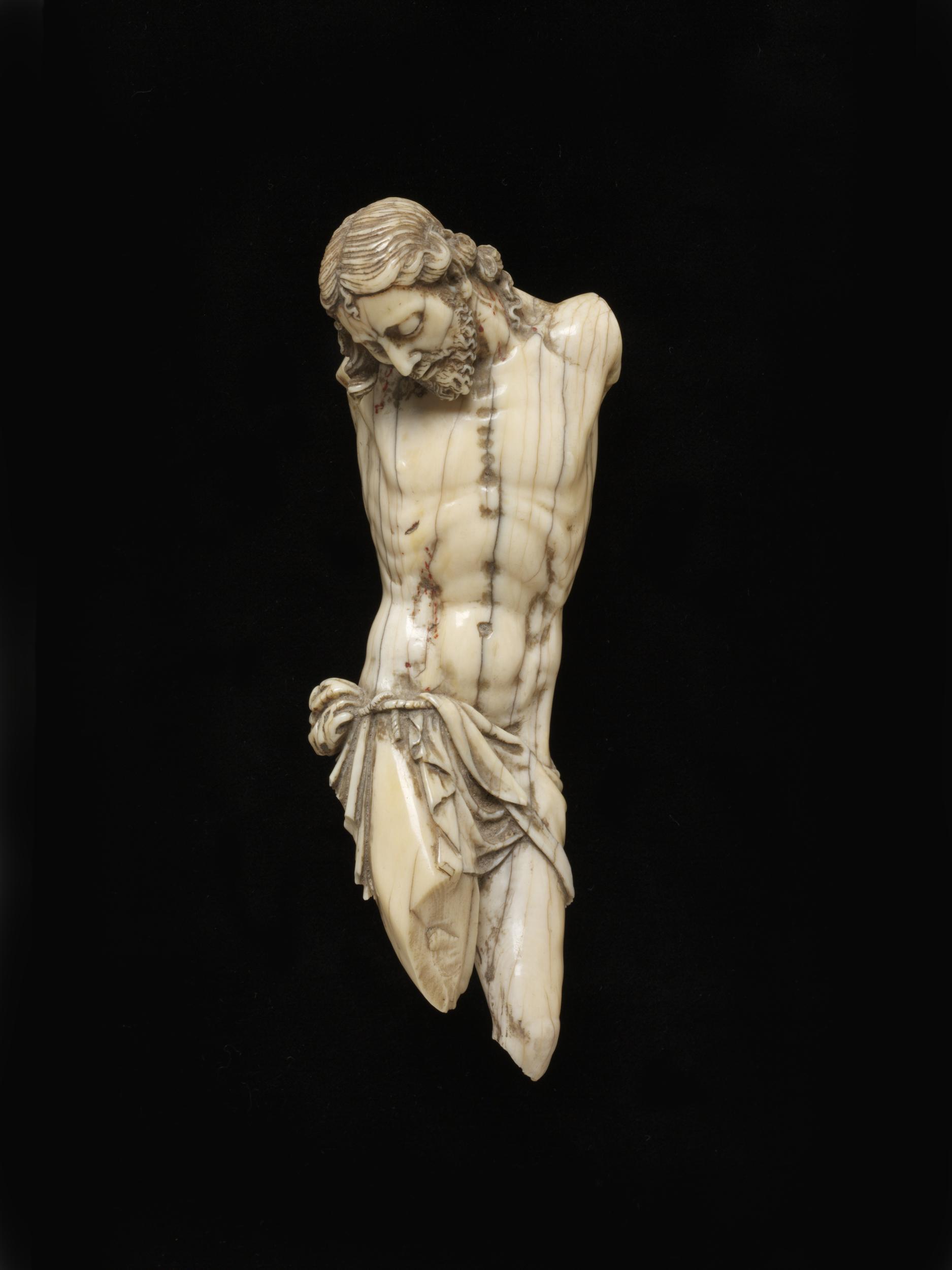
LOOK: Crucifix figure by Giovanni Antonio Gualterio
Gualterio, Giovanni Antonio_Crucifix figure
Giovanni Antonio Gualterio (Italian, active 1582–1600), Crucifix figure, ca. 1599. Ivory, h. 13.5 cm. Victoria and Albert Museum, London.

LISTEN: “Christ’s dying love; or, our pardon bought at a dear price” (aka “Condescension”) | Words by Isaac Watts, 1709 | Music: Appalachian shape-note tune, ca. 1800; published in The Southern Harmony, and Musical Companion (new edition, thoroughly revised and much enlarged), ed. William Walker, 1854 | Arranged and performed by Timothy Seaman on bamboo flute, 2021

How condescending and how kind
Was God’s eternal Son!
Our mis’ry reached his heav’nly mind,
And pity brought him down.

When justice, by our sins provoked,
Drew forth its dreadful sword,
He gave his soul up to the stroke
Without a murmuring word.

He sunk beneath our heavy woes,
To raise us to his throne;
There’s ne’er a gift his hand bestows
But cost his heart a groan.

This was compassion like our God,
That when the Savior knew
The price of pardon was his blood,
His pity ne’er withdrew.

Now though he reigns exalted high,
His love is still as great:
Well he remembers Calvary,
Nor should his saints forget.

Here we behold his bowels roll,
As kind as when he died;
And see the sorrows of his soul
Bleed through his wounded side.

Here we receive repeated seals
Of Jesus’ dying love;
Hard is the heart that never feels
One soft affection move.

Here let our hearts begin to melt
While we his death record,
And with our joy for pardoned guilt,
Mourn that we pierced the Lord.

Virginia musician Timothy Seaman plays a variety of instruments, including the hammered dulcimer, mountain dulcimer, various flutes and whistles, bowed and plucked psalteries, and guitar. He has recorded fifteen albums featuring his instrumental arrangements of traditional music (especially American mountain and Scots-Irish tunes), as well as original compositions, many of them inspired by local wildlife and nature and by the Christian faith. He has eight years’ worth of videos on his YouTube channel, a mix of tutorials and informal performances. For this time of year especially, I’d also commend to you another of his Appalachian folk hymn arrangements, “Behold the Lamb of God” on hammered dulcimer.

Of “Condescension,” he writes,

In 1986 I found this profound folk hymn in an old book, and I’ve loved to play and sing it ever since—but not till now have I recorded it. I’ve considered ensemble arrangements with intriguing chords and rhythms, etc., but I keep coming back to a cappella bamboo flute, or voice. Here it is in its instrumental form! The tune is anonymous, and the words are by the master hymn writer Isaac Watts.

Click here to access the lead sheet for “Condescension.” It was made by Seaman and is shared here with his permission.

For a vocal performance, see The Shapenote Album by The Tudor Choir, directed by Doug Fullington.

The mention of rolling bowels in the sixth stanza may sound strange to us today (sounds like a digestive issue!), but traditionally, the bowels were regarded as the seat of tender and sympathetic emotions—felt in the gut. Several of the biblical authors mention the moving of that organ in relation to yearning, anguish, compassion, or mercy (e.g., Gen. 43:30; Isa. 63:15; Jer. 4:19; 1 John 3:17). The KJV translation preserves the expression, still commonly used in the seventeenth century, with literalness, translating the Hebrew mēʿê and Greek splagchnon as either “bowels,” “belly,” or “inward parts.” Today we locate such emotions in the heart instead.

This stanza is actually my favorite in the hymn. There’s such a poetic quality to it! Watts is meditating on Christ exalted, who is not at all impassive in that high estate, but rather is still moved to compassion for humanity, every bit as much as when he hung on the cross. He still bears the wounds of crucifixion, and, in a figurative sense, those wounds still bleed for us.

Here we behold his bowels roll,
As kind as when he died;
And see the sorrows of his soul
Bleed through his wounded side.
Lent, Day 17

LOOK: Head of Christ by Fernando Botero

Botero, Fernando_Head of Christ
Fernando Botero (Colombian, 1932–), Cabeza de Cristo (Head of Christ), 1976. Oil on canvas, 185 × 179 cm. Museo de Antioquia, Medellín, Colombia.

Colombian painter and sculptor Fernando Botero is South America’s best-known artist. He is influenced by the Old Masters, which he studied in his twenties in Madrid, Paris, and Florence, and by the Mexican muralists. But his style—marked by plump, often childlike figures—is distinctively his own and has even been given the name “Boterismo.”

Throughout his career he has remained adamant that he does not paint “fat people” or “chubbies.” What he paints, he insists, is exaggerated volumes that highlight the body’s natural shape and the “sensuality of form.” In addition to religious subjects, he also paints Latin American street scenes, domestic life, nudes, and political portraits.

At age eighty-nine, Botero continues to be active as an artist, living and working between Paris, New York, and Tuscany.

LISTEN: “Legend (The Crown of Roses),” Op. 54, No. 5, by Pyotr Ilyich Tchaikovsky, 1883/89 | Based on a text by Richard Henry Stoddard, 1856 | Performed by the University of Pretoria Camerata, dir. Michael Barrett, on Written in the Stars, 2021

When Jesus Christ was yet a child
He had a garden small and wild,
Wherein he cherished roses fair,
And wove them into garlands there.

Now once, as summer-time drew nigh,
There came a troop of children by,
And seeing roses on the tree,
With shouts they plucked them merrily.

“Do you bind roses in your hair?”
They cried, in scorn, to Jesus there.
The Boy said humbly: “Take, I pray,
All but the naked thorns away.”

Then of the thorns they made a crown,
And with rough fingers pressed it down.
Till on his forehead fair and young
Red drops of blood like roses sprung.

In 1877 Tchaikovsky found a Russian poem by Aleksey Pleshcheyev published in a journal; it was a translation of the English-language poem “Roses and Thorns” (1856) by American poet Richard Henry Stoddard, an allegory of the Crucifixion. It’s about the boy Jesus who tends a rose garden and dreamily weaves together crowns from the branches’ yield. One day a bunch of rowdy children comes by and carelessly yanks the flowers off the bushes, scoffing at Jesus for being soft, a flower lover. In a spirit of gentleness, he tells them they may have the flowers, but to leave the thorns. Continuing their derision, the children bend the bare, thorny stems into a crown and press it into Jesus’s head. From his flesh then bloom “roses” of blood.

Tchaikovsky first set the Russian poem to music in 1883, arranging it for solo voice and piano and publishing it as part of his Sixteen Songs for Children, Opus 54. In 1884 he arranged it for solo voice and orchestra, and in 1889 for unaccompanied choir.

When English-language choirs sing the song, instead of using Stoddard’s original text, they typically use a 1913 adaptation by British poet Geoffrey Dearmer—which I believe is the superior version. See a side-by-side presentation of the song’s textual history.

Lent, Day 4

Abba Macarius was asked, ‘How should one pray?’ The old man said, ‘There is no need at all to make long discourses; it is enough to stretch out one’s hands and say, “Lord, as you will, and as you know, have mercy.” And if the conflict grows fiercer say, “Lord, help!” He knows very well what we need and he shews us his mercy.

—from the Apophthegmata Patrum (Sayings of the Desert Fathers), trans. Benedicta Ward

LOOK: The Parable of the Mustard Seed by Roman Zilinko

Zilinko, Roman_The Parable of the Mustard Seed
Roman Zilinko (Ukrainian, 1979–), The Parable of the Mustard Seed, 2015. Acrylic and gold leaf on gessoed wood.

LISTEN: “The Jesus Prayer” in Ukrainian [HT: Global Christian Worship]

Ісусе, Ісусе, сину Божий, помилуй, помилуй нас.

Transliteration: Isuse, Isuse, Synu Bozhyy, pomyluy, pomyluy nas.

English translation: Jesus, Jesus, Son of God, have mercy, have mercy on us.

I don’t know the name of this vocal ensemble, when the recording was made, or the origin of the melody they sing. (Can anyone help me out there?)

The text, though, is a famous one, used regularly in the Eastern Orthodox tradition and known as the Jesus Prayer, or the Prayer of the Heart. It originated with the early Christian monks of the Egyptian desert around the fifth century, and was first written down in Greek. Another variation is “Lord Jesus Christ, Son of God, have mercy on me, a sinner.”

An invocation of Christ’s name and presence, the Jesus Prayer is meant to be recited in repetition as a form of meditative prayer. Some Christians use it in conjunction with a breath prayer, breathing in as they say internally, “Jesus, Son of God,” and breathing out on “have mercy.”

It’s most often prayed in the first-person singular—“have mercy on me”—and used in private devotions, but in this corporate chant on the video, it’s prayed in the first-person plural, “us.” In light of Russia’s recent invasion of Ukraine and the war being fought there, I hear in these Ukrainian women’s voices a lament for their country.

Lord, have mercy. Spare the Ukrainian people. Stop the violence and destruction. Protect, provide. Heal the wounded and the traumatized, and comfort the grieving. Thwart the evildoers; turn their hearts to you in repentance. Grant wisdom to the leaders working for peace. In short: “Lord, help!”

The folk icon featured above is by contemporary Ukrainian artist, art historian, and curator Roman Zilinko, who works at the Andrey Sheptytsky National Museum in Lviv. “My artworks continue the tradition of the Ukrainian icon painting of the Carpathian region, which flourished in the 16th and 19th centuries,” Zilinko says. Its distinctive features are “naive and flat painting, but rich in colors and ornaments.” To view more of Zilinko’s icons, click here.

The above icon shows a religious procession, with two people carrying khorugvs (religious banners)—one of the Virgin Mary and Child, one of Christ Pantocrator. Foregrounded in the center is Christ, crucified on a tree that recalls the tree of life from Revelation 22, whose leaves are for the healing of nations. The suffering Christ goes before the people and is right in their midst. He is their companion, their deliverer, their wounded healer, their life.

Zilinko has named the icon The Parable of the Mustard Seed, after Jesus’s saying about how the kingdom of heaven starts out small but then grows into something enormous and lush (Matt. 13:31–32). Christ has indeed grown his church mightily in Ukraine; Christianity has been the primary religion there since the tenth century. Zilinko portrays the Christians of Ukraine as a sea of people who stand behind their Savior with hands clasped in prayer and faces radiant with hope.

Let us join them in intercession for a swift end to the war and lasting peace in the region, and for the ability of refugees to return home.

If you find yourself at a loss for words, I suggest praying the Jesus Prayer from the video.

Advent, Day 10

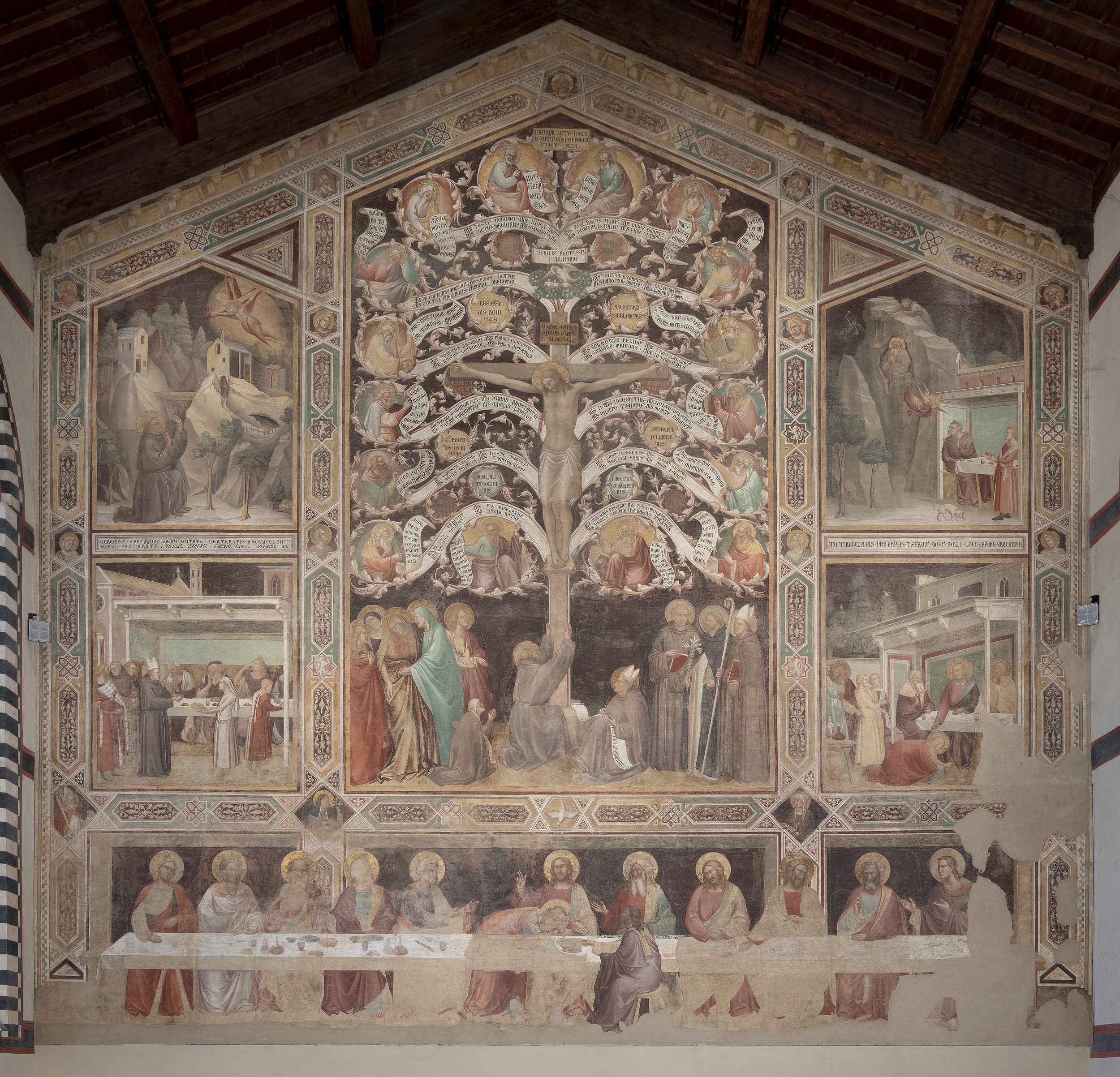
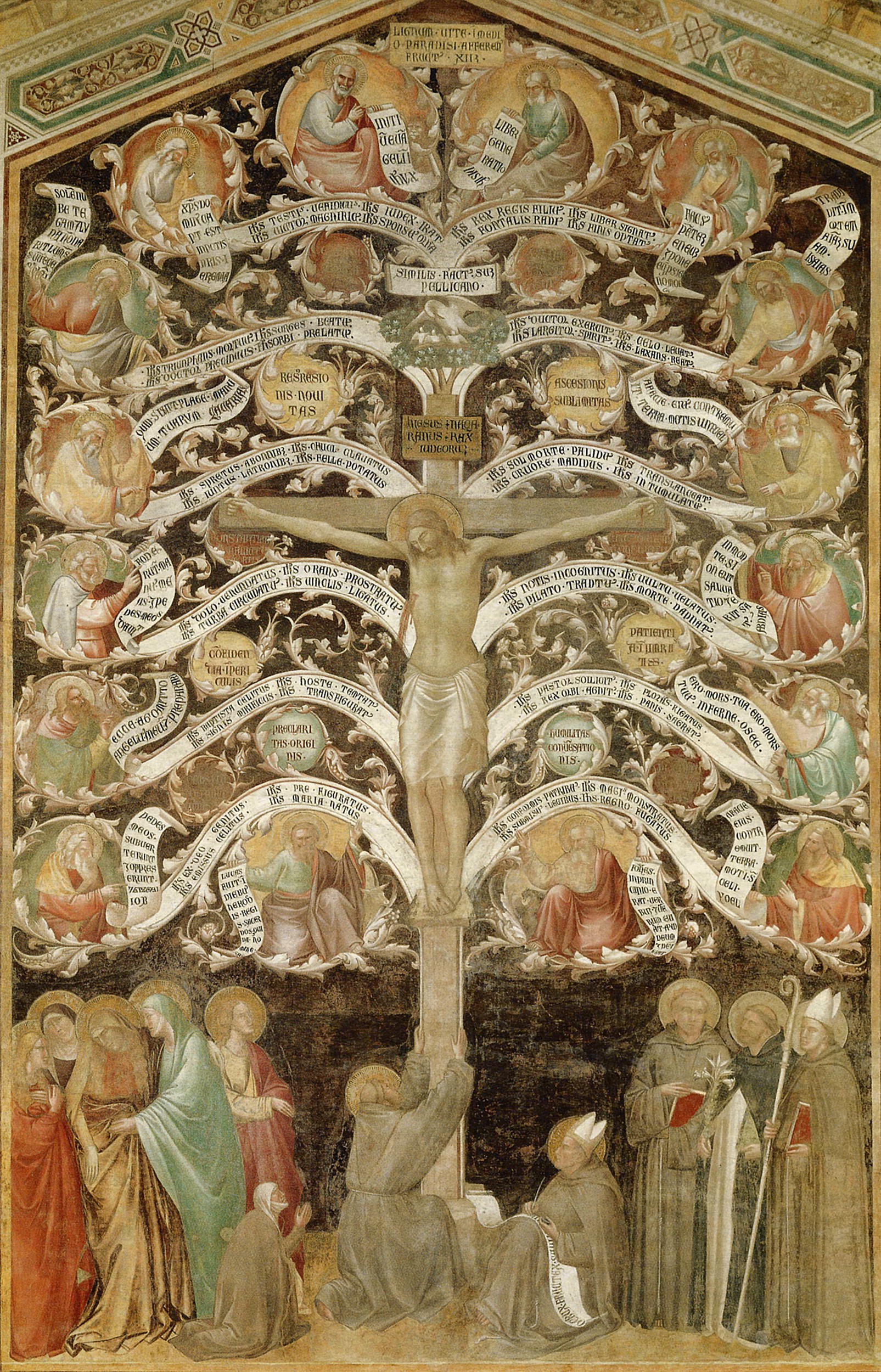
LOOK: Tree of Life by Taddeo Gaddi

Gaddi, Taddeo_Tree of Life
Taddeo Gaddi (Italian, 1290–1366), Tree of Life, ca. 1350. Fresco painted for the refectory of the Franciscan church of Santa Croce in Florence (now a museum).

The Lignum Vitae (Tree of Life) by Bonaventure, an early Franciscan theologian from Bagnoregio, Italy, is a meditational treatise on the life of Christ. It asks readers to picture in their minds a tree bearing twelve fruits (cf. Rev. 22:2), its roots watered by an ever-flowing stream. Standing for specific attributes of Christ or events from the Gospels, “this fruit is offered to God’s servants to be tasted so that when they eat it, they may always be satisfied, yet never grow weary of its taste,” Bonaventure writes. “I call these fruits because they delight with their rich sweetness and strengthen with their nourishment the soul who meditates on them and diligently considers each one.” The chapter outline, organized by “fruit,” is as follows (translation by Ewert Cousins):

PART I. ON THE MYSTERY OF HIS ORIGIN

First Fruit: His Distinguished Origin

Jesus Begotten of God
Jesus Prefigured
Jesus Sent from Heaven
Jesus Born of Mary

Second Fruit: The Humility of His Mode of Life

Jesus Conformed to His Forefathers
Jesus Shown to the Magi
Jesus Submissive to the Law
Jesus Exiled from His Kingdom

Third Fruit: The Loftiness of His Power

Jesus, Heavenly Baptist
Jesus Tempted by the Enemy
Jesus Wonderful in His Miracles
Jesus Transfigured

Fourth Fruit: The Plenitude of His Piety

Jesus, the Solicitous Shepherd
Jesus Bathed with Tears
Jesus Acclaimed King of the World
Jesus, Consecrated Bread

PART II. ON THE MYSTERY OF HIS PASSION

Fifth Fruit: His Confidence in Trials

Jesus Sold through Guile
Jesus Prostrate in Prayer
Jesus Surrounded by the Mob
Jesus Bound with Chains

Sixth Fruit: His Patience in Maltreatment

Jesus Denied by His Own
Jesus Blindfolded
Jesus Handed Over to Pilate
Jesus Condemned to Death

Seventh Fruit: His Constancy Under Torture

Jesus Scorned by All
Jesus Nailed to the Cross
Jesus Linked with Thieves
Jesus Given Gall to Drink

Eighth Fruit: Victory in the Conflict of Death

Jesus, Sun Dimmed in Death
Jesus Pierced with a Lance
Jesus Dripping with Blood
Jesus Laid in the Tomb

PART III. ON THE MYSTERY OF HIS GLORIFICATION

Ninth Fruit: The Novelty of His Resurrection

Jesus Triumphant in Death
Jesus Rising in Blessedness
Jesus, Extraordinary Beauty
Jesus Given Dominion over the Earth

Tenth Fruit: The Sublimity of His Ascension

Jesus, Leader of His Army
Jesus Lifted Up to Heaven
Jesus, Giver of the Spirit
Jesus Freeing from Guilt

Eleventh Fruit: The Equity of His Judgment

Jesus, Truthful Witness
Jesus, Wrathful Judge
Jesus, Glorious Conqueror
Jesus, Adorned Spouse

Twelfth Fruit: The Eternity of His Kingdom

Jesus, King, Son of the King
Jesus, Inscribed Book
Jesus, Fountain-Ray of Light
Jesus, Desired End

Written in Latin around 1260, the Tree of Life became an instant classic, giving rise to many visual representations—first in manuscript miniatures, then in panel paintings and large-scale frescoes, including one by the Florentine artist Taddeo Gaddi.

Gaddi, Taddeo_Tree of Life
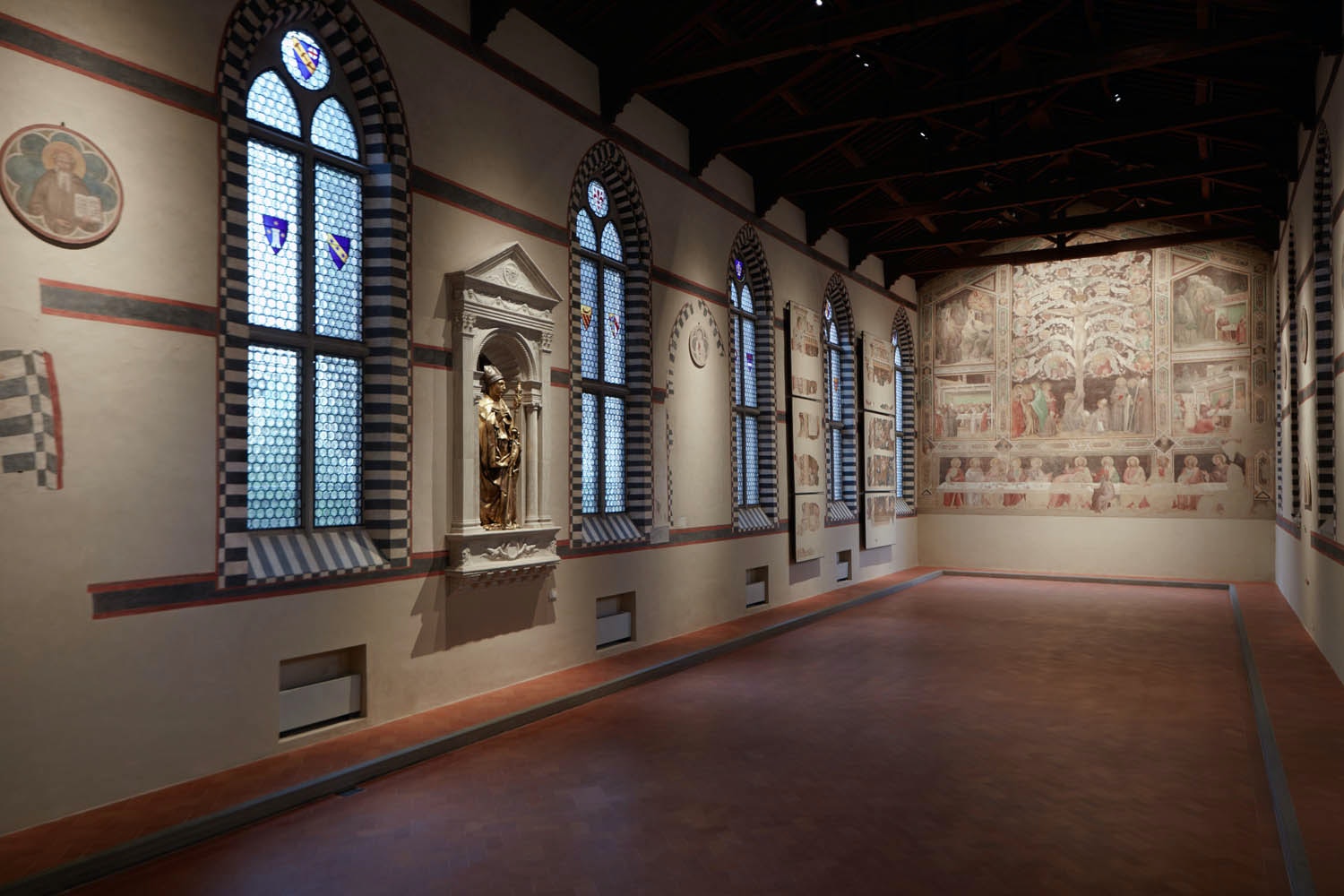
Gaddi, Taddeo_Tree of Life (wide shot)

Painted in the mid-fourteenth century in the refectory (dining room) of the Franciscan church of Santa Croce in Florence, the fresco depicts, in its central register, Christ crucified, with twelve scrolls unfurling from the vertical shaft like branches on a tree. On these scrolls, inscribed in Latin, are all the subheadings from Bonaventure’s treatise—IHS EX DEO GENITUS, IHS PREFIGURATUS, and so on, where “IHS” is an abbreviation for the name Jesus. Leafy roundels bear the names of the twelve “fruits,” and others feature busts of prophets.

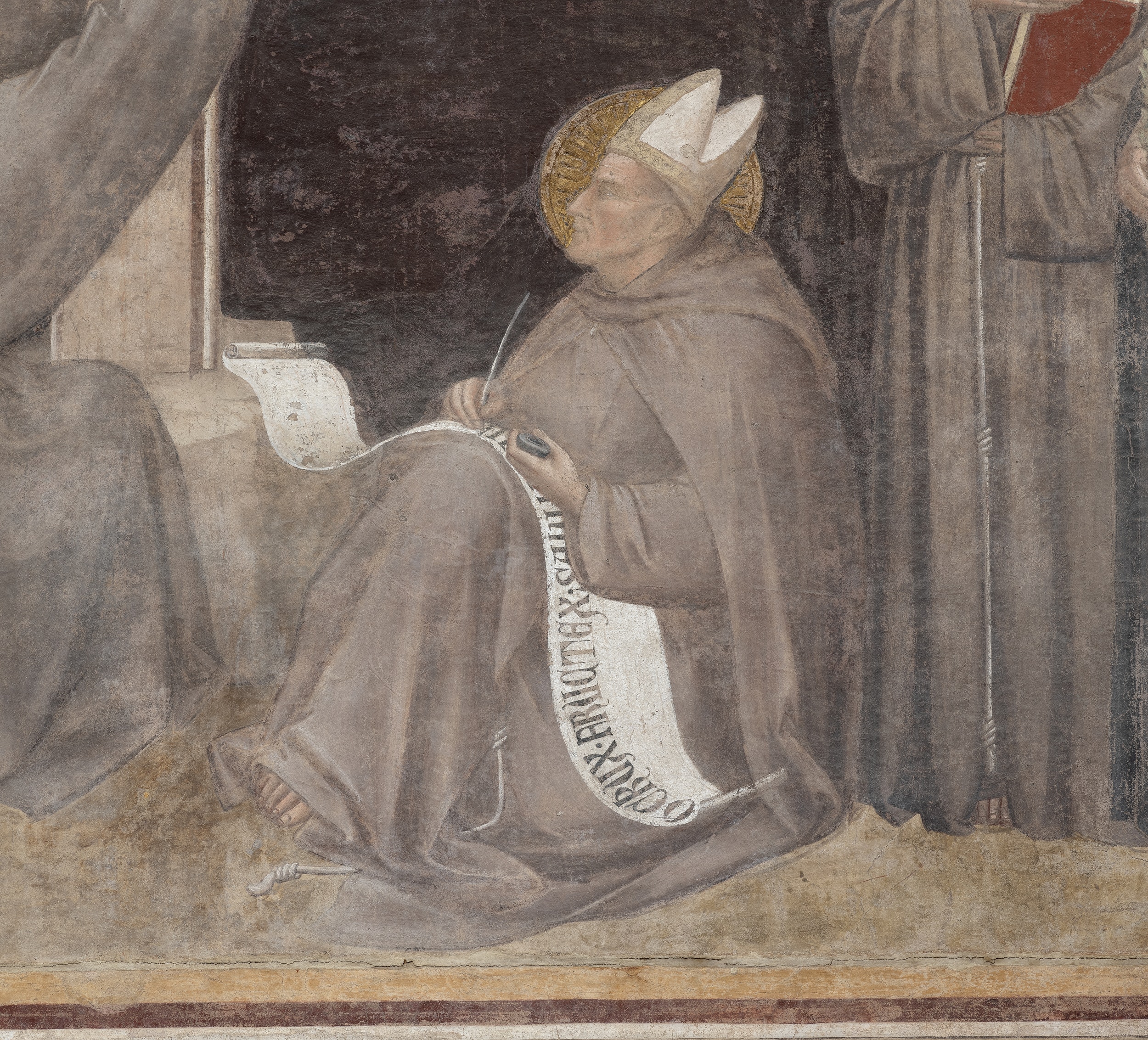
At the bottom of the cross is the Virgin Mary supported by three other women; St. John the Evangelist; the fresco’s patron, probably Vaggia Manfredi, kneeling in prayer; St. Francis, hugging the cross; St. Bonaventure, writing, “O crux, frutex salvificus, / Vivo fonte rigatus, / Quem flos exornat fulgidus, / Fructus fecundat gratus”; St. Anthony of Padua; St. Dominic; and St. Louis of Toulouse.

LISTEN: “O Crux (Frutex Salvificus)” | Original Latin words by Bonaventure, 13th century; translated into English by James Monti | Music by Elizabeth Duffy | Performed by Sister Sinjin on Incarnation (2016; reissued 2019)

O Cross, salvific stem,
The watering, living fount,
Whose blossom is fragrant,
Whose fruit is longed for.

Jesus, begotten of God,
Jesus foreshadowed,
Jesus sent from heaven,
Jesus born of Mary.

Jesus with the patriarchs,
Jesus shown the magi,
Jesus subject to the law,
Jesus from your kingdom.

Jesus holy in the womb,
Jesus tempted by Satan,
Jesus wondrous in the signs,
Jesus transfigured.

Jesus the good shepherd,
Jesus sprinkled with tears,
Jesus King of the world,
Jesus Sacred Bread.

The Sister Sinjin song “O Crux (Frutex Salvificus)” layers the sixteen subheadings from part 1 of Bonaventure’s Tree of Life, “On the Mystery of His Origin,” with the first stanza of a poem that appears in different forms in the various manuscripts of Bonaventure’s works, including the Tree of Life. Another translation of this refrain’s source text, by José de Vinck, is “O cross, tree bearing the fruit of salvation / Refreshed by a living stream / Your blossom so sweetly scented / Your fruit so worthy of desire.”

Gaddi, Taddeo_Tree of Life (Bonaventure detail)
Detail from Taddeo Gaddi’s Tree of Life. Contemplating the Crucifixion, Bonaventure pens one of his famous poetic lines, “O CRUX FRUTEX SALVIFICUS” (“O cross, tree bearing the fruit of salvation”).

The melody and stylings of the song are evocative of the Middle Ages. Elizabeth Duffy, Kaitlyn Ferry, and Elise Erikson Barrett sing to their own gentle guitar, mandolin, and banjo accompaniment.

For another Advent devotion featuring Sister Sinjin and an even older Italian fresco, see here.

Roundup: Online convos with artists Marc Padeu (from Cameroon) and Emmanuel Garibay (from the Philippines), and more

NEW PLAYLIST: October 2021 (Art & Theology): This month’s playlist includes a benediction from the book of Jude; a percussion-driven setting of Francis of Assisi’s “Canticle of the Sun” by the Camaldolese monk Cyprian Consiglio; an Exodus-inspired song in Yorta Yorta, an indigenous Australian language, from the feature film The Sapphires; “Prodigal Son,” a little-known hymn by John Newton, from The Sacred Harp; a sixties gospel song by Shirley Ann Lee (famously covered by Liz Vice on her debut album); and closing out, in anticipation of All Saints’ Day on November 1, the jazz standard “When the Saints Go Marching In.” To save the playlist to your Spotify account, click the ellipsis and select “Add to Your Library.”

+++

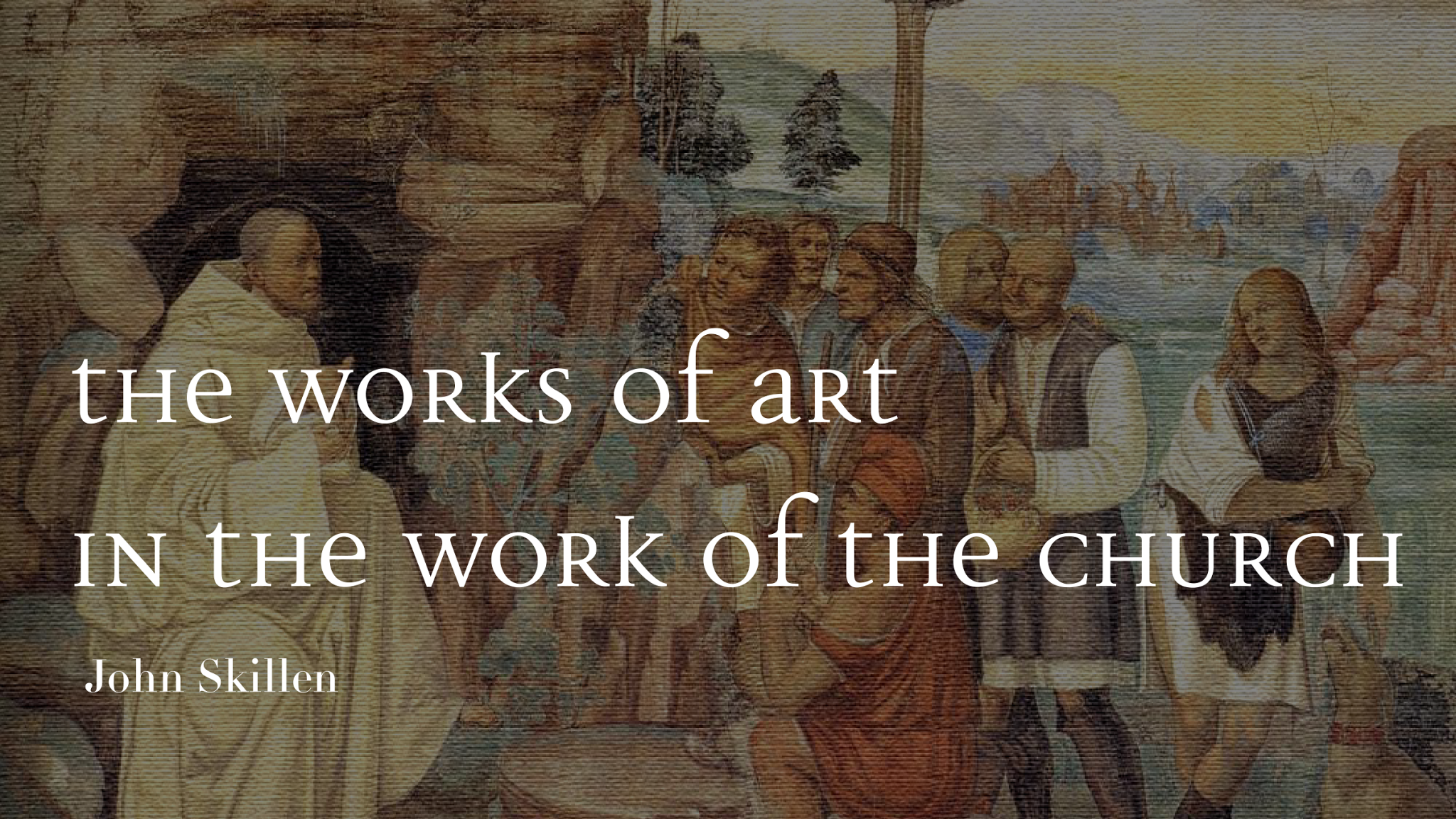
IN-PERSON LECTURE: “The Works of Art in the Work of the Church” by John Skillen, October 16, 2021, Crownsville, MD: The Eliot Society, an organization I work for, is hosting our first event in over a year and a half! It’s an art talk by Dr. John Skillen [previously], director of the Studio for Art, Faith & History in Orvieto, Italy. It will be at the home of two of our board members, so if you’re in the Washington–Baltimore metropolitan area two weekends from now, consider coming by! The event starts with hors d’oeuvres at 6:30 p.m., and an RSVP is requested.

The Works of Art in the Work of the Church

In recent decades, a growing number of Christians—even those from church traditions formerly suspicious of the arts—are warming up to the idea that artworks can serve in the various practices of the life of faith, and not only in iconographic form as images of Jesus in worship. Scripturally sound and aesthetically sophisticated works of art can guide our prayer, help catechize our children, and shape the environments of our missional work. Many of us will welcome some pointers for putting art back in its place in the settings where we live and work.

To help us imagine possibilities, John Skillen will offer examples from a long period of Christian history when the arts were put to work in the collective life of the church in more places and in more ways than most of us nowadays can imagine. Not only churches but also hospitals, orphanages, the meeting rooms of parachurch organizations, baptisteries and bell towers, dining halls and cloisters in monasteries, town halls and civic fountains and public squares—all were places of serious decoration and design expected to be compatible with Christian faith.

No sphere of religious and civic life was off-limits for imagery able to instruct, to prompt memory, and to inspire emotion and action—the three functions of art most commonly cited during the Middle Ages to defend its value.

+++

UPCOMING ONLINE CONVERSATIONS:

Padeu, Marc_Le souper a Penja
Marc Padeu (Cameroonian, 1990–), Le souper a Penja, 2019. Acrylic on canvas, 82 7/10 × 106 3/10 in. (210 × 270 cm).

>> “Caravaggio in Cameroon: Marc Padeu and Jennifer Sliwka in Conversation,” October 14, 2021, 11 a.m. EST (4 p.m. BST): I spoke about Padeu’s Le souper a Penja at a recent seminar on “Picturing Jesus,” so I’m looking forward to hearing the artist himself discuss it along with the larger body of work it’s a part of. Hosted by the National Gallery in London.

Artist Marc Padeu lives and works in Cameroon. Intriguingly, his monumental paintings – exploring tender and complex relationships between family, friends, lovers and working communities – often draw on Italian Baroque compositions and especially those of Caravaggio.

Marc Padeu joins Dr Jennifer Sliwka, specialist in Italian Renaissance and Baroque art. Her research explores how 17th-century painters developed innovative approaches to religious painting, imbuing their works with an immediacy, power, and dynamism.

Together, the speakers will take Padeu’s Le Souper a Penja and its relationship to Caravaggio’s Supper at Emmaus as a jumping-off point for conversation, exploring Padeu’s wider interest and understanding of historical works, his adoption and adaptation of the visual language of the Baroque and how these inform his evocations of contemporary life in Cameroon.

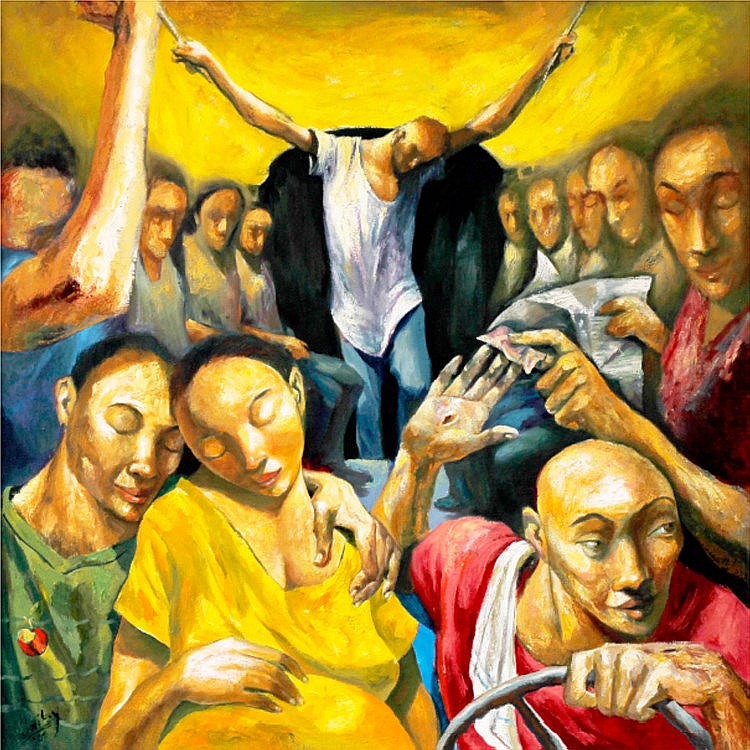
>> “In the Studio with Emmanuel Garibay,” November 11, 2021, 8:30 a.m. EST: The Overseas Ministries Study Center at Princeton Theological Seminary is hosting a conversation with Filipino artist Emmanuel “Manny” Garibay, a social realist painter who served as the 2010–2011 OMSC artist in residence. “It is the richness of the poor that I am drawn to and which I am a part of, that I want to impart,” he says. His paintings often portray Jesus among the marginalized and dispossessed and critique the church’s “compliance with greed, corruption, and social inequality.” Garibay’s children Alee, Nina, and Bam, who are also accomplished artists, will be present for the conversation as well. For more on Garibay, see this Q&A from the OMSC and the Image journal essay “Recognizing the Stranger: The Art of Emmanuel Garibay” by Rod Pattenden.

Garibay, Emmanuel_Kaganapan
Emmanuel Garibay (Filipino, 1962–), Kaganapan, 2006. Oil on canvas, 48 × 48 in. (122 × 122 cm).

+++

NEW SONGS:

>> “Keep Watch (Noelle’s Lullaby)” by Liturgical Folk, a setting of a Compline prayer from the Book of Common Prayer, on the new family album Matins & Vespers:

>> “Psalm 91” by Poor Bishop Hooper, released as part of the EveryPsalm project, through which the duo offers original weekly Psalm-based songs for free download:

Object Narratives (Material and Visual Cultures of Religion)

MAVCOR Journal is an open-access, peer-reviewed digital publication published by the Center for the Study of Material and Visual Cultures of Religion at Yale University. Its “Object Narrative” division is for explicating religious images, objects, monuments, buildings, spaces, performances, or sounds in 1500 words or less.

Visual culture encompasses not just “art” but also ephemera and what we might call “kitsch.” Because my field is art, I gravitate more to research in that vein, which is reflected in the five object narratives I’ve selected to highlight below. In addition to describing the object’s content, each writer also addresses, if applicable, its liturgical or devotional uses and includes relevant historical or cultural context. Click on the links to read more, and spend some time perusing the other offerings on MAVCOR’S website, https://mavcor.yale.edu.

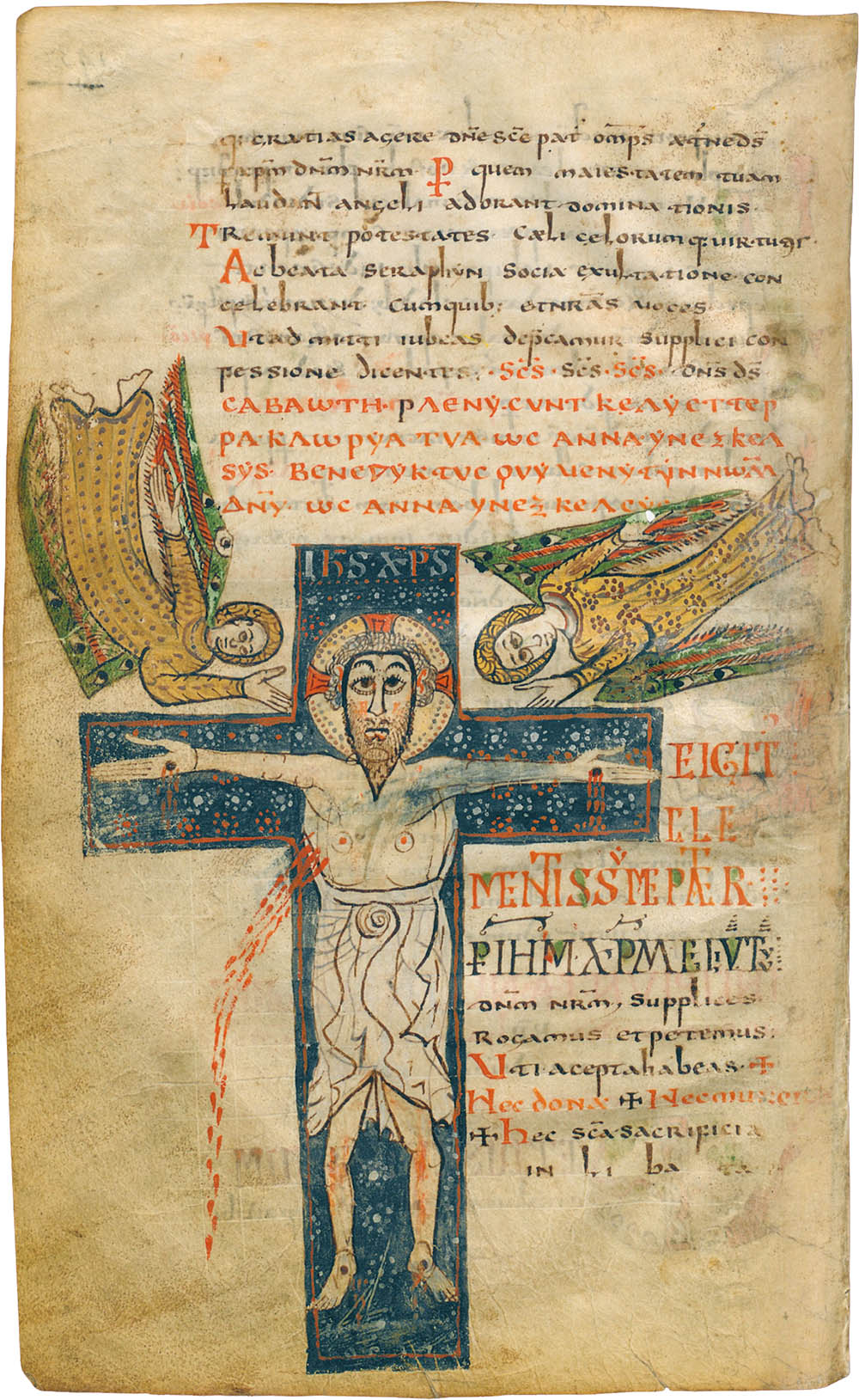
“Christ Crucified in the Gellone Sacramentary” by Lawrence Nees: This eighth-century manuscript illumination from the Frankish kingdom of Charlemagne is one of the earliest surviving images of Jesus on the cross, its viewership restricted to clergy. “He is . . . shown as if nailed to a cross, but this is no wooden cross and indeed no cross at all. It is colored deep blue, studded with white and red flower-like shapes suggesting stars, and indeed it actually is the letter T of the opening words of the Canon of the Mass, the consecration of bread and wine as the body and blood of Christ, in the Latin version here ‘Te igitur clementissime Pater . . . rogamus’ (‘Therefore we beseech Thee, most merciful Father’) . . .”

Crucifixion (Sacramentary of Gellone)
Crucifixion from the Gellone Sacramentary (Latin 12048, fol. 143v), made in France, ca. 790. Housed at the Bibliothèque nationale de France, Paris.

+++

“Kongo Triple Crucifix” by Cécile Fromont: The west central African kingdom of Kongo, which emerged in the fourteenth century, declared Christianity its official religion in 1509. Kongo participated in the commercial, political, and religious networks of the early modern Atlantic world, and its artists reformulated Christian figures from Europe into objects that are distinctly African—including the many brass crucifixes produced from the sixteenth through nineteenth centuries. (Read more in Fromont’s 2014 book The Art of Conversion: Christian Visual Culture in the Kingdom of Kongo, which I reviewed here.)

Triple Kongo crucifix
Triple Crucifix, central figure 16th–17th century; top and bottom figures 18th–19th century. Brass, iron nails, copper, wood, ultramarine pigment, 10 1/4 × 5 3/4 × 1 in. (26 × 14.5 × 2.5 cm). Metropolitan Museum of Art, New York.

+++

“Death Cart (La Muerte en su Carreta)” by Miguel de Baca: “Death carts” were instruments of penance used by the Penitente brotherhood of northern New Mexico and southern Colorado in the second half of the nineteenth century and the first half of the twentieth; this is the earliest known one. They were built in the style of an old oxcart, and seated inside was Doña Sebastiana, an allegorical figure of Death, wielding her bow and arrow. Each Good Friday, “an elected brother attached the heavy chassis to his torso with a horsehair rope and dragged it from the morada (meetinghouse) along the path to the calvario (Calvary site), inflicting abrasions upon his body as a demonstration of his faith and desire for closer union with God.” I must say, this skeletal figure with the close-set eyes and large forehead (and is that human hair and teeth?) terrifies me!

Lopez, Nasario_Death Cart
Nasario López, Death Cart (La Muerte en su Carreta), ca. 1860. Gesso, leather, cottonwood, pine, 51 × 24 × 32 in. (129.5 × 61 × 81.3 cm). Colorado Springs Fine Arts Center, Colorado Springs, Colorado.

For more on the topic, see Thomas J. Steele, “The Death Cart: Its Place among the Santos of New Mexico,” The Colorado Magazine 55, no. 1 (1978): 1–14.

+++

“Georgia O’Keeffe, Black Cross with Stars and Blue” by Jeffrey Richmond-Moll: During a four-month stay in Taos, New Mexico, in the summer of 1929—her first visit to the Southwest—Georgia O’Keeffe painted four canvases of Penitente crosses with Taos Mountain visible in the distance. The Penitentes were a lay Catholic brotherhood whose rituals centered on the remembrance of Christ’s passion. They erected crosses all over the region, outside their moradas (meetinghouses) and along roadsides, which they picked up and carried on holy days.

O'Keeffe, Georgia_Black Cross with Stars and Blue
Georgia O’Keeffe (American, 1887–1986), Black Cross with Stars and Blue, 1929. Oil on canvas, 40 × 30 in. (101.6 × 76.2 cm). Private collection.

+++

“James Latimer Allen, Madonna and Child” by Camara Dia Holloway: “Allen operated a studio in Harlem between 1926 and 1943, producing artistic and commercial photographs. . . . By contributing to the development of a new racial iconography, Allen’s Madonna and Child and other black Madonnas offered positive visual and material rejoinders to widely reproduced images that represented black women’s failure to parent their own children. The Mammy stereotype, the legend of Margaret Garner (known as the Black Medea), and portraits of white children held by their black nannies belong to this latter and negative set of portrayals.” This is a religious icon by and for African Americans, Latimer writes—one that reflects and affirms their own self-image.

Allen, James L._Madonna and Child
James L. Allen (American, 1907–1977), Madonna and Child, 1930s. Photograph, 24.4 × 18.7 cm. New York Public Library.

Alfred Conteh’s “Float” and other recent CAUAM acquisitions

In September 2019 I visited Atlanta, Georgia, and one of the two art stops I made was the Clark Atlanta University Art Museum, whose purpose is “to collect, preserve, research, and exhibit fine art works that document the role of African Americans in American history and culture.” When I got there I was bummed to see that the museum was closed in preparation for three exhibitions that were to open that Sunday. But graciously, even though the signage and lighting hadn’t been installed and some of the objects were still being moved around, the curator allowed me in for a little glimpse.

I was stopped in my tracks by a mixed media sculpture in the gallery of recent acquisitions: Float by Alfred Conteh.  

Conteh, Alfred_Float
Alfred Conteh (American, 1975–), Float, 2014. Steel, epoxy dough, thermoadhesive plastic, atomized steel dust, atomized bronze dust, urethane plastic, steel chain, 93 × 46 × 35 in. Clark Atlanta University Art Museum, Atlanta, Georgia. Photo: Victoria Emily Jones.

Conteh, Alfred_Float (detail)

It shows a Black female Christ figure rising up in a whirl of energy, her hat blown aloft. Wounds are visible on her hands and feet, but these are taken up into new, greening life. At the bottom is a broken chain, indicating that she has been set free. The piece expresses the exhilaration of emancipation, of being shackled no more.

(Related posts: “Contemporary Black artists at the Baltimore Museum of Art”; “Christ figure in Justin Dingwall’s Albus series”)

I would classify Float as a resurrection image, which its staging reinforces. To its far left is a wooden crucifix by Dilmus Hall, followed by The Mourners by Frederick C. Flemister, from 1942. (Note that the two crucifix photos in this post are courtesy of the Souls Grown Deep Foundation, who donated the pieces to the museum.)

Clark Atlanta U aquisitions
Hall, Dilmus_Untitled (Crucifixion)
Dilmus Hall (American, 1896–1987), Untitled, n.d. Wood, wood putty, plastic beads, and paint, 12 × 9 in. Clark Atlanta University Art Museum, Atlanta, Georgia. Photo: Stephen Pitkin / Pitkin Studio.

Flemister, Frederick C._The Mourners
Frederick C. Flemister (American, 1916–1976), The Mourners, 1942. Oil on canvas, 39 3/4 × 31 1/4 in. Clark Atlanta University Art Museum, Atlanta, Georgia. Photo: Victoria Emily Jones.

Drawing on iconography of the Lamentation over the Dead Christ, Flemister’s The Mourners shows a mother holding the corpse of her grown son, who has just been deposed from a lynching tree. Behind her a woman in a pink dress throws up her arms in grief, and a preteen boy runs into his own mother’s arms for comfort. Like many artists before and after him, Flemister connects the killings of innocent Black men to the killing of Jesus—not because their deaths are salvific but because both they and Jesus were unjustly “crucified,” and because Black men bear God’s image, which the visual conflation reminds us of. As Jesus told his disciples, “Truly, I say to you, as you did it to one of the least of these my brothers, you did it to me” (Matt. 25:40).

Death and resurrection, suffering and hope, are the theme of this temporary exhibition. A second wooden crucifix, by Thornton Dial Jr., adorns the opposite wall. It’s titled I’ll Be Back, which, as the sculpture was made a few years after The Terminator came out, may be a playful reference to Arnold Schwarzenegger’s famous line, but it is first and foremost an affirmation that Jesus will return to earth, as promised, to fully set things right. (By the way, I wonder if Conteh, in making Float, was inspired by the hubcap component of another of Dial’s crucifixes . . .)

Dial Jr., Thornton_I'll Be Back
Thornton Dial Jr. (American, 1953–), I’ll Be Back, 1988. Wood, metal, barbed wire, string, fabric, industrial sealing compound, enamel, nails, 35 × 32 × 6 3/4 in. Clark Atlanta University Art Museum, Atlanta, Georgia. Photo: Stephen Pitkin / Pitkin Studio.

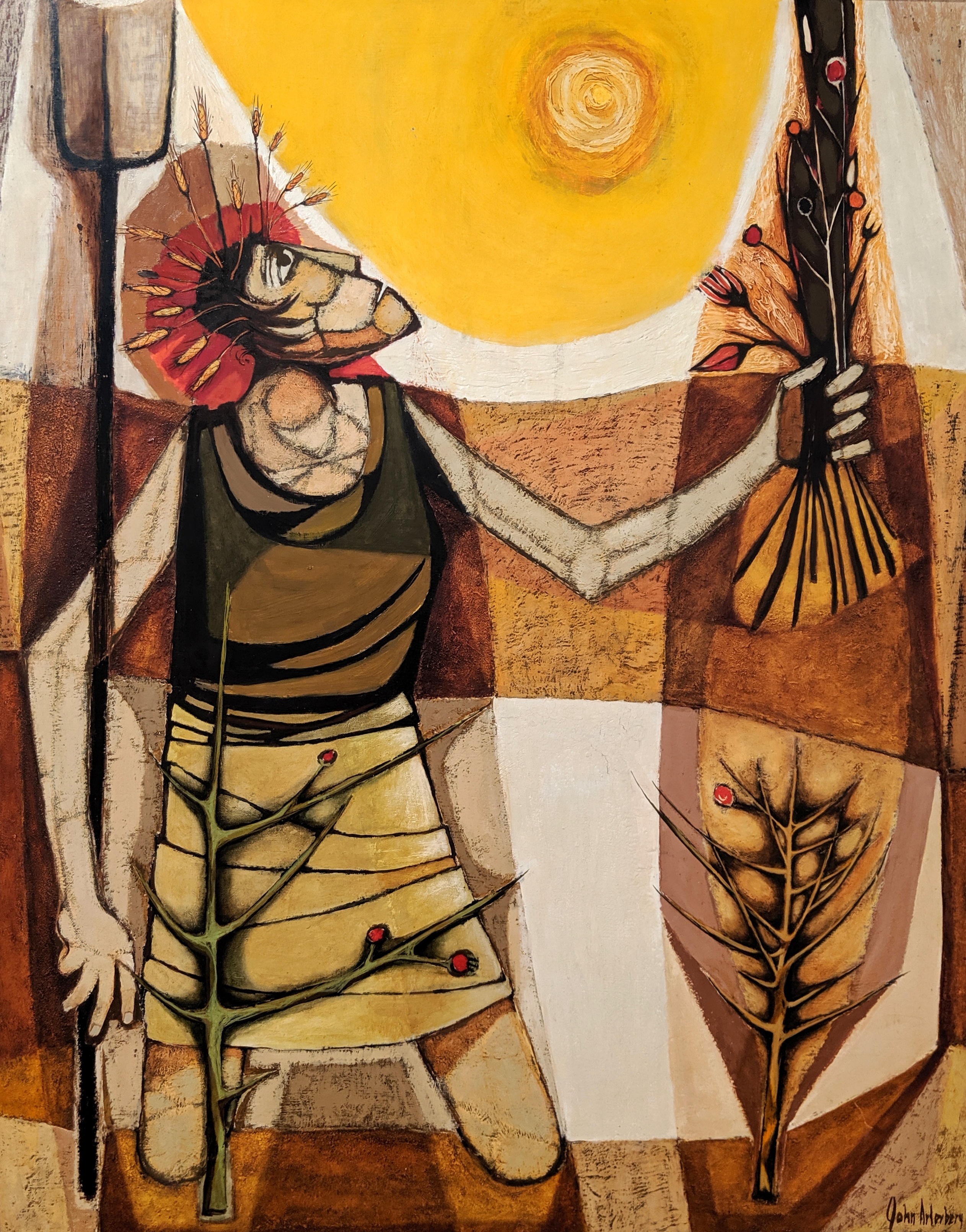
The last piece in the room is Ceres by John W. Arterbery. Ceres was the Roman goddess of agriculture, grain crops, and fertility, the equivalent of the Greek mother-goddess Demeter. In Arterbery’s painting she wears a crown of sprouting wheat stalks and holds a pitchfork in one hand and a leafless plant with buds and berries in the other. I think the flowers may be poppies, as Ceres is associated with those.

Arterbery, John W._Ceres
John W. Arterbery (American, 1928–1977), Ceres, 1963. Oil on Masonite, 60 × 47 1/2 in. Clark Atlanta University Art Museum, Atlanta, Georgia. Photo: Victoria Emily Jones.

It appears as though Arterbery is depicting the imminence of spring, when Ceres will be reunited with her daughter Proserpine (Persephone) and life will grow and flourish. It shows Ceres looking toward the sun in anticipation of such a time. Read in conjunction with the other pieces in the room, Ceres could be interpreted as an Advent image—a waiting for the final fulfillment of God’s good purposes for his creation, which includes a definitive end to suffering and oppression and a universal thriving.

The Clark Atlanta University Art Museum is typically open Tuesday through Friday from 11 a.m. to 4 p.m., as well as by appointment, but you may want to email ahead of time (cauArtMuseum@gmail.com) to confirm. It’s definitely worth a visit, though I can’t guarantee that the works featured here will be on display. If you wish to browse photos of pieces from the museum’s collection, see In the Eye of the Muses: Selections from the Clark Atlanta University Art Collection (2012).

Crucifixion, Harrowing, and Transfiguration

Piers Plowman is a fourteenth-century allegorical poem in Middle English by William Langland, considered one of the greatest works of medieval literature. Unfolding as a series of dream-visions, it follows the narrator Will’s quest for the true Christian life.

Lines 491–95 of Passus V (as counted in the Norton Critical Edition, which uses the B-text) are among the poem’s most striking:

The sonne for sorwe therof les syghte for a tyme,
Aboute midday whan moste lighte is and meletyme of seintes;
Feddest with thi fresche blode owre forfadres in derknesse.
  Populus qui ambulabat in tenebris vidit lucem magnum.
The lighte that lepe oute of the, Lucifer [it] blent,
And blewe alle thi blissed into the blisse of Paradise.

MODERN ENGLISH TRANSLATION:

The sun for sorrow [at the Crucifixion] lost sight for a time,
About midday, when most light is, and mealtime of saints;
Thou feddest with Thy fresh blood our forefathers in darkness.
  Populus qui ambulabat in tenebris vidit lucem magnum.
The light that leapt out of Thee, Lucifer it blinded,
And blew all Thy blessed into the bliss of Paradise.

All three Synoptic Gospels tell us that from noon to three on Good Friday, “there was darkness over all the land” (Matt. 27:45; Mark 15:33; Luke 23:44–45). Medieval writers and artists sometimes imagined this in personified terms, as the sun veiling its face in mourning over the death of Christ. At what should be the brightest hour of day, the speaker remarks, the sky went black. And while people were eating their midday meal, Christ was preparing for his people a feast of his own flesh and blood.

This latter image is multifaceted, referring in context to the idea that Christ’s blood flowed into hell to rescue the patriarchs and prophets who died before his coming, but also to the legend of the pelican who wounded her breast to feed her children with her blood. The Eucharist is an obvious corollary.

Every line of Piers Plowman has three alliterative stresses, which in V.494–95 in particular create such a beautiful musicality: light, leapt, Lucifer, blinded, blew, blessed, bliss.

In the immense darkness of the Crucifixion, there shone, on a spiritual level, a glory so bright it blinded Lucifer and swept the Old Testament saints into God’s presence. Langland quotes, in Latin, the prophecy from Isaiah 9:2: “The people that walked in darkness have seen a great light.” With the atonement accomplished, our foremothers and fathers could finally inherit the promise they had clung to in faith for so long. The conflation of light and breath as a propulsive force or a vehicle of transport is so unique and vivid—how the saints, expelled from their prison, ride a strong wind or a ray of light into paradise. I see them joyfully tumbling to their new home!

This passage anticipates the triumph of Passus XVIII, which centers on the harrowing of hell. Reiterating the unusual verb choice of “blew,” the poet says it is Christ’s breath that breaks down the hellgate. Here is Christ (“the light”) on Holy Saturday, addressing the fiends of hell:

Again the light bade them unlock, and Lucifer answered,
  “Who is that?
What lord are you?” said Lucifer. The light at once replied,
  “The King of Glory.
The Lord of might and of main and all manner of powers:
  The Lord of Powers.
Dukes of this dim place, at once undo these gates
That Christ may come in, the Heaven-King’s son.”
And with that breath hell broke along with Belial’s bars;
For any warrior or watchman the gates wide opened.
Patriarchs and prophets, populus in tenebris,
Sang Saint John’s song, Ecce agnus Dei.
Lucifer could not look, the light so blinded him.
And those that our Lord loved his light caught away.

(XVIII.316–26, modern English translation by E. Talbot Donaldson)

+++

Lesko, Greta_Crucifixion with Transfiguration
Greta Leśko (Polish, 1979–), Crucifixion with Transfiguration, 2019. Tempera on gessoed wood board.

This multitiered icon by Greta Leśko is not a direct response to the Piers Plowman passages, but boy does it resonate! I love how she has rendered the paradoxical nature of the cross as a site of simultaneous darkness and light by integrating a scene of the Transfiguration beneath.

Earlier in his ministry, Jesus went up to Mount Tabor with his disciples Peter, James, and John, where he revealed to them, in dazzling light, his true glory. Pierced by these rays, they are literally knocked off their feet! As is traditional, Leśko shows the transfigured Christ holding a scroll in his left hand (signifying that he is the Word of God) and making a blessing gesture with the other.

The Transfiguration was a prefiguration of the Resurrection, and indeed in Leśko’s minimalist conception, this tableau could be read secondarily as Christ risen from the grave. The dark orb that encircles him is like the mouth of his tomb, and the three splayed men evoke the Roman guards who were sent reeling as their dead charge emerged from it alive and in full health.

The top half of Leśko’s icon portrays the Crucifixion. Christ spreads wide his arms across the orange beam, which seems to have no end, but rather melds into the all-encompassing border of light. To his right is what appears to be an open window or a doorway—a displacement, perhaps, of his side wound, which we are invited to enter and take shelter in. At the base of the cross, in a darkened recess, sits a skull, representing the death of Adam.

Adam also appears, with Eve, in the roundel at the cross’s upper terminal. This is a scene of the Anastasis (Greek for “Resurrection”), which is the primary icon of Pascha (Easter). It shows Christ descending into Hades, breaking down its doors (which lie in a heap at his feet) and liberating all the Old Testament saints. Known in the West as the harrowing of hell, this event is referenced in the ancient Apostles’ Creed, which states that Jesus “suffered under Pontius Pilate, was crucified, died, and was buried, and he descended into hell . . .” Medievals loved this part of the story, with all its drama and redeemer-heroism. (It’s the climax of Piers Plowman!) In the Orthodox Church it is a central doctrine.

It’s notable that Leśko has chosen to place the underworld action at the top of the composition and the mountaintop action at the bottom. From the depths of the universe to its heights, God’s radiance is ablaze, yes, but is there a significance to their being transposed? The old world order being overturned, perhaps? Maybe it’s simply to give the Transfiguration more prominence, making it an equal counterweight to the Crucifixion—with the Anastasis, small as it is, merely hinted at. In any case, visually and narratively, it means we read the icon from bottom to top.

By sandwiching the cross between two unambiguous manifestations of Christ’s glory, Leśko helps us see the fuller picture of the Crucifixion, where human evil and God’s goodness met and salvation was born. Or, as William Langland puts it: where light leapt out and “blew all [God’s] blessed into the bliss of Paradise.”

Christ figure in Justin Dingwall’s Albus series

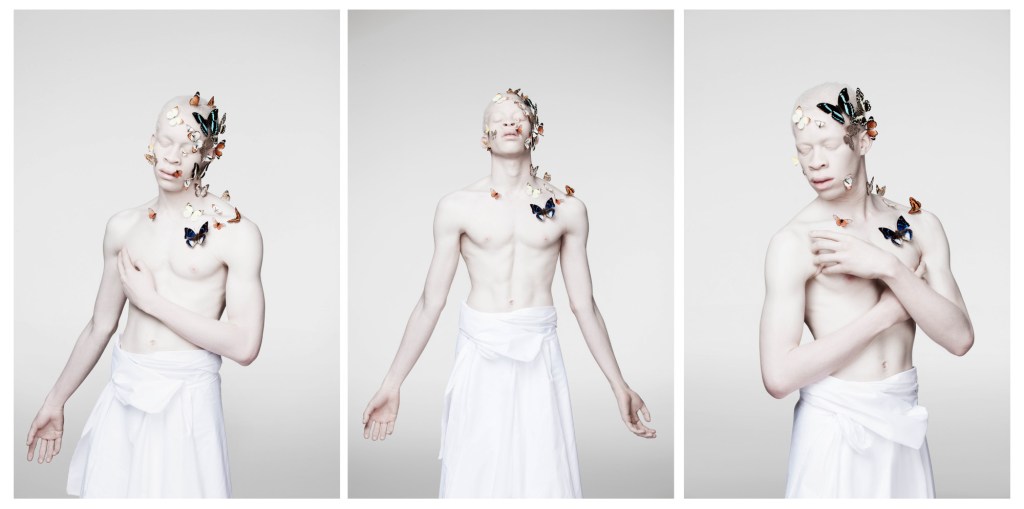
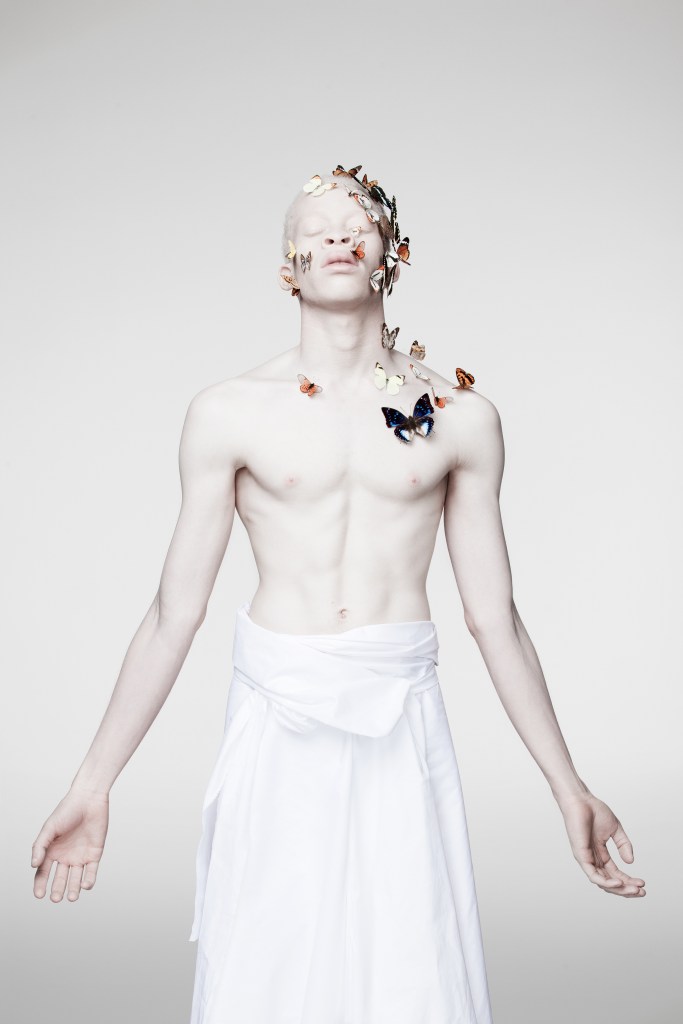
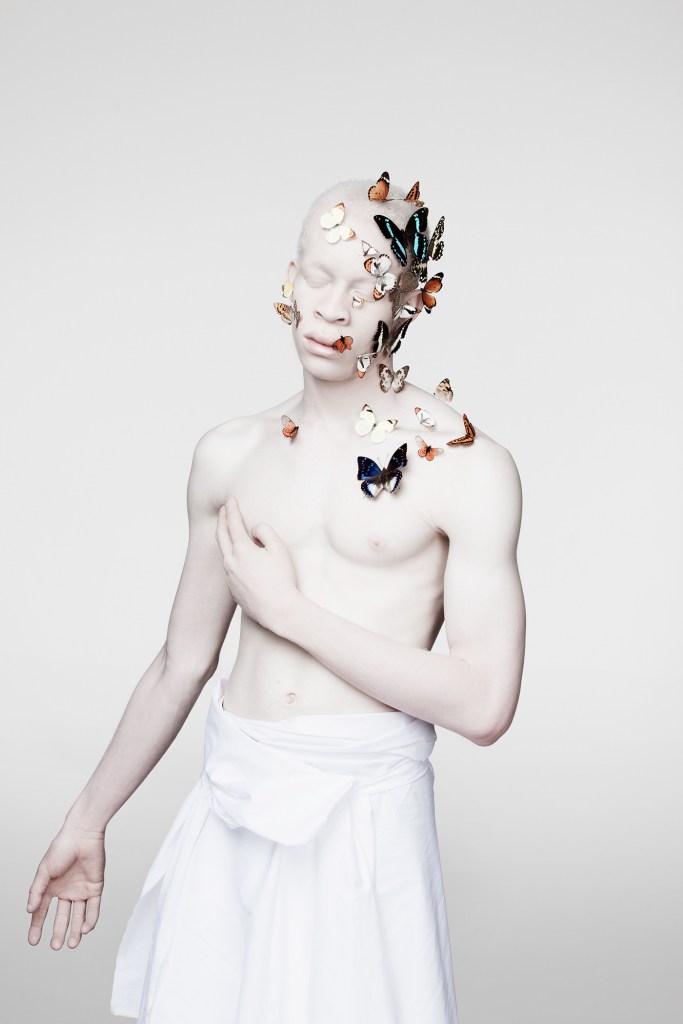
South African photographer Justin Dingwall (born 1983) seeks to depict beauty in difference. For his Albus series—Latin for “white” or “bright”—he worked with South African models and activists Thando Hopa and Sanele Junior Xaba, who have albinism. Albinism is a hereditary condition that affects melanin production, resulting in little to no pigmentation in the skin, hair, and eyes. It is more prevalent in sub-Saharan Africa than in the rest of the world, and people with the condition often face marginalization, discrimination, and even deadly violence.

In many ways Dingwall’s Albus series, which comprises several dozen photographs, is about metamorphosing perceptions about albinism, subverting the idea that it’s a curse; “by using butterflies my aim was to influence the viewer’s vision to be transformed, allowing them to view albinism in a new light—as something unique and beautiful,” he said. But the theme of transformation, of death and rebirth, as portrayed in some of the photos of Xaba, also connects with the narrative of Jesus’s passion, death, and resurrection, the model’s poses evoking traditional Christian imagery. (Not to mention how some of the photos of Hopa, not pictured here, intentionally reference Mother Mary.)

Rhapsody I, II, and III form a passion triptych of sorts, a sequence of three photos that show a male figure, clothed in a loincloth, falling into darkness—and yet, illuminated from above, he looks up toward the light.

Dingwall, Justin_Rhapshody triptych
Justin Dingwall, Rhapsody I, II, III, 2015

I’m reminded of Jesus speaking to his Father in Gethsemane, and at his crucifixion. Of all the art that shows him stumbling on his way to Calvary (“Jesus falls” makes up three of the fourteen stations of the cross). And especially of his slumped body being lowered from the cross. All the supporting characters, however, are absent, intensifying our focus on this lone Christ figure.

Justin Dingwall, Rhapsody I
Justin Dingwall, Rhapsody II
Justin Dingwall, Rhapsody III

Consider some of the compositional similarities between Dingwall’s three Rhapsody photographs and the following explicitly Christological artworks. (To view the full caption, click on the the image.)

Suggestive of burial, Embrace by Dingwall shows a man wrapped, cocoon-like, in white linen, lying against a black ground. His face, again, catches the light, and he appears to be at peace. He is resting in this silent, in-between time that precedes the emergence of new life.

Justin Dingwall, Embrace
Justin Dingwall, Embrace, 2015

More explicitly inspired by Christian visual traditions is Dingwall’s Liberty triptych, which shows our Christ figure risen from death, glowing, and covered in butterflies, symbol of resurrection.

Justin Dingwall, Liberty (triptych)
Justin Dingwall, Liberty I, II, III, 2015

In Liberty II, the man extends his arms at a roughly forty-five-degree angle from his trunk, palms upward, in a beatific gesture. His eyes are closed as he bathes in light. Christ is often shown in this pose in art of the resurrection, emerging triumphant from his tomb and proudly revealing his transfigured wounds. Dingwall’s image, though, is quieter, more interior.

Justin Dingwall, Liberty II

Liberty I is reminiscent of Jesus inviting Thomas to see and touch his wounds, and especially of Bramantino’s The Risen Christ (see tiled gallery below). People have long marveled at the incredible luminosity of Christ in the latter painting—how the light seems to come from within (the setting is nighttime, as the moon in the background indicates).

Justin Dingwall, Liberty I

So in many ways these photographs by Dingwall are continuous with Christian art history, but they are also open enough to be read in a multitude of other ways or applied to different contexts. Though the nature of Jesus’s resurrection and what it accomplished are, Christians believe, unique in history, stories of death and rebirth are universal, traversing all cultures and religious traditions.

View additional photos from the Albus series at https://www.justindingwall.com/albus.

Good Friday, Part 2: My God, My God

Now from the sixth hour there was darkness over all the land until the ninth hour. And about the ninth hour Jesus cried out with a loud voice, saying, “Eli, Eli, lema sabachthani?” that is, “My God, my God, why have you forsaken me?” And some of the bystanders, hearing it, said, “This man is calling Elijah.” And one of them at once ran and took a sponge, filled it with sour wine, and put it on a reed and gave it to him to drink. But the others said, “Wait, let us see whether Elijah will come to save him.” And Jesus cried out again with a loud voice and yielded up his spirit.

—Matthew 27:45–50 (emphasis added; cf. Mark 15:33–37)

According to the ESV Study Bible, “Jesus’s call to God in Aramaic (’Eli, ’Eli) sounds similar to the Hebrew name for Elijah (’Eliyahu), which the bystanders misunderstand as a summons to the prophet.” A minority opinion among scholars is that, instead, the bystanders deliberately twist Jesus’s words to further mock him. It was a common expectation of Jews during Jesus’s time that Elijah would return as a precursor to the great day of the Lord (see Mal. 4:5).

What Jesus was in fact citing was Psalm 22, a lament of David, which opens with this searing cry of dereliction: “My God, my God, why have you forsaken me?” A series of raw and wrenching poetic descriptions of suffering and pleas for deliverance, the psalm is nevertheless punctuated with reflections on God’s holiness, faithfulness, and care. Verse 22 (“I will tell of your name . . .”) marks a clear turn in which the speaker moves into a hope that is triumphant.

My God, my God, why have you forsaken me?
    Why are you so far from saving me, from the words of my groaning?
O my God, I cry by day, but you do not answer,
    and by night, but I find no rest.

Yet you are holy,
    enthroned on the praises of Israel.
In you our fathers trusted;
    they trusted, and you delivered them.
To you they cried and were rescued;
    in you they trusted and were not put to shame.

But I am a worm and not a man,
    scorned by mankind and despised by the people.
All who see me mock me;
    they make mouths at me; they wag their heads;
“He trusts in the LORD; let him deliver him;
    let him rescue him, for he delights in him!”

Yet you are he who took me from the womb;
    you made me trust you at my mother’s breasts.
On you was I cast from my birth,
    and from my mother’s womb you have been my God.
Be not far from me,
    for trouble is near,
    and there is none to help.

Many bulls encompass me;
    strong bulls of Bashan surround me;
they open wide their mouths at me,
    like a ravening and roaring lion.

I am poured out like water,
    and all my bones are out of joint;
my heart is like wax;
    it is melted within my breast;
my strength is dried up like a potsherd,
    and my tongue sticks to my jaws;
    you lay me in the dust of death.

For dogs encompass me;
    a company of evildoers encircles me;
they have pierced my hands and feet—
I can count all my bones—
they stare and gloat over me;
they divide my garments among them,
    and for my clothing they cast lots.

But you, O LORD, do not be far off!
    O you my help, come quickly to my aid!
Deliver my soul from the sword,
    my precious life from the power of the dog!
    Save me from the mouth of the lion!
You have rescued me from the horns of the wild oxen!

I will tell of your name to my brothers;
    in the midst of the congregation I will praise you:
You who fear the LORD, praise him!
    All you offspring of Jacob, glorify him,
    and stand in awe of him, all you offspring of Israel!
For he has not despised or abhorred
    the affliction of the afflicted,
and he has not hidden his face from him,
    but has heard, when he cried to him.

From you comes my praise in the great congregation;
    my vows I will perform before those who fear him.
The afflicted shall eat and be satisfied;
    those who seek him shall praise the LORD!
    May your hearts live forever!

All the ends of the earth shall remember
    and turn to the LORD,
and all the families of the nations
    shall worship before you.
For kingship belongs to the LORD,
    and he rules over the nations.

All the prosperous of the earth eat and worship;
    before him shall bow all who go down to the dust,
    even the one who could not keep himself alive.
Posterity shall serve him;
    it shall be told of the Lord to the coming generation;
    they shall come and proclaim his righteousness to a people yet unborn,
    that he has done it.

—Psalm 22

Ever since the early church, Christians have interpreted this psalm messianically, as there are many clear parallels to Christ’s passion, which the Gospel writers were well aware of.

To read a new poetic interpretation of Psalm 22 by Andy Patton, visit The Rabbit Room. For an unpacking of the significance of Jesus’s quotation of this psalm, which addresses a common misinterpretation, see the Christianity Today article “He’s Calling for Elijah! Why We Still Mishear Jesus” by Dr. Al Hsu.

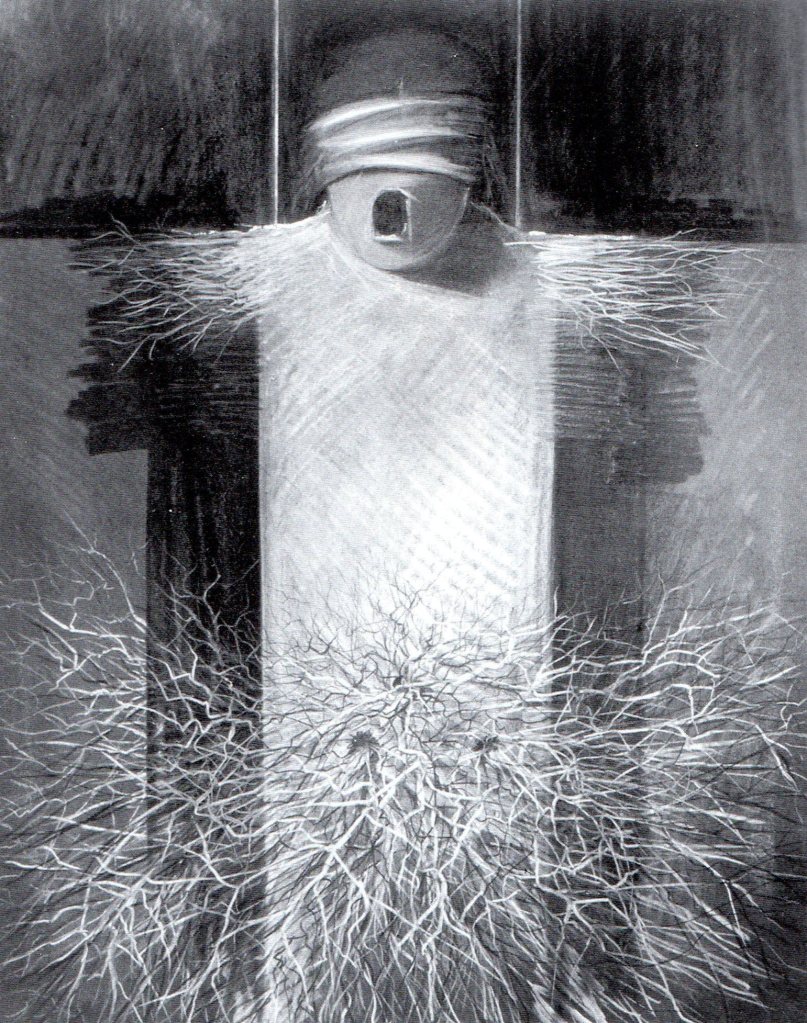
LOOK: Enrico Pinardi (American, 1934–2021), Crucifixion with Thorns, 2002. Oil on canvas.

Pinardi, Enrico_Crucifixion

I corresponded with the artist of this painting a few years ago after having found a black-and-white photo of it in the book The Crucifixion in American Art by Robert Henkes (2003). He granted me permission to reproduce the image on my blog, said he didn’t have a color photo. (“The image is kinda black, white, and blue,” he clarified.) I haven’t gotten around to posting it until now. I wish I had thought to ask about its location; I’m assuming it’s in a private collection somewhere, probably in the United States. After searching for Pinardi online the other week to see what he’s been up to, I found that he died January 30 due to complications from COVID-19.

Crucifixion with Thorns captures something of the horror of Christ’s felt abandonment on the cross. In the throes of death, he opens his mouth in a primal wail—the “loud voice” Matthew and Mark speak of, the “God, why?” He is becoming frayed, unraveled. A thicket of thorns tears through his body—or perhaps that is the cross-post (Pinardi’s expressionistic style deliberately makes it difficult to distinguish between the two). He is pierced.

He is also blindfolded. Luke 22:64 says that Jesus’s captors blindfolded him prior to his appearance before the Sanhedrin, striking him and asking him mockingly to identify, if he’s the Son of God, who it was who struck him. Though his eyes were not covered while he hung on the cross, the artist’s choice to cover them here amplifies the sense of his being in the dark, cut off, and also serves to identify him with other victims of political torture.

LISTEN: “My God, My God, Parts 1 & 2” | Metrical translation of Psalm 22:1–22 by the Committee of the United Presbyterian Church, 1912 | Music by Vito Aiuto of The Welcome Wagon, on Precious Remedies Against Satan’s Devices, 2012

The following text was written by committee (with the input of nine Presbyterian denominations) and first published in Pittsburgh in The Psalter: With Responsive Readings (1912), paired with an older tune by Lowell Mason. It covers two-thirds of Psalm 22, omitting the last nine verses—or rather, if you want to look at it this way, compacting them into four lines, as they contain a lot of repetition. I’ve noted in a separate column which verses of the biblical psalm each line of the song corresponds to.

My God, my God, I cry to Thee;
O why hast Thou forsaken Me?
Afar from Me, Thou dost not heed,
Though day and night for help I plead.

But Thou art holy in Thy ways,
Enthroned upon Thy people’s praise;
Our fathers put their trust in Thee,
Believed, and Thou didst set them free.

They cried and, trusting in Thy Name,
Were saved, and were not put to shame;
But in the dust My honor lies,
While all reproach and all despise.

My words a cause for scorn they make,
The lip they curl, the head they shake,
And, mocking, bid Me trust the Lord
Till He salvation shall afford.

My trust on Thee I learned to rest
When I was on My mother’s breast;
From birth Thou art My God alone,
Thy care My life has ever known.

O let Thy strength and presence cheer,
For trouble and distress are near;
Be Thou not far away from Me,
I have no source of help but Thee.

Unnumbered foes would do Me wrong;
They press about Me, fierce and strong;
Like beasts of prey their rage they vent;
My courage fails, My strength is spent.

Down unto death Thou leadest Me,
Consumed by thirst and agony;
With cruel hate and anger fierce
My helpless hands and feet they pierce.

While on My wasted form they stare,
The garments torn from Me they share,
My shame and sorrow heeding not,
And for My robe they cast the lot.

O Lord, afar no longer stay;
O Thou My helper, haste, I pray;
From death and evil set Me free;
I live, for Thou didst answer Me.

I live and will declare Thy fame
Where brethren gather in Thy Name;
Where all Thy faithful people meet,
I will Thy worthy praise repeat.
v. 1

v. 2


v. 3

v. 4


v. 5

v. 6


v. 7

v. 8


v. 9

v. 10


v. 11


v. 12

v. 13
v. 14

v. 15

v. 16


v. 17
v. 18


v. 19

vv. 20–21a
v. 21b

v. 22

One hundred years later, the Rev. Vito Aiuto wrote a new melody for this metrical translation, his only modifications to the text being to substitute out the archaic pronouns (e.g., Thee, Thou) and verb forms (e.g., hast, dost), unless needed to retain the rhyme scheme or meter. He and his wife, Monique, perform the song on their second full-length album along with a team of other musicians, listed here. Sufjan Stevens is among those in the seven-person choir that wails and sings echoes in the first half.

The song opens with a metallic screeching sound, harsh and grating. There are tensions and dissonances in the music, but at verse 5 (around 4:07) a tonal shift happens, as groping in the dark gives way to greater clarity and confidence. The pain is still there, but, like the psalm on which it’s based, it stretches toward hope.

A graduate of Princeton Theological Seminary, Aiuto is one of the founders of Resurrection Brooklyn, a church network of five Presbyterian (EPC) congregations serving the borough. He has been the lead pastor of Resurrection Williamsburg since it began in May 2005. I had the pleasure of hearing him preach in person at CIVA’s 2019 conference.

I’ve featured retuned hymns by The Welcome Wagon twice before on the blog; see Artful Devotion posts “Hail to the Lord’s Anointed” (for the Baptism of the Lord) and “The Strife Is Over” (for Easter).

“My God, My God, Parts 1 & 2” by The Welcome Wagon appears on the Art & Theology Holy Week Playlist.