Lent, Day 39 (“Simeron Kremate”)

LOOK: Crucifixion by Natalya Rusetska
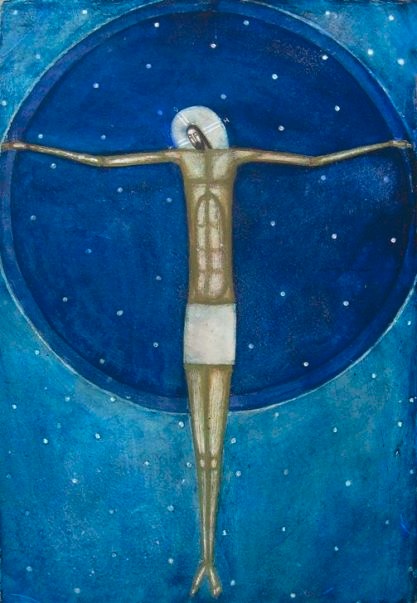
Rusetska, Natalya_Crucifixion
Natalya Rusetska (Ukrainian, 1984–), Crucifixion, 2013. Egg tempera on gessoed board, 20 × 13.5 cm.

LISTEN: “Σήμερον Κρεμάται” (Simeron Kremate), an antiphon for Great and Holy Friday, in plagal second mode, from the Greek Orthodox Church

>> Chanted in English by Vassilis Hadjinicolaou:

[Greek]
Σήμερον κρεμᾶται ἐπὶ ξύλου, ὁ ἐν ὕδασι τὴν γῆν κρεμάσας.
Στέφανον ἐξ ἀκανθῶν περιτίθεται, ὁ τῶν Ἀγγέλων Βασιλεύς.
Ψευδῆ πορφύραν περιβάλλεται, ὁ περιβάλλων τὸν οὐρανὸν ἐν νεφέλαις.
Ῥάπισμα κατεδέξατο, ὁ ἐν Ἰορδάνῃ ἐλευθερώσας τὸν Ἀδάμ.
Ἥλοις προσηλώθη, ὁ Νυμφίος τῆς Ἐκκλησίας.
Λόγχῃ ἐκεντήθη, ὁ Υἱὸς τῆς Παρθένου.
Προσκυνοῦμέν σου τὰ Πάθη Χριστέ.
Δεῖξον ἡμῖν, καὶ τὴν ἔνδοξόν σου Ἀνάστασιν.

[Transliterated Greek]
Símeron kremátai epí xýlou, o en ýdasi tín gín kremásas.
Stéfanon ex akanthón peritíthetai, o tón Angélon Vasiléfs.
Psevdí porfýran periválletai, o perivállon tón ouranón en nefélais.
Rápisma katedéxato, o en Iordáni eleftherósas tón Adám.
Ílois prosilóthi, o Nymfíos tís Ekklisías.
Lónchi ekentíthi, o Yiós tís Parthénou.
Proskynoúmén sou tá Páthi Christé.
Deíxon imín, kaí tín éndoxón sou Anástasin.

[English translation]
Today he who hung the earth upon the waters is hung on the tree.
The King of the angels is decked with a crown of thorns.
He who wraps the heavens in clouds is wrapped in the purple of mockery.
He who freed Adam in the Jordan is slapped on the face.
The Bridegroom of the church is affixed to the cross with nails.
The Son of the virgin is pierced by a spear.
We worship thy passion, O Christ.

We worship thy passion, O Christ.
Show us also thy glorious resurrection.

This is the fifteenth antiphon (short hymn) from the Matins service of Great and Holy Friday (as the day is called in the Orthodox tradition), celebrated on Thursday evening.

>> Arranged by Fr. Seraphim Dedes, chanted by Paul Barnes, 2019:

(An abbreviated version appears as “Byzantine Chant II: Simeron Kremate” on Barnes’s 2021 album Illumination; see my Holy Week Playlist.)

Paul Barnes is both a pianist and a Greek Orthodox chanter. Here he chants the “Simeron Kremate,” starting out in Greek and then using the following English translation:

Today he who suspended the earth on the waters is suspended on a cross. (×3)
The King of the angels wears a crown of thorns.
He who wraps the sky in clouds is wrapped in a fake purple robe.
He who freed Adam in the Jordan accepts to be slapped.
The Bridegroom of the church is fixed with nails to the cross.
The Son of the virgin is pierced with a spear.
We worship your passion, O Christ. (×3)
Show us also your glorious resurrection.

Seven of his piano majors from the Glenn Korff School of Music provide the ison (drone note).

>> Simeron Kremate, a solo keyboard work by Victoria Bond based on the Greek Orthodox chant, performed by Paul Barnes, 2019:

Paul Barnes and composer Victoria Bond are longtime collaborators. He introduced her to the “Simeron Kremate” chant, and she built a piano composition around its five-note melody. Struck by its similar melodic contour, she incorporated the Jewish Passover chant “Tal” (Dew), a prayer that life-sustaining dew would water the land. This prayer is traditionally chanted on the first morning of Passover (which is tomorrow; the festival begins this evening). Bond, who is Jewish, notes the thematic resonance between the two chants as well: (in my own words) the one a request for fruitfulness and refreshment, the other a lament for the death of the One whose death bears fruit and brings life. She describes the musical elements of the composition as follows:

The work opens with the traditional apichima of the plagal of the second mode which aurally establishes the musical atmosphere of the mode. Victoria follows this with a Jewish style cantillation (based on the cantillation of the great cantor Yosele Rosenblatt) which leads to the first statement of the “Simeron” chant. These opening notes are then developed in multiple ways before the intimate entry of the “Tal” melody. The work concludes with a ‘tranquillo’ passage of rare beauty ingeniously combining both themes. The work ends tentatively and unresolved as the opening notes of the chant dissipate into eternity.

Lent, Day 29

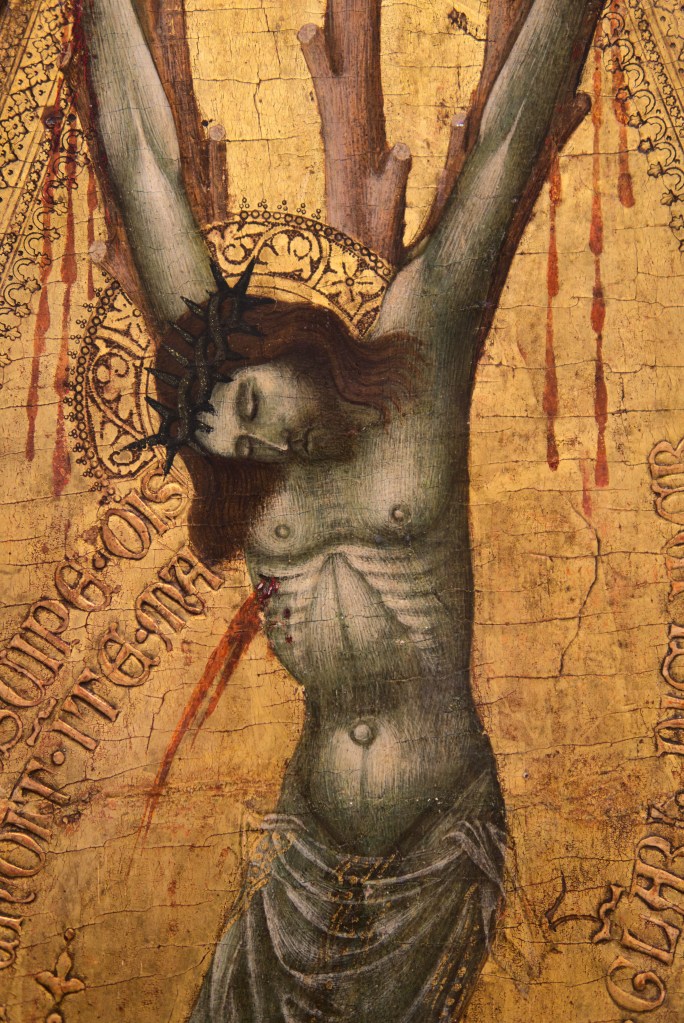
LOOK: Allegorical Representation of the Crucifixion with Saints Andrew and Paul by Francesco Traini

Traini, Francesco_Crucifixion
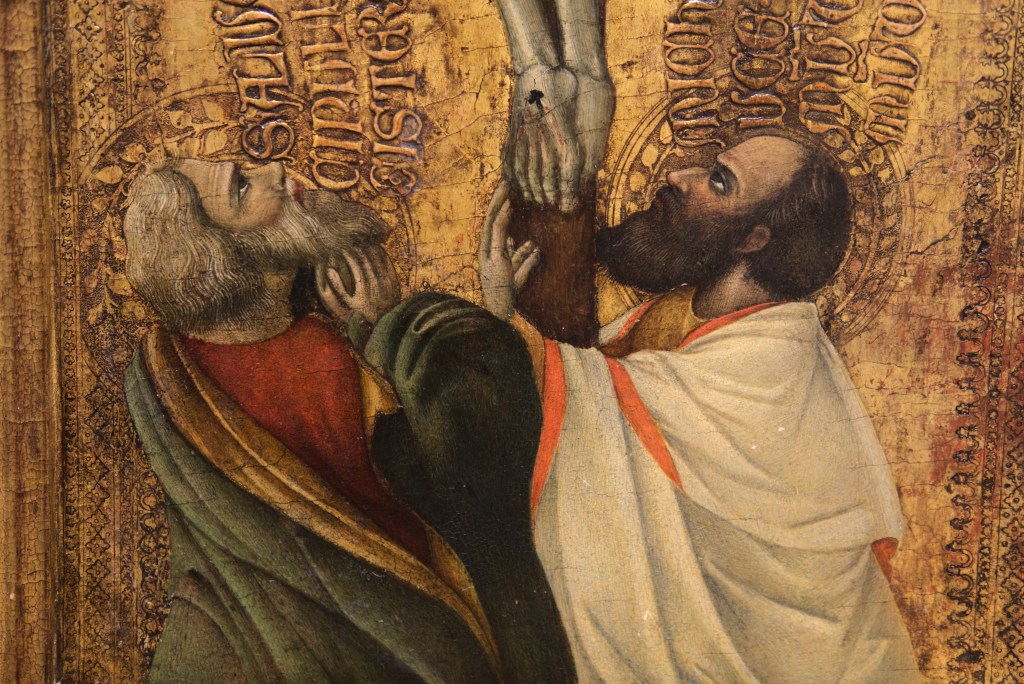
Francesco Traini (Italian, active 1321–1363), Allegorical Representation of the Crucifixion with Saints Andrew and Paul, ca. 1350–60. Tempera and gold leaf on panel, 41 1/4 × 16 5/8 in. (104.8 × 42.2 cm). Carnegie Museum of Art, Pittsburgh, Pennsylvania. Photo: Victoria Emily Jones. [object record]

In this panel painting from late medieval Italy, two of Christ’s apostles—Andrew and Paul—embrace the cross where Christ hangs crucified, his blood running down from his hands and side. The Latin inscriptions unfurl as speech from each. Paul, on the right, says, MICHI AUTEM ABSIT GLORIARI NISI IN CRUCE DOMINI NOSTRI JESU CHRISTU PER QUEM MICHI MUNDUS CRUCIXUS EST ET EGO MUNDO (“But God forbid that I should glory save in the cross of our Lord Jesus Christ, by whom the world is crucified unto me, and I unto the world” [Gal. 6:14]).

And Andrew exclaims, SALVE CRUS SPETIOSA SUSCIPE DISCIPLULUM EIUS QUI PENEDIT IN TE MAGISTER MEUS CHRISTUS (“Hail lovely cross, receive the disciple of him who hung on you, my master Jesus Christ”). This is one of the antiphons from the Feast of Saint Andrew, spoken by Andrew in response to being presented with the instrument of his martyrdom.

Traini, Francesco_Crucifixion (detail)
Traini, Francesco_Crucifixion (detail2)

Francesco Traini is one of the few artists of the period to use raised gesso (plaster) and gold leaf texts on the surfaces of his paintings. He also often used punches, as here, to create elaborate borders.

I’m really compelled by the portrayal of the cross as a forked tree. (Note the similarity to Friday’s featured painting!) Granted, that artistic choice was probably dictated mainly by the narrow dimensions of the panel.

LISTEN: “येशूलाई क्रूसमाथि सब हेर” (Yeshulai Krusmaathi Sab Hera) (Down at the Cross) | Original English words by Elisha A. Hoffman, 1878 | Music by John H. Stockton, 1878 | Performed in Nepali by Psalms Unplugged, 2019 [HT: Global Christian Worship]

१. येशूलाई क्रूसमाथि सब हेर, हाम्रो दुःख उनैले बोकेर, डाक्दैछन् सबलाई प्रेम गरेर, येशूलाई हेर ।

कोः येशूलाई हेर हेर त जिउँनेछौ
येशूलाई क्रूसमाथि सब हेर, येशूलाई हेर ।

२. पापको बोझालाई उतार्नेछन् अमर जीवन पाउने पार्नेछन् मृत्यु नदीदेखि तार्नेछन् येशूलाई हेर ।

३. चिहान देखि प्रभु बौरेछन् बढाऔं सबै जब बेला उनको शक्तिले शोक दूर गर्छन् येशूलाई हेर ।

४. येशू स्वर्गलोकमा बस्दछन् पापीको सब दुःखलाई जान्दछन् साँची नै प्रभुले डाक्दैछन् येशूलाई हेर । [source]

Original English lyrics:

Down at the cross where my Savior died,
Down where for cleansing from sin I cried,
There to my heart was the blood applied;
Glory to his name!

Glory to his name,
Glory to his name;
There to my heart was the blood applied;
Glory to his name!

I am so wondrously saved from sin,
Jesus so sweetly abides within;
There at the cross where he took me in;
Glory to his name!

Oh, precious fountain that saves from sin,
I am so glad I have entered in;
There Jesus saves me and keeps me clean;
Glory to his name!

Come to this fountain so rich and sweet,
Cast thy poor soul at the Savior’s feet;
Plunge in today, and be made complete;
Glory to his name!

Vocals: Jeena Lama
Keys: Sujit Lama
Violin: Prabhat Lamichhane
Bansuri: John Rashin Singh

I love the coming together of all the instruments on the final chorus!

Roundup: Crucifixion and Holocaust, Indonesian Christian art, and more

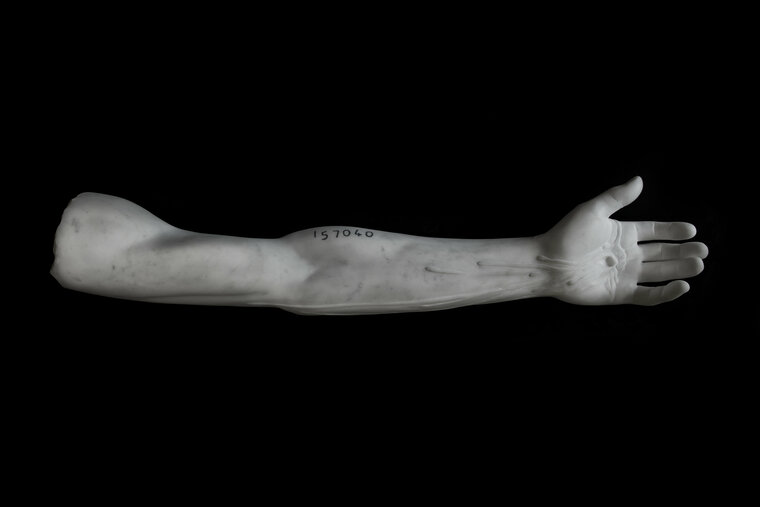
VISUAL MEDITATION: “Golgotha, Auschwitz, and the Problem of Evil” by Victoria Emily Jones: Last month for ArtWay I was asked to write about Emma Elliott’s Reconciliation, a sculpted marble arm that bears both a nail wound of Christ from his crucifixion and the number tattoo of Holocaust survivor Eliezer Goldwyn (1922–2017).

Elliott, Emma_Reconciliation
Emma Elliott (British, 1983–), Reconciliation, 2016. Carrara marble, 20 × 110 × 25 cm.

+++

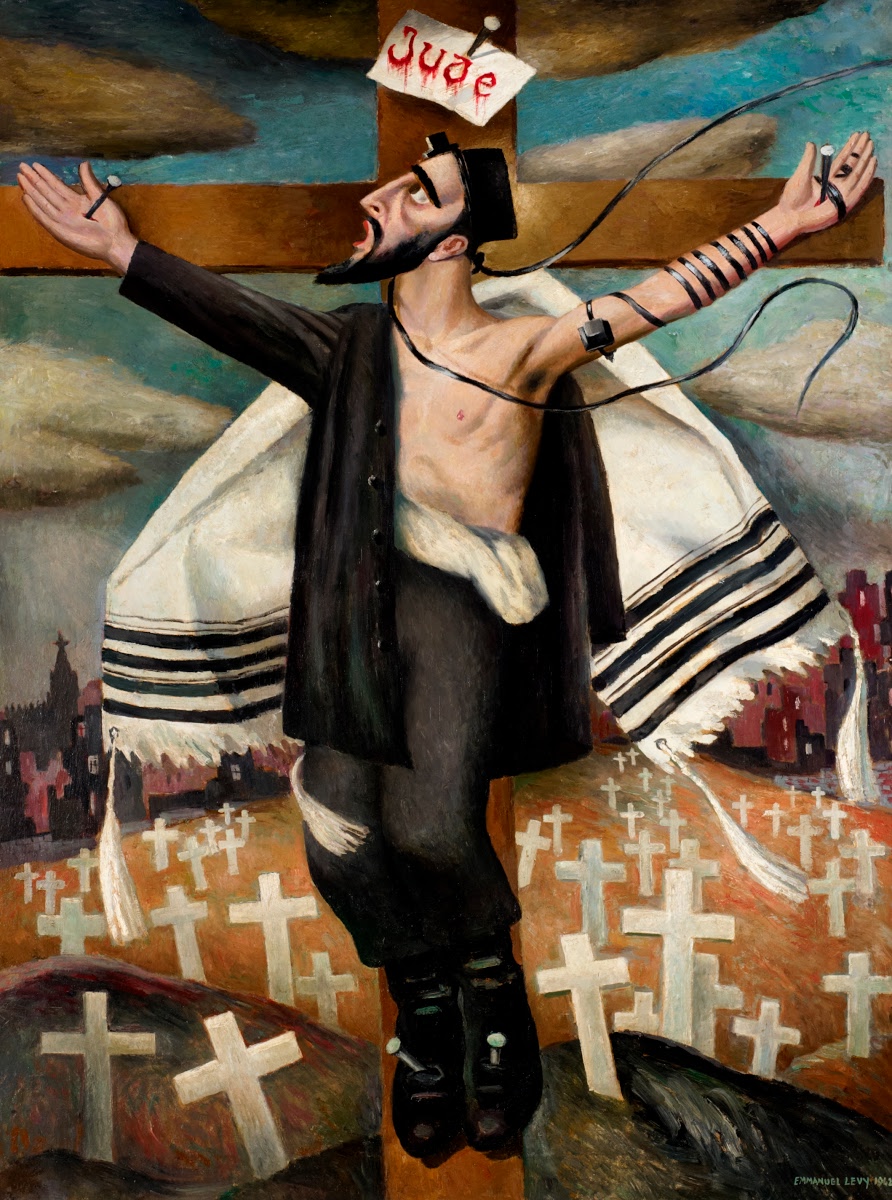
ESSAY: “The church’s reception of Jewish crucifixion imagery after the Holocaust” by Andrew Williams, AGON 48 (Winter 2015): Can Jews create Christian art? “I seek to revisit this question by examining the ways in which Jewish artists have made reference to the central symbol of the Christian faith, the crucifixion, and consider the ethical and theological horizons they open up for the church. . . . Given its place as a symbol of oppression within Judaism, and in particular its integration with the swastika during the years of Nazi power, its widespread adoption within a Jewish artistic vocabulary is remarkable.” Williams discusses “how the resulting christological imagery has been freighted with meaning connected with collective suffering, personal grief and divine abandonment.”

Levy, Emmanuel_Crucifixion
Emmanuel Levy (British, 1900–1986), Crucifixion, 1942. Oil on canvas, 102 × 78 cm. Ben Uri Gallery, London.

Jacob Epstein, Marc Chagall, Emmanuel Levy, RB Kitaj, Mauricio Lassansky, Abraham Rattner, Samuel Bak, Mark Rothko, Barnett Newman, Adi Nes, and Seymour Lipton are among the artists engaged in this illustrated essay. The author provides an extensive bibliography if you’d like to learn more. I also want to remind you of the excellent exhibition catalog essay “Behold the Man: Jesus in Israeli Art” that I shared back in 2017.

+++

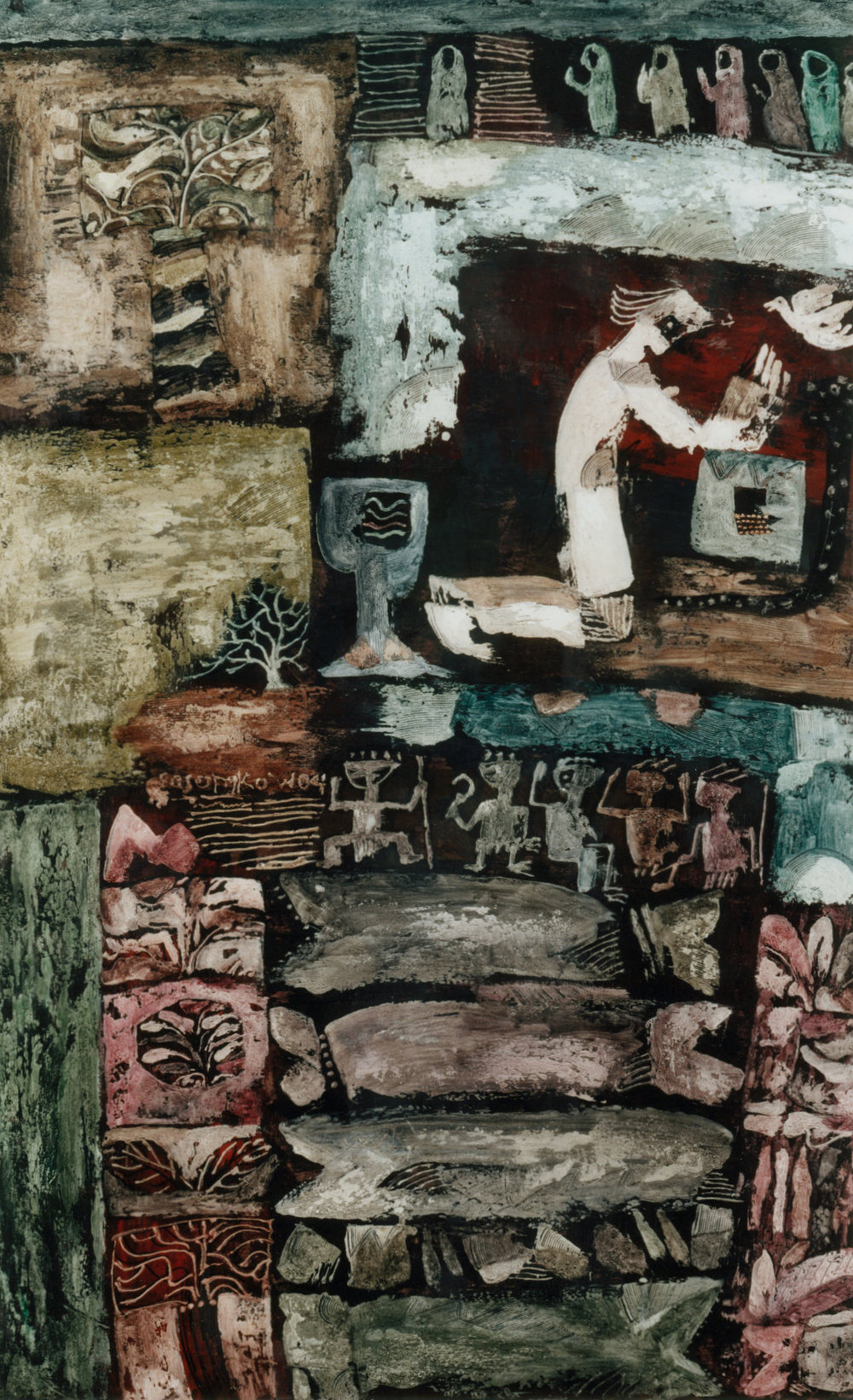
UPCOMING VIRTUAL EVENT: Studio Talk with Indonesian Artist Wisnu Sasongko, April 28, 2022, 8:30 a.m. ET: Organized by the Overseas Ministries Study Center at Princeton Theological Seminary, where Sasongko [previously] served as artist in residence in 2004–5. Cost: $15. Read the artist’s bio and see a sampling of his work at https://omsc.ptsem.edu/artist-sasongko/. There’s also a catalog of his paintings you can buy.

Sasongko, Wisnu_Gethsemane
Wisnu Sasongko (Indonesian, 1975–), Last Night in Gethsemane, 2005. Acrylic on canvas, 48 × 34 in.

+++

ESSAY: “The Christian Art Scene in Yogyakarta” by Volker Küster: Published June 27, 2012, by Protestantse Theologische Universiteit (Protestant Theological University) in Kampen, Netherlands, this essay spotlights five Indonesian artists whose work culturally contextualizes the Christian story: Bagong Kussudiardja [previously], Hendarto, Hari Santosa, Dopo Yeihan, and Wisnu Sasongko. Küster provides biographical information on the artists, including their religious backgrounds (most are converts from Islam), and discusses three paintings by each, all of which are reproduced in full color.

Want to read more by Volker Küster? His chapter on “Visual Arts in World Christianity” in The Wiley Blackwell Companion to World Christianity is excellent, and some of it is available in the Google Books preview. See also his book The Many Faces of Jesus Christ: Intercultural Christology (Orbis, 2001).

+++

ART VIDEO: “Caravaggio’s Taking of Christ (Great Art Explained): In 2020 art writer and gallerist James Payne launched the YouTube video series Great Art Explained, consisting of fifteen-minute videos that each explore a single historically significant artwork. Here’s one he did on an extraordinary painting of Caravaggio’s from the collection of the National Gallery of Ireland, which shows Judas’s betrayal of Christ in Gethsemane.

Lent, Day 27

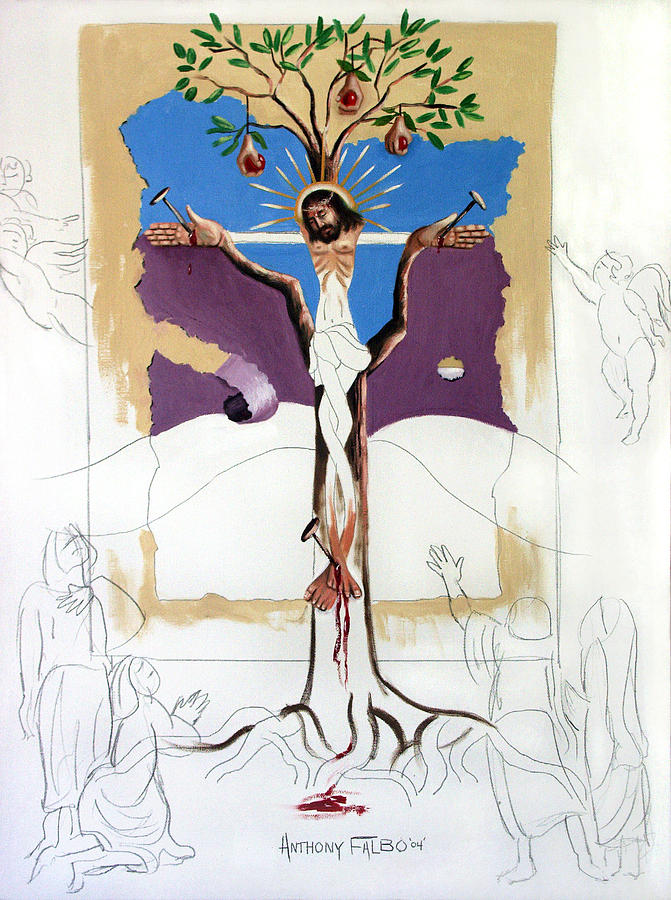
LOOK: It Is Finished by Anthony Falbo

Falbo, Anthony_It Is Finished
Anthony Falbo (American, 1953–), It Is Finished, 2004. Oil and charcoal on paper, 24 × 18 in.

Exaggerated proportions and a sense of humor and play are characteristic of Anthony Falbo’s paintings, including the ones on religious subjects. In It Is Finished, the title is a pun that refers to one of the seven last words of Christ while also affirming that yes, despite half of the paper being unpainted, this artwork is complete as is.

The contrast of minimalist charcoal sketch marks with richly hued oil paints is the painting’s most striking feature. The boxed outline around the Crucifixion and the concentration of color there create the impression of a picture within a picture. But the scene cannot be contained; it spills out, the cross-tree taking root outside the frame, the blood pooling there too. Here is where the mourners—traditionally John and the three Marys—stand, one of them reaching up into the picture. Angels fly about in the margins; one gestures toward the dying Christ as if to tell the viewer, “This is for you.”

The color helps center our attention on Christ’s face and punctuates other details—namely, the three nails, and the blood at the base of the tree. Christ’s figure is painted in some places but line-drawn in others, evoking a sense of fading—but fading out, or in? That is, are we witnessing life giving way to death, or death giving way to life? Is the picture losing color or gaining it? Surely both.

Two rich color fields meet in the background: purple and blue. In addition to royalty, purple is traditionally associated with penitence and mourning and is the liturgical color for Lent. Blue represents heaven and/or truth.

Falbo cleverly uses trompe l’oeil effects to allude to other elements of the Crucifixion narrative. The peeling back of a paint layer references the tearing of the temple veil, a symbolic grant of access for all people to God through the eternal mediating priesthood of Christ. Across from that, an apparent puncture in the picture references the piercing of Christ’s side by a Roman soldier to confirm his death, which unleashed a discharge of water and blood—the symbolic birthing fluids of the church.

Falbo also draws on the traditional tree of life motif, which pictures the cross as a still-living tree, that of Genesis 3:22 and Revelation 22:2. There is art historical precedent for the fusing of Christ’s body to the wood, seen here especially in the hands, suggesting that he himself is life. Uniquely, though, Falbo’s rendition shows hands dangling from the branches, grasping apples, harking back to the Genesis narrative of Adam and Eve’s disobedience in Eden and thereby reminding us of the sin from which Christ’s death redeems us.

LISTEN: “’Tis finished! The Messiah dies” | Words by Charles Wesley, 1751 and 1788, with additions by Austin Pfeiffer, 2016 | Music by Austin Pfeiffer, 2016 | Performed by Salem Presbyterian Church musicians at the PCA General Assembly in Greensboro, North Carolina, June 15, 2017 | CCLI #7192481 [Chord chart]

’Tis finished! The Messiah dies,
cut off for sins, but not his own.
Accomplished is the sacrifice,
the great redeeming work is done.
Done, done, done!

The veil is rent; in Christ alone
the living way to heav’n is seen;
the middle wall is broken down,
and all the world may enter in.
Enter in!

Refrain:
When the Messiah took on flesh
and he gave up throne and home to be with us,
the vict’ry we could never grasp
was captured when they cut and cast
his broken body on the altar of the Lord.

’Tis finished!—all my guilt and pain;
I want no sacrifice beside.
For me, for me the Lamb is slain;
’tis finished! I am justified.
Justified! [Refrain]

The reign of sin and death is o’er,
and all may live from sin set free.
Satan hath lost his mortal power;
’tis swallowed up in victory.
Victory! [Refrain]

The Rev. Austin Pfeiffer (ThM, Duke Divinity School) is an associate pastor at Salem Presbyterian Church in Winston-Salem, North Carolina, one of whose roles is to oversee music and liturgy. In summer 2017 he led a worship session at the annual business meeting of the Presbyterian Church in America (PCA) that included a retuned version he wrote, with new refrain, of Charles Wesley’s “’Tis finished! The Messiah dies.” The music really draws out the celebratory aspect of the lyrics and the sense of finality and accomplishment, especially with the accented repetition of each stanza’s end word or two. And the refrain expounds on Wesley’s imagery of sacrifice, in addition to connecting the Crucifixion and the Incarnation.

I’ve embedded a video of the performance above, extracted from the General Assembly livestream footage, with Pfeiffer’s permission. He is joined onstage by fellow musicians from Salem Pres: Hannah Proulx and Elizabeth Ottenjohn on vocals, Jared Meyer on vocals and guitar, Margaret Raney on fiddle, and John Daniel Ray on upright bass.

Pfeiffer, Meyer, and Ray make up the modern folk band The Pharaoh Sisters, whose debut album, Civil Dawn, is excellent. (I mentioned it here.)

I’ve featured Charles Wesley many times on the blog, as he’s perhaps my favorite hymn-writer. This hymn text of his exists in several iterations, as he returned to it with a revisionary touch throughout his life. The earliest version, consisting of two eight-line stanzas, appears in a manuscript he completed in 1751 and was first published in 1762 in volume 2 of his Short Hymns on Select Passages of the Holy Scriptures:

’Tis finished! The Messias dies,
Cut off for sins, but not his own!
Accomplished is the sacrifice,
The great redeeming work is done;
Finished the first transgression is,
And purged the guilt of actual sin,
And everlasting righteousness
Is now to all the world brought in.

’Tis finished, all my guilt and pain,
I want no sacrifice beside,
For me, for me, the Lamb is slain,
And I am more than justified;
Sin, death, and hell are now subdued,
All grace is now to sinners giv’n,
And lo, I plead th’ atoning blood,
For pardon, holiness, and heaven.

But the most commonly reproduced version in hymnals today uses lines 1–4 and 9–12 (slightly altered) of the original, plus two of the four additional stanzas Wesley wrote on his deathbed in 1788, which weren’t published until 1830. (See the final eight-stanza version by Wesley.)

The hymn is often paired with William Bradbury’s tune OLIVE BROW, from 1853. It’s an alright tune, but I much prefer Pfeiffer’s.

Lent, Day 25

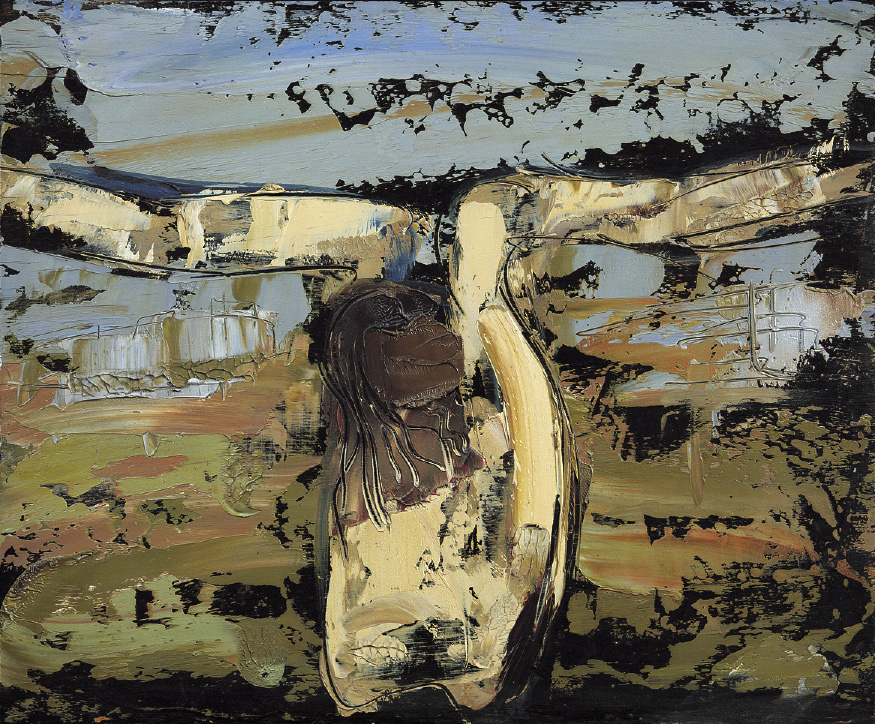
LOOK: Crucifix No. 9 by William Congdon

Congdon, William_Crucifix No. 9
William Congdon (American, 1912–1998), Crocefisso 9 (Crucifix 9), 1961. Oil on Masonite, 19 11/16 × 23 5/8 in. (50 × 60 cm). Private collection, Milan. Photo © The William G. Congdon Foundation.

William Grosvenor Congdon (1912–1998) was a modern American artist, often classified as an abstract expressionist, who spent much of his life in Italy after World War II. He converted to Catholicism in 1959 and for the next two decades painted dozens of Crucifixions, which became more and more abstract as he went on. The one above is one of his earliest, and the subject is still easily recognizable.

Christopher Reardon explains how Congdon achieved the thick surface textures of his paintings:

Typically Congdon applied paint with a palette knife, then incised the encrustations of oil with a jackknife or awl. The technique suited him to the end. “With a brush, it’s a kiss,” he said after painting one of his final landscapes last winter [1997]. “You have to fight with a knife.”

This technique contributes to the agitated feel of many of his Crucifixion paintings.

LISTEN: String Quartet No. 1 “Calvary” by Coleridge-Taylor Perkinson, 1956 | Performed by the Catalyst Quartet, 2021

Coleridge-Taylor Perkinson (1932–2004) was a prodigious American composer whose work spans many genres, including classical, jazz, pop, film, television, and dance. After receiving his bachelor’s and master’s degrees from the Manhattan School of Music, he cofounded the Symphony of the New World in New York in 1965 and later became its music director. He was also music director of Jerome Robbins’s American Theater Lab and the Alvin Ailey American Dance Theater.

Perkinson composed his first string quartet when he was twenty-three, basing it on the melody of the African American spiritual “Calvary.” It’s in three movements, which together capture the light and shade of the Crucifixion event:

I. Allegro
II. Quarter note = 54 (video time stamp: 5:40)
III. Rondo: Allegro vivace (video time stamp: 10:36)

The performance above is by the Grammy-winning Catalyst Quartet. It was part of the “Uncovered” series they played last year at The Greene Space at WNYC & WQXR, comprising three free concerts of work by five historically important Black composers: Florence B. Price, Jessie Montgomery, Coleridge-Taylor Perkinson, George Walker, and Samuel Coleridge-Taylor (Perkinson’s namesake!). View the full concert series here.

I wanted to show a performance caught on video so that you can better see how the instruments interact with one another, but for an album recording, see Perkinson: A Celebration (2000), where the piece is performed by the New Black Music Repertory Ensemble Quartet. I include two of the movements, in addition to the Calvary Ostinato from Perkinson’s Black Folk Song Suite, on my Holy Week Playlist.

Lent, Day 24

LOOK: Sheep in the Moonlight by Craigie Aitchison

Aitchison, Craigie_Sheep in the Moonlight
Craigie Aitchison (Scottish, 1926–2009), Sheep in the Moonlight, 1999. Screenprint in colors, edition of 75 in white ink, on black wove paper, 17 7/8 × 15 in. (45.5 × 38 cm) (full sheet, framed).

LISTEN: “There Is a Green Hill Far Away” | Words by Cecil Frances Alexander, 1848

There is a green hill far away,
Without a city wall,
Where the dear Lord was crucified,
Who died to save us all.

We may not know, we cannot tell,
What pains he had to bear,
But we believe it was for us
He hung and suffered there.

There was no other good enough
To pay the price of sin.
He only could unlock the gate
Of heav’n and let us in.

Oh, dearly, dearly has he loved!
And we must love him too,
And trust in his redeeming blood,
And try his works to do.

>> Version 1: Music by William Horsley, 1844 | Performed by The Gesualdo Six, dir. Owain Park, 2021:

>> Version 2: Music by John H. Gower, 1890 | Performed by The Lower Lights on A Hymn Revival, 2010:

Lent, Day 23

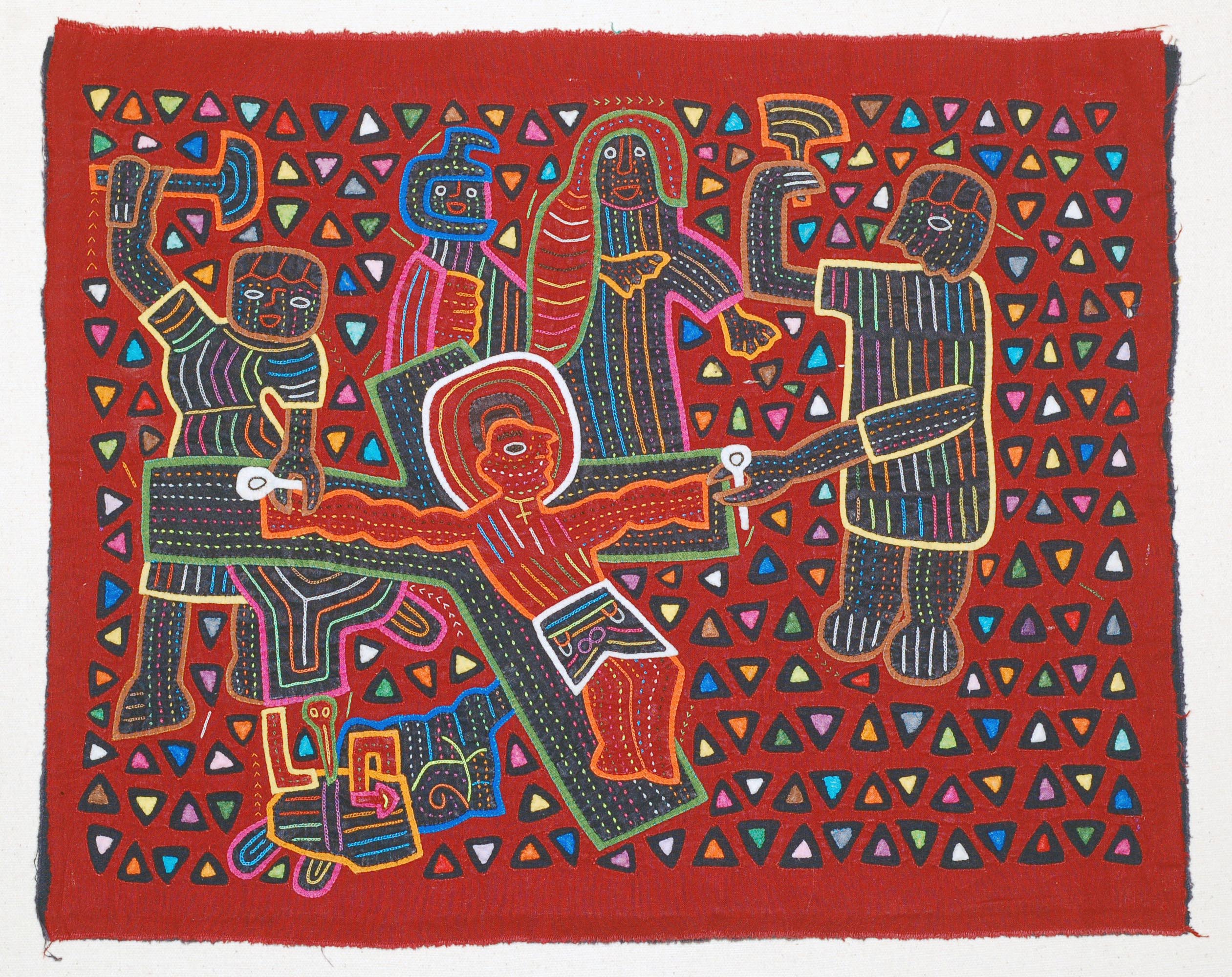
LOOK: Mola from the San Blas Islands

Christ on the Cross (mola)
Christ Nailed to the Cross, mola (reverse appliqué panel) from the San Blas Islands, late 20th century. Bowden Collections.

The Kuna (also spelled Guna or Cuna) Indians live on the San Blas archipelago off the east coast of Panama, a cluster of some 378 islands in the Caribbean Sea. They are politically autonomous, and much of their traditional culture is intact.

Since the late nineteenth century, Kuna women have been making what are called molas, reverse appliqué panels made in pairs for the front and back of women’s blouses. As mola collector Jane Gruver describes, “several layers of cloth are stacked together and the design is made by cutting through the different layers of fabric to expose the desired color. Once the specific shape is achieved, the area is stitched around. Sometimes embroidery and applique are also used to add detail.” This colorful, wearable textile art is an integral part of Kuna culture.

The earliest molas featured geometric designs, which the Kunas translated from their customary body painting designs, but now a vast variety of representational subjects are common, including animals, plants, domestic scenes, political satire, dragons, mermaids, superheroes, spacecraft—and biblical stories!

The first Christian missionary to the San Blas Islands was Annie Coope, a single woman from the United States who arrived in the first decade of the 1900s and established a school on the island of Nirgana in 1913. A significant number of the Kuna embraced Christianity, such that there are now churches on thirty of the islands, as well as eighteen Kuna churches in and around Panama City, according to Wycliffe. A Kuna translation of the New Testament was published in 1995, at the behest of Kuna pastor Lino Smith Arango, and a Kuna Old Testament was completed in 2014.

The mola above shows two men hammering nails into Christ’s palms as two mourning figures—presumably John and Mary—stand behind. This piece is from the collection of Sandra and Bob Bowden in Chatham, Massachusetts, who are among today’s major collectors of modern biblical art. It is one of forty molas in the traveling exhibition Eden to Eternity: Molas from the San Blas Islands, available for rental for a nominal fee.

LISTEN: “Nailed” by Nicholas Andrew Barber, on Stations (2020)

They nailed you to your cross
Yes, they nailed you to your cross
Like you said they would

And they drove those nails through your hands
And they drove those nails through your feet
Like a criminal
Like a criminal

O the pain you must have felt
O the agony
O the agony

Behold the precious Lamb of God
Nailed to the cross
Nailed to the cross

Lent, Day 18

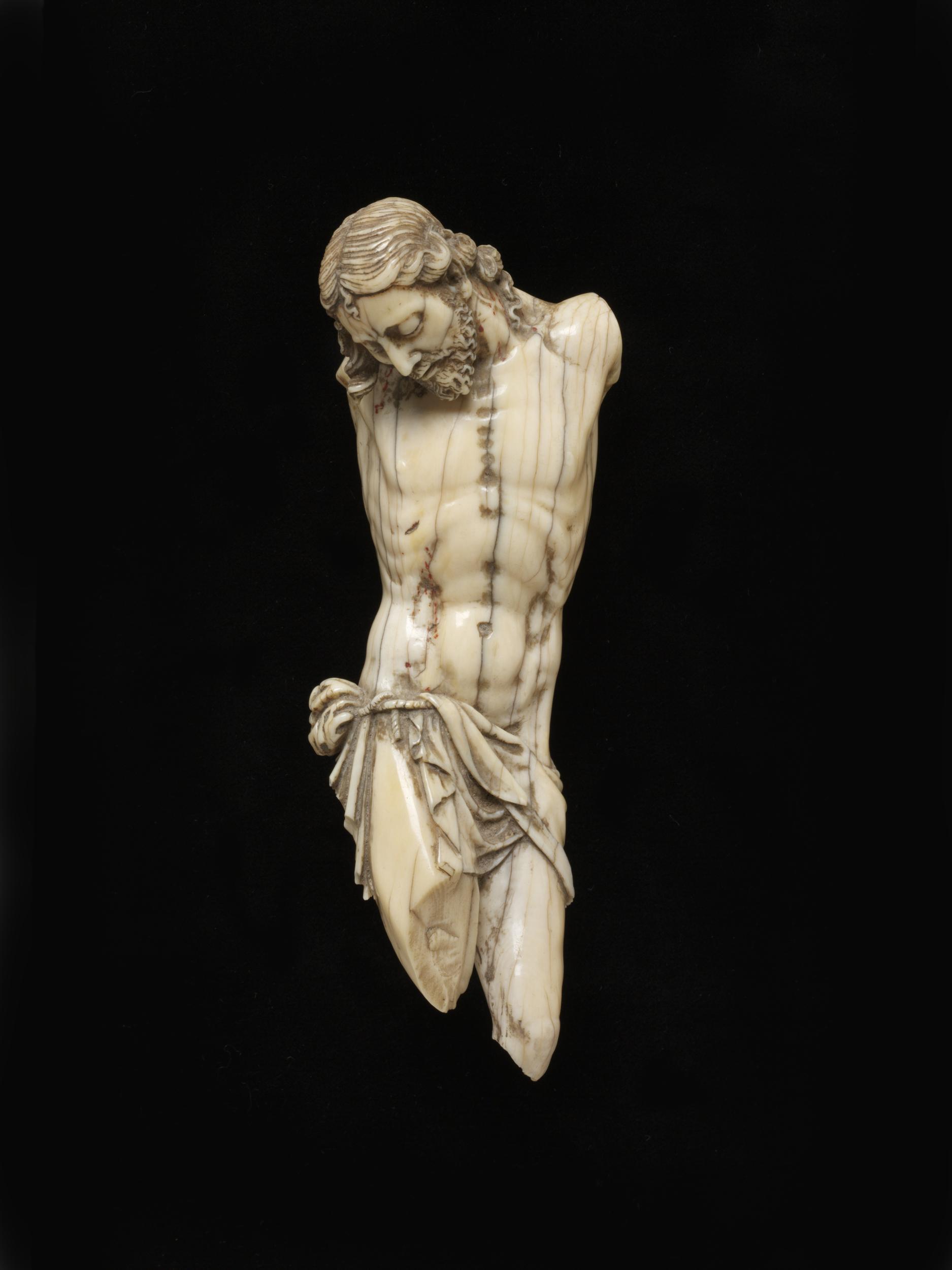
LOOK: Crucifix figure by Giovanni Antonio Gualterio

Gualterio, Giovanni Antonio_Crucifix figure
Giovanni Antonio Gualterio (Italian, active 1582–1600), Crucifix figure, ca. 1599. Ivory, h. 13.5 cm. Victoria and Albert Museum, London.

LISTEN: “Christ’s dying love; or, our pardon bought at a dear price” (aka “Condescension”) | Words by Isaac Watts, 1709 | Music: Appalachian shape-note tune, ca. 1800; published in The Southern Harmony, and Musical Companion (new edition, thoroughly revised and much enlarged), ed. William Walker, 1854 | Arranged and performed by Timothy Seaman on bamboo flute, 2021

How condescending and how kind
Was God’s eternal Son!
Our mis’ry reached his heav’nly mind,
And pity brought him down.

When justice, by our sins provoked,
Drew forth its dreadful sword,
He gave his soul up to the stroke
Without a murmuring word.

He sunk beneath our heavy woes,
To raise us to his throne;
There’s ne’er a gift his hand bestows
But cost his heart a groan.

This was compassion like our God,
That when the Savior knew
The price of pardon was his blood,
His pity ne’er withdrew.

Now though he reigns exalted high,
His love is still as great:
Well he remembers Calvary,
Nor should his saints forget.

Here we behold his bowels roll,
As kind as when he died;
And see the sorrows of his soul
Bleed through his wounded side.

Here we receive repeated seals
Of Jesus’ dying love;
Hard is the heart that never feels
One soft affection move.

Here let our hearts begin to melt
While we his death record,
And with our joy for pardoned guilt,
Mourn that we pierced the Lord.

Virginia musician Timothy Seaman plays a variety of instruments, including the hammered dulcimer, mountain dulcimer, various flutes and whistles, bowed and plucked psalteries, and guitar. He has recorded fifteen albums featuring his instrumental arrangements of traditional music (especially American mountain and Scots-Irish tunes), as well as original compositions, many of them inspired by local wildlife and nature and by the Christian faith. He has eight years’ worth of videos on his YouTube channel, a mix of tutorials and informal performances. For this time of year especially, I’d also commend to you another of his Appalachian folk hymn arrangements, “Behold the Lamb of God” on hammered dulcimer.

Of “Condescension,” he writes,

In 1986 I found this profound folk hymn in an old book, and I’ve loved to play and sing it ever since—but not till now have I recorded it. I’ve considered ensemble arrangements with intriguing chords and rhythms, etc., but I keep coming back to a cappella bamboo flute, or voice. Here it is in its instrumental form! The tune is anonymous, and the words are by the master hymn writer Isaac Watts.

Click here to access the lead sheet for “Condescension.” It was made by Seaman and is shared here with his permission.

For a vocal performance, see The Shapenote Album by The Tudor Choir, directed by Doug Fullington.

The mention of rolling bowels in the sixth stanza may sound strange to us today (sounds like a digestive issue!), but traditionally, the bowels were regarded as the seat of tender and sympathetic emotions—felt in the gut. Several of the biblical authors mention the moving of that organ in relation to yearning, anguish, compassion, or mercy (e.g., Gen. 43:30; Isa. 63:15; Jer. 4:19; 1 John 3:17). The KJV translation preserves the expression, still commonly used in the seventeenth century, with literalness, translating the Hebrew mēʿê and Greek splagchnon as either “bowels,” “belly,” or “inward parts.” Today we locate such emotions in the heart instead.

This stanza is actually my favorite in the hymn. There’s such a poetic quality to it! Watts is meditating on Christ exalted, who is not at all impassive in that high estate, but rather is still moved to compassion for humanity, every bit as much as when he hung on the cross. He still bears the wounds of crucifixion, and, in a figurative sense, those wounds still bleed for us.

Here we behold his bowels roll,
As kind as when he died;
And see the sorrows of his soul
Bleed through his wounded side.

Lent, Day 17

LOOK: Head of Christ by Fernando Botero

Botero, Fernando_Head of Christ
Fernando Botero (Colombian, 1932–), Cabeza de Cristo (Head of Christ), 1976. Oil on canvas, 185 × 179 cm. Museo de Antioquia, Medellín, Colombia.

Colombian painter and sculptor Fernando Botero is South America’s best-known artist. He is influenced by the Old Masters, which he studied in his twenties in Madrid, Paris, and Florence, and by the Mexican muralists. But his style—marked by plump, often childlike figures—is distinctively his own and has even been given the name “Boterismo.”

Throughout his career he has remained adamant that he does not paint “fat people” or “chubbies.” What he paints, he insists, is exaggerated volumes that highlight the body’s natural shape and the “sensuality of form.” In addition to religious subjects, he also paints Latin American street scenes, domestic life, nudes, and political portraits.

At age eighty-nine, Botero continues to be active as an artist, living and working between Paris, New York, and Tuscany.

LISTEN: “Legend (The Crown of Roses),” Op. 54, No. 5, by Pyotr Ilyich Tchaikovsky, 1883/89 | Based on a text by Richard Henry Stoddard, 1856 | Performed by the University of Pretoria Camerata, dir. Michael Barrett, on Written in the Stars, 2021

When Jesus Christ was yet a child
He had a garden small and wild,
Wherein he cherished roses fair,
And wove them into garlands there.

Now once, as summer-time drew nigh,
There came a troop of children by,
And seeing roses on the tree,
With shouts they plucked them merrily.

“Do you bind roses in your hair?”
They cried, in scorn, to Jesus there.
The Boy said humbly: “Take, I pray,
All but the naked thorns away.”

Then of the thorns they made a crown,
And with rough fingers pressed it down.
Till on his forehead fair and young
Red drops of blood like roses sprung.

In 1877 Tchaikovsky found a Russian poem by Aleksey Pleshcheyev published in a journal; it was a translation of the English-language poem “Roses and Thorns” (1856) by American poet Richard Henry Stoddard, an allegory of the Crucifixion. It’s about the boy Jesus who tends a rose garden and dreamily weaves together crowns from the branches’ yield. One day a bunch of rowdy children comes by and carelessly yanks the flowers off the bushes, scoffing at Jesus for being soft, a flower lover. In a spirit of gentleness, he tells them they may have the flowers, but to leave the thorns. Continuing their derision, the children bend the bare, thorny stems into a crown and press it into Jesus’s head. From his flesh then bloom “roses” of blood.

Tchaikovsky first set the Russian poem to music in 1883, arranging it for solo voice and piano and publishing it as part of his Sixteen Songs for Children, Opus 54. In 1884 he arranged it for solo voice and orchestra, and in 1889 for unaccompanied choir.

When English-language choirs sing the song, instead of using Stoddard’s original text, they typically use a 1913 adaptation by British poet Geoffrey Dearmer—which I believe is the superior version. See a side-by-side presentation of the song’s textual history.

Lent, Day 4

Abba Macarius was asked, ‘How should one pray?’ The old man said, ‘There is no need at all to make long discourses; it is enough to stretch out one’s hands and say, “Lord, as you will, and as you know, have mercy.” And if the conflict grows fiercer say, “Lord, help!” He knows very well what we need and he shews us his mercy.

—from the Apophthegmata Patrum (Sayings of the Desert Fathers), trans. Benedicta Ward

LOOK: The Parable of the Mustard Seed by Roman Zilinko

Zilinko, Roman_The Parable of the Mustard Seed
Roman Zilinko (Ukrainian, 1979–), The Parable of the Mustard Seed, 2015. Acrylic and gold leaf on gessoed wood.

LISTEN: “The Jesus Prayer” in Ukrainian [HT: Global Christian Worship]

Ісусе, Ісусе, сину Божий, помилуй, помилуй нас.

Transliteration: Isuse, Isuse, Synu Bozhyy, pomyluy, pomyluy nas.

English translation: Jesus, Jesus, Son of God, have mercy, have mercy on us.

I don’t know the name of this vocal ensemble, when the recording was made, or the origin of the melody they sing. (Can anyone help me out there?)

The text, though, is a famous one, used regularly in the Eastern Orthodox tradition and known as the Jesus Prayer, or the Prayer of the Heart. It originated with the early Christian monks of the Egyptian desert around the fifth century, and was first written down in Greek. Another variation is “Lord Jesus Christ, Son of God, have mercy on me, a sinner.”

An invocation of Christ’s name and presence, the Jesus Prayer is meant to be recited in repetition as a form of meditative prayer. Some Christians use it in conjunction with a breath prayer, breathing in as they say internally, “Jesus, Son of God,” and breathing out on “have mercy.”

It’s most often prayed in the first-person singular—“have mercy on me”—and used in private devotions, but in this corporate chant on the video, it’s prayed in the first-person plural, “us.” In light of Russia’s recent invasion of Ukraine and the war being fought there, I hear in these Ukrainian women’s voices a lament for their country.

Lord, have mercy. Spare the Ukrainian people. Stop the violence and destruction. Protect, provide. Heal the wounded and the traumatized, and comfort the grieving. Thwart the evildoers; turn their hearts to you in repentance. Grant wisdom to the leaders working for peace. In short: “Lord, help!”

The folk icon featured above is by contemporary Ukrainian artist, art historian, and curator Roman Zilinko, who works at the Andrey Sheptytsky National Museum in Lviv. “My artworks continue the tradition of the Ukrainian icon painting of the Carpathian region, which flourished in the 16th and 19th centuries,” Zilinko says. Its distinctive features are “naive and flat painting, but rich in colors and ornaments.” To view more of Zilinko’s icons, click here.

The above icon shows a religious procession, with two people carrying khorugvs (religious banners)—one of the Virgin Mary and Child, one of Christ Pantocrator. Foregrounded in the center is Christ, crucified on a tree that recalls the tree of life from Revelation 22, whose leaves are for the healing of nations. The suffering Christ goes before the people and is right in their midst. He is their companion, their deliverer, their wounded healer, their life.

Zilinko has named the icon The Parable of the Mustard Seed, after Jesus’s saying about how the kingdom of heaven starts out small but then grows into something enormous and lush (Matt. 13:31–32). Christ has indeed grown his church mightily in Ukraine; Christianity has been the primary religion there since the tenth century. Zilinko portrays the Christians of Ukraine as a sea of people who stand behind their Savior with hands clasped in prayer and faces radiant with hope.

Let us join them in intercession for a swift end to the war and lasting peace in the region, and for the ability of refugees to return home.

If you find yourself at a loss for words, I suggest praying the Jesus Prayer from the video.