“To Calvary he bore his cross,” aka “My Fearful Dream”: An Early Tudor Passion Carol from the Fayrfax Manuscript

The English Crucifixion lyric “My Fearful Dream” (also known by the beginning of its first line, “To Calvary he bore his cross”) was written anonymously in the fifteenth century. It is preserved, with music by Gilbert Banastir (sometimes spelled Banaster or Banester) (ca. 1445–1487), on folios 77v–82r of the famous Tudor songbook BL Add. MS. 5465, intended for use at the court of King Henry VII. Compiled around the year 1500, this manuscript is commonly referred to as the Fayrfax Manuscript after Robert Fayrfax, the Tudor composer who was organist of St. Albans and a Gentleman of the Chapel Royal—that is, an adult male singer in the monarch’s household choir. It contains twelve sacred songs and thirty-seven secular songs, all in English—with, “beyond question, the finest music written to vernacular words which survives from pre-Reformation England,” writes John Stevens in Early Tudor Songs and Carols (xvi). It is unknown whether the text or the music was written first.

In 1982 “My Fearful Dream” was performed by Pro Cantione Antiqua under the direction of Mark Brown at the Church of St. John-at-Hackney in London. The recording of this performance was originally released in 1985 in vinyl format on A Gentill Jhesu: Music from the Fayrfax Ms. and Henry VIII’s Book (Hyperion A66152) and was later reissued by Regis Records in 2006 on the CD Tears & Lamentations: English Renaissance Polyphony (RRC 1259). Unfortunately, the CD is out of print, the choral group is inactive, and I can find no performances online. I thus provide the recording of “My Fearful Dream” (or “My Fearfull Dreme,” as the track list spells it) directly below for educational purposes. It is a song for three voices: alto, tenor, bass.

Below is the original text as transcribed by Richard Leighton Greene from the Fayrfax Manuscript in The Early English Carols (Oxford: Clarendon Press, 1935), page 124, followed by a version with modernized spellings and updates of a few antiquated words. The text also appears in John Stevens, Music and Poetry in the Early Tudor Court (London: Methuen, 1961), no. 56, and the music in John Stevens, ed., Early Tudor Songs and Carols (Musica Britannica 36) (London: Stainer and Bell, 1975), page 476.

Pro Cantione Antiqua does not sing the third stanza.

van der Weyden, Rogier_Crucifixion (Philadelphia)
Rogier van der Weyden (Netherlandish, 1399/1400–1464), The Crucifixion, with the Virgin and Saint John the Evangelist Mourning, ca. 1460. Oil on panel, overall 71 × 73 in. (180.3 × 185 cm). Philadelphia Museum of Art.

Most people today use the word “carol” as synonymous with a cheerful Christmas song. But up until about 1550, the term was used for lyrics of a certain form rather than a certain subject or spirit. Greene defines the medieval or Renaissance carol as “a song on any subject, composed of uniform stanzas and provided with a burden . . . [that is,] an invariable line or group of lines which is to be sung before the first stanza and after all stanzas” (Early English Carols, xxxii–xxxiii). He distinguishes a burden from a refrain: “The refrain, as defined in this essay, is a repeated element which forms part of a stanza, in the carols usually the last line. The burden, on the other hand, is a repeated element which does not form any part of a stanza, but stands wholly outside the individual stanza-pattern” (clx).

That’s why “My Fearful Dream” can properly be called a carol. The two lines beginning “My fearful dream” open the song and repeat after each stanza.


My Feerfull Dreme

My feerfull dreme nevyr forgete can I:
Methought a maydynys childe causless shulde dye.


To Calvery he bare his cross with doulfull payne,
And theruppon straynyd he was in every vayne;
A crowne of thorne as nedill sharpe shyfft in his brayne;
His modir dere tendirly wept and cowde not refrayne.
Myn hart can yerne and mylt
When I sawe hym so spilt,
Alas, for all my gilt,
Tho I wept and sore did complayne
To se the sharpe swerde of sorow smert,
Hough it thirlyd her thoroughoute the hart,
So ripe and endles was her payne.

My feerfull dreme . . .

His grevous deth and her morenyng grevid me sore;
With pale visage tremlyng she strode her child before,
Beholdyng ther his lymmys all to-rent and tore,
That with dispaire for feer and dred I was nere forlore.
For myne offence, she said,
Her Son was so betraide,
With wondis sore araid,
Me unto grace for to restore:
‘Yet thou are unkynd, which sleith myn hert,’
Wherewith she fell downe with paynys so smert;
Unneth on worde cowde she speke more.

My feerfull dreme . . .

Saynt Jhon than said, ‘Feere not, Mary; his paynys all
He willfully doth suffir for love speciall
He hath to man, to make hym fre that now is thrall.’
‘O frend,’ she said, ‘I am sure he is inmortall.’
‘Why than so depe morne ye?’
‘Of moderly pete
I must nedis wofull be,
As a woman terrestriall
Is by nature constraynyd to smert,
And yet verely I know in myn hart
From deth to lyff he aryse shall.’

My feerfull dreme . . .

Unto the cross, handes and feete, nailid he was;
Full boistusly in the mortess he was downe cast;
His vaynys all and synowis to-raff and brast;
The erth quakyd, the son was dark, whos lyght was past,
When he lamentable
Cried, ‘Hely, hely, hely!’
His moder rufully
Wepyng and wrang her handes fast.
Uppon her he cast his dedly loke,
Wherwith soddenly anon I awoke,
And of my dreme was sore agast.

My feerfull dreme . . .

My Fearful Dream (modernized)

My fearful dream never forget can I:
Methought a maiden’s child causeless should die.


To Calvary he bore his cross with doleful pain,
And thereupon strained he was in every vein;
A crown of thorns, sharp as needles, shoved in his brain.
His mother dear tenderly wept and could not refrain.
My heart did yearn and melt
When I saw him so spilt,
Alas, for all my guilt,
And I wept and did sore complain
To see the sharp sword of sorrow smart,
How it pierced her straight through the heart,
So ripe and endless was her pain.

My fearful dream never forget can I:
Methought a maiden’s child causeless should die.


His grievous death and her mourning grieved me sore;
With pale visage, trembling, she strode before her child,
Beholding his limbs all rent and torn,
That with despair for fear and dread I was near forlorn.
For my offense, she said,
Her Son was so betrayed,
With wounds sore arrayed,
Me unto grace for to restore:
“Yet thou art unkind, which slayeth my heart,”
Wherewith she fell down with pains so smart;
Hardly one word could she speak more.

My fearful dream never forget can I:
Methought a maiden’s child causeless should die.


Saint John then said, “Fear not, Mary; all his pains
He willfully suffers for the special love
He has to man, to make him free that’s now in thrall.”
“O friend,” she said, “I am sure he is immortal.”
“Why, then, do you mourn so deeply?”
“Of motherly pity
I needs must woeful be,
As a terrestrial woman
Is by nature constrained to smart,
And yet verily I know in my heart
From death to life he shall arise.”

My fearful dream never forget can I:
Methought a maiden’s child causeless should die.


Unto the cross, hands and feet, he was nailed;
Violently into the mortise he was cast down;
His veins and sinews were all riven apart and burst;
The earth quaked, the sun was dark, whose light was past,
When he, lamenting,
Cried, “Eli, Eli, Eli!”
His mother was ruefully
Weeping and wrung her hands fast.
Upon her he cast his deathly look,
Wherewith suddenly anon I awoke,
And of my dream was sore aghast.

My fearful dream never forget can I:
Methought a maiden’s child causeless should die.

The speaker of this carol has a dream—a nightmare—of Calvary, where he beholds the ignominious death of Jesus and the agonizing grief of Jesus’s mother and realizes that such suffering was undertaken for his sake, to save him from sin and its fatal consequences. The accusation that Mary hurls at the speaker in her hour of torment is biting: “You slay my heart!” My son is dead because of you. It’s such a humanizing passage, this expression of a mother’s anger at a death that didn’t have to be.

This is the Mater Dolorosa (Latin for “Sorrowful Mother”) of Christian tradition, who is sometimes depicted with a sword (or seven!) in her chest, literalizing Simeon’s prophecy to her as a teen and evoking the piercing sensation of losing a child. In Rogier van der Weyden’s Crucifixion diptych that I’ve reproduced here, created in roughly the same period as “My Fearful Dream” but in the Low Countries, there’s no sword, but Mary’s sorrow is evident in her tear-stained face, the wringing of her hands, and her literally collapsing under the unbearable weight of what she’s been asked to endure.

van der Weyden, Rogier_Crucifixion (detail)

(Related post: https://artandtheology.org/2023/09/15/her-stations-of-the-cross-by-marjorie-maddox/)

In the carol, the apostle John, present with Mary at the foot of the cross, catches her in her swoon and offers consolation, reassuring her that Jesus suffers willingly out of love. She responds that she knows it in her heart, and that she knows too that he will ultimately rise from death, but that that doesn’t diminish the sharpness of the pain she feels, deep in her body, watching her son shamed and wounded so.

The final image in the dream is of Jesus looking on his mother with a deathly pallor. With that, the speaker is jolted awake and sits with the horror.

On this side of the resurrection, it can be easy to breeze past Good Friday (“He didn’t stay dead!”) or to meditate on the Crucifixion only in a spiritual or theological sense. But this poem, this carol, sticks us in medias res, before the resurrection, into a physical human drama full of emotional intensity, so that we can feel what it might have been like to be present at the execution of the Son of God. Maybe you feel that the graphic details are gratuitous (the thorns shoved in his brain[!], his sinews riven apart, etc.), that sensory engagement with the scene is an exercise that fails to honor the bigger picture, and that it’s fruitless to generate pity for Christ or his mother, as the event is passed and what’s done is done. But centuries of faithful Christians have found otherwise: that meditating on Christ’s pain and that of his mother can help us better appreciate the real-life as opposed to merely mythic dimensions of the story and can cultivate in us a proper horror of sin and a deeper gratitude for Christ’s sacrifice.

The word “causeless” in the burden of the carol—the speaker sees a woman’s child dying without cause—does not imply that Jesus’s death served no purpose, but rather that he was put to death on wrongful charges. The Jewish tribunal charged him with blasphemy for calling himself the Son of God, and the Roman courts charged him with sedition, with inciting insurrection against the empire. But he was telling the truth about his identity and did so in ultimate reverence for God, not lack of it, and while the path he called his followers to would in some ways challenge the values of Rome and reorient ultimate loyalties, he never took up arms or encouraged his followers to do so (quite the contrary), and he never sought political power or overthrow.

Listen once more to Pro Cantione Antiqua’s performance of this carol as it would have been performed for the first Tudor monarch, Henry VII, presumably in private religious services for him and his family. May the depths to which God went to save God’s beloved world be something you never can forget.

van der Weyden, Rogier_Crucifixion (right panel)

Good Friday, Part 2: My God, My God

Now from the sixth hour there was darkness over all the land until the ninth hour. And about the ninth hour Jesus cried out with a loud voice, saying, “Eli, Eli, lema sabachthani?” that is, “My God, my God, why have you forsaken me?” And some of the bystanders, hearing it, said, “This man is calling Elijah.” And one of them at once ran and took a sponge, filled it with sour wine, and put it on a reed and gave it to him to drink. But the others said, “Wait, let us see whether Elijah will come to save him.” And Jesus cried out again with a loud voice and yielded up his spirit.

—Matthew 27:45–50 (emphasis added; cf. Mark 15:33–37)

According to the ESV Study Bible, “Jesus’s call to God in Aramaic (’Eli, ’Eli) sounds similar to the Hebrew name for Elijah (’Eliyahu), which the bystanders misunderstand as a summons to the prophet.” A minority opinion among scholars is that, instead, the bystanders deliberately twist Jesus’s words to further mock him. It was a common expectation of Jews during Jesus’s time that Elijah would return as a precursor to the great day of the Lord (see Mal. 4:5).

What Jesus was in fact citing was Psalm 22, a lament of David, which opens with this searing cry of dereliction: “My God, my God, why have you forsaken me?” A series of raw and wrenching poetic descriptions of suffering and pleas for deliverance, the psalm is nevertheless punctuated with reflections on God’s holiness, faithfulness, and care. Verse 22 (“I will tell of your name . . .”) marks a clear turn in which the speaker moves into a hope that is triumphant.

My God, my God, why have you forsaken me?
    Why are you so far from saving me, from the words of my groaning?
O my God, I cry by day, but you do not answer,
    and by night, but I find no rest.

Yet you are holy,
    enthroned on the praises of Israel.
In you our fathers trusted;
    they trusted, and you delivered them.
To you they cried and were rescued;
    in you they trusted and were not put to shame.

But I am a worm and not a man,
    scorned by mankind and despised by the people.
All who see me mock me;
    they make mouths at me; they wag their heads;
“He trusts in the LORD; let him deliver him;
    let him rescue him, for he delights in him!”

Yet you are he who took me from the womb;
    you made me trust you at my mother’s breasts.
On you was I cast from my birth,
    and from my mother’s womb you have been my God.
Be not far from me,
    for trouble is near,
    and there is none to help.

Many bulls encompass me;
    strong bulls of Bashan surround me;
they open wide their mouths at me,
    like a ravening and roaring lion.

I am poured out like water,
    and all my bones are out of joint;
my heart is like wax;
    it is melted within my breast;
my strength is dried up like a potsherd,
    and my tongue sticks to my jaws;
    you lay me in the dust of death.

For dogs encompass me;
    a company of evildoers encircles me;
they have pierced my hands and feet—
I can count all my bones—
they stare and gloat over me;
they divide my garments among them,
    and for my clothing they cast lots.

But you, O LORD, do not be far off!
    O you my help, come quickly to my aid!
Deliver my soul from the sword,
    my precious life from the power of the dog!
    Save me from the mouth of the lion!
You have rescued me from the horns of the wild oxen!

I will tell of your name to my brothers;
    in the midst of the congregation I will praise you:
You who fear the LORD, praise him!
    All you offspring of Jacob, glorify him,
    and stand in awe of him, all you offspring of Israel!
For he has not despised or abhorred
    the affliction of the afflicted,
and he has not hidden his face from him,
    but has heard, when he cried to him.

From you comes my praise in the great congregation;
    my vows I will perform before those who fear him.
The afflicted shall eat and be satisfied;
    those who seek him shall praise the LORD!
    May your hearts live forever!

All the ends of the earth shall remember
    and turn to the LORD,
and all the families of the nations
    shall worship before you.
For kingship belongs to the LORD,
    and he rules over the nations.

All the prosperous of the earth eat and worship;
    before him shall bow all who go down to the dust,
    even the one who could not keep himself alive.
Posterity shall serve him;
    it shall be told of the Lord to the coming generation;
    they shall come and proclaim his righteousness to a people yet unborn,
    that he has done it.

—Psalm 22

Ever since the early church, Christians have interpreted this psalm messianically, as there are many clear parallels to Christ’s passion, which the Gospel writers were well aware of.

To read a new poetic interpretation of Psalm 22 by Andy Patton, visit The Rabbit Room. For an unpacking of the significance of Jesus’s quotation of this psalm, which addresses a common misinterpretation, see the Christianity Today article “He’s Calling for Elijah! Why We Still Mishear Jesus” by Dr. Al Hsu.

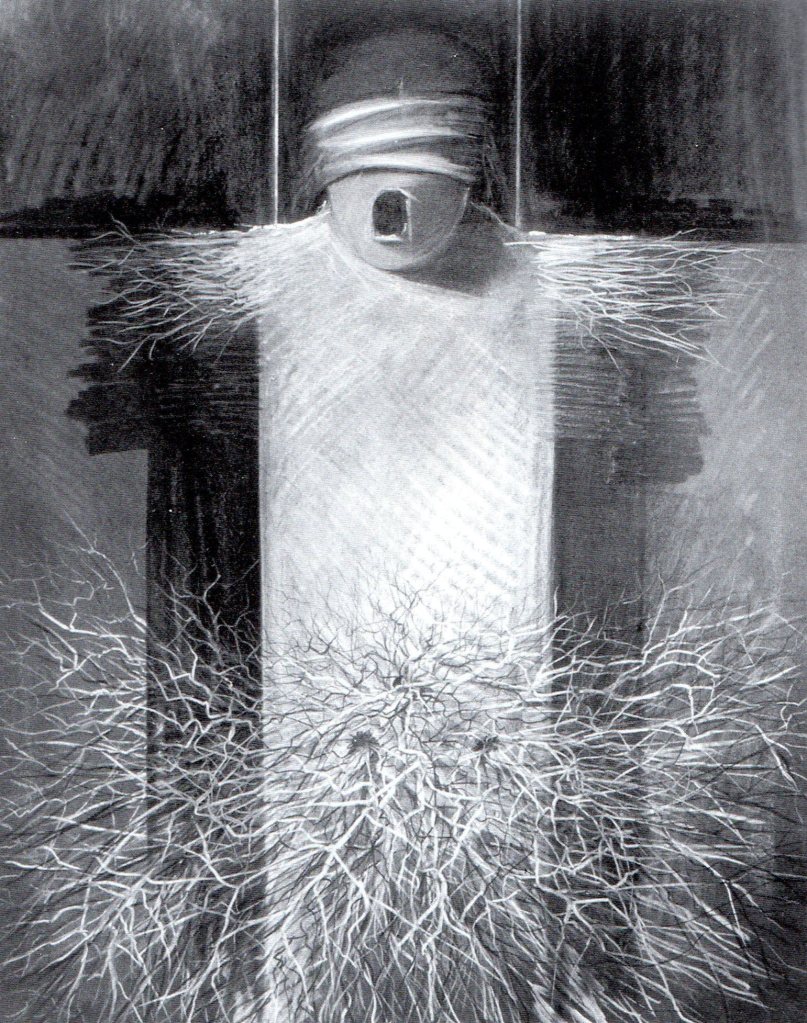
LOOK: Enrico Pinardi (American, 1934–2021), Crucifixion with Thorns, 2002. Oil on canvas.

Pinardi, Enrico_Crucifixion

I corresponded with the artist of this painting a few years ago after having found a black-and-white photo of it in the book The Crucifixion in American Art by Robert Henkes (2003). He granted me permission to reproduce the image on my blog, said he didn’t have a color photo. (“The image is kinda black, white, and blue,” he clarified.) I haven’t gotten around to posting it until now. I wish I had thought to ask about its location; I’m assuming it’s in a private collection somewhere, probably in the United States. After searching for Pinardi online the other week to see what he’s been up to, I found that he died January 30 due to complications from COVID-19.

Crucifixion with Thorns captures something of the horror of Christ’s felt abandonment on the cross. In the throes of death, he opens his mouth in a primal wail—the “loud voice” Matthew and Mark speak of, the “God, why?” He is becoming frayed, unraveled. A thicket of thorns tears through his body—or perhaps that is the cross-post (Pinardi’s expressionistic style deliberately makes it difficult to distinguish between the two). He is pierced.

He is also blindfolded. Luke 22:64 says that Jesus’s captors blindfolded him prior to his appearance before the Sanhedrin, striking him and asking him mockingly to identify, if he’s the Son of God, who it was who struck him. Though his eyes were not covered while he hung on the cross, the artist’s choice to cover them here amplifies the sense of his being in the dark, cut off, and also serves to identify him with other victims of political torture.

LISTEN: “My God, My God, Parts 1 & 2” | Metrical translation of Psalm 22:1–22 by the Committee of the United Presbyterian Church, 1912 | Music by Vito Aiuto of The Welcome Wagon, on Precious Remedies Against Satan’s Devices, 2012

The following text was written by committee (with the input of nine Presbyterian denominations) and first published in Pittsburgh in The Psalter: With Responsive Readings (1912), paired with an older tune by Lowell Mason. It covers two-thirds of Psalm 22, omitting the last nine verses—or rather, if you want to look at it this way, compacting them into four lines, as they contain a lot of repetition. I’ve noted in a separate column which verses of the biblical psalm each line of the song corresponds to.

My God, my God, I cry to Thee;
O why hast Thou forsaken Me?
Afar from Me, Thou dost not heed,
Though day and night for help I plead.

But Thou art holy in Thy ways,
Enthroned upon Thy people’s praise;
Our fathers put their trust in Thee,
Believed, and Thou didst set them free.

They cried and, trusting in Thy Name,
Were saved, and were not put to shame;
But in the dust My honor lies,
While all reproach and all despise.

My words a cause for scorn they make,
The lip they curl, the head they shake,
And, mocking, bid Me trust the Lord
Till He salvation shall afford.

My trust on Thee I learned to rest
When I was on My mother’s breast;
From birth Thou art My God alone,
Thy care My life has ever known.

O let Thy strength and presence cheer,
For trouble and distress are near;
Be Thou not far away from Me,
I have no source of help but Thee.

Unnumbered foes would do Me wrong;
They press about Me, fierce and strong;
Like beasts of prey their rage they vent;
My courage fails, My strength is spent.

Down unto death Thou leadest Me,
Consumed by thirst and agony;
With cruel hate and anger fierce
My helpless hands and feet they pierce.

While on My wasted form they stare,
The garments torn from Me they share,
My shame and sorrow heeding not,
And for My robe they cast the lot.

O Lord, afar no longer stay;
O Thou My helper, haste, I pray;
From death and evil set Me free;
I live, for Thou didst answer Me.

I live and will declare Thy fame
Where brethren gather in Thy Name;
Where all Thy faithful people meet,
I will Thy worthy praise repeat.
v. 1

v. 2


v. 3

v. 4


v. 5

v. 6


v. 7

v. 8


v. 9

v. 10


v. 11


v. 12

v. 13
v. 14

v. 15

v. 16


v. 17
v. 18


v. 19

vv. 20–21a
v. 21b

v. 22

One hundred years later, the Rev. Vito Aiuto wrote a new melody for this metrical translation, his only modifications to the text being to substitute out the archaic pronouns (e.g., Thee, Thou) and verb forms (e.g., hast, dost), unless needed to retain the rhyme scheme or meter. He and his wife, Monique, perform the song on their second full-length album along with a team of other musicians, listed here. Sufjan Stevens is among those in the seven-person choir that wails and sings echoes in the first half.

The song opens with a metallic screeching sound, harsh and grating. There are tensions and dissonances in the music, but at verse 5 (around 4:07) a tonal shift happens, as groping in the dark gives way to greater clarity and confidence. The pain is still there, but, like the psalm on which it’s based, it stretches toward hope.

A graduate of Princeton Theological Seminary, Aiuto is one of the founders of Resurrection Brooklyn, a church network of five Presbyterian (EPC) congregations serving the borough. He has been the lead pastor of Resurrection Williamsburg since it began in May 2005. I had the pleasure of hearing him preach in person at CIVA’s 2019 conference.

I’ve featured retuned hymns by The Welcome Wagon twice before on the blog; see Artful Devotion posts “Hail to the Lord’s Anointed” (for the Baptism of the Lord) and “The Strife Is Over” (for Easter).

“My God, My God, Parts 1 & 2” by The Welcome Wagon appears on the Art & Theology Holy Week Playlist.

Roundup: Merton on art; psalms of ascent; Oscar-nominated “Loving Vincent”; and more

BOOK EXCERPT: “Reality, Art, and Prayer” by Thomas Merton: In this excerpt from No Man Is an Island (1955), Merton talks about “aesthetic formation,” about how “music and art and poetry attune the soul to God”—art that doesn’t perform that function, he says, isn’t worthy of the name! Some might think that the spiritual solution to overstimulated senses (so many images, so much noise) is to close our eyes and ears. But that’s not necessarily so, as Merton explains: “The first step in the interior life, nowadays, is not, as some might imagine, learning not to see and taste and hear and feel things. On the contrary, what we must do is begin by unlearning our wrong ways of seeing, tasting, feeling, and so forth, and acquire a few of the right ones.” Yes! This is what I was trying to get at in my essay “Disciplining our eyes with holy images.”

+++

KICKSTARTER CAMPAIGN: Songs for the Sojourn by Bellwether Arts: The same liturgical arts initiative that brought you this Advent/Christmas package is now poised to release  a set of songs, visual art, and prose devotions inspired by the Bible’s “psalms of ascent,” which were likely sung by Jewish pilgrims as they ascended the road to Jerusalem for their three major annual festivals. At the head of the project is Bruce Benedict, founder of Cardiphonia, who in 2010 received a grant from the Calvin Institute of Christian Worship to commission songwriters and visual artists to help his congregation explore, through their respective disciplines, these fifteen psalms (read his application here). The project was so enriching to those involved that he recently decided to expand it to include even more songwriters, painters, and writers—the fruits of which are being made available to the public as a double-disc album, songbook, and art-filled devotional book.

While the songs have been recorded, Bellwether needs your help to finance the mixing, mastering, and disc pressing and the printing of the other two products, as well as to pay the new artists involved. Pledging money in exchange for a reward (essentially, placing a preorder) is a tangible way to support the project. Visit their Kickstarter page for more information or to make a pledge. Campaign ends March 23.

Help Higher Than the Hills by Aaron Collier
Help Higher Than the Hills (Psalm 123) by Aaron Collier. Photo courtesy Bellwether Arts/Cardiphonia.

Psalm 133 by Kyle Ragsdale
Psalm 133 by Kyle Ragsdale. Photo courtesy Bellwether Arts/Cardiphonia.

(For other artistic responses to Psalm 133, see this artful devotion featuring the Psalter Project and a William Walker mural, and the poem “Aaron’s Beard” by Eugene Peterson.)

+++

SONG: “Refuse the Bait” by Liturgical Folk: Fr. Nelson Koscheski, Ryan Flanigan, and David Moffitt wrote this song last year about Christ overcoming Satan’s temptations in the wilderness. I’m always blessed by these men’s collaborations. To stay apprised of their latest, follow Liturgical Folk on Facebook, and see also https://liturgicalfolk.bandcamp.com/.

+++

POEM CYCLE: “A Small Psalter” by Pádraig J. Daly: I really love this contribution in the current issue of Image journal—twenty-two modern-day psalms by Irish poet-priest Pádraig J. Daly. Like the biblical psalms, these poems express a range of emotions and postures before God, from sorrow and frustration to joy and awe. Here’s #12:

We are numbed, Lord, by number;
But you, being Other, know
Each single form that kneels at night,
Each heart enchanted by a meadow;
And hear our joys and heed our sighs.
And all we have and are, as we come naked here—
The very self of us!—
Comes from no thing in us
But from you, who make in us an emptiness
That you alone suffice.

+++

FILM: Loving Vincent, dir. Dorota Kobiela and Hugh Welchman: The Oscars are the only occasion of the year that I watch live TV, and I’m really looking forward to the show this Sunday. One of the nominations for Best Animated Feature is the world’s first fully oil-painted feature film, Loving Vincent, a biographical drama about the mysterious Vincent van Gogh. While most reviewers say the narrative content is forgettable, they hail the film’s innovative production methods and visual achievement as nothing short of amazing. Funded by Kickstarter, a team of 125 classically trained artists from various countries painted 65,000 frames in the style of the Dutch master (many of the final canvas paintings were exhibited at the Noordbrabants Museum last year), and actors were cast who had a physical resemblance to van Gogh’s portrait subjects (e.g., Chris O’Dowd as Postman Roulin!). To view the paintings and learn more about the filmmaking process, visit LovingVincent.com, and see the trailer below.

+++

VISUAL MEDITATION: “Behold the Broken, the Bruised” by Victoria Emily Jones: Speaking of van Gogh . . . Last week I wrote a reflection for ArtWay on the mixed-media sculpture After Van Gogh by Mad River Wiyot artist Rick Bartow (1946–2016). The primal wail of the figure expresses the artist’s psychological wounds, as a person with PTSD, and the communal wounds of his people, as well as invokes the famously troubled postimpressionist of its title. To me it also evokes Jesus’s cry of dereliction on the cross: “My God, my God, why hast thou forsaken me?”

After Van Gogh by Rick Bartow
Rick Bartow (Wiyot, 1946–2016), After Van Gogh, 1992. Lead, wood, nails, crab claw, copper, and acrylic, 23 × 12 × 7 in. Private collection. Photo: Victoria Emily Jones.

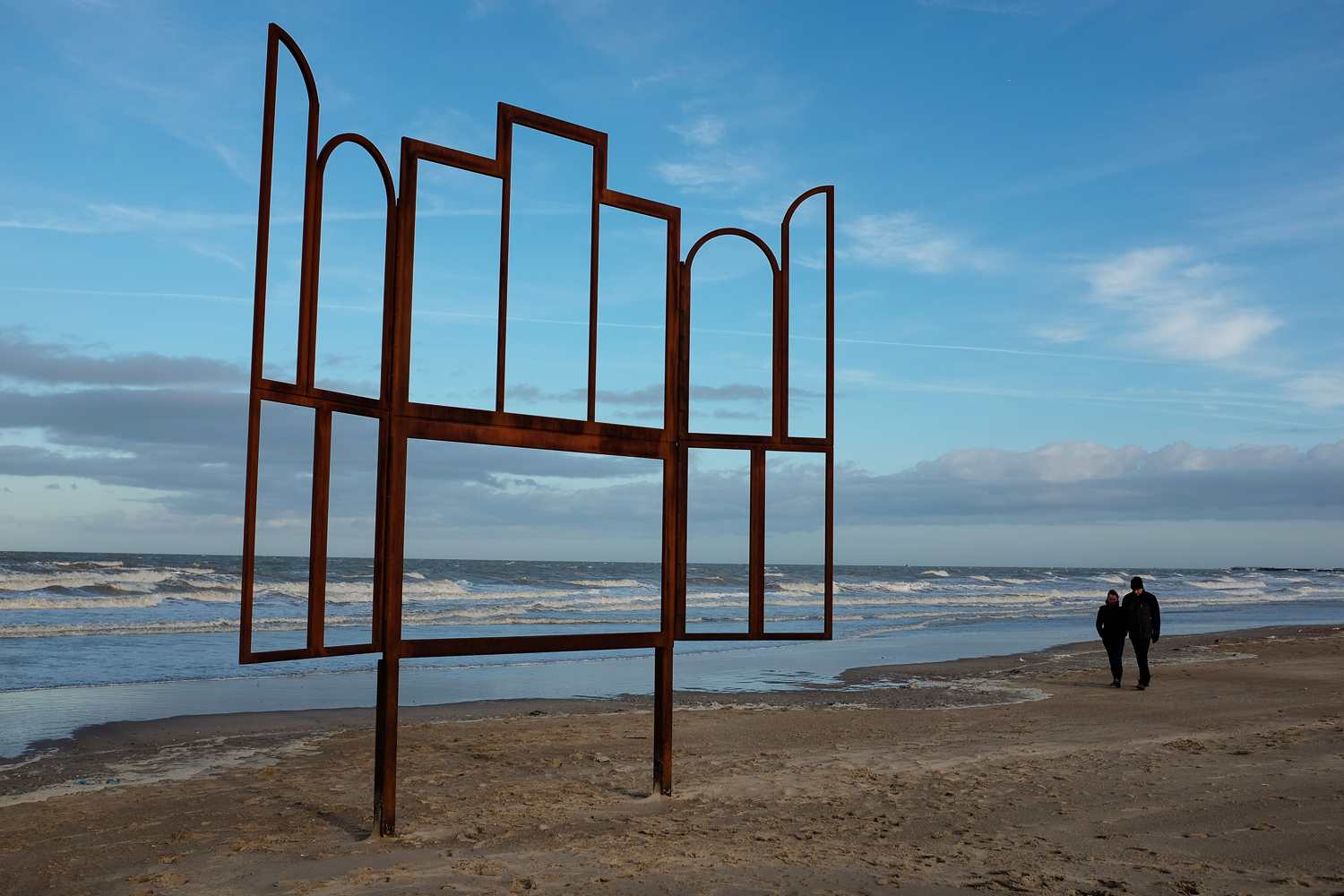
Also, I’ve been writing Lenten art reflections for GiftofLent.org, one for each Monday of the season (through March 25). This week’s is on Kris Martin’s Altar, a steel replica of the Ghent Altarpiece framework, installed on a Belgian beach. Click on the link to read more.

Altar by Kris Martin
Kris Martin (Belgian, 1972–), Altar, 2014. Steel, 17′4″ × 17′3″ × 6′7″. Temporary installation in Ostend, Belgium.