Roundup: “Rothko in Florence,” disabled minister portraits, Shaker songs, and more

EXHIBITIONS:

>> Rothko in Florence, multiple sites in Florence, Italy, March 14–August 23, 2026: Presented by the Fondazione Palazzo Strozzi and curated by Christopher Rothko and Elena Geuna, Rothko in Florence explores the influence of the city on Mark Rothko’s art, especially in terms of space and color. Rothko visited Florence in 1950, 1959, and 1966 and was particularly taken by the monastery-turned-museum San Marco, its cells frescoed with devotional scenes by Fra Angelico, and the vestibule of the Biblioteca Medicea Laurenziana, designed by Michelangelo. Now those two Renaissance sites are host to a display of Rothko’s works: five of his paintings hang alongside Fra Angelico’s monastic frescoes, and two studies for his Seagram Murals hang in the Laurentian Library.
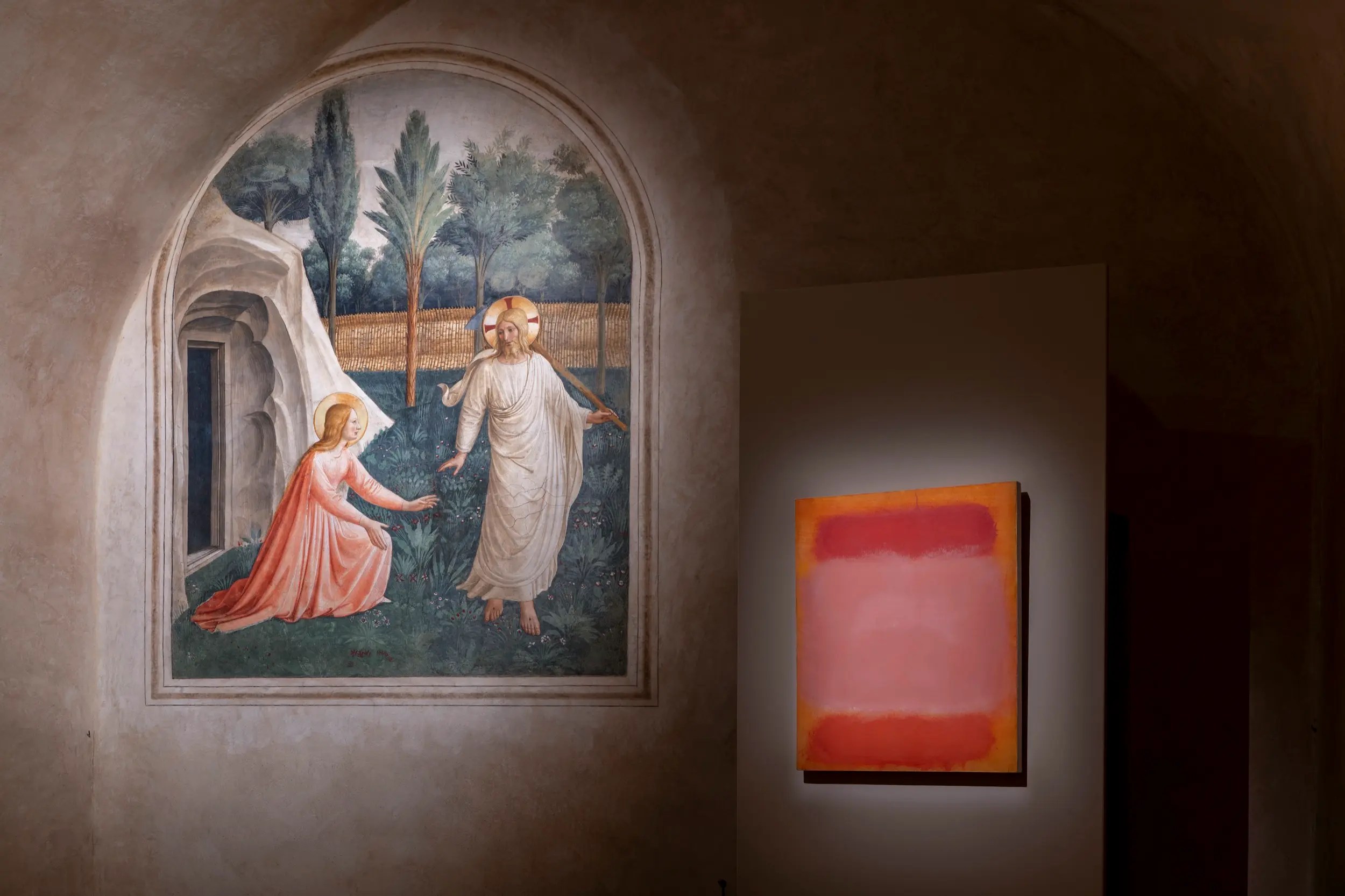
Rothko in Florence
Installation view: Rothko in Florence, San Marco Museum, Florence, 2026. Photo: Ela Bialkowska, OKNO Studio. (Read Georges Didi-Huberman’s reflection on the Fra Angelico painting at left.)

But the primary site of the exhibition is the fifteenth-century Palazzo Strozzi, which shows over seventy of Rothko’s works from private collections and international museums, spanning the different stylistic phases of his career, from figurative to neo-surrealist to color field. And in dialogue with the exhibition, the sacristy of the Chapel of San Nicolò, inside the complex of the Officina Profumo-Farmaceutica di Santa Maria Novella, one of the oldest pharmacies in the world, has been converted into a “listening room”; Rothko Chapel, a composition for chorus, celesta, cello, and percussion written by Morton Feldman in 1971 at Rothko’s commission, plays through speakers, washing over frescoed scenes of Christ’s passion painted by Mariotto di Nardo di Cione between 1385 and 1408.

You can read reviews of the exhibition in The New York Times and The Brooklyn Rail and view photos, including of all five relevant cells in San Marco, on Ruth Philo’s Instagram page.

>> Called as We Are, York Minster, July 12–August 10, 2026 (then to other locations): Presented by the Church of England’s Disability Project in partnership with Art and Christianity, this exhibition consists of twelve photographic portraits by Ruth Samuels of leaders in the Church of England who are Deaf, disabled, and/or neurodivergent. “Called As We Are brings Deaf, disabled and neurodivergent people in ordained and lay ministries into focus and explores the enriching and dynamic contribution that difference brings to their personal ministries and the ministry of the church,” says Rev. John Beauchamp, a blind priest who serves as disability ministry enabler in the Diocese of London. Samuels, the photographer, herself has chronic fatigue syndrome.
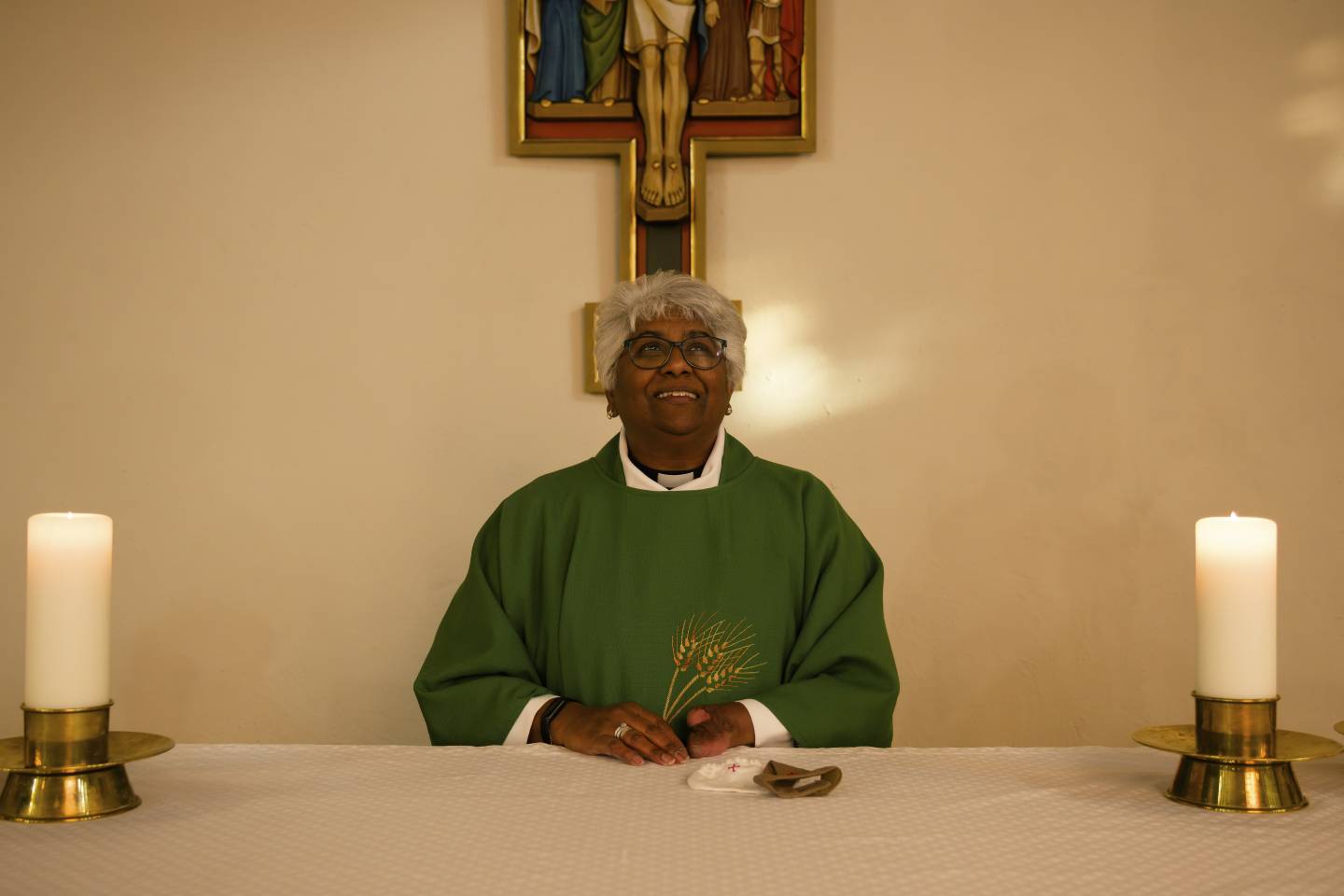
Vanessa Thornborough
Rev. Vanessa Thornborough, curate at St. Edmund of Canterbury, Hayes, who has a hand difference, is one of the church leaders featured in the Disability Project exhibition Called as We Are. Photo by Ruth Samuels.

Each photograph is accompanied by insights and observations from the subject, telling us about their disability, their faith journey, and adaptations that have helped them along their way. There are also audio descriptions, as well as BSL (British Sign Language) interpretation. After its time at York Minster, the exhibition will travel to the following locations:

  • Exeter Cathedral, August 12–19, 2026
  • Liverpool Cathedral, September 14–October 4, 2026
  • Chelmsford Cathedral, October 12–November 9, 2026
  • St Alban’s Cathedral, November 10–26, 2026
  • St Giles Cripplegate, London, January 18–February 8, 2027

Read the press release here.

+++

CALL FOR ART: St. Francis Exhibition, Creo Arts Gallery, Wilmore, Kentucky: “This November, Creo Arts invites you to explore the life, legacy, and spiritual vision of St. Francis through the arts. Whether inspired by his care for creation, his radical hospitality, his pursuit of peace, or the beauty of a life fully surrendered to God, we welcome works that engage with the enduring themes of his witness. Through painting, sculpture, poetry, photography, music, and more, this exhibition celebrates a life that continues to inspire artists and believers across generations.” Submission deadline: September 13, 2026. Selection emails will be sent out by September 21. The exhibition opening is November 6, and participating artists are encouraged but not required to attend.

+++

ARTICLE: “Take me to church: Ecclesiology and Hulu’s The Bear by Beth Felker Jones: “I want a church like a fine dining restaurant with a pickup window serving Chicago style beef sandwiches.” This is how theologian Beth Felker Jones opens her latest Substack post, drawing the hit television drama The Bear into conversation with ecclesiology, the study of the church. She critiques the either/or mentality that says the church has to either devote itself to beauty, depth, liturgy, theology, and careful formation or be accessible and meet practical needs; be specialized and transporting or down-to-earth, ordinary. Why can’t it be both? She then proceeds to reflect on hospitality, family (born and found), and giftedness.

+++

SHAKER SONGS:

Saro Lynch-Thomason is a song leader and folklorist living in Asheville, North Carolina. She identifies as pagan, but a number of songs in her repertoire are from the Christian tradition, including these two from Shakerism, a near-extinct sect whose distinctive practices include celibacy, communal living, and gender equality.

>> “In Yonder’s Valley”: This is the most widely remembered of the early Shaker songs. Written at Enfield, Connecticut, by Father James Whittaker (1751–1787), the second leader of the Shaker sect after Mother Ann Lee, it draws on the paradisal imagery in the second chapter of the Song of Songs (a reference shared by two other songs I’ve recently featured!), bidding the community to enter into unity with God, each other, and the rest of creation—to “take [their] fill” of heaven on earth, living in the cosmic harmony that has been ordained from the beginning. A variation of the song has “yonder” instead of “yonder’s” and “flows” instead of “grows.”

In yonder’s valley there grows sweet union
Let us arise and take our fill
The winter’s past and the spring appears
The turtledove is in our land
In yonder’s valley there grows sweet union
Let us arise and take our fill

>> “Ode to Contentment”: This Shaker hymn has been passed down with varying attributions of authorship and places of origin, but it was most likely written by Richard Pelham (words) and Issachar Bates (music) at the North Union Shaker village in Ohio in 1835. It apostrophizes the Christian virtue of contentment, asking her to come dwell in our hearts, bringing a stabilizing peace, endurance, and bliss. Lynch-Thomason sings three of the original nine verses.

Come, contentment, lovely guest!
Reign unrivaled in my breast;
Thou alone wilt do.
Thou alone canst fill the soul,
Every passion canst control;
When the stormy billows roll,
Thou canst bear me through.

All the lordlings of the earth,
All their boasts, what is it worth?
Nothing but a show.
All the wealth that kings possess,
All their vain and gaudy dress,
All is splendid wretchedness;
Peace they never know.

Nothing on this earth below,
Naught that heaven can bestow,
Fills the soul with peace,
If contentment dwell not there.
All is dreary, dark, and bare;
She alone makes heavenly fare,
She alone is bliss.

Roundup: Sacred poetry, “Shifting the Gaze,” the Birchwood Painters, new films, and more

TGC ARTICLE: “18 Paintings Christians Should See”: The Gospel Coalition Arts & Culture editor Brett McCracken has rounded up fourteen arts professionals to each choose an artistically and theologically significant painting and write about it in 200 words or less—and I’m one of them! I chose Caravaggio’s The Incredulity of Saint Thomas, which shows that famous encounter between the “doubting” disciple and the risen Christ. Here Thomas literally puts his finger on the flesh-and-blood reality of the resurrection, and you can see the marvel in his face.

Caravaggio_Incredulity of Thomas
Caravaggio (Italian, 1571–1610), The Incredulity of Saint Thomas, 1601–2. Oil on canvas, 107 × 146 cm (42 × 57 in.). Sanssouci Picture Gallery, Potsdam, Germany.

Other selections in the article range from medieval manuscript illuminations and Dutch Golden Age portraits to pop art and abstract minimalism. You might recognize the names of some of the contributors whom I’ve featured before on Art & Theology, like Jonathan A. Anderson, Matthew J. Milliner, W. David O. Taylor, and Terry Glaspey—they have all been influential to me. I’m very encouraged to see this major evangelical website engaging with visual art.

+++

POEMS: “Featured Poet: Laurie Klein”: In this post from Abbey of the Arts, poet Laurie Klein introduces herself, discussing the sacred themes in her work and her approach to writing poetry, as well as sharing three of her poems: “How to Live Like a Backyard Psalmist,” “I Dream You Ask, But Where Do I Start,” and “Poem for Epiphany.” All three are wonderfully evocative, and I’m definitely going to check out her collection, Where the Sky Opens. The first poem references St. Kevin of Glendalough, a sixth-century Celtic monk whose hand outstretched in prayer once became a nesting place for a blackbird. The poem is about how to live a life of joy, wonder, and praise, and it begins,

Wear shoes with soles like meringue
and pale blue stitching so that
every day you feel ten years old.
Befriend what crawls.

Drink rain, hatless, laughing.

Sit on your heels before anything plush
or vaguely kinetic:
hazel-green kneelers of moss
waving their little parcels
of spores, on hair-trigger stems.

[Read more]

+++

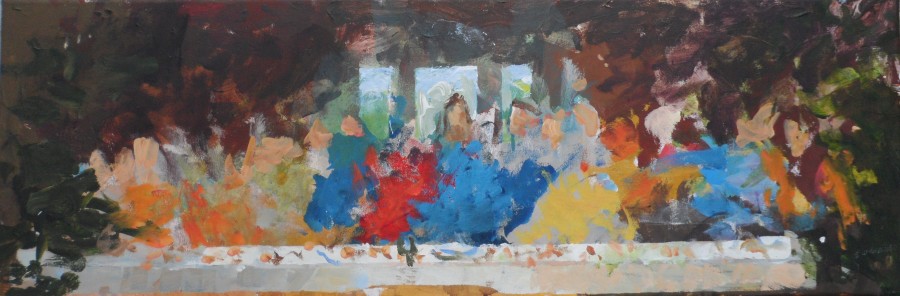
ARTISTS GROUP AT BIRCHWOOD: The Birchwood Painters, founded in 2009, is a group of painters with disabilities who live at Birchwood care home in Chesham, Buckinghamshire, in England, exhibiting locally and in an annual art show at Birchwood. One of the members is Mark Urwin, who has cerebral palsy and uses a wheelchair. Mark loves studying art history, especially the impressionists. Landscapes are his favorite genre to paint, but he also interprets religious works by the Old Masters—like Simone Martini and Lippo Memmi’s Annunciation, or Leonardo da Vinci’s Last Supper—in his own semiabstract style, using bright swaths of color. In 2016 Mark gave a lecture on his work at the Royal Academy of Arts in London.

Urwin, Mark_Annunciation (after Martini)
Mark Urwin (British), Annunciation (after Martini and Memmi), 2013. Acrylic on canvas, 30 × 25 cm.

Urwin, Mark_Last Supper (after Leonardo)
Mark Urwin (British), Last Supper (after Leonardo), 2013. Acrylic on canvas, 25 × 75 cm.

Mark uses an easel that was specially designed for him by DEMAND (Design and Manufacture for Disability) to enable greater freedom and control in his creations. Whereas before, an art class volunteer had to hold Mark’s canvas, making certain angles to paint more awkward, the DEMAND easel improves canvas access, as the canvas can be positioned in any orientation to Mark, with the bulk of his electric wheelchair no longer posing a problem. Furthermore, he can keep his talk board on his lap so that he doesn’t lose his voice while painting.

+++

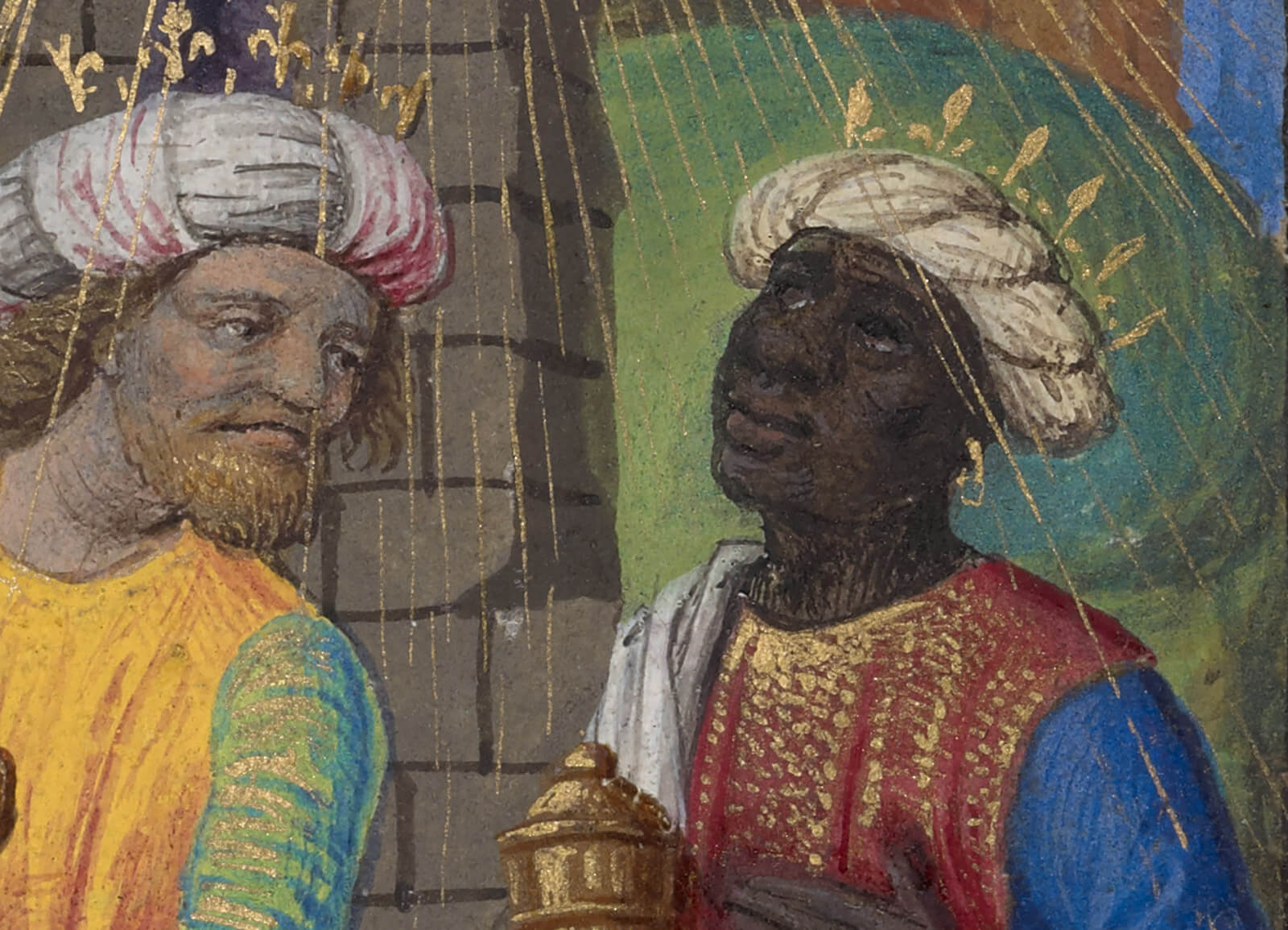
EXHIBITION-IN-PROGRESS: “Exhibition to Examine Balthazar, a Black African King in Medieval and Renaissance European Art”: “Early medieval written legends report that one of the three kings who paid homage to the Christ Child in Bethlehem was from Africa. But it would take nearly 1,000 years for European artists to begin representing Balthazar, the youngest of the three kings, as a black man. Why? . . .

“Delving into the Getty’s collections, we are at work on the exhibition Balthazar: A Black African King in Medieval and Renaissance Art (November 19, 2019–February 17, 2020). We are examining how Balthazar’s depiction coincided with and was furthered by the rise of the slave trade—and we invite your input to inform the exhibition. What questions or ideas do you have about this topic? What stories or themes would you like to see explored? We are eager to incorporate your views into our process.”

Balthazar detail
Detail of The Adoration of the Magi from a French Book of Hours (Ms. 48, fol. 59) showing the magus Balthazar (right), ca. 1480–90, by Georges Trubert. J. Paul Getty Museum, Los Angeles.

In this post from the Getty’s blog, The Iris, in addition to finding out how to relay feedback, learn about who the Magi were, what tradition says about them, and the development of Balthazar’s image over time.

(Further reading: “Carol of the Brown King” by Langston Hughes)

I appreciate the Getty’s efforts to be more inclusive in the visual histories they highlight and to solicit input from the general public to assist them in this task. They did the same for their 2018 exhibition Outcasts: Prejudice and Persecution in the Medieval World.

+++

TED TALK / LIVE PAINTING: “Can Art Amend History?” by Titus Kaphar: American artist Titus Kaphar reconfigures historical artworks—through cutting, bending, overpainting, stitching, tarring, and tearing—to include African American subjects. In this thirteen-minute presentation before a live audience, Kaphar opens by sharing the words his young son spoke upon seeing the famous equestrian statue outside the Natural History Museum in Manhattan, which has Teddy Roosevelt up high on a horse, flanked by a Native American and an African lower down, on foot—which can easily be read as establishing a racial hierarchy.

Kaphar goes on to discuss some of his own encounters with Western art history and his mission to bring black figures out of the shadows of that tradition. He demonstrates this with a reproduction of Family Group in a Landscape by the Dutch master Frans Hals, which shows a wealthy white family of four with their young black servant.* More has been written, Kaphar laments, about the lace the wife is wearing and the dog at the right of the picture than about the black youth who stares straight out at us. This claim did surprise me somewhat—and then I visited the museum website, only to find that their six-paragraph description of the painting doesn’t mention the boy at all! By strategically applying white paint across this canvas, Kaphar forces us to “shift our gaze” and to notice the one who has typically gone unnoticed.

* “Were Those Black ‘Servants’ in Dutch Old Master Paintings Actually Slaves?”

Teddy Roosevelt equestrian statue
James Earle Fraser (American, 1876–1953), Equestrian Statue of Theodore Roosevelt, 1939. Bronze, 300 × 218 × 450 cm (10 × 7 1/6 × 14 3/4 ft.). Museum of Natural History, New York.

Kaphar, Titus_Shifting the Gaze
Titus Kaphar (American, 1976–), Shifting the Gaze, 2017. Oil on canvas, 210.8 × 262.3 cm (83 × 103 1/4 in.). Brooklyn Museum, Brooklyn, New York.

+++

IN THEATERS: Currently showing in theaters are two historical drama films featuring main characters whose work (in art and in activism) was famously inspired by their Christian faith: Tolkien, about the author of Lord of the Rings, and The Best of Enemies, about civil rights leader Ann Atwater from Durham, North Carolina. Both movies have received lukewarm to not-so-great critical reviews but fairly high audience ratings, and I intend to see them. I found out about the latter one through Jonathan Wilson-Hartgrove, one of the mentees of “Grandma Ann,” who prepared a group study guide to accompany the film.

Also in theaters, with rave reviews all around, is Amazing Grace, a documentary about the creation of Aretha Franklin’s best-selling gospel album of the same title, recorded over two nights in 1972 at New Temple Missionary Baptist Church in Los Angeles. The footage was recently unearthed and reassembled after almost fifty years. The resultant film has been called “wonderfully intimate,” “a raw, sensory, reverent experience,” “a transcendent joy,” “the new gold standard of filmed music concerts,” and “one of the finest music documentaries ever.”

It’s been interesting to hear secular reviewers expressing how moved they were by the film, a film that is prayer (e.g., “Precious Lord, Take My Hand”), proclamation and praise (“God Will Take Care of You”), testimony (“Amazing Grace,” “How I Got Over”), and invitation (“Give Yourself to Jesus”).