Roundup: Medieval reading recommendations, “Christ Our Lover,” and more

SUBSTACK POST: “Read something medieval this year” by Grace Hamman: One of the most frequently asked questions that medievalist Grace Hamman receives is: “What books should I read from the past?” She gives recommendations for the following six scenarios (including specific translations/editions!).

  1. I have never read anything medieval before! Where do I start?
  2. I have not read any medieval literature, but I did read Confessions in college. How about something a little later, a little more “medieval”?
  3. I want to read some medieval theology.
  4. I’ve read Bernard. Give me a theology deep cut!
  5. No thanks on the monastic theology. Give me poetry! Give me drama and beauty and weirdness!
  6. I’m a stubborn cuss / good millennial hipster / professional troublemaker. I want to read what no one else is reading casually. Make it super hard and dialectical and confusing (but awesome).

+++

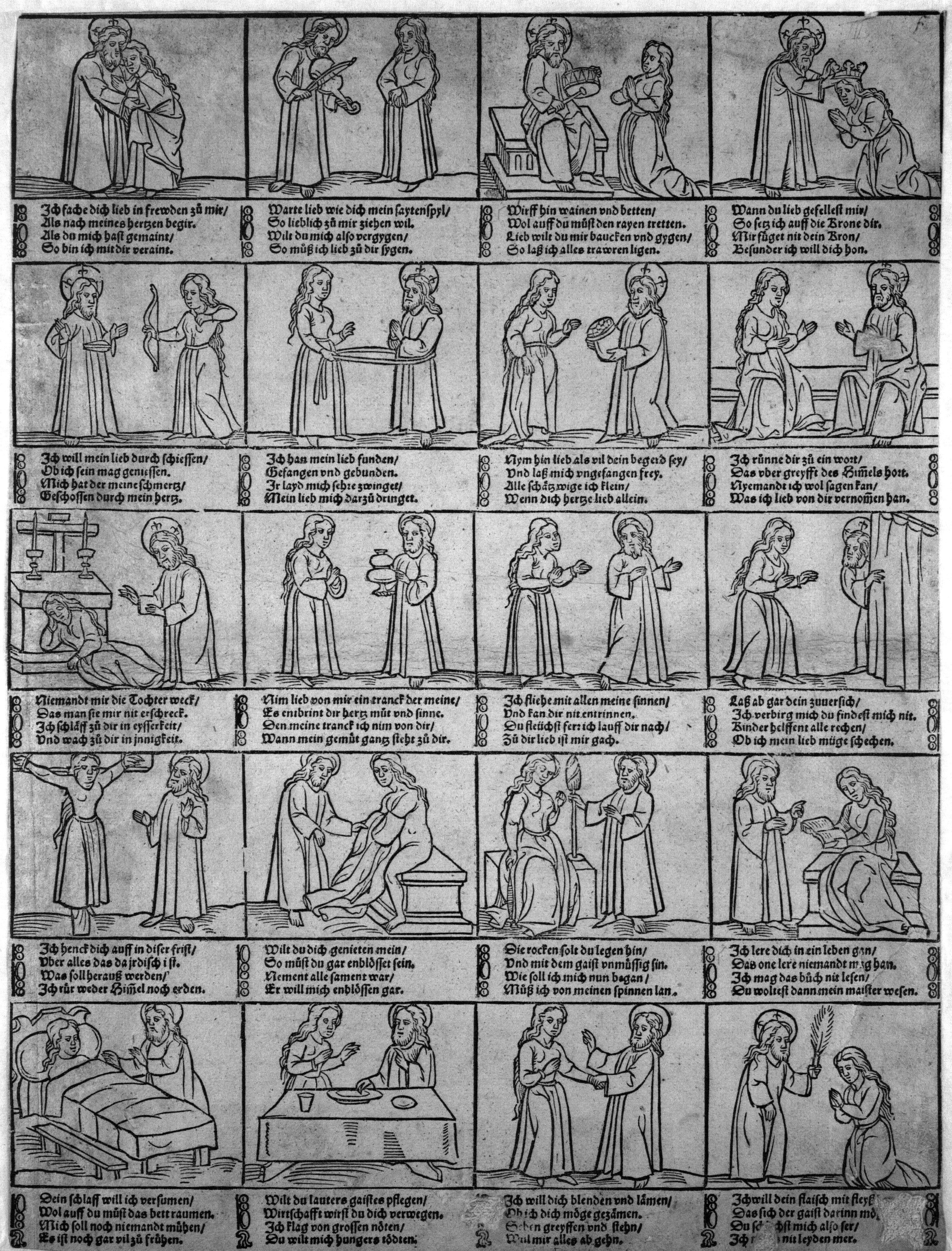
LECTURE: “Christ Our Lover: Medieval Art and Poetry of Jesus the Bridegroom” by Grace Hamman: Last fall I had the pleasure of inviting Dr. Grace Hamman (see previous roundup item) to my neck of the woods to speak for the Eliot Society, a Maryland nonprofit I serve on the board of. She gave this wonderful lecture on one of the popular medieval metaphors for Christ in theology and the arts, which was Jesus as bridegroom, or lover. For medieval people, “the union between God and the human soul was . . . a marriage made in mutual desire, joy, and even mutual submission,” she says. Hamman explores a few different pieces belonging to this tradition, including the fourteenth-century poem “Quia Amore Langueo” (Because I Languish for Love) and the fascinating fifteenth-century verse and image sequence Christus und die minnende Seele (Christ and the Loving Soul).
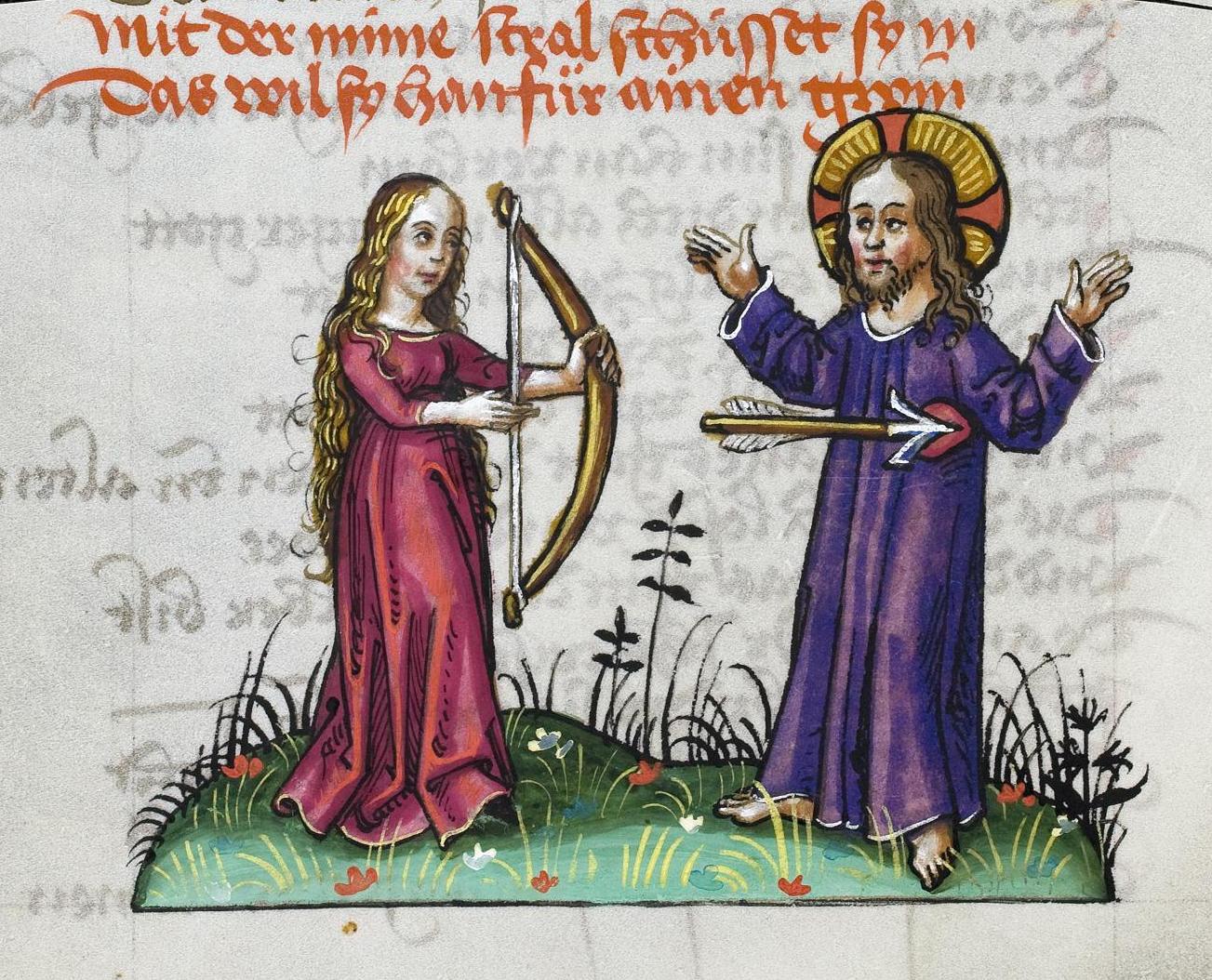
Christ and the Loving Soul (arrow of love)
Illustration by Rudolf Stahel (ca. 1448–1528) from a copy of Christus und die minnende Seele, Constance, Germany, ca. 1495. Karlsruhe, Badische Landesbibliothek, Cod. Donaueschingen 106, fol. 26v. Amber L. Griffioen provides this caption: “The Soul takes up her bow, draws her minne stral (or ‘arrow of love’), and goes on the hunt. She shoots and wounds Christ in the side, capturing him as her prize in order to ‘enjoy him’ forever.”

Christ and the Loving Soul broadsheet
Christus und die minnende Seele, from the printing house of Matthäus Franck in Augsburg, Germany, 1559–68. Woodcut, 35.5 × 27 cm. Munich, Bayerische Staatsbibliothek, Einblatt III, 52f.

+++

SONGS:

Inspired by Hamman’s talk, I’d like to turn your attention to the following two songs: one Jewish, the other Christian.

>> “Et Dodim Kala (Time for Lovers)”: The Hebrew text of this song, drawn from the biblical book the Song of Songs, is traditional Jewish (the video attributes it to Rabbi Haim Ben Sahl of the tenth century), and the music is a traditional gnawa melody (gnawa is a genre of Moroccan religious music marked by repetition). The performance is led by Lala Tamar on vocals and guembri (three-stringed bass plucked lute), and she’s joined by Ella Greenbaum and Imanouelle Harel on background vocals and krakebs (hand cymbals) and Tal Avraham on trumpet.

Tamar is an Israeli musician of Moroccan and Brazilian descent who performs Moroccan Jewish liturgical poems as well as contemporary music in Moroccan Arabic and Ladino.

Turn on closed captioning (CC) in the above video for the lyrics and their English translation, which is basically, “A time for lovers, my bride: / The vine has blossomed, / The pomegranates have budded.” The song is also available on Spotify.

>> “The Heavenly Courtier”: The anonymous words of this hymn were first published in 1694, and the tune is from The Christian Harmony (1805), a shape-note hymnal compiled by Jeremiah Ingalls. The song speaks of “Christ the glorious lover” who comes to earth “to woo himself a bride, resolving for to win her.” At first she’s resistant to his romantic entreaties, preferring instead the company of other lovers. But when she sees him for who he truly is—receives “one glimpse of [his] love and power”—she is overcome with ecstasy and accepts his proposal. The song ends with a wedding feast and mutual embrace. Read the full lyrics here, and listen to the Boston Camerata, directed by Joel Cohen, perform the piece on their album An American Christmas (1993); the vocalist is Joel Frederiksen.

I wouldn’t commend this hymn for a worship service, at least not without adaptation: while I’m on board with most of it, its Christ is in parts coercive, threatening violence, and there’s an overemphasis on the bride’s wretchedness and shame, with Christ the wooer breaking her down by revealing how “filthy” and unworthy she is. The Boston Camerata removes two of the more problematic verses, but I still think further tweaking needs to be done, more nuancing around the doctrines of sin and salvation (literarily, of course, preserving the extended metaphor!), to faithfully communicate the gospel through this song.

Regardless, I find it interesting as an artifact of early American Christian worship (it was sung congregationally in New England) and as an elaboration of the biblical picture of Christ the Bridegroom, not to mention poetically and musically charming. As I gathered from Grace Hamman’s lecture posted above, we can still appreciate creative works from the past and be moved or instructed by aspects of them without embracing them wholesale. It’s important for us Christians to be able to step outside our own cultural, historical, and denominational contexts with humble curiosity.

+++

2025 CALVIN SYMPOSIUM ON WORSHIP:

Calvin University’s annual Symposium on Worship was held last week. I wasn’t able to go this year, but I enjoyed tuning in virtually to the services that were livestreamed, now archived on the “Live” tab of the Calvin Institute of Christian Worship YouTube page. Here are two examples.

>> “Vesper: I Will Lift Mine Eyes,” led by Kate Williams and Tony Alonso: “Inspired by ancient and modern contemplative texts, this Vespers service is an invitation to come into the quiet and discover the eternal beauty of God’s consoling presence.” View the song credits in the YouTube video description.

>> “Worship Service: The Rich Man and Lazarus”: The Calvin University Gospel Choir, under the direction of Nate Glasper and with some songs guest-conducted by Raymond Wise, leads the musical portion of this service, and Rev. Dr. Dennis R. Edwards preaches on Luke 16:19–31, Jesus’s parable of the rich man and Lazarus. I especially enjoyed Wise’s original gospel song “Make a Joyful Noise” at 16:30, based on Psalm 100:1, and, also new to me, “Poor Man Lazarus” at 36:46, a traditional African American spiritual arranged by Jester Hairston. See additional song credits in the YouTube video description.
Roundup: Latin American classical music, Pedro Linares sculpture, Pope Francis on literature, and more

UPCOMING LECTURES:

I’m one of the artistic directors of the Eliot Society, a faith-based arts nonprofit in Annapolis. I’m really looking forward to our next two events this fall! If you’re in the area, I’d love for you to come out to these talks by a musician and a medievalist. They’re both free and include a time of Q&A and a small dessert reception afterward.

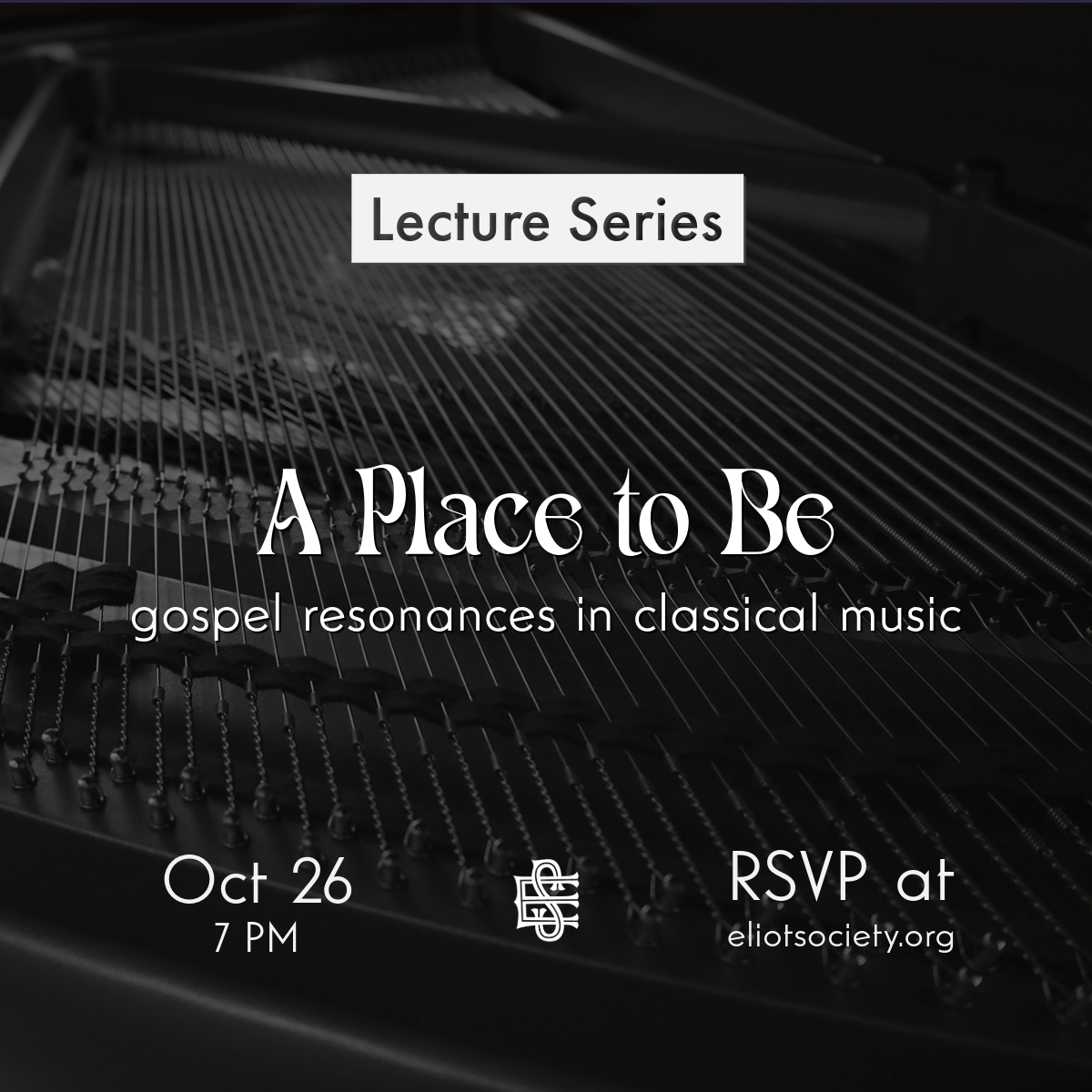
>> “A Place to Be: Gospel Resonances in Classical Music” by Roger Lowther, October 26, 2024, Redeemer Anglican Church, Annapolis, MD: “At its most basic, music is a collection of sounds. How those sounds are organized varies by country and culture and reflects their values, history, and heart-longings. Join Tokyo-based American musician Roger W. Lowther on a journey through the landscapes of Western and Japanese classical music and explore their unique and fascinating differences. Roger will lead from the piano as he demonstrates the musical languages of each tradition and show how they contain hidden pointers to gospel hope in a world full of suffering and pain.”

Roger Lowther lecture

I’ve heard Roger speak before, and he’s very Jeremy Begbie-esque in that he does theology through instrumental music. As a bicultural person, a New Englander having lived in Japan for almost twenty years (ministering to and through artists of all disciplines), he brings a unique perspective. In addition to discussing the defining features of the Western versus Japanese classical traditions, he’ll be performing a few piano pieces from each.

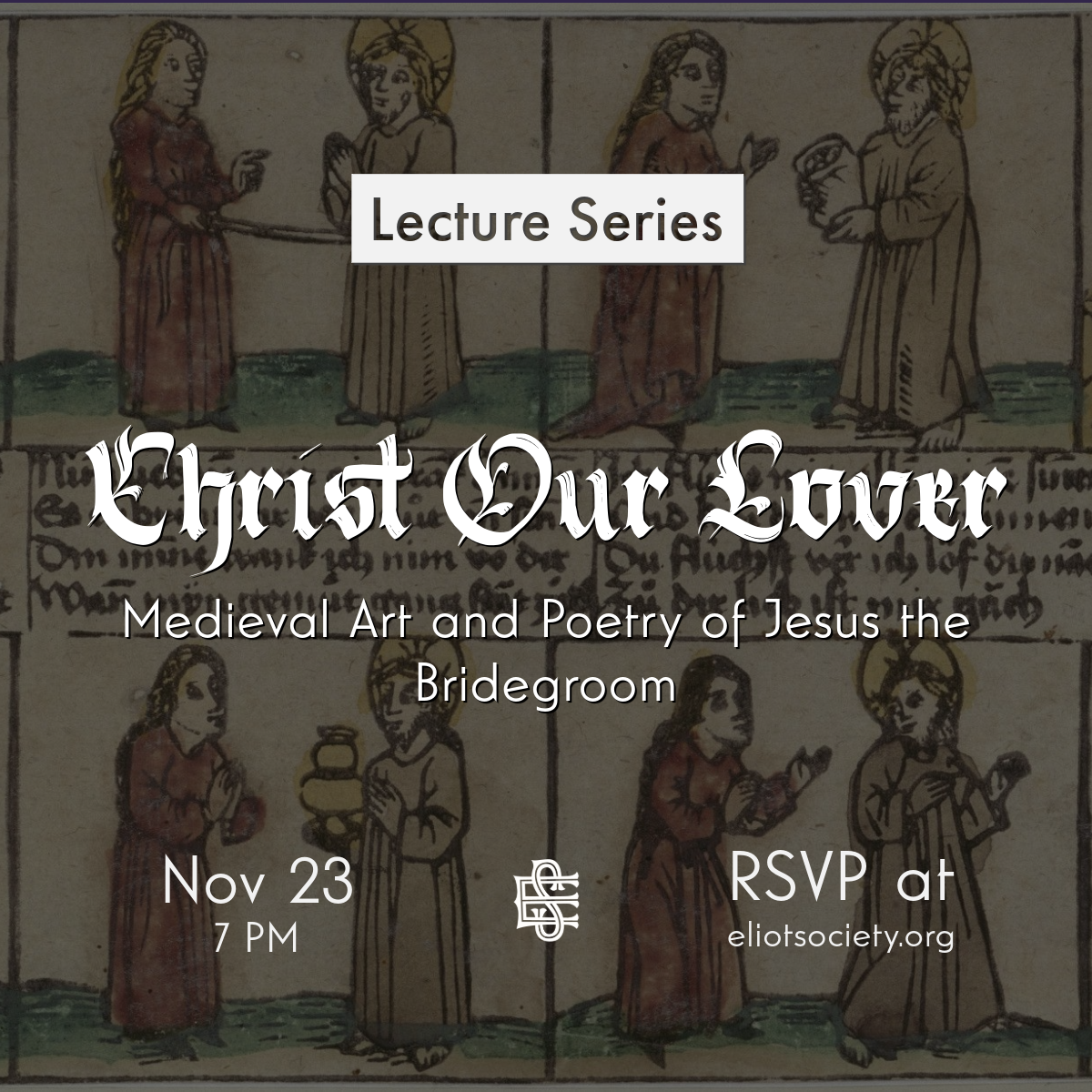
>> “Christ Our Lover: Medieval Art and Poetry of Jesus the Bridegroom” by Dr. Grace Hamman, November 23, 2024, St. Paul’s Anglican Church, Crownsville, MD: “If there was a ‘bestseller’ book of the Bible in the European Middle Ages, it would be the Song of Songs. When read allegorically, in the manner of medieval theologians like St. Bernard of Clairvaux, the book tells the story of the romance between Christ and the soul that culminates in Christ’s love shown on the cross. This is a story of mutual pursuit, the pain of desire and sacrifice, sensual delight, and true union. The idea of Jesus as a longing lover of each individual soul appeared everywhere by the later medieval period, in art, poetry, sermons, and the devotional writings of men and women alike.

“These themes and images can strike us as strange, even uncomfortable. An illustrated poem for nuns depicted the Song of Songs like a cartoon strip. Prayer books of wealthy nobles portrayed Christ’s wounds intimately. Poets wrote Christ in the role of a chivalric, wounded knight weeping and waiting for his lady. And yet, examining this ancient imagery of Jesus our Lover together can challenge us to greater vulnerability with our Savior, to refreshed understandings of God’s hospitality, and, in the words of Pope Gregory the Great, can set our hearts ‘on fire with a holy love.’”

Grace Hamman lecture

Grace is a fabulous teacher of medieval poetry and devotional writing, one whom I’ve mentioned many times on the blog before. Her Jesus through Medieval Eyes was my favorite book of 2023; read my review here. She has encouraged me to move in toward the strange and imaginative in medieval theology and biblical interpretation, because there’s often beauty and wisdom to be found there if we give it a chance. She has a keen awareness of the body of Christ across time and an appreciation for the gifts they’ve bequeathed the church of today, be they words, art, or whatever else.

+++

VIDEO: “Poet and Pastor: Christian Wiman and Eugene Peterson”: In this four-minute video from Laity Lodge, poet and essayist Christian Wiman and pastor and spiritual writer Eugene Peterson (best known for his Bible translation The Message) talk about prayer and spirituality. They each share a poem they’ve written: Wiman’s “Every Riven Thing” and Peterson’s “Prayer Time.” “People who pray need to learn poetry,” Peterson says. “It’s a way of noticing, attending.”

+++

ARTICLE: “Stop and read: Pope praises spiritual value of literature and poetry” by Cindy Wooden, National Catholic Reporter: On August 4 the Vatican published a letter by Pope Francis, a former high school lit teacher, on the important role of literature in formation. Read some highlights at the article link above, or the full letter here.

+++

SONG: “Teach Me How to Pray” by Dee Wilson: This jazz adaptation of the Lord’s Prayer premiered at Good Shepherd New York’s September 8 digital worship service. It is written and sung by Dee Wilson of Chicago.

+++

ARTICLE + PLAYLIST: “Latin American Fiesta!” by Mark Meynell: I always appreciate the selections and knowledge Mark Meynell [previously] brings to his 5&1 blog series for the Rabbit Room, each post exploring five short pieces and one long piece of classical music. This Latin American installment features Kyries from Peru and Argentina, a candombe air, a four-part Christmas anthem in Spanish creole from Mexico (I found an English translation!), an Argentine tango, and a dance chôro (Portuguese for “weeping” or “cry”) from Brazil. What diverse riches!

“Classical music, as conventionally understood, is not often associated with Latin America,” Meynell writes, “though, as we will see, this is a situation that needs rectifying. Some extraordinary soundworlds were being created long before the Conquistadores arrived from European shores, and together with the cultural impact of the transatlantic slave trade from Africa, the musical mix that resulted is unique. To put it at its most simplistic, we could say that the two key musical influences were the Catholic Church and the complex rhythms of percussion and dance; and often, it’s hard to tell where one ends and the other begins.”

View more from the 5&1 series here. In addition to “Latin American Fiesta!,” among the thirty-three posts thus far are “Autumnal Mists and Mellow Fruitfulness,” “Musical Thin Places: At Eternity’s Edge,” “Music in Times of Crisis,” “The Calls of the Birds,” and “It’s All About That Bass.”

+++

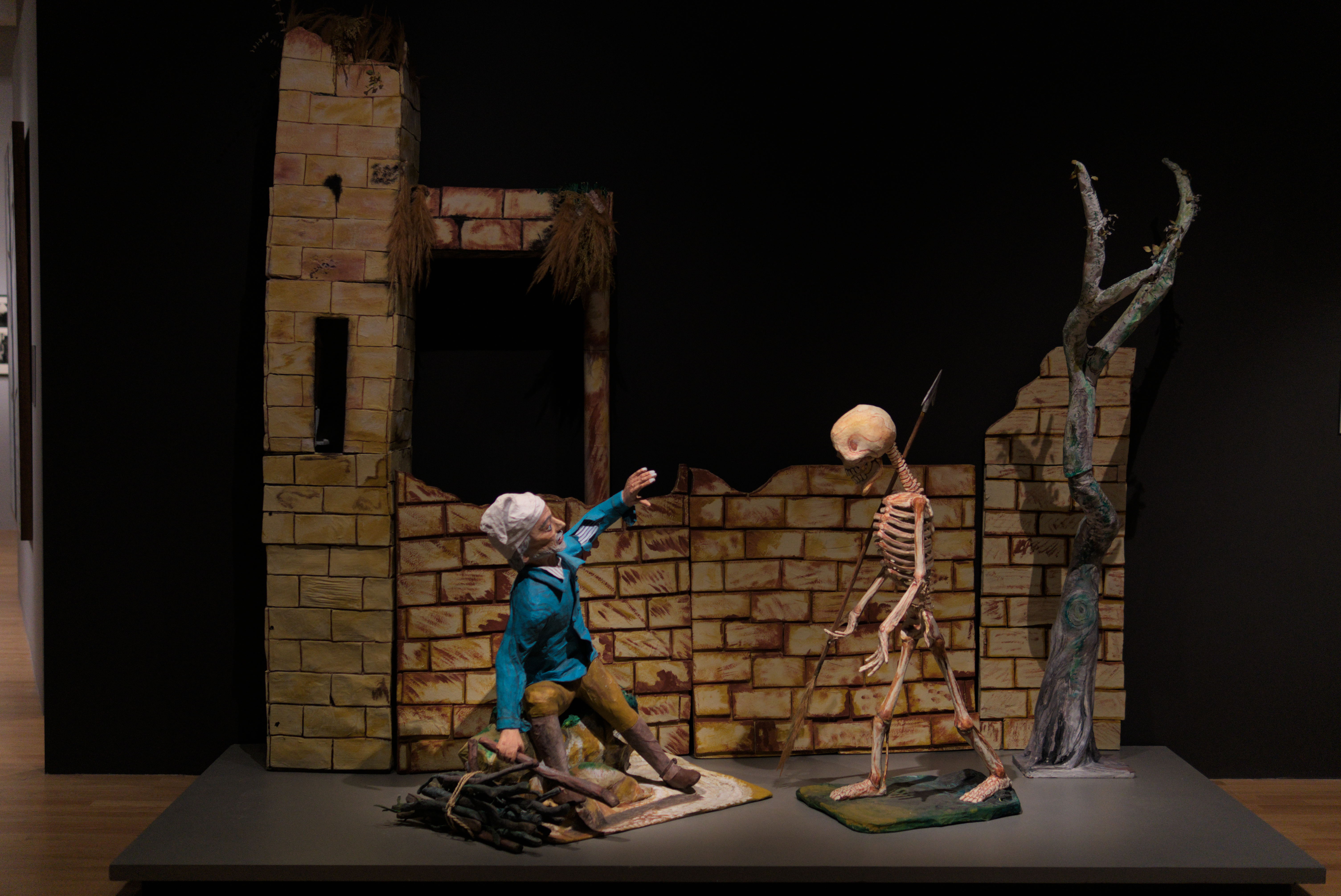
ARTWORK: The Old Man and Death by Pedro Linares: Last month I visited the Wadsworth Atheneum Museum of Art in Hartford, Connecticut, for the first time and was delighted to stumble upon an exhibition that had just been put up, Entre Mundos: Art of Abiayala. On view through December 15, it highlights collection works made by artists with personal or ancestral ties to Mexico, the Caribbean, and Central and South America. The title translates to “Between Worlds,” and “Abiayala,” I learned, is a Guna (Kuna) word that means “land in its full maturity” or “land of vital blood”; it’s used by the Guna and some other Indigenous peoples to refer to the Americas.

Linares, Pedro_The Old Man and Death
Pedro Linares (Mexican, 1906–1992), El viejo y la muerte (The Old Man and Death), 1986. Papier-mâché and mixed media. Wadsworth Atheneum Museum of Art, Hartford, Connecticut. Photo: Victoria Emily Jones.

Linares, Pedro_The Old Man and Death (detail)

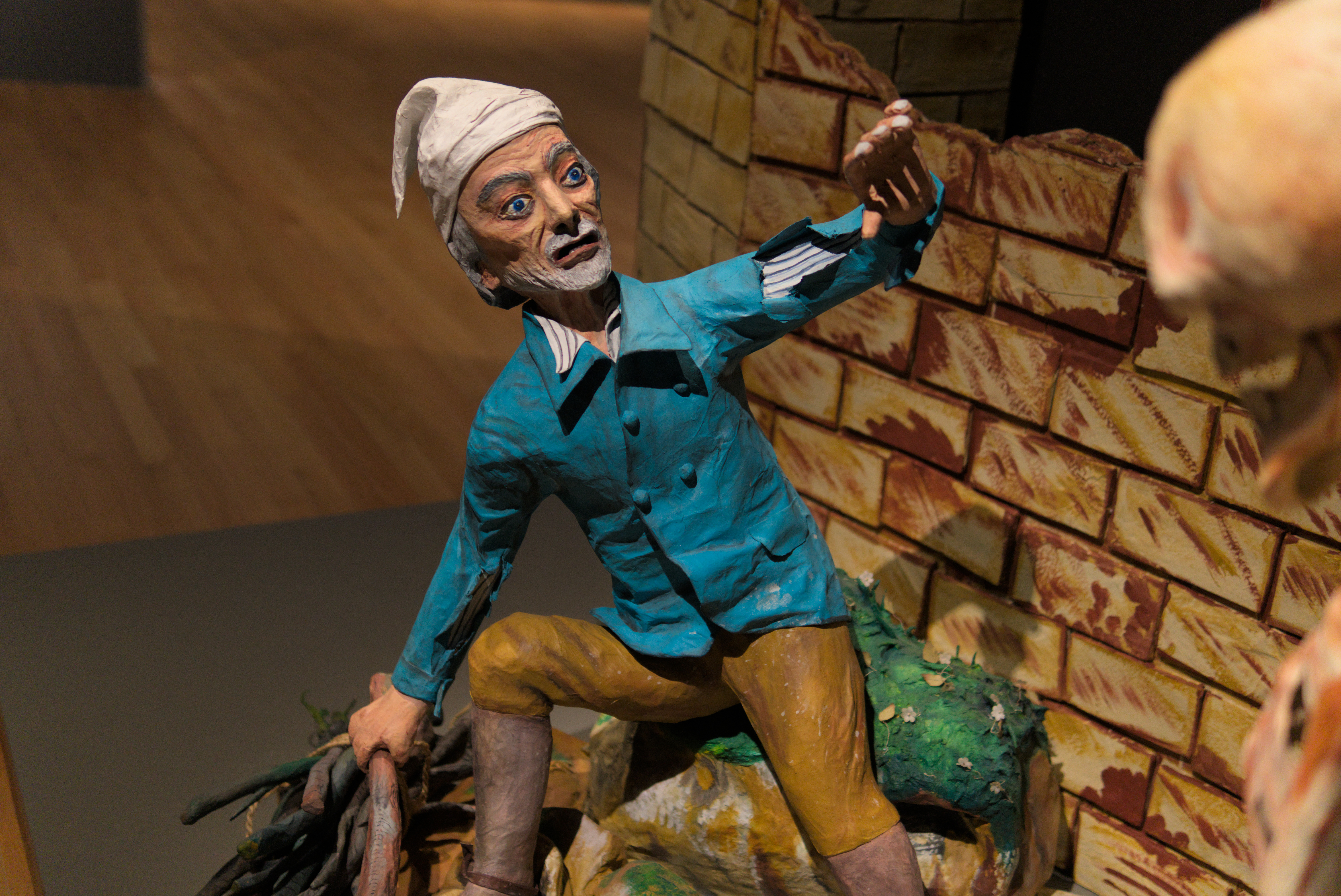
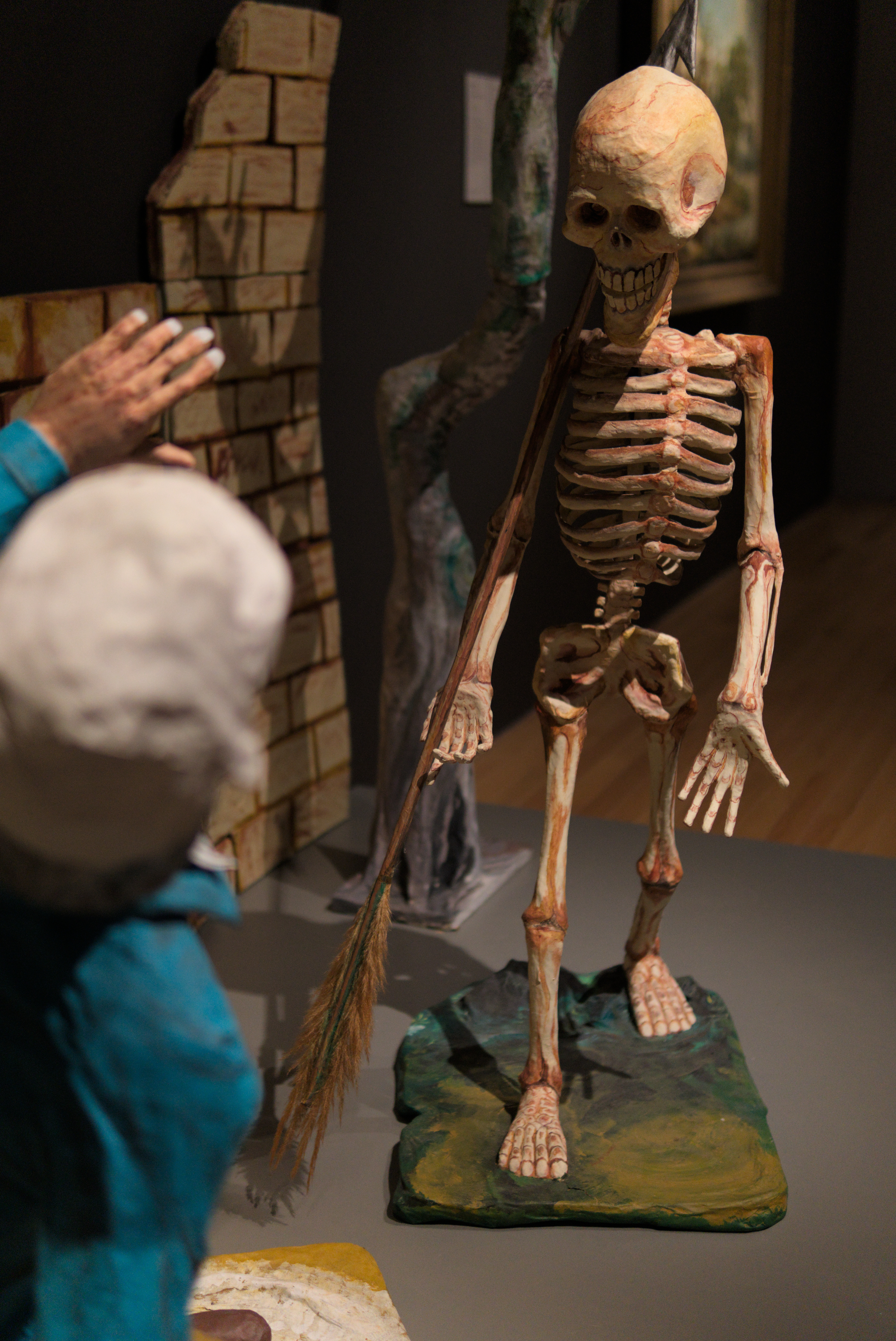
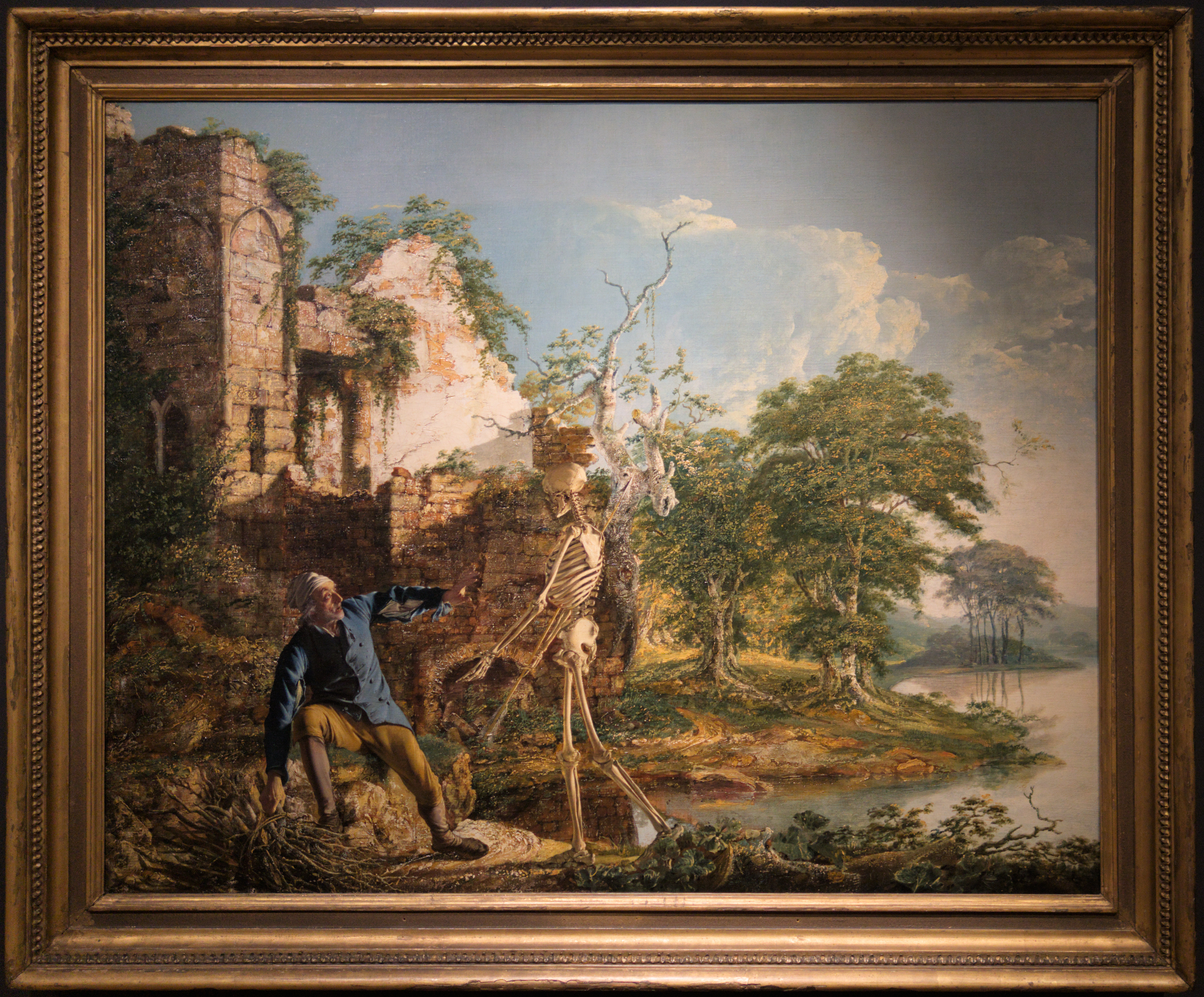
For me the standout piece from the exhibition is The Old Man and Death by Pedro Linares, a dramatic tableau in the medium of cartonería (papier-mâché sculpture), a traditional handcraft of Mexico. Commissioned by the Wadsworth in 1986 for the artist’s MATRIX exhibition, it reinterprets Joseph Wright of Derby’s 1773 painting of the same name, one of the most popular works in the museum’s collection.

Wright, Joseph_The Old Man and Death
Joseph Wright of Derby (English, 1734–1797), The Old Man and Death, 1773. Oil on canvas, 40 × 50 1/16 in. (101 × 127 cm). Wadsworth Atheneum Museum of Art, Hartford, Connecticut. Photo: Victoria Emily Jones.

Regarding the Wright painting, Cynthia Roman writes that it

masterfully combines Wright’s ability to depict a literary narrative with his skill in rendering a natural setting with accuracy and keenly observed detail. The subject of this painting is based on one of Aesop’s Fables or possibly a later retelling by Jean de la Fontaine. . . . According to the tale, an old man, weary of the cares of life, lays down his bundle of sticks and seats himself in exhaustion on a bank and calls on Death to release him from his toil. Appearing in response to this invocation, Death arrives. Personified here as a skeleton, Death carries an arrow, the instrument of death. Illustrating the moral of the tale that it is “better to suffer than to die,” the startled old man recoils in horror and instinctively waves him off, reaching for the bundle as he clings to life.

The Linares piece and its inspiration are placed side-by-side in the gallery, which also displays an alebrije by the same artist, papel picado, painted skulls, an ofrenda, and Diego Rivera’s Young Girl with a Mask.

Roundup: Upcoming conferences, “Rupture as Invitation,” and more

UPCOMING CONFERENCES:

>> Calvin Symposium on Worship, February 7–9, 2024, Calvin University, Grand Rapids, MI: I’ve promoted this event in years past—see, e.g., here and here—and am excited to be attending again this year! I’ll be coleading a breakout session with Joel Littlepage and Ashley Williams about our work at the Daily Prayer Project, curating textual, visual, and musical resources from across time and place to encourage a life of prayer that reflects the church’s beautiful diversity. There are plenty of other sessions being offered as well; a few that stand out to me are “Blues: The Art of Lament” with Ruth Naomi Floyd (she’s also leading a Jazz Vespers service), “Music, Architecture, and the Arts: Early Christian Worship Practices” with Vince Bantu [previously], and “The First Nations Version New Testament and Its Impact on Worship” with Terry Wildman. This is in addition to what is probably my favorite part: the multiple worship services, led by liturgists, preachers, and musicians from different denominations and cultural backgrounds. I love my local church community, but I also love worshipping with folks from outside it—a reminder that the church is far broader than what I’m used to on a weekly basis.

>> “Poetry and Theology: 1800–Present,” February 22–24, 2024, Duke University, Durham, NC: Supported in part by Duke Initiatives in Theology and the Arts, next month Duke is hosting a poetry symposium that’s free and open to the public! The speakers are Lisa Russ Spaar, Judith Wolfe, Toby Martinez de las Rivas, Thomas Pfau, Kevin Hart, Anne M. Carpenter, Ian Cooper, Anthony Domestico, Luke Fischer, Dante Micheaux, Łukasz Tischner, and Bernadette Waterman Ward. Papers are on the poetry of Hopkins, Eliot, Rilke, Miłosz, and more.

>> “Return to Narnia: Creativity, Collaboration, and Community” (Square Halo Books), March 8–9, 2024, Lancaster, PA: Organized by book publisher, author, illustrator, printmaker, and gallerist Ned Bustard, this year’s Square Halo conference will feature author Matthew Dickerson as its keynote speaker and Sarah Sparks as its musical guest, along with various breakout session leaders, such as Brian Brown of the Anselm Society and Stephen Roach of the Makers & Mystics podcast. Tickets are $210 if purchased in advance or $220 at the door.

>> The Breath and the Clay, March 22–24, 2024, Awake Church, Winston-Salem, NC: Organized by Stephen Roach and friends, this annual creative arts gathering aims to foster community and connection around the pursuit of truth, beauty, and goodness, providing opportunities for immersive encounters and kindling for the imagination. There will be main-room sessions, workshops, a juried art exhibition (entry deadline: February 16), a poetry slam and songwriters’ round, a panel discussion on reconciling artists and the church, concerts, a dance performance, a short film screening, and more. Musical artists include Victory Boyd, John Mark McMillan, Young Oceans, and Lowland Hum, and among the keynote speakers are Rachel Marie Kang, Mary McCampbell, Junius Johnson, Vesper Stamper, and Justin McRoberts. I appreciate the bringing together of various artistic disciplines and the emphasis on practice. For tickets, there are both virtual ($99) and in-person ($299) options.

+++

NEW SONG: “MLK Blessing” by the Porter’s Gate: Written by Paul Zach and IAMSON (Orlando Palmer) and just released for Martin Luther King Jr. Day, this song is based on a benediction that MLK prayed, a variant of the ancient Jewish benediction known as the Birkat Kohahim or Aaronic blessing (Num. 6:24–26). It’s sung by Liz Vice and Paul Zach.

+++

PAST LECTURE: “Rupture as Invitation: Generosity and Contemporary Art” by Elissa Yukiko Weichbrodt: I’ve mentioned Elissa several times on the blog—I find her work so illuminating—and was grateful to have her in town last fall to deliver a lecture for the Eliot Society. “Contemporary art can often be unexpected or downright unsettling in its form and subject matter. But what if we reframed our discomfort as an invitation to enter rather than an unbridgeable divide? In this lecture from November 11, 2023, Dr. Elissa Yukiko Weichbrodt demonstrates how approaching contemporary art with humility, love, and courage can be a powerful means of growing in love for our neighbors.”

+++

UPCOMING EVENT: “Why Should Christians Care About Abstract Art?” with Elissa Yukiko Weichbrodt and Jonathan Anderson, February 22, 2024, Gordon-Conwell Theological Seminary–Charlotte, NC: Hosted by the Leighton Ford Initiative for Art, Theology, and Gospel Witness, this evening will consist of an opening of the exhibition Alfred Manessier: Composer in Colors (on display through April 30) and dessert reception, lectures by Elissa Yukiko Weichbrodt and Jonathan Anderson, and a Q&A. “For some people of faith, abstract art is difficult to engage because the meaning remains unclear, and the form can appear chaotic or uncompelling. For others, abstract art is an invitation to engage the whole person, contemplate spiritual realities, and encounter God in transformative ways. If abstract art can facilitate the latter, then Christians have a unique opportunity to learn and care about abstract art for theological, practical, missional, and relational reasons. This event is a unique opportunity to experience abstract art, learn about abstract art, and have formative interaction with one another on this topic.” The cost is just $10, and there is an online option.

Manessier, Alfred_Mount Calvary
Alfred Manessier (French, 1911–1993), La montée au Calvaire (Mount Calvary), from the Suite de Pâques (Easter Series), 1978. Chromolithograph on Arches paper, 22 × 29 9/10 in. (56 × 76 cm). Edition of 99.

+++

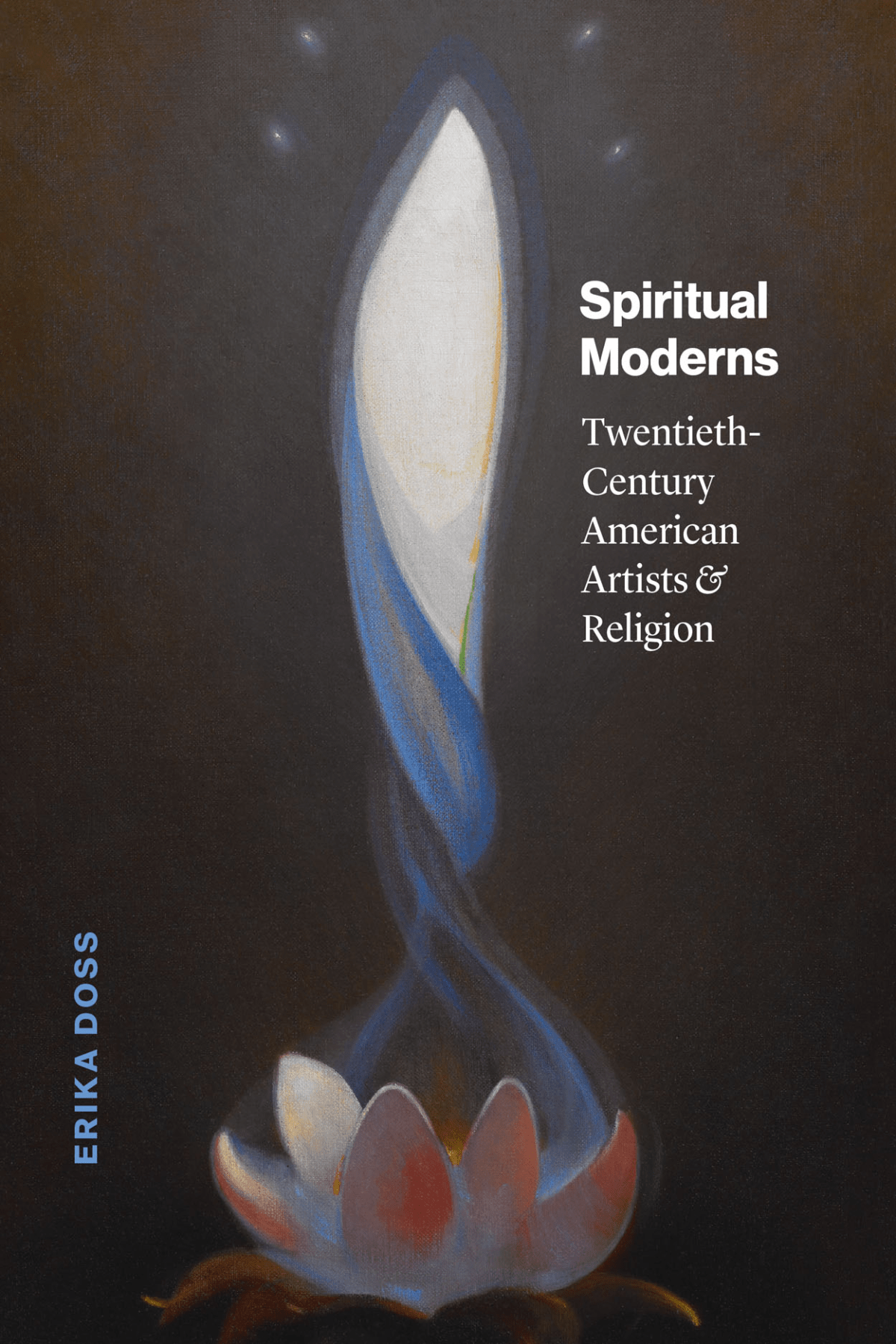
BOOK REVIEW: “Religion’s Understated Influence on Modern Art” by Daniel Larkin, on Spiritual Moderns: Twentieth-Century American Artists and Religion by Erika Doss: Challenging the presumed secularity of modern art, the new book Spiritual Moderns centers on four iconic American artists who were both modern and religious: Andy Warhol, Mark Tobey, Agnes Pelton, and Joseph Cornell.

+ ROUNDTABLE DISCUSSION: Also responding to this publication: the Association of Scholars of Christianity in the History of Art (ASCHA) will be presenting a session at the College Art Association Annual Conference in Chicago on February 16 at 2:30 p.m. that will put four prominent scholars—Stephen S. Bush, Matthew J. Milliner, Robert Weinberg, and Gilbert Vicario—in dialogue with Doss to “explore the assumptions, motivations, and insights of [her] analysis, and consider a more open, inclusive, and diverse reading of American Modernism.”

Roundup: Literary Lent, Psalm 90 virtual art exhibition, and more

Roerich, Nicholas_Christ in the Desert
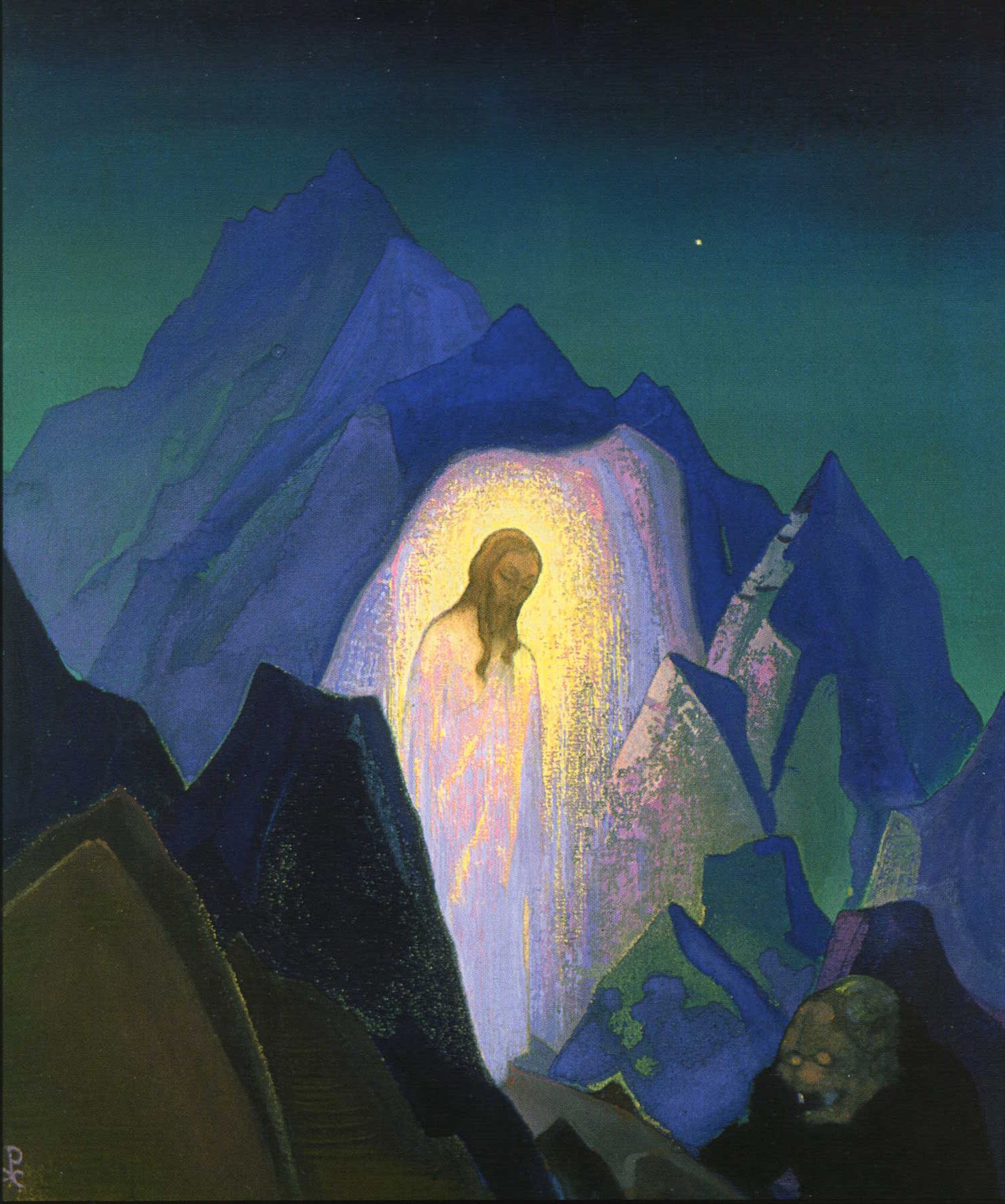
Nicholas Roerich (Russian, 1874–1947), Christ in the Desert, 1933. Tempera on canvas, 60 × 50.9 cm. Nicholas Roerich Museum, Moscow.

QUOTE:

The tradition of Lent means many different things to many different people. I honour the traditions and wisdom of the ages—and I’m interested in discerning what these practices mean [today].

At [my church], Lent is about learning from Jesus, particularly Jesus’ path through the real-life wilderness experiences we all face. We are interested in emulating and discovering a Jesus-shaped life in the hard things, the growing things, and the uncomfortable things. We believe not in an idealized plane of existence no one can quite attain; instead we believe in knowing and living out a Jesus way in the grey areas, the dirt and dust of our earthly lives here and now. . . .

Together and for you, this is our prayer (by Ann Siddall): “May this Lenten journey, with its stories about the hard places of Jesus’ experience, give strength and courage to all whose journey is far from easy. And may it inspire us to risk Christ’s Way of love as we share the journey with other travelers. We make this prayer in his name. Amen.”

—Rielly McLaren, pastor, Windsor Mennonite Fellowship, Windsor, Ontario [source]

+++

ARTICLES:

>> “Ash Wednesday and the Practice of Truth-Telling” by Christine Valters Paintner: In this introduction to the season of Lent, spiritual writer and retreat leader Christine Valters Paintner discusses lament as a Lenten practice—lament as truth-telling, resistance, solidarity, and the release of God’s power. We need to touch those places of grief that we carry, and open ourselves in compassion to the grief of others. Paintner also unpacks the word “repentance,” visiting its Hebrew and Greek root words to further illuminate its meaning.

>> “Forty for 40: A Literary Reader for Lent” by Nick Ripatrazone: Nick Ripatrazone, the culture editor for Image journal and columnist at The Millions, offers suggestions and blurbs for forty stories, poems, essays, and books appropriate for Lent. Some pieces are inspired by feast days and Gospel readings, while others capture the discernment of the season. From Flaubert’s The Temptation of Saint Anthony and Hemingway’s one-act play Today Is Friday to Love & Salt: A Spiritual Friendship Shared in Letters and Karr’s “Disgraceland,” the selections are varied and intriguing. The dates are off because this was published in 2017, but the list is still valid, and many of the poems can be read online.

+++

LIVING ROOM EVENT: “Poetry of Lent”: On March 4, under the aegis of the local arts nonprofit the Eliot Society, I’m moderating an evening of crowdsourced Lenten poetry at a friend’s home in Crownsville, Maryland. If you’re in the Baltimore-Washington metro area, I’d love to see you there! The themes of this season are so expansive, and I’m looking forward to hearing what people share. Of course, I will have many poems in my back pocket as well. Some words I’ve been thinking of in preparation: pilgrimage; hunger; emptying; grace; greening; solitude; beloved; blood.

+++

SONGS:

>> “Circles” by Tow’rs: Tow’rs, an indie-folk band out of Flagstaff, Arizona, is made up of Gretta and Kyle Miller, drummer Dan Bagle, guitarist Kyle Keller, and cellist Emma Riebe. This song of theirs is about how God lovingly pursues us and clothes our shame.

>> “Parce Domini” by Jacob Obrecht: The Gesualdo Six perform a motet by the Flemish composer Jacob Obrecht (1457/58–1505), which sets a traditional Latin liturgical text based on Joel 2:17, 13.

Parce Domine, parce populo tuo quia pius es et misericors. Exaudi nos in aeternum, Domine.

Spare, O Lord, spare thy people, for Thou art gracious and merciful. Hear us for ever, O Lord.

+++

VISUAL COMMENTARY: “Handling Our Fragility, Seeking a Wise Heart” by Rachel Muers: As part of the Visual Commentary on Scripture project, theologian Rachel Muers has selected and comments on three artworks that resonate with Psalm 90 [previously], a song that combines communal lament with a meditation on wisdom. The psalm ends with the cry “Prosper for us the work of our hands—O prosper the work of our hands!”—which guided Muer in her curation. She gives us nine-thousand-year-old handprints on an Argentinian cave wall, a hospital drawing by Barbara Hepworth, and a cat’s-cradle sculpture by Mitzi Cunliffe. This mini-exhibition is a great way to enter into and engage with this typically Lenten psalm.

Cave of Hands
Cueva de las Manos (Cave of Hands), began ca. 7,000 BCE. Mural, UNESCO World Heritage Site, Santa Cruz, Argentina.

On a related note: For this Lent, the VCS is dipping into its archives to bring you “Lent Stations: Repentance and Forgiveness,” fourteen artworks with commentary (two per week) that relate to the stated theme. Follow the link to sign up.

Roundup: Online convos with artists Marc Padeu (from Cameroon) and Emmanuel Garibay (from the Philippines), and more

NEW PLAYLIST: October 2021 (Art & Theology): This month’s playlist includes a benediction from the book of Jude; a percussion-driven setting of Francis of Assisi’s “Canticle of the Sun” by the Camaldolese monk Cyprian Consiglio; an Exodus-inspired song in Yorta Yorta, an indigenous Australian language, from the feature film The Sapphires; “Prodigal Son,” a little-known hymn by John Newton, from The Sacred Harp; a sixties gospel song by Shirley Ann Lee (famously covered by Liz Vice on her debut album); and closing out, in anticipation of All Saints’ Day on November 1, the jazz standard “When the Saints Go Marching In.” To save the playlist to your Spotify account, click the ellipsis and select “Add to Your Library.”

+++

IN-PERSON LECTURE: “The Works of Art in the Work of the Church” by John Skillen, October 16, 2021, Crownsville, MD: The Eliot Society, an organization I work for, is hosting our first event in over a year and a half! It’s an art talk by Dr. John Skillen [previously], director of the Studio for Art, Faith & History in Orvieto, Italy. It will be at the home of two of our board members, so if you’re in the Washington–Baltimore metropolitan area two weekends from now, consider coming by! The event starts with hors d’oeuvres at 6:30 p.m., and an RSVP is requested.

The Works of Art in the Work of the Church

In recent decades, a growing number of Christians—even those from church traditions formerly suspicious of the arts—are warming up to the idea that artworks can serve in the various practices of the life of faith, and not only in iconographic form as images of Jesus in worship. Scripturally sound and aesthetically sophisticated works of art can guide our prayer, help catechize our children, and shape the environments of our missional work. Many of us will welcome some pointers for putting art back in its place in the settings where we live and work.

To help us imagine possibilities, John Skillen will offer examples from a long period of Christian history when the arts were put to work in the collective life of the church in more places and in more ways than most of us nowadays can imagine. Not only churches but also hospitals, orphanages, the meeting rooms of parachurch organizations, baptisteries and bell towers, dining halls and cloisters in monasteries, town halls and civic fountains and public squares—all were places of serious decoration and design expected to be compatible with Christian faith.

No sphere of religious and civic life was off-limits for imagery able to instruct, to prompt memory, and to inspire emotion and action—the three functions of art most commonly cited during the Middle Ages to defend its value.

+++

UPCOMING ONLINE CONVERSATIONS:

Padeu, Marc_Le souper a Penja
Marc Padeu (Cameroonian, 1990–), Le souper a Penja, 2019. Acrylic on canvas, 82 7/10 × 106 3/10 in. (210 × 270 cm).

>> “Caravaggio in Cameroon: Marc Padeu and Jennifer Sliwka in Conversation,” October 14, 2021, 11 a.m. EST (4 p.m. BST): I spoke about Padeu’s Le souper a Penja at a recent seminar on “Picturing Jesus,” so I’m looking forward to hearing the artist himself discuss it along with the larger body of work it’s a part of. Hosted by the National Gallery in London.

Artist Marc Padeu lives and works in Cameroon. Intriguingly, his monumental paintings – exploring tender and complex relationships between family, friends, lovers and working communities – often draw on Italian Baroque compositions and especially those of Caravaggio.

Marc Padeu joins Dr Jennifer Sliwka, specialist in Italian Renaissance and Baroque art. Her research explores how 17th-century painters developed innovative approaches to religious painting, imbuing their works with an immediacy, power, and dynamism.

Together, the speakers will take Padeu’s Le Souper a Penja and its relationship to Caravaggio’s Supper at Emmaus as a jumping-off point for conversation, exploring Padeu’s wider interest and understanding of historical works, his adoption and adaptation of the visual language of the Baroque and how these inform his evocations of contemporary life in Cameroon.

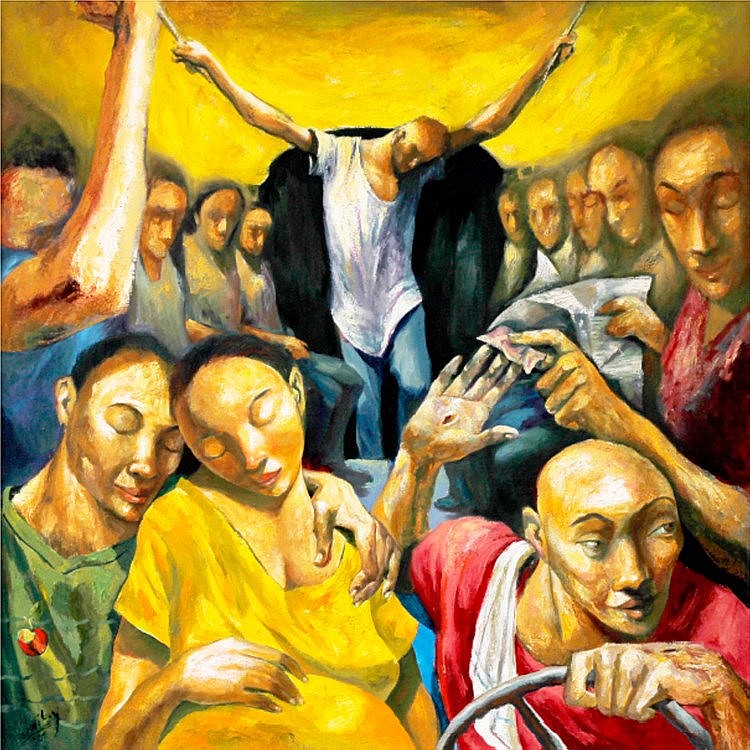
>> “In the Studio with Emmanuel Garibay,” November 11, 2021, 8:30 a.m. EST: The Overseas Ministries Study Center at Princeton Theological Seminary is hosting a conversation with Filipino artist Emmanuel “Manny” Garibay, a social realist painter who served as the 2010–2011 OMSC artist in residence. “It is the richness of the poor that I am drawn to and which I am a part of, that I want to impart,” he says. His paintings often portray Jesus among the marginalized and dispossessed and critique the church’s “compliance with greed, corruption, and social inequality.” Garibay’s children Alee, Nina, and Bam, who are also accomplished artists, will be present for the conversation as well. For more on Garibay, see this Q&A from the OMSC and the Image journal essay “Recognizing the Stranger: The Art of Emmanuel Garibay” by Rod Pattenden.

Garibay, Emmanuel_Kaganapan
Emmanuel Garibay (Filipino, 1962–), Kaganapan, 2006. Oil on canvas, 48 × 48 in. (122 × 122 cm).

+++

NEW SONGS:

>> “Keep Watch (Noelle’s Lullaby)” by Liturgical Folk, a setting of a Compline prayer from the Book of Common Prayer, on the new family album Matins & Vespers:

>> “Psalm 91” by Poor Bishop Hooper, released as part of the EveryPsalm project, through which the duo offers original weekly Psalm-based songs for free download:

Roundup: Roger Lowther on “all things new,” Lord’s Prayer song playlist, and more

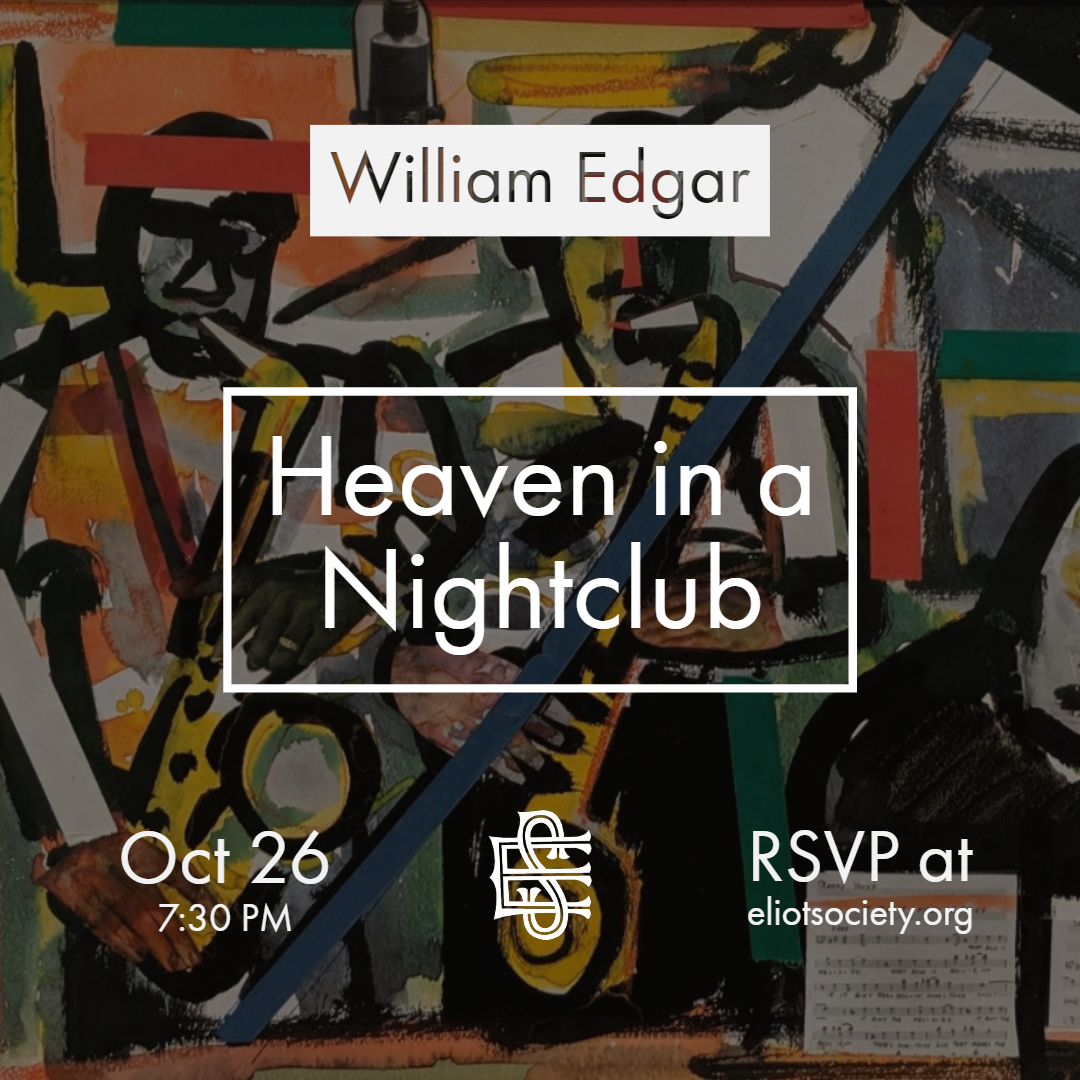
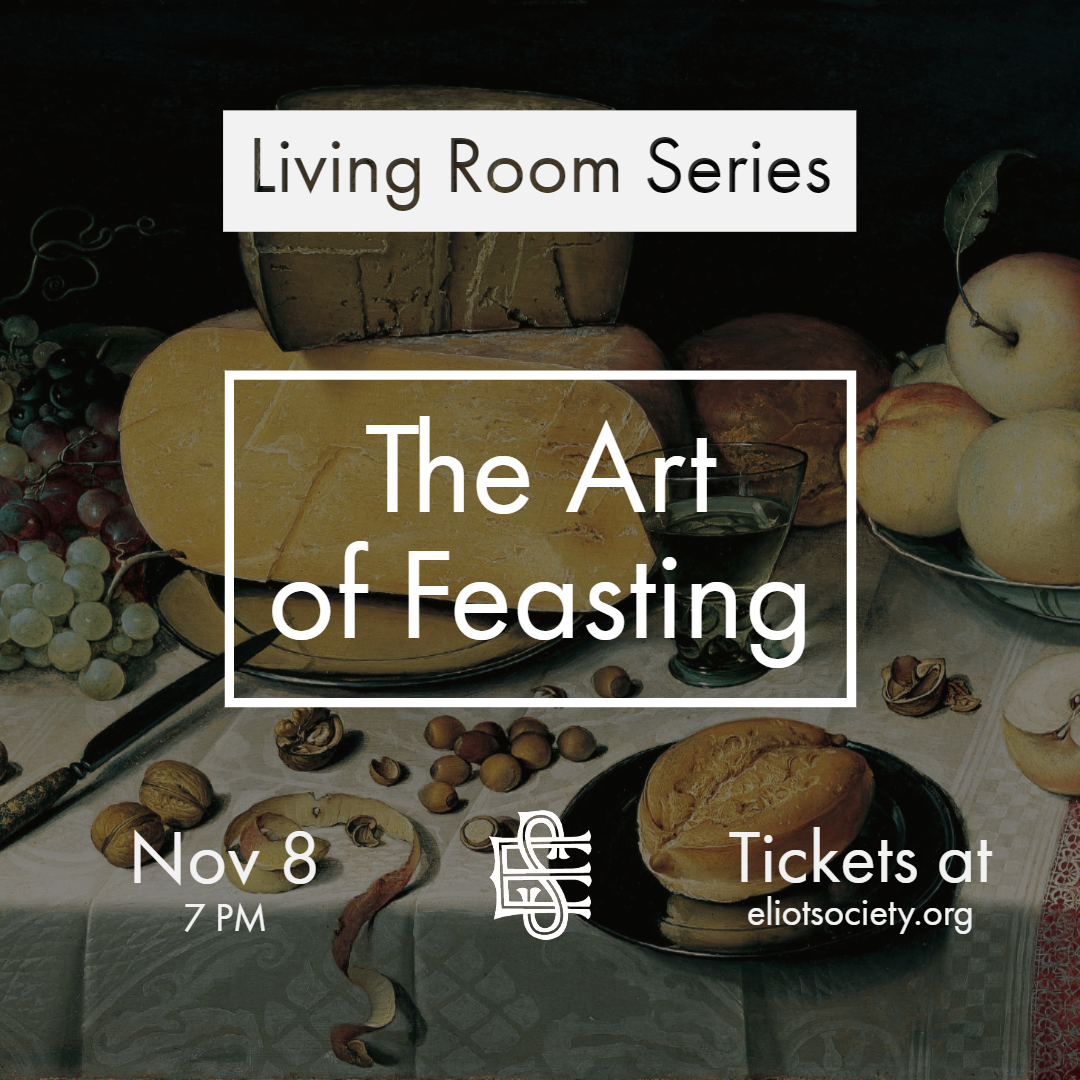
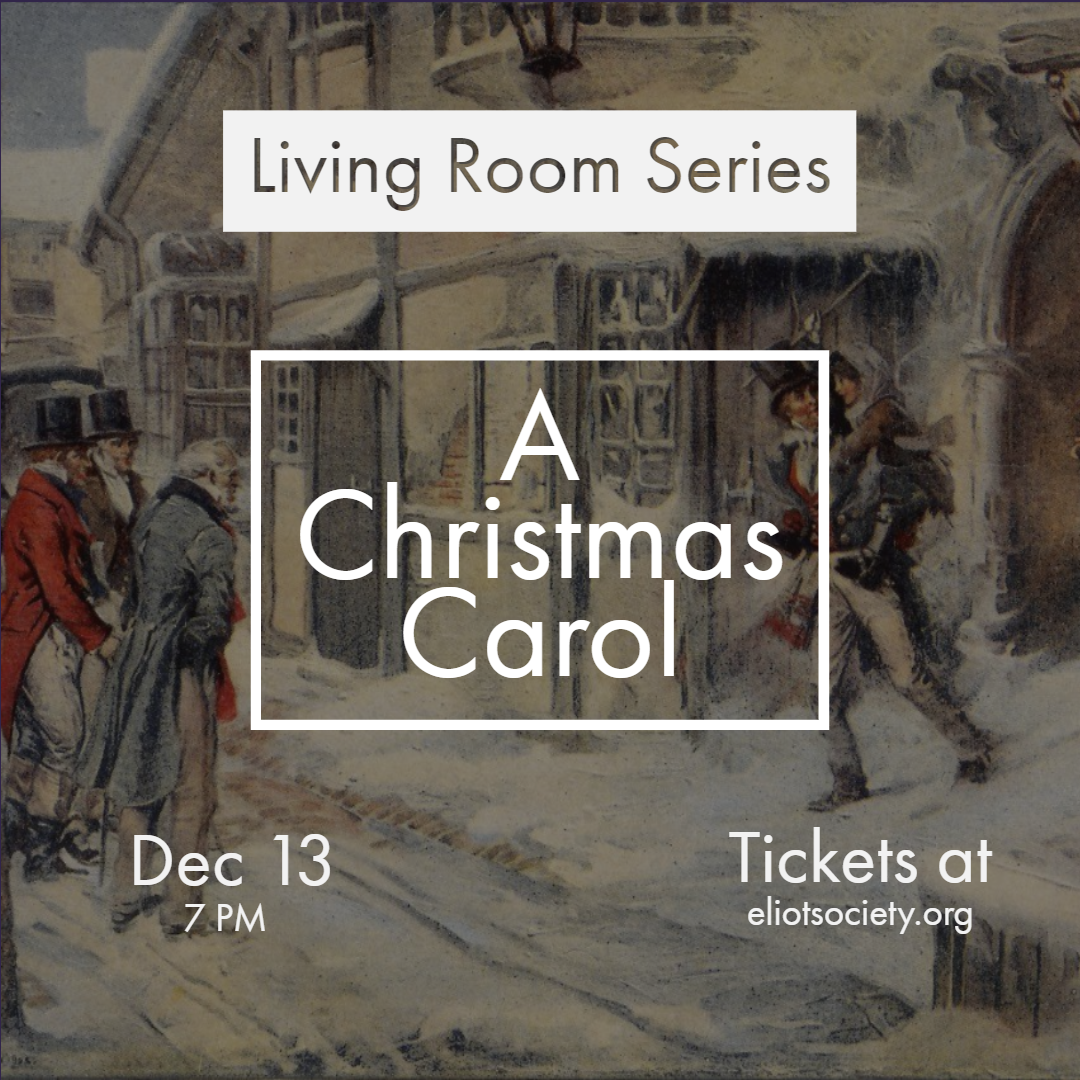
If you live in the Baltimore-Washington area, I hope I’ll see you at one or all of the Eliot Society events this fall! For “Heaven in a Nightclub” on October 26, we’re bringing in jazz pianist Bill Edgar from Philly to give a combo concert-lecture highlighting the spiritual roots of African American music. “The Art of Feasting” will kick off our Living Room Series on November 8, as Heidi Stevens, who teaches art at a local K-12 classical Christian school, will guide us in looking most especially at food table still life paintings from the Dutch Golden Age. On December 13, we’ll gather together again for more food and drinks and to collectively read Charles Dickens’s A Christmas Carol in character. Reserve your spots at https://eliotsociety.org/!

Heaven in a Nightclub

Art of Feasting.png

Christmas Carol event.png

+++

CONFERENCE: The 2019 Madeleine L’Engle Conference: Walking on Water: I just caught wind of this great opportunity taking place November 15–16 at All Angels’ Church in New York City, where L’Engle was a member. “In celebration of Madeleine L’Engle’s centenary year, this inaugural conference brings together a diverse group of artists and seekers to explore, challenge, and deepen our creative lives. . . . The conference has a combination of keynote addresses, panel discussions, and workshops that will be of interest to people across faith traditions who are interested how faith and art inform each other. There will also be sessions on the works and influence of Madeleine L’Engle, and opportunities for alumni of her workshops to reunite and share stories.”

The conference is co-directed by Sarah Arthur, author of A Light So Lovely: The Spiritual Legacy of Madeleine L’Engle (book trailer below), and Brian Allain, owner of Writing for Your Life. The headline speaker is children’s author Katherine Paterson (Bridge to Terabithia; The Great Gilly Hopkins).

+++

LECTURE: “Defining the New” by Roger Lowther: In this sixteen-minute talk from the Community Arts Tokyo International Arts Festival in June [previously], Roger Lowther draws out the festival’s theme of “All Things New” through piano music—namely, Bach’s Prelude in C Major and Chopin’s “Raindrop” Prelude. Both start out prettily, move through a section of dissonance, and then find a new and richer beginning on the other side. “In this world full of sadness,” says Lowther, “we can find a new beginning.” He tells the story of a church piano in Kamaishi City that took on water in the March 11, 2011, tsunami. Rather than throw it out as beyond repair, the church spent much time, effort, and money fixing it up, even though it would have been much easier to just buy a new one. In doing so, they demonstrated the gospel hope of “all things made new.”

Lowther and his wife, Abi, are the directors of the MAKE Collective, “a network of artists [under Mission to the World] who, like Bezalel, have been called by name, by God, and have been filled with the Spirit of God in wisdom, understanding, knowledge, and all kinds of craftsmanship (Exodus 31:2-3). They have embraced their gifts and accepted their unique opportunity and responsibility that the holistic, prophetic, and pastoral expression of those gifts affords in their participation in the evangelical/cultural mandate—God’s reconciliation of all things to Himself, in the context of global church planting movements.” Their values include listening, questioning, experimenting, challenging, generosity, transparency, inclusion, and excellence.

I had lunch with the founder of MAKE, Berenice Rarig [previously], last year and am always encouraged by the thoughtful content of the organization’s bimonthly e-newsletter—some of which can be viewed on their new website, https://themakecollective.org/. Their September newsletter pointed me to a new video of five missionary artists, including the Lowthers, discussing art as community building, as storytelling, and as therapy, as well as beauty in brokenness:

VIDEO: “Can Arts Also Be Missions?” [transcript]

+++

PLAYLIST: Philip Majorins of Liturgy Letter curated an excellent playlist of various settings and performances of the Lord’s Prayer by artists ranging from jazz greats Duke Ellington and Vince Guaraldi to gospelers Aretha Franklin and the Staples Singers to contemporary folk rockers Sandra McCracken and Gungor to Serbian Orthodox singer Divna Ljubojević and even the Byzantine darkwave band Anastasis. And more!

+++

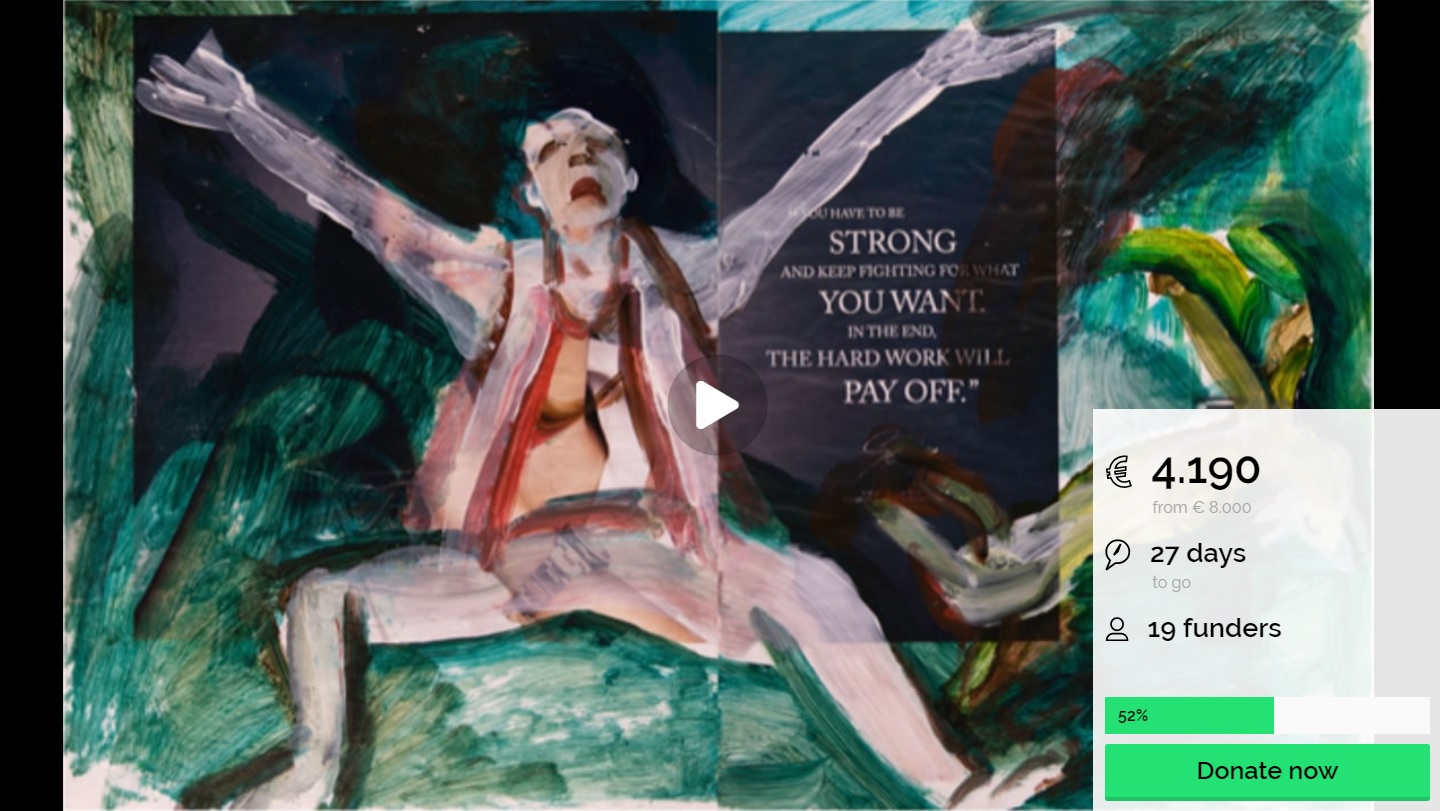
CROWDFUNDING CAMPAIGN: Earlier this year I participated in the Art Stations of the Cross pilgrimage/exhibition in Amsterdam. One of the stops was Mozes en Aäronkerk, which housed Masha Trebukova’s Anywhere, Anytime. This series of paintings on glossy magazine pages raises awareness of human suffering around the globe, providing visual prompts for prayer and action. The artist is seeking to reproduce the images in a standard print-book format for mass production, and she needs help funding the project. Donate at https://www.voordekunst.nl/projecten/9400-anywhere-anytime.

Anywhere, Anytime

Roundup: “Art as Mission,” Ken Myers on culture care, Quadri Plastici, heavy-metal hymn, cultural liturgies

“Translate: Art as Mission” symposium, February 25, 9 a.m.–3:30 p.m.: This Saturday, Third Church of Richmond, Virginia, is bringing together twenty practitioners, advocates, and theorists of the arts as front-line missions (both local and abroad) for a series of presentations and discussions that is free and open to the public. “Our aim is to demonstrate that ‘art as mission’ is not about using people and objects merely as ‘tools’ for missions or proselytization, but is about recognizing that generative, creative practices can and should be intrinsically, inherently ‘missional’ because they put on display and draw people towards the rich, abundant life we were made to experience and have together as God’s children, renewed as the Body of Christ. Together we’ll explore how the arts are a distinctively integrative, incarnational way to be human, and to bear the image of our creator God.” Click on the link to see the schedule and to find out more about the speakers.

+++

“Charged with the Grandeur of God: Faithful Imaginations in a Meaningful Creation” lecture, February 25, 7–9 p.m.: Also on Saturday, Ken Myers, founder and host of Mars Hill Audio and author of All God’s Children and Blue Suede Shoes: Christians and Popular Culture, will be speaking at Wallace Presbyterian Church in College Park, Maryland, on how alert imaginations enable us to receive the meaning in Creation and to rearticulate Creation’s meaning in works of art. A former arts and humanities editor for NPR, Myers writes of the mission of Mars Hill’s bimonthly “audio journal”: “We explore the various factors that have given modern Western culture its distinctive character. We also try to describe what cultural life — its practices, beliefs, and artifacts — might look like if it was the product of thoughtful Christian imaginations.” Each issue features guests from a variety of disciplines (poets, visual artists, scientists, philosophers, musicians and musicologists, social commentators, etc.); you can listen to back issues here, and read a 2013 profile on Myers from the Weekly Standard here. This event is sponsored by the Eliot Society, a new nonprofit in Washington, DC, that aims to “draw Christian faith and artistic culture back together, by promoting the thoughtful exploration of the work of creative men and women from both the past and the present.” Click here to RSVP.

+++

Last season’s Italia’s Got Talent featured a group called Quadri Plastici (“Living Paintings,” or “Tableaux”), which uses actors in period costumes and special lighting effects to recreate famous religious paintings in the flesh. According to the group’s website, the tradition of staging live reproductions of paintings originated in Avigliano in southern Italy in the 1920s: the participants, frozen in position, would be rolled into the town square on mule-drawn carts as part of the celebration of Saint Vitus’s feast day on June 15. In their television performance last year, Quadri Plastici recreated three Caravaggio paintings: The Crucifixion of Saint Peter, The Calling of Saint Matthew, and The Death of the Virgin. Gabriele Finaldi, director of London’s National Gallery, was impressed, and he commissioned the group to perform two of the paintings from the museum’s “Beyond Caravaggio” exhibition in October: The Taking of Christ and Salome Receives the Head of John the Baptist. To better engage the public, these stagings took place outside in Trafalgar Square.

+++

Through Paul Neeley’s Global Christian Worship blog, I discovered a gem of a song: a heavy-metal arrangement of the nineteenth-century Swedish hymn “Bred dina vida vingar” (Thy Holy Wings) by the Finnish worship band Metallmässa (Metal Mass). Unlike its marginal status in most countries, heavy metal music is mainstream in Finland, which has the most heavy metal bands per capita in the world. “Metal masses”—church services performed in a heavy-metal style—became a trend in 2006; into this current stepped the group Metallmässa, whose lead singer, Christer Romberg, was a contestant on the 2007 Finnish Idols. Their headbanging rendition of “Bred dina vida vingar,” performed in the music video below, is from their 2012 EP Sanctus. The words are by Lina Sandell, “the Fanny Crosby of Sweden”; the tune—which I think is just beautiful (and quite catchy!)—is a traditional Swedish folk tune. Metallmässa is no longer active, but Romberg can be found performing a cappella with his four siblings as part of Vokalgruppen Romberg.

+++

Recently I enjoyed listening online to James K.A. Smith’s lecture “A Postmodern Saint? Augustine in France,” given at Wheaton College on August 31, 2016. Because I’m interested in how culture shapes our longings (in particular, visual culture), the bit that starts at 19:57 jumped out at me:

Augustine is a remarkable exegete of cultural liturgies that beset us—the rites and rituals of ambition, consumption, privilege, that aren’t just things that we do but do things to us. The frat house, the football stadium, the rituals of Wall Street finance—these are quasi-religious sites in late modern culture, not because they purvey a message but because they are incubators of love that are rife with rituals that train and direct our hearts and our desires. And conversion is no magical panacea for that; belief doesn’t inoculate our loves from their immersion in those cultural liturgies. So we need to constantly take stock of the formation of our loves and longings, all the subtle ways that secular liturgies bend our desires toward earth rather than heaven.

Consider, too, the act of looking as a cultural liturgy: at our phones and computer screens; at the staged displays in store windows, and the staged photos on social media; at the thirty-second commercial the network forces us to watch before we get back to our show, or the billboard we can’t help but notice when we’re stuck in traffic. Sometime around the year 600, Pope Gregory I insightfully wrote that pictures teach us what to adore, what to imitate. What pictures do you see throughout the day? Is Christ one of them?