Mother-child artworks by Elizabeth Catlett

Last month I saw the exhibition Elizabeth Catlett: A Black Revolutionary Artist at the National Gallery of Art in Washington, DC, an impactful display of over two hundred prints and sculptures from throughout Catlett’s illustrious seven-decade career. Organized in partnership with the Brooklyn Museum of Art, where it first opened last year, the show focuses on Catlett’s advocacy, through her art and her on-the-ground activism, against poverty, racism, war, and gender oppression—her promotion of human dignity and freedom for all. Her work especially celebrates the beauty and strength of African American working-class women.

The exhibition title comes from a speech Catlett delivered in May 1970 by phone from Mexico to attendees at the Conference on the Functional Aspects of Black Art at Northwestern University outside Chicago, which she could not attend in person because the United States refused her entry to the country on the grounds of her allegedly dangerous politics: “I have been, and am currently, and always hope to be a Black revolutionary artist, and all that it implies,” Catlett stated.

Born in 1915 in Washington, DC, and raised there, Catlett witnessed class inequality, racial discrimination, and US imperialism firsthand, which formed her consciousness and influenced the direction her art would go. After graduating from Howard University, she spent time teaching in Durham (North Carolina), New Orleans, and Harlem and studying art in Iowa and Chicago before permanently settling in Mexico in 1946, becoming a Mexican citizen in 1962. She married the Mexican printmaker and muralist Francisco Mora in 1947, and they had three children together, all sons.

Black motherhood is a recurring subject in Catlett’s work, starting with her MFA thesis project in 1941 at the University of Iowa, a limestone sculpture of a mother and child that won first prize at the America Negro Exposition in Chicago that year but that is now lost. “Black women have been cast in the role of carrying on the survival of Black people through their position as mothers and wives, protecting and educating and stimulating children and Black men,” Catlett said. “We can learn from Black women. They have had to struggle for centuries.”

The social justice framework of the current retrospective exhibition leaves plenty of room for Catlett’s depictions of mothers with their children. What follows are photos I took of some such works.
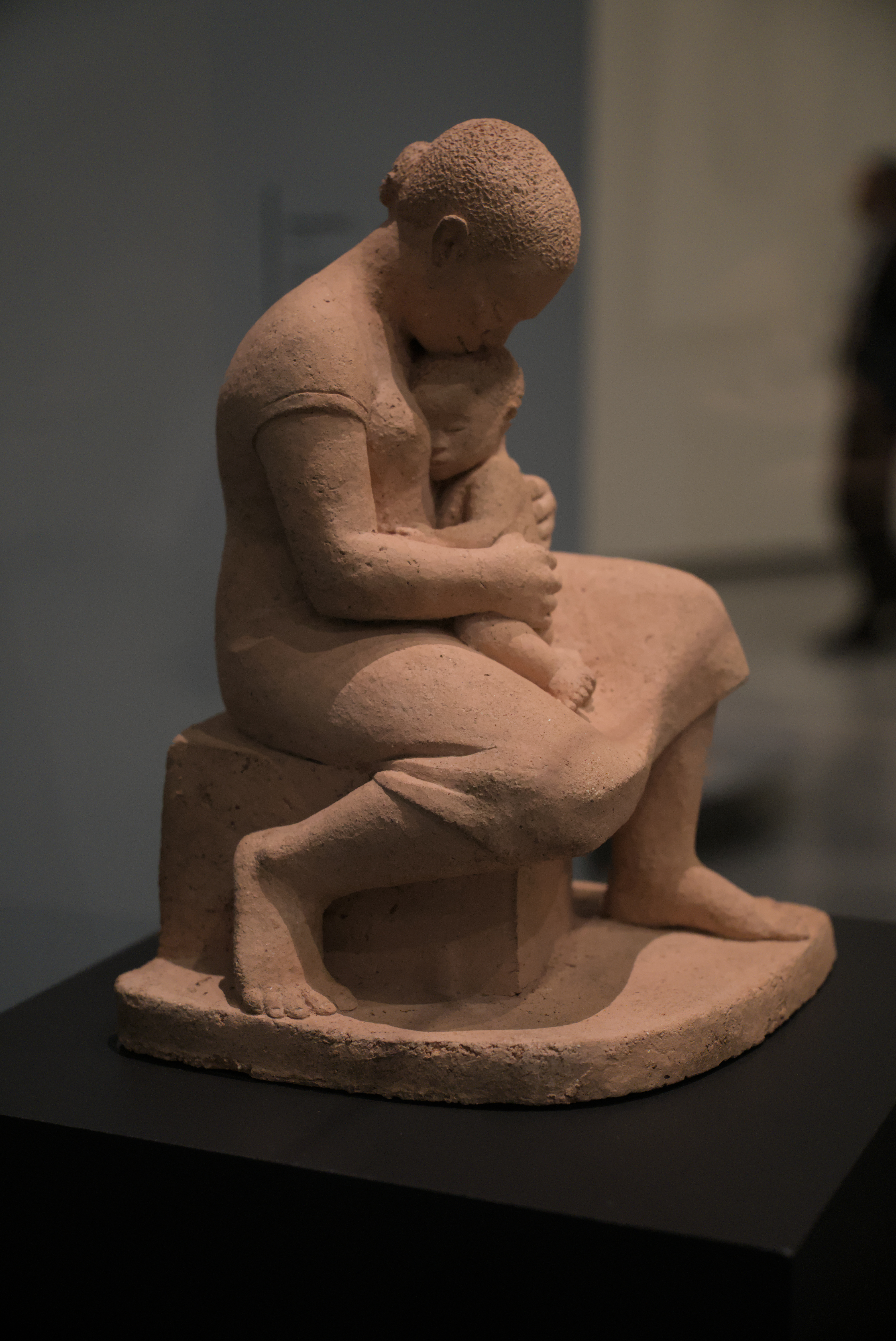
Catlett, Elizabeth_Mother and Child
Elizabeth Catlett (American, active in Mexico, 1915–2012), Mother and Child, 1956. Terracotta, 28.6 × 17.8 × 17.8 cm (11 1/4 × 7 × 7 in.). Museum of Modern Art, New York.

My favorite is a terracotta sculpture made just a year after the lynching of fourteen-year-old Emmett Till, whose mother Mamie Till’s response was an important catalyst of the civil rights movement. It brings two bodies—that of mother and infant son—into one volume. Art historian Leah Dickerman remarks on

the uncanny way that it seems both intimate and monumental at once. Intimacy lies in the way the weight of the child’s face presses against the mother’s breast, the mother’s right leg pushed back to stabilize her balance and her head nestled against the child’s scalp, breathing in that smell. Tenderness, both affectionate and shielding, is conveyed so keenly it almost aches. . . . Catlett seems to capture, somehow, the idea of remembering something fleeting, the sculpture a tiny memorial to loving protection that cannot be maintained.

Catlett, Elizabeth_Mother and Child (detail)

Platformed across from this sculpture is another, in mahogany, this one modernist, abstracted:

Catlett, Elizabeth_Mother and Child
Elizabeth Catlett (American, active in Mexico, 1915–2012), Mother and Child, 1970. Mahogany, 49.5 × 33 × 21 cm (19 1/2 × 13 × 8 1/4 in.). Currier Museum of Art, Manchester, New Hampshire.

It shows a mother holding her baby in a swaddle, his or her head gleefully poking out from the folds. While the baby seems happy, the mother seems stressed, as she turns her head away and grabs her head with her hand, which I interpret as her taking a deep breath to compose herself for several more hours of caregiving before bedtime.

Another mahogany sculpture is borrowed from the New Orleans Museum of Art:
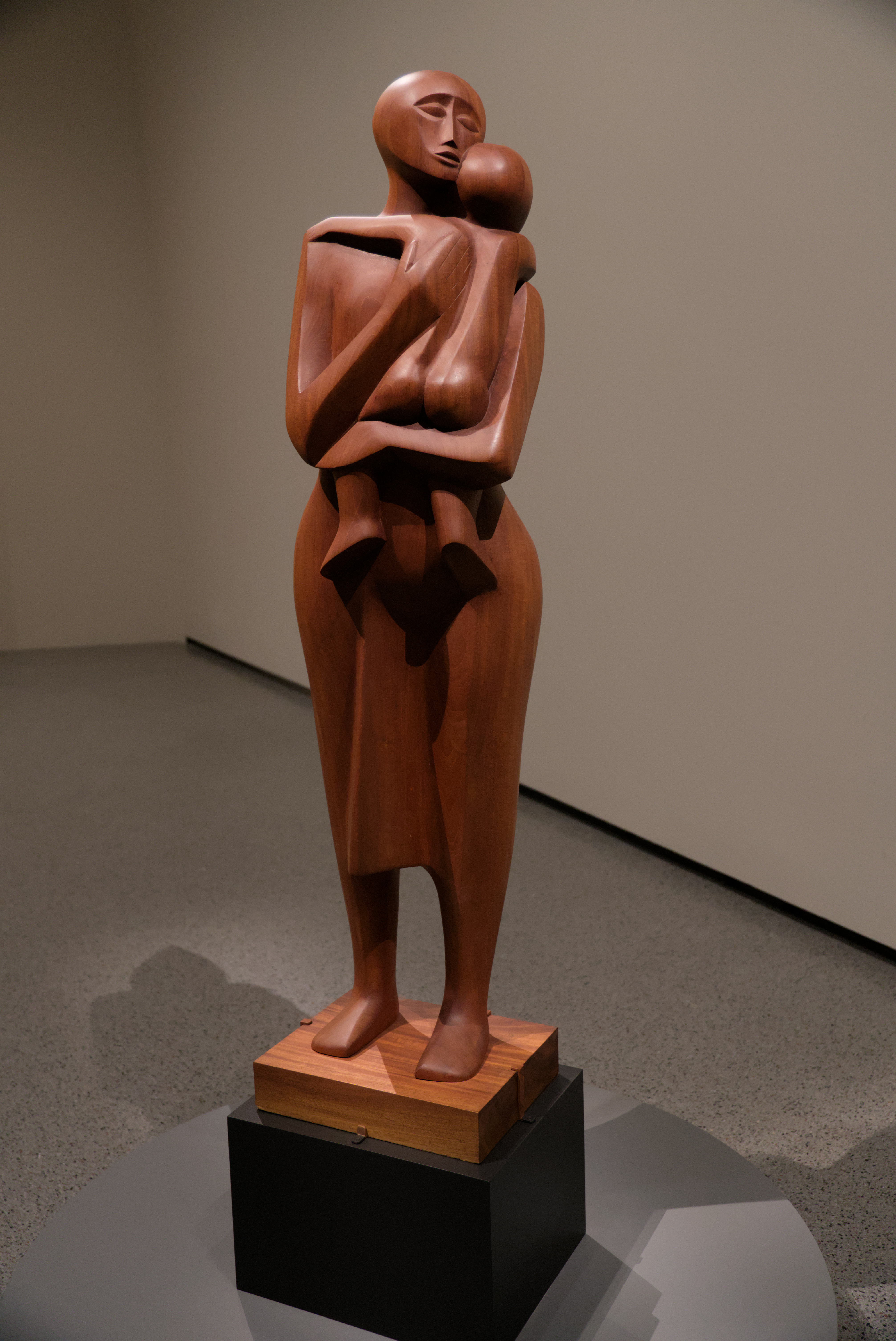
Catlett, Elizabeth_Mother and Child
Elizabeth Catlett (American, active in Mexico, 1915–2012), Mother and Child, 1983. Mahogany, 134.6 × 33 × 33 cm (53 × 13 × 13 in.). New Orleans Museum of Art, Louisiana.

The adjacent wall text quotes art historian Melanie Anne Herzog, author of Elizabeth Catlett: An American Artist in Mexico:

Becoming a mother, Catlett told me, was her most creative endeavor. She returned to the theme of maternity throughout her career in sculptures that illuminate the intimate physical bond between mother and child, a child’s comfort in its mother’s embrace, and the anguish of mothers who know they cannot protect their children from future harm. Catlett’s boldly corporeal rendering of maternity centers Black and Brown women in her depiction of this universal theme. I feel the fierce tenderness of this stately standing figure cradling her child, its body melded with hers. Her pensive expression and resolute stance call us to reflect on what she has endured and what her child, too, will encounter in the world that awaits.

One of Catlett’s earliest prints of the mother-child subject is a lithograph from 1944:
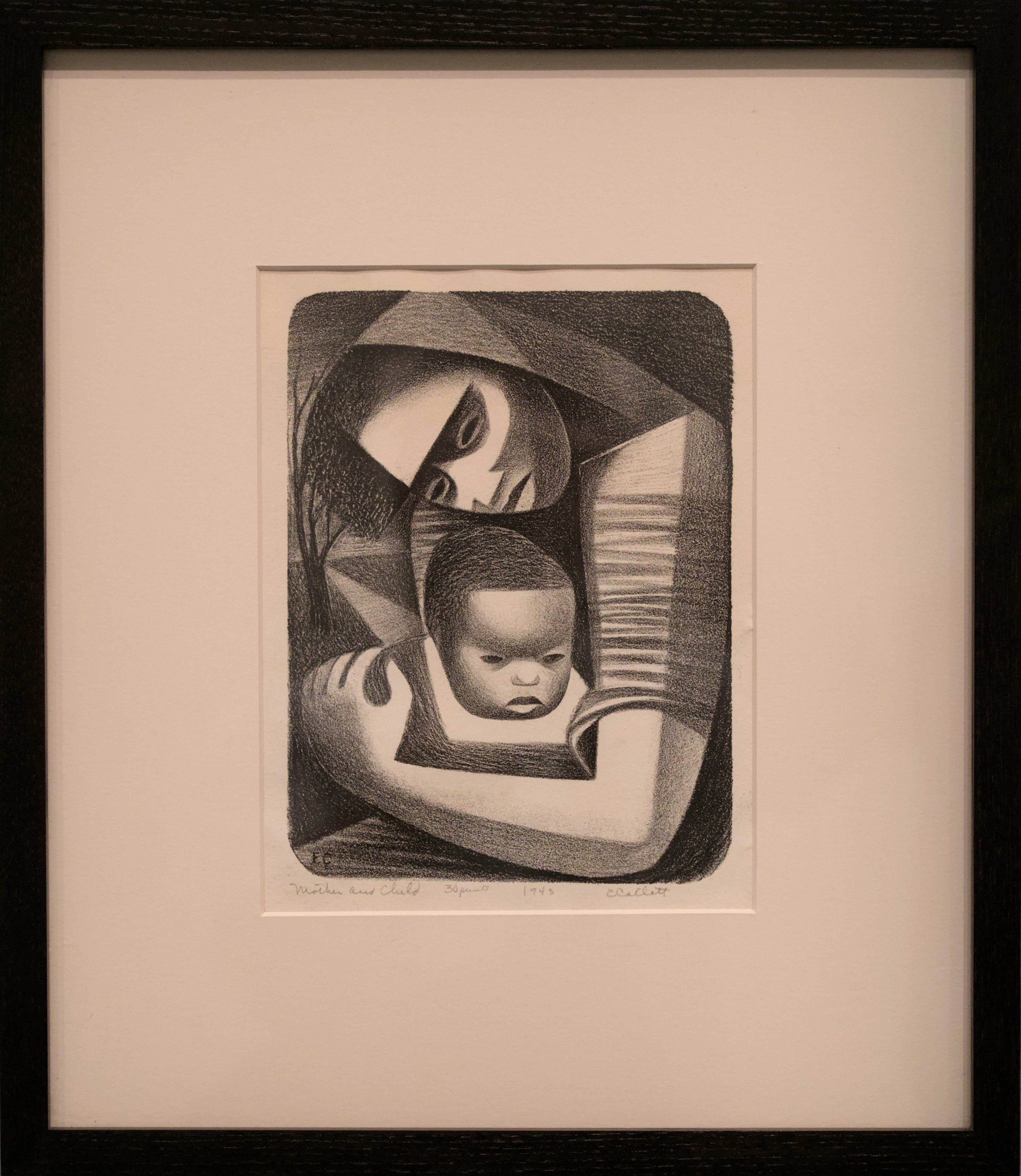
Catlett, Elizabeth_Mother and Child
Elizabeth Catlett (American, active in Mexico, 1915–2012), Mother and Child, 1944, printed 1945. Lithograph, image: 19.7 × 14.3 cm (7 3/4 × 5 5/8 in.); sheet: 31.4 × 23.8 cm (12 3/8 × 9 3/8 in.). Canton Museum of Art, Canton, Ohio.

The label notes how it “recasts Christian Madonna and Child iconography in the context of a racially segregated United States. A leafless tree in the background and the mother’s protective clutch hint at the brutal history of lynching and violence against Black people.”

Even after her move to Mexico, Catlett remained connected to the Black liberation struggle in the US. Her Torture of Mothers from 1970 is based on the photograph by Bud Lee published on the cover of Life magazine’s July 28, 1967, issue, showing a twelve-year-old Black boy lying in a pool of his own blood in the middle of a street in Newark, New Jersey, having been shot by two stray police bullets. The police were trying to suppress the riots that had erupted in protest of the beating of a Black cab driver in Newark by two white police officers, and while Joe Bass Jr. was outside playing with his friends, he got caught in the crossfire.
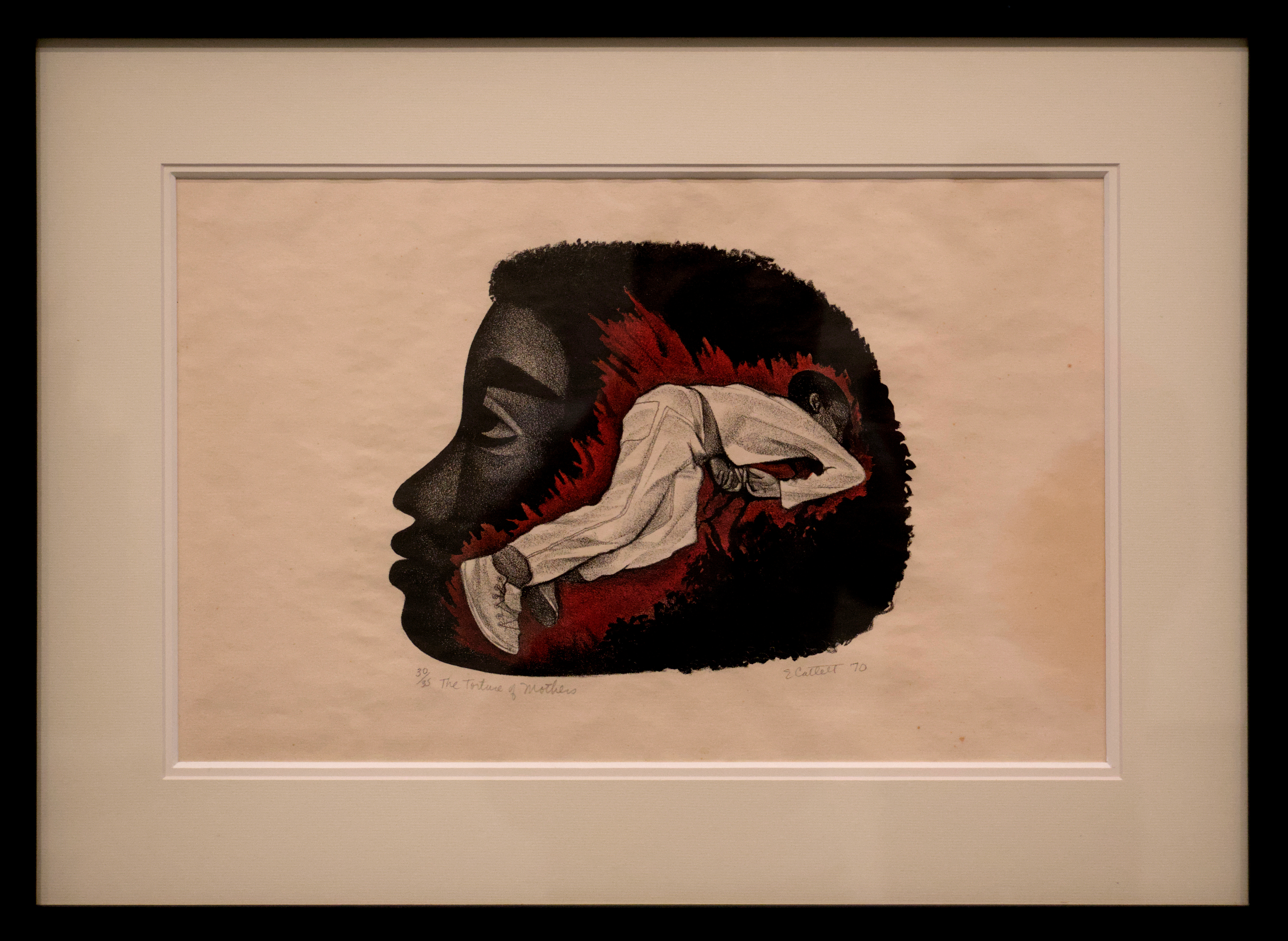
Catlett, Elizabeth_Torture of Mothers
Elizabeth Catlett (American, active in Mexico, 1915–2012), Torture of Mothers, 1970. Hand-colored lithograph, sheet: 38.1 × 56.5 cm (15 × 22 1/4 in.); framed: 48.3 × 66 cm (19 × 26 in.). Collection of Juanita and Melvin Hardy.

“Catlett’s composition visualizes the emotional toll such events have on Black mothers and women of color more broadly,” the gallery label reads—mothers whose minds are continually haunted by the racial violence, sometimes even state-authorized, that threatens the safety of their boys. “While Catlett was tracking police brutality in the US, she was also aware of similar state violence against Mexican youth, including the mass shooting of student protestors in 1968 by police at the Universidad Nacional Autónoma de México where Catlett taught.”

Several of the mothers in Catlett’s art are posed in a protective embrace that seeks to shield their children from harm. The arms of her 1982 Madonna, for example, wrap around a son and a daughter, though her averted eyes look worried:

Catlett, Elizabeth_Madonna
Elizabeth Catlett (American, active in Mexico, 1915–2012), Madonna, 1982. Lithograph, sheet: 76.2 × 56.5 cm (30 × 22 1/4 in.). Stanley Museum of Art, University of Iowa, Iowa City.

In African American families, children are often raised by their grandmothers. Reflecting adaptability and support, such kinship care is memorialized in These Two Generations, which shows in profile a young boy and the primary maternal figure and caregiver in his life: his grandma.

Catlett, Elizabeth_These Two Generations
Elizabeth Catlett (American, active in Mexico, 1915–2012), These Two Generations, 1979, printed 1987. Lithograph, image: 48.3 x 55.7 cm (19 x 21 15/16 in.); sheet: 56.7 x 76.2 cm (22 5/16 x 30 in.); framed: 69.9 x 80 cm (27 1/2 x 31 1/2 in.). Collection of Otis and Harryette Robertson.

Skipping ahead to this millennium, the exhibition includes Danys y Liethis, a portrait of the artist’s niece and great-niece:
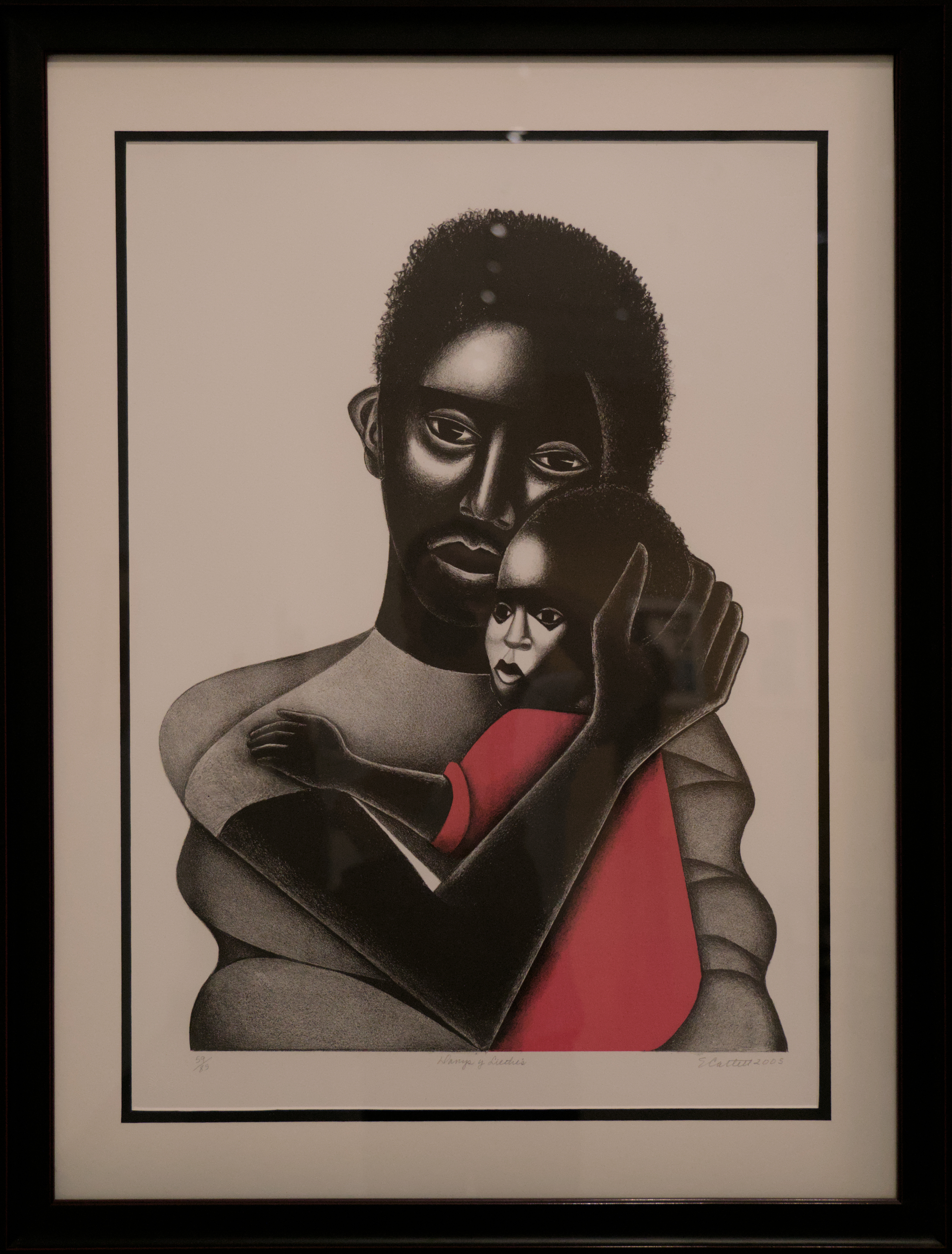
Catlett, Elizabeth_Danys y Liethis
Elizabeth Catlett (American, active in Mexico, 1915–2012), Danys y Liethis, 2005. Offset lithograph, sheet: 71 × 50.8 cm (27 15/16 × 20 in.); framed: 91.4 × 71.1 cm (36 × 28 in.). Collection of Barbara J. Luke.

Lastly, suspended from the ceiling at the exhibition’s entrance/exit, is Catlett’s most unique mother-child sculpture, Floating Family:

Catlett, Elizabeth_Floating Family
Elizabeth Catlett (American, active in Mexico, 1915–2012), Floating Family, 1995. Mexican primavera wood, overall length: 304.8 cm (120 in.). Collection of the Chicago Public Library.

It’s striking! Art historian Elissa Yukiko Weichbrodt writes beautifully about it on her Substack, whose words I’ll close with:

In many of her depictions of motherhood, Catlett unifies the mother and child into a single form, emphasizing their intimacy. But I’ve been thinking about her large-scale sculpture Floating Family, which usually hangs above the circulation desk at the Legler Branch of the Chicago Public Library. Here, mother and daughter are still tethered together, but instead of standing upright they are now perfectly horizontal. Are they maple seed pods, spinning and falling to the earth to plant something new? Or a rotor, lifting upwards, leaving gravity behind? Despite the seeming precarity of the moment, the mother’s face is calm and set, and the daughter looks up at her, trusting.

I imagine that it does something different in the context of a library than as the closing object in a museum retrospective. For me in October, after seeing so many sculptures of mothers cuddling their children close, this work evoked the particular terror and thrill of parenting adolescents. Now, it suggests more than that: the labor and love we give not only our children but our communities and the way that hope can sometimes feel like a free fall.


Elizabeth Catlett: A Black Revolutionary Artist will continue through July 6, 2025, at the National Gallery of Art before traveling to the Art Institute of Chicago for its final leg from August 30, 2025, to January 4, 2026. You can purchase the exhibition catalog here and view some of my other photos on Instagram.

Roundup: Upcoming webinars and conferences

ONLINE LECTURES organized by the Centre for Marian Studies at St Mary’s University in Twickenham:

If you’d like to register for either of these (they’re free), email Catherine O’Brien at info@marianstudies.ac.uk. View additional online lecture offerings at https://www.marianstudies.ac.uk/post/research-seminar-schedule.

>> Annual Candlemas Lecture by Ayla Lepine, February 3, 2025, 7 p.m. GMT (2 p.m. ET): Rev. Dr. Ayla Lepine, who is the associate rector at St James’s Piccadilly in London and an art historian and theologian, “will explore two works of art featured in her forthcoming book, Women, Art, God. In the series entitled The Annunciation (A Study), Julia Margaret Cameron reimagined and reconfigured paintings by Renaissance artists including Perugino and Lippi. In her photography, blurred and hazy aspects of the image are suggestive of the Holy Spirit in this new technology.

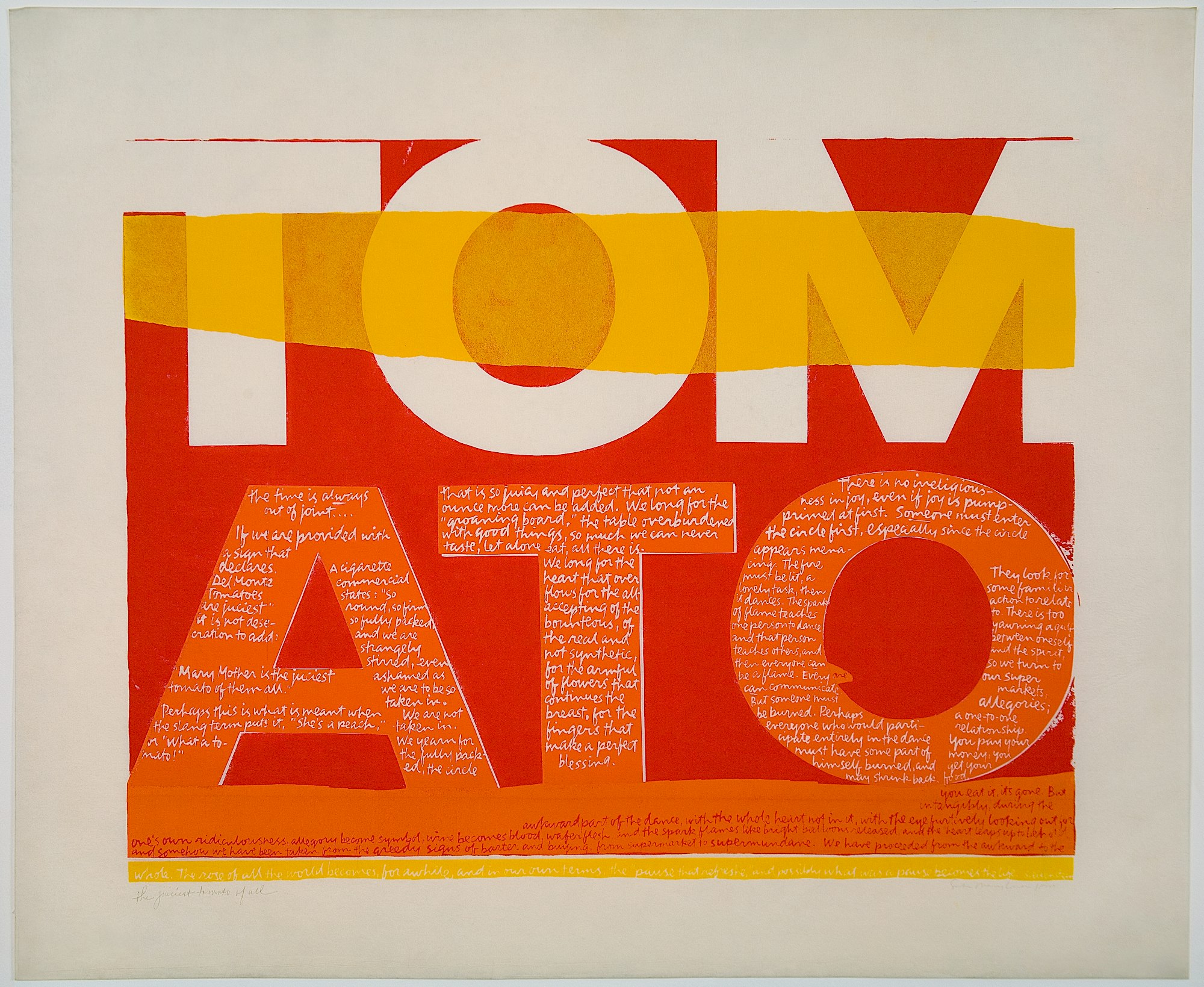
“A century later, the American nun Sister Corita Kent produced a groundbreaking silkscreen print, The Juiciest Tomato of All. This artwork compared the Virgin Mary to a ripe fruit, with a title inspired by Del Monte tinned fruit and vegetable slogans from her local supermarket. By considering these two artworks by women from the nineteenth and twentieth centuries as a pair, new ways of encountering Mary in art history, theology, and prayer can emerge with unexpected resonance for the twenty-first century.”

Cameron, Julia Margaret_Annunciation
Julia Margaret Cameron (British, 1815–1879), After Perugino / The Annunciation, 1865. Albumen print from wet collodion glass negative, 19 1/2 × 15 in. Victoria and Albert Museum, London.

Kent, Corita_the juiciest tomato of all
Corita Kent (American, 1918–1986), the juiciest tomato of all, 1964. Serigraph, 29 3/4 × 36 in. © Estate of Corita Kent / Immaculate Heart Community.

>> “The Annunciation in Theology and Art: Shedding New Light on an Old Doctrine” by Tina Beattie, March 26, 2025, 3 p.m. GMT (10 a.m. ET): No details other than the title have been given about this lecture. But the speaker is a leading Marian theologian and writer whom I’ve been familiar with for some time, and an emerita professor of Catholic studies at the University of Roehampton. Her research is in the areas of gender, sexuality, and reproductive ethics; Catholic social teaching and women’s rights; theology and the visual arts, especially images of Mary; and the relationship between medieval mysticism, sacramental theology, and psychoanalytic theory.

+++

WEBINAR with Drew Jackson, Eugene Peterson Center for Christian Imagination, February 4, 2025, 7 p.m. ET: A conversation on the intersection of poetry, ministry, and Christian imagination. Registration is free. “Drew Jackson is a poet, speaker, and public theologian. He is author of God Speaks Through Wombs: Poems on God’s Unexpected Coming and Touch the Earth: Poems on the Way. . . . Drew received his B.A. in Political Science from the University of Chicago and his M.A. in Theology from Fuller Theological Seminary. He currently works as the Managing Director of Mission Integration for the Center for Action and Contemplation, and lives in Brooklyn, NY, with his wife and daughters.”

Webinar with Drew Jackson

+++

CONFERENCES/SYMPOSIA:

>> Calvin Symposium on Worship, Calvin University, Grand Rapids, Michigan, February 5–7, 2025: “An ecumenical conference dedicated to worship and learning, bringing together people in a variety of roles in worship and leadership from across the country and around the world.”

>> Contemporary Art as/in Pilgrimage, Columbia University, New York, February 11, 2025: Organized by the Association of Scholars of Christianity in the History of Art, this one-day symposium “will explore such questions as: Are galleries, museums, art expos, and art installations the new ‘slow spaces’ for spiritual sustenance and transcendent experiences? How are temples, churches and other ‘religious’ sites transformed by artist installations intended to invoke deep spiritual encounter and healing? And how is the art of contemporary artists working in a diversity of media and practice seen through the lens of pilgrimage?”

The keynote speaker is Kathryn R. Barush, author of Imaging Pilgrimage: Art as Embodied Experience (Bloomsbury, 2021). She will be joined by eleven other presenters. Plus, Elissa Yukiko Weichbrodt, author of Redeeming Vision: A Christian Guide to Looking at and Learning from Art, will lead attendees in the practice of intentional looking at the Cathedral of Saint John the Divine.

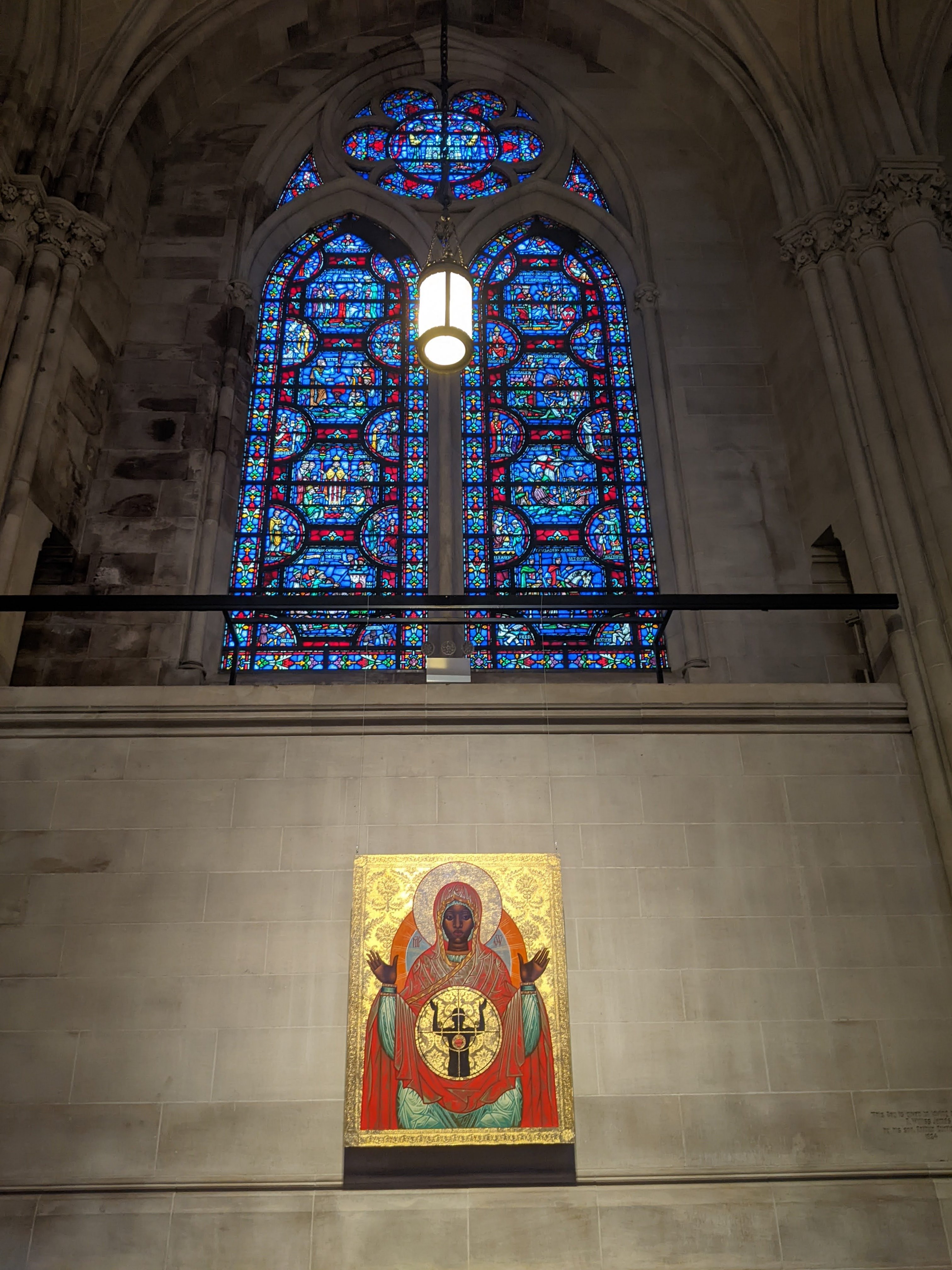
Our Lady of Ferguson
Mark Doox (American, 1958–), Our Lady, Mother of Ferguson and All Those Killed by Gun Violence, 2016. Acrylic and gold leaf on wood, 48 × 36 in. Cathedral of Saint John the Divine, New York. Photo: Victoria Emily Jones, 2022.

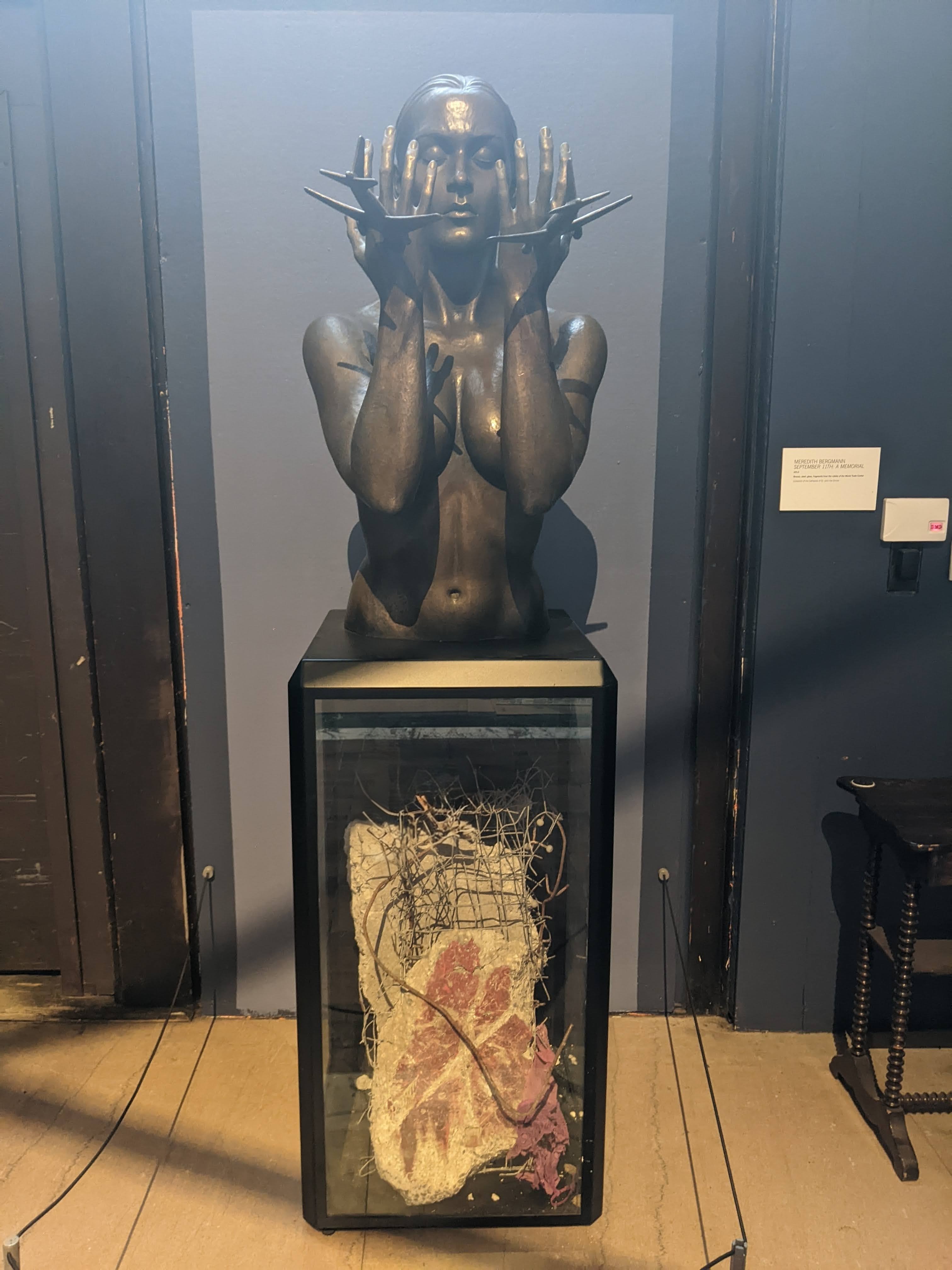
Bergmann, Meredith_September 11th
Meredith Bergmann (American, 1955–), September 11th: A Memorial, 2012. Bronze on pedestal of steel and glass, containing reinforced concrete and brick from the rubble of the World Trade Towers, 78 × 22 × 24 in. Cathedral of Saint John the Divine, New York. Photo: Victoria Emily Jones, 2022.

>> Square Halo Conference, Trust Performing Arts Center, Lancaster, Pennsylvania, March 7–8, 2025: “The Square Halo conferences have offered times not only of fascinating and inspiring ideas in a high caliber of wide and varied presentations, but also of rich, meaningful interactions, dialogue, and (in a deep sense of this word) fellowship. Creativity, collaboration, and community . . . an apt description of what [takes] place” (Matthew Dickerson).

The keynote speaker is Diana Pavlac Glyer, who teaches literature, history, theology, and philosophy in an integrated Great Books curriculum at Azusa Pacific University, and the Saturday-night concert will feature Thomas Austin and Skye Peterson.

>> The Breath and the Clay, Winston-Salem, North Carolina, March 21–23, 2025: “This year we will explore how the light gets in through the fragments of our stories, our lives and our art. We are each built of broken pieces, a mosaic of joys and sorrows, of mundane and miraculous happenings. When we surrender the full spectrum of our human experience, even our pain, doubts and sorrows can heal into art. Through our workshops, keynote talks, immersive gallery and performances, we will explore various facets of the creative life and how everything from inspiration to the everyday, from family to vocation and community coalesce to reveal a hidden wholeness.”

Presenters include Sho Baraka, Vesper Stamper, Justin McRoberts, Cheryl Bridges Johns, Elissa Yukiko Weichbrodt, and more.

>> Illuminate: Art and Faith, Southern Adventist University, Collegedale, Tennessee, March 31–April 1, 2025: “Author and theologian Frederick Buechner famously wrote, ‘Pay attention to the things that bring a tear to your eye or a lump in your throat because they are signs that the holy is drawing near.’ Paintings, poetry, music, and other creative mediums hold strong potential to do just that—to indirectly communicate powerful truths, many of which have eternal consequences. Are we open to what they’re telling us? Will we utilize these tools to share important stories (including The Story) with others? Join us for two rich days of education, inspiration, and community! . . .

“This year’s conference will include a variety of hands-on workshops (flash fiction, drawing, songwriting), as well as sessions exploring fascinating figures, including C. S. Lewis, Madeleine L’Engle, Eugene Peterson, Kurt Vonnegut, Dorothy Sayers, Vincent van Gogh, Norman Rockwell, Ludwig van Beethoven, Duke Ellington, and many more.”

Among the session leaders and performers are art historian Elissa Yukiko Weichbrodt (Redeeming Vision), writer Douglas McKelvey (Every Moment Holy), film and literature scholar Mary McCampbell (Imagining Our Neighbors as Ourselves), pastor Russ Ramsey (Van Gogh Has a Broken Heart; Rembrandt Is in the Wind), illustrator John Hendrix (The Mythmakers; Go and Do Likewise!), and singer-songwriter Andy Gullahorn.

>> Visible and Invisible: Surprising Encounters in Theology and the Arts (DITA 2025), Duke University, Durham, North Carolina, September 4–7, 2025: I’ll be attending this one! Organized by Duke Initiatives in Theology and the Arts. “How can the arts help us open up the very heart of the Christian faith, celebrated at the Council of Nicaea in 325, that Jesus Christ is ‘one in being’ with God? Featuring world-class academics, artists, musicians, and clergy from around the globe and a robust range of programming, DITA2025 is a four-day symposium at Duke University celebrating Nicaea and the myriad surprises the Creed holds in store for artists, academics, clergy, and parishioners today. . . .

“By pairing theologians with poets, clergy with novelists, dancers with liturgists, musicians with scholars, the symposium will generate a series of meetings rarely offered in academic and artistic settings. Including interactive keynotes, plenary presentations, seminar lectures, applied workshops, an evening concert, and more, DITA2025 is a unique opportunity to experience the arts and the academy in action.”

Leah Glenn
Dancer and choreographer Leah Glenn performs an original work, The Youngest of Nine, at DITA 2019.

Speakers include Rowan Williams, Chigozie Obioma, Natalie Carnes, Sandra McCracken, James K.A. Smith, Malcolm Guite, Amy Peeler, and Josh Rodriguez. Early-bird registration ends February 15.

Roundup: Upcoming conferences, “Rupture as Invitation,” and more

UPCOMING CONFERENCES:

>> Calvin Symposium on Worship, February 7–9, 2024, Calvin University, Grand Rapids, MI: I’ve promoted this event in years past—see, e.g., here and here—and am excited to be attending again this year! I’ll be coleading a breakout session with Joel Littlepage and Ashley Williams about our work at the Daily Prayer Project, curating textual, visual, and musical resources from across time and place to encourage a life of prayer that reflects the church’s beautiful diversity. There are plenty of other sessions being offered as well; a few that stand out to me are “Blues: The Art of Lament” with Ruth Naomi Floyd (she’s also leading a Jazz Vespers service), “Music, Architecture, and the Arts: Early Christian Worship Practices” with Vince Bantu [previously], and “The First Nations Version New Testament and Its Impact on Worship” with Terry Wildman. This is in addition to what is probably my favorite part: the multiple worship services, led by liturgists, preachers, and musicians from different denominations and cultural backgrounds. I love my local church community, but I also love worshipping with folks from outside it—a reminder that the church is far broader than what I’m used to on a weekly basis.

>> “Poetry and Theology: 1800–Present,” February 22–24, 2024, Duke University, Durham, NC: Supported in part by Duke Initiatives in Theology and the Arts, next month Duke is hosting a poetry symposium that’s free and open to the public! The speakers are Lisa Russ Spaar, Judith Wolfe, Toby Martinez de las Rivas, Thomas Pfau, Kevin Hart, Anne M. Carpenter, Ian Cooper, Anthony Domestico, Luke Fischer, Dante Micheaux, Łukasz Tischner, and Bernadette Waterman Ward. Papers are on the poetry of Hopkins, Eliot, Rilke, Miłosz, and more.

>> “Return to Narnia: Creativity, Collaboration, and Community” (Square Halo Books), March 8–9, 2024, Lancaster, PA: Organized by book publisher, author, illustrator, printmaker, and gallerist Ned Bustard, this year’s Square Halo conference will feature author Matthew Dickerson as its keynote speaker and Sarah Sparks as its musical guest, along with various breakout session leaders, such as Brian Brown of the Anselm Society and Stephen Roach of the Makers & Mystics podcast. Tickets are $210 if purchased in advance or $220 at the door.

>> The Breath and the Clay, March 22–24, 2024, Awake Church, Winston-Salem, NC: Organized by Stephen Roach and friends, this annual creative arts gathering aims to foster community and connection around the pursuit of truth, beauty, and goodness, providing opportunities for immersive encounters and kindling for the imagination. There will be main-room sessions, workshops, a juried art exhibition (entry deadline: February 16), a poetry slam and songwriters’ round, a panel discussion on reconciling artists and the church, concerts, a dance performance, a short film screening, and more. Musical artists include Victory Boyd, John Mark McMillan, Young Oceans, and Lowland Hum, and among the keynote speakers are Rachel Marie Kang, Mary McCampbell, Junius Johnson, Vesper Stamper, and Justin McRoberts. I appreciate the bringing together of various artistic disciplines and the emphasis on practice. For tickets, there are both virtual ($99) and in-person ($299) options.

+++

NEW SONG: “MLK Blessing” by the Porter’s Gate: Written by Paul Zach and IAMSON (Orlando Palmer) and just released for Martin Luther King Jr. Day, this song is based on a benediction that MLK prayed, a variant of the ancient Jewish benediction known as the Birkat Kohahim or Aaronic blessing (Num. 6:24–26). It’s sung by Liz Vice and Paul Zach.

+++

PAST LECTURE: “Rupture as Invitation: Generosity and Contemporary Art” by Elissa Yukiko Weichbrodt: I’ve mentioned Elissa several times on the blog—I find her work so illuminating—and was grateful to have her in town last fall to deliver a lecture for the Eliot Society. “Contemporary art can often be unexpected or downright unsettling in its form and subject matter. But what if we reframed our discomfort as an invitation to enter rather than an unbridgeable divide? In this lecture from November 11, 2023, Dr. Elissa Yukiko Weichbrodt demonstrates how approaching contemporary art with humility, love, and courage can be a powerful means of growing in love for our neighbors.”

+++

UPCOMING EVENT: “Why Should Christians Care About Abstract Art?” with Elissa Yukiko Weichbrodt and Jonathan Anderson, February 22, 2024, Gordon-Conwell Theological Seminary–Charlotte, NC: Hosted by the Leighton Ford Initiative for Art, Theology, and Gospel Witness, this evening will consist of an opening of the exhibition Alfred Manessier: Composer in Colors (on display through April 30) and dessert reception, lectures by Elissa Yukiko Weichbrodt and Jonathan Anderson, and a Q&A. “For some people of faith, abstract art is difficult to engage because the meaning remains unclear, and the form can appear chaotic or uncompelling. For others, abstract art is an invitation to engage the whole person, contemplate spiritual realities, and encounter God in transformative ways. If abstract art can facilitate the latter, then Christians have a unique opportunity to learn and care about abstract art for theological, practical, missional, and relational reasons. This event is a unique opportunity to experience abstract art, learn about abstract art, and have formative interaction with one another on this topic.” The cost is just $10, and there is an online option.

Manessier, Alfred_Mount Calvary
Alfred Manessier (French, 1911–1993), La montée au Calvaire (Mount Calvary), from the Suite de Pâques (Easter Series), 1978. Chromolithograph on Arches paper, 22 × 29 9/10 in. (56 × 76 cm). Edition of 99.

+++

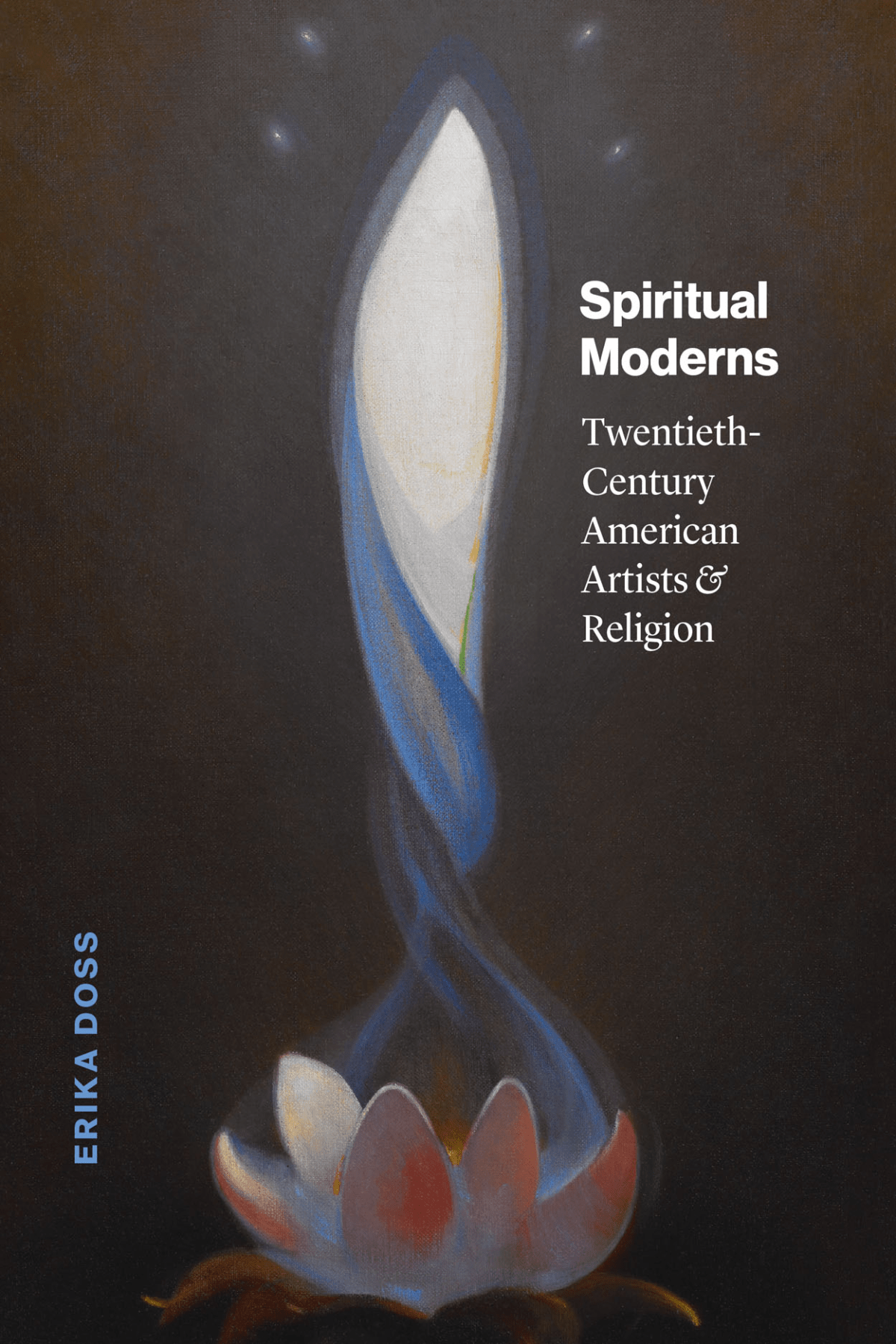
BOOK REVIEW: “Religion’s Understated Influence on Modern Art” by Daniel Larkin, on Spiritual Moderns: Twentieth-Century American Artists and Religion by Erika Doss: Challenging the presumed secularity of modern art, the new book Spiritual Moderns centers on four iconic American artists who were both modern and religious: Andy Warhol, Mark Tobey, Agnes Pelton, and Joseph Cornell.

+ ROUNDTABLE DISCUSSION: Also responding to this publication: the Association of Scholars of Christianity in the History of Art (ASCHA) will be presenting a session at the College Art Association Annual Conference in Chicago on February 16 at 2:30 p.m. that will put four prominent scholars—Stephen S. Bush, Matthew J. Milliner, Robert Weinberg, and Gilbert Vicario—in dialogue with Doss to “explore the assumptions, motivations, and insights of [her] analysis, and consider a more open, inclusive, and diverse reading of American Modernism.”

Roundup: Pregnancy prints, “Hearth” by Janine Antoni, and more

ARTICLES:

>> “Picturing Pregnancy in Early Modern Europe” by Rebecca Whiteley, Public Domain Review: Adapted from the book Birth Figures: Early Modern Prints and the Pregnant Body by Dr. Rebecca Whiteley (University of Chicago Press, 2023), this article explores how the womb and fetuses were depicted in medical book illustrations in Europe during the sixteenth and seventeenth centuries. Pregnancy is such a potent image for Advent, as we await the birth of Jesus—who, fully God and fully human, dwelled for nine months in his mother Mary’s uterus before emerging from her birth canal!

Child in uterus
Woodcut illustration of a baby in the womb from De conceptu et generatione hominis (Zurich, 1554), the first Latin edition of a midwifery handbook by Jacob Rueff

Woodcut illustration of an open uterus from La commare o raccoglitrice . . . (Verona, 1642), a manual about pregnancy and childbirth by Girolamo Mercurio

>> “Rupy C. Tut’s Landscapes of Belonging” by Bridget Quinn, Hyperallergic: Bridget Quinn reviews Rupy C. Tut’s solo exhibition Out of Place that’s running at the Institute of Contemporary Art San Francisco through January 7. I love, love, love her art! It’s inspired by traditional Indian miniature painting and “is an effort to belong, to feel in place,” Tut says. Tut is a first-generation immigrant from India’s Punjab region who settled in California with her Sikh family at age twelve. Her Searching for Ancestors reminds me, visually but not thematically, of Jyoti Sahi’s Incarnation within the Anthill, and her Portrait of a Woman gives me some serious Marian vibes—as it did too the reviewer, who refers to this pregnant woman as “a kind of cross-cultural Madonna, reminiscent of the central mother figure, mandorla, and sun rays of Our Lady of Guadalupe so familiar across California via Mexico.”

Tut, Rupy C._Portrait of a Woman
Rupy C. Tut (Indian American, 1985–), Portrait of a Woman, 2023. Handmade pigments and shell gold on hemp paper, 57 × 37 in.

+++

INSTAGRAM POST: “Birthing // Love” by Elissa Yukiko Weichbrodt: Last Advent, art historian and educator Elissa Yukiko Weichbrodt (@elissabrodt) reflected on Janine Antoni’s Hearth ceramics, part of the artist’s Pelvic Vessels series, and on the biological reality that during the act of childbirth, both the mother’s and baby’s bodies are changed by one another. What might this mean for Advent?

Antoni, Janine_Hearth
Janine Antoni (Bahamian American, 1964–), Hearth, 2014. Set of three pit-fired ceramic vessels, 4 3/4 × 6 1/2 in., 4 3/4 × 7 7/8 in., 5 1/8 × 8 in.

+++

DEVOTIONAL COLUMN: “Jesus’ Bloody Birth” by Lauren F. Winner, Christian Century: “Jesus . . . is bloody in many senses,” writes Rev. Dr. Lauren Winner [previously]. One of those senses is that he came into this world covered in his mother’s blood. Something is lost in the Christmas story when we evade the details of childbirth, Winner says. I was alerted to this short reflection of hers from 2015 by its inclusion in the new book A Radiant Birth: Advent Readings for a Bright Season.

+++

PODCAST EPISODE: “The Incarnation and Health Care as Ministry” with Denise Hess, Hear Me Now Podcast, December 24, 2020: “There is a long tradition of faith-based healthcare. On this Christmas episode—filled with music, poetry, and conversation—we ask: How has the belief that God became human in the flesh inspire care for people and their bodies? Rev. Denise Hess [MDiv, BCC-PCHAC] of the Supportive Care Coalition (now part of the Catholic Health Association) joins host Seán Collins in a reflection on the Christian doctrine of the Incarnation and the ways it has inspired centuries of healthcare. They talk about the example of Jesus-as-healer, the crucial role women have served in promoting healthcare ministries, and the place suffering plays in our understanding of caring for the whole person.”

The conversation is interspersed with poetry readings and performances of carols by a violin-guitar-bass trio. Hess mentions this wonderfully shocking sentence from Chris Abani’s poem “The New Religion”: “what was Christ if not God’s desire / to smell his own armpit?” She also shares Brian Wren’s beautiful hymn text “Good Is the Flesh.” The podcast is a production of the Providence Institute for Human Caring.

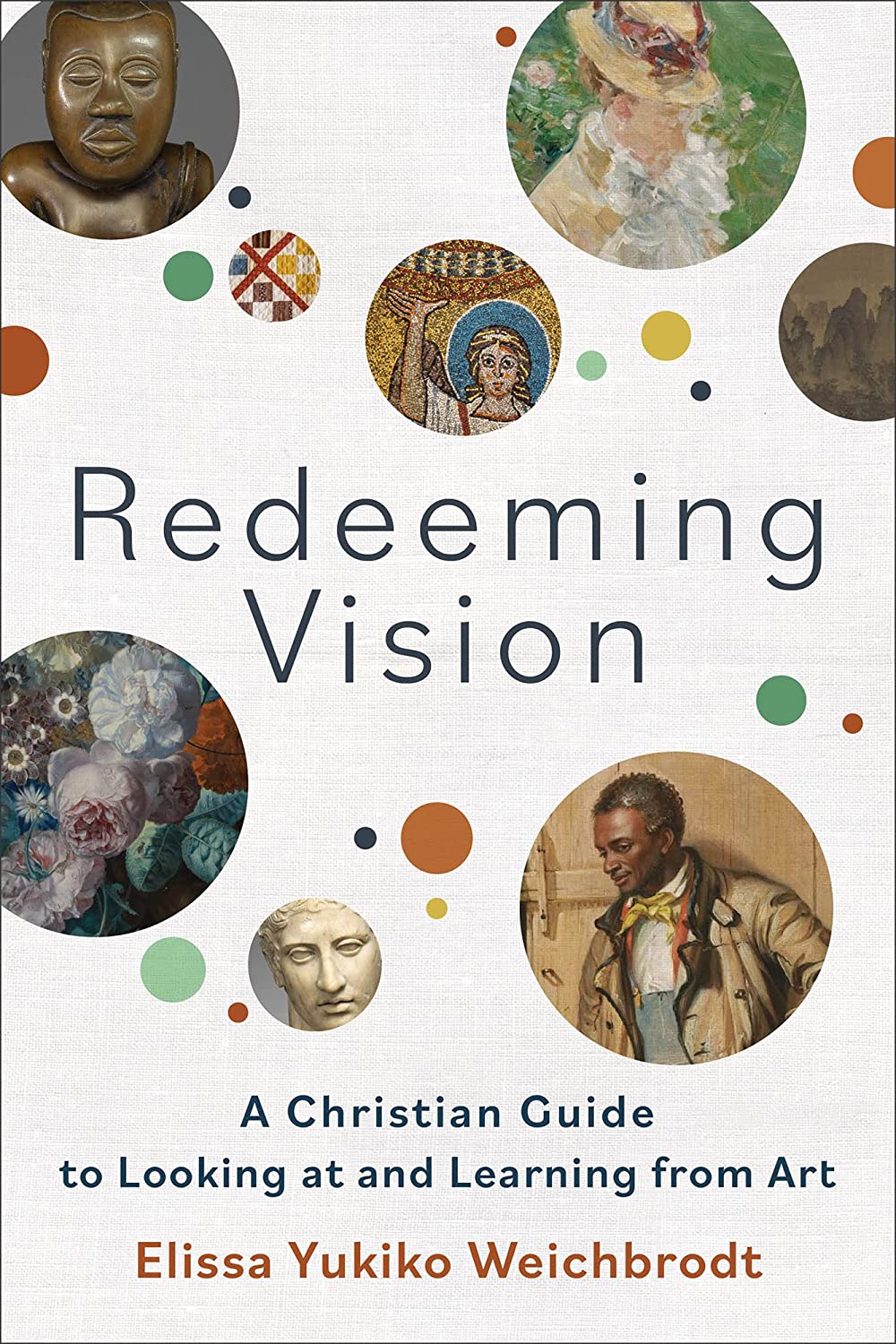
Book Review: Redeeming Vision: A Christian Guide to Looking at and Learning from Art by Elissa Yukiko Weichbrodt

Let’s say you’re visiting London. You buy a ticket to the Tate Modern, because hey, the tourist guides call it a must-see. You enter the enormous Turbine Hall and witness, across the five-hundred-foot downward concrete ramp that is the floor, a giant crack. No, it’s not a foundation problem. It’s a contemporary art installation by Doris Salcedo.* What in the world does this artwork have to offer? How do you engage meaningfully with it?

Dr. Elissa Yukiko Weichbrodt’s book Redeeming Vision: A Christian Guide to Looking at and Learning from Art (Baker Academic, 2023) equips Christians to look closely and well—with a posture of humility and generosity—at works from across the spectrum of art history, including ones like Salcedo’s Shibboleth that may initially evoke only puzzlement or an eye roll, and others that may at first glance seem run-of-the-mill and uninteresting (a marble head, a vase of flowers, an old family photograph). When we close ourselves off to art that doesn’t immediately touch us, we reject potential opportunities for transformation, transformation of how we see and how we love. Regardless of the personal faith commitments of its makers, Weichbrodt says, art can grow our love for both God and neighbor.

In order to love, we must first look. Weichbrodt gives examples of God’s looking in scripture to establish a “model of redemptive looking,” which “is utterly different from the objectifying gaze that is so common in our contemporary culture. Too often we look to consume, to surveil, to control, and to condemn. But as the beloved of God, we are called to mimic his gaze” (19). What if instead of letting personal judgments, stylistic, moral, or otherwise, dominate our approach to art, we were to adopt a primary posture of love?

When it comes to viewing art and visual culture, our faith doesn’t offer us a fence. It provides a path.

Elissa Yukiko Weichbrodt, Redeeming Vision, p. 10

Weichbrodt wants to move us beyond a facile thumbs-up or thumbs-down approach to looking at art, encouraging us to press in to unfamiliar (and too-familiar!) or even off-putting works with curiosity and openness, asking questions of them and allowing them to interrogate us as well. What stories, and whose stories, do the images tell and not tell?

She introduces the notion of “the archive,” the mental collection of images we have seen, which we subconsciously file into categories and access to help us interpret new images. Some examples of categories are “Mother,” “Poor,” “Black,” “Beautiful,” “Villain.” The problem is, our archives are inherently limited. For example,

Why do we have so many mental images of mothers in Africa living in poverty and so few mental images of successful, smiling African women who are business owners and community leaders? Why do we have so many images in our archive of good white mothers and so few of loving, strong, generous Latina mothers? A richly textured, robust, and varied archive is necessary if we are going to learn to see others—of all races, ethnicities, genders, and social classes—as God sees them. (62)

Expand your archive, Weichbrodt urges.

She demonstrates how archives work through a brilliant engagement with Dorothea Lange’s Migrant Mother (1936), an iconic photograph that I remember studying in a high school American history class but which Weichbrodt really opened up for me.

Weichbrodt is an associate professor of art and art history at Covenant College in Lookout Mountain, Georgia. Besides an intro-level Western art survey course, she also teaches courses such as “Race in American Art and Visual Culture,” “Women, Art, and Culture,” “Art and the Church,” “Grace in American Art,” “History and Theory of Photography,” “Global Modernisms,” and “Contemporary Art and Theory.” The facility with which she’s able to guide nonspecialists deeper into her subject is amply evidenced in this book, which is low-shelf academic, geared toward educated readers who may or may not have an art background.

Blue Room (Suzanne Valadon)
In chapter 9 of Redeeming Vision, on the mundane, Weichbrodt discusses how Suzanne Valadon’s Blue Room (1923) complicates a familiar art historical trope.

The most illuminating analyses in Redeeming Vision have to do with race, gender, and/or class; those are the topics where Weichbrodt’s primary research interests lie, and it’s where she really shines. She complexifies images that we might be inclined to take at face value, not think much about.

A highlight of the book is how Weichbrodt joins together fine art and contemporary visual culture more broadly, drawing Instagram selfies, memes, advertisements, news photos, propaganda posters, and such into conversation with paintings, sculptures, and other artworks that you’re likely to find in a museum. The tools she provides for performing visual analysis—chapter 1 unpacks that toolbox, giving us language (and a handy chart!) for describing an image’s visual qualities—can be applied just as well to a friend’s iPhone photo as to a multimillion-dollar oil painting that’s been the subject of multiple monographs.  

As would any art historian, Weichbrodt emphasizes the importance of understanding artworks within their historical contexts; “even if we can’t find all the answers, we should remember to ask questions about the image or object’s original audience and purpose” (62). But where she differs from some academics in the field is that she also acknowledges that our backgrounds—who we are, what we aspire to be, what experiences we carry with us, our cultural conditioning—are not irrelevant to the process of looking at art. She invites us to take stock of associations that come up for us in response to certain images, not to make them an authoritative lens but to prompt queries that bring us closer to truth. We need to recognize the limitations of how we see, but we need not get ourselves entirely out of the way when it comes to art, as if pure objectivity were even possible.

In Weichbrodt’s discussion of specific artworks, I appreciate the balance of attention between the work’s formal qualities, content, historical situatedness, and meaning. She also reminds us to consider a work’s physical context. In chapter 3, for example, she uses Caravaggio’s Deposition to discuss the differences between experiencing an artwork in situ (that is, in the place for which it was created; in this case, a chapel), in a museum, and online—and what questions to ask in each situation.

Caravaggio chapter opener

Chapters 4–10 each conclude with a “For Further Looking” page that lists artworks related to the theme of the chapter and offers guided questions. For example, in chapter 9, “Allowing for Complexity: Art of the Everyday,” the “For Further Looking” section includes the headings “Nineteenth-Century American Genre Painting” (How do these works reinforce certain gender roles or racial hierarchies?), “Genre Works by Black American Artists” (How do these works celebrate the normalcy of Black life and achievement?), and “The History of the Female Nude in Western Art” (How have artists borrowed, developed, and critiqued this trope?). I found these end-of-chapter sidebars to be incredibly helpful, quenching my desire for wider exploration and deeper reflection.

Some of the topics Weichbrodt covers in the book include:

God’s Transcendence. In chapter 5 she contrasts a medieval church mosaic, with its golden resplendence, placed above the head to an abstract expressionist painting by Kandinsky, an explosion of color and movement and indefinable forms—two very different ways, and over a millennium apart, to convey the same idea.

Portraiture. In chapter 7 she addresses the possibilities and pitfalls of the portrait genre. From a Spanish count-duke to a Kuba nyim (king) from Central Africa to the anguished Vincent van Gogh to a mourning Missouri father with his two daughters and nurse, Weichbrodt discusses the physical self, the symbolic self, the public self, the private self, and the relational self. She also comments on how the portraits we see of others on social media shape our self-perception and self-representation.

Landscape. In chapter 8 she considers humanity’s relationship to nature by looking at two mountain views: a Chinese ink on silk from the Northern Song Dynasty, influenced by the principles of Confucianism, and a painting of the American West made during the era of westward expansion.

Weichbrodt encourages us to think critically about the stories we tell through images. Take, for example, this before-and-after photograph of Hastiin To’Haali, a resident of the federally funded Carlisle Indian Industrial School (1879–1918) in Carlisle, Pennsylvania, which gutted me:

Choate, John_Tom Torlino
John Choate, “Tom Torlino—Navajo. As he entered the school in 1882. As he appeared three years later,” in Souvenir of the Carlisle Indian School (Carlisle, PA: J. N. Choate, 1902)

Founder Richard Henry Pratt hired the commercial photographer John Choate to document the residential school’s so-called success in “kill[ing] the Indian, . . . sav[ing] the man,” as Pratt put it, and these are two of the hundreds of photos he took of the students. What do we do when images lie?

One of my favorite chapters in the book is chapter 10, “Learning to Lament: The Art of History.” Here Weichbrodt discusses an ancient Assyrian stone relief carving of a soldier conducting captives across a river, a widely distributed revolutionary-era engraving of the Boston Massacre by Paul Revere, and From Here I Saw What Happened and I Cried by Carrie Mae Weems (1995).

“History is not simply a documentation of the past,” Weichbrodt writes. “It is the story we tell about past events. What do we include? What gets left out? Who has our empathy? Who can be vilified?” (215). She continues:

What stories do we weave about who we are and who we are not? Does our telling of history—and the images we use to support it—ignore brokenness in favor of self-congratulation? What are the images and objects that direct us to lament? We lament not to wallow in despair or guilt or recriminations but because we have the freedom to weep as children of God. Ours can be a productive grief. (232–33)

Hospitable, expansive, and full of insight, Redeeming Vision helps Christians identify the ways in which images form us and teaches us how to skillfully analyze them. Art viewing, Weichbrodt writes, is not necessarily a passive activity; it requires something of us and can be generative. “Our gaze,” she says, “can open up something new” (11), leading to doxology, confession, empathy, understanding, lament, shared delight, or love.

Visit the book’s website at https://www.redeemingvision.com/. You can order a copy from Amazon or Baker Publishing Group, and sign up to participate in the guided chapter-by-chapter reading community that Weichbrodt is leading from August 28 to November 17, 2023. Follow her on Instagram @elissabrodt.

* This artwork is no longer on display; the crack was filled in in 2008.


Note: On November 11, 2023, the Eliot Society in Annapolis, Maryland, is hosting a lecture by Elissa Yukiko Weichbrodt titled “Rupture as Invitation: Generosity and Contemporary Art,” and I’ll be moderating the Q&A. I hope you can come out! Register here. (Update: Listen to the talk.)

Elissa Yukiko Weichbrodt

Roundup: “The Loving Look,” Keiskamma retrospective, and more

ONLINE EVENT: “Theodicy of Beauty” by Sarah Clarkson, March 6, 2:30 p.m. ET: “The question of suffering is one of the central, aching questions of faith. Too often, we meet suffering with an argument for God’s goodness, rather than an invitation to find and discover his goodness anew. Join me for an exploration of what it means to encounter and trust the beauty of God in our times of darkness, suffering, and pain. Drawing on my own story of mental illness and depression, I’ll explore what it means to engage with God’s goodness in a radically healing way, one that restores our capacity to imagine, hope, and create. We’ll use literature, art, and poetry to discern the ways that God arrives in our darkness to heal us, and also to restore us as agents of his loveliness in the midst of a broken world.”

This Crowdcast talk by Sarah Clarkson is based on her book This Beautiful Truth: How God’s Goodness Breaks into Our Darkness. Registration is $7 and includes a complimentary downloadable copy of “Encountering Beauty,” an arts-based reader’s guide to Clarkson’s book. I have appreciated her From the Vicarage: Books, Beauty, Theology newsletter and her wise, gentle reflections on spirituality, literature, and motherhood on Instagram @sarahwanders, so I’m looking forward to hearing from her on this topic!

+++

LECTURES (available on podcast platforms):

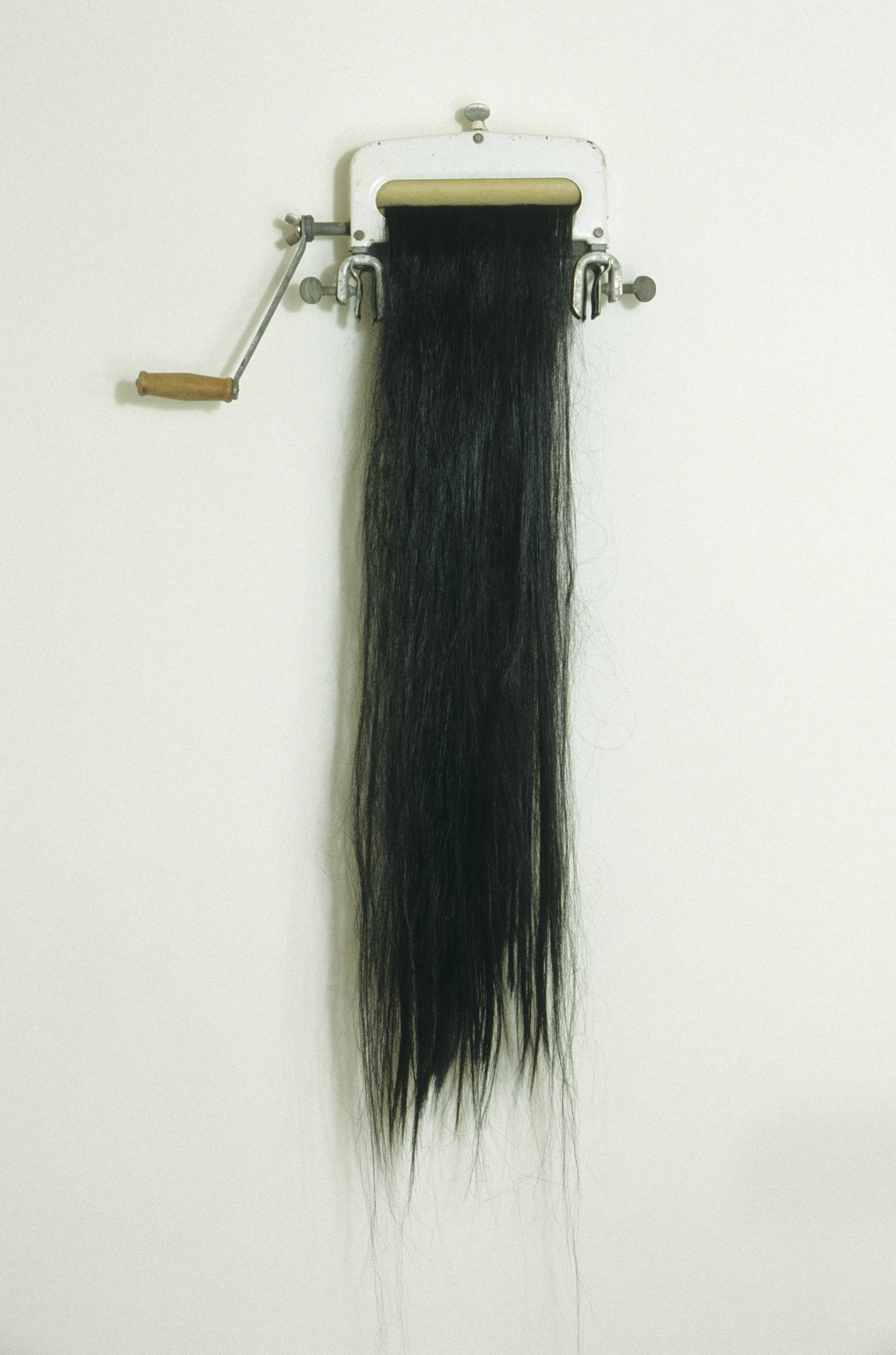
>> “The Loving Look” by Dr. Elissa Yukiko Weichbrodt: In this keynote address for the 2018 Beautiful Orthodoxy conference, art historian Elissa Yukiko Weichbrodt [previously], author of Redeeming Vision: A Christian Guide to Looking at and Learning from Art, discusses how contemporary art—which can sometimes be confounding or otherwise challenging—can drive us to confession, empathy, and love. Sharing her encounters with three contemporary artworks, she talks about art as a place where we can experience sanctification and common grace; how the Incarnation further vested our material world with significance; art as an invitation to embodied knowledge; art as part of how we order and understand our physical world; artworks as mirrors and shapers of culture; and how viewers, not just artists, are called to faithfulness.

Yamamoto, Lynne_Wrung
Lynne Yamamoto (American, 1961–), Wrung, 1992. Wringer, synthetic hair, nails, string, 42 × 13 × 5 in.

She cites Esther Lightcap Meek’s Loving to Know: Covenant Epistemology, in which Meek says that all acts of coming to know are integrative; they become part of us. Knowledge is an act of covenantal care, Meek says. We don’t know in order to love; we love in order to know. Weichbrodt says, “For me, contemporary art—particularly art made by artists grappling with histories and experiences that have remained largely unseen, unknown, and unloved by the dominant culture—has served as a catalyst for faithful knowing.”

Besides Wrung, the two other works she spotlights are Outline by Lorna Simpson and From Here I Saw What Happened and I Cried by Carrie Mae Weems.

>> “The Arts as a Means to Love” by Dr. Mary McCampbell: In this lecture given for English L’Abri, Mary McCampbell [previously], an associate professor of humanities at Lee University, discusses some of the ideas from her book Imagining Our Neighbors as Ourselves: How Art Shapes Empathy. I appreciate how her writing and teaching embraces the arts of film and television alongside literature, such that not only are works like The Power and the Glory by Graham Greene, “A Good Man Is Hard to Find” by Flannery O’Connor, and Beloved by Toni Morrison explored, but so are, for example, the comedy-drama Lars and the Real Girl and the drama series Better Call Saul. Discrediting the recent odd assertion from a prominent evangelical corner that empathy is a sin, McCampbell affirms that empathy is, on the contrary, an essential Christian virtue, and one that the narrative arts are adept at forming in us, exposing us to people and stories outside our realms of experience and helping us recognize the image of God in unlikely places.

+++

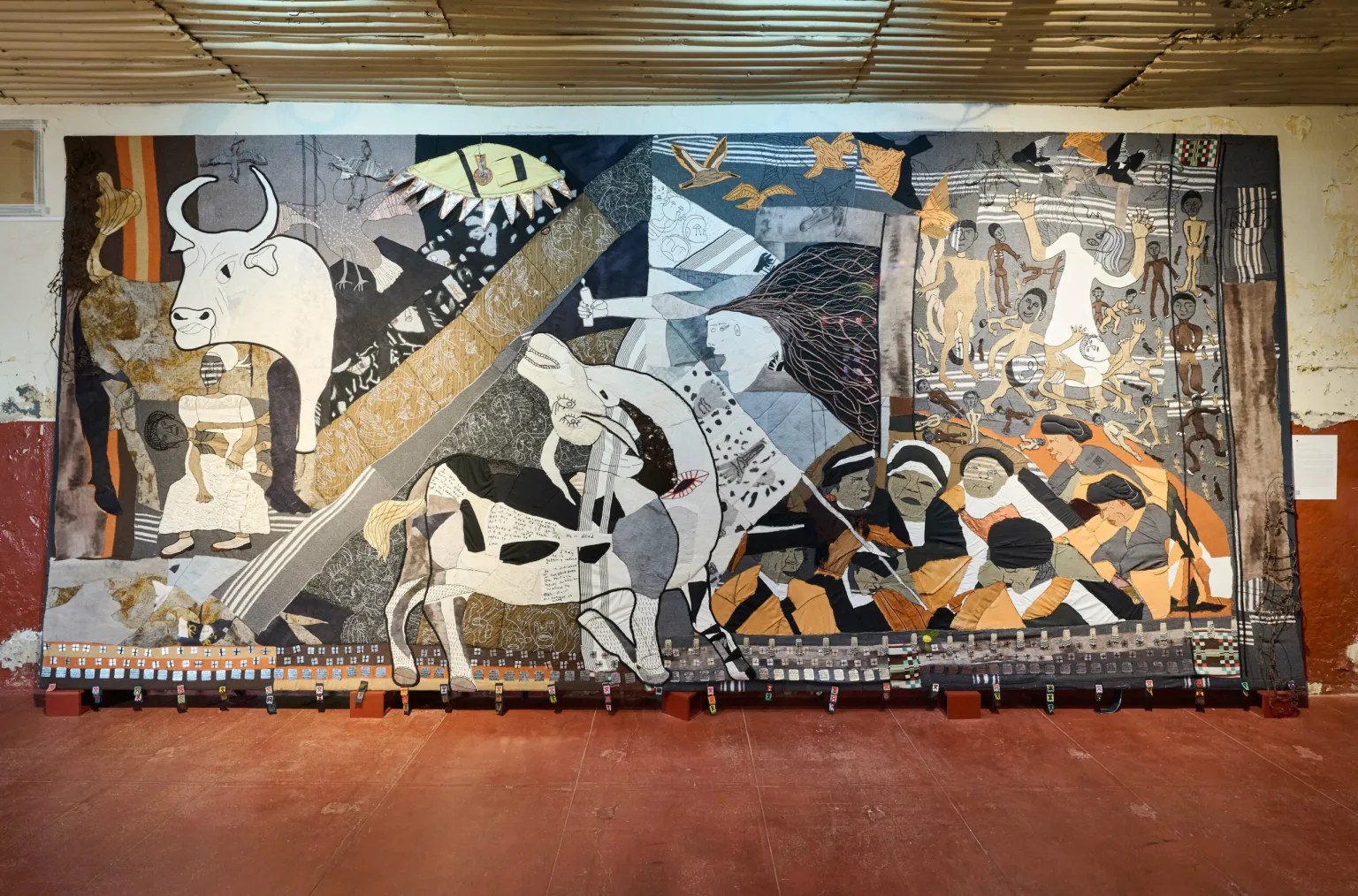
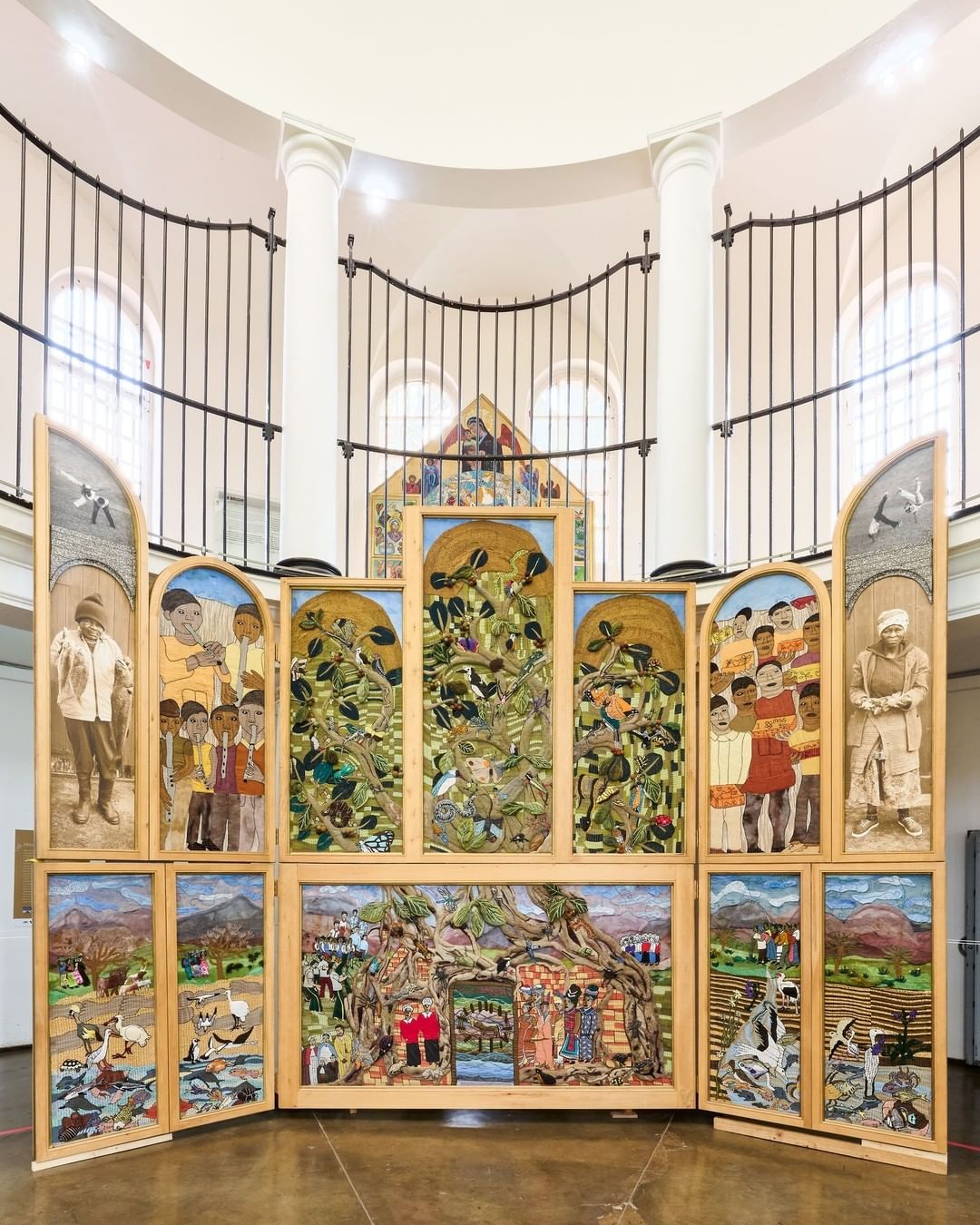
EXHIBITION REVIEW: “Mourning and Perseverance Stitched into South African Tapestries” by Alexandra M. Thomas: Through March 24 at Constitution Hill in Johannesburg, you can see Umaf’evuka, nje ngenyanga, dying and rising, as the moon does, a major retrospective of the work of the Keiskamma Art Project. Founded in 2000, the project archives the collective memory and oral histories of the rural Eastern Cape of South Africa through textile artworks, mainly by Xhosa women. Monumental and small-scale works tell stories of trauma, grief, hope, faith, resilience, and celebration. One of my favorite art research projects has been the one I did on the Isenheim-inspired Keiskamma Altarpiece in 2015, which resulted in the article “Sewing seeds of hope in South Africa”; this altarpiece is one of the many works on display. Let me call out just two others. The photos are from the current exhibition.

Keiskamma Guernica
Keiskamma Guernica, 2010. Mixed media, including appliqué, felt, embroidery, rusted wire, metal tags, beaded AIDS ribbons, used blankets, and old clothes, 3.5 × 7.8 m. Collection of Javett Art Centre at the University of Pretoria, Tshwane, South Africa. Photo: Anthea Pokroy / Keiskamma Trust.

Creation Altarpiece (Keiskamma)
Creation Altarpiece, 2007. Mixed media, including felt, embroidery, photographs, beadwork, wirework, and appliqué, 3.8 × 5.2 m (open). Collection of Unisa Art Gallery, Tshwane, South Africa.

Keiskamma Guernica, after Picasso’s famous antiwar painting, laments the limited access to HIV treatment in rural South Africa in the 2000s and the negligence of government hospitals, which resulted in many HIV/AIDS deaths. The piece repurposes the blankets and clothes of the deceased and serves as an expression of outrage as well as a form of commemoration. Creation Altarpiece, modeled loosely after the Ghent Altarpiece, exults in the region’s abundant wildlife and natural resources and in life-giving initiatives like Hamburg’s music education program, its capoeira group (a dance-like martial art), and the memory boxes made by orphaned children to remember their parents. The three top central panels depict a fig tree eating up an old hotel built by colonialists (a real-life scene observed in the nearby village of Bell!), and the bottom three show villagers of all kinds gathering around Christ, represented as a bull (whereas lambs were commonly sacrificed in ancient Israelite religion, traditional Xhosa religion calls for bull sacrifices).

View the beautiful exhibition catalog here.

+++

SONG: “Kyrie” by Ngwa Roland: Ngwa Roland is a composer and the director of De Angelis Capella [previously], a Catholic choir from Yaoundé, Cameroon. Here is his choral setting of the Kyrie eleison (Greek for “Lord, have mercy”), an important Christian prayer used in liturgies around the world.

+++

ARTICLES:

>> “To One Kneeling Down No Word Came” by Jonathan Chan, Yale Logos: Jonathan Chan is a Singapore-based poet and essayist who graduated with a master’s degree in East Asian Studies from Yale in 2022. In this personal essay he reflects on the poetry of R. S. Thomas, a twentieth-century Anglican priest from Wales, particularly as it relates to the toil of prayer—prayer as a discipline requiring persistence and solitude. Thomas’s poems often express a sense of alienation from God, which is not what we might expect from a pastor, but, as Chan remarks, “God’s absence cultivates a desire for God’s presence.”

>> “Stabat Mater: How a 13th Century Lament Resonates Today” by Josh Rodriguez, Forefront: Back in July 2020, composer Josh Rodriguez [previously here and here] published this article on four modern settings of one of the most celebrated Latin hymns of all time, the twenty-stanza Stabat Mater Dolorosa (lit. “The sorrowful mother was standing”), about Mary mourning the death of her son Jesus. Written in the Middle Ages, it continues to inspire composers today, and it remains “a powerful vehicle for ‘grieving with those who grieve,’” Rodriguez writes. He spotlights the settings by James Macmillan, Julia Perry, Hawar Tawfiq, and Paul Mealor, analyzing some of the musical elements of each and quoting the composers in regards to the piece’s meaning to them.

Upcoming conferences

I’ll be attending the first two, intermittently working the Daily Prayer Project table at Calvin. If you’re there, be sure to say hello!

Calvin Symposium on Worship
Date: February 8–10, 2023
Location: Calvin University, Grand Rapids, Michigan
Cost: $180 (or $25 for students and faculty of any school)
Organizers: Calvin Institute of Christian Worship and the Center for Excellence in Preaching
Presenters: James Abbington, Latifah Alattas, Jeremy Begbie, Carlos Colón, Justin Giboney, Wendell Kimbrough, Te-Li Lau, Karin Maag, Debra Rienstra, W. David O. Taylor, and many more
Description: “The Calvin Symposium on Worship is an annual conference (since 1988) that brings together people from many different denominations and traditions, from a variety of roles in worship and leadership, including pastors, worship planners and leaders, musicians, scholars, students, worship bands and teams, organists, visual artists, preachers, chaplains, missionaries, liturgists, council and session leaders, and more; and encourages leaders in churches and worshiping communities of all sizes and settings.” This year’s theme is Paul’s letter to the Colossians.

Ordinary Saints Conference

Ordinary Saints—Creativity, Community, and Collaboration
Date: February 17–18, 2023
Location: The Trust Performing Arts Center, Lancaster, Pennsylvania
Cost: $210
Organizer: Square Halo Books
Presenters: Malcolm Guite and Elissa Yukiko Weichbrodt (keynotes)
Description: Celebrating Square Halo’s twenty-fifth year publishing “extraordinary books for ordinary saints,” as its tagline reads. Coincides with the release of Ordinary Saints: Living Everyday Life to the Glory of God, an anthology of essays by forty-plus writers on such topics as knitting, home repair, juggling, traffic, pipes, chronic pain, pretzels, and naps. Art historian Elissa Yukiko Weichbrodt, author of the forthcoming Redeeming Vision: A Christian Guide to Looking at and Learning from Art, will be speaking on “Corporeality and Modern Art in Dialogue” and will participate in a panel discussion with Ed Knippers and Ned Bustard, and poet Malcolm Guite will be giving several talks. There will also be breakout sessions led by a range of guests, a pop-up printmaking studio, songwriting roundtables, a performance by Reverie Actor’s Company, and a concert by The Arcadian Wild.

Society for Christian Scholarship in Music (SCSM) Annual Meeting
Date: March 2–4, 2023
Location: Duke Divinity School, Durham, North Carolina
Cost: $100–$150
Organizer: Society for Christian Scholarship in Music
Presenters: Luke Powery (keynote) and others
Description: The Rev. Dr. Luke A. Powery, dean of Duke Chapel and associate professor of homiletics at Duke Divinity School whose publications include devotionals based on the African American spirituals, will offer the keynote address. The conference will also include twenty-three research paper presentations, panel sessions, a lecture recital, a choral concert, and more. Full details will be published soon on the SCSM website.

Art, the Sacred, and the Common Good: Renewing Culture through Beauty, Education, and Worship
Date: April 21–22, 2023
Location: Princeton Theological Seminary, Princeton, New Jersey
Cost: Free
Organizer: Scala Foundation
Presenters: Aidan Hart, Jonathan Pageau, Anna Bond, Peter Carter, David Clayton, Margarita Mooney Clayton, Paul Coyer, Robert Jackson, and RJ Snell
Description: “The modern myth that beauty emerges from the subconscious of a self-seeking creative genius goes against the traditional understanding that beauty emerges from a living tradition under the inspiration of God. For example, C.S. Lewis and J.R.R. Tolkien met regularly in Oxford’s pubs to discuss their writing and their faith. In the early 20th century, Russian exiles in Paris formed a community focused on the re-establishment of the great tradition of iconography so central to Christian worship. Composers like Handel and Mozart created beautiful music accessible to all people that directed listeners to the transcendent.
        Conversations and community among creators and thinkers have always been essential to shaping culture. These eminently human moments—and the friendships they inspire—must be cultivated if we are to illuminate America’s darkening culture and society.
        “American culture is in rapid collapse in large part because of an abandonment of beauty in education and worship. The Scala Foundation’s 2023 conference on art, the sacred, and the common good grows out of its deep work around Princeton to bring together artists, students, teachers, and scholars. In a world increasingly hostile to the idea that beauty is anything more than self-aggrandizement or yet one more tool of oppression, this event offers the warmth of community to anyone who is passionate to restore the connections between beauty and truth and between reason and creativity.”

Hutchmoot UK (*open to UK residents only)
Date: May 18–21, 2023
Location: Hayes Conference Center, Swanwick, Derbyshire
Cost: £365 (all-inclusive)
Organizer: The Rabbit Room
Description: A weekend of live music, delicious food, conversation, and a series of discussions centered on art, faith, and the telling of great stories across a range of mediums.

Roundup: Global Christian music; Christologies from the margins; race, gender, and photography

Today’s roundup brings together a theologian (Anderson Jeremiah), an art historian (Elissa Yukiko Weichbrodt), and a musician (Eric Lige and friends) who I think complement one another really well!

SONGS:

Eric Lige [previously] is “a music-maker who promotes Jesus, Justice, Faith, and Community.” He is the worship director at Ethnos Community Church in San Diego and the co-executive producer of The Ethnos Project, which creates a platform for new and emerging global voices in musical worship to be heard worldwide. Especially since COVID hit in 2019, he has been assembling multinational teams of musicians to produce YouTube videos, many of which are livestreamed as part of Ethnos worship services. Here are three examples (view more on Lige’s YouTube channel):

>> “Ξεδιψασμένος (No Longer Thirsty)” by Kostas Nikolaou: A contemporary Christian worship song in Greek, about how Christ, the living water, quenches our thirst for love and purpose. The lead vocalist is Nefeli Papanagi—and wow, do I love her voice!

>> “Ua Mau (Hosanna)” by Moses W. Kaaneikawahaale Keale (aka Keale Ta Kaula): Reyn and Joy Nishii perform this nineteenth-century Hawaiian hymn by Keale “the Prophet,” who converted to Christianity after calling on God during a hunting accident and finding rescue. The first verse translates to “Perpetual is the righteousness / That comes from the Father above / Let us gather together / In his goodness and grace.”

>> “Love’s in Need of Love Today” by Stevie Wonder: Edward Chen and friends—from Canada, the United States, Armenia, Venezuela, and Mexico—perform the opening track from Stevie Wonder’s Grammy-winning album Songs in the Key of Life. “God gave me this gift, and this particular song was a message I was supposed to deliver,” Wonder has said. “The concept I had in mind was that for love to be effective, it has to be fed.” See the full list of credits in the description on the video page. Eric Lige is the one in the maroon shirt.

+++

LECTURES:

>> “Many Faces of Jesus: Christologies from the Margins” by the Revd. Canon Dr. Anderson H. M. Jeremiah, October 12, 2021: Anderson Jeremiah is a senior lecturer in the politics, philosophy, and religion department at Lancaster University in the UK, whose areas of expertise include Christian theology in Asia, postcolonial approaches to theology, Dalit studies, liberation theology, modern missionary movements, and inculturation and faith. Ordained in the Church of South India (part of the Anglican Communion), he was installed as Canon Theologian of Blackburn Cathedral in September 2021, making him the first Dalit to be appointed to that role in any English cathedral.

In this half-hour online talk given last fall for the Diocese of Manchester, Jeremiah discusses the Incarnation as a continuous event—Christ being born into human cultures—as expressed through a selection of visual artworks from Ghana, Bolivia, China, Japan, and India. These images subvert the predominant Western image of Christ and sometimes provide critique. New to me was the black marble crucifix from the Anglican chapel inside Cape Coast Castle, a former trading post (now a museum) where enslaved Africans were held before being loaded onto ships and sold in the Americas. I’m not sure who commissioned the sculpture or when it was placed at this site, but it definitely looks modern.

The Q&A that followed on the original Zoom event is not included in the video, but here’s one of Jeremiah’s comments from it that I transcribed: “Jesus is not foreign to my own experience; this Jesus is part and parcel of my own existential reality. It [the image] enables people who are seeking peace and emancipation; [they are] emboldened in that process of seeing themselves reflected in the image of Jesus. The normative image the church has been holding on to has not created that space.” When one attendee asked if images of white Jesus are always “wrong” or to be discouraged, Jeremiah replied that there’s nothing wrong with such an image in itself, but the problem is when it is imposed on the entire world as the only way of looking at Jesus. “When we hold up one image as normative, we lose the diverse ways God intends to manifest himself in diverse contexts,” he said. (I couldn’t agree more!)

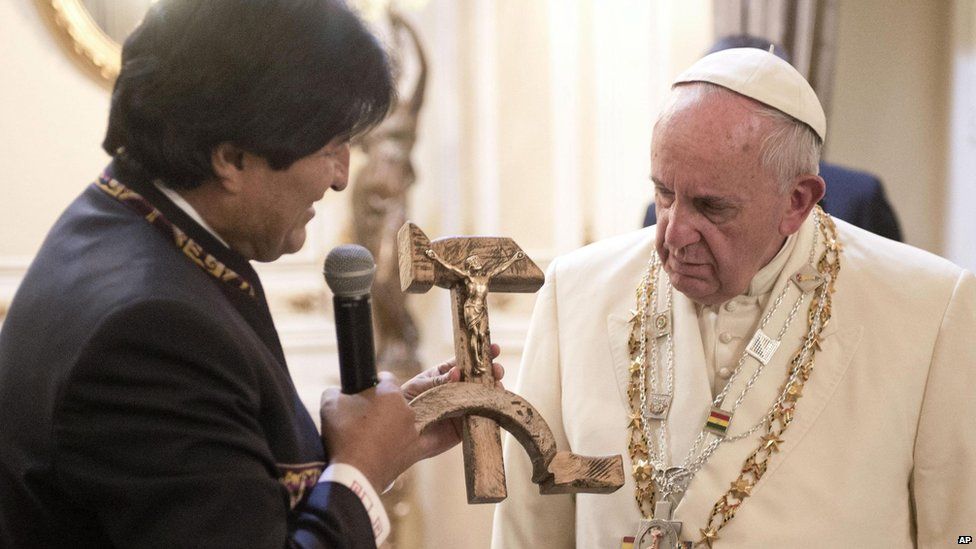
Bolivian crucifix
In July 2015 Bolivian president Evo Morales (who is Aymara) presented to Pope Francis a crucifix sculpted in the shape of a hammer and sickle. The crucifix is based on a design by Luís Espinal (1932–1980), a Jesuit priest assassinated in 1980 by right-wing militia. Bolivia’s communications minister, Marianela Paco, told Bolivian radio that “the sickle evokes the peasant, the hammer the carpenter, representing humble workers, God’s people.” Photo: AP.

Raj, Solomon_The Lord Remembers the Hungry
Solomon Raj (Indian, 1921–2019), The Lord Remembers the Hungry: Liberation from Hunger, 2006 (based on the 1988 original). Woodcut, from the series “Liberation in Luke’s Gospel.”

To hear more from the Rev. Dr. Anderson Jeremiah, see “Dalit Theology in the Context of World Christianity: Subversion and Transgression,” another excellent online talk that he gave in June 2021 at the invitation of the Oxford Centre for Religion and Culture. And this Grace Podcast episode from October, where he briefly discusses the From Lament to Action report of the Church of England’s Archbishops’ Anti-Racism Taskforce (published April 22, 2021), the contextual nature of all theology (contra the view that white Euro-American theology is somehow universal, whereas theologies that come from Africa, for example, need to be qualified), and cultural appreciation versus appropriation. “I’m trying to capture the experiences of communities through the stories they tell about Jesus,” Jeremiah says. Follow him on Twitter @TheOutsider40.

>> “The Loving Look: Or, How Art History Taught Me About the Difference Between Structure and Direction When Looking at Images of Race and Gender” by Dr. Elissa Yukiko Weichbrodt, October 12, 2017: Art historian Elissa Yukiko Weichbrodt, a professor at Covenant College who researches representations of race and gender in art and visual culture from the nineteenth century to the present, is one of my favorite people to follow on Instagram (@elissabrodt). I love how she helps people understand and use the tools of the discipline of art history. She teaches us how images work and how to interrogate them.

In this undergraduate lecture (starts at 4:06), Weichbrodt discusses how photography has been used to shape racial bias and even construct race, as well as gender, focusing on a famous 1957 photograph of school desegregation in Little Rock, Arkansas. She shows how this single photo is part of a larger web of meaning that contemporary news photos also play into. We’re always interpreting and categorizing images in relationship to things we’ve already seen, Weichbrodt says, creating a mental archive—for example, a file for “blackness,” a file for “womanhood.” And “as Christians called to recognize the dignity of God’s image in all people, we have to do actual work to acknowledge how our own archives may have hampered or distorted our love for our neighbors.” To look more faithfully, we need to look more; we need to build a broader archive.

For related content from Weichbrodt, see her 2018 series of articles for The Witness BCC: “Representing Race: Why Do Images Matter?,” “Representing Race: Lenses for Interpretation,” and “Restorative Looking.” You can also view a longer and more recent version of this lecture, “Looking Justly,” given October 30, 2019, at Christ Community Church in Franklin, Tennessee, which includes a Q&A.

+++

NEW PLAYLIST: February 2021 (Art & Theology): Continuing my initiative to share good music from the Judeo-Christian tradition . . . here’s a new (nonthematic) playlist I put together, which includes a fifteenth-century Jewish hymn (with a contemporary melody by Ugandan rabbi Gershom Sizomu), a country one-hit wonder from the sixties (thanks to my dad, a regular ’60s Gold listener, for introducing me to this one!), a virtuoso guitar composition by Bruce Cockburn inspired by Jesus’s first miracle, an original gospel song by Freedom Singer Bernice Johnson Reagon, the opening theme song of an antebellum television drama, and more.