The Lüneburg Goldene Tafel (Golden Panel): An International Gothic Masterpiece

Other than the second one, captioned with a copyright notice, all photos in this article are my own.

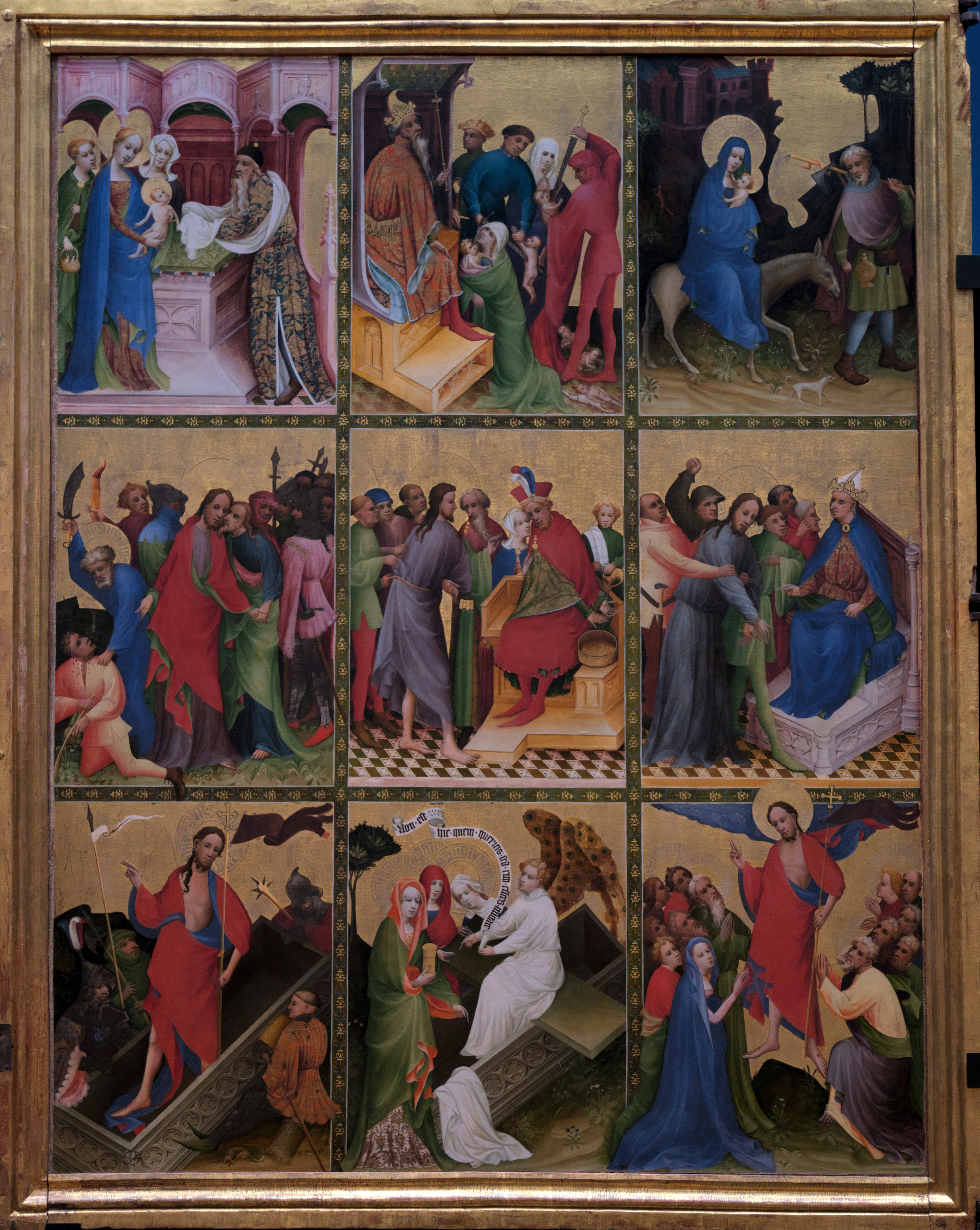
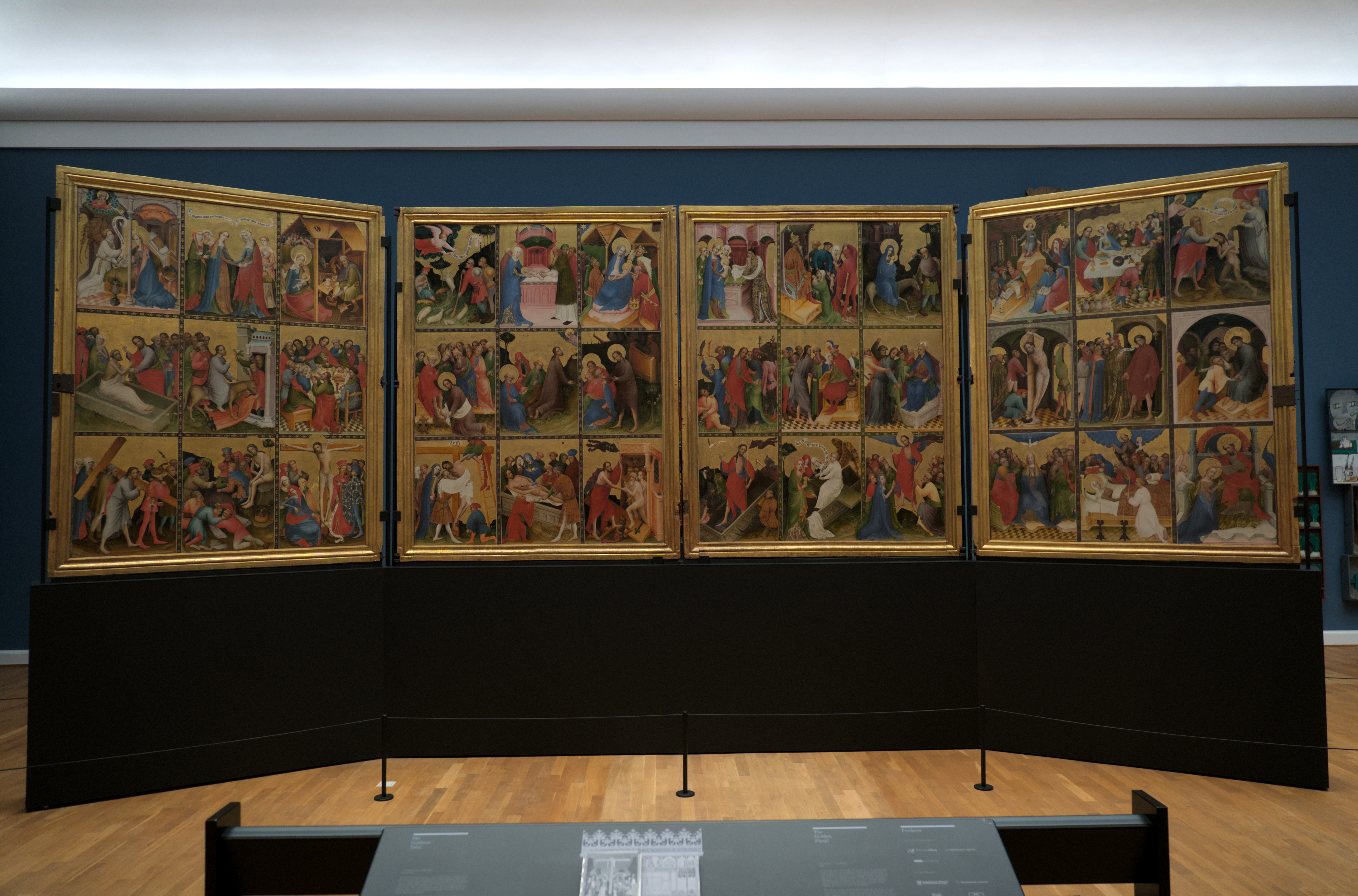
When visiting the Landesmuseum (State Museum) in Hanover, Germany, last fall, I was struck by a monumental medieval altarpiece depicting thirty-six scenes from the life of Christ. Scholars refer to it as the Goldene Tafel (Golden Panel) after the now-lost large gold repoussé plaque, originally designed (most likely) as an antependium in the twelfth century, that was once at the center of its inner display, depicting Christ seated in a mandorla flanked by the twelve apostles.
Golden Panel altarpiece
The “Goldene Tafel” (Golden Panel), made for the church of St. Michael’s monastery in Lüneburg, Germany, ca. 1420–30. Tempera and gold leaf on oak, each panel 231 × 184 cm (overall 231 × 736 cm). Landesmuseum Hannover, Germany, WM XXIII, 27. Photo: Victoria Emily Jones.

One of the most important northern German works in the International Gothic style, the altarpiece was created in the 1420s for the high altar of the newly built Benedictine monastery of St. Michael in Lüneburg. It was the work of carpenters, sculptors, and two painters, one from the circle of the Westphalian artist Conrad von Soest, and the other probably based in Cologne or even Lüneburg.

The Golden Panel altarpiece, in its original design, had two pairs of hinged wings that could be opened or closed over a fixed central shrine, offering three possible configurations. The shrine, irrecoverably robbed in 1644 and 1698, housed the monastery’s treasury, especially its reliquaries, displayed in a cabinet of twenty-two richly decorated rectangular compartments surrounding the eponymous, aforementioned “golden panel.” This main body of the altarpiece (called the corpus) was dismantled in 1792–94 and its remaining objects melted or sold. The predella (base) has also been lost.

However, the altarpiece’s two pairs of wings, replete with panel paintings and figural sculptures, have survived to the present day and, having been restored in 2016–19, are proudly displayed at the Landesmuseum Hannover for visitors to enjoy. When you enter the gallery, you are greeted with the full cycle of thirty-six painted scenes (nine per panel) from the life of Christ, read from left to right in long rows. Then you can walk behind to see the panels’ other sides, which would not have been simultaneously on view to the monks of St. Michael’s with the altarpiece’s original construction.

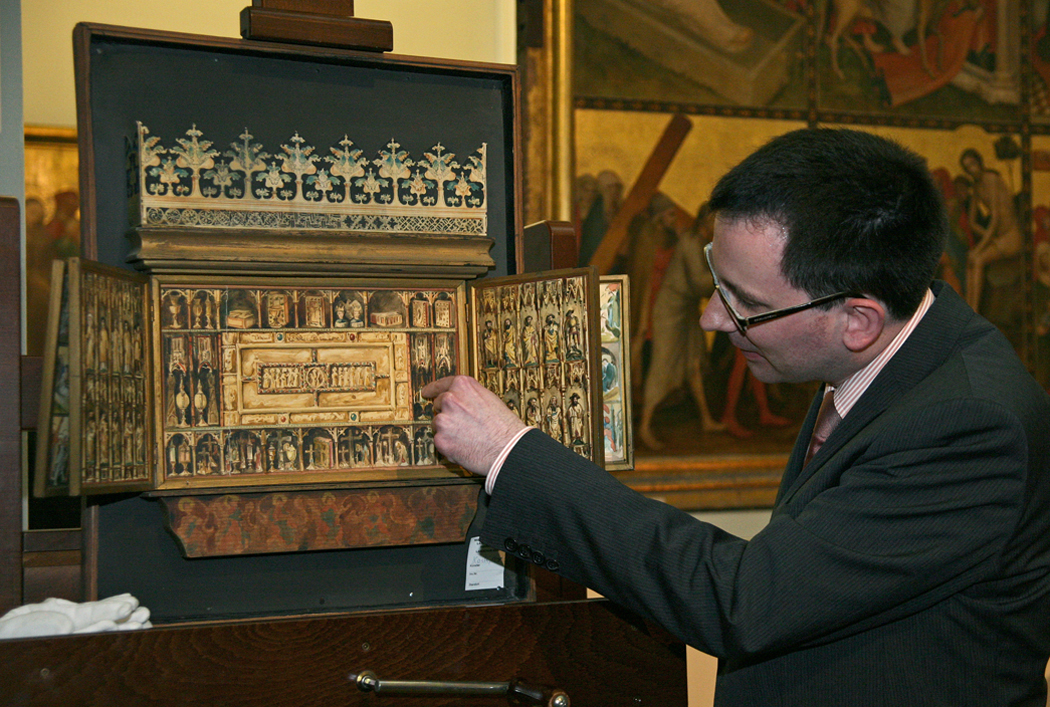
The scale model in the following photograph gives you a good sense of the three distinct viewing states that were originally possible.
Golden Panel model
Dr. Bastian Eclercy, curator of Old Master paintings at the Landesmuseum Hannover from 2010 to 2013, presents a historical model of the Golden Panel. Photo © Landesmuseum Hannover.

View 1: The Brazen Serpent and The Crucifixion

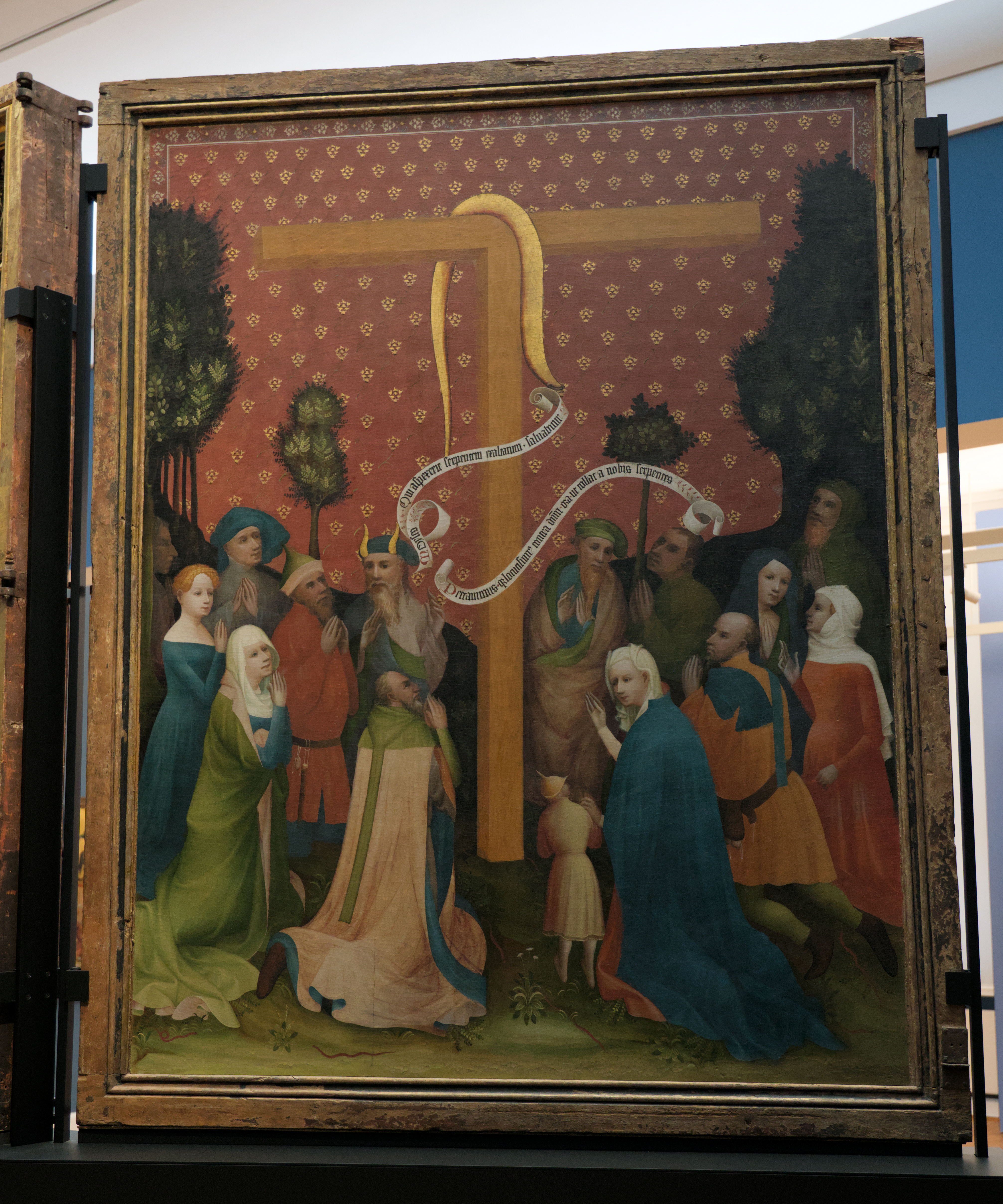
View 1, the closed view, juxtaposes a scriptural type and antitype: the brazen serpent in the wilderness, raised on a pole for the life of the people, and the crucifixion of Christ.
The Brazen Serpent
Crucifixion

Numbers 21:4–9 tells of how, wandering the desert after God delivered them from slavery in Egypt, the Israelites complained about how life was better before. As punishment for their ingratitude, God sent poisonous serpents into their camp, and fatalities ensued. The people realized their sin and repented, asking Moses to intercede with God for relief. God told Moses to craft a bronze serpent and lift it high on a pole, and to instruct the people that if they are bitten, to look on the sculpture and they will be spared.

In John 3:14–15, Jesus interpreted this story as foreshadowing his being raised on a cross to bring healing: “And just as Moses lifted up the serpent in the wilderness,” he told Nicodemus, “so must the Son of Man be lifted up, that whoever believes in him may have eternal life.”

The anonymous artist shows the gleaming snake on a tau cross that mirrors the one Jesus hangs on in the opposite panel. The lower banderole reads, from the Vulgate, “Peccavimus quia locuti sumus contra Dominum et te ora ut tollat a nobis serpentes” (We have sinned, because we have spoken against the Lord and thee: pray that he may take away these serpents). I can’t make out the text on the upper banderole, other than aspexerit, “shall look,” but presumably it communicates God’s antidote to the snake bites.

Moses has horns, as is typical in Western iconography, because of a literal translation of the Hebrew qaran in Exodus 34:29–30:

And when Moses came down from Mount Sinai, he held the two tables of the testimony, and he knew not that his face was horned from the conversation of the Lord. And Aaron and the children of Israel seeing the face of Moses horned, were afraid to come near. (Douay–Rheims)

Almost all English translations say instead that Moses’s face “shone” or “became radiant,” interpreting qaran as horned with rays of light. This artist splits the difference and shows, growing out from under Moses’s hat, two bony protrusions that are luminous!

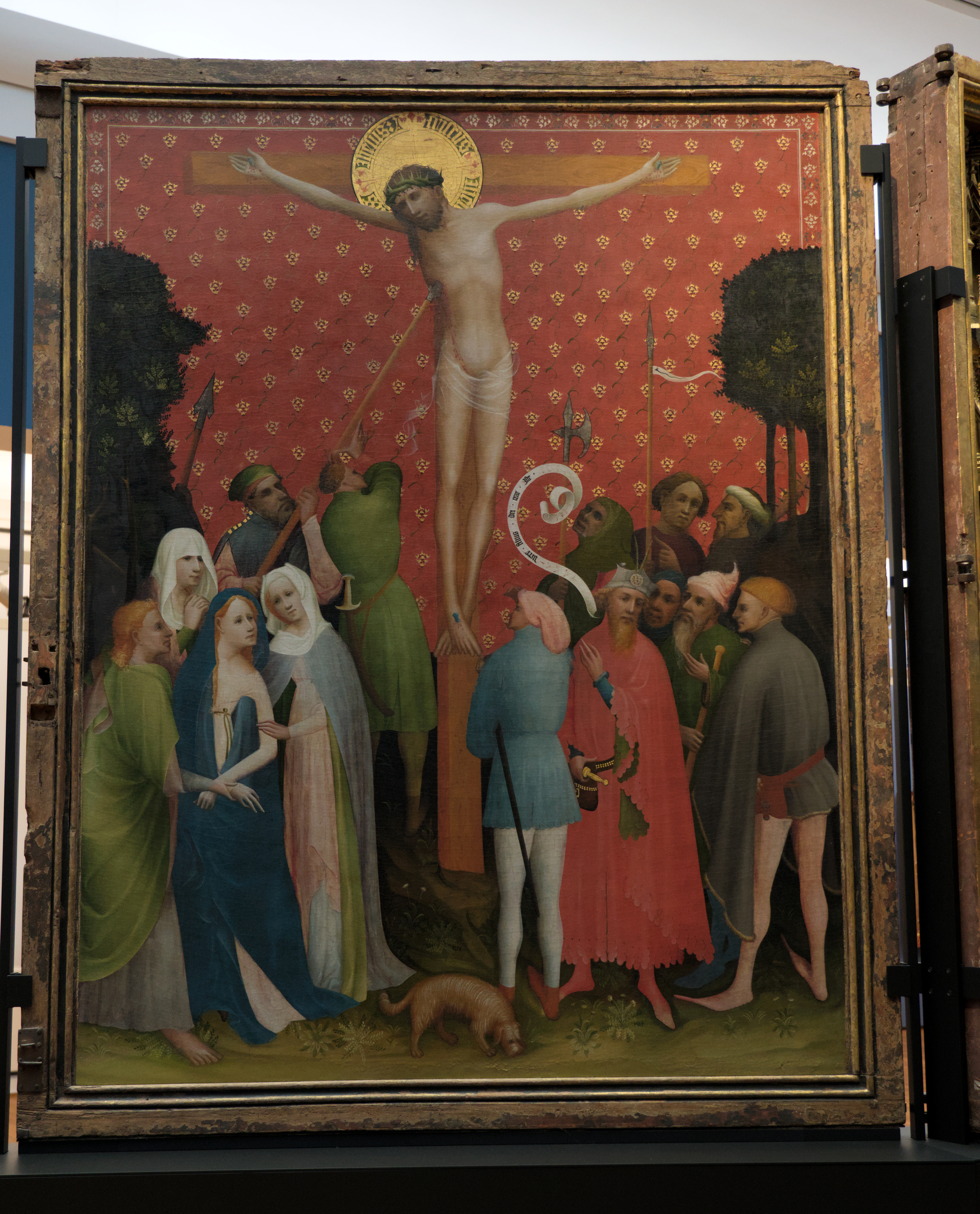
The Crucifixion scene shows a Roman spearman piercing Jesus’s side to confirm his death, while Jesus’s mother, two other Marys, and the apostle John mourn under his right hand. A centurion in the crowd exclaims, “Vere Filius Dei erat iste” (Truly this man was the Son of God).

(Related post: “Four scenes from a medieval German altarpiece”)

View 2: The Life of Christ

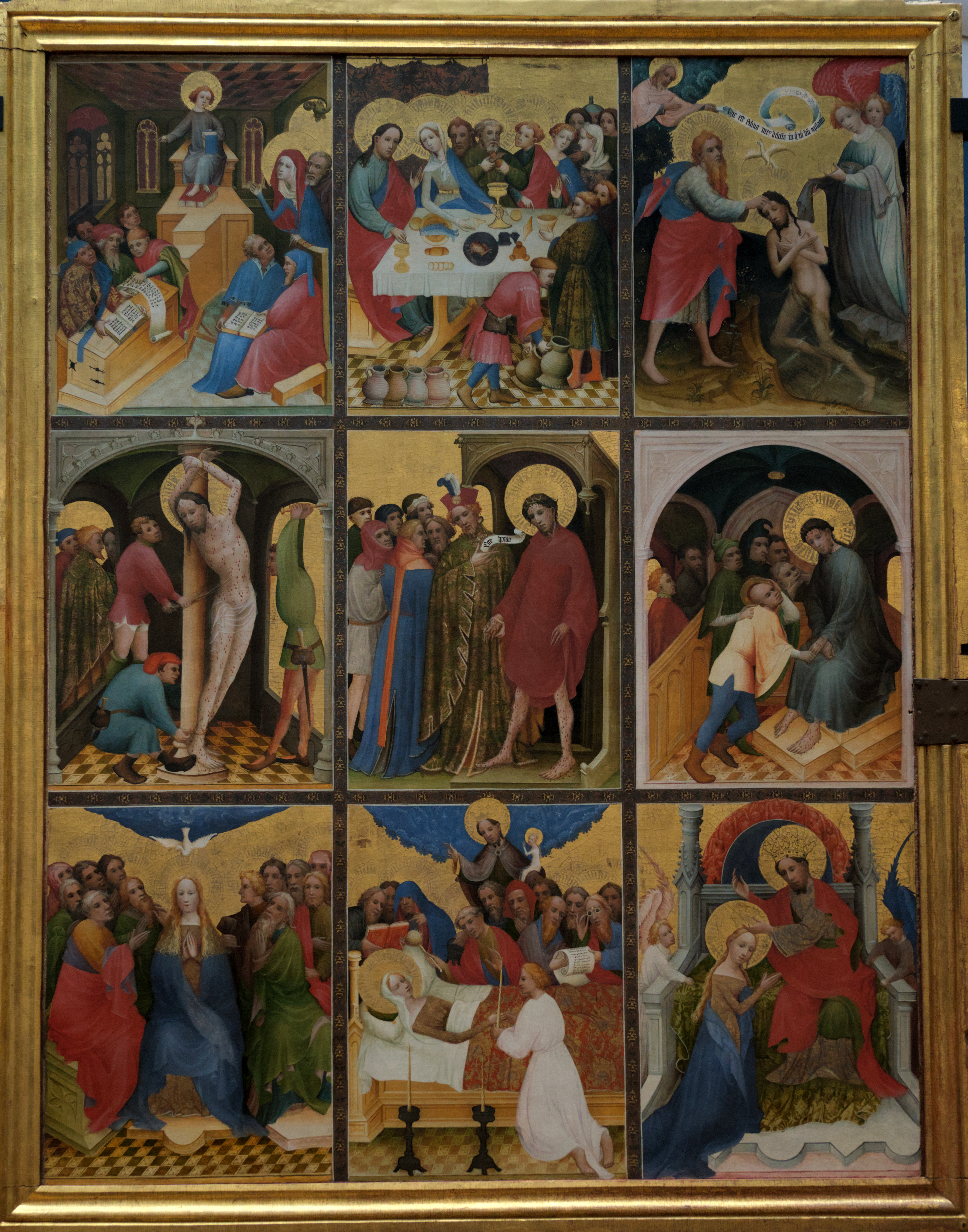
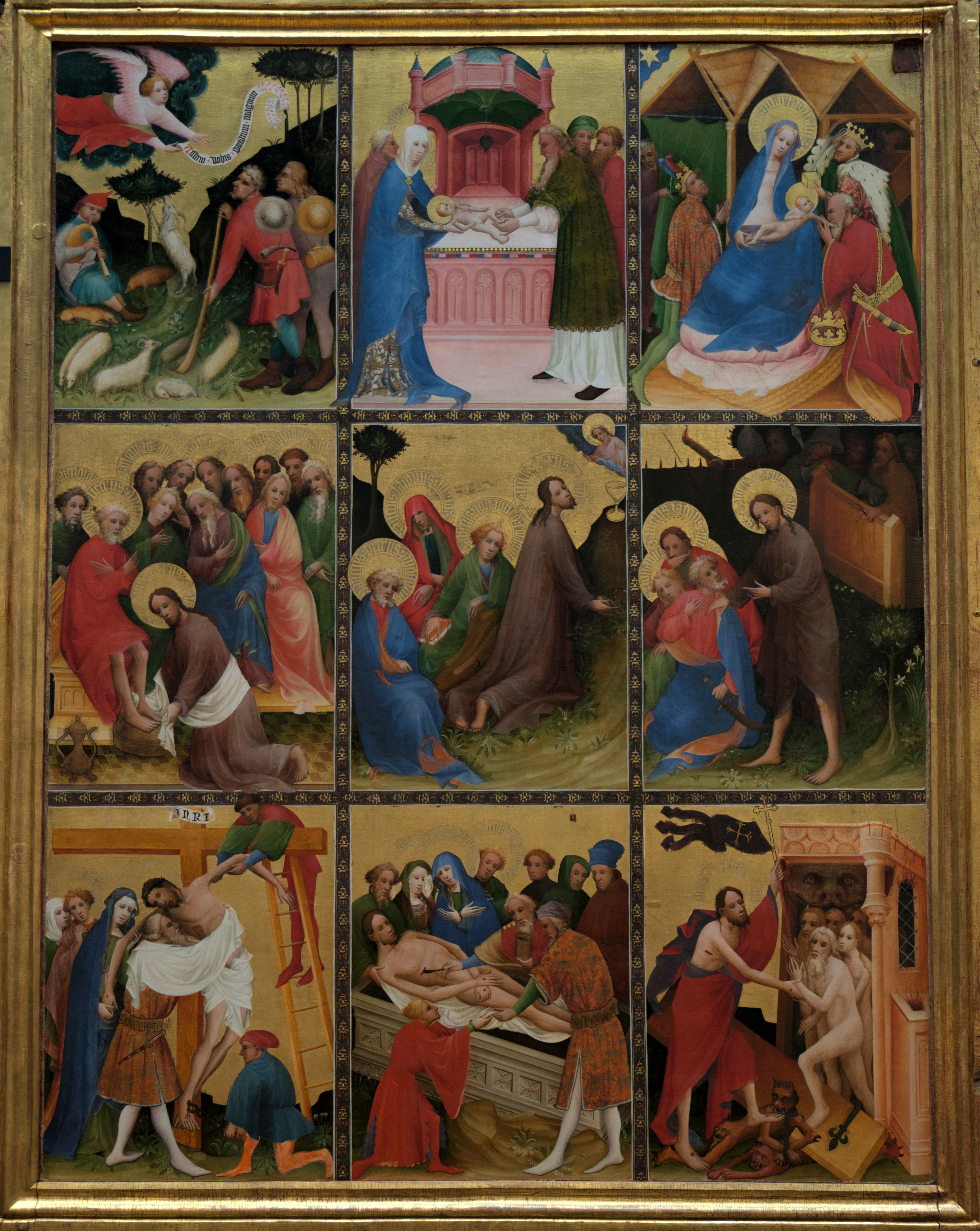
When these two outer panels were opened in their day, they would reveal view 2 of the altarpiece (pictured at top of article), or the first open view, displaying scenes from Jesus’s infancy, passion, and resurrection across four panels.
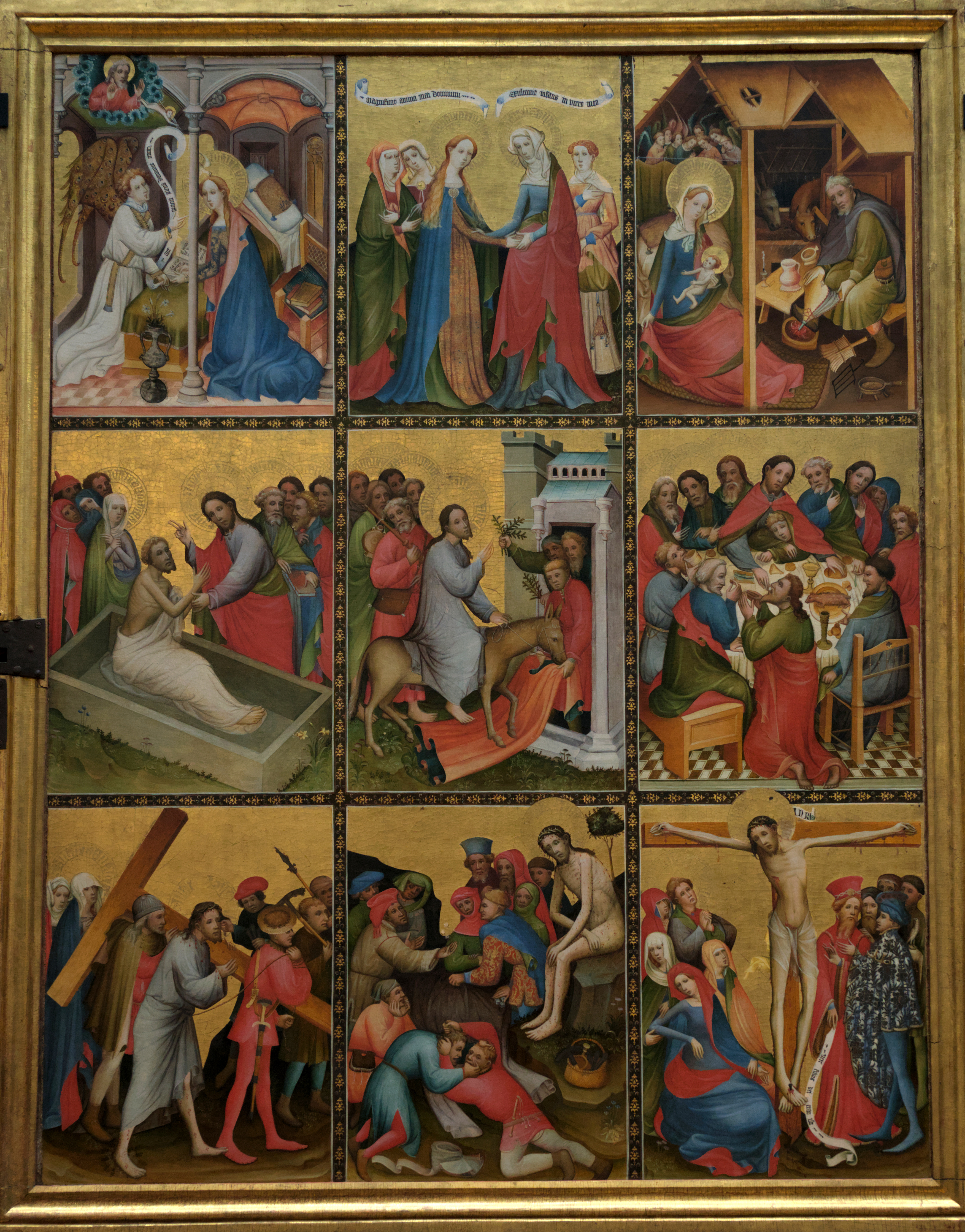
Golden Panel 1
The Annunciation; The Visitation; The Nativity; The Raising of Lazarus; Christ’s Entry into Jerusalem; The Last Supper; Christ Carrying His Cross; Christ in Distress; The Crucifixion

Golden Panel 2
The Annunciation to the Shepherds; The Circumcision of Christ; The Adoration of the Magi; Christ Washing His Disciples’ Feet; The Agony in the Garden (2); The Deposition; The Entombment; The Harrowing of Hell

Golden Panel 3
The Presentation in the Temple; The Massacre of the Innocents; The Flight to Egypt; The Arrest of Christ; Christ before Pilate; Christ before Herod; The Resurrection; The Holy Women at the Tomb; The Ascension

Golden Panel 4
Christ among the Doctors in the Temple; The Wedding at Cana; The Baptism of Christ; The Flagellation of Christ; Ecce Homo; The Mocking of Christ; The Descent of the Holy Spirit; The Death of the Virgin; The Coronation of the Virgin

I’ll share a few of my favorite scenes.
Nativity (Golden Panel)

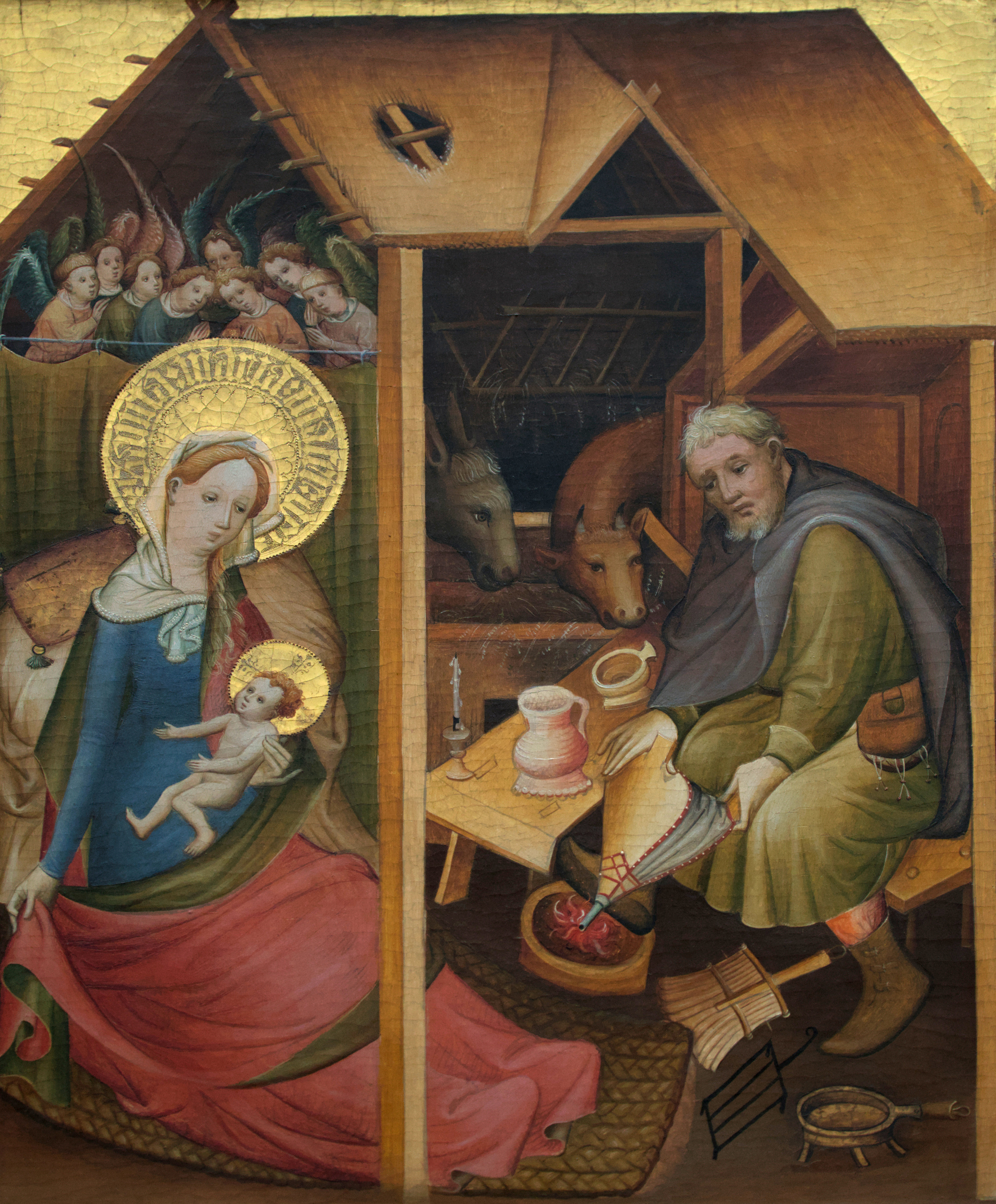
The Nativity features what I call the industrious Joseph motif [previously], as rather than sitting off to the side with his head in his hands, as he’s commonly shown, Jesus’s dad is hard at work trying to make his family comfortable. He pumps a bellows to supply air to the small fire he has going, either to warm his wife and child or, as he does in a handful of other medieval German Nativities, to cook a simple meal. Mary reclines with the infant Christ on a woven straw mattress while angels peek in from over a curtain to adore him.
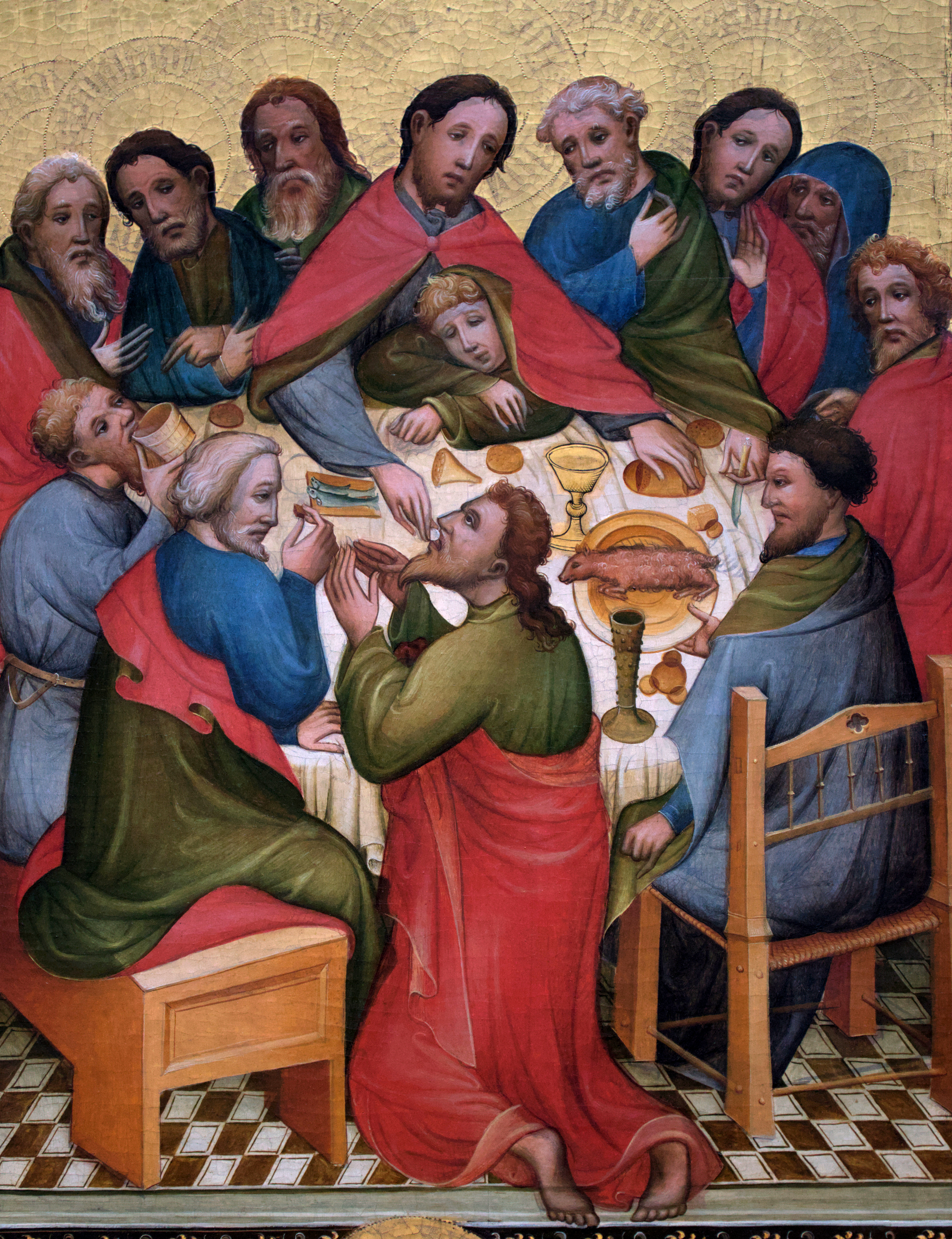
Last Supper (Golden Panel)

The Last Supper I found especially charming because of how the apostle John shelters under Jesus’s cloak, relaxed, secure. The image of John resting on Jesus’s breast rose to popularity in fourteenth-century Germany, a commemoration of the two’s bosom friendship and a call to, like John, abide in Christ. It’s based on the description in John 13:23, which says that at Jesus’s last meal, at Passover time, “one of his disciples—the one whom Jesus loved—was reclining close to his heart.” This verse alludes to the typical eating posture assumed at ancient Greco-Roman banquets, at which men reclined with their heads near a low table and their feet pointing away from it. But in Christian interpretation it has come to signify, more than simply a seating arrangement, the proximity of John to the heart of Christ.

In the Golden Panel’s Last Supper, Jesus enfolds John much like a mother hen would her chick (cf. Matt. 23:37; Luke 13:34), his garment like a wing. Even in this moment before his greatest trial, when most would be inclined to turn inward, Jesus shows concern for those he loves—he covers, protects. And nourishes. He stretches his hand across the table, laid with dishes of lamb and fish, to feed Judas a morsel of bread that resembles a eucharistic wafer. He sups with the man he knows will betray him. He does not turn him away.
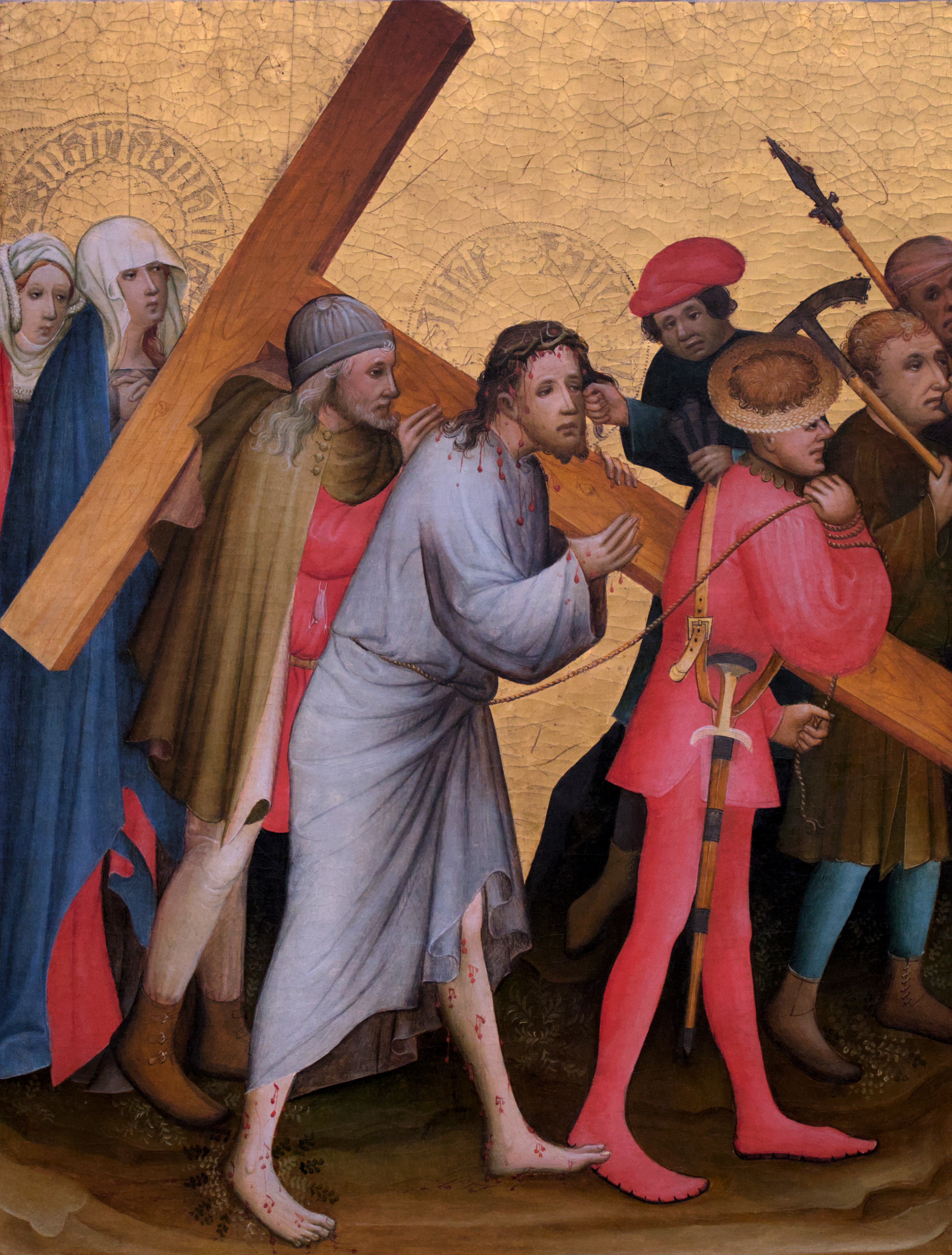
Christ Carries His Cross (Golden Panel)

Further along in the narrative, the scene of Christ carrying his cross with the help of Simon of Cyrene stands out to me because of the man pulling Jesus’s hair as he walks. The cruel mocking and assault continue outside the courtroom and en route to Golgotha.
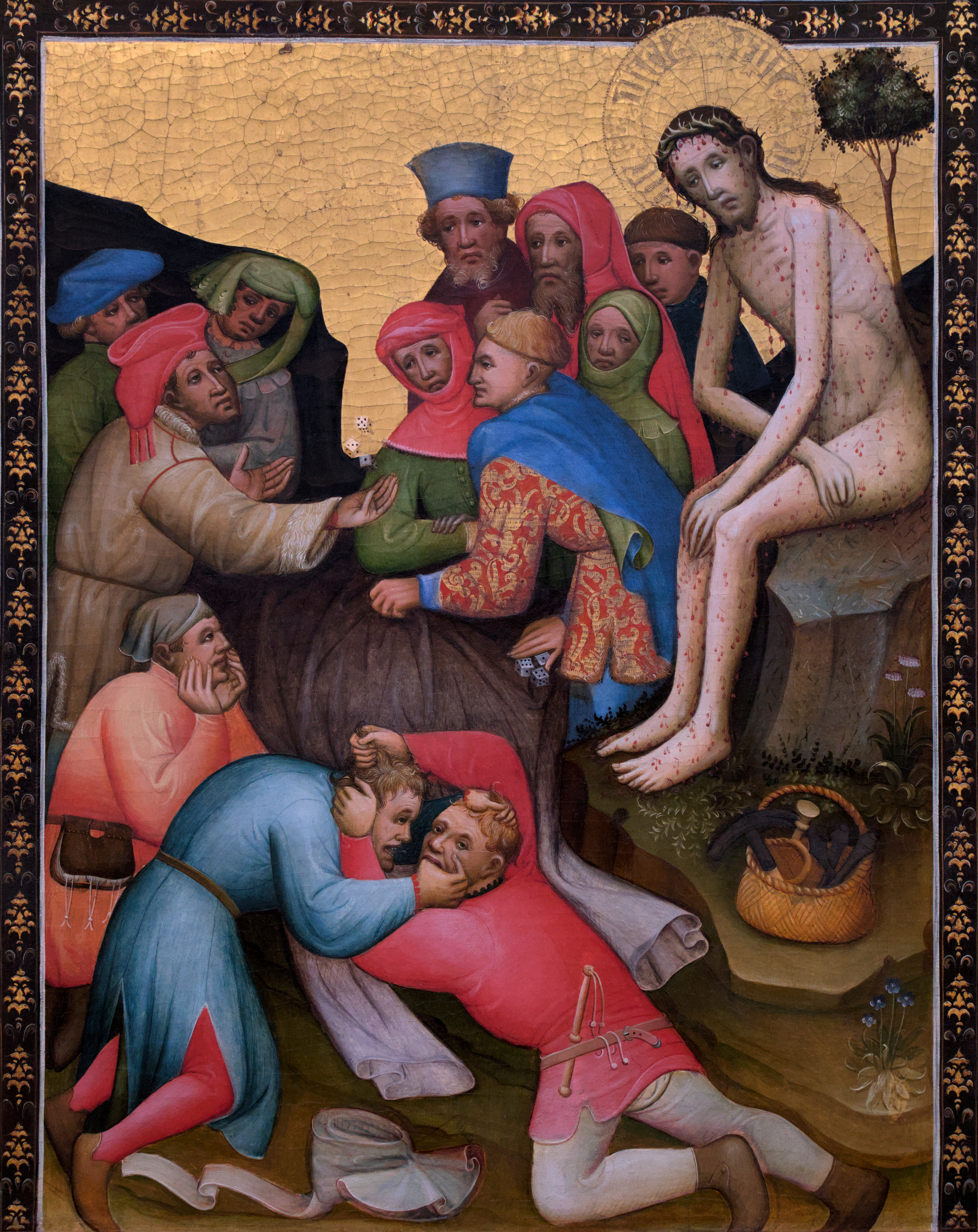
Christ in Distress (Golden Panel)

Called Christus im Elend (Christ in Distress) or Christus in der Rast (Christ at Rest), the subject depicted in the bottom center of the far left panel first started appearing in northern Germany in the second half of the fourteenth century. It shows Jesus sitting pensively, usually on a stone, waiting for his cross to be raised.

In the Golden Panel, Jesus, naked, bleeds all over while the soldiers roll dice and fight over who will get to keep his seamless tunic. The two men in the foreground, one with a flagrum tucked in his belt, tumble and tear at each other, pulling and biting, exemplifying the human penchant for violence that will culminate in the killing of God’s Son. (The basket of hammer and nails that has been procured for the task sits temporarily off to the side.) Combative and puerile, this is the humanity Christ has come to save.
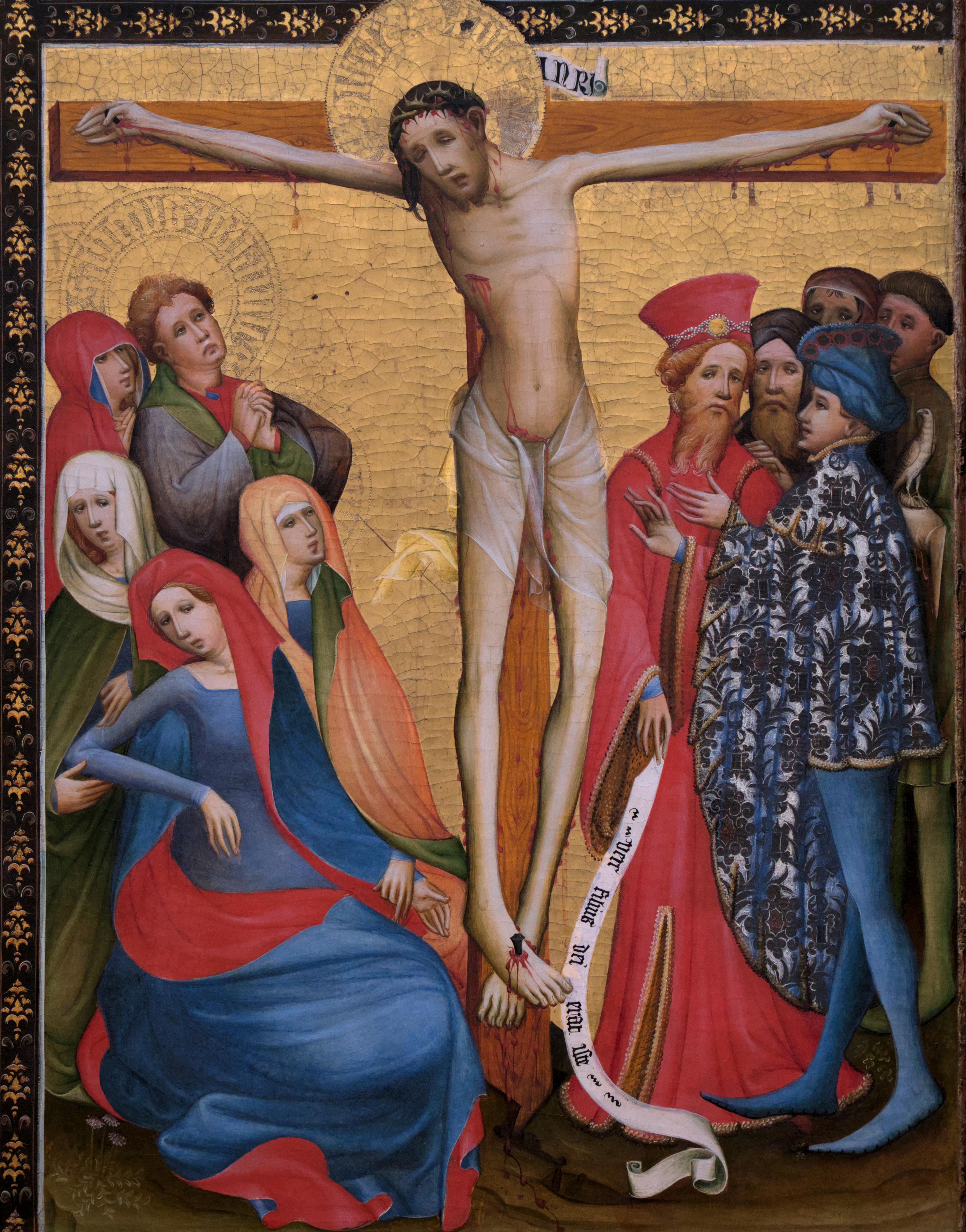
Crucifixion (Golden Panel)

The interior Crucifixion painting is fairly standard, but oh, isn’t it lovely? One notable feature is how Christ’s blood flows from his side, his final wound, down to his groin, where he received, at eight days old, his first wound, the cutting off of his foreskin in a ritual circumcision. Scholars such as Leo Steinberg have remarked how this diversion of the blood’s natural path (which would be to the right thigh) was an intentional device some painters used to connect these two sheddings of blood, and thus the incarnation and the atonement.
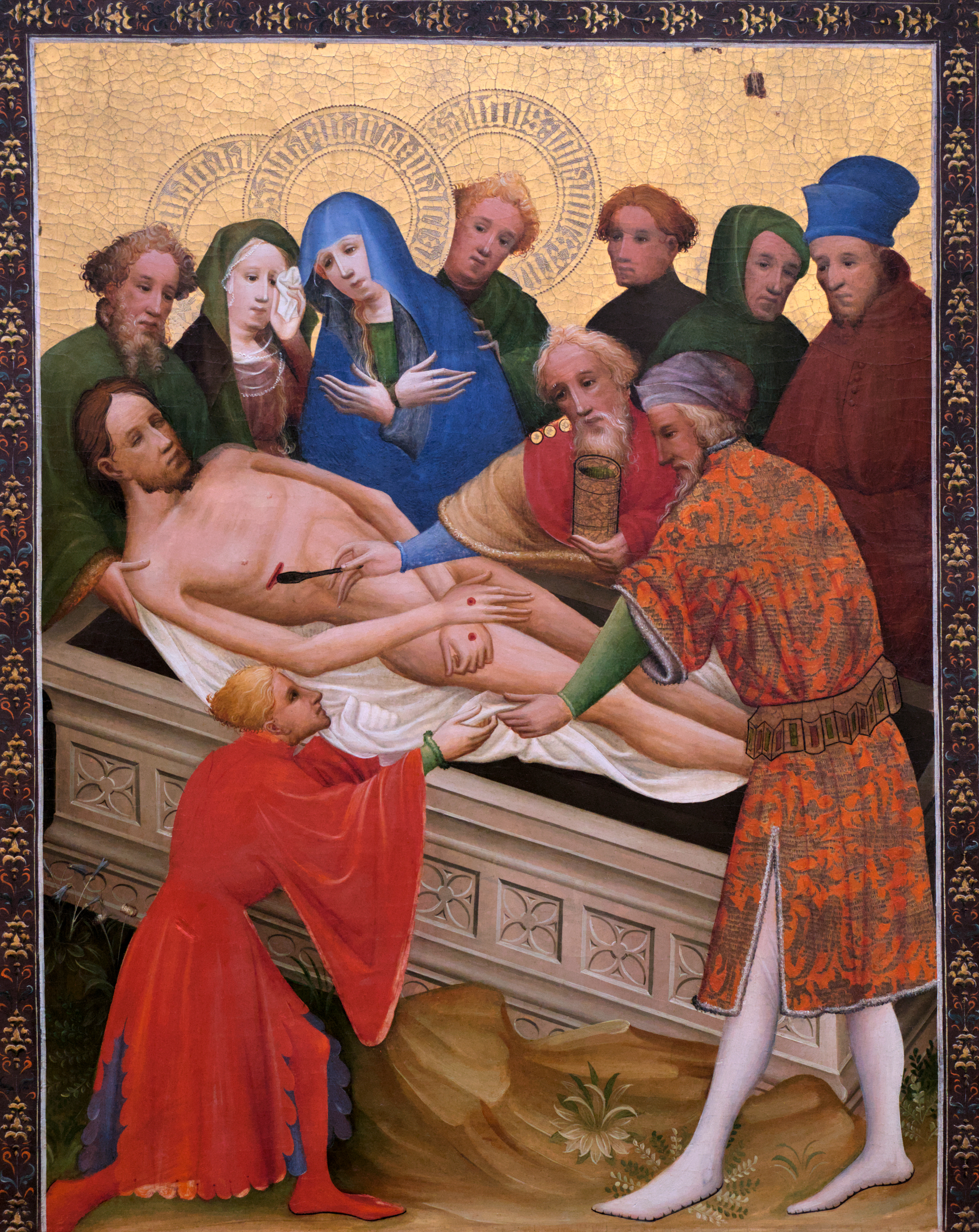
Entombment (Golden Panel)

Moving two pictures down the line, the Entombment scene caught my eye because of the tender care shown to the dead Christ before he’s laid to rest. Nicodemus anoints Christ’s wounds with myrrh and aloes, applying them with a spatula, while Joseph of Arimathea, who has donated his tomb, prepares to enshroud the body.
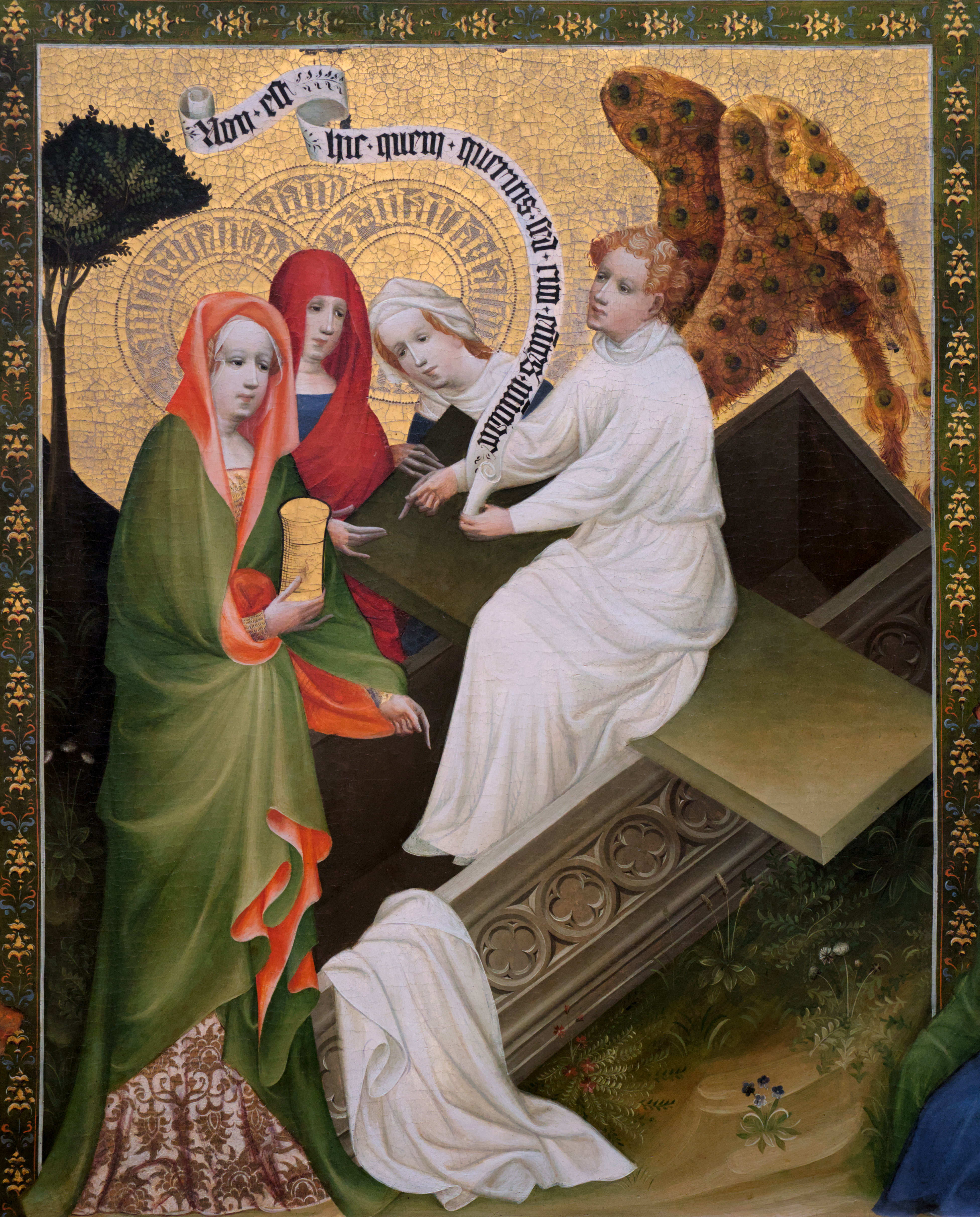
Holy Women at the Tomb (Golden Panel)

In a quintessential Easter scene, three faithful women come to the burial site after the Sabbath to complete the anointing ritual, only to find a finely feathered angel perched atop the skewed lid of Christ’s now-empty sarcophagus. Mary Magdalene, holding a golden jar, points into the vacant space as if to ask, “Where’s my Lord?” To which the angel responds that he is risen!

View 3 (Partial): Sculptures of the Saints

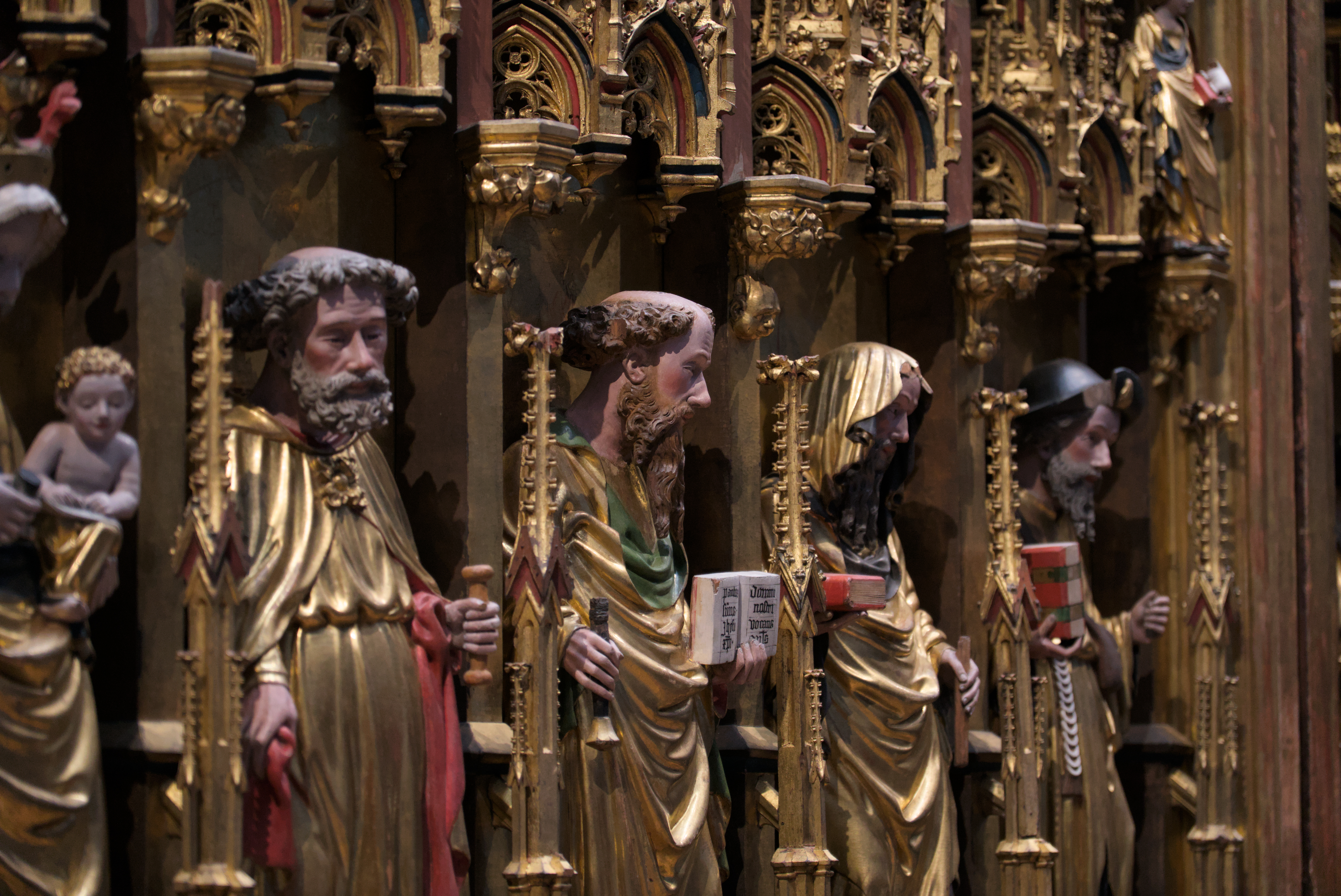
View 3 of the Golden Panel altarpiece—the fully open view, saved for important feast days—cannot be replicated because the shrine that formed the corpus is lost. But flanking the shrine would have been two wings that have survived largely intact, displaying polychrome wood sculptures of twenty (mostly male) saints and, in the intermediate row, smaller statuettes of six female saints (the other six are missing).
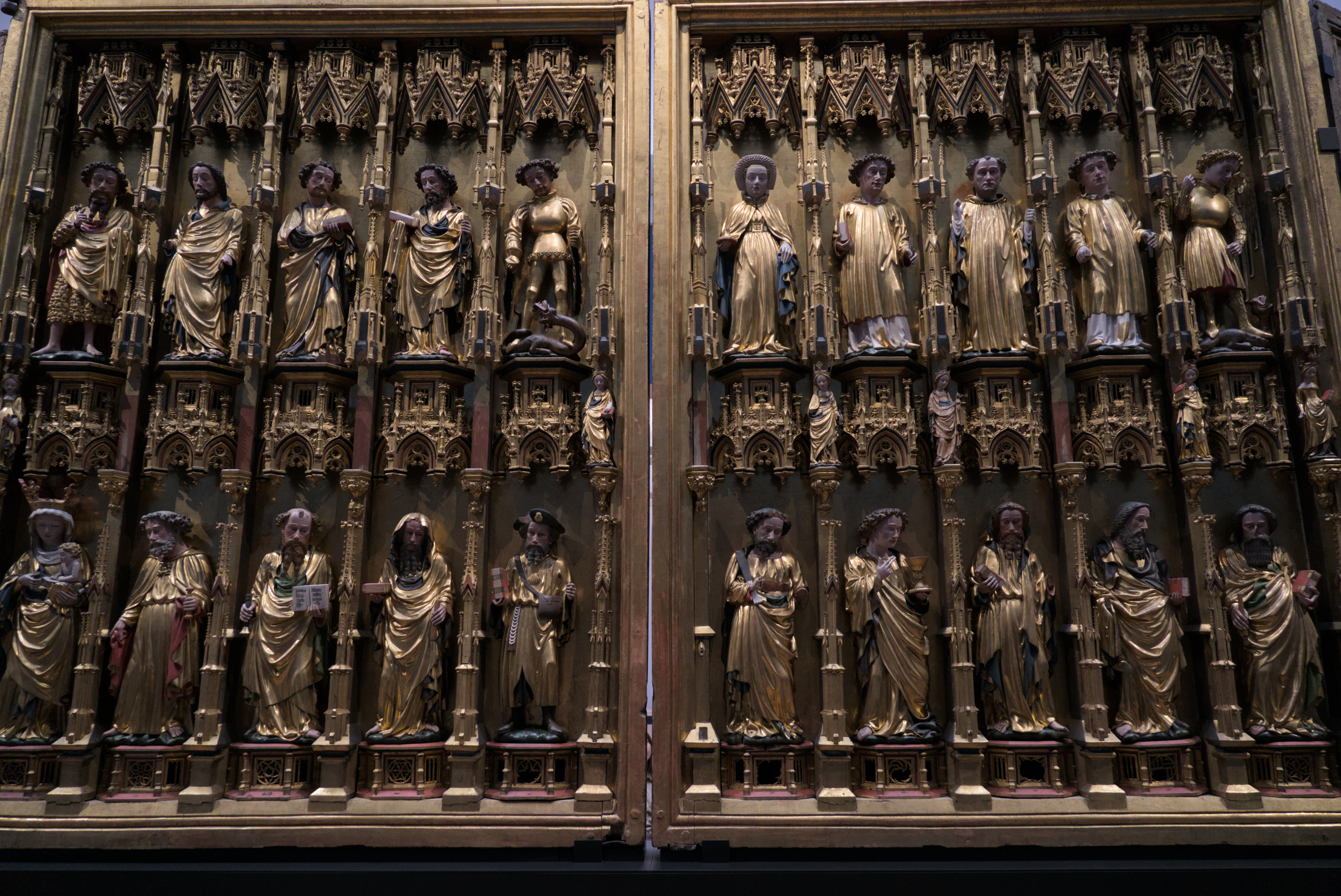
Golden Panel sculptures

The identities of the main figures are listed below. The ones I couldn’t confirm but for which I proffer my best guess are followed by a question mark.

  • Top left: John the Baptist, Thomas(?), Matthew, Simon(?), George
  • Top right: Mary Magdalene, Lawrence (deacon), Benedict, Cyriacus (deacon), Michael
  • Bottom left: Madonna and Child, Peter, Paul, James the Lesser(?), James the Greater
  • Bottom right: Bartholomew, John the Evangelist, Jude (Thaddeus)(?), Andrew, Philip
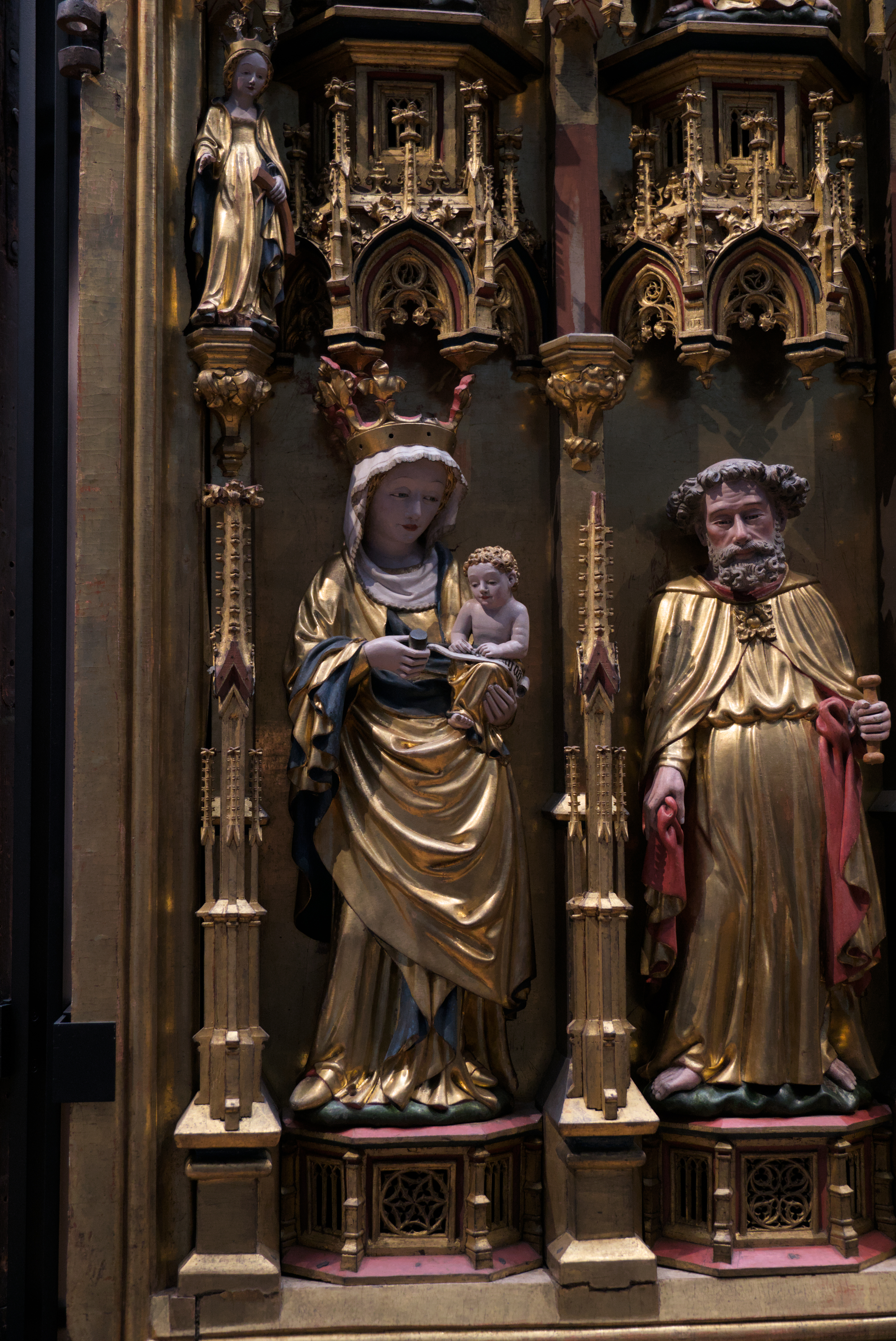
Madonna and Child sculpture

In the sculpture of the Madonna and Child, Mary holds an inkwell that Jesus dips his pen into as he writes on a scroll. How delightful! It’s a rare iconography but one that’s shared by the Tintenfassmadonna in Hildesheim Cathedral, sculpted around the same time.

The figure to the right of Mary is Peter. He holds a handle with a dowel hole on the underside; originally, a set of keys was attached to it and hung down.

The diminutive figure above Mary is Catherine of Alexandria, identifiable by the fragmented wheel she holds, a symbol of her martyrdom.
Saints' sculptures (detail)

To learn more about the Golden Panel, see the book Die Goldene Tafel aus Lüneburg, edited by Antje-Fee Köllermann and Christine Unsinn (Michael Imhof, 2021), from the Niederdeutschen Beiträge zur Kunstgeschichte (Low German Contributions to Art History) series. Only three of its twenty-five chapters are in English; the rest is in German. It’s highly technical, the product of an interdisciplinary research project carried out from 2012 to 2016. There’s not much in it about the actual content of the images. But it provides ample color illustrations, which I always appreciate, as well as stylistic comparisons, historical inventories, and more.
Christmas, Day 9: Word Made Flesh

LOOK: Chr. Geb. by Jörg Länger

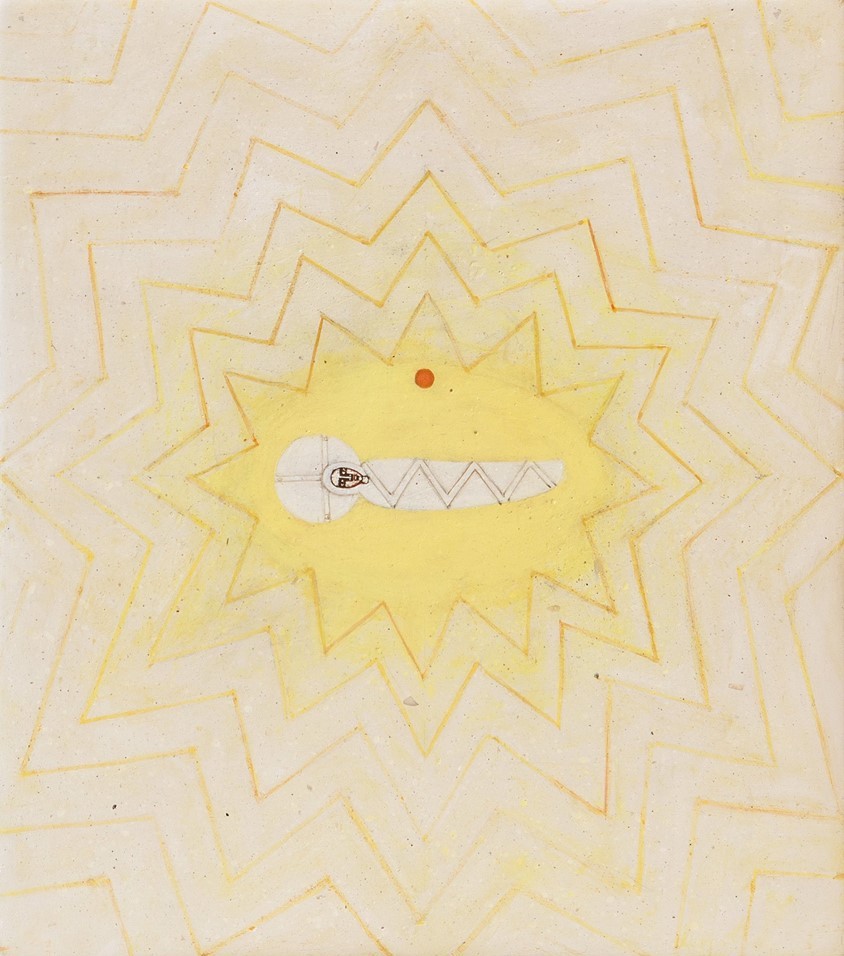
Länger, Jörg_Chr. Geb.
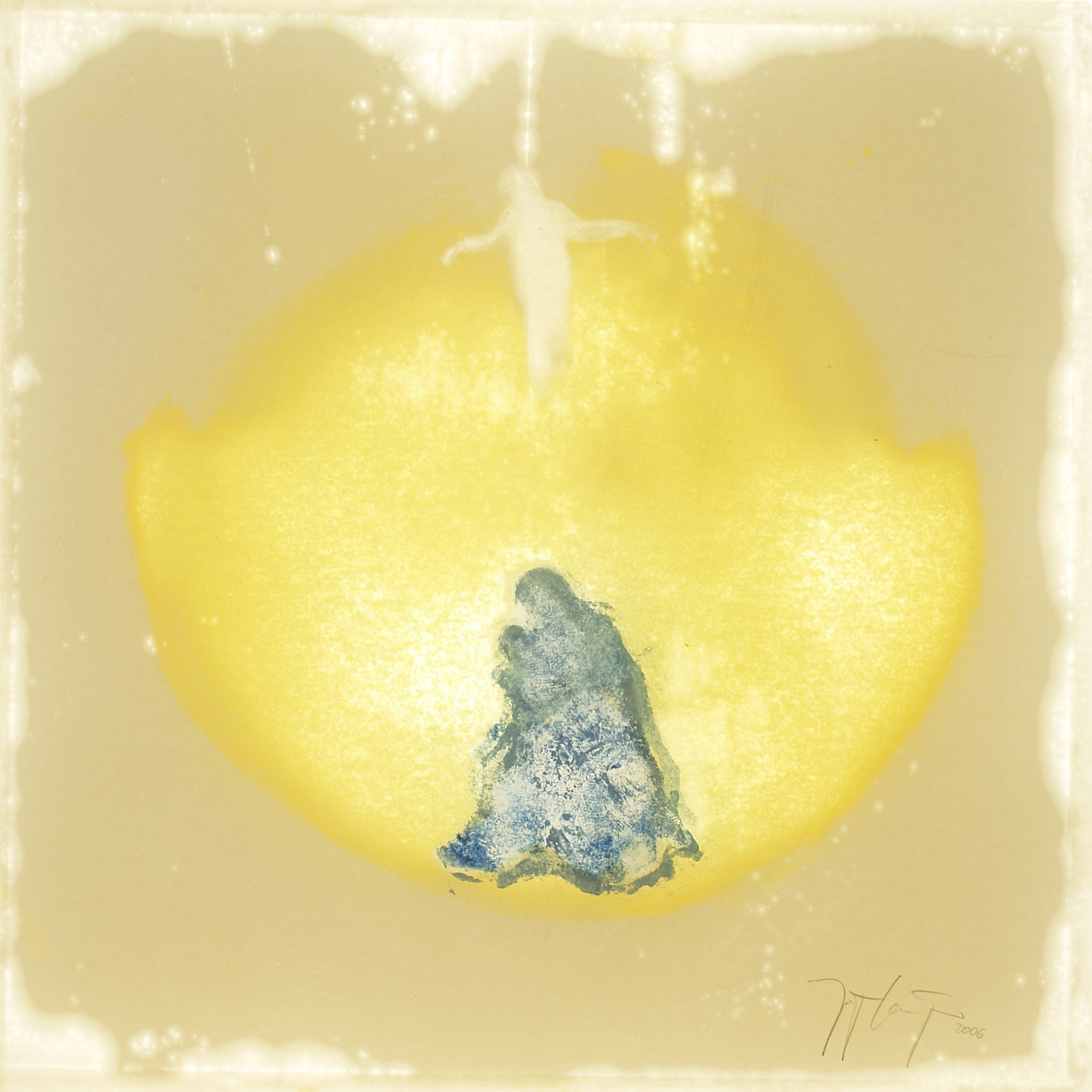
Jörg Länger (German, 1964–), Chr. Geb., 2006. Linocut, wax, oil, and graphite pencil on paper, 33 × 33 cm, cast with resin between two Optiwhite sheets of glass, 38 × 38 cm.

The contemporary German artist Jörg Länger creates extraordinary mixed-media works, many of which are in dialogue with Christian art history. In addition to earning an advanced degree in art, Länger has also done university coursework in theology and philosophy, so it’s no wonder his pieces demonstrate a keen theological awareness and spiritual sensibility.

After some fifteen years of working in photography, installation art, performance art, and conceptual art, in 1998 Länger shifted gears to focus on drawing, painting, and printmaking. He developed a series, still ongoing, that he calls “Protagonisten aus 23.000 Jahren Kulturgeschichte” (Protagonists from 23,000 Years of Cultural History), in which he takes figures from prehistoric petroglyphs and bas-reliefs, ancient Greek vases, medieval manuscripts, European Renaissance paintings, and contemporary art, simplifies them, and puts them into a new pictorial context. He copies the figure’s outline onto a linoleum block, inks and prints it to produce a sort of silhouette, and builds out from there using oil paint, pastels, wax, and/or gold leaf, while still retaining a minimalist aesthetic.

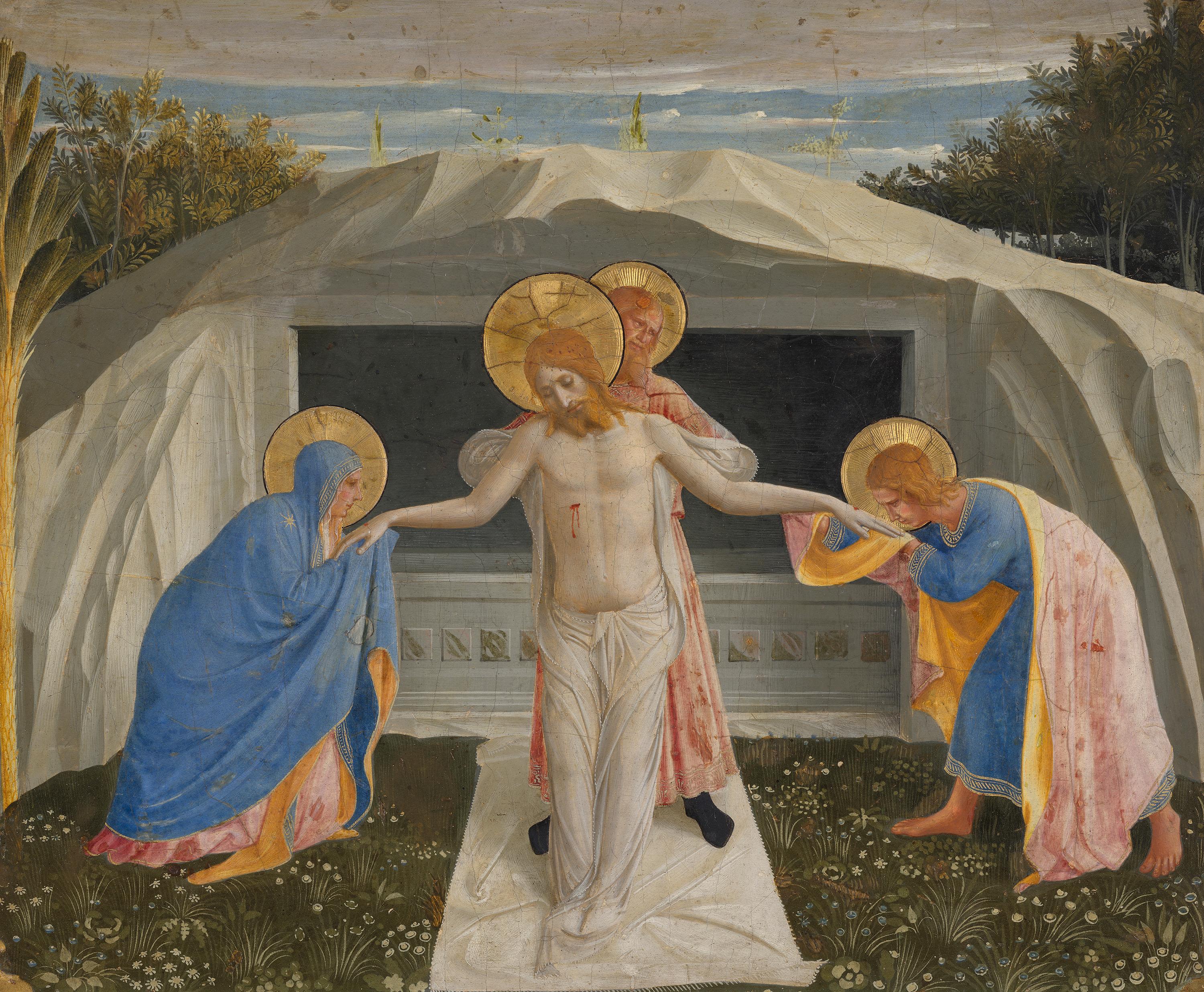
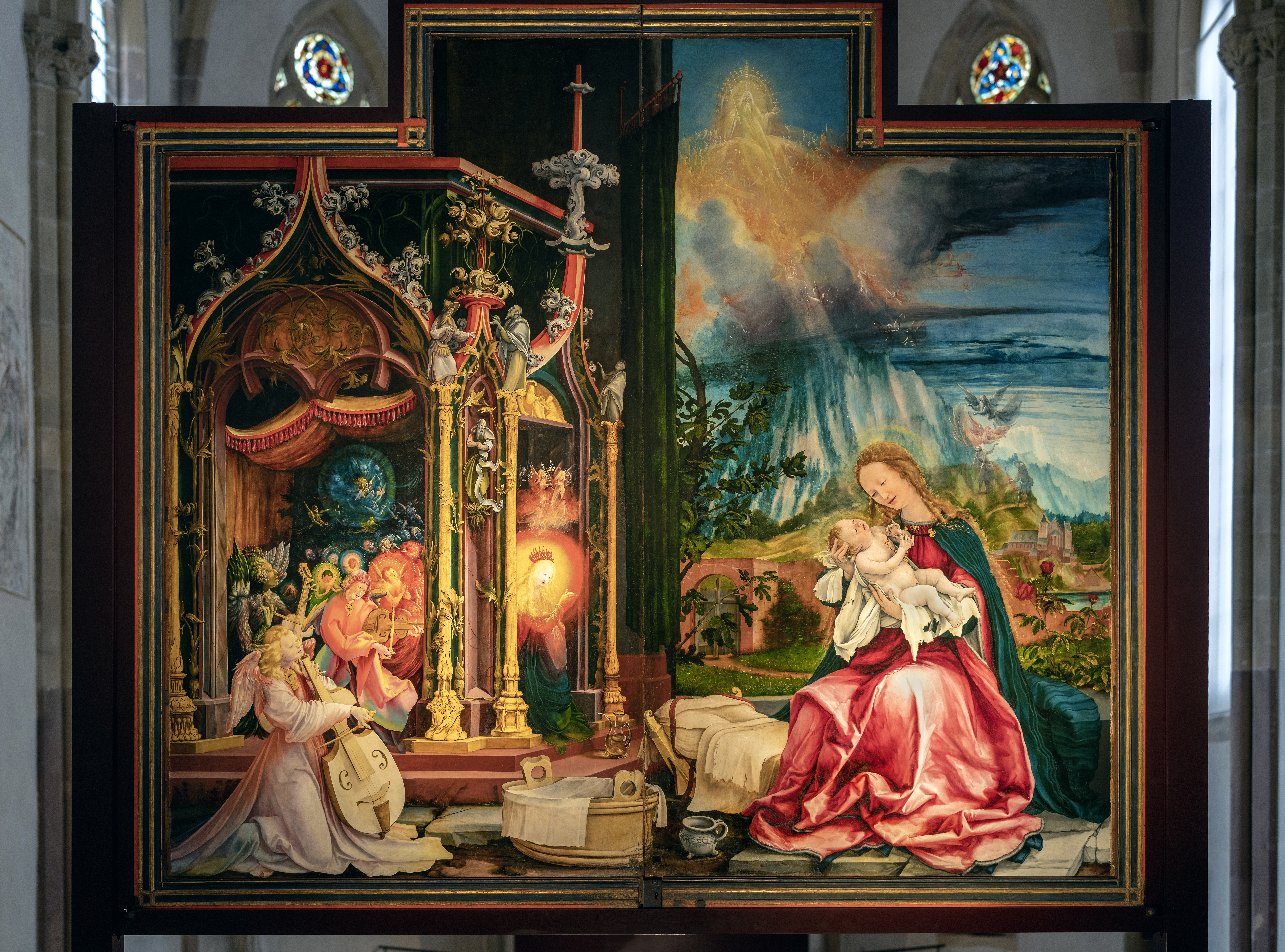
In his 2006 piece Chr. Geb. (short for Geburt Christi, “Birth of Christ”), the silhouetted figures are taken from Matthias Grünewald’s Isenheim Altarpiece and Fra Angelico’s Entombment of Christ.

Grünewald, Matthais_The Nativity
Matthais Grünewald (German, ca. 1475/80–1528), The Nativity, central panel (first open view) of the Isenheim Altarpiece, 1515. Oil on wood, 269 × 307 cm. Unterlinden Museum, Colmar, France. Photo: Steven Zucker.

Fra Angelico_Entombment of Christ
Fra Angelico (Italian, ca. 1400–1455), Entombment of Christ, 1438–40. Tempera on wood, 37.9 × 46.6 cm. Alte Pinakothek, Munich.

With the shadowy blue central pair of Mother and Child, the ghostly impression of Christ’s crucified body (being dragged into a tomb in the scene it’s excised from), the expanding puddle of gold that holds together both birth and death, and the light that presses in from the edges, the work has a mystical feel. It shows the Eternal One entering time, born of a woman, to live and die and rise and so bring humanity back to God and back to their truest selves.  

LISTEN: “O Vis Aeternitatis” by Hildegard of Bingen, ca. 1140–60 | Performed by Azam Ali, 2020

V. O vis aeternitatis
que omnia ordinasti in corde tuo,
per Verbum tuum omnia creata sunt
sicut voluisti,
et ipsum Verbum tuum
induit carnem
in formatione illa
que educta est de Adam.

R. Et sic indumenta ipsius
a maximo dolore
abstersa sunt.

V. O quam magna est benignitas Salvatoris,
qui omnia liberavit
per incarnationem suam,
quam divinitas exspiravit
sine vinculo peccati.

R. Et sic indumenta ipsius
a maximo dolore
abstersa sunt.

V. Gloria Patri et Filio
et Spiritui sancto.

R. Et sic indumenta ipsius
a maximo dolore
abstersa sunt.
V. O power within Eternity:
All things you held in order in your heart,
and through your Word were all created
according to your will.
And then your very Word
was clothed within
that form of flesh
from Adam born.

R. And so his garments
were washed and cleansed
from greatest suffering.

V. How great the Savior’s goodness is!
For he has freed all things
by his own Incarnation,
which divinity breathed forth
unchained by any sin.

R. And so his garments
were washed and cleansed
by greatest suffering.

V. Glory be to the Father and to the Son
and to the Holy Spirit.

R. And so his garments
were washed and cleansed
by greatest suffering.

Trans. Nathaniel M. Campbell

Hildegard of Bingen [previously] was a twelfth-century German nun and polymath who wrote works on theology, medicine, and natural history; hymns, antiphons, and a drama for the liturgy (all with original music); and one of the largest bodies of letters to survive from the Middle Ages. In 1136 she was unanimously elected to lead her Benedictine community as abbess, which she did until her death in 1179.

“O vis aeternitatis” is the first entry in Hildegard’s Symphonia armonie celestium revelationum (Symphony of the Harmony of Celestial Revelations), a compilation of her liturgical songs that she made during her lifetime. It is labeled a “Responsory to the Creator.” “The responsory, one of several compositional forms Hildegard used,” explains medievalist Nathaniel M. Campbell, “is a series of solo verses [marked V] alternating with choral responses [marked R] sung at the first office of the day, vigils (matins), in the monastic liturgy.” It’s basically a call-and-response song.

This responsory, Campbell continues, “contemplate[s] the Incarnation . . . as the pivotal moment in which creation reached its perfect and predestined trajectory.” He notes how the refrain meditates on the cleansing of Adam’s flesh both from suffering and by (Christ’s) suffering. God put on our humanity and redeemed it.

Here’s how the medievalist Barbara Newman translates the responsory on page 99 of the critical edition of the Symphonia published by Cornell University Press:

Strength of the everlasting!
In your heart you invented
order.
Then you spoke the word and
all that you ordered
was,
just as you wished.

And your word put on vestments
woven of flesh
cut from a woman
born of Adam
to bleach the agony out of his clothes.

The Savior is grand and kind!
From the breath of God he took flesh
unfettered
(for sin was not in it)
to set everything free
and bleach the agony out of his clothes.

Glorify the Father,
the Spirit, and the Son.

He bleached the agony out of his clothes.

In the video above, “O vis aeternitatis” is performed by Azam Ali, an internationally acclaimed singer, producer, and composer who was born in Iran and raised in India and is now based in Los Angeles. She writes in the video’s YouTube description that Hildegard is part of the canon of universal spirituality and mysticism and that she is attracted to her cosmology, especially her articulation of the ancient philosophical concept of “the music of the spheres.”

In addition to her solo work, Ali is part of the musical group Niyaz, who blend medieval Sufi poetry and ancient Middle Eastern folk songs with modern electronic and trance music.

“The Purpose of the Incarnation” by LeighAnna Schesser (poem)

Rusetska, Natalya_Nativity
Natalya Rusetska (Ukrainian, 1984–), Nativity, 2016. Tempera on gessoed wood, 17.5 × 15.5 cm.

Gravity’s maker, spinner of spheres and spiraling matter,
made into weight, to sweat. His own feet vulnerable,
drawn flat and close against the punishing ground.

Star-strayed infant, wrapped in weight, heavy heaven.
In the hollow of the years, long and narrow as a well,
he waits suspended, bucket-drawn, clapper in a bell.

Ringing and ringing in the heatfolds of gravity, lines and lines
of weight leaning us into each other, caught up, tumbled
open-face roses in a blue bolt of thorn-pricked cloth.

God made known, fleshly God, Godlight bodied, bleeding
out into wood, over stone. God from God, telluric God,
shadowcast God, lightstricken God, bloodwritten. The pull

electric of low, deep center. God flesh, corpus God, Verbum
corpse, light-riven. Inscribed, blooded, God-heft falling death-
bitten into weighted rising, made and given; the miracle of leaven.

From Struck Dumb with Singing (Lambing Press, 2020). Used by permission of the author.

LeighAnna Schesser is a Catholic writer from south-central Kansas whose poetry collections include Struck Dumb with Singing (2020) and Heartland (2016).

Easter, Day 6: Hope

LOOK: Hope by Ulrich Barnickel

Barnickel, Ulrich_Hope
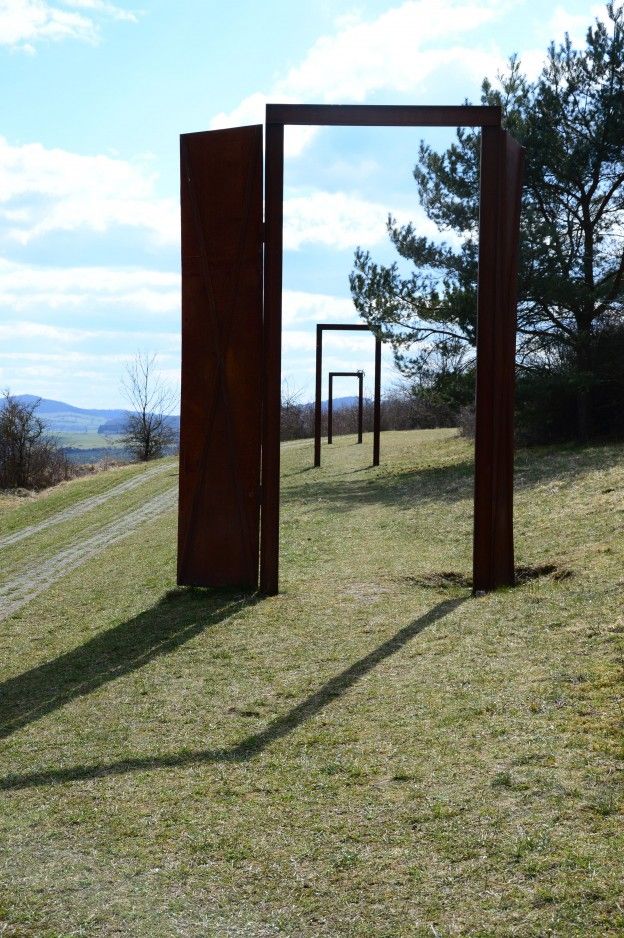
Ulrich Barnickel (German, 1955–), Hoffnung (Hope), fourteenth station from the cycle Weg der Hoffnung (Path of Hope), 2009–10. Iron sculpture, Geisa, Germany.

This is the last of fourteen monumental sculptures situated along the former inner German border that separated Soviet-occupied East Germany and Allied-occupied West Germany from 1952 to 1990. Stretching from Hesse to Thuringia, this highly militarized frontier consisted of high metal fences, barbed wire, alarms, watchtowers, and minefields, a literal iron curtain that divided families, friends, and neighbors.

In 2009, the Point Alpha Foundation, founded to preserve the historic site as a memorial, commissioned German metal sculptor Ulrich Barnickel to create an artwork as part of the memorial. He decided to draw on the traditional fourteen Stations of the Cross, connecting the suffering of Jesus to that of the people on the inner German border under Communism. Collectively titled Path of Hope, his fourteen iron sculptures cover 1,400 meters of ground (scaling down the 1,400 kilometers of the former border). All but the last are figurative, representing Jesus falling, meeting his mother, being nailed to the cross, and so on. They contain artifacts from or references to German Cold War era history, such as a vintage steel helmet hanging on Pilate’s chair, or the grenade and the trench that Jesus stumbles over.

The final station, titled Hope, is a threefold open doorway. After all the heaviness of the previous thirteen stations, we get this breather. Here’s what the doors say to me: Invitation. Possibility. The fourteenth station of the cross is traditionally where Christ is buried in his tomb. But instead of a dead body on a slab or a sealed-up cave, Barnickel gives us an open frame, a door ajar, a view of sky. It alludes to resurrection. Jesus walked through death and came out the other side. And so can we.

While the Path of Hope is a vehicle for remembering, lamenting, and healing from the collective traumas of war and political violence and oppression, it can also speak to personal losses, to any individual’s journey of grief. It’s an invitation to acknowledge the pain we carry but also to see beyond it to the Better Day that is coming, as well as to embrace the life before us here and now. The doors ask us to unburden ourselves of whatever weight is crushing us and to be renewed. (Notice the crown of thorns, an emblem of suffering, left hanging on the corner of the final threshold.) To follow the Man of Sorrows, who walks beside us in our own sorrow, from death into life.

For those accompanying a loved one to the door of death, or who have had a loved one suddenly snatched through, may Barnickel’s Hope meet you in your grieving, filling you with soft consolations of a Love stronger than death, a Love who, once buried, became on the third day the firstfruits of the resurrection harvest.

Barnickel, Ulrich_Hope

LISTEN: “Alleluia, Christ Is Risen Once Again” by Tara Ward, written 2007, performed 2020

Waking up to tragic dawn
Not comprehending what is going on
Alleluia, Christ is risen once again

And it frames a hollow place
Lost dreams and accolades
Alleluia, Christ is risen once again

Alleluia, Christ is risen
Though the walls of castles fall
Alleluia, he is risen for us all

From these sights the shadows light
In an overwhelming night
Alleluia, Christ is risen once again

Hopes fly from us every day
Fear reigns far and so does hate
Alleluia, Christ is risen once again

Alleluia, Christ is risen
Though the gates of all this war
Alleluia, Christ is risen evermore

Alleluia, God is able
To complete the life you led
Alleluia, Christ is risen from the dead

Alleluia, he is risen once again

From the sorrow you have fled
You have joy around your head
Alleluia, Christ is risen once again

And as from earthly trials you fly
You leave sadness when you die
Alleluia, Christ is risen once again

Alleluia, Christ is risen
And the life you’re living now
Alleluia, all’s forgiven somehow

Alleluia, there is beauty
When I think of you, joy I feel
Alleluia, in my sadness, faith is real

Alleluia, Christ is risen once again
Alleluia for you, my friend

Tara Ward [previously] wrote this song during the 2007 Easter season when two tragedies struck within a week of each other. On April 16, a mass shooter opened fire at Virginia Tech, killing thirty-two people, and on April 21, Ward’s friend Liz Duncan was fatally struck by a car while jogging. In the second half of the song, Ward addresses Duncan in the second person, rejoicing through tears that she has entered a state of joy and rest and will one day be raised, body and soul.

Ward returned to the song for Easter 2020 following the death that March of another friend and the initial outbreak of COVID-19. “I was trying to think of what I would sing if I was still working at a church, looking for honest songs to sing on Easter, and this one came up,” she writes on the YouTube video description.

The Nashville community, and America at large, is still reeling from the March 27 shooting at Covenant School that left seven dead, the 131st mass shooting in the US this year. I can only imagine the absolute devastation and rage a parent would feel upon learning that the child they dropped off at school that morning would not be coming home because they were gunned down with an assault rifle.

As I listen to this song, I think, too, of Leslie Bustard, a writer and book publisher, a luminary in the art and faith sphere, who, less than two months after hosting an amazing Square Halo conference on the theme of “ordinary saints,” is now in hospice with late-stage cancer.

Sometimes all the exuberance of Easter can seem disjunctive with the bleak state of the world or our own present circumstances. Christ is risen, but death is still a reality, and it’s still painful. Quiet and aching, this song gives space to grief while also confessing this central Christian doctrine: that Jesus rose from the dead, giving life to all who will receive it. Of course, that doesn’t mean Christians are exempt from experiencing physical death—we will all one day go to the grave—nor from the grief that follows in the wake of a loved one’s passing.

But what Ward’s song helps us do is sing “alleluia” in our sadness, because Christ’s resurrection life is at work in those who have passed on in him, and it’s at work in those of us who walk through the valley of death’s shadow here on earth. The “once again” language—“Christ is risen once again”—indicates that Jesus’s historical rising has ongoing implications, its efficacy extending to every new place of death.

Holy Saturday: Buried Seed

“Very truly, I tell you, unless a grain of wheat falls into the earth and dies, it remains just a single grain, but if it dies it bears much fruit.”

—John 12:24

LOOK: Untitled by Kwon Young-Woo

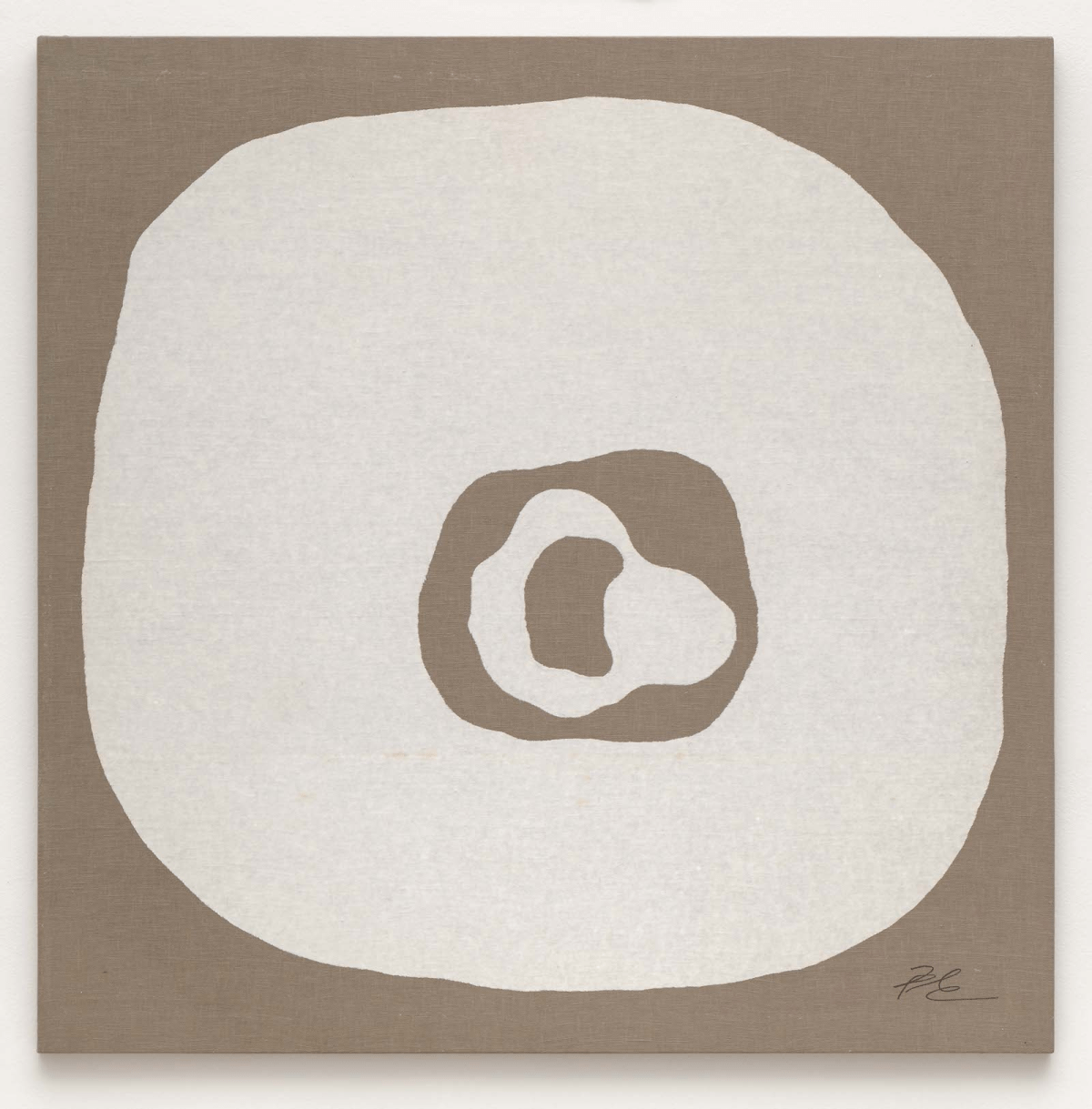
Kwon Young-Woo_Untitled (2002)
Kwon Young-Woo (Korean, 1926–2013), Untitled, 2002. Korean paper on canvas, 51 3/16 × 51 3/16 in. Photo: Chunho Ahn, courtesy the artist’s estate and Kukje Gallery.

LISTEN: “Before the Fruit Is Ripened by the Sun” | Words by Thomas H. Troeger, 1985 | Music by Carol Doran, 1985 | Performed by Sasha Massey, 2020

Before the fruit is ripened by the sun,
Before the petals or the leaves uncoil,
Before the first fine silken root is spun,
A seed is dropped and buried in the soil.

Before the Easter alleluias ring,
Before the massive rock is rolled aside,
Before the fear of death has lost its sting,
A just and loving man is crucified.

Before we gain the grace that comes through loss,
Before we live by more than bread and breath,
Before we lift in joy an empty cross,
We face with Christ the seed’s renewing death.

Text and tune © 1986 Oxford University Press

Icons roundup

As a caveat, I am a Protestant, and while I do have a profound respect and appreciation for icons, my theology of images, including my definition of sacred art, is not the same as the Orthodox Church’s—even though elements of it are influenced by the Orthodox position. All the same, I believe it’s important for Christians of all denominations to understand the significance of icons and what differentiates them from noniconic religious images. Those lines are being blurred a bit by the new schools of iconography coming out of western Ukraine and Poland, which honor tradition even as they push it forward into the contemporary era. Here are a few icon-related videos, articles, and weblinks that I’ve gathered over the past several months.

LECTURES:

>> “The Meaning of Icons” by Fr. Maximos Constas, November 13, 2019, Notre Dame Seminary: Father Maximos Constas, professor of patristics and Orthodox spirituality at Hellenic College Holy Cross Greek Orthodox School of Theology, explains the significance of icons in the Orthodox Church, with special attention to their aesthetic features and theological meaning, which is informed by the church’s Christology and cosmology. He answers such questions as, Why do the figures in icons look bored and unnatural? And, Doesn’t the Second Commandment forbid representations of Christ? He does not address icon veneration or details of the making process.

Constas spends the first fifteen minutes juxtaposing Eastern and Western approaches to religious images, discussing how the Renaissance values of humanism and naturalism came to prevail in the West. The Orthodox, he says, see this as the “secularization” or “carnalization” of sacred art—in its commitment to depicting observable realities, Western art from the Renaissance onward typically lacks overt signs of transcendence.

Constas also discusses the dogmatization of sacred images in the East. Icons are never simply works of art or pedagogical tools, he says. “They were understood to be visual artistic expressions of the church’s theology. And in the same way that church doctrines could not be changed, neither could the image in which the doctrines were embodied.”

Here are some notes I took on the talk, including some transcriptions:

  • An icon can be a panel painting, a fresco, a mosaic, a relief carving, an enameled plaque, a manuscript illumination, etc. “What ultimately defines an icon has nothing to do with artistic medium or style but rather depends on how the image is used and, most importantly, what it is believed to be. And every icon is a means of spiritual encounter and dialogue. It offers us the possibility of such an encounter because it shares in the holiness of the sacred figure whose likeness it bears.”
  • An icon is not a work of art but a work of witness that makes use of art.
  • “Icons are not simply portraits but manifestations of human persons in their new heavenly condition. They are images of the spiritual character of human beings reborn, as it were, in the womb of eternity.”
  • “The icon has the ability to evoke within me the memory of the forgotten depth of my own being. It enables me to see my true face. It orients me toward my destiny in God. And this vision, this remembrance, this knowledge fills me with unspeakable joy and profound consolation.”
  • We not only can but must make images of Christ; “to deny the icon is to deny the reality of the Incarnation.”
  • “All created things are intrinsically good, and all, therefore, have spirit-bearing potentialities. And to this essential goodness and beauty of the material world, the icon bears joyful witness. In the icon, we see matter restored to harmony and so fulfilling its true vocation, which is to reflect and transmit the divine glory. The icon, then, safeguards not only the authenticity of Christ’s physical body, but also the true value of creation in its unfallen state as created by God. Inherent in the very fact of the icon is an optimistic, affirmative vision of the material creation. As spirit-bearing matter, the icon has what we would call eschatological significance—it anticipates the final transfiguration of the cosmos at the last day, when the created world will be delivered from its present bondage to corruption, to quote St. Paul, and will enter into the glorious liberty of the children of God.”
  • Icons as:
    • windows, doors, thresholds into heaven (spiritual places of passage)
    • mirrors, a reflection of their living source
    • tracks or traces
  • 32:40: Portrayal of figures in icons
    • Alteration of the natural symmetries and proportions of the body, including the features of the face (eyes and ears enlarged; nose elongated; mouth small and closed)
    • Full frontality—wholeness, completion, perfection; makes the icon dialogical and relational
    • Serene, controlled facial expression
  • No shadows cast; illumined from within

>> “Rajaton hengellinen kuva: Kärsimyksen ja ylösnousemuksen kuvat” (Boundless Spiritual Image: Images of Suffering and Resurrection) by Ari Luomajoki, March 26, 2021, Kuopio Cathedral, Kuopio, Finland: I don’t speak Finnish, but I share this seventy-minute video for the visuals (and of course for any Finnish speakers!) and to show how contemporary icons are spreading west. In August 2016 under the leadership of Pastor Ari Luomajoki, the Lutheran Monastic Community of Enonkoski in Ihamaniemi, Finland, organized its first international icon workshop (read more here, and follow @LutheranIcon on Facebook), which attracted iconographers from Poland and Ukraine, as well as a few domestic artists. It was reprised in 2017 (I mentioned this second workshop here). Icons that came out of these workshops have been exhibited several times in Finland, and have facilitated relationships that have led to new exhibitions—such as Kärsimyksen ja ylösnousemuksen kuvat (Images of Suffering and Resurrection) at Kuopio Cathedral, which ran March 26–April 11, 2021. Follow the boldface link to see a taping of the opening, which includes opening comments, a tour, and a lecture.  

Movchan, Danylo_Descent from the Cross
Danylo Movchan (Ukrainian, 1979–), Descent from the Cross, 2021. Watercolor on paper, 33 × 38 cm.

Mindewicz, Basia_Entombment of Christ
Basia Mindewicz (Polish, 1978–), Lamentation, 2016. Acrylic on wood, 26 × 20 cm.

In the first sixteen minutes of the video, Pastor Olli Viitaniemi, one of the main organizers of the exhibition (with Pastor Salla Tyrväinen), shows screen captures from the website he built connected to the exhibition, https://sielunkuvat.net/. At around 16:24 he gives a tour of the exhibition around the church sanctuary.

At 32:48 Luomajoki—who is a Lutheran pastor in Kouvola, Finland, and has a master’s degree in art history—starts his half-hour lecture. He introduces Międzynarodowe Warsztaty Ikonopisów w Nowicy (International Iconography Workshop in Nowica) in Poland and Lviv National Academy of Arts and the Iconart gallery in Ukraine, two centers of contemporary Eastern iconography that inspired the icons project at the Enonkoski monastery in Finland. At 47:41 Luomajoki does side-by-side image comparisons to show similarities and differences across time. At 50:41 he discusses the use of images in early Lutheranism. He goes on to show some examples of religious art in Finland in the past century (including a really compelling Crucifixion painting by Helene Schjerfbeck and crucifix by Paavo Halonen!). He closes by spotlighting Hidden Life in Nazareth by Ivanka Demchuk and a Nativity by Arsen Bereza, participants in the workshop.

Luomajoki is a wonderful photographer of art. Follow him on Instagram @ari.luomajoki.

+++

INTERVIEW with contemporary iconographer Khrystyna Kvyk, by Kevin Antlitz: OK, Patheos blog posts are painful to read because of all the obtrusive ads, which is why I rarely link to them. But I’m making an exception for this one, where American Anglican pastor Kevin Antlitz interviews Ukrainian Greek Catholic iconographer Khrystyna Kvyk, who earned a master’s degree in sacral art in 2020. She discusses her process of painting icons, what makes an icon an icon, timelessness and transfiguration, the relationship between tradition and innovation, the idea of divine light as reflected in two of her icons, and more. I really love her work and was delighted to hear some of her own words about it.
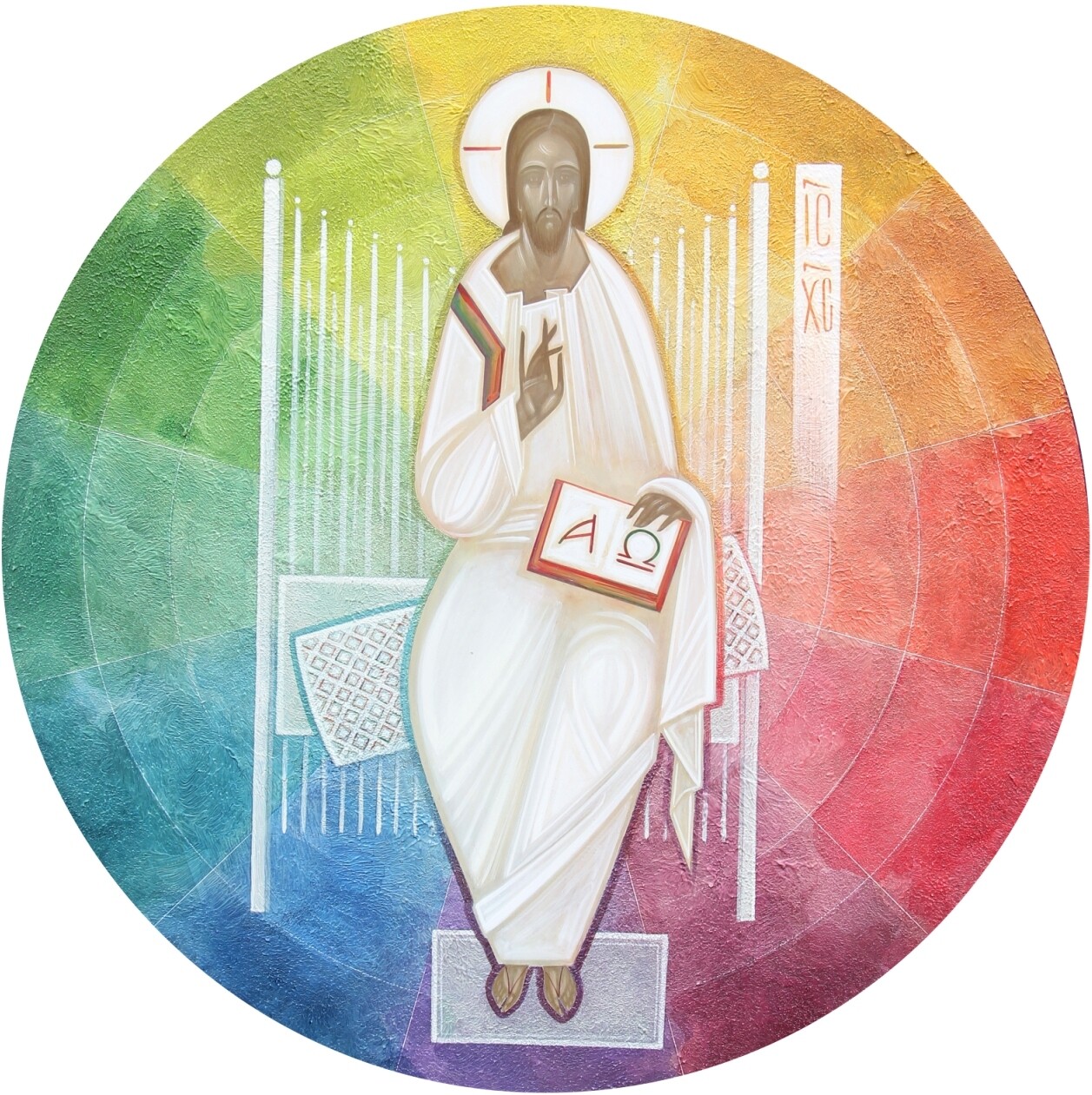
Kvyk, Krystyna_I Am the Light of the World
Khrystyna Kvyk (Ukrainian, 1994–), I Am the Light of the World, 2021. Acrylic on gessoed wood, diameter 35 cm.

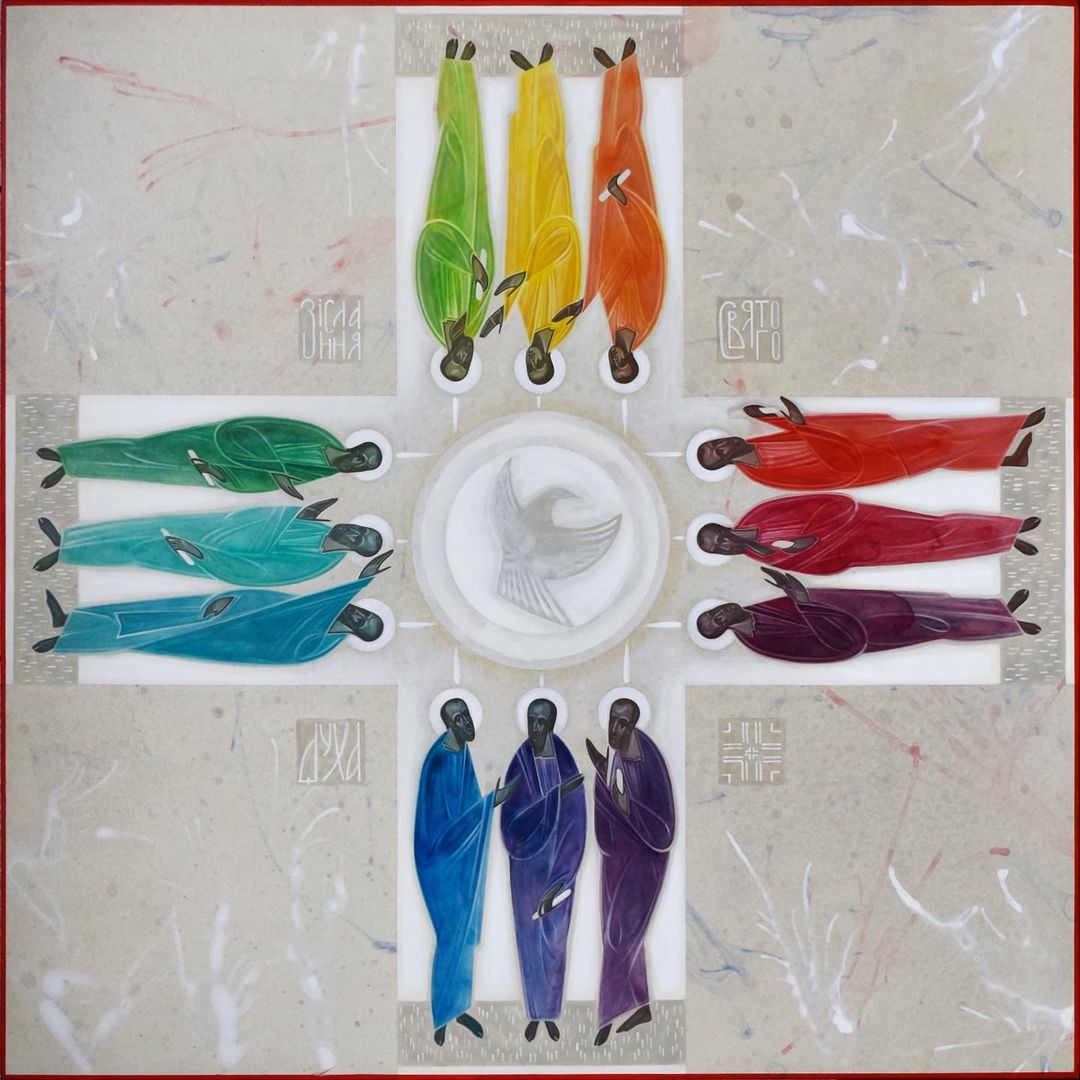
Kvyk, Khrystyna_Pentecost
Khrystyna Kvyk (Ukrainian, 1994–), Pentecost, 2021. Acrylic on gessoed wood, 45 × 45 cm.

This is the final installment of a three-part series by Antlitz. Part 1 answers, What Are Icons?, and part 2 is about “Praying Through Icons.”

+++

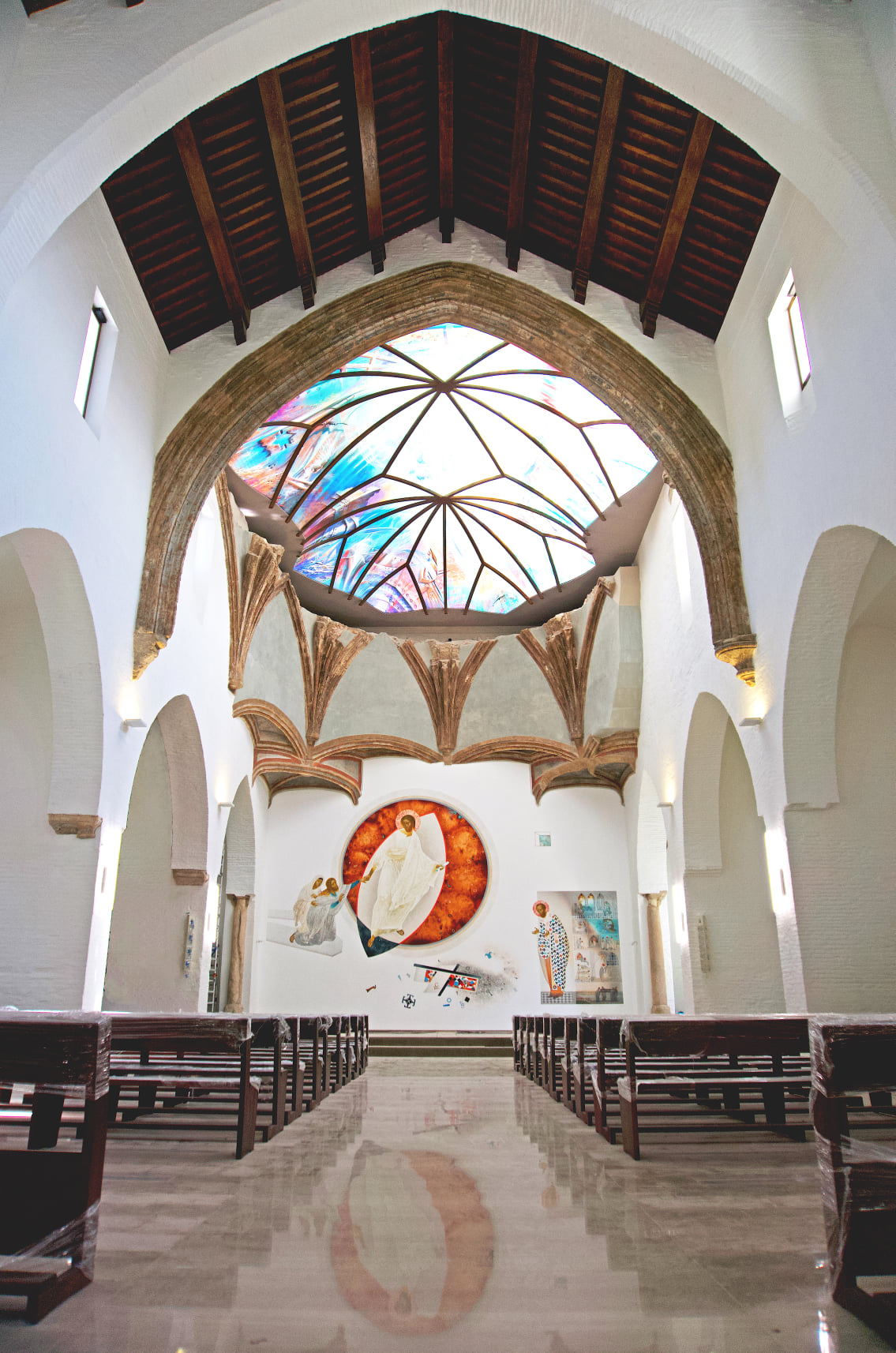
NEW CHURCH COMMISSION: Wall paintings at Iglesia de San Nicolás by Ivanka Demchuk and Arsen Bereza: Ukrainian artists Ivanka Demchuk and Arsen Bereza—a married couple!—have completed a monumental painting on the east wall of the Catholic church of Saint Nicholas in Granada. It was deeply influenced by Byzantine iconography, in which they’ve both been trained, but also contains some modern abstract and geometric elements.

The church building is from the sixteenth century and recently underwent extensive renovations, finally reopening to the public in April, which is when Demchuk and Bereza’s mural was unveiled. It portrays the Anastasis, the Eastern Orthodox image of Christ’s resurrection, which shows him breaking down the doors of hell to release its captives. In the video (which is in Ukrainian with Spanish subtitles), Demchuk describes how they painted two mandorlas behind him: the almond-shaped one symbolizing his divine light, and a round one symbolizing the cosmos.

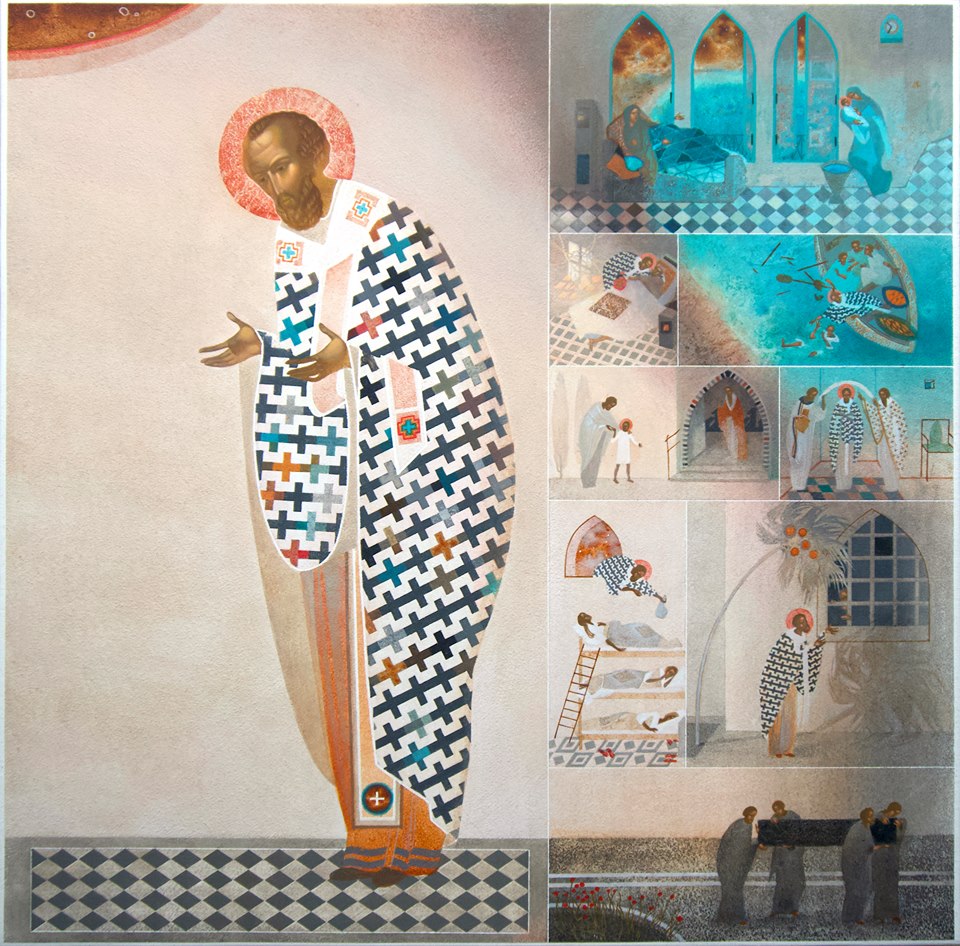
Appearing alongside this focal point is a portrait of the church’s namesake, Saint Nicholas, with eight scenes from his life—including my favorite, where he tosses three bags of gold through the window of an impoverished family’s home. (The legend of Santa Claus—Claus being a shortened form of “Nicholas”—evolved from this story of anonymous gift giving.)

Demchuk, Ivanka_Anastasis (in situ)
Iglesia de San Nicolás, Granada, Spain, 2022, with east end mural by Ivanka Demchuk and Arsen Bereza

Demchuk, Ivanka_Resurrection
Ivanka Demchuk (Ukrainian, 1990–), Resurrection, 2018. Mixed media on wood. Design for the Church of St. Nicholas, Granada, Spain.

Demchuk, Ivanka_St. Nicholas with Scenes from His Life
Ivanka Demchuk (Ukrainian, 1990–), Saint Nicholas with Scenes from His Life, 2018. Mixed media on wood. Design for the Church of St. Nicholas, Granada, Spain.

See more photos of the project on Demchuk’s Facebook page.

+++

BLOG POST: “The Meaning of Melchizedek in Icons” by David Coomler: Though he’s not religious, David Coomler is an expert on Christian icons and often consults on them. On his blog he unpacks the iconography of standard types but also more unusual ones, like You Are a Priest Forever After the Order of Melchizedek, inspired by Hebrews 7. This rare type is meant to show that Jesus is both the offering and the offerer. The variation pictured below shows, I think, three representations of Christ: as crucified seraph (still quite puzzling to me, but Coomler points out that the Greek of Isaiah 9:6 refers to the Messiah as the “Messenger of Great Counsel”), Holy Wisdom (aka Sophia), and high priest—hence the man in ecclesiastical garb in the back. Wild!

Icon with Jesus High Priest

Beauty and joy in the paintings of Alma Thomas

I’ve never bothered painting the ugly things in life. . . . No. I wanted something beautiful that you could sit down and look at. [1]

What is more far reaching than beauty? [2]

Alma Thomas
Alma Thomas. Photo © 1976 Michael Fischer, courtesy of the Smithsonian American Art Museum, Washington, DC.

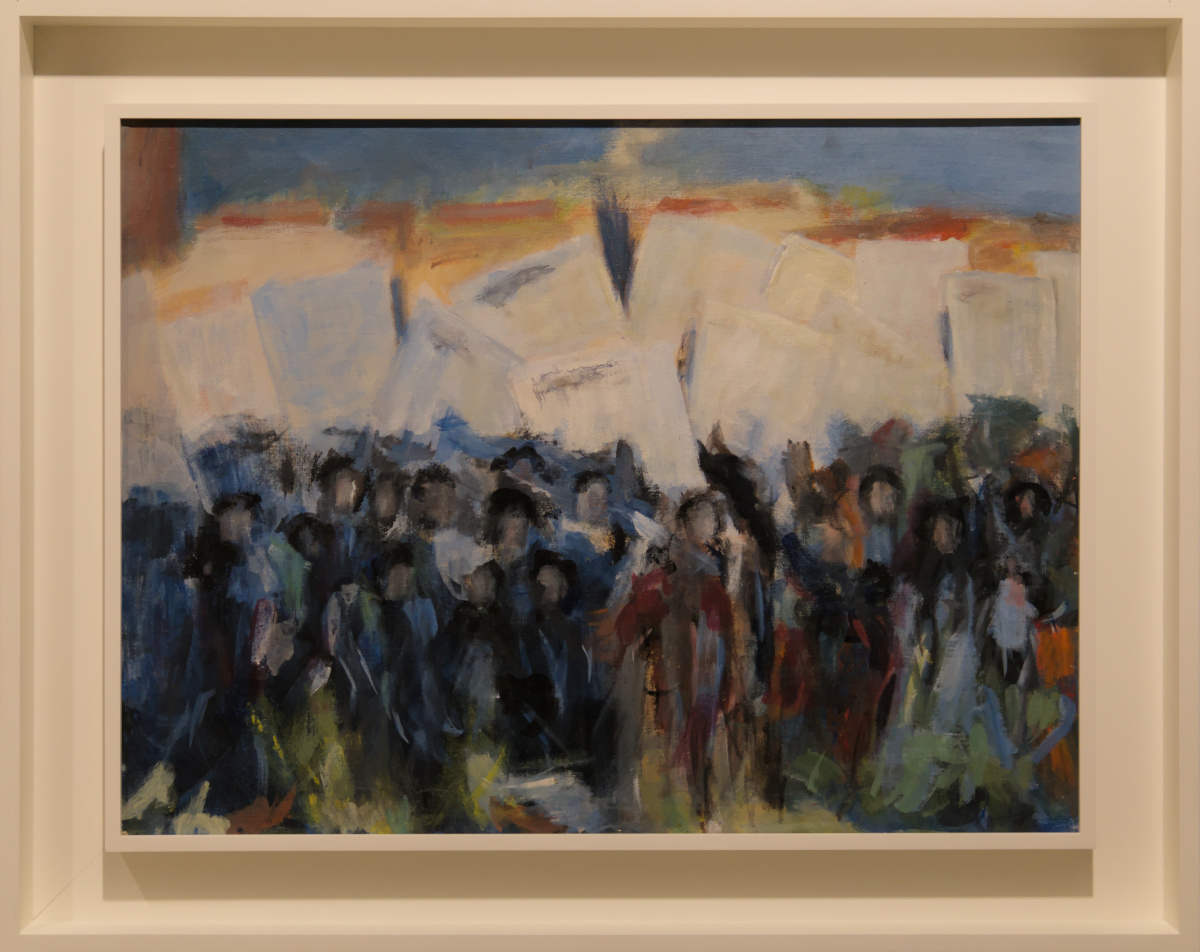
Last October I saw the wonderful retrospective exhibition Alma W. Thomas: Everything Is Beautiful at the Phillips Collection in Washington, DC, co-organized by the Chrysler Museum of Art in Norfolk, Virginia, and the Columbus Museum in Columbus, Georgia. Taking its title from the 1970 hit song by Ray Stevens (which was on the mixtape Thomas listened to while she painted), the exhibition shows that Thomas’s creativity extended beyond the studio to encompass interior design, costume design, fashion, puppetry, teaching, service, gardening, and more.
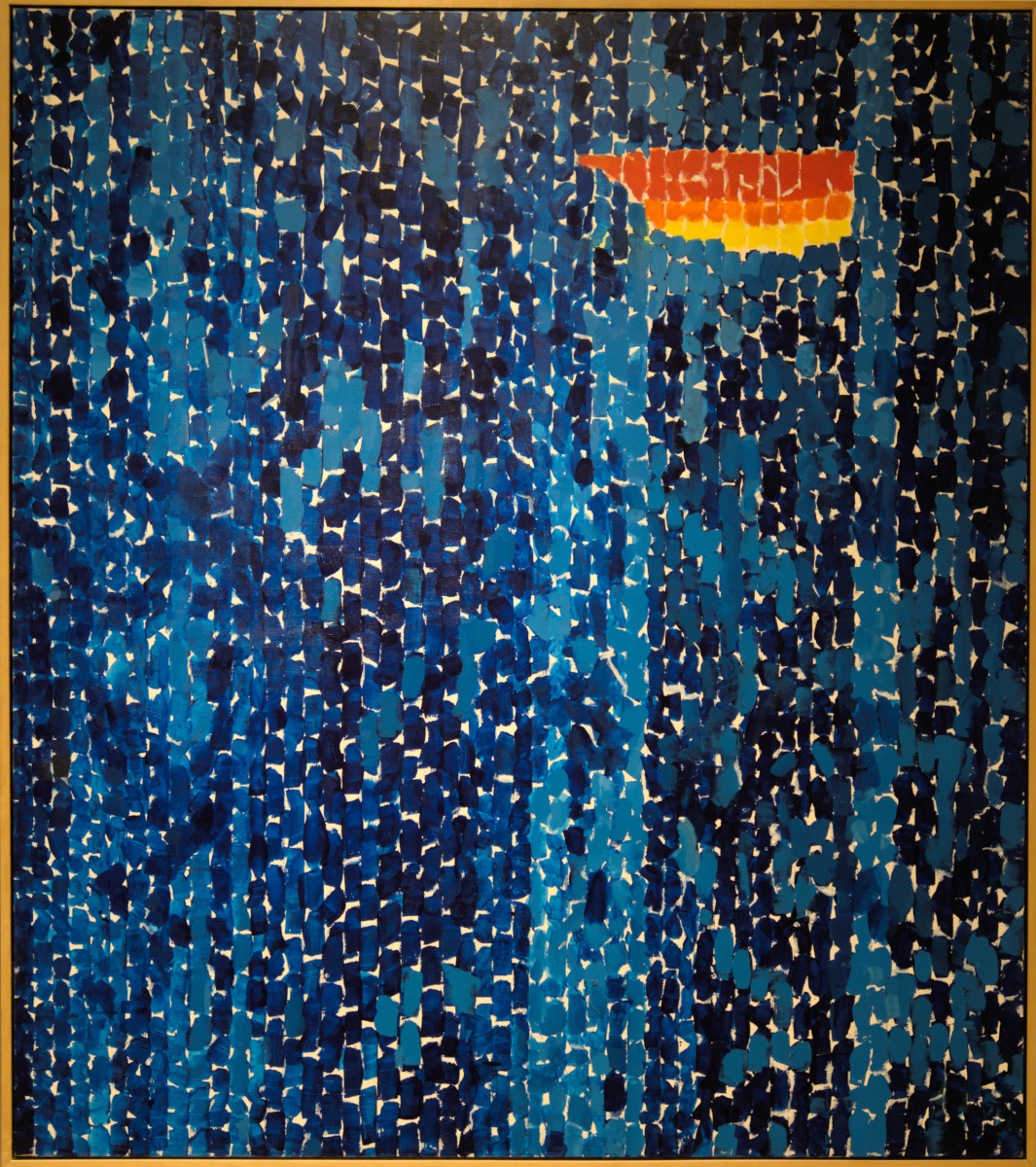
Alma Thomas (1891–1978) was an African American artist best known for her exuberant abstract paintings inspired by the hues, patterns, and movement of trees and flowers in and around her neighborhood in Northwest Washington, DC. Seeking relief from the racial violence in her native Georgia and better educational opportunities, she moved to Washington with her family at age fifteen and remained there for the rest of her life. In 1924 she became Howard University’s first fine arts graduate, and after that taught art for thirty-five years at Shaw Junior High School, leaving behind a celebrated legacy as an educator and a champion for Black youth. She was also an active member of St. Luke’s Episcopal Church, through which she founded the Sunday Afternoon Beauty Club, organizing field trips, lectures, and other activities to promote arts appreciation.

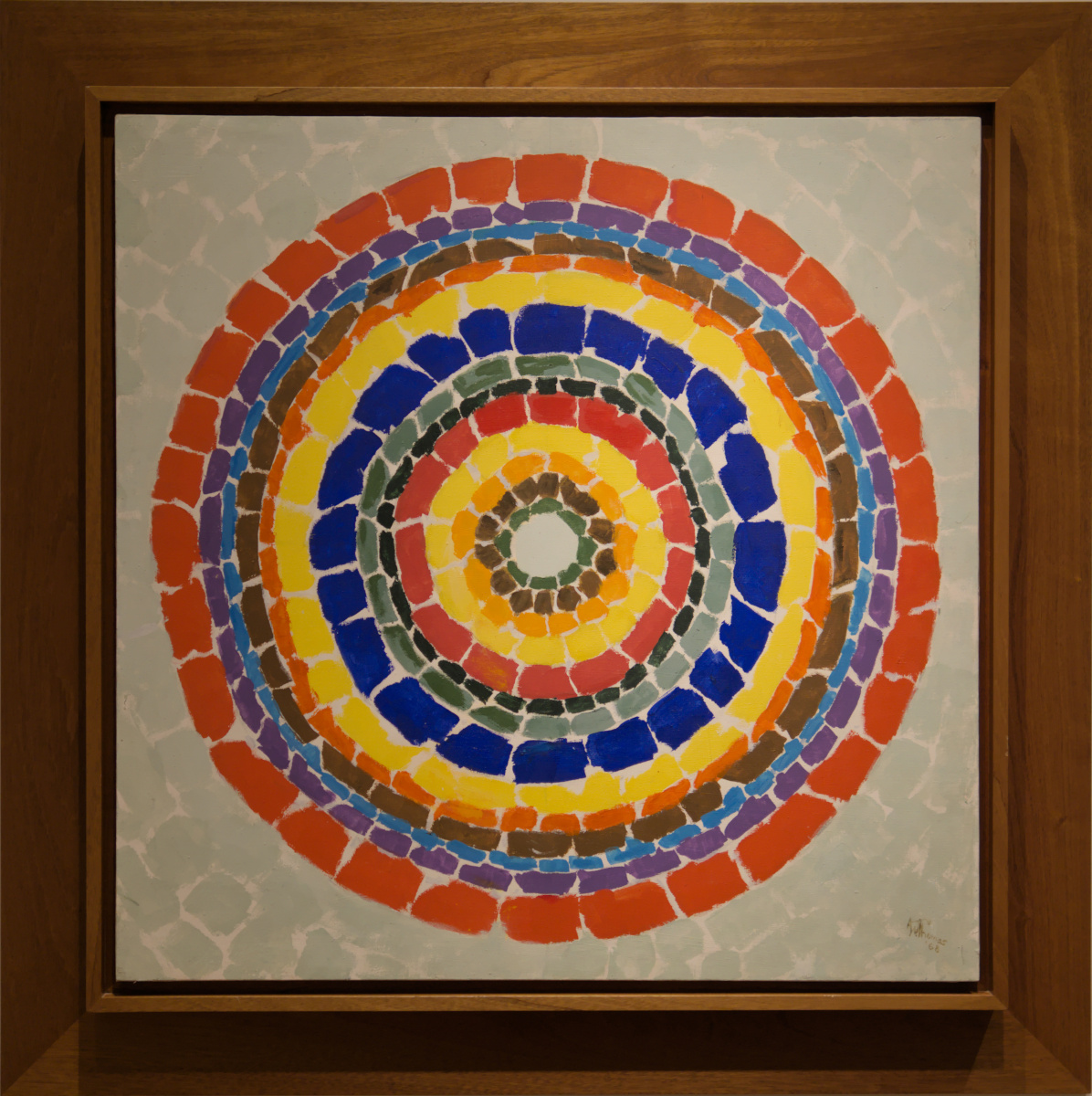
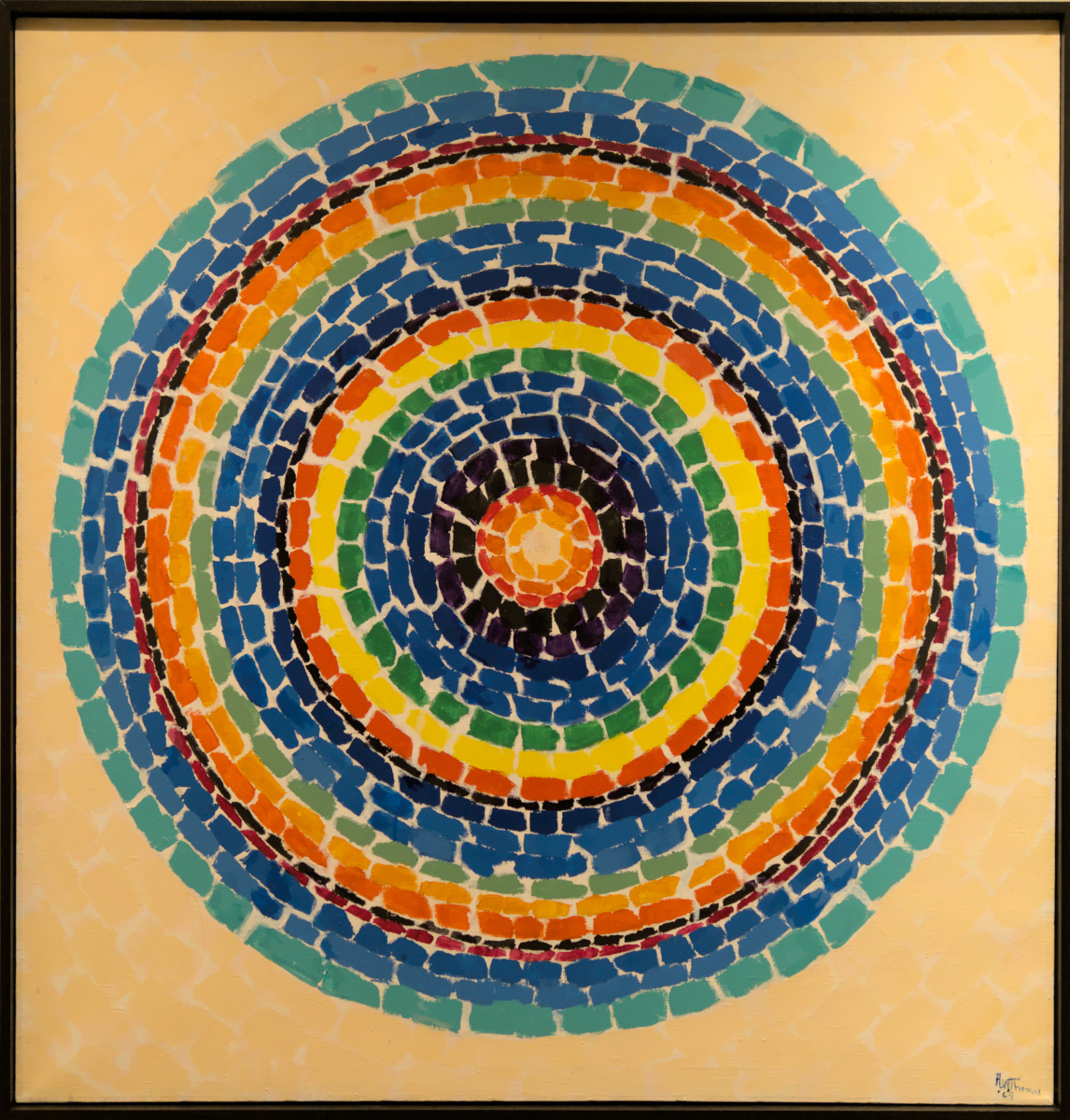
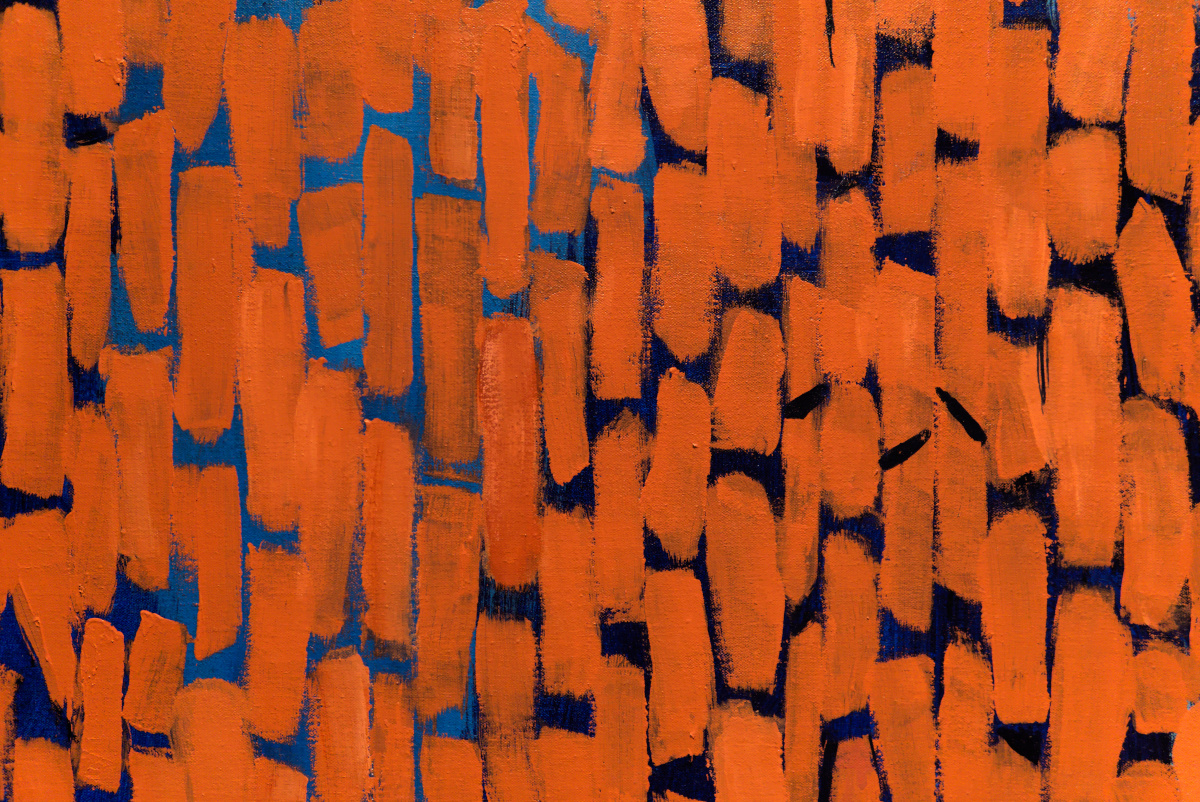
Though Thomas had been painting for decades, she didn’t develop her signature style—consisting of vibrant paint pats arranged in columns or concentric circles—until about 1965, after retiring from teaching; she called these irregular free blocks “Alma’s Stripes.” Her exploration of the power of simplified color and form in luminous, contemplative, nonobjective paintings means she is often classified as a Color Field painter, and she is particularly associated with the Washington Color School. At age eighty she had her first major exhibition, at the Whitney Museum of American Art in New York in 1972. She was the first Black woman to receive a solo show at this prestigious museum, and the show won her instant acclaim.

Thomas, Alma_A Joyful Scene of Spring
Alma W. Thomas (American, 1891–1978), A Joyful Scene of Spring, 1968. Acrylic on canvas, 36 1/4 × 36 1/4 in. Collection of the Love, Luck & Faith Foundation. Photo: Victoria Emily Jones. “Spring delivers her dynamic sermons to the world each year, drenching one’s soul with its extravaganza,” Thomas said (catalog, p. 167).

The natural world was an enduring source of inspiration for Thomas. She kept a flower garden in her backyard and frequented the green spaces of the nation’s capital. She described the holly tree visible through the bay window of her living room with great relish:

That tree, I love it. It’s the one who inspired me to do this sort of thing. The composition in the bay window reached me each morning—the colors, the wind who is their creative designer, the sunshine filtering through the leaves to add joy. The white comes through those leaves and gives me the white of the canvas. I’m fascinated by the way the white canvas dots around, and above, and through the color format. My strokes are free and irregular, some close together, others far apart, thus creating interesting patterns of canvas peeking around the strokes. [3]

Thomas saw nature as having a musicality, an idea underscored by many of the titles she gave her paintings, which pair terms from classical music especially—such as “symphony,” “sonata,” “concerto,” “rhapsody,” “étude”—with the names of trees or flowers. Nature sounds forth an array of notes, all in resplendent harmony with one another. And its compositions are new every morning!

(Related post: “Nature as extravagant gift from God”)

Thomas’s rhythmic dabs of prismatic color express joy, celebration, and wonder at God’s creation and are reminiscent of those biblical psalms in which nature is said to praise God (e.g., Psalm 19:1–3; Psalm 65:12–13; Psalm 96:11–12; Psalm 98:4–8). Not only is nature animate; it sings and dances and claps its hands.

Many of Thomas’s paintings, whether of outwardly radiating rings or parallel rows, are meant to suggest an aerial view of flower beds or nurseries. “I began to think about what I would see if I were in an air-plane,” she said. “You streak through the clouds so fast you don’t know whether the flower below is a violet or what. You see only streaks of color.” [4]

Thomas, Alma_Breeze Rustling Through Fall Flowers
Alma W. Thomas (American, 1891–1978), Breeze Rustling Through Fall Flowers, 1968. Acrylic on canvas, 57 7/8 × 50 in. The Phillips Collection, Washington, DC. Photo: Victoria Emily Jones.

Thomas, Alma_Wind Dancing with Spring Flowers
Alma W. Thomas (American, 1891–1978), Wind Dancing with Spring Flowers, 1969. Acrylic on canvas, 50 3/16 × 48 1/16 in. Hood Museum of Art, Dartmouth College, Hanover, New Hampshire. Photo: Victoria Emily Jones.

Thomas, Alma_Red Roses Sonata
Alma W. Thomas (American, 1891–1978), Red Roses Sonata, 1972. Acrylic on canvas, 60 × 54 in. Metropolitan Museum of Art, New York. Photo: Victoria Emily Jones.

Thomas, Alma_Cumulus
Alma W. Thomas (American, 1891–1978), Cumulus, 1972. Acrylic on canvas, 71 × 53 in. San Francisco Museum of Modern Art. Photo: Victoria Emily Jones.

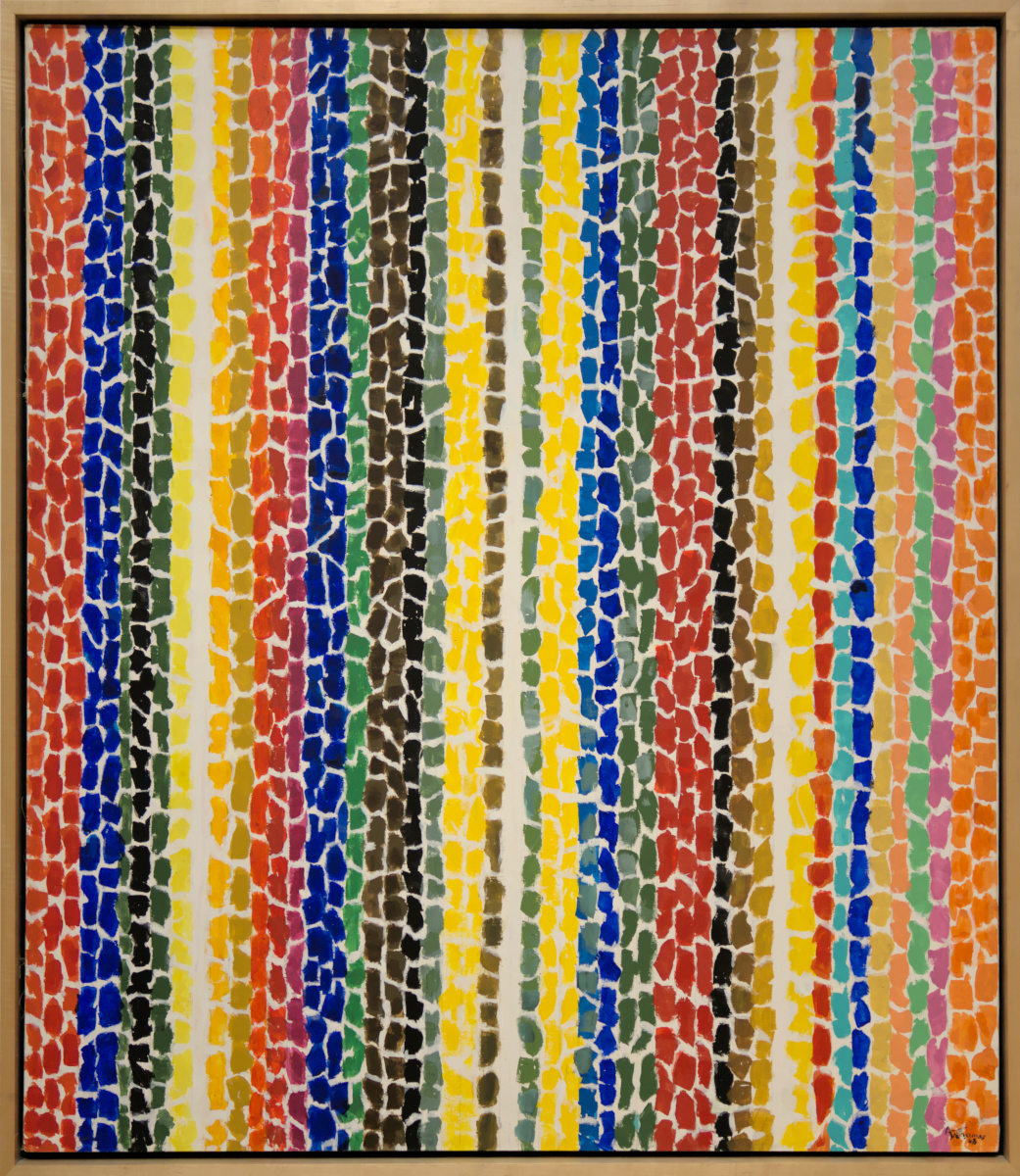
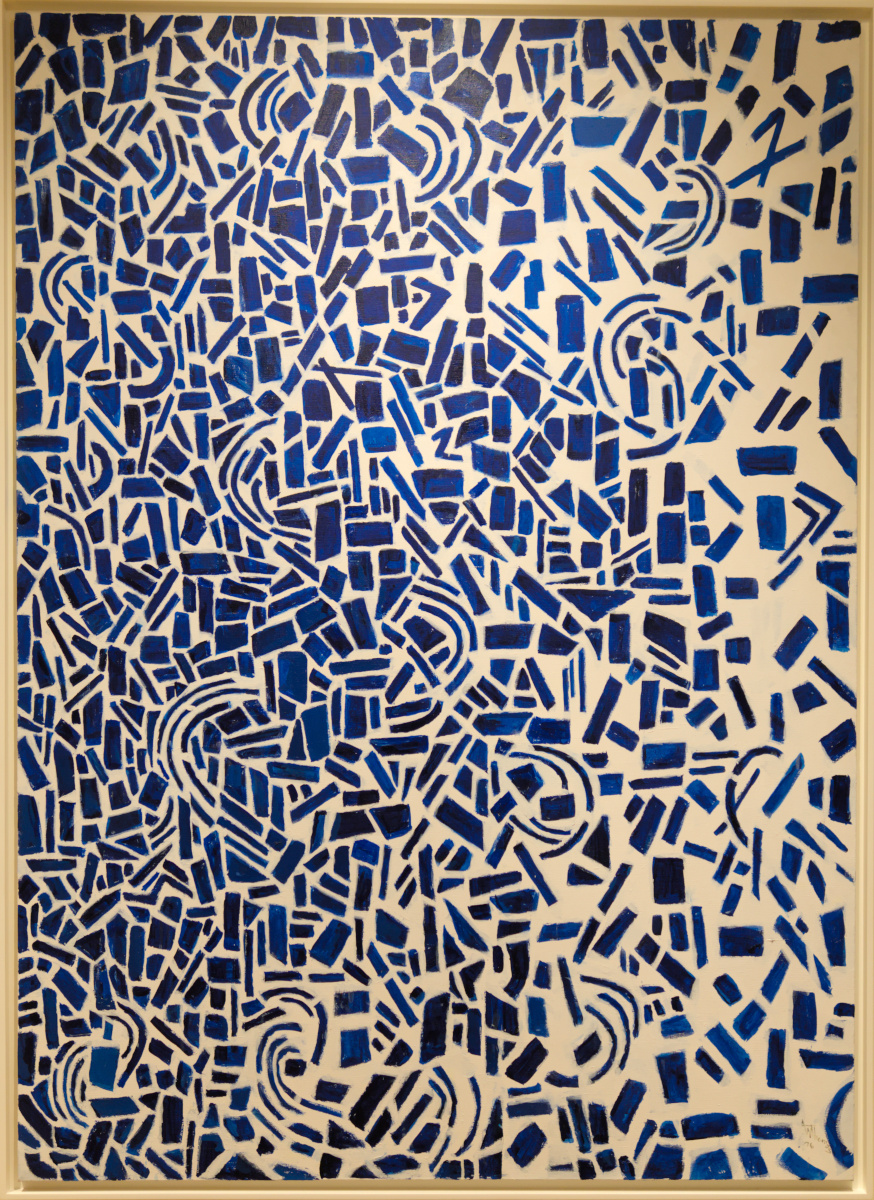
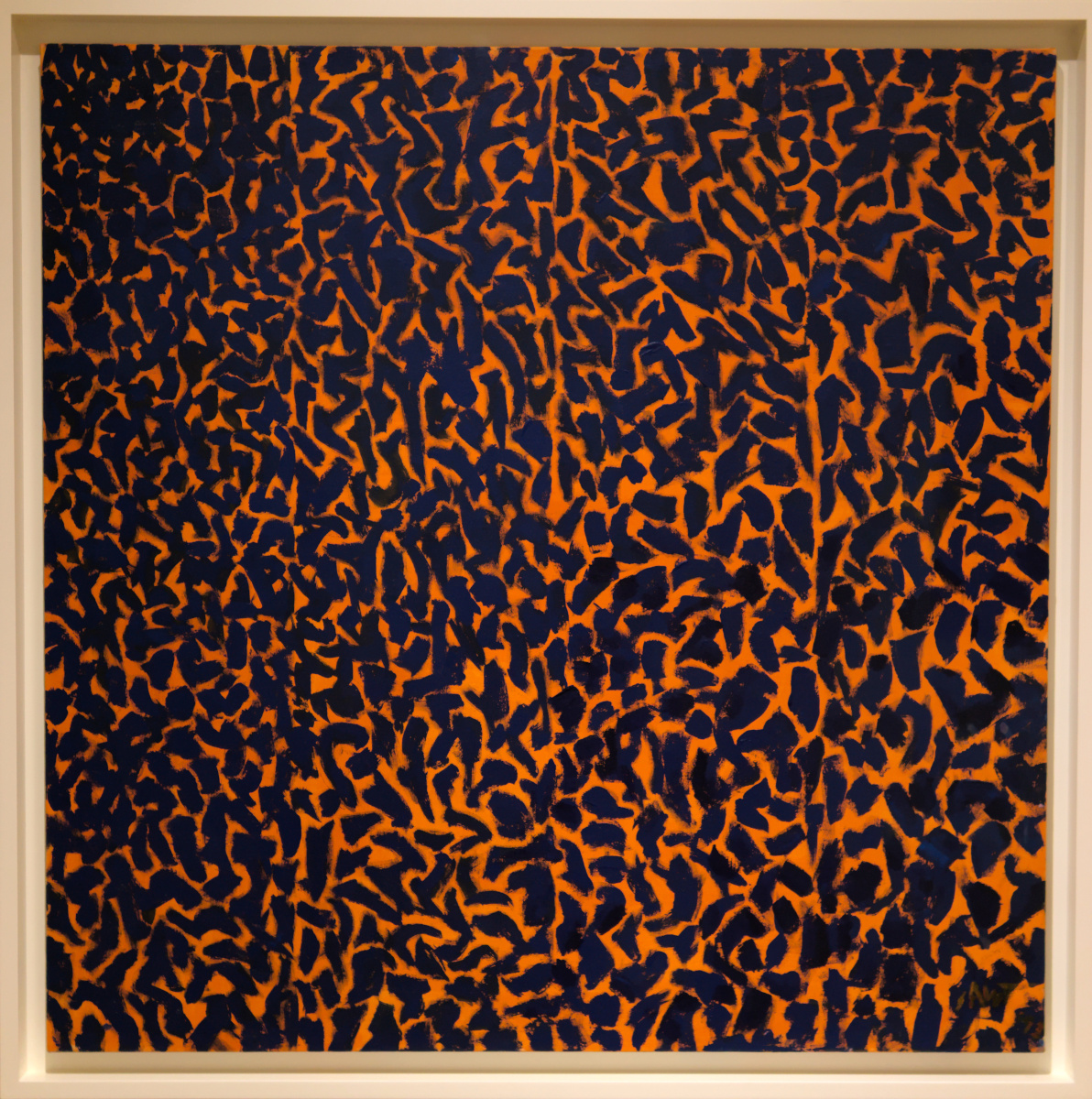
Eventually, Thomas’s vocabulary of vertically or circularly organized paint pats expanded to include “wedges, commas, and other glyphic shapes formed entirely by her brush and arranged in tessellated patterns” [5], which have the same vibratile quality. Grassy Melodic Chant visually references the path to her garden, which featured dark flagstones with off-white mortar borders.

Thomas, Alma_Grassy Melodic Chant
Alma W. Thomas (American, 1891–1978), Grassy Melodic Chant, 1976. Acrylic on canvas, 46 × 36 in. Smithsonian American Art Museum, Washington, DC. Photo: Victoria Emily Jones.

Thomas, Alma_Babbling Brook and Whistling Poplar Trees Symphony
Alma W. Thomas (American, 1891–1978), Babbling Brook and Whistling Poplar Trees Symphony, 1976. Acrylic on canvas, 72 × 52 in. Michael Rosenfeld Gallery LLC, New York. Photo: Victoria Emily Jones. Thomas recalled in reference to this painting, “I would wade in the brook [near my childhood home] and when it rained you could hear music. I would fall on the grass and look at the poplar trees and the lovely yellow leaves would whistle” (catalog, p. 33).

Thomas, Alma_Fiery Sunset
Alma W. Thomas (American, 1891–1978), Fiery Sunset, 1973. Acrylic on canvas, 41 1/4 × 41 1/4 in. Museum of Modern Art, New York. Photo: Victoria Emily Jones.

Thomas, Alma_Falling Leaves, Love Wind Orchestra
Alma W. Thomas (American, 1891–1978), Falling Leaves, Love Wind Orchestra, 1977. Acrylic on canvas, 21 1/2 × 27 1/2 in. Private collection. Photo: Victoria Emily Jones.

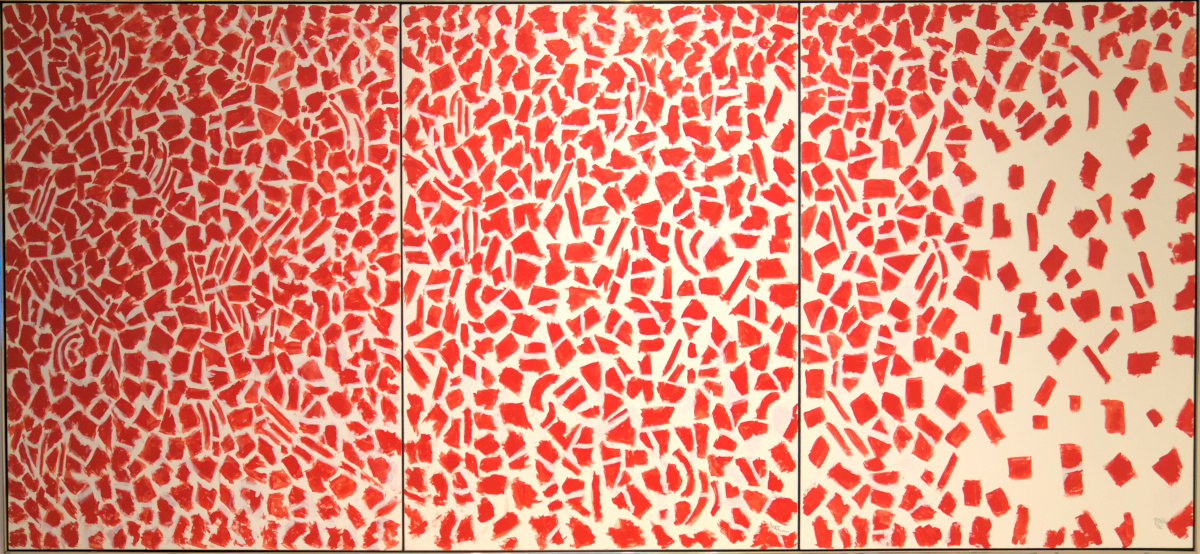
At over thirteen feet long, the monumental three-paneled Red Azaleas Singing and Dancing Rock and Roll Music (1976) is Thomas’s most ambitious painting and the touchstone of the exhibition. She painted it two years before her death, when she was suffering from painful arthritis, deteriorating vision, and the lasting repercussions of a broken hip. Though she had to adapt her technique to accommodate these ailments, her aesthetic vision is masterfully executed, and most people regard this as her magnum opus.

Thomas, Alma_Red Azaleas Singing and Dancing Rock and Roll Music
Alma W. Thomas (American, 1891–1978), Red Azaleas Singing and Dancing Rock and Roll Music, 1976. Acrylic on three canvases, 73 3/4 × 158 1/2 in. Smithsonian American Art Museum, Washington, DC. Photo: Victoria Emily Jones.

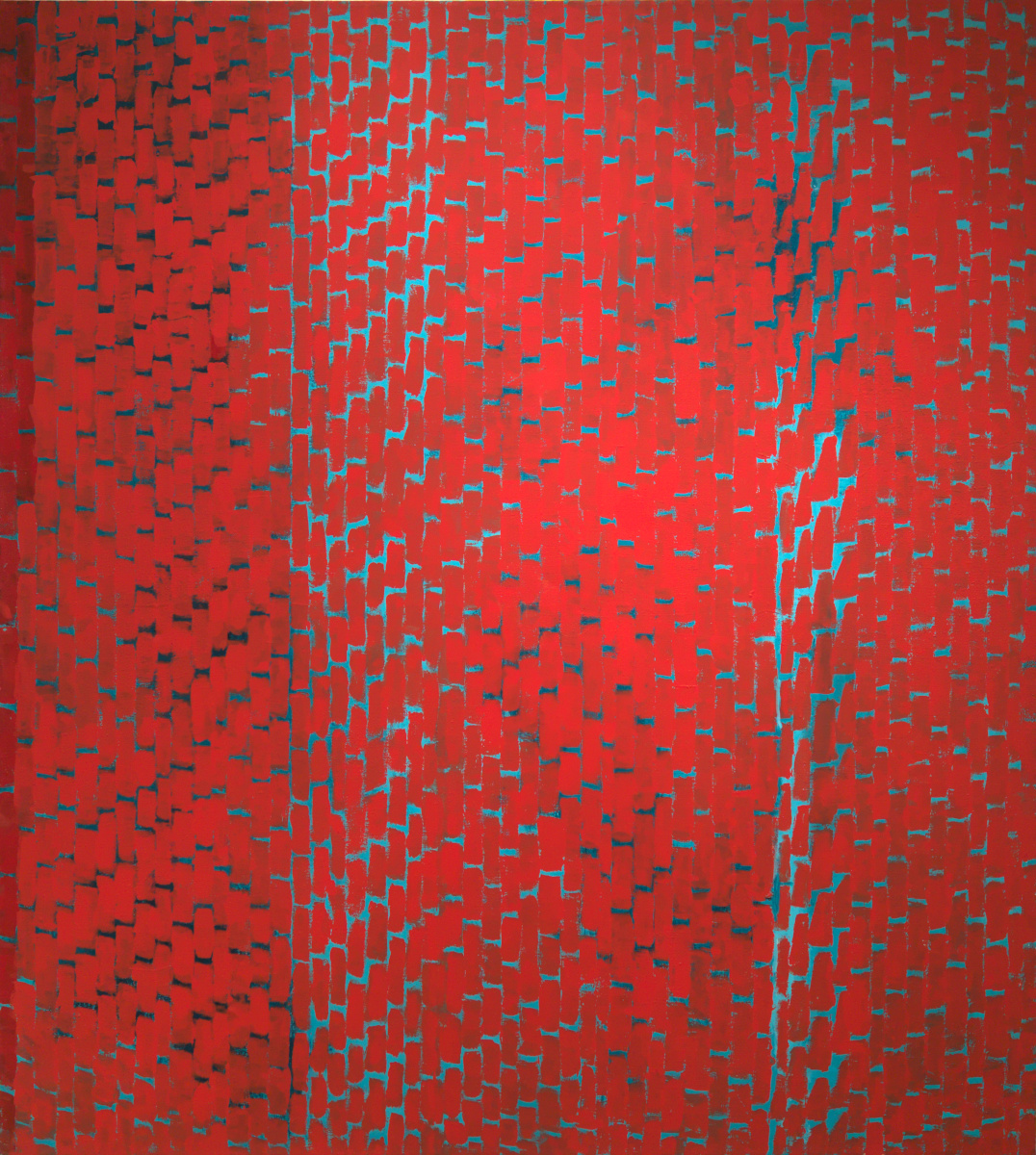
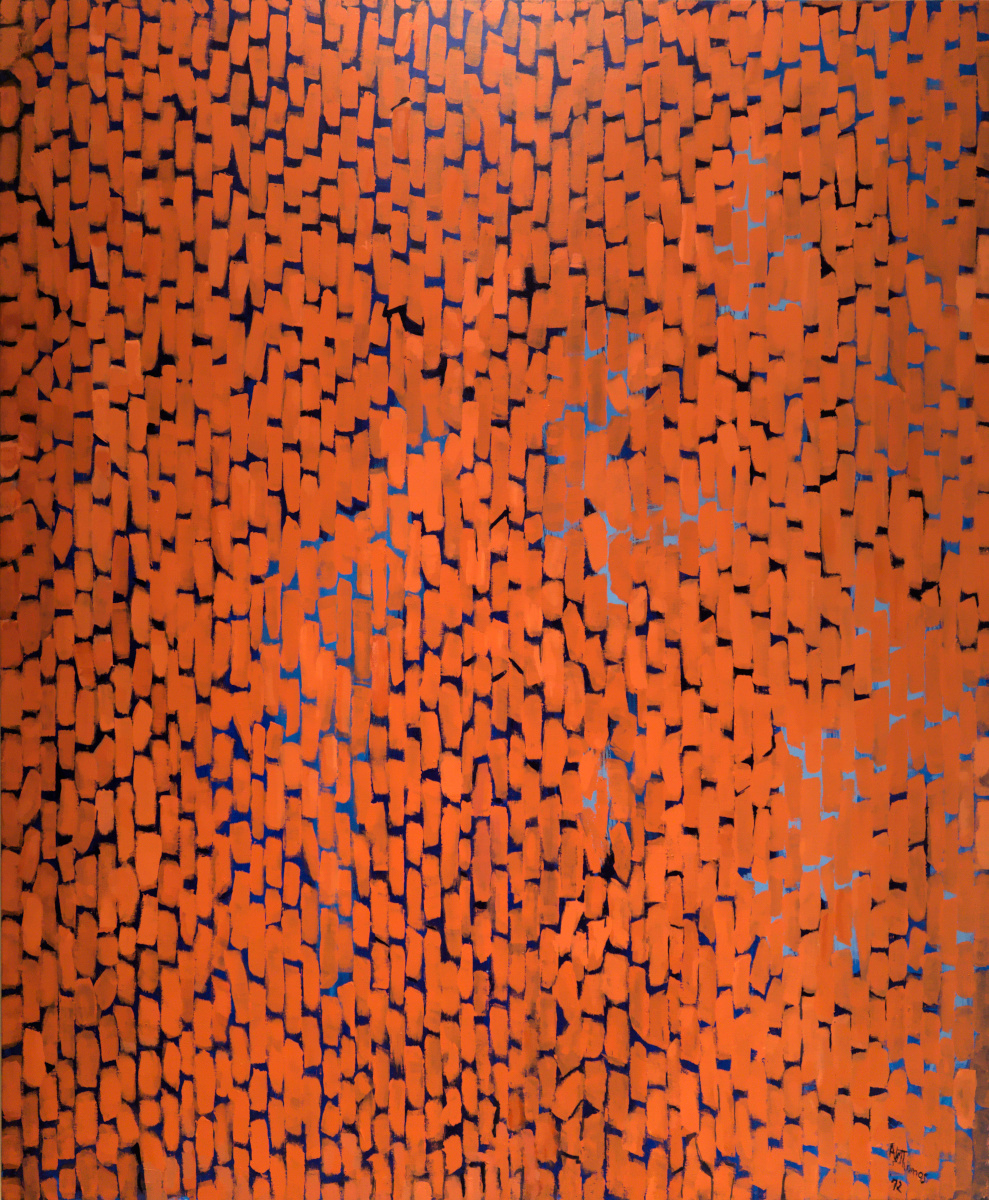
In addition to her enthusiasm for local, seasonal flora, Thomas was also really interested in space exploration. Like many Americans, she followed NASA’s lunar and Mars missions on the radio and television. She painted Mars Dust in 1971 as Mariner 9 circled the Red Planet, attempting to map its surface but being held up by a massive dust storm.

Thomas, Alma_Mars Dust
Alma W. Thomas (American, 1891–1978), Mars Dust, 1972. Acrylic on canvas, 69 1/4 × 57 1/8 in. Whitney Museum of American Art, New York. Photo: Victoria Emily Jones.

Thomas, Alma_Mars Dust (detail)
Mars Dust, detail

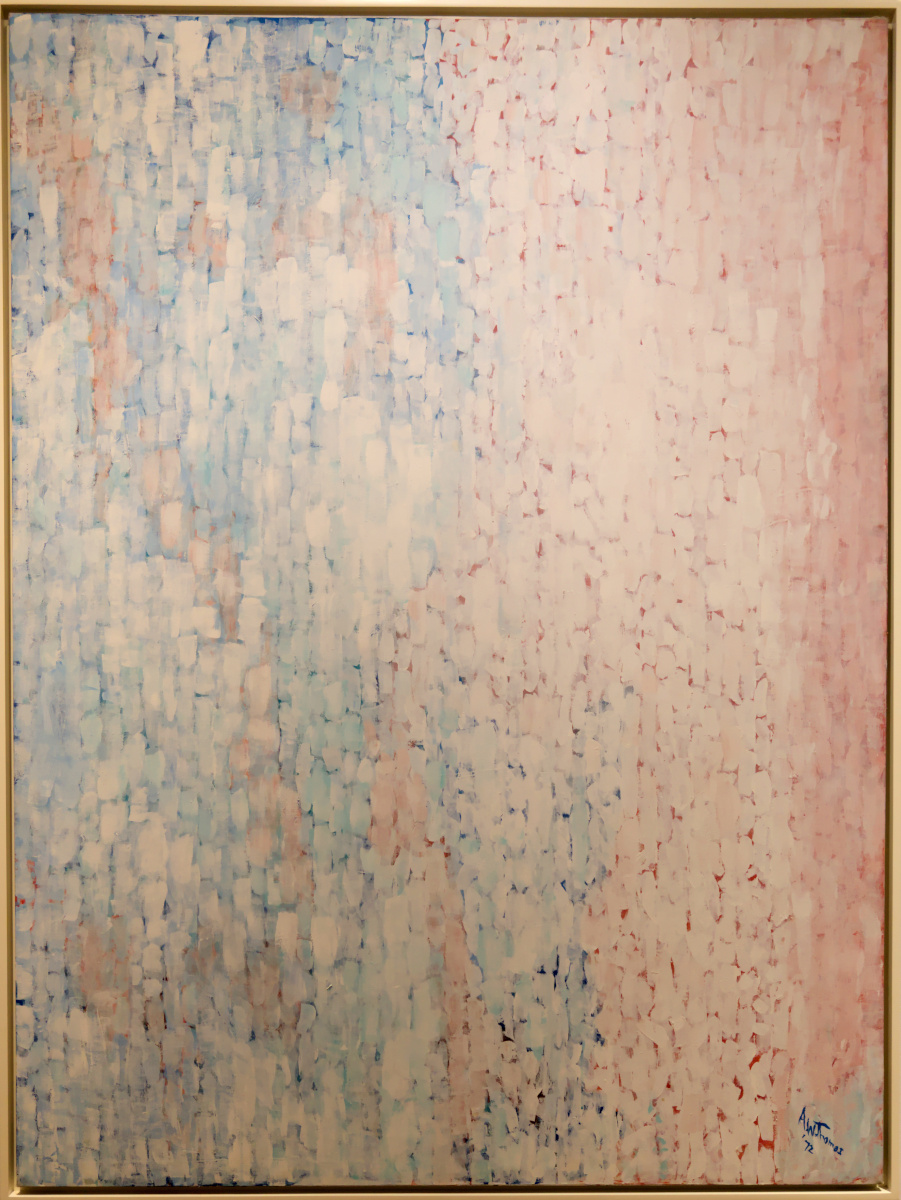
She also painted several works inspired by images taken of Earth during the Apollo 10 and 11 spaceflights, such as Snoopy Sees Earth Wrapped in Sunset (not pictured)—Snoopy being the name of the lunar module. Starry Night with Astronauts is the final work in her Space series.

Thomas, Alma_Starry Night and the Astronauts
Alma W. Thomas (American, 1891–1978), Starry Night and the Astronauts, 1972. Acrylic on canvas, 60 × 53 in. Art Institute of Chicago. Photo: Victoria Emily Jones.

Thomas’s choice to paint apolitical abstractions rather than taking the Black human figure as her subject was somewhat controversial. Members of the Black Arts Movement rigidly insisted that “Black artists should be making work that furthered the goals of Black liberation by speaking directly to their own communities rather than trying to fit into white aesthetic frameworks or addressing non-Black audiences. . . . In the process, they largely rejected visual abstraction because it was rooted in a European modernist tradition, one that had very little to do, they believed, with the lives and urgencies of Black folks.” [6]

Thomas disliked being pigeonholed as a “Black artist” and resisted the idea that responsible art must be oriented toward social activism. “We artists are put on God’s good earth to create,” she said. “Some of us may be black, but that’s not the important thing. The important thing is for us to create, to give form to what we have inside us. We can’t accept any barriers, any limitations of any kind, on what we create or how we do it.” [7] And elsewhere: “Through color, I have sought to concentrate on beauty and happiness, rather than on man’s inhumanity to man.” [8] In finding success as an abstractionist focused on beauty in nature and in technological innovation, she broke down barriers of what were considered (by both whites and Blacks) acceptable styles and subject matter for African American art.

This doesn’t mean Thomas was indifferent to Black progress. On the contrary, she was deeply involved in advancing racial uplift in her own community.

Thomas, far from retreating from the world, had always flung herself headlong into it. She devoted her life to advancing the lives of her Black students, peers, and neighbors—from her commitment to education (“Education is the strongest weapon we [African Americans] have,” she insisted); to her work to establish an art gallery that would collect the creations of Black people so as to begin to build an art historical archive; to her collaborations with civil rights organizations and publications; to her backyard garden, which she treated as a small offering of beauty in the midst of her gritty surroundings. [9]

Her one political painting, for which she painted two preparatory sketches, is on the August 28, 1963, March on Washington for Jobs and Freedom, which she participated in.

Thomas, Alma_March on Washington (sketch)
Alma Thomas (American, 1891–1978), Sketch for March on Washington, ca. 1963. Acrylic on canvasboard, 20 × 24 in. The Columbus Museum, Columbus, Georgia. Photo: Victoria Emily Jones.

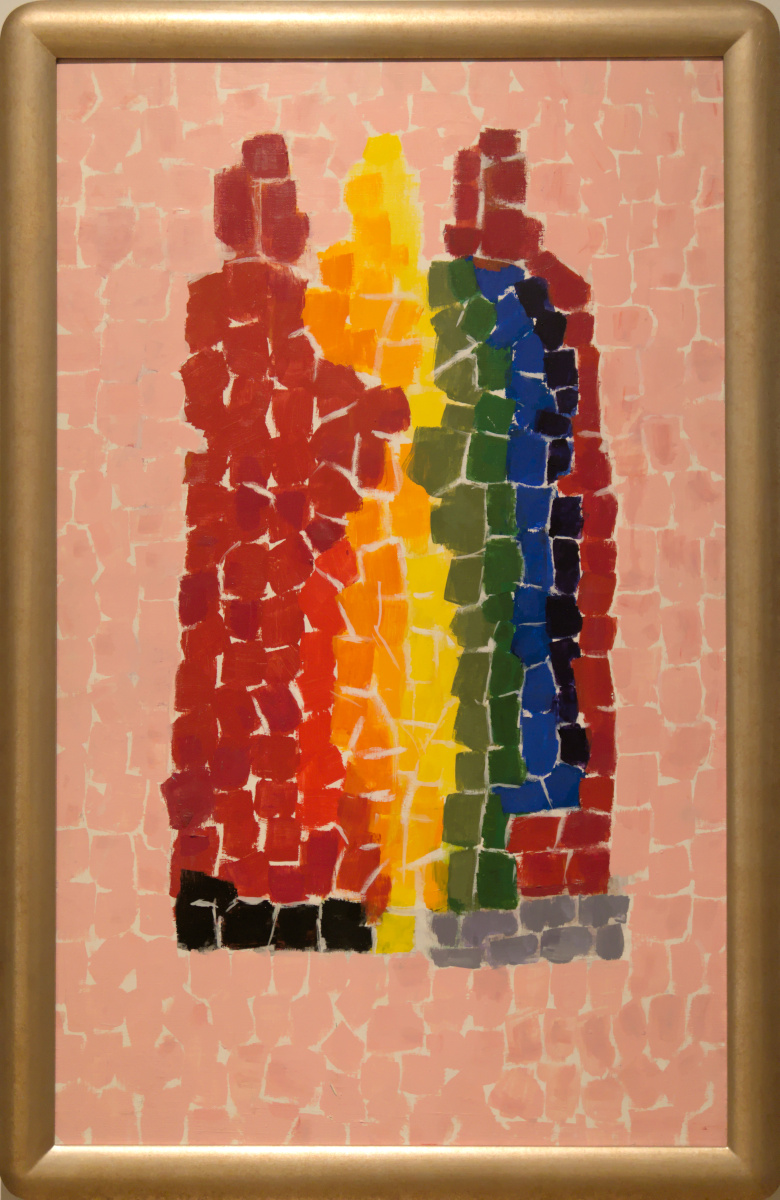
She also painted a few explicitly religious subjects, among them the Journey of the Magi and the Entombment of Christ.

Thomas, Alma_Three Wise Men
Alma W. Thomas (American, 1891–1978), Three Wise Men, 1966. Acrylic on canvas, 36 1/2 × 23 1/2 in. Collection of the Harmon and Harriet Kelley Foundation for the Arts. Photo: Victoria Emily Jones.

Thomas, Alma_They Laid Him in the Tomb
Alma W. Thomas (American, 1891–1978), They Laid Him in the Tomb, ca. 1958. Oil on canvas, 32 1/4 × 40 1/4 in. Collection of Paola Luptak. Photo: Victoria Emily Jones.

Alma W. Thomas: Everything Is Beautiful has left the Phillips but will be at the Frist Art Museum in Nashville from February 25 to June 5, 2022. From there it will visit the Columbus Museum in Columbus, Georgia (Thomas’s birthplace), from July 1 to September 25, 2022.

At the archived Phillips exhibition page, you can find video lectures and conversations and audio commentaries, plus you can take a 360-degree virtual tour of the exhibition. Washington-area readers: if you missed Everything Is Beautiful and want the chance to see Thomas’s work in person, mark your calendars for October 2023, when the Smithsonian American Art Museum will be exhibiting the more than two dozen Thomas paintings in its collection; the show is called Composing Color: Paintings by Alma Thomas.

There is plenty of material out there about Alma Thomas. A few other resources I’ll point you to are the Alma W. Thomas: Everything Is Beautiful catalog, of which the following video gives you a look inside:

The National Women’s History Museum also curated an interactive online exhibition about Thomas through Google Arts & Culture.

NOTES

1. Alma Thomas, quoted in Eleanor Munro, Originals: American Women Artists (New York: Simon and Schuster, 1979), 194.

2. This rhetorical question of Thomas’s is printed beneath her 1924 senior class photograph in The Bison, Howard University’s annual. Seth Feman and Jonathan Frederick Walz, eds., Alma W. Thomas: Everything Is Beautiful (New Haven, CT: Yale University Press, 2021), 78 (fig. 3).

3. Quoted in Andrea O. Cohen, “Alma Thomas,” DC Gazette, October 26–November 8, 1970.

4. Alma Thomas Papers, untitled statement, Biographical Accounts and Notes, c. 1950s–c . 1970s, box 1, folder 2, page 10.

5. Sydney Nikolaus, et al., “Composing Color: The Materials and Techniques of Alma Woodsey Thomas,” in Feman and Walz, 105.

6. Aruna D’Souza, “What Filters Through the Spaces Between,” in Feman and Walz, 61.

7. Quoted in Adolphus Ealey, “Remembering Alma,” in Merry A. Foresta, A Life in Art: Alma Thomas, 1891–1978 (Washington, DC: Smithsonian Institution Press for the National Museum of American Art, 1981), 12.

8. Quoted in David L. Shirey, “At 77, She’s Made It to the Whitney,” New York Times, May 4, 1972, 52.

9. Aruna D’Souza, “What Filters Through,” 69.

Holy Saturday: Keening

All four canonical Gospel accounts of the retrieval of Jesus’s body from the cross and its entombment are very matter-of-fact. There is no mention of grieving. The focus is on the roles of Joseph of Arimathea and Nicodemus, though Matthew and Mark mention two Marys being present (Matt. 27:61; Mark 15:47), and Luke refers generically to “the women who had come with him from Galilee” (Luke 23:55). Mark and Luke also mention the women preparing and, after the Sabbath, returning with burial spices (Mark 16:1; Luke 23:56–24:1).

Leave it to the artists, poets, and composers to inject some emotion into these undeniably wrenching moments! Of carrying the corpse of a loved one, cleaning it, dressing it, and saying goodbye as it’s put into the earth. There is an enormous number of paintings, sculptures, music, and literary texts composed over the centuries to aid Christians in meditating on the dead Christ and vicariously lamenting with those present, especially the Virgin Mary.

After Mary and the others laid Jesus to rest on Friday, their mourning continued, I’m sure, into Saturday. They were utterly bereft.

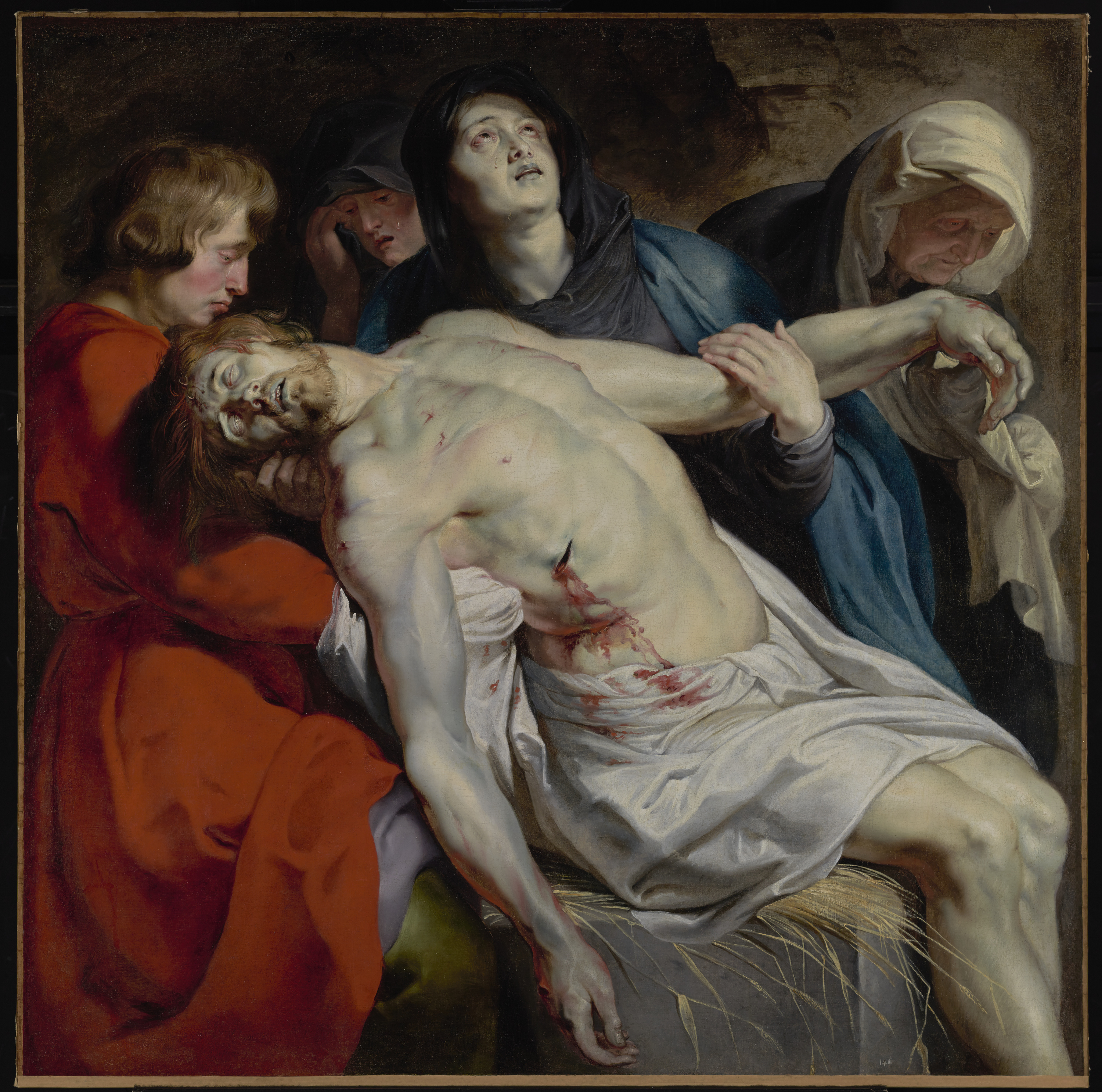
LOOK: Peter Paul Rubens (Flemish, 1577–1640), The Entombment, ca. 1612. Oil on canvas, 51 5/8 × 51 1/4 in. (131.1 × 130.2 cm). J. Paul Getty Museum, Los Angeles.

The Flemish Baroque artist Peter Paul Rubens painted scenes of the lamentation of Christ many times. I saw this one in person at the Getty a few years ago, and it really drew me in. It shows Saint John and the Virgin Mary supporting Jesus’s body as they lay him down onto a stone slab. Mary Magdalene weeps from behind, and another, older Mary, the mother of James the Younger and Joseph (Matt. 27:56; Mark 15:40), gingerly lifts his wounded hand, fixing her sorrow there.

Rubens does not shy away from the ugliness of death, showing Jesus’s eyes rolled back in his head, his lips blue, and blood caked in his hair and dried up around the gaping laceration in his side. His whole body is pale with death, his skin green-tinged, in contrast to John’s ruddy complexion; his mother wears the same deathly pallor. Her eyes are red and puffy, and she looks up to the heavens as if to question why, or to petition God for strength.

The wheat that Jesus lies on alludes to the straw he was bedded in as a newborn and to the bread of the Eucharist on the altar. Christ’s body is given as a holy offering for the sins of the world.

LISTEN: “Song of Keening” by Áine Minogue, on Celtic Lamentations: Healing Music for Twelve Months and a Day (2005)

Áine Minogue is an award-winning Irish harpist, singer, arranger, and composer, now living in the Boston area. She plays and sings a mix of traditional tunes and original songs, most with Gaelic lyrics. “Song of Keening” wasn’t written explicitly for Holy Week, but it is a funeral lament that uses non-word utterances to express grief. Minogue writes,

In old Ireland, the practice of keening provided a physical and emotional release for those who grieved. Sometimes, keening was a direct emotional response to loss, practiced by both men and women, though particularly by women who had lost young children—a common occurrence in the past, when child mortality rates were significantly higher.

However, often a professional keener was hired by a family as a way of honoring the dead. These professional mourners were always women, and their keening was more stylized, taking the form of an improvisation based on particular structures and handed-down phrases. Though practiced in diverse cultures from Ireland to Greece, keening was generally frowned upon by church authorities, and treated with disdain by those who embraced the trappings of modernity. The practice now has virtually died out.

This piece is improvised in the old style, using old structures and vocables.

Professional mourners (moirologists) were used in ancient Israel too, at least by those wealthy enough to afford them. There’s no indication that any were present at the death of Jesus. In art history the chief mourners at Jesus’s crucifixion and burial are his mother, Mary; John, to whose care Mary was entrusted; Mary Magdalene; and Jesus’s other female followers.

This song appears on the Art & Theology Holy Week Playlist.

The Tabernacle of Cherves (Limoges enamel, 13th century)

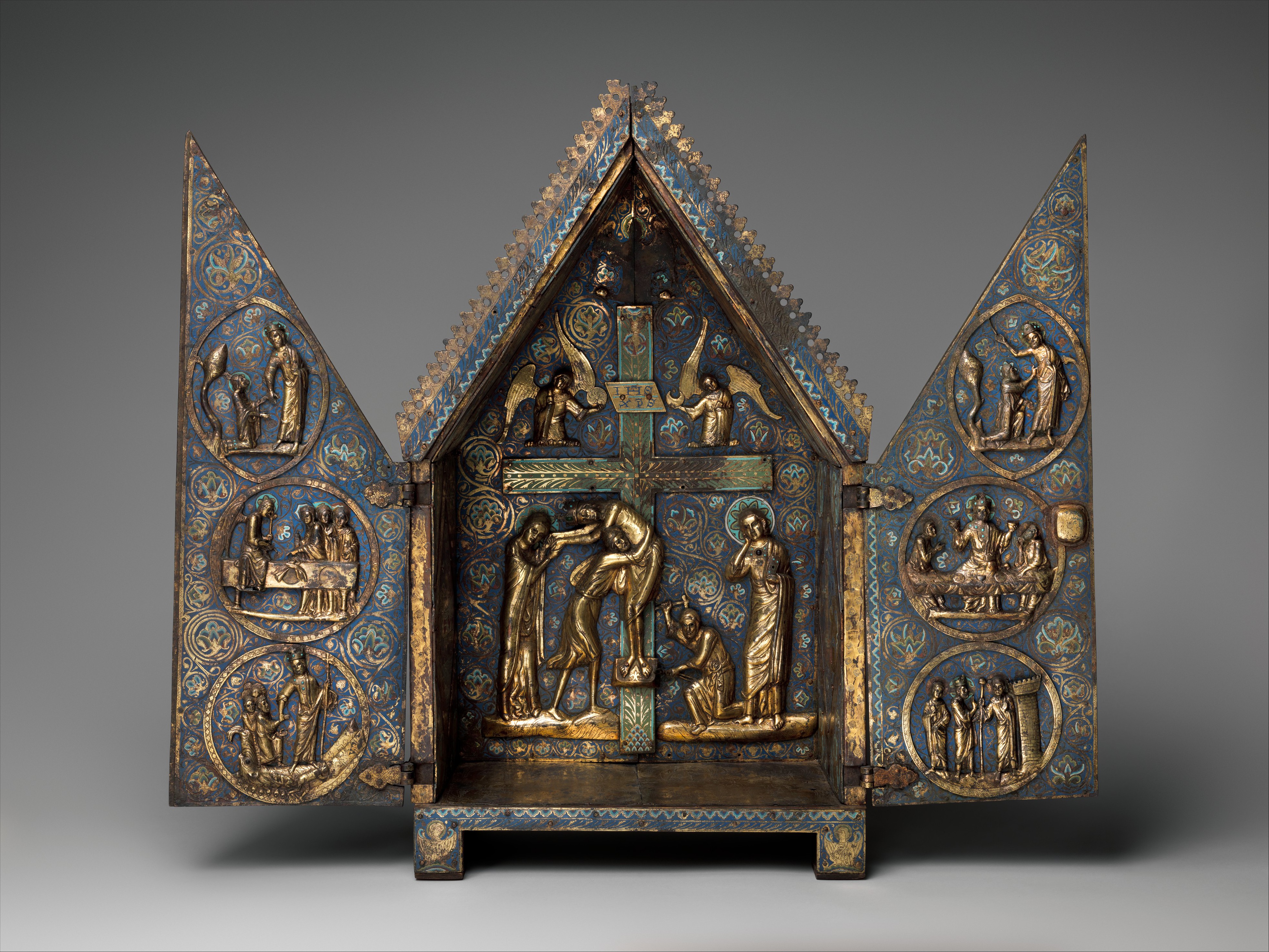
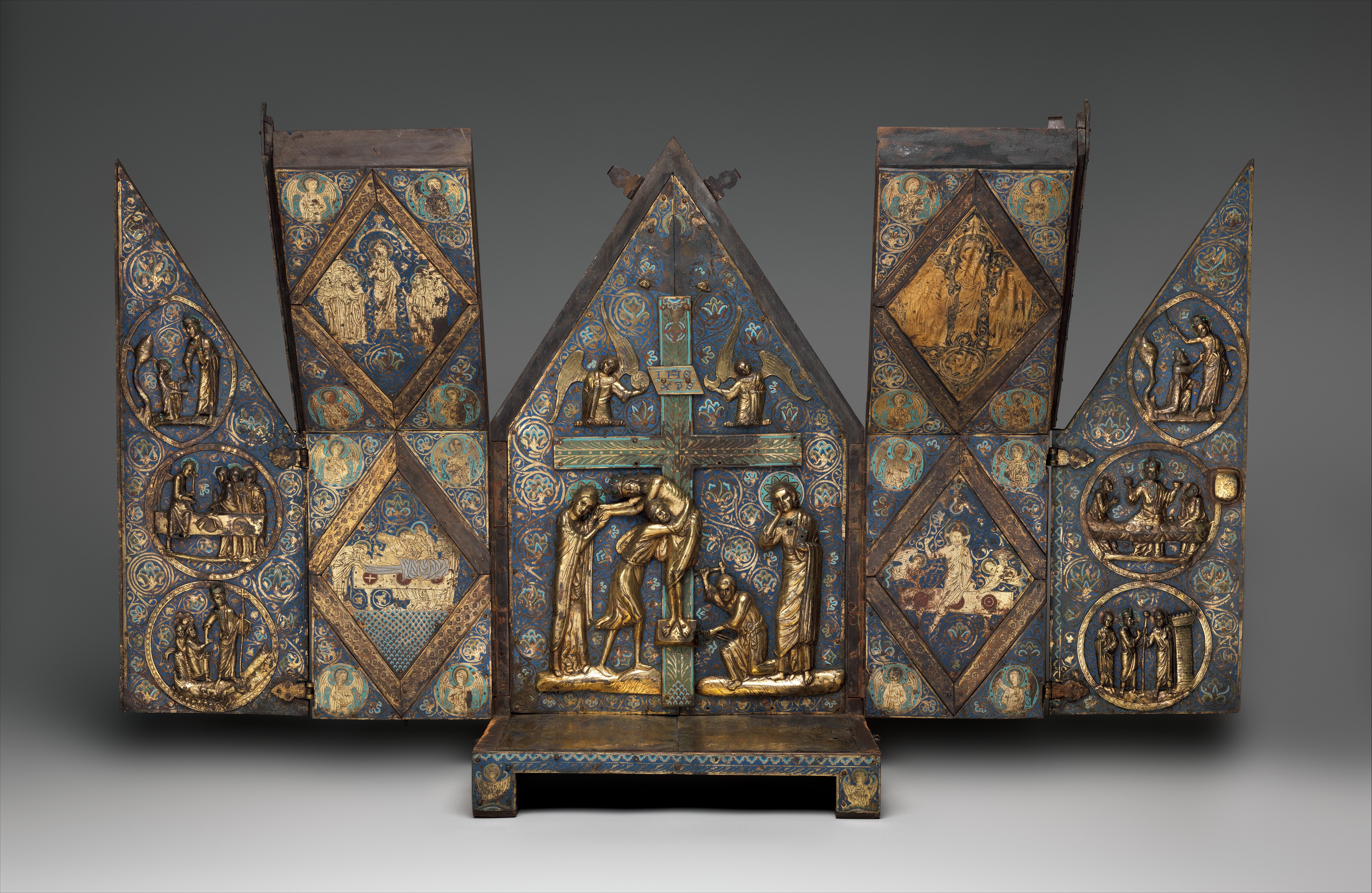
The Met Cloisters in New York City—the branch of the Metropolitan Museum of Art devoted to the art and architecture of medieval Europe—has some of the most beautiful Christian art objects I’ve seen. Here I’ll share just one of them: an elaborately decorated champlevé enamel tabernacle, that is, a cupboard where the vessels containing the “reserved Eucharist,” the already-blessed bread and wine, are kept. The primary scene represents the descent of Christ’s body from the cross, while the six medallion scenes on the interior doors (Christ’s appearance to Mary Magdalene, Thomas, and the Emmaus pilgrims; the holy women at the tomb; and the Harrowing of Hell) all have to do with the resurrection. To indicate his kingliness, Christ wears a crown. More on the iconography below.

Tabernacle of Cherves
Tabernacle of Cherves, Charente, France, ca. 1220–30. Champlevé enamel and copper, open: 33 × 37 3/4 × 10 3/4 in. (83.8 × 95.9 × 27.3 cm). Metropolitan Museum of Art, New York.

The enameled metalworks produced in twelfth- through fourteenth-century Limoges in southwestern France are renowned for their exquisite craftsmanship, which contemporary makers still marvel at. Some 7,500 such objects still survive in a variety of forms, including altar frontals, book covers, candlesticks, censers (incense burners), chrismatories (containers for chrism oil), coffers, croziers (bishop’s staffs), reliquaries (containers for relics), gemellions (handwashing basins), pyxides (small receptacles for the consecrated host), and more. The large concentration of churches and monasteries in France’s Limousin region created a large demand for decorated liturgical objects, which led to the rise of enamel workshops in the city of Limoges, located at the intersection of major trade routes. The technical and artistic mastery of these workshops’ products meant that soon orders were being placed by buyers in other regions and countries, and for a more diversified range of objects, not just those for church use.
The champlevé method of enameling, the predominant decorative technique associated with Limoges, first requires the gouging out of a prepared metal substrate (almost always copper) to create cells. Enamel powder, made from shards of colored glass, is carefully laid into these recessed cells and the object is fired, then cooled, then polished. Champlevé enamels often have appliqué figures attached to them. These are created from copper sheet that is raised from the back and then finished from the front using various specialized tools. For a detailed description of the creation process, which I find fascinating, see the essay “Techniques and Materials in Limoges Enamels” by Isabelle Biron, Pete Dandridge, and Mark T. Wypyski, in the 1996 Met exhibition catalog Enamels of Limoges, 1100–1350, available for free download from MetPublications.

The Cherves tabernacle, so named because it was discovered in the Cherves-Richemont commune near the site of a ruined priory, is one of only two enamel tabernacles that have survived from the Middle Ages. It consists of blue, turquoise, green, yellow, red, and white champlevé enamel; gilded copper figures shaped by the twin metalworking techniques of repoussé (hammering from the reverse side to create a design in low relief) and chasing (hammering on the front side, sinking the metal); and, on the inside gables, engraved copper plaques covered in gold leaf. Its wood support was fabricated after the object was excavated at Château-Chesnel, near Plumejeau, in 1896.

The following text, written by Barbara Drake Boehm, senior curator at the Met Cloisters, is reproduced from pages 299–302 of the book Enamels of Limoges, 1100–1350 by permission of the publisher. I’ve inserted one bracketed note, plus hyperlinks on references that may be unfamiliar to readers. All photos are courtesy of the museum and are linked to their source page.

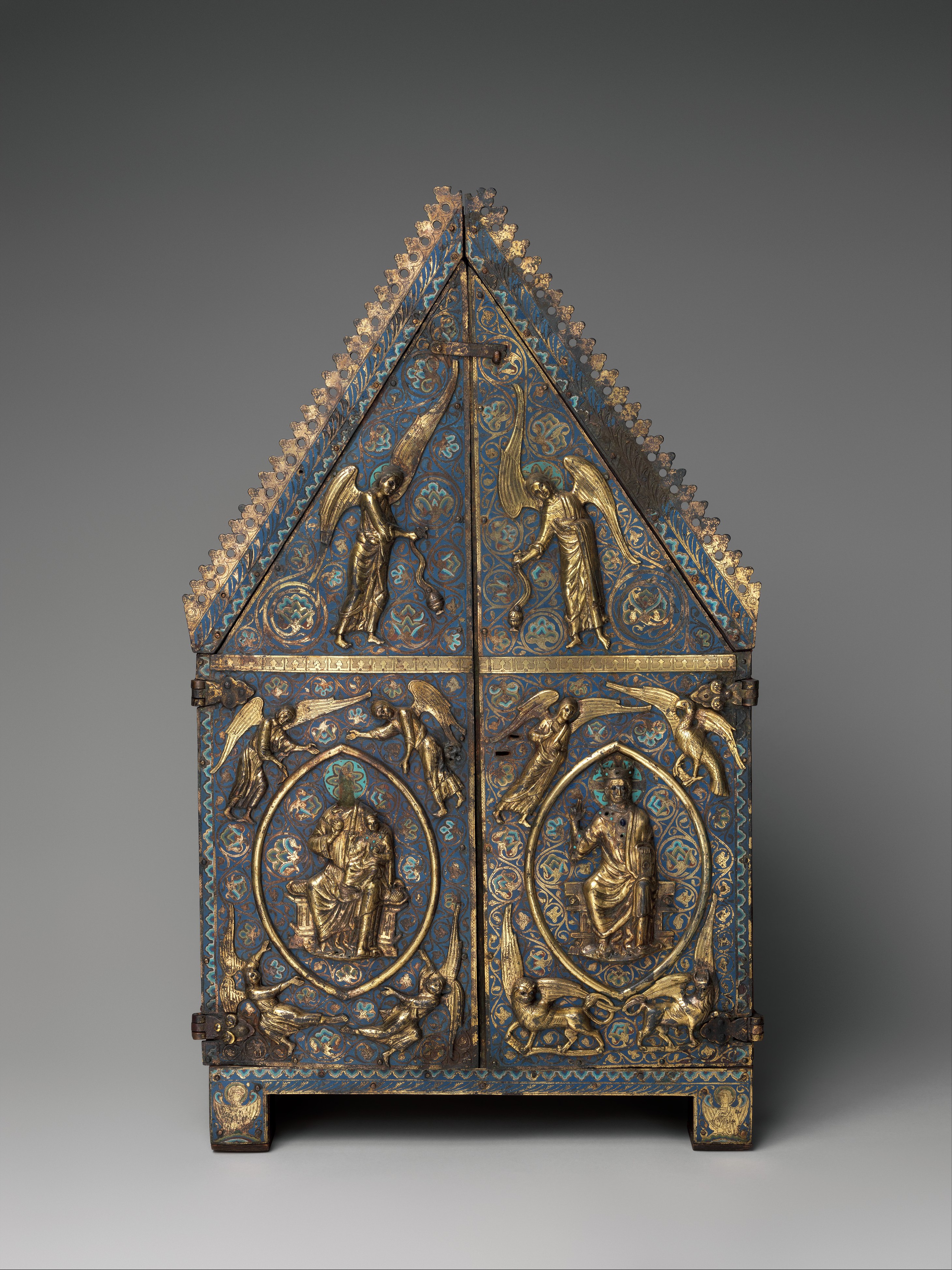
Tabernacle of Cherves (closed)
Closed view (the Virgin’s head is missing)

Standing on short legs, the tabernacle is in the form of a gabled cupboard with hinged doors. Gilded repoussé figures are applied to copper plates decorated with enameled foliate ornament. On the outside of the proper left door is the figure of Christ in Majesty, enthroned in a mandorla and surrounded by symbols of the evangelists. Opposite him on the proper right door is the Virgin with the Infant Jesus on her lap. She is framed within a mandorla and surrounded by four angels. Above them on the roof are two full-length angels, each holding a censer. Across the front runs a band of gilt copper inscribed with a decorative pattern derived from Kufic script, apparently based on the Arabic word yemen.

Tabernacle of Cherves (fully open)
Overall, all wings completely open

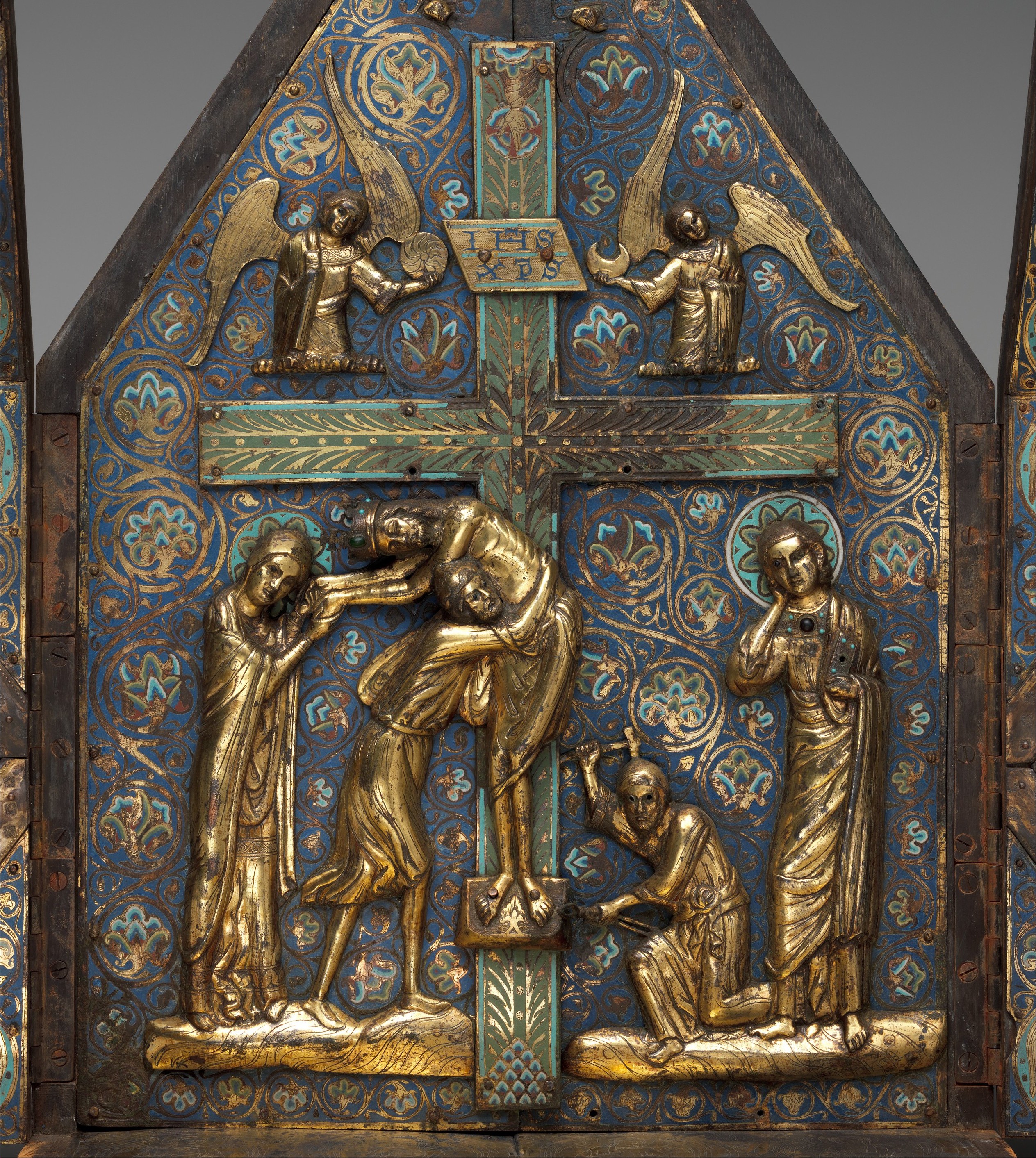
At the center of the open tabernacle, against its back wall, are appliqué figures representing the Descent from the Cross. Joseph of Arimathea takes the torso of the dead Christ in the arms as Nicodemus uses pliers and a hammer to remove the nails that still hold Christ’s feet to the green-enameled cross. The Virgin takes her son’s hands in hers and gently pulls them to her cheek; Saint John looks on from the opposite side, his head resting in his hand. Above the arms of the cross, two half-length angels hold emblems of the sun and moon. The Hand of God appears at the top of the cross; another figure of an angel once stood over it.

Tabernacle of Cherves (Harrowing of Hell)
The Harrowing of Hell

Tabernacle of Cherves (Empty Tomb)
The Holy Women at the Tomb

Tabernacle of Cherves (Noli me tangere)
“Noli me tangere” (The risen Christ appears to Mary Magdalene)

Tabernacle of Cherves (Road to Emmaus)
The Road to Emmaus

Tabernacle of Cherves (Supper at Emmaus)
The Supper at Emmaus

Tabernacle of Cherves (Incredulity of Thomas)
The Incredulity of Saint Thomas

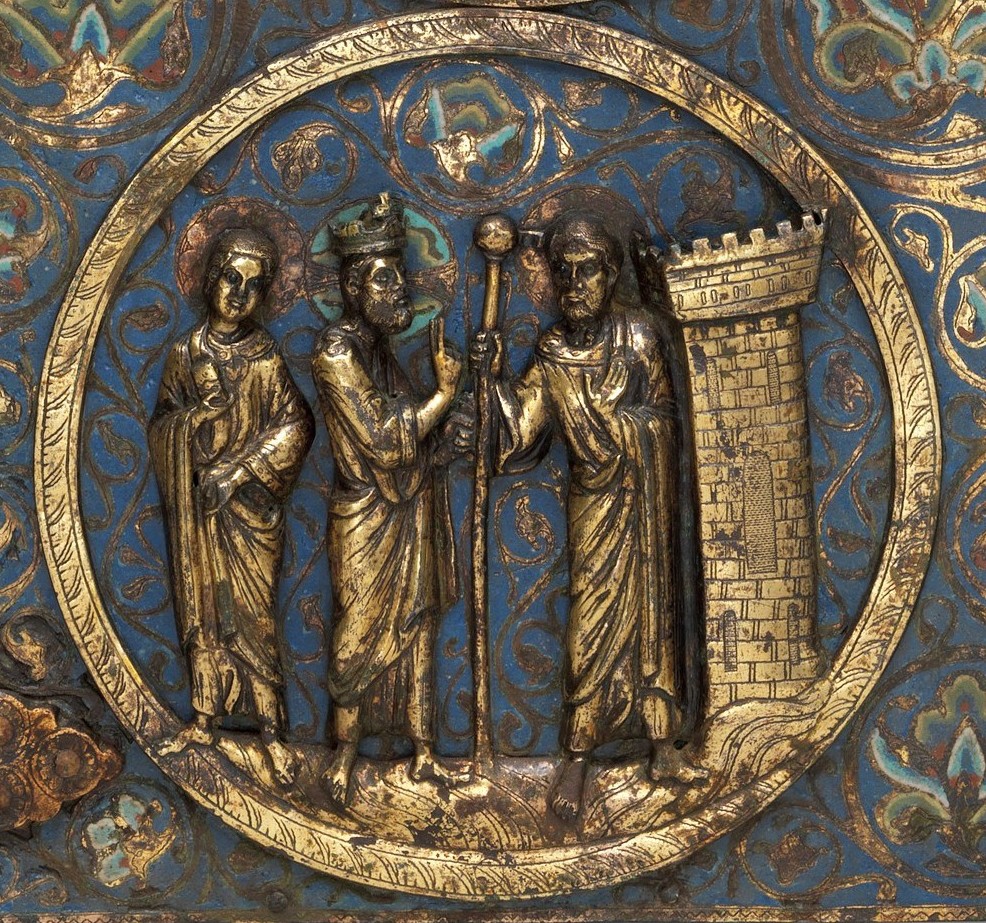
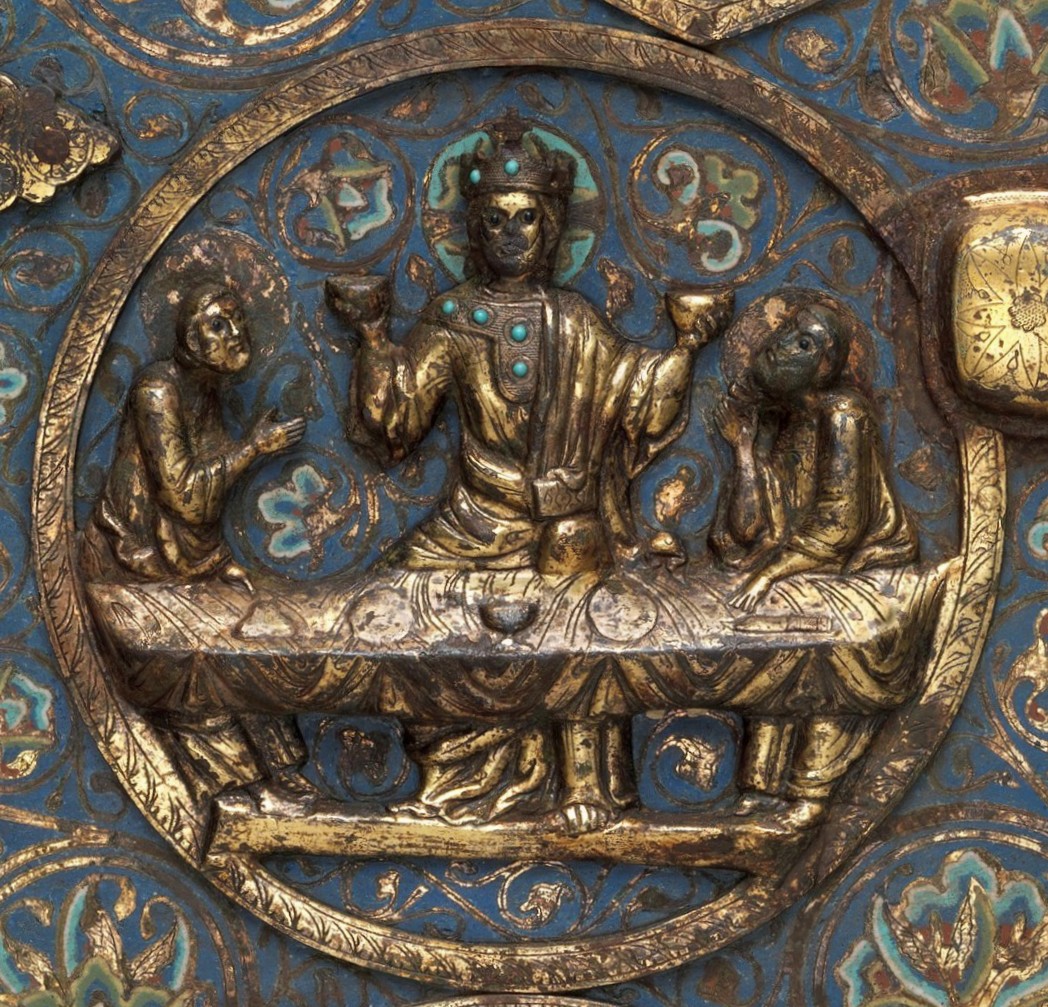
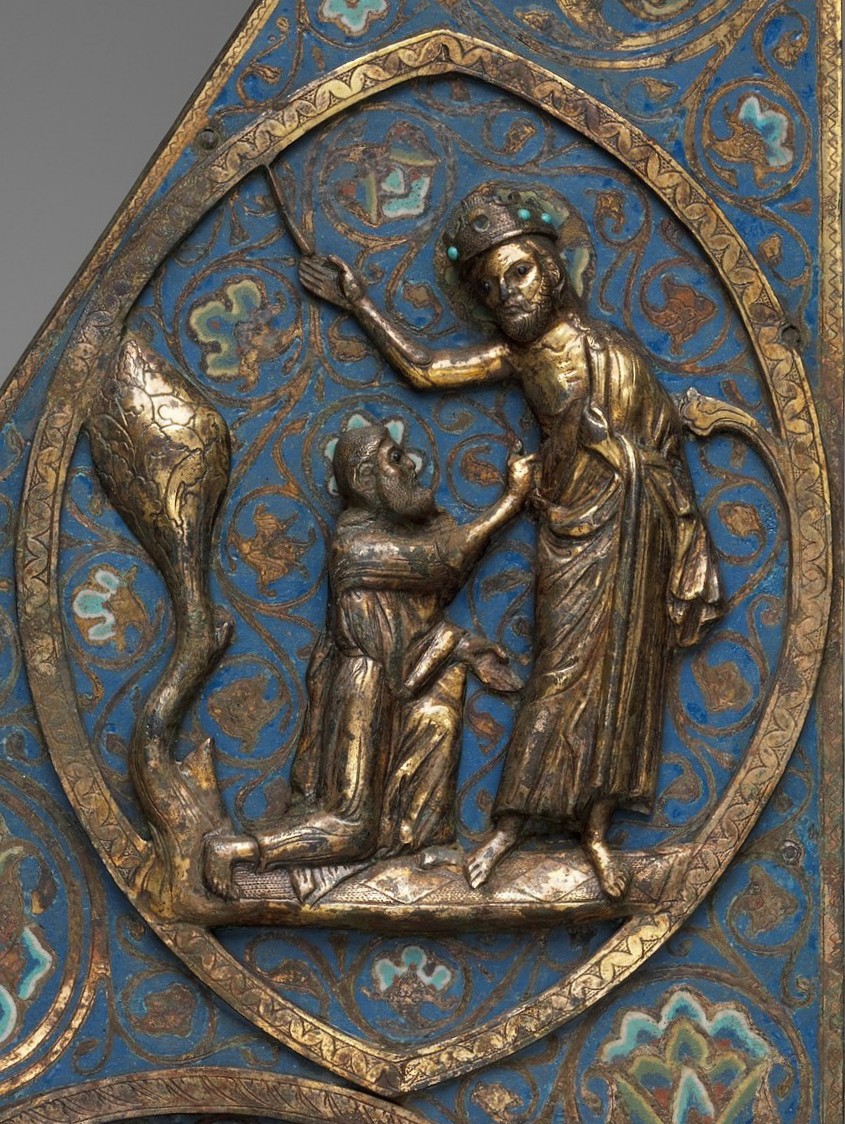
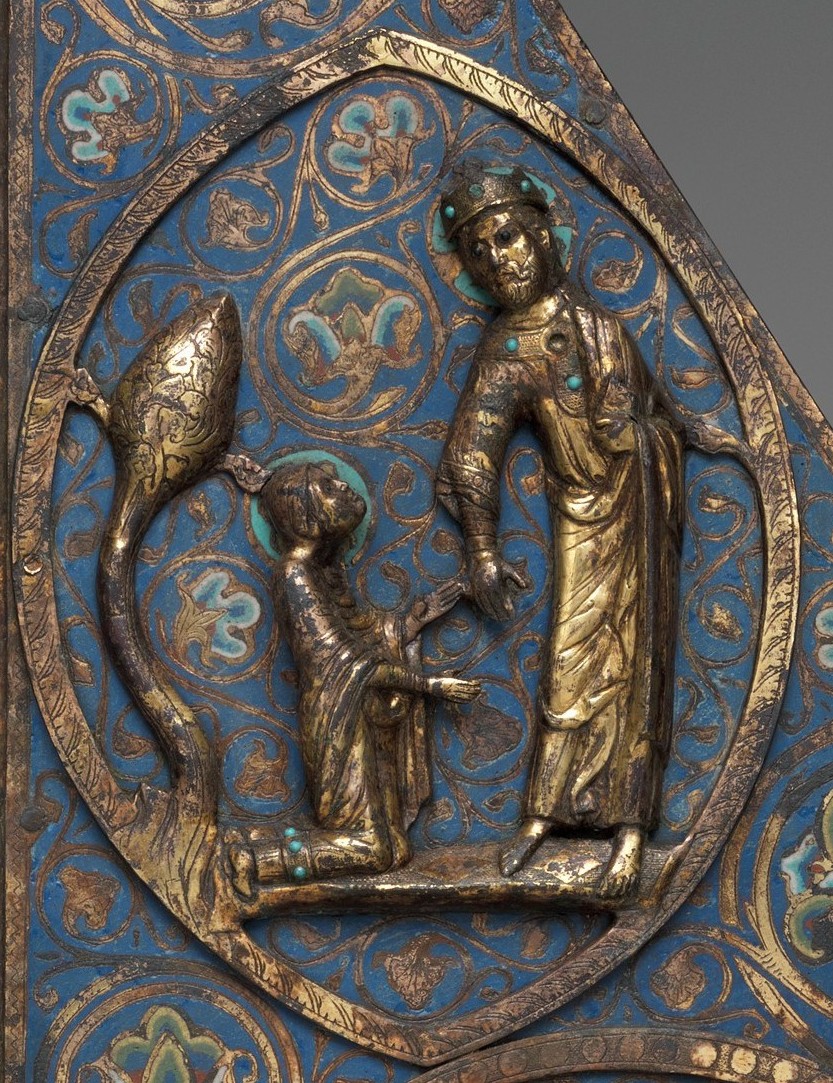
On the insides of the doors are openwork medallions recounting the events that followed the Crucifixion, reading from lower left to upper right. The first is the Descent into Limbo, a nonscriptural image of Jesus leading souls by the hand out of the mouth of Hell, which is seen as the gaping mouth of a dragonlike beast. Set above it is the scene of the Holy Women arriving at the tomb of Jesus on Easter Sunday. Following the account in the Gospel of Mark (16:1), they bear jars of unguent to anoint the body and are greeted by a man, seen here as winged, who informs them that Jesus has risen. In the almond-shaped medallion above, Mary Magdalen meets the risen Christ in the garden (Mark 16:9; John 20:14–18), where he backs away and advises her not to touch him yet. At the lower right, the apostles on the road outside the walls of Emmaus (Luke 24:13–35) are greeted by Jesus, attired as a pilgrim; in the roundel above, they dine with him at Emmaus and realize who he is when he breaks bread with them. In the oval at the upper right, Saint Thomas (Doubting Thomas) touches the wound in Jesus’ side and is convinced of his Resurrection (John 20:24–29).

Tabernacle of Cherves (Entombment)
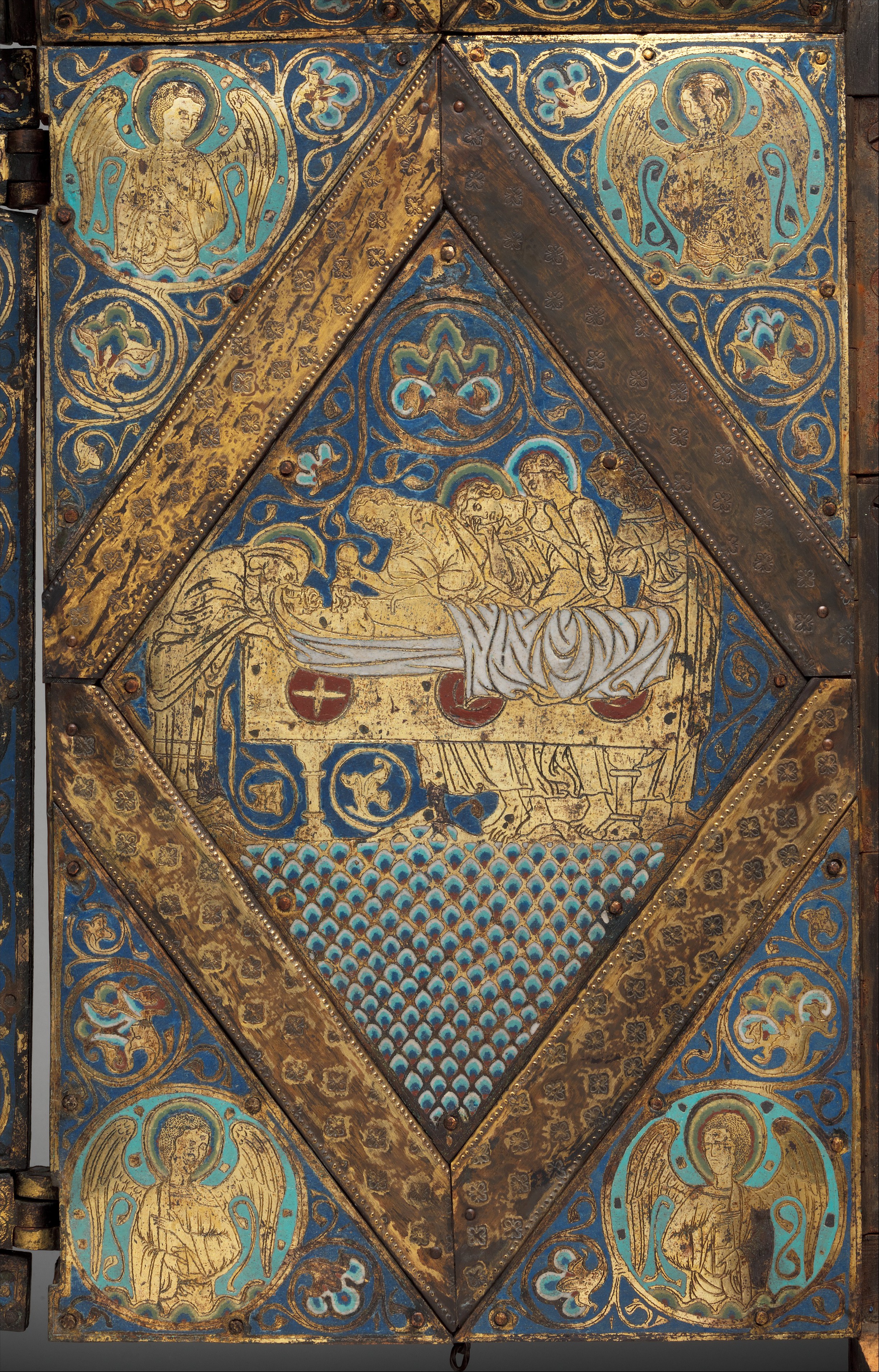
The Entombment

Tabernacle of Cherves (Resurrection)
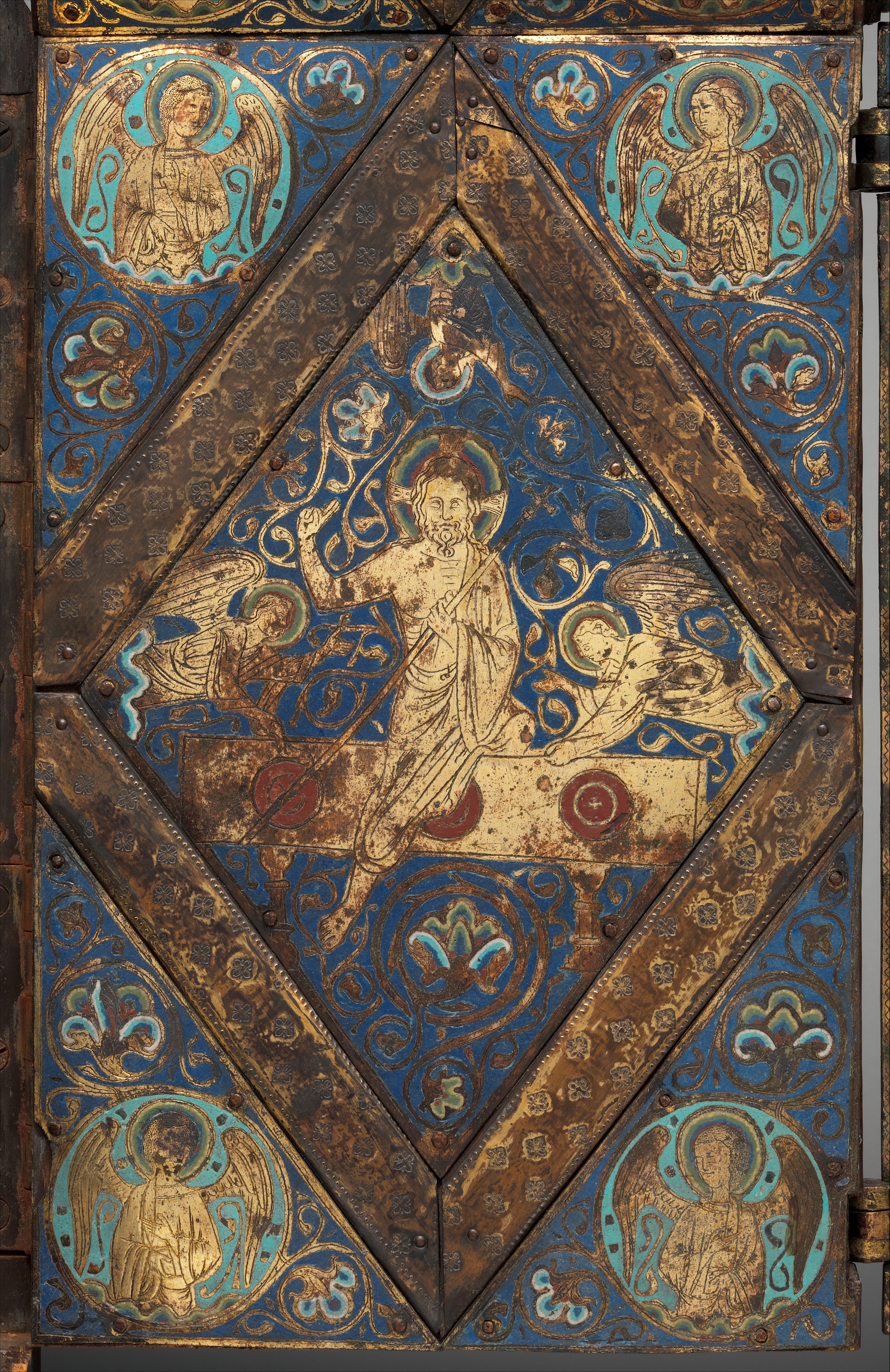
The Resurrection

Tabernacle of Cherves (Ascension)
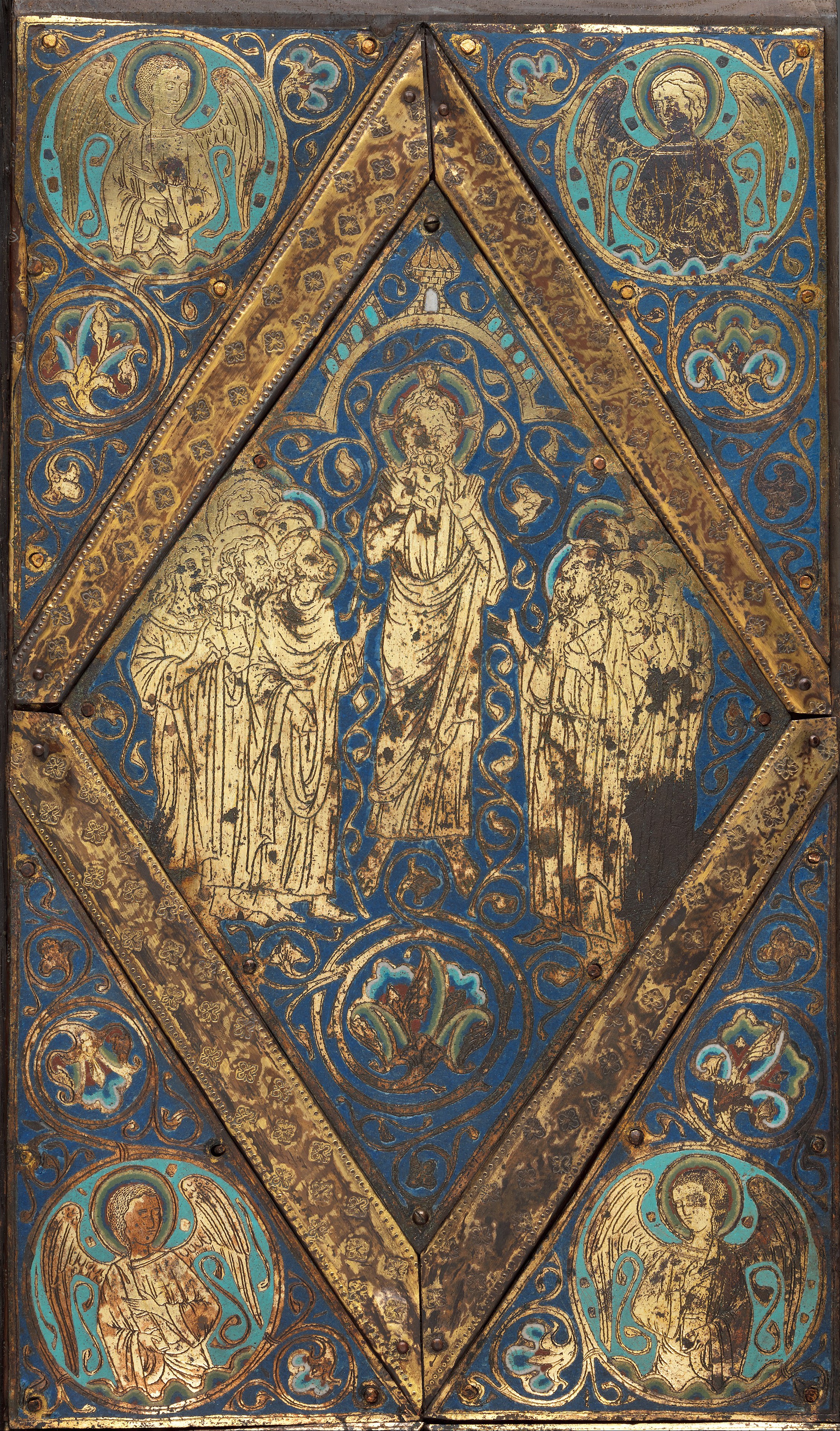
The Ascension

The interior side panels of the tabernacle have large lozenges with engraved figurative scenes framed at the corners by triangular enamel plaques, each depicting an angel in a roundel. At the lower left is the Entombment of Christ; at the upper left is the Ascension. At the lower right, Christ emerges from his tomb, with angels at either side. The base of the cupboard is covered with sheets of gilt copper depicting angels in roundels.

The tabernacle of Cherves is remarkable for its iconographic sophistication and for the dialogue established compositionally and visually between thematically related scenes. On the insides of the doors, Jesus guides souls out of the mouth of Hell at the lower left; at the lower right, he guides the apostles on the journey to Emmaus. On the center left roundel, the Holy Women seek Jesus’ body and find it gone; on the center right roundel, Jesus offers his body to the apostles in the sacrament of bread and wine. At the upper left, he tells the Magdalen it is too soon to touch him; at the upper right, he invites Thomas to touch his wound. In the inside lozenge at the left, Jesus is lowered into his tomb; at the right, he rises from it. At the upper left, he leaves his apostles and rises to heaven; at the upper right, the Holy Spirit descends from heaven on the apostles in a representation of Pentecost. [This latter scene is missing and has been replaced by a copy on paper or parchment of the Ascension image opposite it.]

Tabernacle of Cherves (Deposition)
The Descent from the Cross

The Descent from the Cross is both elegant and full of pathos, a masterpiece of Gothic relief sculpture. As such, it has rightly served as a point of comparison with works in other media, notably the ivory Descent from the Cross in the Louvre. A number of gilt-copper relief sculptures produced in the Limousin but now isolated from their original contexts can be compared with those on the Cherves tabernacle. Notable among these is the Descent from the Cross preserved in the Abegg-Stiftung, Bern, first recorded in 1870. Most of these reliefs are presumed to come from altar frontals.
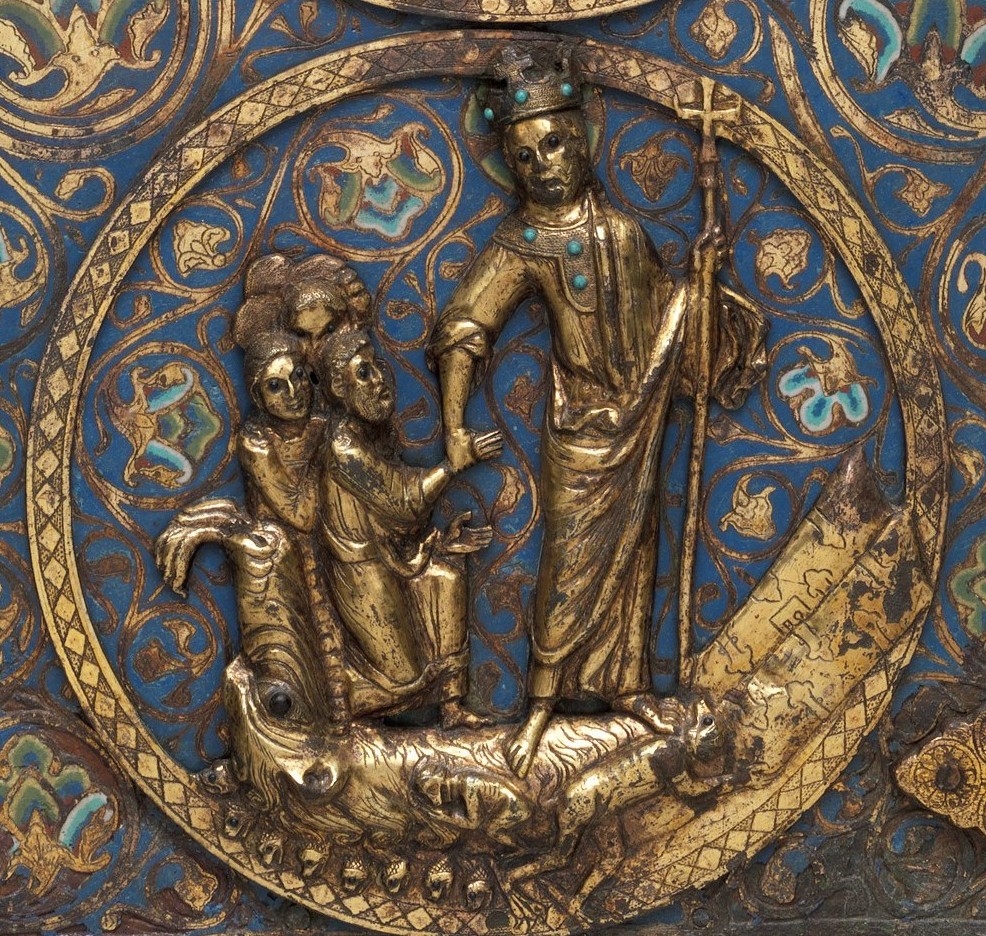
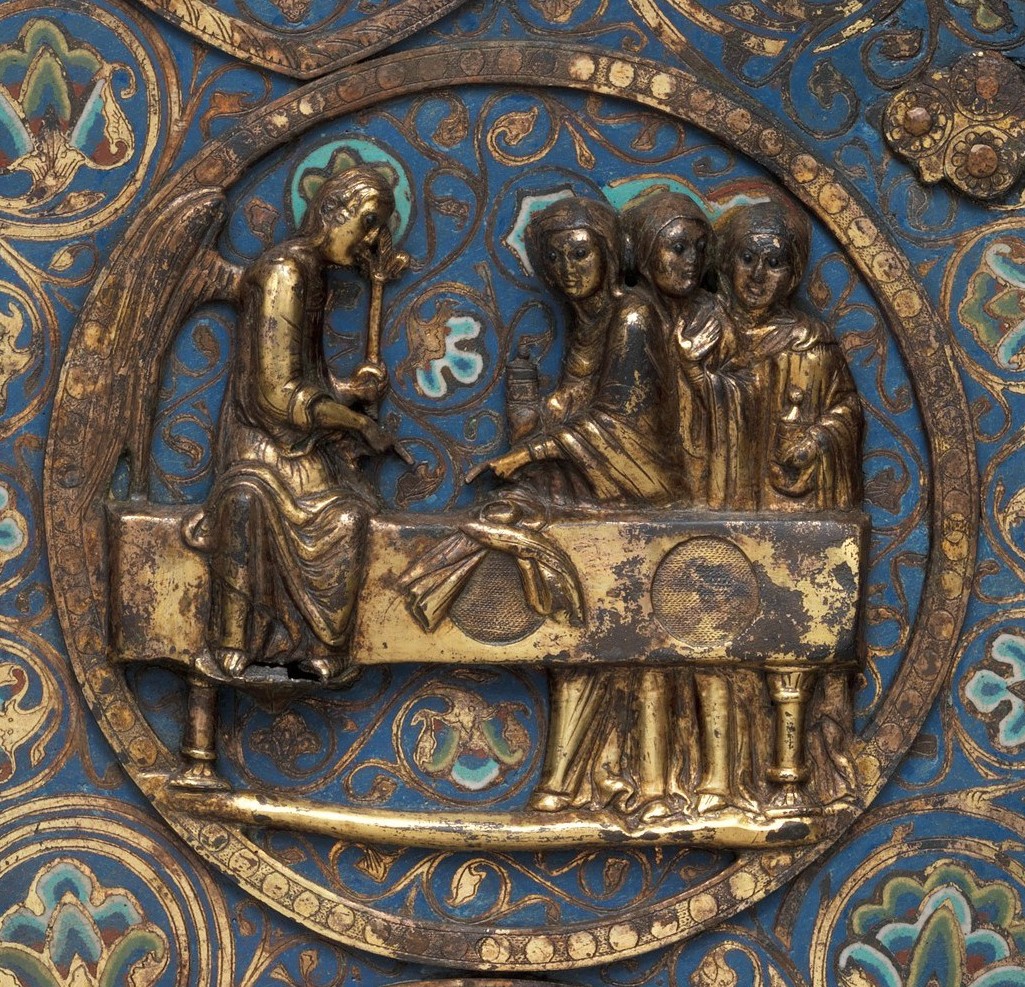
The enameled ground of the Cherves tabernacle, with its strong concentric circles of reserved gilt copper enclosing full fleurons, seems to anticipate the enameled plate of the tomb effigy of John of France of after 1248.

The identification of this enameled cupboard as a tabernacle for the consecrated Host has not been confirmed: the Church of the Middle Ages had no universal custom for the reservation of the Eucharistic bread or regulations requiring a tabernacle. Nor is there a wealth of comparative medieval examples. Only one other Limoges tabernacle of this type is known; it was acquired by the cathedral of Chartes in the nineteenth century, and its earlier history is not known. The supposition that the enameled cupboard from Cherves is a Eucharistic tabernacle is based on its resemblance in form to later tabernacles, its subject matter, and even the gilt-copper base plate which would allow an enclosed pyx to slide easily in and out.

Soon after its discovery in 1896, the tabernacle was presented to the Société archéologique de la Charente by Maurice d’Hauteville, a curator at Angoulême and son-in-law of Ferdinand de Roffignac, on whose property it was unearthed. He suggested that the treasure could have come from the Benedictine monastery of Fontdouce, founded in 1117. More recently it has been supposed that the treasure at Cherves comes from the Grandmontain foundation at Gandory, of which, unfortunately, there are no remains.

Since its discovery, the tabernacle of Cherves has been recognized as a masterpiece of Limoges work in the Gothic period. Part of a larger treasure, . . . it was exhibited successively at Poitiers, Brive, and Limoges, and then at the Musée de Cluny before being sent to Great Britain.

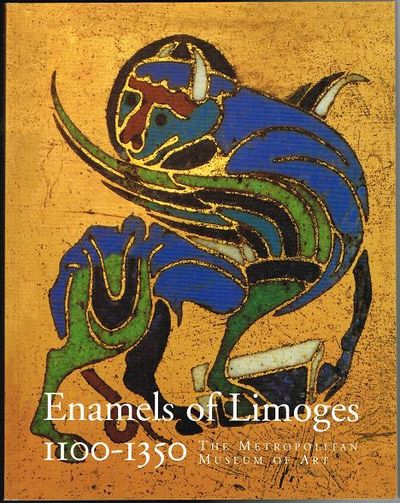
You can explore other champlevé enamels at the Met using its website’s advanced search function. If you wish to study the topic in more depth, the book I’ve quoted from is an excellent resource, featuring essays as well as photographs and descriptions of 157 objects not only from the Met’s collection but also from the Louvre and various other European and American museums, ecclesiastical institutions, and private collections. Click on the cover image to go to the book page.

Enamels of Limoges

Holy Saturday (Artful Devotion)

Entombment of Christ (Armenia)
“The Entombment of Christ,” from an Armenian Gospel-book, 1437. MS Or. 2668, fol. 5v, British Library, London.

When it was evening, there came a rich man from Arimathea, named Joseph, who also was a disciple of Jesus. He went to Pilate and asked for the body of Jesus. Then Pilate ordered it to be given to him. And Joseph took the body and wrapped it in a clean linen shroud and laid it in his own new tomb, which he had cut in the rock. And he rolled a great stone to the entrance of the tomb and went away. Mary Magdalene and the other Mary were there, sitting opposite the tomb.

—Matthew 27:57–61

After these things Joseph of Arimathea, who was a disciple of Jesus, but secretly for fear of the Jews, asked Pilate that he might take away the body of Jesus, and Pilate gave him permission. So he came and took away his body. Nicodemus also, who earlier had come to Jesus by night, came bringing a mixture of myrrh and aloes, about seventy-five pounds in weight. So they took the body of Jesus and bound it in linen cloths with the spices, as is the burial custom of the Jews. Now in the place where he was crucified there was a garden, and in the garden a new tomb in which no one had yet been laid. So because of the Jewish day of Preparation, since the tomb was close at hand, they laid Jesus there.

—John 19:38–42

+++

MUSIC: “Tagh for the Funeral of the Lord” by Tigran Mansurian, 1998–2004 | Performed by Kim Kashkashian (viola) and Robyn Schulkowsky (percussion), on Neharo’t, 2009

The tagh is an ancient genre of Armenian monodic music—that is, lamentation over another’s death. “The characteristics of the tagh are its expansiveness of form and volume, its free melodic style, the existence of instrumental passages and richness of rhythm” [source].

“Tagh for the Funeral of the Lord” is the second piece in contemporary Armenian composer Tigran Mansurian’s suite “Three Medieval Taghs for Viola and Percussion” (the other two are for the Crucifixion and for the Resurrection). On YouTube you can find a January 27, 2019, performance by violist Kim Kashkashian and (different from the earlier album recording) percussionist Jonathan Hepfer as part of the Lark Musical Society’s Dilijan Chamber Music Series is Los Angeles. The funeral tagh starts at 4:23:

Note: Sometimes this piece is called Tagh “to” or “of” the Funeral of the Lord.

+++

The Entombment painting above is from a fifteenth-century Gospel-book copied and illuminated at the Monastery of St. George in Armenia by the priest Awetik. At the center, Christ’s body lies with his head tilted toward the viewer but wrapped, like the rest of him, in a white shroud. Joseph of Arimathea cradles Christ’s head and Nicodemus straightens his legs as the two situate his body in the grave. Two of the Marys stand by, grieving.

The vast swatch of dark blue across the top half of the painting indicates the deep darkness of the cave and accentuates the feeling of emptiness and loss. The figures form a middle band, below which are two more large color fields: brown and green, the colors of the earth.

The inertness is striking, as is the complete hiddenness of God the Son under his burial clothes.


This post belongs to the weekly series Artful Devotion. If you can’t view the music player in your email or RSS reader, try opening the post in your browser.

To view all the Revised Common Lectionary scripture readings for Holy Saturday, cycle A, click here.