
Holy Saturday (Artful Devotion)

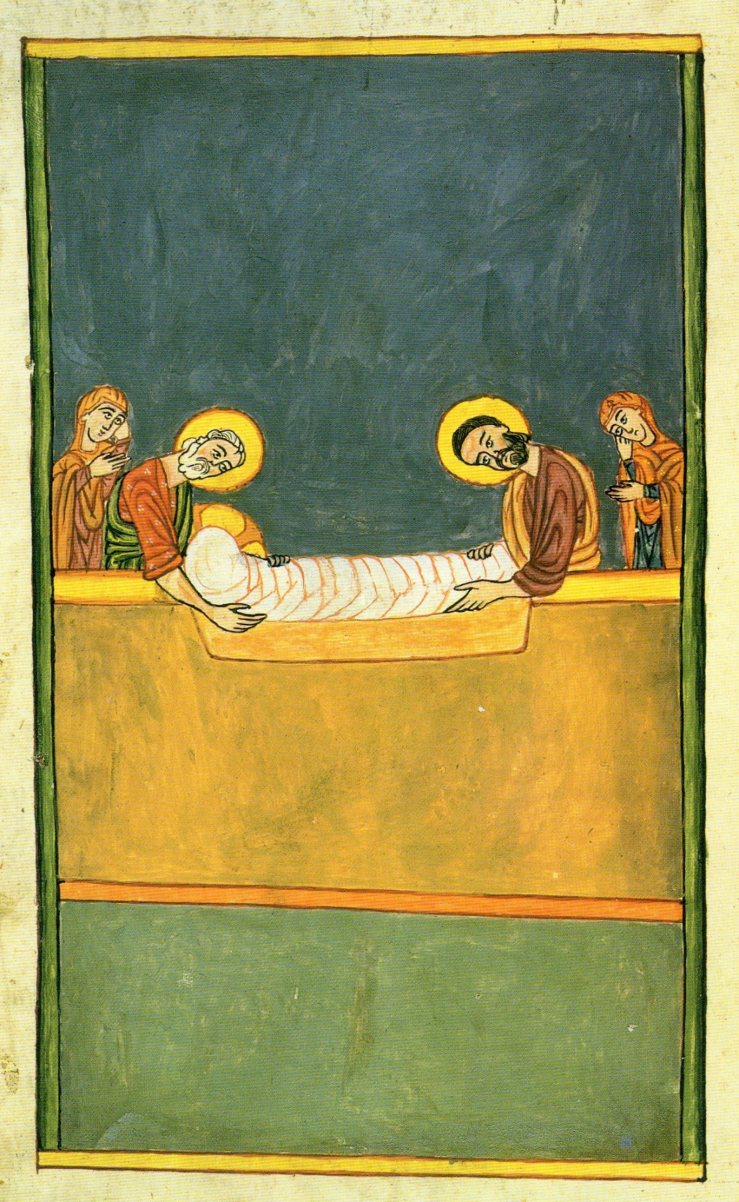
Entombment of Christ (Armenia)
“The Entombment of Christ,” from an Armenian Gospel-book, 1437. MS Or. 2668, fol. 5v, British Library, London.

When it was evening, there came a rich man from Arimathea, named Joseph, who also was a disciple of Jesus. He went to Pilate and asked for the body of Jesus. Then Pilate ordered it to be given to him. And Joseph took the body and wrapped it in a clean linen shroud and laid it in his own new tomb, which he had cut in the rock. And he rolled a great stone to the entrance of the tomb and went away. Mary Magdalene and the other Mary were there, sitting opposite the tomb.

—Matthew 27:57–61

After these things Joseph of Arimathea, who was a disciple of Jesus, but secretly for fear of the Jews, asked Pilate that he might take away the body of Jesus, and Pilate gave him permission. So he came and took away his body. Nicodemus also, who earlier had come to Jesus by night, came bringing a mixture of myrrh and aloes, about seventy-five pounds in weight. So they took the body of Jesus and bound it in linen cloths with the spices, as is the burial custom of the Jews. Now in the place where he was crucified there was a garden, and in the garden a new tomb in which no one had yet been laid. So because of the Jewish day of Preparation, since the tomb was close at hand, they laid Jesus there.

—John 19:38–42

+++

MUSIC: “Tagh for the Funeral of the Lord” by Tigran Mansurian, 1998–2004 | Performed by Kim Kashkashian (viola) and Robyn Schulkowsky (percussion), on Neharo’t, 2009

The tagh is an ancient genre of Armenian monodic music—that is, lamentation over another’s death. “The characteristics of the tagh are its expansiveness of form and volume, its free melodic style, the existence of instrumental passages and richness of rhythm” [source].

“Tagh for the Funeral of the Lord” is the second piece in contemporary Armenian composer Tigran Mansurian’s suite “Three Medieval Taghs for Viola and Percussion” (the other two are for the Crucifixion and for the Resurrection). On YouTube you can find a January 27, 2019, performance by violist Kim Kashkashian and (different from the earlier album recording) percussionist Jonathan Hepfer as part of the Lark Musical Society’s Dilijan Chamber Music Series is Los Angeles. The funeral tagh starts at 4:23:

Note: Sometimes this piece is called Tagh “to” or “of” the Funeral of the Lord.

+++

The Entombment painting above is from a fifteenth-century Gospel-book copied and illuminated at the Monastery of St. George in Armenia by the priest Awetik. At the center, Christ’s body lies with his head tilted toward the viewer but wrapped, like the rest of him, in a white shroud. Joseph of Arimathea cradles Christ’s head and Nicodemus straightens his legs as the two situate his body in the grave. Two of the Marys stand by, grieving.

The vast swatch of dark blue across the top half of the painting indicates the deep darkness of the cave and accentuates the feeling of emptiness and loss. The figures form a middle band, below which are two more large color fields: brown and green, the colors of the earth.

The inertness is striking, as is the complete hiddenness of God the Son under his burial clothes.


This post belongs to the weekly series Artful Devotion. If you can’t view the music player in your email or RSS reader, try opening the post in your browser.

To view all the Revised Common Lectionary scripture readings for Holy Saturday, cycle A, click here.

Walking the Via Dolorosa through Amsterdam (Part 3)

This is the final part of my commentary on Art Stations of the Cross: Troubled Waters, a multisite exhibition in Amsterdam running from March 6 to April 22. (Read parts one and two.) Unless otherwise noted, all photos are by Eric James Jones/ArtandTheology.org.

+++

STATION 10. This is the one station I did not get a chance to see, due to its more limited opening hours. Anywhere, Anytime by Masha Trebukova is a temporary installation in the Mozes en Aäronkerk (Church of Moses and Aaron) in Amsterdam’s Waterlooplein neighborhood. It consists of a nine-foot-tall octagonal structure (a “columbarium”) covered with paintings on newspaper, as well as six large-format “books” of paintings on glossy magazine pages.

Columbarium by Masha Trebukova
Masha Trebukova (Russian, 1962–), Anywhere, Anytime, 2019. Temporary installation at the Moses and Aaron Church, Amsterdam, consisting of an eight-paneled “columbarium” with paintings on newsprint, each panel 60 × 290 cm, and “How to spend it,” six painted-over magazines. Photo courtesy of Sant’Egidio Nederland.

A columbarium is a room, building, or freestanding structure with niches for the public storage of funerary urns (which hold the ashes of the deceased). Ancient Romans decorated theirs with frescoes, often of peaceful scenes of the hereafter. Trebukova, on the other hand, has painted this columbarium with images of war and violence, exposing the savagery that causes death. This is not a celebration of paradise gained; it’s a lament for paradise lost.

Hear the artist briefly introduce the piece:

Columbarium (detail) by Masha Trebukova
Masha Trebukova, Anywhere, Anytime (detail). Photo courtesy of Sant’Egidio Nederland.

Trebukova used as her painting surface pages from newspapers and magazines, the headlines often creating consonance with the images while the ads create dissonance. The sleek photos selling vacations and luxury goods, enticing you to treat yourself, contrast starkly with Trebukova’s slashes and smears of color that depict masked gunmen terrorizing families, mass executions, refugees on the run, and individuals huddled over the corpses of loved ones. This contrast urges viewers to consider how our own self-absorption might be restricting our view of what’s going on in the larger world. What incinerations are being carried out as we casually engage in our leisure reading and other entertainments? The vaults in Anywhere, Anytime are fictive, but they prompt us to imagine the many bodies and places being turned to ash as armed conflict and acts of terrorism persist globally. [Images below sourced from the artist’s website]


The books are too fragile to be handled by visitors, so they are displayed open in glass cases, laid flat on a black-clothed table, and a video screen nearby loops through all the images in succession. Here is an excerpt from the video, a showcase of book five:

The book appears to have originally been a dance magazine, but Trebukova subverts the elegance associated with controlled bodily movement by recontextualizing these found images of dancers. A woman walking down a rustic road in pointe shoes is given a heavy burden on her back—a child—and a head scarf, recasting her as one of the many mothers fleeing violence in the Middle East. On the following page spread, another dancer’s graceful backbend is re-envisioned as an involuntary response to his having been shot; unlike on stage, this movement will end with a fall.

The Moses and Aaron Church is home to the Amsterdam chapter of the Community of Sant’Egidio, a Catholic lay association committed to prayer, the poor, and peace. Existing in over seventy countries, Sant’Egidio seeks especially to serve the sick, the homeless (including displaced persons), the elderly, and the imprisoned. “War is the mother of every poverty,” they say, and they have been key players in peace initiatives in Mozambique, Algeria, the Balkans, the Democratic Republic of Congo, and other areas.

Trebukova, Masha_Columbarium (detail3)
Masha Trebukova, page spread from “How to spend it.” Photo courtesy of Sant’Egidio Nederland.

+++

STATION 11. Erica Grimm’s Salt Water Skin Boats, a collaboration with artist and arborist Tracie Stewart and soundscape specialist Sheinagh Anderson, is an installation of five sculptural coracles made of interwoven willow, dogwood, fig, and cedar branches; animal skin and gut; cheesecloth; and bathymetric ocean maps imprinted with scientific measurements of things like glacial melt, sea-level rise, and ocean acidification. These are suspended from the ceiling along the nave of the Waalse Kerk and are lit from inside, and they are accompanied by an ambient soundscape that viewers activate by scanning a QR code.

Salt Water Skin Boats by Erica Grimm
Erica L. Grimm (Canadian, 1959–), Salt Water Skin Boats, 2018. Willow, dogwood, fig, and cedar branches; cheesecloth; animal skin and gut; bathymetric ocean maps; layers of wax; earbuds; LED lights. Installation view at Waalse Kerk, Amsterdam, in March 2019, part of Art Stations of the Cross.

Small lightweight boats without rudder, anchor, or keel, coracles are unstable watercraft, easily carried by currents and wind. Back in the day, Celtic Christian pilgrims would set sail in them, not having any destination in mind but rather trusting that God would steer their little boats to wherever he saw fit. In a sense, we are all “skin boats” afloat on a vast ocean, not knowing where we’ll end up. But Grimm’s incorporation of numerical data that highlight the dangerous warming, acidifying, and expanding of the world’s oceans pushes this metaphor in a new direction; the work “proposes an analogy,” writes curator Marleen Hengelaar-Rookmaaker, “between our bodies and the vast ecology of the global ocean: between the life-sustaining, precariously balanced ocean chemistry and the chemistry of our own salt-water-filled bodies.”  Continue reading “Walking the Via Dolorosa through Amsterdam (Part 3)”