“They will hunger no more and thirst no more; the sun will not strike them, nor any scorching heat, for the Lamb at the center of the throne will be their shepherd, and he will guide them to springs of the water of life, and God will wipe away every tear from their eyes.”
—Revelation 7:16–17
Then the angel showed me the river of the water of life, bright as crystal, flowing from the throne of God and of the Lamb through the middle of the street of the city. On either side of the river is the tree of life with its twelve kinds of fruit, producing its fruit each month, and the leaves of the tree are for the healing of the nations. Nothing accursed will be found there any more. But the throne of God and of the Lamb will be in it, and his servants will worship him; they will see his face, and his name will be on their foreheads. And there will be no more night; they need no light of lamp or sun, for the Lord God will be their light, and they will reign forever and ever.
And he said to me, “These words are trustworthy and true, for the Lord, the God of the spirits of the prophets, has sent his angel to show his servants what must soon take place.”
“See, I am coming soon! Blessed is the one who keeps the words of the prophecy of this book.”
—Revelation 22:1–7
LOOK: The Supper of the Lamb by Wayne Forte
Wayne Forte (Filipino American, 1950–), The Supper of the Lamb, 2004. Oil on canvas, 60 × 48 in.
In this eschatological painting by Wayne Forte, the slain and risen Lamb reopens Eden, welcoming us all to the feast. He holds a palm branch, symbol of the martyr’s victory, and stands atop a table set with bread, wine, and the fruits of the tree of life. A river issues forth, further underscoring that this is a place of refreshment.
In the foreground, the iron grillwork of the gate depicts key events from salvation history: the Fall and Expulsion, Noah’s Ark, the Sacrifice of Isaac, the Exodus, the Nativity, the Crucifixion, and the Resurrection. Originating in the early Christian era, the IHS monogram at the top denotes the first three letters of the Greek name of Jesus, ΙΗΣΟΥΣ: iota, eta, sigma. Later it came to be mistakenly (but appropriately!) interpreted as an acronym for the Latin Jesus Hominum Salvator, “Jesus, Savior of Humanity.”
LISTEN: “Behold, Behold” by Caroline Cobb, performed with Sean Carter on AHome and a Hunger: Songs of Kingdom Hope (2017)
I see a city coming down Like a bride in whitest gown Purely dressed I see the pilgrims coming home All creation finds shalom The promised rest The Lamb of God will be her light The sun will have no need to shine
Refrain: Behold, behold God makes his home with us He’ll take his throne, forever glorious Behold, behold God makes his home with us He’ll take his throne, forever glorious The curse will be undone O come, Lord Jesus, come
The Lord will banish every sin All that’s broken he will mend And make new And we will see him face to face As he wipes our tears away And death is through And all the ransomed and redeemed From every tongue and tribe will sing
[Refrain]
At last the darkness will surrender to the light But we, unveiled in glory, will forever shine At last the powers of hell will drown in lakes of fire But we will freely drink the crystal streams of life
Come, thirsty, taste and see Come, hungry, to the feast Come, weary, find your peace The Bride and Spirit sing Come! Come!
[Refrain]
Based on Revelation 21–22, “Behold, Behold” is the last song on Caroline Cobb’s album A Home and a Hunger, which traces kingdom hope from Genesis to Revelation, each song focusing on a different biblical book.
This post is part of a daily Advent series from December 2 to 24, 2023 (with Christmas to follow through January 6, 2024). View all the posts here, and the accompanying Spotify playlist here.
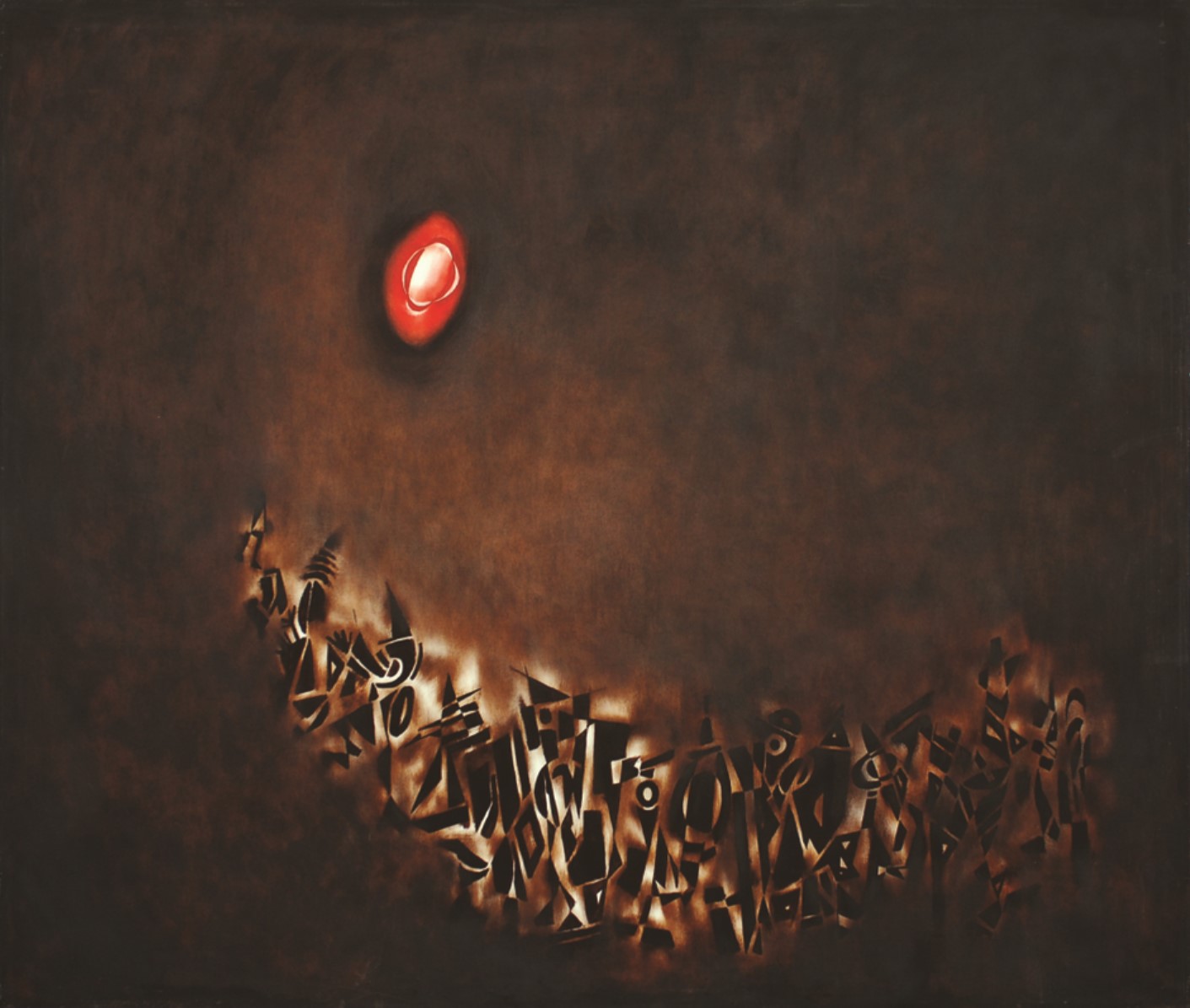
Born in Harlem to Black Bermudian immigrants, Norman Lewis began his art career making social realist paintings but after World War II turned increasingly to abstraction. He is known for his rhythmic lines and shapes.
New World A’Coming is one of his later works. In it “a crowd of figures, abstracted in geometric frenzy, gather in processional unity under the glow of a crimson sun,” the Bill Hodges Gallery writes. “Enveloped in a burnt-umber haze, the dark silhouette of the congregation is accented by a bright white glow that seems to emanate from within the crowd”—they are a holy people. The upward curve suggests movement, ascent. It’s as if the people are dancing their way to a new dawn.
“New World a-Comin’” by the famous African American jazz pianist, composer, and bandleader Duke Ellington is a single-movement work for piano and ensemble. Ellington premiered the earliest version with his eponymous jazz orchestra at Carnegie Hall on December 11, 1943, with himself on piano. He edited and reprised the piece throughout the years, orchestrating it for symphony orchestra in 1966 (the score is lost) and sometimes performing it as a piano solo without accompaniment. He never made a definitive studio recording of “New World a-Comin’” in its original form, and he never wrote down the piano part.
Above is a recording of the live premiere performance. But here it is, below, with the symphony orchestration, recorded in 1970 with the Cincinnati Symphony Orchestra, directed by Erich Kunzel, and again featuring Ellington as soloist. This recording appears on the album Duke Ellington: Orchestral Works (released on CD in 1989):
Of all the renditions, though, Harvey G. Cohen writes in his book Duke Ellington’s America that Ellington’s unaccompanied solo performance at the Whitney Museum of Art in 1972 may be the most poignant; it’s “searching and delicate,” Cohen says (239).
If you want to see a video recording, here’s Ellington soloing it up at a sacred music concert at Grace Cathedral in San Francisco on September 16, 1965 (view the full concert):
The title of this piece comes from the Peabody Award–winning book New World A-Coming: Inside Black America by the prominent Black journalist Roi Ottley, which documents the daily lives of African Americans in Harlem during the 1920s and ’30s as well as their hope for a better future.
In his 1976 memoir Music Is My Mistress, Ellington wrote, “I visualized this new world as a place in the distant future where there would be no war, no greed, no categorization, no non-believers, where love was unconditional, and no pronoun was good enough for God” (183).
“Musically,” writes Los Angeles Philharmonic content director Ricky O’Bannon, “that hope takes the form of a virtuoso showpiece for Ellington at the piano—unusual for the bandleader and a more-than-capable pianist who preferred showing off his skills as a composer. The beautiful theme and variations are supported with rich overtones and chords that Ellington scholar Mark Tucker describes as reminiscent of Ravel to the point it ‘might be called Fox-Trots Nobles et Sentimentales’ and is first-rate Ellington. Other parts might be evocative of the Romantic sweetness of Rachmaninoff.”
This post is part of a daily Advent series from December 2 to 24, 2023 (with Christmas to follow through January 6, 2024). View all the posts here, and the accompanying Spotify playlist here.
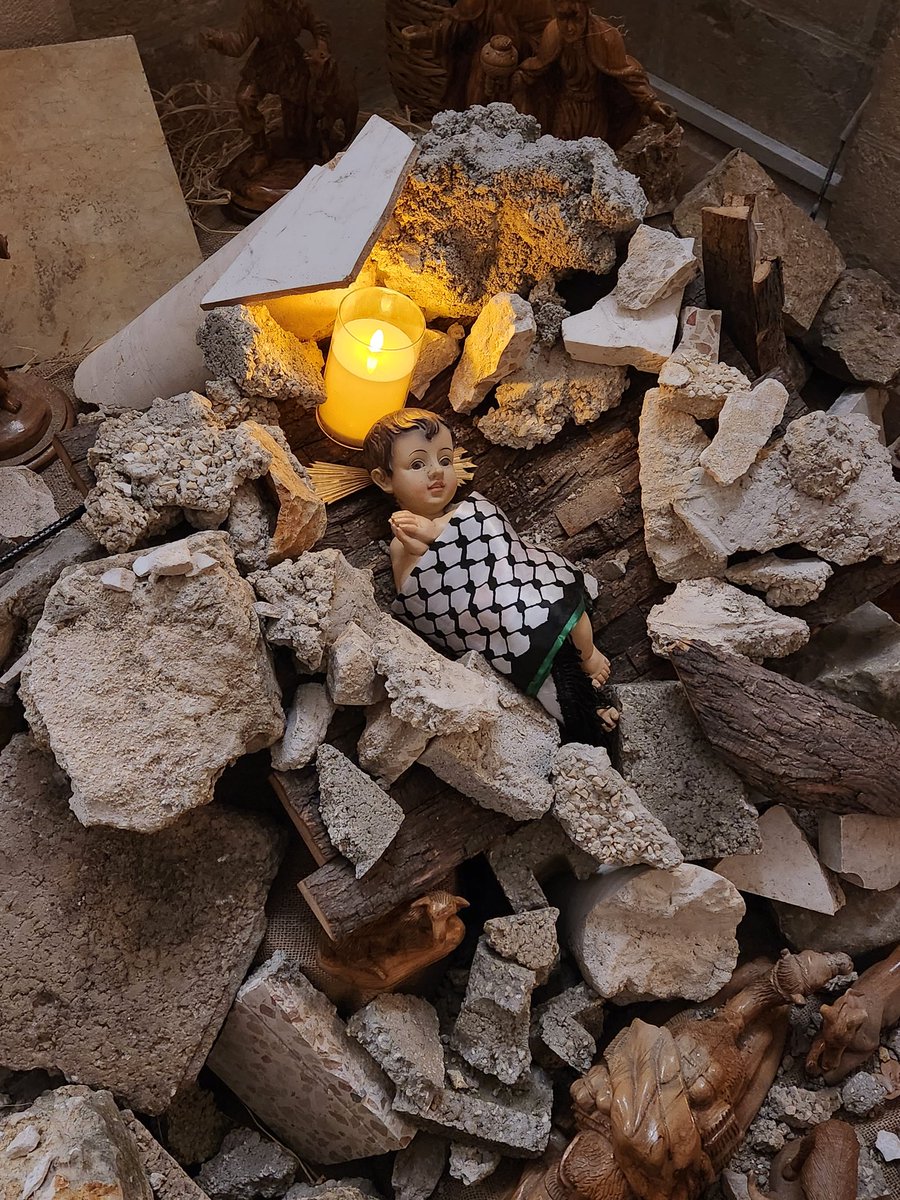
It shows the baby Jesus wrapped in a black-and-white checkered keffiyeh (Palestinian headdress) and lying in a pile of rubble while Mary, Joseph, the shepherds, the wise men, and the animals search for him. It is situated at the side of the altar in Bethlehem’s Evangelical Lutheran Christmas Church, which Rev. Dr. Munther Isaac, a prominent Palestinian Christian peacemaker, pastors. He said he wants the world to know that this is what Christmas looks like in Palestine this year, and for his own congregation to know the solidarity of Christ with the oppressed. Al Jazeera ran a news segment on the crèche on Tuesday, which features an interview with Isaac:
Since October 7, over 16,000 Palestinians have been killed by Israeli forces, and almost 1.9 million Palestinians (over 80 percent of the population) have been displaced. Morgues and hospital halls are overflowing in Gaza, and many people remain trapped under buildings felled by air strikes.
“In Gaza today, God is under the rubble. He is in the operating room,” Isaac wrote on Instagram. “If Christ were to be born today, he would be born under the rubble. We see his image in every child killed and pulled from under the rubble. In every child in incubators.” He expanded on these sentiments in a sermon preached October 22, titled “God Is Under the Rubble in Gaza,” reproduced in Sojourners. See also this video clip of Isaac explaining why his church chose to display such a scene in their sanctuary.
BLOG POST: “When a Dragon Tried to Eat Jesus: The Nativity Story We Don’t Talk About” by Chad Bird: “I’m still searching for a Christmas card with a red dragon in the nativity, lurking amidst the cows and lambs, waiting to devour the baby in the manger,” writes Bible scholar Chad Bird [previously]. “None of the Gospels mention this unwelcome visitor to Bethlehem, but the Apocalypse does. John paints a seven-headed, ten-horned red dragon onto the peaceful Christmas canvas. You can read all about it in Revelation 12. It’s the nativity story we don’t talk about. A dragon trying to eat our Lord . . .”
I’ve been wanting to write a long-form essay on this topic for some time—the dragon as a character in the Christmas story; a cosmic battle underlying our cozy little crèches. I would pull in iconography of the Woman of the Apocalypse and the treading of the beasts, as well as some Christmas songs and poems that reference the dragon. I won’t get around to it this season . . . but it’s coming sometime!
For now, I simply offer Chad Bird’s wonderful blog post to get you thinking about it. Since it was published in 2016, I’ve started seeing more people bringing it up. In 2019, Glen Scrivener, a minister in the Church of England, released the kids’ video “There’s a Dragon in My Nativity,” with illustrations by Alex Webb-Peploe and animation by Diego M. Celestino:
In 2020, Rev. Yohanna Katanacho, a Bible professor in Nazareth, wrote “The Christmas Dragon” for Radix, a retelling of the Nativity story through the lens of Revelation 12. And in a Christianity Today article published last December, Julie Canlis recommended adding a red dragon to your nativity set! Apparently some families have been doing this for years, such as the Gowins and the Palpants:
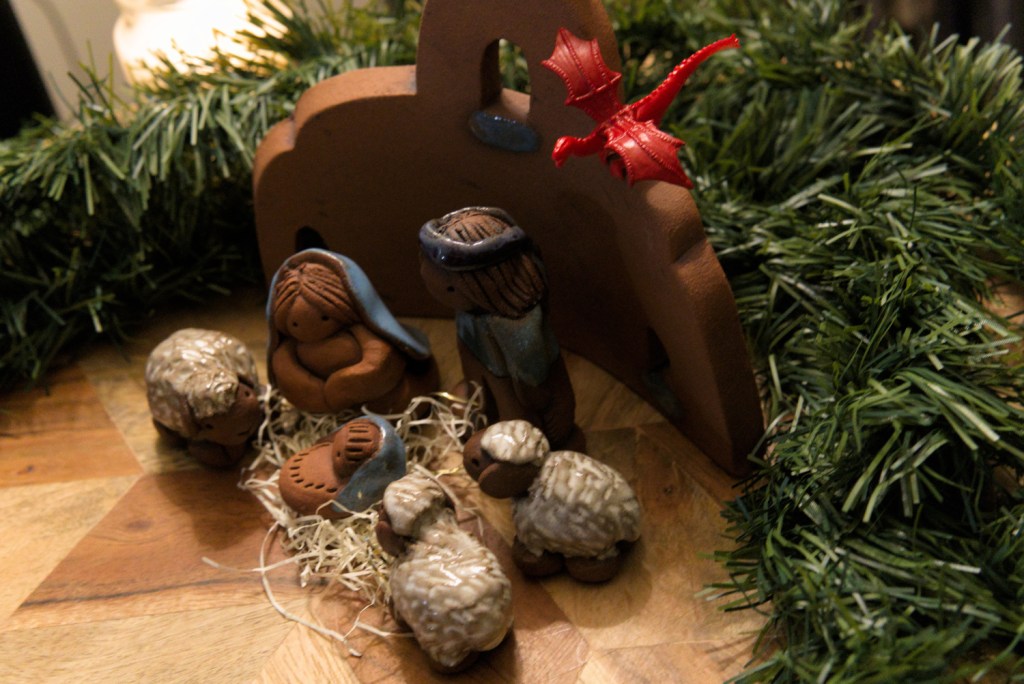
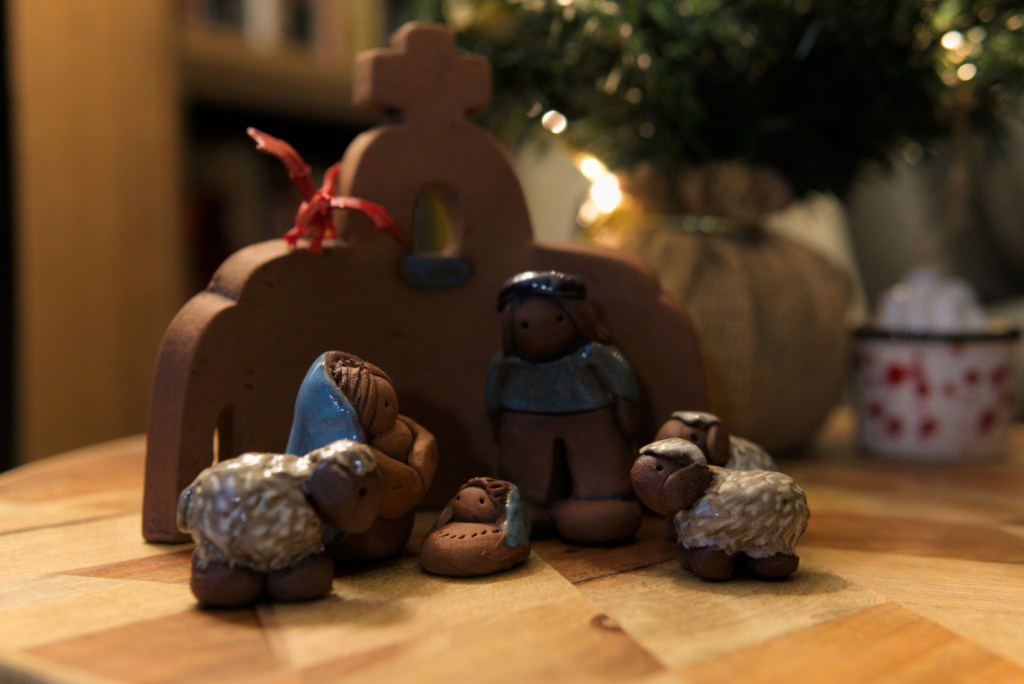
This year I bought a little plastic dragon myself to add to my household nativity! Below are some photos my husband and I took. The clay figurines and adobe-style backdrop were made by Barbara Boyd, an artisan from New Mexico. (I bought them in 2016 at a festival in Albuquerque.)
The dragon was part of a cheap multipack from Amazon, and there are twenty-three other dragons that I don’t know what to do with—so if you live in the US and you want one, shoot me an email at victoria.emily.jones@gmail.com and your physical mailing address and I’ll send you one! The first three respondents get a red one. None of them are seven-headed or horned per Revelation (a gap in the Christmas market, perhaps?!), but they still convey the gist.
+++
LECTURE: “What Is God’s Future for the World?: An Eschatological Vision for the Kingdom on Earth” by N. T. Wright: This talk on inaugurated eschatology, on heaven and earth coming together redemptively and new-creatively, was delivered at the Fuller Forum at Fuller Theological Seminary on May 3, 2014. Any time we talk, sing, or preach about the return of Christ and the end, Wright says, we’re really using signposts that point into a bright mist. But we need those signposts. Wright seeks to dispel the popular belief that humans’ ultimate destination is some disembodied existence “up there” and instead have us embrace the ancient vision of this world as the site of the Messiah’s eternal reign and these bodies as participants, a vision of creation made new from the old. To believe that God will eventually abandon the world to the forces of human wickedness or entropy and decay instead of claiming it as his own undermines the entire narrative of scripture. Wright makes his case by way of the books of Genesis, Isaiah, Ezekiel, Daniel, the Psalms, the Gospels, Romans, and Revelation—the whole gamut.
“The Jewish vision of God’s ultimate future was never that people would leave this world and end up somewhere else called heaven in the company of God. . . . When eschatology comes into full focus, . . . it is all about God’s kingdom being set up on earth as in heaven, and indeed on earth by means of heaven.” He continues, “Heaven is the place where God’s future purposes are stored. And the New Jerusalem comes down from heaven to earth so that the dwelling of God is with humans.”
There’s so much more I could say—but instead of reading my takeaways, listen to the talk itself! It ends at 1:04:45 and is followed by an hour of Q&A. Here is a list of the questions with time stamps:
1:05:33: What is your reading of 2 Peter 3:10–12, which says that the earth will be burned up?
1:08:18: What does Paul mean in 1 Thessalonians 4:17: “Then we who are alive, who are left, will be caught up in the clouds together with them to meet the Lord in the air, and so we will be with the Lord forever”?
1:13:05: Where do you land on premillennialism, amillennialism, postmillennialism?
1:15:42: If earth is already crowded, how will everyone fit in the renewed creation after the resurrection?
1:21:42: If this world is going to be renewed, why should we make economic and lifestyle sacrifices now to protect endangered species and such?
1:24:18: How do you interpret John 14:3: “I go and prepare a place for you; I will come again and take you to myself”?
1:27:48: How do you understand hell? What are your thoughts on the teaching of universal restoration, the idea that everyone will eventually be saved?
1:33:48: Since you take issue with Michelangelo’s Last Judgment, what would you have painted at the east end of the Sistine Chapel instead?
1:34:17: How does Paul’s “now and not yet” correlate with Jesus’s teaching that “this generation will not have passed away before all this has happened” (Matt. 24:34; Mark 13:30; Luke 21:32)?
1:36:59: What is the role of departed saints (the “cloud of witnesses”)? What are your thoughts on the intercession of the saints?
1:41:17: What are your words of advice for preaching on these subjects and for pastorally caring for congregants who come with certain stock images of and language about heaven?
1:44:30: Since we believe in Jesus’s bodily resurrection, where is Jesus now?
1:46:28: Please give us some guidance on Paul’s view on homosexuality and how to address this complex issue in the church.
1:52:16: Is there any sense in which the State of Israel founded in 1948 could be the fulfillment of biblical prophecy?
1:56:40: What impact do you hope your work has on Christian discipleship?
2:10:34: What’s the relationship between faith and action?
Oh, and at 1:18:58, Wright offers this rousing sidebar on Christian art:
We are starved imaginatively as Christians. Christian art easily collapses into sentimentalism, just as contemporary postmodern art easily collapses into brutalism. Both of those are ways of seeing something but not the whole picture. Sentimentalism is what you get when you’re determined to smile even if the whole world is falling apart; it becomes inane, this sort of silly grin, and sadly, there’s a lot of Christian art like that.
But actually, Christians ought to be at the forefront of the art and the music, because that creates the imaginative world within which it’s possible to think differently about things. I think the secular world has done a pretty good job, and we’ve colluded with that, of keeping our imaginative levels down to the level of eighteenth- and nineteenth-century Epicureanism or deism, so that heaven is just this odd place, etc., etc. We need the new art and the new music which will create a world in which it makes sense to think of these things.
+++
BLOG POST: “Advent Love and Anselm Kiefer’s Alchemist” by Alexandra Davison: I grew up, and my parents and sibling still live, in a suburb of Raleigh, North Carolina, so I’m a somewhat frequent visitor to the North Carolina Museum of Art. Their untitled triptych by Anselm Kiefer is one of my favorite pieces in their collection—it transfixes me every time—so I was delighted to see that Alexandra Davison [previously], a creative director of Artists in Christian Testimony International whom I bump into at arts conferences now and again, wrote about it a few years ago. She describes it as an image of “cosmic drama that waits for resolution,” conveying “an unflinching Advent longing.” I sense that too when I stand in front of it.
Anselm Kiefer (German, 1945–), Untitled, 1980–86. Oil, acrylic, emulsion, shellac, lead, charcoal, and straw on photograph, mounted on canvas, with stones, lead, and steel cable, overall 130 1/4 × 218 1/2 in. North Carolina Museum of Art, Raleigh. Photo: Victoria Emily Jones.
Kiefer is the subject of an acclaimed new documentary by Wim Wenders (which I’m eager to see when it comes to streaming!). He was born in Germany at the tail end of World War II, and his art, which often incorporates materials such as lead, ash, and straw, is inextricably connected to the ravaged landscapes and haunted history of his country.
You shall have the trumpet sounded throughout all your land. And you shall hallow the fiftieth year and you shall proclaim liberty throughout the land to all its inhabitants. It shall be a jubilee for you . . .
—Leviticus 25:9–10
The LORD has proclaimed to the end of the earth: Say to daughter Zion, “See, your salvation comes . . .”
—Isaiah 62:11
Immediately after the suffering of those days
the sun will be darkened, and the moon will not give its light; the stars will fall from heaven, and the powers of heaven will be shaken.
Then the sign of the Son of Man will appear in heaven, and then all the tribes of the earth will mourn, and they will see “the Son of Man coming on the clouds of heaven” with power and great glory. And he will send out his angels with a loud trumpet call, and they will gather his elect from the four winds, from one end of heaven to the other.
—Matthew 24:29–31
“Look, I tell you, lift up your eyes, and see that the fields are white for harvest.”
—John 4:35
LOOK: Middle Eastern manuscript illumination of a trumpeting angel
Written around 1270, Aja’ib al-Makhluqat wa Ghara’ib al-Mawjudat (The Wonders of Creation and the Oddities of Existence) by the Persian cosmographer Zakriya ibn Muhammad al-Qazwini was one of the best known and most copied texts in the medieval Islamic world. This leaf from a fourteenth-century illuminated version shows an angel blowing a long trumpet that resembles a karnay, an ancient brass instrument still used throughout Central Asia, especially Uzbekistan, to herald celebrations.
The British Museum website identifies the angel in this painting as Gabriel; however, according to the hadith (records of the traditions and sayings of the prophet Muhammad) and the verso of this page, it is the angel Israfil who will blow the horn on the Day of Resurrection. Similar representations can be found here, here, here, and here. I sent a query to the museum asking why they’ve titled the painting “The Angel Gabriel” and whether it might be a mistake, and they told me they are looking into it.
Even though the Bible never specifies Gabriel as the trumpeter of the last days, he has come to be associated with that role in Christian tradition. The Armenian church was the first to assign it to him beginning in the twelfth century, and John Milton did likewise in his seventeenth-century epic, Paradise Lost. Gabriel’s trumpet is also a familiar trope in African American spirituals.
Israfil is not mentioned in the Bible. However, because whole hosts of angels exist and so few are named in scripture, all three Abrahamic religions (Judaism, Christianity, Islam) have naturally taken to supplying some names of their own.
The unknown artist of this image has creatively imagined an angel’s wing that tapers off into what looks like an animal head!
I chose the image for its ability to evoke Christ’s return—which, FYI, Muslims are also waiting for.
LISTEN: “Days of Elijah” by Robin Mark, 1996 | Arranged by Keith Lancaster and performed by the Acappella Company on Glorious God: A Cappella Worship, 2007
These are the days of Elijah Declaring the Word of the Lord And these are the days of your servant Moses Righteousness being restored And though these are days of great trials Of famine and darkness and sword Still we are the voice in the desert crying Prepare ye the way of the Lord
Behold he comes Riding on the clouds Shining like the sun At the trumpet call So lift your voice It’s the year of Jubilee And out of Zion’s hill Salvation comes
And these are the days of Ezekiel The dry bones becoming as flesh And these are the days of your servant David Rebuilding a temple of praise And these are the days of the harvest The fields are as white in the world And we are the laborers in your vineyard Declaring the Word of the Lord
Behold he comes Riding on the clouds Shining like the sun At the trumpet call So lift your voice It’s the year of Jubilee And out of Zion’s hill Salvation comes
There’s no god like Jehovah There’s no god like Jehovah There’s no god like Jehovah There’s no god like Jehovah
In the fifth century BCE God told Israel through his prophet Malachi, “See, I am sending my messenger to prepare the way before me. . . . Lo, I will send you the prophet Elijah before the great and terrible day of the LORD comes” (Mal. 3:1a; 4:5; cf. Isa. 40:3).
Four hundred years later came John the Baptist, whom Jesus referred to as Elijah (Matt. 11:14)—preparing the way, preaching the Word.
Northern Irish singer-songwriter Robin Mark invokes Elijah and, implicitly, his new-covenant counterpart, John, in the first stanza of “Days of Elijah,” comparing the ministries of these two prophets to that of the church. Just as John the Baptist prepared the way for the Messiah’s first coming, we are to prepare the way for his second.
The refrain pictures that second coming as a jubilee celebration—as freedom, rest, wholeness, the world set right—announced by a trumpet blast.
We are in the last days, the time between Christ’s two advents. And though we await the fullness of redemption, we do not do so passively. Filled with Christ’s Spirit, we labor as agents of justice and resurrection and praise, as the song suggests.
Above I featured a fairly standard (and skillful!) version of “Days of Elijah” that could be sung by your average church congregation. But here’s one to really knock your socks off: an arrangement by the South African gospel group Joyous Celebration, which they performed live in Johannesburg last month:
Detail of the Last Judgment, 1240–1300. Mosaic dome, Baptistery of Saint John (San Giovanni), Florence, Italy. Photo: Johann H. Addicks.
For we must all appear before the judgment seat of Christ, so that each one may receive what is due for what he has done in the body, whether good or evil.
POEMS: “The Last Judgment” by Raymond Oliver is darkly humorous and a true account of how some medieval artists stuck it to the man. For a more reverent reflection on the topic, read “Judgment Day” by R. S. Thomas, in which a perpetrator of injustice against the sick and the poor on earth stands before God’s heavenly throne, contrite; the speaker could well be Dives from the parable of the Rich Man and Lazarus—or, to name a more recent literary example, Scrooge from A Christmas Carol. She could also be you or me, if we heed not the many commands of scripture to love and support the needy.
This post belongs to the weekly series Artful Devotion. If you can’t view the music player in your email or RSS reader, try opening the post in your browser.
To view all the Revised Common Lectionary scripture readings for Proper 6, cycle B, click here.












 Art & Theology