Roundup: Mary Magdalene exhibition, “Grief Songs,” seeing God in Japan, and more

EXHIBITION: Mary Magdalene. Sin. Pray. Love., September 17, 2026–January 17, 2027, Städel Museum, Frankfurt, Germany: The first comprehensive art exhibition in the German-speaking world dedicated to Mary Magdalene, presented by the Städel Museum in collaboration with the Liebieghaus Skulpturensammlung, opened this month. It was heavily advertised throughout Frankfurt when I was there in August, and I regret that the timing of my visit didn’t coincide!
Gonzalez, Nieves_La sfida
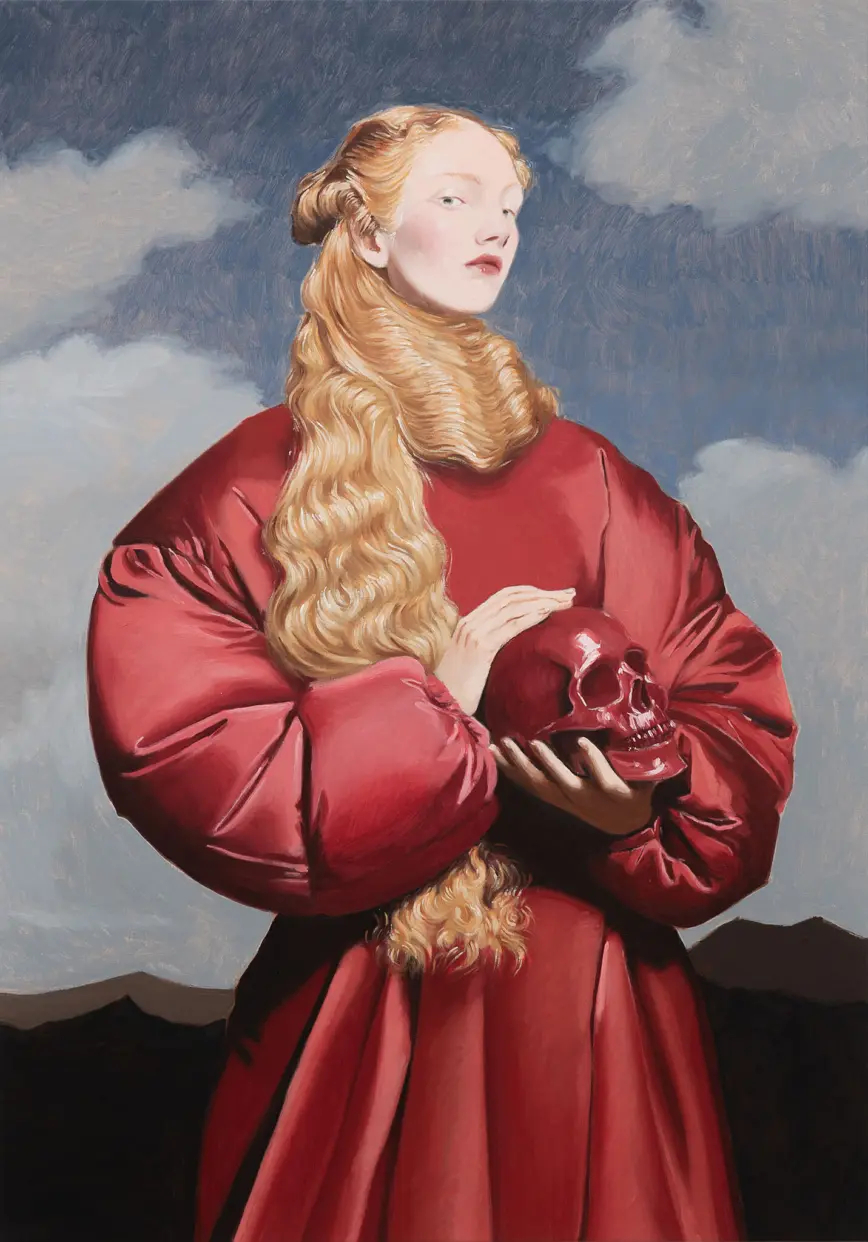
Nieves González (Spanish, 1996–), La sfida (The Challenge), 2025. Oil on canvas, 116 × 81 cm. Private collection.

The poster image, The Challenge, one of over a hundred works on display, is an oil painting by Nieves González. It portrays Mary with her characteristic long, auburn-blond hair, dressed in an oversize red puffer jacket and holding a red skull.

Mary Magdalene is traditionally shown in red, a color representing her intense spiritual passion but also alluding to the legend of the first Easter egg. One version of the story goes that when Mary went to Rome to proclaim the Resurrection to Emperor Tiberius, a basket of hardboiled eggs in hand (she had brought them with her to Jesus’s tomb for sustenance), Tiberius scoffed and said that Jesus no more rose from the dead than those eggs she carried were red. Well, right then, the eggs changed color from their natural white.

I love the unexpected clothing choice in this painting. I bristle against a historical image type of Mary Magdalene, especially popular among sixteenth-century Italian aristocrats, that shows her only partially clothed, her breasts exposed, ostensibly to emphasize her stripping away of worldly vanity, and even her return to the innocence of Eden—but methinks the Renaissance and Baroque penchant for sensuality had more to do with this representation than did any kind of biblical or theological reasoning. González’s Mary does not bare her body for the titillation of viewers.

Nor is her gaze passive; it’s strong, assured, unashamed. “The challenge” of the title could be Mary’s defying her mischaracterization throughout history as a reformed prostitute—probably the number one thing your average person, whether Christian or non, most associates with her, but which comes from erroneously conflating her with other New Testament women. What the Bible tells us about Mary is that Christ delivered her from seven demons, after which she joined his movement, traveling with him and the other disciples and financially supporting his ministry, which suggests she was a woman of independent means; faithful in her devotion to Christ, she was present at his crucifixion and, two days later, was the first person to whom he appeared in his risen flesh, commissioning her to go and tell the others the news. Although church tradition presents her as the model penitent (which the skull symbolizes), we really don’t know what her former life looked like, nor her life after the events of the Gospels; only that Christ wrought a spiritual transformation in her, and that she boldly followed him. Her pose in The Challenge is one not of arrogance or smugness but of confidence, confidence in who she is, and in the Gardener who called her name.

Another challenge in Mary’s gaze could be for us to consider, if Christ chose her to be the first witness of his resurrection (an event of immense theological import) and ordained her to preach the same, why so many pockets of the church continue to restrict the ministry of women.

+++

ONLINE COURSE: Stories about the End with Dr. Mary McCampbell, October 13–December 8, 2026: Starting next month, my professor friend Mary McCampbell [previously] is teaching an online course on Tuesday evenings that will examine contemporary works of dystopian literature, film, and television. The reading/watching list includes novels by Don DeLillo, Douglas Coupland, Octavia Butler (in graphic novel adaptation), and Margaret Atwood; Alfonso Cuarón’s Children of Men; and a to-be-voted-on television series.
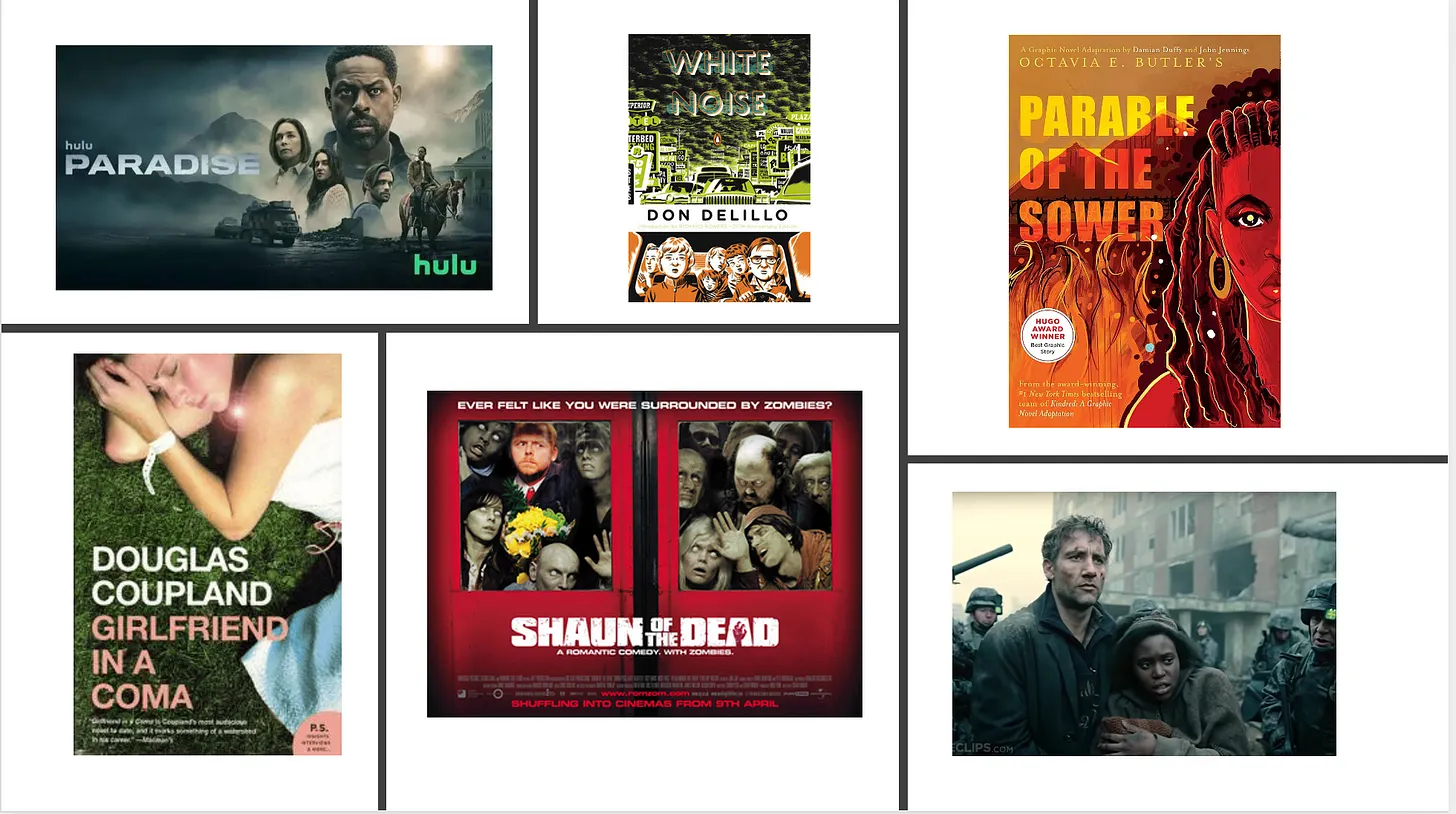
Stories about the End

“Why is our culture so drawn to fantasies of death and destruction that often provide no ultimate redemption or regeneration? To begin exploring this question, we will analyze how dystopian narratives are (typically) the result of the modern and postmodern secularization of the concept of ‘apocalyptic.’ We will then examine contemporary works of literature, film, and television to investigate how these stories are told and what they reveal about the contemporary cultural landscape. Through close reading of cultural products, we will look at the relationship between dystopian narratives and the centrality of Western consumerism, the practice of religious belief, the experience of grief and loss, the threat of sinister environmental factors, and questions about the presence or absence of a human condition.”

+++

LIMITED SERIES: The Lord of the Flies (2026), dir. Marc Munden: Speaking of dystopian fiction, the recent BBC adaptation (bought by Netflix) of William Golding’s classic novel is phenomenal. The script, the acting, the cinematography, the score, the costuming—perfect. A dark story about thirty-some British schoolboys aged six to twelve who attempt self-governance when they find themselves stranded on a desert island, it explores democracy versus autocracy, vulnerability and violence, and the dangers of groupthink, probing the savage instincts of humans.

The book was written during the Cold War and the threat of nuclear annihilation. It deliberately subverts the colonial narrative found in many books of the period that touted the “civilizing” authority of the British.

+++

KICKSTARTER CAMPAIGN: Grief Songs, an album by the Porter’s Gate: Last year, a group of roughly sixty scholars, pastors, and musicians gathered to share personal stories of loss and, out of that, wrote songs “meant to be sung by congregations who are willing to sit, to wait, to watch, and to pray with those who grieve.” The Porter’s Gate [previously] has selected a handful of these to record onto an album, and although most of the work has been done, they need some additional funds to bring the project across the finish line. “May these songs give voice to what has been wordless, and may they help our communities become places where the brokenhearted can bring their whole selves and still find themselves held.”

+++

FILM: Space and Time (2024), dir. Keone and Mari Madrid: Keone and Mari Madrid [previously] are a Filipino American husband-wife duo of hip-hop choreographers, dancers, and directors. In 2023, they suffered a series of losses, one of which they interrogate and transfigure in this forty-three-minute dance film, which shows the couple traversing the landscape of grief after a miscarriage.

+++

PODCAST EPISODE: “Seeing God in Japan” with Roger Lowther, The Purpose of Beauty, July 31, 2025: Podcast host Anna Gardner Herren interviews organist Roger Lowther [previously], an American missionary to Japan (for over twenty years) and founder of Community Arts Tokyo, about the role of beauty in missions. They discuss the popularity of Bach in Japan, and how Bach has opened up in many Japanese people a curiosity about and receptivity to Christian truth (he has stories about his language teacher attending one of his concerts and having an emotional connection to how it elucidated hope; and about his conductor for the St Matthew Passion asking him to explain the significance of the text being sung, since he was the only Christian in the room!). They talk especially about the necessity of beauty to combat despair after the 2011 Tōhoku earthquake and tsunami.

Lowther then goes on to recount stories from the ethnodoxology (“praise of the nations”) movement, which seeks to discerningly use indigenous art forms (musical, dramatic, visual, etc.) in Christian worship; he tells of the professional koto (traditional Japanese zither) player Chieko Ozawa (see this short film), who, when she became a Christian, initially thought she had to quit her instrument because of its association with Shintoism but soon realized it could be used for God’s glory.

(Read the transcript.)

Roundup: Jesus as Dancer, The Daily Prayer Project, ethnoarts in Indonesia, and more

BLOG POST: “Jesus as Dancer: Jyoti Sahi’s ‘Lord of Creation’” by Victoria Emily Jones: I wrote a guest post for the Sojourn Arts blog about a gouache I own by Indian artist Jyoti Sahi, which shows Jesus leading the dance of new creation. On one side he pounds a drum, and on the other he emerges from a lotus. The painting brings together Jyoti’s interests in Christian and Hindu theologies and folk symbolism.

Sahi, Jyoti_Lord of Creation
Jyoti Sahi (Indian, 1944–), Lord of Creation, 1982. Gouache on paper, 14 3/4 × 20 in. Collection of Victoria Emily Jones.

Sojourn Arts is a ministry of Sojourn Church Midtown in Louisville, Kentucky, that seeks to support artists and build up the church through the arts. They have organized and/or hosted numerous exhibitions over the years and have commissioned temporary installations for their sanctuary, as well as coordinated community art projects. Visit www.sojourn-arts.com.

+++

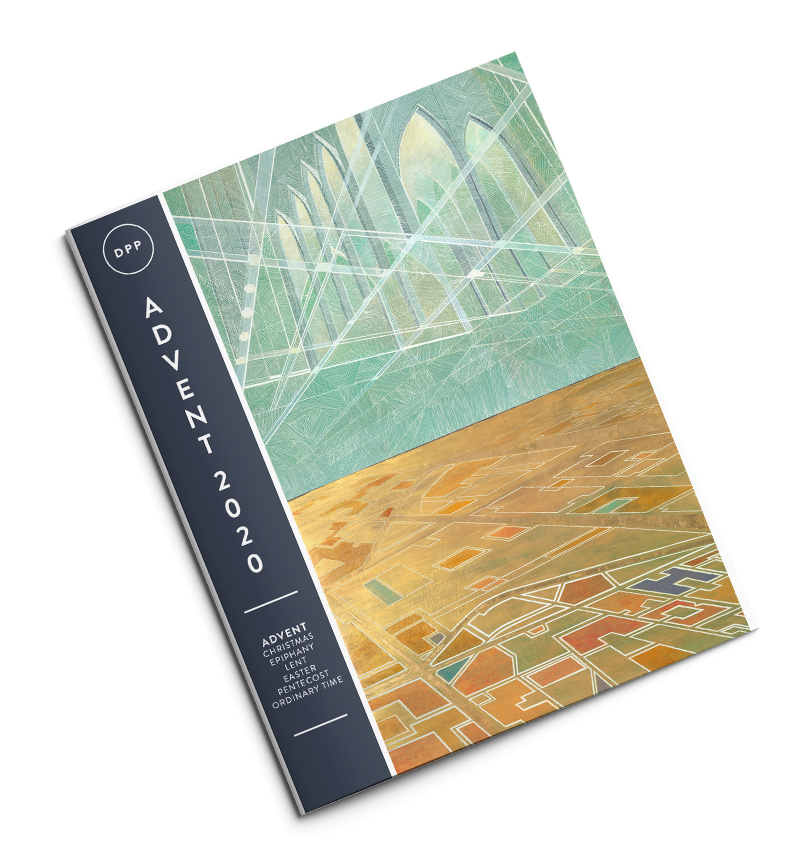
THE DAILY PRAYER PROJECT: This fall I joined the team at the Daily Prayer Project as curator of visual art. The Daily Prayer Project is a periodical that covers every season of the Christian year with robust, rooted, and cross-cultural liturgies for use in congregations, households, workplaces, small groups, or other gatherings. Released in seven editions per year, it features daily morning and evening prayer guides for the week, which include Psalm, Old Testament, and New Testament readings; short prayers sourced from around the globe and from different eras; specific prayer prompts; and songs (including lead sheets). In addition to the cover image, there is a mini-gallery of two art images inside, reproduced in full color, to serve as visual prompts for further contemplation and prayer. There is also a section called “The Practices,” with two page-long seasonal reflections by staff members or guest contributors.

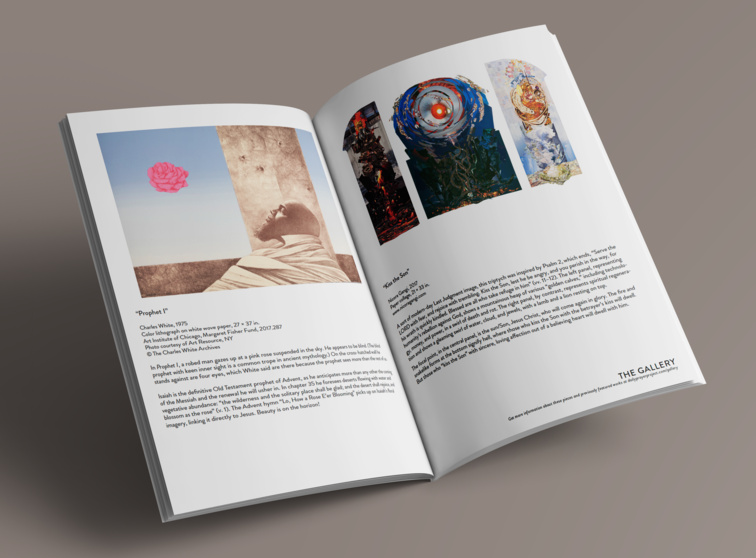
The Advent 2020 issue of the DPP, covering November 29 through December 24, was released last week. It features prayers by African American civil rights leader Fannie Lou Hamer, the tenth-century English saint Ethelwold, and others; a Hebrew folk song, a Taizé chant, and an Argentine hymn by Federico J. Pagura; a striking cover image by Hilary Siber, which shows heaven coming down to earth; Charles White’s Prophet I, which resonates with passages from Isaiah; and an apocalyptic paper collage by Nicora Gangi.

The periodical is available as a physical booklet or as a PDF download. Visit the website for more information. If you are an artist and are interested in having your work considered for publication in a future prayerbook, email team@dailyprayerproject.com.

DPP Advent 2020 interior

+++

VIDEO: “Local Riches: Ethnoarts and Sumba”: A workshop for churches on the island of Sumba in Indonesia, led by Yayasan Suluh Insan Lestari in July 2019, reinforced that God is best honored, and the global body of Christ built up, when people worship God using their unique cultural and linguistic gifts, bringing their whole, authentic selves before him in praise. [HT: Global Christian Worship]

For centuries many Christian missionaries to other countries brought with them Western hymns and images, presenting them as definitive—as forms that alone are good and pleasing to God. (For example, a woman in the video mentions how she had previously thought that worship songs had to be based on Western scales and performed using certain instruments to be acceptable.) But in the last fifty or so years especially, at least from what I’ve noticed, many missionaries have recognized the falsity of this line of thinking and seek to undo negative conditioning by promoting the use of indigenous artistic expressions (sometimes called “ethnoarts”) in Christian worship, be it dance, drama, music, storytelling, carving, or what have you. I found it interesting that the interviewees seem to suggest that now it’s the forces of modernism that most threaten the survival of traditional cultures, whereas it used to be that the church was largely blamed (missionaries did undeniably play a large part, banning this and that, though in every era there were exceptions to the rule). Now the church is at the forefront of trying to preserve not only traditional languages but also traditional art forms.

“Everything we have was created by God, and we need to return to it with gratefulness because this is how God made us!” says Rev. Herlina of the Christian Church of Sumba. “With whatever we already have, we can be a blessing to our people.”

+++

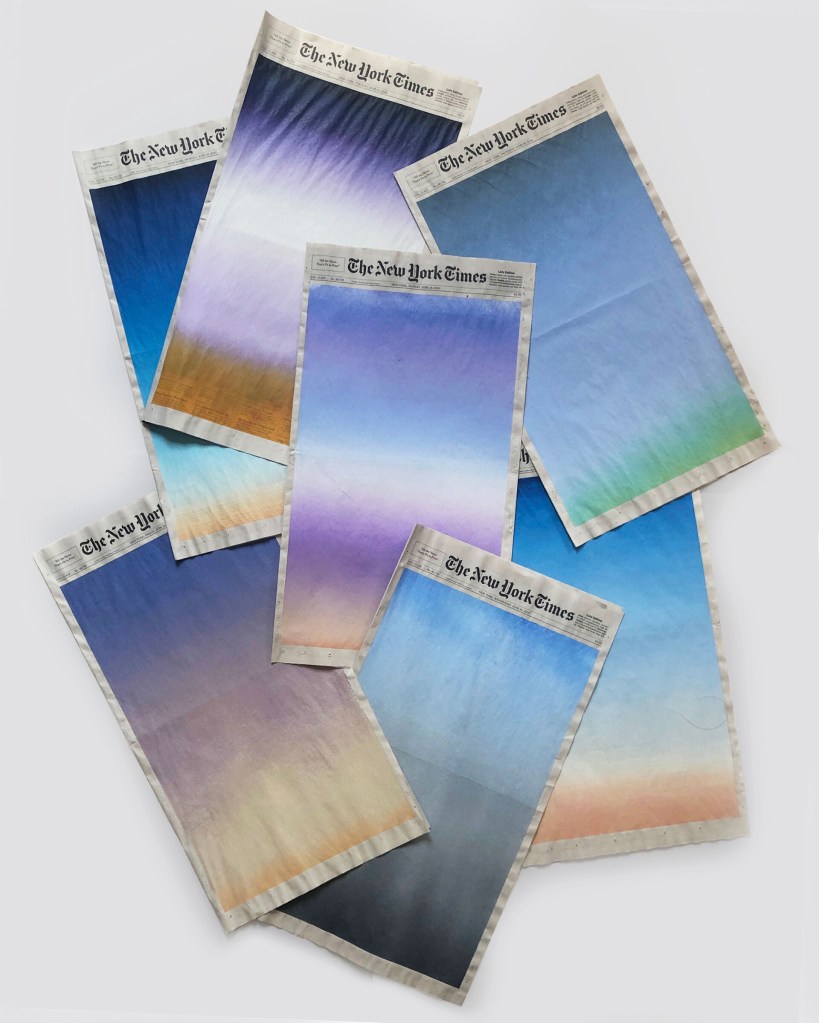
NEW ART SERIES: “Organic, Sunrise Gradients Mask Front Pages of the New York Times by Artist Sho Shibuya”: Since the lockdown started in March, Brooklyn-based artist and graphic designer Sho Shibuya has been painting color gradients in acrylic over the front pages of the New York Times, inspired by each morning’s sunrise. He calls the series “Sunrises from a Small Window.” I love how he’s able to express gratitude for a beautiful new day and to access calm amid dire news cycles. Shibuya is still reading those headlines and articles; he’s just putting them in a larger perspective. (As for myself, call me escapist, but I’ve found that actually blocking out the news—turning down the noise—for certain periods can be a helpful spiritual practice.)

Sho Shibuya, Sunrises from a Small Window, June 22–28, 2020. Acrylic on newsprint.

“I started . . . contrasting the anxiety of the news with the serenity of the sky, creating a record of my new normal,” Shibuya says. “Their front page has always been a time capsule of a day in history, so it made sense to use history as the canvas because the paintings are meant to capture a moment in time. . . . The spirit of the project is that maybe, even after the pandemic subsides, people can continue some of the generosity and peace we discovered in ourselves and that the sky reminds us of every day with a sunrise through a small window. If one thing the news has made clear, we need generosity and peace for all people now more than ever.”

+++

TWO FILMS: “Death on Netflix: I’m Thinking of Ending Things and Dick Johnson Is Dead” by Mitch Wiley: I really liked both these cinematic reflections on mortality, but they’re completely different, as this short Gospel Coalition article bears out. Dick Johnson Is Dead is the more “Christian” of the two because of its hopeful perspective—the human subject of the film is a Seventh-Day Adventist, so death for him is not a final end. After her father was diagnosed with dementia, filmmaker Kirsten Johnson asked her dad if he’d be interested in a collaborative film project where, to help them both face the inevitable, she would stage his death in inventive and comical ways. Relishing the opportunity to spend more time with his busy daughter, he enthusiastically agreed.

The documentary shows them preparing and carrying out these stunts but also interacting in other contexts—birthday parties, trick-or-treating, looking through old photo albums, cleaning out Dick’s office, Dick’s being asked to give up driving, and so on. It made me laugh and cry—films that can do both tend to rate highly on my favorites list. There’s so much love and warmth and heartache and whimsy in it as father and daughter confront death together, talking very openly about it, which I found, strange as it may seem, refreshing. Oh, and the heaven sequences just may be the best I’ve ever seen.

For a more cynical take on death, here’s the trailer to I’m Thinking of Ending Things (Charlie Kaufman isn’t for everyone, but I’m still thinking about this movie after watching it a month ago, which means it made an impression!):

Seeing and Believing, a Christ and Pop Culture podcast, covered Ending Things and Dick Johnson in episodes 264 and 266, respectively, as have most other film podcasts and reviewers, with Dick Johnson being uniformly lauded as one of the best movies of the year.

+++

SONG: “Hodu” (Give Thanks), performed by the Platt Brothers: The Platt Brothers [previously] singing scripture to me? Yes, please. The text of this song is Psalm 118:1–4, and the music is by Debbie Friedman (1951–2011), a Jewish singer-songwriter whose songs are used widely in Reform and Conservative Jewish liturgies in North America. Friedman’s “Hodu” was originally released on her 1981 album And the Youth Shall See Visions. (Find sheet music here.)

In this video from earlier this month, Henry, Jonah, and Ben Platt sing “Hodu” to a guitar accompaniment by Al Seller.

Hodu l’Adonai kitov
Ki l’olam chasdo, ki l’oam chasdo
Yomar na, yomar na, Yisraeil
Ki l’olam chasdo, ki l’olam chasdo
Yomru na, yomru na veit Aharon
Ki l’olam chasdo, ki l’olam chasdo

Let all who revere G-d’s name now say
Ki l’olam chasdo
Give thanks to the Lord for G-d is good
Ki l’olam chasdo

The first time the Platt Brothers performed in public as a trio was this April, when they appeared in a virtual Yom Ha’atzmaut celebration at the request of the Jewish Federations of North America, singing “Ahavat Olam.” Ben and Jonah are musical theater performers: Ben originated the title role in Broadway’s Dear Evan Hansen and won a Tony for it, and Jonah is best known for playing Fiyero in Wicked on Broadway from 2015 to 2016. Henry is a senior at the University of Pennsylvania, where’s he’s a member of the a cappella group Counterparts.