
Roundup: Dissident cinema, extreme birdwatching, Thomas Kinkade’s hidden vault, and more

SPOTIFY PLAYLIST: May 2026 (Art & Theology)

+++

PODCAST SERIES: Dissident Cinema Marathon, Filmspotting: Over the next two months, Filmspotting, my favorite film podcast, is running a marathon on the theme of politically dissident cinema, exploring six films that confront authoritarian power and state abuse. They come from the US, Italy, Japan, Greece, France, and Iran:

  1. The Great Dictator (Chaplin, 1940) – Kanopy, HBO, Amazon Prime, Criterion Channel, etc.
  2. Rome, Open City (Rossellini, 1945) – HBO
  3. No Regrets for Our Youth (Kurosawa, 1946) – Criterion Channel
  4. Z (Gavras, 1969) – HBO
  5. The Sorrow and the Pity (Ophuls, 1969) – Kanopy, Kino Film Collection (free trial)
  6. The Circle (Panahi, 2000) – psst

The first episode of the marathon aired May 4 (see below). It reviews Charlie Chaplin’s first true sound film, The Great Dictator, a political satire denouncing Hitler and Nazism. Chaplin stars as Adenoid Hynkel, the delusional, power-hungry, self-obsessed “phooey” (parody of Führer) of Tomainia. Chaplin started writing the script in fall 1938 and began filming it in September 1939; the movie was released in the US in October 1940. At a time when European nations were making concessions to Hitler and many Germans, swayed in part by his charisma and promises, were supporting his ultranationalist ideology, and others were simply conveniently ignoring him (Chaplin’s own adopted country was trying to maintain neutrality), Chaplin had the guts to call a spade a spade and openly mock the world leader and, in the character of a Jewish barber who’s mistaken for Hynkel, deliver a sincere and rousing speech against his fascist rule.

Chaplin realized, says cohost Josh Larsen [previously], that “it’s a crucial thing . . . calling out a dictator, whether it’s Hitler or someone we’re living with. You call him out as an idiot, because as a comedian, this is what Chaplin is going to be able to do: lampoon the inherent silliness . . . the puffery, the pageantry, the needing of arches and ballrooms and your face on every frickin’ thing everyone looks at. . . . It takes a comedian to spoof all of this self-important buffoonery that, to my mind, is really just an attempt to mask a lack of moral authority.” The movie contains one of cinema’s most memorable and prescient scenes: the demented globe dance, where Hynkel gracefully tosses, kicks, and balances a balloon globe, imagining a “pure Aryan world” with himself as a god.
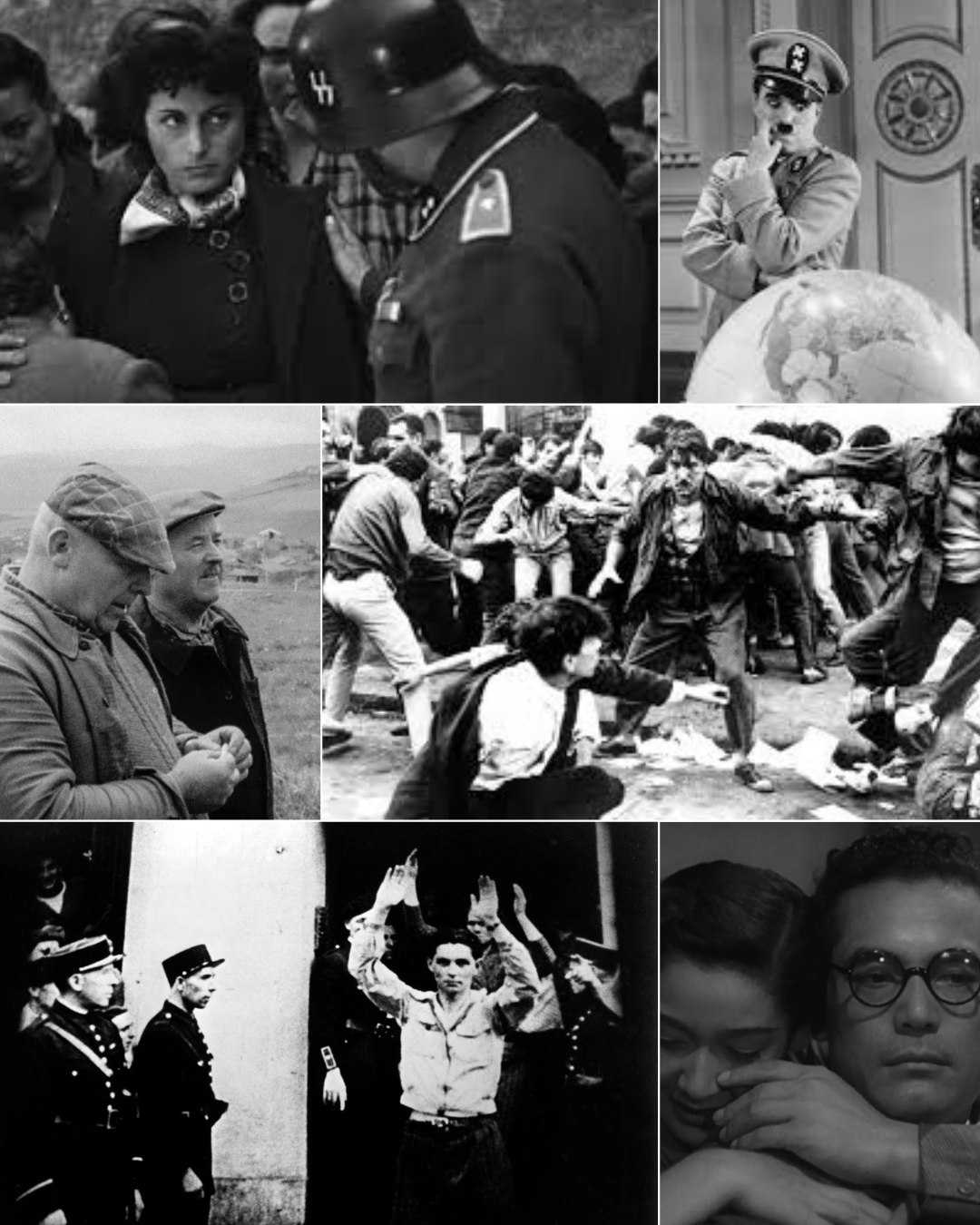
Dissident Cinema Marathon

To participate in the marathon, watch the films on your own (above, I shared the streaming services they’re on, but you might also see if DVDs are available at your local library), and listen to the podcast discussions that will be released one by one in the coming weeks on YouTube and your favorite podcast platform.

+++

BOOK EXCERPT: “Thinking about Cinema and Spirituality” by Gareth Higgins, from A Whole Life in Twelve Movies: Last year I published a micro-review of A Whole Life in Twelve Movies: A Cinematic Journey to Deeper Spirituality by Kathleen Norris and Gareth Higgins. Here’s an excerpt from the book’s introduction, in which Higgins provides some principles to help you go deeper into movies, to “experienc[e] images, sounds, words, and stories in a sacramental way.” Three primary questions to ask are:

  • What do you remember most about the movie—what stands out for you?
  • What was a highlight for you, and what was a challenge?
  • What questions does the film raise for your own life or for the world as you see it?

And he suggests several more questions to consider as and after you watch.

This excerpt is published on the Substack Soul Telegram, which Norris and Higgins also jointly author. The second half comprises Norris’s reflections on Life Itself, a 2014 documentary about the famous film critic Roger Ebert.

+++

PODCAST EPISODE: “Songs for Public Faith, with Jon Guerra,” Conversing, February 10, 2026: “Singer-songwriter Jon Guerra [previously] joins Mark Labberton to explore devotional songwriting, public faith, and the tension between the kingdom of Jesus and American cultural power. Through music and reflection, Guerra considers how art can hold grief, courage, and hope together in turbulent times.” Guerra says he wants his music to help orient people to higher and longer and deeper things. He discusses his songs “American Gospel,” “Love Your Enemies,” “The Kingdom of Jesus,” and “Citizens” (last two embedded below).

+++

DOCUMENTARY: Listers: A Glimpse into Extreme Birdwatching (2025), dir. Owen Reiser: In 2024, twenty-something brothers Quentin and Owen Reiser, the latter a wildlife photographer, embarked on what birders call a “big year,” traveling the contiguous United States attempting to witness and identify as many bird species as possible, trying to beat the record of 751 birds. They undertook this challenge on a meager $16,000 budget (in contrast to most big year competitors, who spend hundreds of thousands of dollars), driving and sleeping in a Kia Sedona and eating mostly beans and canned tuna. Listers—a term describing birdwatchers who keep detailed records of the birds they encounter—is a documentary about the Reisers’ whimsical excursion, learning the ins and outs of birding by poring over field guides, calling rare bird hotlines, interviewing members of the birding community, and simply doing. The film alternates between high-resolution footage of the birds they observe and handheld camcorder footage of their other experiences on the road and in the wild. They delve into relevant controversies and debates, such as the playback of recorded bird calls to attract birds into view and the increasing gamification of birding through the citizen science app eBird.
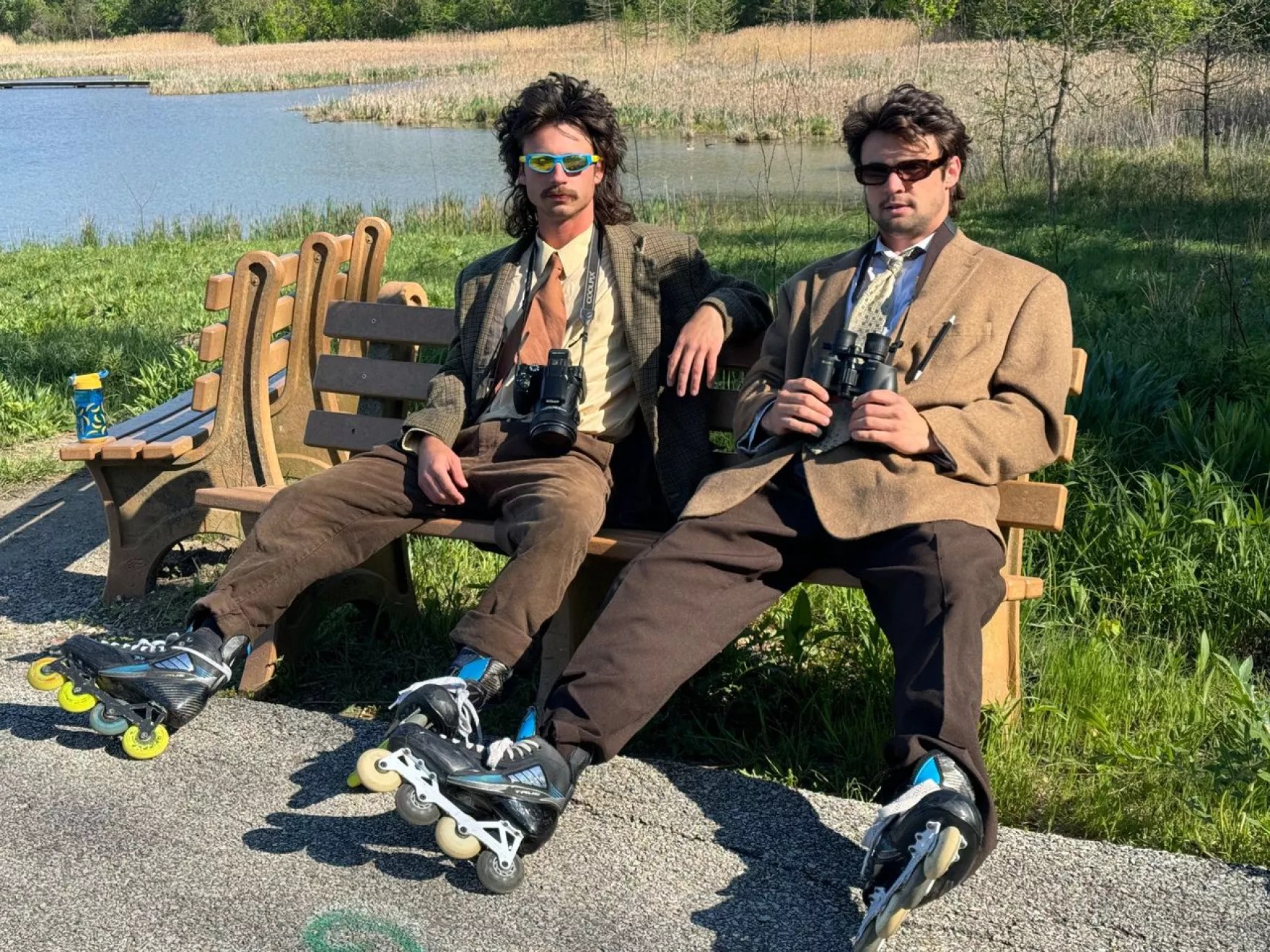
Listers documentary

But the film also encourages an appreciation of the beauty and variety of North American birds. It closes with an intertitle quote by the naturalist Kenn Kaufman, from his book Kingbird Highway: “As trivial as our listing pursuit may be, it gets us out there in the real world, paying attention, hopeful and awake. Any day could be a special day, and probably will be, if we just go out to look.”

The Reisers received distribution offers from Netflix, HBO, and Amazon but turned them all down, as they want Listers to be freely accessible to everyone. Watch the film here; trailer below. They also self-published their own field guide as a supplement.

+++

ARTICLE: “Lessons from the Hidden Vault of Thomas Kinkade” by Michael Wright: After Thomas Kinkade, the best-selling evangelical Christian “painter of light,” died of an overdose in 2012, his estranged family found a vault in his home containing hundreds of off-brand paintings he had made. Dark, moody, experimental—they are a far cry from the idyllic cottages that made him rich and famous. These previously unseen paintings are featured in the recent documentary Art for Everybody, directed by Miranda Yousef. (See trailer below.) Michael Wright shares some thoughts after seeing the film, which he says cultivated sympathy in him for Kinkade and the pressures he faced to be a “Good Christian Leader” and softened his harsh opinions of the artist into more complicated questions, such as “Why does an artist hide vital parts of himself for the sake of success? What happens when we curate branded versions of ourselves? Why do we continue to see this cycle of Christian leaders wrecking their lives? How can we imagine new social landscapes?” How can the market make room for an artist’s whole self?

Favorite Films of 2022, Part 1

Since 2020, I have been publishing an annual list of my top twenty films of the year, with trailers and microreviews. (See my lists for 2020 and 2021.) I love the collaborative nature of filmmaking, the coming together of so many talents—writing, acting, directing, shooting, editing, set design, costume design, etc.—to tell a story through moving images. Movies are actually my favorite mode of storytelling. It’s a shame that in some circles they’re denigrated as inferior to novels, less worthy of our time. That’s absolutely not true!

Moviegoing can be transformative. Like other art forms, movies reflect back to us the many aspects of the human (and in the case of my #5, animal!) experience, and can demand something of us.

Here are the first ten of my twenty recommendations for films to see that were released in the United States (though several were made internationally) in 2022, ranked in order of preference. Please be aware that many of these have R ratings and that you can consult content advisories if that concerns you.

1. Everything Everywhere All at Once, dir. Daniel Kwan and Daniel Scheinert. Bighearted and bizarre, this comedy sci-fi action adventure is about a first-generation Chinese American woman, Evelyn (Michelle Yeoh), who’s trying to hold it all together as her laundromat business is failing and her relationships are fraying, especially with her twenty-something daughter, Joy (Stephanie Hsu), whom she just doesn’t “get.” Then one day, out of nowhere, Evelyn is enlisted by a version of her husband, Waymond (Ke Huy Quan), to stop the evil Jobu Tupaki, a version of Joy, from destroying the multiverse. As Evelyn travels to alternate universes, she’s able to access skills and emotions her alt-selves possess and bring them back with her to help her fight.

Absurdity ensues. In one universe, Evelyn has hotdogs for fingers, and so becomes adept at using her feet; in one she’s a rock overlooking a canyon; in another, a teppanyaki chef whose colleague is controlled by a raccoon under his hat; in yet another, she’s a martial arts–trained movie star who never left China. She “verse jumps” from one to the other seeking to save her daughter from the vortex of despair into which she’s trying to suck everyone and everything, and all the while Joy is trying to find a version of her mother whom she can connect with, who can understand the emptiness in her.

The directors said the film is about a family trying to find each other through the chaos. At its core, it’s a family drama—one that explodes across the multiverse. It’s also about choosing kindness and joy (symbolized by a googly eye) and moving toward one another in empathy. It’s much louder and more outrageous than all my other picks, and I could have done without the scatological humor, but I found myself enthralled by the wild, disorienting ride that lands at a really tender place. Michelle Yeoh proves her versatility as an actor, and Jamie Lee Curtis, who plays IRS inspector Deirdre Beaubeirdra, is hilarious.

Streaming on Showtime.

2. The Banshees of Inisherin, dir. Martin McDonagh. Set in 1923 during the Irish Civil War on a fictional island off Ireland’s west coast, this dark comedy begins when Colm (Brendan Gleeson) tells his lifelong bestie, Pádraic (Colin Farrell), that he no longer wants to be friends. Colm is a fiddler and composer who wants to establish a legacy, a musical output that will live on—a goal that Pádraic is impeding by distracting him with daily hours of dull conversation, he says—whereas Pádraic says he merely wants to be known for “being nice.” Baffled by his friend’s abrupt severing of their relationship, Pádraic repeatedly pursues understanding and restoration, escalating the tension toward acts of violence. Male friendship and loneliness, melancholy, and mortality are key themes in this artful buddy-breakup movie that had me laughing out loud as well as tearing up.

Streaming on HBO Max.

3. Guillermo del Toro’s Pinocchio, dir. Guillermo del Toro and Mark Gustafson. Light overcomes the darkness in this stop-motion animated musical adaptation of the classic Italian children’s novel from 1883. It was written and codirected by Guillermo del Toro, a master of magical realism, and has been in development since 2008. When his young son dies, the carpenter Geppetto (David Bradley) carves a boy puppet, Pinocchio (Gregory Mann), to fill the hole left by this profound loss. In an act of compassion, the Wood Sprite (Tilda Swinton) brings Pinocchio to life and commissions Sebastian J. Cricket (Ewan MacGregor), an itinerant writer, to look out for him. Curious and unruly, Pinocchio ends up trapped in a circus by an abusive showman. He and his father spend much of the film trying to reunite, to be family to each other.  

These story points will sound familiar to most, but del Toro cleverly adapts them and adds new ones, setting the story in a Tuscan village during the rise of Mussolini in the 1930s, with one of the main villains being a Fascist podestà who’s trying to recruit Pinocchio into the army. It turns out it is the villagers who blindly subscribe to Il Duce’s propaganda who are the puppets, whereas Pinocchio, with his irrepressibility, is decidedly unpuppetlike. Thus the film explores contexts in which disobedience can be a virtue. Del Toro also places more emphasis on Geppetto’s growth than Pinocchio’s, making the story about Geppetto becoming a real father—learning to accept Pinocchio with all his quirks and difference, not making his love contingent on Pinocchio fulfilling his image of the perfect son—rather than Pinocchio becoming a real boy.

The artistry of this film is dazzling! I was blown away by the production design by Guy Davis and Curt Enderle (they designed the locations and characters and established the whole visual style), especially the evocation of interwar Italian life and culture, with the centrality of the church. I’m also dazzled by the puppets—shout-out to Georgina Haynes, the director of character fabrication—because remember, with stop-motion animation, all the characters are handmade, physical creations existing in three-dimensional space, not computer-made or drawn on a page; all but the “wooden” Pinocchio (made from 3D-printed hard plastic) consist of a manipulable silicone skin sitting over a mechanized system.

Streaming on Netflix.

4. Aftersun, dir. Charlotte Wells. Eleven-year-old Sophie (Frankie Corio) is on vacation with her single dad, Calum (Paul Mescal), in Turkey. He doesn’t have a lot of money, but he’s trying to create a memorable holiday for her. And despite its mundanity, it is memorable—the frame story is adult Sophie replaying its moments on tape and in her mind. Aftersun is a very personal project for first-time writer-director Charlotte Wells, who draws on her own history and relationship with her father; she says she wants people to be able to feel the warmth of these memories, even though they’re tinged with sadness. Though it’s never spelled out, it appears that Calum suffers from depression, and we gradually see more and more of his pain. The lack of exposition enables us to make our own inferences about it and about the ending. The “Under Pressure” dance sequence, which intercuts a frantic, stroboscopic nightclub scene where adult Sophie searches the floor for Calum with one of young Sophie and Calum dancing lovingly outside the hotel, safe in each other’s arms, is a contender for scene of the year—a metaphoric conveyance of mental health decline, of holding on and letting go.

5. EO, dir. Jerzy Skolimowski. Who would have thought a donkey’s inner life could be so captivating to watch onscreen? His memories, his imagination, his hopes, his fears, the affection he feels and longs for, his joys and sorrows. EO follows the life journey of the titular donkey as he passes from owner to owner, some of them kind, others cruel. He starts out at a circus in Poland, where he’s tenderly cared for by the young performer Magda (Sandra Drzymalska). But he’s seized by animal rights activists and ends up at a horse sanctuary, and from there he moves to a petting farm for children with disabilities. He escapes, looking for Magda, and spends a harrowing night alone in the forest. Chancing upon a soccer game the next day, he becomes a mascot for a time, a figure of great adulation but also vitriol by the opposing team. His next job is as a beast of burden at a fur farm, where he’s made to carry fox pelts, and then he’s acquired by an Italian priest.

There’s very little dialogue in the film, and there are no voiceovers to convey EO’s thoughts or emotions, which we infer by context. The cinematography, from close-up shots of EO’s dark, expressive eyes to wide shots of varied landscapes, is gorgeous—visual poetry. EO is an indictment of human violence and a call to empathy for animals. Dare I say I liked it better than the Bresson classic (Au hasard Balthazar) that inspired it? Unlike its predecessor, it stays entirely focused on the donkey’s perspective, with humans relegated to the periphery.

6. Hit the Road, dir. Panah Panahi. A road-trip dramedy from Iran, this debut feature by Panah Panahi follows a family of four as they drive across the Iranian countryside under the pretext of a wedding. Dad (Mohammad Hassan Madjooni), who wears a leg cast, sits in the back with the young ball-of-fire son (Rayan Sarlak) and sick dog, while Mom (Pantea Panahiha) and the quiet older son (Amin Simiar) take turns at the wheel, sometimes evincing their worry. There’s something clandestine about this journey, and over the course of the film we learn more but not much. But even with the imminent separation hanging like a cloud, there’s a lightness and a sweetness that’s so endearing as we watch the characters bicker and goof around and connect with one another. Films that can hold together the weighty and the comical, like this one, tend to be the ones I enjoy most.

Streaming on Showtime.

7. TÁR, dir. Todd Field. Set in the classical music world, this drama explores the corrupting nature of power through the (fictional) character of Lydia Tár (Cate Blanchett), an award-winning conductor, composer, educator, and author. It’s an intense and brilliant performance of a complex character who is amazing at her craft but who also uses her status to manipulate others, including the young female cellist who has just joined her orchestra, the prestigious Berlin Philharmonic. The tension rachets up as they prepare to perform Mahler’s Fifth Symphony and rumors about Lydia’s connection to the death of one of her former protégés threaten to undo her.

8. Broker, dir. Kore-eda Hirokazu. Found families is a key theme in the oeuvre of the Japanese director Kore-eda Hirokazu, whose Shoplifters (2019) is one of my all-time favorite films. His latest, Broker, is set in South Korea. Seeking to place her newborn son, Woo-sung, in the care of a family better equipped to raise him, the young single mom So-young (Ji-eun Lee) leaves him outside a church, where he is intercepted by Sang-hyeon (Song Kang-ho) and Dong-soo (Dong-won Gang), who attempt to sell him on the adoption black market. The next day she returns with doubts and demands to be included in the process of finding a home for Woo-sung. So she follows the two brokers in responding to the calls of prospective buyers, and along the way they pick up a stowaway from an orphanage, the ebullient Hae-jin (Seung-soo Im), the character that really brought it all together for me.

As they drive from city to city, the five travelers bond with one another, each of them carrying their own forms of rejection trauma and seeking love and belonging. The last night they spend together . . . wow! Kore-eda is a deft handler of sentiment, never maudlin but rather inserting understated emotional moments in all the right places (another example: the flower on the wet car window scene). He tackles heavy subject matter and complex social issues with heart, always keeping his characters at the center and allowing for reprieves of warmth and brightness. He avoids simplistic endings but also unnecessarily bleak ones, taking a vantage point of hope.

9. The Fabelmans, dir. Steven Spielberg. This coming-of-age drama is a fictionalized telling of Steven Spielberg’s upbringing in a midcentury Jewish American household and, since seeing his first movie in a theater at age six, his developing passion for cinema. Spielberg’s stand-in is Sammy Fabelman (Gabriel LaBelle). In many ways The Fabelmans is Spielberg’s love letter to his artistic and free-spirited mother, named Mitzi in the movie and played by Michelle Williams, who from the get-go fully supports Sammy’s dream to become a filmmaker, unlike his much more practical father, Burt (Paul Dano), a computer engineer, who doesn’t initially see filmmaking as a worthy pursuit.

I wondered if The Fabelmans was going to be a self-indulgent homage to Spielberg’s successful career, full of Easter eggs to his other films, but it wasn’t that at all. The story stands on its own apart from its basis in the particularities of Spielberg’s life. It’s about vocation and family and the power of films to help us see the truth. That it’s also a semiautobiographical portrait of a director whose films I grew up on (E.T., Jaws, Jurassic Park) and continue to admire is an added bonus!

10. Nanny, dir. Nikyatu Jusu. Marked by menace and mystery, this psychological horror-drama centers on Aisha (Anna Diop), a Senegalese immigrant to New York City hired by an affluent couple to care for their daughter. Aisha is haunted by the absence of her six-year-old son, whom she left under the care of a cousin in Senegal so that she could earn money to bring him to the US. But that goal becomes difficult when her employers start withholding her wages. As she navigates the oppressive situation she finds herself in, she is visited by figures from West African folklore: Mami Wata (a mermaid-like water spirit) and Anansi (a trickster spider). They seem like malevolent forces, but her boyfriend’s grandmother encourages her to reframe her thinking and to ask what the spirits want not from her but for her. Could they be haunting her to help guide her toward a new and better life?

The film deals with class, race, exploitation, resistance, survival, motherhood, and guilt—all parts of Aisha’s immigrant experience. Despite the too-quick resolution that follows, the scene at the end of Aisha being reborn out of chaos is visually and emotionally compelling. I appreciate how writer-director Nikyatu Jusu, born in the US to Sierra Leonean parents, uses supernatural horror tropes in unique and subversive ways.

Streaming on Amazon Prime.

Read part 2.