Easter, Day 8: Sent

Now the eleven disciples went to Galilee, to the mountain to which Jesus had directed them. When they saw him, they worshiped him, but they doubted. And Jesus came and said to them, “All authority in heaven and on earth has been given to me. Go therefore and make disciples of all nations, baptizing them in the name of the Father and of the Son and of the Holy Spirit and teaching them to obey everything that I have commanded you. And remember, I am with you always, to the end of the age.”

—Matthew 28:16–20

Jesus said to [his disciples] again, “Peace be with you. As the Father has sent me, so I send you.” When he had said this, he breathed on them and said to them, “Receive the Holy Spirit.”

—John 20:21–22

LOOK: The Great Commission by He Qi

He Qi_Great Commission
He Qi (Chinese, 1950–), The Great Commission, 2017. Oil on canvas. [purchase giclée print]

In this painting by the Chinese artist He Qi (pronounced huh chee), Jesus holds a staff in his right hand (he is the Good Shepherd) and with the other points to the world outside Jerusalem’s gates, to which he calls his disciples to carry his all-renewing gospel. A modern cityscape rises up behind the figures, indicating that this call extends to the present era.

In the foreground, a minister baptizes a kneeling woman in red, their forms intercut with a fishing boat. The boat is a reference to Peter and Andrew’s original vocation as fishers and to Jesus’s promise, should they choose to follow him, to make them “fishers of people” (Matt. 4:19)—that is, gatherers of folks into the wide net of (proto-)Christian community, proclaiming and living out the kingdom of God in the power of God’s Spirit.

The Holy Spirit is represented as a dove sweeping down from the heavens, caressing the edge of Jesus’s halo. He’s the wind in the sails of the woman at the right, who goes forth into the darkness bearing the light of God’s word—her cheeks aglow with it, her feet eager to publish it abroad.

Her predecessors in the task of preaching the good news of Christ’s resurrection are portrayed in the background—the three women who first discovered the empty tomb and who then proceeded to “go quickly and tell” (Matt. 28:7).

LISTEN: “As the Father Sent Me” by Alana Levandoski, on Behold, I Make All Things New (2018)

As the Father sent me
So I send you


This is the final “artful devotion” post of this Easter season—but Eastertide continues until June 8! Spiritual director Tamara Hill Murphy explains on her Substack:

Easter Sunday marks the beginning of a week in the liturgical calendar known as the Easter Octave, followed by a seven-week festival called Eastertide, also referred to as the Great Fifty Days.

Beginning with the Feast of the Resurrection and including the Feast of the Ascension, Eastertide lasts fifty days, paralleling the forty days Christ spent on earth after His resurrection, plus the ten days the disciples spent waiting for the promised Spirit of Jesus. Exclamatory worship and celebratory feasting characterize the prayers and practices of Eastertide, which include invitations for baptism, thanksgiving, savoring beauty, feasting, play, and caring for creation. It is a time of celebration for the new creation that Jesus inaugurates for all of us.

So keep celebrating! I will continue posting Easter content throughout the season, just at a lesser frequency.

On this eighth day of Easter and ever forward, may you be filled with the transforming knowledge, excitement, and power of Christ’s resurrection, and go out and share it with the world.

“Fishers of People” by Andrew Roycroft (poem)

Mynheer_Nicholas_The Calling
Nicholas Mynheer (British, 1958–), Jesus Appears on the Shore: The Calling, 2007. Oil on canvas, 31 × 25 cm. Final painting from the thirteen-piece Sarum Cycle on Christ’s passion. [read artist profile]

Just as day was breaking, Jesus stood on the shore;
yet the disciples did not know that it was Jesus.
(John 21:4)

Lap lulled by lifeless waters,
ill-cast nets bearing no weight,
the fishermen see against
charcoal dawn
the lone figure of the Lord—
come to draw them in again,
and launch them out.

This poem is No. XXXII from 33: Reflections on the Gospel of Saint John by Andrew Roycroft (Baltimore: Square Halo Books, 2022). Used by permission of the publisher.


Roycroft’s poems from the collection 33 are remarkable for their concision, especially this one based on John 21. There’s so much richness packed into these seven spare lines, about resurrection, restoration, plenitude, calling. The rabbi Jesus whom they had followed for three years and staked all their hopes in had died; he was executed by the state. Disappointed and forlorn, and some perhaps ashamed by their abandonment of him in his hour of deepest need, the disciples return to their livelihood as fishers. But their first night back at sea proves fruitless, yields no catch; the waters are dead, like their Lord. Or so they thought.

A voice from the shore yells out to them, telling them to cast their nets on the right side of the boat. Skeptically, they do, and the nets fill with such an abundance of fish that the men can barely heave them up. It’s then that they recognize the voice as that of their beloved Jesus. Peter cannot contain his joy and jumps into the sea, splashing his way to reunion with the one he had denied knowing just the previous week.

Jesus and friends then have a fish barbecue breakfast on the beach. He redeems Peter and removes his guilt by asking him three times, “Do you love me?,” giving him the chance to respond triply in the affirmative, counteracting the three no’s he had spoken the other night outside the house of Caiaphas. “Then feed my sheep,” Jesus says. Peter would go on to show his love for Jesus by doing just that, playing an instrumental role in the early church.

Luke places the episode of the miraculous catch of fish at the beginning of Jesus’s ministry, when Jesus calls his very first disciples (see Luke 5:1–11). That this episode bookends the Gospels speaks of second chances and the persistence of God’s promise to make fruitful his word. In both versions, the call is the same: “Follow me.” Through life and in death and out the other side.

At the end of the Gospel of John, Jesus calls his disciples back into ministry, to teaching and healing and spreading the good news of resurrection. The abundance teeming below the surface of the Sea of Galilee hints at the life and heft of the new movement Jesus was launching—the imminent multiplication of followers of the Way. Having reeled them in from their feelings of lostness and imbued them with fresh hope, Jesus casts his disciples back into the waters of the world, commissioning them to draw others into God’s kingdom of love and grace.


Andrew Roycroft is a poet and pastor from Northern Ireland who blogs at Thinking Pastorally. His poetry has featured in a variety of journals in the UK and Ireland, in Arts Council for Northern Ireland projects, on BBC Radio, and in the work of composer Anselm McDonnell, and he has received several commissions from New Irish Arts. 33: Reflections on the Gospel of Saint John (Square Halo, 2022) is his first poetry collection.

Roundup: Choral setting of Luke 5, portraits of the unhoused, a theology of negative spaces, animated shorts

SONG: “Put out into the deep” by David Bednall (2008), performed by The Gesualdo Six (2020): A verbatim setting of Luke 5:1–11 (RSV), the calling of the disciples, which is the Revised Common Lectionary reading for February 6.

+++

ESSAYS:

>> “Ghosts in Los Angeles” by Arthur Aghajanian, Ekstasis: The author of this essay reflects on Andres Serrano’s Nomads (1990), a humanizing series of portrait photographs of men and women experiencing homelessness in New York City. “Serrano titled each photograph with its subject’s first name, suggesting a familiarity with those portrayed while retaining their anonymity. . . . The images mimic the visual style of fashion and advertising, while also referencing historical portraits of the wealthy and powerful. The work restores the visibility along with the dignity of its subjects. . . . His diverse group reflects the vulnerabilities we all share, and the grace that sustains us in adversity.”

Serrano, Andres_Bertha (Nomads)
Andres Serrano (American, 1950–), Bertha, from the Nomads series, 1990. Cibachrome, 152 × 125 cm.

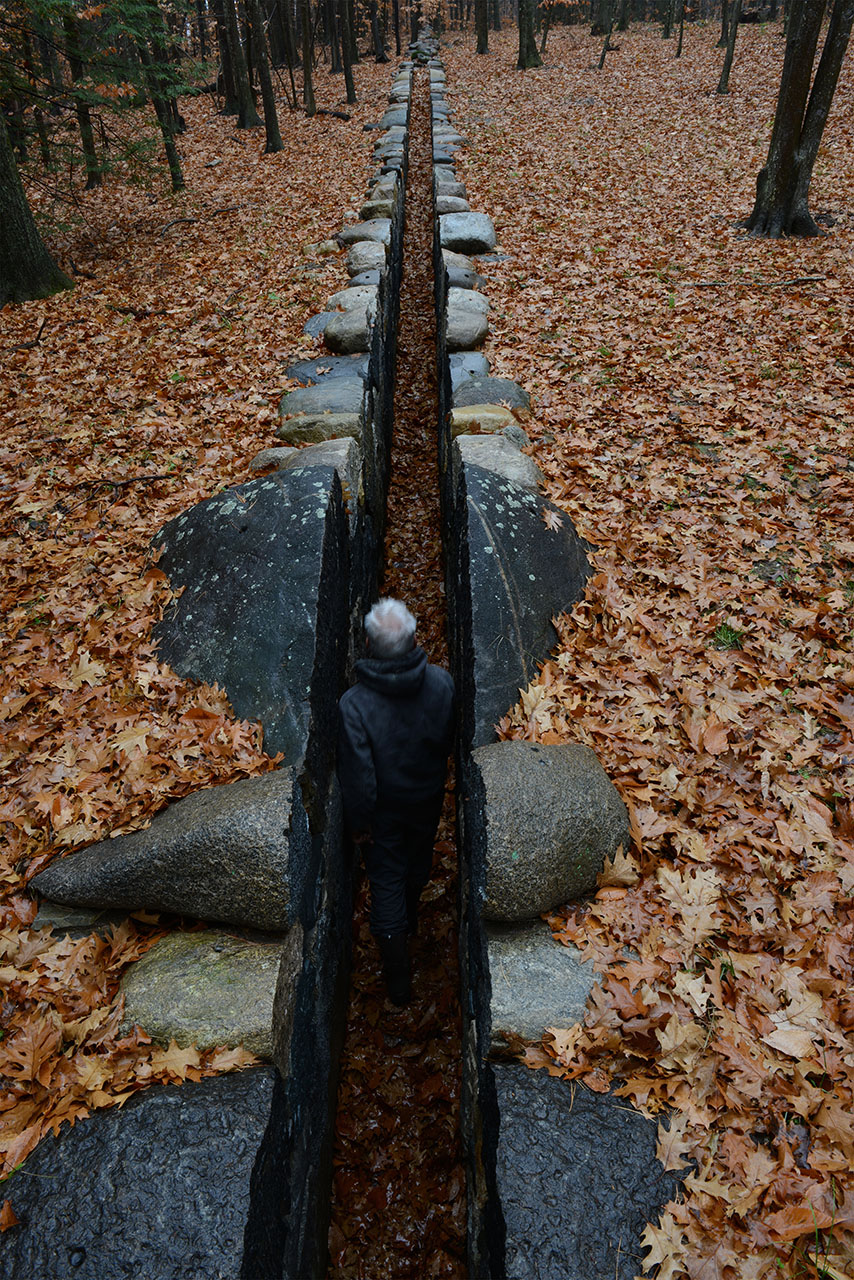
>> “The Cleft in the Rock: A Theology of Negative Spaces” by Daniel Drage, Image: This Image journal essay explores profound negative spaces in scripture—the first Sabbath, exile, the passage opened up by the parting of the Red Sea, empty wombs, tombs, nail wounds, the cleft of a rock, the space between the gold cherubim’s wings above the mercy seat—bringing them into conversation with works by contemporary British sculptors David Nash, Rachel Whiteread, and Andy Goldsworthy. Emptinesses that are full and presence via absence are key ideas.

Goldsworthy, Andy_Passage
Andy Goldsworthy (British, 1956–), Passage, 2015. Granite. Private collection, New Hampshire. Copyright of the artist.

+++

ANIMATED SHORT FILMS:

>> Migrants, dir. Hugo Caby, Antoine Dupriez, Aubin Kubiak, Lucas Lermytte, and Zoé Devise: The graduation project of five film students from the Pôle 3D school in France, this short follows a mother polar bear and her cub who are displaced from their Arctic home. When their ice float runs aground a new habitat and they’re forced to learn a new way of life, the native brown bears treat them with hostility. The filmmakers said the project was initially inspired by the story of the Aquarius, a watercraft filled with refugees that grabbed global headlines when it was refused entry at Italian ports in 2018. [HT: Colossal]

>> Tokri (The Basket), dir. Suresh Eriyat: A father-daughter story set in Mumbai, this stop-motion animated short from Studio Eeksaurus is about mistakes and forgiveness, and how meaningful a kind extended hand from a stranger can be . . . or not. [HT: Colossal]

Fishers of Men (Artful Devotion)

Fishing for Souls by Bill Hemmerling
Bill Hemmerling (American, 1943–2009), Fishing for Souls. Oil on canvas, 60 × 10 in.

On one occasion, while the crowd was pressing in on him to hear the word of God, he was standing by the lake of Gennesaret, and he saw two boats by the lake, but the fishermen had gone out of them and were washing their nets.

Getting into one of the boats, which was Simon’s, he asked him to put out a little from the land. And he sat down and taught the people from the boat.

And when he had finished speaking, he said to Simon, “Put out into the deep and let down your nets for a catch.”

And Simon answered, “Master, we toiled all night and took nothing! But at your word I will let down the nets.” And when they had done this, they enclosed a large number of fish, and their nets were breaking. They signaled to their partners in the other boat to come and help them. And they came and filled both the boats, so that they began to sink.

But when Simon Peter saw it, he fell down at Jesus’ knees, saying, “Depart from me, for I am a sinful man, O Lord.” For he and all who were with him were astonished at the catch of fish that they had taken, and so also were James and John, sons of Zebedee, who were partners with Simon.

And Jesus said to Simon, “Do not be afraid; from now on you will be catching men.”

And when they had brought their boats to land, they left everything and followed him.

—Luke 5:1–11

+++

SONG: “Fishers of Men” by Becky Buller | Performed by Rhonda Vincent, on One Step Ahead (2003)

Rhonda Vincent and the Rage is the most awarded band in bluegrass history. This studio version of their “Fishers of Men” cover is great, but there is also a commercially available live recording on Vincent’s Sunday Mornin’ Singin’ (2012), plus several live-performance videos on YouTube. I like this one from a 2007 bluegrass festival in Miamisburg, Ohio:

The other singers are, from left to right, Mickey Harris, Kenny Ingram, and Darrell Webb.


This post belongs to the weekly series Artful Devotion. If you can’t view the music player in your email or RSS reader, try opening the post in your browser.

To view all the Revised Common Lectionary scripture readings for the Fifth Sunday after Epiphany, cycle C, click here.