Christmas, Day 9: Word Made Flesh

LOOK: Chr. Geb. by Jörg Länger
Länger, Jörg_Chr. Geb.
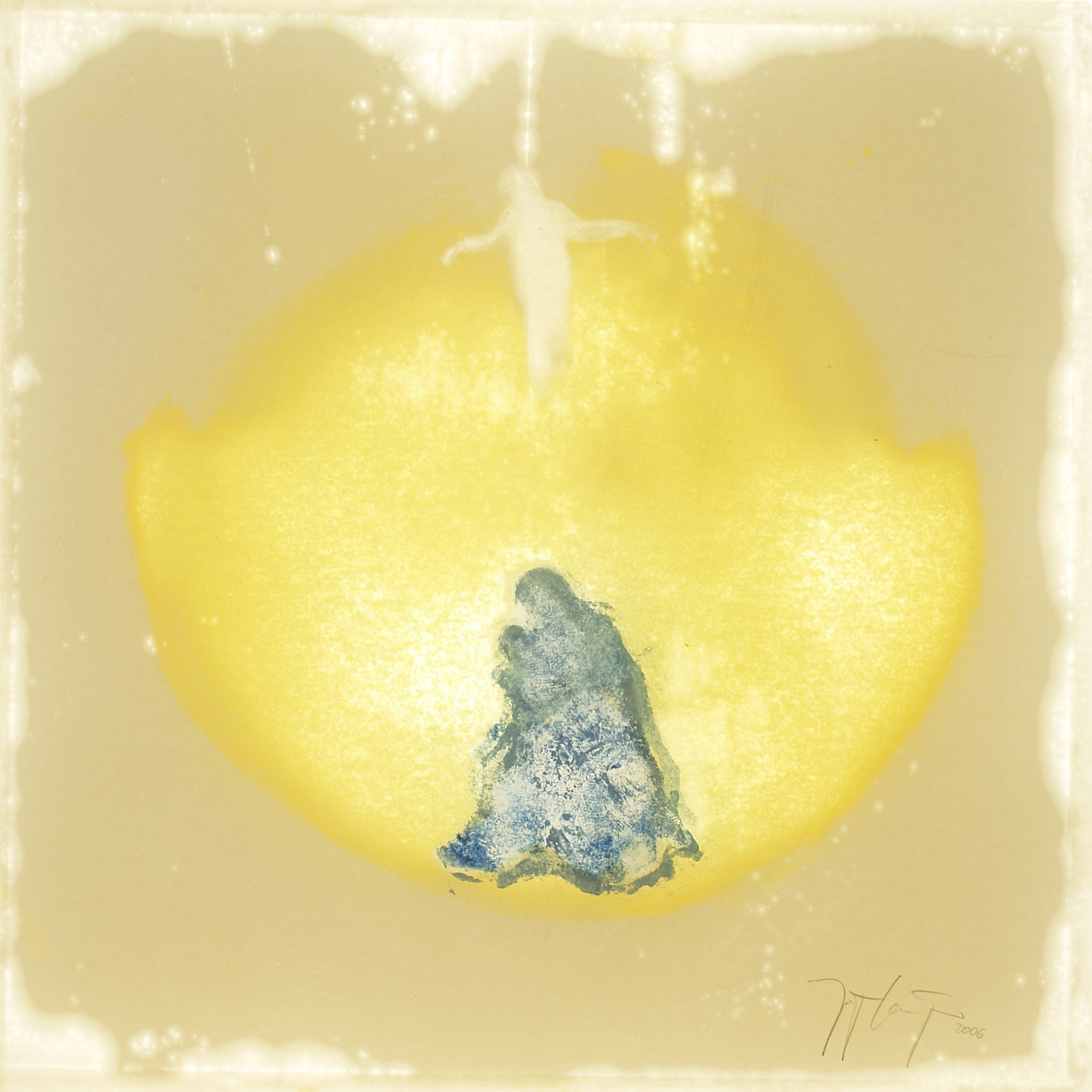
Jörg Länger (German, 1964–), Chr. Geb., 2006. Linocut, wax, oil, and graphite pencil on paper, 33 × 33 cm, cast with resin between two Optiwhite sheets of glass, 38 × 38 cm.

The contemporary German artist Jörg Länger creates extraordinary mixed-media works, many of which are in dialogue with Christian art history. In addition to earning an advanced degree in art, Länger has also done university coursework in theology and philosophy, so it’s no wonder his pieces demonstrate a keen theological awareness and spiritual sensibility.

After some fifteen years of working in photography, installation art, performance art, and conceptual art, in 1998 Länger shifted gears to focus on drawing, painting, and printmaking. He developed a series, still ongoing, that he calls “Protagonisten aus 23.000 Jahren Kulturgeschichte” (Protagonists from 23,000 Years of Cultural History), in which he takes figures from prehistoric petroglyphs and bas-reliefs, ancient Greek vases, medieval manuscripts, European Renaissance paintings, and contemporary art, simplifies them, and puts them into a new pictorial context. He copies the figure’s outline onto a linoleum block, inks and prints it to produce a sort of silhouette, and builds out from there using oil paint, pastels, wax, and/or gold leaf, while still retaining a minimalist aesthetic.

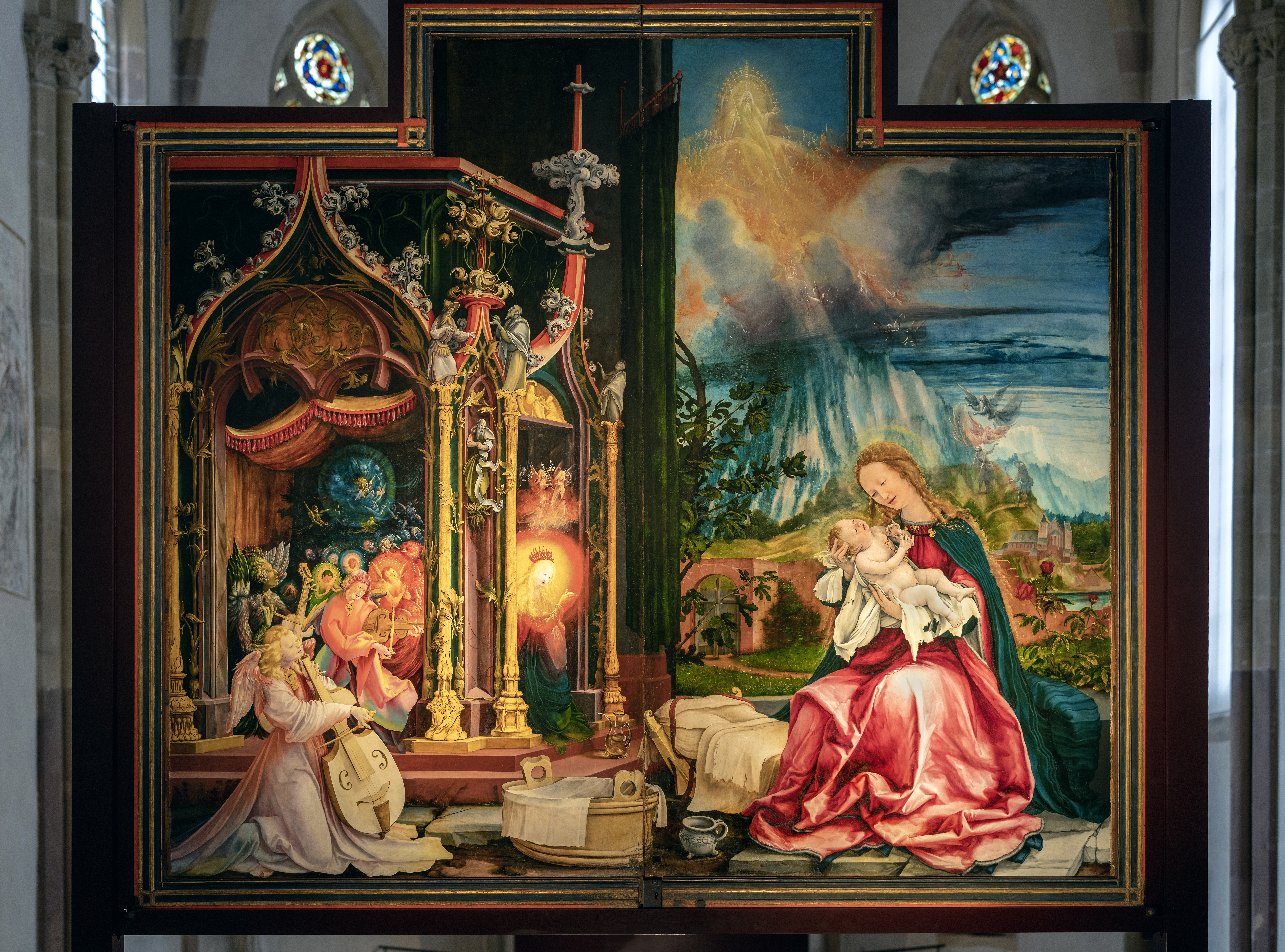
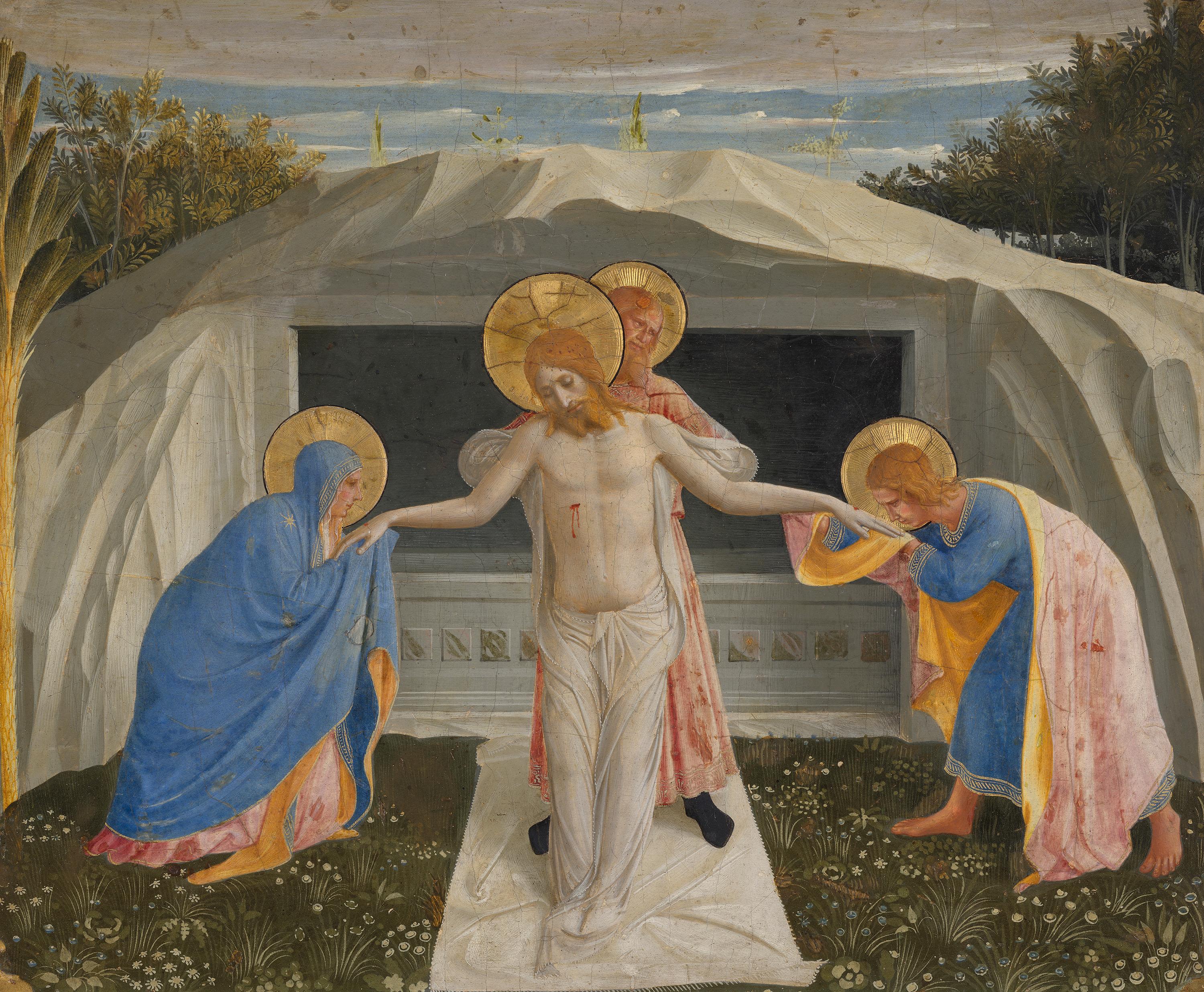
In his 2006 piece Chr. Geb. (short for Geburt Christi, “Birth of Christ”), the silhouetted figures are taken from Matthias Grünewald’s Isenheim Altarpiece and Fra Angelico’s Entombment of Christ.
Grünewald, Matthais_The Nativity
Matthais Grünewald (German, ca. 1475/80–1528), The Nativity, central panel (first open view) of the Isenheim Altarpiece, 1515. Oil on wood, 269 × 307 cm. Unterlinden Museum, Colmar, France. Photo: Steven Zucker.

Fra Angelico_Entombment of Christ
Fra Angelico (Italian, ca. 1400–1455), Entombment of Christ, 1438–40. Tempera on wood, 37.9 × 46.6 cm. Alte Pinakothek, Munich.

With the shadowy blue central pair of Mother and Child, the ghostly impression of Christ’s crucified body (being dragged into a tomb in the scene it’s excised from), the expanding puddle of gold that holds together both birth and death, and the light that presses in from the edges, the work has a mystical feel. It shows the Eternal One entering time, born of a woman, to live and die and rise and so bring humanity back to God and back to their truest selves.  

LISTEN: “O Vis Aeternitatis” by Hildegard of Bingen, ca. 1140–60 | Performed by Azam Ali, 2020

V. O vis aeternitatis
que omnia ordinasti in corde tuo,
per Verbum tuum omnia creata sunt
sicut voluisti,
et ipsum Verbum tuum
induit carnem
in formatione illa
que educta est de Adam.

R. Et sic indumenta ipsius
a maximo dolore
abstersa sunt.

V. O quam magna est benignitas Salvatoris,
qui omnia liberavit
per incarnationem suam,
quam divinitas exspiravit
sine vinculo peccati.

R. Et sic indumenta ipsius
a maximo dolore
abstersa sunt.

V. Gloria Patri et Filio
et Spiritui sancto.

R. Et sic indumenta ipsius
a maximo dolore
abstersa sunt.
V. O power within Eternity:
All things you held in order in your heart,
and through your Word were all created
according to your will.
And then your very Word
was clothed within
that form of flesh
from Adam born.

R. And so his garments
were washed and cleansed
from greatest suffering.

V. How great the Savior’s goodness is!
For he has freed all things
by his own Incarnation,
which divinity breathed forth
unchained by any sin.

R. And so his garments
were washed and cleansed
by greatest suffering.

V. Glory be to the Father and to the Son
and to the Holy Spirit.

R. And so his garments
were washed and cleansed
by greatest suffering.

Trans. Nathaniel M. Campbell

Hildegard of Bingen [previously] was a twelfth-century German nun and polymath who wrote works on theology, medicine, and natural history; hymns, antiphons, and a drama for the liturgy (all with original music); and one of the largest bodies of letters to survive from the Middle Ages. In 1136 she was unanimously elected to lead her Benedictine community as abbess, which she did until her death in 1179.

“O vis aeternitatis” is the first entry in Hildegard’s Symphonia armonie celestium revelationum (Symphony of the Harmony of Celestial Revelations), a compilation of her liturgical songs that she made during her lifetime. It is labeled a “Responsory to the Creator.” “The responsory, one of several compositional forms Hildegard used,” explains medievalist Nathaniel M. Campbell, “is a series of solo verses [marked V] alternating with choral responses [marked R] sung at the first office of the day, vigils (matins), in the monastic liturgy.” It’s basically a call-and-response song.

This responsory, Campbell continues, “contemplate[s] the Incarnation . . . as the pivotal moment in which creation reached its perfect and predestined trajectory.” He notes how the refrain meditates on the cleansing of Adam’s flesh both from suffering and by (Christ’s) suffering. God put on our humanity and redeemed it.

Here’s how the medievalist Barbara Newman translates the responsory on page 99 of the critical edition of the Symphonia published by Cornell University Press:

Strength of the everlasting!
In your heart you invented
order.
Then you spoke the word and
all that you ordered
was,
just as you wished.

And your word put on vestments
woven of flesh
cut from a woman
born of Adam
to bleach the agony out of his clothes.

The Savior is grand and kind!
From the breath of God he took flesh
unfettered
(for sin was not in it)
to set everything free
and bleach the agony out of his clothes.

Glorify the Father,
the Spirit, and the Son.

He bleached the agony out of his clothes.

In the video above, “O vis aeternitatis” is performed by Azam Ali, an internationally acclaimed singer, producer, and composer who was born in Iran and raised in India and is now based in Los Angeles. She writes in the video’s YouTube description that Hildegard is part of the canon of universal spirituality and mysticism and that she is attracted to her cosmology, especially her articulation of the ancient philosophical concept of “the music of the spheres.”

In addition to her solo work, Ali is part of the musical group Niyaz, who blend medieval Sufi poetry and ancient Middle Eastern folk songs with modern electronic and trance music.
Roundup: Steve Martin on banjo, poetry comic about the Resurrection, and more

BANJO DUET: “Foggy Morning Breaking” by Alison Brown and Steve Martin: Did you know the actor Steve Martin also has a music career? He’s been playing the banjo since he was a teenager, and he writes, records, and tours, both solo and as part of bluegrass bands. He’s even won three Grammys for his banjo music!

Fellow banjoist Alison Brown invited him to contribute to one of the tunes on her forthcoming album, On Banjo, which releases May 5. It’s called “Foggy Morning Breaking.” She wrote and plays the A section; he wrote and plays the B. The piece was released last month as a single, along with this music video.

+++

VIDEO: “Spring” by Jamie Scott: This time-lapse short film of flowers blooming is extraordinary! It’s by visual effects artist and time-lapse photographer Jamie Scott (IG @invisiblejam). The score is by Jim Perkins. [HT: Tamara Hill Murphy]

+++

EVENTS:

>> April 22: “The Ekstasis Café: An Evening of Poetry, Music, Testimony, and Gallery,” Goldberry Books, Concord, North Carolina: Ekstasis is a beautiful quarterly magazine “exhibit[ing] arts and letters that reflect the depths of Christian life.” Next Saturday they are hosting their first-ever public gathering! Their hope with it is to foster meaningful connections, conversation, deep aesthetic encounters, and inspiration.

>> April 28: Artists’ Talk and Reception for The Resurrection and the Life by Fish Coin Press Exhibition, Sojourn Arts Gallery, Louisville, Kentucky: Fish Coin Press (IG @fishcoin.press) is a Richmond, Virginia–based publisher of illustrated books, comics, and trading cards rooted in the story of scripture. They work with a range of artists and are doing really imaginative work.

Procopio, Stephen_Ascension
Stephen Procopio, Ascension, 2020. A full-color version of an illustration for Come See a Man (an illustrated Gospel of John) by Fish Coin Press.

From April 9 to May 28, the gallery at Sojourn Church Midtown in Louisville is exhibiting a selection of art from Fish Coin projects (open Sundays from 9 a.m. to 12:30 p.m., or by appointment); here are a few exhibition views. And two Friday evenings from today, Fish Coin Press creative director Jared Boggess and development lead Stephen Procopio, who are illustrators themselves, will be visiting the gallery to discuss “visual theology” and its role in the local church. There will be a Q&A and a sneak preview of upcoming publications.

+++

POEM: “Psalm” by Dorianne Laux: This poem sings the glories of “the hidden and small,” of the plants and creatures beneath our feet. Read more of Laux’s poems at https://www.doriannelaux.net/poems.

+++

LECTURE: “Resurrection and the Renewal of Creation” by N. T. Wright: In this 2018 lecture sponsored by Lanier Theological Library and Baylor University’s Truett Seminary, ancient historian and New Testament scholar N. T. Wright discusses the meaning of Jesus’s resurrection, a topic he explores thoroughly in the influential academic tome The Resurrection of the Son of God and its more accessible corollary, Surprised by Hope: Rethinking Heaven, the Resurrection, and the Mission of the Church. “Easter is the start of something; it isn’t the ending,” he says. With the resurrection of Christ, the new creation has been launched and put to work in the world. It’s not about securing our souls a place in some nonspatiotemporal heaven when we die but about heaven colonizing earth here and now. We humans, he says, are meant to stand at the place where heaven and earth interlock. We who have received life are to be ourselves life-bringers, to participate in God’s massive renewal project. We are resurrection people!

Wright addresses common Christian misconceptions about death, judgment, and the fate of this world, seeking to root out the corrupting influence of Platonism and other pagan Greek philosophies on Christian eschatology. (For example, the new creation won’t be a creatio ex nihilo, creation out of nothing; it will be a creatio ex vetere, a creation out of the old. The implications of that are huge.) He also affirms the absolute importance of belief in Jesus’s bodily resurrection—his rising is no mere metaphor!—and calls on Christians to recover a centralizing hope in the general resurrection (what he calls “life after life after death”; fully embodied life in the new heavens and the new earth that comes after the not-yet-fully-realized life experienced in the interim between one’s death and the future cosmic coming of Christ) rather than regarding what happens immediately after one’s death as the ultimate beatitude.

Wright always makes me excited about what God’s doing and excited to be a disciple of Jesus. What more could a preacher ask for?

The final half hour of the video is Q&A.

+++

DIGITAL COMIC: 30 Days of Comics (2022) by Madeleine Jubilee Saito: Madeleine Jubilee Saito [previously] is a Seattle-based cartoonist who is interested, as she says on her website, in “friendship, formal experimentation, medieval sacred comics, the built environment, solidarity, climate justice, the psalms, the material world, and the sacred.” Last year she was one of five artists in the inaugural cohort of On Being Project’s Artist Residency; during that time she created “For living, in climate crisis.” Her work is poetic, spiritual, and earthy, and I love it.  

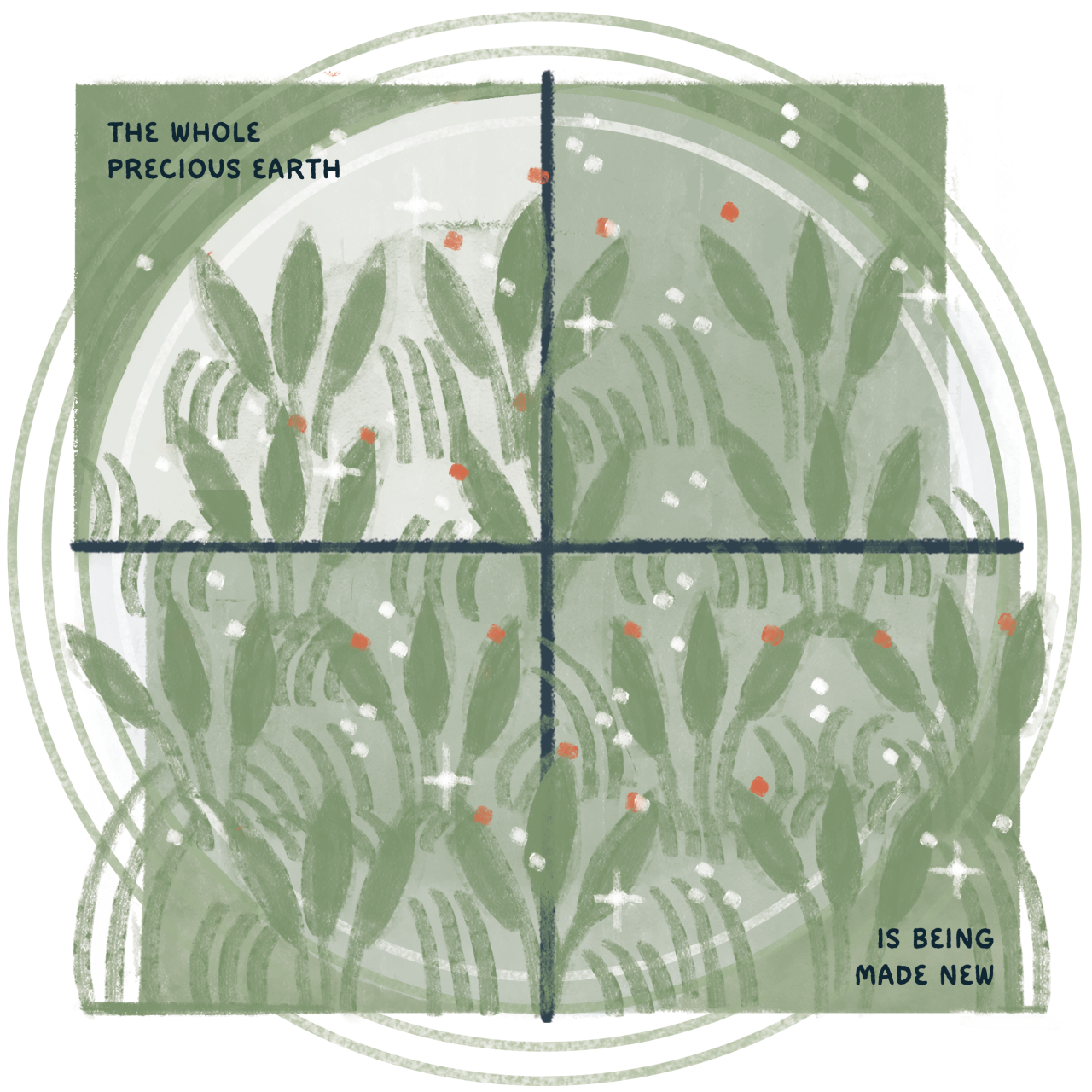
Saito, Madeleine Jubilee_Made New
Comic by Madeleine Jubilee Saito, 2022, the ninth of thirty from “30 Days of Comics.”

In November 2022 Saito made a one-page, four-panel comic (almost) every day for the duration of the month. The series is resurrection-themed and, she told me, inspired by one of my blog posts: the one about Fra Angelico’s Noli me tangere at San Marco, a painting in which Christ the Gardener sows his stigmata across the lawn, as art historian Georges Didi-Huberman so beautifully interprets in his monograph on the artist. Click on the image and scroll down (then, at the bottom, click “←older”) to view all twenty-seven comics from the series. Each can stand alone, but they also have a cumulative effect. It’s stunning! You can follow Saito on Instagram @madeleine_jubilee_saito.

Maundy Thursday: Watch and Pray

Then Jesus went with his disciples to a place called Gethsemane, and he said to them, “Sit here while I go over there and pray.” He took Peter and the two sons of Zebedee along with him, and he began to be sorrowful and troubled. Then he said to them, “My soul is overwhelmed with sorrow to the point of death. Stay here and keep watch with me.

Going a little farther, he fell with his face to the ground and prayed, “My Father, if it is possible, may this cup be taken from me. Yet not as I will, but as you will.”

Then he returned to his disciples and found them sleeping. “Couldn’t you men keep watch with me for one hour?” he asked Peter. “Watch and pray so that you will not fall into temptation. The spirit is willing, but the flesh is weak.”

He went away a second time and prayed, “My Father, if it is not possible for this cup to be taken away unless I drink it, may your will be done.”

When he came back, he again found them sleeping, because their eyes were heavy. So he left them and went away once more and prayed the third time, saying the same thing.

Then he returned to the disciples and said to them, “Are you still sleeping and resting? Look, the hour has come, and the Son of Man is delivered into the hands of sinners. Rise! Let us go! Here comes my betrayer!”

—Matthew 26:36–46 NIV, emphasis added

LOOK: Agony in the Garden by Fra Angelico [HT: John Skillen]

Fra Angelico_Agony in the Garden
Fra Angelico (Italian, ca. 1387–1455), Agony in the Garden, ca. 1450. Fresco, 177 × 147 cm. Cell 34, Convent of San Marco, Florence.

This fresco is from one of the forty-four cells in the Dominican convent of San Marco in Florence whose walls Fra Angelico and his assistants painted with religious scenes in the mid-fifteenth century. The friars who lived at San Marco—of which the artist, whose nickname means “Angelic Brother,” was one—used these paintings for private meditation.

Here we see Jesus in the garden of Gethsemane pleading with God the Father to let the cup of suffering, held out by an angel, pass him by. As he prays in agony, his disciples James, John, and Peter nod off just a stone’s throw away. Jesus had asked them to stay awake and pray with him, but their tiredness gets the better of them. In their friend’s hour of deepest need, they fail him.

By contrast—and this is unique!—Mary and Martha, two sisters from Bethany who are also followers of Jesus, are awake and alert under an open loggia, diligently praying and studying God’s word. Perhaps Mary points, in the book in her lap, to the passage of the Suffering Servant in Isaiah 53, recognizing Christ in it, or to the book of Exodus, where the Israelites celebrate their first Passover by smearing the blood of a lamb over their doors. Perhaps Martha prays that the Father would grant Jesus discernment of his will and the strength to follow through with it—that he would sustain him all the way to the cross and beyond.

While the male disciples on the other side of the wall fall asleep, heads in hands, the women watch and wait through the night, exemplars of faithfulness. They trust the prophecies and keep vigil, supporting their Lord in his suffering.

LISTEN: “Stay with Me” by Jacques Berthier, 1984 | Performed by the Taizé Community Choir on Songs of Taizé: O Lord, Hear My Prayer & My Soul Is at Rest, 1999

Stay with me
Remain here with me
Watch and pray
Watch and pray

The words from this Taizé chant come from Jesus’s words in Matthew 26:38, 41 (cf. Mark 14:34, 38). He and his disciples have just finished the Passover Seder, and with full bellies, three of them follow Jesus up to an olive grove, which was perhaps a favorite prayer spot. But they neglect his instruction to stay awake and pray with him.

How can we remain with Christ this Maundy Thursday?

To “keep vigil” this night is to be fully present to Christ’s suffering and spiritually awake to his will and way.

This song is on the Art & Theology Holy Week Playlist.

The Reproaches: A divine lament for Good Friday

O my people, what have I done to you?
In what have I wearied you? Answer me!

—Micah 6:3

The Reproaches (Latin: Improperia), also known by the first phrase of their refrain, “Popule meus” (O My People), are a series of antiphons and responses used in Good Friday liturgies across all three branches of Christianity. The text contrasts Old Testament stories of God’s goodness with humanity’s enactment of evil against God’s Son. Whereas God graciously delivered his people from death time and again throughout history, they delivered his Son to death—death on a cross. Thus God reproaches us, his beloved ones, for our fatal rejection of Christ, his greatest gift, lamenting that we have spurned his love.

The lyrics are reproduced below (the side-by-side formatting with English translation on the right is best viewed on a computer screen), followed by four musical settings, chosen from among dozens. In the present Roman Rite, the roman-style text is sung by a cantor and the italicized text by a choir, and the lines of the Trisagion (“Thrice Holy”), the ancient hymn that follows the first improperium, are sung by two halves of a choir in alternation—the first singing in Greek, the second in Latin. Composers working outside that context, however, may assign the sections differently.

(Related post: “Blood and Tears”)

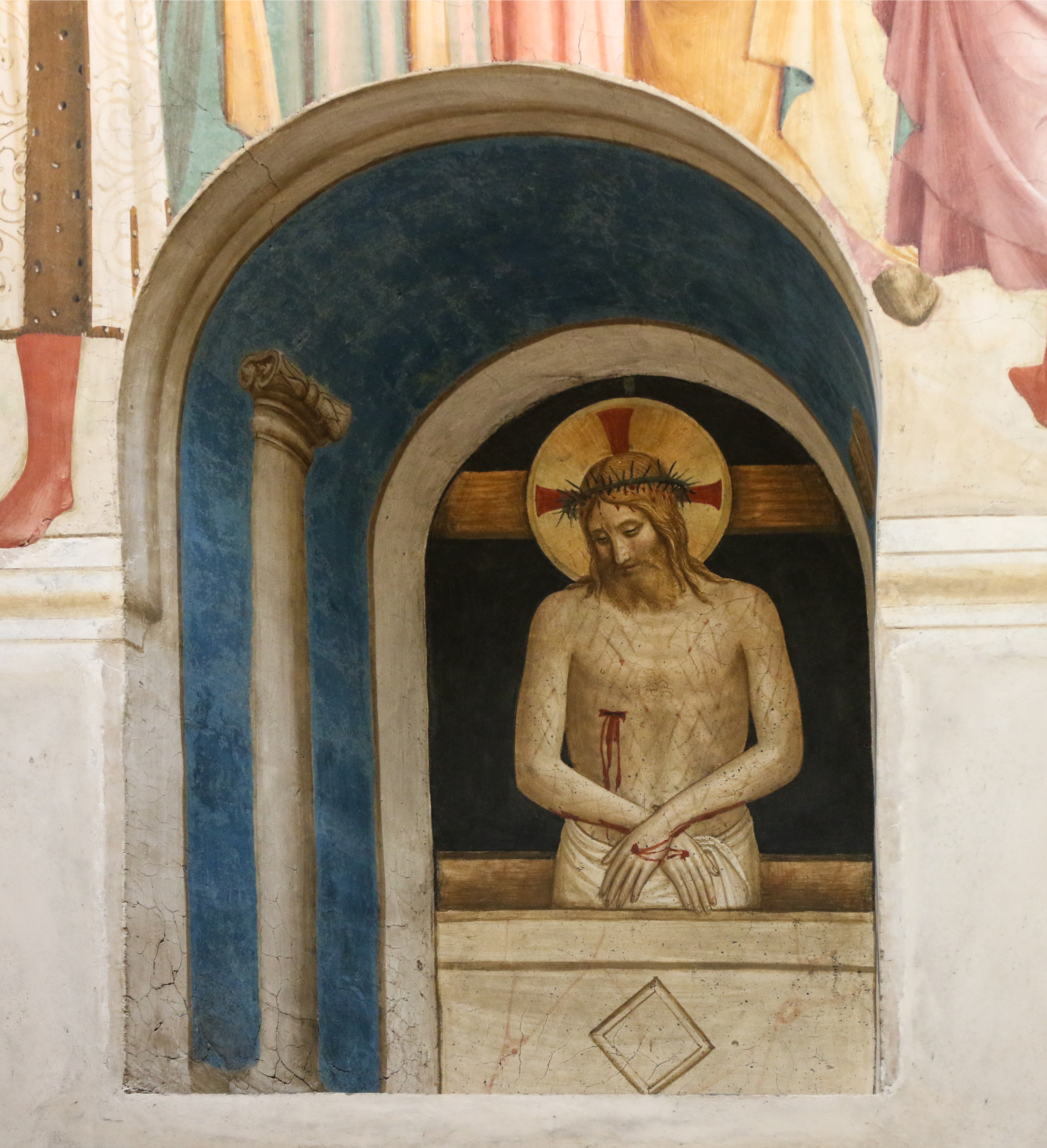
Fra Angelico_Man of Sorrows
Fra Angelico (Italian, ca. 1395–1455), Man of Sorrows, ca. 1440. Fresco, Cell 39, Convent of San Marco, Florence. Photo: Fr. Lawrence Lew, OP.

Popule meus, quid feci tibi?
Aut in quo contristavi te?
Responde mihi.

Quia eduxi te de terra Aegypti:
parasti Crucem Salvatori tuo.

   Hagios o Theos.
      Sanctus Deus.
   Hagios Ischyros.
      Sanctus fortis.
   Hagios Athanatos, eleison himas.
      Sanctus immortalis, miserere nobis.

Quia eduxi te per desertum quadraginta annis:
et manna cibavi te, et introduxi te in terram satis bonam:
parasti Crucem Salvatori tuo.
Hagios . . .

Quid ultra debui facere tibi, et non feci?
Ego quidem plantavi te vineam meam speciosissimam:
et tu facta es mihi nimis amara:
aceto namque sitim meam potasti:
et lancea perforasti latus Salvatori tuo.
Hagios . . .

Ego propter te flagellavi Aegyptum cum primogenitis suis:
et tu me flagellatum tradidisti.
Popule meus . . .

Ego te eduxi de Aegypto, demerso Pharone in mare Rubrum:
et tu me tradidisti principibus sacerdotum.
Popule meus . . .

Ego ante te aperui mare:
et tu aperuisti lancea latus meum.
Popule meus . . .

Ego ante te praeivi in columna nubis:
et tu me duxisti ad praetorium Pilati.
Popule meus . . .

Ego te pavi manna in desertum:
et tu me cedisti alapis et flagellis.
Popule meus . . .

Ego te potavi aqua salutis de petra:
et tu me potasti felle et aceto.
Popule meus . . .

Ego propter te Chananeorum reges percussi:
et tu percussisti arundine caput meum.
Popule meus . . .

Ego dedi tibi sceptrum regale:
et tu dedisti capiti meo spineam coronam.
Popule meus . . .

Ego te exaltavi magna virtute:
et tu me suspendisti in patibulo crucis.
Popule meus . . .
O my people, what have I done to thee?
Or how have I offended thee?
Answer me.

Because I led thee out of the land of Egypt:
thou hast prepared a cross for thy Savior.

O holy God!
O holy God!
O holy strong One!
O holy strong One!
O holy and immortal, have mercy upon us.

Because I led thee through the desert for forty years:
and fed thee with manna, and brought thee into a land exceeding good:
thou hast prepared a cross for thy Savior.
O holy God! . . .

What more ought I to have done for thee, that I have not done?
I planted thee, indeed, my most beautiful vineyard:
and thou hast become exceeding bitter to me:
for in my thirst thou gavest me vinegar to drink:
and with a spear thou hast pierced the side of thy Savior.
O holy God! . . .

For thy sake I scourged the firstborn of Egypt:
Thou hast given me up to be scourged.
O my people . . .

I led thee out of Egypt, having drowned Pharaoh in the Red Sea:
and thou hast delivered me to the chief priests.
O my people . . .

I opened the sea before thee:
and thou hast opened my side with a spear.
O my people . . .

I went before thee in a pillar of cloud:
and thou hast led me to the judgment hall of Pilate.
O my people . . .

I fed thee with manna in the desert:
and thou hast assaulted me with blows and scourges.
O my people . . .

I gave thee the water of salvation from the rock:
and thou hast given me gall and vinegar to drink.
O my people . . .

For thy sake I struck the kings of the Canaanites:
and thou hast struck my head with a reed.
O my people . . .

I gave thee a royal scepter:
and thou hast given a crown of thorns for my head.
O my people . . .

I exalted thee with great strength:
and thou hast hanged me on the gibbet of the cross.
O my people . . .

1. “Popule meus” by Tomás Luis de Victoria (1585)

First up, a traditional setting of the Latin by the Spanish Renaissance composer Tomás Luis de Victoria (ca. 1548–1611) [previously], performed by Ensemble Invocatio under the direction of Daniel Knaggs in 2022 at Seminary Church in Warsaw, Poland. The soloist is Łukasz Dziuba. This four-part motet is the most widely performed setting of the Reproaches.

2. “The Reproaches” by John Sanders (1984)

This setting in English by the British composer John Sanders (1933–2003) has become standard repertoire for many English cathedral and church choirs. Sanders first wrote it in 1984 for a Good Friday service at Gloucester Cathedral, where he served as organist, but it wasn’t published until 1993. It’s performed here by the Ely Cathedral Choir, conducted by Sarah MacDonald, from 2018. Whereas Victoria scored his setting for four voices (SATB), Sanders scored his for eight (SSAATTBB), creating more complex harmonies, including dissonance.

3. “Popule meus” by Filipe Faria and Sérgio Peixoto (2015)

In 1999 Portuguese composers Filipe Faria (b. 1976) and Sérgio Peixoto (b. 1974) founded Sete Lágrimas ECMC (Early and Contemporary Music Consort) to create dialogues between medieval, Renaissance, and early Baroque music on the one hand and contemporary music on the other. Their “Popule meus,” which includes just the opening refrain, is from their Missa Mínima, a minimalistic setting for two voices and recorder of the five parts of the Catholic Mass, along with other important liturgical texts. They began composing it in 1999, put it on the back burner for a while, and returned to it later, completing it in 2015. In this 2016 recording, the singers are Faria and Peixoto. The melodic embellishment on the syllable -sta in contristavi (literally “saddened” but more often translated in this song as “offended” or “distressed”) creates a tense quivering effect, a climax before the languid return to the title phrase and a petering off with “Responde mihi.”

4. “The Reproaches” by Paul Zach (2021)

American singer-songwriter Paul Zach wrote this condensed version of the Reproaches with frequent collaborator Kate Bluett [previously], which puts the words in the voice of the people, who assume and repent of their responsibility for Jesus’s death—for no matter our temporal or geographical proximity to the event, it was our sin that led him to and held him on the cross. Transferring the speaker from God to the Christian for the whole duration helps make the song more suitable for congregational singing, as it can then function as a corporate confession.

You delivered us from Pharaoh;
We delivered you to death.
You gave manna in the desert;
We gave a crown of thorns for your head.

You brought us out of slavery
Into the promised land;
We brought you up to Calvary
And pierced your feet and hands.

Holy God, Holy Mighty One,
Holy Immortal One,
Have mercy, mercy,
Have mercy on us.

You opened up the Red Sea;
We opened up your side.
“Come down, come down,” we mocked you;
“My God, my God,” you cried.

Holy God, Holy Mighty One,
Holy Immortal One,
Have mercy, mercy,
Have mercy on us.

Zach told me he’s not fully satisfied with the song and is working on a rewrite that he may release in 2024. Nonetheless, I really like what he and Bluett have created here! And I appreciate how it brings the Reproaches into an indie-folk idiom, making that long-standing sung portion of the global church’s Good Friday liturgy accessible to those who find it difficult to connect with choral music or chant.

Addendum, 3/21/23: Rev. Bill Combs from Greensboro, Georgia, has just reminded me of a contemporary adaptation of the text of the Reproaches by Janet Morley, a liturgist from the UK. It’s from her wonderful collection All Desires Known, a resource for public worship and private devotion, and can be read here. Combs’s church, Episcopal Church of the Redeemer, chants this text as part of their annual Good Friday service using Tone II.1.

Advent, Day 12: The New Eve

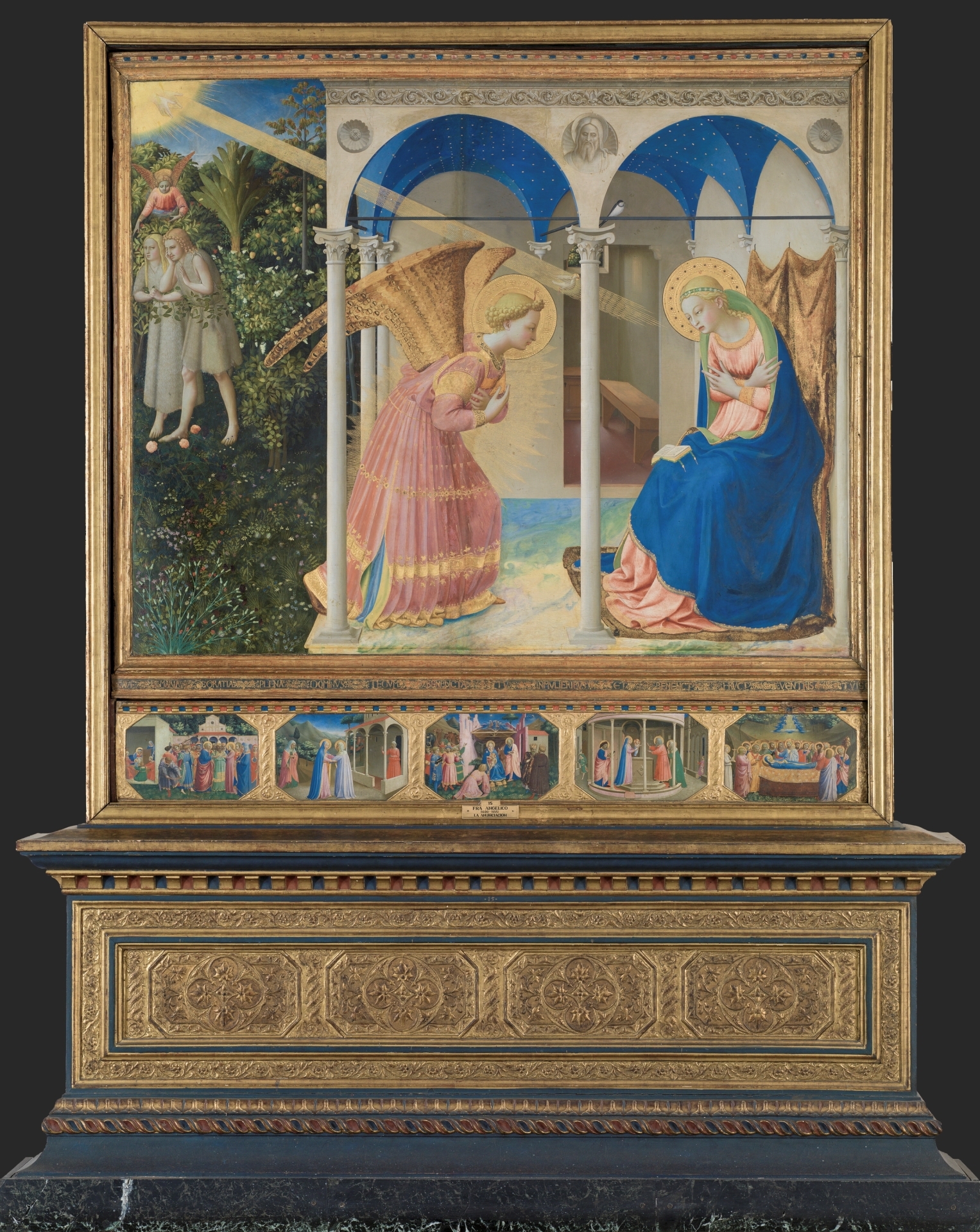
LOOK: Prado Annunciation by Fra Angelico

Fra Angelico_The Annunciation (Prado)
Fra Angelico (Italian, ca. 1395–1455), The Annunciation, ca. 1426. Tempera and gold on wood panel, 162.3 × 191.5 cm. Museo del Prado, Madrid.

The Annunciation was a favorite subject of the Early Renaissance artist Fra Angelico [previously], and he painted it multiple times throughout his career. Once was for an altarpiece for the convent of San Domenico in Fiesole, near Florence, now in the Prado Museum in Madrid.

In this version Mary sits on a draped chair under the portico of a domestic space, reading the scriptures, when suddenly this otherworldly being, dressed in rose and radiating, approaches. It’s the archangel Gabriel. His foot crosses the threshold of paradise into Mary’s space—the divine stepping into the human realm. Will you do it? he asks. Be mother to God?

Mary’s initial fear and perplexity eventually give way to glad acceptance. The artist compresses the episode—the arrival, the ask, the cogitation, the answer—into this singular freeze frame. When Mary says yes to God’s plan to become flesh of her flesh and so work out the salvation of the world, God releases his Spirit, who rides a stream of light from the heavens into her womb. At this miraculous moment, Jesus is conceived.

Gabriel crosses his hands over his chest in humble reverence, a gesture mirrored by Mary. Both are still before the profound mystery of the Incarnation.

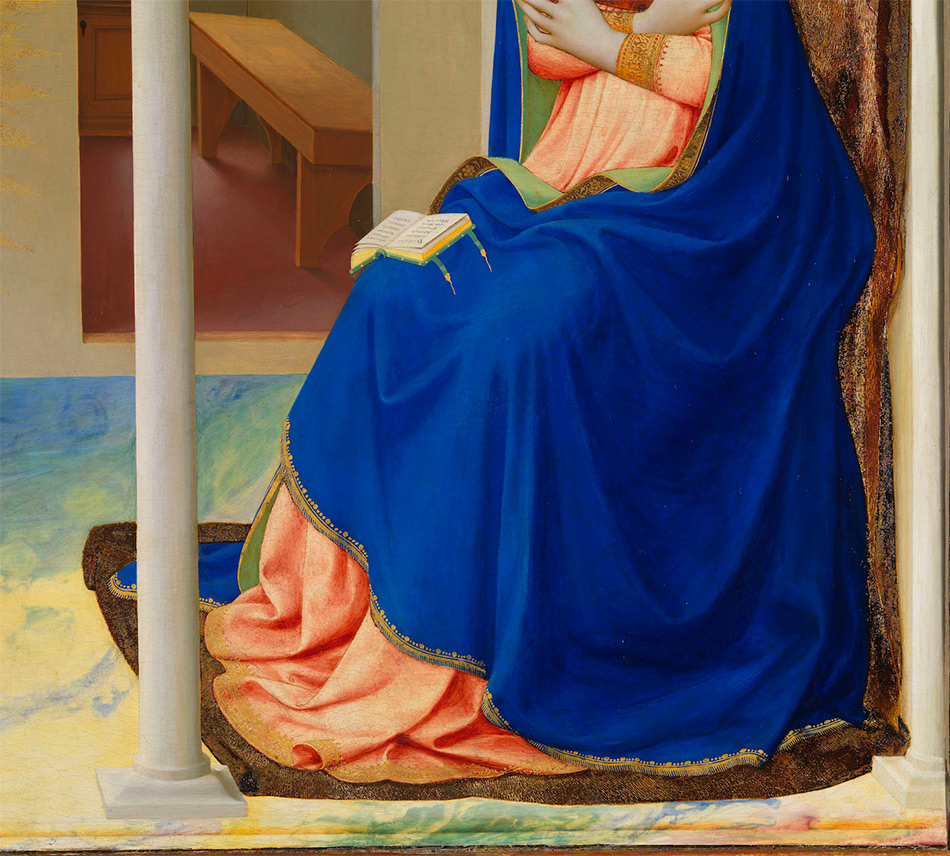
Fra Angelico used ultramarine—the finest and most expensive of all pigments, made from lapis lazuli, a semiprecious stone imported to Europe from the Middle East—to paint Mary’s mantle as well as the star-studded ceiling above her. Blue represents heaven, and here Mary is clothed with it and overshadowed by it.

Prado Annunciation (detail)

The male figure in the carved roundel above the central column is, I’d say (based on the unambiguous Montecarlo Altarpiece), the prophet Isaiah, who wrote centuries before the event that “the Lord himself shall give you a sign; behold, a virgin shall conceive, and bear a son, and shall call his name Immanuel” (Isa. 7:14).

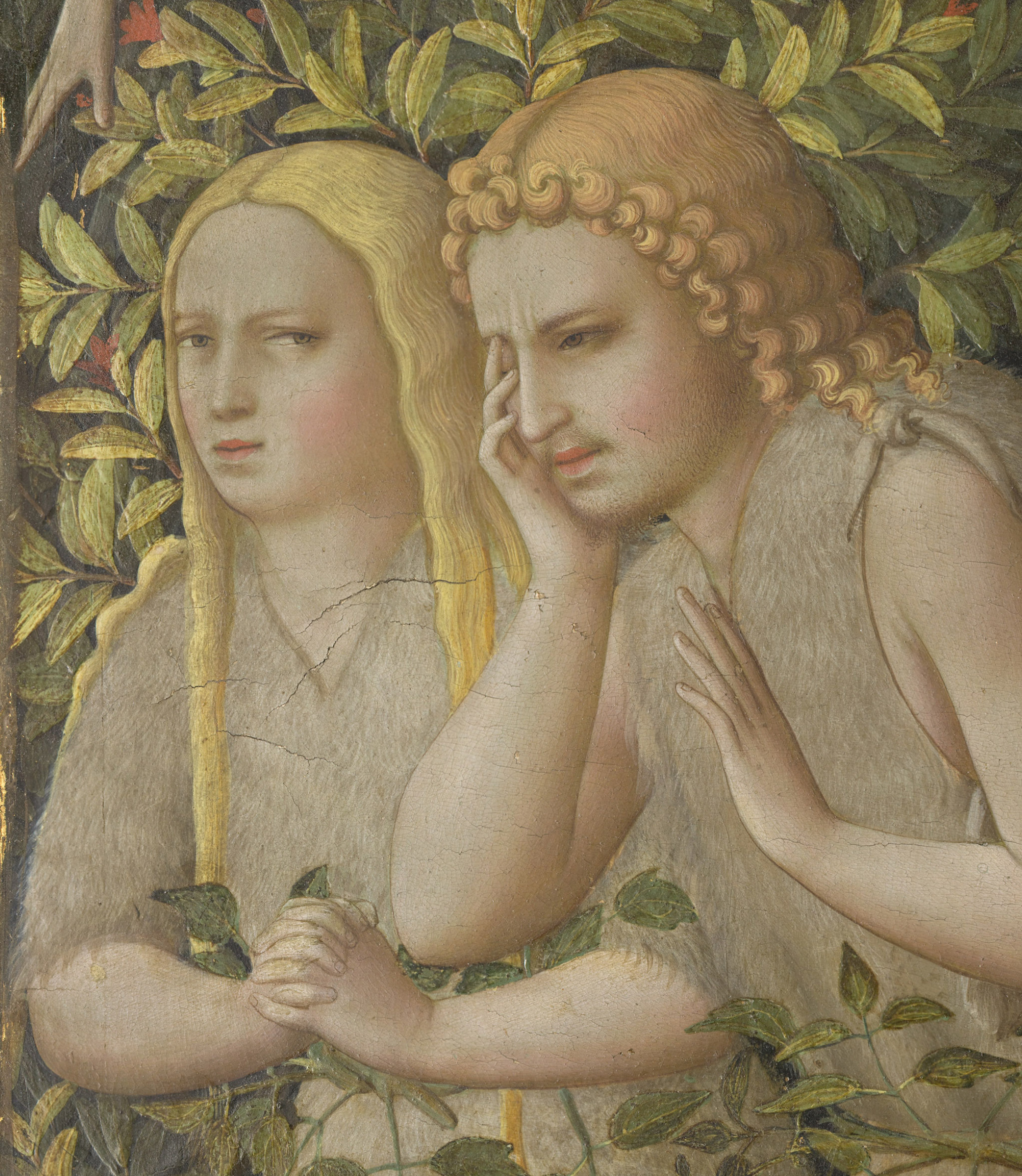
But Fra Angelico goes even further back than the Old Testament prophets. On the left side of the panel he shows our foreparents, Adam and Eve, being cast out of paradise, having broken God’s trust. They blush in shame—they wince, they cover their face. By including this catalyzing event from salvation history in his painting of the Annunciation, the artist is telling a larger narrative. In particular, he is drawing connections, mainly contrastive, between Adam and Eve and Christ and Mary.

Prado Annunciation (detail)

In his epistles, the apostle Paul talks about Christ as the Second Adam, or the New/Last Adam (Rom. 5:12–21; 1 Cor. 15:22–23, 45), who came to restore what was lost with the first Adam. Whereas Adam disobeyed God and caused sin to enter the world, Christ lived a life of perfect obedience to the Father, thereby redeeming humanity. The early church fathers, starting with Justin Martyr, Irenaeus, and Tertullian in the second century, extended this corollary with another: Mary as the Second Eve. Whereas Eve rejected God’s will, Mary embraced it, and her obedient yes, like Eve’s disobedient no, had repercussions for all of humanity. As the arts lecturer John Skillen puts it, our undoing in the Expulsion is undone by the Annunciation.

We see on the left an angel driving humanity out of Eden, but on the right, another angel welcomes humanity back in. And in a glorious reversal of the order of first creation, where Eve was created from Adam, here the Second Adam is created from the Second Eve, knit together from her DNA.

In the first issue of her Medievalish newsletter from last December, Dr. Grace Hamman discusses Fra Angelico’s Prado Annunciation in terms of chronos (ordinary time measured in seconds and hours) and kairos (moments outside of time). “Fra Angelico recognizes something that is easy to forget: because God is outside of time, not bound by chronology like us creatures, this painting offers a ‘God’s-eye view’ of salvation history,” she writes, portraying a simultaneity of “falls” that the fourteenth-century contemplative writer Julian of Norwich expounds on:

When Adam fell, God’s Son fell; because of the true union which was made in heaven, God’s Son could not be separated from Adam, for by Adam I understand all mankind. Adam fell from life to death, into the valley of this wretched world, and after that into hell. God’s Son fell with Adam, into the valley of the womb of the maiden who was the fairest daughter of Adam, and that was to excuse Adam from blame in heaven and on earth; and powerfully he brought him out of hell. (Revelations of Divine Love, chap. 51)

“There was never a moment,” Hamman continues, “even in the expulsion from Eden, that Emmanuel was not with us, if one is given the eyes of kairos.”

This came a few weeks after we discussed the artwork, along with several others on the Annunciation, on Hamman’s podcast, Old Books with Grace. It’s such a generative painting!

And the Annunciation is only the main panel. Along the predella (base) are depicted the Marriage of the Virgin, the Visitation, the Nativity, the Presentation of Christ in the Temple, and the Dormition (the “falling asleep,” or death, of Mary).

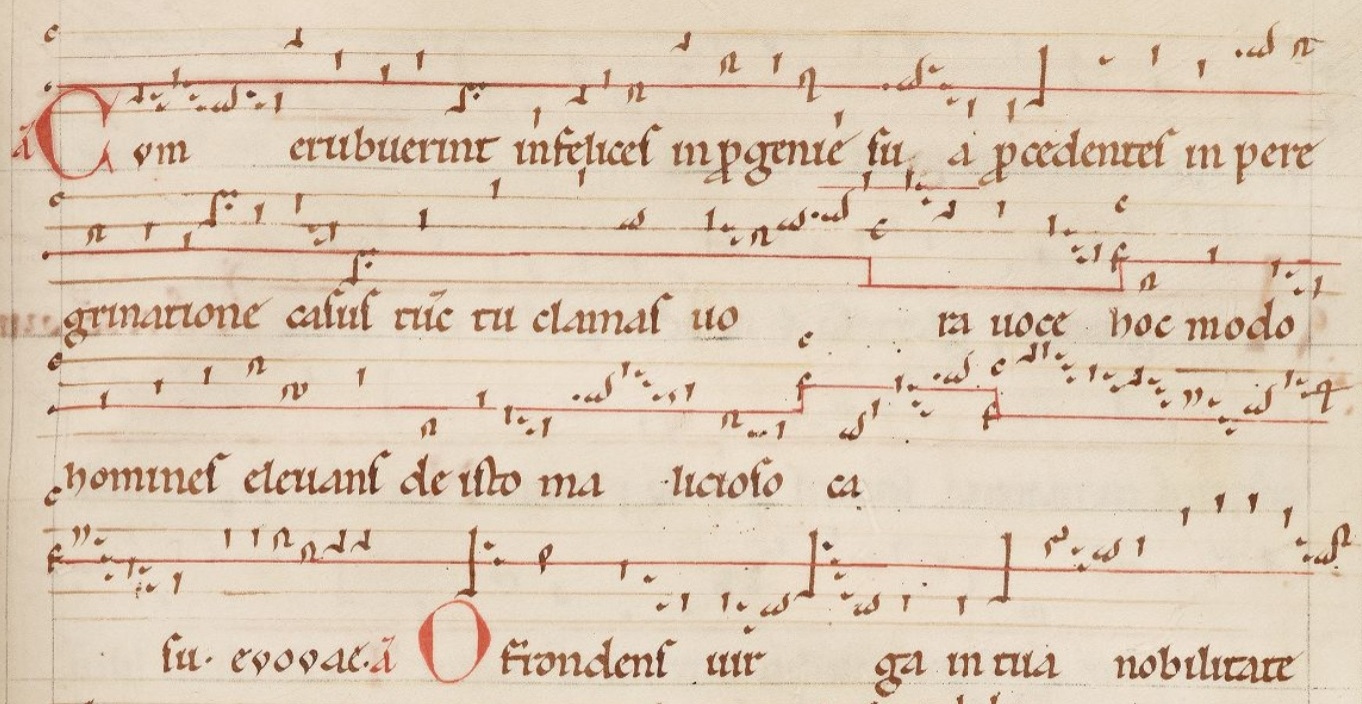
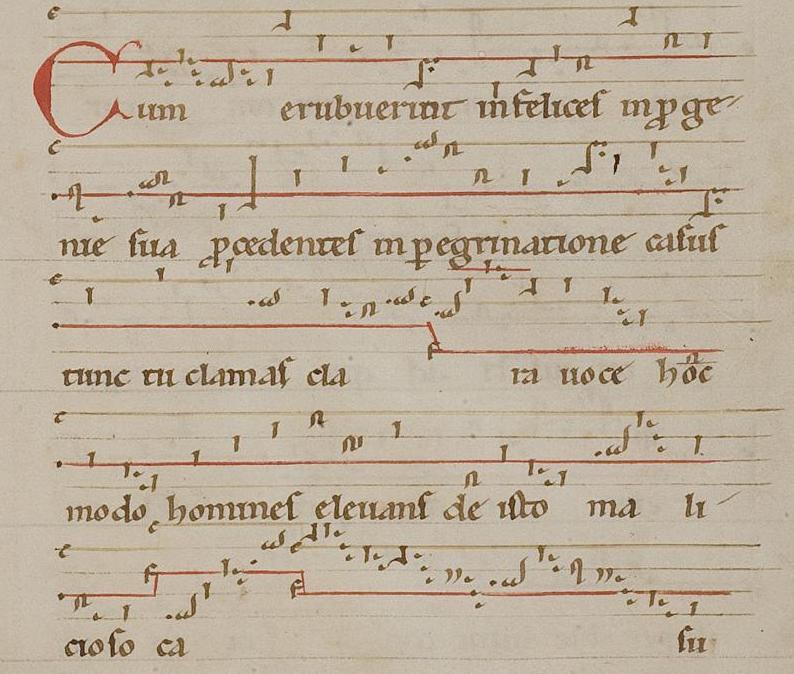
LISTEN: “Cum erubuerint infelices” (While Downcast Parents Blushed) by Hildegard of Bingen, ca. 1175 | Performed by La Reverdie on Sponsa Regis: La victoire de la Vierge dans l’œuvre d’Hildegard, 2003

Cum erubuerint infelices
in progenie sua,
procedentes in peregrinatione casus,
tunc tu clamas clara voce,
hoc modo homines elevans
de isto malicioso
casu.
While downcast parents blushed,
ashamed to see their offspring
wand’ring off into the fallen exile’s pilgrimage,
you cried aloud with crystal voice,
to lift up humankind
from that malicious
fall.

Trans. Nathaniel M. Campbell [source]

The Benedictine abbess Hildegard of Bingen (1098–1179) was a visionary theologian, poet, composer, singer, artist, gardener, and physician. She wrote on scientific and medical subjects in addition to theology, which she conveyed not only through prose but also through poetry, music, dramas, and illuminations. She was quite the medieval polymath!

I first learned about Hildegard in a Western music history survey course in college, in a unit centered on her Ordo Virtutum (Play of the Virtues). I couldn’t believe I had never heard about this amazing sister in the faith before. In 2012 she was formally canonized by the Roman Catholic Church—a long time coming!—and Pope Benedict XVI even named her a “doctor of the church,” a title given to saints who have made a significant contribution to theology or doctrine.

The corpus of surviving musical compositions by Hildegard is larger than that of any other medieval composer. More than half of these are antiphons, short free verses sung before and after each set of psalms during monastic prayer.

“Cum erubuerint” is one such antiphon. Hildegard would have sung it with her sisters at her monastery on the Rupertsberg and later the abbey at Eibingen as part of the Divine Office.

The song addresses the Virgin Mary, whose yes to Gabriel set into motion the Incarnation and thus humanity’s deliverance from spiritual exile.

As are many of Hildegard’s compositions, “Cum erubuerint” is highly melismatic—that is, it features long melodic phrases sung to one syllable. For example, I counted thirteen notes on the first syllable, “Cum”! The highest pitch occurs on clara (“clear”), referring to the definitive quality of Mary’s consent, bright and luminous, to this new thing that God is doing. An agent of God’s grace, Mary speaks a word that cuts through the mists of confusion through which we’ve been wandering, lost, uplifting us from the fall (casu), whose depths are underscored by that word’s being pitched the lowest. In her fiat, Mary is essentially saying, “Let there be light.”

Symphonia armonie celestium revelationum (Symphony of the Harmony of Celestial Revelations) is the title Hildegard gave to her collection of musical compositions, which are preserved in two manuscripts:

  • Dendermonde (D), Belgium, Sint-Pieters-en-Paulusabdij, Cod. 9 (ca. 1175). This one is considered by scholars to be the more authoritative. It was prepared under Hildegard’s supervision as a gift for the monks of Villers and contains fifty-seven songs.
  • Riesenkodex (R), Wiesbaden, Hessische Landesbibliothek, Hs. 2 (ca. 1180–85). This revised and enlarged edition, which includes seventy-five songs, was produced at the Rupertsberg scriptorium not long after Hildegard’s death.

“Cum erubuerint” appears in both.

Cum erubuerint by Hildegard
D 155r
Cum erubuerint (R 467r)
R 467r

Click here for a modern transcription from the International Society of Hildegard von Bingen Studies.

In her critical edition of Hildegard’s Symphonia, Barbara Newman writes,

Hildegard’s creations, compared with a contemporary hymn by Abelard or a sequence by Adam of St. Victor, will sound either primitive or unnervingly avant-garde. In a sense they are both. As a Benedictine, she was acquainted with a large repertoire of chant, but she lacked formal training and made no attempt to imitate the mainstream poetic and musical achievements of her day. Various scholars have hypothesized that she was influenced by German folksong, yet her compositions lack the two essential traits of a popular tune: it must be easy to remember and easy to sing. The difficult music of the Symphonia is sui generis. In [Sr. Maria Immaculata] Ritscher’s words, it is ‘gregorianizing but not Gregorian’ and impossible to classify in terms of any known contemporary movement. (27–28)

And regarding Hildegard’s lyrical texts:

Until the advent of modern vers libre, scholars were reluctant even to dignify Hildegard’s songs with the title of poetry. In style they are much closer to Kunstprosa, a highly wrought figurative language that resembles poetry in its density and musicality, yet with no semblance of meter or regular form. (32–33)

The above performance of “Cum erubuerint” is by La Reverdie, a medieval and Renaissance vocal ensemble that started in 1986 with two pairs of sisters from Italy.

But in addition, here are a few instrumental versions I particularly like:

>> Tina Chancey of the early music ensemble Hesperus plays the melody on kemenche, a bowed instrument from the Black Sea region of Turkey:

>> Riley Lee on shakuhachi (bamboo flute):

>> Noël Akchoté on electric guitar:

The song also appears, under the title “From This Wicked Fall,” on the Billboard-topping Vision: The Music of Hildegard Von Bingen (1994), a classical-electronic crossover album of seventeen of Hildegard’s works arranged by Richard Souther. In Souther’s version, nonlexical vocables (sung by soprano Emily Van Evera and mezzo-soprano Sister Germaine Fritz, OSB) replace the Latin text.

Roundup: The Soil and The Seed Project, Transfiguration art, and more

For the first time, this year I plan on publishing short daily posts for the entirety of Lent and for the Octave of Easter, pairing a visual artwork with a piece of music along the seasons’ themes (for an example of this format, see here)—just an FYI of what to expect. I also have several poems lined up. And you might want to check out the Art & Theology Lent Playlist and Holy Week Playlist on Spotify (introduced here and here respectively), which I’ve expanded since last year. I’m very pleased with the Holy Week Playlist in particular.

+++

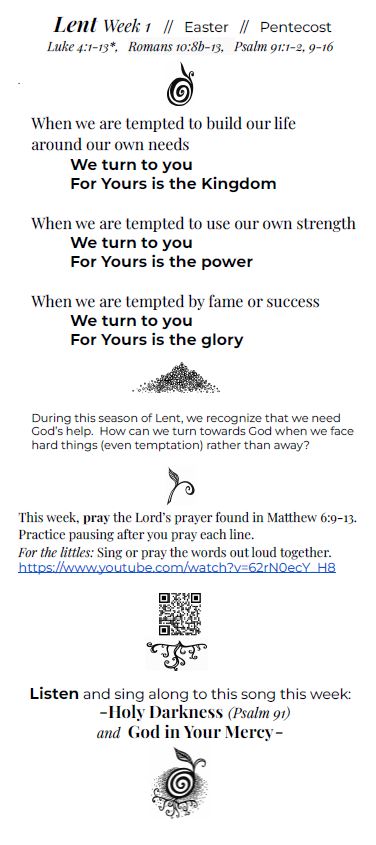
NEW RESOURCE FOR HOME LITURGIES: The Soil and The Seed Project: Directed by Seth Thomas Crissman of The Walking Roots Band [previously] and with the contributions of a team of artists, writers, and musicians, “The Soil and The Seed Project nurtures faith through music, art, and Little Liturgies for daily and weekly use in the home. These resources help establish new rhythms of faith as together we turn towards Jesus, believing and celebrating the Good News of God’s Love for the whole world.” The project launched in November 2021 with its Advent/Christmas/Epiphany collection. When the project is complete it will consist of four volumes of music (forty-plus songs total—all original, save for a couple of reimagined hymns) and four liturgical booklets that include responsive scripture-based readings, reflection prompts, suggested practices, and an original artwork.

The Lent/Easter/Pentecost collection releases February 25, but as a special treat, Crissman is allowing Art & Theology readers a “first listen” with this private link (it will turn public on Friday). Here’s one of the songs, “I Want to Know Christ,” a setting of Philippians 3:10–11 by Harrisonburg, Virginia–based songwriter and jail chaplain Jason Wagner, followed by a Little Liturgies sample:

Little Liturgies, Lent Week 1

Thanks to a community of generous donors, The Soil and The Seed Project gives away all its content for free, including shipping, to anyone who is interested (individuals, couples, families, churches, etc.); request a copy of the latest music collection and liturgies here. CDs and printed booklets are available only while supplies last (1500 copies have been pressed/printed for this collection), but digital copies of course remain available without limit.

+++

CONVERSATIONS AT CALVIN: Below are two videos (of many!) from the 2022 Calvin Symposium on Worship, which took place earlier this month.

>> “Modern-Day Prophets: How Artists and Activists Expand Public Worship” with Nikki Toyama-Szeto: A writer, speaker, and activist on issues of justice, leadership, race, and gender, Nikki Toyama-Szeto is the executive director of Christians for Social Action and a leading voice for Missio Alliance. Here she is interviewed by preacher and professor Noel Snyder. They discuss the generativity of imagination, and its invitation to displacement; the connection between corporate worship and public witness; the movement of the Holy Spirit outside church walls; “political” and “pastoral” as classifications that differ from group to group; embracing messiness; and what pastors can learn from artists and activists.

A few quotes from Toyama-Szeto that stood out to me:

  • “Part of what we’re trying to do at Christians for Social Action is stir the Christian imagination for what a fuller followership of Jesus looks like in a more just society. The word ‘imagination,’ and I would say specifically Christian imagination, I think of as the dream that God dreams for his people and his creation. What does it mean to be oriented toward the dream that God is dreaming? Another word for it is shalom—the full flourishing of all his creation and all his people. And if you look at the gap between where we are today and what that dream is, that gap is imagination. How is it that we get from here, the broken world we see . . . how do we press in and lean into the dreams that God dreams for his people and for his world?”
  • “For me, I have found artists and prophets—those who are agitating for justice—are ones who help dislodge me from everyday things I take for granted, and those assumptions, and they help me to dream new and bigger dreams.”
  • “The pursuit of justice is the declaration of God’s character in the public square.”

Here are links to a few of the names and books she references: Sadao Watanabe, A Book of Uncommon Prayer, Andre Henry [previously], The Many.

>> “Christians and Cultural Difference,” with Pennylyn Dykstra-Pruim and David I. Smith: María Cornou interviews Calvin University professors Pennylyn Dykstra-Pruim and David I. Smith, authors of Christians and Cultural Difference (2016).

Smith shares his frustration that often the only Christians who endeavor to learn other languages and develop cultural intelligence and appreciation are those who are preparing to be missionaries in a foreign country, and they do it only for the purpose of missional effectiveness.

If you take one piece of theology [i.e., evangelism] and try and make that the bit that’s about cultural difference, that puts distortions into the conversation. . . . You might want to think about mission, but you might also want to think about what it means to be made in the image of God. Does that mean everyone’s the same, or does it mean everyone has responsibility for shaping culture and we might all do it in different ways, and you have to make space for that? We might need to think about the cross. We might need to think about God’s embrace of us and how we embrace each other. We might need to think about love of neighbor. We might need to think about the body of Christ and the makeup of the early church. . . . You might have to visit a whole bunch of different theological places to get a composite picture rather than saying this is the doctrine that somehow solves cultural difference for us.

I was also struck by Smith’s discussion of how cultural difference can help us read the scriptures in a new way (see 19:38ff.). He gives an example from In the Land of Blue Burqas, where Kate McCord, an American, describes her experience reading the Bible with Muslim women from Afghanistan, and particularly how they taught her a very different interpretation of John 4, the story of Jesus’s encounter with the Samaritan woman at the well. Wow.

+++

VISUAL COMMENTARY ON SCRIPTURE: The Transfiguration: In churches that follow the Revised Common Lectionary, this Sunday, the last Sunday in the Epiphany season, is Transfiguration Sunday, giving us a vision with which to enter Lent. (Other traditions celebrate Jesus’s transfiguration on August 6.) In this video from the Visual Commentary on Scripture project, art historian Jennifer Sliwka and theologian Ben Quash discuss this New Testament event through three visual artworks: a fifteenth-century icon by Theophanes the Greek, which shows the “uncreated light” revealed to Peter, James, and John on Mount Tabor; a fresco by Fra Angelico from the wall of a friar’s cell in Florence, where Jesus’s pose foreshadows his suffering on the cross; and a contemporary light installation by the seminary-educated American artist Dan Flavin, comprising fluorescent light tubes in the shape of a mandorla. Brilliant!

+++

CIVA TRAVELING EXHIBITION: Again + Again, curated by Ginger Henry Geyer with Asher Imtiaz: “A photography exhibition that invites recurring and fresh contemplation of the ordinary and extraordinary through the seasons of the Christian liturgical calendar,” sponsored by Christians in the Visual Arts. The show will be on view at Second Presbyterian Church in Indianapolis from February 26 to March 26 and is available for rental in North America after that. I saw it at St. David’s Episcopal Church in Austin in November at the CIVA biennial and was impressed! It is accompanied by a beautifully designed catalog that pairs each photograph with a poem, several of which were written specifically for the exhibition and which respond directly to a given photo.

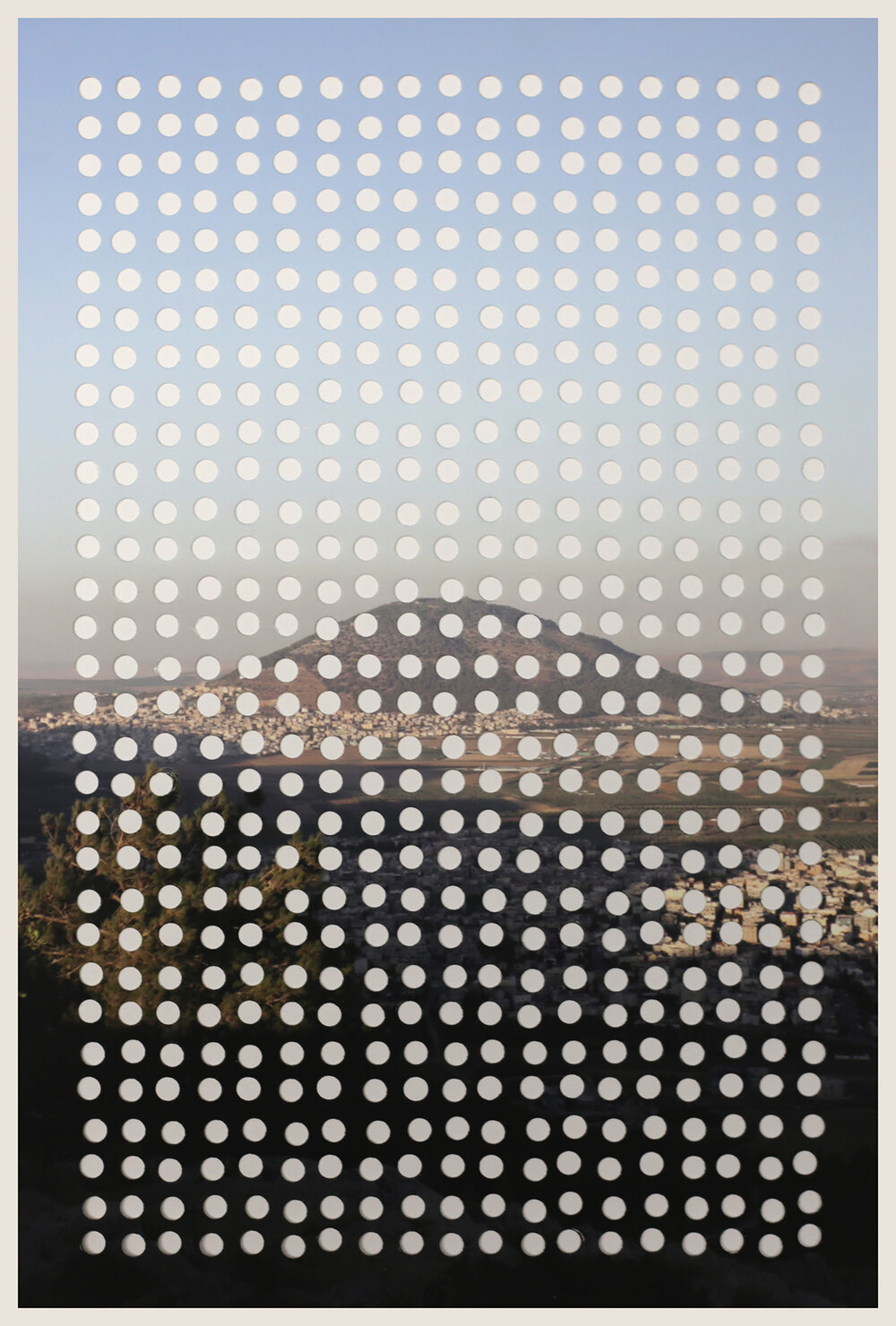
Winters, Michael_Mount Tabor, June 2017
Michael Winters, Mount Tabor, June 2017, 2017. Inkjet print with holes punched out in white wood frame, 19 × 13 in.

One of my favorite art selections is Mount Tabor, June 2017 by Michael Winters, the director of arts and culture at Sojourn Church Midtown in Louisville, Kentucky. “Mount Tabor . . . is where the transfiguration of Christ is thought to have occurred,” Winters writes. “I stood viewing that scene in 2017. It looked so normal. I’m not sure why I felt compelled to punch holes in this photograph, but I think it’s because I wanted to be able to see through this ‘normal’ landscape to the glory of the transfigured Christ—which is to say, I wanted to see reality.”

Browse all the Again + Again photographs on the CIVA website. Longtime followers of the blog will recognize some of the photos from Greg Halvorsen Schreck’s Via Dolorosa series that I featured back in 2016.

Roundup: Round dance of praise; minimalist church architecture; Psalm 46 sung in Spanish; Armenian Christian heritage destroyed; and more

Image journal subscriptions are 50% off through the summertime—only $24 for four full-color issues! This is the magazine I most look forward to receiving in the mail. So much great poetry, art, essays, and more.

+++

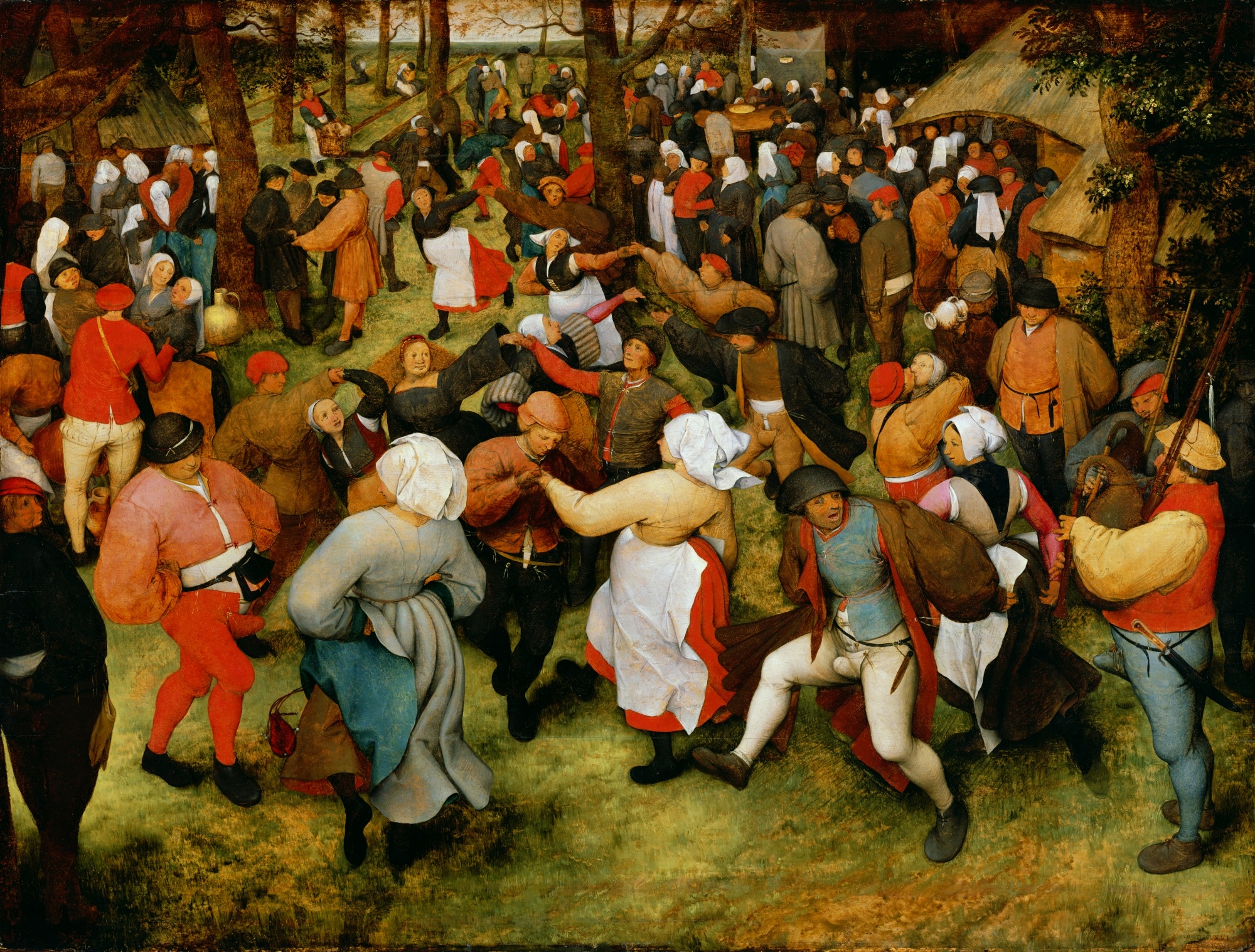
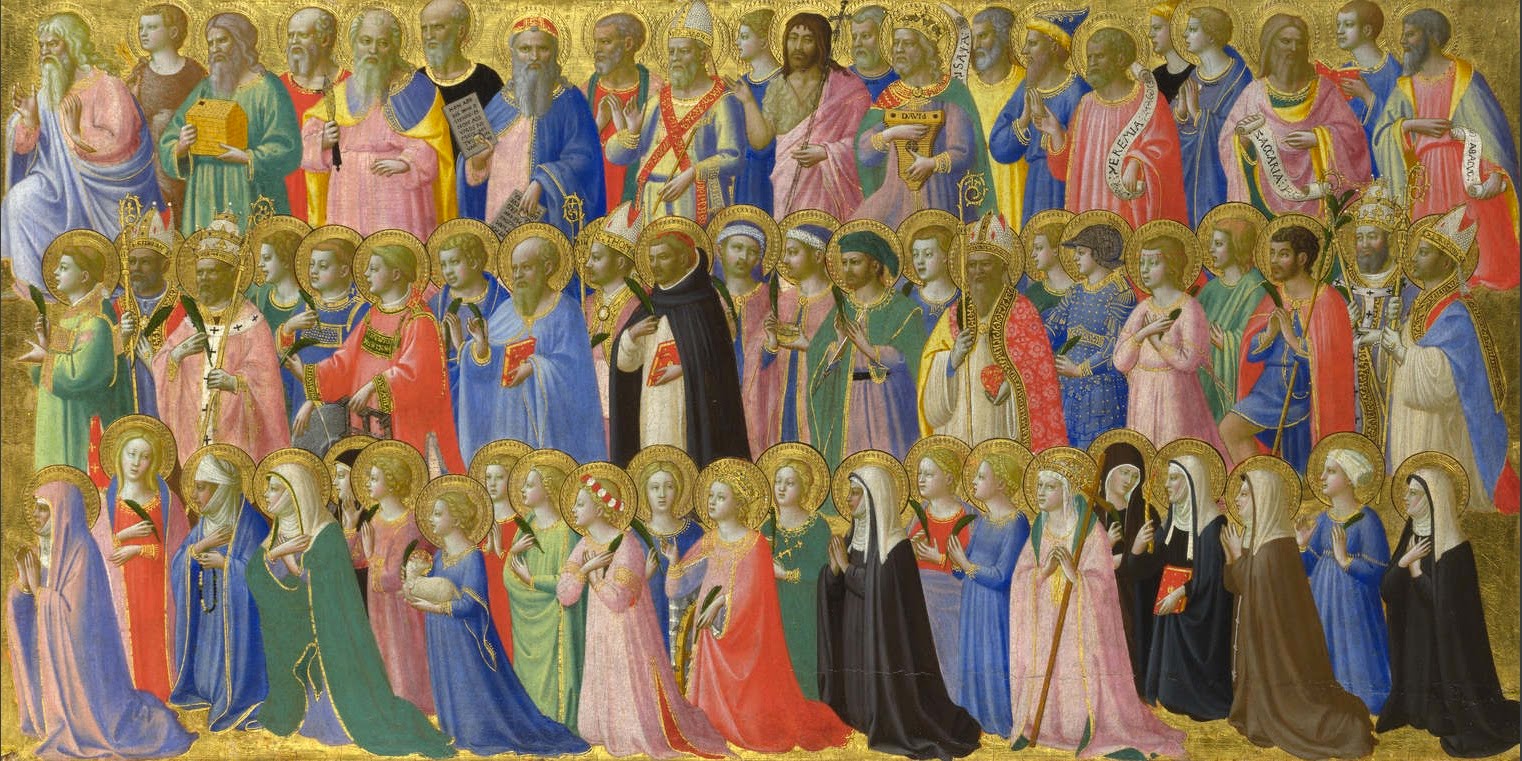
NEW POEM: “They Too Go Round” by Paul Mariani: This poem from the current issue of Image journal (no. 101) brings together Pieter Bruegel the Elder’s Wedding Dance with Fra Angelico’s Last Judgment at San Marco, gesturing toward a vision in which the terrestrial is taken up into the celestial. Bruegel’s Dutch peasant dancers “pound” and “rollick” with beer foam on their faces and general bawdiness; the saints from the Fra Angelico painting, by contrast, step lithely and with reverence in their round dance on the very grasses of paradise. Disparate though they are in tone, Mariani connects these two images, playing with the idea of circling. Just as the wedding guests dance round and round, so too does time; so too the spheres. And at the center of this cosmic round dance is praise: humanity linked hand in hand with the angels, not closed in on themselves but opening up into the glory of God.

The Wedding Dance by Pieter Bruegel the Elder
Pieter Bruegel the Elder (ca. 1525–1569), The Wedding Dance, ca. 1566. Oil on panel, 119.3 × 157.4 cm. Detroit Institute of Arts, Michigan, USA.

Fra Angelico_Last Judgment
Fra Angelico (ca. 1395–1455), The Last Judgment (detail), ca. 1431. Tempera on wood, 105 × 210 cm. Museum of San Marco, Florence, Italy.

The last stanza quotes an excerpt from a famous medieval Catholic prayer: “Sinning daily, and not repenting, the fear of death disturbs me, for there is no redemption in Hell. Have mercy on me, O God, and save me.” The speaker’s anxiety has been building up as he reflects on the empty pleasures to which he has been so long devoted and the imminence of death. This anxiety, however, is swept away in one turn as he catches a glimpse of God’s abundant salvation and its final consummation—a “sea-changing moment, now and forever.” Christ, the fulfillment of all desire, sits on his throne at the center of this turning world, beckoning us into the dance of the redeemed.

(FYI, Paul Mariani will be one of the plenary speakers at the Catholic Imagination Conference at Loyola in September. Registration is still open!)

+++

CHURCH ARCHITECTURE: Known for his work in concrete, Spanish architect Fernando Menis designed the new Holy Redeemer Church in Tenerife, Spain, consecrated May 12. I’m digging the minimalism. Learn more and view more photos on the architect’s website. [HT: ArtWay]

Holy Redeemer Church (Tenerife)
Holy Redeemer Church, Tenerife, Spain. Designed by Fernando Menis, completed 2019.

Holy Redeemer Church (Tenerife)
Interior: Holy Redeemer Church, Tenerife, Spain. Designed by Fernando Menis, completed 2019.

+++

CHORAL ARRANGEMENT: “Dios es Nuestro Amparo” (God Is Our Refuge), arr. Alfredo Colman: I love this traditional setting of Psalm 46 in Spanish, recently arranged by Alfredo Colman and performed by the Coro del Seminario Internacional Teológico Bautista (Choir of the International Baptist Theological Seminary) in Buenos Aires, Argentina. [HT: Global Christian Worship]

I was curious about the history of the song, so I wrote to Colman; he said he first encountered it in Paraguay, where he grew up, but doesn’t know its country of origin. The song, he told me, has been well known in Latin America since the 1970s. While this particular arrangement of Colman’s has not yet been published, you can find a simpler arrangement for congregational singing in the bilingual hymnal Santo, Santo, Santo: Cantos para el pueblo de Dios / Holy, Holy, Holy: Songs for the People of God, released just this month. Edited by the Calvin Institute of Christian Worship (CICW) in partnership with GIA Publications, it contains over 700 songs in Spanish and English.

For a vision and resources for singing together in Spanish and English, see this recorded CICW workshop, led by Colman and five others, and also the article “Expand Your Church’s Bilingual Music Repertoire.” Introducing bilingual music to a church congregation is “like introducing a new vegetable to toddlers,” says María Eugenia Cornou, the CICW program manager for international and intercultural learning. “Some kids love it, but usually it takes time. It’s a new flavor.”

+++

CULTURAL DESTRUCTION: “A Regime Conceals Its Erasure of Indigenous Armenian Culture” by Simon Maghakyan and Sarah Pickman: An investigative report published in February exposed Azerbaijan’s destruction of thousands of medieval Christian Armenian artworks and objects at the necropolis of Djulfa in Nakhichevan. The cemetery at Djulfa contained the world’s largest collection of khachkars, ornately carved memorial steles with crosses, characteristic of Armenian Christianity; 2,920 were documented clandestinely by native Argam Ayvazyan from 1964 to 1987, half of the 5,840 he documented in Nakhichevan as a whole. But, other than the dozen that were removed from the region during or before the Soviet era into church or museum collections, all these were demolished by Azerbaijani soldiers in 1997, 2002, and 2005–6, expunging the region’s last remaining traces of Christianity. (This was in addition to the demolition of 89 Armenian churches and 22,000 tombstones in Nakhichevan.)

Djulfa cross-stone
A 1915 photograph of researcher Aram Vruyr’s son with one of many thousand khachkars (cross-stones) at Djulfa, enhanced by Judith Crispin’s Julfa Cemetery Digital Repatriation Project. Courtesy Aram Vruyr Archives.

St. Thomas Cathedral (Armenia, now lost)
Surb Tovma (St. Thomas Cathedral) in Agulis, Nakhichevan, Azerbaijan, which tradition states was founded as a chapel by Bartholomew the Apostle. Now destroyed. Photo © Argam Ayvazyan Archives, 1970–1981.

“Unlike the self-publicized cultural destruction of ISIS, independent Azerbaijan’s covert campaign to re-engineer Nakhichevan’s historical landscape between 1997 and 2006 is little known outside the region. . . . While some Azerbaijanis have embraced their government’s vandalism as either righteous revenge or a national security measure against potential Armenian territorial claims, other Azerbaijanis . . . have mourned the destruction.”

Here is a short video posted in December 2005 by Nshan Topouzian, the leader of north Iran’s Armenian church, who was tipped off to the destructive activity taking place at the Djulfa cemetery by an Iranian border patrol. (Djulfa is located at the border of Azerbaijan and Iran.)

Hyperallergic pointed out the “cruel irony” and “insult” of Azerbaijan hosting UNESCO’s World Heritage Committee session earlier this month. UNESCO not only avoided a public condemnation of the destruction of Armenian Christian artifacts and churches in Nakhichevan but also praised Azerbaijan (one of its biggest donors) as a “land of tolerance.”

+++

ARTICLE: “6 Works of Classical Music Every Christian Should Know” by Jeremy Begbie: Theologian and pianist Jeremy Begbie is a superstar in the field of theology and the arts. Most of his books, published for academic audiences, are pretty dense, but this article that he wrote for The Gospel Coalition is wonderfully accessible. It opens, “Why bother with classical music? On the face of it, it seems like a serious indulgence to give time and attention to something so trivial as music—classical or otherwise. Yet the fact remains that no human society, however impoverished, has yet managed to do without music in some form. The impulse to sing, to blow air through wooden tubes, and to draw hair across strings seems ineradicable. What’s more, it’s long been recognized that people pour their deepest longings and passions into music-making. Music can be a remarkable index of the profoundest impulses and stirrings of a culture—impulses and stirrings that are often theologically charged.”

He then recommends six works of classical music to spend time with, highlighting the best recordings and musical guides available. From the “bubbling, joyful abundance” of a Mozart piano concerto (“a fresh iteration of creation’s hallelujah”) to the “aching beauty” of Rachmaninov, there’s variety here. Find out what Begbie considers to be “the greatest Christian musical achievement of the early modern era,” and which symphony contains, from its penultimate to final movement, one of the best transitions in Western music.

Begbie is the founder Duke Initiatives in Theology and the Arts, and the program is throwing a big symposium in September to celebrate its ten-year anniversary. I’ll be there! Join me? If you can’t swing the registration cost but live in the Triangle area of North Carolina, consider coming out on Saturday night to “Making All Things New: The Sound of New Creation,” a concert featuring a range of music, “from Bach to Bernstein, Rachmaninov to Latino, medieval to jazz, concert music to film music,” as well as a reflection by N. T. Wright. I attended a similar Begbie-led concert at Duke two years ago, and it was phenomenal.

+++

FILM: Ida (2013), dir. Pavel Pawlikowski: This Oscar Award–winning film about identity and faith is a great watch, especially for its stunning cinematography by Lukasz Zal and Ryszard Lenczewski. Shot in high-contrast black-and-white in the classic 4:3 format, it is almost entirely made up of static frames, exquisitely composed. I really just can’t get over the visuals. Watch the trailer and film clip below, and you’ll get a sense of what I mean. The movie is available on Kanopy, an on-demand streaming service provided for free by many public libraries.

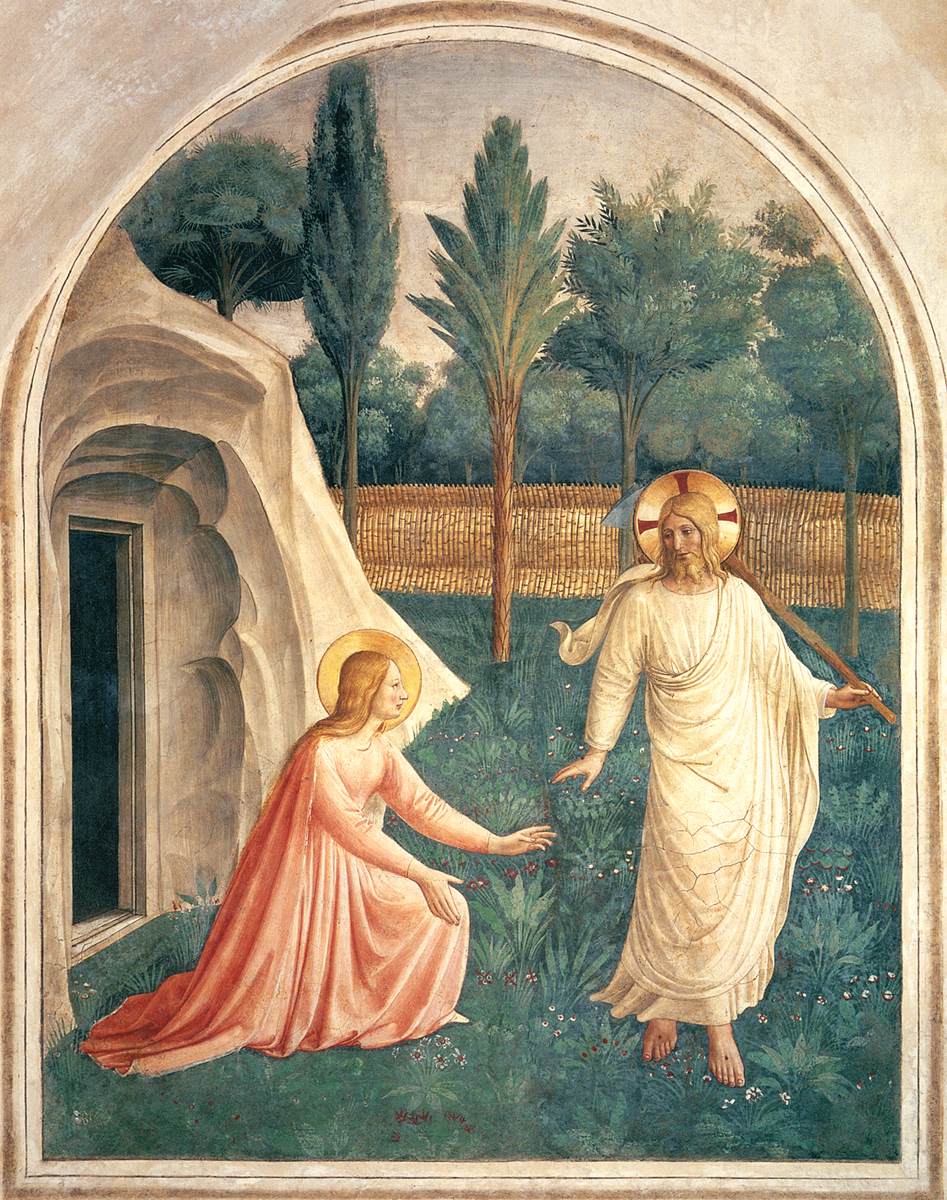
Sowing the stigmata: A reading of Fra Angelico’s Noli me tangere by Georges Didi-Huberman

During Easter 2016 I published an article on Jesus as the gardener of our souls, featuring a roundup of Noli me tangere (“Touch me not”) paintings that portray the risen Christ as a literal gardener, including a fresco by Fra Angelico from the convent of San Marco in Florence.

Noli me tangere by Fra Angelico
Fra Angelico (Italian, ca. 1395–1455), Noli me tangere, 1440–42. Fresco from the convent of San Marco, Florence, Italy.

I spent the spring semester of my junior year of college living in Florence and, while there, fell in love with Renaissance art, and in particular the paintings of Fra Angelico (ca. 1395–1455). Born Guido di Pietro, he took vows as a Dominican friar and, together with his assistants, painted two corridors and the forty-four cells in the newly built San Marco, where he lived. The convent is now a state museum and is one of my favorite sites in the city.

In 1990 art historian Georges Didi-Huberman published a monograph on Fra Angelico, spending considerable time on his Noli me tangere, especially its red flowers, which he reads as a figural displacement of Christ’s stigmata (nail wounds). (More on this below.) In the painting, he writes, Christ’s blood “soaks the earth and makes a new humanity grow there, a humanity in the imitation of Christ, a humanity redeemed from sin” (161). He notes how the floral imagery is echoed in the Annunciation in the hallway outside the cell, serving to visually connect these two stages of redemption: Christ’s “flowering,” or conception, in the womb of Mary and his flowering forth from the womb of the earth on Easter.

(Related: “Rosing from the Dead” by Paul J. Willis)

The figure of the Christ-flower was already a common one in the medieval West. For example, the great thirteenth-century theologian Albertus Magnus writes,

The Christ-flower [flos Christus] blossomed in the Nativity, as we read in Isaiah 11:1: “There shall come forth a rod out of the stem of Jesse.” It withered in the Passion, when there was no longer aspect or beauty. . . . It blossomed again at the Resurrection according to human nature, in the very place where it had withered. Thus it is said: “And my flesh blossomed anew” (Psalm 27:7). [De laudibus 12.4.2]

Fra Angelico furthered the development of this metaphor in visual form, picturing Christ’s blood (according to Didi-Huberman) as a fertilizing material, the agent of regeneration.

The following excerpt is taken from Fra Angelico: Dissemblance and Figuration* by Georges Didi-Huberman, translated from the French by Jane Marie Todd (Chicago: University of Chicago Press, 1995), pages 19–22. I find some of the semiotics discourse to be abstruse, but I’ve highlighted a few standout ideas in boldface—ideas that have helped me to see Fra Angelico’s Noli me tangere (and the Resurrection!) with new eyes.

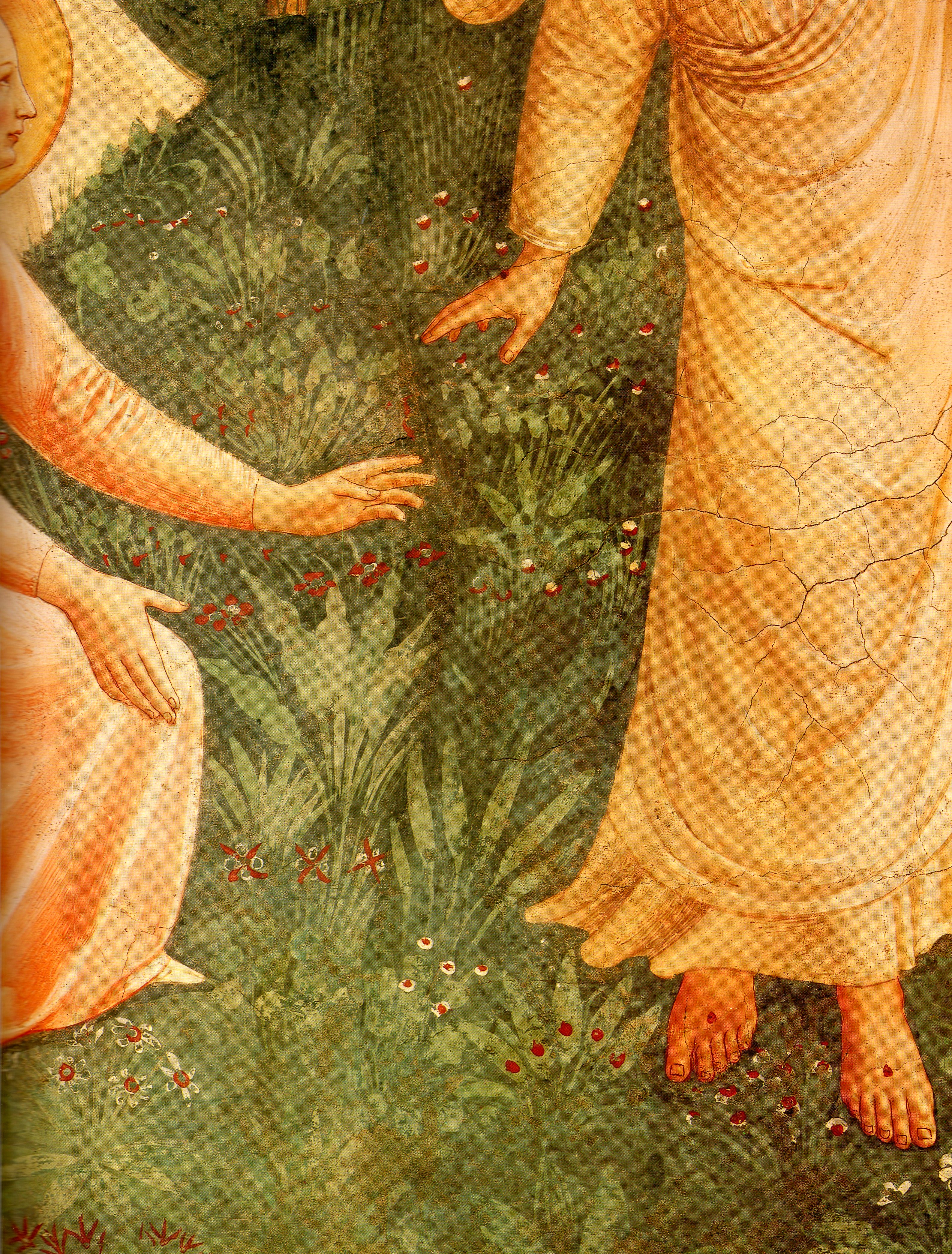
Noli me tangere (detail) by Fra Angelico

Angelico sprinkled little spots, deposited little splotches all over this “field” [of green]: more or less regular blotches, made of Saint John White [bianco di San Giovanni]—that is, the very material that constitutes the intonaco of the pigment—and, on top of that, red. It is a bright color, a terra rossa, and it forms a slight relief from the wall; the rhythmic effect, the pattern effect, is only that much stronger.

But what about this “field” in the economy of representation? And in particular, what exactly do these little spots of red pigment spread across the surface like stars represent? To what category of signs do they belong? A response suggests itself at first glance, a response relating to the obviousness of the storia and, consequently, to the overall mimetic, “realist” nature of the fresco: these little red blotches without a doubt represent flowers in the meadow. In [Charles Sanders] Peirce’s semiotic typology, these little red blotches would therefore be icons of flowers in a meadow. Peirce noted quite rightly, concerning this concept of the icon, the extent to which we have a tendency when contemplating a painting to forget the distinction between the present sign (in this case, the red blotches) and the absent reality (the flowers). We therefore need to go a bit further in our contemplation of the little blotches themselves.

We notice at this point that the colored patterns are absolutely not painted like flowers. They do not describe anything, do not suggest any distinguishing features: in these flowers, there are no calyxes, no corollas, no pistils, no stamens. They are colored blotches, no more and no less. And it would be completely absurd to invoke at this point some incompetence on Fra Angelico’s part in representing a flower with its pistil and stamens: he carried out the task perfectly well elsewhere, and moreover, he proved himself competent in the face of much greater mimetic difficulties. It would be just as pointless to imagine the painter “not having the time,” or the coat of paint drying too quickly. If Angelico had wanted to paint a flower like a flower, he would have done so; he would have applied himself. But that is precisely the point: he did not decide to do so. He was satisfied with laying on little circular “heaps” of terra rossa. Why? The response is not in absentia, in a meadow or a text, for example; it is in praesentia, on the fresco itself. For if we persist in wondering what the red blotches are painted like, we can give as our response only what we see: in all rigor, these red blotches are painted like—that is, exactly in the same manner as—Christ’s stigmata.

These red blotches are even painted the way Fra Angelico painted stigmata in general, Christ’s or Saint Francis’s, everywhere in San Marco: they are small circular inflections of the brush that deposits its thick pigment of terra rossa. And the evidence of such a relation is accentuated, specified, virtually demonstrated by the constellation effect Angelico actually bestowed on his little blotches: these flowers scattered across a green ground follow a trajectory that ends with a repetition of the same pictorial sign on Christ’s hand and foot.

Noli me tangere details sketch
Detail sketches of Fra Angelico’s Noli me tangere, showing Christ’s dispersal of his stigmata. Source: Fra Angelico: Dissemblance and Figuration, p. 20

Confronted with what amounts to a real displacement of the iconic sign, I can no longer affirm anything that has the minimal stability required for the notion of a motif: speaking in absolute terms, I can no longer say “it is” or “it is not” in a decisive way. There is a displacement of the iconic value and hence an equivocal representation. For example, I can very well affirm that Christ’s stigmata are, according to Fra Angelico, the flowers of his body. And I will have no difficulty, by the way, in finding a Thomist text to support an affirmation of this kind: for instance, the article in his Summa theologica that Aquinas devotes to the question of whether Christ’s risen body had or did not have scars. To the objector who maintained that stigmata are wounds, and hence a “corruption” and a “defect,” Aquinas responds yes, but those wounds, on Christ, possess a “special beauty” (specialis decor) which is Beauty itself, the (bleeding, of course) Beauty of the Virtue of Humility [Summa theologica 3a.54.4].

But I could just as easily affirm, confronted with Angelico’s fresco, that Christ is here represented in the emblematic act of “sowing” his stigmata in the garden of the earthly world, just before going to rejoin the right hand of his Father in heaven. The idea finds support, by the way, if we pay attention to the fact that, seven times in the fresco and especially next to the stigmata stricto sensu, the red “flowers” appear in groups of five, the symbolically very pregnant number of Christ’s wounds.

In short, in considering these little red blotches in terms of the how of their presence in the fresco, we are led to equivocate on the question of what they represent mimetically. The iconic character of these red signs moves to the background, submits to a logical aporia, while their nature as indexes, as blotches, as pure physical, colored traces, takes center stage. And their way of signifying—between the flower and the stigmata, creating the notion of a relation above all—no longer has anything to do with the way the story delivers its very recognizable meaning.

Finally, as if to definitively convince his meditative fellow friar that he was not merely recounting a too well-known anecdote from the Gospels, Fra Angelico placed a third type of sign at the level of the gaze, something that does not look like anything recognizable in a meadow or even in the story of the Noli me tangere: it is a symbol, three little bleeding crosses, placed between Mary Magdalene and the risen Christ. Here is something that does not “resemble” anything in the order of meadow reality, but nonetheless possesses an obvious memorative function, pointing toward a meditation on Christ’s Passion and the Trinity.

It is particularly important to note that Angelico’s fresco signifies a great deal beyond the conventional iconographical attributes of its story. The example of the little patterns of red in itself raises the possibility of a painter’s using pictorial signs that constitute, strictly speaking, signa translata, a term I will translate as “transit signs,” signs or operators of conversion. And these signs of conversion are not simply metaphors, because their material existence sets up a labile movement between signs of very different semiotic status—icons, indexes, and symbols. That is why such pictorial signs immediately prohibit any univocal relation of attribution—a word to be understood in its two senses, logical and iconological. Such signs have the value of displacement, movement, and association rather than definition, identification, or predication.

But that does not mean they have a lesser value. On the contrary: if there is a type of thinking characteristic of images, it is associative—translata—thinking, a thinking that structures itself by shifting. To represent flowers in a field, Fra Angelico chose to produce only stigmata, simple marks, red colored traces; but these traces, arranged in series, in some sense bridge the gap between two completely heterogeneous (but theologically articulable) orders of thought: a field in springtime on the one hand, and Christ’s body “decorated” with wounds, his stigmata, on the other. That is what, in all rigor, is called a practice of figurability. The image, incapable of—or rather oblivious to—strict logical thinking, draws from this obliviousness all its signifying force. It is only a matter of seeing in Angelico’s fresco how a single material element—that famous terra rossa color—can function on the whole surface of the work as the privileged operator of displacements and structurers of meaning: this red speaks to us of sin in Mary Magdalene’s robe, but it is also, across from her, the very place of Christ’s suffering, the stigmata; it returns to Mary Magdalene in the converted form of compassion; it is disseminated as spring flowers, as an emblem of the Passion, but also of the Resurrection; it continually shifts between the flesh of man—since it is in general a stroke of that same red that outlines bodies in Angelico’s frescoes—and the glory of Christ’s risen flesh, the incarnate of his lips, the red cross of his halo. . . .


* This is an Amazon affiliate link, meaning that Art & Theology will earn a small commission on any purchase that originates here.

Around the Throne (Artful Devotion)

Predella of the San Domenico Altarpiece (Fiesole)
Predella of the San Domenico Altarpiece at Fiesole, ca. 1424, probably by Fra Angelico (Italian, ca. 1395–1455). Tempera and gold leaf on panels, 32 × 244 cm. National Gallery, London.

This week the Revised Common Lectionary assigns an additional set of readings, on top of Sunday’s, for the special celebration of All Saints’ Day (Hallowmas) on November 1. Among them is John’s vision of a multitude of angels and faithful departed surrounding the enthroned Christ in heaven, sounding forth his praise.

After this I looked, and behold, a great multitude that no one could number, from every nation, from all tribes and peoples and languages, standing before the throne and before the Lamb, clothed in white robes, with palm branches in their hands, and crying out with a loud voice, “Salvation belongs to our God who sits on the throne, and to the Lamb!” And all the angels were standing around the throne and around the elders and the four living creatures, and they fell on their faces before the throne and worshiped God, saying, “Amen! Blessing and glory and wisdom and thanksgiving and honor and power and might be to our God forever and ever! Amen.”

—Revelation 7:9–12

+++

O quam gloriosum est regnum (“O how glorious is the kingdom”) — A cappella motet for four voices composed by Tomás Luis de Victoria, 1572 | Performed by the University of Utah Chamber Choir

O quam gloriosum est regnum
in quo cum Christo gaudent omnes sancti!
Amicti stolis albis,
sequuntur Agnum quocumque ierit.

O how glorious is the kingdom
in which all the saints rejoice with Christ!
Clad in robes of white,
they follow the Lamb wherever he goes.

+++

Explore the individual panels from Fra Angelico’s “court of heaven” predella in greater detail on the National Gallery of London’s website, and rejoice this All Saints’ Day in the Christian witness of those who have gone before us!

The Virgin Mary with the Apostles and Other Saints
Probably Fra Angelico (Italian, ca. 1395–1455), The Virgin Mary with the Apostles and Other Saints, ca. 1424. Tempera and gold leaf on panel, 32 × 64 cm. From the San Domenico Altarpiece predella, National Gallery, London.

Christ Glorified in the Court of Heaven
Probably Fra Angelico (Italian, ca. 1395–1455), Christ Glorified in the Court of Heaven, ca. 1424. Tempera and gold leaf on panel, 31.7 × 73 cm. From the San Domenico Altarpiece predella, National Gallery, London.

Saints and Martyrs (Fra Angelico)
Probably Fra Angelico (Italian, ca. 1395–1455), The Forerunners of Christ with Saints and Martyrs, ca. 1424. Tempera and gold leaf on panel, 31.9 × 63.5 cm. From the San Domenico Altarpiece predella, National Gallery, London.


This post belongs to the weekly series Artful Devotion. If you can’t view the music player in your email or RSS reader, try opening the post in your browser.

To view all the Revised Common Lectionary scripture readings for All Saints’ Day, cycle A, click here.