
Gaudete! Ten Songs for Advent Rejoicing

(This article is an all-new edition of last year’s “Ten Songs of Joy for Gaudete Sunday.”)

The third Sunday of Advent is traditionally known as Gaudete (Joy) Sunday, a day of celebrating the joyful reality that God is near. Advent is characterized by our waiting and yearning for Christ, which can feel heavy, especially as we look around and within and see so much brokenness. But on this day we are reminded to embrace a spirit of joy as we wait and as we yearn—much like a child waits with eager anticipation to unwrap a gift, or lovers to be reunited after a time of separation.

The following ten songs help us to inhabit the gladsome aspects of the Advent season, paving the way to Christmas.

Geyser
Øystein Sture Aspelund (Norwegian, 1984–), GVariations #08, Pamir Mountains, Tajikistan [HT]

1. “First Song of Isaiah” by Jack Noble White (1976) | Arranged and performed by Advent Birmingham, feat. Annie Lee, on Canticles (2020): Here’s an upbeat rendition, with xylophone and ukelele, of Jack Noble White’s choral setting of Isaiah 12:2–6. “You shall draw water with rejoicing from the springs of salvation. . . . Cry aloud, inhabitants of Zion, ring out your joy!” In the Book of Common Prayer this text appears in the section “Morning Prayer, Rite 2,” where it is labeled Canticle 9, “The First Song of Isaiah: Ecce, Deus.”

2. “Rejoice Greatly, O Daughter of Zion” from Messiah by George Frideric Handel (1741) | Performed by Regula Mühlemann (2019): A setting of Zechariah 9:9–10, this aria from Handel’s most famous oratorio features coloratura in the vocals—that is, elaborate, fast-paced ornamentation, trills, runs, and wide leaps—that accentuates the prophecy’s joyful message of a coming king. It’s sung by the Swiss soprano Regula Mühlemann, accompanied by the Sächsische Staatskapelle Dresden under the direction of Alondra de la Parra. For a Broadway-style arrangement of this piece, see here.

3. “Joy (Elizabeth)” by Poor Bishop Hooper, on Firstborn (2018): This song by Jesse and Leah Roberts voices Elizabeth’s awe upon visiting with her younger relative Mary, who is newly pregnant with the Son of God. Elizabeth radiates such joy in the Messiah that her preborn son, John, catches it too, leaping in her womb.

4. “Joy” by Kirk Franklin and Donald Malloy | Performed by the Georgia Mass Choir, feat. Dorothy Anderson and Kirk Franklin, on I Sing Because I’m Happy (1992): Sweet, beautiful, soul-saving joy! That’s what Jesus gives. The Georgia Mass Choir testifies with vigor, led by the Grammy-winning artist Kirk Franklin. In 1996 this song was adapted for Whitney Houston for the film The Preacher’s Wife, with Christmas-specific lyrics, but I really dig Dorothy Anderson’s solo work in this original recording.

5. “Rejoice” by Victory Boyd, on Glory Hour (2023): This anthem by singer-songwriter Victory Boyd is based on Nehemiah 8:10: “Do not be grieved, for the joy of the LORD is your strength.” Victory often incorporates scripture recitations into her songs, and here she speaks Psalm 27:1–6 as a bridge, which has thematic crossovers with the Nehemiah verse. In this live performance from the February 4, 2024, episode of the Hour of Power television program, she is accompanied by the Hour of Power Orchestra, conducted by Marc Riley.

6. “Joy” by Shakti, on Shakti with John McLaughlin (1976): Shakti is an acoustic fusion band that combines Indian music with elements of jazz; they were active in the 1970s and re-formed in 2020. Recorded at the Montreux Jazz Festival in 1976, this instrumental improvisation features John McLaughlin on guitar, L. Shankar on violin, Zakir Hussain on tabla (hand drums), and T. H. “Vikku” Vinayakram on ghatam (clay pot).

7. “There Will Be Joy” by Paul Zach and Kate Bluett (2022): “Sorrow has an ending / Something new is coming / Oh, there will be joy!”

8. “Come That Day” by Ken Wettig, on Behold and Become (2019): Ken Wettig served for eight years as pastor of Early Church, a Mennonite congregation in Harrisonburg, Virginia, before becoming a community minister at Coracle. This song he wrote is one that Early Church sings in its worship services. It celebrates the coming day of the Lord, when death will be no more and Christ will bring about total restoration. On that day, all chaos will be stilled, swords will be beaten into plowshares, the poor will be filled, and loved ones taken too soon will embrace one another once again. The song is an invocation: it beseeches Christ to come, to bring the promised consummation of his kingdom.

Wettig has given me permission to post the lead sheet for “Come That Day,” which he freely offers for noncommercial use. Click the link to download a PDF.

9. “Peace and Joy,” Shaker hymn (1893) | Performed by the Rose Ensemble, feat. Kim Sueoka, on And Glory Shone Around (2014): One of the less recognized roots of bluegrass and old-time music is the Shaker tradition. This hymn, performed here by the Rose Ensemble, hails from the late nineteenth-century Shaker community in Mount Lebanon, Columbia County, New York. It beckons us “Awake!” and hear the angels whispering forth the blessings of Christ. “Happy are they who gather these gifts” of peace and joy ushered in by the Incarnation. The fabulous soprano soloist is Kim Sueoka.

10. “Carol of the Bells” – Music by Mykola Leontovych (1914), based on a traditional Ukrainian folk chant | Words by Peter Wilhousky (1936) | Arranged by Isaac Cates and performed by Ordained on Carol of the Bells (2014): The composer, conductor, and pianist Isaac Cates plays piano accompaniment for his choir, Ordained, in this original arrangement of a Christmas classic. Dramatic and haunting, energizing too, “Carol of the Bells” is one of my favorite choral songs of the season—I never tire of hearing it! I love the build in volume and the interplay of voices in imitation of church bells.
Advent, Day 22

He shall feed his flock like a shepherd: he shall gather the lambs with his arm, and carry them in his bosom, and shall gently lead those that are with young.

—Isaiah 40:11 (KJV) (cf. Micah 5:2–5a, today’s lectionary reading)

“Come unto me, all ye that labour and are heavy laden, and I will give you rest. Take my yoke upon you, and learn of me; for I am meek and lowly in heart: and ye shall find rest unto your souls. For my yoke is easy, and my burden is light.”

—Matthew 11:28–30 (KJV)

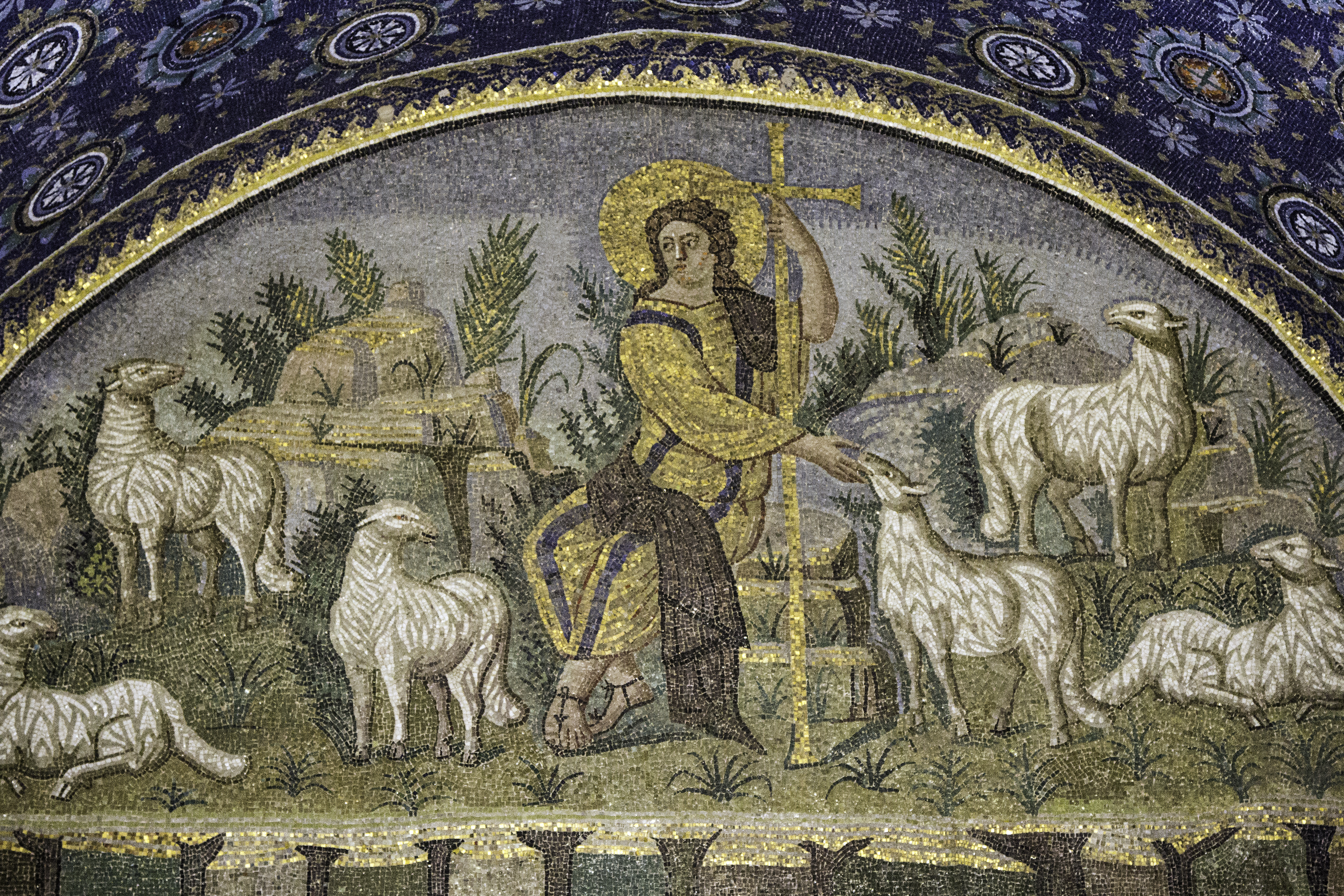
LOOK: Good Shepherd mosaic, Ravenna

Good Shepherd (Ravenna)
Christ the Good Shepherd, 5th century. Mosaic from the tomb of Galla Placidia, Ravenna, Italy. Photo: Fr. Lawrence Lew, OP.

[Related post: “Love, My Shepherd” (Artful Devotion)]

LISTEN: “He Shall Feed His Flock” | Text: Isaiah 40:11; Matthew 11:28–30 (KJV) | Music by Georg Frederic Handel, 1742 | Arranged and sung by Tara Ward on Adventus by Church of the Beloved, 2010

He shall feed his flock
Like a shepherd
And he shall gather
The lambs with his arm
With his arm

He shall feed his flock
Like a shepherd
And he shall gather
The lambs with his arm
With his arm

And carry them in his bosom
And gently lead those
That are with young
And gently lead those
That are with young

Come unto him
All ye that labor
Come unto him
Ye that are heavy laden
And he will give you rest

Come unto him
All ye that labor
Come unto him
Ye that are heavy laden
And he will give you rest

Take his yoke upon you
And learn of him
For he is meek
And lowly of heart
And ye shall find rest
Unto your souls

Take his yoke upon you
And learn of him
For he is meek
And lowly of heart
And ye shall find rest
Unto your souls

Born out of a group of friends’ reading of Life of the Beloved by Henri Nouwen, the Church of the Beloved in Edmonds, Washington, was active from 2006 to 2019. It had a vibrant music ministry, led by Tara Ward, that put out four albums, including Adventus. One of the tracks on Adventus is Ward’s slow, ambient, synth-driven arrangement of “He Shall Feed His Flock,” an air from Handel’s Messiah. Charles Jennens, the librettist (lyricist) of the oratorio, combined passages from Isaiah and Matthew to evoke a sense of the deep soul-rest and care that Christ proffers. Church of the Beloved’s rendition so beautifully captures the weariness we often feel, whether we’re on a spiritual path or not, and is a gentle reminder that Christ is always calling us back into his bosom.

New Easter Music

As the church continues in this fifty-day season of Eastertide to celebrate the resurrection of Christ, here are some songs I’ve come across for the occasion and really enjoyed. A few are brand-new, while others are new performances.

Good Shepherd New York, a church in Manhattan, has a phenomenal team of in-house musicians and collaborators from coast to coast. They provide music for weekly digital worship services as well as release recordings under the name Good Shepherd Collective. Check out their Easter service from April 4! The songs are listed below.

  • MEDLEY: “Christ the Lord Is Risen Today” by Charles Wesley / “Celebrate Jesus” by Gary Oliver (1:35)
  • “Here Comes the Sun” by the Beatles (3:50)
  • “Morning Has Broken” by Eleanor Farjeon (6:59)
  • “Easter Dawn” by David Gungor (11:31)
  • “Because He Lives” by Bill Gaither (15:27)
  • “Waymaker” by Donald Vails (20:45)

The GSC has posted “Here Comes the Sun” as a standalone video on Instagram. It features Brennan Smiley on lead vocals and acoustic guitar; Liz Vice on harmonizing vocals; Charles Jones on Hammond organ; John Arndt on piano; Jesse Chandler on flute, clarinet, and saxophone; Joseph M on electric guitar; Tyler Chester on bass guitar; and McKenzie Smith on drums. The art and stop-motion animation are by Boston-based artist Soyoung L Kim.

+++

“Hallelujah” (Chorus) from the Messiah by George Frideric Handel, 1742 | Performed by the Orquesta Barroca Catalana (Catalan Baroque Orchestra), the Barcelona Ars Nova choir, and 352 other singers, 2020 [HT: Global Christian Worship]

Last year the Fundación la Caixa in Barcelona launched project #YoCanto Aleluya, soliciting professional and amateur singers alike throughout Spain and Portugal to be part of a “virtual choir,” a phenomenon that has exploded since the pandemic has made live musical concerts a health risk. Participants were asked to submit a video of themselves singing Handel’s famous “Hallelujah” chorus. Igor Cortadellas of Igor Studio then developed a concept for digitally merging all 352 submissions by projecting them on the interior architecture of Barcelona’s Basilica of Santa Maria del Mar (or overlaying them in postproduction?), and he directed a small team to execute this vision. What a feat! The final video was released a few months ago at Christmastime.

“Hallelujah” concludes part 2 of 3 of the oratorio, which covers Christ’s passion and death, resurrection, ascension, and the first spreading of the gospel. The words of the chorus are taken from Revelation 19:6, 11:15, and 19:16. For another blog post featuring an excerpt from Handel’s Messiah, see the Artful Devotion “Worthy Is the Lamb.”

+++

“Easter Dawn” | Words by Malcolm Guite, 2012 | Music by Zebulon M. Highben, 2021: A conductor, composer, and scholar of sacred music, Dr. Zebulon M. Highben serves as director of chapel music at Duke University. This year he wrote a choral setting of Malcolm Guite’s sonnet “Easter Dawn,” about Mary Magdalene’s encountering the risen Christ on Easter morning. Sung by the Duke Chapel Choir, it premiered last Sunday as part of the chapel’s Easter service and will be part of the online spring concert “Faith & Hope & Love Abide: Meditations on Resurrection,” which goes live tomorrow (April 11) at 4 p.m. EDT (view the program).

+++

“Keep the Feast (Pascha Nostrum)” by Ryan Flanigan: For this new song, Ryan Flanigan of Liturgical Folk adapted the words of the Pascha Nostrum (“Our Passover”), a traditional Christian hymn for Eastertide that, after the Reformation, was preserved in English in the Book of Common Prayer. It is based on 1 Corinthians 5:7–8, Romans 6:9–11, and 1 Corinthians 15:20–22. Flanigan wrote a fun new melody for it, which he demos here.

+++

“Zinda Yeshua (Jesus Is Alive)” by Blesson Varghese and James Bovas: This Hindi-language Easter song is from Grace Ahmedabad, an Assemblies of God church in the Indian state of Gujarat. James Bovas sings lead, with Priscilla Mozhumannil on supporting vocals. See the YouTube description for a full list of credits. [HT: Global Christian Worship]

+++

“Judah’s Lion” | Words by Fulbert of Chartres, ca. 975–1028, and Rick Barnes, 2016 | Music by Rick Barnes, 2016 | Performed by Covenant Presbyterian Virtual Choir and Orchestra, Birmingham, Alabama, 2021

Worthy Is the Lamb (Artful Devotion)

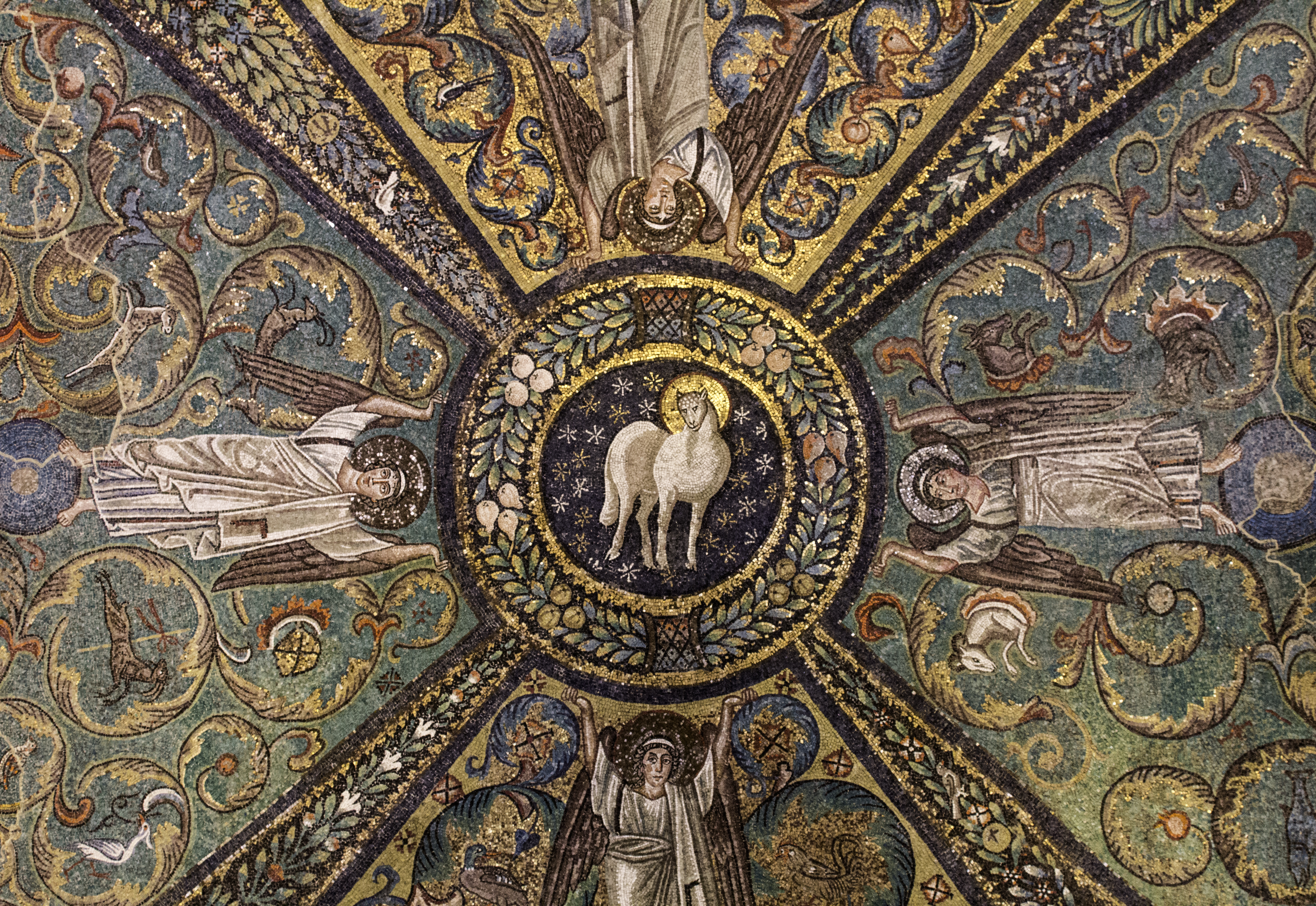
Agnus Dei mosaic
This 6th-century mosaic of the Lamb of God is on the chancel ceiling of the Basilica of San Vitale in Ravenna, Italy. The lamb is encircled by a golden orb (enclosed with stars) and a fruited laurel wreath, supported by angels. Photo: Fr. Lawrence Lew, OP.

Then I looked, and I heard around the throne and the living creatures and the elders the voice of many angels, numbering myriads of myriads and thousands of thousands, saying with a loud voice,

“Worthy is the Lamb who was slain,
to receive power and wealth and wisdom and might
and honor and glory and blessing!”

And I heard every creature in heaven and on earth and under the earth and in the sea, and all that is in them, saying,

“To him who sits on the throne and to the Lamb
be blessing and honor and glory and might forever and ever!”

And the four living creatures said, “Amen!” and the elders fell down and worshiped.

—Revelation 5:11–14

+++

SONG: “Worthy Is the Lamb / Amen” by George Frideric Handel, from Messiah (1742)

This video is a 2014 performance by the Mormon Tabernacle Choir—and you can find many more besides on YouTube. I’m partial, though, to the Oregon Bach Festival Choir and Orchestra’s performance on Easter Joy (2009), which you can stream on Spotify:

Handel was German but spent the bulk of his career in London, settling there in 1712 and becoming a naturalized British citizen in 1727. In the 1730s, he transitioned from composing Italian operas to composing English choral works, one of which is the world-famous oratorio Messiah. (Read Charles Jennens’s full libretto, a curation of scripture passages, here.)

People might assume that the so-oft-performed “Hallelujah” chorus is the finale of this majestic work, but no, that chorus concludes part two, capping off the narrative of Christ’s death, resurrection, and ascension, and the early spreading of the gospel through the known world. The “Worthy Is the Lamb” chorus, rather, serves as the Messiah’s consummation, an acclamation of Christ’s full and final victory over sin and death that follows part three’s prophecies of the day of judgment and the general resurrection. The text is taken from Revelation 5.

San Vitale mosaic ceiling
Upward view of the east end of San Vitale, Ravenna. Left lunette: The Hospitality of Abraham and The Sacrifice of Isaac. Center (apse): Christ in Majesty. Right lunette: The Offerings of Abel and Melchizedek. Photo: Fr. Lawrence Lew, OP.

San Vitale mosaic ceiling
Photo: Jim Forest

The anonymous sixth-century mosaicists of San Vitale in Ravenna, Italy, gloriously visualized this passage in the cross-ribbed vault of the church’s chancel, just above the altar. Tens of thousands of tesserae (tiny pieces of colored glass, and clear glass sandwiching gold leaf) come together to image Christ high and lifted up as the sacrificial Lamb of God. Can you imagine worshipping in this space? It must have been so transporting for those early Christians of Ravenna: to enter and move toward their promised end in Christ. To be enfolded in this luminous vision of paradise that they enacted below in the liturgy.

To learn more about San Vitale and its mosaics, see this Smarthistory video. (Unfortunately it focuses on the two political portraits at the expense of the biblical subject matter, but nonetheless, it gives a good sense of the architectural setting of the mosaics.)


This post belongs to the weekly series Artful Devotion. If you can’t view the music player in your email or RSS reader, try opening the post in your browser.

To view all the Revised Common Lectionary scripture readings for the Third Sunday of Easter, cycle C, click here.