Stained glass in West Side Chicago church reclaims an identity for Black youth

New Mount Pilgrim commemorates the Maafa, the Great Migration, and martyrs of urban violence and instills hope with trilogy of rose windows, which include an African Christ
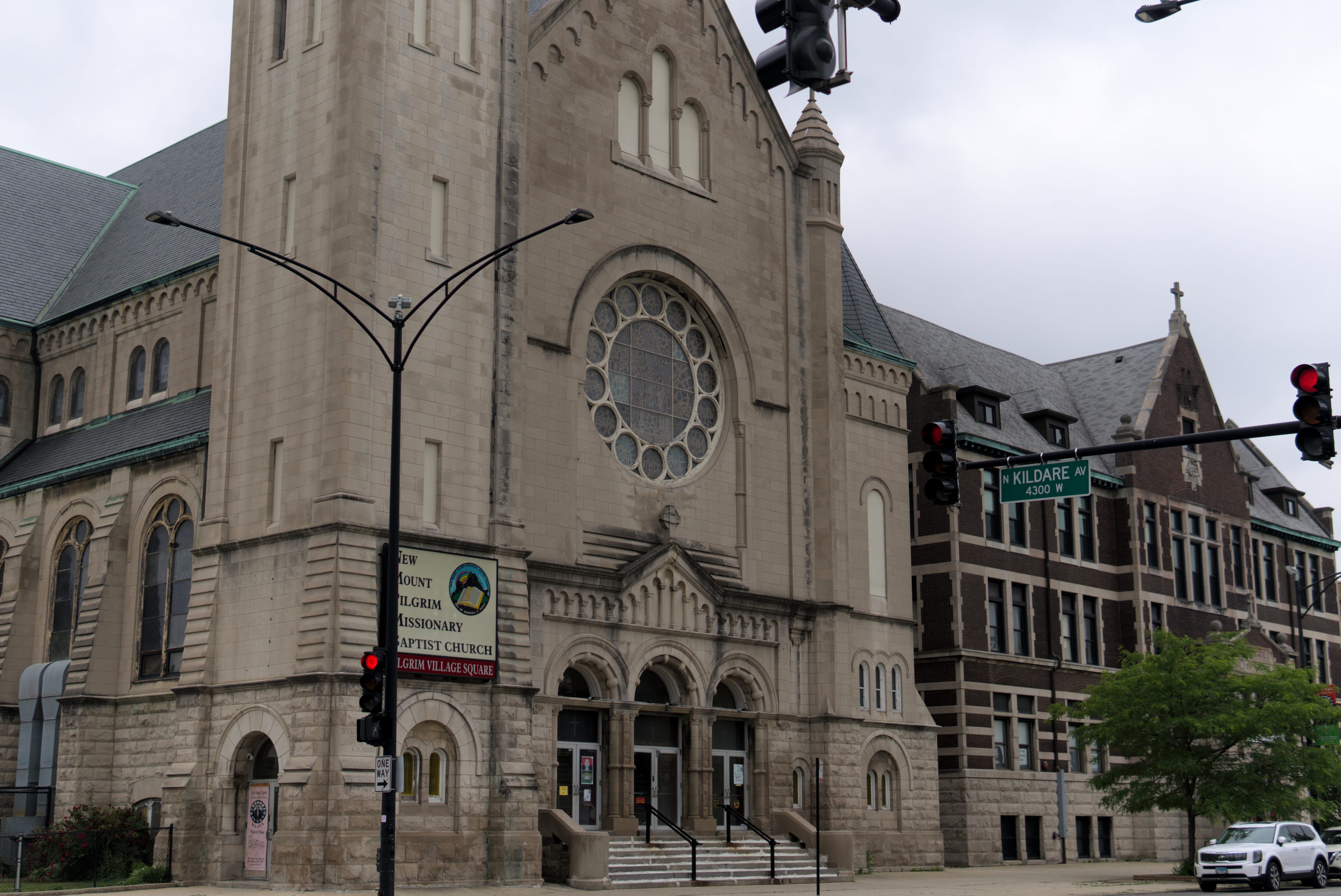
Designed by Charles L. Wallace and built in 1910–11, the French Romanesque–style church at 4301 West Washington Boulevard in Chicago’s West Garfield Park neighborhood was originally home to one of the largest Irish Catholic parishes in the city: St. Mel’s (named after Mél of Ardagh, a nephew of St. Patrick from the fifth century). They had the interior decorated with stained glass windows made by the studio of F. X. Zettler in Munich, portraying biblical figures and other saints—all as Caucasian, as was customary at the time and, frankly, still is. St. Mel’s, which merged with Holy Ghost Catholic Church in 1941 (whose parishioners were mainly of German descent), was a flourishing congregation. But in the late 1960s, white people began leaving the neighborhood as Black people moved in, and St. Mel’s membership waned until eventually the church closed its doors in 1988.

After the building had stood vacant for several years, in 1993, the Catholic Archdiocese of Chicago sold it to New Mount Pilgrim Missionary Baptist Church, a local Black congregation founded in 1950. The church leaders found that, due to lack of maintenance, the three large rose windows had structural issues that needed to be addressed. Rather than repairing the windows, they decided to replace them with new ones that better reflected the faith stories of their own parishioners—their history, heritage, and aspirations as a community. Rev. Dr. Marshall E. Hatch Sr., who had become the church’s pastor just a month after they moved into the new building and still serves in that role, developed the concepts for the windows with input from the congregation and started fundraising. All three were fabricated by Botti Studio of Architectural Arts in nearby Evanston, Illinois.

The Maafa Remembrance Window

The most striking and theologically profound of the three new windows, and the one I flew to Chicago to see last summer, is the Maafa Remembrance window on the wall to the left of the front altar. Because the church is oriented south rather than the traditional east, this is, directionally speaking, the East Rose Window; it purposefully faces the Atlantic Ocean. It was dedicated December 17, 2000, the church’s fiftieth anniversary year. It replaced an image of the Assumption of Mary (which you can view here); read more about the church building’s original windows on the website of art historian Rolf Achilles.

Maafa Remembrance Window
Maafa Remembrance, 2000, based on an illustration from The Middle Passage by Tom Feelings. Stained glass, diameter 25 feet. New Mount Pilgrim Missionary Baptist Church, West Garfield Park, Chicago. Photo: Victoria Emily Jones.

Original stained glass
Six of the twelve apostles are pictured in these stained glass windows inherited by New Mount Pilgrim from the building’s former owner, St. Mel’s Catholic Church. They appear beneath the newer Maafa Remembrance window, commissioned to counterbalance the preponderance of sacred white personages with sacred Black ones and to tell a narrative of liberation. Photo: Victoria Emily Jones.

Maafa (mah-AH-fah) is a Swahili word meaning “great disaster” or “great tragedy.” Since the late 1980s it has been used to refer to the transatlantic slave trade of the sixteenth through nineteenth centuries, during which an estimated 12.5 million African men, women, and children were kidnapped from their homes and forcibly brought to the Americas to work plantations without pay (by and large), building the wealth of their white enslavers. Some scholars prefer the term “African Holocaust” or “Black Holocaust” to describe this historic atrocity.

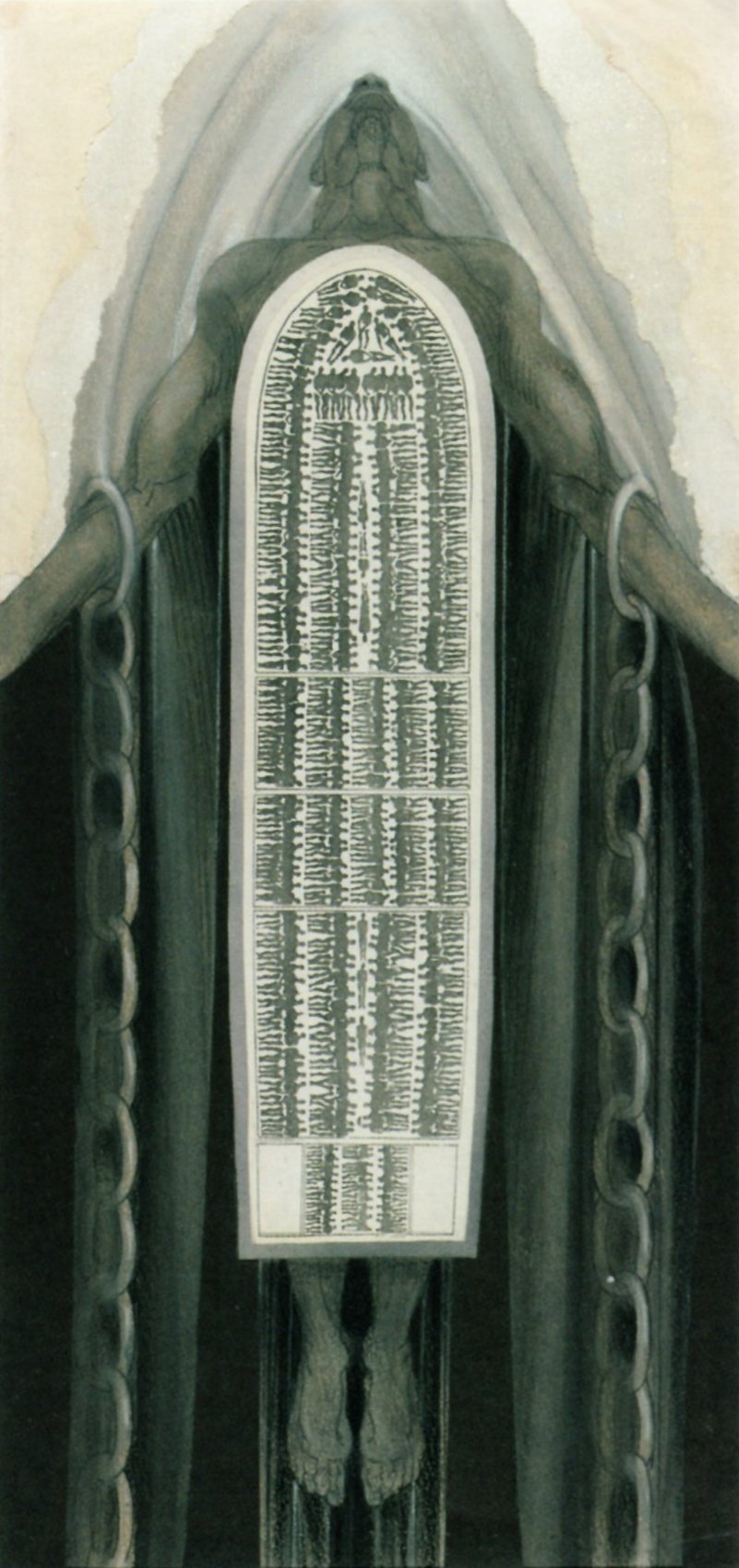
Based on an illustration by Tom Feelings from his extraordinary book The Middle Passage: White Ships / Black Cargo (Dial, 1995), the East Rose Window commemorates the Maafa through an evocation of the Middle Passage, the second leg of the triangular trade route. On this harrowing two- to three-month voyage across the Atlantic Ocean, which ships made many times over chattel slavery’s multicentury duration, at least two million enslaved Africans died of malnutrition, dehydration, disease, captor-inflicted violence, or suicide.


The closeness of the place, and the heat of the climate, added to the number in the ship, which was so crowded that each had scarcely room to turn himself, almost suffocated us. This produced copious perspirations, so that the air soon became unfit for respiration, from a variety of loathsome smells, and brought on a sickness among the slaves, of which many died, thus falling victims to the improvident avarice, as I may call it, of their purchasers. This wretched situation was again aggravated by the galling of the chains, now become insupportable; and the filth of the necessary tubs, into which the children often fell, and were almost suffocated. The shrieks of the women, and the groans of the dying, rendered the whole a scene of horror almost inconceivable.

—Olaudah Equiano, The Interesting Narrative of the Life of Olaudah Equiano, Or Gustavus Vassa, the African (London, 1789)

Slave ship icon
William Elford, “Stowage of the British slave ship ‘Brookes’ under the regulated Slave Trade Act of 1788,” 1788. Elford was the chairman of the Plymouth Committee of the Society for Effecting the Abolition of the Slave Trade in England, the body that commissioned these stowage plans in order to expose the horrors of human trafficking. He based the plans on the measurements and sailing records of an actual slave ship docked in Liverpool in early 1788.

Feelings, Tom_The Middle Passage
Tom Feelings (American, 1933–2003), illustration for The Middle Passage: White Ships / Black Cargo (Dial, 1995). Pen and ink, tempera on rice paper. Collection of the Beinecke Rare Book and Manuscript Library, Yale University. © The Estate of Tom Feelings. Used with permission.

Tom Feelings and Marshall Hatch
Newbery- and Caldecott-winning illustrator Tom Feelings shakes hands with Pastor Marshall Hatch in the offices of New Mount Pilgrim in December 2000 after the dedication of the Maafa Remembrance window, designed after an illustration from Feelings’s book The Middle Passage. Feelings said it was the first time his art had been used by a church.

In Feelings’s image, an African Christ figure stretches his chained arms out, as if on the cross. His body is constituted by the famous schematic representation of the crowded lower deck of the Brookes slave ship’s human cargo hold, first created in England in 1788 and widely disseminated throughout the nineteenth century. The perspective is such that we’re looking down on a body-as-slave-ship gliding through the waters—but it’s also a crucifixion. The Son of God carries the suffering of the sons and daughters of God, feeling it in his own body. He wears the slave ship like a giant wound that will forever mark him because it has marked his ecclesial body, the church.

The window functions, on one level, as a lament. Consider it in light of the following poem by Lucille Clifton, which draws out the cruel irony of the actual names some ostensibly Christian slave ship owners gave their vessels.

“slaveships” by Lucille Clifton

loaded like spoons
into the belly of Jesus
where we lay for weeks for months
in the sweat and stink
of our own breathing
Jesus
why do you not protect us
chained to the heart of the Angel
where the prayers we never tell
and hot and red
our bloody ankles
Jesus
Angel
can these be men
who vomit us out from ships
called Jesus    Angel    Grace Of God
onto a heathen country
Jesus
Angel
ever again
can this tongue speak
can these bones walk
Grace Of God
can this sin live

—from The Terrible Stories (1996), compiled in Blessing the Boats: Selected Poems, 1988–2000 and The Collected Poems of Lucille Clifton, 1965–2010; © The Estate of Lucille Clifton

The speaker of the poem, an enslaved African, addresses Jesus, questioning why he allows them to be so brutally treated—stolen from their homeland, marched to the coast in chains, claustrophobically packed in ship holds for maximum profitability, and spat out onto auction blocks in a barbarous country that appears to practice the devil’s ways more than God’s. How can God abide such sin? What kind of grace is it that transports them into oppression?

Christian Wiman brilliantly unpacks this poem, noting Clifton’s cunningly subtle tweak of a prophetic passage from Ezekiel that promises resurrection, both of individuals and of a nation. Underneath its acerbity, there’s a certain hopefulness to the poem—a hope that this sin will die, this suffering be transformed. In both Ezekiel’s vision of the valley of dry bones and Clifton’s poem, Wiman writes,

the Word comes streaming again through, and by means of, the word. In terms of the poem, Jesus (the man) is on board Jesus (the ship), but he is in the hold, just as, when the worship services took place above the captured slaves on the Gold Coast of Africa, God, if he was anywhere, was underneath it all, shackled and sweating and merged with human terror.

Emmanuel, God-with-us.

Clinging to this truth, the psalmist declares, “If I make my bed in hell, behold, thou [God] art there” (Psalm 139:8b). In his great compassion, God descends with us into the depths, and bears us up.

Photo: Victoria Emily Jones

The Maafa Remembrance window plays with the themes of descent and ascent. As Emmanuel, Jesus was below deck, in the miserable belly of the thousands of slave ships that traversed the Atlantic, suffering with those chained inside. Christ’s arms are draped with chains, notes Marshall Hatch Jr., the pastor’s son and cofounder and executive director of the MAAFA Redemption Project (more on that below), “but he’s rising. And at some point those chains will break. That’s the hopefulness that shines through.”

Thus, the window commemorates both tragedy and triumph. It honors those who died on the Middle Passage and through the institution of slavery more broadly while also honoring those who persevered all the way to freedom. Hatch Jr. says this Christ is “carrying within himself the memories of those who lost their lives on the journey to America. But also he’s carrying the legacy of those who survived. And we are that living legacy,” descendants of the Middle Passage.

The border around the window’s central image calls parishioners to “REMEMBRANCE.” They must remember their history, the Great Catastrophe their ancestors endured, and, having faced the truth, commit to ending slavery’s legacy of racism in America’s civic, social, and religious spheres and in their own psyches.

Two of the roundels in the bottom border show a map of Africa and a Communion table laid with kente cloth, a loaf of bread, and a flask of wine. The roundel between these two displays the open word of God, which guides Christians forward in our work of justice and reconciliation.  
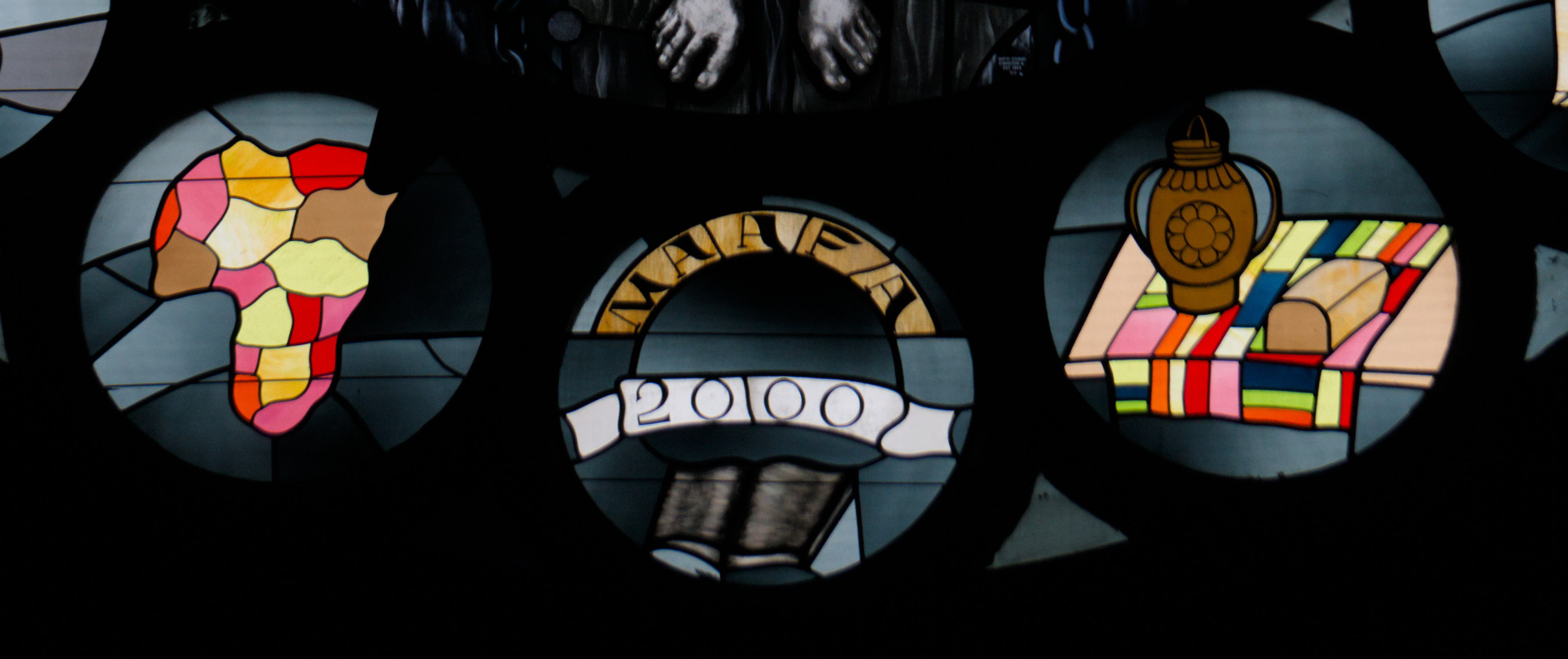
Photo by Victoria Emily Jones

Art historian Cheryl Finley features New Mount Pilgrim’s Maafa Remembrance window in her book Committed to Memory: The Art of the Slave Ship Icon (Princeton University Press, 2022), which traces the origins of the Brookes schematic and its proliferation in mass culture and art. She identifies the window, twenty-five feet in diameter, as the largest example of the “slave ship icon” in the world and writes that, like the cross of Christ, the slave ship embodies both death and rebirth. It is “a site of death, of dying Africans, and of new life, of a people who would persevere in the face of slavery and unspeakable cruelty to become a free people who helped define the modern era” (6).

“The children will need to know that this symbol, this window, is a representation of not only the pain but also the possibilities of a great and mighty God,” Rev. Dr. Gregory Thomas told the Chicago Tribune in 2000. Thomas was a theology professor at Harvard Divinity School, where Hatch Sr. served a fellowship sabbatical semester in 1999 and first encountered Feelings’s Middle Passage book.

In the window, slavery is interpreted in light of the paradox of the cross. Theologian James H. Cone famously interpreted another, later icon of Black suffering—the lynching tree—in light of the same in his essential book The Cross and the Lynching Tree (Orbis, 2011). He opens the book by explaining why and how the cross has held such power for the Black church:

The cross is a paradoxical religious symbol because it inverts the world’s value system with the news that hope comes by way of defeat, that suffering and death do not have the last word, that the last shall be first and the first last.

That God could “make a way out of no way” in Jesus’ cross was truly absurd to the intellect, yet profoundly real in the soul of black folk. Enslaved blacks who first heard the gospel message seized on the power of the cross. Christ crucified manifested God’s loving and liberating presence in the contradictions of black life—that transcendent presence in the lives of black Christians that empowered them to believe that ultimately, in God’s eschatological future, they would not be defeated by the “troubles of this world,” no matter how great and painful their suffering. Believing this paradox, this absurd claim of faith, was only possible through God’s “amazing grace” and the gift of faith, grounded in humility and repentance. There was no place for the proud and the mighty, for people who think that God called them to rule over others. The cross was God’s critique of power—white power—with powerless love, snatching victory out of defeat. (2)

A powerful reclamation of Christian iconography, New Mount Pilgrim’s Maafa Remembrance window weds Black history and Christian theology to offer its predominantly African American congregation a communal symbol that honors what they’ve been through as a people and reminds them that they worship a risen Christ who breaks chains and brings life out of death.

The North Star / Great Migration Window

The East Rose Window covered in the previous section is narratively the first in the trilogy of newly commissioned windows, but the first of the three to be fabricated and installed, earlier in 2000, was the North Rose Window, called the North Star or Great Migration window. It commemorates those who traveled north on the Underground Railroad to escape slavery, and, a few generations later (from about 1910 to 1970), as part of a mass movement to escape Jim Crow oppression.

North Star Window
North Star / Great Migration, 2000. Stained glass, diameter 25 feet. New Mount Pilgrim Missionary Baptist Church, West Garfield Park, Chicago. Photo: Victoria Emily Jones.

The North Star window shows a Black family unit, the father, in purple robe, lifting his newborn up to the heavens in a gesture of gratitude and pride. The child is backlit by the North Star, a beacon to freedom. The scene recalls the famous naming ceremony in the 1977 Roots miniseries, based on the best-selling novel by Alex Haley, in which Omoro Kinte, a Mandinka man living in The Gambia, carries his firstborn son, Kunta Kinte, to the edge of the village, raises him into the starry night sky, and exclaims, “Behold, the only thing greater than yourself!” This declaration affirms the child’s inherent worth and directs him toward worship of his Creator God.

Later in the story, when Kunta has his first child, Kizzy, thousands of miles away in America, he enacts the same ritual with her.

During New Mount Pilgrim’s baby dedication ceremonies, the pastor raises the child in like manner while the parents vow to bring up the child in the nurture and admonition of the Lord and the congregation vows to support them in this task. This physical gesture of lifting up signifies surrender to God and hope that the next generation will carry the flame of faith out into the city of Chicago and the wider world. Because the North Star window is situated across from the pulpit, over the choir loft and organ, it is in full view of the dedicants.

Baby dedication
Baby dedication ceremony, New Mount Pilgrim Missionary Baptist Church. Photo courtesy of Partnering for Community Impact.

New Mount Pilgrim MB Church
View from the pulpit of New Mount Pilgrim, facing the North Star window and the main entrance to the church. Photo courtesy of the church.

The inscription below the family in the window reads, “Lift holy hands,” a phrase taken from 1 Timothy 2:8, and the roundels in the border spell out the name of the church. The three portraits at the bottom are of the church’s longest-serving pastors: (from right to left) Rev. J. H. Johnson, the church’s first elected pastor; Rev. James R. McCoy, who served from 1965 to 1993; and Rev. Dr. Marshall Hatch Sr., who has served since 1993. Hatch Sr.’s father and McCoy both participated in the Great Migration, having moved to Chicago from Aberdeen, Mississippi, and so did the majority of the church’s founding members.

The North Star window fills the space previously occupied by a window depicting Saint Cecilia, a Roman virgin martyr.

The Sankofa Peace Window

The West Rose Window, known as the Sankofa Peace window, was the final one to be installed, replacing the clear panes that were there for over two decades. (New Mount Pilgrim sold the original window depicting Mary and the Christ child blessing and accepting the rosary from a male and female saint, to raise funds for the new one.) The Sankofa Peace window was dedicated on February 24, 2019 (watch the service here and view photos here), the year that marked the four hundredth anniversary of race-based slavery in America.
Sankofa Peace Window
Sankofa Peace, 2019. Stained glass, diameter 25 feet. New Mount Pilgrim Missionary Baptist Church, West Garfield Park, Chicago. Photo: Victoria Emily Jones.

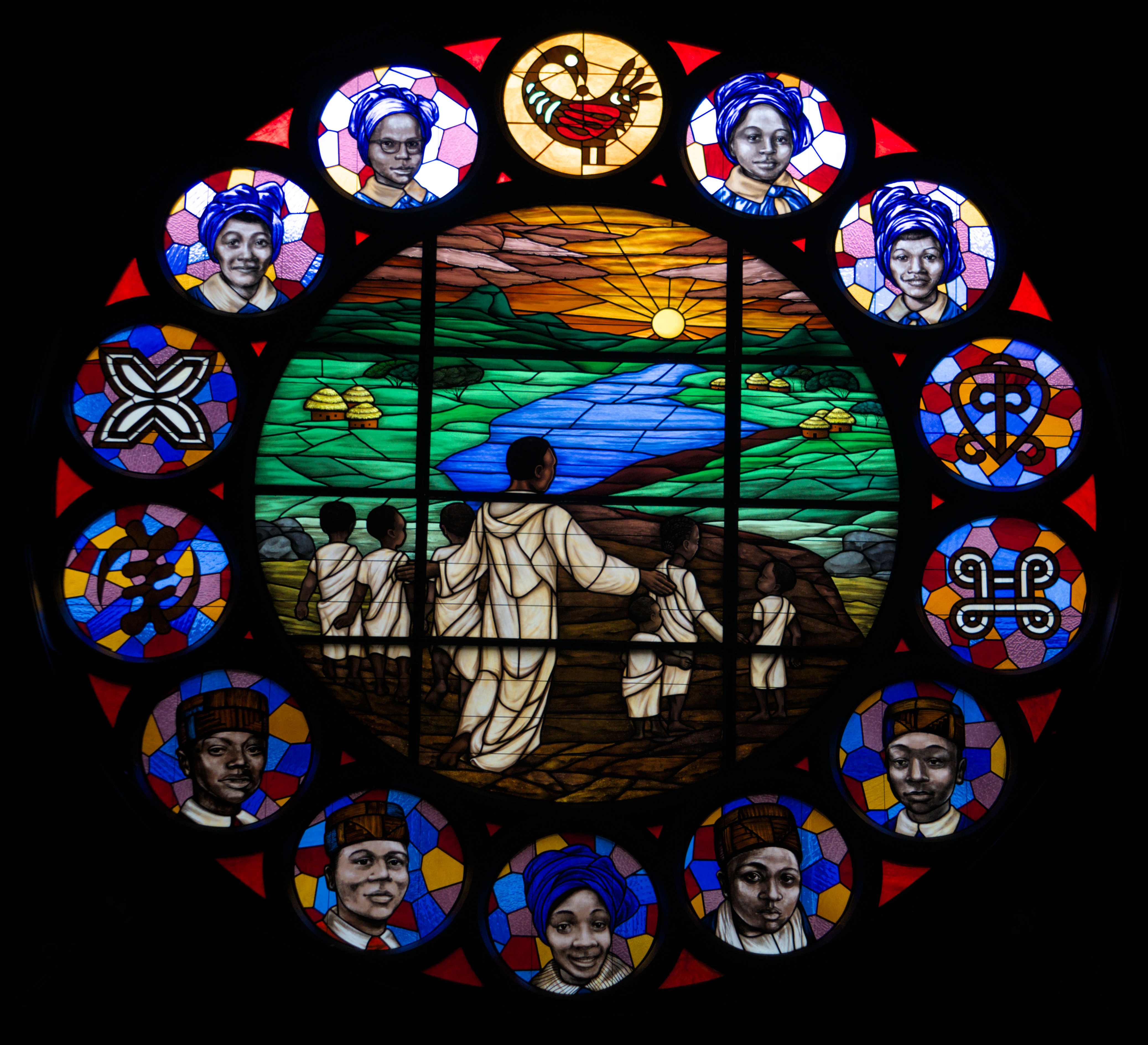
Sankofa is a Twi word from the Akan people of Ghana that means “go back and retrieve it,” a phrase that encourages learning from the past to inform the future. It comes from the proverb “Se wo were fi na wosan kofa a yenkyiri”—“It is not wrong to go back for that which you have forgotten,” to return to one’s roots to reclaim lost identity. The concept of Sankofa is traditionally symbolized by a mythical bird with its head turned backward while its feet face forward, carrying a precious egg in its mouth, which represents the knowledge of the past on which wisdom is based.

Sankofa bird

The Sankofa bird appears in the top center roundel of the window.

Hatch Jr., who preached at the window’s dedication service, discussed Sankofa as a spiritual discipline, highlighting how it can refer not only to returning to one’s cultural roots, but also to God, our Source. “Sankofa is the process of training my soul to reach back and remember the grace and the glory of God,” he says, which can fuel us for the forward journey. He quotes the famous gospel hymn that says, “My soul looks back in wonder how I got over.” We must regale one another with stories of where we’ve been and how far God has brought us, and remind ourselves and each other where we’re heading.

Besides the Sankofa bird, the other four adinkra symbols that New Mount Pilgrim chose to include in the window’s border are:

These are key guiding principles of the church, part of their missional purpose and identity. They seek liberation and peace for all, through the power of God, following the path of the Savior who is Love, who brings us back to who we most truly are.

One way the Sankofa Peace window looks backward while moving forward is through the memorialization of murdered Black American youth, from the civil-rights-era South and twenty-first-century Chicago. The portraits at the top depict the four girls who were killed by the Sixteenth Street Baptist Church bombing in Birmingham, Alabama, in 1963: Carole Robertson (age fourteen), Addie Mae Collins (fourteen), Denise McNair (fourteen), and Cynthia Wesley (eleven).

The five teens at the bottom, selected by members of New Mount Pilgrim’s youth leadership committee, were victims of Chicago violence from the previous decade or so. From left to right, they are:

  • Derrion Albert (1994–2009), age sixteen. On his way home from school, he got caught in the middle of a brawl between two rival factions of students and was beaten to death with a railroad tie. The crime was captured on cellphone video.
  • Laquan McDonald (1997–2014), age seventeen. He was shot sixteen times by a police officer while he was walking away.
  • Hadiya Pendleton (1997–2013), age fifteen. She was killed by a stray bullet while hanging out in a park with friends after her final honors exams.
  • Blair “Bizzy” Holt (1990–2007), age sixteen. He was fatally shot on a CTA bus while shielding his friend from gang gunfire.
  • Demetrius “Nunnie” Griffin Jr. (2000–2016), age fifteen. A lifelong member of New Mount Pilgrim, he was burned to death in a trash can in a West Side alley. His death was ruled a homicide, but his killer(s) have not been found. He had told his mother that a gang had been trying to recruit him.

All nine children are dressed in traditional African headwear. 

Even as the window laments these unjust deaths, it also provides a vision of restoration. The central scene shows Jesus as the Good Shepherd, leading his children to green pastures and still waters lined with thatched-roof homes—an Edenic place of peace and rest. One might view this as the afterlife (Hatch Sr. told me the children are “going back to the Father’s estate”); but it could also be seen as a picture of Christ leading us into a future on this side of the parousia, where all God’s children are safe and thrive on earth as it is in heaven.

Hatch Sr. told me the window is about recovering a village mentality right in the heart of the city, embracing values like hospitality, family, mutual support, elder respect, and the protection and uplift of children. Whereas the North Star window visualizes the literal lifting up of a child, the Sankofa Peace window calls parishioners to do it metaphorically, through the building of strong community and advocacy for policies that prevent violence and tragedy.

The MAAFA Redemption Project

As a tangible outworking of the communal values expressed in its three rose windows, in 2017 New Mount Pilgrim established a workforce, social, and spiritual development program for young Black men in West Garfield Park, which is still running strong. (It graduated its seventh cohort last month!) Called the MAAFA Redemption Project, it is predicated on the belief that redemption and transformation must begin with the individual, and then that personal transformation can effect family and community transformation. The program emphasizes the importance of, as its website says, “remembering the past in order to create a more just and verdant present and future.”
MAAFA Redemption Project
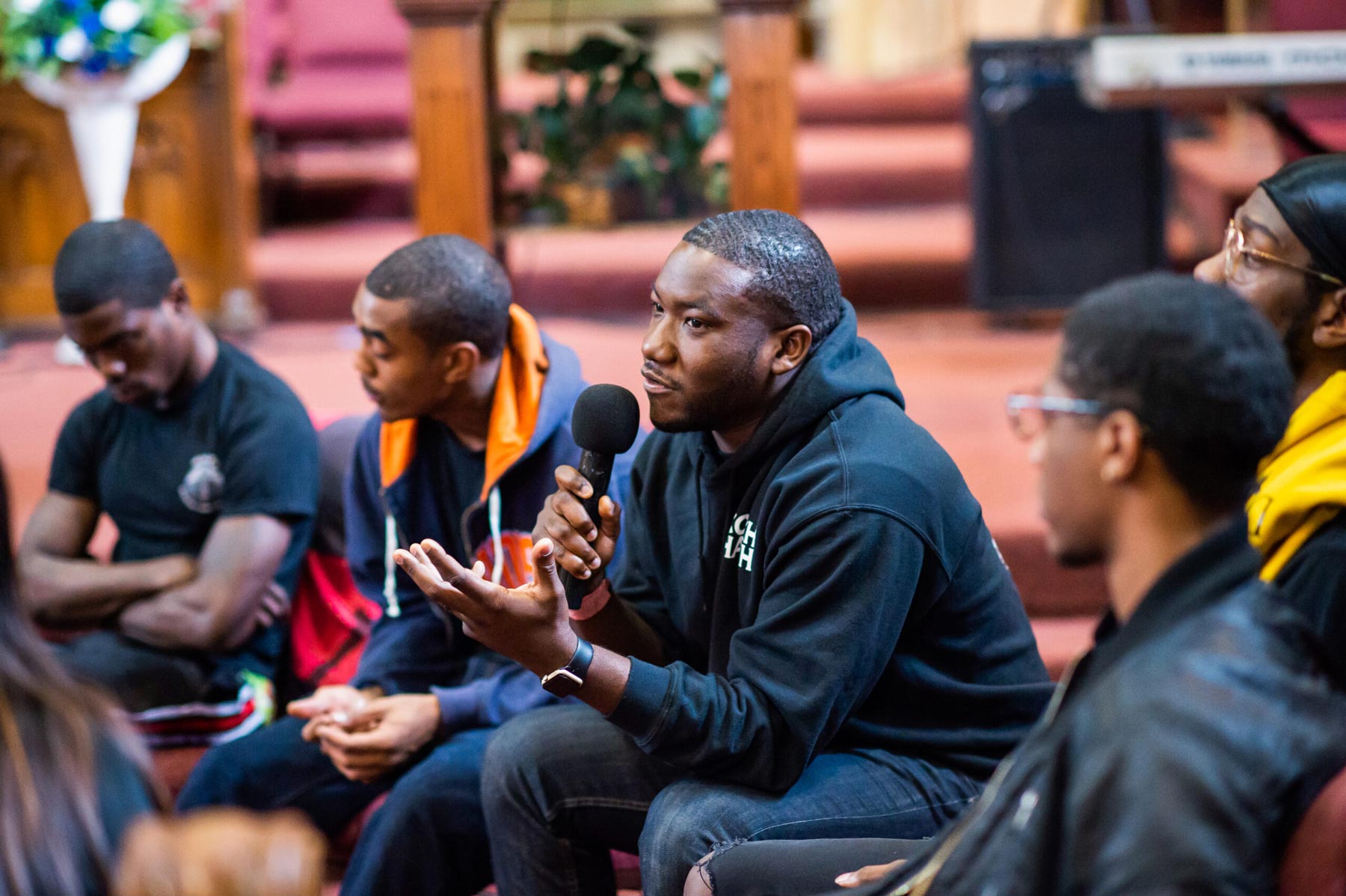
Marshall Hatch Jr., director of the MAAFA Redemption Project (a ministry of New Mount Pilgrim MB Church), speaks with a group of participants about their experiences as young Black men living in West Garfield Park.

Using a dual direct-service and community-building approach, the program provides housing, job training, educational opportunities, psychotherapy, counseling, and wrapround social services to the young men who enroll. These supports are supplemented with programming that focuses on the arts, cultural identity development, spiritual enrichment, transformative travel, civic empowerment, and life coaching and mentoring.

The square-mile neighborhood of West Garfield Park has the highest rate of gun violence in Chicago and is one of the most crime-dense populations in the nation. The MAAFA Redemption Project seeks to recruit men between the ages of eighteen and thirty who are a part of this gun culture or at risk of becoming so, recognizing that young people are a neighborhood’s greatest resource for change. The project affirms the dignity and promise of the neighborhood’s Black and Brown youth and aims to instill hope in them, empowering them in activism against gun violence and the conditions that create it.

“The young people who come to us are tired of the subculture that only produces death, despair, and falling into the trap of the criminal justice system,” says Marshall Hatch Jr., the cofounder and executive director of the MAAFA Redemption Project. “They want something different for themselves and their loved ones.”

He continues, “We want to create the space for young men to see themselves differently, to reimagine themselves as men and leaders, pillars of this neighborhood. And so our goal is to embrace the truths that they give us of their experience but also challenge them to overcome, just as their ancestors overcame; to develop the inner resources to persevere and to challenge the system so that their sons, their daughters, don’t have to fight the same fights.”

The video storytelling unit NBC Left Field ran a wonderful segment in November 2018 that features the work of MAAFA Redemption Project:

I also recommend the feature-length documentary All These Sons (2021), directed by the Oscar-nominated Bing Liu and Joshua Altman (Minding the Gap) and streaming for free on Tubi, Amazon, and other services. MAAFA Redemption Project is one of the two Chicago antiviolence programs profiled, the other being the South Side’s Inner-City Muslim Action Network (IMAN) run by Billy Moore.

Most recently, MAAFA Redemption Project has partnered with other groups to build and share ownership of the Sankofa Wellness Village, a series of interconnected capital projects and social enterprises sited along the Madison and Pulaski corridor in West Garfield Park. Winner of the Chicago Prize awarded by the Pritzker Traubert Foundation, the village will be a sprawling, $50 million campus that will bring critical health, financial, and recreational resources back into the disinvested neighborhood, including a wellness center, a credit union, an art center, a business incubator and entrepreneurial support center, and pop-up fresh food markets.

The Sankofa Wellness Village breaks ground later this summer and is expected to open in late 2025.

Having identified the arts as an unmet need and desire of West Garfield Park residents, MAAFA Redemption Project has taken the reins on what will be called the MAAFA Center for Arts and Activism. They are working to restore the old St. Barnabas Episcopal Church to provide a space where residents can engage in intergenerational art making, relationship building, community organizing, political education, and civic empowerment.

Maafa Center for Arts and Activism
Rendering of the future MAAFA Center for Arts and Activism in West Garfield Park, Chicago. Credit: Moody Nolan/Bureau Gemmel

“We’re part of a continuum of that liberation narrative of God,” Hatch Sr. says, referring to his church’s commitment to see their neighborhood flourish.

For another, well-reported article on the New Mount Pilgrim windows that includes many great photographs of them within the larger sanctuary and worship service context, see the Faith & Leadership article “Proclaiming the liberation narrative of God through church art” by Celeste Kennel-Shank.

Conclusion

When in the nineties they inherited a grand church full of Eurocentric stained glass and other decoration from the Irish Catholic community that worshipped there previously, New Mount Pilgrim Missionary Baptist Church had some decisions to make. How would they honor the history of that sacred space while also making room for their own histories? What adjustments would have to be made to accommodate their different ecclesial and theological tradition? They made a few changes to the sanctuary, but they left most of it intact. The most significant change is the three new rose windows they commissioned to replace the old ones that were buckling. Once the first two were installed, Pastor Marshall Hatch Sr. told me, the space really started to feel like home.

Hatch Sr. spoke to me about “the power of art to reclaim an identity” for youth involved in or susceptible to gang violence. For sure, many local youth have been inspired by the Maafa Remembrance image in particular, which MAAFA Redemption Project uses as its logo, and thus it’s been widely visible throughout the neighborhood. And yet while the “under thirty” demographic is a particular focus of the church’s outreach efforts, the identity-forming power of art holds true for folks of any age. When a West Garfield Park resident enters the New Mount Pilgrim sanctuary for whatever reason—prayer, worship, respite, connection, religious education, compulsion from a family member—they can hopefully see themselves reflected in the imagery of the rose windows, and, in conjunction with the church’s music and preaching ministries, experience healing and revival.

Their culture, their history, their stories are sacralized in stained glass and integrated into the larger story of redemption God is telling.

Perhaps, from viewing the windows, they feel a deep identification with Christ in his crucifixion, or a sense of God’s presence with them in their suffering; perhaps they are dazzled by the dignity and endurance of their ancestors, or are compelled by the freedom Christ offers; perhaps that was one of their friends whose face shines down from the wall, or the niece or nephew of a friend, and they are turned toward somber remembrance of the lost life and moved to concrete action to reduce the city’s violence; perhaps they’re emboldened by the reminder that Christ goes with them as they seek transformation, as they bring to bear the gospel in this present age, in their own lives and the life of their community.

Visit the Church

Address:
New Mount Pilgrim Missionary Baptist Church
4301 W. Washington Blvd.
Chicago, IL 60624
(To see the windows in the sanctuary, I made a weekday appointment ahead of time with office manager Rochelle Sykes by calling the church at 773-287-5051. She let me in through the side door.)

Closest CTA train stop:
Pulaski (Green Line) (twelve-minute walk)

Worship service:
Sundays, 10:00 a.m.

Further Reading

The Middle Passage: White Ships / Black Cargo by Tom Feelings (Dial, 1995). This is an important work that every American should own a copy of. It consists of fifty-four powerful grayscale drawings that tell the story of the transatlantic slave trade’s Middle Passage. There’s no written narrative, but there is a brief introduction by the historian John Henrik Clarke. The book caught the attention of Marshall Hatch Sr. while he was a scholar-in-residence at Harvard Divinity School in 1999 and led him to reach out to Feelings for permission to have a stained glass window made based on one of the illustrations.

Committed to Memory: The Art of the Slave Ship Icon by Cheryl Finley (Princeton University Press, 2022). Thank you to Marshall Hatch Sr. for recommending this book to me. Finley, an art historian, explores how an eighteenth-century engraving of a slave ship became a cultural icon of Black resistance, identity, and remembrance, its radical potential rediscovered in the twentieth century by Black artists, activists, writers, filmmakers, and curators who have used it as a medium to reassert their common identity and memorialize their ancestors. It’s heavily illustrated and an insightful read, academic in tone but very accessible.
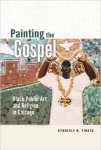
Painting the Gospel: Black Public Art and Religion in Chicago by Kymberly N. Pinder (University of Illinois Press, 2016). This is where I first found out about the Maafa Remembrance window at New Mount Pilgrim. It’s one of sixty-some Black-affirming religious images from Chicago churches and their neighborhoods made between 1904 and 2015 that Pinder, an art historian, features, focusing on their intersection with the social, political, and theological climates of the times. Read my review here.

“Voices from Chicago’s Most Violent Neighborhood” by Andy Grimm, Chicago Sun-Times, 2023. The Sun-Times spent months last year talking to residents of West Garfield Park about why they’ve chosen to stay despite the rampant violence, and they’ve presented some of these stories in a well-designed, interactive web feature. One of the remarks that stands out to me is: “The most dangerous residents of the neighborhood are also the most endangered.”
Playlist: The Lord Is My Shepherd (Psalm 23, etc.)

Tomorrow’s readings in the Revised Common Lectionary, for the fourth Sunday of Easter, include what’s probably the most famous passage in the Bible, Psalm 23:

The LORD is my shepherd; I shall not want.

He maketh me to lie down in green pastures: he leadeth me beside the still waters.

He restoreth my soul: he leadeth me in the paths of righteousness for his name’s sake.

Yea, though I walk through the valley of the shadow of death, I will fear no evil: for thou art with me; thy rod and thy staff, they comfort me.

Thou preparest a table before me in the presence of mine enemies: thou anointest my head with oil; my cup runneth over.

Surely goodness and mercy shall follow me all the days of my life: and I will dwell in the house of the Lord for ever.

In characterizing God as a shepherd, the psalmist expresses how God leads, protects, rescues, feeds, and cares for his own. The author of Psalm 95 uses the same metaphor when he writes, “For he is our God, and we are the people of his pasture, and the sheep of his hand” (v. 7)—as do Isaiah and Ezekiel. During his teaching ministry, Jesus described himself as “the good shepherd [who] lays down his life for the sheep,” and whose flock knows his voice and follows him (John 10:1–18).

There are hundreds of metrical paraphrases and musical settings of Psalm 23. I’ve compiled some three dozen of the best into a Spotify playlist, along with a handful of other songs that reference or adapt other biblical passages that speak of God as a shepherd. There are settings by Philippe Rogier, Franz Schubert, Antonin Dvořak, Noel Paul Stookey (of Peter, Paul and Mary), John Michael Talbot, Val Parker, David Gungor, Luke Morton, and others. Besides English, languages include Hebrew, Latin, Spanish, French, German, Czech, Arabic, Mandarin, Urdu, Swahili, and Sotho.

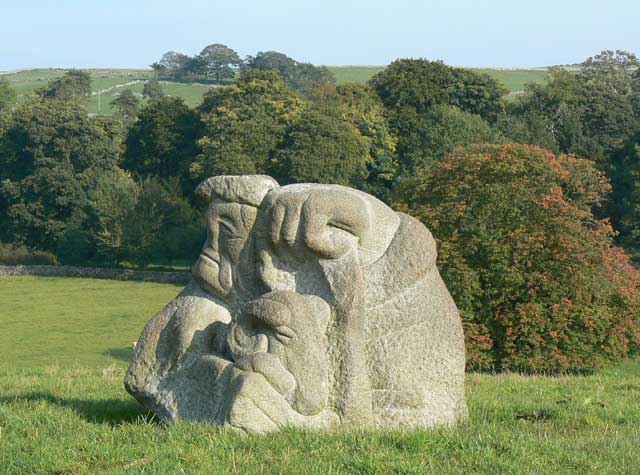
Rae, Ronald_Shepherd
Ronald Rae (Scottish, 1946–), Shepherd, 1988. Granite, 4 × 5 × 4 ft. Private collection, Peak District, Scotland.

The Psalm 23 settings that are most widely reproduced in modern English-language hymnals are:

  • “The Lord’s My Shepherd,” written by Francis Rous but extensively revised by committee and published by the General Assembly of the Church of Scotland in the Scottish Psalter (1650). This text is most commonly matched with the 1872 tune CRIMOND by Ms. Jessie Seymour Irvine of Scotland, but I really like it with the early American folk tune PISGAH, as recorded, for example, by the William Appling Singers. However, both melodies, I feel, are difficult to sing congregationally.
  • “My Shepherd Will Supply My Need” by Isaac Watts, from The Psalms of David Imitated in the Language of the New Testament (1719). This text is traditionally paired with the tune RESIGNATION, first published in the fifth edition of the shape-note hymnal The Beauties of Harmony (Pittsburgh, 1828), compiled by Freeman Lewis, but first appearing with the Watts text in The Valley Harmonist in 1836. My playlist features a performance by the female a cappella quartet Anonymous 4 (the music arranged by Johanna Maria Rose; see video embed below), as well as by folk singer Claire Holley, who recorded the hymn at the request of a friend who told her it was the song that helped her get sober for good. I also like the minor-key setting by Stephen Gordon.
  • “The Lord Is My Shepherd (No Want Shall I Know)” by James Montgomery (1822), with music by Thomas Koschat (1862). Here’s the Lower Lights:
  • “The King of Love My Shepherd Is” [previously] by Henry Williams Baker (1868). This hymn is most often sung to a traditional Irish tune known as ST. COLUMBA (my playlist features both a choral performance by the Choir of Kings School, Canterbury, and a folksy solo by Luke Spehar) and occasionally to MCKEE, also from Ireland, as recorded by Redeemer Knoxville.

At my church we use Wendell Kimbrough’s musical adaptation of the psalm, “His Love Is My Resting Place.” Do you sing Psalm 23 at your church, and if so, what version?

Probably my favorite choral setting is by Bobby McFerrin, “The 23rd Psalm,” performed below by his VOCAbuLarieS, featuring SLIXS & Friends, live in Gdansk, Poland, at the Solidarity of Arts Festival on August 17, 2013:

Some people are thrown off by McFerrin’s use of feminine pronouns for the Divine in this song. God has no literal sex because God does not possess a body, so our gendered binaries are inadequate—but scripture and church tradition refer to God using masculine pronouns. I’m not bothered by the “She” throughout, or even “Mother,” but the substitution of “Daughter” for “Son” in the Trinitarian doxology at the end is theologically confusing, since Jesus was a man. But I get what McFerrin is doing.

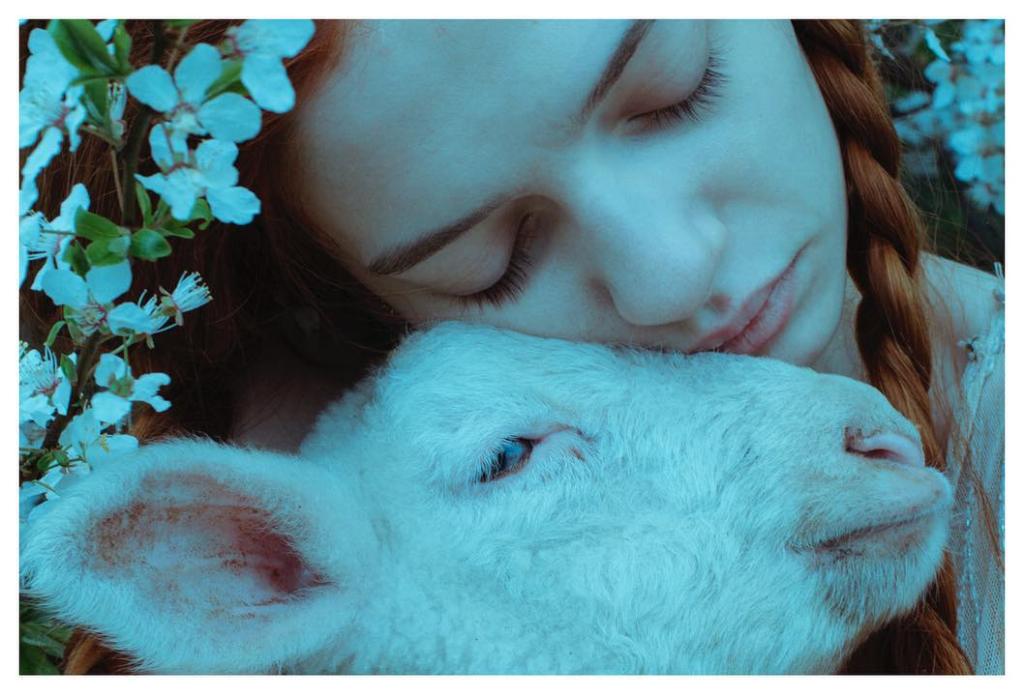
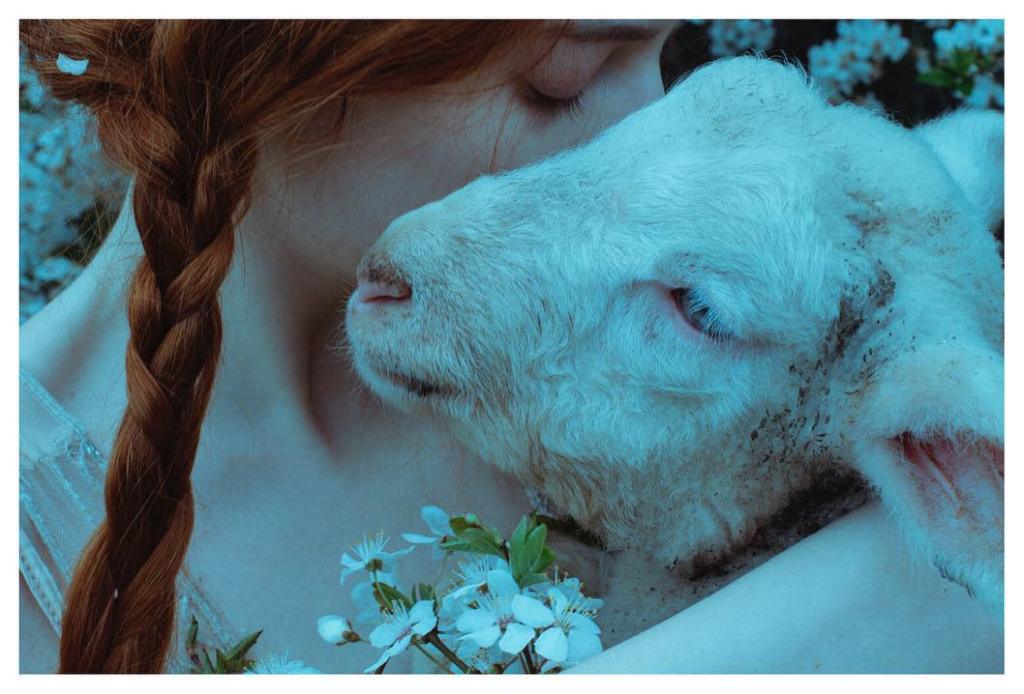
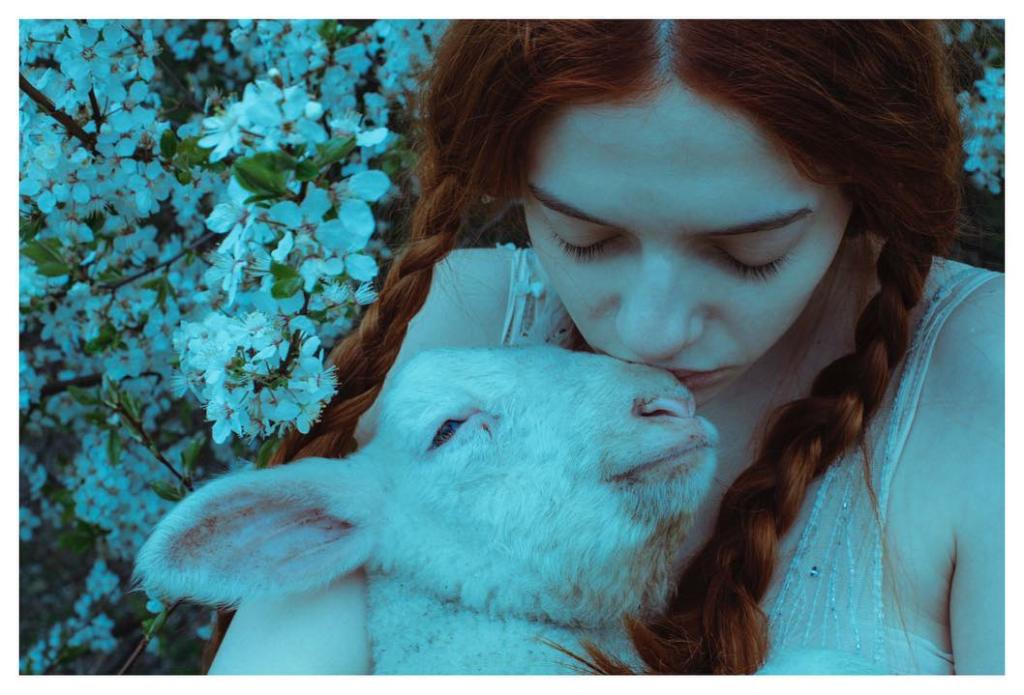
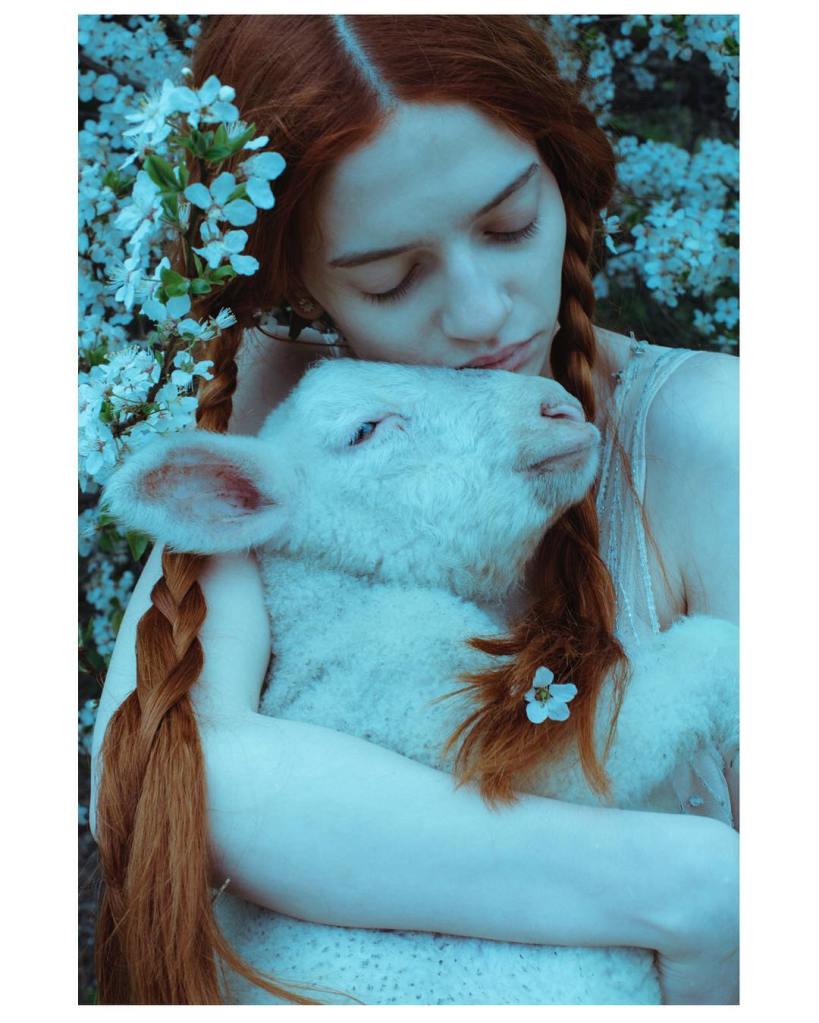
How does the change in gender impact your reception of the psalm text? We’re used to seeing religious imagery of a man with a sheep slung over his shoulders to embody the metaphor of God as shepherd—but what happens when you picture a shepherdess in the role? Note that it was not unusual in the ancient Near East for girls and women to tend their family herds (think of Rachel and Zipporah in the Old Testament, for example), and still today across the globe there are many female shepherds.

McFerrin dedicated his “23rd Psalm” to his mother.

(The above artworks, sourced from Instagram, are from the 2019 series The Shepherd by Laura Makabresku, a fine-art photographer from Poland whose work is influenced by her Catholic faith and by fairy tales.)

Here is a selection of other songs from the playlist:

>> “Adonai Ro’i” is a setting of the original Hebrew of Psalm 23 by Jamie Hilsden of Misqedem, a band from Tel Aviv, Israel, that is heavily influenced by Middle Eastern and North African music styles, often utilizing microtonal scales, irregular time signatures, and regional instruments. The song is sung by Shai Sol. (Available on Bandcamp.)

>> “The Lord Is My Shepherd” by Paul Zach of the United States:

>> “El Señor es mi Pastor” by Omar Salas of the Dominican Republic, a salsa song:

>> “Ke Na Le Modisa” by the Soweto Gospel Choir, sung live at the Nelson Mandela Theatre in Johannesburg in 2008. The song is in Sotho, an official language in South Africa and Lesotho.

>> “The Shadow Can’t Have Me” by Arthur Alligood:

>> “Done Found My Lost Sheep,” an African American spiritual sung by Lucy Simpson [previously] for Smithsonian Folkways, based on Jesus’s parable of the lost sheep (Luke 15:1–7):

Lost sheep found (British Library)
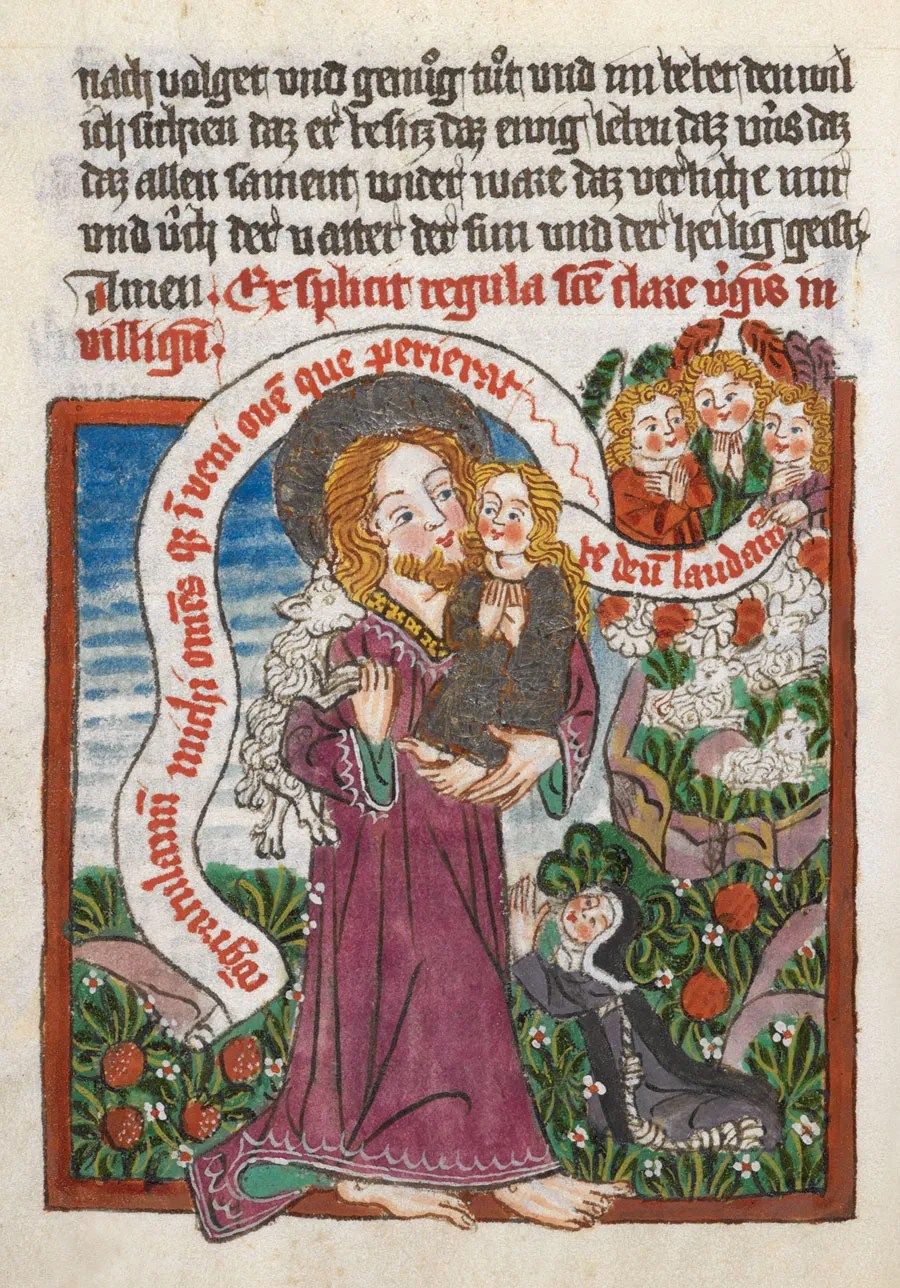
Illustration by the nun Sibylla von Bondorf (German, ca. 1440–1525), from a copy of the Clarrissan Rule, Freiburg, ca. 1480. Opaque pigments on parchment, 15 × 10 cm. London, British Library, Add. MS 15686, fol. 30v. The banderole reads, “Rejoice with me, for I have found my sheep that was lost” (Luke 15:6). [HT]

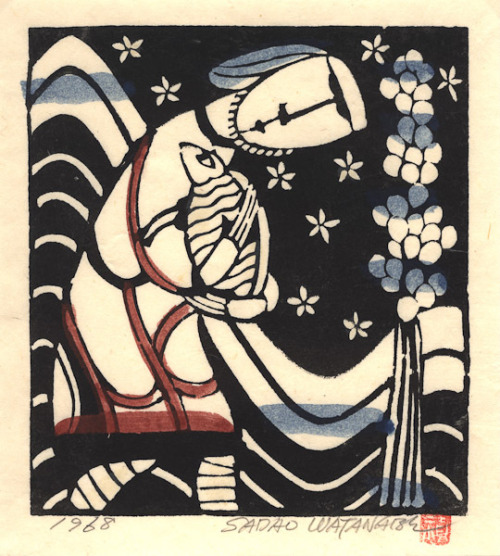
Watanabe, Sadao_Good Shepherd
Sadao Watanabe (Japanese, 1913–1996), Good Shepherd, 1968. Katazome stencil print.

>> “Our Psalm 23” by Gabriella Velez, Kevin Dailey, Justin Gray, and JonCarlos Velez of Common Hymnal, featuring Sharon Irving:

Roundup: Biber’s Mystery Sonatas, icons by Maxim Sheshukov, “Mercy at the Movies,” and more

SPOTIFY PLAYLIST: March 2024 (Art & Theology): My new monthly playlist of thirty songs is up a day early and, as usual, includes both recent releases and older favorites. Let me also point you to the longer, thematically distinct playlists I made for Lent, Holy Week, and Eastertide.

+++

CONCERT: Phantasia performs Biber’s Mystery Sonatas, St Hubert’s Church, Corfe Mullen, England, February 17, March 23, and April 13, 2024: The Mysteries of the Rosary are a set of fifteen meditations on episodes in the lives of Jesus and his mother, Mary. They are divided into three groups: the Joyful Mysteries (the Annunciation, the Visitation, the Nativity, the Presentation of the Infant Jesus in the Temple, the Twelve-Year-Old Jesus), the Sorrowful Mysteries (Christ on the Mount of Olives, the Scourging at the Pillar, the Crown of Thorns, Jesus Carries the Cross, and the Crucifixion), and the Glorious Mysteries (the Resurrection, the Ascension, Pentecost, the Assumption of the Virgin, and the Beatification of the Virgin).

Around 1676, the Bohemian Austrian composer Heinrich Ignaz Franz von Biber (1644–1704) wrote fifteen short sonatas for violin and continuo based on these mysteries. In a free three-part event sponsored by Deus Ex Musica, the newly formed period-instrument ensemble Phantasia will be performing Biber’s Mystery Sonatas at St Hubert’s Church, Corfe Mullen, on the south coast of England, accompanied by commentary by musician and educator Dr. Delvyn Case, who will provide thoughts about the ways each sonata reflects its “mystery,” linking specific elements of the musical structure to themes or ideas in the biblical scene. The performance of the first cycle of the work has already passed, but the remaining two are still upcoming: the Sorrowful Mysteries on March 23 (the Saturday just before the start of Holy Week), and the Glorious Mysteries on April 13.

Case tells me that Deus Ex Musica hopes to eventually provide video excerpts from the performances on their YouTube channel. In the meantime, here’s a little teaser, a snippet from the “Presentation in the Temple” movement, performed by Phantasia musicians Emma-Marie Kabanova on Baroque violin and Chris Hirst on German theorbo (long-necked lute).

+++

ARTICLES:

>> “Mercy at the Movies: Ten Films That Flip the Script” by Meaghan Ritchey, Mockingbird: “Spanning almost a century of cinema, this list of films maps a world—real and imagined—devoid of the mercy for which we all have need, as well as a world animated by unexpected and unearned mercies, flipping the script and leaving the plot forever changed.” What a great list! Number 7 is one of my all-time favorite films.

>> “As If Through a Child’s Inner Eye: The Contemporary Icons of Maxim Sheshukov” by Fr. Silouan Justiniano, Orthodox Arts Journal: In this article from 2016, Fr. Silouan Justiniano, a monk at the Monastery of Saint Dionysios the Areopagite on Long Island, explores the work of contemporary iconographer Maxim Sheshukov (Максим Шешуков) of Pskov, Russia, finding it “exemplary of the diversity and flexibility possible within our ever-renewing and living Tradition.”

Sheshukov, Maxim_Zacchaeus
Maxim Sheshukov, Zacchaeus, 2015. Egg tempera on gessoed wood.

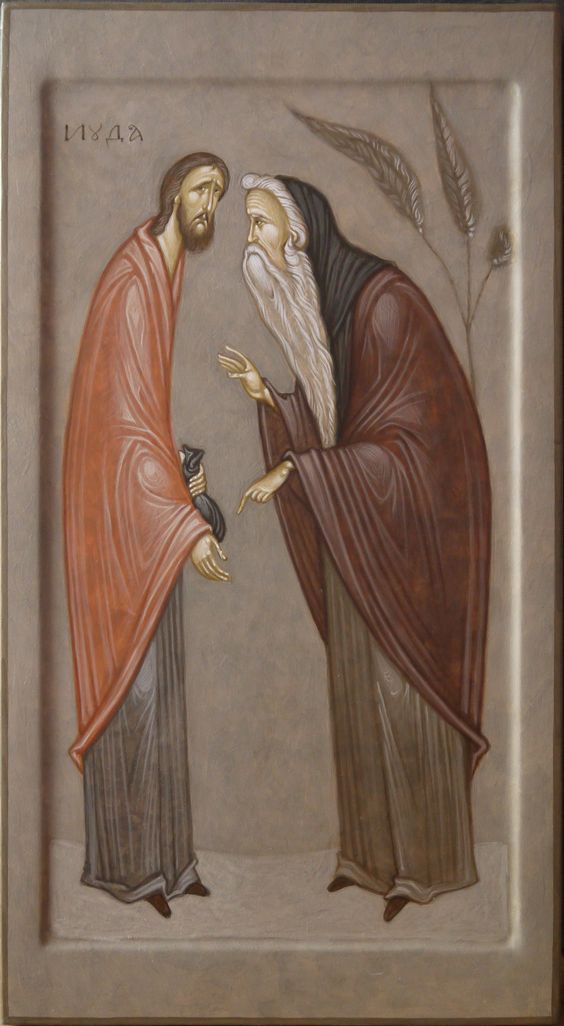
Sheshukov, Maxim_Judas
Maxim Sheshukov, Judas, 2020. Egg tempera on gessoed wood.

+++

NEW ALBUMS:

>> Volume 9 (Lent-Easter-Pentecost) of The Soil and The Seed Project: This is the latest release in an ongoing series of music for the church year by musicians of faith from the Shenandoah Valley. Some of my favorite tracks are “I Will Sing to the LORD” (a setting of Psalm 104:33) and “Hosanna, Loud Hosanna” (a newly retuned but old-timey-sounding hymn for Palm Sunday). I also really like “Gentle Shepherd,” a lullaby written for the children of Salford Mennonite Church to sing in worship in 2018 and performed in this music video by the sister folk duo Spectator Bird:

>> Life and Death and Life: Songs for Lent, Holy Week, and Easter by Steve Thorngate: Chicago-based church musician and songwriter Steve Thorngate has followed up his excellent album After the Longest Night: Songs for Advent, Christmas, and Epiphany with an album for the next two seasons of the church year, including the Day of Pentecost! In addition to twelve original songs, it includes two African American spirituals, a Charles Tindley hymn, and, perhaps my favorite, a cover of (new-to-me) Brett Larson’s poetic country song “Rolling Away,” about barriers to sight and wholeness being removed and a fresh new clarity, a freedom, a path opening up:

>> JOY JOY JOY JOY JOY by Paul Zach: The ever prolific Paul Zach of Virginia’s latest release is an effusively joyous ten-track album celebrating God’s love, salvation, and sustenance. He collaborated with other musicians on the project, including Jon Guerra, Tristen Stuart-Davenport, and IAMSON. Here’s a snippet of the opening song, “Nothing,” based on Romans 8 (listen to the full track here):

Roundup: Sermons by Nadia Bolz-Weber, Jewish graffiti, four-word poem by Giuseppe Ungaretti, and more

SERMONS by Rev. Nadia Bolz-Weber: Nadia Bolz-Weber [previously] is an ordained Lutheran pastor who founded the House for All Sinners and Saints in Denver and now guest-preaches around the city. Here are two of her sermons from the past year or so that I’ve come across and appreciate, just twelve minutes each.

>> “Sinking,” Montview Boulevard Presbyterian Church, Denver, August 13, 2023: Preaching on Matthew 14:22–33, Bolz-Weber critiques the idea that our ability to do great things relies on the quality of our faith instead of on the power of God: “I’ve often heard this walking-on-water story from Matthew preached as like The Little Disciple Who Almost Could. Like Peter could have kept walking on water if he just thought ‘I think I can, I think I can’ enough. The message being that with enough faith, you too can walk on water all the way to Jesus. Which, on the surface, sounds inspiring. But taken to its logical conclusion, it also means that if you are not God-like in your ability to overcome all your fears and failings as a human, if you are not God-like in your ability to defy the forces of nature, then the problem isn’t the limits of human potential, the problem is the limits of your faith, and you should probably muster up some more . . .” [Read the transcript]

>> “The Lord Is My Shepherd, (but) I Shall Not Want (a Shepherd, Thank You Very Much),” Saint John’s Cathedral, Denver, May 8, 2022: No matter how much we fancy ourselves “anti-shepherdarian,” wanting to make our own choices and go our own way, we are all shepherded by someone or something, says Bolz-Weber in this sermon on Psalm 23. Perhaps it’s by the “wellness” industry, or by the angriest voices on Twitter. And the thing is, “not one single shepherd-shaped wolf that I have followed has ever actually fulfilled my wants and desires,” she confesses; “they have only ever increased them. They have only ever led me to waters with a high salt content, only ever led me to waters that create thirst and never ever quench it. They leave me feeling insecure and insufficient.” She contrasts the shepherds of this world to the one true Good Shepherd. The preaching starts at 23:20. [Read the transcript]

+++

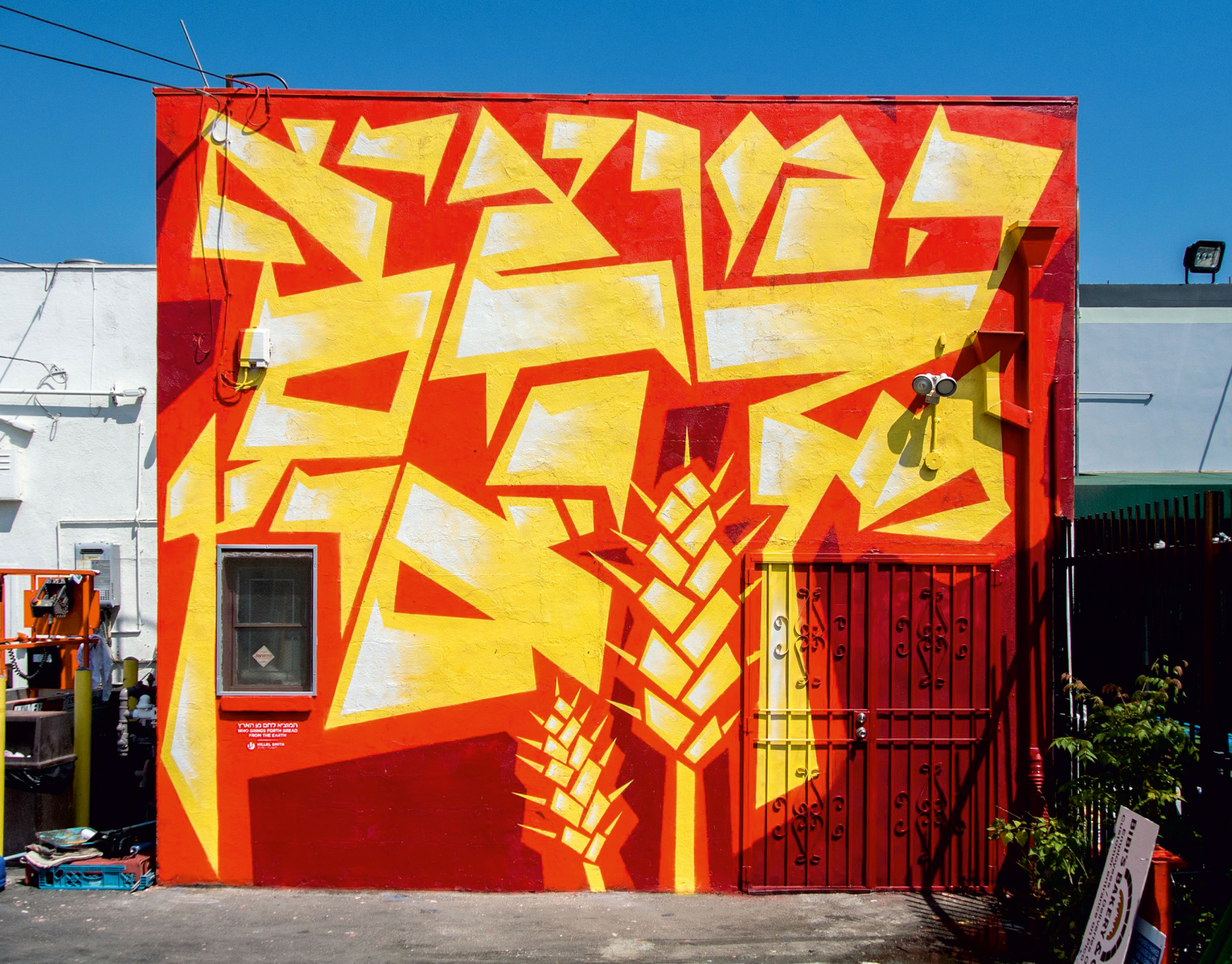
BOOK REVIEW: The Beauty of the Hebrew Letter: From Sacred Scrolls to Graffiti by Izzy Pludwinski, reviewed by Sarah Rose Sharp: In this new book from Brandeis University Press, certified Jewish scribe and calligrapher Izzy Pludwinski looks at the evolution of Hebrew calligraphy from sacred scrolls through modern art and graffiti. “Font enthusiasts, lovers of Judaica, and those passionate about the minutiae and range of the written form” will find much to appreciate here, writes Sarah Rose Sharp, whose review includes a handful of images from the book. For example, below is a mural painted by Hillel Smith on the alley-side exterior of a kosher bakery in the Pico-Robertson neighborhood of Los Angeles, which reads in bright yellow letters, “בָּרוּך אַתָּה אַדָנָי אֱלהֵינוּ מֶלֶך הָעוֹלָם הָמוֹציא לֶחם מן הַארץ” (Hamotzi lechem min ha-aretz) (Who brings forth bread from the earth), part of the traditional Hebrew blessing over bread before a meal: “Blessed are You, Lord our God, King of the Universe, Who brings forth bread from the earth.” [purchase on Amazon]

Smith, Hillel_Hamotzi Mural
Hillel Smith (American, 1984–), Hamotzi Mural, Bibi’s Bakery and Café, Los Angeles, 2016. Photo courtesy of the artist.

+++

SONGS:

>> “Be Alright” by God’s Children: Having amassed over four million collective views, this video was posted August 1 by Shirika “ReRe” Flowers across multiple social media platforms, showing four of her six kids singing a gospel song she wrote for them, “Be Alright,” at her home in Memphis. It’s led by Demeriauna “Sugar Mama” Harper, with the other three parts sung by Thedrick “Preacher” Webb (in orange Crocs), Dedric “Chunky” Trice (seated at left), and Cornbread.

The family performs and records together under the name God’s Children, and this song can be heard on their 2018 album It’s So Amazing.

>> “Aakhaima Rakhchhu Mero Yeshu” (आँखैमा राख्छु मेरो येशू) (Keep My Eyes on Jesus): In this 2016 video, a group of teens from New Life Church in Nepal sing a popular Nepali Christian worship song. I haven’t been able to find who the songwriter is, but from a search on YouTube, I can see that it’s a very popular song to dance to in Nepal! There are dozens of videos, mainly of children or youth, dancing to it with hand motions and a bounce, often in church.

From what I can tell through Google Translate, the lyrics translate roughly to “I keep my eyes on Jesus. I keep him in my heart. He shadows me with his love.”

+++

POEMS:

>> “Mattina” (Morning) by Giuseppe Ungaretti: This week reading the book Poetry and Revelation: For a Phenomenology of Religious Poetry by Kevin Hart, I came across this beautiful four-word poem in Italian from 1917 that stopped me in my tracks: “M’illumino / d’immenso.” (Those euphonic m’s!) Hart didn’t translate it, and though I could recognize the two keywords (they’re English cognates), I wasn’t sure of the words connecting them or the verb tense. In googling the poem, I was sent to the blog Parallel Texts: Words Reflected, run by Canadian literary translator Matilda Colarossi, who lives in Florence. It’s fascinating to hear her describe the complicated process of translating these two spare lines. Click on the link to read her translation and to learn what considerations informed her.

Part of the poem’s brilliance is its openness to various readings. For me, it’s about being known warmly and intimately by an immensity I call God.

>> “What He Did in Solitary” by Amit Majmudar: A second book I read this week was the poetry collection What He Did in Solitary by Amit Majmudar, Ohio’s first poet laureate. The titular poem, the first in a suite of three that conclude the book, made me cry. You can read all three on the website of Shenandoah journal, where they were originally published in 2019.

Other favorites: “Altarpiece,” “Ode to a Jellyfish,” “Elegy with van Gogh’s Ear.”

Christmas, Day 7: All Glory Be to Christ

LOOK: The Burning Bush by Sassandra

Sassandra_The Burning Bush
Jacques Richard Sassandra (French, 1932–), Le buisson ardent (The Burning Bush), late 1980s. Oil on canvas, 110 × 272 cm. Collection of the artist.

Last year when I was corresponding with the artist Sassandra about the New Jerusalem collage from his Apocalypse series, he sent me some photos of this painted triptych on the same subject. It’s called The Burning Bush. When open, it’s about nine feet across, and it shows Christ as the Good Shepherd standing in the river of life, which waters the roots of the tree of life, whose leafy branches extend all around. This is a depiction of the new heaven and new earth described in the book of Revelation, with angels posted at its twelve gates. (See Advent, Day 15.)

The image references other biblical passages as well. The lion and the lamb lying down together in peace—the lion having given up its carnivorous diet to eat straw instead of fellow creatures—is an allusion to the messianic kingdom prophesied in Isaiah 11. And the French inscription on the arch above Jesus and the bottom gatepost is the text of John 10:9: Je suis la porte. Si quelqu’un entre par moi il sera sauvé. (“I am the gate. If anyone enters by me, he will be saved.”) Jesus is the doorway through which we enter this glorious future.

Sassandra_The Burning Bush
Sassandra, Le buisson ardent (central panel)

It’s worth quoting the John passage in full, which rings loudly with the theme of sacrifice:

So again Jesus said to them, “Very truly, I tell you, I am the gate for the sheep. All who came before me are thieves and bandits, but the sheep did not listen to them. I am the gate. Whoever enters by me will be saved and will come in and go out and find pasture. The thief comes only to steal and kill and destroy. I came that they may have life and have it abundantly.

“I am the good shepherd. The good shepherd lays down his life for the sheep. The hired hand, who is not the shepherd and does not own the sheep, sees the wolf coming and leaves the sheep and runs away, and the wolf snatches them and scatters them. The hired hand runs away because a hired hand does not care for the sheep. I am the good shepherd. I know my own, and my own know me, just as the Father knows me, and I know the Father. And I lay down my life for the sheep. I have other sheep that do not belong to this fold. I must bring them also, and they will listen to my voice. So there will be one flock, one shepherd. For this reason the Father loves me, because I lay down my life in order to take it up again. No one takes it from me, but I lay it down of my own accord. I have power to lay it down, and I have power to take it up again. I have received this command from my Father.”

Two of the seven I AM statements that Jesus speaks in the Gospel of John are present here: “I AM the gate of the sheepfold,” “I AM the good shepherd.” The others are “I AM the bread of life,” “I AM the light of the world,” “I AM the resurrection and the life,” “I AM the way, the truth, and the life,” and “I AM the true vine.” Biblical scholars say that with these statements, Jesus was ascribing to himself the divine, if somewhat cryptic name that God disclosed to Moses in Exodus 3:14–15: I AM THAT I AM.

Sassandra_The Burning Bush (closed)
Sassandra, Le buisson ardent (closed)

Sassandra makes that connection in this triptych. When the wings are closed, the outer scene shows Moses before the burning bush, his shoes reverently removed, his arms raised in worship before the fiery Voice that calls him. Inscribed along the sides of these two exterior panels is Saint, saint, saint est le seigneur de l’univers! Toute la terre est pleine de sa gloire! (“Holy, holy, holy is the Lord of the universe! All the earth is full of his glory!”) (Isa. 6:3).

The artwork thus links Yahweh’s revelation to Moses as the great I AM with Christ’s apocalyptic appearing at the end of time. The wispy leaves on the tree of life on the interior panels appear as little flames, and Christ stands among them, the full revelation of God, who beckons us.

“Adonai” is one of the seven traditional O Antiphons, titles for Christ taken from the Old Testament and turned into short Advent refrains. It’s a Hebrew word that translates to “my Lord,” and it was used by the ancient Israelites to refer to God, as they regarded the divine name, I AM, as too sacred to be uttered. The “O Adonai” antiphon of Christian tradition recognizes that the God who spoke to Moses in the burning bush is the same God who speaks through Christ, and it entreats God to come deliver us from bondage, as he did the Israelites from Egypt:

O Adonai and ruler of the house of Israel,
who appeared to Moses in the burning bush and gave him the Law on Sinai:
come with an outstretched arm and redeem us.

Sassandra’s Burning Bush shows that deliverance—a landscape of liberation, where Christ, having given himself, holds us at rest in his arms and we are refreshed unceasingly by living water, and all creation sings God’s glory.

LISTEN: “All Glory Be to Christ” | Words by Dustin Kensrue, 2012 | Scottish folk melody, probably 17th century | Arranged and performed by The Petersens on Christmas with the Petersens, 2020

Should nothing of our efforts stand
No legacy survive
Unless the Lord does raise the house
In vain its builders strive [Ps. 127:1]
To you who boast tomorrow’s gain
Tell me, what is your life?
A mist that vanishes at dawn [James 4:13–14]
All glory be to Christ!

Refrain:
All glory be to Christ our king!
All glory be to Christ!
His rule and reign we’ll ever sing,
All glory be to Christ!

His will be done, his kingdom come
On earth as is above
Who is himself our daily bread [Matt. 6:10–11]
Praise him, the Lord of love
Let living water satisfy
The thirsty without price [Isa. 55:1; John 4:10; 7:37; Rev. 21:6]
We’ll take a cup of kindness yet
All glory be to Christ! [Refrain]

When on the day the great I Am [Exod. 3:14]
The faithful and the true [Rev. 19:11]
The Lamb who was for sinners slain [Rev. 5:6]
Is making all things new [Rev. 21:5]
Behold our God shall live with us
And be our steadfast light [Rev. 22:5]
And we shall e’er his people be
All glory be to Christ! [Refrain]

This traditional folk melody from Scotland is one of the most recognizable in the world. It is most associated with Robert Burns’s Scots poem “Auld Lang Syne,” a staple of New Year’s Eve parties. As the old year passes, it’s common to pause and consider what passes away with it and what will last, and to cast a renewed vision for the new year.

In December 2011 the American singer-songwriter Dustin Kensrue [previously] was inspired to write new lyrics for the tune AULD LANG SYNE. “The idea is that—especially at the beginning of the new year—we would dedicate all our efforts to bringing glory to Jesus Christ,” he said, “to acknowledge that anything else would be of no value, and to celebrate our redemption in him.” Kensrue’s lyrics are full of biblical allusions, whose chapter-verse references I’ve cited in brackets above.

Kings Kaleidoscope recorded “All Glory Be to Christ,” sung by Chad Gardner, on their Christmas EP Joy Has Dawned (2012). The music video was filmed on a carousel at a fair, a metaphor for the passage of time. The years go round and round as our world revolves around the sun. When the ride stops, will we have ridden wisely and well?

Rather than feature the original recording, I’ve chosen to feature a more recent version by The Petersens, a family bluegrass band from Branson, Missouri, because I absolutely love how they have reharmonized it, including starting it in a minor key. Ellen Petersen Haygood sings lead, and harmonizing vocals are supplied by her siblings Matt Petersen and Katie Petersen and her mom, Karen Petersen.

Advent, Day 22

He shall feed his flock like a shepherd: he shall gather the lambs with his arm, and carry them in his bosom, and shall gently lead those that are with young.

—Isaiah 40:11 (KJV) (cf. Micah 5:2–5a, today’s lectionary reading)

“Come unto me, all ye that labour and are heavy laden, and I will give you rest. Take my yoke upon you, and learn of me; for I am meek and lowly in heart: and ye shall find rest unto your souls. For my yoke is easy, and my burden is light.”

—Matthew 11:28–30 (KJV)

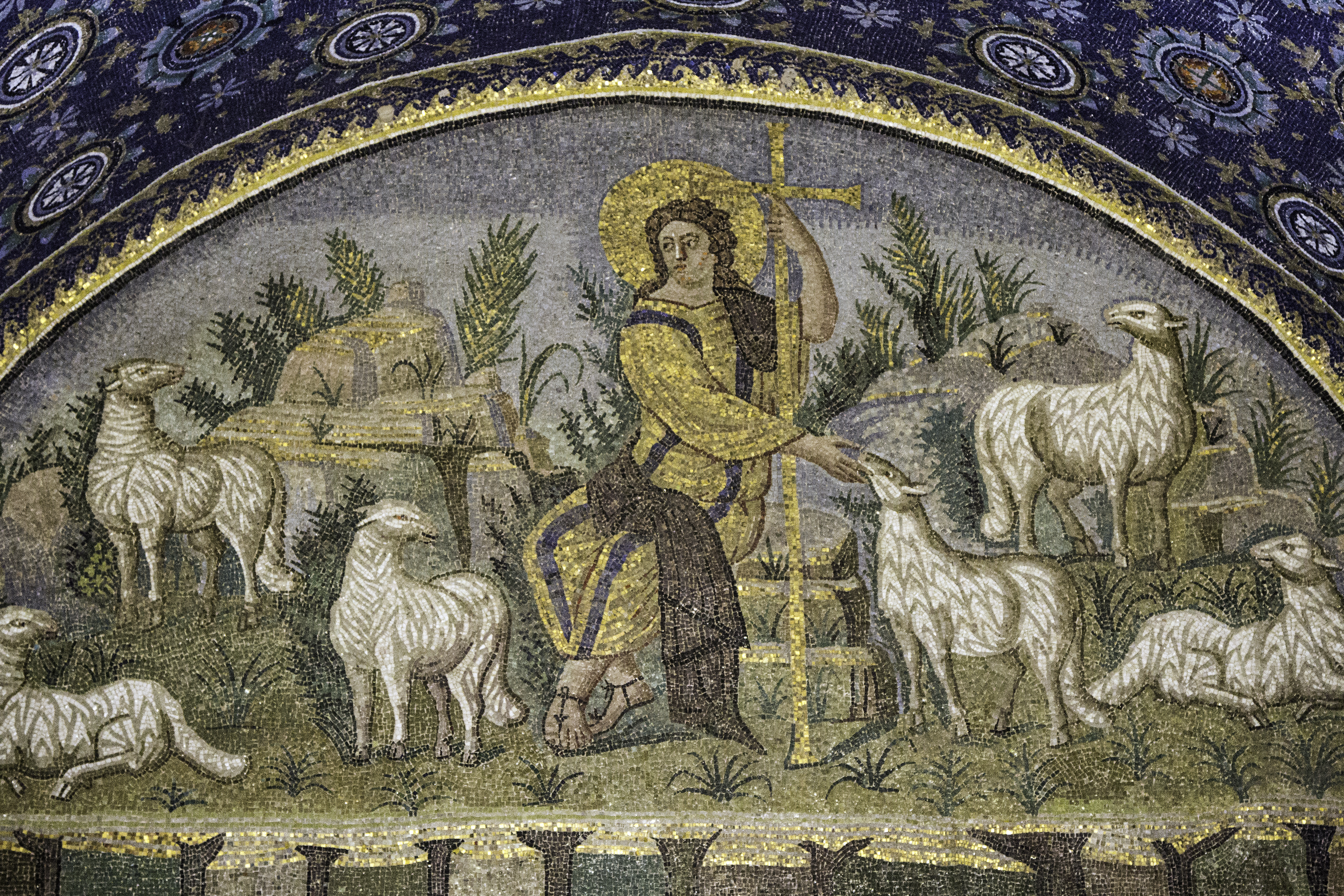
LOOK: Good Shepherd mosaic, Ravenna

Good Shepherd (Ravenna)
Christ the Good Shepherd, 5th century. Mosaic from the tomb of Galla Placidia, Ravenna, Italy. Photo: Fr. Lawrence Lew, OP.

[Related post: “Love, My Shepherd” (Artful Devotion)]

LISTEN: “He Shall Feed His Flock” | Text: Isaiah 40:11; Matthew 11:28–30 (KJV) | Music by Georg Frederic Handel, 1742 | Arranged and sung by Tara Ward on Adventus by Church of the Beloved, 2010

He shall feed his flock
Like a shepherd
And he shall gather
The lambs with his arm
With his arm

He shall feed his flock
Like a shepherd
And he shall gather
The lambs with his arm
With his arm

And carry them in his bosom
And gently lead those
That are with young
And gently lead those
That are with young

Come unto him
All ye that labor
Come unto him
Ye that are heavy laden
And he will give you rest

Come unto him
All ye that labor
Come unto him
Ye that are heavy laden
And he will give you rest

Take his yoke upon you
And learn of him
For he is meek
And lowly of heart
And ye shall find rest
Unto your souls

Take his yoke upon you
And learn of him
For he is meek
And lowly of heart
And ye shall find rest
Unto your souls

Born out of a group of friends’ reading of Life of the Beloved by Henri Nouwen, the Church of the Beloved in Edmonds, Washington, was active from 2006 to 2019. It had a vibrant music ministry, led by Tara Ward, that put out four albums, including Adventus. One of the tracks on Adventus is Ward’s slow, ambient, synth-driven arrangement of “He Shall Feed His Flock,” an air from Handel’s Messiah. Charles Jennens, the librettist (lyricist) of the oratorio, combined passages from Isaiah and Matthew to evoke a sense of the deep soul-rest and care that Christ proffers. Church of the Beloved’s rendition so beautifully captures the weariness we often feel, whether we’re on a spiritual path or not, and is a gentle reminder that Christ is always calling us back into his bosom.

Roundup: Pippy the Piano, “The Cobblestone Gospel,” and more

The Lent 2021 edition of the Daily Prayer Project prayerbook is now available, covering February 17–April 3. (I serve as curator.) The stunning cover image is Prayers of the People I by Meena Matocha, who works in charcoal, ashes, acrylic, and wax. You can purchase the booklet in either digital or physical format.

In the opening letter, Project Director Joel Littlepage writes, “Lent is a season that disturbs many people. Maybe that includes you. Among Protestant Christian communities that I have been a part of over the years, Lent can either be seen as a ‘graceless,’ ‘harsh,’ ‘legalistic’ part of the Christian year or, on the other hand, trivialized into a time to ‘pick something to give up,’ like a seasonal spiritual diet plan. Both these characterizations miss the mark.” He goes on to describe the bidirectionality of the Lenten journey: downward, as we are crucified with Christ, and upward, toward the victory of resurrection and new life. “It is a season to sense again the path of the Christian life.”

+++

NEW CHILDREN’S BOOK: Pippy the Piano and the Very Big Wave by Roger W. Lowther, illustrated by Sarah Dusek: My friend Roger Lowther [previously], director of Community Arts Tokyo and host of the Art Life Faith podcast, has written his first children’s book, which released in December. It’s inspired by the story of a church in Kamaishi, who after the 2011 tsunami found their beloved piano upside down and covered in mud and debris but, rather than discard it, decided to spend enormous amounts of time and money to restore it—a picture of God’s love for his precious creation, and the lengths he went to to demonstrate that love. Hollywood and Broadway actor Sean Davis reads the book in the video below. [Available on Amazon]

+++

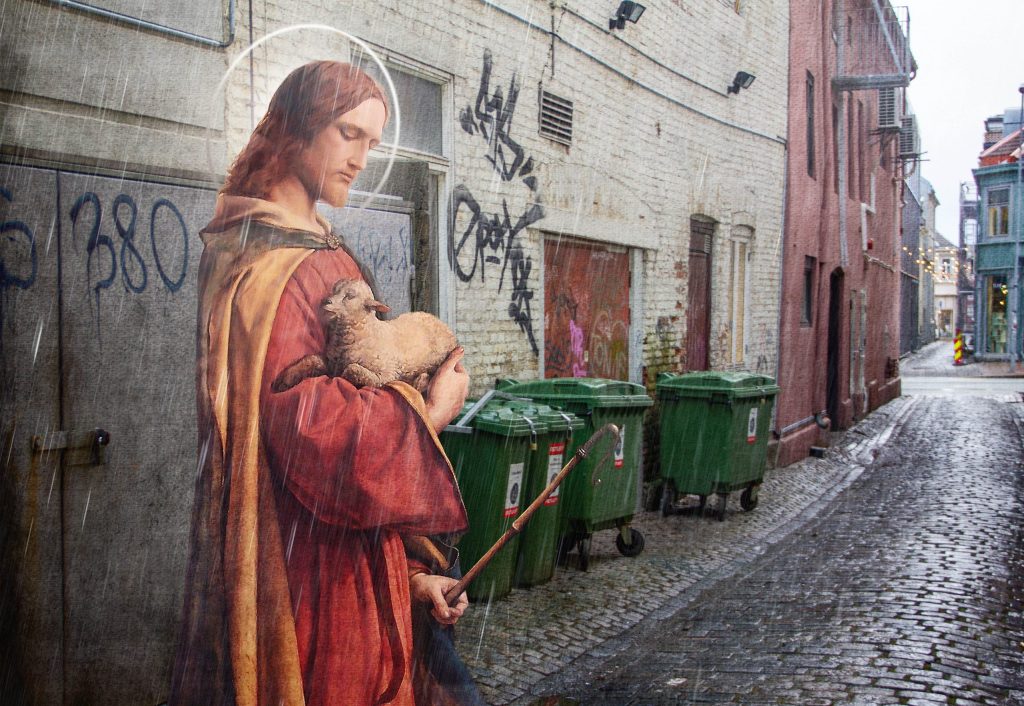
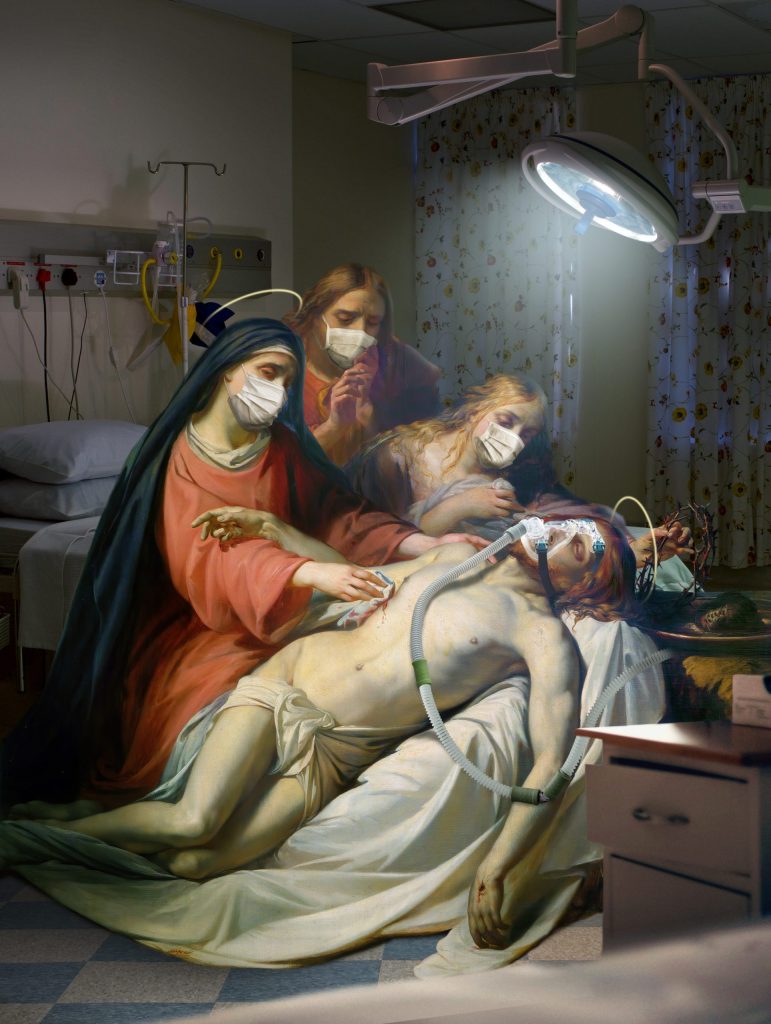
EXHIBITION: The Cobblestone Gospel by Trygve Skogrand, Vår Frue Kirke (Our Lady Church), Trondheim, Norway, July 2020–April 2021: “An exhibition of collages of historic low-church art merged with photographs of our own contemporary surroundings. The essence of the works is the meeting. Between painting and photography, the mystical and the mundane, and how the meeting makes both worlds renewed and re-visibled.” The original advertising says the exhibition is open Mondays through Saturdays from 12 to 3 p.m., but I’m not sure whether COVID has changed that; you can contact the church here.

Skogrand, Trygve_Found
Trygve Skogrand (Norwegian, 1967–), Found, 2020. Collage / pigment print on paper.

Skogrand, Trygve_The Beloved
Trygve Skogrand (Norwegian, 1967–), The Beloved, 2020. Collage / pigment print on paper.

In October Skogrand described the impetus behind his work to Edge of Faith magazine:

When I was a child, I went to a Christmas party at our local church. At the end of the party, every child got a small bag of gifts to take home. In the bag: a pack of raisins, a small orange, some sweets – and a prayer card showing Jesus in paradise. Oh, how beautiful I thought the small prayer card was! Jesus and butterflies and a sunset and flowers AND a golden glittery border. A wonder of loveliness and holiness!

Move on twenty years. I was 30, had started working as an artist, and found the bible card again. I had changed, and the card too. Instead of seeing loveliness, I found the card rather sad. It looked to me as if Jesus was imprisoned in a dusty and suffocating make-believe paradise.

Then it struck me: What if I remove the paradise?

I have now been working with the merging of high and low historical Christian art with our contemporary surroundings for twenty years. For me, this process not only binds together what nowadays normally is shown as sundered but also re-actualizes the classical art and infuses the everyday, modern surroundings with holiness.

+++

MUSIC VIDEO: “Fear Thou Not” by Josh Garrels: This beautiful new setting of Isaiah 41:10 by Josh Garrels appears on Garrels’s 2020 album Peace to All Who Enter Here [previously]. “Fear thou not; for I am with thee: be not dismayed; for I am thy God: I will strengthen thee; yea, I will help thee; [and] I will uphold [you] with the right hand of my righteousness” (KJV).

+++

SHORT FILM: A Colorized Snowball Fight from 1896 Shows Not Much Has Changed in the Art of Winter Warfare: This is pure joy! “A short clip, originally captured by Louis Lumière in 1896, documents a rowdy snowball fight [bataille de boules de neige] on the streets of Lyon, France. Thanks to Saint-Petersburg, Russia-based Dmitriy Badin, who used a combination of the open-source software DeOldify and his own specially designed algorithms to upscale and colorize the historic footage, the video of the winter pastime is incredibly clear, revealing facial features and details on garments.”

Love, My Shepherd (Artful Devotion)

Good Shepherd (sarcophagus fragment)
Sarcophagus Fragment with the Good Shepherd, Rome, early 4th century. Marble, 13 9/16 × 21 5/8 in. (34.5 × 55 cm). Walters Art Museum, Baltimore. Photo: Victoria Emily Jones.

God, my shepherd!
I don’t need a thing.
You have bedded me down in lush meadows,
you find me quiet pools to drink from.
True to your word,
you let me catch my breath
and send me in the right direction.

Even when the way goes through
Death Valley,
I’m not afraid
when you walk at my side.
Your trusty shepherd’s crook
makes me feel secure.

You serve me a six-course dinner
right in front of my enemies.
You revive my drooping head;
my cup brims with blessing.

Your beauty and love chase after me
every day of my life.
I’m back home in the house of God
for the rest of my life.

—Psalm 23 (MSG)

The King James Version’s translation of Psalm 23 from Hebrew into English is unsurpassable in terms of sheer poetic beauty, but since I’ve featured it here before and the words are so very familiar, I thought I’d shake things up a bit by giving Eugene Peterson’s contemporary translation.

The relief carving in this post is from a gallery of early Christian art at the Walters Art Museum in Baltimore, one of my favorite local hangouts. The museum label reads,

This fragment comes from a small Early Christian sarcophagus that was probably made for a child. At the right is a young shepherd, who carries a lamb over his shoulders as two sheep gaze up at him from below. The image of the Good Shepherd originated with the pagan Greek figure of Hermes (the gods’ messenger and ram-bearer) and was later transformed into Jesus as the Good Shepherd who watches over his flock.

[Related posts: “Sheep May Safely Graze (Artful Devotion)”; “The Lost Lamb (Artful Devotion)”]

+++

SONG: “The King of Love My Shepherd Is” | Words by Sir Henry Williams Baker, 1868 | Music: Traditional Irish tune (ST. COLUMBA) | Arranged by Paul Terracini and performed by the Ars Nova Vocal Group, on Hymns of Our Forefathers, 2000

The King of love my shepherd is,
whose goodness faileth never.
I nothing lack if I am his,
and he is mine forever.

Where streams of living water flow,
my ransomed soul he leadeth;
and where the verdant pastures grow,
with food celestial feedeth.

Perverse and foolish, oft I strayed,
but yet in love he sought me;
and on his shoulder gently laid,
and home, rejoicing, brought me.

In death’s dark vale I fear no ill,
with thee, dear Lord, beside me;
thy rod and staff my comfort still,
thy cross before to guide me.

Thou spreadst a table in my sight;
thy unction grace bestoweth;
and oh, what transport of delight
from thy pure chalice floweth!

And so through all the length of days,
thy goodness faileth never;
Good Shepherd, may I sing thy praise
within thy house forever.

I chose this intricate a cappella SATB arrangement as the feature track for today, but for a solo female vocalist on acoustic guitar, see Taylor Tripodi:

Though “The King of Love” is most associated with the traditional Irish tune ST. COLUMBA, it is sometimes sung to a handful of others. Below you can hear it with a different traditional Irish tune (MCKEE), arranged by Harry T. Burleigh in 1939. Performed by Tyler Anthony (of Cereus Bright) and the musicians of Redeemer Knoxville, this peppier version appears on the 2011 Cardiphonia album Songs for the Supper:

Contemporary retunes of the hymn include those by I Am They and Sarah Hart and Sarah Kroger. (Update, 6/26/20: The Gentle Wolves has just released one too.)

Good Shepherd (sarcophagus fragment)
Photo: Victoria Emily Jones


This post belongs to the weekly series Artful Devotion. If you can’t view the music player in your email or RSS reader, try opening the post in your browser.

To view all the Revised Common Lectionary scripture readings for the Fourth Sunday of Easter, cycle A, click here.

The Lost Lamb (Artful Devotion)

Good Shepherd (Chinese)
Chinese scroll painting of the Good Shepherd, 1966. Collection of the Church of the Good Shepherd, Ann Arbor, Michigan.

“What man of you, having a hundred sheep, if he has lost one of them, does not leave the ninety-nine in the open country, and go after the one that is lost, until he finds it? And when he has found it, he lays it on his shoulders, rejoicing. And when he comes home, he calls together his friends and his neighbors, saying to them, ‘Rejoice with me, for I have found my sheep that was lost.’”

—Luke 15:4–6

+++

SONG: “The Lost Lamb” by Abigail Washburn and Jingli Jurca | Performed by Abigail Washburn, on Song of the Traveling Daughter (2005)

Zai na yaoyuan de guxiang
Wo shiluo liao yi ge gulao de meng
Yi ge youshang de meng
Zai na yangyu wo de defang

Wo fenbian buliao muse he chenguang
Wo yanjuanliao chenmo he sixiang
Feng nanchui you zhuanxiang beifang
Jianghe ben hai, hai que bu zhang

Wo xin manliao choucheng
Yu lai you shi qing bu jiuchang
Fuzu tianbuman linghun de kewang
Zhihui dangbukai yongsheng de shuangjiang

Wo
Wo shi
Yi zhi
Mitu de gaoyang

Shei neng ying wo zouchu mimang
Nar you wo chongsheng de xiwang
Oh, muyangren ah
Ni zai hefang?

In that far distant land I call home
I lost the ancient dream
A sorrowful dream
In that place that raised me

I cannot discern the growing shadows of dusk
And the first faint rays of the morning sun
I’ve wearied in the silence and searching
Wind blows south and turns again north
River flows to the sea, yet the sea does not rise

My heart is filled with melancholy
The rains come, clear skies will follow soon
Even fortune and good blessings
Cannot quench the soul’s thirst
Wisdom cannot relieve us our eternal lot

I am a lost lamb

Who will lead me from this haze?
What will bring me hope again?
Oh shepherd
Where are you? [source]

+++

Before Abigail Washburn (previously featured here) became one of America’s most acclaimed folk musicians, she was a college student majoring in East Asian studies and Mandarin, traveling intermittently to China and ready to pursue a degree in international law at Beijing University. But before her planned departure, she heard at a party one night a recording of Doc Watson singing “Shady Grove,” and she instantly fell in love with American bluegrass music. She bought herself a banjo and traveled Appalachia, learning the instrument and developing a repertoire. Her skill and enthusiasm soon landed her at a recording studio in Nashville, the city where she now lives with her husband, Béla Fleck.

Although Washburn decided not to pursue a law career in Beijing, her love of Chinese language and culture has continued. In 2011 she embarked on a Silk Road Tour, where she collaborated with Chinese musicians at each stop along the way. That year also marks the founding of The Wu-Force, a self-described “kung fu-Appalachian avant-garde folk-rock” trio consisting of Washburn, guzheng (Chinese zither) virtuoso Wu Fei, and multi-instrumentalist Kai Welch. As her website says, “her efforts to share US music in China and Chinese music in the US exist within a hope that cultural understanding and the communal experience of beauty and sound rooted in tradition will lead the way to a richer existence.” Learn more by watching her 2012 TED talk, “Building US-China Relations . . . by Banjo,” or by listening to her (and Fleck’s) 2015 interview with Krista Tippett, “Truth, Beauty, Banjo.”

“The Lost Lamb” is one of several songs that Washburn co-wrote with her friend Jingli Jurca, a poet from Beijing. Washburn says it was inspired by one of the Chinese students she was teaching English to in Vermont in the early 2000s. He had come to the States to earn money to send back home, but four years later he received a letter from his wife saying that she and their daughter were going to start a new life without him. This mournful ballad gives expression to his feeling of exile, of rootlessness, of being far from home and unable to return to what was once a place of joy and connection.

The first time I heard this song, I was incredibly moved. Having no knowledge of Mandarin or the context of the song’s composition, I looked up a translation, finding that the lyrics have a beautiful resonance, whether intentional or not, with Jesus’s parable of the lost sheep, where he likens himself to a good shepherd who seeks out and restores those of his flock who have wandered off. I hear it as very psalmic, a grasping after God through pain. It’s hard to tell dusk from dawn, the speaker says. My soul thirsts. It ends, “Oh Shepherd, where are you?” Shepherd, who promises to lead us through dark valleys and bring us to still waters. The speaker is readily confessing that he’s lost; “come find me” is essentially what he pleads.

In the spirit of the biblical psalmists, the speaker appears to take God to task, questioning whether he will show up as he said he would. “Who will lead me from this haze? / What will bring me hope again?” It’s an earnest reaching, through tears and uncertainty, for something stable that he or she once knew.

Whether you want to interpret the song as lamenting a felt distance from one’s home country or culture or family or faith, it rings so true, so beautiful.

I’ve paired it with a visual artwork and scripture reading that fulfill its longing, showing a being found.


This post belongs to the weekly series Artful Devotion. If you can’t view the music player in your email or RSS reader, try opening the post in your browser.

To view all the Revised Common Lectionary scripture readings for Proper 19, cycle C, click here.

“I Leave You My Peace” (Artful Devotion)

Osborne, Mary Ann_Paths of Peace
Sister Mary Ann Osborne, SSND, Paths of Peace, 2005. Linden wood, glass, brass wire, gold leaf, and paint, 36 × 27 × 1 in.

Jesus answered him, “If anyone loves me, he will keep my word, and my Father will love him, and we will come to him and make our home with him. Whoever does not love me does not keep my words. And the word that you hear is not mine but the Father’s who sent me.

“These things I have spoken to you while I am still with you. But the Helper, the Holy Spirit, whom the Father will send in my name, he will teach you all things and bring to your remembrance all that I have said to you. Peace I leave with you; my peace I give to you. Not as the world gives do I give to you. Let not your hearts be troubled, neither let them be afraid. You heard me say to you, ‘I am going away, and I will come to you.’ If you loved me, you would have rejoiced, because I am going to the Father, for the Father is greater than I. And now I have told you before it takes place, so that when it does take place you may believe.”

—John 14:23–29

+++

SONG: “I Leave You My Peace” | Music by Maxime Kovalevsky, French Orthodox Church, Paris, 1940s–50s | Arranged by Josef Gulka, Holy Cross Orthodox Church, Medford, NJ | Performed by the St. Symeon Orthodox Church Choir, Birmingham, AL, on Fire and Light (2010)

You can download free sheet music for this song from the Liturgical Music PDF Library of the Antiochian Orthodox Christian Archdiocese of North America.

+++

The mixed-media artwork above is by Sister Mary Ann Osborne, a Minnesota nun in the order of the School Sisters of Notre Dame. The Good Shepherd figure references a Christian fresco from the third-century catacomb of St. Callixtus in Rome, where the shepherd carries a sheep over his shoulders, securing it with one hand while carrying a milk pail in the other; it’s an image of care and protection derived from scripture. Sister Mary Ann has added two open-palmed hands rising up behind, or perhaps emerging from, the shepherd, a posture of prayer (orans) but also of benediction (see, e.g., Lev. 9:22; Luke 24:50).

Christ is pronouncing a blessing—it could be the words of peace and promise from his farewell discourse, excerpted in Sunday’s lectionary reading. We, his people, receive it. He has forged “paths of peace” for us to follow, as Sister Mary Ann’s work suggests, with road markings at the bottom left inviting us to set off where Christ has trod. And he goes with us in the Spirit.

He has called the world to a new order, signified by the shofar at the right, which announces Jubilee. As one of seven, the trump also carries connotations of the day of the Lord.

See more of Sister Mary Ann’s wood carvings at http://sistermaryannosborne.com/.


This post belongs to the weekly series Artful Devotion. If you can’t view the music player in your email or RSS reader, try opening the post in your browser.

To view all the Revised Common Lectionary scripture readings for the Sixth Sunday of Easter, cycle C, click here.