New albums: “Confessions” by the Anachronists, “Though It Be a Cross” by Weston Skaggs, and more

Here’s my new Spotify playlist for July:

Every month I curate a mix of old and new Christian (or Christian-resonant) song releases. For this coming month, some of the new songs come from the following five albums that were released this spring or early summer, which I’ve really been enjoying. I list them here chronologically and encourage you to listen to them each in full!

New albums 2025

1. Jesus by Jon Guerra, released April 4, 2025: An album of original songs in conversation with the words of Christ. Guerra says that a few years ago, to reacquaint himself with Jesus, he began reading cyclically through the Gospels, and as he did, “little song fragments started coming. I was trying to really hear the words, to feel the stories again, and so I’d write little tunes around certain phrases—‘do not lay up for yourselves treasures on earth,’ ‘if anyone would come after me,’ ‘give to everyone who asks of you,’ ‘take this cup from me,’” etc. He then developed those into the twelve fully fledged songs that made it onto the album.

Favorite tracks: “Reckoner (An Axe Laid to the Root),” “Where Your Treasure Is” (above), “Love Your Enemies”

2. Sermon on the Mount: Bible Memory Collection by The Soil and The Seed Project, released May 16, 2025: The Soil and The Seed Project is a ministry that provides intergenerational resources for people as they follow Jesus, read scripture, and talk about their faith together. One of those resources is new music, written and recorded by an expanding collective of folks. All twenty-five songs on this new double album of theirs are based on the Sermon on the Mount in Matthew 5–7, which contains the Beatitudes, the Lord’s Prayer, warnings against hypocrisy, the call to be salt and light, the command to love one’s enemies, the parable of the wise and foolish builders, assurances of God’s care, and the promise that those who seek will find. For the first disc, the Project set 48 of the 111 sermon verses to music, and for the second, they invited a handful of singer-songwriters to write songs in response to what they encountered as they dwelt in the text.

The album is accompanied by a “Little Liturgies” booklet of litanies, reflection prompts, and line drawings covering eleven weeks. Both the music and the booklet (digital or physical, while supplies last) are FREE from their website!

Favorite tracks: “Come and Eat” (above), “Mountains of Treasure,” “God of Mercy, God of Peace,” “Take What You’ve Given”

3. Though It Be a Cross by Weston Skaggs, released June 20, 2025: An EP of six hymns, freshly arranged and performed by Weston Skaggs of Ohio. The album title comes from a line from “Nearer, My God, to Thee” (video below). “Sarah Fuller Flower Adams wrote the lyrics from the perspective of Jacob and his received revelation of God’s nearness. A nearness that only occurred when he felt most hopeless and alone,” Skaggs explains. “In meditating on that narrative, she determined to be like Saint Peter: who became the most like Christ his master when he was raised on his own cross.” This song and others feature backing vocals by Katy Martin.

The most stylistically daring is “For the Beauty of the Earth,” whose verses Skaggs transposed to a minor key—to allude to the beauty and brokenness of creation and relationships, Skaggs said, “invit[ing] listeners to hold both gratitude and longing in the same breath.”

Favorite tracks: “No, Not One,” “Nearer, My God, to Thee” (above)

4. Confessions by the Anachronists, released June 26, 2025: The Anachronists are Andrés Pérez González, Corey Janz, and Jonathan Lipps, three musician friends who met while studying theology at Regent College in Vancouver and who have formed a group to give renewed voice, through modern indie music, to theologians and mystics from ages past. Confessions is their debut EP, with six songs rooted in Augustine’s spiritual autobiography from the late fourth century. The songs address grief over the death of a dear friend, and God’s merciful pursuit of those who wander; a preconversion sense of dissatisfaction but as yet unwillingness to make any changes; God as the One who is fully at rest in his own self, and how we might share in that rest; struggles with distraction and pride in the spiritual life; and the promise of renewal both personal and universal.

The still life colored-pencil drawing commissioned for the album cover is by the Finnish artist Minni Havas; it portrays Easter lilies growing out of a compost heap. It was especially inspired by the concluding song, “All of Our Decayed Parts,” which is itself based on an excerpt from Book IV.16 of the Confessions:

Do not be vain, my soul. Do not deafen your heart’s ear with the tumult of your vanity. Even you have to listen. The Word himself cries to you to return. There is the place of undisturbed quietness where love is not deserted if it does not itself depart. See how these things pass away to give place to others, and how the universe in this lower order is constituted out of all its parts. “Surely I shall never go anywhere else,” says the word of God. Fix your dwelling there. Put in trust there whatever you have from him, my soul, at least now that you are wearied of deceptions. Entrust to the truth whatever has come to you from the truth. You will lose nothing. The decayed parts of you will receive a new flowering, and all your sicknesses will be healed. All that is ebbing away from you will be given fresh form and renewed. (trans. Henry Chadwick)

This album comprises just six of the thirty-some Confessions-based songs the trio has written; they are testing the waters with it to see if there is more interest and funding to record more, and then to apply this approach to other ancient and medieval theological and spiritual writings by such luminaries as Athanasius and Julian of Norwich. Some laypeople feel daunted to read centuries-old works, or assume that they’re mostly irrelevant. But the Anachronists seek to mine the riches of historical Christian thought and provide an easy access point through music, hopefully encouraging folks to seek out the sources. I’m excited to see what they do next! Follow them on Instagram @anachronists.music.

Favorite tracks: “God of the Runaways,” “All of Our Decayed Parts” (above)

5. All Shall Be Well by the Good Shepherd Collective, released June 27, 2025: This album consists mainly of gospel and hymn covers. The artists in this collective, whom I’ve mentioned many times before, are top-notch, and I’m always excited to see what they put out.

Favorite tracks: “Lift Every Voice” (James Weldon Johnson and J. Rosamond Johnson), “Ancient of Days” (Ron Kenoly) (this appears to be a re-release from the collective’s Gospel Songs, vol. 1; above), “My Jesus Is All” (the Staples Singers), “I Saw the Light” (Hank Williams)

Roundup: The body as sacred offering; rest as resistance; “Amazing Grace”

I’m late in notifying you about my June 2025 playlist (a random compilation of faith-inspired songs I’ve been enjoying lately), but be sure to check it out on Spotify.

See also my Juneteenth Playlist, which I’ve added six new songs to since originally releasing it two years ago, including a cover of Roberta Slavitt’s protest song “Freedom Is a Constant Struggle,” “Black Gold” by Esperanza Spalding, and “The Block” by Carlos Simon, a short orchestral work based on a six-panel collage by Romare Bearden celebrating Harlem street life.

Romare Bearden, The Block
Romare Bearden (American, 1911–1988), The Block, 1971. Cut-and-pasted printed, colored, and metallic papers, photostats, graphite, ink marker, gouache, watercolor, and ink on Masonite, 4 × 18 ft. (121.9 × 548.6 cm). Metropolitan Museum of Art, New York. Photo: Victoria Emily Jones.

+++

PODCAST EPISODE: “The Body as Sacred Offering: Ballet and Embodied Faith” with Silas Farley, For the Life of the World, April 30, 2025: An excellent interview! “Silas Farley, former New York City Ballet dancer and current Dean of the Colburn School’s Trudl Zipper Dance Institute, explores the profound connections between classical ballet, Christian worship, and embodied spirituality. From his early exposure to liturgical dance in a charismatic Lutheran church to his career as a professional dancer and choreographer, Farley illuminates how the physicality of ballet can express deep spiritual truths and serve as an act of worship.”

I was especially compelled by Farley’s discussion of turnout, the rotation of the leg at the hips—foundational to ballet technique. It gives the body an “exalted carriage” and allows for “a more complete revelation of the body,” he says, because you see more of the leg’s musculature that way. This physical positioning, he says, reflects the correlative “spiritual turnout” that’s also happening in dance, and that Christians are called to in life—a posture of openness and giving. He cites the theological concept of incurvatus in se, coined by Augustine and further developed by Martin Luther, which refers to how sin curves one in on oneself instead of turning one outward toward God and others.

Farley also discusses how liturgical dance is like and unlike more performative modes of dance (“liturgical dance . . . is a kind of embodied prayer . . . a movement that goes up to God out of the body”); how discipline and freedom go together; the body as instrument, and how dancers cultivate a hyperawareness of their bodies; the two basic design elements of ballet, the plié and the tendu, and their significance; his formation, from ages fourteen to twenty-six, under the teaching of Rev. Dr. Tim Keller at Redeemer Presbyterian Church; the Four Loves ballet he choreographed on commission for the Houston Ballet, based on a C. S. Lewis book (see promo video below, and his and composer Kyle Werner’s recent in-depth discussion about it for the C. S. Lewis Foundation); Songs from the Spirit, a ballet commissioned from him by the Metropolitan Museum of Art (see next roundup item); Jewels by George Balanchine, a three-act ballet featuring three distinct neoclassical styles; “Hear the Dance” episodes of City Ballet the Podcast, which he hosts; and book recommendations for kids and adults.

+++

SITE-SPECIFIC BALLET: Songs from the Spirit, choreographed by Silas Farley: Commissioned by MetLiveArts [previously], Songs from the Spirit by Silas Farley is a three-part ballet for seven dancers that interprets old and new Christian spirituals, having grown out of an offertory Farley gave at Redeemer Presbyterian Church based on the song “Guide My Feet, Lord.” Staged in the museum’s Assyrian Sculpture Court, the Astor Chinese Garden Court, and the glass-covered Charles Engelhard Court of the American Wing, the ballet progresses from “Lamentation” to “Contemplation” to “Celebration.” Here’s a full recording of the March 8, 2019, premiere:

For the project, Farley solicited new “songs (and spoken word poetry) from the spirit” from men who were currently or formerly incarcerated at San Quentin State Prison in California, whose creative talent he learned about through the Ear Hustle podcast. Recordings of these contributions form about half the score, while the other half consists of traditional spirituals sung live by soprano Kelly Griffin and tenor Robert May. My favorite section is probably “Deep River” at 26:54, a duet danced by Farley and Taylor Stanley, picturing a soul’s “crossing over” to the other side, supported by an angelic or divine presence, or perhaps one who’s gone before.  

In his artistic statement, Farley says he wanted to invite viewers “to accompany us [dancers] on this journey: from darkness to light, bondage to freedom, exile to home.”

I am struck by how a contemporary work that is, in Farley’s words, so “unequivocally Christ-focused and Christ-exalting” was welcomed, even made financially possible, by a prestigious secular institution. I find apt Farley’s response when asked by Macie Bridge from the Yale Center for Faith & Culture about his consideration of his audiences (see previous roundup item):

All the people coming to the performance are hungry in different ways. Some are longing for beauty. Some are longing for a prophetic image of a better world. Some are longing to see something reflected back to them from their own lives. And I’m just trusting that as I offer the artwork as an act hospitality, and as I offer the artwork as an act of adoration and worship back to God, that in his own beautiful, winsome, totally personalized way, he’ll meet each of the audience members in the way they need to be met.

+++

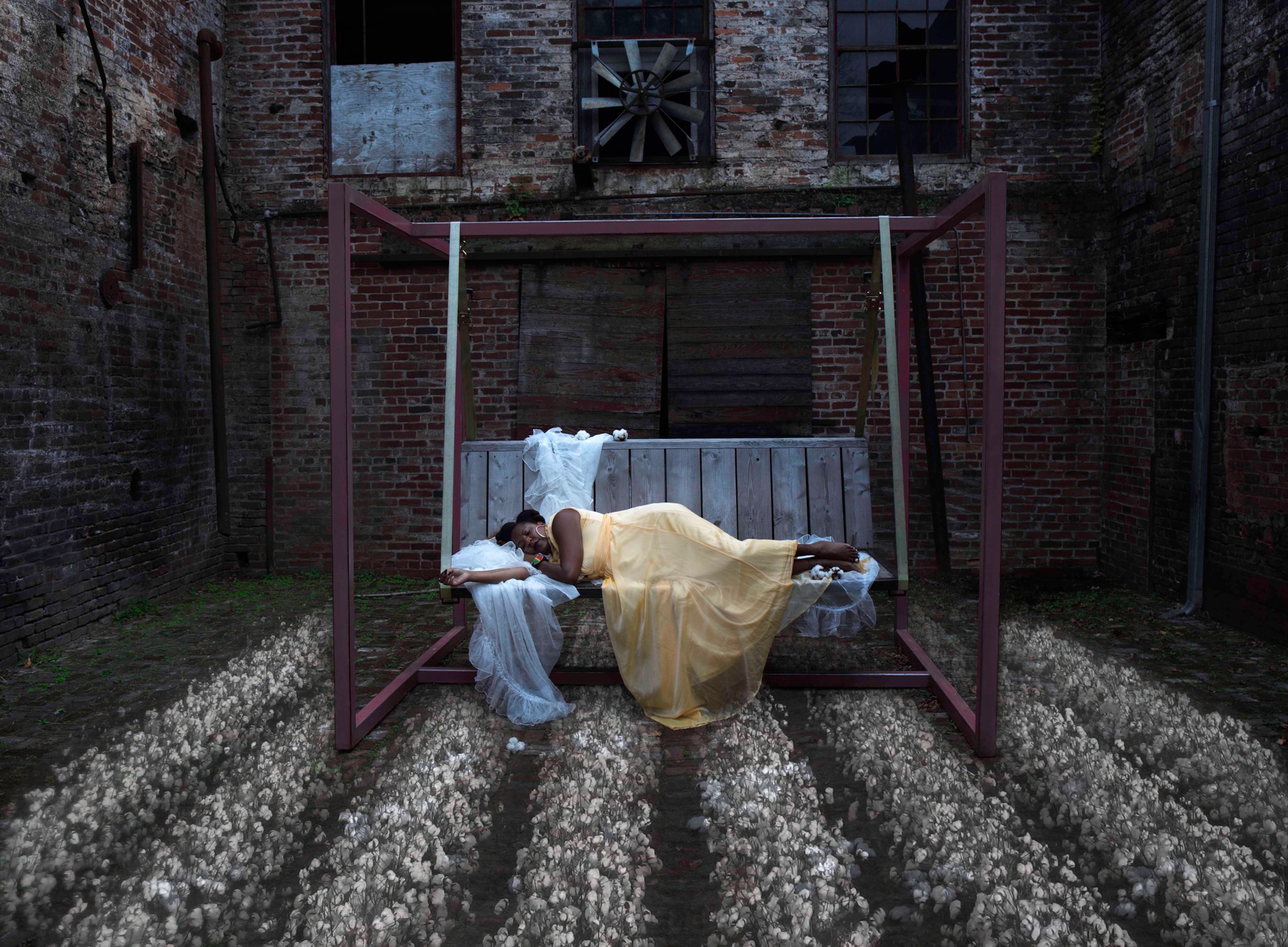
ARTWORK: Dreaming with the Ancestors by Charlie Watts and Tricia Hersey [HT: Visual Commentary on Scripture]: Tricia Hersey is a poet, performance artist, spiritual director, and community organizer living in Atlanta, Georgia. She is the founder of The Nap Ministry, an organization that promotes rest as a form of resistance against capitalism (which fuels contemporary grind culture) and white supremacy, and the author of the New York Times best-selling Rest Is Resistance: A Manifesto (2022) and We Will Rest! The Art of Escape (2024). She pursued graduate research in Black liberation theology, womanism, somatics, and cultural trauma, earning a master of divinity degree from Candler School of Theology at Emory University.

Watts, Charlie_Dreaming with the Ancestors
Charlie Watts and Tricia Hersey, Dreaming with the Ancestors, 2017. Archival digital print photograph, 76.2 × 101.6 cm.

The photograph Dreaming with the Ancestors, taken by Charlie Watts, portrays Hersey reclining on a wooden bench inside an open brick enclosure and above rows of cotton plants. Dressed in a soft yellow gown, she closes her eyes in rest, practicing what she calls “the art of escape”—from the incessant demand of productivity and overwork, from oppression of body and spirit, from noise that drowns out voices of wisdom.

In We Will Rest!, Hersey advises:

Every day, morning or night, or whenever you can steal away, find silence. Even if for only a few minutes. Look for quiet time, quiet breathing, quiet wind, quiet air. It is there. Even if it’s cultivated in your body by syncing with your own heart beating. Guilt and shame will be a formidable and likely opponent in your resistance. We expect guilt and shame to surface. Let them come. We rest through it. We commit to our subversive stunts of silence, truth, daydreaming, community care, naps, sleep, play, leisure, boundaries, and space. Be passionate about escape. (107)

+++

ALBUM: Grace Will Lead Me Home by Invisible Folk (2024) [HT: Jonathan Evens]: An Arts Council England grant awarded to singer-songwriter Jon Bickley in 2022 enabled him to conduct a research and songwriting project that culminated in the album Grace Will Lead Me Home, which engages with the hymn “Amazing Grace,” its author’s biography, and its legacy. Bickley partnered with the Cowper and Newton Museum in Olney and enlisted the collaboration of fellow folk musicians Angeline Morrison (The Sorrow Songs: Folk Songs of Black British Experience) and Cohen Braithwaite-Kilcoyne (creator of the “Black Singers and Folk Ballads” resource for secondary educators, and concertina player on Reg Meuross’s Stolen from God). Here’s the title track, written and sung by Morrison:

The album also includes a cover of Zoe Mulford’s “The President Sang Amazing Grace,” written in response to the racially motivated mass shooting at Mother Emanuel AME Church in Charleston, South Carolina, on June 17, 2015 (its ten-year anniversary is next Tuesday). In his eulogy at the funeral of one of the nine victims, Rev. Clementa Pinckney, President Barack Obama chose “the power of God’s grace” as his theme, and he closed by singing the first stanza of “Amazing Grace,” a moving gesture that Mulford’s song remembers.

Other songs on Grace Will Lead Me Home address John Newton’s love for his wife Polly, his impressment into naval service, and his friendship with William Cowper. There are also songs that grapple with the harm and suffering Newton inflicted on others through his involvement in the slave trade, and that wonder at his hymn’s being so mightily embraced not only by the Black church, many of whose members are descendants of enslaved Africans, but also by other traumatized communities, who insist amid all the wrongs and afflictions they’ve suffered that God is amazingly gracious.

It’s a myth that John Newton (1725–1807), who converted to Christianity in 1748 after surviving a turbulent sea voyage, immediately gave up his employment as a slave trader upon embracing Christ. In fact, he was soon after promoted from slave ship crew member to captain and sailed three more voyages to Africa as such, trafficking human beings for profit until 1754, when his ill health forced him to retire. But he continued to invest in slaving operations for another decade, until becoming a priest in the Church of England. It wasn’t until 1788, in the pamphlet Thoughts Upon the African Slave Trade, that he publicly denounced slavery and confessed his sin of having participated in that evil institution, and this was the start of his abolitionism.

+++

SONG: “Amazing Grace,” performed by the Good Shepherd Collective: This adaptation of “Amazing Grace” premiered at Good Shepherd New York’s digital worship service on June 1. Listen via the Instagram video below, or cued up on YouTube. The vocalists are, from right to left, Charles Jones on lead, Solomon Dorsey (also on bass), Jon Seale, Dee Wilson, and Aaron Wesley. James McAlister is on drums, Michael Gungor is on electric guitar, and Tyler Chester is on keys.

Roundup: New film book, “Sawubona,” conceptual art, and more

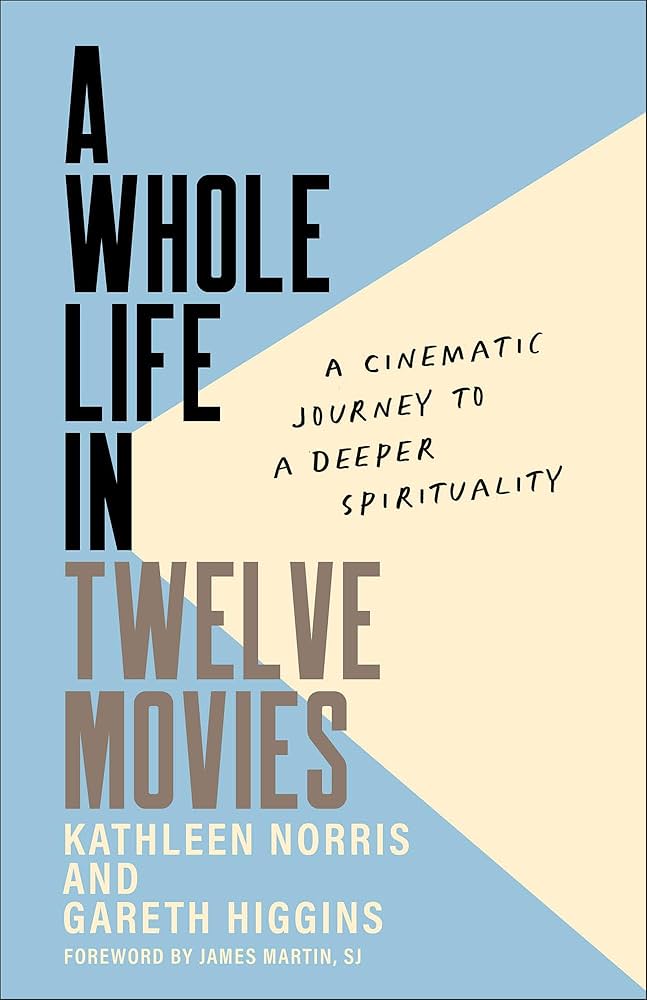
NEW BOOK: A Whole Life in Twelve Movies: A Cinematic Journey to a Deeper Spirituality by Kathleen Norris and Gareth Higgins: Published last October by Brazos Press, this excellent book comprises twelve chapters reflecting on fourteen movies (two chapters feature a complementary pair), drawing out story, insights, and meaning. It’s authored by the award-winning American spiritual memoirist and poet Kathleen Norris (Acedia and Me; The Cloister Walk; Dakota: A Spiritual Geography) and the Irish writer, peace activist, retreat leader, and festival organizer Gareth Higgins. Each chapter contains two mini-essays—one by each author, the second responding to the first, sometimes disagreeing on points—and a section of “Questions and Conversation,” which make the book especially fitting for a film/reading club. There’s also a “For Further Viewing” section in the back, with many more recommendations, several of which are new to me and which I’ve been watching (e.g., Le Havre, Love Is Strange, Patti Cake$) and really enjoying!

A Whole Life in Twelve Movies

I so appreciate the variety of films featured in the book—which come from different eras, cultures, and genres and address different themes—and I like that the writers don’t overdetermine the films’ meanings to try to make them fit a Christian agenda, which is sometimes a trap that people writing on Christianity and film fall into (influenced partly, I’m sure, by publishers’ demands, to make the marketing easier). Norris and Higgins are simply two Christians writing about their shared love of cinema, and I had so much fun listening in on their conversations.

You may also want to check out the Substack that Norris and Higgins write together, Soul Telegram: Movies & Meaning, whose purpose is “to help people find the most life-giving movies, and to write about them as a way of reflecting on the meaning of our lives.” See also the recent Habit podcast episode “Kathleen Norris watches movies,” where Norris discusses Paterson, Babette’s Feast, After Life, and more.

+++

SONGS:

>> “Oh Mercy (Long Way to Go)” by Glen Spencer and David Gungor, 2024: Debuted by the Good Shepherd Collective on December 8, 2024. Watch on Instagram below, or this cued-up YouTube video.

>> “Sawubona” (I See You) by Jane Ramseyer Miller, 2012: The most common greeting used by Zulu people is “Sawubona,” literally meaning “I see you,” with the implication of “My whole attention is with you. I value you.” The word conveys a deep witnessing and presence, acknowledgment and connection. A standard reply is “Ngikhona,” “I am here.” This humanity-honoring exchange that occurs regularly in South Africa was set to music by the American choral director Jane Ramseyer Miller and is performed in the video below by the Justice Choir, a grassroots movement that encourages more community singing for social and environmental justice.

The song is authorized for free noncommercial use, and sheet music is available from the Justice Choir Songbook.

+++

PODCAST EPISODE: “Taylor Worley: Sacramental Eyes and Conceptual Art,” The Artistic Vision, January 31, 2025: Dr. Taylor Worley is a visiting associate professor of art history at Wheaton College, the author of Memento Mori in Contemporary Art: Theologies of Lament and Hope (Routledge, 2019), and a recipient of a grant from the Templeton Religion Trust, which he has used to research the intersection of conceptual art and Christian contemplation. He’s also become a friend of mine, as we often run into each other at conferences!

In this recent podcast interview, he talks about his most amazing teaching experience to date; helping Protestants like himself recover a sacramental ontology of the world; asking questions verbally versus aesthetically; death and mortality; what conceptual art is, and why it’s “real art”; what the esteemed Roger Scruton got wrong in his documentary Why Beauty Matters; the “Art of Attention” study he conducted with a psychophysiology colleague in the modern wing of the Art Institute of Chicago (which I participated in! here’s one of the three pieces I was tasked with looking at for five straight minutes while hooked up to a heart-rate monitor); and why artists inspire him.

+++

LECTURE: “Spirituality and Art in the Twenty-First Century” by Aaron Rosen: For its fourth annual keynote on October 23, 2024, the MSU (Michigan State University) Foglio Speaker Series on Spirituality hosted Dr. Aaron Rosen, a writer, curator, and educator on religion and the arts. He is a practicing agnostic Jew married to an Episcopal priest and the author of Art and Religion in the 21st Century (Thames & Hudson, 2015). His presentation is so well-structured and spotlights a vast range of artworks! It starts at 5:05 of the video below; the Q&A is not included.

Rayner, Stephanie_Boat of Eternal Return
Stephanie Rayner, Boat of Eternal Return, 1998–2012. Pine, tulip poplar, mahogany, ebony, moose ribs, guanaco coccyx, mare pelvis, ruler, dice, DNA sequencing gels from the Human Genome Project, score of Mozart’s Requiem, cello components, hand-worked glass, spirit level, 9 × 30 × 2 1/4 ft.

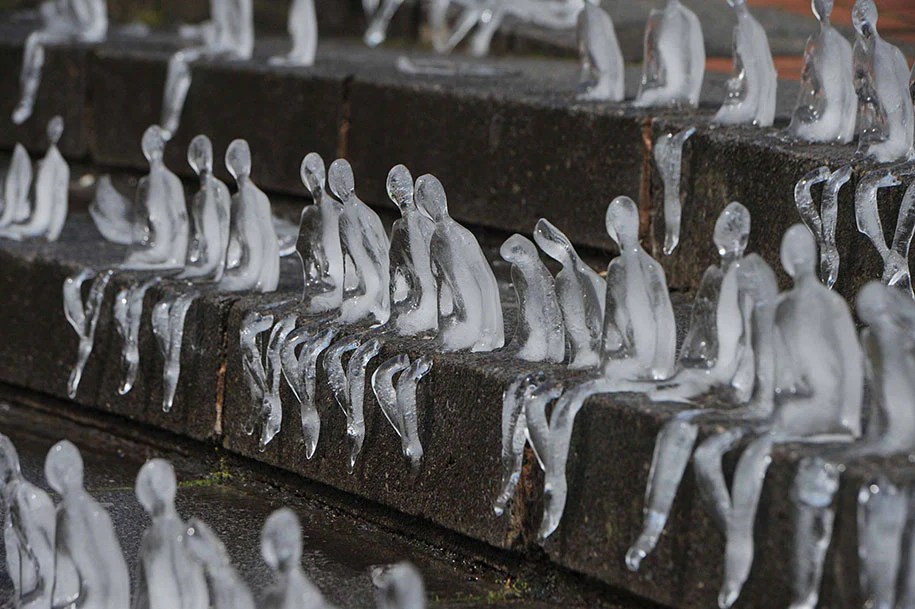
Azevedo, Nele_Minimum Monument
Néle Azevedo (Brazilian, 1950–), Minimum Monument (detail), Chamberlain Square, Birmingham, England, 2014. Sculpted ice.

In the talk, Rosen explores how art can facilitate or exemplify four spiritual states:

  1. Attention
    – Simplicity
    – Repetition
    – Memory
  2. Wonder
    – The Uncanny
    – Technological Sublime
    – Sublime Silence
    – Darkness
    – Ecological Lament
    – Ecological Hope
  3. Care
    – Resilience
    – Replenishment
    – Maintenance
    – Recognition
  4. Belonging
    – Homecoming
    – Pilgrimage
    – Sanctuary
    – Sharing Sacred Space

+++

VIDEO INTERVIEW: “VCS Creative Conversations: Ben Quash with Steve Reich”: “This film continues our series of ‘Creative Conversations’. In these conversations, living artists working in a variety of different artistic media discuss how the Bible and its legacies of visual and theological interpretation operate as a vital resource for their own creativity. In this film, VCS [Visual Commentary on Scripture] Director Ben Quash interviews the legendary American contemporary composer Steve Reich. They discuss the profound role of the Bible in transforming both the subject matter and the style of Reich’s music, reflecting especially on his settings of the Abraham story, the episode of Jacob’s ladder, and texts from the Psalms.”

“Love is patient…”: Ten songs based on 1 Corinthians 13

This Sunday’s lectionary reading from the Epistles is 1 Corinthians 13:1–13, the famous “love” passage. Here are ten songs that set that text or are based on it. And there are many more besides!

1. “1 Corinthians 13:1–8,” chanted in Romanian by Maria Coman, 2023:

2. “Love Will Never Fail” by Leslie Jordan, Orlando Palmer, Isaac Wardell, and Paul Zach of The Porter’s Gate, from Neighbor Songs, 2019:

For a cover by the Good Shepherd Collective, featuring Jayne Sugg and Son of Cloud (Jonathan Seale) (his is one of my favorite male singing voices), see here. They add as an outro the refrain of Martin Smith’s “I Could Sing of Your Love Forever.”

3. “Tell Him” by Lauryn Hill, 1998, performed by Esperanza Spalding, 2009:

The neo-soul/R&B album The Miseducation of Lauryn Hill (1998), Hill’s solo debut, is one of the most widely acclaimed albums of the nineties. At an evening of jazz and spoken word hosted at the White House on May 19, 2009, by then president Barack Obama, upright bass player, singer, and composer Esperanza Spalding performed her gorgeous arrangement of Hill’s “Tell Him.” The object pronoun “him” used throughout has been interpreted by listening publics as either a romantic partner or God, and the ambiguity is probably intentional. As for me, I hear the song as religious, especially given the line “the love that was shown when our lives were spared,” which I take to be a reference to Christ’s saving sacrifice. [HT]

4. “1 Corinthians 13:8–11” (excerpt) from Uganda, 2021:

This video was uploaded by Bwire Isaac, the founder of Alpha Worship Connection, a registered nonprofit that trains and equips worship leaders in Uganda. It was filmed at one of his Discipleship Training Weeks, and features a pastor named Muwanguzi playing the adungu (bow harp). I believe the language is Luganda. [HT]

5. “Love (1 Corinthians 13)” by Joni Mitchell, from Wild Things Run Fast, 1982:

The song also appears, re-recorded and in new arrangement, on Mitchell’s Travelogue (2002). Hear her speak about how the apostle Paul’s words inspired her in this two-minute video.

(Related post: “The Greatest of These,” a poem by Tania Runyan)

6. “Faith, Hope and Love” by Joanna Forbes L’Estrange, performed by London Voices, dir. Ben Parry, from Heaven to Earth, 2024:

7. “El Amor (1 Corintios 13)” by Michelle Matius, 2023:

Matius is a Christian singer-songwriter and recording artist from the Dominican Republic. Like all her songs, this one is in Spanish.

8. “Live for Love” by Eric Lige, 2022:

9. “The Gift of Love” by Hal Hopson, 1972, performed by Koiné on Gesanbuch, 2008:

The music of this one is adapted from a traditional English folk tune.

10. “Kanoo” (Love) by Elfi Bohl, aka Mariyama Suso, from Suukuu Kutoo / A New Song, 1999:

Bohl’s “Kanoo” is an original setting of 1 Corinthians 13:4–7 in the Mandinka language of West Africa, which she sings to a kora self-accompaniment. She wrote and recorded it while living in The Gambia. To learn more about Bohl and her kora songs, see my previous blog post from December.

Roundup: Nativity story told by Kenyan children, Annie Moses Band Christmas Special, industrious Joseph, and more

Some of you may wonder why I’m still posting Christmas content. It’s because it’s still Christmastime! Christmas is a twelve-day feast extending from December 25 to January 5. So keep the celebration going with parties, carols, decoration, storytelling, worship, and meditation on the amazing historic event of the Incarnation.

VIDEO: “The Nativity Story (as Imagined by Children in Kenya)”: Released in 2021, this video produced in Kenya by the faith-based child sponsorship organization Compassion International tells the story of Jesus’s birth with localized details, narrated and enacted by children. I was struck by how Mary is pounding yams when the angel Gabriel comes to her, like in one of Nigerian artist George Bandele’s wood carvings of the Annunciation, and how the shepherds literally run to see Jesus, so excited are they to meet him! [HT: Global Christian Worship]

As far as I can tell, this is the first installment in a series of children’s retellings of the Nativity story from around the world that Compassion International releases annually. Subsequent videos—all of them worth watching!—are from Indonesia (2022), Bolivia (2023), and the Philippines (2024).

+++

CONCERT RECORDING: O Holy Night: An Annie Moses Band Christmas Special: Named after their great-grandmother, the Annie Moses Band is an Americana string band of six siblings, raised by award-winning Nashville songwriters Bill and Robin Wolaver, who are committed to godly excellence in the arts. This Christmas concert of theirs, featuring outstanding arrangements of a range of classic carols and one original, was released on DVD in 2018 and just made available by the band for free on YouTube!

Here’s the set list. Links are to standalone videos, excerpted from the performance above. My favorites are probably the opener, “On This Day,” and “We Three Kings”:

+++

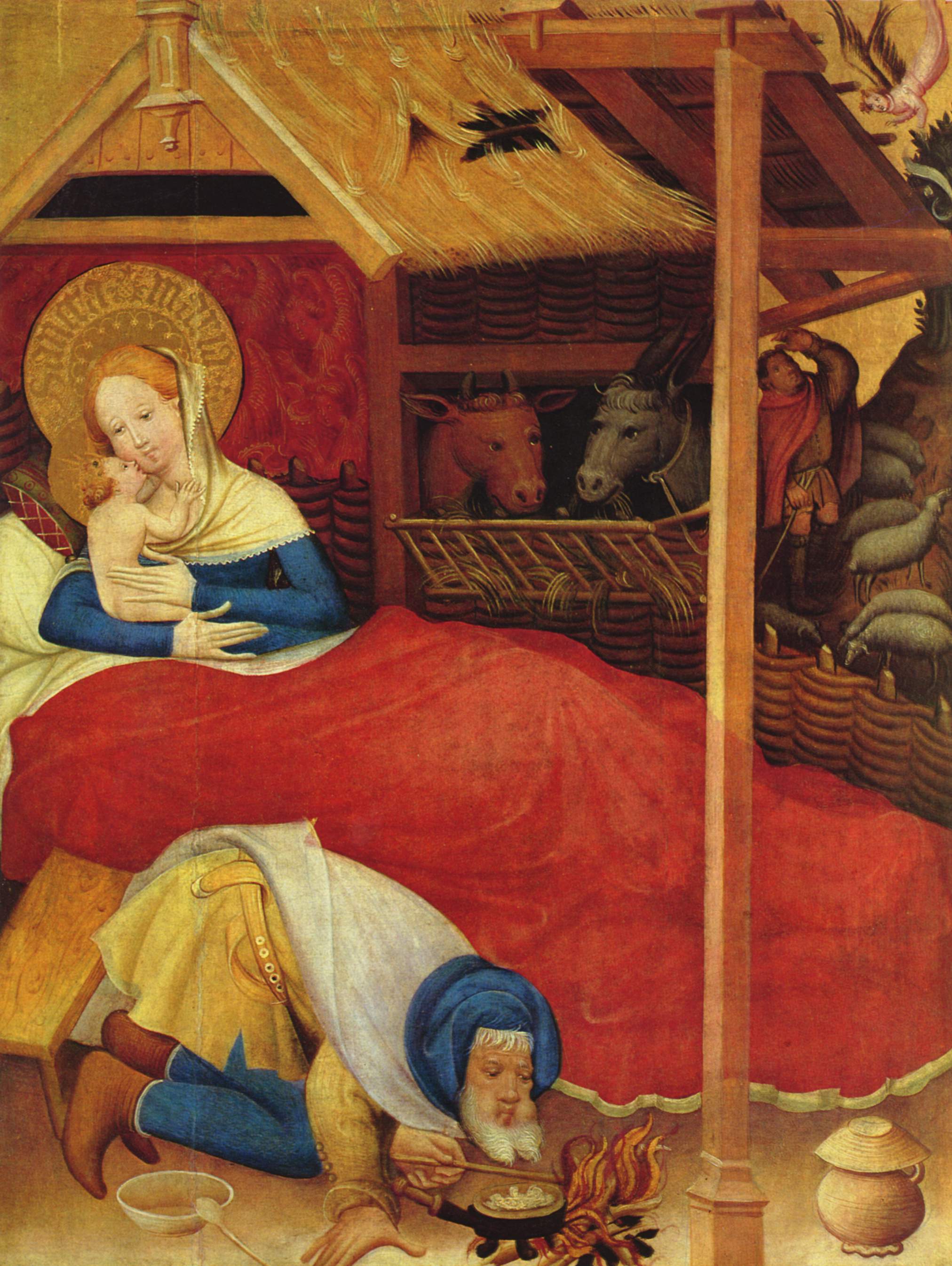
ARTICLE: “Saint Joseph as Baby Daddy: An Illustrated Medieval Guide” by Ela Bobek, DailyArt Magazine: In 2021 on Instagram I shared a small compilation of images that show Joseph as helpful and industrious at the Nativity, as opposed to the more classic depiction of him sitting off to the side with his head in his hands. I’ve since collected over a dozen more and have been wanting to develop a reflection on this motif into a full-fledged article (and probably still will someday), but Ela Bobek has beaten me to it! Check out the images she has compiled that show Joseph cooking, doing laundry, sewing clothes, preparing a bath, and swaddling or holding the baby—allowing Mary some much-needed rest. What a loving, caring, actively involved father and husband!

Konrad von Soest_Nativity
Conrad von Soest (German, ca. 1370–ca. 1422), Nativity, panel in the left wing of the Niederwildungen Altarpiece, 1403. Tempera on wood, 73 × 56 cm. Stadtkirche St. Nikolaus, Bad Wildungen, Germany. [view full altarpiece]

+++

SONGS:

>> “Christmas Ko Ramjham Ma” by Milan Bhujel and Surya Rasaili: This Nepali Christmas song was written by Milan Bhujel (words) and Surya Rasaili (music) in 2022 and is performed here (with dancing!) by Bhujel and friends. I couldn’t find a translation of the Nepali lyrics, but the gist of it is “Let’s dance and rejoice, let’s celebrate the birth of Jesus, who has come to save us. Jesus is a light dispelling all darkness.” [HT: Global Christian Worship]

>> “Christ Is Born (This Day)” by Todd Family Hymnal: This song by Jason B. Todd and Sara K. Todd, a married couple who make music together, is the second track of their Christmas EP from 2020. Jason (who goes by “JB”) is the pastor of administration and music at Westport Baptist Church in Denver, North Carolina.

>> “Funky Little Drummer Boy” by the Good Shepherd Collective: A cover of the funk arrangement of “The Little Drummer Boy” by Sharon Jones & the Dap-Kings, this performance video premiered last week at Good Shepherd New York’s Christmas Eve digital service. The soloist is Stephany Mora. Watch the standalone video on Instagram, or listen on YouTube at this cued-up link.

[Related post: “The Little Drummer Boy: Four Versions (Nigeria, India, Cuba, Norway)]

Roundup: Apache Christ icon, the Bible in photography, deer in church, and more

SPOTIFY PLAYLIST: September 2024 (Art & Theology)

+++

NEW ALBUMS:

>> Live On by the Good Shepherd Collective: The fourteen songs on this seventh full-length album by the Good Shepherd Collective are a mix of gospel, pop, and indie covers (Natalie Bergman, Harry Connick Jr., Aaron Frazer, Joni Mitchell, the Alabama Shakes, Celine Dion, Valerie June, Toulouse, Wilder Adkins) and two originals. Here’s “Look Who I Found” by Harry Connick Jr., sung by Charles Jones, followed by “Peace in the Middle” by Dee Wilson, Asaph Alexander Ward, and David Gungor, sung by Wilson, Gungor, and Rebecca McCartney. For more video recordings of songs from the album, see the Good Shepherd New York YouTube channel, which also features weekly digital worship services. Released July 12.

>> Facing Eden by Hope Newman Kemp: I heard Kemp perform at last year’s Square Halo conference and was compelled by her style, spirit, and songwriting. So I’m excited to see that several of the songs she shared live have now been recorded and released on her brand-new album! Produced by Jeremy Casella and tracked with a session band at the storied Watershed Studio in Nashville, Facing Eden leans toward café jazz but also bears influences from the Jesus Folk music of the 1960s that she was immersed in growing up. “Encompassing expansive sonic territory, the record isn’t afraid to wander into blue cocktail hours (‘My Inflatable Heart’), gospel riversides (‘Mercy,’ ‘Come Home,’ ‘Let It Rise’), ballad-style acoustic hymnody (‘Maria’s Song’), and even the free rubato motion of a musical theatre sound (‘Take Them Home’).” Released August 30.

+++

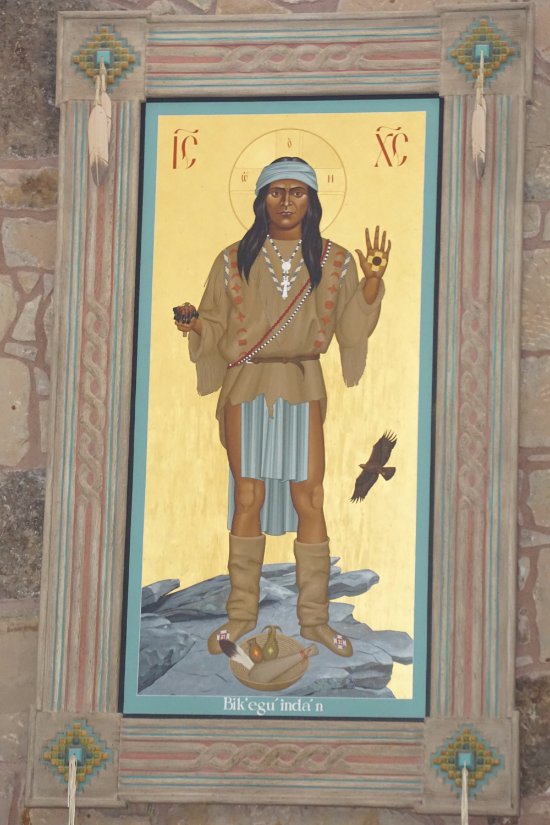
ARTICLE: “Apache Christ icon controversy sparks debate over Indigenous Catholic faith practices” by Deepa Barath, Associated Press: In 1989, a new icon by the Franciscan artist-friar Robert Lentz was installed behind the altar of St. Joseph Apache Mission church in Mescalero, New Mexico. According to the artist’s statement, the painting shows Christ as a Mescalero holy man, standing on the sacred Sierra Blanca (White Mountains). A sun symbol is painted on his left palm, and in his right hand he holds a deer hoof rattle. A basket at his feet holds an eagle feather, a grass brush, and bags of tobacco and cattail pollen, items used in Native rituals. Behind him flies an eagle, the guide who led the nomadic hunter-gatherer Apaches to their “promised land” of the Tularosa Basin in southern New Mexico some seven hundred years ago. The inscription at the bottom reads, “Bik’egu’inda’n,” Apache for “Giver of Life.” The Greek letters in the upper corners are an abbreviation for “Jesus Christ.”

Lentz, Robert_Apache Christ
Br. Robert Lentz (American, 1946–), OFM, Apache Christ, 1989. Egg tempera and gold leaf on gessoed panel, 8 × 4 ft. St. Joseph Apache Mission Church, Mescalero, New Mexico. Photo: Colin Archibald.

Fr. Dave Mercer, a former priest at St. Joseph’s, describes the image and its significance:

When Franciscan Br. Robert Lentz painted his Apache Christ icon, he did so with great care for Apache traditions and sacred customs and with dialogue with tribal spiritual leaders, the medicine men and women. With their approval, he painted Jesus as a medicine man, including symbols and sacred items for which our Apache friends needed no explanation. They understood the message that our Lord Jesus had been with them all along and that he is one of them as he is one with the people of every land.

But on June 26, the church’s then-priest, Father Peter Chudy Sixtus Simeon-Aguinam, who had been installed in December 2023, removed the icon and a smaller painting depicting a sacred Indigenous dancer. Also taken were ceramic chalices and baskets given by the Pueblo community for use during the Eucharist. Neither Father Chudy nor the Diocese of Las Cruces, which oversees the mission, have provided a statement, but in July Father Chudy departed and, due to the demands of the congregation, the icon and other objects were returned. Presumably the removal was due to a fear of syncretism.

I’m not able to address that complicated charge in this roundup format, but I wanted to put this news item out there to show how art so often shapes religious communities—in this case affirming the Apache Christian identity (contrary to the claims of some, the two are not mutually exclusive) and conveying a sense of God-with-us and God-for-us. Click here to watch a five-minute video interview with the artist from 2016, who says the icon of the Apache Christ is an effort to heal the wounds that Christian missionaries inflicted on Native people in the past.

+++

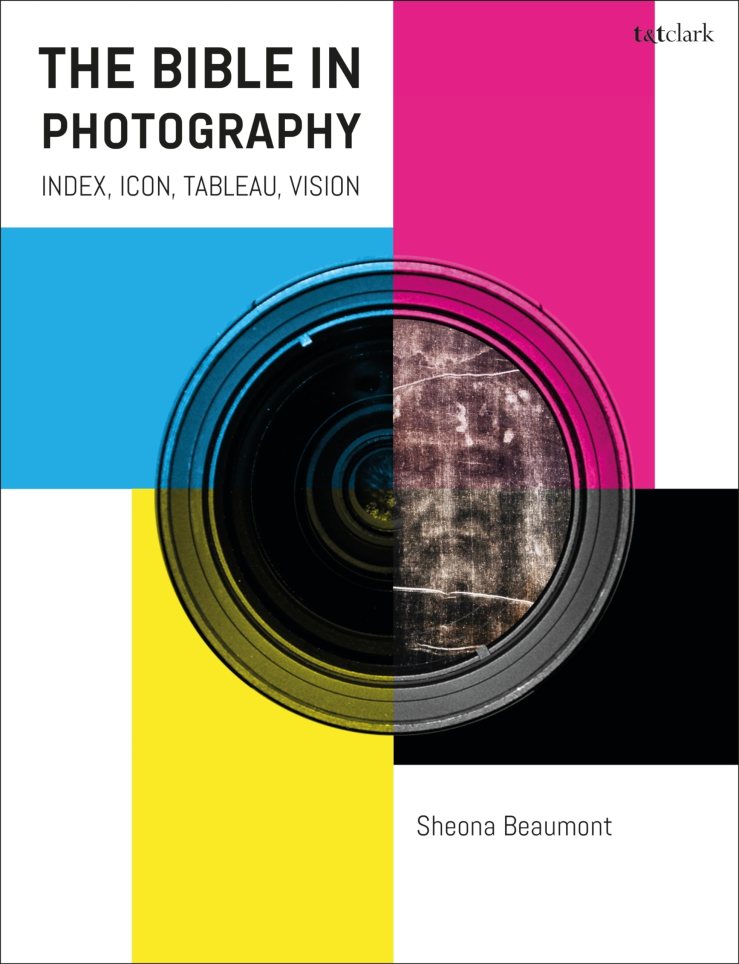
NEW BOOK: The Bible in Photography: Index, Icon, Tableau, Vision by Sheona Beaumont: Artist and scholar Sheona Beaumont [previously] is a visiting research fellow at King’s College London and cofounder of Visual Theology. In this book published by T&T Clark, she discusses, with critical depth, a range of “photographs that depict or refer to biblical subject matter, asking how the reception of the Bible by photographers and their audiences reveals their imaginative interpretation,” she writes. “I hope to show that, far from being an outdated, idiosyncratic or dead referent, the Bible’s many afterlives in photographs are uniquely qualified to show up the workings of a modern religious imagination” (1).

The Bible in Photography

In preparation for this project, Beaumont comprehensively scoped the representations of biblical characters, scenes, and texts through the whole of photographic history, from Fred Holland Day and Julia Margaret Cameron to Gilbert & George and Bettina Rheims. For the book she chose fifty-five such images and interviewed twenty living photographers. In addition to fine-art photography, she covers documentary photography, advertising photography, propaganda, diableries, and spirit photography.

The Bible in Photography is highly academic; nonscholars will probably find part 1, where the author establishes the conceptional and methodological footing for her inquiry, too dense (it’s in dialogue with Hans-Georg Gadamer, Marshall McLuhan, Walter Benjamin, and Anthony Thiselton). For me, the highlight of the book is the selection of images and the grappling with the literal and the spiritual—the difficulties of representing historically real persons using contemporary models, and of conveying a “something more” beyond the surface, an element of transcendence. Some of the photographic pieces I’ve never encountered before, such as Corita Kent’s arrangement of journalistic photographs as Stations of the Cross from the Spring 1966 issue of Living Light. There’s much to savor here!

My research interests center on the figure of Christ, a figure that, Beaumont notes, still has cultural currency in fine-art photography. “Even if our predominantly secular culture has largely abandoned its inheritance of a (Christian) hermeneutic tradition, the heritage-infused currents of visual culture in combination with the return of religion in global terms, demands its voice” (225). She encourages us to consider where and how and why Jesus is showing up in the medium of photography.

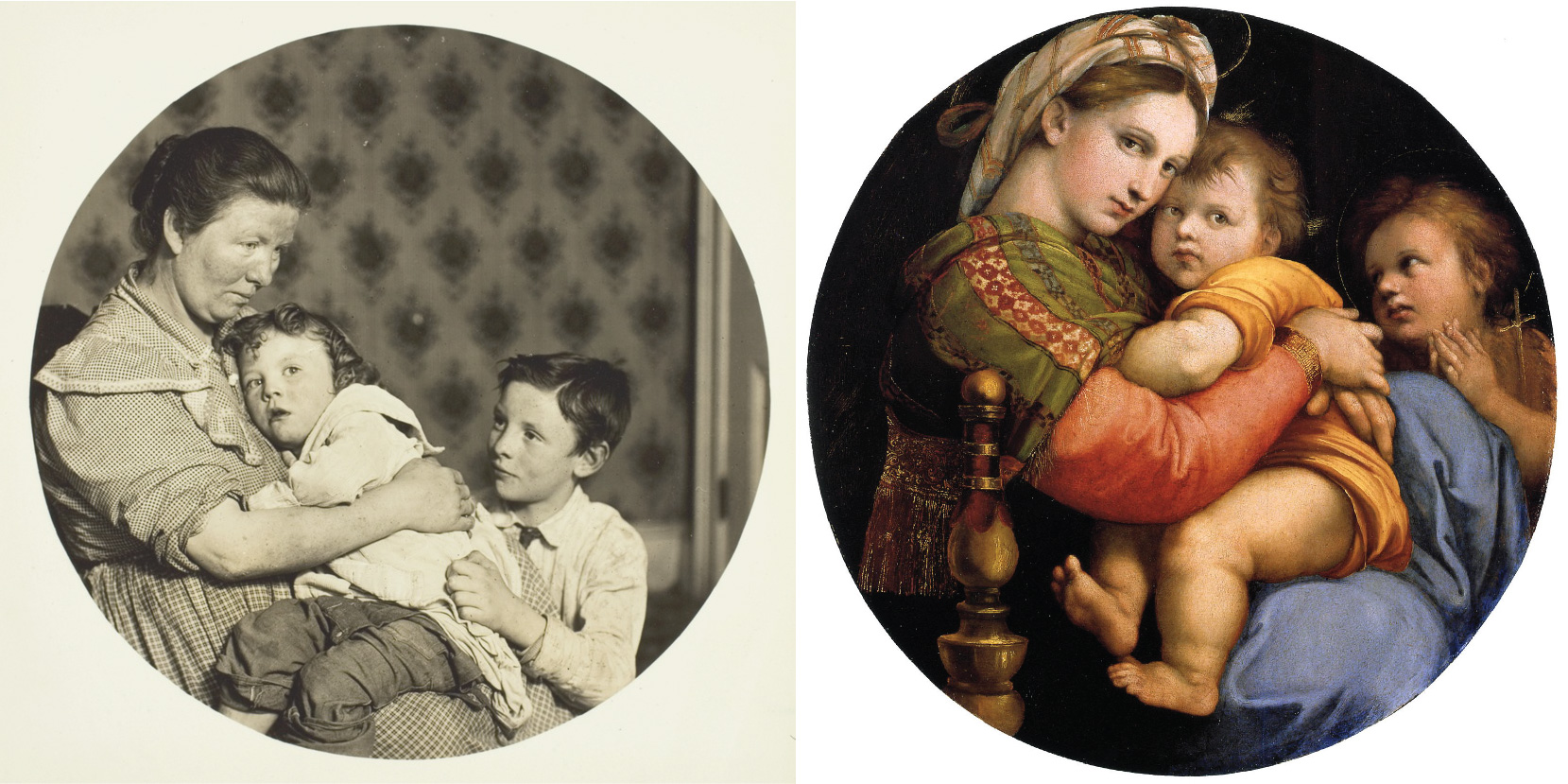
Tenement Madonna
Left: Lewis Hine (American, 1874–1940), A Madonna of the Tenements, 1904. Gelatin silver print, diameter 10 in. Right: Raphael (Italian, 1483–1520), Madonna of the Chair, 1513–14. Oil on panel, diameter 28 in. Palazzo Pitti, Florence.

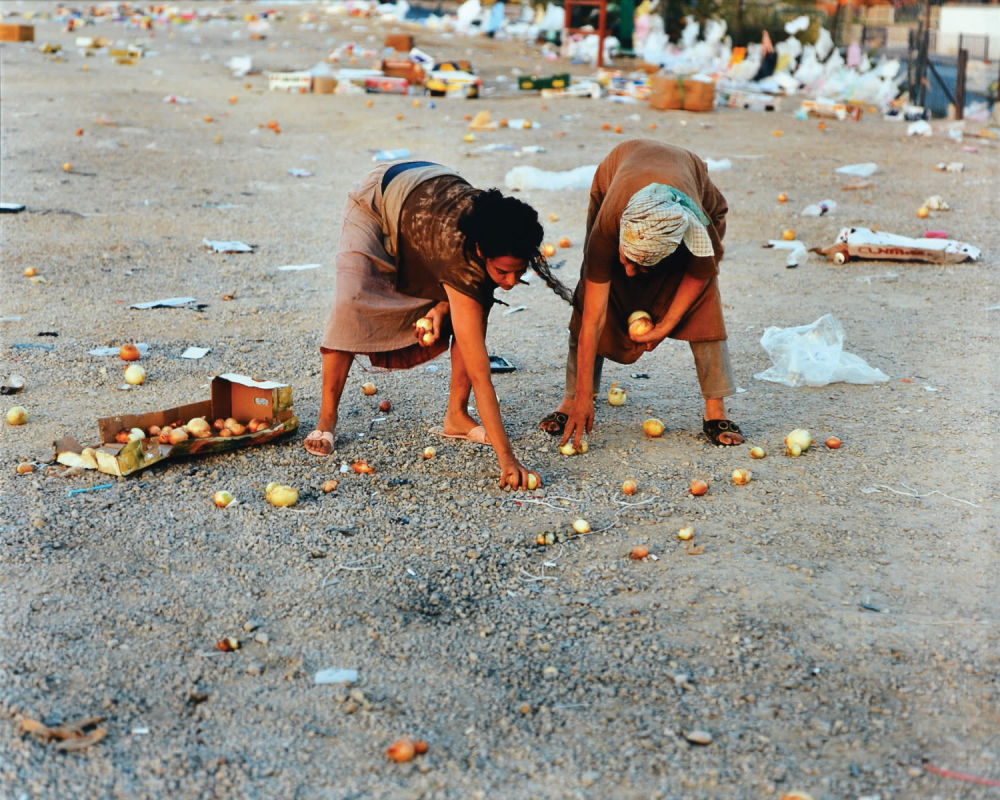
Nes, Adi_Ruth and Naomi
Adi Nes (Israeli, 1966–), Untitled (Ruth and Naomi), 2006. C-print, 140 × 177 cm.

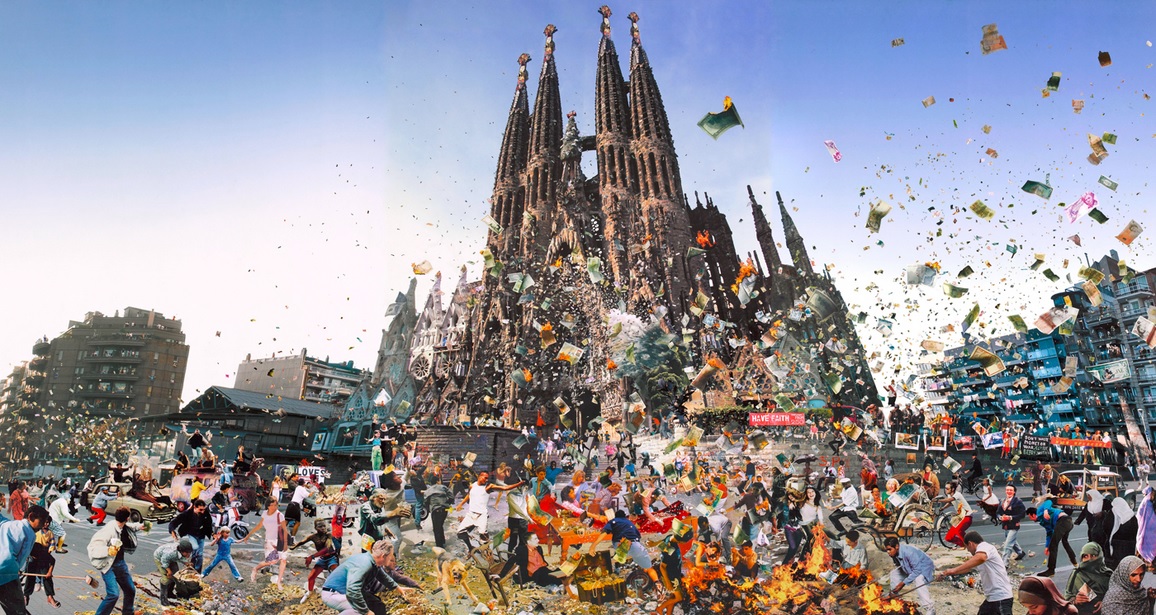
Mach, David_The Money Lenders
David Mach (Scottish, 1956–), The Money Lenders – Barcelona, 2011. Press print collage, 10 × 18 ft.

+++

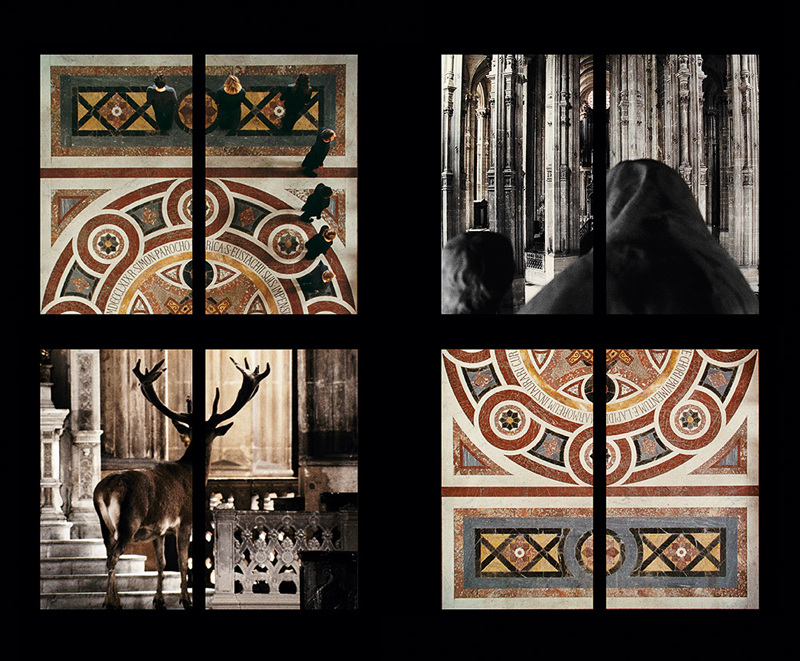
VIDEO: Deer in a Church: This short clip is one of the test scenes filmed on July 23, 2014, at the Église Saint-Eustache (Church of Saint Eustace) in Paris in preparation for a site-specific video installation commissioned for the church from Leonora Hamill, a photographic artist born in Paris and based in London and New York. The church is named after a Roman general who converted from paganism to Christianity during a hunt, after the stag he was pursuing turned to him and a cross appeared between its antlers, and he heard God speak, commanding him to be baptized. Eustace was martyred for his faith by Emperor Trajan in AD 118. His feast day is celebrated on September 20 in the Catholic Church and November 2 in the Orthodox Church.

The magnificent red deer (Cervus elaphus) in the video, a trained stag, is named Chambord. The installation he was filmed for, which was on view from December 4, 2014, to January 18, 2015, is titled Furtherance; a “making of” video can be seen here, and Hamill has posted another test scene on Instagram. Her director of photography for the project was Ghasem Ebrahimian.

From the artist’s website: “Shot on 35mm, the work weaves together traces of everyday activities within the church, unusual architectural points of view and a live stag . . . wandering through the space. Hamill transcribes the collective energy specific to this place of worship by retracing the steps of the church’s various occupants: priests, parishioners, tourists, soup-kitchen volunteers (on duty at the West Entrance every evening during winter) and their ‘guests’. These crossing paths constitute the social essence of the site. Their minimalist and precise choreography merges the human and spiritual sap of St Eustache.”

The footage of the majestic deer inside the majestic seventeenth-century sacred space—looking curiously around the high altar, the soaring candles reminiscent of trees in a forest—is breathtaking! Reminds me of Josh Tiessen’s Streams in the Wastelands painting series. Even nonhuman creatures praise the Creator.

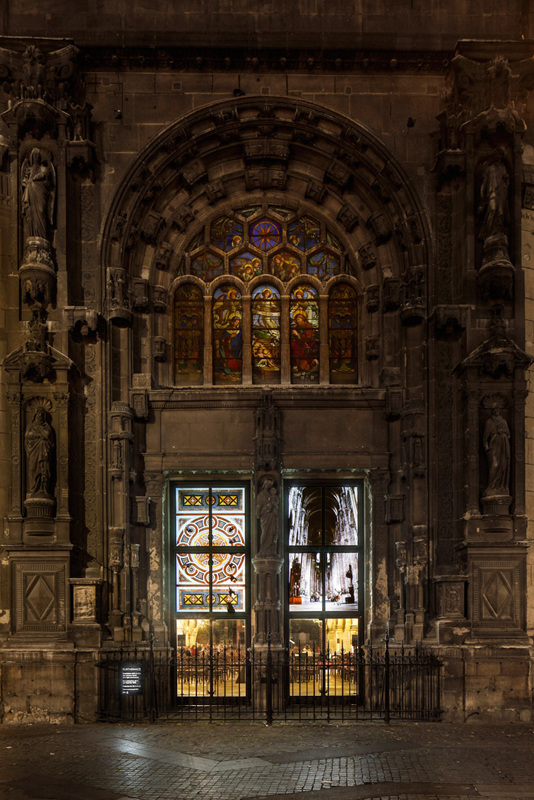
Hamill, Leonora_Furtherance (installation)
Leonora Hamill (French, 1978–), Furtherance, installation view, St. Eustache Church, Paris, 2014. Two-channel HD projection, color. 35 mm transferred to 2K. Duration: 8 mins, 26 secs. Commissioned by the Rubis Mécénat cultural fund. Photo: Liz Eve.

Hamill, Leonora_Furtherance
Production still from Furtherance by Leonora Hill

Roundup: Coventry Cathedral HENI Talk, dilapidated migrant boats transformed into musical instruments, and more

SONGS:

>> “Empty Grave” by Zach Williams: Some southern rock!

>> “Overcome with Light” by Bowerbirds, performed by Daniel Seavey and Liz Vice:

>> “Look Who I Found” by Harry Connick Jr., performed by the Good Shepherd Collective, feat. Charles Jones: This song cover premiered at Good Shepherd New York’s online Easter service last month. The original is from Harry Connick Jr.’s 2021 album Alone with My Faith, a mix of new songs he wrote (like this one) and classic hymns.

+++

ART VIDEO: “Coventry Cathedral: A Journey Through Art” (HENI Talks), written and presented by James Fox: While my husband was presenting at a science conference at Oxford in 2013, I took a train to Coventry and spent the whole day at the city’s cathedral, wandering through its chapels and grounds, sitting in front of its various artworks as the light changed, praying, and even talking with a few locals, including one man who had lived in Coventry since before its bombing in World War II. That bombing destroyed the original St. Michael’s from the fourteenth century, but when the cathedral was rebuilt after the war, it provided the occasion for new commissions from modern architects and artists. Here’s a wonderful video introduction to the history, art, and design of Coventry Cathedral:

In it the art historian and BAFTA-nominated broadcaster Dr. James Fox explores some of the cathedral’s modernist masterpieces: St. Michael’s Victory over the Devil by Jacob Epstein; the West Screen by John Hutton; the Tablets of the Word by Ralph Beyer; the stained glass windows in the nave by Lawrence Lee, Keith New, and Geoffrey Clarke; the lectern eagle by Elisabeth Frink; the high-altar cross of nails by Geoffrey Clarke; the monumental tapestry Christ in Glory in the Tetramorph by Graham Sutherland (which I wrote about for ArtWay); Angel of Agony by Steven Sykes; the Crown of Thorns by Geoffrey Clarke; the Chapel of Unity floor mosaics by Einar Forseth; and the Baptistery Window by John Piper. The latter Fox calls the pinnacle of the entire complex, and I agree—it’s extraordinary. Explore more at www.coventrycathedral.org.uk.

Coventry Cathedral interior
Coventry Cathedral in the West Midlands, England. Photo: David Iliff (CC BY-SA 3.0).

West Screen by John Hutton
Detail of the large glass “west” screen at Coventry Cathedral, designed and hand-engraved by John Hutton, 1962. This view looks out over the ruins of the Old Cathedral. Photo: Victoria Emily Jones.

For more HENI Talks, see heni.com/talks. See also a feature I ran about this video series back in 2021.

+++

SONG: “See What a Morning (Resurrection Hymn)” by Stuart Townend and Keith Getty, sung by the Coventry Cathedral choirs and congregation: Although Coventry Cathedral attracts tourists, it’s also an active church, home to a regular worshipping community! Here’s a video of the beginning of the entrance rite on Easter Day 2012, a procession carried out to the 2003 hymn “See What a Morning.” I appreciate the versatility of Stuart Townend and the Gettys’ hymns, which tend to work equally well if led by a contemporary worship band or a traditional choir with piano/organ accompaniment. I’m used to hearing their hymns sung in low-church contexts (“low church” refers to Christian traditions, such as evangelicalism, that place less emphasis on ritual and sacrament, as opposed to “high church”), so it was a delight to see one used as part of the Anglican liturgy and in such a majestic space!

+++

ARTICLE: “La Scala concert features violins that inmates made from battered migrant boats” by Colleen Barry, AP News, February 13, 2024: “The violins, violas and cellos played by the Orchestra of the Sea in its debut performance at Milan’s famed Teatro alla Scala carry with them tales of desperation and redemption. The wood that was bent, chiseled and gouged to form the instruments was recovered from dilapidated smugglers’ boats that brought migrants to Italy’s shores; the luthiers who created them are inmates in Italy’s largest prison. The project, dubbed Metamorphosis, focuses on transforming what otherwise might be discarded into something of value to society: rotten wood into fine instruments, inmates into craftsmen, all under the principle of rehabilitation . . .” This is a beautiful story of repurposing, of new life—for weathered wood that carried families out of danger zones, and for men who have been convicted of crimes but who seek to engage their hands and hearts in creative projects.

Reclaimed violin
February 9, 2024: A violin made from the wood of wrecked migrants’ boats lies in the instrument workshop at Opera maximum-security prison outside Milan. Photo: Antonio Calanni / Associated Press.

Reclaimed cellos
Two members of the Orchestra of the Sea play cellos made by inmates from reclaimed wood at the orchestra’s debut performance in Milan on February 12, 2024. Photo: Antonio Calanni / Associated Press.

Roundup: New essay collection, Notes of Rest, Saint Francis, and more

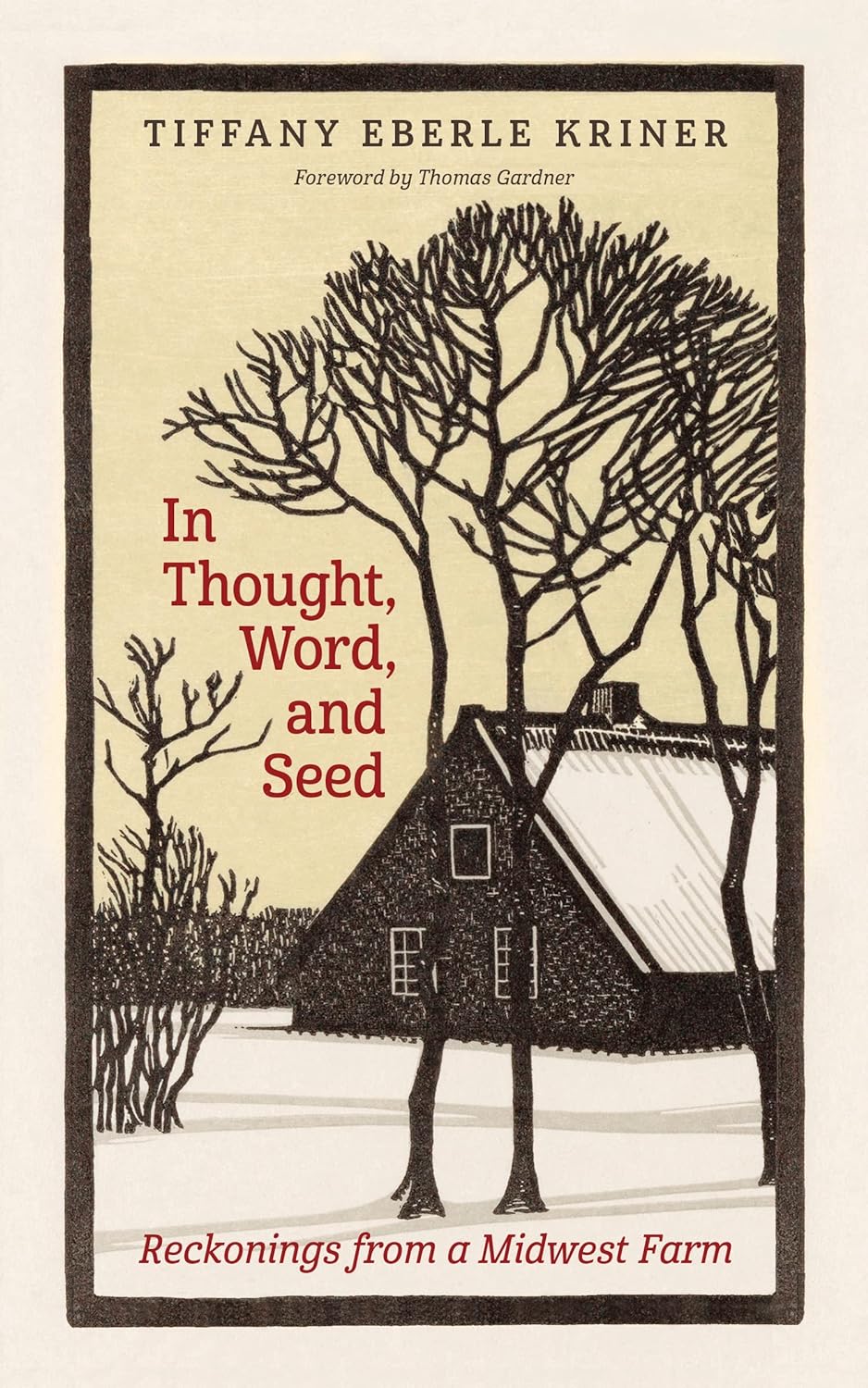
NEW BOOK: In Thought, Word, and Seed: Reckonings from a Midwest Farm by Tiffany Eberle Kriner: As a freelance copyeditor, I’ve worked on many projects for Eerdmans, and this has been one of my favorites: an essay collection by Tiffany Kriner, a Wheaton English professor and farmer from Illinois. It’s a unique blend of literary criticism, nature writing, and memoir. Virgil, George Eliot, James Baldwin, and Walt Whitman are among the authors she engages, respectfully weaving their stories into and around her own experiences of cultivating sixty acres of land and raising livestock with her husband, Josh. Today is the book’s official release date, and I can’t recommend it enough!

+++

(FIVE-WEEK) ONLINE COURSE: “Notes of Rest: Receiving Rest from Scripture and Black Music in Our Restless World,” taught by Julian Davis Reid: On Monday evenings from October 9 to November 6, pianist, speaker, and writer Julian Davis Reid, MDiv, of Chicago will be leading five, seventy-five-minute virtual discussions and meditations on the theme of rest, explored through the lenses of scripture and Black music. “Salvation,” “Sabbath,” “Sleep,” “Stillness,” and “Sanctuary” are the organizing principles. “The purpose of the class is to help the Body of Christ hear God’s invitation to rest,” Reid told me. “The means of getting there is through a mixture of artistic reflection and practical theology grounded in biblical analysis, reflection questions, and musical performance.” No prior musical knowledge is required.

The spiritual “Give Me Jesus” is an example of one of the songs Reid will be playing and guiding participants through (this recording is from his 2021 album Rest Assured, with album art by Shin Maeng):

This course is presented by the Candler Foundry, an initiative of Emory University’s Candler School of Theology that aims to make theological education accessible to everyone. It’s only $29! Reid has been leading Notes of Rest sessions since 2021, and he is currently accepting bookings from churches, universities, and parachurch ministries; you can contact him through his website.

+++

SONGS:

>> “Garden Will Bloom” by the Good Shepherd Collective, feat. Diana Gameros: Released this July as a single, “Garden Will Bloom” was written by Diana Gameros, Jon Guerra, and Kate Gungor at Laity Lodge, an ecumenical retreat center in Texas, and produced by David Gungor. It’s a song that speaks hope to one’s own soul, encouraging persistence through seasons of no yield. The music video was filmed and directed by Jeremy Stanley.

>> “Sing, Sing, Sing (Psalm 96)” by Wendell Kimbrough: This is my favorite track from Wendell Kimbrough’s latest album, You Belong.

+++

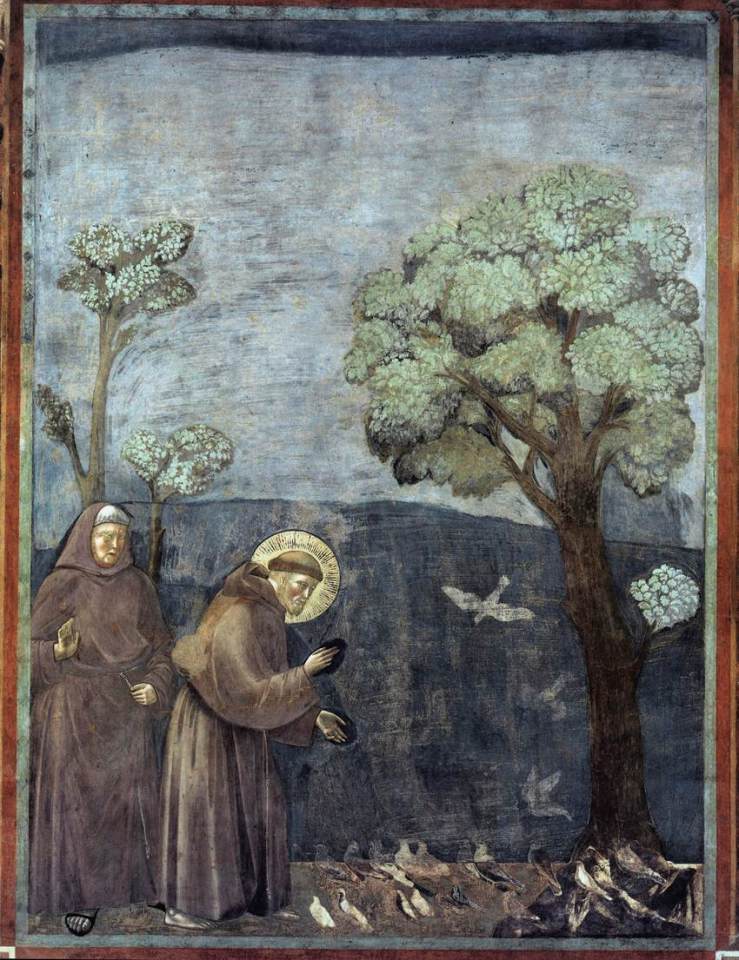
POEM: “Saint Francis and the Birds” by Seamus Heaney: Giovanni di Pietro di Bernardone (ca. 1181–1226), better known as Francis of Assisi, was an Italian mystic and friar who founded the religious order named after him, the Franciscans. Because of his love for all God’s creatures, he is considered the patron saint of animals, and his feast day is October 4. One story about him says he preached to the birds, as he believed the gospel is for them too, and that they, too, have a duty to praise God. This poem by the Nobel Prize–winning Seamus Heaney evokes Saint Francis’s sermon to his feathered friends.

St. Francis Preaching to the Birds
“Sermon to the Birds,” from the Legends of Saint Francis cycle, attributed to Giotto, 1297–1300. Fresco, 270 × 200 cm. Upper Church, Basilica of St. Francis of Assisi, Assisi, Italy.

From the blog archives: For another poem about this legend, see “Saint Francis Endeth His Sermon” by Louise Imogen Guiney. For a brilliant literary essay by Kimberly Johnson on Francis’s “Canticle of the Creatures” (which evolved into the hymn “All Creatures of Our God and King”), see here.

+++

INTERVIEW: “The Artist’s Gift of Reckless Courage” with Betty Spackman: Comfort, confront, teach, heal—those are just a few of the actions the arts can perform, says Canadian installation artist Betty Spackman in this insightful interview for Radix Magazine (available in audio format wherever you get your podcasts, and in print). Spackman discusses misconceptions about artists and the arts, the expansive definition of “creativity,” the gifts artists offer the church, and the charge of elitism. She also gives advice to pastors and to artists.

Here are just two snippets:

  • “The artist can reveal the heart of God in unique ways, and that gives us a responsibility. We can be vessels of wonder and light, through sound and image and movement and story. . . . By their very nature, [artists] are more open to thinking outside the box, to going past the status quo, to dreaming and to imagining. . . . Scripture tells us a child will lead us and it is childlike faith that will lead us forward. Perhaps what we can learn from artists is to be more childlike.”
  • “When someone paints their pain, or sings it, or dances it, our response should not be to ignore or condemn it because it’s not pretty or is outside of our worldview. We should find out what it is, and then respond in a meaningful way to the person who made it. The arts are really a place of opportunity to both express and to listen to the grief of the world, and Christians need to be there to do both.”

Roundup: Kristin Asbjørnsen interprets the spirituals, photos from Skid Row, and more

SPOTIFY PLAYLIST: July 2023 (Art & Theology): This month’s Spotify mix that I put together for you all includes a Shona worship song from Zimbabwe; “Adonai Is for Me,” a song in Hebrew by Shai Sol; a Black gospel rendition of the children’s classic “Jesus Loves Me”; a new setting of the Lord’s Prayer by Jon Guerra; a composition for clarinet and piano by Jessie Montgomery, written in April 2020 to try to make peace with the sadness brought about by the pandemic-prompted quarantine orders; a country-style setting of Psalm 121 by Julie Lee; and a benediction by Bob Dylan that I heard Leslie Odom Jr. sing in concert recently—its refrain, “May you stay forever young,” is not an anti-aging wish but rather a call to childlike faith, wonder, and curiosity in perpetuity.

The playlist also includes the following two songs.

>> “Come Go with Me”: A lesser-known African American spiritual performed by the Norwegian jazz singer-songwriter Kristin Asbjørnsen, from her excellent album Wayfaring Stranger: A Spiritual Songbook. She describes the spirituals as “existential expressions of life: songs of longing, mourning, struggling, loneliness, hopefulness and joyful travelling.” This particular one is about walking that pilgrim path to heaven, a path on which Satan lays stones to obstruct our progress but which Jesus, our “bosom friend,” clears away.

>> “Love, More Love”: A short Shaker hymn that opens with a common Shaker greeting: “More love!” “Our parents above” refers, I believe, to the elders of the faith who have passed on. The hymn uses horticultural imagery to describe the qualities of communal love—something planted and grown, becoming stronger and fuller and more beautiful as it is nurtured.

Love, more love
A spirit of blessing I would be possessing
For this is the call of our parents above

We will plant it and sow it
And every day grow it
And thus we will build up an arbor of love

The Shakers are a Christian sect founded in 1747, but because celibacy is one of their tenets (and thus they cannot rely on procreation for the community’s continuation), there are only two Shakers left: Sister June and Brother Arnold, who live in Dwellinghouse, Maine. But there has long been a historical interest in Shaker religious culture and aesthetics—which is why, for example, the Enfield Shaker Singers was formed, to preserve the hymnody.

+++

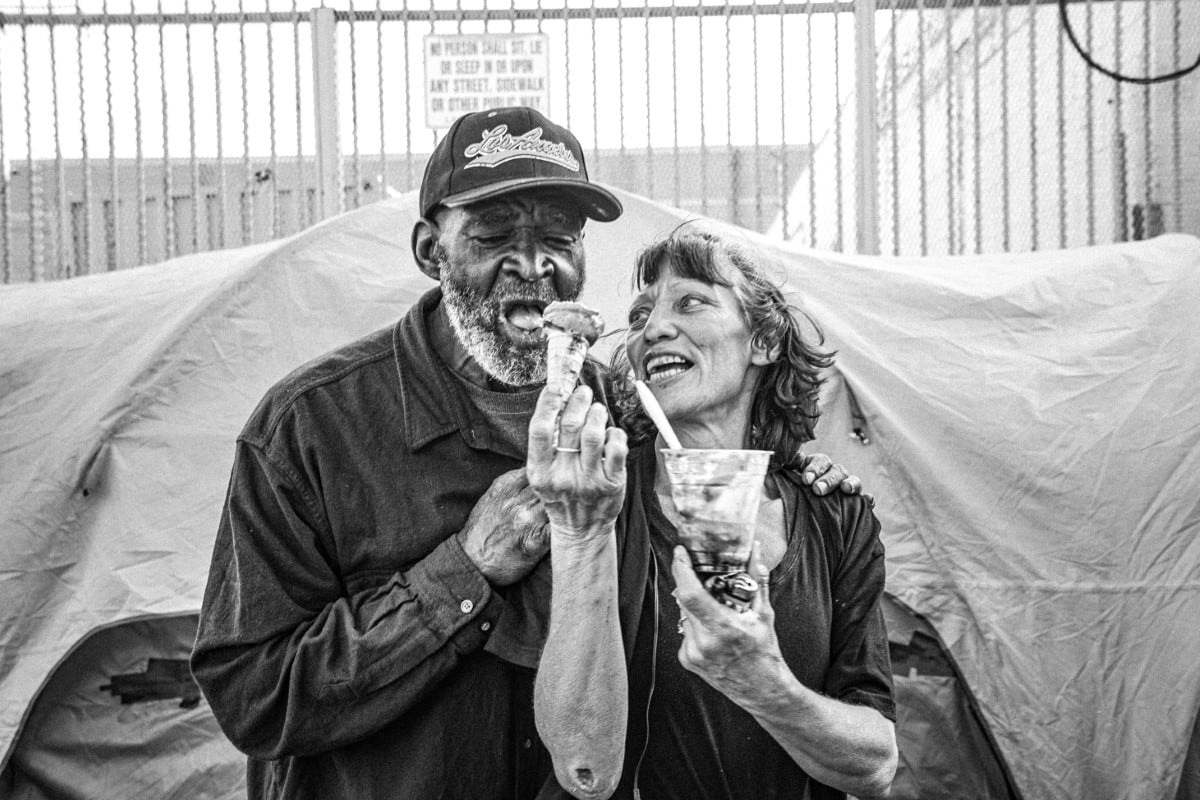
INTERVIEW + PHOTOS: “Photographer Shows the Raw, Unflinching Reality of Life on Skid Row”: For the past decade, anonymous street photographer Suitcase Joe has been spending time on Skid Row in downtown Los Angeles, a neighborhood inhabited by the largest unhoused community in America. He slowly developed trust and built relationships with the people in that community, learning more about their stories, and they granted him unprecedented access to their daily lives, allowing him to capture them on camera. Hear him talk about the experience, and about misconceptions people tend to have about those experiencing homelessness, in this interview, which also includes a sampling of photos. Even though the headline hawks “Raw!” and “Unflinching!,” I was more struck by how the photographs show experiences of joy and friendship.  

Photo by Suitcase Joe
Photograph by Suitcase Joe, Skid Row, Los Angeles

To find out ways to help meet the needs of those living on Skid Row, visit https://suitcasejoefoundation.org/.

+++

POEM WITH COMMENTARY: “The Rungs” by Benjamin Gucciardi, commentary by Pádraig Ó Tuama: Each week on the Poetry Unbound podcast, Ó Tuama reads and reflects on a different contemporary poem. In this episode’s featured poem, “a social worker holds a group for teenagers at a school. They only half pay attention to him. Then something happens, and they pay attention to each other.” The poem is from Gucciardi’s latest collection, West Portal.

+++

ARTICLE: Dool-Hoff: A Dutch Maze with New Jerusalem at its Centre (1705)”: The Public Domain Review is always uncovering unique, amusing prints and other artistic and literary curiosities from centuries past. Here they look at an early eighteenth-century religious maze published in Haarlem, Netherlands, whose pathways are filled with didactic verse, some leading to dead ends but others leading to heaven at the center.

Dool-Hoff (Dutch maze)
Dool-hoff (maze), signed by the Dutch Catholic printer Claes Braau, 1705. Photo courtesy of the Rijksmuseum, Amsterdam.

+++

SONG: “Home Inside” by Valerie June, performed by the Good Shepherd Collective: This Valerie June cover is sung so gorgeously by Sowmya Somanath with Kate Gungor, Bea Gungor, Jayne Sugg, Liz Vice, and Diana Gameros, and John Arndt accompanies on piano. It premiered in Good Shepherd New York’s March 12 digital service. The song is a prayer for belonging more fully to ourselves, to God, and to this earth; its speaker asks that she might be sensitive to the divine breath in all living things, and be soothed and refreshed by that great stream of water that flows from God’s heart. (Reminds me a bit of Universal Jones’s “River”!)

Here is the original recording by Valerie June.

Pentecost Playlist

Celebrated fifty days after Easter, Pentecost is one of the great feasts of the Christian year. It commemorates the descent of the Holy Spirit on Jesus’s apostles when they were gathered in Jerusalem for the Feast of Weeks ten days after Jesus ascended to heaven, marking the birth of the church. Acts 2 describes the Spirit’s coming as accompanied by a “rushing mighty wind” and “tongues of fire”—quite the dramatic entry! The Spirit filled the apostles with the miraculous ability to preach in speech that was comprehensible to all the many Jewish pilgrims, from various language groups, who were gathered in the city, resulting in the conversion that day of three thousand to the Jesus Way.

I’ve compiled a Spotify playlist of one hundred-plus Pentecost songs that celebrate God’s Spirit poured out over the face of the earth, bringing life and power. The indie folk genre is heavily represented, but there’s also an Appalachian fiddle tune, a Renaissance motet, a Native American dance song, a Russian Orthodox kontakion, Sacred Harp hymns, modern classical, Pentecostal gospel, blues, jazz, pop, lo-fi, and more. I hope to capture something of the Spirit’s dynamism with these selections.

The Holy Spirit ministers in a handful of ways. He renews, purifies, transforms. He gifts and empowers. He guides and illumines and comforts. He dwells within, a constant friendly presence. He intercedes for us with wordless groans. He unites believers across lines of difference, making us one. He enables us to bear fruit—love, joy, peace, etc.—for God’s glory and the world’s good.

So many songs centered on the Holy Spirit have an individualistic focus and a gentle, subdued tone. The Spirit does of course minister to the individual, and can be gentle and soothing (Jesus refers to him as the Comforter, after all!), and we often invoke him in our weariness. But the Spirit is also wild and uncontainable. And the life he brings is not merely of an inward spiritual kind; his impact manifests itself in tangible deeds out in the community, as those whom he fills go forth to serve their neighbors after the example of Christ.

Urban Doxology’s “Spirit, Send Your Fire” is a good example of a Holy Spirit song with an outward, communal focus, and it’s full of anticipatory excitement:

In terms of energy, consider the vigor with which Bach ornaments the final line of the Gloria, “Cum Sancto Spiritu in gloria Dei Patris” ([You, Jesus Christ, alone are the Most High] with the Holy Ghost in the glory of God the Father), in his B minor Mass. And for wildness: the loud clashing of the piano chords in Daniel Glover’s “The Descent of the Holy Spirit” from Misteria, evoking a sense of the disorientation that must have been felt on that historic day when the Spirit came suddenly sweeping in and the apostles started speaking multiple languages at once. (Some observers thought they were drunk!)

“Let the Waters” is another high-octane Pentecost song—this one in a rock style—which Michael Gungor wrote in 2014 when he was part of the Liturgists. In 2020 he revisited it with the Good Shepherd Collective, adding as a tag the African American spiritual “Wade in the Water” [previously]. In this context the spiritual references both the Spirit’s tendency to disrupt and the ancient Jewish folk belief that an angel would periodically come down to stir the waters of a certain pool in Bethesda, activating its healing properties (see John 5:4). The GSC released this new arrangement later in 2020 under the title “Pentecost,” featuring on vocals Gungor, Liz Vice, and Charles Jones.

Let the waters cool ya
Let the Spirit move ya
Feel the fire on your lips and sing your hallelujah
Sing your hallelujah

O my soul, sing hallelujah

Wade in the water
Wade in the water, children
Wade in the water
God’s gonna trouble the water

Led by Betty Pamptopee of Isabella Reservation, Michigan, “Methodist Hymn” is the first verse of “O for a Thousand Tongues to Sing” in Ojibwe (but to the tune of “Alas, and Did My Savior Bleed”). Even though “tongues” in the song’s titular first line is probably referring not to languages but to the individual’s desire to maximize God’s praise—as in “Oh, that I had more tongues to praise you with!”—I love the implications for Pentecost, when the gospel went out in many tongues, the beginning of the “proclaim[ing] and spread[ing] through all the earth abroad / the honors of [Jesus’s] name.” I think there’s massive potential for a multilingual choral arrangement of this hymn. (I’m thinking, for example, of Laurel MacDonald’s “Qui habitat,” featured here.)

Several of the songs on the playlist highlight the Spirit’s creativity, such as verse 1 of “Come, Holy Spirit” (alt title: “Holy Spirit, Groaning”) by David Benjamin Blower. Genesis 1 says that in the beginning, the Spirit hovered over the waters of chaos—implying that he was active in creation. And he is still a creative force, bringing forth new life.

Hildegard of Bingen [previously], a twelfth-century nun and polymath from Germany, wrote several beautiful Latin antiphons to the Holy Spirit, both words and music, which together convey a sense of mystery and awe. One of them is “Spiritus sanctus vivificans,” from her Symphony of the Harmony of Celestial Revelations, sung here by soprano Anna Sandström:

Here are two English translations; I can’t decide which I like best, so I proffer them both:

Holy Spirit, 
giving life to all life,
moving all creatures,
root of all things,
washing them clean,
wiping out their mistakes,
healing their wounds,
you are our true life,
luminous, wonderful, 
awakening the heart
from its ancient sleep.

Trans. Stephen Mitchell
The Spirit of God
is a life that bestows life,
root of the world-tree
and wind in its boughs.

Scrubbing out sins,
she rubs oil into wounds.

She is glistening life
alluring all praise,
all-awakening,
all-resurrecting.

Trans. Barbara Newman

Most songs take the form of calling on the Spirit to descend once more with the breath or fire of revival, such as many of the old hymns: by Ambrose (retuned by Bradford Loomis and Beth Whitney), Rabanus Maurus, Bianco da Siena (retuned by Seth Thomas Crissman, and another version by Luke Brodine), Martin Luther (retuned by Paula Best and Tara Ward), Heinrich Held (retuned by Joshua Bennetch), Isaac Watts (retuned by Jon Green), Joseph Hart (retuned by Stephen Gordon), Charles Wesley (retuned by Jered McKenna), Benjamin Beddome, and Samuel Longfellow (retuned by Seth Thomas Crissman, and another version by Greg Yoder, both of The Soil and The Seed Project).

For example, we might ask the Spirit to increase our love for God and others. In Watts’s “Come, Holy Spirit, heav’nly dove,” we beseech him to come “with all Thy quick’ning pow’rs; come, shed abroad a Savior’s love, and that shall kindle ours.” Or elsewhere, similarly, to “light up our mortal frame” with love, “till others catch the living flame” (Ambrose). The Spirit also kindles belief and trust. “Revive our drooping faith,” prays Hart.

(Related post: “Pentecost roundup”)

Further, the Spirit knits together diverse peoples into a brand-new family whose head is Christ. Fr. Peter Raymond Scholtes, a Catholic priest living on the south side of Chicago, penned the post–Vatican II hymn “One in the Spirit” (aka “They’ll Know We Are Christians by Our Love”) against the backdrop of the civil rights movement. It proclaims that Christians are united by their share in, as the apostle Paul puts it, “one body and one Spirit . . . one hope . . . one Lord, one faith, one baptism, one God and Father of all . . .” (Eph. 4:2–5), and prays “that all unity [across all humankind] will one day be restored.” It also emphasizes the importance of the church’s public witness through acts of love. As Jesus says in John 13:35, “By this everyone will know that you are my disciples, if you have love for one another.” Love is the primary fruit of the Spirit that Paul lists in Galatians 5:22–23. Here’s a jazz arrangement of the hymn performed by Ruth Naomi Floyd:

Unity is also the theme of one of four featured hymns from the Orthodox liturgy for Pentecost, the text of which translates to: “When the Most High descended and confused tongues [at the Tower of Babel], he scattered the people; but when he distributed the tongues of fire, he called all to unity. Therefore, with one voice, let us praise the most Holy Spirit.” Pentecost is often referred to as a reverse Babel.

There are several musical settings of scripture on the playlist, including:

  • “Psalm 104: Lord, Send Out Your Spirit” by Roderick Bell and Rawn Harbor, a setting of Psalm 104:1, 24, 29–30, 31, 34, with an adapted verse 30 serving as the refrain: “When you send forth your spirit, they are created, and you renew the face of the ground.”
  • “O Children of Zion” by Seth Thomas Crissman (The Soil and The Seed Project), a setting of Joel 2:23a, 28: “O children of Zion, be glad and rejoice in the LORD your God. . . . I will pour out my spirit on all flesh; your sons and your daughters shall prophesy, your old men shall dream dreams, and your young men shall see visions.”
  • “If Ye Love Me” by Thomas Tallis, a setting of John 14:15–17: Jesus says, “If you love me, you will keep my commandments. And I will ask the Father, and he will give you another Advocate [/Helper/Comforter; Gr. parakletos, Paraclete], to be with you forever. This is the Spirit of truth, whom the world cannot receive because it neither sees him nor knows him. You know him because he abides with you, and he will be in you.”
  • “The Spirit of Life” by Cody Curtis (Psallos), a setting of Romans 8:1–17, about living not according to the flesh but according to the Spirit, who is “life and peace” and who abides in us, enabling us to resist sin and bearing witness that we are children of God and therefore join heirs with Christ
  • “God Is Love” by Ri-An, a setting of 1 John 4:7–21, about how we abide in God, and God in us, through the Spirit, who is love

There are also a few songs that reference the story of Ezekiel in the valley of dry bones [previously], in which God brings his prophet to a desolate landscape littered with human bones. But then: “Thus says the Lord GOD to these bones: I will cause breath to enter you, and you shall live. . . . Come from the four winds, O breath, and breathe upon these slain, that they may live” (Ezek. 37:5, 9). And the bones reassembled, took on flesh, and became animated once again—a picture of the regenerative power of God’s Spirit. (The Hebrew word for “spirit” is ruach, which can also be translated “breath”; same with the Greek pneuma.) Here’s Caroline Cobb’s “Dry Bones”:

Several of the playlist songs I’ve featured before on the blog: “Wind” by Joseph, “Abbeville” (Come, Holy Spirit, Come), “The Elements: Fire” by Hiromi and Edmar Castaneda, “Untitled” by Seryn, “If Ye Love Me” by Thomas Tallis, “The Earth Shall Know” by the Porter’s Gate, “Blessed Be the Tie That Binds,” “Make of Our Hearts” by Hiram Ring, “Your Peace Will Make Us One” by Audrey Assad, and “This Little Light of Mine.”

I hope the Art & Theology Pentecost Playlist helps you to more fully exult in the myriad workings of the Spirit, who came in a blaze some two thousand years ago and burns still, all over the globe, where Christ’s kingdom has taken root.