Four site-specific art installations in churches for Pentecost

I’m always intrigued by how artists respond creatively to sacred Christian spaces when invited to do so by the owning ecclesial bodies. Such invitations tend to appeal to artists, even those of different or no faith backgrounds, because of the chance to work with a (often) grand architectural space already charged with meaning and to make something that will live with a community over time, either temporarily or permanently, likely forming them in some way.

Because the feast of Pentecost is coming up on June 8, in which the church celebrates its “birthday,” effectuated by the descent of the Holy Spirit after Jesus’s ascension (see Acts 2), here are four striking artistic interventions in active or former churches that reference that spectacular event of wind and fire. Only the first was commissioned specially for Pentecost, but the other three bear Pentecostal resonances.

1. Tongues of Fire by Nancy Chinn, Grace Cathedral, San Francisco

Chinn, Nancy_Pentecost
Nancy Chinn (American, 1940–), Tongues of Fire, 1988. Fifty painted nylon-net strips, 18 in. × 10–50 ft. (dimensions variable). Temporary installation at Grace Cathedral, San Francisco.

Nancy Chinn is a liturgical artist and lay feminist theologian living in California, working in fibers and mixed media. Her Tongues of Fire was originally installed in Grace (Episcopal) Cathedral in San Francisco for Pentecost 1988, and she has since reprised it in a handful of other churches throughout her career.

It consists of fifty strips of nylon netting, painted in red, orange, and gold and suspended along the expansive neo-Gothic nave. She chose that number based on the etymology of the word “Pentecost,” which means “fiftieth” in Koine Greek; it was the name Hellenistic Jews used to refer to the Jewish festival of Shavuot, celebrated fifty days after Passover, but it also became a Christian festival in the first century CE when, fifty days after Jesus rose from the dead, his Spirit descended to empower his nascent community of followers.

Draped in a mighty sweeping movement and overlapping one another, the streamers respond to air flow in the space, furthering the sense of dynamism.

2. Tilting at Giants by Dayton Castleman and Fall to Flight by Alison Dilworth, Broad Street Love, Philadelphia
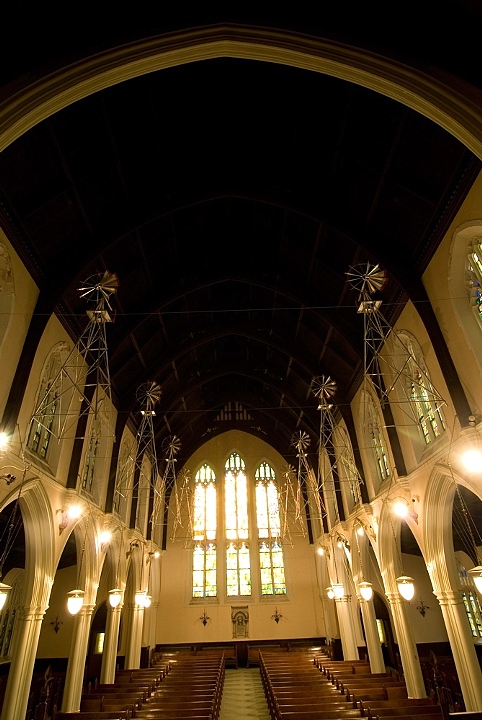
Castleman, Dayton_Tilting at Giants
Dayton Castleman (American, 1975–), Tilting at Giants, 2006. Aluminum, steel, votive candles, glass votive holders, braided fishing line, steel cable, and rigging hardware. Permanent site-specific sculpture, Broad Street Love, Philadelphia.

Tilting at Giants was commissioned by Broad Street Ministry (renamed Broad Street Love in 2024), a nonprofit organization in downtown Philadelphia providing stabilizing services to individuals experiencing deep poverty. It’s housed inside the former Chambers-Wylie Memorial Presbyterian Church, a historic turn-of-the-century Gothic Revival church that closed its doors in 1999 due to dwindling membership and the death of its pastor. The Presbytery of Philadelphia (PCUSA) leased the building for a few years to the University of the Arts, who used it for classes and events.

Then in May 2005, Rev. Bill Golderer rejuvenated the dormant church by opening Broad Street Ministry, billed as “an innovative Christian faith community that emphasizes the Gospel imperatives of extending generous hospitality, demonstrating justice and compassion, and providing a ground for artistic expression.” He removed the pews and set communal dining tables in their place, inviting in guests off the streets to enjoy chef-prepared meals all week long. The organization also provides legal help, fresh clothes, medical assistance, and a mailbox for those who lack a permanent address.

In its first year, Golderer issued an open call for proposals for a site-specific art installation that would be funded by the city’s Percent for Art program. Multidisciplinary artist Dayton Castleman, who lived in Philly at the time but who is now based in Northwest Arkansas, was awarded the commission.

His project comprises twelve large windmills that hover in the air, six in a line down each side of the vault—“unexpected, anachronistic, misplaced . . . [and] completely still,” Castleman says. He elaborates:

This stillness infuses the atmosphere with a sense of uneasy expectation. The brilliant towers, tall and clean, flash against the dark, vaulting canopy above. Like sentinels keeping watch, the sun-burst fans are poised, brimming with potential energy, waiting for a mysterious, transcendent wind to fill the space and make it sacred. Cradled within each tower, nearly lost in the spectacle, hover votive candles, glowing, unflickering, in prayer. This sanctuary is a living prayer—an aching, tense, expectant prayer—and a hair pulled taut, waiting to snap. . . .

The air is rich with suggestions and intimations of the invisible.

His artist’s statement also mentions Pentecost. On that seminal day two millennia ago, the disciples were gathered in Jerusalem with anticipation, as Jesus had told them, just before returning to the Father, to remain in the city until they received their new baptism, “for John baptized with water, but you will be baptized with the Holy Spirit not many days from now” (Acts 1:5).
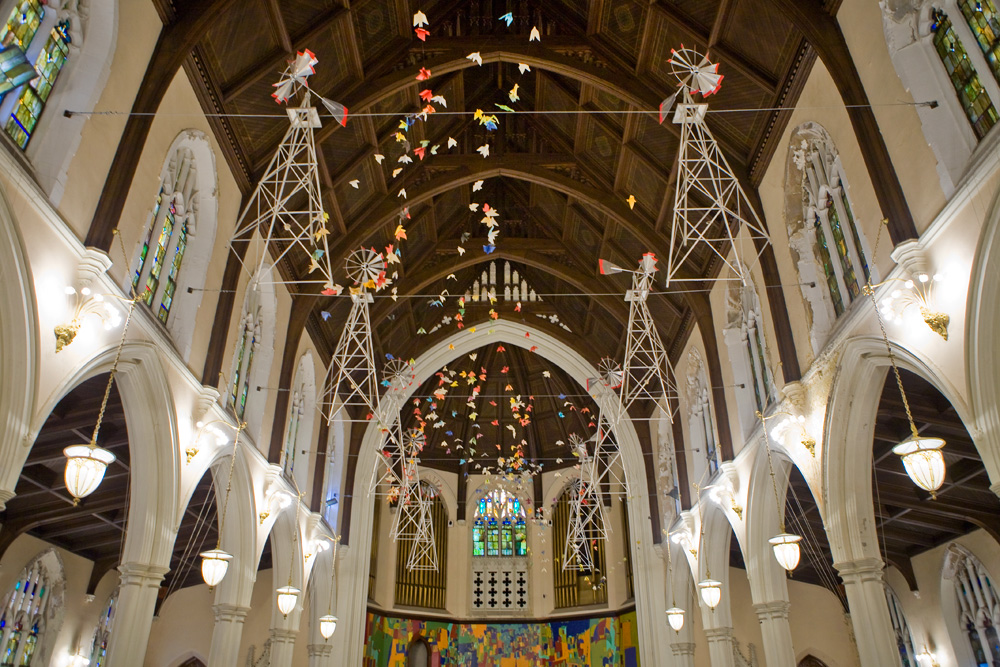
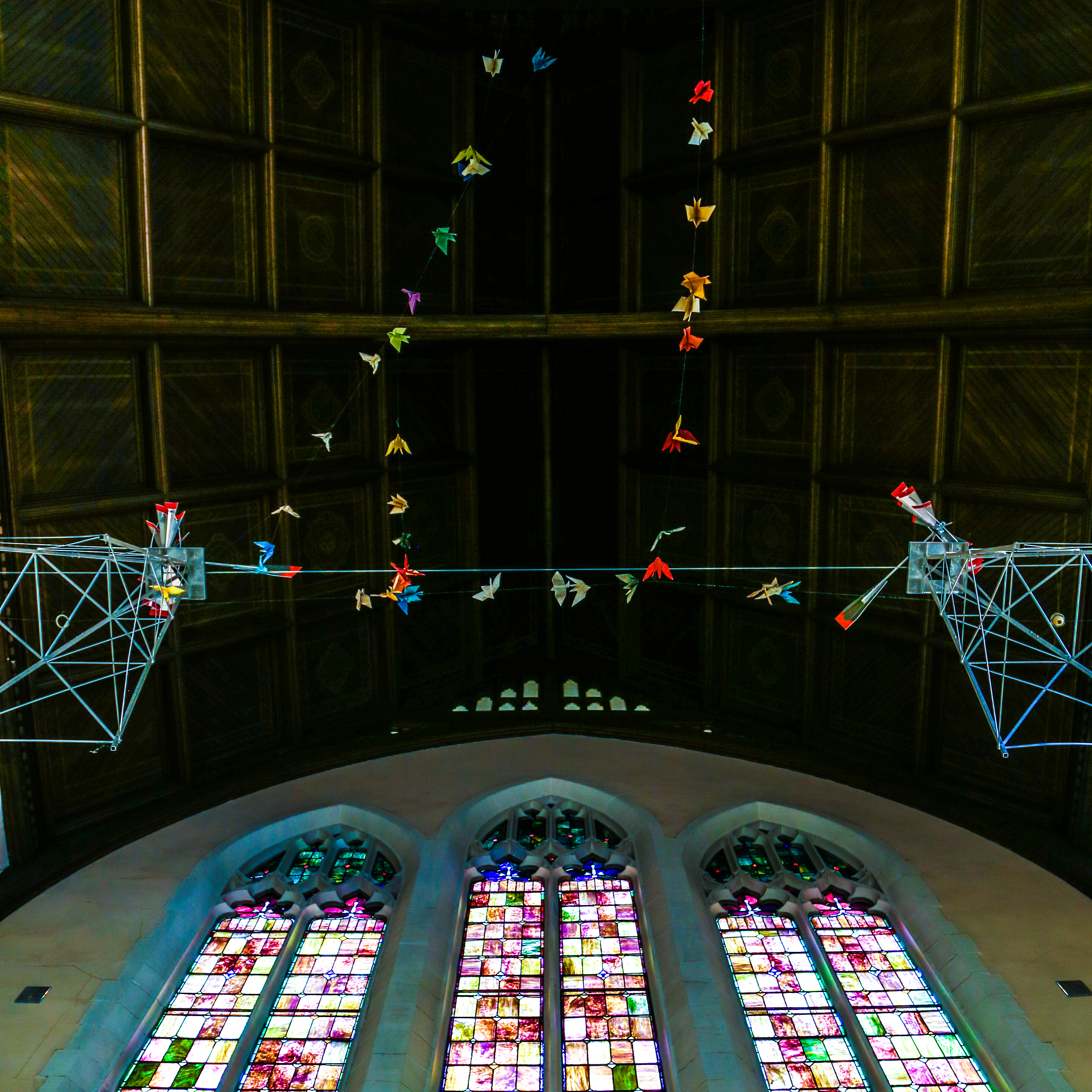
Broad Street Love
Broad Street Love in Philadelphia, with art installations by Dayton Castleman (windmills) and Alison Dilworth (swallows). Photo: Bradley Maule.

Broad Street Love (upward view)

Shortly after Castleman’s Tilting at Giants was installed, it was joined by Fall to Flight, a flock of approximately six hundred origami swallows suspended from the ceiling, containing written prayers of the community. Created by Philadelphia-based artist Alison Dilworth, the multicolored birds winging overhead evoke the unleashed joy of the Holy Spirit, who is sometimes compared in scripture to a dove, but also Jesus’s encouragement in the Sermon on the Mount that God will provide for the needs of his children, just as he provides for our avian friends who neither sow nor reap nor gather.

3. HS by Maciej Urbanek, St. Michael’s Church, Camden Town, London
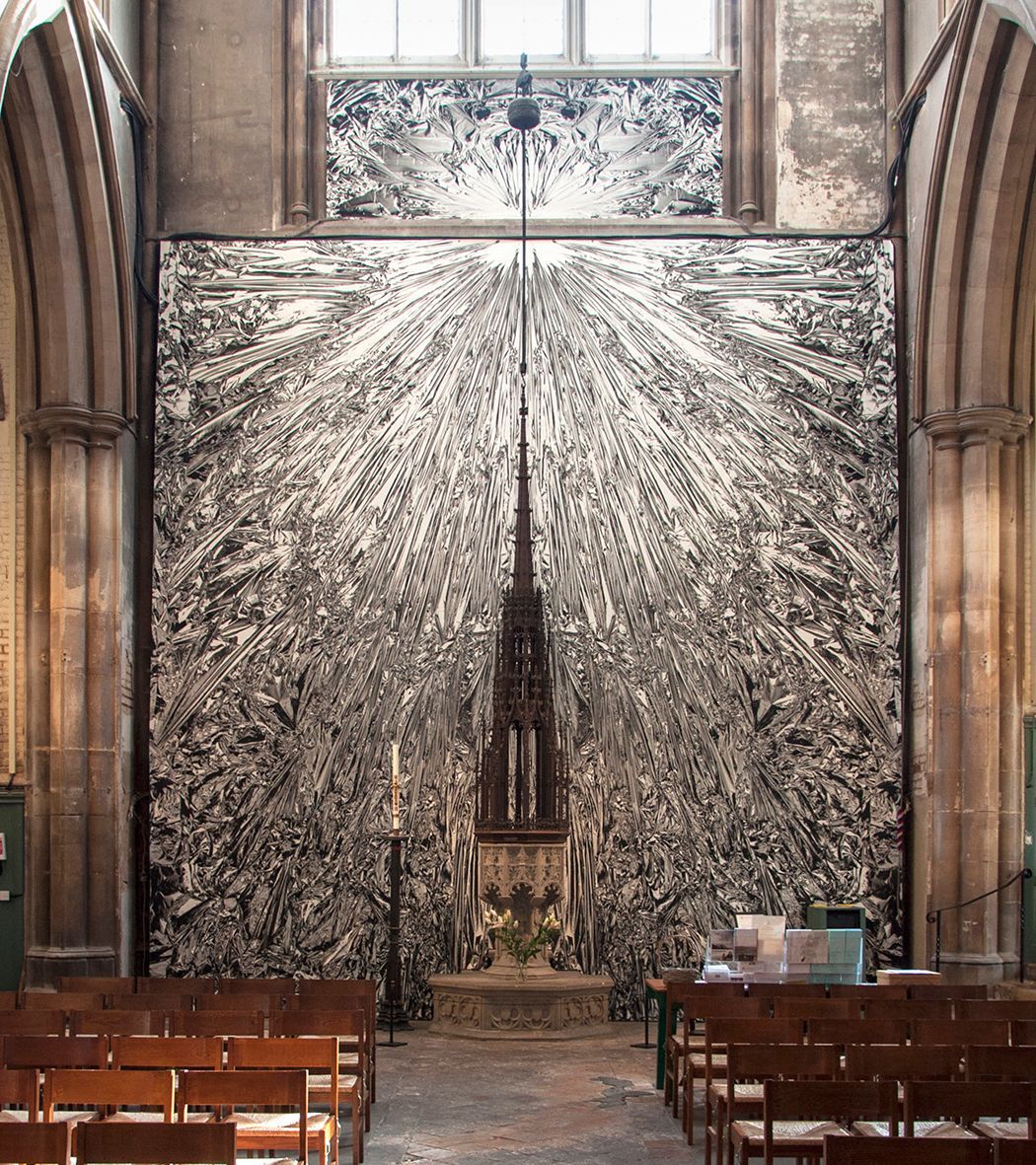
Urbanek, Maciej_HS
Maciej Urbanek (British, 1979–), HS, 2014. Digital photographic print, 10 × 7.5 m. St. Michael’s Church, Camden Town, London.

HS by the Polish-born British artist Maciej Urbanek is a monumental composite digital print installed on the west wall of St. Michael’s (Anglican) Church in Camden Town, London, covering up damaged plasterwork in need of restoration. What appears to be an explosion of silvery light is an effect produced with black plastic trash bags, which the artist crumpled up, lit, photographed, digitally reworked, and inkjet-printed on a large scale. Winner of the 2015 Art+Christianity Award for Art in a Religious Context, the work brings a baroque aesthetic to the Victorian interior.

“I am interested in elevating the banal and prosaic elements of life and turning them into powerful and rich visual statements,” Urbanek has said. A sign at the church says that Urbanek’s use of an everyday material to make something so beautifully radiant is “a metaphor for God’s work in taking ordinary human lives and making them extraordinary.”

Commissioned by Father Philip North (then the team rector of the parish of Old St Pancras) and privately funded by John Booth, HS was intended to be a temporary installation, but it was so well received by the parish that it has become a permanent fixture. According to the church’s X account, it “represent[s] the Holy Spirit breaking in from the outside world.”

The artwork’s location just behind the church’s baptismal font creates a linkage between the sacrament of baptism—in the Church of England, marking the beginning of a journey with God and the baptizand’s membership in the community of faith—and the work of the Spirit, who came at Pentecost with great power to set ablaze and send out. Indeed, HS can be read as that dramatic moment of the Spirit’s outpouring, and that parishioners walk past it when they exit the sanctuary is a reminder that they leave empowered by the Spirit to live and proclaim Christ’s gospel.

Thank you to Sheona Beaumont for introducing me to this work in her book The Bible in Photography: Index, Icon, Tableau, Vision. It is also the subject of a 2021 essay by Jonathan A. Anderson, “Bin bag visions: Theological horizons in Maciej Urbanek’s HS,” which I don’t have access to.

From “On Pentecost” by Romanos the Melodist (poem)

Pentecost (Ottonian)
The Descent of the Holy Spirit, from a benedictional made in Regensburg, Germany, ca. 1030–40. Tempera colors, gold leaf, and ink on parchment, 9 1/8 × 6 5/16 in. (23.2 × 16 cm). J. Paul Getty Museum, Los Angeles, Ms. Ludwig VII 1 (83.MI.90), fol. 47v. As is traditional in artistic depictions of this subject, the apostle Paul (with brown beard) is seated in a prominent position opposite Peter, receiving the Spirit like the other eleven apostles. Paul was not present at the event, but he was later mystically joined to it.

. . .

Peter, speaking like this to the apostles, roused them to prayer,
And standing in their midst, he spoke as follows:
“On bended knee let us beg and pray
That we shall make this chamber a church, for so it is and has become.
Let us be eager to cry unto God,
‘Send us thy good spirit
So that it may lead all of us to correct knowledge
Which thou hast prepared for those who worship and praise
The All-Holy Spirit.’”

When they heard this, those who had been called with him gathered together
As lambs in the presence of the shepherd, charmed by his speech;
And silently they specified what they desired,
And they held up to the Pantokrator the prayers which pressed for these things:
“To the Lord of angels and the King,
To the Ruler of humankind and the Maker of the world,
To the One who holds sway with his nod over those in heaven and earth,
Thy friends and servants cry to thee: ‘Quickly send us
The All-Holy Spirit.’”

Immediately after completing their prayers, they wrote their names under them,
And sealing them in faith, they sent them on high—
Prayers which the Master recognized and he said:
“Comforter, descend as thou dost wish, of thy own initiative, and without being summoned;
The disciples expect thee; they are the ones
Whom I gather together for thee and the Father,
The ones whom I educated when I said: ‘Teach the nations,
Extolling the Father, and worshiping the Son, and praising
The All-Holy Spirit.’”

God heard their wants, and his Comforter
Descended on those who were praying.
The Ineffable One was not removed from one place to the other,
Nor was there alteration, nor accommodation, nor did he endure diminution,
For he was above, and below, and everywhere;
For the divine nature is ineffable and not to be touched;
It is not seen by the eyes, but it is apprehended through faith;
It is not grasped in the hands; but it is felt in hearts of faith—
The All-Holy Spirit.

When the divine Pentecost was complete, the eleven chosen ones set up a din.
As they persevered in their prayers,
And as the passage read from Acts says,
When the sound of the powerful wind of the spirit suddenly came resounding from heaven,
The whole chamber was filled with fire.
Indeed, it amazed the beloved disciples rather too much.
When they saw the dwelling tossed like a boat, they cried:
“O Master, check the storm and send
The All-Holy Spirit.”

When the disciples recognized that the whole upper room was shaken as by an earthquake from the wind,
They all lowered their eyes in fear;
And lo! Another trembling still more to be shuddered at,
And one upon another marvel brought a second trembling in addition to the first fear,
For fiery tongues touched them anew
And began to appear on the heads of the chosen group.
Indeed, the fiery tongues did not burn their hair but lighted up their hearts
And sent them forth cleansed and purified—
The All-Holy Spirit.

Peter, seeing all the things which were happening, cried out: “Brothers,
Let us hold in reverence what we see, and let us not examine it.
Does anyone say what it is that has been done?
For what has been accomplished transcends belief and defies thought.
Spirit and fire are united—a true miracle;
Air and flame are joined together—awesome sight!
Along with winds, torches; along with dew, sparks of fire.
Who has seen, who has heard of this? Who is able to speak of what is produced by
The All-Holy Spirit?

“Do you, then, dearly beloved, stand and simply observe the fire
Which the One who is in heaven has sent from on high;
Do not fear, for the coals do not burn;
Do not be amazed that the fire does not burn, but as prudent men remember
How long ago the fire received kindly the three children,
How their bodies were not burned, nor their hair,
How the furnace revealed the three as four,
For it gave back those whom it received with interest, since it feared
The All-Holy Spirit.

“Then, brothers, let the One descended upon us cast out fear from our minds,
And make a show of love to the Ascended One.
Since he loved those whom he called,
Since all the things which he prophesied, he has fulfilled, and since he has done as he said,
Why, then, should we be afraid of a flame which does not burn?
Let us consider the fire as roses, which indeed it is.
It has been placed upon our heads like flowers,
And on our heads it has formed a crown, an ornament, and illumined us,
This All-Holy Spirit.”

. . .

This passage constitutes strophes 4–12 of a sixth-century Pentecost kontakion (poetic homily) by Romanos the Melodist, translated by Marjorie Carpenter in Kontakia of Romanos, Byzantine Melodist; I: The Person of Christ (Columbia: University of Missouri Press, 1970). For the original Greek, see #33 in the critical edition edited by Paul Maas and Constantine Athanasius Trypanis, Sancti Romani Melodi Cantica Genuina (Oxford: Clarendon Press, 1963).

Three details stand out to me: the prayers of the apostles for the Spirit being sent up like signed, sealed letters to the heavens, eliciting God’s affirmative response; the paradoxical mingling of dew and fire (two seemingly incompatible elements) in the Spirit’s descent, both refreshing and enflaming; and the image of the Pentecostal flames as roses that crown the apostles’ heads!

Romanos is known for his kontakia, a form of hymn in the Byzantine liturgical tradition that Romanos is believed to have introduced. The kontakion is basically a poetic sermon that was sung, containing highly dramatic features, including dialogue, but it was not staged. At its inception in the early sixth century and through the seventh, a kontakion consisted of a prologue (the prooimoion or koukoulion) followed by eighteen to thirty metrically identical strophes (oikoi or ikoi, i.e., stanzas; sing. oikos or ikos) linked by a refrain. (In the example above, the refrain is “The All-Holy Spirit.”) The first letter of each of the strophes often forms an acrostic.

Kontakia were written to be sung at the Daily Office, not Mass, on feast days. Unfortunately, none of the music Romanos wrote for his survives.

By the eighth century, the kontakion had become shortened, and it lost its homiletic character and its dialogue.


Romanos the Melodist (fl. 536–556 CE) was a preeminent Byzantine hymnographer and composer who is said to have written, in Greek, nearly a thousand kontakia, of which fifty-nine (text only) survive, his best known being on the Nativity of Christ. He was born in the late fifth century to a Jewish family in Emesa (modern-day Homs), Syria, but was baptized into Christianity as a young boy. He later moved to Berytus (Beirut) and was ordained a deacon of the Church of the Resurrection there. During the reign of Emperor Anastasius I (r. 491–518) Romanos moved to Constantinople and served as sacristan at Hagia Sophia, residing in that capital city until his death. He was sainted by the Greek Orthodox Church, which celebrates his feast on October 1. The famous Akathist Hymn to the Theotokos is attributed to him.

Pentecost roundup: “All Flesh” by Steve Thorngate, animated fabrics, and more

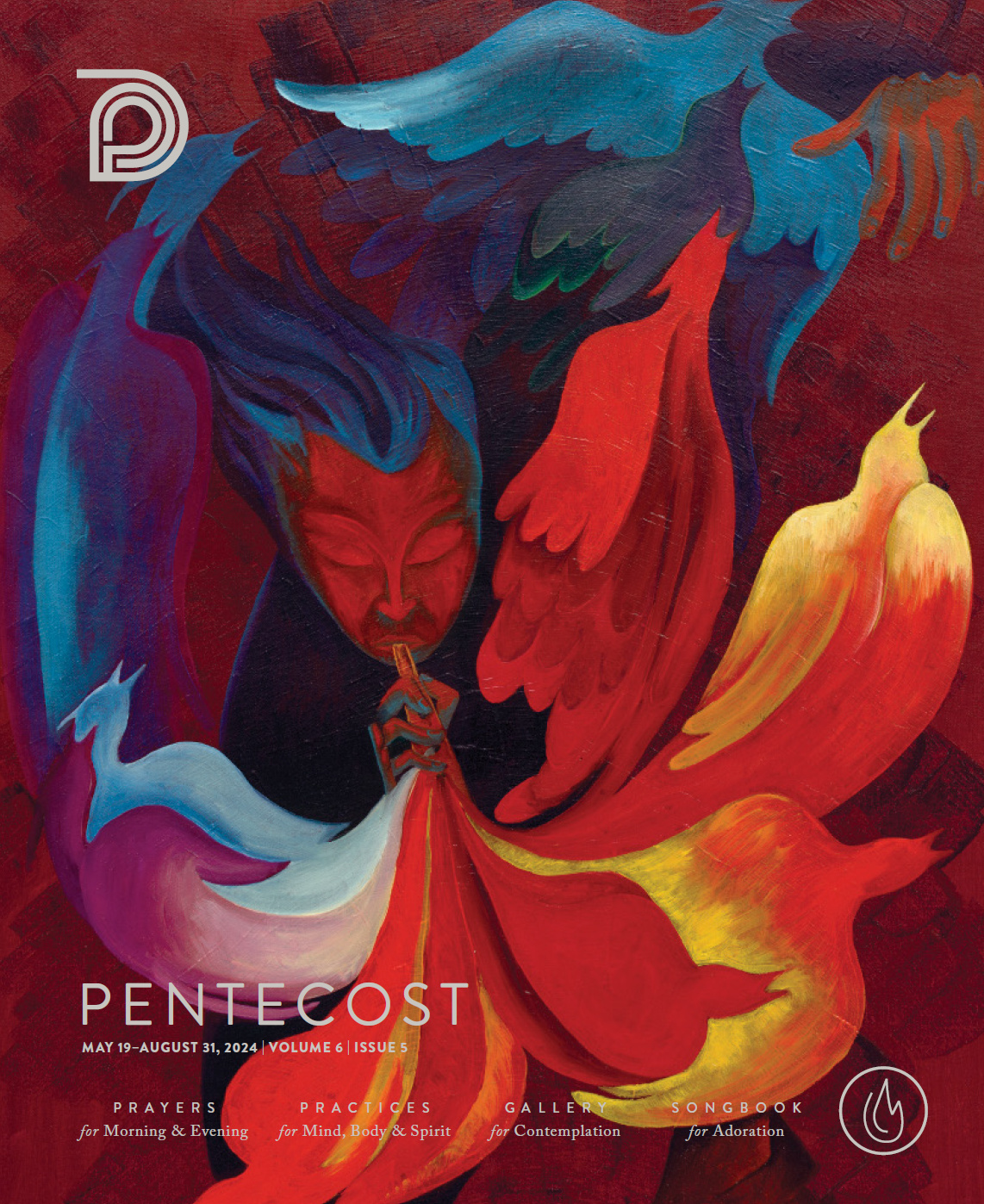
LIVING PRAYER PERIODICAL: Pentecost 2024: The latest edition of the Daily Prayer Project’s Living Prayer Periodical is available for purchase! Pentecost is this Sunday, May 19, so grab your copy soon. The booklet provides a distinct liturgy of scripture and prayer for each day of the week, through August 31, as well as art with accompanying reflections, songs, spiritual practice essays, and, new this issue, a poem! I curate the art and poetry for the DPP. The cover image is cropped from a painting by the Guatemalan artist Juan Francisco Guzmán (it’s reproduced in full in the interior). And the poem we feature, which I wrote a short commentary for to help readers engage it more meaningfully, is “Not Like a Dove” by Mary F.C. Pratt; I’m grateful to the directors for taking a risk with this unusual, even difficult, poem, which rewards those willing to sit with its imagery over time.

Pentecost LPP 2024

+++

SERMON (text only): “When the Spirit Comes” by N. T. Wright: Preached May 23, 2010, at Durham Cathedral, where he was bishop at the time, this Pentecost sermon by the esteemed N. T. Wright is a rousing call to stand, like Jesus, at the place where heaven and earth collide: in the Spirit. Here are two excerpts:

  • “The point about Pentecost is that it’s the point at which two worlds collide and look like they are now going to be together for keeps. The two worlds are of course heaven and earth. . . .
              The whole point of heaven and earth in Jewish thought is that they are meant to meet and merge. And the point of the gospel story as Luke has told it in his first volume is that Jesus had come to bring the life of heaven and earth together. That is the meaning of the ‘kingdom of God’. Thy kingdom come, he taught us to pray, on earth as in heaven. The disciples, we may presume, had been praying that prayer, among others, in the fifty days since Easter. And now the prayer is answered.”
  • “When the Spirit comes, the Spirit will prove the world wrong [in how things are run] . . . which is not a comfortable message, and it’s not meant to be. But if we can at least recognise that discomfort, and see it as the thing you should expect when the two worlds collide, we can put our shoulders back, take a deep breath – in other words, breathe in God’s breath – and get on with the task to which the New Testament commits us but in which . . . we feel a strange reluctance.
              Of course we can get it wrong, and of course we will find it awkward. But how much more wrong would it be not to try! How much more awkward, when God finally brings heaven and earth fully together, will it be to discover that we had continued to live in the split-level world when we were invited, by Ascension and Pentecost together, to dare and to risk the possibility of bringing them together in our own lives and in our own witness! Because of course none of this is in the last analysis ‘about’ us. If we are embarrassed at the heaven-and-earth conjunction, we are forgetting that we are not, after all, the centre of attention in all this. Jesus went on to say that the Spirit would glorify him, not us: he will take what belongs to Jesus and declare it to us and through us to the world.”

+++

MUSIC:

>> “All Flesh” by Steve Thorngate: This playfully serious song is rooted in Joel 2:28–29, which Peter quotes in his sermon at Pentecost: “I will pour out my spirit on all flesh; your sons and your daughters shall prophesy, your old men shall dream dreams, and your young men shall see visions. Even on the male and female slaves, in those days I will pour out my spirit.” Thorngate wrote it several years ago, but this recording, new this year, is the first he’s released, and it’s available only on Bandcamp for now.

>> “Ruach” by Delvyn Case, performed by the Mivos Quartet: Inspired by the story of Pentecost in Acts 2, this sacred concert work for string quartet, writes composer Delvyn Case, “bring[s] to our awareness many different ways ‘breath’ and ‘spirit’ can become sonically and dramatic present. Throughout the piece the performers are asked to make various kinds of breath sounds with their instruments and their own voices, blurring the line between music and sound. Overall, the piece emphasizes idea of the spirit as a powerful force that is surprising, shocking, and fundamentally resistant to control.”

>> “Sweet, Sweet Spirit” by Doris Akers, performed by Ruah Worship: Consisting of siblings Joshua Mine, Julia Mine, Erika Grace Izawa, and Marian Mine, Ruah Worship from Japan performs original worship songs as well as covers. I especially love their a cappella arrangements of Black gospel songs. Here they sing a song by Gospel Music Hall of Famer Doris Akers (1923–1995), about the sweetness of the Holy Spirit, who revives communities and fills them with love.

+++

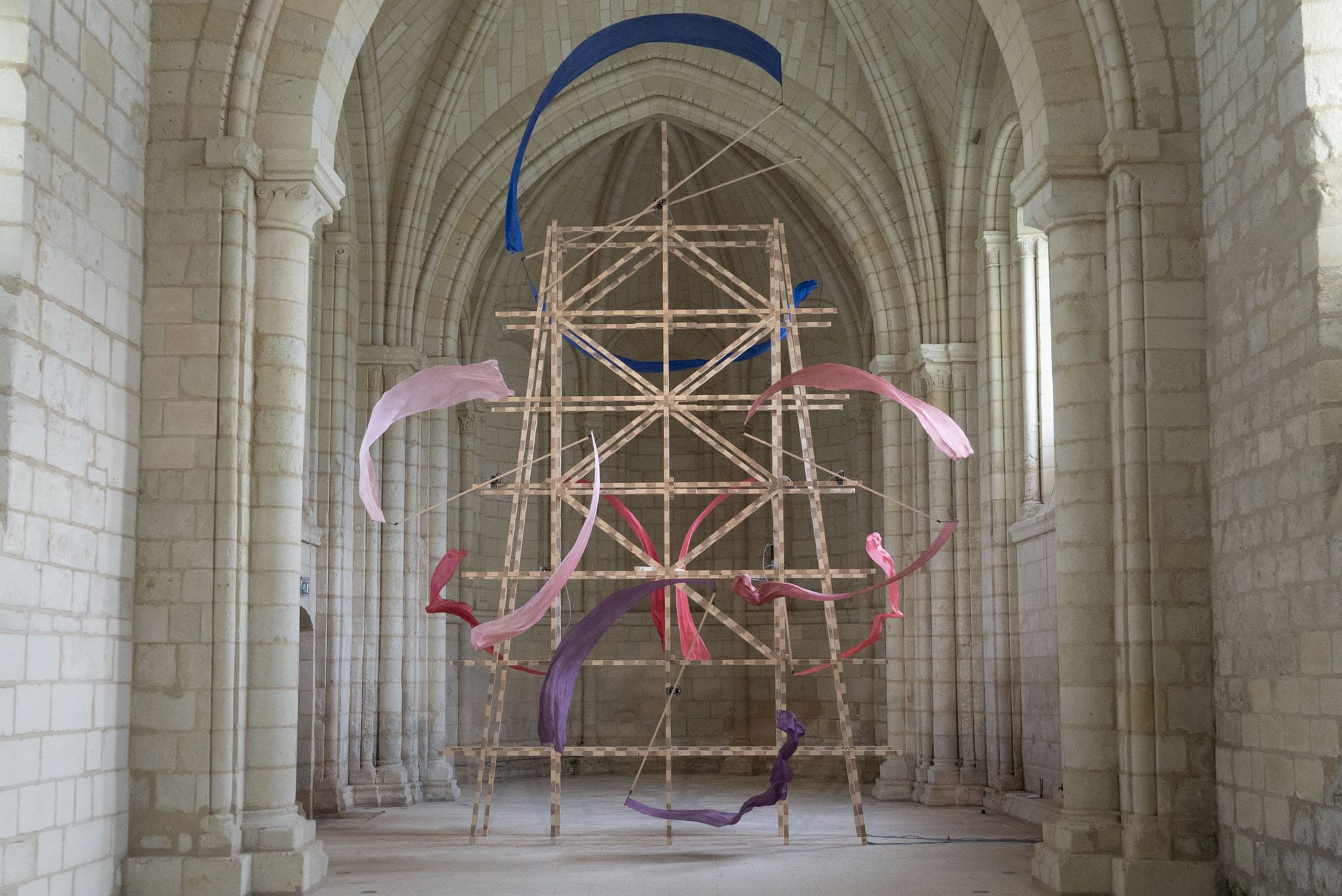
ART INSTALLATION: Fanions et Carillons by Pinaffo & Pluvinage: I learned of this kinetic sculpture by the French artist duo Marion Pinaffo (b. 1987) and Raphaël Pluvinage (b. 1986) in a Colossal article in February and thought of the movement of the Holy Spirit. Fanions et Carillons, French for “Pennants and Chimes,” was commissioned by Fontevraud Abbey and was on display earlier this year in one of the abbey’s twelfth-century chapels. Inspired by the historical striking clocks of churches, the automaton comes to life every half hour, sending fourteen pennants of blue, red, pink, and purple swinging and swirling.

Fanions et Carillons
Marion Pinaffo and Raphaël Pluvinage (aka Pinaffo & Pluvinage), Fanions et Carillons, 2023. Painted wood, motor, silk, electronic, 4 × 2 × 7 m. Temporary installation at the Chapelle St-Benoît, Abbaye Royale de Fontevraud, Anjou, Maine-et-Loire, France.

On their website, Pinaffo & Pluvinage write of the piece, “Although its mechanics are simple and rudimentary, using rotational or pendulum movements, it doesn’t produce the sound of bells, but rather animates fabrics. A set of 14 inert pennants awaken in turn to create ephemeral forms that mutate, respond and compose. Like a harmony of chimes creating a melody, this ensemble creates a choreography lasting a few minutes at regular intervals.” Whereas one might associate a certain rigidness and predictability with clocks, in this piece there’s a freedom, with the pennants moving at different rates and occasionally reversing direction.

+++

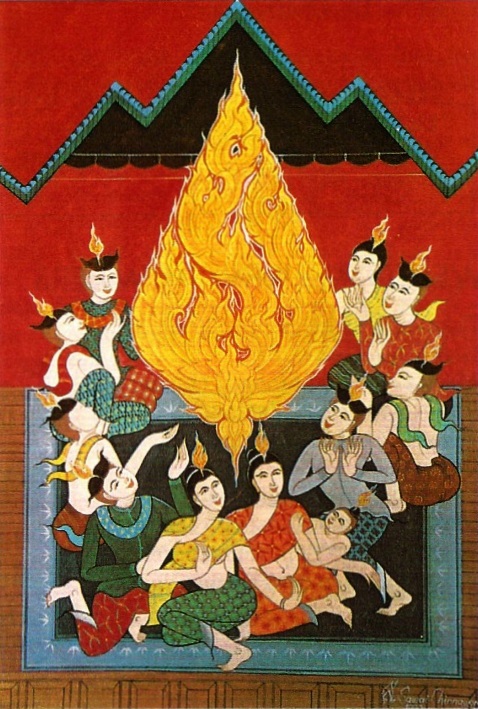
ARTICLE: “Painting Pentecost: Painter Sawai Chinnawong saturates the outpouring of the Spirit with the colors Thai art traditionally associates with the holy” by Amos Yong and Jonathan A. Anderson, Christian Century: Adapted from the book Renewing Christian Theology: Systematics for a Global Christianity (Baylor University Press, 2014), this article explores one of the Pentecost paintings of Thai Christian artist Sawai Chinnawong, who adopts and adapts a Thai Buddhist visual vernacular in terms of color choices, design elements, and the gestures and postures of figures. I’m appreciative of how the painting shows both men and women, and even a child, present at Pentecost and being recipients of the gift of the Spirit, as they surely were.

Chinnawong, Sawai_Pentecost
Sawai Chinnawong (Thai, 1959–), Pentecost, 1997. Acrylic on canvas.

(Related post: “Pentecost art from Asia”)

Some Christians are uncomfortable with art that transposes biblical events into other cultural contexts. But I think it’s a beautiful picture of the global character of the gospel, which has taken root in countries all over the world. As the authors write, in addition to celebrating a historic event, Chinnawong’s Pentecost “prompts us to see this as another event altogether: the outpouring of the Spirit in a room in 21st-century Bangkok rather than first-century Jerusalem. Chinnawong sets the scene here not out of disregard for the historical particularity of the original event but as a means of imagining and visually praying for the Spirit’s presence in his own historical moment. For Chinnawong, the Holy Spirit’s filling is not isolated to a single event, a particular moment, or one place but may be repeated at any time and place and for any people. Thus the circle of believers being filled with the Spirit is repeatedly repopulated and renewed.”

“I Thirst” by Frances Ellen Watkins Harper (poem)

Knight, Chad_Release
Digital concept for outdoor fountain by Chad Knight, 2017 [purchase]

FIRST VOICE.

I thirst, but earth cannot allay
The fever coursing through my veins.
The healing stream is far away—
It flows through Salem’s lovely plains.
The murmurs of its crystal flow
Break ever o’er this world of strife;
My heart is weary, let me go,
To bathe it in the stream of life;
For many worn and weary hearts
Have bathed in this pure healing stream,
And felt their griefs and cares depart,
E’en like some sad forgotten dream.
SECOND VOICE.
“The Word is nigh thee, even in thy heart.”
Say not, within thy weary heart,
Who shall ascend above,
To bring unto thy fever’d lips
The fount of joy and love.
Nor do thou seek to vainly delve
Where death’s pale angels tread,
To hear the murmur of its flow
Around the silent dead.
Within, in thee’s one living fount,
Fed from the springs above;
There quench thy thirst till thou shalt bathe
In God’s own sea of love.

This poem was originally published in Sketches of Southern Life (1872) (revised and expanded from an earlier version in Forest Leaves [1845]) and is in the public domain.


Tired and disheartened, the speaker in the first half of “I Thirst” by Frances Ellen Watkins Harper longs to be with God in the New Jerusalem (Salem for short). She thirsts for another world, away from the brokenness and suffering endured on earth. She can faintly hear the rush of living waters somewhere above and beyond her, and she wants desperately to plunge in. Essentially, she wishes to die, to enter the eternal presence of the Lord, where true life is.

But then a wise voice gently reprimands her escapist attitude, reminding her that God is with her in the Spirit right now, pouring his life into her, even residing within her. She has intimate access to the Divine. While full beatitude still lies on the horizon, in the meantime, we can quench our thirst for that “something more” by communing with God interiorly, through prayer and the word, and in corporate worship with our fellow pilgrims on the way. We receive a foretaste of the heavenly feast at the Lord’s Table, and throughout the week God nourishes us again and again so that, overflowing with the Holy Spirit, we may nourish others, pointing them to the Source.

This second half of the poem is based on Romans 10:6–8: “The righteousness which is of faith speaketh on this wise: ‘Say not in thine heart, “Who shall ascend into heaven?” (That is, to bring Christ down from above.) Or, “Who shall descend into the deep?” (That is, to bring up Christ again from the dead.)’ But what saith it? ‘The word is nigh thee, even in thy mouth, and in thy heart: that is, the word of faith . . .’” (KJV). There’s an echo of Jesus’s words to his disciples that “neither shall they say, ‘Lo here!’ or, ‘lo there!’ for, behold, the kingdom of God is within you” (Luke 17:21). There’s also an implicit connection to John 4:13–14 and 7:38, which says that springs of living water—that is, Spirit-powered life—flow forth from the hearts of believers unto eternity.

[Related post: “‘River’ by Eugene McDaniels (song)”]


Frances Ellen Watkins Harper (1825–1911) was a best-selling poet, fiction writer, essayist, traveling lecturer, and prominent political activist who advocated for abolitionism, temperance, and women’s suffrage. Born to free African American parents in Baltimore, Maryland (a slave state), she was orphaned at age three and subsequently raised by her maternal uncle, William Watkins, an AME minister and educator. In her twenties she moved to Philadelphia, and a letter she wrote to a friend in April 1858 describes how, against orders, she refused to give up her seat on a city trolley to a white person. At the forefront of nineteenth-century Black political thought and action, Harper founded, supported, and held high office in several national progressive organizations, including the National Association of Colored Women. She was also at the forefront of the early African American literary tradition, publishing ten volumes of poetry during her lifetime, which sold in the tens of thousands—in addition to her short stories and novels.

Roundup: Pentecost-inspired harp duet, the Sacred Art of Reading, and more

AVANT-GARDE CLASSICAL: Klang—Die 24 Stunden des Tages (Sound—The 24 Hours of the Day) is a cycle of chamber-music compositions by the avant-garde German composer Karlheinz Stockhausen, which he worked on from 2004 until his death in 2007. (The intention was for there to be twenty-four pieces, but the cycle was unfinished at twenty-one.) The first two pieces in the cycle, on the themes of Ascension and Pentecost, were commissioned for the interdisciplinary Pause festival at Milan Cathedral by artache, a Milan-based nonprofit committed to showcasing contemporary artworks in public places of worship. The artistic director of artache at the time was Don Luigi Garbini, a priest at the church of San Marco in Milan and cofounding director of the artache initiative the Laboratorio di Musica Contemporanea al Servizio della Liturgia (Laboratory for Contemporary Music in the Service of the Liturgy).

>> No. 81: “KLANG, 1st Hour: Himmelfahrt (Ascension)” by Karlheinz Stockhausen, for organ or synthesizer, soprano, and tenor, 2004–5: This thirty-seven-minute piece premiered at Milan Cathedral on Ascension Day, May 5, 2005. The two hands of the organist almost always play in different, independent tempos of a chromatic time scale, while the soloists sing words or phrases associated with “ascension,” particularly the Ascension of Christ. According to the composer, “Asking a performer to break the barrier of time by playing simultaneously in different tempi is like submitting a man to physical disruption, allowing him to go in spirit form towards another world” (source). For musical analysis by Ed Chang, see here. The performance below is from the North American premiere at the Schwartz Center for the Performing Arts at Emory University in Atlanta on October 11, 2005, featuring organist Randall Harlow, soprano Teresa Hopkin, and tenor John Bigham.

>> No. 82: “KLANG, 2nd Hour: Freude (Joy)” by Karlheinz Stockhausen, for two harps and voice, 2005: This forty-minute piece premiered at Milan Cathedral on July 6, 2006. The text is taken from the medieval Pentecost hymn “Veni Creator Spiritus” [previously], which the harpists sing in spurts, “in alternation or sometimes together . . . , while plucking, picking, caressing, stroking, pinching, rubbing, striping, striking, pinking, jubilating,” as Stockhausen put it. In program notes dated February 15, 2006, he writes, “There is something unique about the adventure to combine two harps which are normally tuned in diatonic scales and to synthesise them into one large chromatic harp. . . . Pentecost unites what has been separated. My work FREUDE too.” For musical analysis by Ed Chang, see here. The performance below is from the Stockhausen Memorial Concert in Kürten, Germany, on December 16, 2017, featuring Marianne Smit and Miriam Overlach.

(As an interesting side note: The Beatles included Stockhausen’s face on the cover of Sgt. Pepper’s Lonely Hearts Club Band. Their “A Day in the Life” and “Revolution 9” were influenced by his electronic music.)

+++

NEW DOCTORAL COHORT: The Sacred Art of Reading: The Eugene Peterson Center for Christian Imagination at Western Theological Seminary in Holland, Michigan, is offering a new, mostly remote, three-year DMin track called “The Sacred Art of Reading,” which begins this October, taught by Professor Chris E.W. Green. The program is centered on the reading of scripture—the Old Testament narrative books (Year 1), Old Testament poetry and wisdom literature (Year 2), and the Gospels and Apocalypse (Year 3)—alongside a number of additional primary texts, whose titles you can view on the website; authors include, among others, Avivah Gottlieb Zornberg, Amy-Jill Levine, Daniel Berrigan, Robert Alter, Shusaku Endo, and of course Eugene Peterson! Participants get together in person for one week each semester (times six semesters) and are responsible for, in addition to the $17,280 tuition, travel and lodging costs. The application deadline is June 30, 2023. Applicants must hold an MDiv degree or its educational equivalent and have at least three years of ministry experience since completing the MDiv. Here’s a condensed program description:

The Sacred Art of Reading cohort will be dedicated to collaboration in “the forbidding discipline of spiritual reading,” confident that such an undertaking cultivates the loving attentiveness, prophetic discernment, and childlike openness to surprise that characterize what St. Paul calls the faith that works by love. . . . The cohort is designed to cultivate an alternative awareness, one shaped by the slow, painstaking work of collaborative interpretation. And to that end, the heart of the program is the reading of the Christian Scriptures. The aim will be both philosophical and devotional, critical and celebratory, mystical and pastoral. No one reading method will be stipulated, but students will be encouraged to find ways to honor the traditions of the communities in which they learned to argue, to muse, and to pray.

Besides Scripture, the cohort will engage a wide range of texts including poems, memoirs, essays, treatises, sermons, and stories old and new, familiar and strange, sacred and “worldly,” in part and in whole, not so much in order to “plunder the Egyptians” as to bear glad witness to the wonder that God is never left without a witness because all truth, truly received, trues.

This approach really wets my whistle! I don’t have a master’s degree, so I’m out, but I feel so energized by the reading list and wanted to share the opportunity with you all, as the program seems doable for those with full-time jobs. A virtual interest meeting is being held on June 1. Click here to view other doctor of ministry cohorts at Western.

+++

FUNDRAISING CAMPAIGN: The Soil and The Seed Project: I’ve mentioned this project several times on the blog before, as I’m a big fan. A ministry of VMMissions (Virginia Mennonite Missions), The Soil and The Seed Project releases original music, art, and liturgies throughout the Christian year, especially suitable for families with littles. They launched in December 2021 and since then have put out seven collections, with their latest and largest yet—Vol. 7 // Ordinary Time—dropping this week. (Request a free download through their website, or stream the music through your favorite service.) Coinciding with this release, they have also launched a campaign to raise $27,000 by June 18 to cover the costs of recording, mixing, pressing, printing, shipping, etc., for future collections. Learn more in the five-minute video below, which features the new songs “In the Little Moments,” “Teach Me, O LORD,” and “Because of Jesus.”

The Soil and The Seed Project offers all their content for free, including physical CDs (as stock permits), and are committed to keeping it that way—which is why they need the support of donors. Donate to their campaign, and you can opt to receive stickers, notecards, and/or a T-shirt as a thank-you. Also note: they’ll be giving a concert at 6:30 p.m. on Saturday, June 3, at the Brethren & Mennonite Heritage Center in Harrisonburg, Virginia.

+++

SONG: “Holy Spirit” by Victoria Williams: “Part front-porch soothsayer, part quirky bayou princess, and part eternal child, Victoria Williams writes songs of indescribable originality that embrace the earthly and the divine with wit, charm, and understated vision,” writes Josh Kun for Bomb magazine. The song “Holy Spirit” [read lyrics] is from her 1990 album Swing the Statue!. It opens with the familiar invocation from a Gullah spiritual: “Kum ba yah, my Lord” (which translates to “Come by here”). She seeks God’s presence and then, given a renewed sensitivity to it, identifies and celebrates its flow throughout her daily goings. She feels the Holy Spirit while building a raft with friends on the shores of Louisiana’s Lake Bistineau and riding a New York City subway beside a whistling stranger, as well as in graveyards and at bars and out under open night skies. The Spirit flows through all of life. I can’t find the song online anywhere other than in this YouTube fan video, which sets it to photos. [HT: Jonathan Evens]

+++

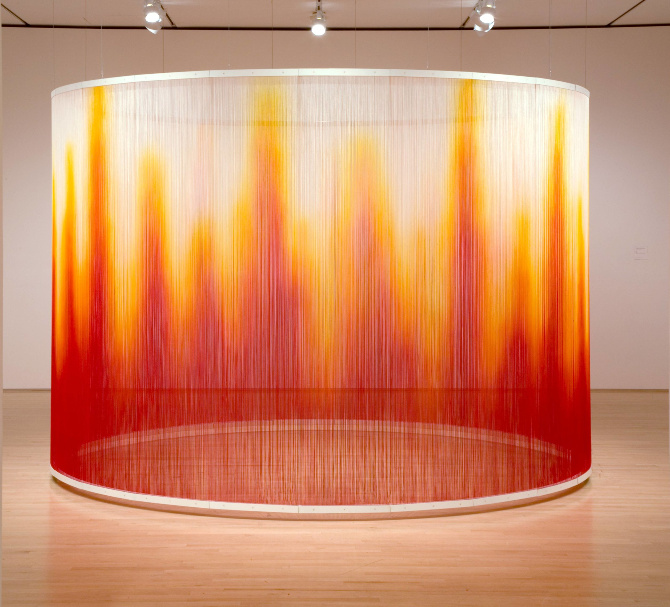
ARTWORK: Fire by Teresita Fernández: In the collection of SFMOMA, this ring of warm-colored silk yarn conveys something of the flickering quality of fire. At the link is a short video interview with the artist about the piece. Fernández says she is interested in the sensorial aspects of viewer engagement with art.

Fernandez, Teresita_Fire
Teresita Fernández (American, 1968–), Fire, 2005. Silk yarn, steel armature, and epoxy, 243.8 × 365.8 cm. San Francisco Museum of Modern Art, California.

Fire was a highlight of the 2013 exhibition Beyond Belief: 100 Years of the Spiritual in Modern Art, jointly organized by SFMOMA and the Contemporary Jewish Museum. Here’s a video of the Lick Wilmerding High School Vocal Ensemble singing “Famine Song” by VIDA around the installation that year, a song inspired by the basket weavers of Sudan, who persist in their craft during times of hardship, their hands working natural fibers into beautiful, colorful vessels. “Weave, my mother; weave, my child; weave your baskets of rushes wild . . .”

“Spiritus” by Steve Turner (poem)

Bearden, Romare_All the Things You Are
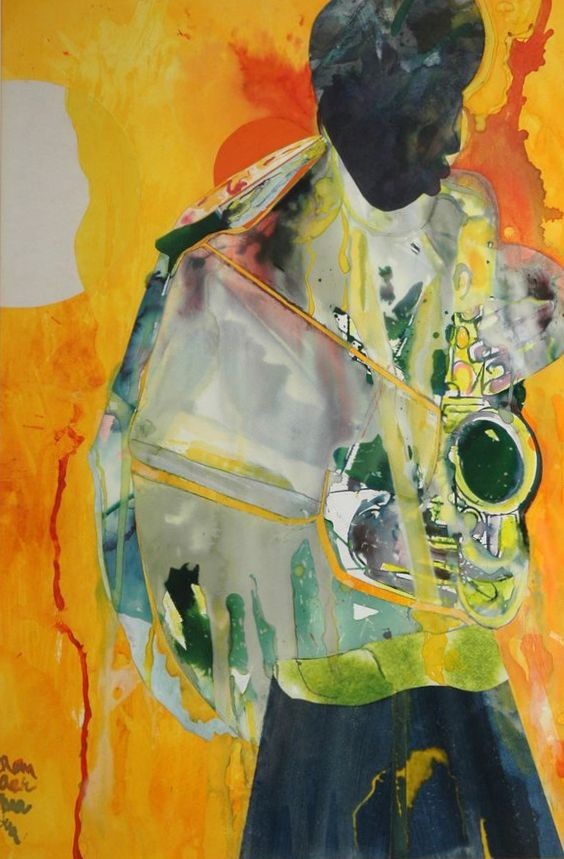
Romare Bearden (American, 1912–1988), All the Things You Are, 1987. Collage, color dyes, and watercolor on board, 36 × 24 in. (91.4 × 61 cm).

I used to think of you
as a symphony
neatly structured,
full of no surprises.
Now I see you as
a saxophone solo
blowing wildly
into the night,
a tongue of fire,
flicking in unrepeated
	patterns.

From Poems by Steve Turner, compiled by Rebecca Winter (Oxford: Lion Publishing, 2002)

Steve Turner is a music journalist, biographer, and poet from the UK who has spent his career chronicling and interviewing people from the worlds of music, film, television, fashion, art, and literature. He has contributed to newspapers such as The Mail on Sunday and The Times, and among his many books is the influential Imagine: A Vision for Christians in the Arts. He lives in London.

Trinity Redemption by James Keay-Bright (painting)

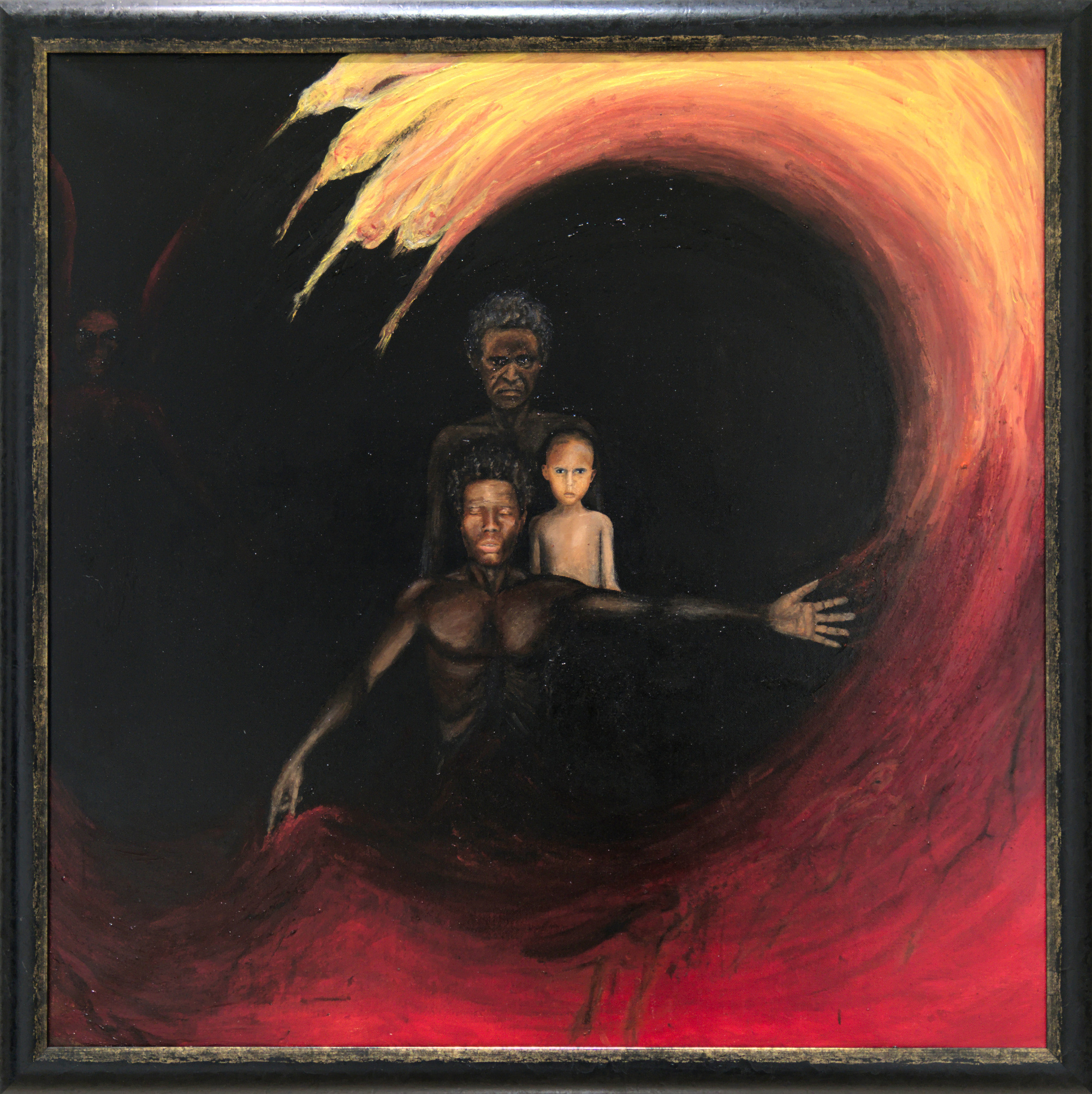
I first encountered the work of Welsh Catholic artist James Keay-Bright last year at the 8th Catholic Arts Biennial at the Verostko Center for the Arts at Saint Vincent College in Latrobe, Pennsylvania, where his Trinity Redemption painting was among the juried selections.

Keay-Bright, James_Trinity Redemption
James Keay-Bright (Welsh, 1965–), Trinity Redemption, 2013. Oil on canvas, 40 × 40 in. Private collection, United States. All photos by Victoria Emily Jones, at the 8th Catholic Arts Biennial, Verostko Center for the Arts, Saint Vincent College, Latrobe, Pennsylvania.

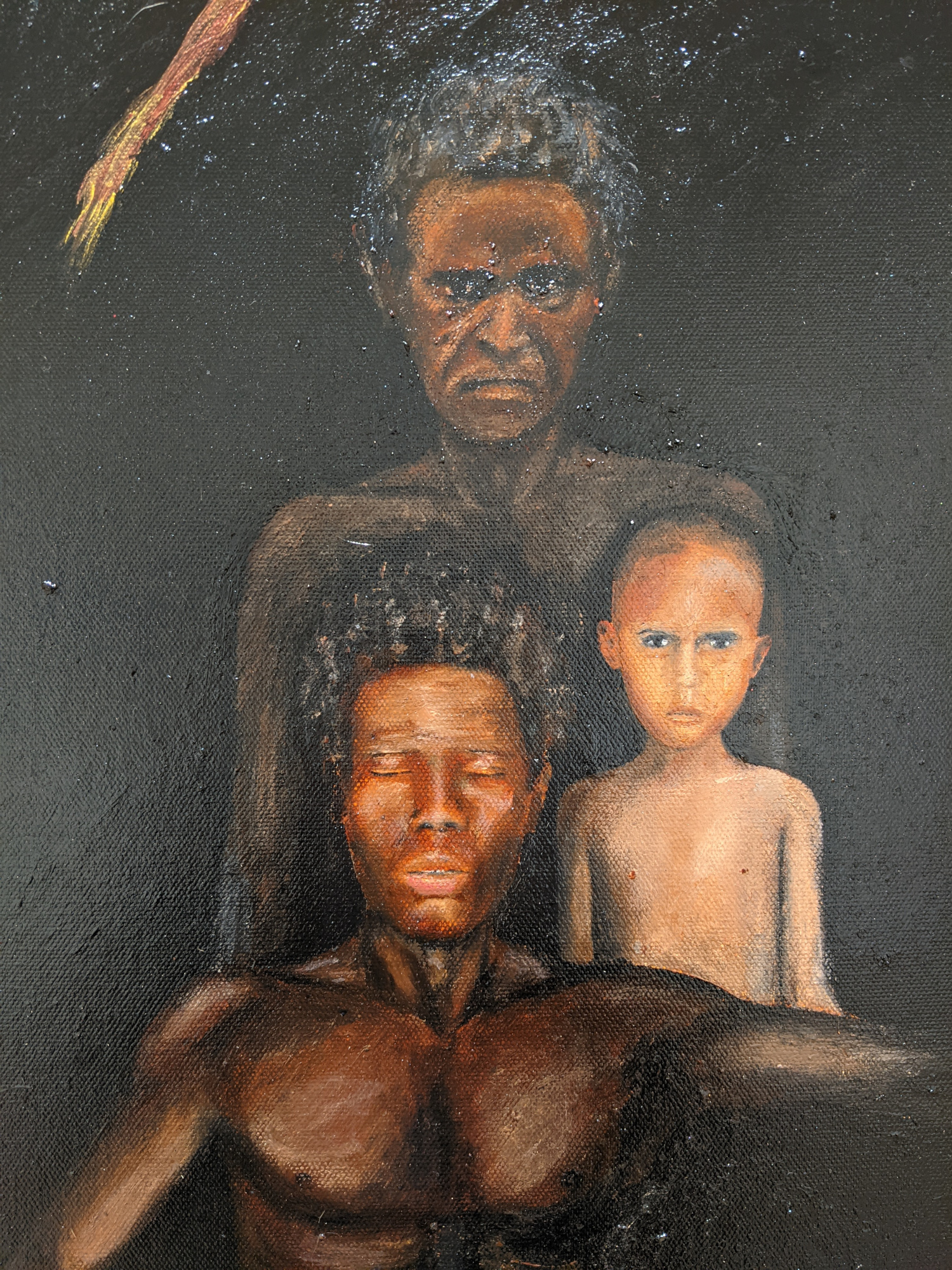
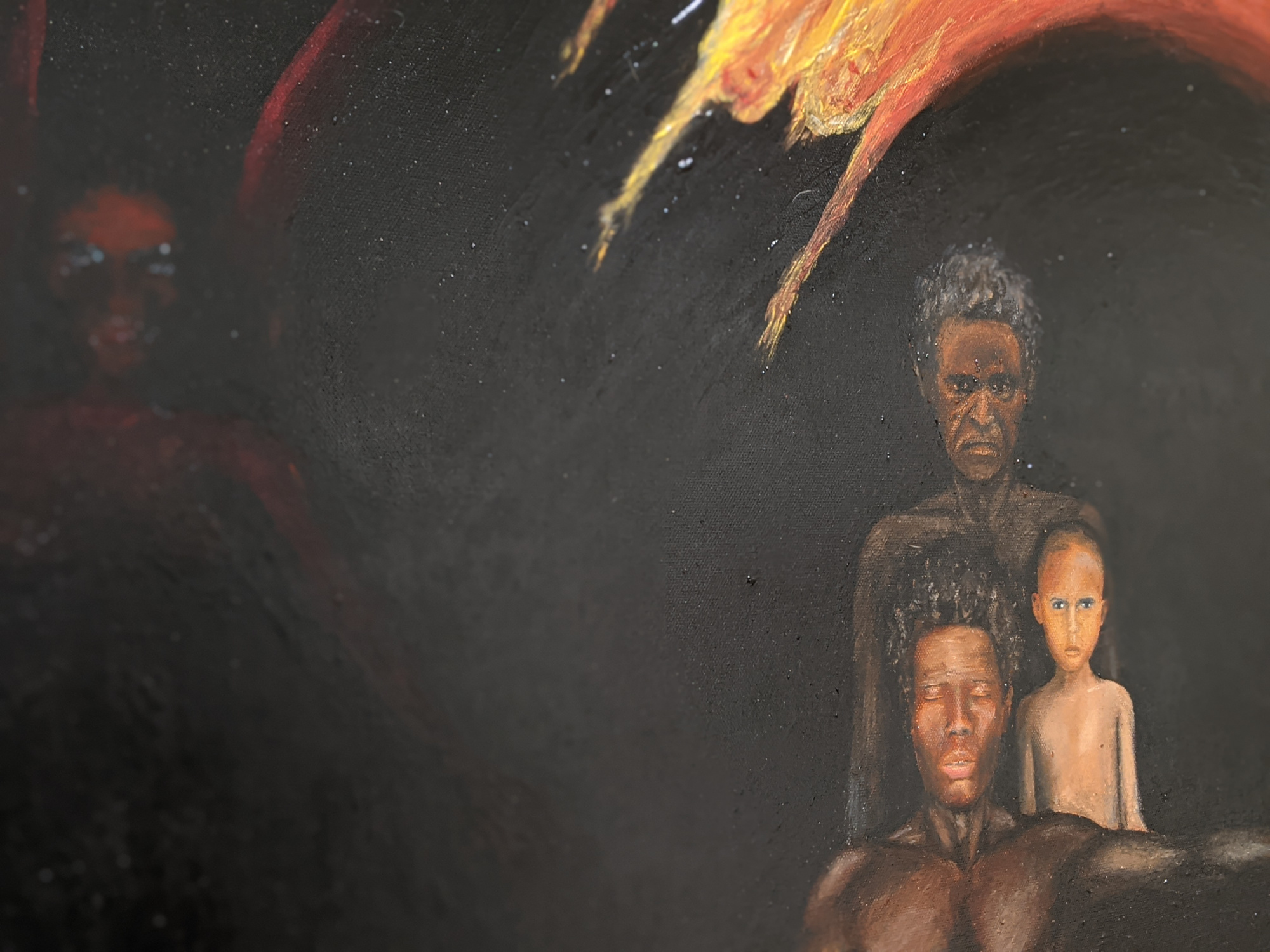
It shows God the Father, Son, and Holy Spirit standing one behind the other against a black background, facing forward. They are semi-encompassed by a wave of fire that emanates from the foreground figure’s outstretched hand. Vigorous and bright, it swells up and around the trio, its branching tip reaching like arms into the darkness.

The young African man in front represents the Holy Spirit sending forth his presence, Keay-Bright told me. (The illumination of his face is wonderful!) Jesus Christ is shown as a Middle Eastern boy of about eight years old, while God the Father is modeled after an elderly Aboriginal Australian.

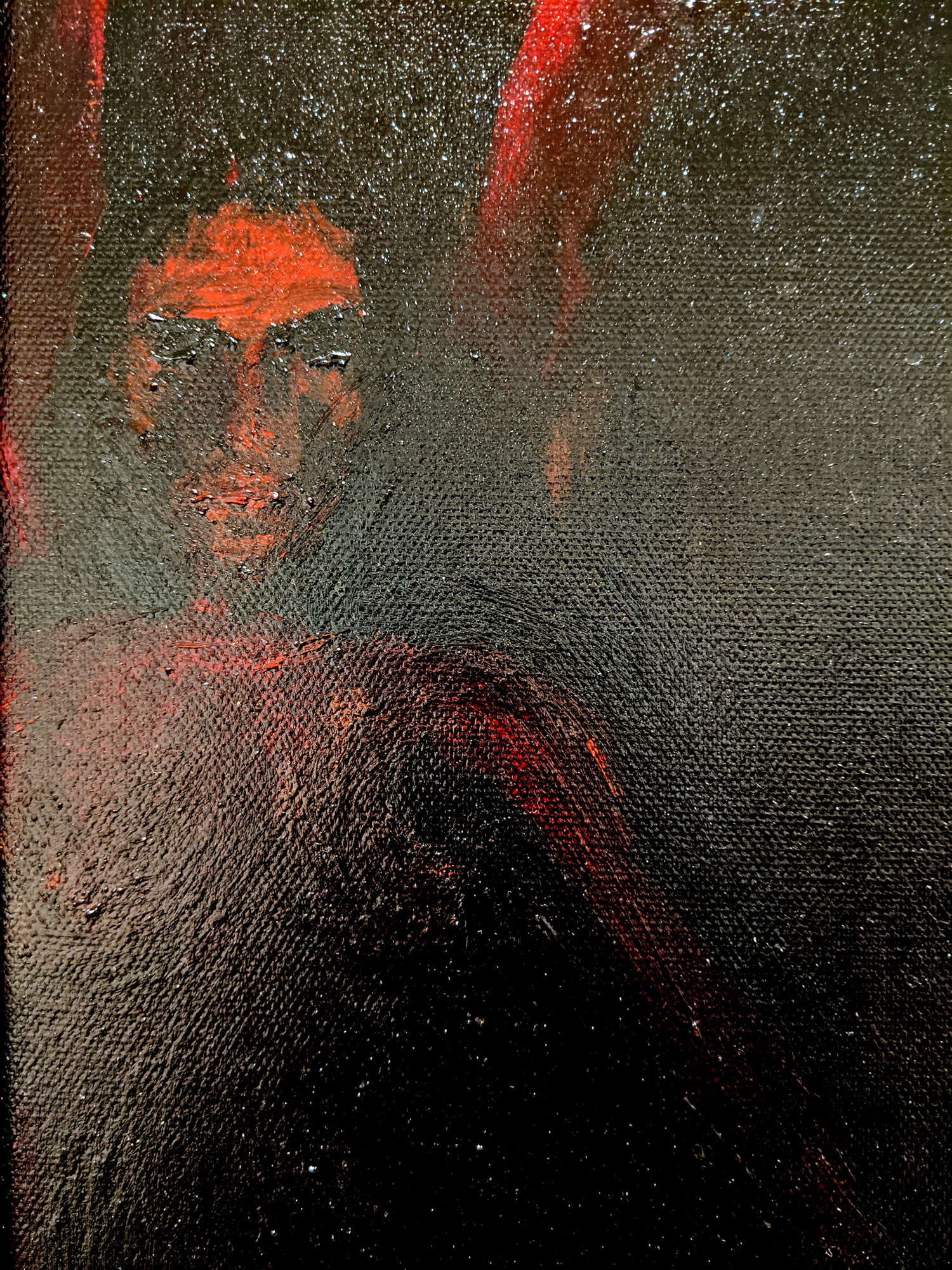
Unable to withstand the tidal wave of divine light, evil retreats into the shadows, symbolized by the satanic figure at the left.

Keay-Bright, James_Trinity Redemption (detail, fire)

In the Old Testament, fire often signifies the presence of God, as when Moses encounters God in the burning bush (Exod. 3:2), or as with the pillar of fire that leads the Israelites through the wilderness (Exod. 13:21).

In the New Testament, in Acts 2, the Holy Spirit descends like fire on the people who are gathered in Jerusalem for the feast of Pentecost. This “fire” ignites faith and has a sanctifying effect—purifying us of sin, making us holy.

[Related posts: “Innovative Trinity paintings in the Rothschild Canticles”; “Father, Son, Spirit (Artful Devotion)”]

Last Sunday the church celebrated the Spirit’s historic descent, and this Sunday is marked in liturgical calendars as Trinity Sunday. One of the scripture readings in the Revised Common Lectionary comes from Romans 5: “Therefore, since we are justified by faith, we have peace with God through our Lord Jesus Christ, through whom we have obtained access to this grace in which we stand, and we boast in our hope of sharing the glory of God. . . . And hope does not put us to shame, because God’s love has been poured into our hearts through the Holy Spirit that has been given to us” (vv. 1–2, 5). This passage describes the combined activity of the Triune God in bringing about salvation.

Commenting on his painting, Keay-Bright told me, “It’s about cycles of redemption. We respond to God’s call but then fall away. But we can always come back.” God’s “spirit and grace” are constantly extended to us, he says. The fire of divine love is always going out, sweeping through the world to reclaim and restore.

Keay-Bright is interested in non-Caucasian representations of biblical figures. That desire has sprung in part from his international humanitarian work, in which he has encountered the sacred through people of various races and ethnicities. He has worked with refugees in the Balkans, Uganda, and Algeria—first through an NGO and later through the UN Refugee Agency. This month he is traveling to Rwanda to serve refugees from Burundi and the Democratic Republic of Congo.

He supplements this vocation with his art making.

Catching fire

As Luke records in Acts 2, ten days after Jesus ascended to heaven, during the feast of Shavuot, the Holy Spirit manifested as “tongues of fire” and descended on Jesus’s apostles, filling them with power before the multitudes that had gathered. Peter preaches this as a fulfillment of the prophet Joel: “In the last days it will be, God declares, that I will pour out my Spirit upon all flesh, and your sons and your daughters shall prophesy, and your young men shall see visions, and your old men shall dream dreams . . .” (Acts 2:17; cf. Joel 2:28).

As geographically and linguistically diverse pilgrims embraced the good news of Christ that day and carried it back to their homes, God’s Spirit spread throughout the ancient Near East and from there to other parts of the world, such that Christianity is the most global and multicultural religion. The fire that fell that one Sunday in Jerusalem has spread exponentially! First it caught the Twelve, and then some three thousand witnesses, and it’s been burning ever since.

Consider this untitled poem by Theodore Roszak*:

Unless the eye catch fire
The God will not be seen
Unless the ear catch fire
The God will not be heard
Unless the tongue catch fire
The God will not be named
Unless the heart catch fire
The God will not be loved
Unless the mind catch fire
The God will not be known

In it the physical senses are ignited, as are the emotions and the intellect. The whole person—body, spirit, and soul—is set on fire. Sounds Pentecostal, no? With echoes of Moses’s meeting God in a burning bush on Mount Horeb (Exod. 2), as revelation is key.

Slowly read each of the five couplets, one at a time, considering how God makes himself known through that faculty. Ponder what it means for the eye to “catch fire,” the ear to catch fire, and so on. What does that image evoke?

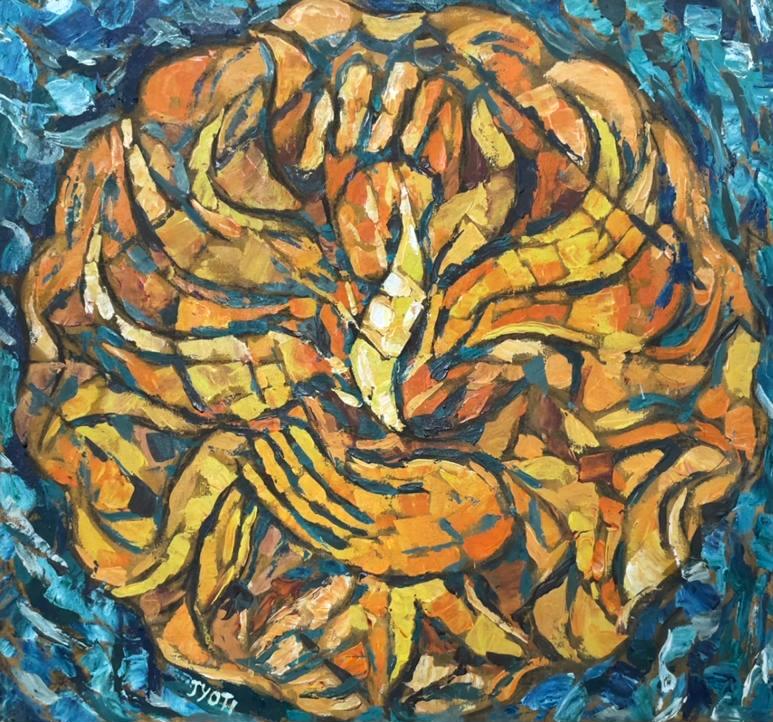
Sahi, Jyoti_Holding the Flame of Fire
Jyoti Sahi (Indian, 1944–), Holding the Flame of Fire, 2005. Oil on canvas, 36 × 36 in. Painted as a design for a stained glass window for the entrance of Paripurnata Halfway Home in Kolkata, India.

Fire shows up a lot in the work of Indian Christian artist Jyoti Sahi, as in his painting Holding the Flame of Fire, which shows a pair of hands cradling a flame that fans out in bright oranges and yellows, forming a mandala (Sanskrit “circle”). Perhaps you see licking tongues, or dove’s wings, or I AM calling out from a blazing shrub.

This painting was inspired by aarti, a ritual expression of love and gratitude to a deity that originated and is widely practiced in Hinduism but that has been adapted by some Christians in South India. (Sahi demonstrated it to me in a Christian chapel in Bengaluru when I visited him a few years ago.) A lit oil or ghee lamp is placed on a tray, Sahi explains, “where different offerings are arranged representing the senses, such as flowers related to sight, incense sticks in relation to smell, water and fruit in a bowl in relation to taste, and earth and ash in relation to touch.” The priest or householder waves the tray in a clockwise motion, then brings it around from person to person, each of whom cups the flame with their hands and then touches their forehead, seeking divine blessing. Aarti is often accompanied by singing and can be performed at home or in public places of worship.

(Related post: https://artandtheology.org/2020/11/30/advent-day-2-fire/)

How awesome is it that the Spirit of God, the living flame, moves among us—even abides within us! The Spirit stirs, illuminates, regenerates, sanctifies, guides, comforts, intercedes, and empowers. What a gift.

* Note on authorship: This poem appears in Where the Wasteland Ends: Politics and Transcendence in Postindustrial Society by Theodore Roszak (Doubleday, 1972) as the epigraph to chapter 9, “Mind on Fire: Notes on Three Old Poets.” While Roszak provides attributions for all the other epigraphs in the book, he does not for this one, leading me to believe that the verse either originated with him or is from an unknown source. It is often misattributed to William Blake—probably because Roszak’s chapter focuses on Blake, in addition to Wordsworth and Goethe—but I confirmed with multiple Blake scholars that these lines are not Blake’s. P. K. Page wrote a short story in 1979 titled “Unless the Eye Catch Fire,” citing Roszak as the title’s source.

Pentecost roundup

SONGS: The Holy Spirit Prayer is a traditional Catholic prayer that’s sung at Mass on the feast of Pentecost: “Come, Holy Spirit; fill the hearts of your faithful, and kindle in them the fire of your love. Send forth your Spirit and they shall be created, and you shall renew the face of the earth. O God, who by the light of the Holy Spirit did instruct the hearts of the faithful, grant that by the same Holy Spirit we may be truly wise and ever enjoy his consolations, through Christ our Lord. Amen.” The following two songs are settings of the first part of this prayer.

>> “Kindle in Us Your Love” by Deanna Witkowski: This funky refrain by jazz composer Deanna Witkowski “works well as a gospel acclamation, prayer response, or opening song,” especially for Pentecost. I’m planning to introduce it to my Presbyterian congregation this Sunday. (For church services, Witkowski charges a licensing fee of just $3 per use.) You can purchase the piano score here; it also appears in the Voices Together hymnal. Hear a high school choir perform the piece in the video below, with Witkowski accompanying on keys.

Come, Holy Spirit
Kindle in us the fire of your love
Come, Holy Spirit
Kindle in us your love

>> “Holy Spirit, Come to Us” by Jacques Berthier (Taizé chant): Taizé is an ecumenical Christian monastic community in France comprising more than one hundred Catholic and Protestant brothers from some thirty different countries. They welcome in around a hundred thousand young pilgrims a year, who come for prayer, Bible study, and communal work and worship. The songs of Taizé use simple musical phrases and few words that are repeated. Composed in 1998, “Holy Spirit, Come to Us” is one of 232 songs Jacques Berthier wrote for Taizé. It consists of solo verses sung by a leader over an ostinato refrain sung by the people.

Holy Spirit, come to us
Kindle in us the fire of your love
Holy Spirit, come to us

Jesus said, “It is by your love for one another
That everyone will recognize you as my disciples.”

Jesus said, “No one has greater love than this:
To lay down one’s life for those one loves.”

We know love by this,
That Christ laid down his life for us.

This is love: it is not we who have loved God
But God who loved us.

Taizé songs may be sung in public worship settings free of charge, provided their simplicity is preserved (i.e., no elaborate arrangements are permitted); for other uses, see here.

+++

DIGITAL DOWNLOAD: Pentecost Party: Word & Wonder is offering a free twelve-page PDF of resources for celebrating Pentecost with children. Besides a list of party ideas, it includes an imaginative retelling of the Pentecost story from the perspective of a child, a prayer guide, prompts for talking about the Holy Spirit, coloring pages, and a pinwheel craft. On their website you will also find other family-friendly resources for the church year. [HT: Global Christian Worship]

+++

BLOG POST: “Whitsun Week” by Eleanor Parker: “The week following Pentecost is a lost holiday. From the Middle Ages until the early 20th century the period around Whitsun was the principal summer holiday of the year – especially Whit-Monday”—which is June 6 this year. “It was the time for fairs, Morris dancing, games, ale-drinking, school and church processions, weddings, wandering into the countryside, and generally having a good time.” Gooseberries and cheesecakes were broken out for the occasion, and communities engaged in fun activities like cricket, archery, sack races, and donkey derbies.

British medievalist Eleanor Parker compiles several sources that describe the Whitsuntide festivities of medieval western Europe and calls her readers to revive the week’s outdoor merrymaking!

+++

SHORT FILM: Stickmatch: Created in 2020 by London-born animator William Crook, this twenty-second stop-motion animation uses autumn leaves to simulate flames. [HT: Colossal]

+++

Here’s a new Spotify playlist I made for the month of June.

+++

Previous posts on the blog that are related, either directly or indirectly, to Pentecost include:

Lent, Day 5

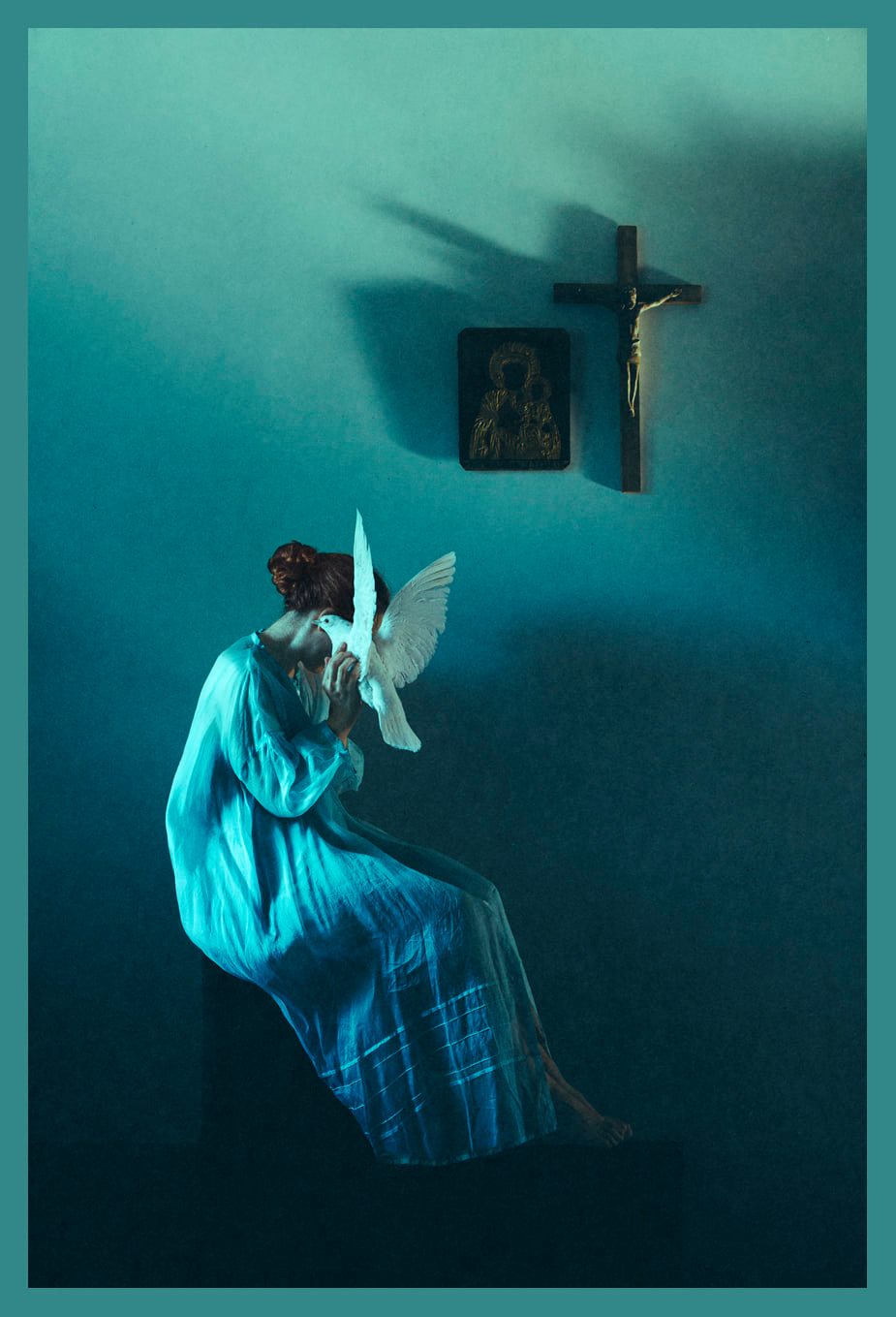
LOOK: Lessons of Hearing by Laura Makabresku

Makabresku, Laura_Lessons of Hearing
Laura Makabresku (Polish, 1987–), Lessons of Hearing, 2021, photograph

Laura Makabresku is the artist pseudonym of Kamila Kansy, whose photographs are inspired by dreams, fairy tales, and the Christian story. Surreal and spiritual, her body of work moves me immensely. It’s so poetic. Divine and human love and suffering are recurring themes, and animals—doves, crows, deer, lambs, foxes—often appear. Follow her on Instagram @lauramakabresku and on Facebook.

Lessons of Hearing shows a young woman alone in a shadowy domestic space, listening intently to the Spirit. A crucifix and an icon of the Virgin and Child hang above her on the wall. A limited edition of this photograph is available for sale—signed, numbered, printed on archival Hahnemühle Baryta paper, and framed. Contact the artist if interested.

LISTEN: “Bring Forth” | Words by John Ernest Bode, 1869, with adaptations and refrain by Ben Thomas, 2015 | Music by Ben Thomas, 2015 | Album: Bring Forth

O Jesus, I have promised
To serve thee to the end;
Open my eyes within
To see your everlasting hand.
I shall not fear the struggle
If thou art by my side,
Nor wander from the pathway
If you will be my guide.

[Refrain] Bring forth the truth and beauty
Embedded deep inside.
Breathe life in every moment.
You will not leave my side.

O let me hear thee speaking
In accents clear and still,
Above the storms of trials,
The murmurs of self-will.
O speak to reassure me,
Strengthen and make me whole;
O speak, and let me listen,
Creator of my soul.

[Bridge] Bring forth the beauty (×8)

O Jesus, I have promised
To serve thee to the end.

Edicam pulchritudine (×8)

This song is about coming home to who we were created to be—good and beautiful, reflections of our Maker. Sadly, sin often leads us away from home, and God’s image that we bear becomes marred. But Christ walks alongside us, calling forth our truest selves, reminding us that we are God’s beloved. We have been redeemed, made alive by God’s Spirit, and are being sanctified. God is bringing forth the beauty he embedded in us at creation.

The speaker of the song seeks Christ’s guidance, illumination, strength, and wholeness. He prays for the ability to discern God’s voice above all the voices of this world that try to tell us we are less than, or that only such and such will satisfy us. And he prays for the will to obey. His desire is that he be animated moment by moment by the Holy Spirit (see Romans 8).

The last line, which I take to be in God’s voice, is Latin for “I will bring forth the beauty.”

This song appears on the Art & Theology Lent Playlist.