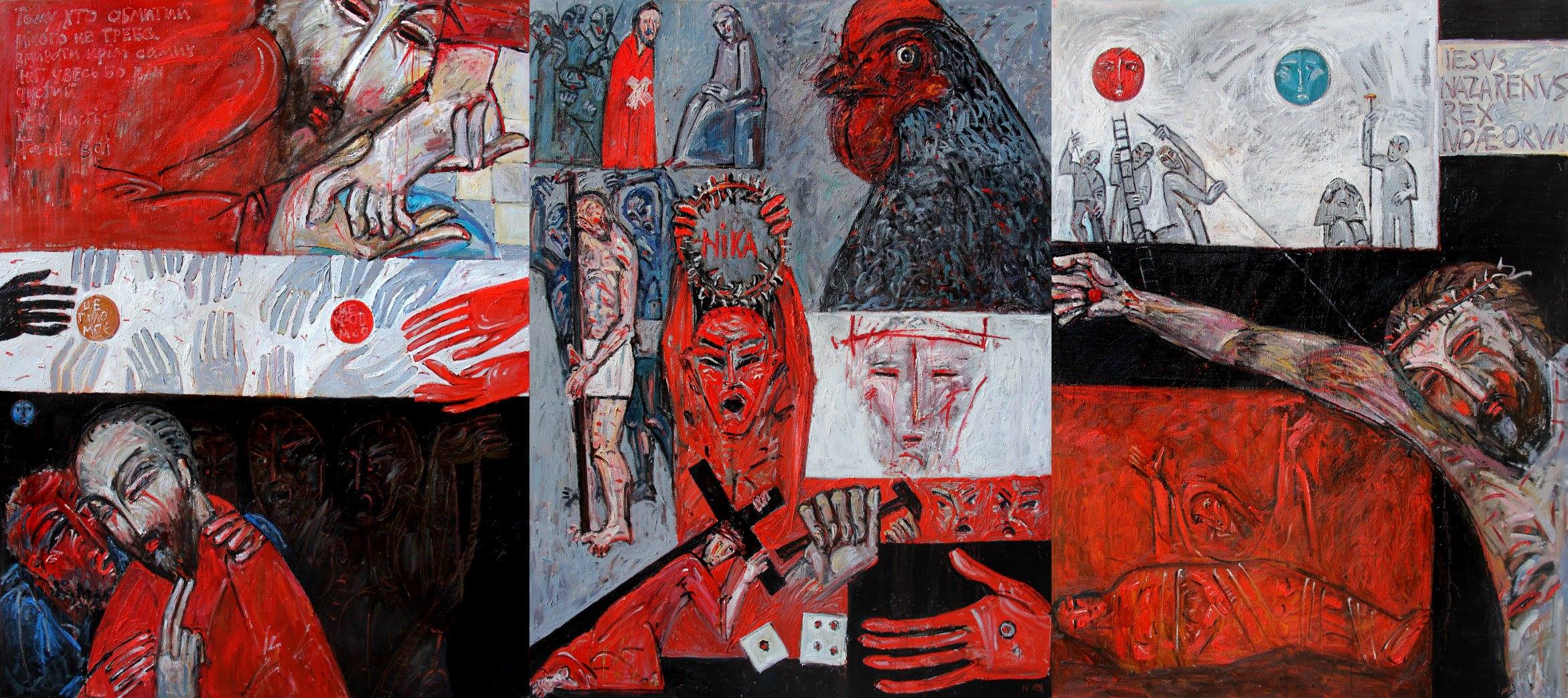
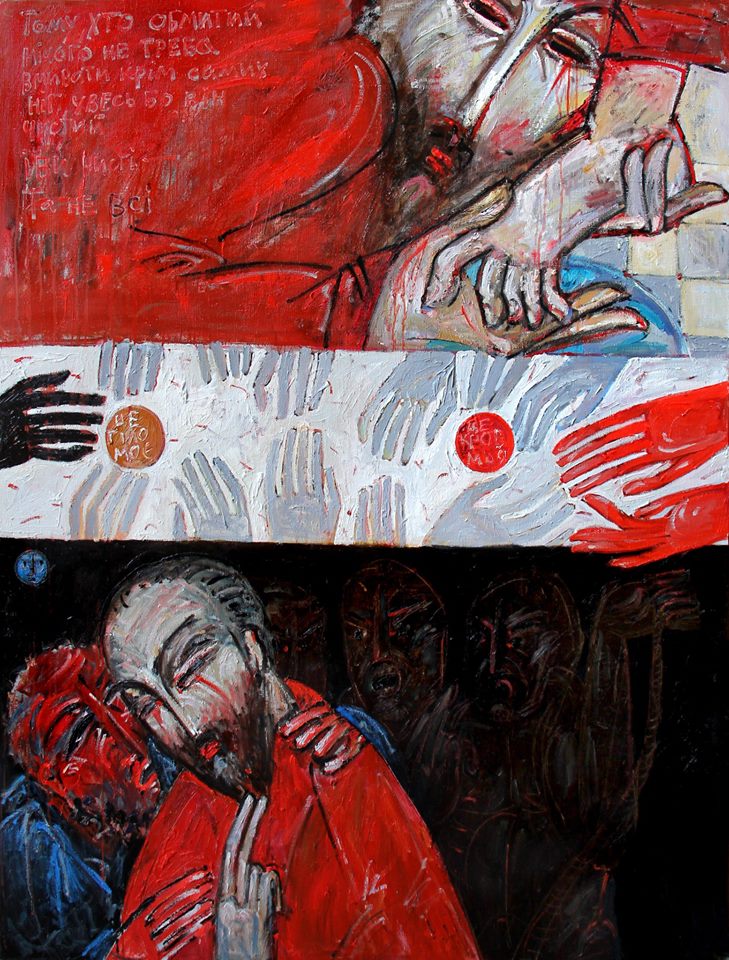
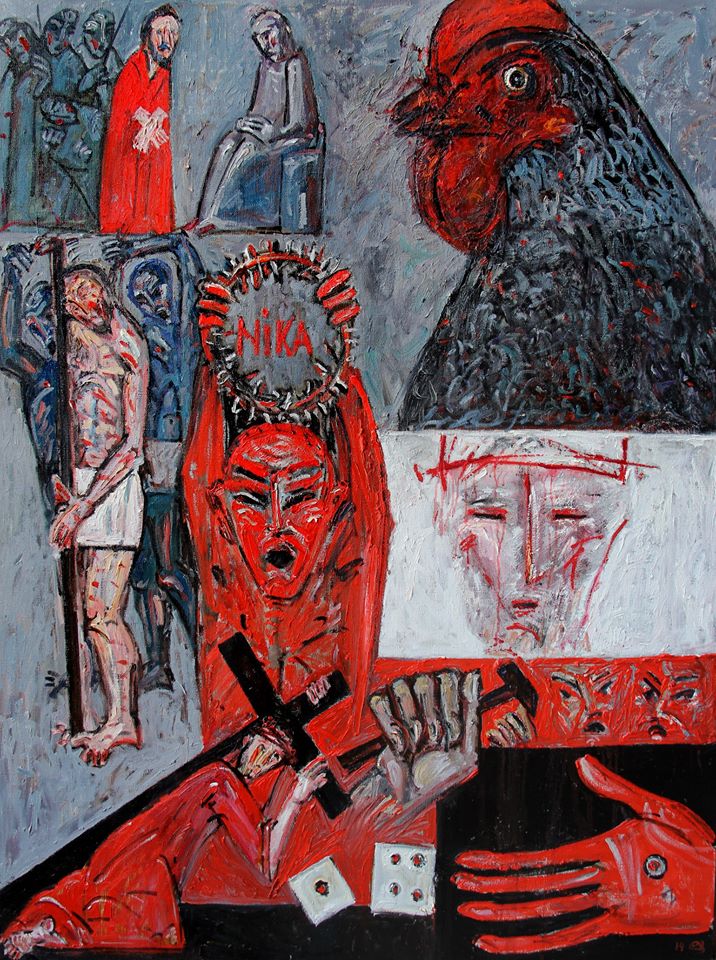
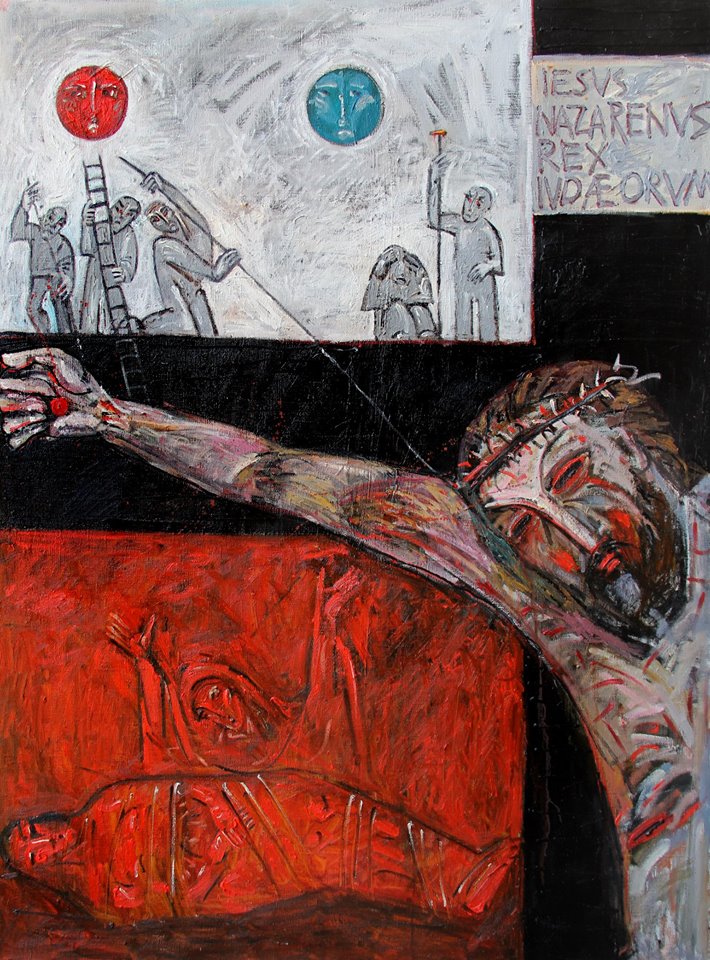
This painting by the late Ukrainian artist Ostap Lozynsky portrays a handful of episodes from Passion Week: Jesus washing his disciples’ feet, the Last Supper, the Kiss of Judas, Christ before Pilate, the Flagellation, the Crowning with Thorns, Peter’s denial (represented emblematically by the rooster), Christ taking up his cross, Christ being nailed to the cross, the Crucifixion, and the Lamentation over the Dead Christ.
From liner notes of PRIMEMOVER by Joshua Stamper. Pinch to zoom, or if on a computer, right-click and open the image in a new tab to enlarge.
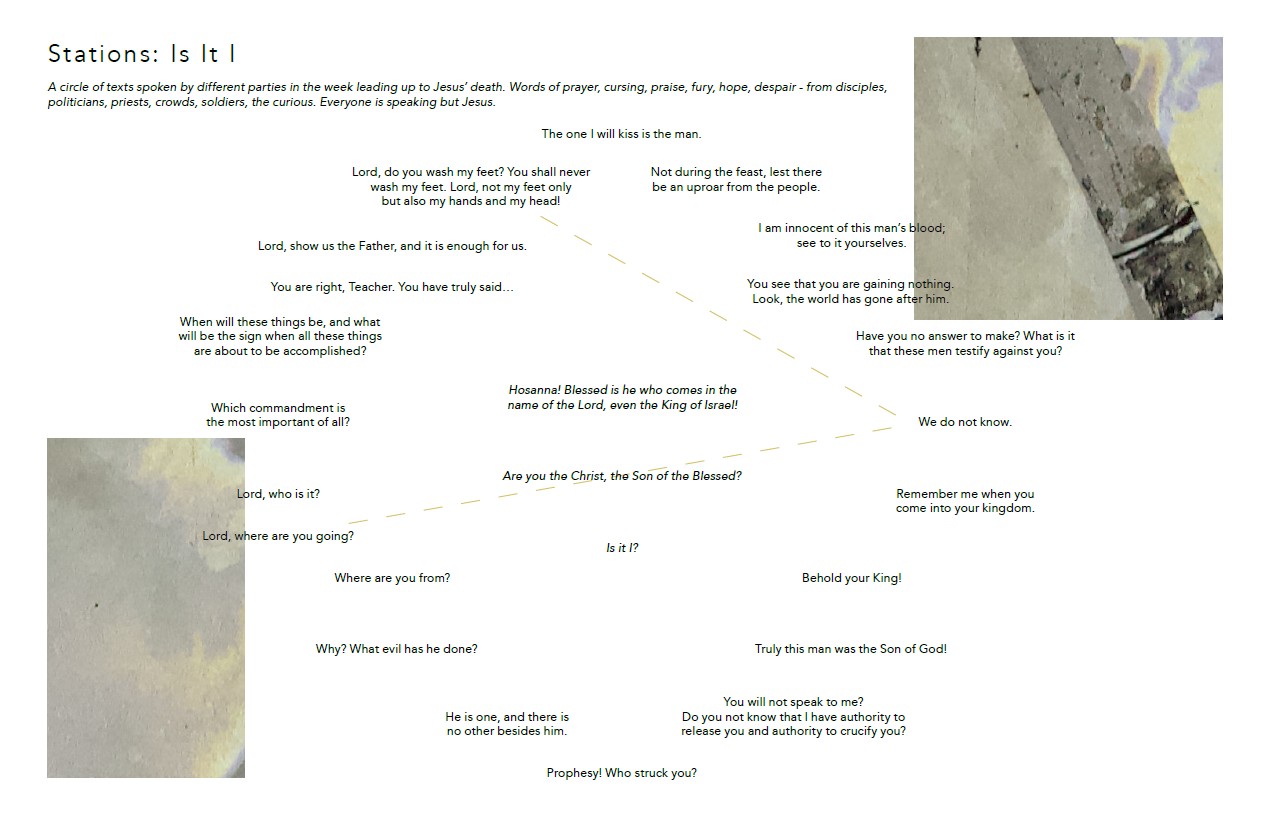
Joshua Stamper [previously] is “a transdisciplinary artist and composer whose work explores hiddenness, revelation, ephemera, and archive.” Commissioned by Resurrection Philadelphia, his “Stations: Is It I” composition collages spoken “words of prayer, cursing, praise, fury, hope, despair—from disciples, politicians, priests, crowds, soldiers, the curious,” all parties connected to Jesus’s final week. The texts are taken from scripture.
The cacophony is stressful. Maybe you turned off the recording before it finished, unable to bear it. I encourage you to stick with it for the full four minutes and twenty-one seconds, as a way of sitting with the discomfort and chaos of Christ’s passion, of entering into this story that’s at the center of the church’s proclamation.
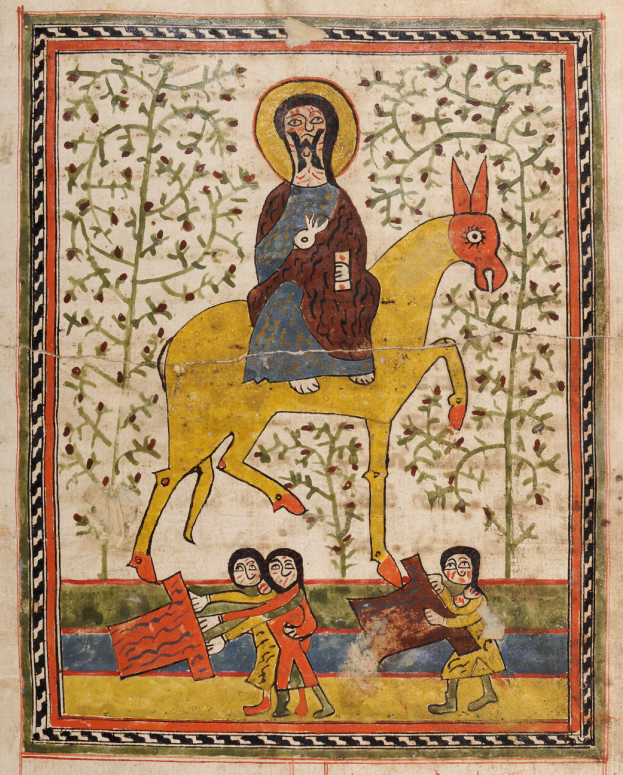
Christ’s Entry into Jerusalem, Alqosh, Iraq, 1723, from a Syriac Gospel lectionary. Collection of the Dominican Friars of Mosul (DFM 13, fol. 43v). Digitized in collaboration with the Centre Numérique des Manuscrits Orientaux (CNMO), Ankawa, Erbil, Iraq.
Made three centuries ago at a monastery in Iraq, this is one of three figurative paintings from a Syriac Gospel lectionary, the other two depicting Thomas touching Jesus’s wounds and the apocryphal saint George defeating a dragon. While the scribe is named in the manuscript as ʼEliyā bar Yaldā, the artist, if he is a different person (as they usually were), is not identified.
I love the fanciful coloration! Yellow and orange for the donkey, and a tricolored road of yellow, blue, and green. Plus, in the background, fruiting tree branches that climb and curl. The red striations on the figures’ necks and faces are, as far as I know, an idiosyncratic aesthetic choice of the artist’s; they may signify blood running through the veins, or perhaps the marks are simply decorative.
While the donkey is shown in profile, clopping along toward Jerusalem’s city center, Jesus rides sidesaddle and is oriented toward us, his eyes meeting ours. He holds a scroll in one hand, signifying that he is the fulfillment of Old Testament prophecies (most directly in this moment, Zechariah 9:9), and his right hand, which is heavily stylized, I can only assume is raised in a gesture of blessing, as it is in many other images of this subject.
At his feet, the people spread their cloaks, a sign of reverence.
Addendum: The following video of Palm Sunday celebrations in Iraq showed up in my Instagram feed a few hours after I published this blog post, and I thought it fitting to add.
LISTEN: “Hosanna! (Matthew 21:9 & 11)” by Frank Hernandez, for Steve Green’s Hide ’Em in Your Heart: Bible Memory Melodies, 1990 | Performed by Susanna and Rosalia, 2026
Blessed is he who comes in the name of the Lord Blessed is he who comes in the name of the Lord
Hosanna to the Son of David Hosanna in the highest Hosanna to the Son of David Hosanna, this is Jesus
Blessed is he (blessed is he) who comes in the name of the Lord Blessed is he (blessed is he) who comes in the name of the Lord
Hosanna to the Son of David Hosanna in the highest Hosanna to the Son of David Hosanna, this is Jesus
Hosanna (Hosanna) Hosanna (in the highest) Hosanna (Hosanna) Hosanna, this is Jesus
I learned this song two years ago when two girls from my church, sisters, sang it during the offertory for our Palm Sunday worship service. I asked them if they’d be willing to reprise their performance for my blog, as I love the sweetness of their voices together, and they obliged. They are thirteen and eleven years old.
Palm Sunday is an especially great day to utilize the children’s voices in your congregation for music or other parts of the liturgy, as Matthew mentions in his account of Christ’s entry into Jerusalem that “when the chief priests and the scribes . . . heard the children crying out in the temple and saying, ‘Hosanna to the Son of David,’ they became angry and said to [Jesus], ‘Do you hear what these are saying?’ Jesus said to them, ‘Yes; have you never read, “Out of the mouths of infants and nursing babies you have prepared praise for yourself” [Ps. 8:2]?’” (Matt. 21:15–16). “Hosanna” is an expression that in this context means something like “Hooray for salvation!,” as John Piper puts it.
The enthusiasm of the masses upon Jesus’s arrival in Judea’s capital city for Passover, and especially their ascription to him of the messianic title “Son of David” (not to mention “prophet” and “wonderworker”), raised the hackles of the temple leadership. He was a threat to their authority and status and to their understanding of the scriptures. So they purposed, in collusion with Rome, to put him to death.

 Art & Theology