Roundup: Pitjantjatjara picture Bible, “Feeling Through” short film, the reconciling Eucharist, and more

SPOTIFY PLAYLIST: September 2025 (Art & Theology): A new monthly playlist featuring a range of faith-based songs, including “Day by Day” by Lowana Wallace and Isaac Wardell of the Porter’s Gate (especially apt for Labor Day!), sung below by Kimberly Williams; “Jesus of Nazareth” by the early twentieth-century hymn writer Hugh W. Dougall, performed in a bluegrass style by the Lower Lights; and a fantastic instrumental jazz arrangement by Alice Grace of the classic children’s song “Jesus Loves Me,” performed by the Indonesian group Bestindo Music (Grace is at the keys).

+++

VIDEO: “The Apostles’ Creed”: This video presentation of the Apostles’ Creed, one of the oldest statements of Christian belief, used across denominations, was created in 2016 by Faith Church in Dyer, Indiana, using twenty-one of its members to voice the lines. [HT: Global Christian Worship]

+++

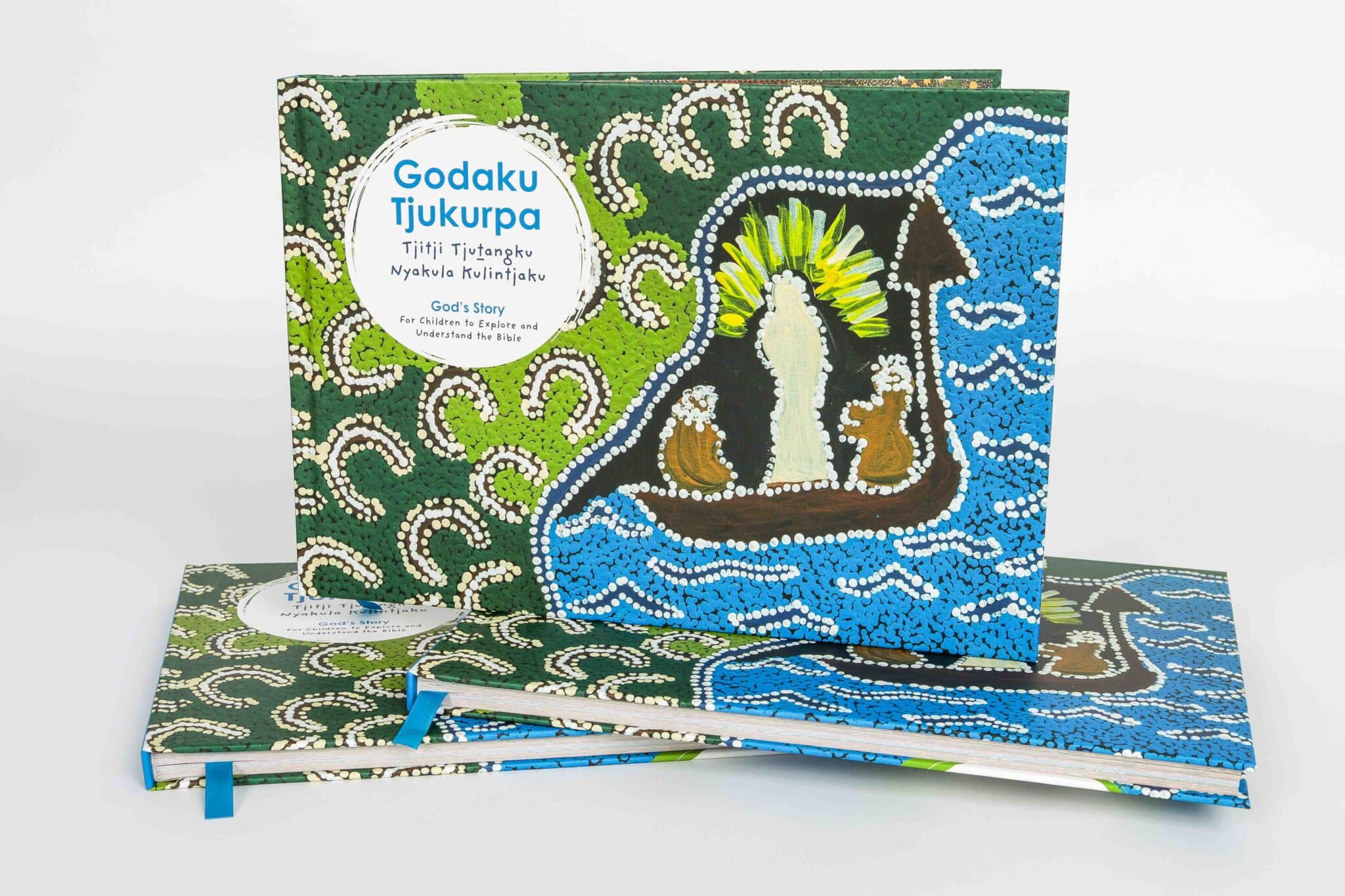
CHILDREN’S PICTURE BIBLE: Godaku Tjukurpa (God’s Story): Nami Kulyuru, a long-serving Pitjantjatjara Bible translator and artist from Central Australia, had the vision to pass on the stories of the Bible to her grandchildren and other young Pitjantjatjara readers using traditional Anangu paintings, compiled in book format. She began the artistic work in 2021 but shortly after was diagnosed with a malignant brain tumor. Following her death in 2022, her friends and colleagues rallied together to complete the project, which was published last November by Bible Society Australia. [HT: Global Christian Worship]

Godaku Tjukurpa
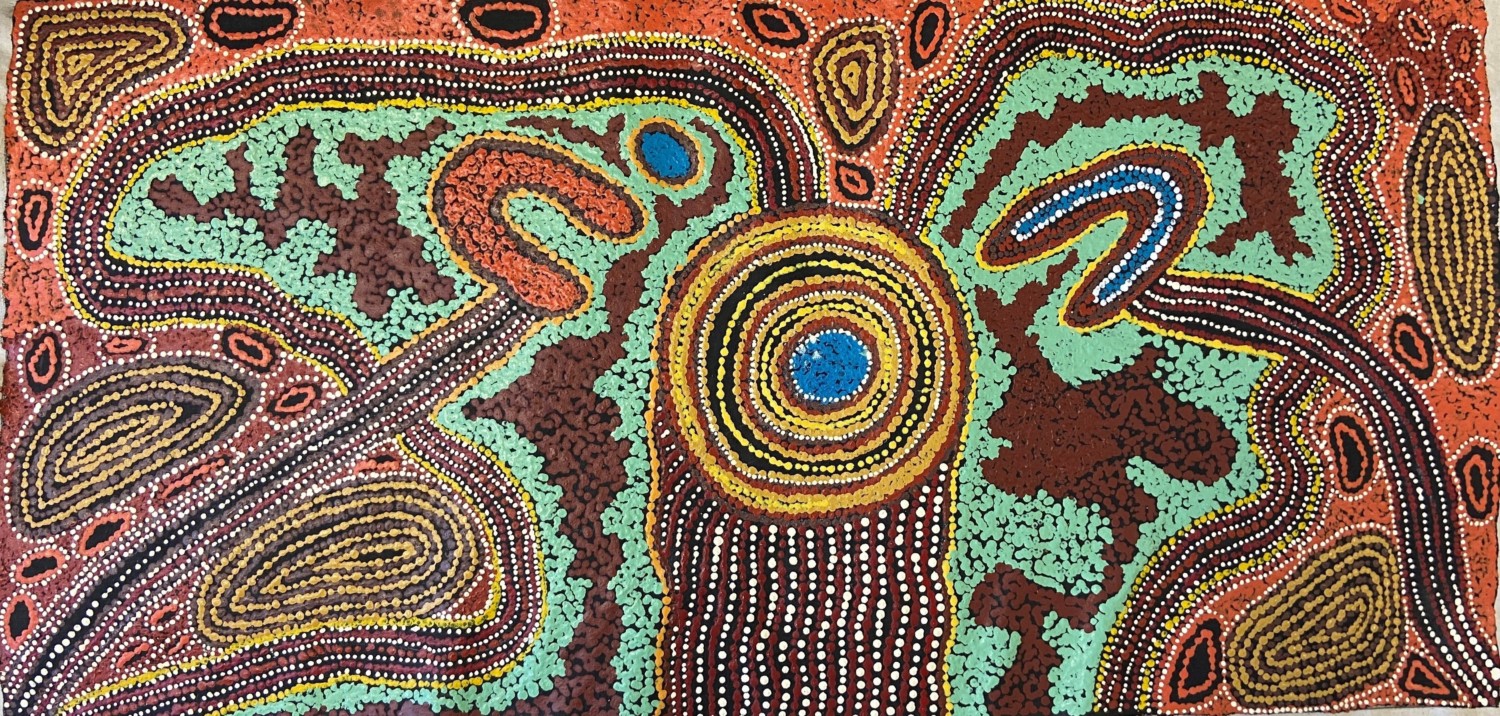
Kulyuru, Nami_Woman by the Well
Nami Kulyuru (Pitjantjatjara, 1964–2022), The Woman at the Well (John 4), 2021, from the bilingual book Godaku Tjukurpa (God’s Story) (Bible Society Australia, 2024)

Spanning the Old and New Testaments, Godaku Tjukurpa (God’s Story) features fifty-four Bible illustrations by Pitjantjatjara artists, along with descriptions in Pitjantjatjara and English. It is available for purchase through the Koorong website, but it appears that it can ship only to Australia or New Zealand.

+++

SHORT FILM: Feeling Through, dir. Doug Roland (2019): Nominated for an Academy Award in 2021, this eighteen-minute film is about a homeless teen (played by Steven Prescod) who encounters a DeafBlind man (played by Robert Tarango) on the streets of New York City. It was inspired by an actual experience writer-director Doug Roland had some years earlier. He partnered with the Helen Keller National Center to make the film, including casting a DeafBlind actor as co-lead, the first film to ever do so. You can watch Feeling Through for free on the film’s website, along with a “making of” documentary. Here’s a trailer:

+++

FEATURE FILM: Places in the Heart, dir. Robert Benton (1984): Set in Jim Crow Texas during the Great Depression, this film centers on the recently widowed Edna Spalding (Sally Field), a middle-age white woman who is struggling to run the cotton farm she inherited from her late husband and to make ends meet for herself and her two small children. To earn some cash, she takes in a boarder, Mr. Will (John Malkovich), a bitter World War I vet who is blind, and she hires Moze (Danny Glover), a Black drifter who is being harassed by the Ku Klux Klan, to teach her how to plant and harvest cotton. The three are thrown together out of necessity and help each other survive.

It’s a pretty good movie overall—and it won Sally Field her second Oscar for Best Actress—but what leads me to recommend it is its theologically profound closing scene, which shows the ordinance of Communion being celebrated at the local country church. First Corinthians 13:1–8, the famous “love” passage, is read from the pulpit, and the choir launches into “In the Garden” (a hymn inspired by the risen Christ’s appearance to Mary Magdalene on Easter morning) as the plates of bread and grape juice are passed down the pews. The camera zooms in close on each congregant as they receive the elements, starting with a couple whose marriage had suffered due to infidelity but who, in this scene, silently reconcile.

On my first watch, what signaled to me that we had entered the realm of the imaginary (the mystical? the aspirational?) was the presence of Moze, who had left town the previous night after having been beaten by Klansmen; he’s here, with no visible wounds, in this conservative white church in the 1930s that very likely would not have welcomed him, being served the body and blood of Christ by a deacon. I believe that some of the white men in the pews in front of him are repentant Klansmen who, when Mr. Will identified them under their hoods by their voices the previous night, mid-assault, slinked away in shame. Within the row, too, is the mortgage collector who was in conflict with Edna, insisting that she sell the farm.

After Edna receives the elements, she passes them to her husband, Royce, who was dead before but here is very much alive. He then passes the elements to the young Black teen, Wylie, who had shot and killed him in a drunken accident, whom vigilantes then lynched. “Peace of God,” they say to each other—a traditional Christian greeting expressing love and reconciliation. The final frame lingers on Royce and Wylie, sharing the meal together, and I’m intrigued by the actors’ choices of expression: Wylie is serene, grace-filled, whereas Royce appears befuddled, perhaps recognizing for the first time the blessed tie that binds him to his Black neighbor, his brother in Christ.

This scene speaks powerfully of the invitation of the Lord’s Table—open to all, even the most morally odious, who would come in humble confession of (and turning from) sin and reliance on God’s mercy through Christ, which heals and transforms. Partaking of the meal are various people from the community—people who have cheated on their spouses; people with ornery dispositions; people with narrow economic interests, who fail in compassion; people who have stolen; people who have committed cruel, racist, violent acts; people driven to drink, leading to fatal harm; people who have silently allowed racial terror to reign in their town. All these sinful, forgiven people make up the body of Christ, are united under his cross. They’ve often hurt one another, but the Holy Spirit is at work making them a new creation. I see this final scene as a picture of heaven, where wrongs are redressed, and of the “beloved community” Martin Luther King Jr. talked about.

Places in the Heart is streaming for free on Tubi (no account required).

Four site-specific art installations in churches for Pentecost

I’m always intrigued by how artists respond creatively to sacred Christian spaces when invited to do so by the owning ecclesial bodies. Such invitations tend to appeal to artists, even those of different or no faith backgrounds, because of the chance to work with a (often) grand architectural space already charged with meaning and to make something that will live with a community over time, either temporarily or permanently, likely forming them in some way.

Because the feast of Pentecost is coming up on June 8, in which the church celebrates its “birthday,” effectuated by the descent of the Holy Spirit after Jesus’s ascension (see Acts 2), here are four striking artistic interventions in active or former churches that reference that spectacular event of wind and fire. Only the first was commissioned specially for Pentecost, but the other three bear Pentecostal resonances.

1. Tongues of Fire by Nancy Chinn, Grace Cathedral, San Francisco

Chinn, Nancy_Pentecost
Nancy Chinn (American, 1940–), Tongues of Fire, 1988. Fifty painted nylon-net strips, 18 in. × 10–50 ft. (dimensions variable). Temporary installation at Grace Cathedral, San Francisco.

Nancy Chinn is a liturgical artist and lay feminist theologian living in California, working in fibers and mixed media. Her Tongues of Fire was originally installed in Grace (Episcopal) Cathedral in San Francisco for Pentecost 1988, and she has since reprised it in a handful of other churches throughout her career.

It consists of fifty strips of nylon netting, painted in red, orange, and gold and suspended along the expansive neo-Gothic nave. She chose that number based on the etymology of the word “Pentecost,” which means “fiftieth” in Koine Greek; it was the name Hellenistic Jews used to refer to the Jewish festival of Shavuot, celebrated fifty days after Passover, but it also became a Christian festival in the first century CE when, fifty days after Jesus rose from the dead, his Spirit descended to empower his nascent community of followers.

Draped in a mighty sweeping movement and overlapping one another, the streamers respond to air flow in the space, furthering the sense of dynamism.

2. Tilting at Giants by Dayton Castleman and Fall to Flight by Alison Dilworth, Broad Street Love, Philadelphia

Castleman, Dayton_Tilting at Giants
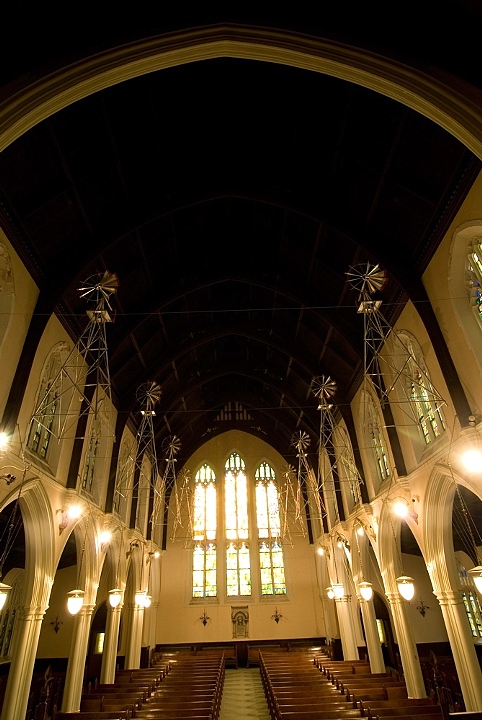
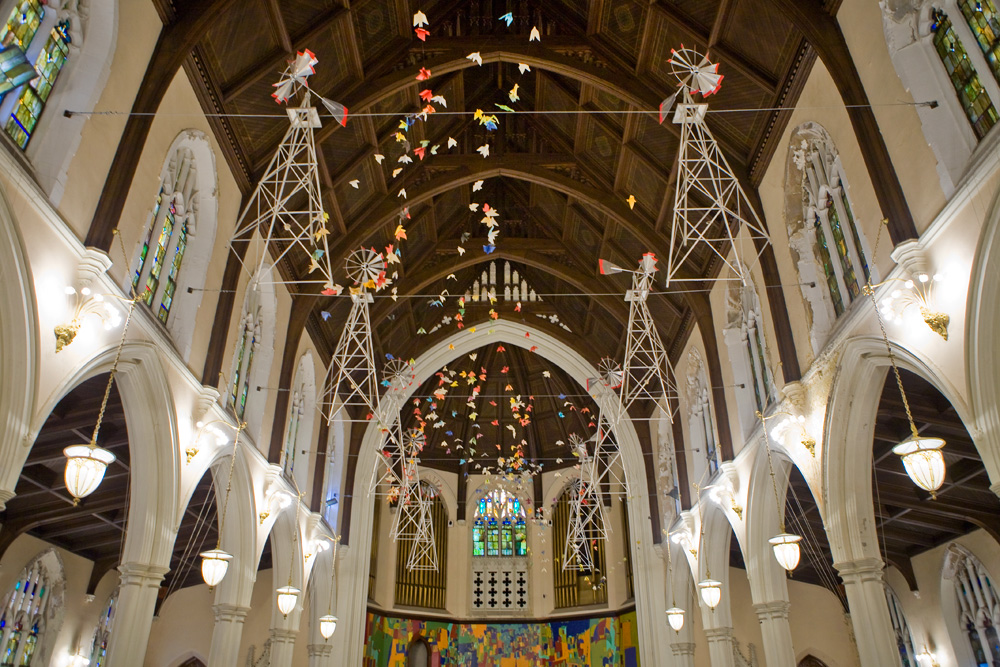
Dayton Castleman (American, 1975–), Tilting at Giants, 2006. Aluminum, steel, votive candles, glass votive holders, braided fishing line, steel cable, and rigging hardware. Permanent site-specific sculpture, Broad Street Love, Philadelphia.

Tilting at Giants was commissioned by Broad Street Ministry (renamed Broad Street Love in 2024), a nonprofit organization in downtown Philadelphia providing stabilizing services to individuals experiencing deep poverty. It’s housed inside the former Chambers-Wylie Memorial Presbyterian Church, a historic turn-of-the-century Gothic Revival church that closed its doors in 1999 due to dwindling membership and the death of its pastor. The Presbytery of Philadelphia (PCUSA) leased the building for a few years to the University of the Arts, who used it for classes and events.

Then in May 2005, Rev. Bill Golderer rejuvenated the dormant church by opening Broad Street Ministry, billed as “an innovative Christian faith community that emphasizes the Gospel imperatives of extending generous hospitality, demonstrating justice and compassion, and providing a ground for artistic expression.” He removed the pews and set communal dining tables in their place, inviting in guests off the streets to enjoy chef-prepared meals all week long. The organization also provides legal help, fresh clothes, medical assistance, and a mailbox for those who lack a permanent address.

In its first year, Golderer issued an open call for proposals for a site-specific art installation that would be funded by the city’s Percent for Art program. Multidisciplinary artist Dayton Castleman, who lived in Philly at the time but who is now based in Northwest Arkansas, was awarded the commission.

His project comprises twelve large windmills that hover in the air, six in a line down each side of the vault—“unexpected, anachronistic, misplaced . . . [and] completely still,” Castleman says. He elaborates:

This stillness infuses the atmosphere with a sense of uneasy expectation. The brilliant towers, tall and clean, flash against the dark, vaulting canopy above. Like sentinels keeping watch, the sun-burst fans are poised, brimming with potential energy, waiting for a mysterious, transcendent wind to fill the space and make it sacred. Cradled within each tower, nearly lost in the spectacle, hover votive candles, glowing, unflickering, in prayer. This sanctuary is a living prayer—an aching, tense, expectant prayer—and a hair pulled taut, waiting to snap. . . .

The air is rich with suggestions and intimations of the invisible.

His artist’s statement also mentions Pentecost. On that seminal day two millennia ago, the disciples were gathered in Jerusalem with anticipation, as Jesus had told them, just before returning to the Father, to remain in the city until they received their new baptism, “for John baptized with water, but you will be baptized with the Holy Spirit not many days from now” (Acts 1:5).

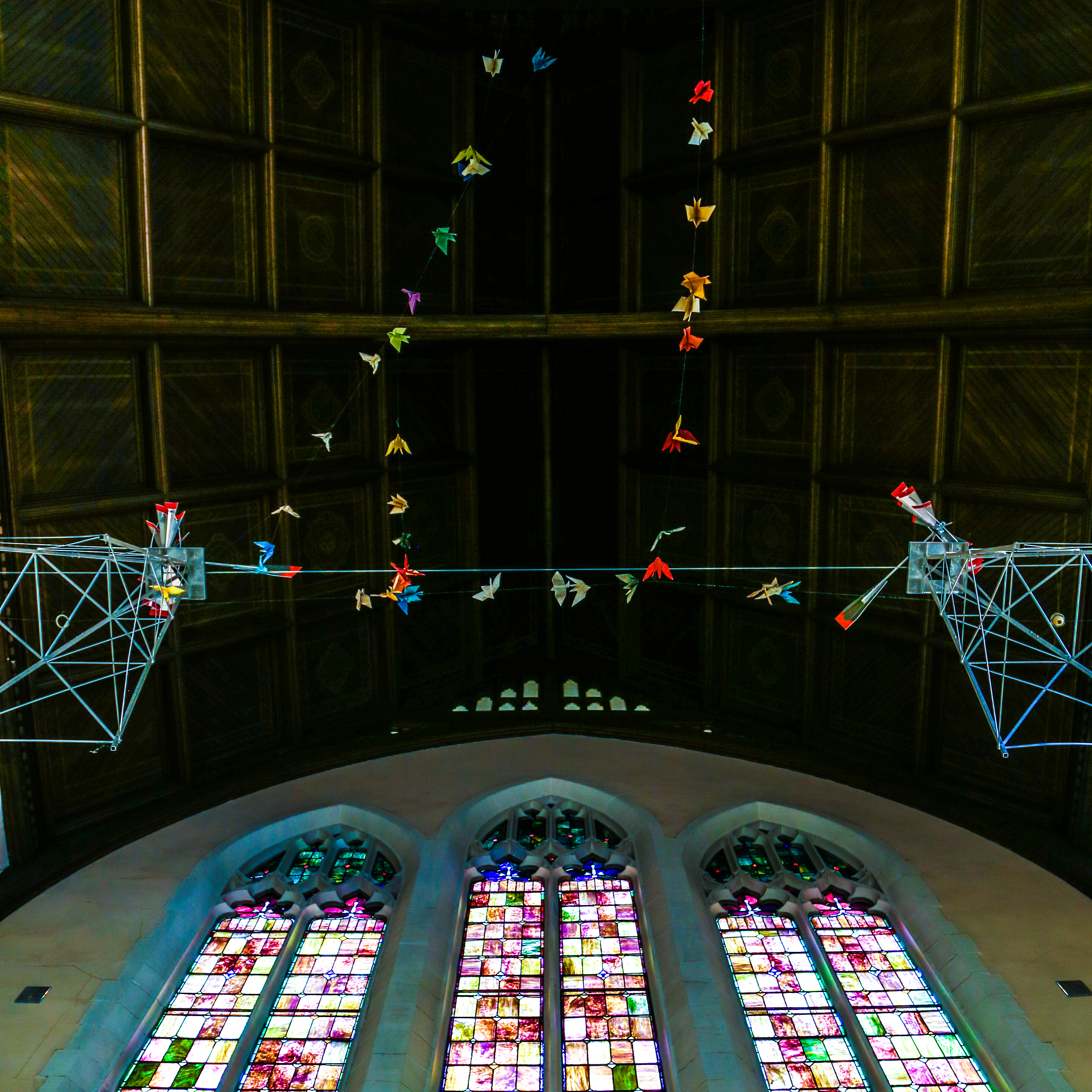
Broad Street Love
Broad Street Love in Philadelphia, with art installations by Dayton Castleman (windmills) and Alison Dilworth (swallows). Photo: Bradley Maule.

Broad Street Love (upward view)

Shortly after Castleman’s Tilting at Giants was installed, it was joined by Fall to Flight, a flock of approximately six hundred origami swallows suspended from the ceiling, containing written prayers of the community. Created by Philadelphia-based artist Alison Dilworth, the multicolored birds winging overhead evoke the unleashed joy of the Holy Spirit, who is sometimes compared in scripture to a dove, but also Jesus’s encouragement in the Sermon on the Mount that God will provide for the needs of his children, just as he provides for our avian friends who neither sow nor reap nor gather.

3. HS by Maciej Urbanek, St. Michael’s Church, Camden Town, London

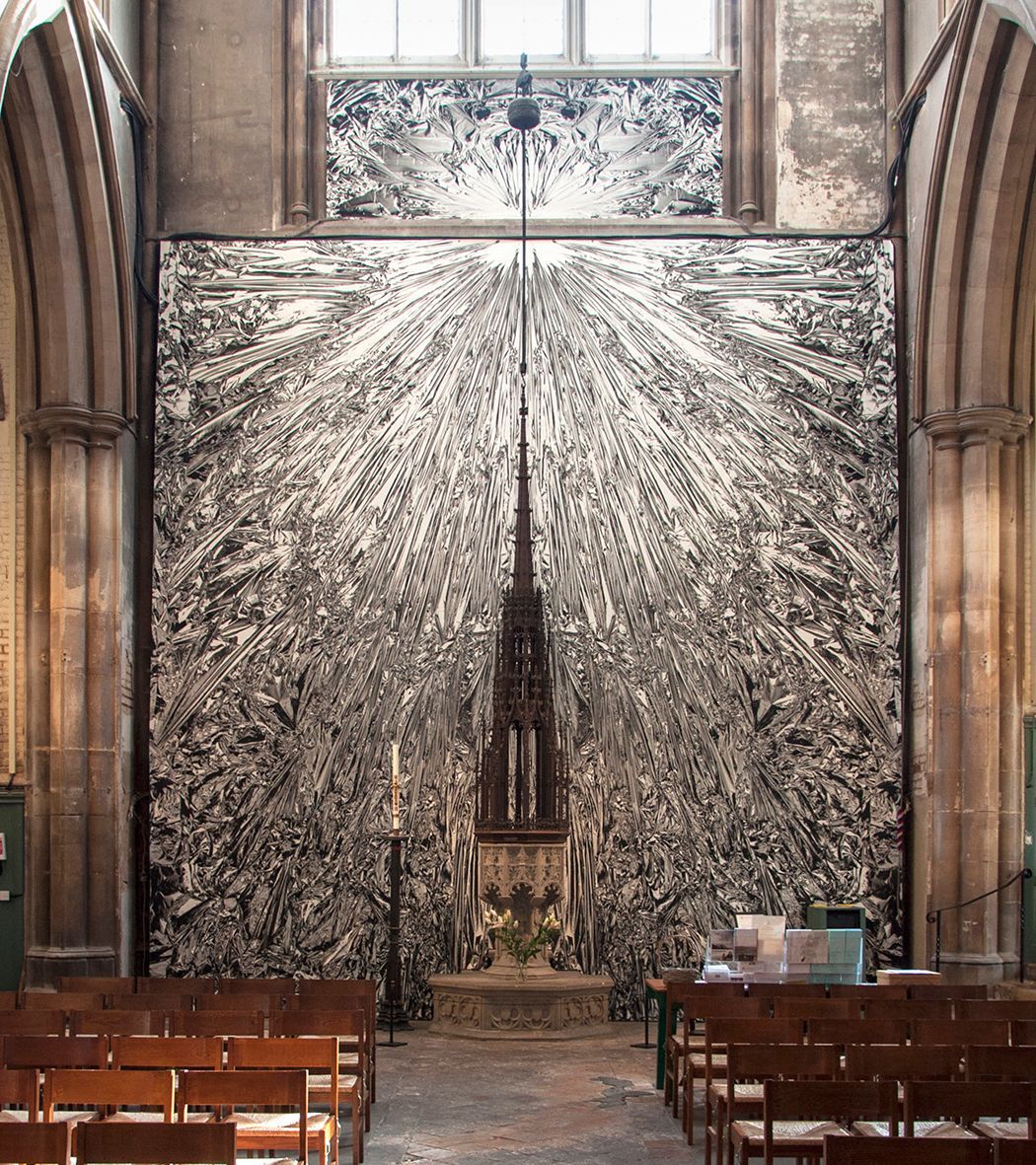
Urbanek, Maciej_HS
Maciej Urbanek (British, 1979–), HS, 2014. Digital photographic print, 10 × 7.5 m. St. Michael’s Church, Camden Town, London.

HS by the Polish-born British artist Maciej Urbanek is a monumental composite digital print installed on the west wall of St. Michael’s (Anglican) Church in Camden Town, London, covering up damaged plasterwork in need of restoration. What appears to be an explosion of silvery light is an effect produced with black plastic trash bags, which the artist crumpled up, lit, photographed, digitally reworked, and inkjet-printed on a large scale. Winner of the 2015 Art+Christianity Award for Art in a Religious Context, the work brings a baroque aesthetic to the Victorian interior.

“I am interested in elevating the banal and prosaic elements of life and turning them into powerful and rich visual statements,” Urbanek has said. A sign at the church says that Urbanek’s use of an everyday material to make something so beautifully radiant is “a metaphor for God’s work in taking ordinary human lives and making them extraordinary.”

Commissioned by Father Philip North (then the team rector of the parish of Old St Pancras) and privately funded by John Booth, HS was intended to be a temporary installation, but it was so well received by the parish that it has become a permanent fixture. According to the church’s X account, it “represent[s] the Holy Spirit breaking in from the outside world.”

The artwork’s location just behind the church’s baptismal font creates a linkage between the sacrament of baptism—in the Church of England, marking the beginning of a journey with God and the baptizand’s membership in the community of faith—and the work of the Spirit, who came at Pentecost with great power to set ablaze and send out. Indeed, HS can be read as that dramatic moment of the Spirit’s outpouring, and that parishioners walk past it when they exit the sanctuary is a reminder that they leave empowered by the Spirit to live and proclaim Christ’s gospel.

Thank you to Sheona Beaumont for introducing me to this work in her book The Bible in Photography: Index, Icon, Tableau, Vision. It is also the subject of a 2021 essay by Jonathan A. Anderson, “Bin bag visions: Theological horizons in Maciej Urbanek’s HS,” which I don’t have access to.

Roundup: Kristin Asbjørnsen interprets the spirituals, photos from Skid Row, and more

SPOTIFY PLAYLIST: July 2023 (Art & Theology): This month’s Spotify mix that I put together for you all includes a Shona worship song from Zimbabwe; “Adonai Is for Me,” a song in Hebrew by Shai Sol; a Black gospel rendition of the children’s classic “Jesus Loves Me”; a new setting of the Lord’s Prayer by Jon Guerra; a composition for clarinet and piano by Jessie Montgomery, written in April 2020 to try to make peace with the sadness brought about by the pandemic-prompted quarantine orders; a country-style setting of Psalm 121 by Julie Lee; and a benediction by Bob Dylan that I heard Leslie Odom Jr. sing in concert recently—its refrain, “May you stay forever young,” is not an anti-aging wish but rather a call to childlike faith, wonder, and curiosity in perpetuity.

The playlist also includes the following two songs.

>> “Come Go with Me”: A lesser-known African American spiritual performed by the Norwegian jazz singer-songwriter Kristin Asbjørnsen, from her excellent album Wayfaring Stranger: A Spiritual Songbook. She describes the spirituals as “existential expressions of life: songs of longing, mourning, struggling, loneliness, hopefulness and joyful travelling.” This particular one is about walking that pilgrim path to heaven, a path on which Satan lays stones to obstruct our progress but which Jesus, our “bosom friend,” clears away.

>> “Love, More Love”: A short Shaker hymn that opens with a common Shaker greeting: “More love!” “Our parents above” refers, I believe, to the elders of the faith who have passed on. The hymn uses horticultural imagery to describe the qualities of communal love—something planted and grown, becoming stronger and fuller and more beautiful as it is nurtured.

Love, more love
A spirit of blessing I would be possessing
For this is the call of our parents above

We will plant it and sow it
And every day grow it
And thus we will build up an arbor of love

The Shakers are a Christian sect founded in 1747, but because celibacy is one of their tenets (and thus they cannot rely on procreation for the community’s continuation), there are only two Shakers left: Sister June and Brother Arnold, who live in Dwellinghouse, Maine. But there has long been a historical interest in Shaker religious culture and aesthetics—which is why, for example, the Enfield Shaker Singers was formed, to preserve the hymnody.

+++

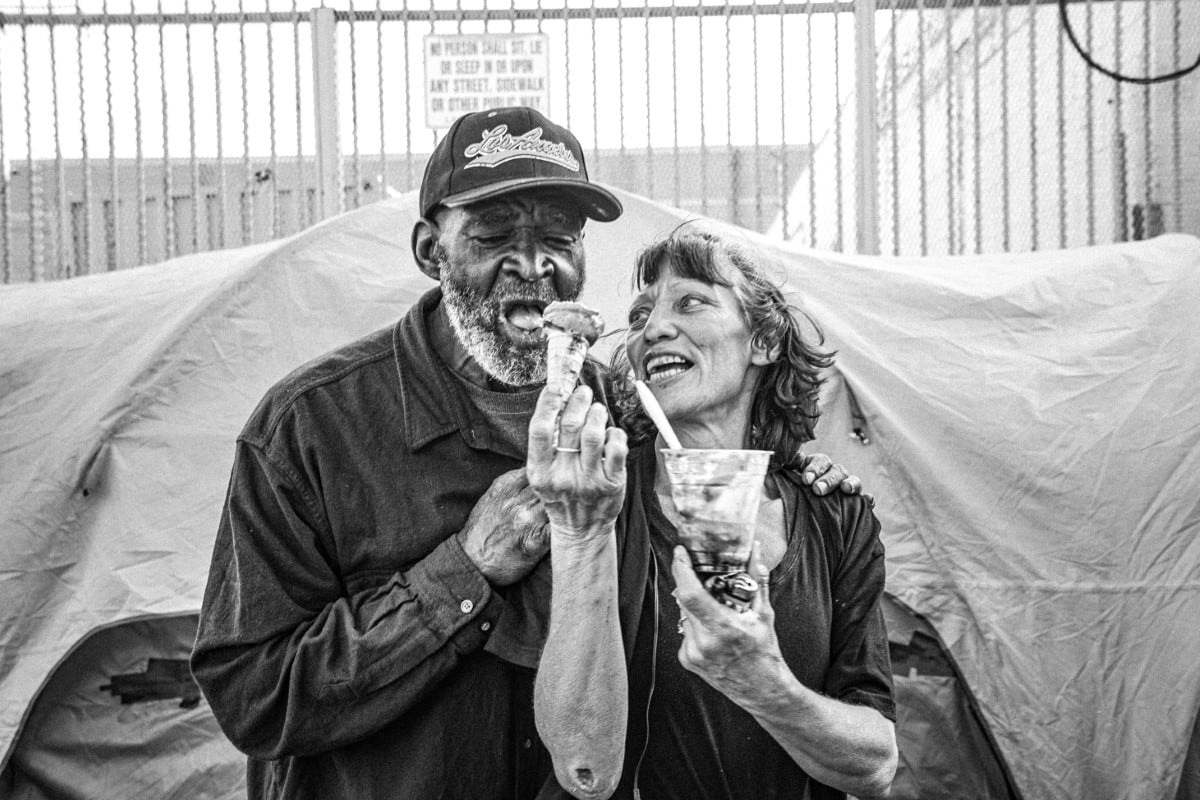
INTERVIEW + PHOTOS: “Photographer Shows the Raw, Unflinching Reality of Life on Skid Row”: For the past decade, anonymous street photographer Suitcase Joe has been spending time on Skid Row in downtown Los Angeles, a neighborhood inhabited by the largest unhoused community in America. He slowly developed trust and built relationships with the people in that community, learning more about their stories, and they granted him unprecedented access to their daily lives, allowing him to capture them on camera. Hear him talk about the experience, and about misconceptions people tend to have about those experiencing homelessness, in this interview, which also includes a sampling of photos. Even though the headline hawks “Raw!” and “Unflinching!,” I was more struck by how the photographs show experiences of joy and friendship.  

Photo by Suitcase Joe
Photograph by Suitcase Joe, Skid Row, Los Angeles

To find out ways to help meet the needs of those living on Skid Row, visit https://suitcasejoefoundation.org/.

+++

POEM WITH COMMENTARY: “The Rungs” by Benjamin Gucciardi, commentary by Pádraig Ó Tuama: Each week on the Poetry Unbound podcast, Ó Tuama reads and reflects on a different contemporary poem. In this episode’s featured poem, “a social worker holds a group for teenagers at a school. They only half pay attention to him. Then something happens, and they pay attention to each other.” The poem is from Gucciardi’s latest collection, West Portal.

+++

ARTICLE: Dool-Hoff: A Dutch Maze with New Jerusalem at its Centre (1705)”: The Public Domain Review is always uncovering unique, amusing prints and other artistic and literary curiosities from centuries past. Here they look at an early eighteenth-century religious maze published in Haarlem, Netherlands, whose pathways are filled with didactic verse, some leading to dead ends but others leading to heaven at the center.

Dool-Hoff (Dutch maze)
Dool-hoff (maze), signed by the Dutch Catholic printer Claes Braau, 1705. Photo courtesy of the Rijksmuseum, Amsterdam.

+++

SONG: “Home Inside” by Valerie June, performed by the Good Shepherd Collective: This Valerie June cover is sung so gorgeously by Sowmya Somanath with Kate Gungor, Bea Gungor, Jayne Sugg, Liz Vice, and Diana Gameros, and John Arndt accompanies on piano. It premiered in Good Shepherd New York’s March 12 digital service. The song is a prayer for belonging more fully to ourselves, to God, and to this earth; its speaker asks that she might be sensitive to the divine breath in all living things, and be soothed and refreshed by that great stream of water that flows from God’s heart. (Reminds me a bit of Universal Jones’s “River”!)

Here is the original recording by Valerie June.

Roundup: News photos with Advent promises, “Tent City Nativity,” and more

PHOTO COMPILATION: “Alternative Advent 2022” by Kezia M’Clelland: Kezia M’Clelland [previously] is the children in emergencies specialist and people care director for Viva and a child protection consultant for MERATH, the Lebanese Society for Educational and Social Development’s community development and relief arm. She is a British citizen, but her work brings her around the world, seeking to safeguard the rights and well-being of children globally.

Every December M’Clelland compiles photos from that year’s news, showing people affected by natural disasters, violence, and injustice, and overlays them with Advent promises. There’s sometimes a disjunction between image and text that’s grievous and challenging, a reminder that our long-looked-for deliverance is not yet fully here, even though we receive foretastes. The twenty-eight photos M’Clelland gathered from 2022 include throngs of people making their way to Aichi cemetery in Saqqez, Iran, to attend a memorial for twenty-two-year-old Mahsa Amini, allegedly beaten to death by the country’s religious morality police for not wearing her hijab properly; a police officer helping a child flee artillery on the outskirts of Kyiv, and a baby being born in a bomb shelter; women carrying pans of granite up the side of a mine in Ouagadougou, Burkina Faso, for meager wages; a woman comforting a neighbor who lost her home to flooding in Tejerias, Venezuela; children playing in a sandstorm at the Sahlah al-Banat camp for displaced people in the countryside of Raqa in northern Syria; children clearing trash from a river in Tonlé Sap, Cambodia; and more.

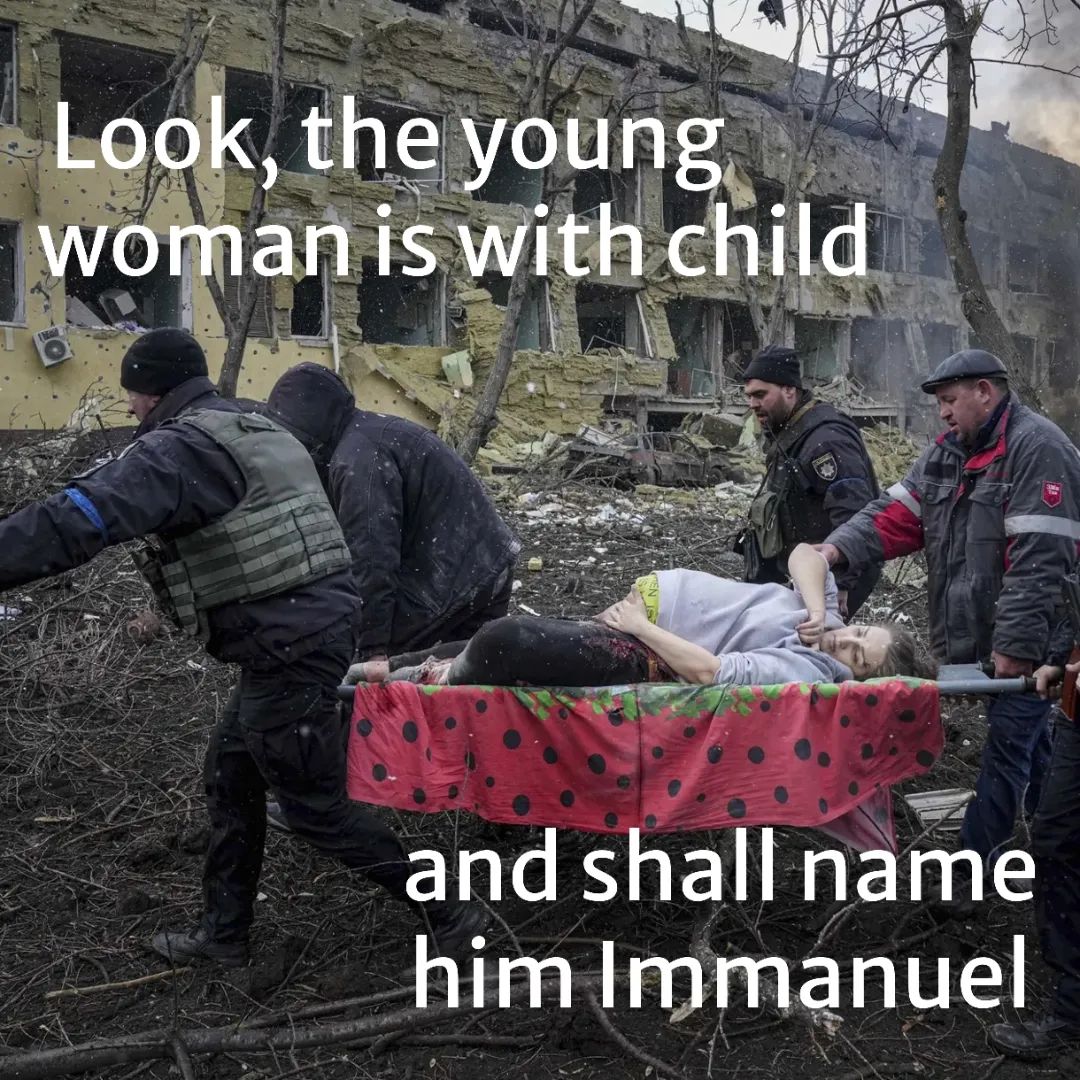
Alternative Advent 2022 (Immanuel)
March 9, 2022: An injured pregnant woman is rescued from a maternity hospital in Mariupol, Ukraine, that was bombed by Russian forces. The following week it was reported that she and her child, delivered in an emergency C-section, did not survive. Photo: Evgeniy Maloletka/AP. Scripture: Isaiah 7:14.

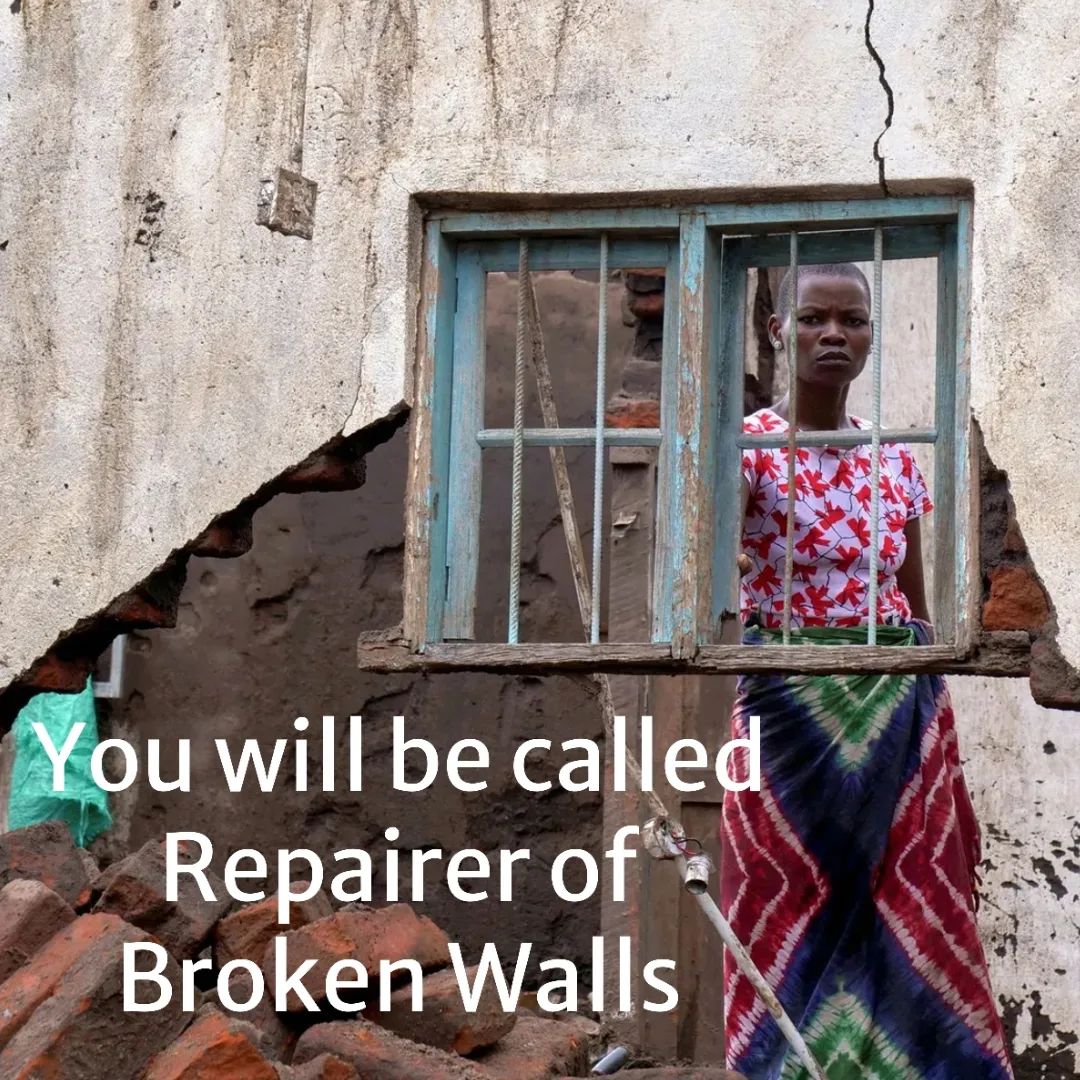
Alternative Advent 2022 (Repairer)
January 26, 2022: A young woman looks on from her house destroyed by tropical storm Ana in the village of Kanjedza in Malawi. Photo: Eldson Chagara/Reuters. Scripture: Isaiah 58:12.

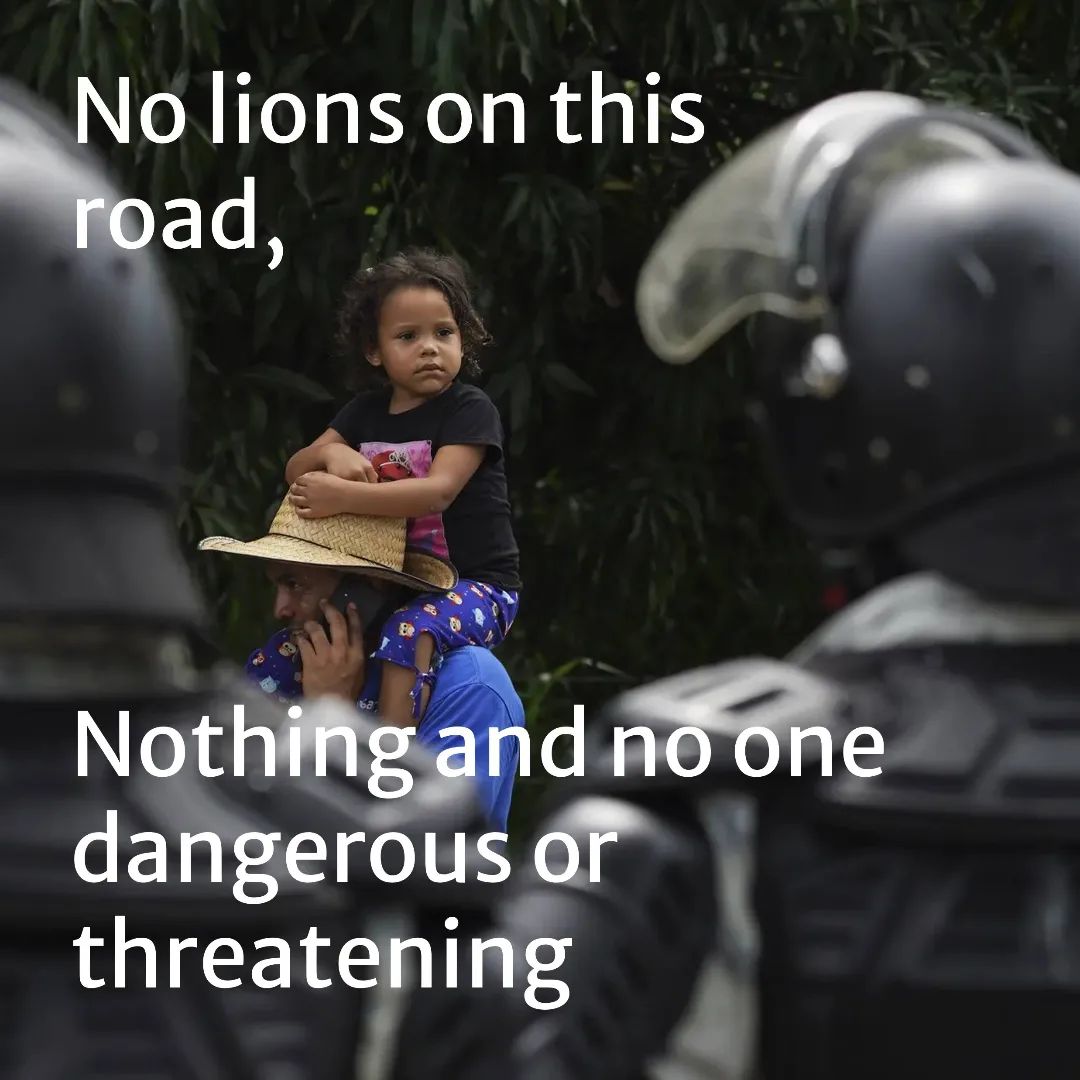
Alternative Advent 2022 (no lions)
June 7, 2022: A man and child, part of a migrant caravan consisting mostly of Central Americans, are blocked by members of the Mexican National Guard on a Huixtla road in Chiapas state, Mexico. They seek transit visas from the National Migration Institute so that they can continue their thousand-plus-mile journey north to the US. Photo: Marco Ugarte/AP. Scripture: Isaiah 35:9 MSG.

The sequence of images is a visual prayer of lament and intercession. I appreciate how M’Clelland—via the work of photojournalists, and her sensitive curation—raises awareness about these places of suffering, putting faces to the headlines, but also spotlights moments of empowerment and joy amid that suffering. We are encouraged to seek God’s coming into these situations of distress and to see the subtle ways he does come—for example, through the consoling embrace of a friend, the nurturance of an elder sibling, the protective aid of an officer, a jug of clean water, a child’s glee, or acts of protest.  

For photo credits and descriptions, see the Instagram page @alternative_advent. (Start here and scroll left if you’re on your computer, or up if you’re on your phone.) Follow the page to receive new posts in your feed starting next Advent.

+++

SONGS by Rev Simpkins, an Anglican priest and singer-songwriter from Essex previously featured here:

>> “Hallelu! (Love the Outcast)”: This song was originally released on The Antigen Christmas Album (2014) with the byline “Ordinand Simpkins & Brother De’Ath”; it was reissued in 2016 on Rev Simpkins’s album Love Unknown, “a cornucopia of non-LP tracks, studio experiments, ingenious live re-workings, radio sessions, off-the-wall demos, obscure b-sides, & pissings about.” The music video was recorded on an iPhone 4 in the Edward King Chapel at Ripon College Cuddesdon in Oxford. [Listen on Bandcamp]

>> “Poor Jesus” (Traditional): Here the Rev. Matt Simpkins performs the African American spiritual “Oh, Po’ Little Jesus” with a soft banjo accompaniment. Harmonizing vocals are supplied by his daughter, Martha Simpkins. It’s the opening track of his EP Poor Child for Thee: 4 Songs for Christmastide (all four songs are wonderful!), released December 11, 2020, to support St Leonard’s Church, Lexden, where he serves as priest-in-charge. [Listen on Bandcamp]

+++

NEW PAINTING: Tent City Nativity by Kelly Latimore: Kelly Latimore is an Episcopalian artist from St. Louis, Missouri, who “rewonders” traditional iconography, especially with an eye to social justice. This Christmas he painted an icon called Tent City Nativity, which shows the Christ child being born in a homeless encampment. A streetlight shines directly over the Holy Family’s tent, like the star of Bethlehem, and neighbors bring gifts for warmth and sustenance: coffees, a blanket, a cup of chili. View close-ups on Instagram, and read the artist’s statement on his website. Proceeds from print and digital sales of the icon will support organizations serving the unhoused in St. Louis.

Latimore, Kelly_Tent City Nativity
Kelly Latimore (American, 1986–), Tent City Nativity, 2022. Acrylic, Flashe, and golf leaf on birch board, 27 × 32 in.

[Purchase signed print] [Purchase digital download]

+++

SONG MEDLEY: YouTube user African Beats spliced together excerpts from three songs performed at a church in Germany at Christmastime by South African singer Siyabonga Cele and an unnamed woman, including “Akekho ofana no Jesu” (There’s No One like Jesus) and “He’s Got the Whole World in His Hands.” I couldn’t find the name of the last song, and attempts to contact the singer for information were unsuccessful, but it’s in Zulu, as is the first one. Lyrics to the first song, sourced from here, are below.

Akekho ofana no Jesu (There’s no one like Jesus)
Akekho ofana naye (There’s no one like him)
Akekho ofana no Jesu (There’s no one like Jesus)
Akekho ofana naye (There’s no one like him)

Sahamba, hamba, lutho, lutho (I’m walking, walking, nothing, nothing)
Safuna, funa, lutho, lutho (I’m searching, searching, nothing, nothing)
Sajika, jika, lutho, lutho (I’m turning, turning, nothing, nothing)
Akekho afana naye (There is no one like him)

“Jesus’ Blood Never Failed Me Yet”: From the streets to symphony hall

In 1971 Gavin Bryars was working as a mixer and editor for a film documenting street life in and around the Elephant and Castle area of South London. Sifting through all the material that filmmaker Alan Power had recorded for the project, Bryars was struck by a twenty-six-second audio fragment of an elderly homeless man singing a simple song of Christian faith:

Jesus’ blood never failed me yet
Never failed me yet
Jesus’ blood never failed me yet
That’s one thing I know
For he loves me so

The clip didn’t make it into the film, but Power gave Bryars permission to keep it. Unfortunately the singer’s name and likeness were never recorded, and Bryars’s attempts to find him were unsuccessful. And despite scouring various hymnals and archives, neither Bryars nor anyone else has been able to find any other record of the song, which means it very likely could have been written by the man himself.

Inspired by the beauty and sincerity of the man’s song, Bryars ended up using the unwanted audio as the basis of a major orchestral composition. He made a loop of its thirteen bars (which the man sings perfectly in tune) and wrote a simple chordal arrangement, which he then developed into a rich ensemble piece with strings and brass, lasting about thirty minutes. The first three and half minutes feature a playback of the man’s bare vocals, the clip gradually increasing in volume until the strings enter in layers, then the brass, building to a swell that supports (but crucially, does not overwhelm) the voice for the entire duration.

“In a loose narrative sense, the frail, forsaken man is given a dignity and a sense of comradeship from the supporting musicians,” writes British journalist Oliver Keens, who also says that this “work of experimental classical music .  .  . as accessible as any pop song .  .  . is the closest we have in [England] to an underground national hymn.”

Music writer and sound artist Marc Weidenbaum says the piece “takes the melody inherent in a creaky recording of a homeless man singing a hymn in a painfully sweet and wavering rendition and renders it in a gentle, sensitive setting that suggests a heavenly chorus if not outright beatification.”

It is meditative; trancelike, even. And it has such emotional power. I cried when I first heard it.

The orchestration honors the anonymous man’s faith and the object of his faith, Jesus Christ—particularly the efficacy of Jesus’s blood, shed for the life of the world. An expression of divine love, that blood flows into every dark corner, bringing hope, forgiveness, and healing. The man on the tape clung to its promise. Even though his circumstances might suggest that the blood did fail him, he testifies otherwise: Jesus’s blood has never failed me.

“Jesus’ Blood Never Failed Me Yet” was originally released on LP on Brian Eno’s Obscure Records label in 1975 (a few minutes had to be shaved off for it to fit on vinyl) and was re-released in 2015. A shortened version was recorded in 2002 on Gavin Bryars: A Portrait, featuring Tom Waits, with the Gavin Bryars Ensemble.

Widely performed, the piece exists in many iterations, with different lengths (from four minutes to twelve hours) and instrumentation. Bryars said he reinvents it every time he conducts it, usually writing parts for the musicians he has available.

Last year, in celebration of the work’s fiftieth anniversary, The Song Company and friends recorded a new choral a cappella version by Bryars.

The song has also been covered by popular Christian artists such as Jars of Clay (2003) and Audrey Assad (2016). Sandra Stephens sings it with a new melody and Latin rhythm on the collaborative album Shades of Blue (1994), interspersed with a monologue by Lanny Cordola that references the song’s source in that unnamed Londoner who graced the world with it.

The video above captures a performance by Psappha, conducted by Clark Rundell, which took place October 12, 2016, at the RNCM Theatre in Manchester.

In a Luminous podcast interview with Bryars last year, host Peter Bouteneff, reflecting on how Bryars recovered the old singer’s brief improvised performance from the cutting-room floor, said something that has stayed with me: “It makes you wonder how at any given moment, there’s something passing being said or sung, that if we cared enough to isolate it and love it, it could become exactly as beautiful.”

Recognizing the sublimity of the man’s song, Bryars shone a light on it, developing it into a full-fledged concert piece that doesn’t compete with the original homespun quality, but rather elevates it, broadens it. “Jesus’ Blood” is a merging of “fine” and “folk” cultures that exhibits the unique strengths of both.

It’s a pity that the man has never received named authorship credit—although, as mentioned, due diligence was taken to identify him prior to the song’s going public, and no new leads have emerged since, now surely decades after the man has passed. We don’t know whether the song is one he heard long ago in some church or mission hall, or from a friend, or something he composed himself. Either way, his heartfelt presentation of the song is a gift, and Bryars’s stewardship of that gift and creative engagement with it has extended its reach all over the globe.

“On the Swag” by R. A. K. Mason

His body doubled
    under the pack
    that sprawls untidily
    on his old back,
    the cold wet dead-beat
    plods up the track.

The cook peers out:
    oh, curse that old lag—
    here again
    with his clumsy swag
    made of a dirty old
    turnip-bag.

Bring him in, cook,
    from the cold level sleet:
    put silk on his body,
    slippers on his feet;
    give him fire
    and bread and meat.

Let the fruit be plucked
    and the cake be iced,
    the bed be snug
    and the wine be spiced
    for the old cove’s night-cap—
    for this is Christ.
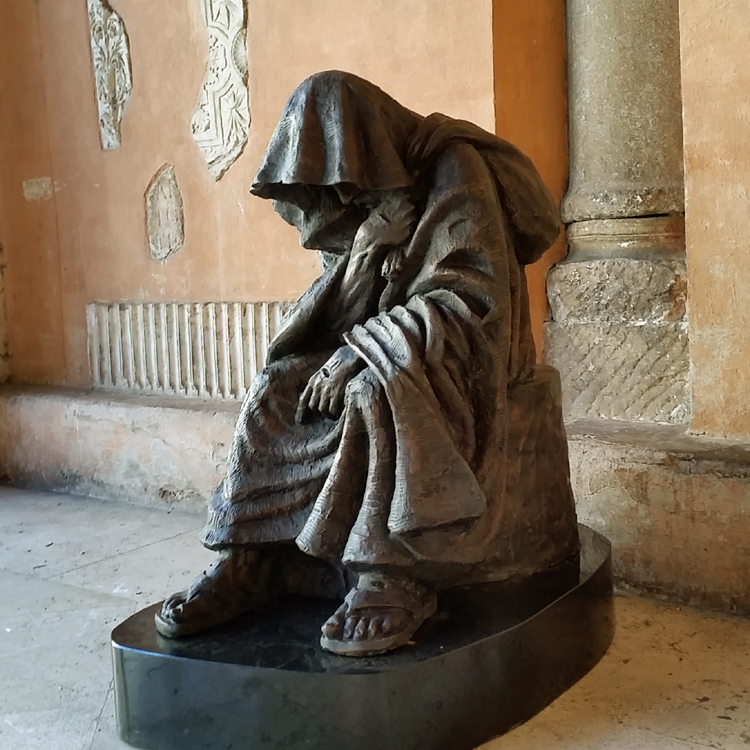
Schmalz, Timothy_When I Was a Stranger
Timothy P. Schmalz (Canadian, 1969–), When I Was a Stranger, 2016. Bronze, 42 × 23 × 39 in. Basilica of San Lorenzo (Saint Lawrence), Lucina, Rome.

R. A. K. Mason (1905–1971) was one of New Zealand’s preeminent poets. Written around 1932, his poem “On the Swag” was inspired by Matthew 25:31–46, where Jesus says that our treatment of the poor redounds to him. That is, if we ignore the cries of the poor or even directly reject them, we are effectually ignoring or rejecting Christ—but if we welcome the poor into our homes and lives and endeavor to meet their needs, it is as if we welcome Christ himself.

In New Zealand and Australia, “swag” refers to a pack of personal belongings, and to “go on the swag” is an informal expression meaning to become a wandering foot-traveler, lacking a permanent residence and steady work. So in the poem a homeless man, hunched over in exhaustion and with his meager bag of possessions in tow, is passing down a neighborhood lane. A house cook sees him through the window and in vexation complains about what an eyesore he is, stinking up the streets and making the city look bad. She has seen him in these quarters before and wishes him good riddance.

(Related posts: “The Seven Works of Mercy”; “Advent, Day 19”)

But in the next two stanzas a more compassionate voice intervenes—probably the master or mistress of the house, or otherwise an intrusive narrator. This voice orders the cook to bring the man inside and to lavish him with the finest foods and dress, and then to make up a warm bed for the “old cove.” (“Cove” is an old-fashioned British word meaning “fellow.”) The last line tells us what impels this loving and urgent hospitality: “this is Christ.”

Whenever you encounter an outstretched hand or a dejected face, how might seeing it as the hand or face of Christ impact your response?

Copyright credit: “On the Swag” by R. A. K. Mason was originally published in 1932 in Kiwi: The Magazine of the Auckland University College and more recently has appeared in R. A. K. Mason: Collected Poems (Victoria University Press, 2014). It is reproduced here by permission of Hocken Library Uare Taoka o Hakena, University of Otago, Dunedin, the holder of Mason’s papers.

Roundup: Choral setting of Luke 5, portraits of the unhoused, a theology of negative spaces, animated shorts

SONG: “Put out into the deep” by David Bednall (2008), performed by The Gesualdo Six (2020): A verbatim setting of Luke 5:1–11 (RSV), the calling of the disciples, which is the Revised Common Lectionary reading for February 6.

+++

ESSAYS:

>> “Ghosts in Los Angeles” by Arthur Aghajanian, Ekstasis: The author of this essay reflects on Andres Serrano’s Nomads (1990), a humanizing series of portrait photographs of men and women experiencing homelessness in New York City. “Serrano titled each photograph with its subject’s first name, suggesting a familiarity with those portrayed while retaining their anonymity. . . . The images mimic the visual style of fashion and advertising, while also referencing historical portraits of the wealthy and powerful. The work restores the visibility along with the dignity of its subjects. . . . His diverse group reflects the vulnerabilities we all share, and the grace that sustains us in adversity.”

Serrano, Andres_Bertha (Nomads)
Andres Serrano (American, 1950–), Bertha, from the Nomads series, 1990. Cibachrome, 152 × 125 cm.

>> “The Cleft in the Rock: A Theology of Negative Spaces” by Daniel Drage, Image: This Image journal essay explores profound negative spaces in scripture—the first Sabbath, exile, the passage opened up by the parting of the Red Sea, empty wombs, tombs, nail wounds, the cleft of a rock, the space between the gold cherubim’s wings above the mercy seat—bringing them into conversation with works by contemporary British sculptors David Nash, Rachel Whiteread, and Andy Goldsworthy. Emptinesses that are full and presence via absence are key ideas.

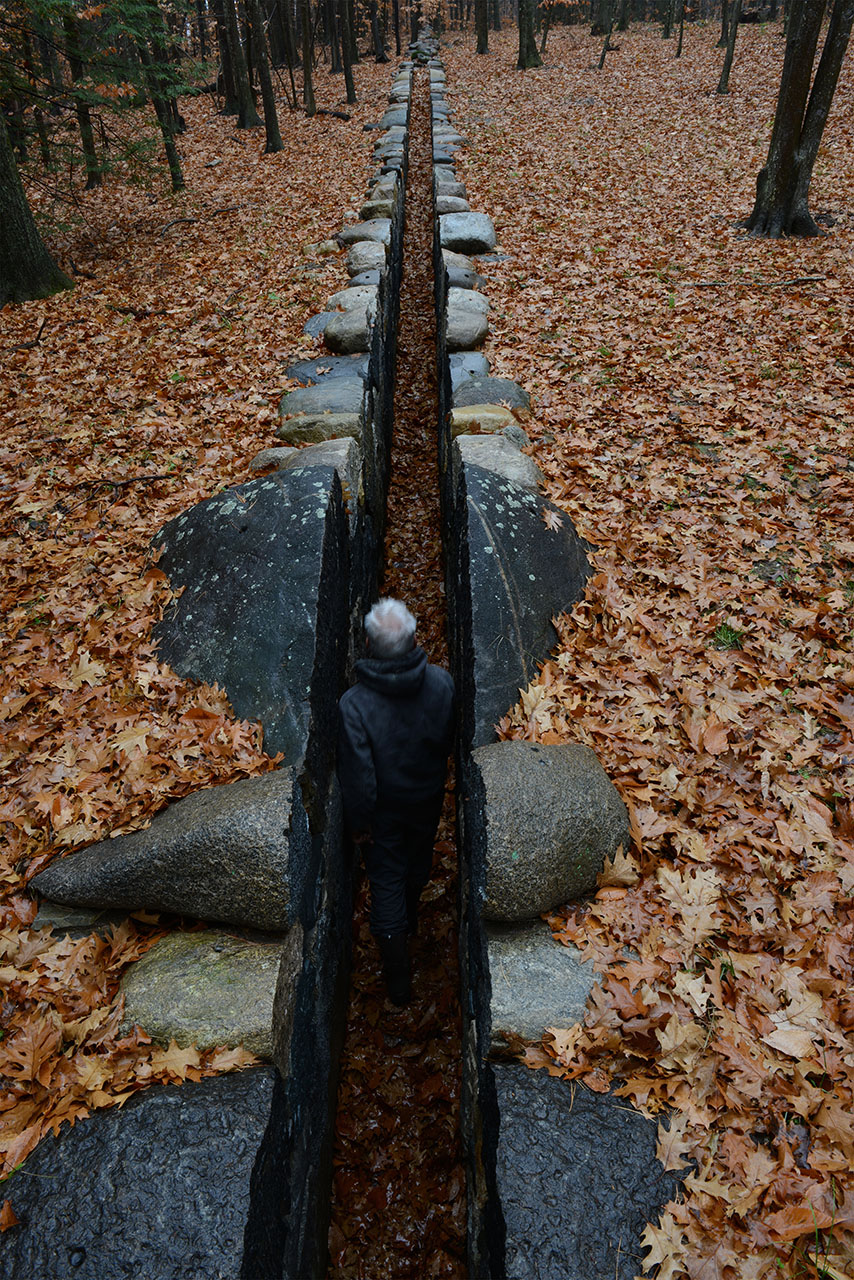
Goldsworthy, Andy_Passage
Andy Goldsworthy (British, 1956–), Passage, 2015. Granite. Private collection, New Hampshire. Copyright of the artist.

+++

ANIMATED SHORT FILMS:

>> Migrants, dir. Hugo Caby, Antoine Dupriez, Aubin Kubiak, Lucas Lermytte, and Zoé Devise: The graduation project of five film students from the Pôle 3D school in France, this short follows a mother polar bear and her cub who are displaced from their Arctic home. When their ice float runs aground a new habitat and they’re forced to learn a new way of life, the native brown bears treat them with hostility. The filmmakers said the project was initially inspired by the story of the Aquarius, a watercraft filled with refugees that grabbed global headlines when it was refused entry at Italian ports in 2018. [HT: Colossal]

>> Tokri (The Basket), dir. Suresh Eriyat: A father-daughter story set in Mumbai, this stop-motion animated short from Studio Eeksaurus is about mistakes and forgiveness, and how meaningful a kind extended hand from a stranger can be . . . or not. [HT: Colossal]

The Beatitudes (Artful Devotion)

Finished Haywood Street Fresco
Christopher Holt (American, 1977–), Haywood Street Beatitudes, 2018–19. Fresco, 9 1/2 × 27 ft. Haywood Street Congregation, Asheville, North Carolina. Photo: John Warner.

“Blessed are the poor in spirit, for theirs is the kingdom of heaven.

“Blessed are those who mourn, for they shall be comforted.

“Blessed are the meek, for they shall inherit the earth.

“Blessed are those who hunger and thirst for righteousness, for they shall be satisfied.

“Blessed are the merciful, for they shall receive mercy.

“Blessed are the pure in heart, for they shall see God.

“Blessed are the peacemakers, for they shall be called sons of God.

“Blessed are those who are persecuted for righteousness’ sake, for theirs is the kingdom of heaven.

“Blessed are you when others revile you and persecute you and utter all kinds of evil against you falsely on my account. Rejoice and be glad, for your reward is great in heaven, for so they persecuted the prophets who were before you.”

—Matthew 5:3–11

+++

SONG: “Beatitudes” by Bernice Johnson Reagon | Performed by Sweet Honey in the Rock, live at Carnegie Hall, November 7, 1987

Bernice Johnson Reagon (born October 4, 1942) is a song leader, composer, scholar, and social activist who in the early 1960s was a founding member of the Student Nonviolent Coordinating Committee’s Freedom Singers in the Albany Movement in Georgia. In 1973 she founded the all-black female a cappella ensemble Sweet Honey in the Rock, based in Washington, DC. Reagon, along with other members of the SNCC Freedom Singers, realized the power of collective singing to unify the disparate groups who began to work together in the 1964 Freedom Summer protests in the South. ‘After a song,’ Reagon recalled, ‘the differences between us were not so great. Somehow, making a song required an expression of that which was common to us all. . . . This music was like an instrument, like holding a tool in your hand.’” [source]

Reagon was the creator and host of the Peabody Award–winning NPR series Wade in the Water: African American Sacred Music Traditions, which originally aired in 1994 in twenty-six parts. (All the episodes are freely accessible online!) Under Reagon’s guidance, the production team traveled all over the country to record baptismal and congregational services, concerts, and interviews with a range of performers, composers, and community members. A four-CD set was released as a companion to the series.

+++

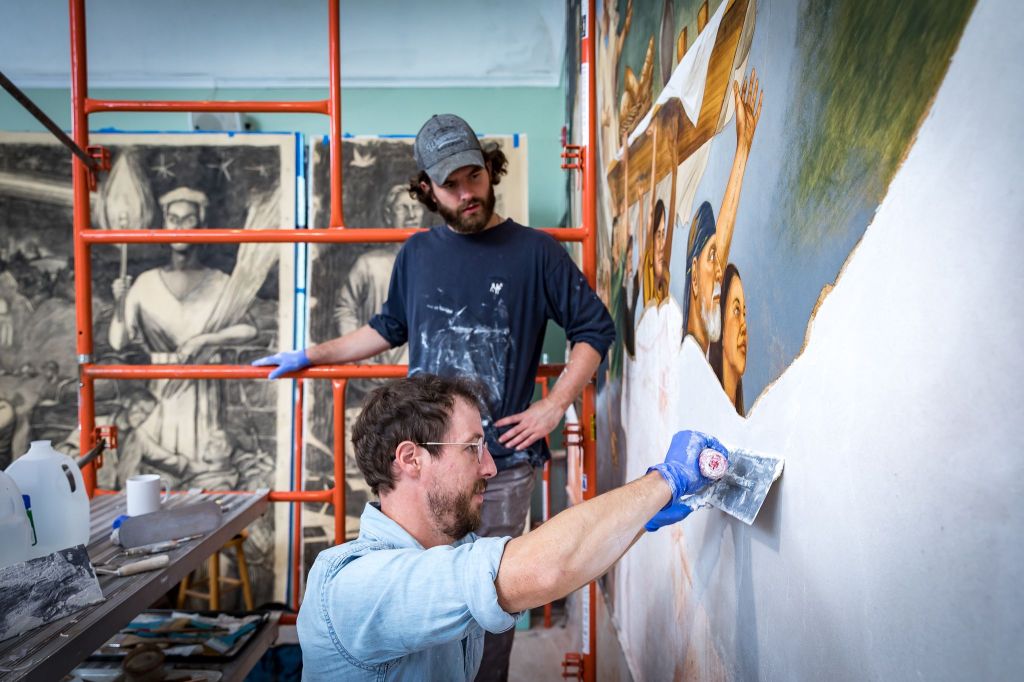
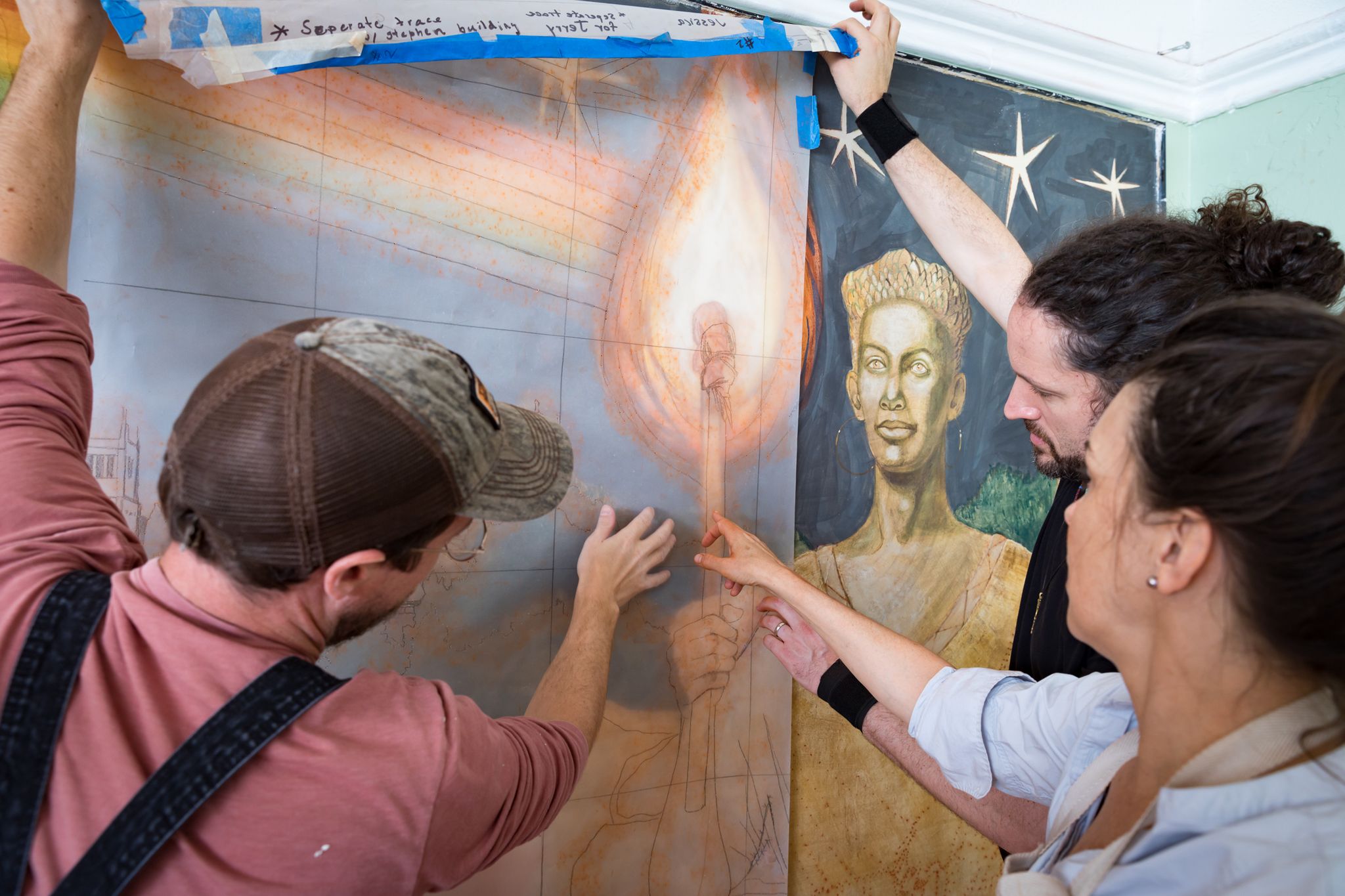
The Haywood Street Beatitudes fresco was completed last year in the sanctuary of Haywood Street Congregation in Asheville, part of whose mission is “breaking down barriers that divide the ‘haves’ from the ‘have-nots’ and reminding each person of their worth, their goodness.” The principal artist is Christopher Holt, and he worked with a team of four others. To learn more about the fresco, visit the interactive website https://visit.haywoodstreetfresco.org/, which includes many photos and sketches that document the making process in detail, information about the people pictured and an interpretive guide, and comments from participants in the project. All the quotes and photos in this section I’ve sourced from there.

The Rev. Brian Combs, who is shown emerging from behind the stone wall on the right, founded Haywood Street Congregation in 2009 to be a place of welcome for those struggling with addiction and/or homelessness. “The most painful part of holding a cardboard sign at the intersection,” he says, “is not the humiliating public declaration of helplessness or having trash thrown at you, or watching the automatic doors lock down. By far, from what I’ve heard after a decade of listening, is the refusal of so many drivers, idling just feet away at the red light, to even make eye contact.”

Commissioning this fresco—a permanent medium in which paint joins with plaster, making the image inseparable from the church architecture—is one way in which Haywood Street is “affirming sacred worth, restoring human dignity, and sabotaging the shame of poverty.” Fresco painting reached its zenith in the Italian Renaissance, but “too often . . . religious art . . . was made over in the image of those in power who were paying for it. God was rendered European and male. Jesus was more prince than peasant. Salvation meant being upper class.” The Haywood Street Beatitudes contains a more racially and socioeconomically diverse set of individuals that is reflective of the makeup of the community. Its message is that “God continues to show up in everyday life among the unhoused and the housed, the poor and poor in spirit, the meek, the merciful, and the hungry.” 

The skyline, with its Appalachian Mountain vista, offers an idealized portrait of Asheville. Some historical buildings are visible in the background, such as the racially segregated Stephens-Lee High School (on the top of the hill), which opened in 1923 and became a center for culture and arts and a source of pride for the Black community; it closed in 1965 as part of the county school board’s integration plan, and in 1975 most of it was bulldozed.

Haywood Street is most known for its Downtown Welcome Table ministry: family-style meals are served—with cloth napkins and on china plates!—on Wednesdays and Sundays in the church’s dining room, where people from all backgrounds are encouraged to come and eat together and enjoy fellowship. (Due to COVID-19 restrictions, meals are currently served to-go.) “We are a ministry that acknowledges each of us has gifts and each of us has needs. While some come with hunger from the body, others come with a hunger in their souls.” The website goes on to explain that visitors can “expect roles to be reversed. If you are coming to give, you might be asked to receive, to simply sit and have lunch. . . . If you are coming to receive, you might be called upon to serve.”

Haywood Street fresco
Haywood Street fresco (detail)

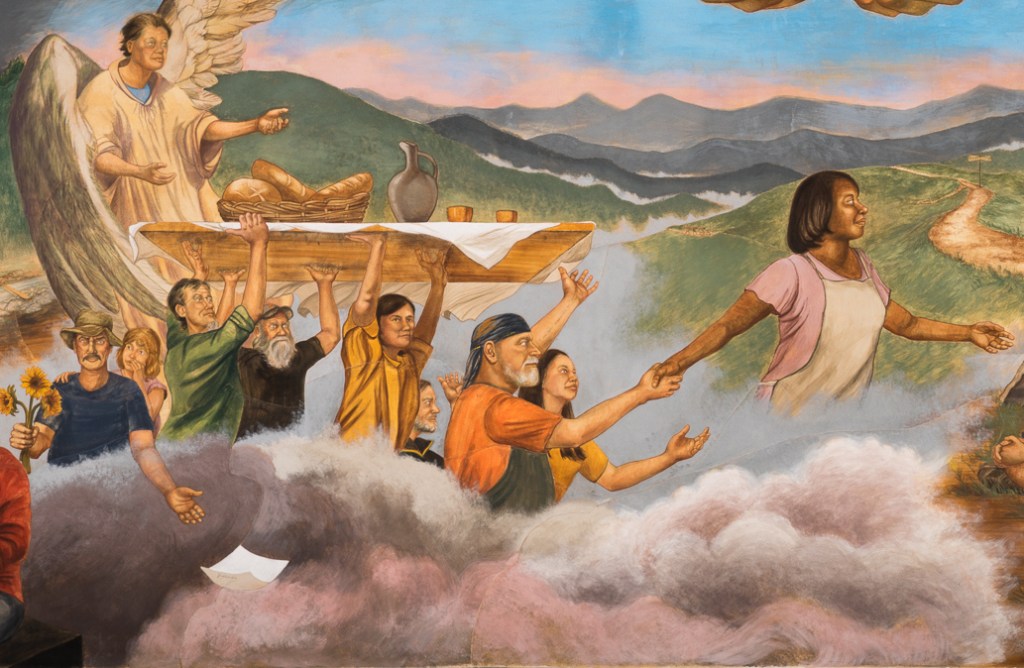
“Table is the defining metaphor at Haywood Street,” signifying relationship and togetherness. In the fresco, community members prepare the table and hold it up, led by Miss Mary (center); “keep the house open and be generous with your life,” she says. Holding her hand is Dave, a US Air Force veteran who grew up in Alabama in a culture where he was told never to touch a Black person. At Haywood he has overcome the prejudice he was formerly steeped in.

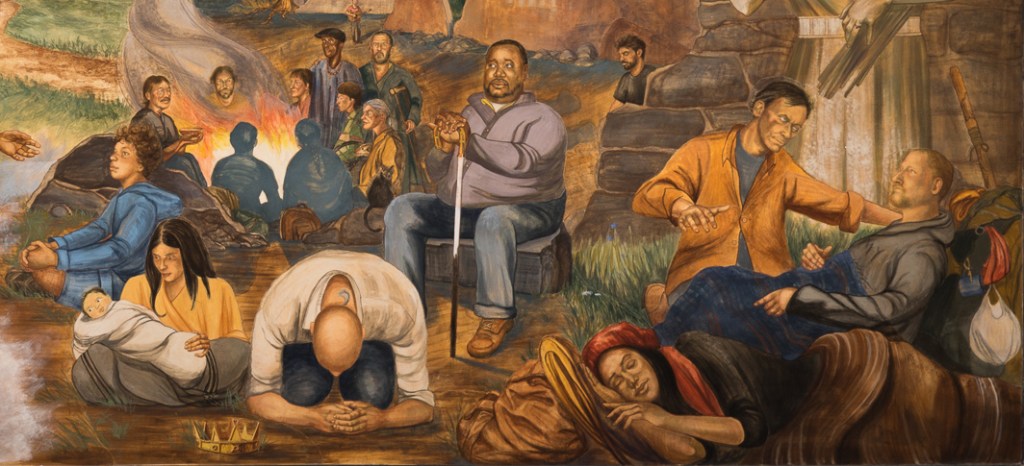
Other pictured individuals include Edward, the church organist; Robert, a gardener who arranges flowers for the altar and dining room tables each week; Soleil, a little girl who loves coming to Haywood Street for the desserts and who is whispering into Robert’s ear; Wayne (bottom right), who initially came to Haywood Street through its Respite ministry, which provides a safe place for homeless adults to rest, recover, and be cared for following a hospital discharge; and so on.

Haywood Street fresco (detail)

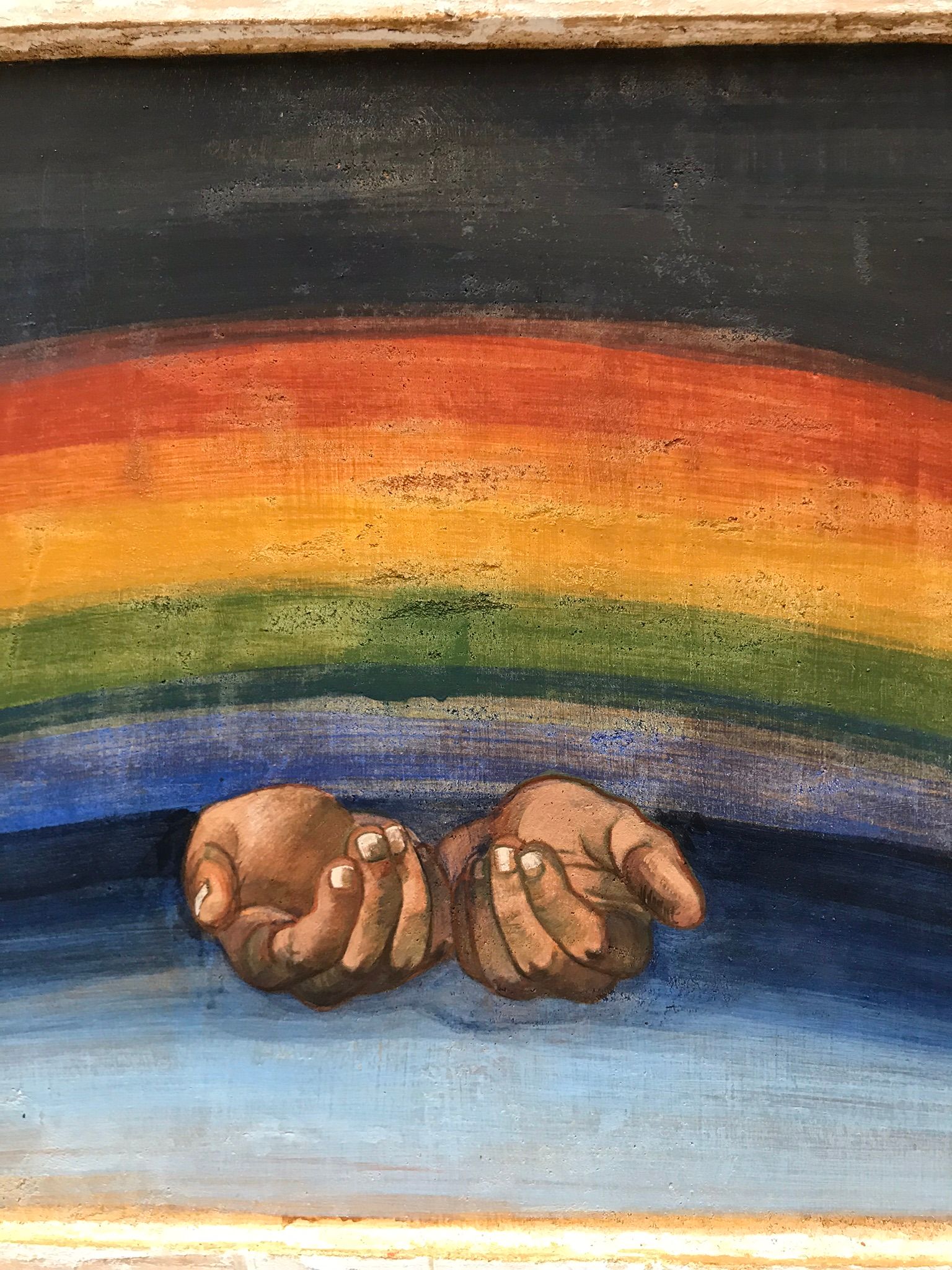
All are underneath the blessing hands of God and the rainbow of God’s promise.

Flanking the scene are two sentinel figures, each holding a light so that those in the darkness can find their way. The one on the left is modeled after Charles, a community member who died of cancer in May 2019, a few months before the fresco was completed. He was foundational to the church, as he lived on the streets and vouched for Haywood Street to all his friends when it was just getting started. His dog, Emma, sits in front of him, next to an open pouch of his woodworking tools. The other light-bearer, on the right, is Jeanette, a single mom who “came for lunch” one day between job interviews “and found love.” She is a care minister at Haywood Street and is on the board of directors. The two hold the Communion elements: Charles, a wine flask, and Jeanette, a sheaf of wheat.

Shout-out to Alexandra Davison, director of Culture Care RDU and a docent at the North Carolina Museum of Art, whose blog post “Lent, COVID-19 & the Beatitudes on Haywood Street” introduced me to this fresco.

+++

I’ve addressed the Beatitudes in previous Artful Devotions, which feature

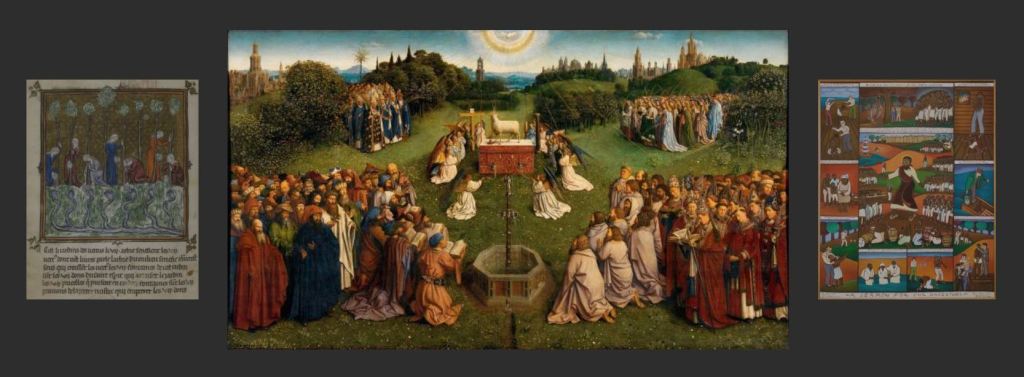
For more Beatitudes-related art, see the Visual Commentary on Scripture exhibition “Blessed,” curated by Rebekah Eklund, a professor of New Testament, theology, and ethics at Loyola University Maryland. I appreciate how she addresses descriptive versus prescriptive interpretations of the Beatitudes. She examines (1) an illumination from a French medieval moral treatise that shows seven women in a “virtue garden,” each representing a different beatitude; (2) an Ethiopian-inspired canvas painting by contemporary American artist Laura James, which places the Beatitudes in the context of chattel slavery; and (3) the central panel of the Ghent Altarpiece [previously], where seven groups of saints gather round a bleeding Lamb.

Blessed (VCS exhibition)

“All three artworks place a Christ-figure in the centre: the tallest tree in the middle of the garden tended by prayer, an African Jesus with open arms delivering the Sermon on the Mount, or the slaughtered Lamb standing triumphantly on the altar of his sacrifice and surrounded by angels. This centrality suggests Christ’s role not only as the speaker of the Beatitudes but also as their embodiment and fulfilment.”


This post belongs to the weekly series Artful Devotion. If you can’t view the music player in your email or RSS reader, try opening the post in your browser.

To view all the Revised Common Lectionary scripture readings for All Saints’ Day, cycle A, click here.

Cadet Chapel of the United States Air Force Academy

All photos by Victoria Emily Jones or Eric James Jones, © ArtandTheology.org

Soaring 150 feet into the air against a Rocky Mountain backdrop, the United States Air Force Academy Cadet Chapel in Colorado Springs is a National Historic Landmark and one of Colorado’s most-visited manmade attractions. It was designed by Walter Netsch Jr. of Skidmore, Owings and Merrill, the architectural firm responsible for the planning and design of the entire academy, and is a recipient of the American Institute of Architects’ Twenty-Five-Year Award. Construction of the Cadet Chapel began in 1959 and was completed in 1962. It was dedicated in 1963.

United States Air Force Academy Cadet Chapel

The Cadet Chapel was designed to house three distinct worship spaces—Protestant, Catholic, and Jewish—on two levels, with a large “All-Faiths Room” on a third (bottom) level available to members of other faiths. In 2007 a Buddhist Chapel (the Vast Refuge Dharma Hall) was added, and more recently a Muslim prayer room, and outside there is a Falcon Circle for the Earth-Centered Spirituality community (pagans, Druids, Wiccans, etc.), dedicated in 2011. Because of the building’s sound-proofing and separate entrances, different services can be held simultaneously without interfering with one another.

I visited the Cadet Chapel last year shortly before it closed in September for a major renovation and restoration project needed to address water damage. It is scheduled to reopen again in fall 2023.

The most striking feature of the exterior is its seventeen spires, made to resemble jet fighter wings. I must admit: though it is an impressive structure, and I’m fully aware it is a military chapel, the evocation of warplanes for a worship space is a little unsettling. But the design choice does give the building great height—it points to the heavens as do the great medieval Gothic cathedrals of Europe, meant to turn the eye upward toward God.

United States Air Force Academy Cadet Chapel

The steel frame of the chapel comprises one hundred identical tetrahedrons, each weighing five tons and enclosed with aluminum panels. The surfaces of the outer panels are striated so that they reflect light differently throughout the day, depending on the sun’s position.

The chapel is situated on a terrace that overlooks part of the campus as well as beautiful mountain vistas.

View from USAFA Cadet Chapel

The front façade faces south—an atypical orientation for churches, which are traditionally built on a west–east axis, but a choice made, I’m assuming, to best utilize the sunlight for the interior decoration (see next section).

To reach the main entrance you have to ascend a wide granite stairway that leads up one story to an uncovered front porch. Walk inside, and you’re in the narthex (lobby) of the Protestant Chapel.

Protestant Chapel

The Protestant Chapel is by far the largest worship space within the Cadet Chapel, taking up the whole main floor—a choice made based on the religious demographics of enrolled cadets at the time of the building’s construction in the early sixties. (An article published shortly after the chapel’s dedication reported that 68% of cadets listed themselves as Protestant, 29% Catholic, and 2% Jewish, with a few listing other faiths or agnosticism.)

Though the exterior of the Cadet Chapel is, as I experienced it, somewhat cold, sterile, severe, the interior is incredibly warm and genial. Its vertical lift is spectacular. Stained glass strip windows provide ribbons of color between the tetrahedrons and progress from darker to lighter as they reach the altar, with some of the nearly 25,000 dalles (small, thick glass slabs) being deliberately chipped to produce jewel-like facets. The play of colored light across vault, floor, and pews was my favorite part of this space.

USAFA Cadet Chapel (Protestant Chapel)

Vault of USAFA Cadet Chapel (Protestant Chapel) Continue reading “Cadet Chapel of the United States Air Force Academy”

Calls for Art, Poetry

CHAIYA ART AWARDS: Now in its second year, this UK art competition explores spirituality through the visual arts. The theme for 2019/20 is “God is . . .” The finalist entries will be brought together for a public exhibition at gallery@oxo in London on April 10–19, 2020, with the winners announced on opening night. Any media are welcome, including painting, drawing, sculpture, ceramics, glass, textiles, photography, and video. You are allowed up to three entries.

Top prize: ₤10,000
Deadline: October 18, 2019
Entry fee: ₤20 (or early-bird rate of ₤15 for submissions sent by July 18)
Restrictions: Must be a UK resident age sixteen or over
Judges: Marcus Lyon, Deborah Tompsett, Mark Oakley, Clive Davis, Katrina Moss
Sponsors: Bible Society, The Jerusalem Trust

Thousand Tear Bottles
Deborah Tompsett, A Thousand Bottles of Tears, 2007–15. Installation view (detail) from Chichester Cathedral, 2015. Winner of the 2018 Chaiya Art Award. [see video]

Left Out by Maxwell Rushton
Maxwell Rushton (British, 1989–), Left Out, 2016. Jesmonite cast encased in a bin liner, 60 × 60 × 60 cm. This sculpture won the public vote at the 2018 Chaiya Art Awards.

I featured a 2018 Chaiya Art Award finalist in a previous roundup—a beautiful Holy Saturday image that uses pregnancy as a metaphor; click here.

+++

JANET B. MCCABE POETRY PRIZE: There is no prescribed theme or topic for this annual poetry contest presented by Ruminate, a contemplative literary arts magazine with Christian roots. Fifteen finalists will be selected by a panel, and then the first- and second-place winners and honorable mentions will be chosen by poet Craig Santos Perez. Besides a cash prize of $1500, the winner will also have his or her poem published in Ruminate. (Note: If nothing happens when you click the Enter button on the submission webpage, be sure your ad blocker is turned off.)

Top prize: $1500
Deadline: May 15, 2019
Entry fee: $20 (includes submission of up to two poems and a free digital copy of Ruminate)
Judge: Craig Santos Perez
Presenter: Ruminate

You may also like to know that Ruminate runs contests for short fiction, creative nonfiction, and visual art—though the entry periods for those are currently closed.

+++

ROSS AND DAVIS MITCHELL PRIZE: This biennial prize presented by Image journal “seeks to recognize Canadian poets whose work wrestles with the beauty and complexity of religious faith.

“The Mitchell Prize will be awarded to a poet who is hammering out new forms and new language to express the ineffable today. Our goal is to encourage writers whose poems provide access to spiritual experience, awakenings that cast light on the world and make it known. We want to hear from poets who are grappling with transcendence and the divine, those for whom poetry is—as Christian Wiman would describe it—a form of theology.

“Poets engaged with all faith traditions are encouraged to submit work, however this prize is not designed to erase distinctions or paper over conflict. There are meaningful differences between Muslims and Christians, Hindus and Orthodox Jews that cannot, and should not, be erased, suppressed, or ignored. Instead, this prize seeks to honor writing that explores the distinctive contours of belief and the shape it gives to modern life.”

Top prize: $20,000 CAD
Deadline: June 30, 2019
Entry fee: $25 CAD (includes a one-year digital subscription to Image)
Restrictions: Must be a Canadian citizen or resident
Judges: Scott Cairns, Lorna Goodison, Chelene Knight
Presenter: Image, with support from Cardus