Roundup: Restful Advent; preparing the way; walking with the Holy Family

ADVENT SERIES: Restful Advent by Tamara Hill Murphy: Tamara Hill Murphy [previously] is one of my favorite spiritual writers, her thoughtful words and curation of resources having served as a well of inspiration for me over the years. Each year, similar to Art & Theology but with the sensibilities and expertise of an Anglican spiritual director, she publishes a new daily Advent and Christmastide guide through her Substack, Restful, running this year from November 30 to January 5. Each post in the series includes lectionary readings, art, music, a prayer, and a simple practice to help us notice God’s presence during these waiting days. This time around, the Daybook will feature excerpts from Claude Atcho’s new book Rhythms of Faith along with ideas from The Liturgical Home by Ashley Tumlin Wallace and some of my own formerly published art commentaries.

“The Daybook is a way to pay attention to Christ’s three arrivals—then, now, and still to come—and to walk through December with a quieter heart and a stronger hope,” Murphy writes.

Murphy is offering Art & Theology readers a 50% discount to Restful using this link, which brings the subscription cost down to $4/month (let it run for two months if you want to receive the full Christmastide Daybook) or $32/year, which will give you access to her year-round content. The offer expires January 5, 2026.

+++

BLOG POST: “The Sacred Journey of Advent” by Ashley Tumlin Wallace, The Liturgical Home: “Advent,” writes Wallace, “is a season of preparation, for the coming of Christ at Christmas, and also for His return in glory at the end of time.” This is a great introduction to the season that kicks off the new church year.

+++

SONGS:

One of the scripture texts of Advent is Isaiah 40:3–5:

A voice cries out:
“In the wilderness prepare the way of the LORD;
    make straight in the desert a highway for our God.
Every valley shall be lifted up,
    and every mountain and hill be made low;
the uneven ground shall become level,
    and the rough places a plain.
Then the glory of the LORD shall be revealed,
    and all flesh shall see it together,
    for the mouth of the LORD has spoken.”

The Gospel-writers Matthew (3:3), Mark (1:3), and Luke (3:4) all see this exclamatory figure as John the Baptist, who told people to prepare for God’s coming by repenting of sin, since holding on tightly to ways of unlove erects barriers to God’s entry into one’s life. Here are two songs based on this Advent passage.

>> “Prepare the Way” by Maverick City Music and Tribl, feat. Chandler Moore and Siri Worku, on Tribl I (2021): This song repeats, again and again, the Advent mantra “Prepare the way,” embedding John the Baptist’s invitation deeply into hearts and minds. Its tag beseeches Christ to come with the fire of purging, the rain of refreshment, and the oil of blessing. To welcome this coming, this transformation and growth, we need to decenter ourselves, ceding to God the place of primacy, from which he works our good and his glory.

>> “Prepare the Way” by Christopher Walker, on Rise Up and Sing, 3rd ed., vol. 3 (2009): This 1991 song is by Christopher Walker, a church music composer, lecturer, and choral conductor originally from the UK but now living in Santa Monica, California. Published by OCP (Oregon Catholic Press), it would make a great song for a children’s Advent choir.

+++

2018 SERIES: Advent Caravan: Walking with the Holy Family by Sarah Quezada: I learned about Sarah Quezada’s work at the intersection of faith, justice, and culture through Tamara Hill Murphy (see first roundup item) in 2018, when Quezada published a five-part series reflecting on the likelihood that Mary and Joseph traveled to Bethlehem for the census not alone but in a caravan. Interweaving personal story, biblical interpretation, and current events, Quezada considers how the holy couple’s experience in the final months of Mary’s pregnancy connects to the reality of people on the move seeking hope, peace, joy, and love today.

While the series is not hosted online, I received permission from Quezada to reproduce it here.

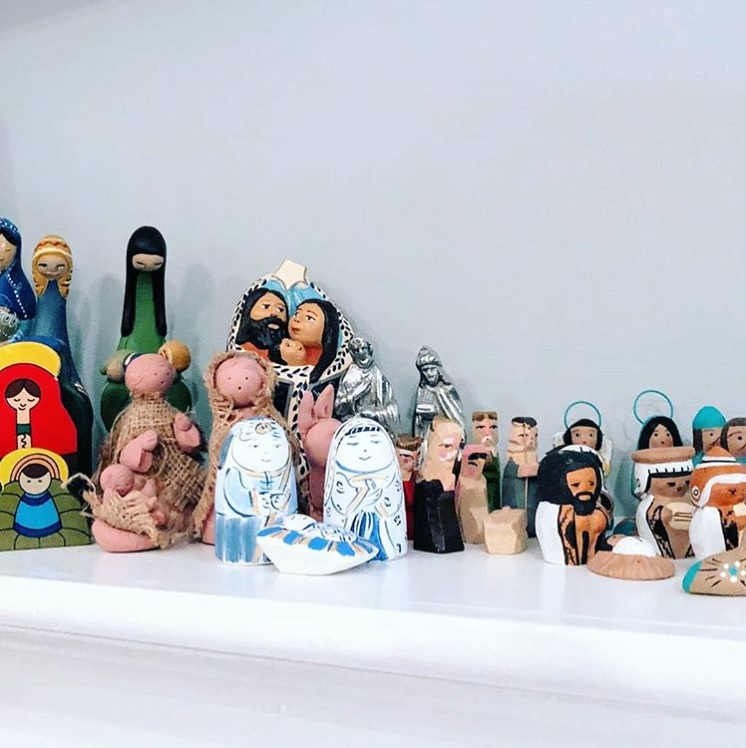
On Instagram, Quezada also shared a photo of her friend’s Advent mantel, where she combined figurines from her various nativity sets to form a “caravan” of travelers.

Advent caravan
Photo via @sarahquezada

+++

YOUTUBE PLAYLIST: Jouluradion Hoosianna: Jouluradio is a Finnish radio station that broadcasts annually from November 1 to January 6, playing all Advent and Christmas music. Since 2012, every year they premiere a new arrangement and video performance of the popular Scandinavian Advent hymn “Hoosianna” (Hosanna, an Aramaic expression meaning “Save now!”), which Lutheran and Catholic churches in Finland sing on the first Sunday of the season. Based on Matthew 21:9, its lyrics greet the approaching Christ, affirming his identity and craving the deliverance only he can bring:

Hoosianna, Daavidin Poika,
kiitetty olkoon hän!
Kiitetty Daavidin Poika,
joka tulee Herran nimeen.
Hoosianna, hoosianna,
hoosianna, hoosianna!
Kiitetty Daavidin Poika,
joka tulee Herran nimeen.
Hosanna, Son of David,
Most blessed Holy One,
Hosanna, Son of David,
Who comes in the name of the Lord!
Hosanna, hosanna, hosanna
In the highest!
Hosanna, Son of David,
Who comes in the name of the Lord!

This hymn was written by the German composer, educator, and piano and organ virtuoso Georg Joseph Vogler in 1795 while working in Sweden as court conductor as well as tutor to the crown prince Gustav IV Adolf.

The Jouluradio commissions, which the station has compiled in a YouTube playlist, encompass a range of genres, including jazz, hip-hop, choral, pop, and electronic. Below is a list of previous years’, of which I’ve embedded the two asterisked ones on this page. Jouluradio typically releases their annual “Hoosianna” the day before Advent, so 2025’s will likely be posted this Saturday. [HT: Gracia Grindal]

Holy Week: Jesus Enters Jerusalem

When they were approaching Jerusalem . . . they brought the colt to Jesus and threw their cloaks on it, and he sat on it. Many people spread their cloaks on the road, and others spread leafy branches that they had cut in the fields. Then those who went ahead and those who followed were shouting,

Hosanna!
Blessed is the one who comes in the name of the Lord!
Blessed is the coming kingdom of our ancestor David!
Hosanna in the highest heaven!

Then he entered Jerusalem and went into the temple . . .

—Mark 11:1, 7–11

LOOK: Palm Sunday by Kai Althoff

Althoff, Kai_Palmsonntag
Kai Althoff (German, 1966–), Palmsonntag (Palm Sunday), 2002. Boat varnish, watercolor, and tinted paper on canvas, 70 × 90 cm. Private collection, Berlin.

In Kai Althoff’s painting of Jesus entering Jerusalem on a donkey, the background pulsates with color and people from all walks of life lay down their garments to carpet his path. There’s a nun and a monk in their habits; two bishops in dalmatics, one of whom casts his mozzetta at Christ’s feet; a choirboy; folks in a coat and tails and party dresses; and others in overalls, sweaters, and wool skirts. On the left, a backpacker passes by, looking behind him with curiosity at the hubbub, while at the bottom right a crowd of haloed people point and gaze—one man even yanks the collar of a friend, trying to pull him closer to the front for a better view.

Several of those present wave palm branches and shout, “Hosanna!,” meaning “Save us!” They quote Psalm 118:25–26: “Save us, we beseech you, O LORD! O LORD, we beseech you, give us success! Blessed is the one who comes in the name of the LORD.” The people recognize Jesus as their delivering Messiah and celebrate.

LISTEN: “Hosanna” by Jacques Berthier, 1978 | Performed by the Paul Leddington Wright Singers on Songs of Taizé, vol. 4 (2006)

Hosanna, hosanna!
Hosanna in excelsis!

This Palm Sunday canon (round) is from Taizé, a community of lay brothers in southern France who welcome pilgrims, especially young ones, from all over the world. The Latin in excelsis means “in the highest.”

Though the Hebrew expression that “Hosanna” transliterates was used by Jews as a supplication, a plea, today Christians often use “Hosanna” as a shout of jubilation, an acclamation of praise, in recognition of the salvation Jesus has wrought—so instead of the imperative “Save!,” it’s the exclamative “Salvation!” I think both meanings can hold simultaneously.


This is the first post in a daily series (running through Saturday) in which I’ll highlight a handful of events from Holy Week by choosing a visual artwork and a piece of music that engage with that event. The posts will all be short like this one—I imagine people spending ten minutes or so with each—and are an invitation to prayer and contemplation. For additional music, see the Art & Theology Holy Week Playlist on Spotify.

Palm Sunday

O give thanks to the LORD, for he is good;
    his steadfast love endures forever!

Let Israel say,
    “His steadfast love endures forever.”

. . .

Open to me the gates of righteousness,
    that I may enter through them
    and give thanks to the LORD.

This is the gate of the LORD;
    the righteous shall enter through it.

I thank you that you have answered me
    and have become my salvation.
The stone that the builders rejected
    has become the chief cornerstone.
This is the LORD’s doing;
    it is marvelous in our eyes.
This is the day that the LORD has made;
    let us rejoice and be glad in it.
Save us, we beseech you, O LORD!
    O LORD, we beseech you, give us success!

Blessed is the one who comes in the name of the LORD.
    We bless you from the house of the LORD.
The LORD is God,
    and he has given us light.
Bind the festal procession with branches,
    up to the horns of the altar.

You are my God, and I will give thanks to you;
    you are my God, I will extol you.

O give thanks to the LORD, for he is good,
    for his steadfast love endures forever.

—Psalm 118:1–2, 19–29

 The crowds that went ahead of [Jesus] and that followed were shouting,

“Hosanna to the Son of David!
    Blessed is the one who comes in the name of the Lord!
Hosanna in the highest heaven!”

—Matthew 21:9

LOOK: Palm Sunday, Home Depot Parking Lot by Gary Bergel

Bergel, Gary_Palm Sunday, Home Depot Parking Lot
Gary Bergel (American, 1943–), Palm Sunday, Home Depot Parking Lot. Digital photograph. Part of the traveling CIVA exhibition Again & Again.

LISTEN: “Blessed Is the One (Psalm 118)” by Tim Coons of Giants & Pilgrims | Performed by Tim Coons (guitar, vocals) and Craig Basarich (trumpet), 2020

Blessed is the one who comes in the name of the Lord (×4)

Hosanna (×4)

Blessed is the one who comes in the name of the Lord (×4)

Hosanna (×4)

Hosanna (×4)

Palm Sunday: Sannanina (Hosanna)

Now when they drew near to Jerusalem, to Bethphage and Bethany, at the Mount of Olives, Jesus sent two of his disciples and said to them, “Go into the village in front of you, and immediately as you enter it you will find a colt tied, on which no one has ever sat. Untie it and bring it. If anyone says to you, ‘Why are you doing this?’ say, ‘The Lord has need of it and will send it back here immediately.’” And they went away and found a colt tied at a door outside in the street, and they untied it. And some of those standing there said to them, “What are you doing, untying the colt?” And they told them what Jesus had said, and they let them go. And they brought the colt to Jesus and threw their cloaks on it, and he sat on it. And many spread their cloaks on the road, and others spread leafy branches that they had cut from the fields. And those who went before and those who followed were shouting, “Hosanna! Blessed is he who comes in the name of the Lord! Blessed is the coming kingdom of our father David! Hosanna in the highest!”

—Mark 11:1–10

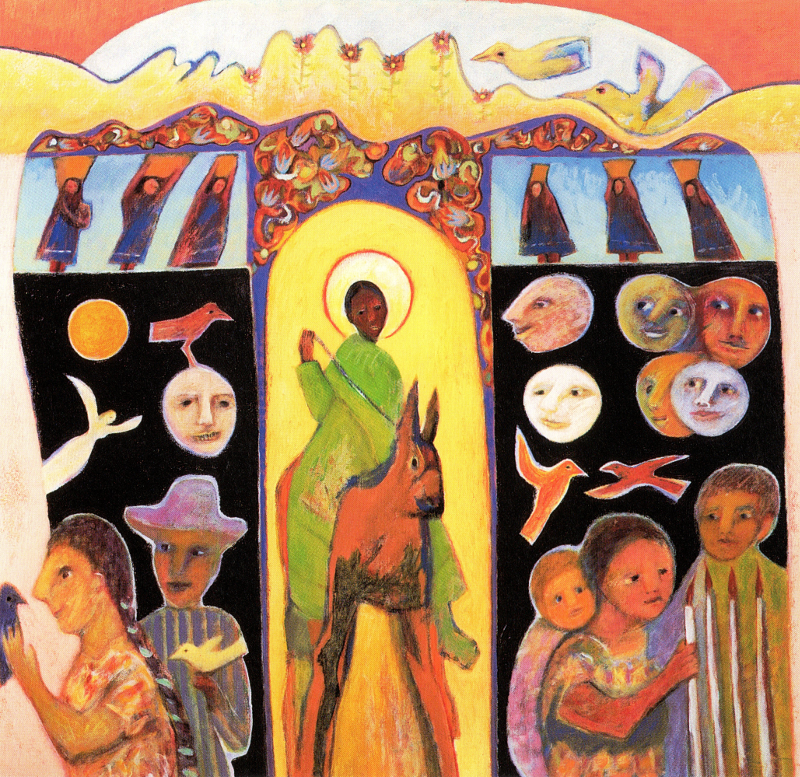
LOOK: Betty LaDuke (American, 1933–), Guatemala: Procession, 1978. Acrylic on canvas, 72 × 68 in.

LaDuke, Betty_Guatemala-Procession

In Imaging the Word, vol. 3, the artist describes the inspiration behind this painting:

Before Christmas, at the Mayan village of Chichicastenango in Guatemala, statues of Christ, the Virgin Mary, and the saints are . . . carried aloft in an annual procession. In my painting Guatemala: Procession, Christ appears on a donkey surrounded by the masks worn by the Mayans who dance to honor and celebrate their indigenous roots. They also dance a re-enactment of the brutal Spanish invasion, with satirical masks representing conquistadores. Inside the church many candles are lit and prayers are offered. (181)

So it seems LaDuke has imagined Christ entering this Maya community of Christian celebrants who remember biblical history alongside their history as a people. This isn’t a Palm Sunday image per se, since it visualizes a procession that occurs toward the beginning of the liturgical year, but Jesus’s presence in the center on donkeyback, in a gateway backlit with glorious yellow, flanked by crowds and with angels overhead, evokes his triumphal entry into Jerusalem five days before his death.

LISTEN: “Sanna, Sannanina,” traditional South African

“Sannanina” is a Xhosa derivate of the Greek word “Hosanna,” which is itself a transliteration of a Hebrew phrase that means “Save us, please!” (For more on the word “hosanna” and how its meaning shifted from a cry for help to a shout of exultation—“Salvation!”—read here.) In the first video below, the song is performed by the Africa University Choir. The second video is a demo produced by MennoMedia in preparation for the publication of the Mennonite hymnal Voices Together in 2020.

For more songs for Holy Week, see the Art & Theology Holy Week Playlist.