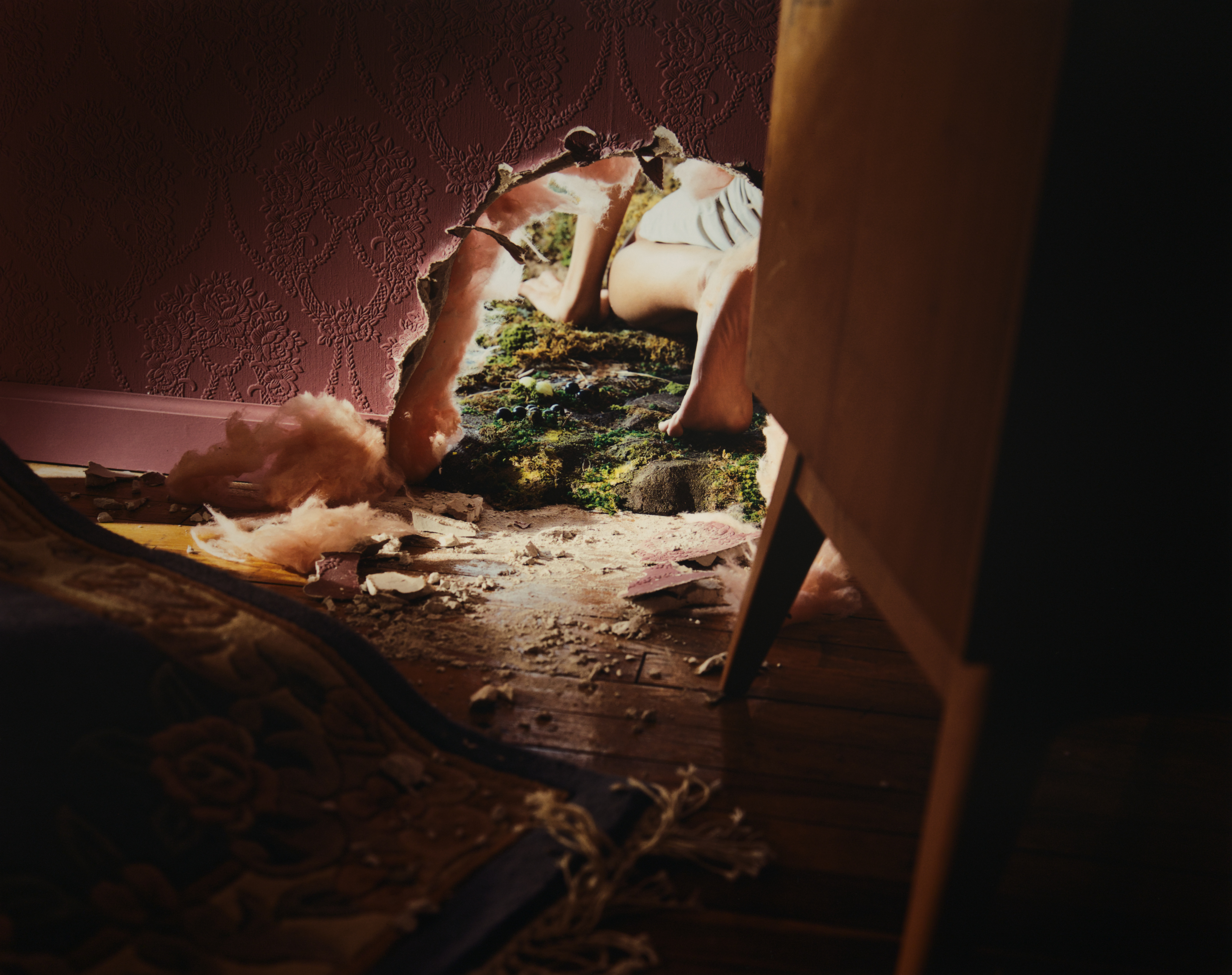
Deborah Mesa-Pelly (Cuban American, 1968–), Rosy, 1999. Chromogenic print mounted on aluminum, 30 × 40 in. National Museum of Women in the Arts, Washington, DC. [view artist’s website]
At that time the disciples came to Jesus and asked, “Who is the greatest in the kingdom of heaven?” He called a child, whom he put among them, and said, “Truly I tell you, unless you change and become like children, you will never enter the kingdom of heaven. Whoever becomes humble like this child is the greatest in the kingdom of heaven.”
—Matthew 18:1–4 (cf. Mark 9:33–37; 10:13–16; Luke 9:46–48)
The Architect of Love has built the door into heaven so low that no one but a small child can pass through it, unless, to get down to a child’s little height, they go in on their knees.
I saw the above photograph on display several years ago at the National Museum of Women in the Arts and was captivated. The artist, Deborah Mesa-Pelly, regularly features female subjects in her work, often on the verge of marvelous adventure. In Rosy, a girl breaks through a papered wall, entering another world on hands and knees.
The image of this child-size portal leading from a dark, dusty room into a bright and verdant landscape reminds me of Jesus’s teaching that we must receive the kingdom of heaven like little children. What is it about little ones that makes God more accessible to them? What quality or qualities of children ought we to emulate?
Matthew specifically names their humility, by which he may mean their lack of pretension or worldly ambition, their dependance and trust, and/or their openness and teachability (different from naivete). Children tend to be curious, exploratory, full of wonder, energetic, honest, and unselfconscious. These are all traits I want to embody in my life of faith as I press through walls to discover more and more of the “life more abundant” that Jesus offers.
The Advent Project published yearly by Biola University’s Center for Christianity, Culture, and the Arts (CCCA) is an online devotional that brings together daily scripture readings, visual art, music, poetry, and written reflections for the seasons of Advent and Christmas (which this year is December 3–January 6). Introduced in 2013, it is the only recurrently published art-forward Advent/Christmas devotional I know of, and I recommend it highly. It is in large part what inspired my year-round “Artful Devotion” series and the Advent art booklet I published digitally last year.
With so many different elements, design matters a lot, and I’m super-impressed by what Biola has come up with. The homepage is laid out as a gridded calendar with thumbnail images; click on a date, and you’re brought to a new viewing mode in which a large image and a music player are set in a fixed position on the left while the right sidebar contains scrollable text, separated into two tabs—the main content, and biographical information about the artists. This design enables the image to remain before your eyes so that you can continue to reference it as you read on (something that, frustratingly, I cannot achieve with Art & Theology’s long-scrolling format), and it also relegates the bios to “back matter.” It’s all very organized and easily navigable.
This initiative is an outworking of the CCCA’s mission to explore the rich interrelationships between contemporary art making, theology, and religious tradition. Be sure to check out the other sections of their website; they offer plenty of free resources, including an archive of past Advent (and Lent!) devotionals, and a calendar of events, such as lectures, workshops, symposia, art exhibitions, concerts, film screenings, and more.
Below is one of my favorite Advent Project entries from last year, reproduced by kind permission of the CCCA. Centered on Mary’s Magnificat, it brings together the work of an Italian Renaissance painter, a contemporary British video artist (who I’ve written about before), a modern Bohemian Austrian poet, and a minimalist composer working with Spanish, Latin, and English texts. Adjunct professor of philosophy Evan Rosa (who is a superb writer!) reflects on how scandalous Mary’s humility is for power-hungry Western Christians—just as it would have been for the Greco-Roman world in which she lived. He concludes with a prayer that invites us to move from self-magnification to the magnification of God.
Due to this blog’s design limitations, I had to adapt the following content from its original format. To view the devotion on the Biola website, click here. I have excluded biographical information for the song performers and poet.
+++
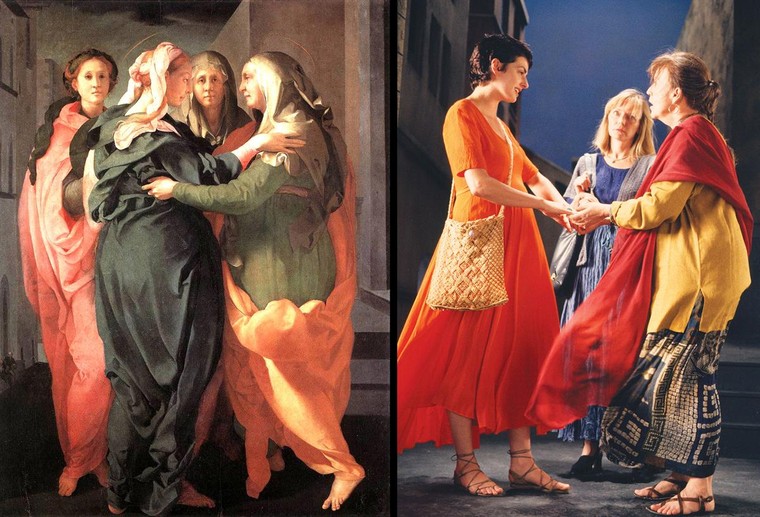
ARTWORKS: The Visitation by Pontormo; The Greeting by Bill Viola
Left: Jacopo da Pontormo, The Visitation, 1528, oil on canvas, Church of San Francesco de Michele, Carmignano, Italy. Right: Bill Viola, The Greeting, 1995, still image from a large-screen video installation.
About the Artist and Artwork #1:
Jacopo Carucci(1494–1557), usually known asPontormo, was an Italian Mannerist painter and portraitist from the Florentine School. His work represents a profound stylistic shift from the calm perspectival regularity that characterized the art of the Florentine Renaissance. He is famous for his use of twining poses, coupled with ambiguous perspective; his figures often seem to float in an uncertain environment, unhampered by the forces of gravity. Pontormo’s painting The Visitation, completed in 1528, now adorns the altar of a side chapel in a small church called the Pieve di San Michele in Carmignano, a town west of Florence, Italy. The setting for this painting is the visitation of the Virgin Mary on her older pregnant cousin Elizabeth, the wife of Zacharias. Elizabeth and Mary, who are painted in profile, gracefully embrace each other as they exchange glances of mutual affection and share in the news of Mary’s pregnancy. They dominate the canvas as they stand on the threshold of Zacharias’s house.
About the Artist and Artwork #2:
Bill Viola(b. 1951) is internationally recognized as one of today’s leading artists. He has been instrumental in the establishment of video as a vital form of contemporary art, and in so doing has helped to greatly expand its scope in terms of technology, content, and historical reach. His works focus on universal human experiences—birth, death, the unfolding of consciousness—and have roots in both Eastern and Western art as well as spiritual traditions.
Bill Viola’s large-screen video installation The Greeting was inspired by TheVisitation, painted by Italian Mannerist artist Jacopo Pontormo. Viola’s video sequence echoes the drama of Pontormo’s Visitation, but transforms the moment into an enigmatic contemporary narrative. In this still frame, three women are dressed in long, flowing garments and stand in an Italianate architectural setting similar to that in Pontormo’s painting. The woman in the orange dress, her stomach visibly swollen, has just entered the scene from the left, interrupting a conversation and perhaps whispering to the older woman the news of her pregnancy. This encounter was filmed in less than a minute, but Viola has slowed the video down to ten minutes. The use of extreme slow motion draws attention to the nuances of the women’s gestures and glances, and intensifies the psychological dynamic of the exchange.