Landmark exhibition “Ethiopia at the Crossroads” explores cross-cultural influences on Ethiopian art

All photos in this post, except for the last one (of the processional icon), are my own.

(Note: WordPress seems to have disabled the feature that allows you to expand an image upon clicking, but if you’re reading on a computer, you can right-click an image and open it in a new tab to view it in full resolution; if you’re reading on a phone, you can pinch to zoom.)

Located in the Horn of Africa and with access to the Red Sea, Nile River, Mediterranean Sea, and Indian Ocean, Ethiopia stands at the nexus of historical travel, trade, and pilgrimage routes that brought it into contact with surrounding cultures and influenced its artistic development. Coptic Egypt, Nubia, South Arabia, Byzantium, Armenia, Italy, India, and the greater African continent were among those influencers. But Ethiopia not only absorbed influences; it transmitted them too.

A major art exhibition is centering Ethiopia’s artistic traditions in a global context. For Ethiopia at the Crossroads at the Walters Art Museum in Baltimore (running through March 3), curator Christine Sciacca has brought together more than 220 objects from the Walters’ own extraordinary Ethiopian art collection and private and institutional lenders both domestic and international. Icons, wall paintings, processional crosses and hand crosses, illuminated Gospel books and psalters, sensuls (chain manuscripts), healing scrolls, and more are on display throughout the galleries, whose walls have been painted bright green, yellow, and red—the colors of the Ethiopian flag. To round off the exhibition, guest curator Tsedaye Makonnen, an Ethiopian American multidisciplinary artist, was tasked with curating a few works from contemporary artists of the Ethiopian diaspora.

Ethiopia at the Crossroads exhibition view

The majority of objects are Christian, made for liturgical or private devotional use. Ethiopia is one of the world’s oldest Christian nations: in the early fourth century, persuaded by a missionary from Syria, King Ezana of Aksum embraced Christianity, and it has been the dominant religion of Ethiopia ever since. But the exhibition does also include some Islamic and Jewish objects.

One of the first works you’ll encounter is a mural that would have originally been mounted on the outer wall of an Ethiopian Orthodox church sanctuary (mäqdäs), portraying the Nativity, the Presentation of Christ in the Temple, and the Adoration of the Magi.

Nativity, Presentation of Christ in the Temple, and Adoration of the Magi, Ethiopia, 18th century. Glue tempera on overlapping canvas pieces mounted to a new stretched canvas, 49 3/16 × 66 15/16 in. (124.9 × 170 cm). Walters Art Museum, Baltimore. [object record]

Remarkably, at the Nativity, there is a feast taking place, and Jesus is feeding his mother with what looks like a Communion wafer! As the theologian Lester Ruth has said, “The sound from most baby beds is a cry to be fed. But the cry from the manger is an offer to feed on his body born into this world.”

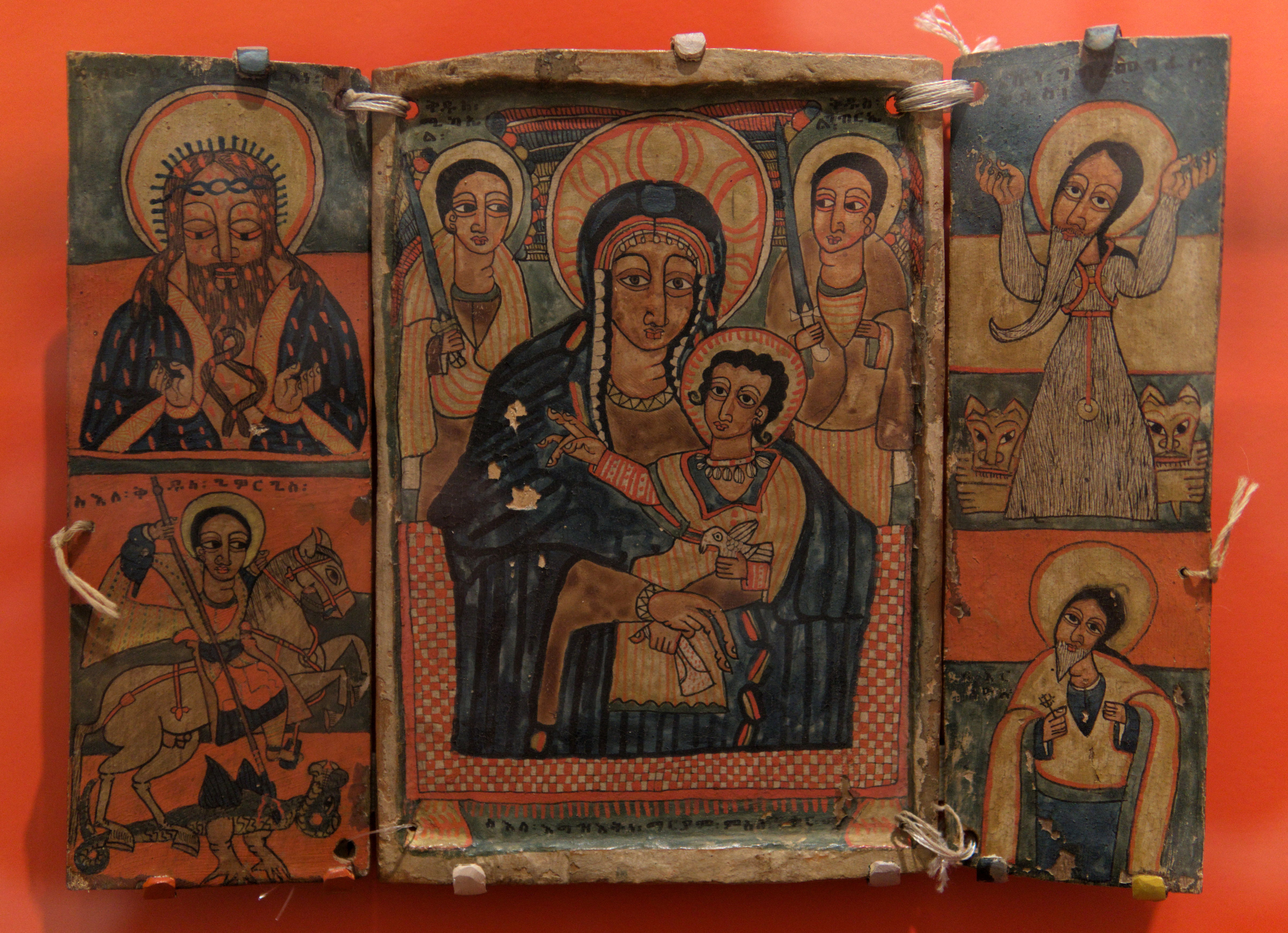
One of history’s most famous Ethiopian painters is Fre Seyon, who worked at the court of Emperor Zara Yaqob (r. 1434–1468) and was of the first generation of Ethiopian artists who painted icons on wood panels. He was also a monk. He likely introduced one of the characteristic features of Ethiopian icons of the Virgin and Child: the archangels Michael and Gabriel flanking them with drawn swords, acting as a kind of honor guard.
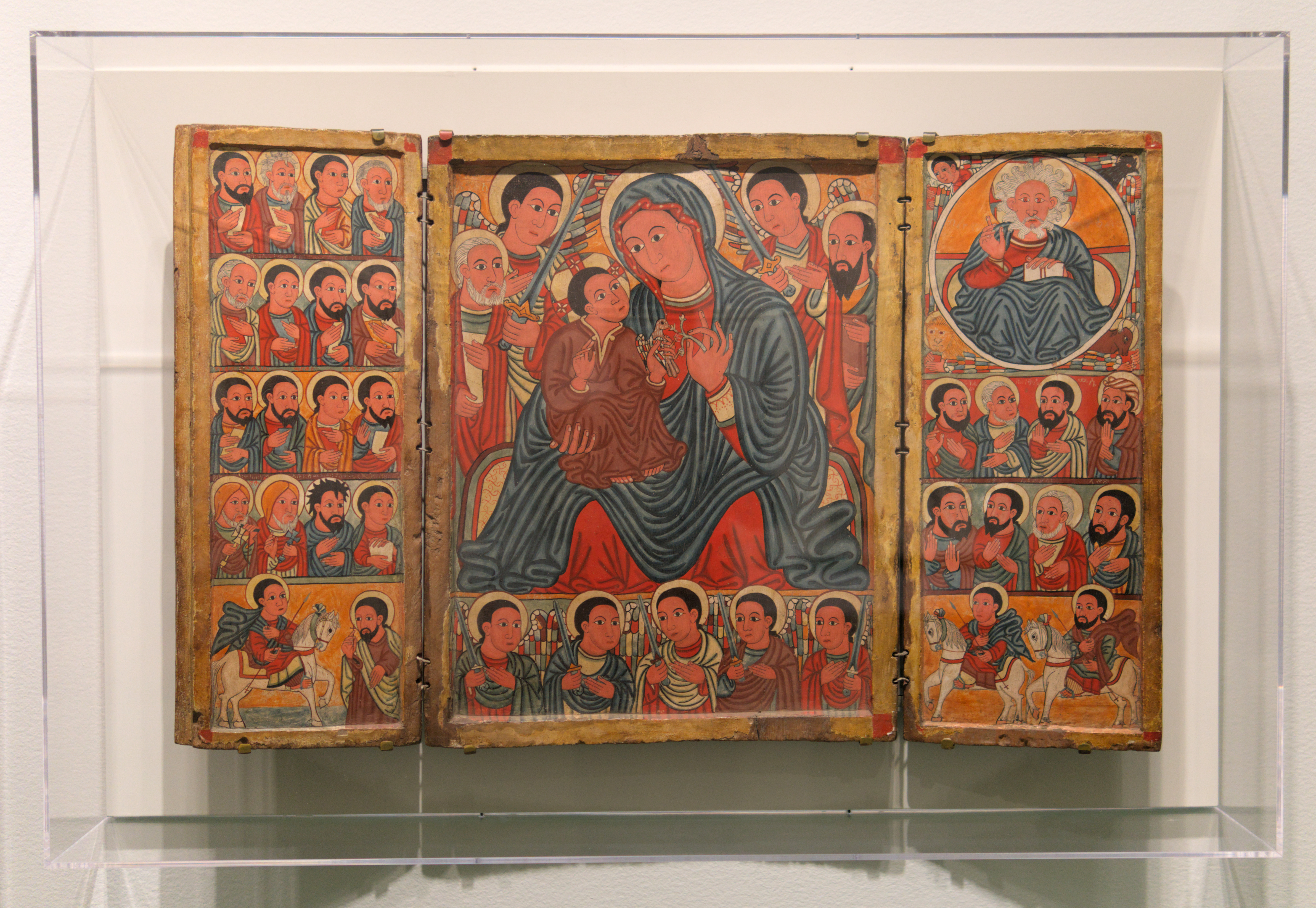
Fre Seyon triptych
Fre Seyon (Ethiopian, active 1445–1480), Triptych Icon with the Virgin Mary and Christ Child Flanked by Archangels and Saints (center), Twelve Apostles and Saints (left), and Prophets and Saints (right), mid- to late 15th century. Tempera on gesso-primed wood. Institute of Ethiopian Studies, Addis Ababa University, acc. no. IESMus4186.

My two favorite details of this triptych by Fre Seyon are (on the right wing) the image of the Ancient of Days surrounded by the tetramorph, his wild gray locks being blown about, and in the center, the bird that Christ holds, its feet grasping at a three-branched twig. On a literal level, the bird is a plaything for the boy that charmingly emphasizes his humanity (in the late Middle Ages, at least in Europe—I’m not sure about in Ethiopia—it was common for young children to keep tame birds as pets). On another level, the bird may be symbolic. In traditional Western art, Jesus sometimes holds a goldfinch, a bird with distinctive red markings that’s fond of eating thistle seeds and gathering thistle down and thus came to be read as a prefiguration of Christ’s thorny, blood-spilt passion. I’m not sure whether Fre Seyon intended a symbolic significance for this bird.

The Ancient of Days, enthroned in the tetramorph

Here’s another triptych from the exhibition, this one from a century and a half later:

Virgin and Child triptych
Triptych Icon with the Virgin Mary and Christ Child Flanked by Archangels, Scenes from the Life of Christ, Saint George, and Saints Honorius, Täklä Haymanot, and Ewostatewos, Ethiopia (Tigray), early 17th century. Glue tempera on panel, 16 3/4 × 22 5/16 in. (42.5 × 56.7 cm). Walters Art Museum, Baltimore. [object record]

The composition of the Virgin and Child is based on prints of a painted icon from Santa Maria Maggiore in Rome brought to Ethiopia by Portuguese Jesuit missionaries—but it innovates. As the wall text notes, “Mary’s cloak stretch[es] out in either direction to embrace the scene of Christ Teaching the Apostles below. Umbrella-like, Mary appears as both the protector and personification of the church.”
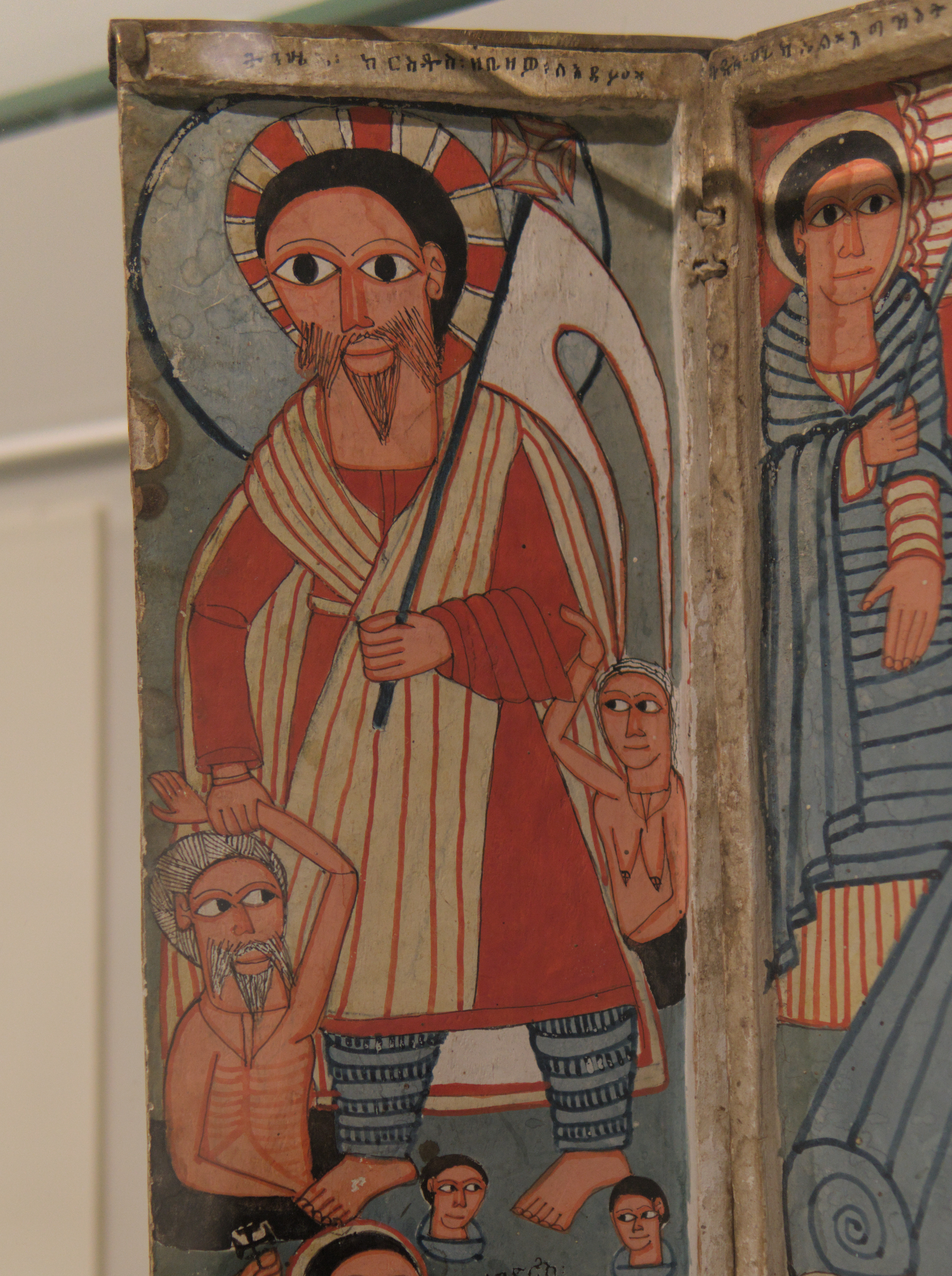
Harrowing of Hell

On the right wing, angels hold up chalices to collect the blood that flows from Jesus’s wounds on the cross, while below that, Joseph of Arimathea and Nicodemus carry Jesus’s wrapped corpse to the tomb. On the left wing is one of my favorite traditional religious scenes: the Harrowing of Hell, or Christ’s Descent into Limbo, in which, on Holy Saturday, Jesus enters the realm of his dead to take back those whom Death has held captive, first of which are our foreparents Adam and Eve. Below that scene is an image of the dragon-slaying Saint George, a late third-century figure from the Levant or Cappadocia who is the patron saint of Ethiopia.

At the bottom center is a scene of Christ teaching the twelve apostles, plus two Ethiopian saints. They all hold hand crosses, like those carried by Ethiopian priests and monks.
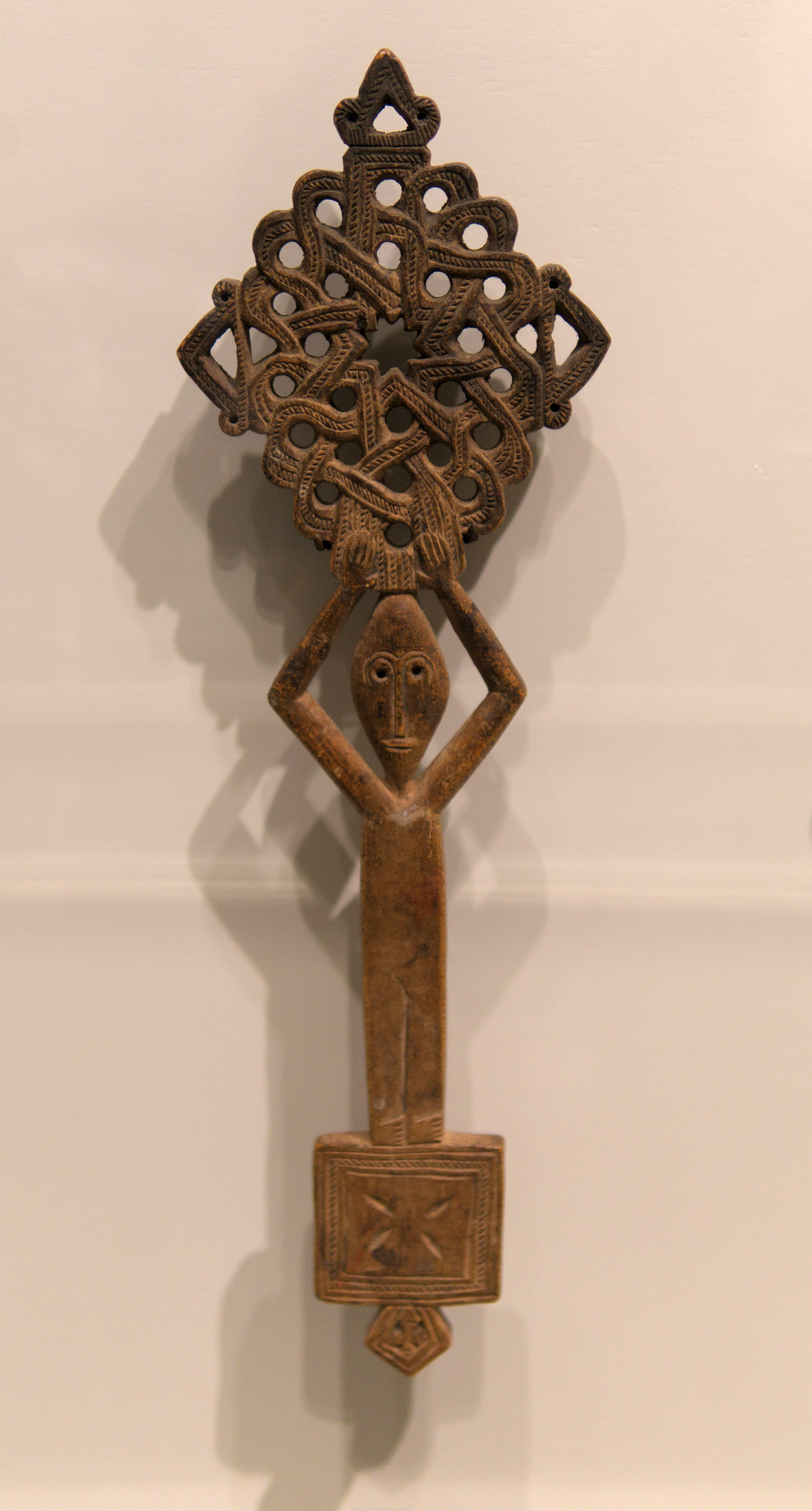
Hand Cross with Figure
Hand Cross with Figure, Ethiopia, probably 18th–19th century. Wood, 13 3/8 × 4 3/16 × 9/16 in. (34 x 10.7 × 1.4 cm). Walters Art Museum, Baltimore. [object record]

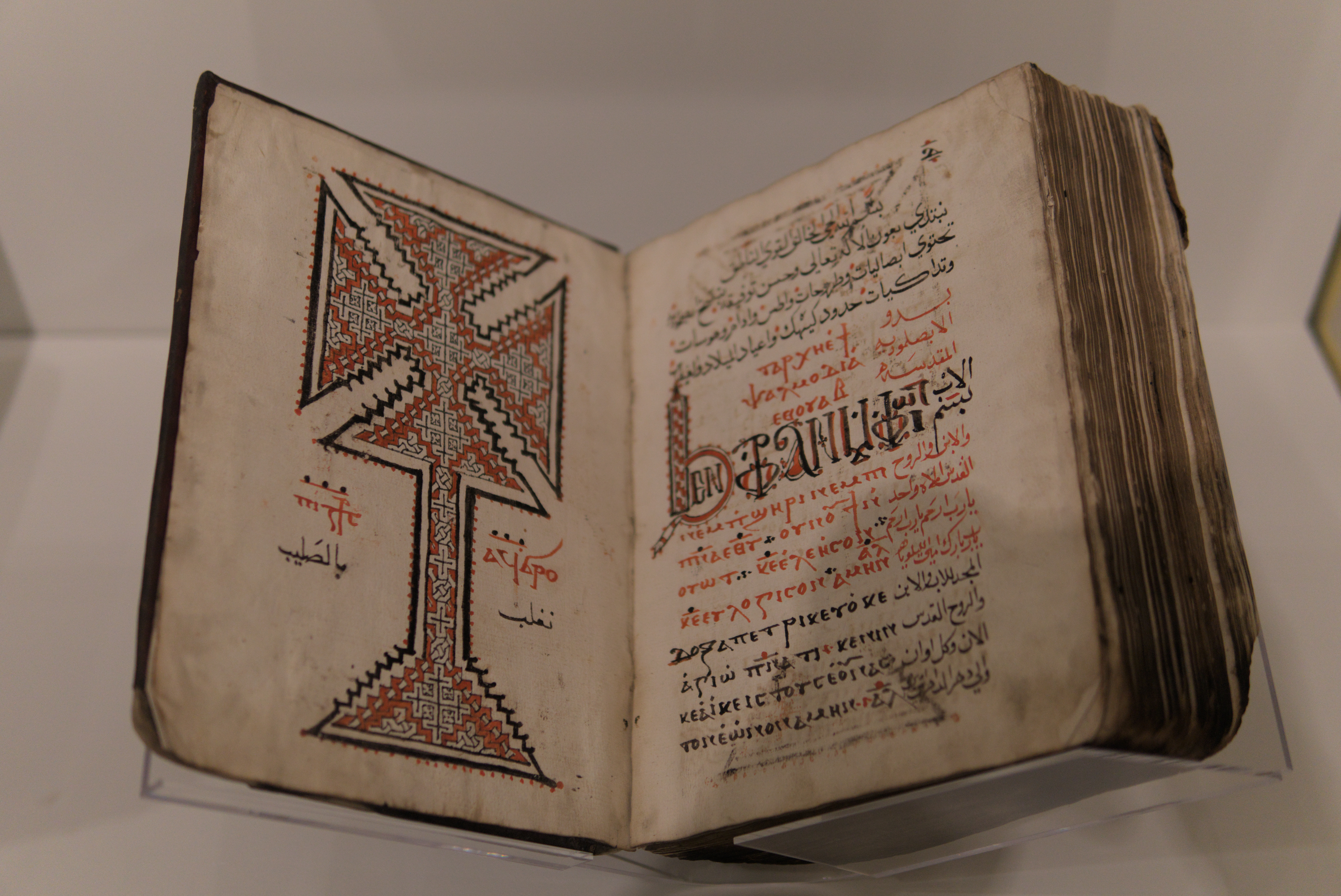
Coptic-Arabic Book of Prayer
Coptic-Arabic Book of Prayer, Egypt, 18th century. Tempera and ink on parchment, 11 3/4 × 9 in. (29.8 × 22.8 cm). Melikian Collection. [object record]

One of the hallmarks of the exhibition is its multisensory nature: attendees are immersed not only in the sights of Ethiopia but also in the sounds and smells. Scratch-and-sniff cards invite people to take a whiff of frankincense, which would have filled the censer on display. Or to smell berbere, a hot spice blend that would have been stored in the woven baskets nearby.

Frankincense

This olfactory element was produced by the Institute for Digital Archaeology, which, as part of its efforts to record and preserve ephemeral culture, has launched an ambitious program to preserve the heritage of smells. “The aim is to provide the technical means for documenting the aromas of today for the benefit of future generations – and to find new methods and opportunities for experiencing the odors of the past.”

Also in the exhibition there are screens where you can watch videos of Ethiopian Orthodox worship, including music and liturgies, where you will see some of the objects in use. You can also listen to interviews with members of the local Ethiopian diaspora community. (The Washington metropolitan area has the largest Ethiopian population outside Ethiopia.)
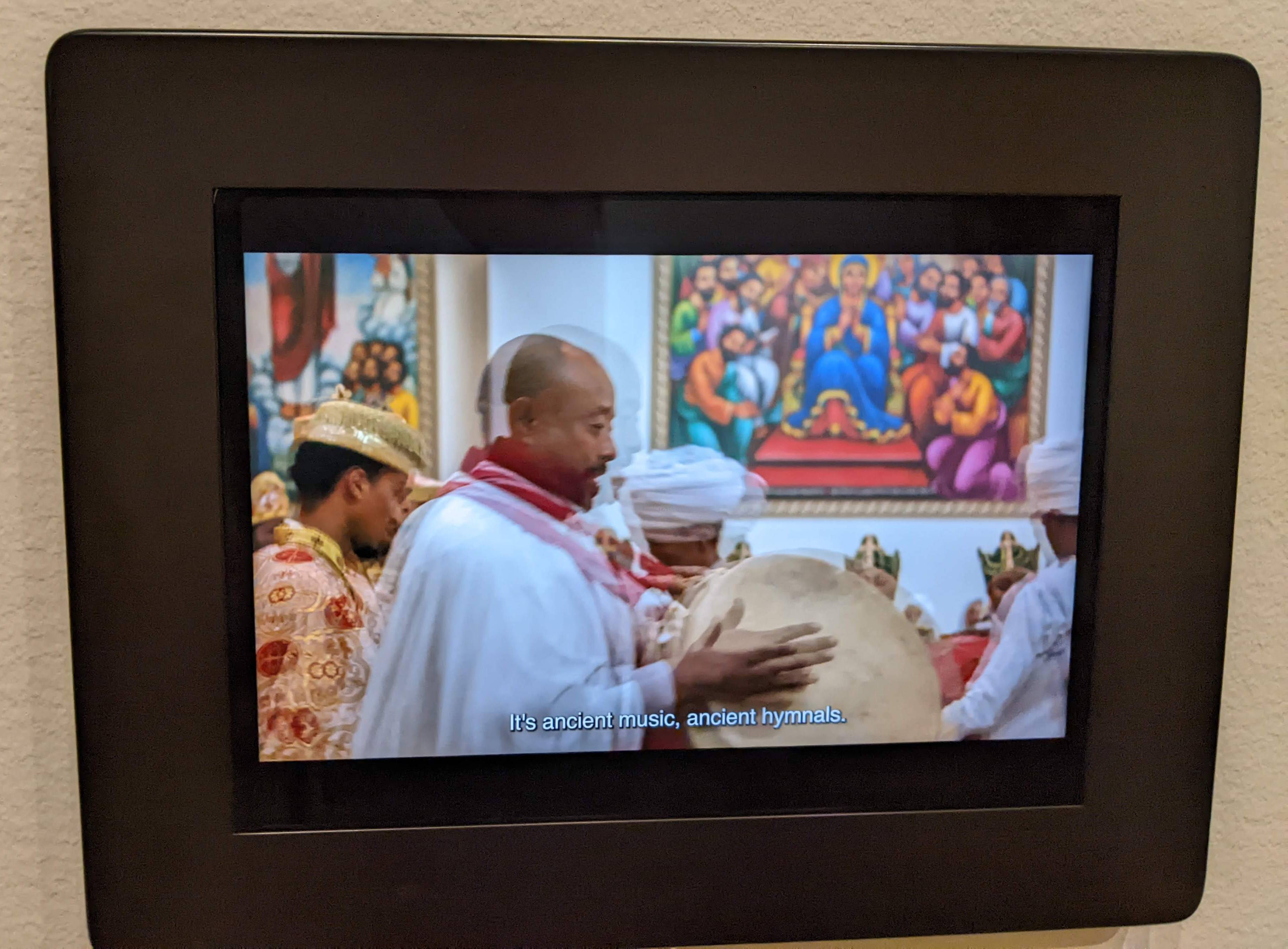
Further contextualizing the objects and enhancing the sense of place, pasted onto the wall is a blow-up photograph of a Christian holy-day celebration wending through the streets. This serves as a backdrop to two physical artifacts present in the room: a qämis (dress) and a debab (umbrella).

Dress and umbrella
Left: Dress (qämis), Ethiopia, 20th century(?), cotton, Peabody Essex Museum, E72559. Right: Umbrella (debab), Ethiopia, 20th century, silk and velvet, Peabody Essex Museum, E68713.

The inscriptions on many of the Ethiopian icons and manuscript illuminations, which identify the figures and scenes, are in Ge‘ez (aka classical Ethiopic), an ancient South Semitic language that originated over two thousand years ago in what is now northern Ethiopia and Eritrea. It’s no longer spoken in daily life, but it is still used as the language of the Ethiopian Orthodox Church and taught to boys in Sunday school. I really wish I could read it, as it would be a great help in interpreting the Ethiopian images I come across in my studies!

Contrary to what some may assume, Ethiopians in the medieval era were not an isolated people. They traveled—to Rome, to Jerusalem, and so forth. Evidence of Holy Land pilgrimage is suggested by an early fourteenth-century Gospel book that includes the domed Church of the Holy Sepulcher as the backdrop for Christ’s resurrection:
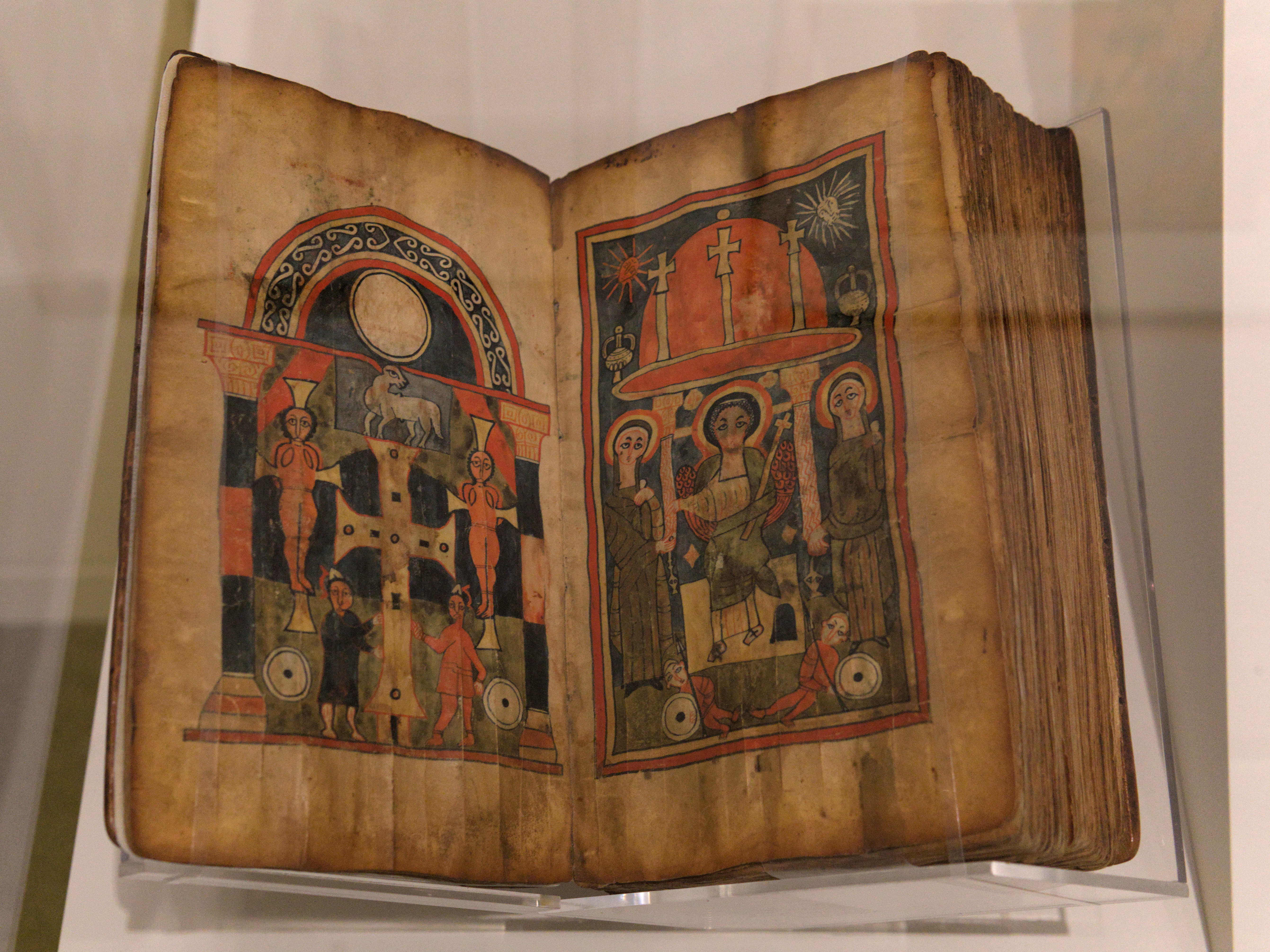
Crucifixion and Resurrection
Gospel Book with the Crucifixion and Christ’s Resurrection, Ethiopia (Tigray), early 14th century. Ink and paint on parchment, 10 1/2 × 6 11/16 in. (26.7 × 17 cm). Walters Art Museum, Baltimore, W.8.36, fols. 6v–7r. [object record]

This is an extraordinary book, one of the oldest surviving Ethiopian manuscripts and the oldest in North America. Ethiopian artists weren’t yet depicting Jesus on the cross, so to represent the Crucifixion, this artist has painted a living lamb surmounting a bejeweled cross, with the two thieves crucified on either side.

Also from the fourteenth century, a manuscript opened to a page spread of Christ’s Entry into Jerusalem:

Triumphal Entry
Christ’s Entry into Jerusalem, folios added from an earlier Gospel book to a Ta’ammera Maryam manuscript, Ethiopia, 14th century. Tempera and ink on parchment. Private collection.

I like how the scene extends across both pages, creating a sense of forward progression, and the two onlookers above the city gate.

One of my favorite objects from the exhibition is a sensul from Gondar depicting ten scenes from the life of Mary. A sensul is an Ethiopian chain manuscript, in this case pocket-size, created out of a single folded strip of parchment attached to heavy hide boards at each end, which creates a small book when folded shut. Here’s a detail showing the Annunciation:
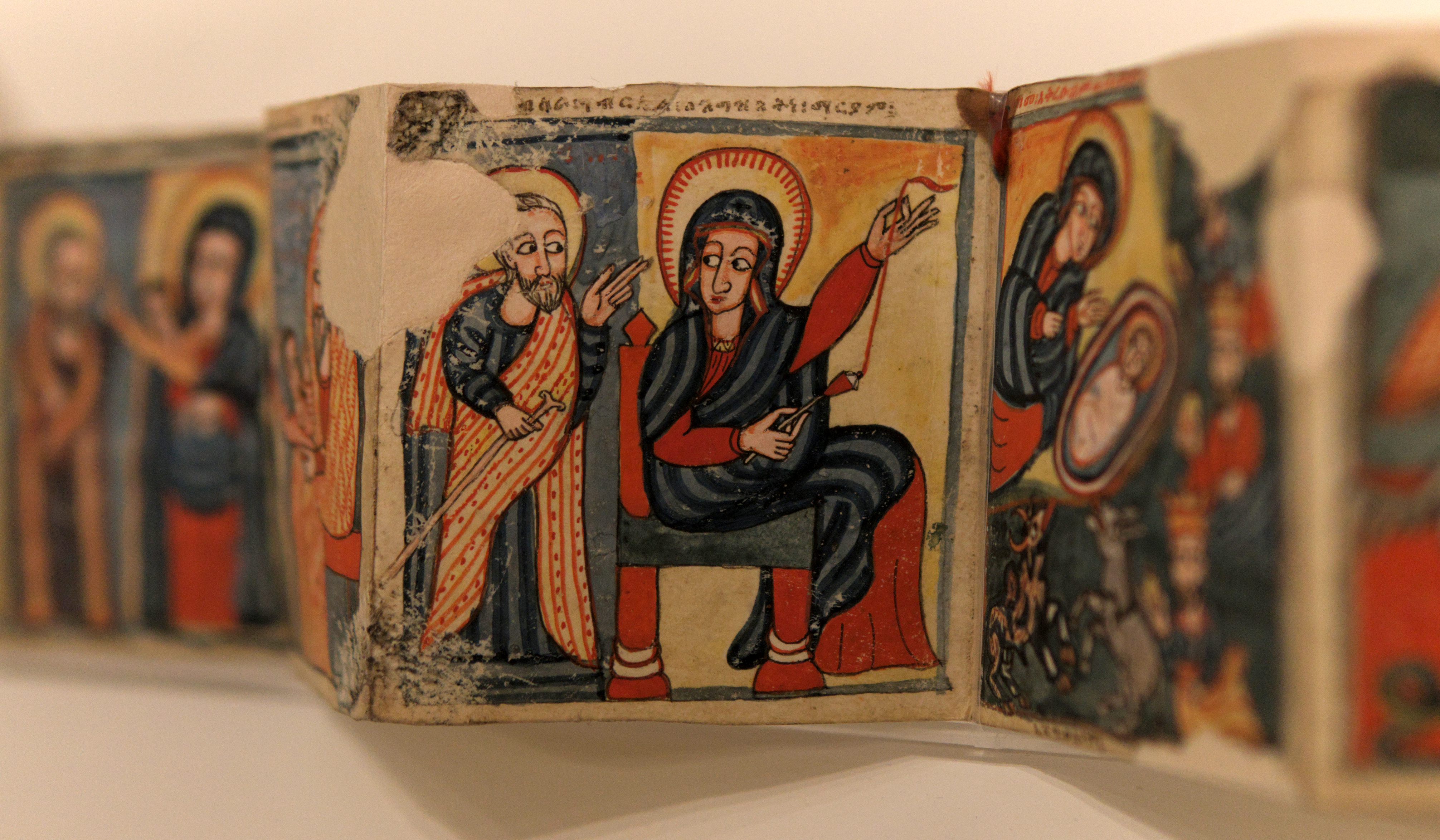
Annunciation (from a sensul)
Annunciation, from a Gondarine sensul (chained manuscript), Ethiopia (Gondar), late 17th century. Ink and paint on parchment, each panel 3 5/8 × 3 1/8 in. (9.2 × 9 cm). Walters Art Museum, Baltimore. [object record] [GIF]

It’s a common misconception that Ethiopians have always depicted biblical figures as dark-skinned to reflect the local population. Such treatment didn’t become normative until the eighteenth century, although some earlier artists did choose black complexions for holy persons:
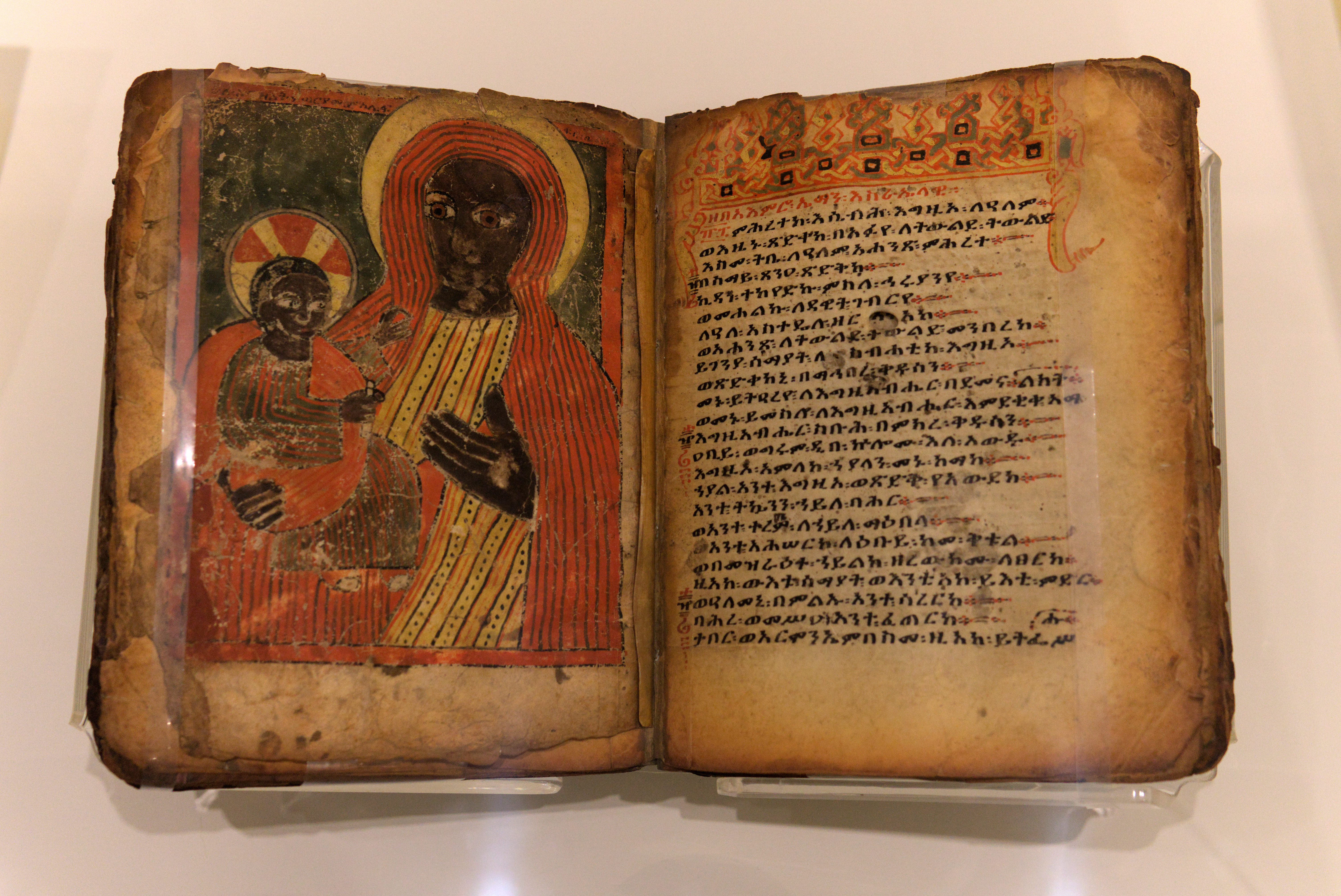
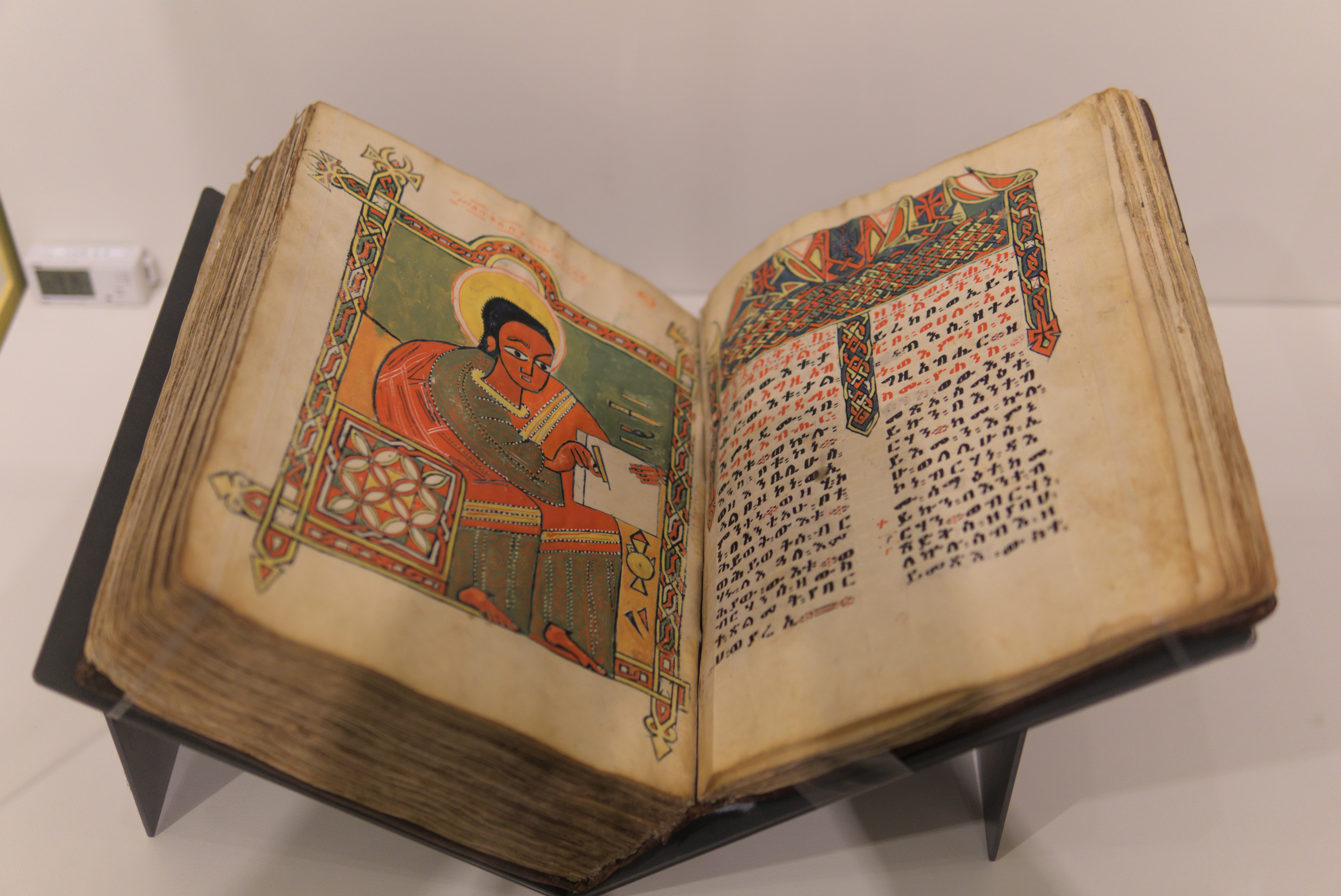
Virgin and Child
Virgin and Child, from a Psalter with the Wəddase Maryam (Praise of Mary) and Mähalǝyä Näbiyyat (Canticles of the Prophets), Ethiopia, 15th century. Ink and pigments on parchment with wooden boards, open: 8 7/8 × 6 11/16 × 3 15/16 in. (22.5 × 17 × 10 cm). Toledo Museum of Art, Ohio. [object record]

Portrait of John the Evangelist
The Opening of the Gospel of John, from a Gospel book, Ethiopia, ca. 1504–5. Tempera on parchment, 13 9/16 × 10 7/16 in. (34.5 × 26.5 cm). J. Paul Getty Museum, Los Angeles, Ms. 102, fols. 215v–216r. [object record]

Virgin and Child triptych
Triptych Icon with the Virgin Mary and Christ Child Flanked by Archangels (center), the Kwer‘atä re’esu (Man of Sorrows) and Saint George (left), and Saint Gäbrä Mänfäs Qeddus and Abba Arsanyos (right), Ethiopia (Gondar), late 17th–early 18th century. Tempera on gesso-primed wood. Institute of Ethiopian Studies, Addis Ababa University, acc. no. IESMus3492.

In the triptych shown above, not only is the infant Jesus depicted as Black, but he also wears a necklace made of cowrie shells, which are traditionally given to Ethiopian children for protection!

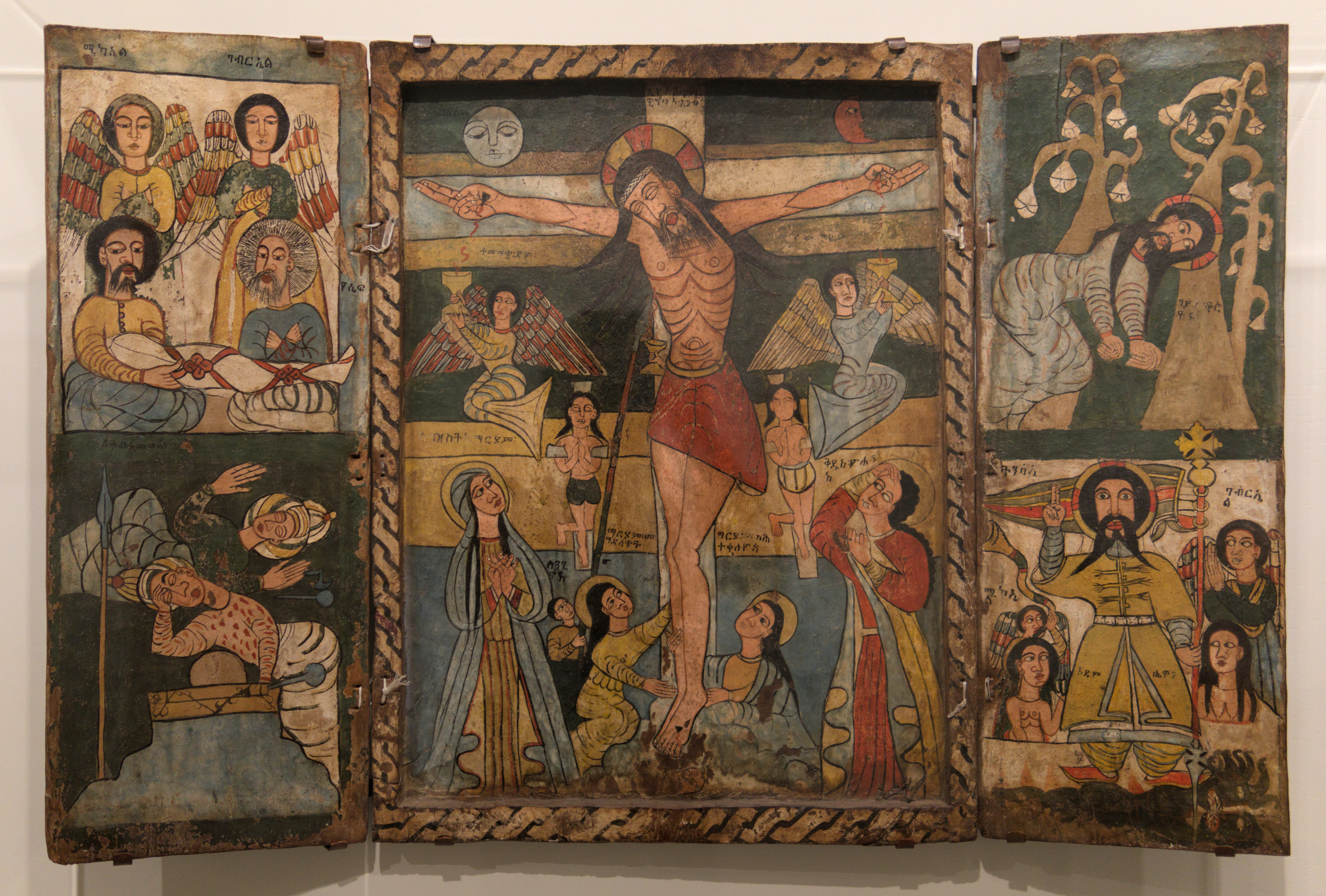
My favorite artwork from the exhibition is probably this triptych:
Crucifixion triptych
Triptych Icon with the Crucifixion (center), Entombment and Guards at the Tomb (left), and Temptation in the Wilderness and the Resurrection of Christ (right), Ethiopia, late 16th century. Tempera on gesso-primed wood. Institute of Ethiopian Studies, Addis Ababa University, acc. no. IESMus4126.

Its central panel depicts the Crucifixion, Christ’s head bowed in death and his fingers gesturing blessing, even as his palms are nailed. At the top, the sun and the moon mourn his passing. As we saw before, angels catch the blood that drips from his body (notice the cute little hand sticking out from behind his torso!). At the base, the two larger-scale figures are the Virgin Mary and St. John, while next to Mary on a smaller scale is Longinus, the centurion who pierces Christ’s side with a spear.

The left wing shows the Entombment of Christ, with two guards, wearing pointed turbans, sleeping at their post. The right wing shows a scene that the label identifies as “Temptation in the Wilderness” (presumably a translation of the inscription on the tree) but that looks to me more like an Agony in the Garden. Below that is the Resurrection, with Christ holding a victory banner, standing atop Hades. An angel blows a shofar and the dead rise up out of their graves, following Christ, the firstfruits of the resurrection (1 Cor. 15:20–22). Christ wears a short-sleeved, knee-length jacket with frog closures, and bunched sleeves and trousers, both of which reflect clothing from regions east of Africa.

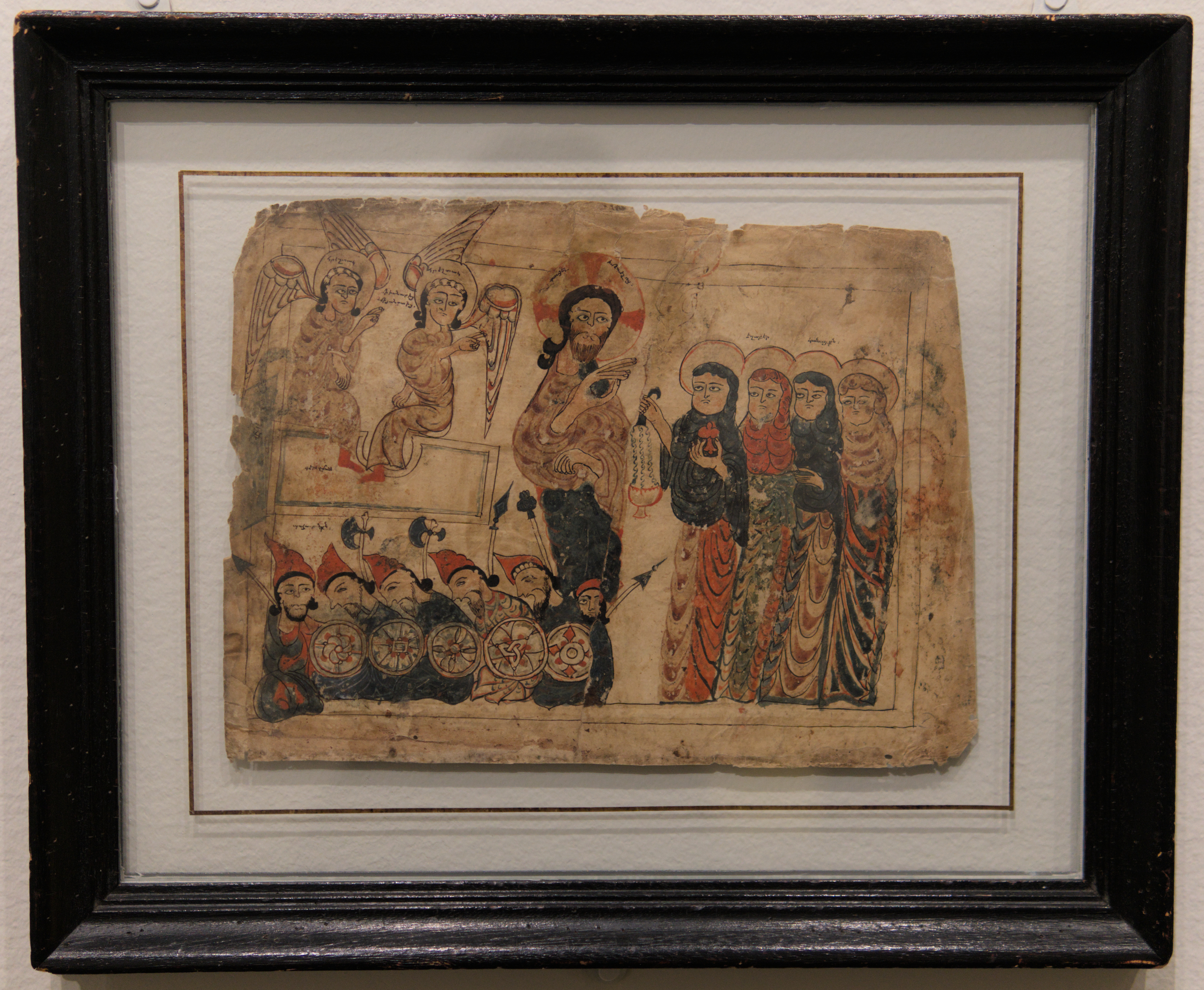
The wall text notes the fine, wavy lines used to render the figures’ draperies, perhaps influenced by Armenian artists from the Lake Van region.
Armenian Resurrection
Yovsian of Vaspurakan (Armenian), Leaf from a Gospel book with the Resurrection of Christ and Visit of the Women to the Tomb of Christ, ca. 1350. Tempera on cotton paper. Private collection.

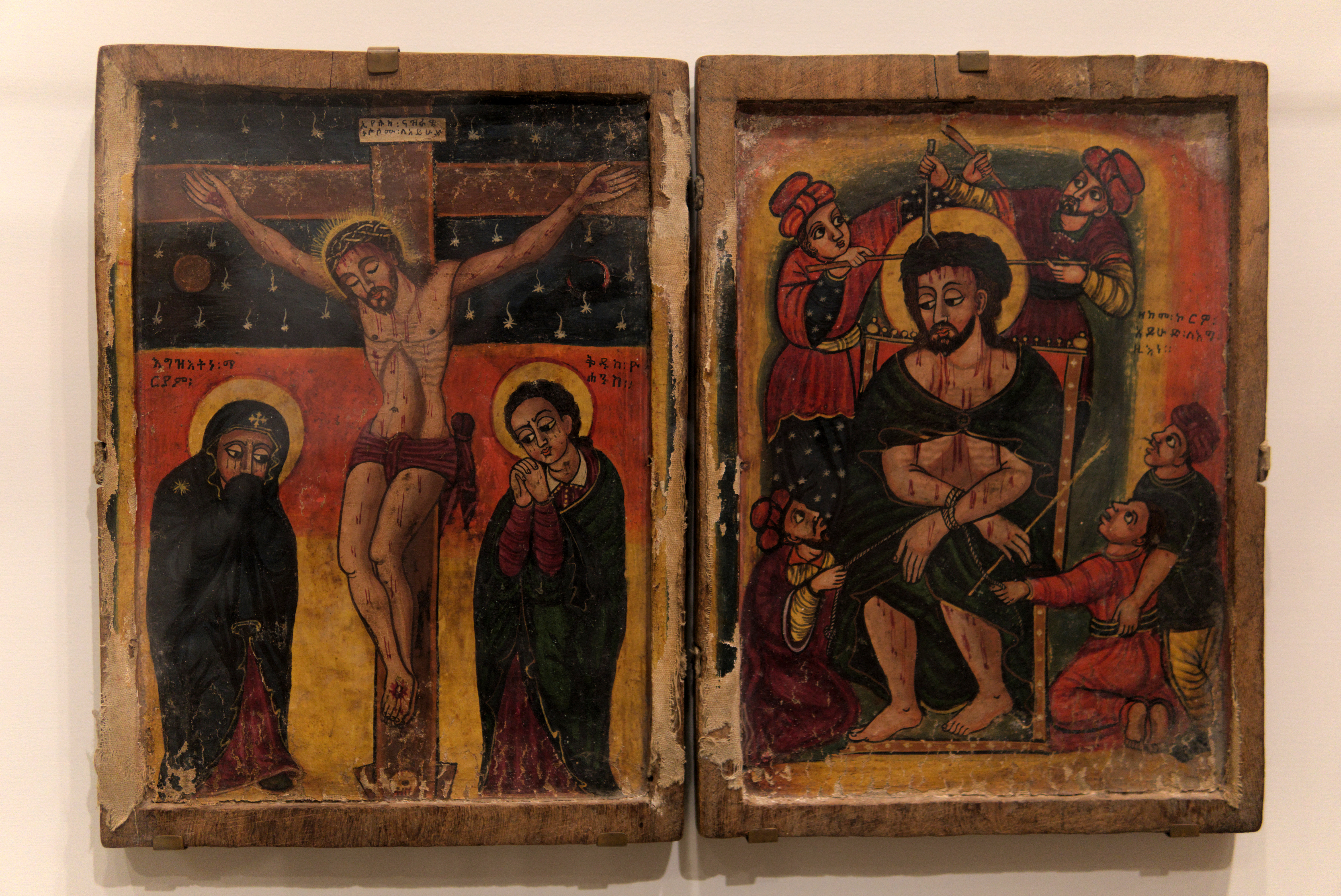
Here’s another Crucifixion, this one painted in what’s called the Second Gondarine style, characterized by smoothly modeled figures, often with darker skin tones, and wide horizontal bands of red, yellow, and green filling the background:
Crucifixion-Mocking diptych
Diptych Icon with the Crucifixion (left) and the Mocking of Christ (right), Ethiopia, late 17th–early 18th century. Wood, polychrome, 13 1/2 × 9 7/8 in. (34.3 × 25.1 cm). Virginia Museum of Fine Arts, Richmond. [object record]

The squiggles behind Christ at the top left may simply be a decorative motif, but to me they look like falling stars, an apocalyptic sign, and as if the sky is weeping.

The right panel of the diptych shows Christ being cruelly fitted with a crown of thorns.

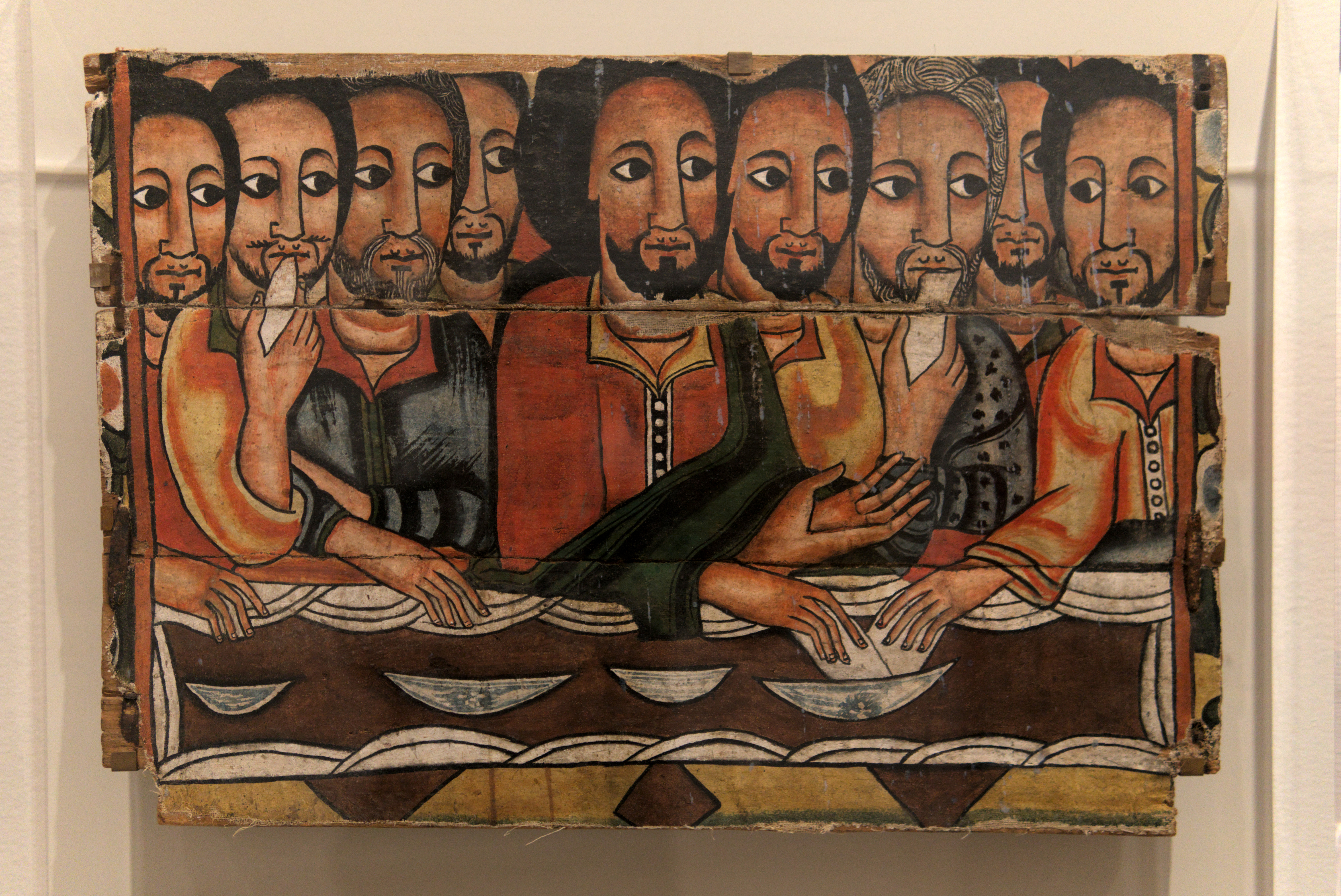
Two other passion images I want to share are a Last Supper wall painting and an Entombment from a disbound album.
Last Supper
Last Supper, Ethiopia, 18th century. Tempera on linen, mounted on panel, 16 3/4 × 24 in. (42.6 × 61 cm). Virginia Museum of Fine Arts, Richmond. [object record]

Entombment
Album Leaf with the Entombment of Christ, Ethiopia (Sawa?), late 17th century. Pigments on vellum. Minneapolis Institute of Art, 2009.39.3y. [object record]

In the Last Supper, Jesus and Judas both dip their bread (injera!) into the same bowl and exchange a knowing glance.

In the Entombment, Jesus, wrapped in white linen, is lowered into the ground, mourned by several of his women followers. The portrayal of his mother Mary’s weeping, her hands covering her eyes and her face stained with tears, is particularly poignant. This leaf is from a set of forty-four, now matted separately but originally arranged in series and likely painted on several long sheets of parchment that were sewn together and folded accordion-style to form a sensul.

One of the most extraordinary objects on display is a rare folding processional icon that adopts the form of a fan, from the late fifteenth century:

Processional icon (Ethiopia)
Folding Processional Icon in the Shape of a Fan, Ethiopia, late 15th century (Stephanite). Ink and paint on parchment, thread, extended: 24 1/4 × 154 1/8 × 4 3/4 in. (61.6 × 391.4 × 12 cm). Walters Art Museum, Baltimore. Photo courtesy of the museum. [object record]

Thirty-eight identically sized figures span the surface of this elongated parchment: the early Christian martyrs Julitta (Juliet) and Cyricus, St. George, St. John the Baptist, the archangel Michael, the Virgin Mary, the archangel Raphael, St. Paul, the Ethiopian artist-priest Afnin, and unidentified Old Testament patriarchs and prophets. There would have been a wooden handle attached to either end that, when pulled together, created a double handle for a giant wheel to be displayed during liturgical processions and church services (see here). As the museum website notes, “The Virgin Mary, whose hands are raised in a gesture of prayer, is then at the top of the wheel. By depicting Mary in the company of saints and angels, the icon powerfully evokes the celestial community of the church.”

This is just a sampling of all the wonderful art objects that are a part of the Ethiopia at the Crossroads exhibition. I’ll share more photos on Instagram (@art_and_theology) in the coming weeks.

I strongly encourage you to go see this! I think it would be enjoyable for children as well, especially Christian children, who will be able to identify many of the painted stories. For Christians, it’s an opportunity to connect with our artistic heritage and with African church history. If you can’t catch the exhibition at the Walters in Baltimore before it closes March 3, it will be traveling to the Peabody Essex Museum in Salem, Massachusetts (April 13–July 7, 2024), and the Toledo Museum of Art in Ohio (August 17–November 10, 2024).

Also, a catalog is coming out in April, where you will find photos of all the artworks in addition to illuminating essays.

Trinity Sunday Roundup

Today, June 4, is Trinity Sunday! Here’s a handful of art and music items on the topic.

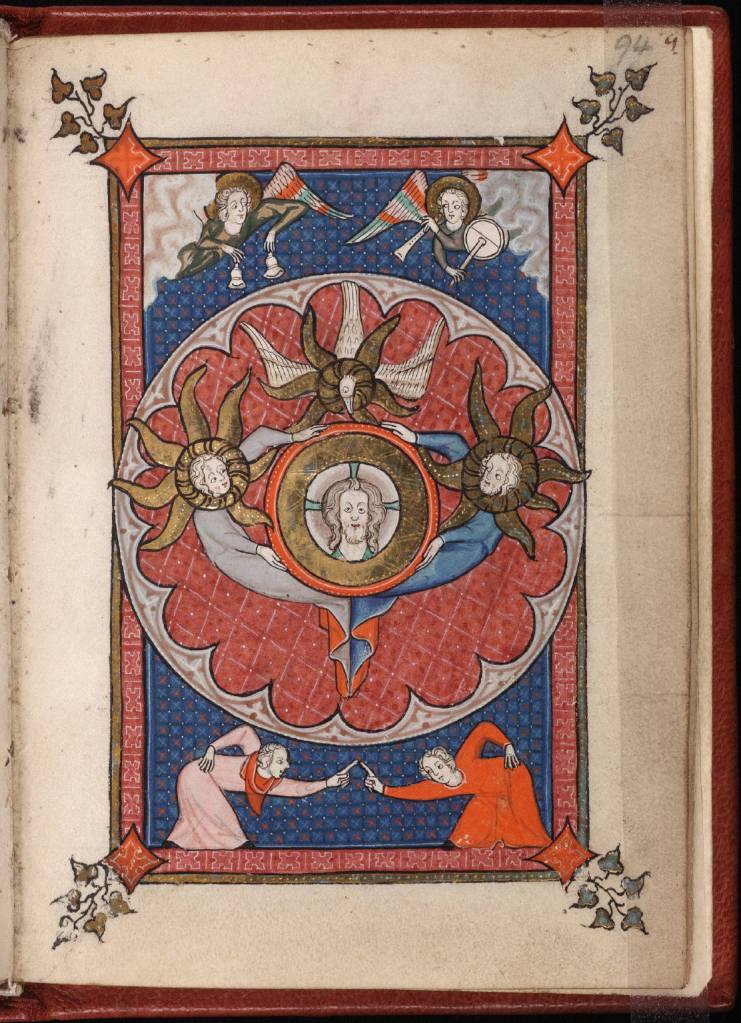
VISUAL MEDITATION: “The Wheeling Playfulness of the Trinity” by Victoria Emily Jones: The Rothschild Canticles [previously] from ca. 1300 Flanders contains some of the most inventive and delightful artistic renderings of the Trinity that I’ve ever seen. I key in on four of them in today’s visual meditation for ArtWay

Beinecke MS 404, fol. 94r

+++

MUSICAL COMMENTARY: “Theology in Sound and Motion: Perichoresis, for Brass Quintet” by Delvyn Case: Delvyn Case provides musical and theological commentary on his brass quintet composition “Perichoresis” (2006), inspired by the divine dance of the Trinity. “Its overall mood is joyous, an ecstatic whirling-about in which all three members become lost in the ecstasy of divine fellowship,” he writes. “At the exact moment of the dance when one member moves, the other fills in the spot left vacant.” “Perichoresis” premiered by Boston’s Triton Brass and appears on Case’s 2018 album Strange Energy. About this piece, Bible scholar and theologian Walter Brueggemann said, “I . . . have pondered ‘perichoresis’ for a long time. This is the finest exposition of that thick idea that I have encountered.”

+++

SONGS:

>> “Trinity Song” by Paul Zach: Performed in 2021 by Solomon Dorsey with Liz Vice and Madison Cunningham, this song by Paul Zach evolved into “God of Grace and Mystery” for The Porter’s Gate’s 2022 album Climate Vigil Songs. This earlier iteration has a Trinitarian focus that’s just lovely. “God of all eternity / Father, Spirit, and the Son / Ever-loving Three-in-One / O divine community / . . . / Calling us to join your dance . . .”

>> “One-Two-Three” by the Chosen Gospel Singers: This song was recorded in Los Angeles for Specialty Records and released as a single in 1952, with singers J. B. Randall (bass), E. J. Brumfield (tenor), George Butler (tenor), Fred Sims (tenor), and Oscar Cook (baritone). It opens with a repetition of the lines “One, two, three / One-in-Three and the Trinity.” The refrain is:

One for the Father
Two for the Son
Three for the Holy Ghost
All made of one

The song is largely eschatological. The first verse is about John the Revelator’s vision of the New Jerusalem descending, among other wonders; it ascribes a vision of the Trinity to John, even though that is not explicit as such in either John’s Gospel or the Apocalypse (but see “The Trinity in the Book of Revelation” by Edwin Reynolds). The second verse anticipates our singing and praising the Triune God in heaven, dressed in our brand-new robes. It also mentions David and Goliath, and I’m honestly not sure how that relates. But with gospel songs, floating lyrics are common, taken from one song and spliced into another, some more coherent than others in their new context.

+++

ESSAY: “The Hospitality of Abraham in the Work of Julia Stankova, Painter of Bulgarian Icons” by François Bœspflug: The first half of this peer-reviewed article introduces readers to the Bulgarian artist Julia Stankova, rehearsing her biography and examining her relationship to the icons tradition. The second half explores twelve of her paintings on the subject of the three angelic visitors to Abraham and Sarah in Genesis 18, whom the narrator suggests are a manifestation of God (“The LORD appeared to Abraham at the oaks of Mamre . . .”); because of the number of visitors, many Christians interpret this passage as revealing something of God’s triune nature, and for this reason traditional icons of the story are often titled The Trinity.

Stankova, Julia_The Hospitality of Abraham
Julia Stankova (Bulgarian, 1954–), The Hospitality of Abraham, 2004. Tempera on primed wooden panel and lacquer technique, 46 × 41 cm.

Since the publication of this article in 2019, Stankova has made at least three more paintings on the subject, all of which foreground Sarah and are titled Sarah’s Smile. She has just heard the angels announce that she will conceive a son in her old age.

+++

POEM: “After Rublev’s Trinity by Carrie Purcell Kahler: Published in Image no. 99 (Winter 2018), p. 21, this ekphrastic poem by Carrie Purcell Kahler interprets the famous fifteenth-century Trinity icon by Andrei Rublev. Sometimes referred to as “the hospitality of Abraham,” this biblical episode, as the iconographers interpret it, is really about the hospitality of God, who extends a hand to humanity, ever inviting us to sit at his table.

Rublev, Andrei_Trinity
Andrei Rublev (Russian, 1360–ca. 1430), The Trinity, ca. 1411. Tempera on wood, 141.5 × 114 cm. Tretyakov Gallery, Moscow.

A new choral setting of this poem by Garrett John Law is premiering today at Holy Trinity Episcopal Church in Covina, California, where Law serves as music director and organist. I believe it can be heard on the 10:30 a.m. PT worship service livestream on the church’s YouTube channel, but I’m not sure whether the performance will be archived online for later viewing. (Update, 6/12/23: Here it is! Sung by Holy Trinity’s seven-person choir.)

Roundup: More Christmas music, and icons of the Incarnation

CHRISTMAS EVE SERVICE 2021, Good Shepherd New York: Good Shepherd New York is an interdenominational church located in the Chelsea neighborhood of Manhattan. When the pandemic hit in 2020, like many churches, they pivoted to online services. This video-only format enabled them to expand their music ministry, soliciting participation from nonlocal musicians, who collaborated virtually with the church’s in-house musicians to release some stellar worship music—beautiful arrangements and performances. While GSNY now meets again in person for worship, they also release separate digital worship services on their YouTube channel to reach a wider community. Last year I tuned in to their Christmas Eve service, which I really enjoyed, particularly the music. “Mary’s Lullaby,” written by associate pastor David Gungor and sung by his wife, Kate, with harmonizing vocals by Liz Vice, is my favorite from the list.

  • Children’s skit
  • 4:31: Prelude: “Carol of the Bells,” cello solo by David Campbell
  • 5:20: Welcome
  • 7:22: “Mary, Did You Know,” feat. Charles Jones
  • 11:04: “O Come, All Ye Faithful”
  • 13:55: “Joy to the World!”
  • 16:55: “Angels We Have Heard on High”
  • 20:51: “Hark! the Herald Angels Sing”
  • 23:51: “O Holy Night,” feat. Charles Jones
  • 28:05: “Mary’s Lullaby” (by The Brilliance), feat. Kate Gungor and Liz Vice
  • 30:03: Sermon by Michael Redzina
  • 44:55: “Silent Night,” feat. Matthew Wright and Liz Vice
  • 48:43: “Happy Xmas (War Is Over)” (by John Lennon)

Many of these songs were released last month on the Good Shepherd Collective’s debut Christmas album, Christmas, Vol. 01, available wherever music is sold or streamed.

Good Shepherd New York will be holding an in-person candlelight service at 5 p.m. on Christmas Eve this year in the Chapel of the Good Shepherd at 440 West 21st Street. Musician Charles Jones will be there.

+++

EXHIBITION WALK-THROUGH: Słowo stało się Ciałem (The Word Became Flesh), Warsaw Archdiocese Museum, March 3–31, 2021: Last year a collection of contemporary Ukrainian and Polish icons on the theme of Incarnation was exhibited in Warsaw. In this video, curator Mateusz Sora and Dr. Katarzyna Jakubowska-Krawczyk, head of the Department of Ukrainian Studies at the University of Warsaw, discuss some of the pieces. I don’t speak a lick of Polish, and closed captioning is not available, so I’m not sure what is said—but the camera gives a good visual overview. You can also view a full list of artists and photos of select icons in this Facebook post.

Kuziv, Kateryna_Annunciation
Kateryna Kuziv (Катерина Кузів) (Ukrainian, 1993–), Annunciation, 2020. Egg tempera and gilding on gessoed wood, 40 × 40 cm. [IG: @kateryna_kuziv]

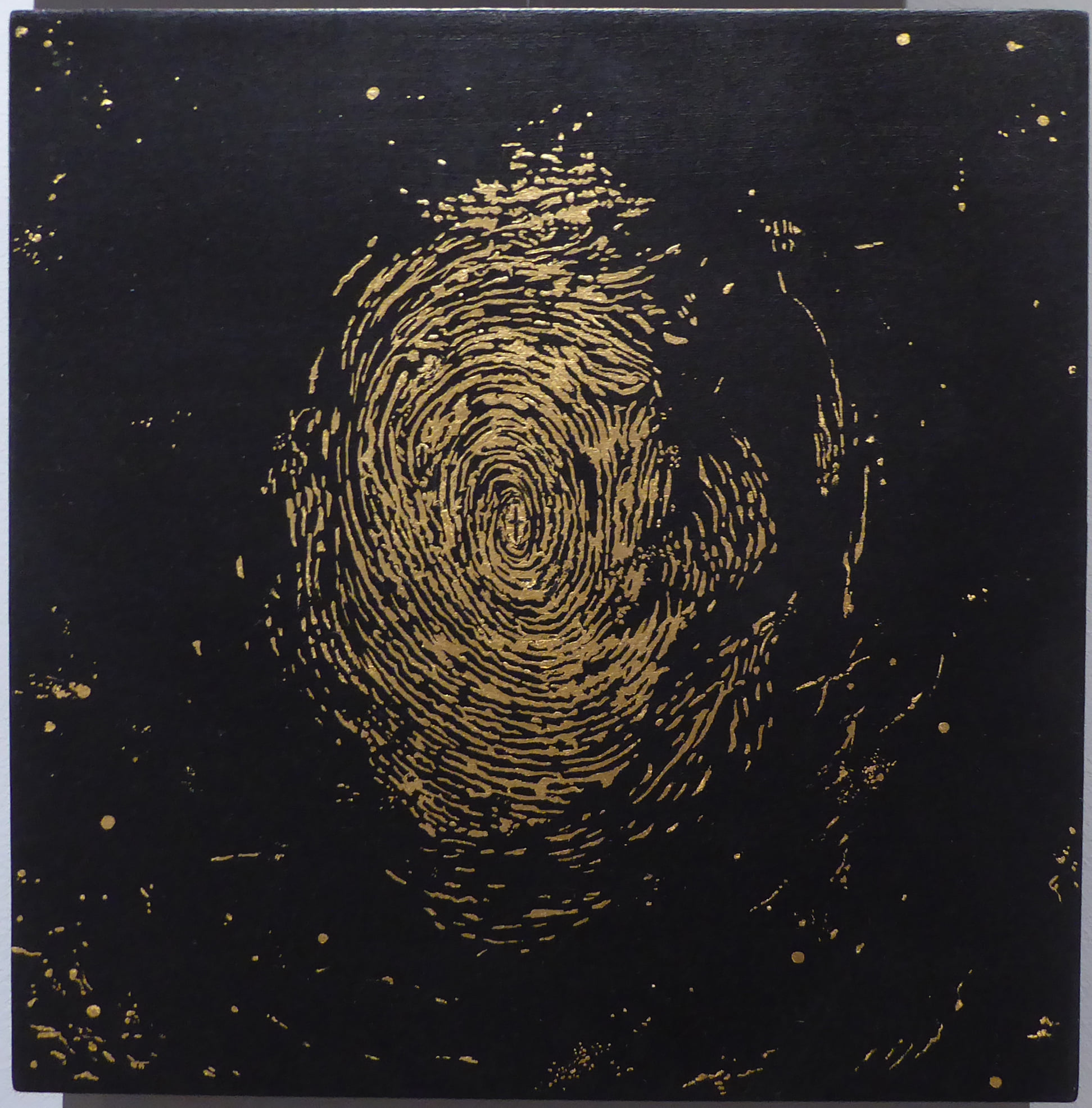
Fiodorowicz, Boris_3,1415926535879323846264338327
Borys Fiodorowicz (Polish), 3,1415926535879323846264338327, 2020. God has fingerprints! [IG: @borysfiodorowicz]

ON A RELATED NOTE: There’s a public exhibition of icons by several of these artists happening in North Carolina at Gordon-Conwell Theological Seminary–Charlotte through February 17, 2023: East Meets West: Women Icon Makers of Western Ukraine. I attended an earlier iteration of East Meets West in Massachusetts back in 2017 (mentioned here), and it was wonderful. The icons are owned by the American collector and former news correspondent to the USSR John A. Kohan, and he has added more pieces to this area of his collection since I last saw it.

There will be a special event on Wednesday, February 1, from 7 to 9 p.m., featuring a talk about the history of iconography by Professor Douglas Fairbairn and a video introduction by Kohan; RSVP here.

+++

ICON INTERPRETATION: “The ‘All-Seeing Eye of God’ Icon” by David Coomler: Icons expert David Coomler unpacks a preeminent example, and two variants, of this unusual icon type that emerged in Russia at the end of the eighteenth century, influenced by the “Eye of Providence” symbol found, for example, on the Great Seal of the United States. Moving from the center outward, four concentric circles show a young Christ Emmanuel, a sun-face, the Theotokos (Virgin Mary), and the angelic hosts, with Lord Sabaoth (God the Father) at the top and symbols of the Four Evangelists at the corners. Inscriptions include “As the burning coal that appeared to Isaiah, a sun arose from the virgin’s womb, bringing to those who wandered in darkness the light of the knowledge of God” (a variant of the Irmos, Tone 2, from the Easter Octoechos) and “My eyes [shall be] on the faithful of the land, that they may dwell with me” (Psalm 101:6).

All-Seeing Eye icon
All-Seeing Eye of God icon, Russia, late 19th or early 20th century

For more icons of this type, see Dr. Sharon R. Hanson’s Pinterest board. And for a fascinating history of the disembodied eye–in-triangle that’s most often associated (unwarrantedly) with Freemasonry in the popular imagination, read Matthew Wilson’s BBC article “The Eye of Providence: The symbol with a secret meaning?” (I learned that one of its earliest appearances is in a Supper at Emmaus painting by Pontormo! It was a Counter-Reformation addition, to cover up the newly banned trifacial Trinity that Pontormo had painted.)

+++

SONG: “Almajdu Laka” (Glory to You) (cover) by the Sakhnini Brothers: The Sakhnini family has lived in Nazareth—Jesus’s hometown!—for generations and is part of the town’s minority Arab Christian population. Adeeb, Elia, and Yazeed Sakhnini [previously] record traditional and original Arabic worship songs together as the Sakhnini Brothers. This is their latest YouTube release, just in time for Christmas. The song is by the Lebanese composer Ziad Rahbani. Turn on “CC” to view the lyrics in English, and see the full list of performers in the video description.

+++

BLOG SERIES: Twelve Days of Carols by Eleanor Parker: There’s a plethora of medieval English Christmas carols preserved for us in medieval manuscripts, a few of which are still part of the repertoire around the world but most of which have fallen into disuse or that are at least lesser known. Medievalist Eleanor Parker spotlights twelve from the latter category. She ran this series back in 2012–13 with the intention of doing twelve posts, one for each day of Christmas, but she stopped short at seven—so I’ve added links to additional carol-based posts of hers from other years. She provides modern translations of the Middle English and, in some cases, brief commentary.

Note that #11 contains an Old English word that Tolkien adopted in his Lord of the Rings!

  1. “Welcome, Yule” (below)
  2. “The Sun of Grace”
  3. “Come kiss thy mother, dear”
  4. “A Becket Carol”
  5. “The Jolly Shepherd”
  6. “Be Merry, and the Old Year”
  7. “Behold and See”
  8. “Hand by hand we shall us take”
  9. “King Herod and the Cock” (below)
  10. “Be merry, all that be present”
  11. “Hail Earendel”
  12. “Christmas Bids Farewell”

Roundup: Light in Nativity and Transfiguration icons, plus more art and song

LECTURE: “Light in Sacred Space: Light from the Cave” by Matthew J. Milliner and Alexei Lidov, December 19, 2019, Bridge Projects, Los Angeles: This double lecture about the role of light in Christian spirituality and theology was organized to coincide with the premiere of 10 Columns, an immersive light installation by Phillip K. Smith III that Bridge Projects commissioned for their inaugural exhibition.

While the Light & Space movement was born in Southern California in the 1960s, in many ways it participates in a much longer history of artists in dialogue with the phenomena of light. This presentation by two art historians, Matthew Milliner and Alexei Lidov, will begin with Milliner exploring the unexpected resonance of Phillip K. Smith III’s work with Byzantine and Gothic traditions. Lidov will then expand on these ideas with his scholarship in the Eastern Orthodox tradition and its long history of engaging light and mysticism. What kinds of insights might come when Light and Space artists, including Phillip K. Smith III, are put in conversation with ancient Orthodox Christian concepts of the nativity and uncreated light? [source]

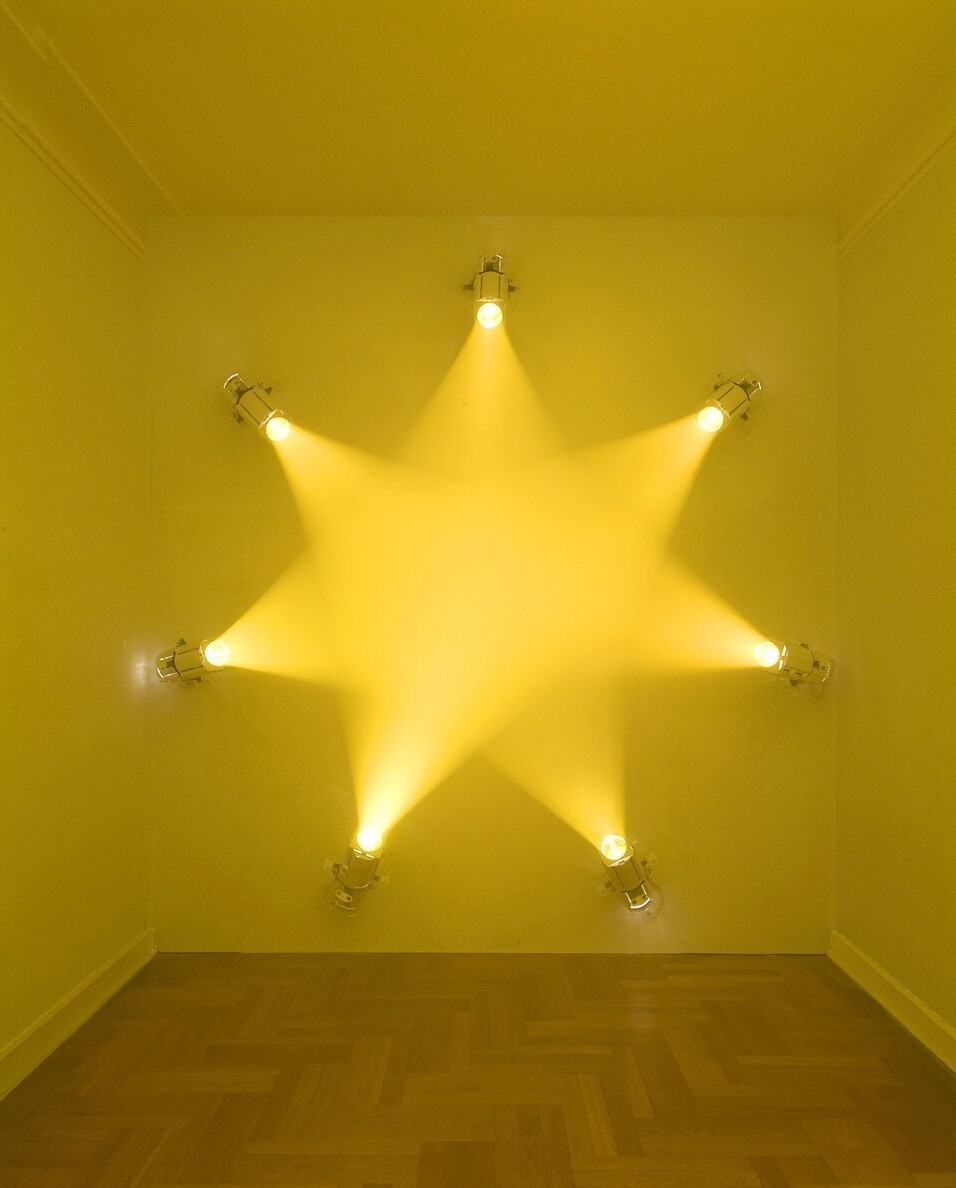
Milliner speaks for the first forty minutes, discussing Nativity and Transfiguration icons and their correlatives in the West and making, as always, fascinating connections between art of the past and present. For example, he overlays Olafur Eliasson’s Ephemeral Afterimage Star (2008) on Rublev’s Transfiguration icon (19:19), and Ann Veronica Janssens’s Yellow Rose on an Adoration of the Magi illumination from a fifteenth-century book of hours at the Getty (26:32). He also introduced me to a fascinating medieval manuscript illumination from Germany (which he in turn learned about through Solrunn Nes) that combines the light of Bethlehem and Tabor—two Gospel scenes in one. Don’t miss the quote by Gregory of Nazianzus.

Janssens, Ann Veronica_Yellow Rose
Ann Veronica Janssens (Belgian, 1956–), Yellow Rose, 2007. Projectors, dichroic filters, and artificial mist, dimensions variable (min. 360 cm diameter, min. 250 cm depth). Museum Morsbroich, Leverkusen, Germany. Photo: Philippe De Gobert.

Nativity-Transfiguration (Ottonian MS)
The Nativity and the Transfiguration, from an Ottonian Gospel-book made in Cologne, 1025–50. Bamberg State Library, Msc.Bibl.94, fol. 155r.

Combining art history and theology (he has advanced degrees in both), Milliner’s talk is organized as follows:

  1. Thessaloniki | Gregory Palamas (d. 1337)
  2. Constantinople | Pseudo-Dionysius the Areopagite (d. ca. 500)
  3. Paris | Abbot Suger (d. 1151)
  4. Los Angeles | Phillip K. Smith III (b. 1972)

+++

ART VIDEOS:

>> “A 60-second introduction to ‘The Nativity at Night’”: One of my favorite Nativity paintings! By fifteenth-century Dutch artist Geertgen tot Sint Jans, a lay brother in the religious order of St. John. In this video from the National Gallery in London, a camera scans over the painting as an atmospheric soundscape plays and captions guide us in looking at the details.

Geertgen tot Sint Jins_The Nativity at Night
Geertgen tot Sint Jans (Dutch, ca. 1455/65–ca. 1485/95), The Nativity at Night, ca. 1490. Oil on oak, 34 × 25.3 cm. National Gallery, London.

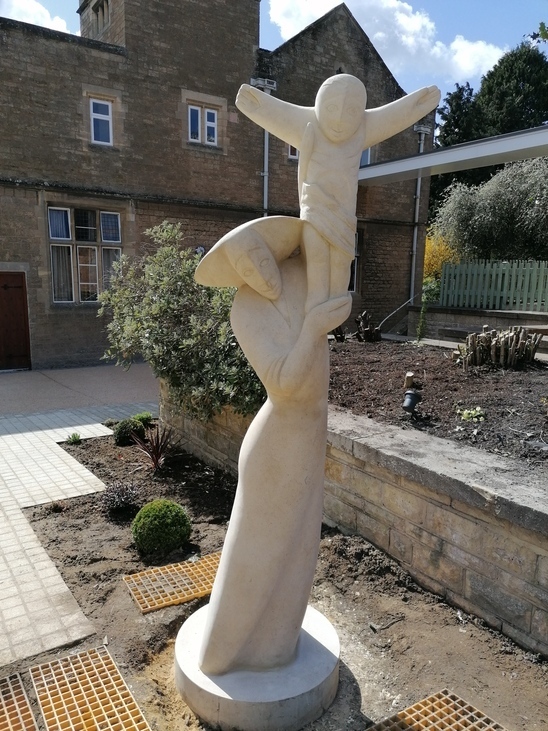
>> “Mother and Child Commission”: In this twelve-minute “making of” video, filmmaker Nick Clarke talks to artist Nicholas Mynheer over the first half of 2020, tracing his progress on the life-size Mother and Child sculpture that was commissioned by the Community of St Mary the Virgin, Wantage, an Anglican convent in Oxfordshire. I was struck by, from the looks of it, the physical demands of the sculpting process—the strength and endurance required to chip away daily at blocks of stone outside in winter, until they yield the shape you desire, then the logistics of attaching the blocks with steel, which weigh nearly a ton collectively, and disassembling, transporting, and reassembling them for installation. I was also interested to hear Mynheer discuss the expressive capabilities of English limestone—how you can convey emotional and sartorial subtleties, for example, through the precise angling of the chisel.

Mynheer, Nicholas_Mother and Child (Wantage)
Nicholas Mynheer (British, 1958–), Mother and Child, 2020–21. English limestone, height 230 cm.

Mother and Child was installed in the outdoor reception area of St Mary’s on April 12, 2021; you can watch a video of the installation here. “In very, apparently, simplified form, there is so much tenderness, energy, and something new,” says Sister Stella, the sister in charge, about the sculpture. “Jesus isn’t going to be held back. Her son’s going to go places.”

To learn more about Nicholas Mynheer, visit his website, https://www.mynheer-art.co.uk/. You can also read the artist profile I wrote on him for Transpositions in 2017.

+++

SONGS:

>> “Corazón Pesebre” (Heart Manger) by Rescate: A follower of the blog introduced me to this Christmas song from Argentina, and I dig it! Released as a single in 2017, it’s about turning our hearts into a manger to receive Christ. Read the Spanish lyrics in the YouTube video description.

The song is by the highly popular Argentinian Christian rock band Rescate, active from 1987 to 2020. Their lead singer and main songwriter, Ulises Eyherabide, died of cancer in July.

>> “Hallelujah, What a Savior!” (Christmas Version), performed by Providence Church, Austin, Texas: In 2012 Austin Stone Worship songwriters Aaron Ivey, Halim Suh, and Matt Carter rewrote the lyrics to Philip P. Bliss’s classic “Hallelujah, What a Savior!” to make them more Christmas-centered and added a new refrain; their version was released that year on A Day of Glory (Songs for Christmas). Here the song is performed by another Austin worship team—Jordan Hurst, Jaleesa McCreary, and Brian Douglas Phillips from Providence Church—for a virtual worship service on November 29, 2020. Instead of using the Austin Stone refrain, they quote Leonard Cohen’s “Hallelujah” between verses.

Icons roundup

As a caveat, I am a Protestant, and while I do have a profound respect and appreciation for icons, my theology of images, including my definition of sacred art, is not the same as the Orthodox Church’s—even though elements of it are influenced by the Orthodox position. All the same, I believe it’s important for Christians of all denominations to understand the significance of icons and what differentiates them from noniconic religious images. Those lines are being blurred a bit by the new schools of iconography coming out of western Ukraine and Poland, which honor tradition even as they push it forward into the contemporary era. Here are a few icon-related videos, articles, and weblinks that I’ve gathered over the past several months.

LECTURES:

>> “The Meaning of Icons” by Fr. Maximos Constas, November 13, 2019, Notre Dame Seminary: Father Maximos Constas, professor of patristics and Orthodox spirituality at Hellenic College Holy Cross Greek Orthodox School of Theology, explains the significance of icons in the Orthodox Church, with special attention to their aesthetic features and theological meaning, which is informed by the church’s Christology and cosmology. He answers such questions as, Why do the figures in icons look bored and unnatural? And, Doesn’t the Second Commandment forbid representations of Christ? He does not address icon veneration or details of the making process.

Constas spends the first fifteen minutes juxtaposing Eastern and Western approaches to religious images, discussing how the Renaissance values of humanism and naturalism came to prevail in the West. The Orthodox, he says, see this as the “secularization” or “carnalization” of sacred art—in its commitment to depicting observable realities, Western art from the Renaissance onward typically lacks overt signs of transcendence.

Constas also discusses the dogmatization of sacred images in the East. Icons are never simply works of art or pedagogical tools, he says. “They were understood to be visual artistic expressions of the church’s theology. And in the same way that church doctrines could not be changed, neither could the image in which the doctrines were embodied.”
Here are some notes I took on the talk, including some transcriptions:

  • An icon can be a panel painting, a fresco, a mosaic, a relief carving, an enameled plaque, a manuscript illumination, etc. “What ultimately defines an icon has nothing to do with artistic medium or style but rather depends on how the image is used and, most importantly, what it is believed to be. And every icon is a means of spiritual encounter and dialogue. It offers us the possibility of such an encounter because it shares in the holiness of the sacred figure whose likeness it bears.”
  • An icon is not a work of art but a work of witness that makes use of art.
  • “Icons are not simply portraits but manifestations of human persons in their new heavenly condition. They are images of the spiritual character of human beings reborn, as it were, in the womb of eternity.”
  • “The icon has the ability to evoke within me the memory of the forgotten depth of my own being. It enables me to see my true face. It orients me toward my destiny in God. And this vision, this remembrance, this knowledge fills me with unspeakable joy and profound consolation.”
  • We not only can but must make images of Christ; “to deny the icon is to deny the reality of the Incarnation.”
  • “All created things are intrinsically good, and all, therefore, have spirit-bearing potentialities. And to this essential goodness and beauty of the material world, the icon bears joyful witness. In the icon, we see matter restored to harmony and so fulfilling its true vocation, which is to reflect and transmit the divine glory. The icon, then, safeguards not only the authenticity of Christ’s physical body, but also the true value of creation in its unfallen state as created by God. Inherent in the very fact of the icon is an optimistic, affirmative vision of the material creation. As spirit-bearing matter, the icon has what we would call eschatological significance—it anticipates the final transfiguration of the cosmos at the last day, when the created world will be delivered from its present bondage to corruption, to quote St. Paul, and will enter into the glorious liberty of the children of God.”
  • Icons as:
    • windows, doors, thresholds into heaven (spiritual places of passage)
    • mirrors, a reflection of their living source
    • tracks or traces
  • 32:40: Portrayal of figures in icons
    • Alteration of the natural symmetries and proportions of the body, including the features of the face (eyes and ears enlarged; nose elongated; mouth small and closed)
    • Full frontality—wholeness, completion, perfection; makes the icon dialogical and relational
    • Serene, controlled facial expression
  • No shadows cast; illumined from within

>> “Rajaton hengellinen kuva: Kärsimyksen ja ylösnousemuksen kuvat” (Boundless Spiritual Image: Images of Suffering and Resurrection) by Ari Luomajoki, March 26, 2021, Kuopio Cathedral, Kuopio, Finland: I don’t speak Finnish, but I share this seventy-minute video for the visuals (and of course for any Finnish speakers!) and to show how contemporary icons are spreading west. In August 2016 under the leadership of Pastor Ari Luomajoki, the Lutheran Monastic Community of Enonkoski in Ihamaniemi, Finland, organized its first international icon workshop (read more here, and follow @LutheranIcon on Facebook), which attracted iconographers from Poland and Ukraine, as well as a few domestic artists. It was reprised in 2017 (I mentioned this second workshop here). Icons that came out of these workshops have been exhibited several times in Finland, and have facilitated relationships that have led to new exhibitions—such as Kärsimyksen ja ylösnousemuksen kuvat (Images of Suffering and Resurrection) at Kuopio Cathedral, which ran March 26–April 11, 2021. Follow the boldface link to see a taping of the opening, which includes opening comments, a tour, and a lecture.  

Movchan, Danylo_Descent from the Cross
Danylo Movchan (Ukrainian, 1979–), Descent from the Cross, 2021. Watercolor on paper, 33 × 38 cm.

Mindewicz, Basia_Entombment of Christ
Basia Mindewicz (Polish, 1978–), Lamentation, 2016. Acrylic on wood, 26 × 20 cm.

In the first sixteen minutes of the video, Pastor Olli Viitaniemi, one of the main organizers of the exhibition (with Pastor Salla Tyrväinen), shows screen captures from the website he built connected to the exhibition, https://sielunkuvat.net/. At around 16:24 he gives a tour of the exhibition around the church sanctuary.

At 32:48 Luomajoki—who is a Lutheran pastor in Kouvola, Finland, and has a master’s degree in art history—starts his half-hour lecture. He introduces Międzynarodowe Warsztaty Ikonopisów w Nowicy (International Iconography Workshop in Nowica) in Poland and Lviv National Academy of Arts and the Iconart gallery in Ukraine, two centers of contemporary Eastern iconography that inspired the icons project at the Enonkoski monastery in Finland. At 47:41 Luomajoki does side-by-side image comparisons to show similarities and differences across time. At 50:41 he discusses the use of images in early Lutheranism. He goes on to show some examples of religious art in Finland in the past century (including a really compelling Crucifixion painting by Helene Schjerfbeck and crucifix by Paavo Halonen!). He closes by spotlighting Hidden Life in Nazareth by Ivanka Demchuk and a Nativity by Arsen Bereza, participants in the workshop.

Luomajoki is a wonderful photographer of art. Follow him on Instagram @ari.luomajoki.

+++

INTERVIEW with contemporary iconographer Khrystyna Kvyk, by Kevin Antlitz: OK, Patheos blog posts are painful to read because of all the obtrusive ads, which is why I rarely link to them. But I’m making an exception for this one, where American Anglican pastor Kevin Antlitz interviews Ukrainian Greek Catholic iconographer Khrystyna Kvyk, who earned a master’s degree in sacral art in 2020. She discusses her process of painting icons, what makes an icon an icon, timelessness and transfiguration, the relationship between tradition and innovation, the idea of divine light as reflected in two of her icons, and more. I really love her work and was delighted to hear some of her own words about it.

Kvyk, Krystyna_I Am the Light of the World
Khrystyna Kvyk (Ukrainian, 1994–), I Am the Light of the World, 2021. Acrylic on gessoed wood, diameter 35 cm.

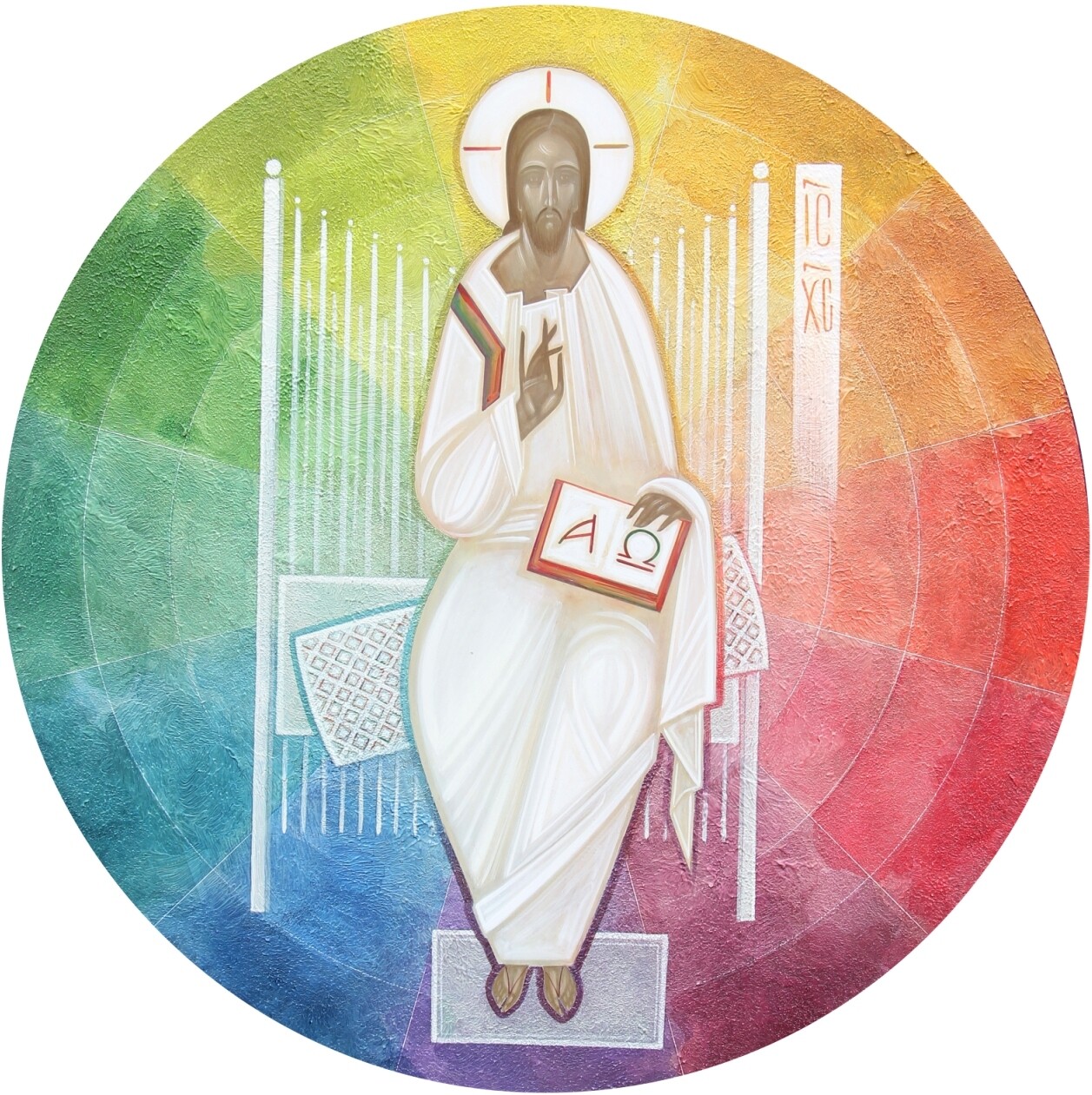
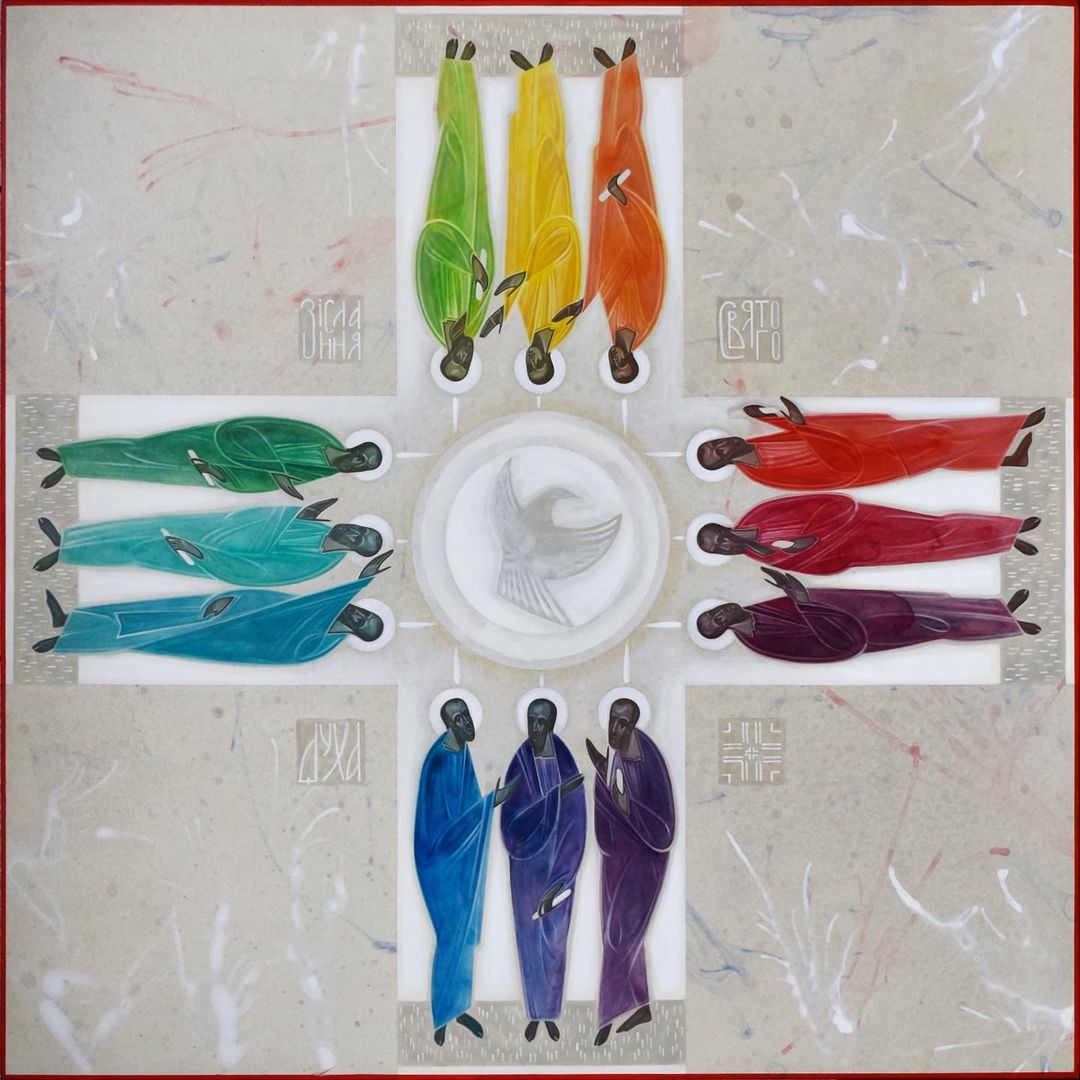
Kvyk, Khrystyna_Pentecost
Khrystyna Kvyk (Ukrainian, 1994–), Pentecost, 2021. Acrylic on gessoed wood, 45 × 45 cm.

This is the final installment of a three-part series by Antlitz. Part 1 answers, What Are Icons?, and part 2 is about “Praying Through Icons.”

+++

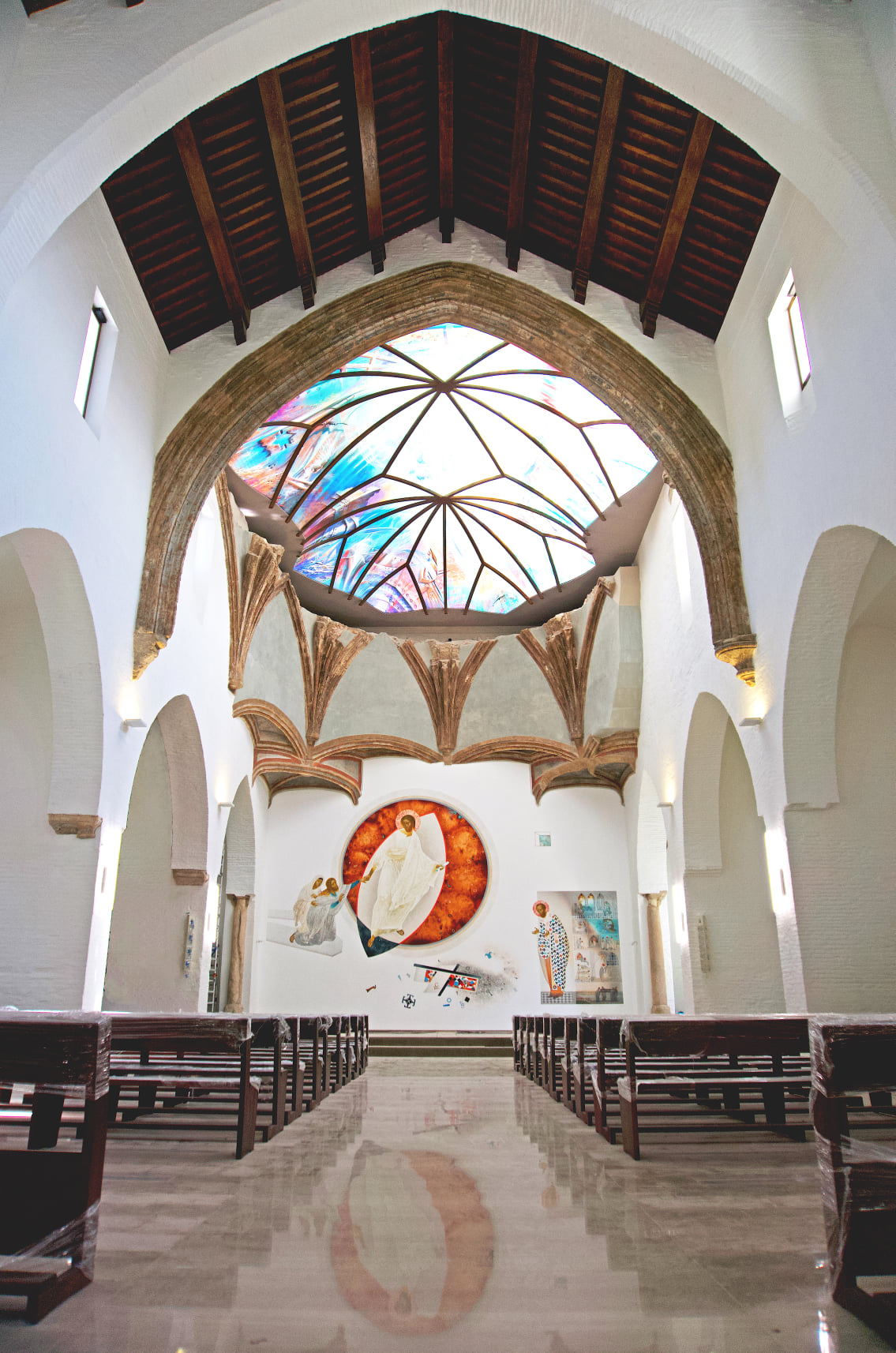
NEW CHURCH COMMISSION: Wall paintings at Iglesia de San Nicolás by Ivanka Demchuk and Arsen Bereza: Ukrainian artists Ivanka Demchuk and Arsen Bereza—a married couple!—have completed a monumental painting on the east wall of the Catholic church of Saint Nicholas in Granada. It was deeply influenced by Byzantine iconography, in which they’ve both been trained, but also contains some modern abstract and geometric elements.

The church building is from the sixteenth century and recently underwent extensive renovations, finally reopening to the public in April, which is when Demchuk and Bereza’s mural was unveiled. It portrays the Anastasis, the Eastern Orthodox image of Christ’s resurrection, which shows him breaking down the doors of hell to release its captives. In the video (which is in Ukrainian with Spanish subtitles), Demchuk describes how they painted two mandorlas behind him: the almond-shaped one symbolizing his divine light, and a round one symbolizing the cosmos.

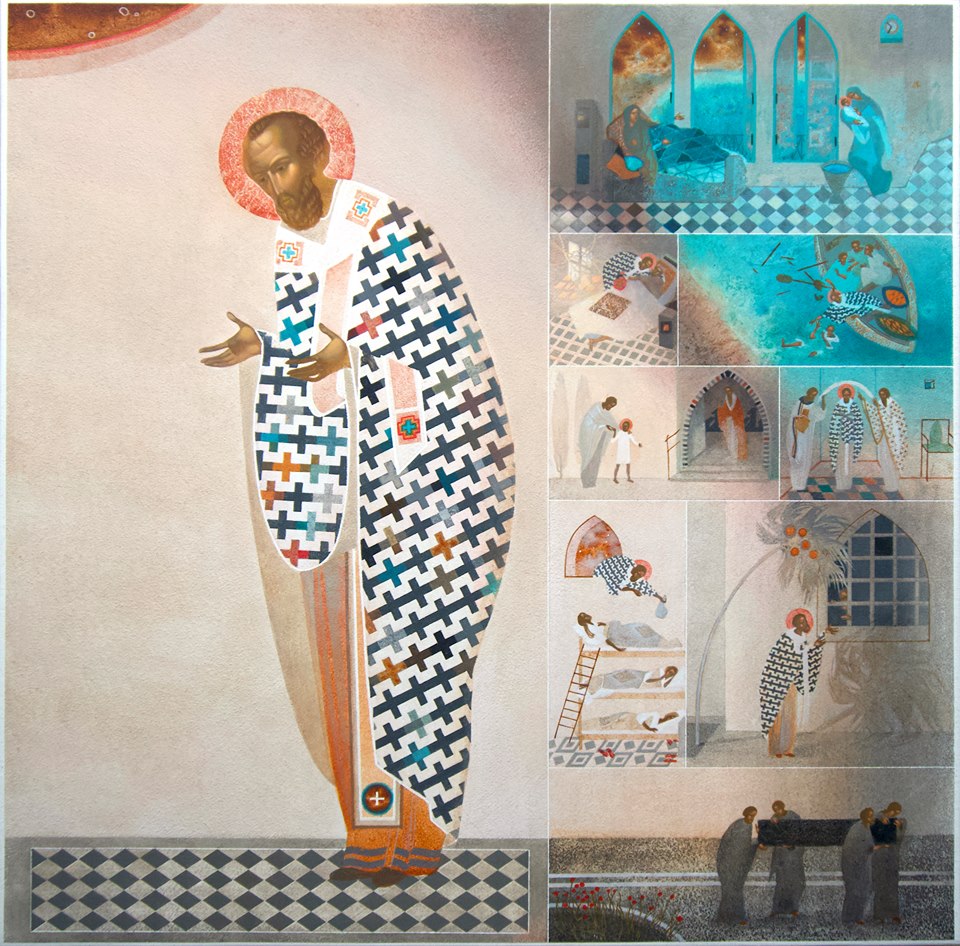
Appearing alongside this focal point is a portrait of the church’s namesake, Saint Nicholas, with eight scenes from his life—including my favorite, where he tosses three bags of gold through the window of an impoverished family’s home. (The legend of Santa Claus—Claus being a shortened form of “Nicholas”—evolved from this story of anonymous gift giving.)

Demchuk, Ivanka_Anastasis (in situ)
Iglesia de San Nicolás, Granada, Spain, 2022, with east end mural by Ivanka Demchuk and Arsen Bereza

Demchuk, Ivanka_Resurrection
Ivanka Demchuk (Ukrainian, 1990–), Resurrection, 2018. Mixed media on wood. Design for the Church of St. Nicholas, Granada, Spain.

Demchuk, Ivanka_St. Nicholas with Scenes from His Life
Ivanka Demchuk (Ukrainian, 1990–), Saint Nicholas with Scenes from His Life, 2018. Mixed media on wood. Design for the Church of St. Nicholas, Granada, Spain.

See more photos of the project on Demchuk’s Facebook page.

+++

BLOG POST: “The Meaning of Melchizedek in Icons” by David Coomler: Though he’s not religious, David Coomler is an expert on Christian icons and often consults on them. On his blog he unpacks the iconography of standard types but also more unusual ones, like You Are a Priest Forever After the Order of Melchizedek, inspired by Hebrews 7. This rare type is meant to show that Jesus is both the offering and the offerer. The variation pictured below shows, I think, three representations of Christ: as crucified seraph (still quite puzzling to me, but Coomler points out that the Greek of Isaiah 9:6 refers to the Messiah as the “Messenger of Great Counsel”), Holy Wisdom (aka Sophia), and high priest—hence the man in ecclesiastical garb in the back. Wild!

Icon with Jesus High Priest

Lent, Day 4

Abba Macarius was asked, ‘How should one pray?’ The old man said, ‘There is no need at all to make long discourses; it is enough to stretch out one’s hands and say, “Lord, as you will, and as you know, have mercy.” And if the conflict grows fiercer say, “Lord, help!” He knows very well what we need and he shews us his mercy.

—from the Apophthegmata Patrum (Sayings of the Desert Fathers), trans. Benedicta Ward

LOOK: The Parable of the Mustard Seed by Roman Zilinko

Zilinko, Roman_The Parable of the Mustard Seed
Roman Zilinko (Ukrainian, 1979–), The Parable of the Mustard Seed, 2015. Acrylic and gold leaf on gessoed wood.

LISTEN: “The Jesus Prayer” in Ukrainian [HT: Global Christian Worship]

Ісусе, Ісусе, сину Божий, помилуй, помилуй нас.

Transliteration: Isuse, Isuse, Synu Bozhyy, pomyluy, pomyluy nas.

English translation: Jesus, Jesus, Son of God, have mercy, have mercy on us.

I don’t know the name of this vocal ensemble, when the recording was made, or the origin of the melody they sing. (Can anyone help me out there?)

The text, though, is a famous one, used regularly in the Eastern Orthodox tradition and known as the Jesus Prayer, or the Prayer of the Heart. It originated with the early Christian monks of the Egyptian desert around the fifth century, and was first written down in Greek. Another variation is “Lord Jesus Christ, Son of God, have mercy on me, a sinner.”

An invocation of Christ’s name and presence, the Jesus Prayer is meant to be recited in repetition as a form of meditative prayer. Some Christians use it in conjunction with a breath prayer, breathing in as they say internally, “Jesus, Son of God,” and breathing out on “have mercy.”

It’s most often prayed in the first-person singular—“have mercy on me”—and used in private devotions, but in this corporate chant on the video, it’s prayed in the first-person plural, “us.” In light of Russia’s recent invasion of Ukraine and the war being fought there, I hear in these Ukrainian women’s voices a lament for their country.

Lord, have mercy. Spare the Ukrainian people. Stop the violence and destruction. Protect, provide. Heal the wounded and the traumatized, and comfort the grieving. Thwart the evildoers; turn their hearts to you in repentance. Grant wisdom to the leaders working for peace. In short: “Lord, help!”

The folk icon featured above is by contemporary Ukrainian artist, art historian, and curator Roman Zilinko, who works at the Andrey Sheptytsky National Museum in Lviv. “My artworks continue the tradition of the Ukrainian icon painting of the Carpathian region, which flourished in the 16th and 19th centuries,” Zilinko says. Its distinctive features are “naive and flat painting, but rich in colors and ornaments.” To view more of Zilinko’s icons, click here.

The above icon shows a religious procession, with two people carrying khorugvs (religious banners)—one of the Virgin Mary and Child, one of Christ Pantocrator. Foregrounded in the center is Christ, crucified on a tree that recalls the tree of life from Revelation 22, whose leaves are for the healing of nations. The suffering Christ goes before the people and is right in their midst. He is their companion, their deliverer, their wounded healer, their life.

Zilinko has named the icon The Parable of the Mustard Seed, after Jesus’s saying about how the kingdom of heaven starts out small but then grows into something enormous and lush (Matt. 13:31–32). Christ has indeed grown his church mightily in Ukraine; Christianity has been the primary religion there since the tenth century. Zilinko portrays the Christians of Ukraine as a sea of people who stand behind their Savior with hands clasped in prayer and faces radiant with hope.

Let us join them in intercession for a swift end to the war and lasting peace in the region, and for the ability of refugees to return home.

If you find yourself at a loss for words, I suggest praying the Jesus Prayer from the video.

Roundup: Empty chair, how to read a Last Judgment icon, and more

ARTWAY VISUAL MEDITATIONS:

ArtWay.eu is an online hub of resources related to faith and the visual arts. Every Sunday a new “visual meditation” is released on a selected artwork, written by one of a diverse range of volunteers from across the globe. (I contributed last week’s, on Eduardo Kingman, and another of mine, on a Flight to Egypt painting by Pranas Domsaitis, will be forthcoming.) Sign up here to receive the free weekly meditation in your inbox. Here are two examples from the past year, with Advent vibes, that I’ve found particularly meaningful.

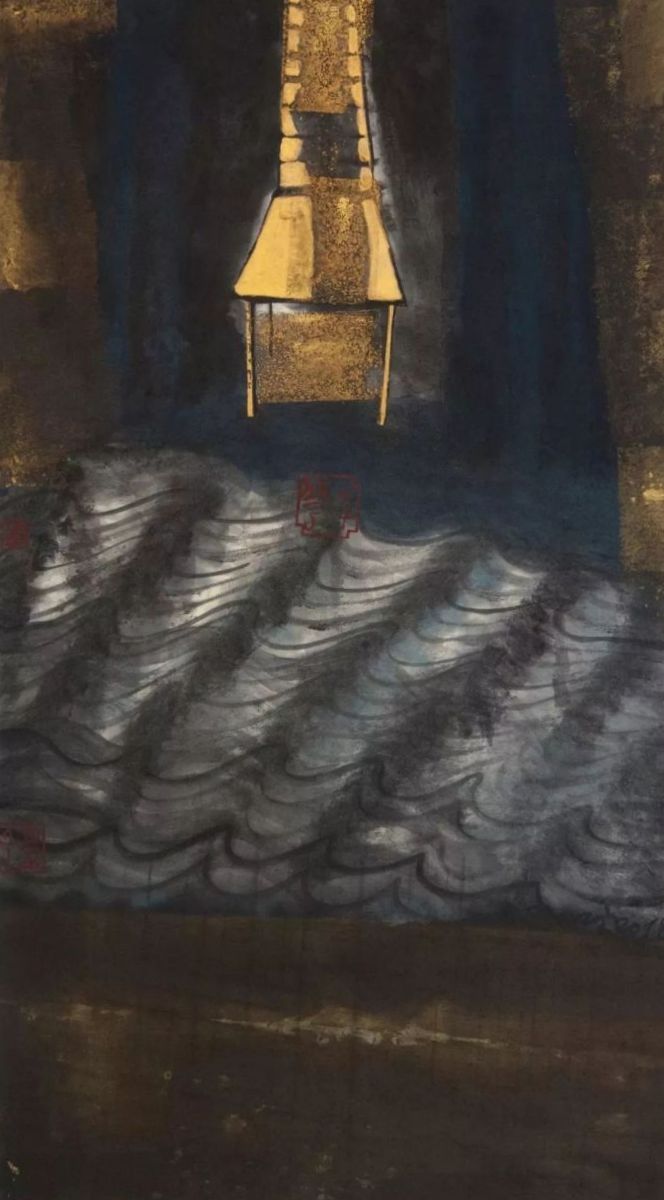
>> “The Empty Chair in a Season of Waiting” by Rachel Hostetter Smith: Last year, in the midst of the COVID-19 pandemic, art history professor Rachel Hostetter Smith wrote about a series of Chinese ink wash paintings by Daozi. They’re a tribute to his friend, the Chinese human rights activist Liu Xiabo (1955–2017), who was unable to accept his 2010 Nobel Peace Prize in person because he was in prison, so he was represented at the ceremony by an empty chair. Smith brings this image of an empty chair into conversation with all the uncertainty and absence in this current time of pandemic; the Jewish Passover Seder liturgy and its setting a place at the table for the prophet Elijah; Franciscan priest Richard Rohr on the liminal space between the old world and the world to come; and John the Revelator’s eschatological vision of a throne descending from heaven (Rev. 21).

Daozi_The Empty Chair on the Sea Ridge
Daozi (aka Wang Min) (Chinese, 1956–), The Empty Chair on the Sea Ridge, 2018. Ink and color on paper, 97 × 54 cm.

This and fifty-four other contemporary artworks are part of the international traveling exhibition Matter + Spirit: A Chinese/American Exhibition, which Smith curated (click the link to explore the art—it’s very compelling!). The exhibition is a product of a gathering of North American and Chinese art professors in June 2018 in Beijing, Nanjing, and Shanghai, sponsored by the Nagel Institute for the Study of World Christianity.

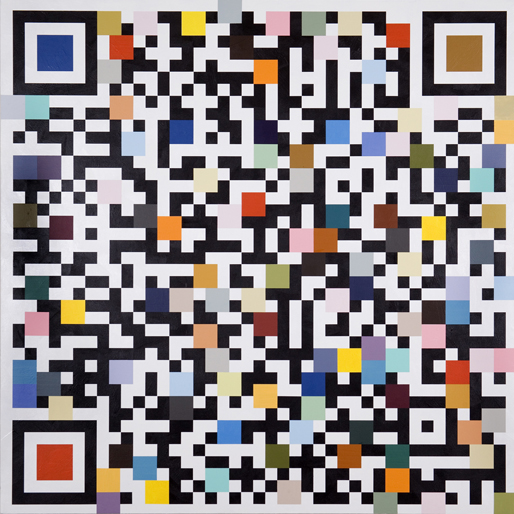
>> “Waiting for the Lord” by Mary McCampbell: Mary McCampbell [previously] writes about a painting by Douglas Coupland, best known for his work as a novelist and for popularizing the term Generation X. “In I wait and I wait and I wait for God to appear (2011), the artist has painted a colorful QR (Quick Response) code, defamiliarizing a familiar symbol of daily life. . . . Like most QR codes, if a viewer holds up her camera to the graphic image, a message is decoded via smart phone. A contrast to the hard geometric edges of the painting, the message that magically appears is soft and human: ‘I wait and I wait and I wait for God to appear.’ . . . The painting reflects a longing for the real God to manifest himself, no longer merely an idea, a doctrine, a rhetorical position. Where is God in the intricate, detailed, yet seemingly random pattern of life? How can we discern WHO He is? . . . This atypical reminder to ‘Wait for the Lord; be strong and take heart and wait for the Lord’ (Psalm 27:14) discloses the curious, humble faith of a non-believer, one hoping and waiting for eyes to see the ‘appearance’ of the Lord.”

Coupland, Douglas_Waiting for the Lord
Douglas Coupland (German, 1961–), I wait and I wait and I wait for God to appear, 2011. Acrylic and latex on canvas, 182.9 × 182.9 cm. Queen’s University, Kingston, Ontario, Canada.

+++

LECTURE: “Understanding the Last Judgment” by Jonathan Pageau: “The traditional icon of the Last Judgment is a very complex image which is both the synthesis of Christian typology as well as an image of the eschatological finality of all things.” In this talk given at St. John Chrysostom Byzantine Catholic Church in Seattle, Jonathan Pageau breaks down Last Judgment iconography, explaining how to read it scene by scene.

Elements include:

  • The Deësis, a representation of Christ enthroned between Mary and John the Baptist
  • The hetoimasia, or prepared throne, which awaits the return of Christ
  • The psychostasis, or weighing of souls
  • The ladder of divine ascent, representing the struggle to reach illumination
  • Paradise, with the “good thief,” Abraham’s bosom, and the Mother of God
  • The last trump and the resurrection of the dead, with beasts regurgitating their human prey
  • The river of fire, per Daniel 7:10, with the damned being swallowed by the mouth of Hades

Why am I sharing this now? Because Advent is eschatological and future-oriented in nature, and, though it tends to be underemphasized in our era, judgment is a major theme—which Fleming Rutledge does a great job unpacking in her book Advent: The Once and Future Coming of Jesus Christ.

+++

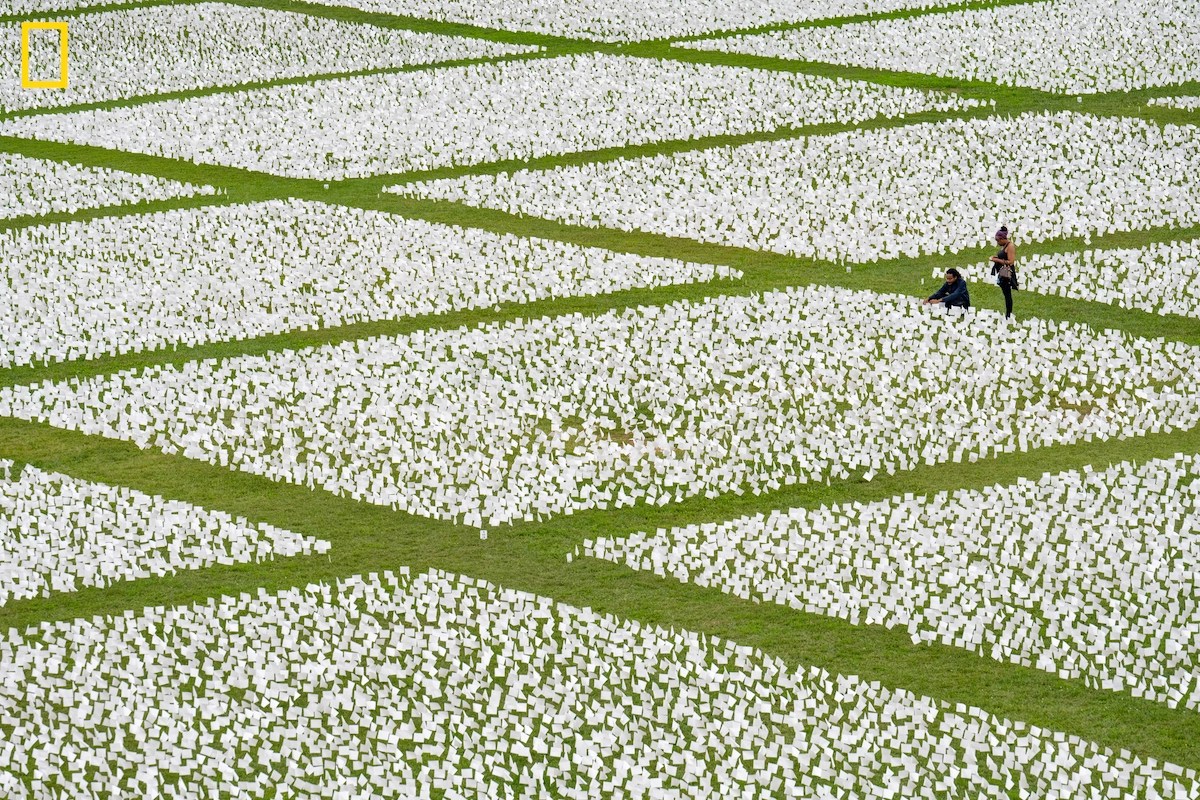
COVID MEMORIAL: From September 17 to October 3, 2021, the National Mall in Washington, DC, was blanketed with some 670,000 white flags, each one representing an American life lost to COVID-19. Titled In America: Remember, the installation was conceived by artist Suzanne Brennan Firstenberg as a way to visualize the magnitude of loss the country has suffered over the past two years in relation to the pandemic, and to invite mourning. Visitors were invited to personalize flags for someone they lost.

Stephen Wilkes’s photos of the memorial undid me. The enormity of suffering represented is difficult to fathom. Every single flag is a devastation. And since the installation was put up this fall, there have been another 100,000-plus COVID deaths in the US, while the global death toll has surpassed 5.2 million.

In America: Remember (detail)
Photo: Stephen Wilkes / National Geographic

In America: Remember (detail)
Photo: Stephen Wilkes / National Geographic

In America: Remember (photo by Stephen Wilkes)
In America: Remember, September 17–October 3, 2021, an installation of 670,000+ white flags on the National Mall, conceived by Suzanne Brennan Firstenberg. Photo: Stephen Wilkes / National Geographic.

+++

ART COMPETITION: “Macierzyństwo Maryi” (The Motherhood of Mary): The results are in for Poland’s first annual Ogólnopolski Konkurs Sztuki Sakralnej (National Competition of Sacred Art, or OKSSa for short), organized by the Fundacji Maria i Marta (Mary and Martha Foundation). The theme was Mary’s motherhood.

First place, with a prize of 15,000 zł (about USD $3,600), went to Błażej Guza for Macierzyństwo Maryi, which shows Mary drawing a hopscotch board on the pavement, its shape portending her boy’s fate. Jesus is not visible in frame, save for his shadow, which reveals simply an innocent child ready to play.

This piece and thirty-four others from among the many entries were exhibited at Concordia Design Wrocław November 25–30, 2021, and this month a few of them will be shown at the National Museum in Wrocław. You can view the top three winners as well as four honorable mentions at the boldface link above, or on the foundation’s Facebook page. And here’s an exhibition view.

The Fundacji Maria i Marta aims to promote the development of contemporary Christian art in Poland by organizing competitions, exhibitions, and workshops and by providing artistic consultation for churches.

Guza, Blazej_The Motherhood of Mary
Błażej Guza, Macierzyństwo Maryi (The Motherhood of Mary), 2021. Acrylic and chalk, 90 × 60 cm.

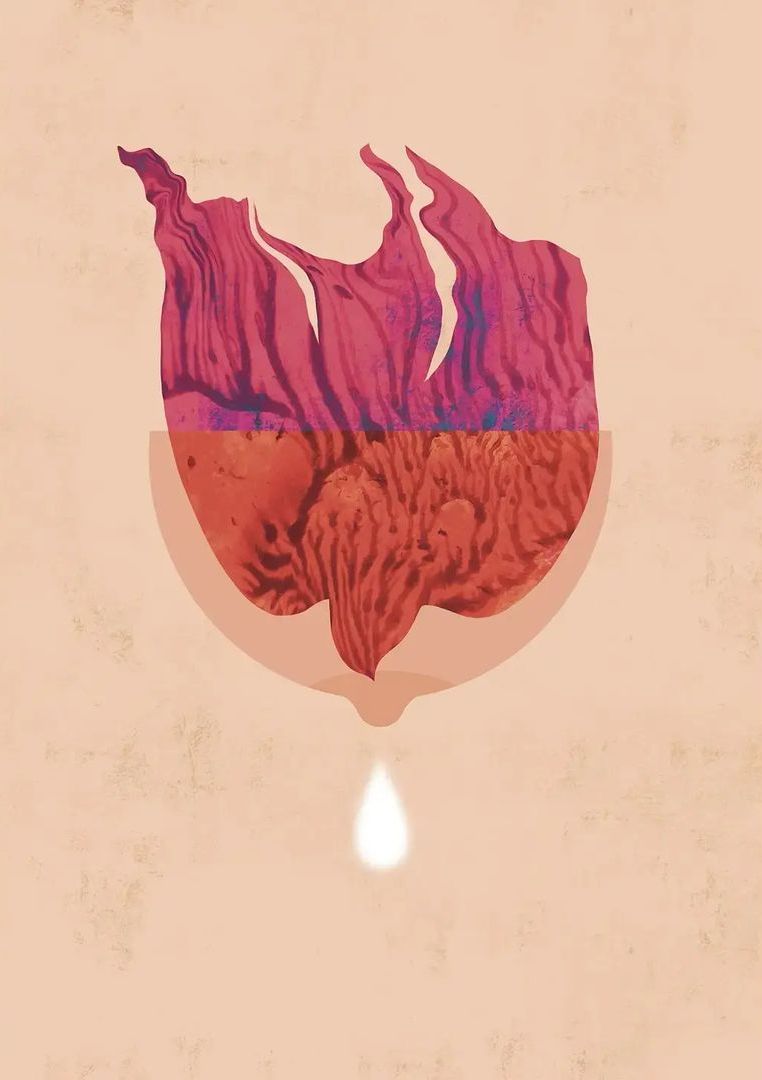
Kowalewska-Tylka, Beata_Fullness of Spirit
Beata Kowalewska-Tylka, Pełnia ducha (Fullness of Spirit), 2021. Digital painting, 70 × 50 cm. The OKSSa jury commented on how this piece shows “the interpenetration of the spiritual and human dimensions of Mary’s motherhood,” the shape of the fiery red cloth evoking the Holy Spirit as dove, and the breast that gives milk signifying Mary’s physical nourishment of her son from her own body.

Art highlights from CIVA conference, part 1

Last month I attended the biennial conference of Christians in the Visual Arts (CIVA) at Bethel University in St. Paul, Minnesota. Celebrating forty years, CIVA is a membership organization made up primarily of studio artists but also other arts professionals—curators, gallerists, administrators, educators, critics, art historians—as well as collectors, theologians, and church leaders. As a writer about the arts working independently out of my home in Maryland, sometimes I feel disconnected from artists themselves, so five years ago I joined CIVA to plug into and invest in this community of believer artists. The large conference that CIVA organizes every other year, each time in a different US city, is an opportunity to meet and talk with artists, to see what they’re working on, and to worship and pray with them. It’s also a weekend chock-full of amazing talks, panel discussions, breakout sessions, exhibitions, and other activities.

In a series of blog posts, I’d like to share some of the art I encountered at the CIVA conference. All photos in this post are by me, Victoria Emily Jones.

+++

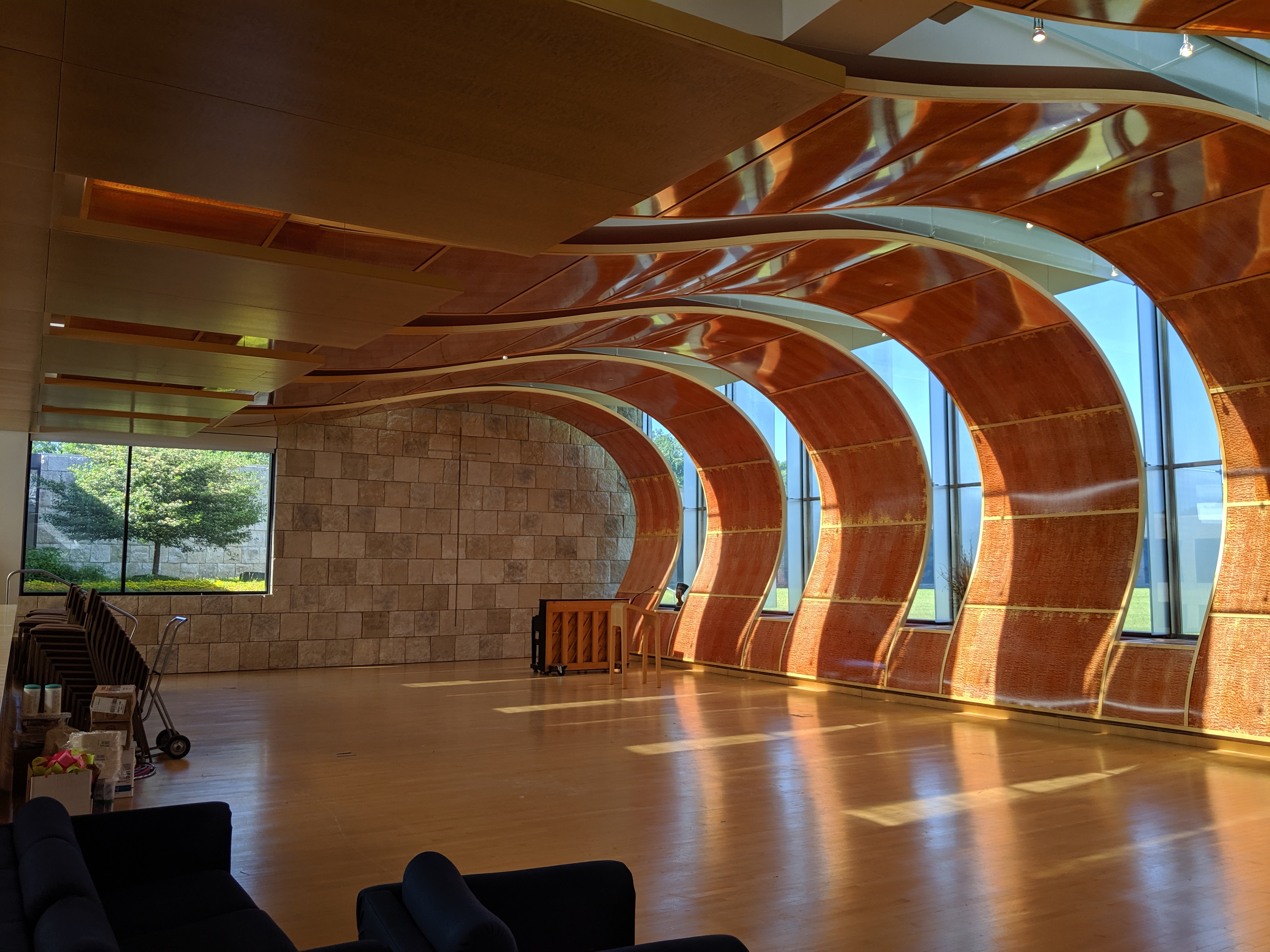
I arrived a day early to participate in a CIVA-sponsored Sacred Spaces tour of the Twin Cities with Kenneth Steinbach, a sculptor and a professor of art at Bethel. The first stop was Bigelow Chapel, designed by Hammel Green & Abrahamson at the commission of United Theological Seminary in 2004. As Ken warned us in advance, the chapel was recently sold by the seminary to a charter school, who will not be using it as a worship space and will be removing its one overt Christian symbol (the inset cross) as well as renaming it. Because of the changeover, the chapel was in a bit of disarray when we visited, being used for the time being as an ad hoc storage space, but I was grateful for the chance to see this acclaimed work of contemporary religious architecture before it fully succumbs to its fate as a secular meeting room.

I first learned about Bigelow Chapel through the book Visual Theology: Forming and Transforming the Community through the Arts (reviewed here, with annotated chapter list). Ken read us the vision statement of this ecumenical Protestant institution—“a generous and welcome seminary where all—trailblazers and traditionalists, questioners and yearning spirits—explore the boundless possibilities of a loving and beloved community”—and we discussed how the design reflects that vision. Symmetry and linearity, for example, can be associated with authority, rigidity, so this chapel is notable for its asymmetry, an uncommon feature in church design, as well as an open floor plan that accommodates different traditions and styles of worship. It’s also curvy, feminine, womblike; a series of translucent maple wood panels sweeps up the wall and over the ceiling, casting the sun’s warm glow inside the space. Some people on the tour expressed a sense of being enveloped in God’s love.

Bigelow Chapel
Bigelow Chapel, New Brighton, Minnesota

Bigelow Chapel

Another mentioned how the cross is far too subtle, almost unnoticeable, and seems to recede; it’s certainly not a focal point as it typically is in other Christian worship spaces. Ken pointed out that the cross was intentionally positioned next to a clear window that looks out into a central garden, suggesting the idea of deep incarnation; nature is itself part of the space, and Christ’s redemption is for all of creation. One person noted how the large green shrub outside, when illuminated by the sun, is reminiscent of the burning bush of Exodus and therefore calls us into an awareness of how God might be speaking to us.

Bigelow Chapel cross

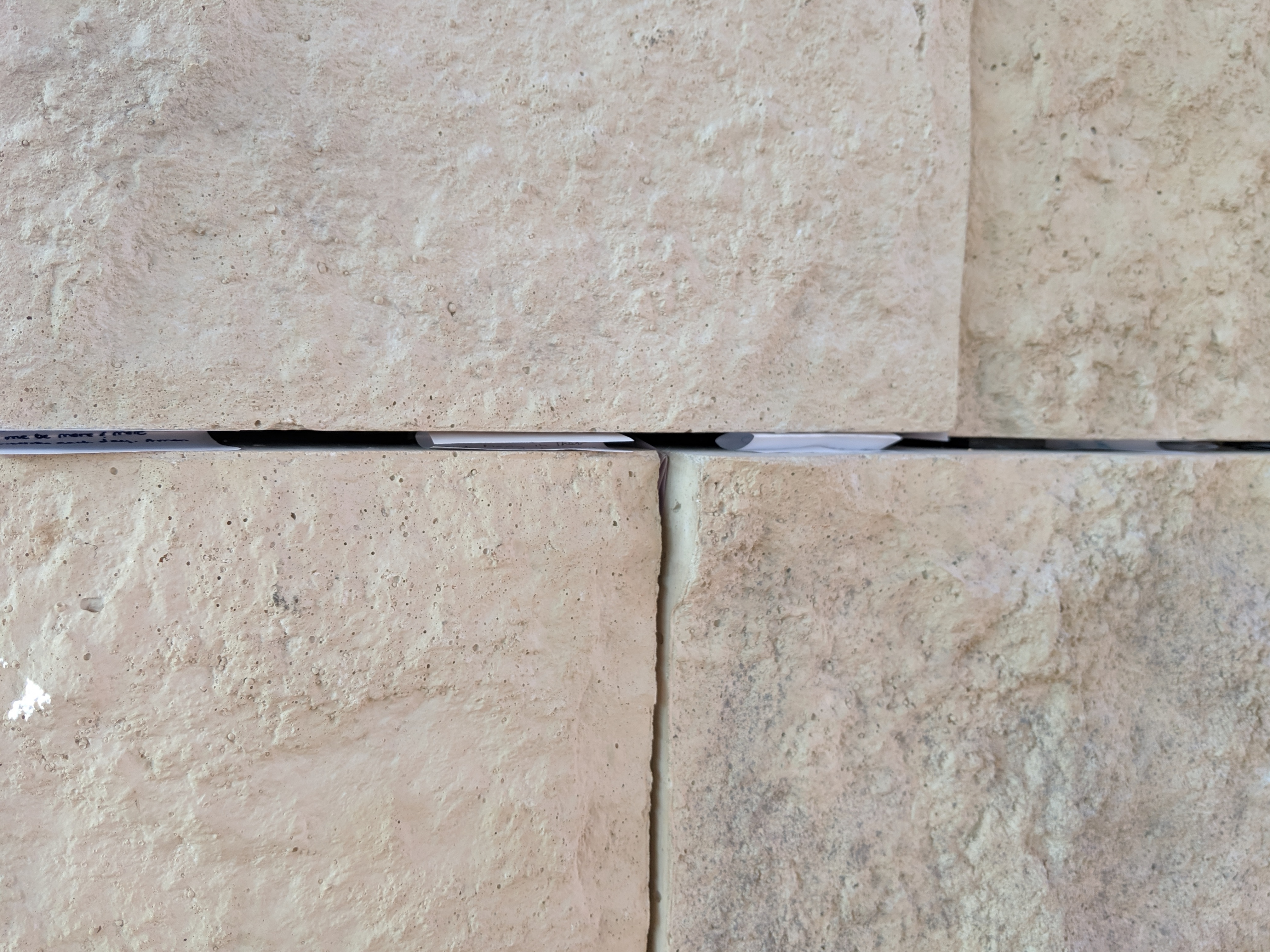
Ken also told us that student worshippers used to stick written prayers between the chapel’s wall-stones, much like at Jerusalem’s Wailing Wall. Several such pieces of paper were still there, wedged in the cavities of the masonry.

Bigelow Chapel (prayers)

Bigelow Chapel (prayers)

It was sad to me to see this building losing its original function as a Christian worship space. The impetus for the sale was the seminary’s relocation from New Brighton, a suburb, into the city of St. Paul, where it believes it can be of better service to the surrounding community. View more photos of Bigelow Chapel at https://www.kirkegaard.com/827.

+++

Next our tour group visited the Minneapolis Sculpture Garden, where we spent time inside a James Turrell Skyspace titled Sky Pesher, 2005, a subterranean concrete chamber with a square aperture in the ceiling that frames the sky. (The word pesher is Hebrew for “interpretation.”) Turrell calls himself a sculptor of light; light, he says, is his medium. His work is influenced by his Quaker faith, especially the doctrine of the Inner Light. Quaker worship gatherings consist primarily of silence, a time of corporately waiting on the Light, which is God, who dwells within us as wisdom and guide. I did find the environment Turrell built especially conducive to stillness and listening. Quakers say that silence is not a void, it’s full, and I found that to be true as I opened myself to encountering God in that space.

Turrell, James_Sky Pesher, 2005
James Turrell (American, 1943–), Sky Pesher, 2005 (detail), 2005. Pigmented cast concrete, concrete, paint, cold-cathode lighting, computerized dimming device. Minneapolis Sculpture Garden, Walker Art Center, Minneapolis, Minnesota.

Turrell, James_Sky Pesher, 2005

I actually really cherished sitting there in silence with the group, ridding myself of distractions as together we simply turned our gaze to the wonderful gradients of blue stretched out above us. Out of interest in and respect for the artist’s Quaker spirituality, I took the opportunity to commune with God in “wordless thought”; instead of me talking to God or about God, I let God talk to me.

I expressed my particular enjoyment of the experience afterward to a colleague, who was surprised that, because of my fascination with biblical imagery and its possibilities in worship and devotion, I should be so moved by a sacred space that lacks any imagery at all, other than open, undefined sky. It surprised me somewhat too! Continue reading “Art highlights from CIVA conference, part 1”

Roundup: Norman Rockwell updated; snow-crystal photography; Good Samaritan icon; and more

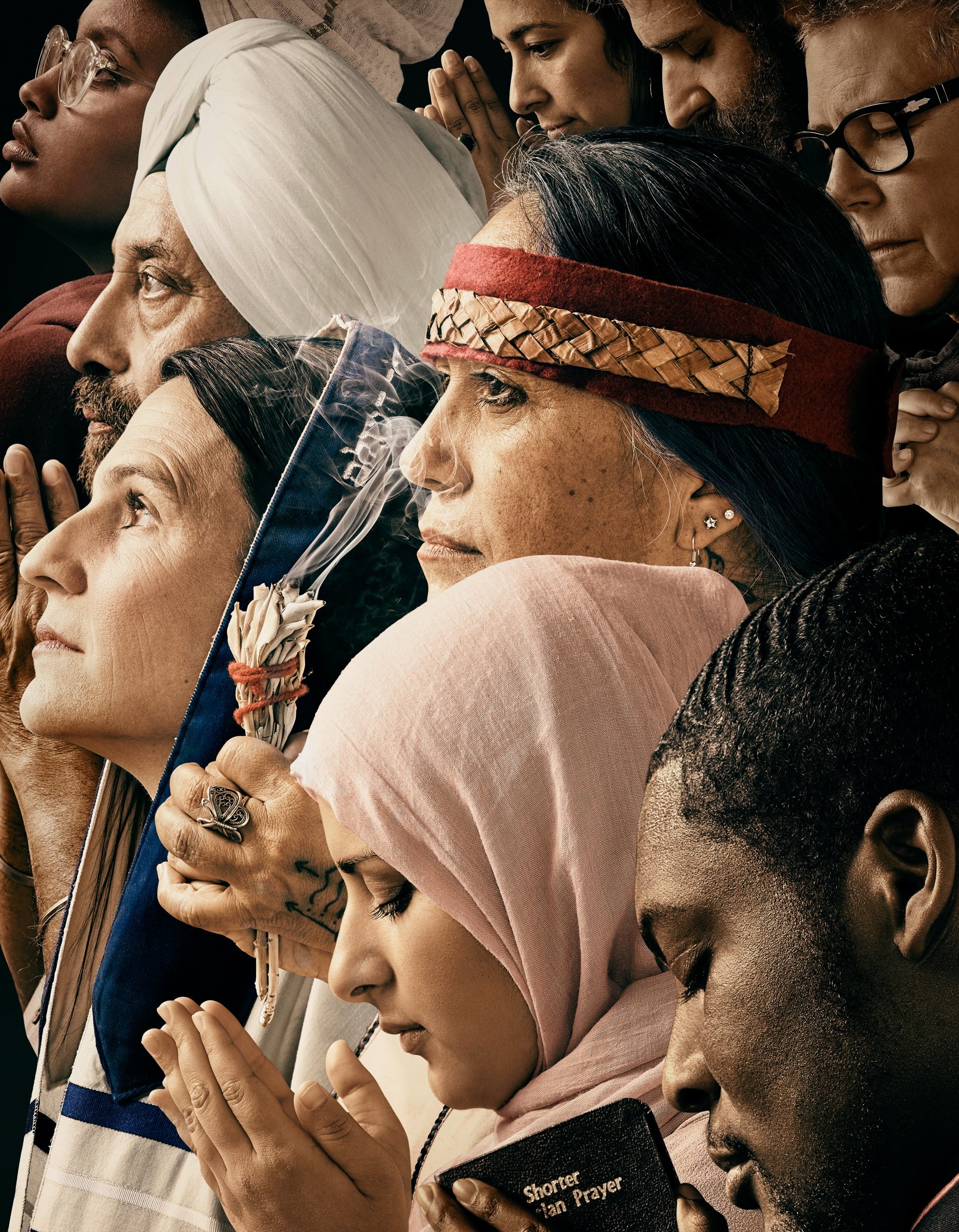
Freedom of Worship by Hank Willis Thomas and Emily Shur
Hank Willis Thomas (American, 1976–) and Emily Shur (American), Freedom of Worship, 2018. While Norman Rockwell’s illustration of the same name contains specific representations of Protestantism, Catholicism, and Judaism, this reinterpretation goes even further to include Islam, Native American spirituality, and Sikhism.

NEW PHOTOGRAPH SERIES: “The Four Freedoms” by Hank Willis Thomas and Emily Shur: In his 1941 State of the Union address, President Franklin D. Roosevelt insisted that people in all nations share Americans’ entitlement to four basic freedoms: freedom of speech, freedom of worship, freedom from want, and freedom from fear. This famous speech became the basis for Norman Rockwell’s set of four illustrations, originally published in the Saturday Evening Post in 1943, that have become some of history’s most iconic representations of the American idea.

Artist Hank Willis Thomas and photographer Emily Shur decided to reimagine these scenes with a cast that’s more representative of American diversity. One of the eighty-two final images they created is published on the cover of the current issue of Time magazine. It and others will form the backbone of a national billboard campaign by the nonpartisan organization For Freedoms to encourage civic engagement. “We believe that if artists’ voices replace advertising across the country, public discourse will become more nuanced,” their website says.
+++

IN CONCERT: Eric and I went to see brother-sister folk duo The Oh Hellos (Tyler Heath and Maggie Heath Chance) in Baltimore earlier this month and had a great time. My favorite song from their set list was “Soldier, Poet, King,” which describes Jesus’s coming in all three roles—perfectly appropriate for the upcoming Advent season! Jesus, the Word of God, comes to tear down Satan’s kingdom and establish his just rule in our lives and world (1 John 3:8bRev. 19:11–16). The final verse affirms Jesus’s status as Messiah, the waited-for “Anointed One,” and celebrates his power marked by humility, even unto death. The blood he wears into battle is his own.

There will come a soldier
Who carries a mighty sword
He will tear your city down
O lei o lai o lord

There will come a poet
Whose weapon is his word
He will slay you with his tongue
O lei o lai o lord

There will come a ruler
Whose brow is laid in thorn
Smeared with oil like David’s boy
O lei o lai o lord

The Oh Hellos’ nationwide tour continues through the end of the year, so visit their website to see if they’ll be stopping near you.

+++

NEW ALBUM: Crumbs by Liturgical Folk: Liturgical Folk (previously here and here) released its third album this month, which “build[s] on the themes of eucharist and the mission of the church to bring peace and reconciliation to the world.” The title comes from the track “Prayer of Humble Access,” a verbatim setting from the “Holy Eucharist Rite I” in the Book of Common Prayer that alludes to the story of the Syrophoenician woman.


Most of the song texts on the album come from that traditional Anglican prayer-book and were set to music by Ryan Flanigan, though a few texts are contemporary. “Lord, Lord, Lord,” for example, was written in the wake of the August 9, 2014, shooting of Michael Brown in Ferguson, Missouri, and amid the subsequent escalation of racial tensions in the country. “As a privileged, white, middle class, American man,” Flanigan wrote,

I felt for the first time in my life the systemic injustice against black males in our country. What I found most troubling, besides death itself, was the response of some white, privileged people to the shooting, particularly the response of some Christians on social media and the News. When we should have been mourning with those who mourn, confessing our fears and sins, and seeking reconciliation, many of us turned a blind eye or, worse, assumed a posture of defensiveness and denial. I wrote this song as a corporate confession of sin to God and our fellow men, a plea for God to forgive us and restore our broken trust with him and with those we’ve failed to love.

+++

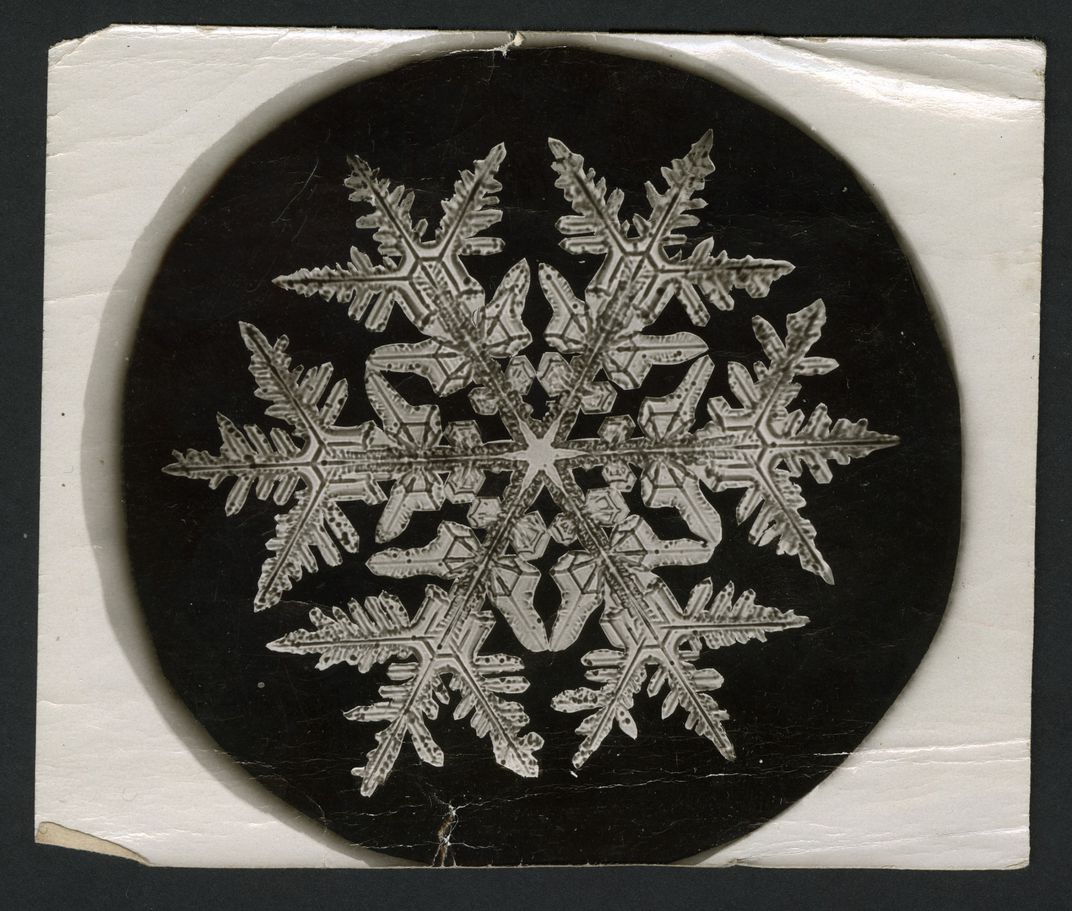
WORLD’S FIRST SNOWFLAKE PHOTOS: “The Man Who Revealed the Hidden Structure of Falling Snowflakes”: Maryland saw its first snow of the season this week, as did most of the East Coast, which means Twitter saw a flurry of snowflake images! The Smithsonian posted about Wilson “Snowflake” Bentley (1865–1931), whose perfection of innovative photomicrographic equipment and techniques (which included chilled velvet and a turkey feather) enabled him to photograph thousands of individual snowflakes without their melting, providing valuable scientific records of snow crystals and their many types.

The first person to photograph a single snowflake, . . . Wilson A. Bentley used a microscope with his bellows camera—plus years of trial and error—to get a photo of one flake in 1885. But he didn’t stop there. Bentley went on to take thousands more, . . . which helped support the belief that no two snowflakes are alike. In 1903, he sent 500 prints of his snowflakes to the Smithsonian, hoping they might be of interest to our Secretary. The images are now part of the Smithsonian Archives.

Snowflake photo by Wilson Bentley

Snowflake photo by Wilson Bentley

+++

BALKAN ICON: “Transforming a Parable: The Good Samaritan”: Run by David Coomler, a museum researcher, Icons and Their Interpretations discusses aspects of traditional Russian, Greek, and Balkan iconography, inviting people to submit photos of icons for identification of subject or meaning, and translation of inscriptions. Recently he wrote about a fourteenth-century Serbian Orthodox fresco that, like many of the church fathers, promotes an allegorical reading of the parable of the good Samaritan. In this interpretation, the man en route to Jerusalem is Adam, or Everyman, who is beaten by demons; the priest and the Levite represent the law of Moses and the priesthood of Aaron, which cannot help the wounded man. But the “good Samaritan,” Jesus, stoops down to save, carrying the man not on a beast of burden but on his own back, to an “inn,” the church. He hands two “coins,” the Bible and tradition, to the innkeeper, and promises to return. See further image details and commentary at the web link above.

Good Samaritan fresco (Balkans)
Parable of the Good Samaritan (see bottom register), 14th century. Fresco in the narthex of the Patriarchal of Pech, a Serbian Orthodox monastery in Kosovo.

Good Samaritan fresco (Balkans) (detail)

+++

OBITUARY: Christian composer Kurt Kaiser dies at 83: On November 12, Kaiser passed away at his home in Waco, Texas, after a six-decade-long career in composing, playing, arranging, and producing Christian music. A Gospel Music Hall of Famer and a progenitor of CCM, he’s best known for his song “Pass It On,” but I know him for “Oh How He Loves You and Me,” two renditions of which are posted below; the first is a solo performance by Vanessa Williams with gospel piano accompaniment by Richard Smallwood, and the second is performed a capella in four-part harmony by Kaoma Chende with the use of overdubbing.

Son of David, I Want to See (Artful Devotion)

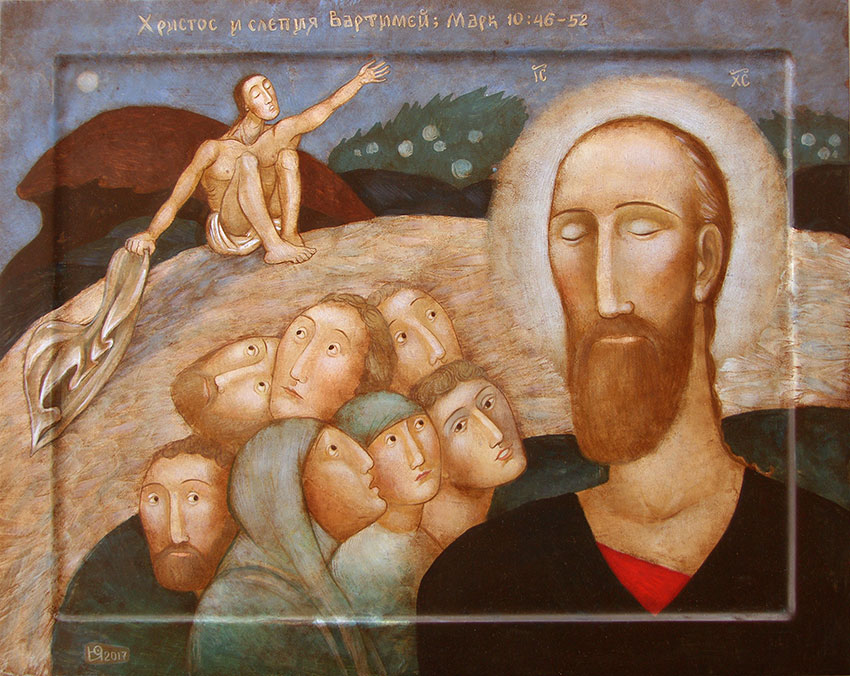
Christ and Bartimaeus by Julia Stankova
Julia Stankova (Bulgarian, 1954–), Christ and Bartimaeus, 2017. Tempera on primed wooden panel and lacquer technique, 36 × 45 cm.

And they came to Jericho. And as he was leaving Jericho with his disciples and a great crowd, Bartimaeus, a blind beggar, the son of Timaeus, was sitting by the roadside. And when he heard that it was Jesus of Nazareth, he began to cry out and say, “Jesus, Son of David, have mercy on me!” And many rebuked him, telling him to be silent. But he cried out all the more, “Son of David, have mercy on me!” And Jesus stopped and said, “Call him.” And they called the blind man, saying to him, “Take heart. Get up; he is calling you.” And throwing off his cloak, he sprang up and came to Jesus. And Jesus said to him, “What do you want me to do for you?” And the blind man said to him, “Rabbi, let me recover my sight.” And Jesus said to him, “Go your way; your faith has made you well.” And immediately he recovered his sight and followed him on the way.

—Mark 10:46–52 (cf. Matthew 20:29–34; Luke 18:35–43)

+++

SONG: “Son of David” by Ghost Ship, on The Good King (2013)

Here’s an introduction and acoustic performance by band leader Cam Huxford, who cowrote “Son of David” with fellow Ghost Ship member Shay Carlucci:

+++

“The Blind Suppliant” by Richard Crashaw

Silence, silence, O vile crowd;
Yea, I will now cry aloud:
He comes near, Who is to me
Light and life and liberty.
Silence seek ye? yes, I’ll be
Silent when He speaks to me,
He my Hope; ah, meek and still,
I shall ’bide His holy will.
O crowd, ye it may surprise,
But His voice holdeth my eyes:
O have pity on my night,
By the day that gives glad light;
O have pity on my night,
By the day would lose its light,
If it gat not of Thee sight;
O have pity on my night,
By day of faith upspringing bright;
That day within my soul that burns,
And for eyes’ day unto Thee turns.
Lord, O Lord, give me this day,
Nor do Thou take that away.


This post belongs to the weekly series Artful Devotion. If you can’t view the music player in your email or RSS reader, try opening the post in your browser.

To view all the Revised Common Lectionary scripture readings for Proper 25, cycle B, click here.