Christmas, Day 3: The Infinite a Sudden Guest

LOOK: I Am Born by Ihor Paneyko
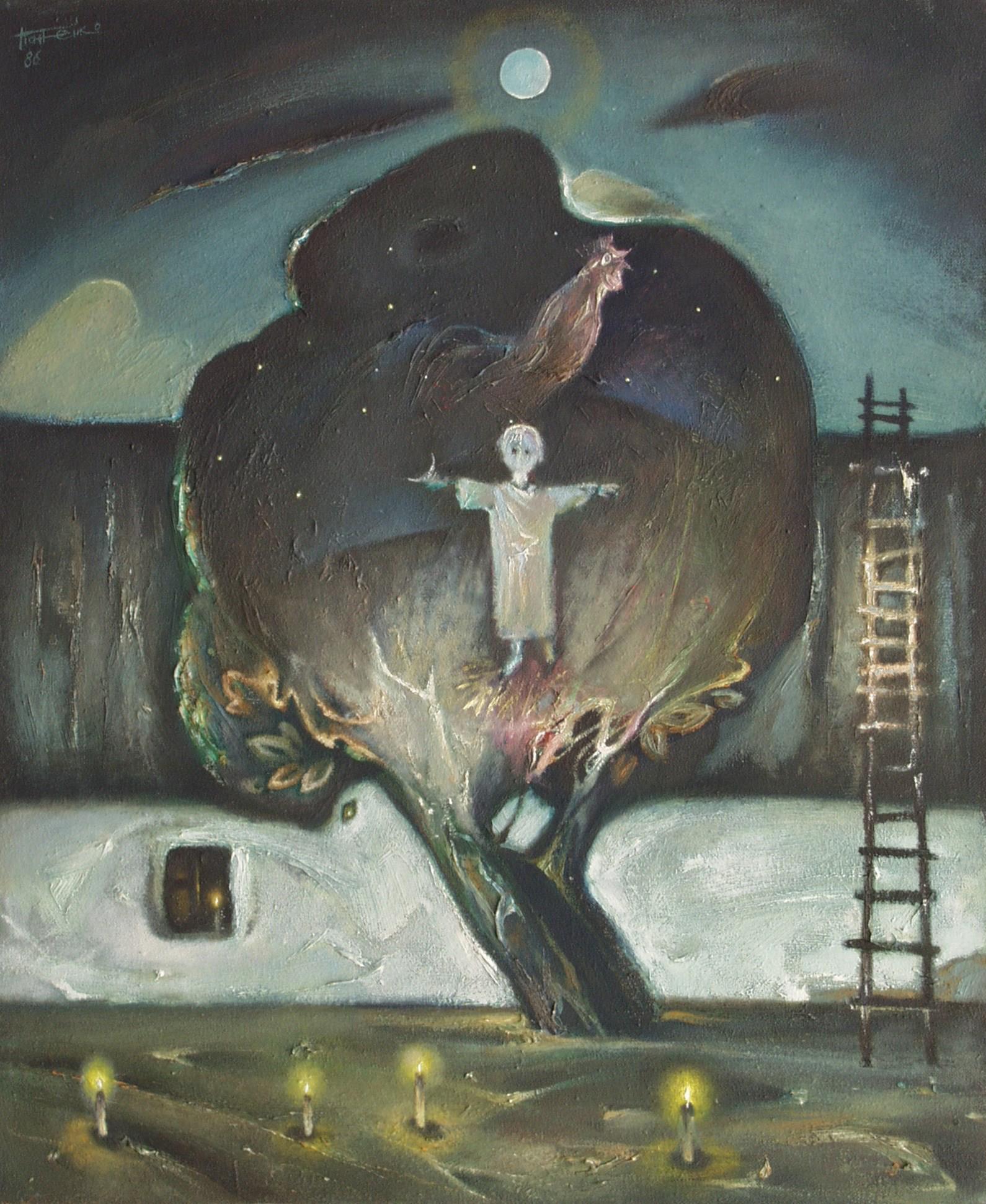
Paneyko, Igor_I Am Born
Ihor Paneyko (Ukrainian, 1957–), Я родився (I Am Born), 1986. Oil on canvas.

LISTEN: “The Infinite a Sudden Guest” by Josh Rodriguez, 2015 | Performed by New City Music on Songs from Engedi, 2015

The Infinite a sudden guest—

Awake, mankind!
For your sake God has become man.
Awake, you who sleep:
God has become man.
Awake, rise up from the dead,
And Christ will enlighten you.
For your sake, God became man.

You would have suffered eternal death,
Never freed from sinful flesh,
Had he not taken on himself
The likeness of sinful flesh;
Lost from everlasting unhappiness,
Had it not been for this mercy.
You would never have returned to life,
Had he not shared your death.

Let us celebrate the coming of salvation and redemption!
Let us celebrate the day who is the great and eternal day,
Came from the great and endless day of eternity
Into our own short day of time.

Christ, born of Mary.
Eternity entered time.
Truth has arisen from the earth:
Christ who said, “I am the Truth.”
And Justice looked down from heaven:
Because believing in this newborn child,
Man is justified not by himself but by God.

Truth has arisen from the earth:
Because the Word was made flesh,
And Justice looked down from heaven.
Justified by faith, let us be at peace with God.
For Peace and Justice have embraced in Jesus Christ.

The Infinite a sudden guest—
God
In time
In God
In time
In God
In time
In God
In time
In God
In time
In God
In time
In God.

In 2015 Josh Rodriguez [previously here and here] composed this piece for SATB choir, violin, and percussion for New City Presbyterian Church in Royal Oak, Michigan, where he served as music director at the time.

Its striking title and first line come from a short poem by Emily Dickinson, and the rest of the text is taken from a Christmas sermon by Augustine of Hippo (cataloged as Sermon 185 by scholars), which centers on Psalm 85:11: “Truth shall spring out of the earth; and righteousness shall look down from heaven.” Augustine sees this prophecy as fulfilled in Christ. The full sermon can be read in St. Augustine, Sermons on the Liturgical Seasons, trans. Mary Sarah Muldowney, RSM (vol. 38 of the Fathers of the Church series) (Washington, DC: Catholic University of America Press, 1959), 6–9. Section 1 can be read for free here.

Celebrating the entrance of God into human history, this choral work alternates between vigorous, exuberant passages and ones that are slower and more introspective. In the opening, there’s a wonderful crescendo on “guest”—an expansion that reflects the possibility opened up by the Incarnation. The final passage alternates between the phrases “in God” and “in time.” God is in time and time is in God, the infinite contracted to a span.


This post is part of a daily Christmas series that goes through January 6. View all the posts here, and the accompanying Spotify playlist here.

Spiritual imagination in the art of Igor Paneyko

I spend a lot of time “art surfing” the Internet, following click-trails that start maybe with a Google image search of a subject I’m researching and then end up somewhere totally different. One of those trails this weekend led me to the work of Ukrainian New Wave artist Igor Paneyko.

Paneyko was born on March 2, 1957, in the city of Stryi in the Lviv Oblast region of western Ukraine, in the foothills of the Carpathian Mountains. From 1975 to 1981 he studied at the Lviv State Institute of Applied and Decorative Art (now the Lviv National Academy of Arts), then spent a year working in Khiva, Uzbekistan. He currently lives and works in Uzhhorod, Ukraine, near the Hungarian border, in the region known as Transcarpathia.

Other than this general biographical information, I can find little else about the artist. An exhibition promo from 2012 suggests that he is a private person who’s “wary of publicity,” though he does exhibit his work. Using the Ukrainian spelling of his name, Игоря Панейка, yields more results than a search in English, but information is still sparse.

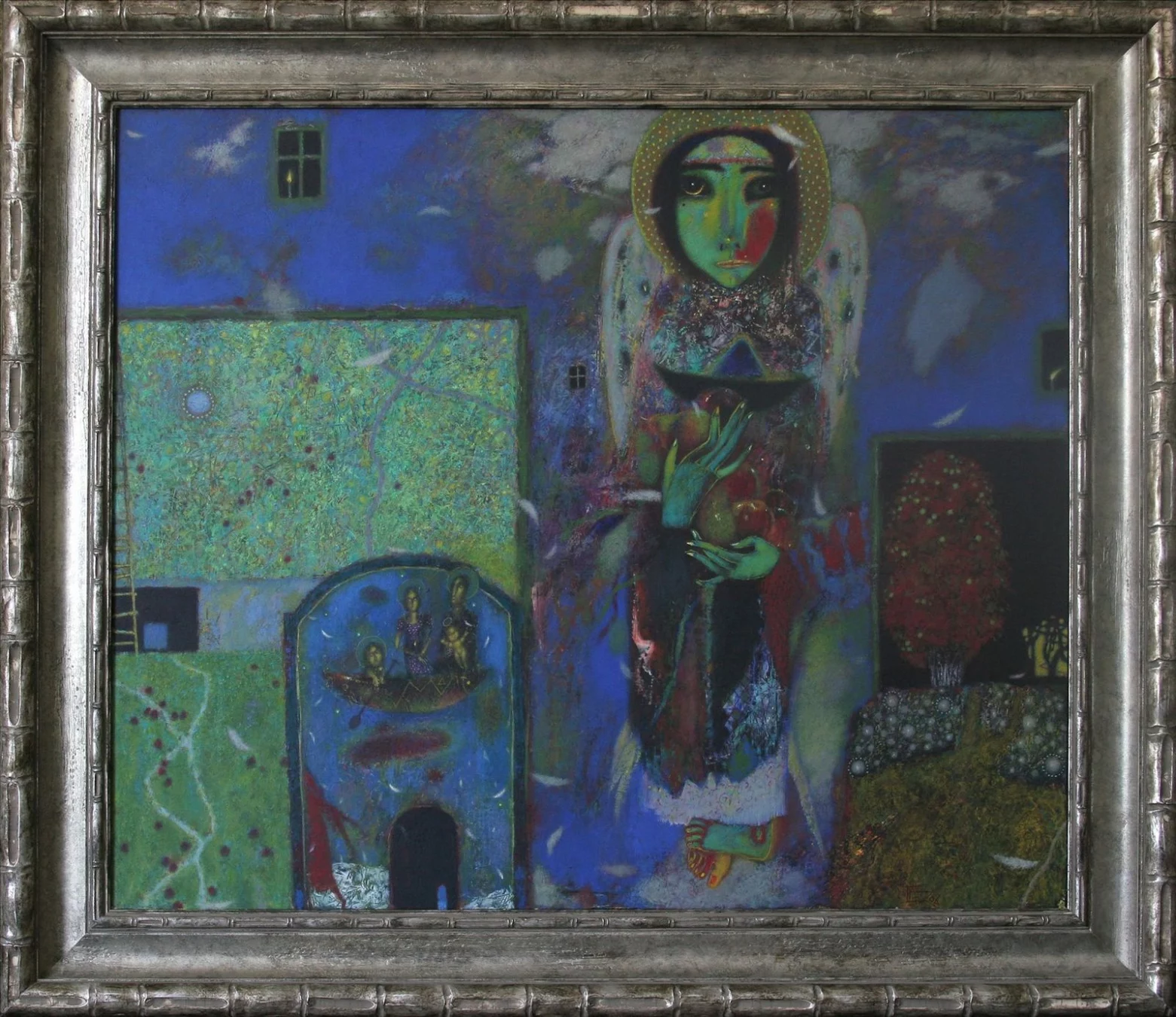
Many of Paneyko’s paintings are of visionary landscapes with floating, haloed figures. Candles, moons, and ladders (see Genesis 28:12) are often featured. Much of his work seems to me to carry on the legacy of Symbolism, a late nineteenth-century art movement that developed new and often abstract means to express psychological truth and the idea that behind the physical world lay a spiritual reality. Symbolists sought to give form to the ineffable, such as dreams and visions, and they emphasized emotions, feelings, ideas, and subjectivity over realism, often addressing the themes of religious mysticism and death. Gustav Klimt and Odilon Redon are two of Symbolism’s greatest artists.

(Related post: “Christ Crowned with Thorns interpreted by Symbolist artist Odilon Redon”)

Below is a compilation of some of Paneyko’s paintings that I find particularly appealing. I don’t know the specs for any of them, besides the year of those that have it painted large enough on the canvas, but I’ve linked each of them to its online source.

These first five are, to me, visually stunning. Ground and sky are not discernible from each other but rather interpenetrate, creating sacred space and evoking wonder.

igor-paneyko2

^ From 2005, we have a woman with a candle standing in contrapposto and covered in multicolored roses. The thin gold band around her head suggests a halo, and the purple burst behind her an aureola. It appears that she has come to pay devotion to Christ, as a wayside crucifix, whose patibulum supports the candles of previous pilgrims, is planted in the background. In the center of the woman’s chest, a little red kernel is encircled with light, representing the love that’s set aglow by her encounter; her loins, too, bear this mark—a possible allusion to the erotic language used by medieval mystics to describe their union with Christ.

igor-paneyko

^ Here a haloed woman—maybe an angel (are those wings behind her?)—carries a load of pears and apples. To the left is a rowboat with four other haloed figures, one of them a baby; to the right, a garden. Some associations that come to my mind are Eden, Flight to Egypt, ship of salvation, fruit of the Spirit.

igor-paneyko4

^ In this one, the focal point is the bottom left corner, where a yellow-green-blue crescent moon balances atop a patchwork mountain, and a row of nightcapped sheep saunters sleepily away. On the other side of the mountain a newspaper party hat floats over a cross-marked graveyard. Maybe it’s because we’ve just come out of Christmas, but I think of Bethlehem after Christ’s birth: the Judean hills alive and vibrant, having been touched by angel song; the shepherds’ charges seeking rest after the flurry of activity; and spreading a shadow over the celebration, the Massacre of the Innocents—Herod’s extermination of the town’s infant male population.   Continue reading “Spiritual imagination in the art of Igor Paneyko”