Roundup: Modern Bible illumination; hula; First Nations baptism design; father-daughter waltz; Tamayo and Parker

ESV Illuminated Bible spread

NEW BOOK: ESV Illuminated Bible (2017): In October Crossway released a new Bible illuminated by Seattle-based designer and lettering artist Dana Tanamachi. Printed in two-color (the illuminations are in gold ink), this volume contains one full-page illustration, custom icon, and illuminated drop cap for each book of the Bible, plus hundreds of hand-lettered Bible verses throughout the margins. There are no human figures in any of the illuminations; most consist of flora and fauna—olives, figs, pomegranates, peacocks, lions, lilies, deer, cedar, and so on—derived from the given book. Be sure to check out the book-opener illustration index, and the short video below, in which Tanamachi introduces herself, talks through her process, and explains some of her artistic choices:

“God loves beauty, so we wanted to honor him through this project with something that was beautiful,” says Josh Dennis, Crossway’s senior vice president of creative. “For this edition we really want people to engage with it, so there’s a lot of negative space and wide margins for people to write in it and to do their own Bible journaling.”

This publication comes six years after the release of Makoto Fujimura’s Four Holy Gospels, another illumination project. Fujimura’s is an oversize book with a $150 price point, containing original abstract paintings reproduced in full color alongside the first four books of the New Testament. By contrast, the ESV Illuminated Bible is more wieldy—it has a 6½ × 9 trim size—and less costly ($45), and it contains all sixty-six books. The aesthetic is also much different, as Tanamachi’s influences include art nouveau, the arts and crafts movement, and designers like William Morris and Koloman Moser. [HT: David Taylor]

+++

CHRISTIAN HULA: “‘O ‘Oe ‘Io” (You Are God): Though reduced to tourist entertainment in some places, Hawaiian hula dancing, in its traditional context, is a form of teaching and worship. Because of its associations with polytheism, early missionaries denounced it as sinful. Over the last half century or so, however, most missionaries have changed their stance toward this and other traditional forms of artistic expression—not only in Hawaii, but in whatever their host culture—seeing how such forms can offer more authentic ways for the people to connect to and worship the Christian God.

In the video below, Moani Sitch and ‘Anela Gueco perform a hula noho (“seated hula”) at the 2006 Urbana student missions conference sponsored by InterVarsity Christian Fellowship. It’s to the Christian hymn “‘O ‘Oe ‘Io” (You Are God), originally written in Maori by Luke Kaa Morgan but translated into Hawaiian by Moses Kaho‘okele Crabbe. The sacred name for Creator God—‘Io—is the same in both languages. The lyrics are below. [HT: Global Christian Worship]

‘O ‘oe ‘Io, e makuna lani (You are God, Heavenly Father)
‘O ‘oe ‘Io, ka waiola (You are God, the Living Water)
‘O ‘oe ‘Io, e kumu ola (You are God, the Source of Life)
Ka mea hana i na mea apau (The one who has made all things)
E ku‘u Haku (My Lord)
Ka mauna ki‘eki‘e (Who is the Highest Mountain)
‘O ‘oe ‘Io (You are God)

For a fantastic religious history of Hawaii, see this PDF booklet published by Aloha Ke Akua (“God Is Love”) Ministries. Among the many things I learned is that Hawaiians regard the arrival of Christian missionaries as the fulfillment of their elders’ prophecies that the one true God would one day return to the islands.

+++

FROM THE ARCHIVES: “Jesus as Chief: ‘Baptism Mural’ by Tony Hunt”: First Nations artist Tony Hunt Sr. died last month, just two months after his son Tony Hunt Jr., also a renowned carver. Read about Hunt Sr.’s inculturated serigraph of Christ’s baptism at my old blog, The Jesus Question—part of a seven-part series I did on Christian art of the Pacific Northwest Coast. Based on a carved and painted design he made for the Canadian Conference of Catholic Bishops, it shows John the Baptist as a Kwakwaka’wakw shaman in Native dress and with ceremonial rattle, installing Jesus as chief. The Father is manifest as Sun and the Spirit as Thunderbird.   Continue reading “Roundup: Modern Bible illumination; hula; First Nations baptism design; father-daughter waltz; Tamayo and Parker”

Roundup: Controversial Eve painting, liturgy, protest, visualizing belief, and “Ya Hey”

“Mormon painting of a black Eve draws fire, but not for the reasons you might think” by Peggy Fletcher Stack, Salt Lake Tribune: Early this year a new painting of a seminude black Eve by Mormon artist J. Kirk Richards went on display at Writ & Vision gallery in Provo, Utah. While many Mormons have expressed how captivated and inspired they are by it (and I should note, black figures are extremely rare in Mormon art), a few have insisted it’s wrong for a white man to depict a nude black woman because it conjures up collective memories of sexual brutality and enslavement. The article features some interesting perspectives by black Mormon feminists. In addition to raising important questions surrounding racial histories and representation, the painting, I’ve noticed, also illustrates a distinctly Mormon view of the Fall, which differs from the orthodox Christian view—a fact Richards alludes to in his March 14 gallery talk. View the painting.

+++

“A Conversation about Creativity and the Liturgical Calendar,” panel discussion presented by Brehm Center and Fuller Studio: Moderator Edwin M. Willmington, composer-in-residence at Fuller Theological Seminary, talks with an all-star trio of creatives and liturgists comprising David Gungor of The Brilliance [00:50], on authenticity in songwriting and introducing liturgical practices to the evangelical church he attended; Todd E. Johnson [10:40], on the history, purpose, and major observances of the church calendar; and Lauralee Farrer [26:18], on discovering the Canonical Hours in a New Mexico desert and later developing them into characters for a film project. Questions: [34:02] How has liturgy shaped you? [36:20] Advice for artists on how to bring the church year to bear in their art? [37:11] Have you found that lament is generally embraced or resisted? [39:41] Advice for worship leaders?

+++

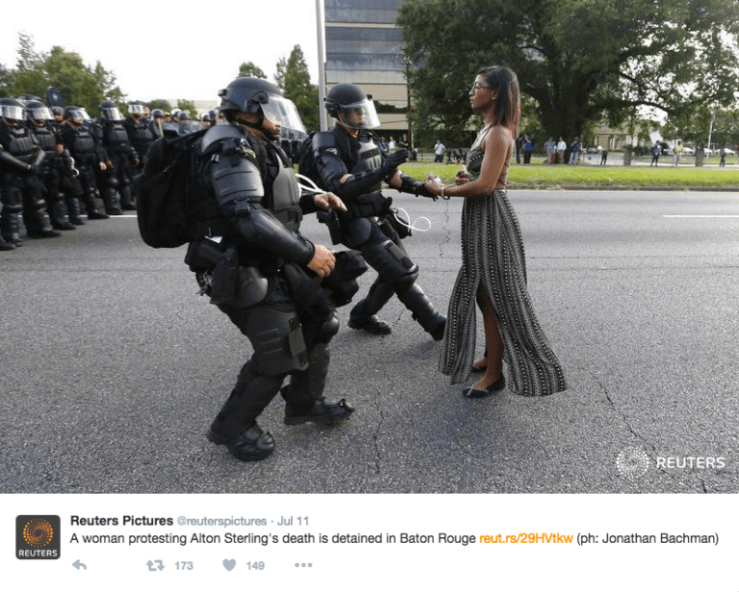
“An Art Historical Perspective on the Baton Rouge Protest Photo that Went Viral” by An Xiao Mina and Ray Drainville, Hyperallergic: During a July 10 protest following the fatal killing of Alton Sterling, Reuters photographer Jonathan Bachman captured the moment of twenty-eight-year-old Ieshia L. Evans’s arrest. As heavily armored policemen pressed in, the other protestors dropped back, but Ieshia stood assuredly in the middle of the three-lane highway, prepared to be bound. This article lauds the strength of this image of confrontation by citing compositionally and thematically similar paintings, including Briton Riviere’s Daniel in the Lion’s Den and Giotto’s The Arrest of Christ, and other works of art.

Ieshia Evans arrest photo

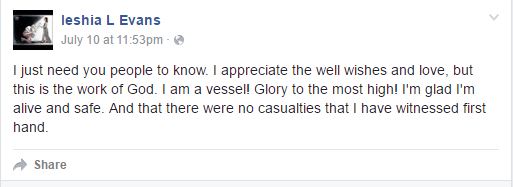
Ieshia considers herself a vessel of God, eager to be used by him to bring justice and peace. Here’s what she wrote on her Facebook wall the night of her release from jail:

Ieshia Evans statement

+++

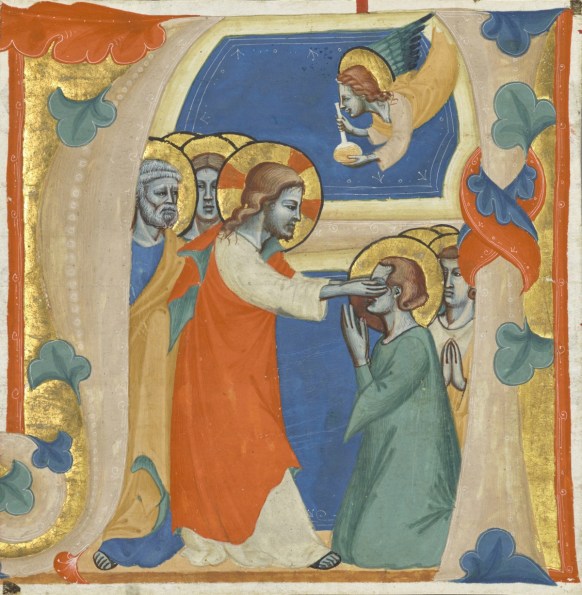
“Things Unseen: Vision, Belief, and Experience in Illuminated Manuscripts”: Running through September 25 at the Getty Center in Los Angeles, this exhibition “explores the visual challenges artists faced as they sought to render miraculous encounters with the divine, grand visions of the end of time, the intricacies of belief, and the intimate communications of prayer.” It includes a September 15 talk, “How Do We Depict Religious Experiences?”—that is, how do we convey metaphysical essence in physical form? I appreciated the Getty’s blog post this week featuring a newly acquired choir book leaf that’s part of the exhibition. Curator Bryan C. Keene writes about the difficulties of identifying the illuminator and about discovering, through an examination of the back and a search on the Cantus database, that the illumination depicts the wiping of tears from saints’ eyes, not, as previously assumed, the healing of the blind.

Christ wiping the tears from the eyes of the saved
Initial A: Christ Wiping the Tears from the Eyes of the Saved, attributed to the Master of the Antiphonary of San Giovanni Fuorcivitas, ca. 1345–50. Tempera and gold leaf on parchment, 5 1/3 × 5 1/3 in. (13.5 × 13.5 cm). The J. Paul Getty Museum, Ms. 113, recto. Digital image courtesy of the Getty’s Open Content Program.

+++

“Ya Hey” song cover by The Brilliance: Written by Ezra Koenig of Vampire Weekend, “Ya Hey” is a modern-day psalm that expresses frustration with God’s seeming unresponsiveness—to being spurned and being sought, to brokenness and suffering, to sin and struggle. The title is a play on the word Yahweh, the Hebrew name for God. The chorus references the burning bush of Exodus 3: “Through the fire and through the flames / You won’t even say your name / Only ‘I am that I am.’” The Brilliance’s acoustic cover of “Ya Hey” was released last month as a music video on YouTube featuring four New York City ballet dancers. It abandons the shrill vocoder and heavy percussion of the original song in favor of a softer, purer sound. Read the lyrics and an analysis at Sound: Interrupted.

Roundup: Mavis Staples documentary, baptizing the imagination, how medieval manuscripts were made, Nubian Christian art, and Twain’s war prayer

Mavis!: The HBO documentary Mavis! profiles gospel and soul music legend Mavis Staples, from her rise to stardom as part of the Staples Singers, whose Uncloudy Day was the first gospel album to sell one million copies, and her involvement in the civil rights movement, to her still active career as a solo artist. “I’ll stop singin’ when I have nothin’ left to say,” she says. “And that ain’t gonna happen!” Watch the trailer below.

Luci Shaw on art and Christian spirituality: In this 1998 article from Direction journal, the oh-so-quotable poet Luci Shaw writes about imagination, mystery, receptivity, sacramentality, the similarities between art and faith, and her muse, the Holy Spirit. Concludes with her poem “Ghostly,” which explores the Spirit’s different manifestations.

Making medieval manuscripts: Through narrated demonstrations, this video by the Getty Museum shows how paper, pens, ink, paint, book covers, and bindings were made during the Middle Ages—laborious processes! It also shows how the illuminators (visual artists) worked with the scribes (calligrapher-copyists), jobs typically filled by two separate people.

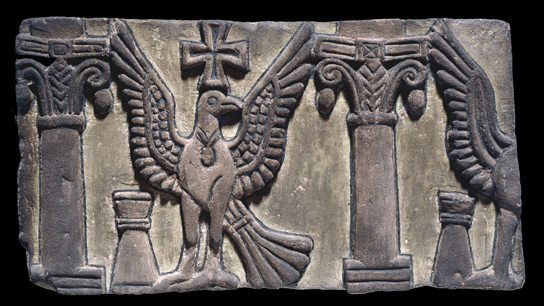
Christianity on the Middle Nile: The two largest Christian kingdoms in the medieval world were actually in modern-day Sudan, writes curator Julie Anderson in a British Museum blog post from 2014: the Makuria and the Alwa kingdoms. Many wall paintings and other objects have been excavated from Faras Cathedral and its adjoining tombs, such as the pottery lamp (with the inscription “Great is the name of God”) and sandstone frieze fragment in the British Museum’s collection. (The paintings are divided between the Sudan National Museum and the National Museum of Warsaw, as it was a Polish team that rescued them from flooding by Lake Nasser.)

Faras Cathedral frieze fragment
Seventh-century sandstone frieze fragment from the former Faras Cathedral in Nubia. Collection of the British Museum.
Fiery Furnace fresco from Faras Cathedral
Fresco from the former Faras Cathedral in Nubia depicting the three youths in the fiery furnace. Collection of the National Museum of Sudan.

“The War Prayer” by Mark Twain: In his day Twain was radically opposed to American military intervention in Cuba and the Philippines and frustrated by the so-called patriotism that made his fellow countrymen so uncritically supportive of it. The stranger’s speech in Twain’s short story “The War Prayer,” set during a church service, exposes the ridiculousness of some of the prayers that go up during wartime even today.

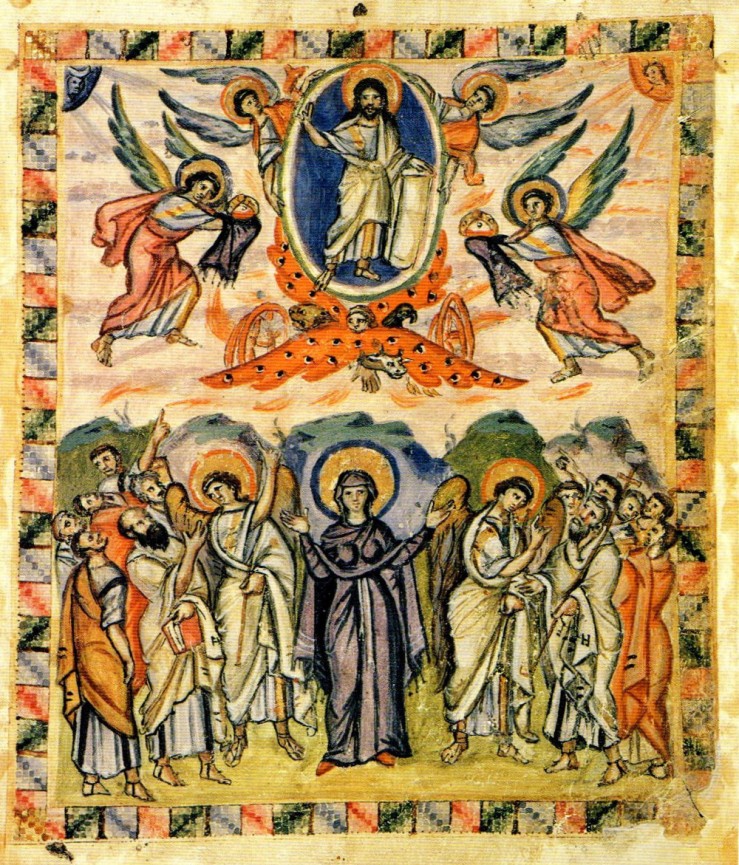
Christ ascending into Ezekiel’s vision

The sixth-century illuminated Syriac manuscript known as the Rabbula Gospels (after the signed name of its scribe) contains one of the earliest depictions of Christ’s ascension into heaven. A full-page miniature, it illustrates the narrative from Acts 1:6–11—but not strictly.

Ascension (Rabbula Gospels)
Ascension, fol. 13v from the Rabbula Gospels (cod. Plut. I, 56), Syria, 586. Tempera on parchment, 33 × 25 cm. Biblioteca Mediceo Laurenziana, Florence.

One embellishment to the story is the centralized presence of Mary on the bottom level. She is not mentioned in the biblical account of the event, but her attendance was likely. Here she stands in a frontal, orant pose and, unlike the other disciples, is nimbed. Whereas those around her are wracked with confusion, she understands the deep mysteries of her son’s birth, death, resurrection, and ascension, and she stands ready for his return.

Among the crowd is the apostle Paul—an anachronistic insertion, as his conversion occurred after the Ascension. The book he holds, signifying his contributions to the New Testament, is one of his identifying attributes.

The “two men . . . in white robes” mentioned in Acts 1:10 are interpreted as angels.

All these elements became standard in medieval iconography of the Ascension.   Continue reading “Christ ascending into Ezekiel’s vision”

Roundup: The art of celebration, cross-cultural exchanges in illuminated manuscripts, the history of color, and insect-wing blooms

The Art of Celebration (album): Rend Collective is a folksy worship band from the small coastal town of Bangor in Northern Ireland that is internationally known for its high-spirited, experimental songs of joy. The Art of Celebration is their fourth of five albums, the story of which is told in the video below. “This record is an attempt to reflect something of the irrepressible laughter in the heart of God,” says bandleader Gareth Gilkeson. “It’s a call to the cynical to once again choose celebration over condemnation and a reminder to the broken that ‘the joy of the Lord is our strength.’” You can preview songs from the album here and purchase it here, or catch the band on tour (they’re currently in the US). I’ve embedded one of my favorite songs from the album below: “My Lighthouse.”

+++

“Traversing the Globe through Illuminated Manuscripts” (exhibition): Through June 26, the J. Paul Getty Museum in Los Angeles is running an exhibition of illuminated manuscripts and painted book arts from the ninth through seventeenth centuries. From the website: “These highly prized objects allow us to glimpse, admire, and study a world gone by, as well as its peoples, different belief systems, and an interconnected global history of human thought and ideas about art.” Check out the Q&A with curator Bryan Keene—so fascinating. Also click the link above to find out about related events. Next up is a lecture on April 19 titled “A Medieval Picture Book and Its Judeo-Persian Lives: The Shah Abbas Bible in 17th-Century Safavid Iran.”

Virgin and Child (Ethiopian)
The Virgin and Child with the Archangels Michael and Gabriel, from a Gospel book, ca. 1480-1520, Gunda Gunde Monastery, Ethiopia. J. Paul Getty Museum, Los Angeles.
Northumberland Bestiary
Pen-and-ink wash-tinted drawing of a dragon riding an elephant, England, ca. 1250–1260. Northumberland Bestiary (Ms. 100), fol. 54, J. Paul Getty Museum, Los Angeles.

+++

The Brilliant History of Color in Art (book): Victoria Finlay’s latest book from Getty Publications, full of fun facts about the origins and science of color. The trailer below tells how Prussian blue, Indian yellow, lead white, and Tyrian purple came to be. Lapham’s Quarterly has a nifty infographic on the same topic.

+++

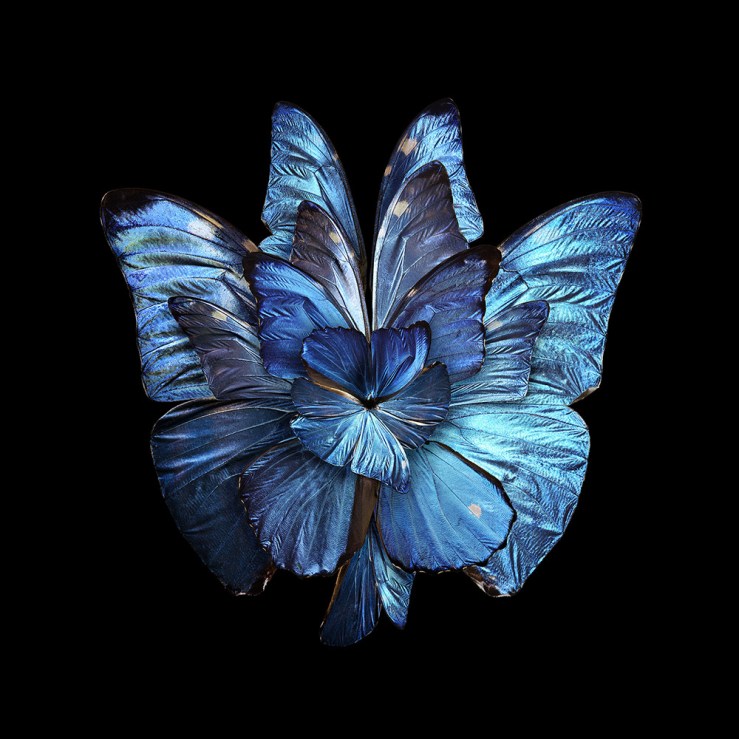
Mimesis (photomontage series): From 2012 to 2014 Paris-based artist Seb Janiak executed a series of twenty-two photographs that show insect wings pieced together in flower-like forms. Janiak says he believes that a spiritual reality undergirds the physical. “Using art to reveal what is behind the veil of matter is fascinating and full of discoveries,” he writes. See more Mimesis photos at the link above.

Mimesis by Seb Janiak
Seb Janiak (French, 1966–), Mimesis—Lacus Luxuriae, 2013. Chromogenic print, 180 × 180 cm.