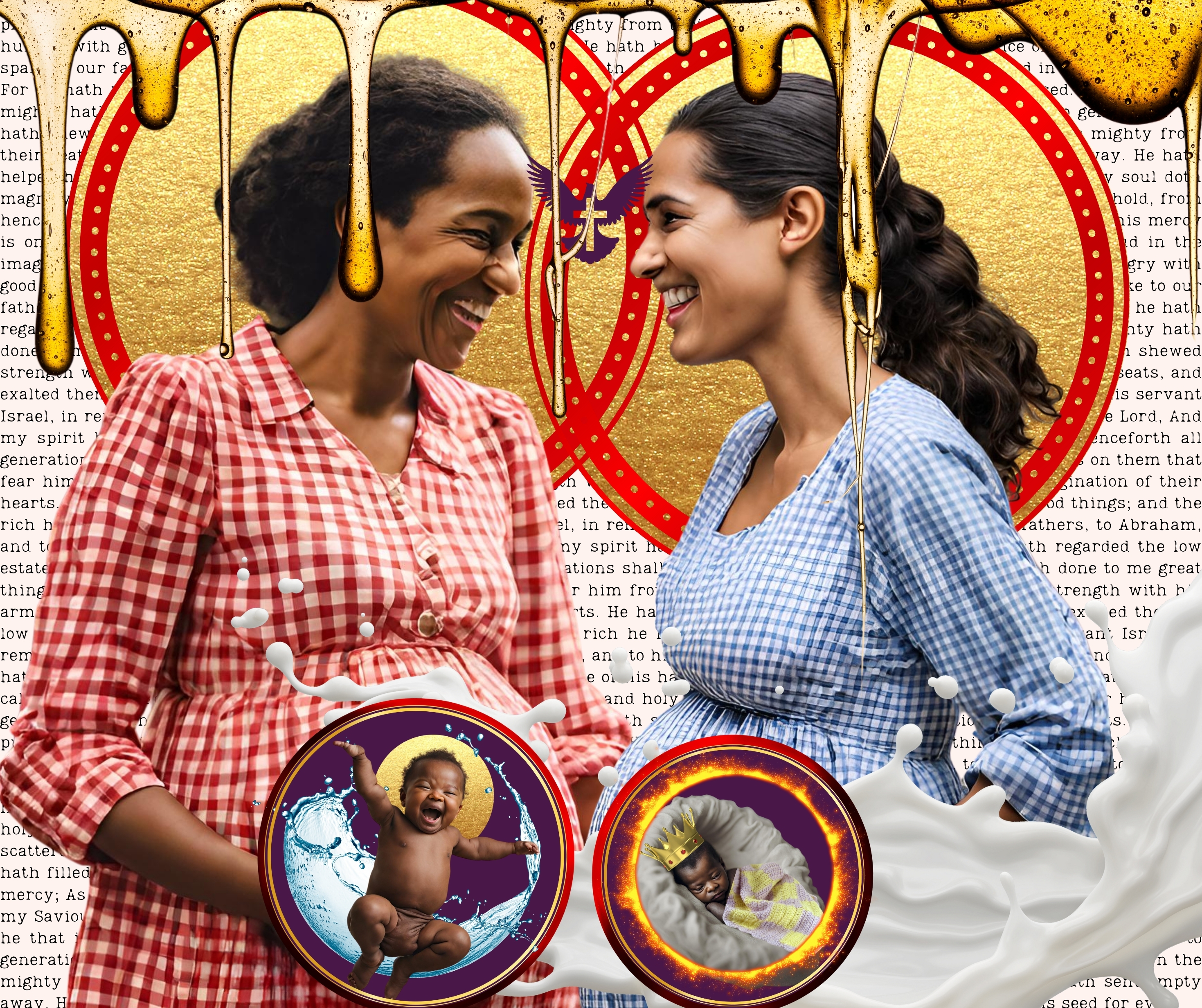
Beth Felker Jones (American, 1976–), Visitation, 2024. Digital collage with AI-generated elements.
Dr. Beth Felker Jones is a theologian who teaches at Northern Seminary near Chicago. This past year she has been making digital collages of biblical figures, especially women, with the assistance of AI technology. She shares them on her Substack, Church Blogmatics, and offers them for free with watermark or just $10 for a high-resolution, watermark-free download.
Her Visitation, she says, “imagines Mary’s visit to Elizabeth in Luke 1, flowing with milk and honey,” symbols of abundance and nourishment. (The promised land is often referred to in scripture using this poetic expression; see Exod. 3:8, Num. 14:8, Deut. 31:20, and Ezek. 20:15.) With the coming of a Savior, a great spiritual bounty awaits God’s people.
Luke the Evangelist describes Elizabeth as “filled with the Holy Spirit” (1:41). The Spirit is present in the center of this collage, silhouetted in purple, the color of Advent. His wings touch the women’s foreheads as if to bless or to join them together in celebration.
Luke also says that John the Baptist “leaped for joy” inside Elizabeth upon hearing Mary’s greeting (1:44), already recognizing that the one she bore was the Messiah. Jones shows this exultation of the in utero prophet. He splashes in the waters of his mama’s womb, as he will one day in the river Jordan, baptizing the repentant. Meanwhile, the great I AM, enfleshed as a preborn baby, sleeps inside a fiery ring in Mama Mary, crowned as king.
The words of Mary’s Magnificat form the backdrop of the scene.
LISTEN: “Among Us” by Nick Chambers, on Advent Songs by Incarnation Music (2023)
My soul will magnify The Lord who looked on my Lowliness with grace My soul will magnify My neighbor’s precious life I see Christ in their face
Refrain: God is among us In human disguise Born as one of us To open our eyes
My soul will magnify The Lord who took on my Lowliness in flesh My soul will magnify My neighbor’s desperate cry For in Christ they are blessed [Refrain]
Based on the Magnificat (Luke 1:46–55), “Among Us” by singer-songwriter Nick Chambers highlights how God’s becoming flesh helps us see the imago Dei (image of God) in our fellow humans. There’s an old Orthodox hymn that says, “Christ was born to raise the image that fell of old. Christ came to restore the beautiful image of God within humankind,” the image that had become obscured through sin.
With Mary, Elizabeth, and baby John, let us celebrate the Lord who brings salvation, raising up the lowly, restoring the broken, and reminding us of the dignity and belovedness of our embodied selves.
Juneteenth (June 19) is a federal holiday in the United States celebrating the liberation of enslaved African Americans in Texas in 1865. Abraham Lincoln had issued the Emancipation Proclamation on January 1, 1863, but it was not implemented in places still under Confederate control, and because Texas, being on the westernmost edge of the Confederacy, was farthest from the military action of the Civil War, Texans could conveniently continue to enslave, as there were no soldiers there to enforce the executive decree. But when Union troops, both white and Black, arrived in Galveston Bay on June 19, 1865, two months after the official end of the war, they saw to it by threat of force that the 250,000-plus enslaved Black people in the state were freed.
Also known as Emancipation Day or Jubilee Day (after the year of release mandated by ancient Israelite law), Juneteenth has been celebrated by African American communities in Texas ever since the first anniversary of the freeing event. Historically, the church has been at the center of these celebrations, as the formerly enslaved attributed their liberation to God, to whom they gave effusive thanks and praise. In the twentieth century, Juneteenth expanded into other states but still remained very niche, until 2021, when, after decades of lobbying by Black activists, President Joe Biden signed into law the Juneteenth National Independence Day Act, moving the holiday into the mainstream.
Juneteenth marks not only that one historic day but also, more broadly, freedom as an ongoing struggle. It’s not as if the illegalizing of chattel slavery, or even the passage of the Civil Rights Act of 1964, ended racial oppression or prejudices, which manifest today in, for example, the racial wealth gap, voter suppression, and disparities in policing. We have made important progress as a country, for sure, but there’s still a ways to go until everyone breathes free.
Bishop T. D. Jakes of The Potter’s House in Dallas says that Juneteenth must involve a reckoning with our nation’s sordid past and a commitment to identifying and rooting out whatever sordidness persists. “It’s vital we all must remember when liberty and justice is delayed or denied, it causes traumatic ripples throughout future generations. . . . As we collectively stop to acknowledge and learn from the delayed liberties of our nation’s ancestors, we must not allow those same systems to repeat injustices.”
In recognition of Juneteenth, I’ve compiled on Spotify 118 songs of Black joy, liberation, and faith. From Beyoncé to Duke Ellington, Adolphus Hailstork to Rhiannon Giddens, Mary Lou Williams to Richard Smallwood, these artists jubilate, extol, lament, protest, revel, testify, and hope.
I acknowledge the complications of me, a white person, offering this playlist. I have grappled with how to appropriately celebrate Juneteenth and how to balance its predominant tone of joy (am I allowed to feel joy?) with an honest accounting of past and present evils that mark the Black experience in America, especially slavery and its legacy. One basic piece of advice I’ve heard is to center Black voices. Listen to and lift up Black historians, Black theologians, Black novelists, Black songwriters, etc.
The Art & Theology Juneteenth Playlist combines sacred and so-called secular music written and/or performed by Black artists and exhibiting a spirit of defiant joy. It emphasizes the beauty, power, creativity, and divine belovedness of Black people.
Honoring the religious roots of Juneteenth and the faithful ongoing witness of the Black church, I have incorporated many Christian songs, especially those that speak to the imago Dei and to God’s faithfulness, guidance, and deliverance. The Bible is full of divine deliverance tales: the Israelites from slavery in Egypt; Daniel from the lions’ den; the three Hebrew boys from the fiery furnace; Jonah from the belly of the whale; Paul and Silas from prison. “Didn’t my Lord deliver Daniel? Then why not every man?” sings one spiritual. Another, “Go Down, Moses,” confronts Pharaoh, a stand-in for white Southern enslavers, with the demand “Let my people go,” while yet another exults in the toppling of Pharaoh’s power—“Pharaoh’s army got drownded.” The spiritual “Satan, We’re Gonna Tear Your Kingdom Down” addresses the Enemy directly, expressing resolve to overthrow demonic systems and ideologies, such as white supremacy.
There are also plenty of feel-good vibes on the playlist, lighter songs like Lee Dorsey’s “Occapella,” Count Basie’s “Jumpin’ at the Woodside,” and Jon Batiste’s “Freedom” (with its stylish, smile-inducing music video that I can’t get enough of!):
Its first verse is: “This joy that I have—the world didn’t give it to me. . . . The world didn’t give it, and the world can’t take it away.” “This strength,” “this love,” and “this peace” follow in subsequent verses—otherworldly qualities given to us by God, as Caesar makes explicit in the original, and which no one can ever steal from us. No matter what harm people may do to us, we still possess these inner gifts, which help us face whatever comes.
Composed in the antebellum South, “No More Slavery Chains for Me” (aka “Many Thousands Gone” or “No More Auction Block”) holds together proclamation and grief. The speaker boldly asserts her freedom: “No more slavery chains,” “no more auction block,” “no more peck of corn,” “no more driver’s lash,” “no more mistress’ call,” “no more children stole from me.” It could be spoken by someone who is still enslaved but who refuses to tolerate that condition any longer, or it could be spoken by someone recently freed, rejoicing in what she has escaped. But the solemn refrain, “Many thousands gone,” remembers the multitudes whom slavery has killed. Here’s a performance by mezzo-soprano Shirley Verrett, an international opera star active from the late 1950s through 1990s:
Often words fail to capture the emotional intensity one might feel. “Triptych: Prayer / Protest / Peace” by Max Roach, from his 1960 avant-garde jazz album We Insist!: Freedom Now Suite, featuring Abbey Lincoln, consists almost entirely of wordless vocal expressions, screaming, and sighing, along with drumming by Roach. It’s mournful and alarming. The only words are at the beginning of part 3: “I need peace.” Cued up here (starting at 5:50) is Lincoln and Roach’s performance of the first two parts of “Triptych” for a Belgian TV station that aired January 10, 1964. (The earlier song in the video is “Tears for Johannesburg,” from the same suite.)
In the liner notes for We Insist!, Nat Hentoff writes that “Triptych” is a “final, uncontrollable unleashing of rage and anger that have been compressed in fear for so long that the only catharsis can be the extremely painful tearing out of all the accumulating fury.”
From the same era and genre is “They Say I Look Like God” from The Real Ambassadors, a jazz musical by Dave Brubeck and Iola Brubeck that never made it to the stage but that was recorded in the studio in 1961 and released a year later. Sung by Louis Armstrong, the song opens with these humorous lines, which Armstrong delivers with chilling earnestness:
They say I look like God Could God be black? My God If all are made in the image of Thee Could Thou perchance a zebra be?
This is one-half of the first of four verses, all of which are interspersed with lines of scripture from Genesis 1 and 1 John 4 intoned, like a liturgical chant, by the trio Lambert, Hendricks & Ross, affirming the inherent goodness of Black folks, bearers of the divine breath. Verses 2 and 3 are addressed to God, pleading that he would show “that our creation was meant to be.” The final verse expresses longing for the day
When God tells man he’s really free Really free Really free Really free
The creation narrative of Genesis 1 is also where Sho Baraka’s “Black as Heaven” opens—with beautiful Blackness, sacred humanity. Historically the color white has been used to symbolize goodness, purity, and heaven, but Baraka turns that symbol inside out and declares that he is “black as heaven.” If God created all humans in his image and many of those humans have black skin, then Blackness is a reflection of God. The Creator loves what he created, and we should too.
Heaven is full of Black saints and will continue to fill with such. The song lists many from across the fields of politics, music, history, education, theology and homiletics, agricultural science, and the culinary arts: Dr. Martin Luther King Jr., King Ezana of Aksum, King Lalibela of the Zagwe dynasty, Mahalia Jackson, Athanasius, Mary McLeod Bethune, George Washington Carver, David Walker, Edna Lewis, Carter G. Woodson, Bishop G. E. Patterson, Sister Rosetta Tharpe. These men and women are all “black as gold,” not in the sense that they are commodities or currencies, but rather are holy, luminous; and black as life-giving soil.
This is one of the songs commissioned for the 2022 documentary Juneteenth: Faith and Freedom [previously], and it includes a rap by Mag44 of Zambia. There’s so much richness in it, and I encourage you to follow along and sit with the lyrics, investigating any unfamiliar references and, depending on your background, humbly receiving the critiques or gladly receiving the affirmations.
In addition to hip-hop and jazz, the playlist is full of songs from the civil rights movement, such as “Woke Up This Morning with My Mind.” This old gospel song was recorded by Roosevelt and Uaroy Graves in 1936 and adapted in 1961 by the Rev. Robert Wesby, a Baptist minister from Aurora, Illinois. Wesby first sang it while spending time in jail in Hinds County, Mississippi, as a Freedom Rider, replacing the repeated word “Jesus” with one of Jesus’s key platform goals, “freedom”: “Woke up this morning with my mind stayed on freedom.”
This song became an important one in civil rights marches, and is led in the above recording by the famous activist Fannie Lou Hamer. For subsequent verses, she sings “Walkin’ and talkin’ with my mind . . . ,” “Singin’ and prayin’ with my mind . . . ,” “Ain’t no harm to keep your mind . . .” Stayed on freedom.
“Ain’t No Grave” is another traditional gospel song, first recorded by Bozie Sturdivant in 1942 and then by Sister Rosetta Tharpe in 1946–47. It’s about the general resurrection, when the saints will be called up out of their graves, but it’s also about indestructibility, the refusal to be or stay buried. I chose a more recent arrangement performed by jazz vocalist Tiffany Austin [previously], from her 2018 album Unbroken:
Hers starts off with the percussive sounds of a ring shout, a style borrowed from the Gullah Geeche of South Carolina’s Sea Bird Islands, and then goes on to incorporate scat singing. It’s full of enthusiastic energy!
One of the most powerful songs on the playlist is “Make It Home” by Tobe Nwigwe, written after the murder of George Floyd in May 2020. The song is “for the nappy heads in heaven, with a nappy-head Christ by they side”—for Blacks who have died.
It’s also a prayer and a blessing for Blacks who are living. “I pray you catch a wave that doesn’t subside. . . . May your streets be paved with gold. Hope my whole hood make it home.” He prays that his friends, family, and neighbors are able to make it safely back to their homes each night and are not killed in the streets. But “home” operates on other levels as well. To be at home with yourself, for example, is to feel whole, confident, secure in your body. Home also implies belonging. And of course “home” can also mean heaven, that place of ultimate freedom and rest. Are we creating the necessary conditions for freedom and rest here on earth as it is in heaven?
Collectively, the songs on this playlist reflect the multifaceted spirit of Juneteenth, which encapsulates exultation, passion, power, praise, irrepressibility, resistance, sorrow, anger, and hope and trust. Like Juneteenth itself, the playlist is a looking back and a looking forward. We Americans are a people “on our way.” The work of emancipation is unfinished. These Black artists invite us to join the work.
I invite you, as a way of commemorating the holiday, to:
1. Choose one of the songs and pray from it.
2. Choose one of the artists and explore more of their oeuvre.
3. Choose one of the older songs and explore its origin and history, learning more about the context from which it arose and how it has been received over the decades. Listen to other renditions to see the different ways it’s been interpreted.
The image on the playlist cover is cropped from a photo I took a few years ago at Duke University Chapel of the linocut Ain’t No Grave by Steve A. Prince (2019), which shows a dancing winged figure emerging from the head of Carlotta Walls LaNier, the youngest of the Little Rock Nine, as she integrates the city’s high school in 1957. It is an embodiment of LaNier’s mighty spirit, and that of other Black “agents of God,” to use Prince’s term, who pursue freedom for themselves and others.
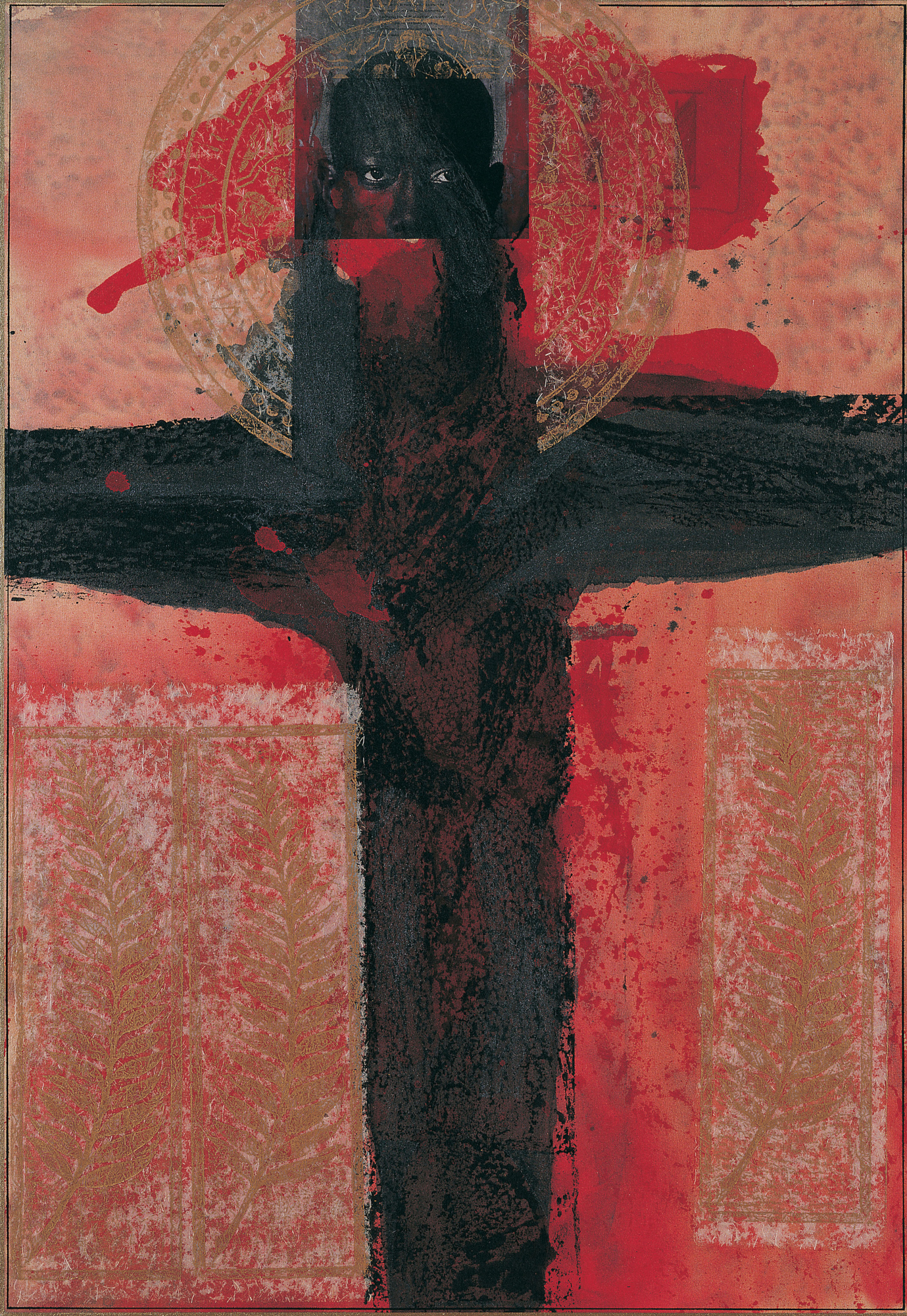
Last month when I was driving home to Maryland from Connecticut, I decided to stop for an hour or two at the Newark Museum of Art in New Jersey. I wanted to see a monumental Nativity painting in their collection by Joseph Stella. It didn’t end up being on display, but I did find many other compelling works. Chief among them was the acrollage painting Christ of the Christians by Nuyorican (New York Puerto Rican) artist Rodríguez Calero, a variation on the Crucifixion that portrays the violence of the cross in the abstract.
Rodríguez Calero (Puerto Rican, 1959–), Christ of the Christians, 1995. Acrollage on canvas, 52 × 36 in. Newark Museum of Art, Newark, New Jersey. All photos (except the two details that follow) courtesy of the artist.
Made with acrylic paint, rice paper, imaged paper, colored glazes, and gold leaf, the work is heavily layered. Its focal point is the direct gaze of a young Black man, his head framed by a shaded gray box and haloed in gold. His face is cut off just above the mouth. The Word is muted.
This figure fragment is at the top terminal of a rough-edged cruciform that is rendered in a harsh tar-black embedded with deep splotches of red. Body merges with cross—blood, wood, and flesh.
The whole background is covered in pinks and reds. The color pools and splatters and permeates, representing the pouring out of life.
Standing upright alongside the cross are three stenciled palm branches, alluding to Christ’s entry into Jerusalem just five days earlier. Palm branches were a symbol of triumph in ancient Judaism, hence their being waved to greet the Christ, the “Anointed One,” at the city gate. (Jesus’s followers anticipated a political victory over Rome, little knowing that God had other plans.) In Christian iconography palm branches are associated with martyrdom; in portraits and heavenscapes they are held by saints who met an early end because of their spiritual convictions, just like their Lord.
Their presence in this scene can be read on the one hand as an indictment of human fickleness (lauding Jesus as savior one day, crucifying him the next) and on the other as an assertion of triumph through the unlikely means of death on a cross.
The work can also be read through the lens of Black suffering and liberation. The late Christian theologian James Cone writes about such themes in The Cross and the Lynching Tree, a landmark book published in 2013, anticipating the Black Lives Matter movement. Cone explains how powerful a symbol the cross has historically been to Black American communities who face racial terror, violence, and oppression. They see in the Crucifixion, in addition to its spiritual implications, a demonstration of God’s solidarity with the oppressed, and hope on the other side. “I’m with you in your suffering,” says the God who hangs on a tree at the behest of a mob, “and death will not have the final word.”
Cone describes the thousands of lynchings of Black men, women, and children in the US as “recrucifixions”—the killing of sons and daughters of God. Two decades earlier, Jamaican American artist Renee Cox made the same connection in her photographic collage It Shall Be Named, just one in a line of artistic works to do so, going as far back as the Harlem Renaissance. Calero’s Christ of the Christians contributes to this tradition.
The gaze of the Christ in her piece is arresting. It confronts. It asserts the sacred humanity of its wearer, despite attempts to blot it out.
However, the artist tells me that for her, Christ of the Christians is about sacrifice, not violence, racial or otherwise. The man in the painting is the “people’s Messiah,” she says, “the anointed Savior to humankind who was sent to save all from the pain, darkness, and injustices that we see on a regular basis.” The cross is “willful humility, the culmination of prophecy, and the fulfillment of promises,” and the crown is heavenly reward. The trinity of branches represents hope.
One of the features that most struck me about this piece is its raised and varied textures, a hallmark all across the artist’s larger body of work. Calero coined the term “acrollage” to describe her mixed-media technique in which she uses an acrylic emulsifier to transfer collaged images (from found elements or her own photographs) onto painted canvas, adding further embellishments with gold leaf, stenciled patterns, and rice paper. This technique of layering materials, producing veils, suggests a theme of hiddenness and revelation.
Rodríguez Calero, or RoCa for short, was born in Arecibo, Puerto Rico, in 1959 and moved to Brooklyn when she was a year old. She returned to Puerto Rico after high school to study at the Escuela de Artes Plásticas at the Instituto de Cultura Puertorriqueña, under master artist Lorenzo Homar, who specialized in printmaking. Then she returned to New York for additional training in painting and collage under artist Leo Manso. She currently resides in New York and New Jersey.
Calero’s work merges Catholic iconography and hip-hop culture, drawing her personal community into the visual lexicon of the sacred. Raised Catholic, she was influenced from an early age by religious imagery at church and school. She brings this influence to bear in her artistic work while also integrating and reflecting the multiracial, multiethnic, urban environment she grew up in. “My inspiration really comes from just being in the neighborhood . . . the people walking the streets,” she says.
Alejandro Anreus, art historian and curator of the major 2015 exhibition Rodríguez Calero: Urban Martyrs and Latter-Day Santos at El Museo del Barrio in New York, describes the Nuyorican art aesthetic that was just getting off the ground while Calero studied at the Art Students League of New York from 1976 to 1982:
Starting before 1970—crystalizing possibly with the foundation of the Taller Boricua in New York City—and emerging and developing throughout the 1970s and into the 1980s, a specific aesthetic that can be defined as Nuyorican came into being. The aesthetic of New York Puerto Rican art was a diverse fusion of abstract expressionism and geometric abstraction, surrealism and social realism, as well as assemblage and constructions incorporating cultural and ethnic icons. The ethnic and cultural icons reflected several thematic preoccupations, which included Taino and Afro-Hispano imagery, depictions of barrio life, a popular, even populist Catholicism, and the belief that everyone, particularly the poor and marginalized of the neighborhoods, has dignity and inner worth regardless of social status. [exhibition catalog, p. 23]
The Christian doctrine of the imago Dei—that all human beings bear God’s image—is a central theme in Calero’s work. In His Image even adopts this theological language from the book of Genesis in its title, reminding us that God created each and every person with intrinsic and objective value, a reflection of his own divine self.
Rodríguez Calero (Puerto Rican, 1959–), In His Image, 1994. Acrollage on canvas, 36 × 24 in.
The piece shows a Black man dressed in a coat and beanie looking pensive and forlorn, his eyes downcast. Rectilinear pieces of teal-blue handmade paper form a cross behind him, and the outline of a manhole cover labeled “PUBLIC SERVICE” is superimposed over his face, doubling as a halo. In Christian art the halo signifies the light of Christ shining around and through a person, and Calero often adopts that device to underscore the sacred humanity of her subjects.
But the cross-hatching of this round form across the man’s face gives the impression of prison bars. Is he headed to prison, or is that destination merely what others, those with shallow or skewed vision, see when they look at him? Maybe he feels imprisoned by his circumstances. Or perhaps he is experiencing some kind of mental captivity. Whatever the nature of the confinement, those bars need to be broken. God wants every human being to be free and flourishing.
Rodríguez Calero (Puerto Rican, 1959–), El Hijo de Dios, 1995. Acrollage on canvas, 36 × 24 in.
The youth in El Hijo de Dios also shines forth God’s image. He looks straight out at the viewer from under his red Karl Kani sweatshirt hood, with a softness and a self-awareness that evoke empathy. A gilded pattern of crosses in diamonds cuts across the middle third of the acrollage, and a dot-rimmed semicircle, a halo fragment, seems to embrace the boy. The delicacy of this intervention over the thick, heavy folds of the cotton sportswear creates an intriguing mix.
To the boy’s right is a collaged face of a male in profile that looks like it could have been taken out of a Picasso painting. He could be an extension of the primary figure, his face set on a path. Or he could be someone who is at cross-purposes with him, as they are oriented at a ninety-degree angle from each other.
Translated “The Son of God,” the title of this acrollage could refer to Jesus Christ, who bears this title in a special sense, as the only begotten of God the Father. The man does seem to embody the vulnerability and determination that characterize Christ in his passion. Alternatively, it could refer to a child of God more generally, as the Spanish hijo is not necessarily male-specific. The particular and the universal are both at play here. We are all God’s children (Acts 17:28–29), equally and eternally beloved.
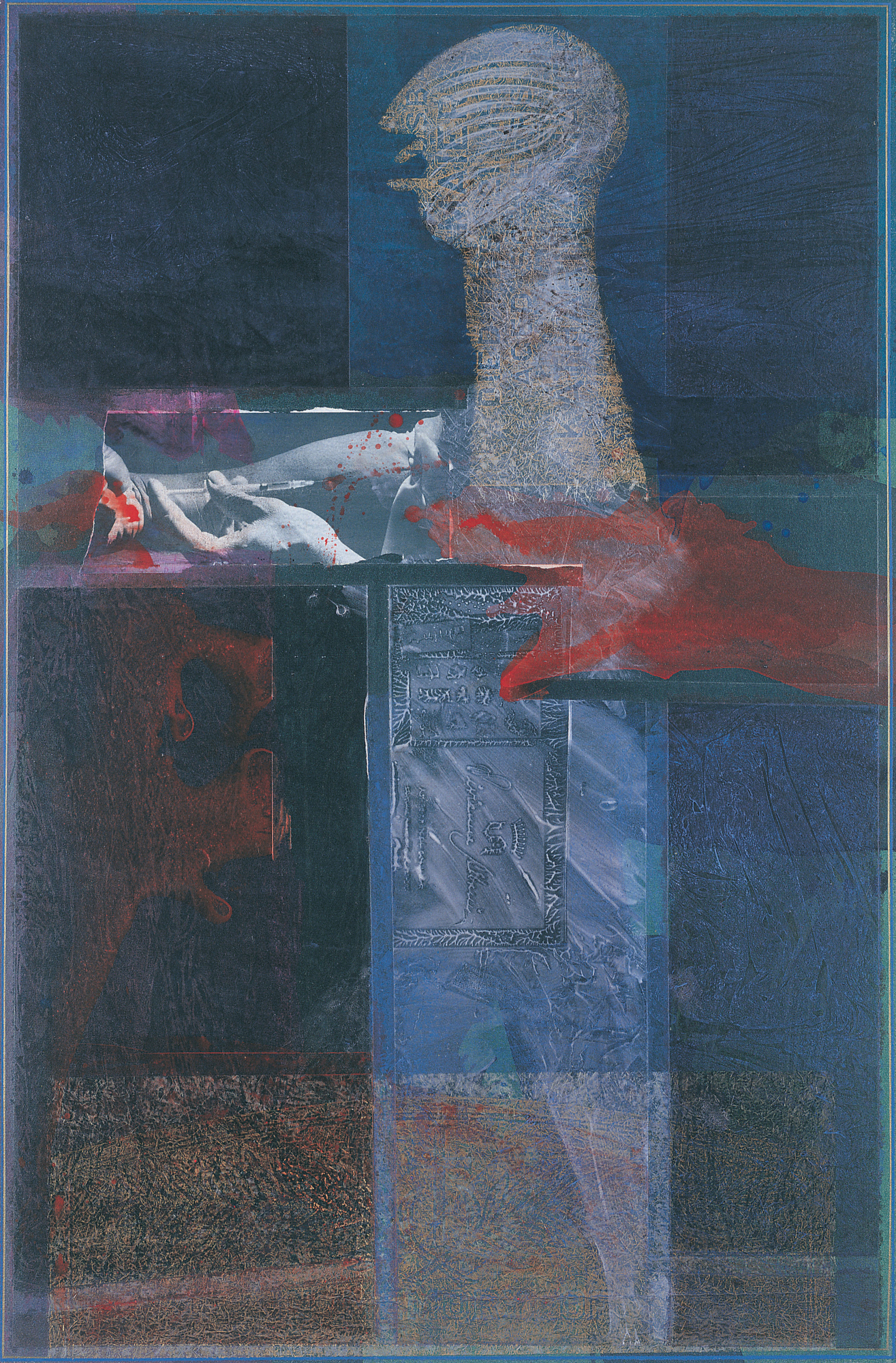
Rodríguez Calero (Puerto Rican, 1959–), Cruz de Loisaida, 1994. Acrollage on canvas, 64 × 42 in.
God’s love reaches especially into places of darkness, even though we don’t always feel it. In Cruz de Loisaida, our eyes are drawn to a monochrome found image of a hand injecting heroin into an arm. This fragment forms part of an abstracted cross, that archetypal symbol of deep suffering. The title, which translates to “Cross of Loisaida,” references a Lower East Side neighborhood with a strong Puerto Rican heritage. The piece laments the pain and anguish of drug addiction and, the artist says, the burdens forced on the Puerto Rican community by the government (“we are the sacrificial lambs”). Red pigment spills forth from the arm, evoking blood.
Rodríguez Calero (Puerto Rican, 1959–), Crowned with Thorns, 1999. Acrollage on canvas, 36 × 24 in.
Another acrollage that alludes to Christ’s passion is Crowned with Thorns, which is dominated by a large orange halo filled with linear and organic designs and cut out narrowly to reveal the face of a Black man. This headpiece is not obviously a crown of suffering; instead, it seems to convey an unironic air of royalty. It contains palm branches and irradiating gold lines that branch out like the veins of a leaf. And it smolders like fire. Could this be I AM speaking from the burning bush? The lush floral patterns, the Voice abloom?
By virtue of its historical associations, the title connects the man to Christ. With his hands he touches his Sacred Heart.
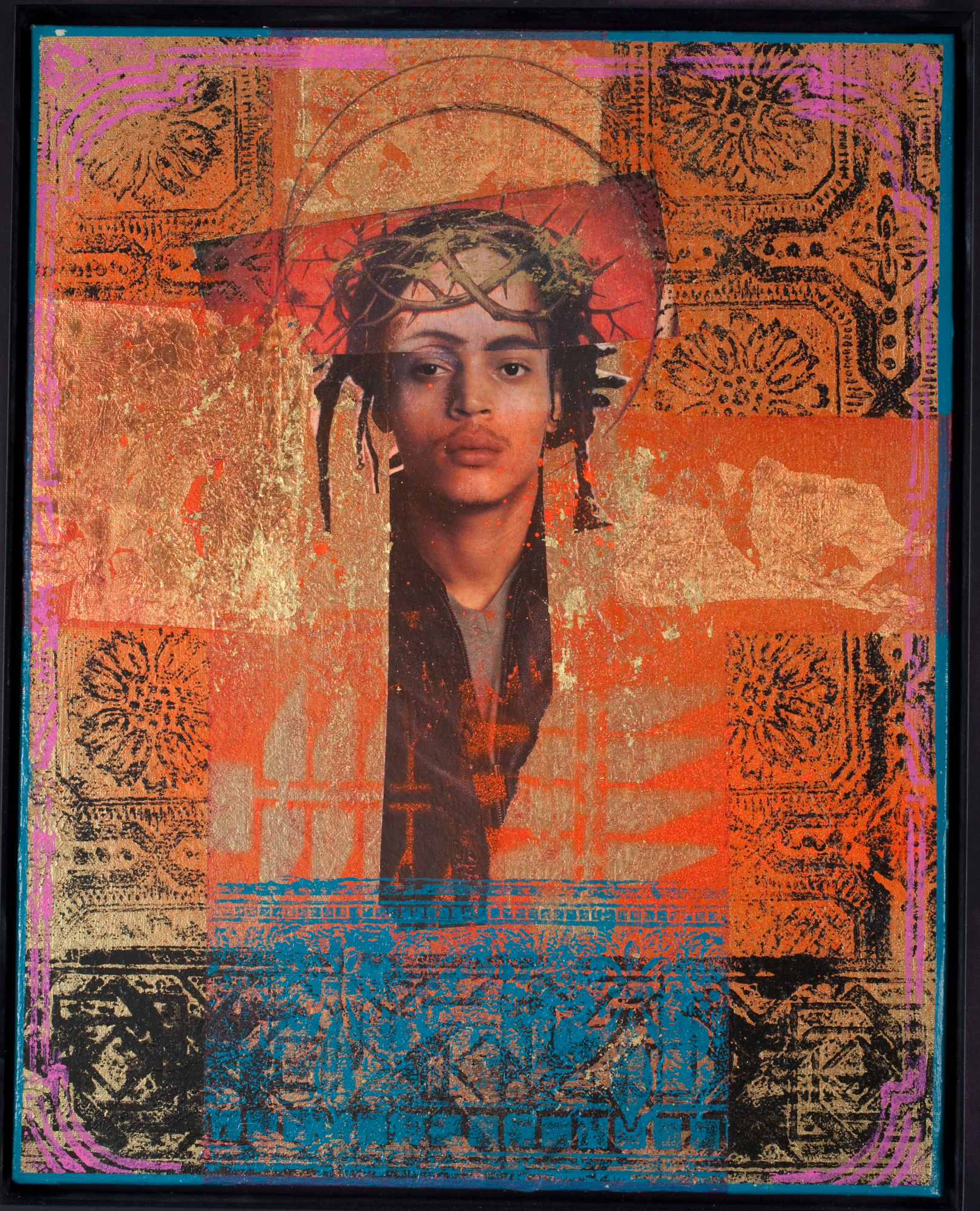
Rodríguez Calero (Puerto Rican, 1959–), The Chosen, 2000. Acrollage on canvas, 20 × 16 in.
One piece that appropriates unmistakable imagery of Christ is The Chosen: it contains a fragment of a Dutch Renaissance painting in the National Gallery of Christ crowned with thorns. Calero has cropped a detail of the gnarly crown piercing (a Caucasian) Christ’s forehead and collaged it with the face of a Latino man and the locs of a third (presumably a Black man). Her multiracial Jesus is nimbed twice over and emerges as if from a behind gold curtain, his brown eyes holding our gaze. He is surrounded by black-ink prints of flowers and crosses and flanked, as in Christ of the Christians, by golden palm branches. Droplets of red paint are splattered about his face and torso, one resting prominently on his upper right cheek like a tear.
Like Jesus, the Virgin Mary, his mother, is a major religious figure in Puerto Rican culture, and Calero references her in several of her artworks. Ángel y Maria depicts the moment of Annunciation, when the angel Gabriel comes to Mary to tell her that she has been chosen to bear God’s Son (Luke 1:26–38).
Rodríguez Calero (Puerto Rican, 1959–), Ángel y María, 2000. Acrollage on canvas, 52 × 36 in.
It’s a stunning image, bringing new life to a subject that has been painted hundreds of thousands of times over the course of history, starting with the ancient Roman catacombs. In Calero’s take, Mary is portrayed as a beautiful young woman of African descent who sits in profile, contemplating the gravity of what has just been asked of her. She holds a bouquet of flowers to her chest—perhaps she was in the midst of picking or arranging them when Gabriel arrived.
Gabriel stands in formality, cognizant of the weight of his message, patiently awaiting a response. His body is rendered in a wash of colors that blend into one another, producing an ethereal look.
Mary’s lips are parted, speaking her yes.
“The theme is love,” Calero told me. “The flowers are a representation of the blessing already inside.”
In the gospel story, this supernatural encounter results in a miraculous pregnancy, pictured in Calero’s La Madonna Negra (The Black Madonna). The image is of the Madonna del Parto (Our Lady of Parturition) type—that is, the pregnant Mary. We don’t often see Mary’s bare belly in all its pregnant glory, but here we are given a glimpse and reminded of the bodiliness of the Incarnation. We can even see the linea nigra extending across her belly button!
Rodríguez Calero (Puerto Rican, 1959–), La Madonna Negra, 2007. Acrollage on canvas, 54 × 24 in.
Calero’s Afro-Latina Madonna has two sets of arms. With one, she cradles her third-trimester baby bump and clenches the veil near her face, and the other she extends outward in a gesture of giving, offering the fruit of her womb for the life of the world (notice the printed impression of a fetus in her upper left hand). I love how these multiple gestures capture the conflicting instincts she must have felt—on the one hand, to keep the child to herself, to protect him from harm, and on the other, knowing her ministry is to support his, to share him with everyone. I see both Mary’s fear and her surrender in this image; her very human “What if I’m not ready for this?” and her “Welcome; come, receive.”
Rodríguez Calero (Puerto Rican, 1959–), Virgen María, 2000. Acrollage on canvas, 52 × 34 in. Collection of María Domínguéz-Morales and Juan M. Morales.
There’s also a hybridity in Virgen María, which shows a woman whose face is an amalgam of “every woman,” says the artist. Strong and confident, this Mary takes up space. Streaks of red paint cut across her torso like cords—but she spreads her arms, breaking what binds her. The bottom half of the canvas consists of blues and reds, Mary’s traditional colors, while the top half is gold, signifying the light of God.
“Mary, for me, has always been pictured as passive, and dressed in blue,” Calero told me. “Think about God in heaven, searching the world for the perfect woman to bear his Son. Now, in that state of mind, I thought Mary was chosen for her beauty, strength, compassion, intellect, and sexiness, and must represent all women, hence my Virgen María.”
Just as Calero often composites people of different races and ethnicities, she also occasionally mixes genders, as in Divine Prophet.
Rodríguez Calero (Puerto Rican, 1959–), Divine Prophet, 2012. Acrollage on canvas, 54 × 36 in.
This prophet’s face is made up of three collaged elements. A male with long hair and closely cropped facial hair forms the base, but the two eyes, underlined in blue shadow, are clearly a woman’s. And a mystical third eye is patched onto the forehead.
In Eastern spirituality, the third eye, also called the inner eye, provides perception beyond ordinary sight. The prophet, for example, sees visions of a reality that is presently invisible but that will one day be made manifest. The third eye symbolizes a state of enlightenment.
The prophet in this piece could be Jesus, or an Old Testament seer, or a prophet from another faith tradition. If the former, it’s interesting to consider how male and female are both contained in the Godhead, per Genesis 1:27. Although the second person of the Trinity incarnated as a male, there’s a long tradition of ascribing feminine attributes to Christ, from Clement to Ephrem to Anselm to Marguerite d’Oingt to Julian of Norwich. Christ is our Mother, they say, who labors to bring us to birth and feeds us at his breast. Moreover, the biblical book of Proverbs personifies Wisdom as a woman, and that woman is associated with Christ.
Centuries of European religious art and its mass-produced derivatives have harnessed the popular imagination to a narrow view of what the sacred looks like. Because of this conditioning through images, most people all over the world, not just in the West, conceive of Jesus, Mary, and the saints—those due honor—as white. Calero challenges that conception, not erasing whites but broadening the tent of sacred imagery to encompass people of color as well.
Most of her “saints” are not historical. They’re ordinary folks from New York’s barrios, or from other US cities—and from today. With their strong frontal poses, direct gazes, and haloes, they reflect the dignified, divine image–bearing status of those whom traditional Christian iconography has tended to exclude.
“Her saints—santos—are latter day and among us, her martyrs are our contemporaries,” says Alejandro Anreus. “They all live and struggle in an urban world filled with tension, even violence, as well as humor, yet open to epiphanies, where miracles can happen.” And, he continues, “her representations of Jesus Christ become all of us, as if reflecting the variety of humanity redeemed by Christ.”
(Regarding Anreus’s crucial last point: I articulated some of my thoughts on the matter a few years ago in this Instagram post.)
Black and brown bodies are beautiful and good, bearing the imprint of God their Creator. Rodríguez Calero helps us see and celebrate that. Bringing her cultural heritage to the fore, she cuts and combines, mixes and matches, contemplates, plays, and intuits, constructing affirming figure-based images of flesh and spirit that, while borrowing Christian visual tropes, are not tethered to Christianity but rather can live and move beyond an orthodox framework.
To learn more about Calero’s art training, her oeuvre, and collage as an art form, see the catalog for her retrospective (written in English and Spanish). You can also visit her website, www.rodriguezcalero.com.
Today’s roundup brings together a theologian (Anderson Jeremiah), an art historian (Elissa Yukiko Weichbrodt), and a musician (Eric Lige and friends) who I think complement one another really well!
SONGS:
Eric Lige [previously] is “a music-maker who promotes Jesus, Justice, Faith, and Community.” He is the worship director at Ethnos Community Church in San Diego and the co-executive producer of The Ethnos Project, which creates a platform for new and emerging global voices in musical worship to be heard worldwide. Especially since COVID hit in 2019, he has been assembling multinational teams of musicians to produce YouTube videos, many of which are livestreamed as part of Ethnos worship services. Here are three examples (view more on Lige’s YouTube channel):
>> “Ξεδιψασμένος (No Longer Thirsty)” by Kostas Nikolaou: A contemporary Christian worship song in Greek, about how Christ, the living water, quenches our thirst for love and purpose. The lead vocalist is Nefeli Papanagi—and wow, do I love her voice!
>> “Ua Mau (Hosanna)” by Moses W. Kaaneikawahaale Keale (aka Keale Ta Kaula): Reyn and Joy Nishii perform this nineteenth-century Hawaiian hymn by Keale “the Prophet,” who converted to Christianity after calling on God during a hunting accident and finding rescue. The first verse translates to “Perpetual is the righteousness / That comes from the Father above / Let us gather together / In his goodness and grace.”
>> “Love’s in Need of Love Today” by Stevie Wonder: Edward Chen and friends—from Canada, the United States, Armenia, Venezuela, and Mexico—perform the opening track from Stevie Wonder’s Grammy-winning album Songs in the Key of Life. “God gave me this gift, and this particular song was a message I was supposed to deliver,” Wonder has said. “The concept I had in mind was that for love to be effective, it has to be fed.” See the full list of credits in the description on the video page. Eric Lige is the one in the maroon shirt.
+++
LECTURES:
>> “Many Faces of Jesus: Christologies from the Margins” by the Revd. Canon Dr. Anderson H. M. Jeremiah, October 12, 2021: Anderson Jeremiah is a senior lecturer in the politics, philosophy, and religion department at Lancaster University in the UK, whose areas of expertise include Christian theology in Asia, postcolonial approaches to theology, Dalit studies, liberation theology, modern missionary movements, and inculturation and faith. Ordained in the Church of South India (part of the Anglican Communion), he was installed as Canon Theologian of Blackburn Cathedral in September 2021, making him the first Dalit to be appointed to that role in any English cathedral.
In this half-hour online talk given last fall for the Diocese of Manchester, Jeremiah discusses the Incarnation as a continuous event—Christ being born into human cultures—as expressed through a selection of visual artworks from Ghana, Bolivia, China, Japan, and India. These images subvert the predominant Western image of Christ and sometimes provide critique. New to me was the black marble crucifix from the Anglican chapel inside Cape Coast Castle, a former trading post (now a museum) where enslaved Africans were held before being loaded onto ships and sold in the Americas. I’m not sure who commissioned the sculpture or when it was placed at this site, but it definitely looks modern.
The Q&A that followed on the original Zoom event is not included in the video, but here’s one of Jeremiah’s comments from it that I transcribed: “Jesus is not foreign to my own experience; this Jesus is part and parcel of my own existential reality. It [the image] enables people who are seeking peace and emancipation; [they are] emboldened in that process of seeing themselves reflected in the image of Jesus. The normative image the church has been holding on to has not created that space.” When one attendee asked if images of white Jesus are always “wrong” or to be discouraged, Jeremiah replied that there’s nothing wrong with such an image in itself, but the problem is when it is imposed on the entire world as the only way of looking at Jesus. “When we hold up one image as normative, we lose the diverse ways God intends to manifest himself in diverse contexts,” he said. (I couldn’t agree more!)
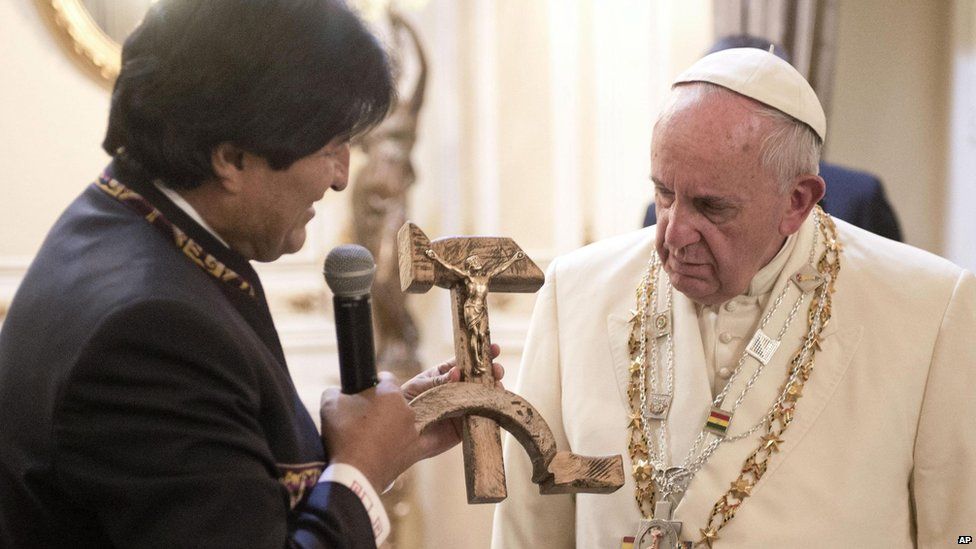
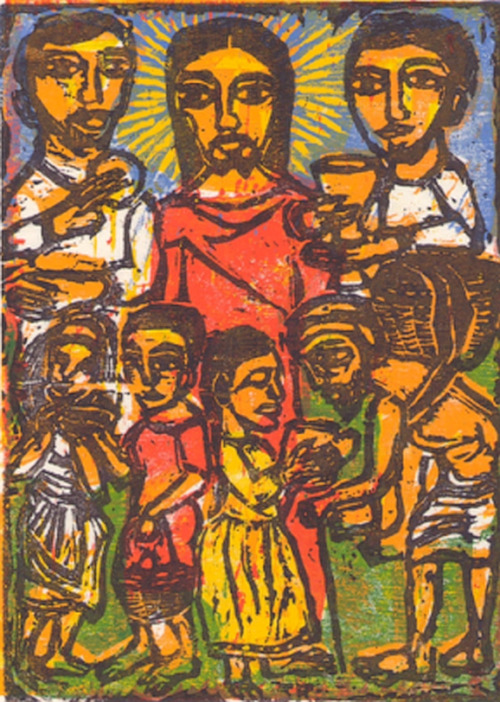
In July 2015 Bolivian president Evo Morales (who is Aymara) presented to Pope Francis a crucifix sculpted in the shape of a hammer and sickle. The crucifix is based on a design by Luís Espinal (1932–1980), a Jesuit priest assassinated in 1980 by right-wing militia. Bolivia’s communications minister, Marianela Paco, told Bolivian radio that “the sickle evokes the peasant, the hammer the carpenter, representing humble workers, God’s people.” Photo: AP.Solomon Raj (Indian, 1921–2019), The Lord Remembers the Hungry: Liberation from Hunger, 2006 (based on the 1988 original). Woodcut, from the series “Liberation in Luke’s Gospel.”
In this undergraduate lecture (starts at 4:06), Weichbrodt discusses how photography has been used to shape racial bias and even construct race, as well as gender, focusing on a famous 1957 photograph of school desegregation in Little Rock, Arkansas. She shows how this single photo is part of a larger web of meaning that contemporary news photos also play into. We’re always interpreting and categorizing images in relationship to things we’ve already seen, Weichbrodt says, creating a mental archive—for example, a file for “blackness,” a file for “womanhood.” And “as Christians called to recognize the dignity of God’s image in all people, we have to do actual work to acknowledge how our own archives may have hampered or distorted our love for our neighbors.” To look more faithfully, we need to look more; we need to build a broader archive.
The doctrine of the imago Dei—which states that human beings were uniquely created in the image of God and continue to bear that image—is central to Christian theology, for it tells us who (and Whose) we are. The book The Image of God in an Image Driven Age: Explorations in Theological Anthropology(Downers Grove, Illinois: InterVarsity Press, 2016), edited by Beth Felker Jones and Jeffrey W. Barbeau, delves into that doctrine, examining its implications for relationships, ethics, sexuality, consumer visual culture, art making, dissemination of the gospel, and more. Comprising twelve essays that resulted from the 2015 Wheaton Theology Conference, the book explores what it means to be made in God’s image and issues a challenge: that we resist all the false images that try to topple the one true image in our lives.
Two of the chapters revolve around visual images. In chapter 5, “Culture Breaking: In Praise of Iconoclasm,” Matthew J. Milliner starts out by stating that we live in an optocracy—that is, we are ruled by what our eyes see. Advertisements (billboards, commercials, magazines, web banners), celebrity coverage, and product packaging and store displays are high up on the throne, and we think and act according to their influence.
To illustrate the takeover of unedifying imagery, he cites Limelight Shops, a mini-mall in New York City that inhabits the deconsecrated Church of the Holy Communion. Where a Christian community once thrived, signage and shop displays now parody Christianity, beckoning shoppers to “be transformed,” to try on True Religion jeans in confession-booth dressing rooms, and to indulge in a “slice of heaven” at the pizzeria.
Milliner calls for opposition to the deleterious aspects of our optocracy, a reclamation of our iconoclastic heritage (which, he notes later with examples, belongs to all three branches of Christianity, not just Protestantism):
Evangelicals have spent the last half of the century embarrassed of their iconoclastic heritage and attempting to make themselves culturally serious. But the challenge that is so clear in the case of Limelight Shops might spur us to reactivate our iconoclastic heritage as well. Our charge may be not only to go about culture making but to do some culture breaking as well, for breaking is what the people of God do when they find themselves in Babylon. (112)
He endorses not a literal breaking but a mental and rhetorical breaking, much as the Israelites did when they were in Babylon (e.g., Jeremiah 10:5). We need to break the power certain images hold over us, say no to their attempts to shape and define us. God alone can tell us who we truly are, and we bear his imprint.
Many contemporary artists in the macro–art world would claim to share Milliner’s iconoclastic impulse, but in practice, most of them fail to effectively break anything, and Milliner gives a few examples of those failures. Then he recounts several successes from within his own immediate sphere: works by his art faculty colleagues at Wheaton College. Among the commendable works he discusses are Jeremy Botts’s Bee in Hand; Greg Halvorsen Schreck’s Lambertian photograph The Shroud and his American Trinity and the Cry of the Deer (I covered Botts’s and Schreck’s Via Dolorosa cycle in February); David J. P. Hooker’s Corpus(pictured on the book’s cover); and Joel Sheesley’s Camels and his Good Shepherd mural at the local All Souls Anglican Church—all of which are reproduced as halftones in the book. These artists demonstrate different ways to break by making and vice versa—to engage in “creative destruction,” as Philip Jenkins puts it in the final chapter (259).
Joel Sheesley (American, 1950–), Camels, 1993. Oil on canvas, 58 × 53 in. In the narthex of All Souls Anglican Church, Wheaton, Illinois.







 The doctrine of the imago Dei—which states that human beings were uniquely created in the image of God and continue to bear that image—is central to Christian theology, for it tells us who (and Whose) we are. The book
 Art & Theology