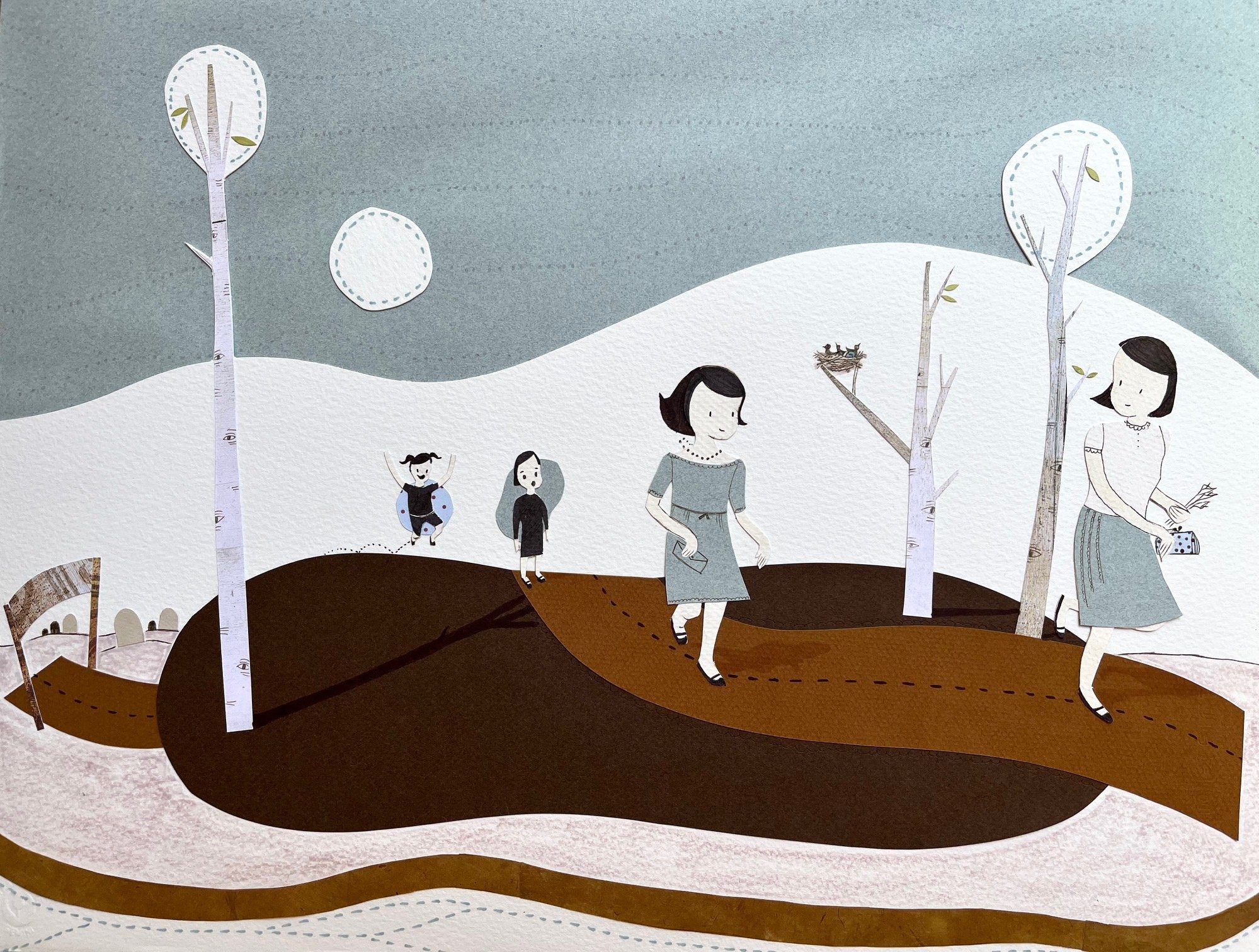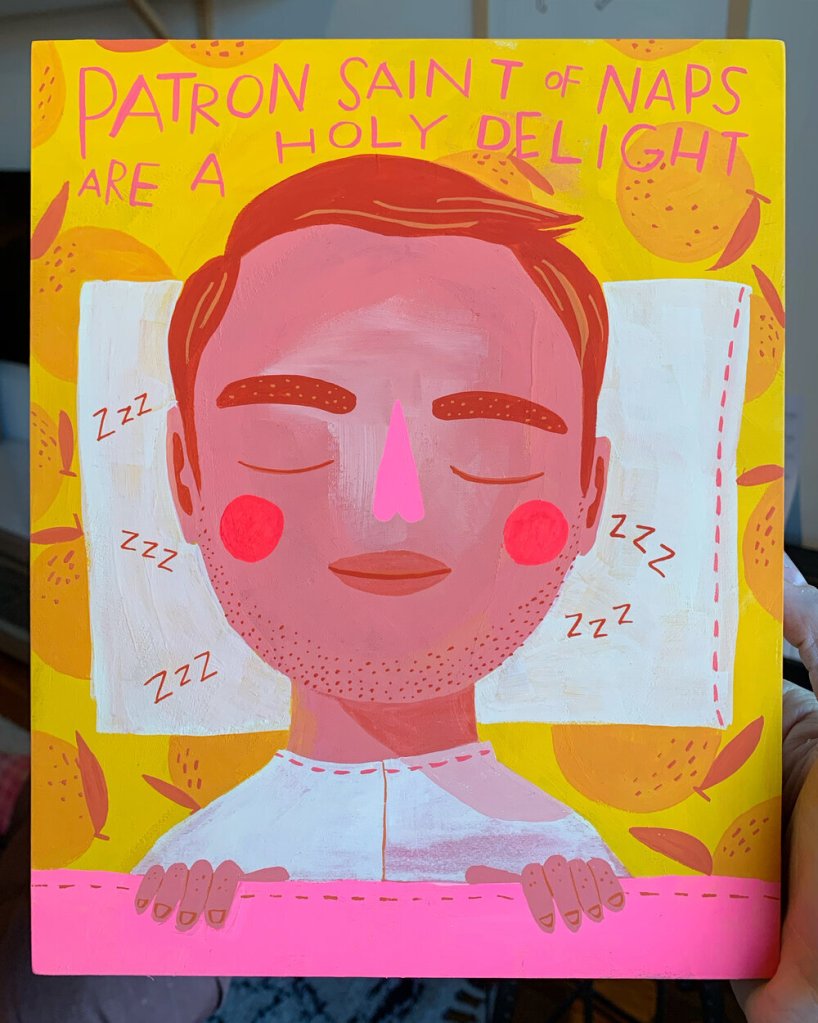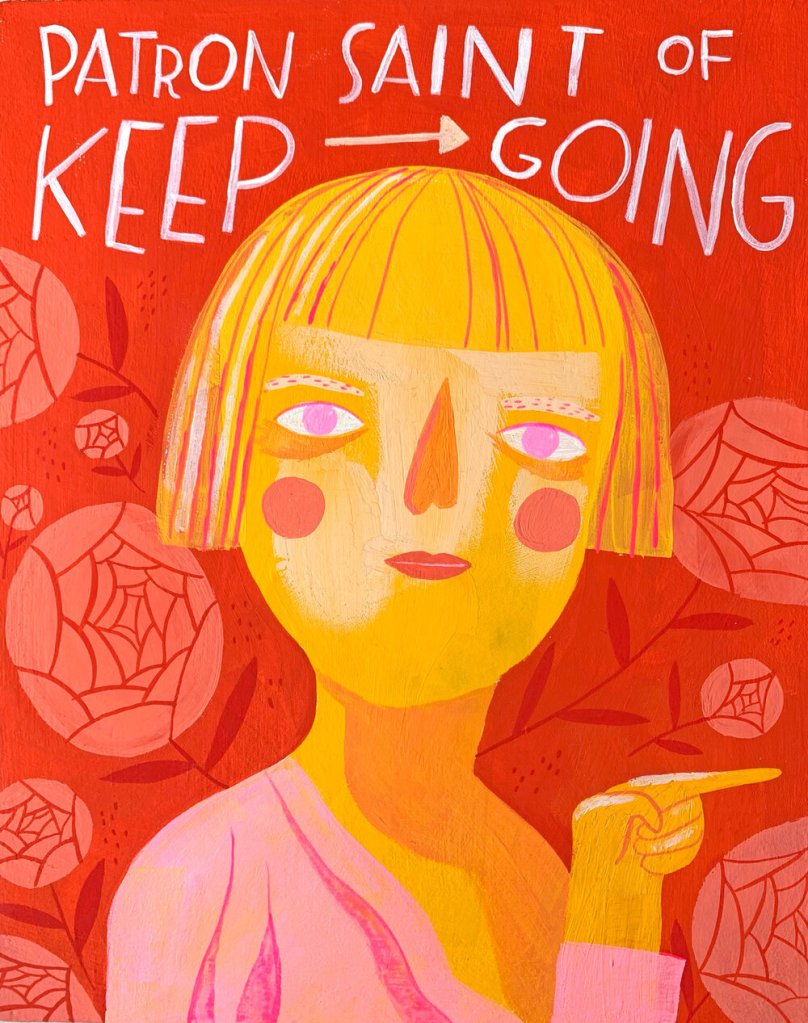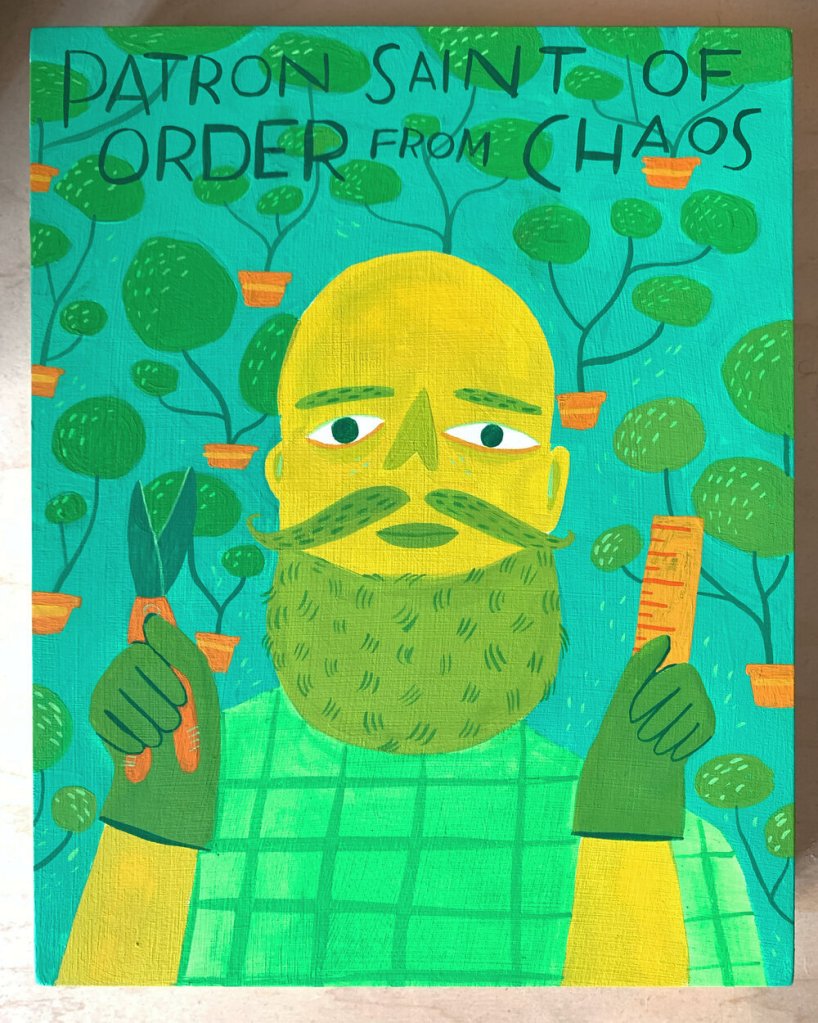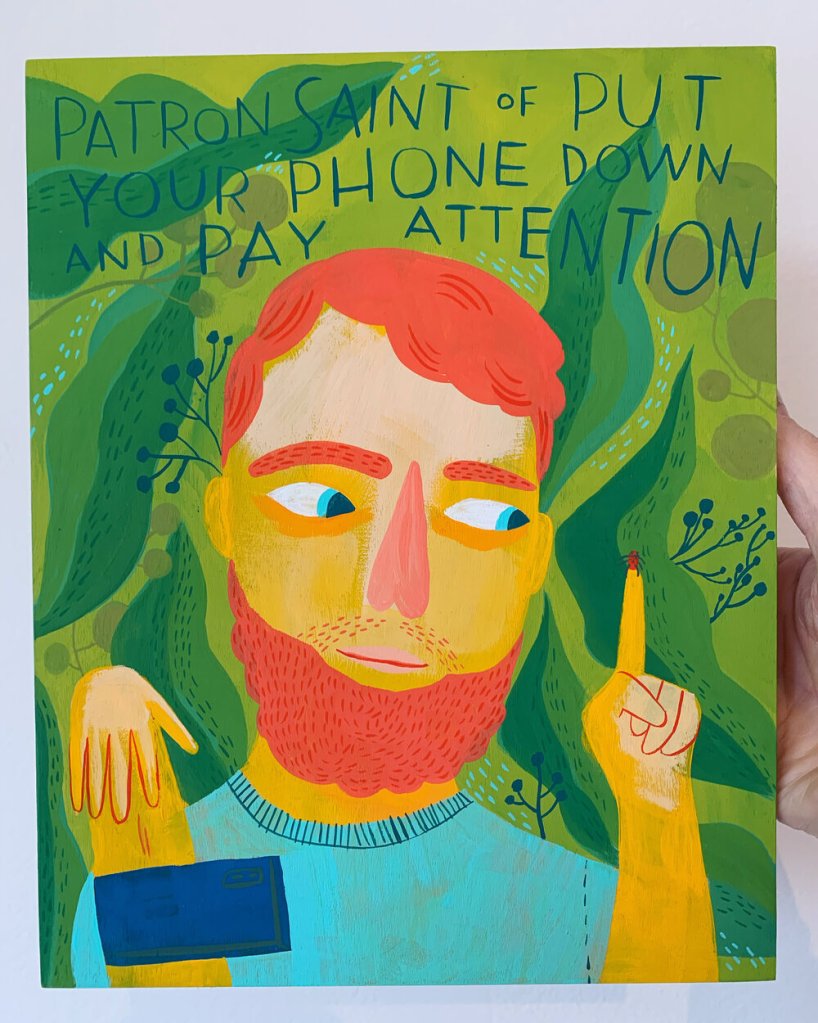
ADVENT SERIES: Restful Advent by Tamara Hill Murphy:Tamara Hill Murphy [previously] is one of my favorite spiritual writers, her thoughtful words and curation of resources having served as a well of inspiration for me over the years. Each year, similar to Art & Theology but with the sensibilities and expertise of an Anglican spiritual director, she publishes a new daily Advent and Christmastide guide through her Substack, Restful, running this year from November 30 to January 5. Each post in the series includes lectionary readings, art, music, a prayer, and a simple practice to help us notice God’s presence during these waiting days. This time around, the Daybook will feature excerpts from Claude Atcho’s new book Rhythms of Faith along with ideas from The Liturgical Home by Ashley Tumlin Wallace and some of my own formerly published art commentaries.
“The Daybook is a way to pay attention to Christ’s three arrivals—then, now, and still to come—and to walk through December with a quieter heart and a stronger hope,” Murphy writes.
Murphy is offering Art & Theology readers a 50% discount to Restful using this link, which brings the subscription cost down to $4/month (let it run for two months if you want to receive the full Christmastide Daybook) or $32/year, which will give you access to her year-round content. The offer expires January 5, 2026.
+++
BLOG POST: “The Sacred Journey of Advent” by Ashley Tumlin Wallace, The Liturgical Home: “Advent,” writes Wallace, “is a season of preparation, for the coming of Christ at Christmas, and also for His return in glory at the end of time.” This is a great introduction to the season that kicks off the new church year.
+++
SONGS:
One of the scripture texts of Advent is Isaiah 40:3–5:
A voice cries out: “In the wilderness prepare the way of the LORD; make straight in the desert a highway for our God. Every valley shall be lifted up, and every mountain and hill be made low; the uneven ground shall become level, and the rough places a plain. Then the glory of the LORD shall be revealed, and all flesh shall see it together, for the mouth of the LORD has spoken.”
The Gospel-writers Matthew (3:3), Mark (1:3), and Luke (3:4) all see this exclamatory figure as John the Baptist, who told people to prepare for God’s coming by repenting of sin, since holding on tightly to ways of unlove erects barriers to God’s entry into one’s life. Here are two songs based on this Advent passage.
>> “Prepare the Way” by Maverick City Music and Tribl, feat. Chandler Moore and Siri Worku, on Tribl I (2021): This song repeats, again and again, the Advent mantra “Prepare the way,” embedding John the Baptist’s invitation deeply into hearts and minds. Its tag beseeches Christ to come with the fire of purging, the rain of refreshment, and the oil of blessing. To welcome this coming, this transformation and growth, we need to decenter ourselves, ceding to God the place of primacy, from which he works our good and his glory.
>> “Prepare the Way” by Christopher Walker, on Rise Up and Sing, 3rd ed., vol. 3 (2009): This 1991 song is by Christopher Walker, a church music composer, lecturer, and choral conductor originally from the UK but now living in Santa Monica, California. Published by OCP (Oregon Catholic Press), it would make a great song for a children’s Advent choir.
+++
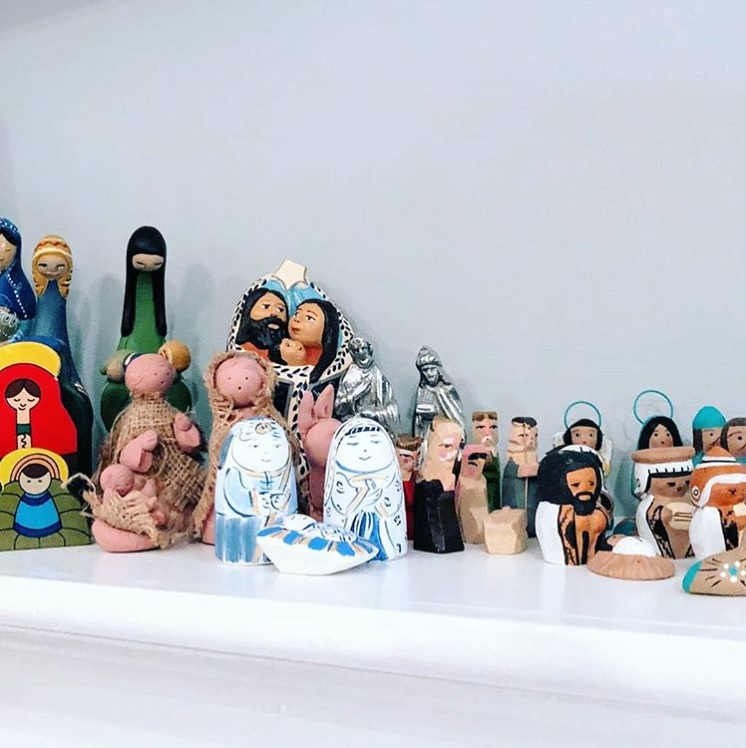
2018 SERIES: Advent Caravan: Walking with the Holy Family by Sarah Quezada: I learned about Sarah Quezada’s work at the intersection of faith, justice, and culture through Tamara Hill Murphy (see first roundup item) in 2018, when Quezada published a five-part series reflecting on the likelihood that Mary and Joseph traveled to Bethlehem for the census not alone but in a caravan. Interweaving personal story, biblical interpretation, and current events, Quezada considers how the holy couple’s experience in the final months of Mary’s pregnancy connects to the reality of people on the move seeking hope, peace, joy, and love today.
While the series is not hosted online, I received permission from Quezada to reproduce it here.
On Instagram, Quezada also shared a photo of her friend’s Advent mantel, where she combined figurines from her various nativity sets to form a “caravan” of travelers.
Photo via @sarahquezada
+++
YOUTUBE PLAYLIST: Jouluradion Hoosianna: Jouluradio is a Finnish radio station that broadcasts annually from November 1 to January 6, playing all Advent and Christmas music. Since 2012, every year they premiere a new arrangement and video performance of the popular Scandinavian Advent hymn “Hoosianna” (Hosanna, an Aramaic expression meaning “Save now!”), which Lutheran and Catholic churches in Finland sing on the first Sunday of the season. Based on Matthew 21:9, its lyrics greet the approaching Christ, affirming his identity and craving the deliverance only he can bring:
Hoosianna, Daavidin Poika, kiitetty olkoon hän! Kiitetty Daavidin Poika, joka tulee Herran nimeen. Hoosianna, hoosianna, hoosianna, hoosianna! Kiitetty Daavidin Poika, joka tulee Herran nimeen.
Hosanna, Son of David, Most blessed Holy One, Hosanna, Son of David, Who comes in the name of the Lord! Hosanna, hosanna, hosanna In the highest! Hosanna, Son of David, Who comes in the name of the Lord!
This hymn was written by the German composer, educator, and piano and organ virtuoso Georg Joseph Vogler in 1795 while working in Sweden as court conductor as well as tutor to the crown prince Gustav IV Adolf.
The Jouluradio commissions, which the station has compiled in a YouTube playlist, encompass a range of genres, including jazz, hip-hop, choral, pop, and electronic. Below is a list of previous years’, of which I’ve embedded the two asterisked ones on this page. Jouluradio typically releases their annual “Hoosianna” the day before Advent, so 2025’s will likely be posted this Saturday. [HT: Gracia Grindal]
*2015: Sointi Jazz Orchestra, arr. Jukka Perko (I don’t really understand the narrative in the video. I think the man is remembering a time in his childhood when he got lost in the woods, and then was found by his mother?)
ONLINE COURSE: Studying the novel Demons by Fyodor Dostoevsky with Brian Zahnd, January 3–March 9, 2026: This ten-week online course led by Pastor Brian Zahnd (a Christian writer and preacher I admire) will explore Dostoevsky’s “darkest and most prophetic novel”: Demons (aka The Possessed or The Devils), a social and political satire, psychological drama, and large-scale tragedy inspired by the true story of a 1869 political murder in Russia. The course sounds intriguing to me, and I’m contemplating whether I can invest the time in a seven-hundred-page book—but I did buy a copy just in case! It’s the only one of the literary master’s four novels I haven’t read.
“Dostoevsky’s Demons changed me,” Zahnd writes on Substack. “From it I learned the danger of giving oneself to an ism instead of to Christ. Isms are idols and they often become demonic. Admittedly Demons is a difficult novel, but it’s also prophetic and timely. . . . As you read Demons, expect to be horrified, but also expect to laugh—you are meant to. During the course we will be horrified and warned, but we will also laugh and learn together.”
The live Q&As will take place the first ten Mondays of 2026 at 5 p.m. CT (6 p.m. ET).
+++
SEMINAR (VIDEO):“How to Watch a Movie (as a Christian)” with Chris Retts and Morgan Jefferson: On his FootnotesSubstack, historian Jemar Tisby recently hosted a teach-in with two team members from the Los Angeles Film Studies Center, a nonprofit educational program designed to give undergraduate students at Christian colleges and universities meaningful experience in the film industry during a semester “abroad” in Los Angeles. Chris Retts is the director of the center, and Morgan Jefferson is an instructor.
Before discussing how to watch a movie, they discuss why Christians should watch movies in the first place, beyond the obvious (enjoyment):
Because general revelation can happen anywhere, even at the movies (Rom. 1:20).
Because movies generate empathy, which is central to the greatest commandment (Matt. 22:37–40).
Because every movie has a theology, and media literacy makes it conscious and discernable (1 John 4:1).
They also discuss the four modes of meaning that filmmakers work with; cinematic language; and four steps for exegeting (“drawing out”) a film.
How does film relate to Dr. Tisby’s work at the intersection of faith, history, and justice? He has written for years about the dangers of white Christian nationalism. He says adherents of that ideology, or any, are not evaluating a list of propositions but are buying into a narrative; and “you can’t meet a narrative with logical reasoning,” he says. “You have to invite them into a counter-narrative—a more beautiful story.” Story is why he’s interested in film, as film is an engaging, and probably the most popular (in the US), storytelling medium. “Stories shape our sense of what’s true, what’s possible, and who belongs. That’s as true for political movements as it is for movies.”
DOCUMENTARY SHORT: The Quilters (2024), dir. Jenifer McShane: This thirty-minute documentary on Netflix follows a group of men in a maximum-security prison in Missouri who design and sew custom quilts for children in foster care using donated fabrics and old machines. They care deeply about the quality of their work—they’re proud of what they make—and are emotional about the recipients, some of whom send thank-you cards. The film is about creating beauty and meaning within strict confines, not letting destructive choices from your past stymie you from making constructive ones in the present.
+++
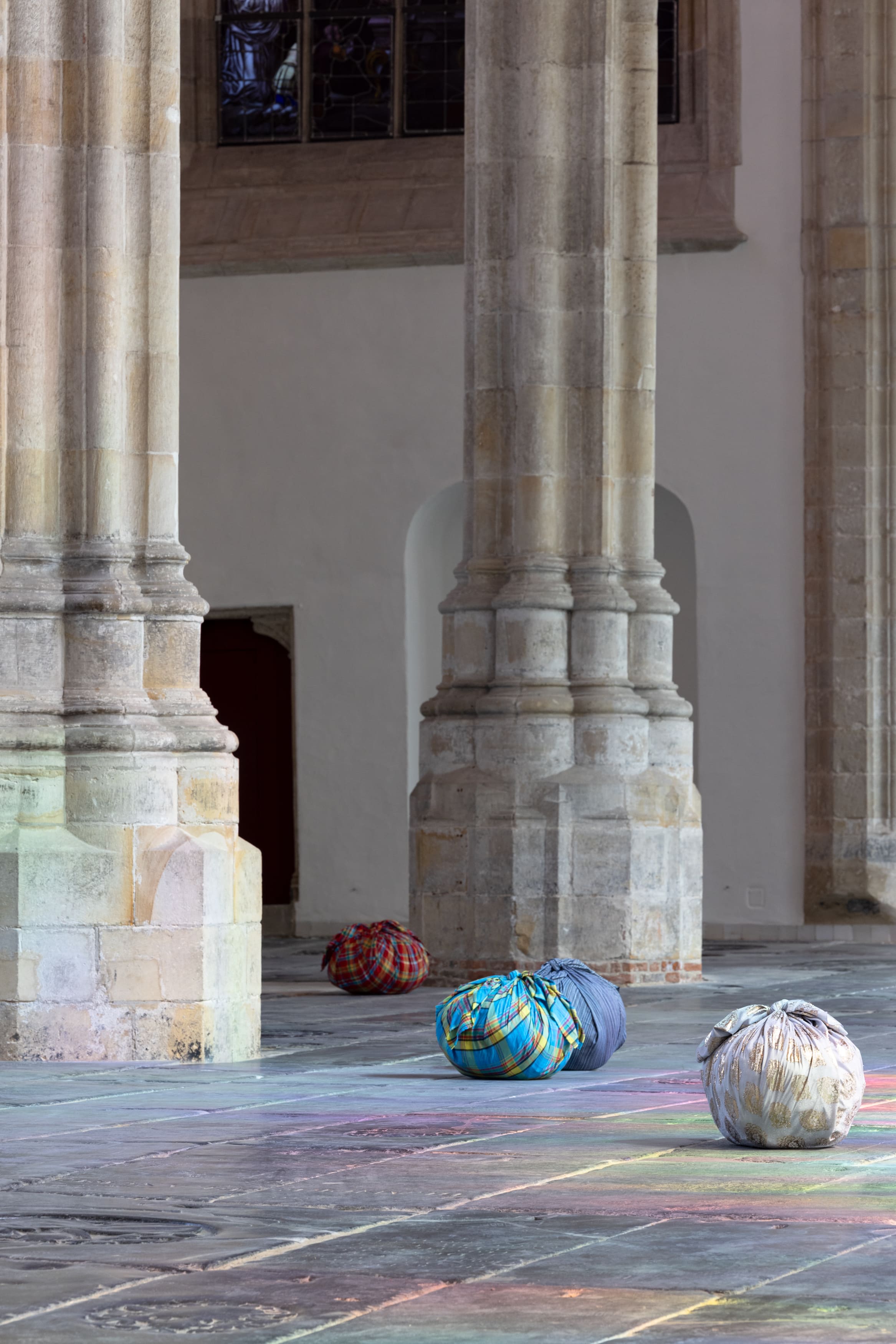
TEMPORARY INSTALLATION: To Breathe—Mokum by Kimsooja, Oude Kerk (Old Church), Amsterdam, May 23–November 9, 2025: Sorry I didn’t get this out while the installation was still up (it wrapped on Sunday), but please do explore the photographic documentation. Kimsooja’s To Breathe—Mokum explores themes of migration, belonging, and the transient nature of home; the Yiddish word in its subtitle means “safe haven.” “At the work’s heart are Kimsooja’s iconic bottari—colorful textile bundles inspired by traditional Korean wrapping cloths,” designboom writes. “Spread across the [medieval] stone floor of the church, these bundles are filled with clothing donated by members of Amsterdam’s diverse communities. Each piece of clothing represents the lives and stories of the people who contribute to the city’s rich multicultural fabric. These textile bundles serve as symbols of both personal and collective journeys, embodying the arrival and departure of individuals who have shaped the identity of the city” over its 750 years.
Kimsooja (Korean, 1957–), To Breathe—Mokum (partial view), 2025. Site-specific installation at Oude Kerk, Amsterdam. Photo: Natascha Libbert.
+++
POEMS:
>> “On the Staten Island Ferry” by A. E. Stallings, Plough, July 1, 2025: Liberty is an American ideal—but for many in this country, an illusory one. Riding in New York Harbor with a boatload of commuters and tourists, Stallings lets settle what a young girl, pointing to the Statue of Liberty, exclaims.
>> “The Pillar of Cloud and Fire”by Anna A. Friedrich, Monafolkspeak (Substack), October 29, 2025: The poet reflects on her confusion as a child about this manifestation of God from the Old Testament, which leads her to surprising insights.
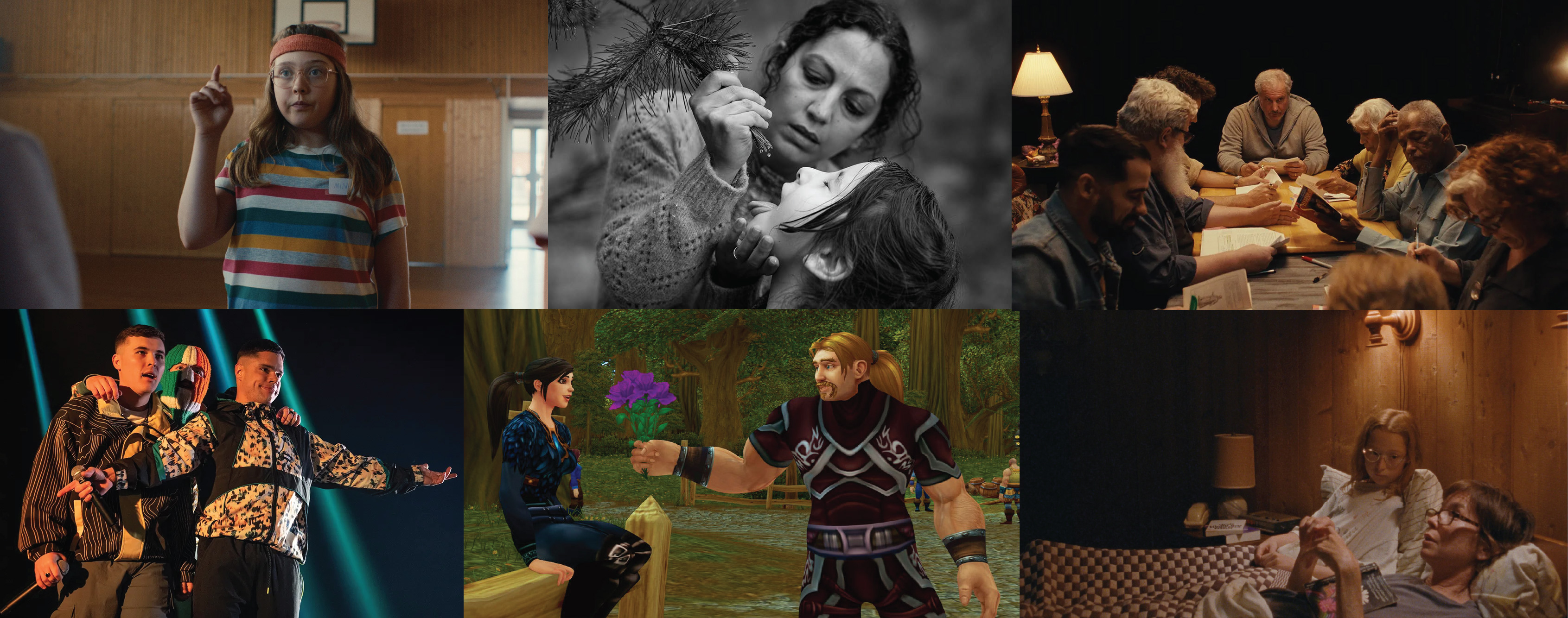
11.Dancing Queen, dir. Aurora Gossé. This coming-of-age dramedy from Norway was not promoted at all in the US but quietly arrived on Google Play early this year—thanks to my YouTube algorithm for suggesting it! Seventh-grade Mina (Liv Elvira Kippersund Larsson) has a crush on Edwin (Vilijar Knutsen Bjaadal), aka E.D. Win, a hip-hop dancer with a large social media following who has just transferred to her school. Despite having no dance experience, Mina decides to audition for his crew ahead of a local competition, and she enlists her grandma (Anne Marit Jacobsen) to train her, and her best friend Markus (Sturla Harbitz) to help her practice the partner work. The film is so endearing, even if a bit predictable in its beats.
12.Ghostlight, dir. Alex Thompson and Kelly O’Sullivan. Dan (Keith Kupferer) is a construction worker who’s grieving a grave loss and is unwilling to open up about it with his wife Sharon (Tara Mallen) and daughter Daisy (Katherine Mallen Kupferer). (The three actors are father-mother-daughter in real life.) One day he inadvertently stumbles into a rehearsal of a community theater production of Romeo and Juliet. The head of the troupe, Rita (Dolly De Leon), invites him to stay, which he reluctantly does. He’s never acted before, but he finds himself taking on a role in the play, which helps him connect with his emotions and with other people and begin his healing journey.
Streaming on AMC+.
13. Janet Planet, dir. Annie Baker. The free-spirited but weary Janet (Julianne Nicholson) lives with her eleven-year-old daughter, Lacy (Zoe Ziegler), in western Massachusetts, running an acupuncture practice out of their home. Lacy is lonely and quirky and craves her mom’s affection; Janet gives it but is usually also absorbed in some kind of interpersonal entanglement. Over the summer of 1991, during which the film is set, a succession of three visitors come in and out of Janet’s life: a live-in boyfriend, a woman trying to escape a cult, and said cult leader. Lacy tolerates these ephemeral presences but wishes her mom were more exclusively available to her. The film is about Lacy learning to share her mom with others and coming to grips with the fact that she is not the only person her mom needs. The last scene, where Lacy comes to this realization while watching her mom contradancing, gutted me!
Streaming on Max.
14.Green Border, dir. Agnieszka Holland. This film is a difficult watch. It dramatizes the humanitarian crisis precipitated in fall 2021 when Alexander Lukashenko, the dictator of Belarus, lured several thousand asylum seekers from the Middle East and Africa to his country with the promise of free transit to the European Union, then dumped them on the borders of Poland, Lithuania, and Latvia as payback for EU sanctions against his country. Green Border focuses on a Syrian refugee family of six (Jalal Altawil plays the father) and an Afghan woman (Behi Djanati Atai) they befriend on the plane ride over—their being tossed (like a football, as one character laments) back and forth across the militarized Polish-Belarussian border, cold and hungry, with neither country willing to receive them.
The film also follows two Poles: border guard Jan (Tomasz Wlosok), who contracts PTSD, and budding activist Julia (Maja Ostaszewska), who joins a group providing water, food, clothing, first aid, power banks, and legal counsel to those crossing the forested swampland into Poland. We see one aid worker cradling the head of a hypothermic refugee as she spoon-feeds him hot soup, and another tenderly rubbing ointment onto the swollen, blistered feet of a weary woman traveler. Sadly, government policy has made these tangible acts of loving care acts of political resistance and grounds for arrest. But there’s a double standard at play, as we see in the epilogue.
Streaming on Kanopy.
15. Juror #2, dir. Clint Eastwood. A taut legal thriller, Juror #2 is all about conscience. Family man Justin (Nicholas Hoult) finds himself on the jury of a murder trial, and when the details of the alleged crime are revealed, he realizes he may have been the unwitting perpetrator. He is torn between his integrity and his self-preservation instincts, between his loyalty to the law and his loyalty to his wife and soon-to-be-born child. What I like about the film is how it prompts you to consider what you would do in the same situation—let someone with less to lose and with lower morals take the fall (the defendant, a single man with gang involvement, is a known abuser of women, and the prosecution has a strong case against him), or own up to what you know and have your and your family’s lives upended.
Streaming on Max.
16. Kneecap, dir. Rich Peppiatt. UNESCO classifies the Irish language as “endangered,” as the number of native speakers has continued to decline ever since English became the national language during British rule. However, more recently there’s been an urban revival, owing in part to the proliferation of Irish-language immersion schools—and to the popularity of Kneecap, a hip-hop trio from West Belfast who rap mostly in Irish, for them a sign of national identity and pride. Formed in 2017, they’re a controversial group whose lyrics often contain Irish republican themes along with profanity and references to drugs and sex. Many young Irish people have embraced them and been inspired by their music to learn Irish.
Band members Liam Ó Hannaidh (stage name Mo Chara), Naoise Ó Caireallain (Móglaí Bap), and JJ Ó Dochartaigh (DJ Próvai) play versions of themselves in this riotous, fictionalized origin story that compelled me mostly because of its fresh take on the musical biopic genre and in how it addresses the politicization of language. Also, it’s funny. But expect irreverence.
Streaming on Netflix.
17.The Outrun, dir. Nora Fingscheidt. Based on the best-selling memoir by Amy Liptrot, The Outrun follows Rona (Saoirse Ronan), an alcoholic in her late twenties who drops out of her PhD program in biology and returns to the remote Orkney Islands of Scotland, where she grew up, to pursue recovery. Rona is closely attuned to the natural forces around her, which gives the film an elemental quality, and Ronan attacks the role with an admirable ferocity. It’s a vital portrait of addiction and the journey to and through sobriety. Unlike some other films that tackle the subject, it doesn’t revel in the character’s misery; it shows the destructiveness of addiction, for sure, but it also shows Rona finding happiness along the way in things other than drink, like dancing with neighbors, barking at seals, baking bread, collecting and drawing seaweed, or pretending she’s a sailor at sea.
18.We Live in Time, dir. John Crowley. In nonlinear fashion, this affecting rom dram traces the relationship of Tobias (Andrew Garfield) and Almut (Florence Pugh), from their initial meeting in a hospital hallway, to the birth of their daughter, to Almut’s death from cancer, and a hundred little moments in between. It’s a beautiful picture of committed romantic love and how it negotiates change, crisis, and conflicting aspirations, but also the many joys it holds.
19.The Remarkable Life of Ibelin, dir. Benjamin Ree. The subject of this Norwegian documentary is Mats Steen (1989–2014), a video gamer who was born with Duchenne disease, a rare form of muscular dystrophy. When he died at age twenty-five, his parents had thought he lived an isolated life. But then they started receiving emails from strangers, numbering in the hundreds, who knew Mats through the online role-playing game World of Warcraft, where Mats interacted with friends daily as the character Ibelin Redmoore.
To bring Mats’s story to life, the film starts out conventionally, with home video footage from and interviews with the family. But then it transitions into animated segments that re-create some of Mats’s personal experiences within the world of the game. An actor voices Mats using Mats’s own words, taken from gaming transcripts and blog posts. These segments are interspersed with in-person interviews with some of Ibelin’s fellow Starlight guild members. I appreciate how the film challenges the stereotype of video games as shallow, time-wasting, and solitary, showing how for Mats, who had limited mobility, they were a means of exercising agency and cultivating meaningful connections with people all over the world.
Streaming on Netflix.
20. A Different Man, dir. Aaron Schimberg. Part dark comedy, part psychological thriller, this film stars Sebastian Stan as Edward, a man living with neurofibromatosis, which causes noncancerous tumors to grow on nerve tissue. He undergoes an experimental procedure that undoes his facial disfigurement and thrusts him into an identity crisis, even more so when he meets a man named Oswald (Adam Pearson) who looks a lot like his presurgery self. He envies Oswald’s confidence and charisma and feels increasingly threatened by him when Oswald is cast to play a version of him in a stage play written by his former next-door neighbor Ingrid (Renate Reinsve). We’re made to wonder whether there’s something insidious about Oswald, or Edward’s insecurities are just acting up.
Writer-director Aaron Schimberg, who has a cleft palate, said this film arose in part from his own contradictory feelings about his disfigurement, and the odd experience of looking in a mirror after having had multiple surgeries and wondering if the face he sees is his own or one that was only created by doctors. He also said he wanted to write a role for Pearson, whom he had worked with before, that defies the two roles he is typically offered—either a sympathetic victim who’s deemed heroic simply for existing, or a horror villain—and that makes use of his naturally gregarious, extroverted personality.
In addition to the new, nonthematic playlist above, I also have a Thanksgiving Playlistthat I published in 2021 and have been adding to sporadically. Here are three new songs, among others, that you can hear on it:
>> “I Just Want to Thank You, Lord” by Lynda Randle: Singer-songwriter Lynda Randle has been performing on the Gaither Homecoming videos and tours since 1993. Here she sings one of her original gospel songs with Gayle Mayes and Angela Primm.
>> “Thanks a Lot” by Raffi:Raffi Cavoukian, who goes by his first name only, is an Armenian Canadian children’s singer-songwriter and book author, best known for his song “Baby Beluga.” “Thanks a Lot” expresses gratitude—presumably to God, though God is not named—for the sun, clouds, wind, birds, stars, “the wondering me,” and so on. This live recording is on the 1984 release A Young Children’s Concert with Raffi. I’m guessing he told the kids in the audience to close their eyes, to help cultivate a prayerful state.
>> “Herraa Hyvää Kiittäkää” (Thank the Good Lord) by Herännäisnuorten kuoro: This hymn was originally written in Swedish by Jesper Swedberg in 1694 and was translated into Finnish six years later. It uses an older (1640) tune—nice and hearty! and in a minor key—by the German composer Heinrich Albert. You can follow along with the Finnish lyrics here.
+++
VIDEO: Jazz Vespers Worship Service, Duke Chapel, November 19, 2019: Duke University in Durham, North Carolina, has hosted a Jazz Vespers worship service nearly every March and November since 2014, a collaboration between Duke Chapel and the Duke Jazz Program. In this recorded service from the fall 2019 semester, Rev. Dr. Luke Powery (the chapel dean) leads the liturgy and Rev. Joshua Lawrence Lazard (the chapel’s minister for student engagement) delivers the sermon, which is from 1 Thessalonians 5:16–18: “Rejoice always, pray without ceasing, give thanks in all circumstances, for this is the will of God in Christ Jesus for you.” The music is led by Duke music professor John Brown, a Grammy-nominated jazz bassist and composer, and his Little Big Band. I can’t find the names of the two vocalists.
List of songs:
“Every Day Is a Day of Thanksgiving” by Shelby Wills
“Glory, Glory (Since I Laid My Burden Down)”
“Because of Who You Are” by Vicki Yohe
“I Feel Like Praising Him” by Shirley Caesar
“Amazing Grace” by John Newton
“Perfect Love Song” by Anita Wilson
“You Can’t Beat God Giving” by Billy Preston
“Thank You, Lord, for All You’ve Done for Me” by Walter Hawkins
LITANY: “Celebrating the Gifts of Immigrants” by Rev. Maren C. Tirabassi: “A prayer for the United States which has come to a time of conflict, when the discussion of immigration seems to be limited to a choice of two – fears of burden or pity for the vulnerable – ignoring the third truth – deep gratefulness.”
+++
VIRTUAL WORKSHOP: “Evocations: Advent Responsive Writing” with Marilyn McEntyre, Nov 26, Dec 3, Dec 10, Dec 17, 2024: Each Tuesday over the course of a month, from 7:00 to 8:30 p.m. ET, Marilyn McEntyre will be leading an online gathering of writers in reflecting on and working with words and images gleaned from centuries of song, poetry, and paintings that celebrate Advent, the season of waiting. Participants will engage in lectio divina and visio divina as a foundation for writing personal reflections, memoir, and poetry. Hosted by Image journal. Registration cost: $195.
+++
ART EXHIBITIONS:
I don’t know that I’ll be able to make it up to New York City before these two exhibitions close in January, but I will try! They both look excellent.
>> Siena: The Rise of Painting, 1300–1350, Metropolitan Museum of Art, October 13, 2024–January 26, 2025: “Siena: The Rise of Painting, 1300–1350 examines an exceptional moment at the dawn of the Italian Renaissance and the pivotal role of Sienese artists—including Duccio, Pietro and Ambrogio Lorenzetti, and Simone Martini—in defining Western painting. In the decades leading up to the catastrophic onset of the plague around 1350, Siena was the site of phenomenal artistic innovation and activity. While Florence is often positioned as the center of the Renaissance, this presentation offers a fresh perspective on the importance of Siena, from Duccio’s profound influence on a new generation of painters to the development of narrative altarpieces and the dissemination of artistic styles beyond Italy.”
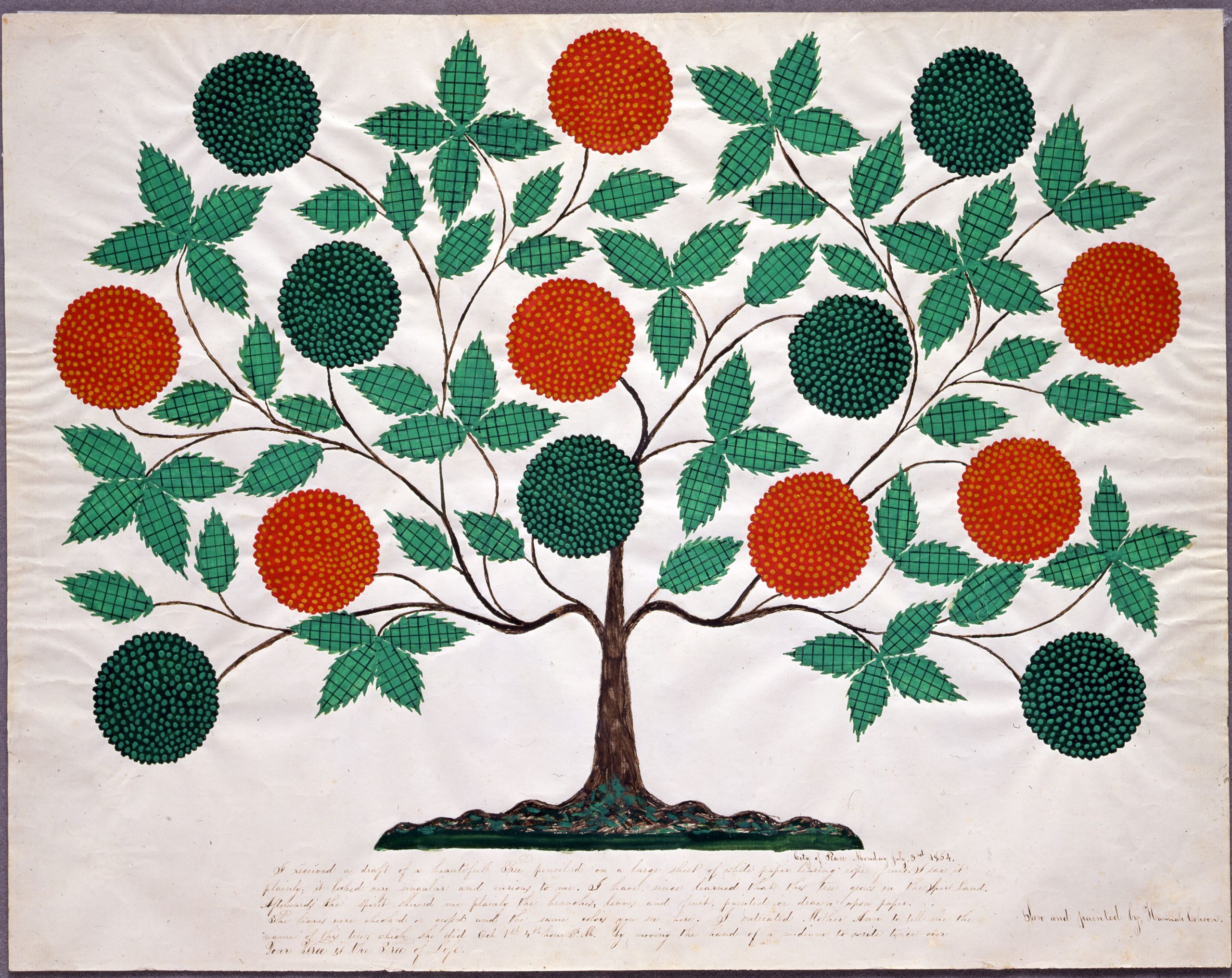
>> Anything but Simple: Gift Drawings and the Shaker Aesthetic, American Folk Art Museum, September 13, 2024–January 26, 2025: “The Shakers, often celebrated for their minimalist approach to design, will be showcased in a new light with the exhibition Anything but Simple: Gift Drawings and the Shaker Aesthetic. Made by women in the mid-19th century and believed to represent divine messages, the ‘gift’ drawings on display represent a departure from the simplicity typically associated with Shaker material culture.
“Opening during the 250th year of Shakerism in the United States, the exhibition features drawings widely considered to be among the finest surviving examples of this rare type. These symbols of love and nature were often given as ‘tokens’ to other Shakers during meetings. Brightly colored and replete with intricate ornamentation, they represent a stunning world of celestial imagery. Compared to examples of Shaker clothing and furniture that will also be included in the exhibition, the vibrancy of the drawings will mark a distinct contrast with the clean lines typically associated with Shaker design.”
Hannah Cohoon (American, 1788–1864), The Tree of Life, 1854. Ink and watercolor on paper, 18 1/8 × 23 5/16 in. Collection of the Hancock Shaker Village, Pittsfield, Massachusetts.
SPOTIFY PLAYLIST: August 2024 (Art & Theology): An assortment of psalms, hymns, and spiritual songs, old and new.
+++
OBITUARIES:
>> Jürgen Moltmann (1926–2024): Jürgen Moltmann, one of the leading Christian theologians of the twentieth century, died June 3 at age ninety-eight. His conversion to Christianity began while he was a German soldier in a POW camp in Belgium during World War II, and he afterward spent most of his career as a theology professor at the University of Tübingen, confronting the theological implications of Auschwitz, among other topics. The pastors of the first church I joined as an adult were deeply influenced by Moltmann (and his protégé Miroslav Volf), so I have been shaped by his theology, especially in the areas of theodicy (which he binds inextricably to Christology) and eschatology.
Moltmann challenged the classical doctrine of divine impassibility, which says God does not feel pain or have emotions, in his seminal book The Crucified God (1974), articulating how God the Father, not just God the Son, is a being who feels and is moved and who also suffered on Good Friday; understanding this, he says, is key to understanding how God relates to the suffering of the world. In Theology of Hope (1964), Moltmann tackled eschatology, which he defines not as the theology of last things but as the theology of hope; not of the end of time but of the fullness of time toward which God is moving all creation, even now. The gospel, he says, must be taken as good news not just of a past event (the birth, life, death, and resurrection of Jesus Christ) but also of a promised future, with vast implications for the present.
>> Bernice Johnson Reagon (1942–2024):Bernice Johnson Reagon [previously], a civil rights activist who cofounded The Freedom Singers and later started the African American vocal ensemble Sweet Honey in the Rock, died July 16 at age eighty-one. I’m so inspired by her Christian witness through nonviolent resistance and music—her songs are on regular rotation in my house.
Beauty isn’t necessarily pretty, pleasant, soothing, Vander Lugt says. Beauty is whatever makes our being gasp a little—whether in delight, or in terrified awe. Beauty demands attention. It also dislodges us from the center of the story, Vander Lugt continues—it unselfs us, in a way, curving us outward. It can be present in what’s torn. (“God goes belonging to every riven thing,” as the poet Christian Wiman puts it.)
I was struck by a remark that Howell, the host, who is a pastor, made near the beginning of the conversation: he said preachers should be less like an instructor imparting moral lessons and more like a docent at an art museum who points out the beauty of the paintings, drawing people’s eyes to its various aspects. What a compelling way to frame the ministry of preaching!
>> Malcolm Guite on Poetry and the Imagination, The Habit: Conversations with Writers about Writing (Rabbit Room), May 7, 2020: In the eleventh poem of his “Station Island” cycle, Seamus Heaney writes about “the need and chance // To salvage everything, to re-envisage / The zenith and glimpsed jewels of any gift / Mistakenly abased.” In this podcast episode, poet-priest Malcolm Guite [previously] talks with host Jonathan Rogers about the “salvaging of the mistakenly abased gift of imagination.” Imagination, Guite says, is as much a truth-bearing faculty as reason; in order to know things well, wemust engage the imagination. It’s not about a private, subjective world or inward fantasies devised to compensate for the cruelty of the world; it’s about truly seeing.
One of the gifts mistakenly abased by our culture for about the last two or three hundred years is the gift of the imagination. We’ve sidelined it so it’s only about the subjective, [whereas] out there is the objective world of dry, rational facts. And we’ve abased that gift of intuitively knowing the truth and value of things and expressing that in warm and poetic imagery, rather than simply reducing everything to a set of tiny particles or mathematical formulae.
—Malcolm Guite
The Romantic poets, for example, Guite says, “aimed at awakening the mind’s attention, removing the film of familiarity and restoring to us that vision of the freshness and depth of nature for which we have eyes that see not, ears that hear not, and hearts that neither feel nor understand. So they weren’t trying to make stuff up. They were trying to take away this film which [Samuel Taylor Coleridge] says our selfishness and solicitousness have cast over the world, and unveil a deeper but equally real truth about nature which is more than just the surfaces we see.”
Also in this conversation, Guite reveals the poet who made him want to be a poet, the poem that prompted his reconversion to Christianity, what we lost when poetry changed from oral to written, and why he writes poetry in meter.
+++
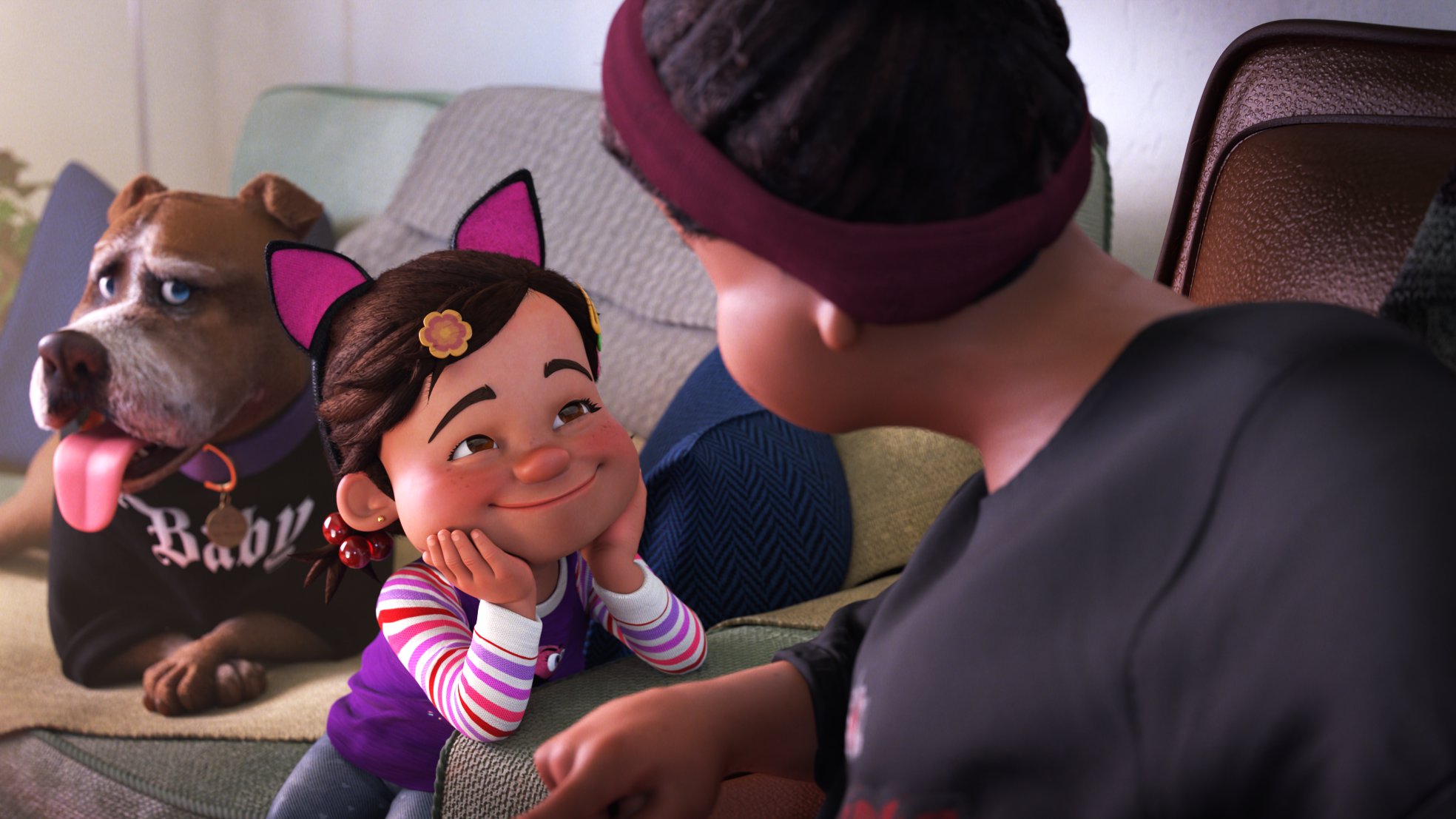
SHORT FILM SERIES: SparkShorts, produced by Pixar, streaming on Disney+: Did you know Pixar Animation Studios launched an experimental shorts initiative in 2017, giving employees the opportunity, through funding and resourcing, to flex their creative muscles with a great measure of freedom? “The SparkShorts program is designed to discover new storytellers, explore new storytelling techniques, and experiment with new production workflows,” says Pixar President Jim Morris. “These films are unlike anything we’ve ever done at Pixar, providing an opportunity to unlock the potential of individual artists and their inventive filmmaking approaches on a smaller scale than our normal fare.”
Eleven SparkShorts have been released since 2019, all streaming on Disney+. Here are my favorites:
>>Self, dir. Searit Kahsay Huluf: Released February 2, 2024, this stop-motion–CGI hybrid is about a woman who self-sabotages to belong. Writer-director Searit Kahsay Huluf says it was inspired by her family story: her mother immigrated to the US from Ethiopia to escape a civil war and had to learn how to assimilate without losing herself, and as a second-generation African immigrant growing up in Los Angeles, she herself wrestled with identity issues. The way in which Huluf tells the story is beautiful, clever, and kind of dark! Notice the differentiation of textures and sound between the wood of the main character (portrayed by a puppet) and the metal of the “Goldies.”
>> Float, dir. Bobby Rubio: A father discovers his infant son has a unique characteristic that differentiates him from others and then tries to hide him to avoid judgment—but when doing so visibly deflates his son’s spirit, he vulnerably releases him out into the world to be who he is. Writer-director Bobby Rubio created Float for his son, Alex, who is on the autism spectrum. As a dad, Rubio initially struggled with the diagnosis, and this is his story of learning to embrace the beauty of it. It’s one of the few portrayals of a Filipino American family on film, and a warmhearted celebration of neurodivergence—or any other type of divergence.
>> Nona, dir. Louis Gonzales: Nona is looking forward to a day to herself to just chill in front of the TV, watching her favorite show, E.W.W. Smashdown Wrestling. But when her five-year-old granddaughter is unexpectedly dropped off, she has to adapt her plans—begrudgingly at first. Writer-director Louis Gonzales says Nona is based on his own grandma, with whom he shared a love of wrestling. I appreciate how the film addresses dealing with disruptions to a cherished routine; it’s honest about the frustration (even if the disrupter is someone you love dearly!) while also showing how a gracious, go-with-the-flow attitude can unlock surprising new joys. What a fitting watch for the current season of Ordinary Time!
Chagall’s Peace Window is one of the most significant works in the United Nations’ art collection. On my quick visit to New York City last month, where the UN is headquartered, I was hoping to see it, but I emailed ahead of time and found out it’s not currently available for viewing due to construction behind it. (You can “see” it but not really, because it’s not lit, and there’s a tall plastic barrier in front.) I was disappointed, but I decided to visit the UN anyway, to see what other art I might find.
The United Nations was founded in 1945 for the purpose of preventing a third world war. Comprising 193 member states, the organization is committed to maintaining international peace and security, developing friendly relations among nations, and promoting social progress, better living standards, and human rights. Their motto is “Peace, dignity, and equality on a healthy planet.”
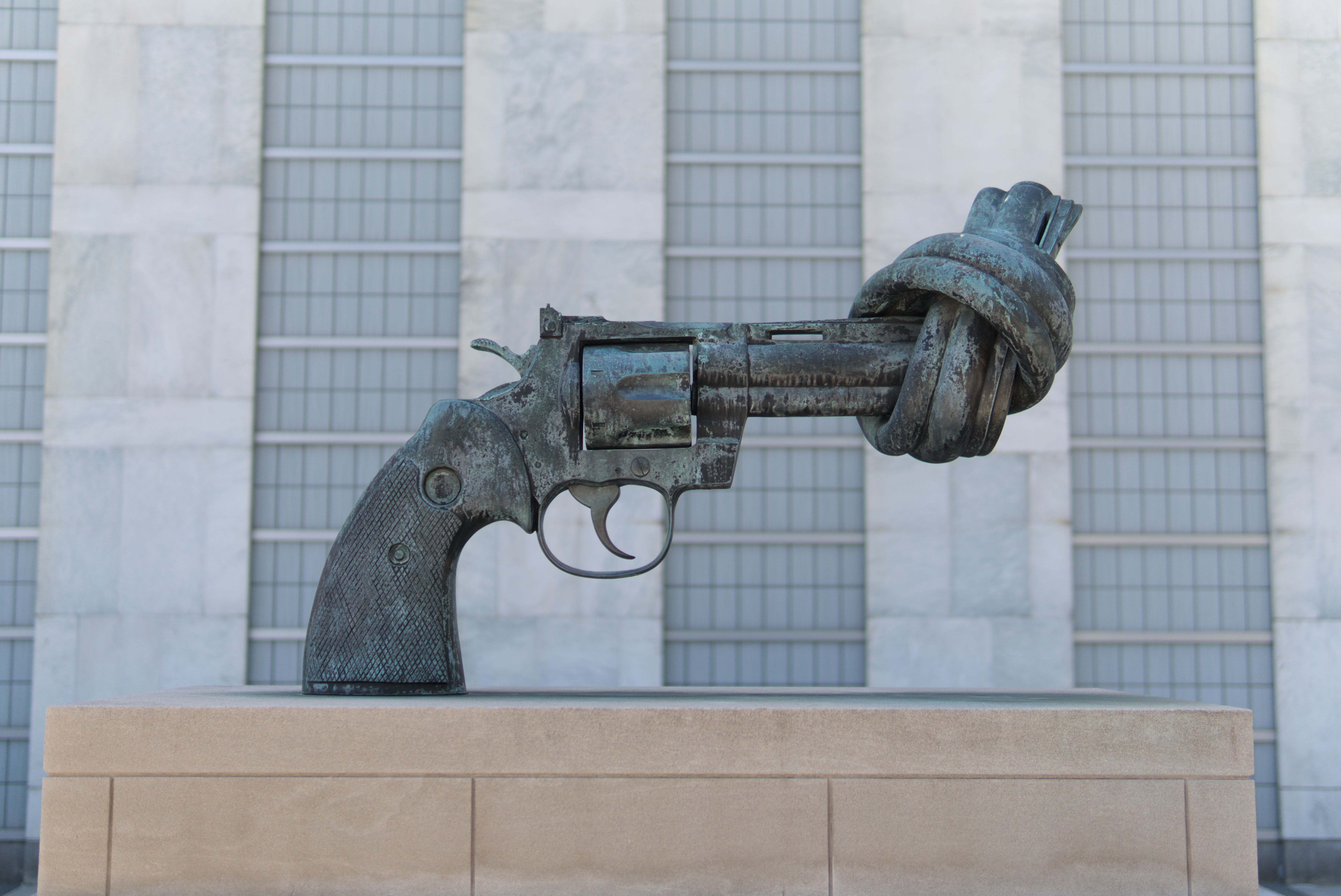
After presenting my ID, getting my photo taken, being stickered, and going through security, I was inside the campus and directed to the General Assembly Building. Outside the entrance to this building is the famous Non-Violence bronze, aka TheKnotted Gun, by Carl Fredrik Reuterswärd of Sweden. The artist made the sculpture in 1980 after his friend John Lennon was murdered. He wanted to honor the singer-songwriter’s vision of a peaceful world.
Carl Fredrik Reuterswärd (Swedish, 1934–2016), Non-Violence, 1984. Bronze, 79 × 44 × 50 in. United Nations Headquarters (outside the General Assembly building), New York. Gift from Luxembourg. Photo: Victoria Emily Jones. [object record]
The original cast was first placed at the Strawberry Fields memorial in New York City’s Central Park, across the street from the Dakota apartment building where Lennon and his wife, Yoko Ono, lived, and where he was shot. But Reuterswärd worried it would be stolen there. In 1988, the Government of Luxembourg bought the sculpture and donated it to the United Nations, who installed it inside the gate of their New York headquarters.
Non-Violence is an oversize replica of a Colt Python .357 Magnum revolver with the barrel tied in a knot and the muzzle pointing upward, rendering the weapon useless. In his statement from 1988, Reuterswärd said, “Humor is the finest instrument we have to bring people together. While making my peace-symbol, I thought of the importance of introducing a touch of humor, just to make my ‘weapon’ symbolically ridiculous and completely out of order.”
Reuterswärd ultimately made over thirty additional casts of Non-Violence, which are publicly installed in cities such as Beijing, Beirut, Cape Town, Lausanne, and Mexico City.
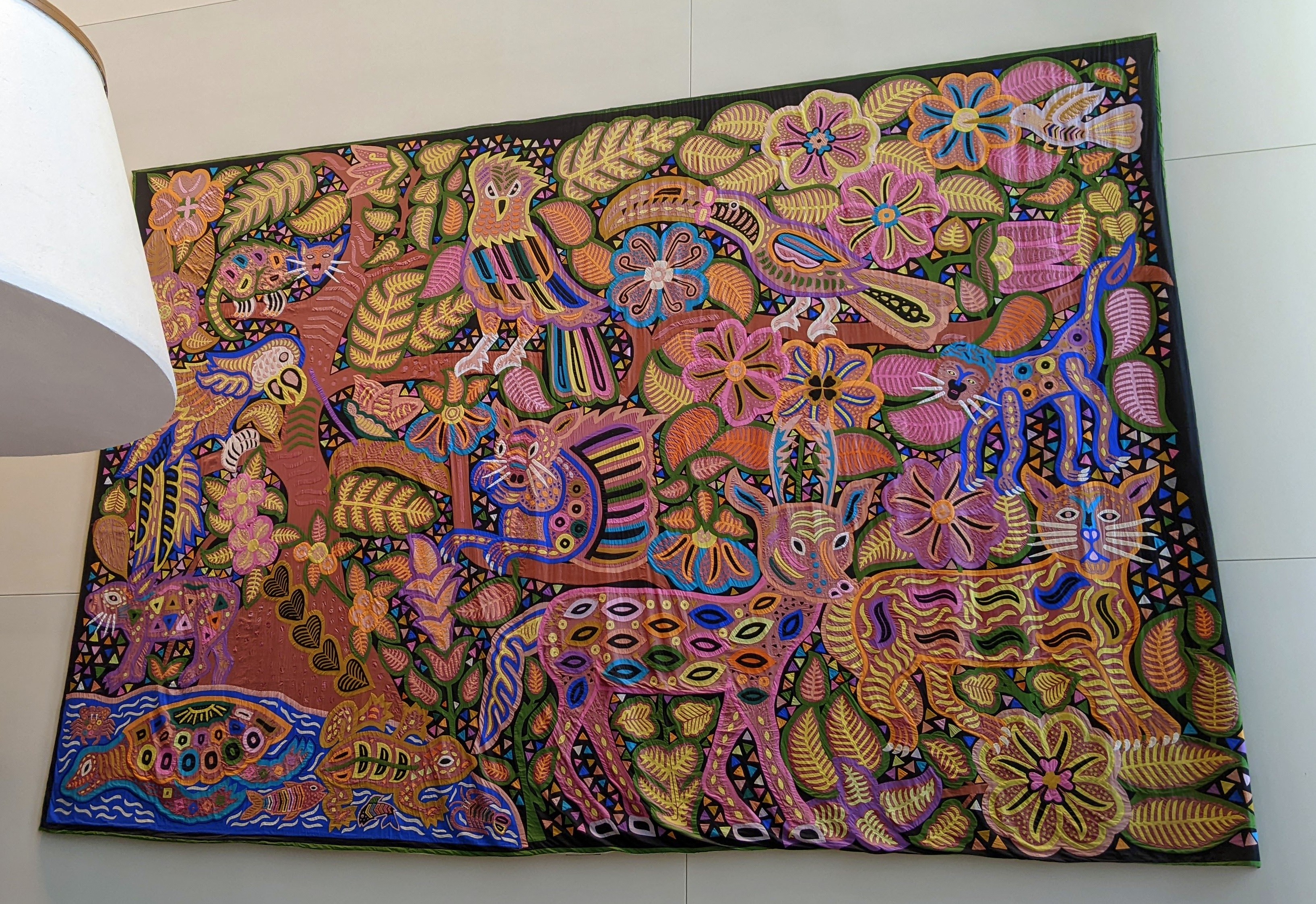
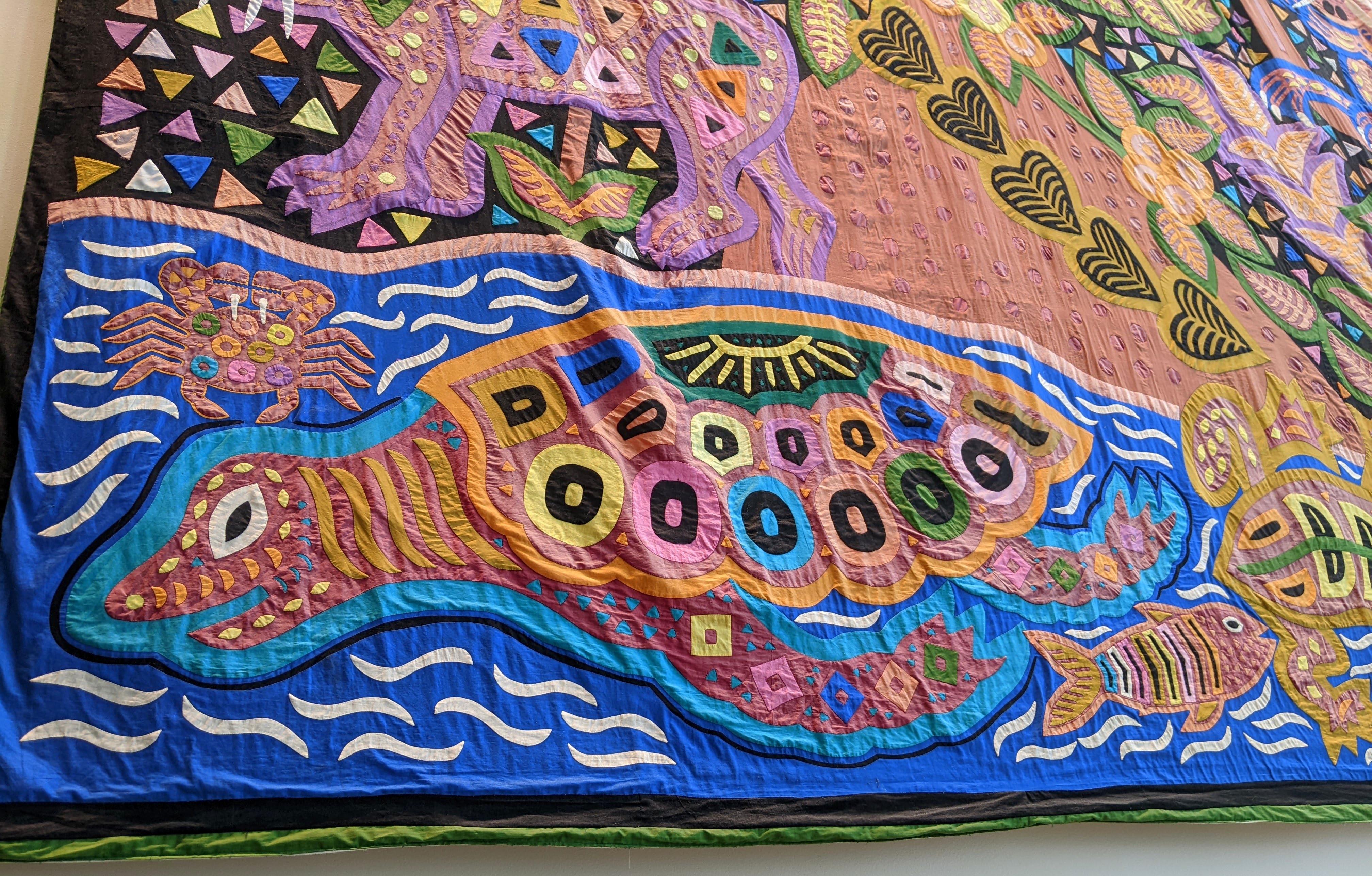
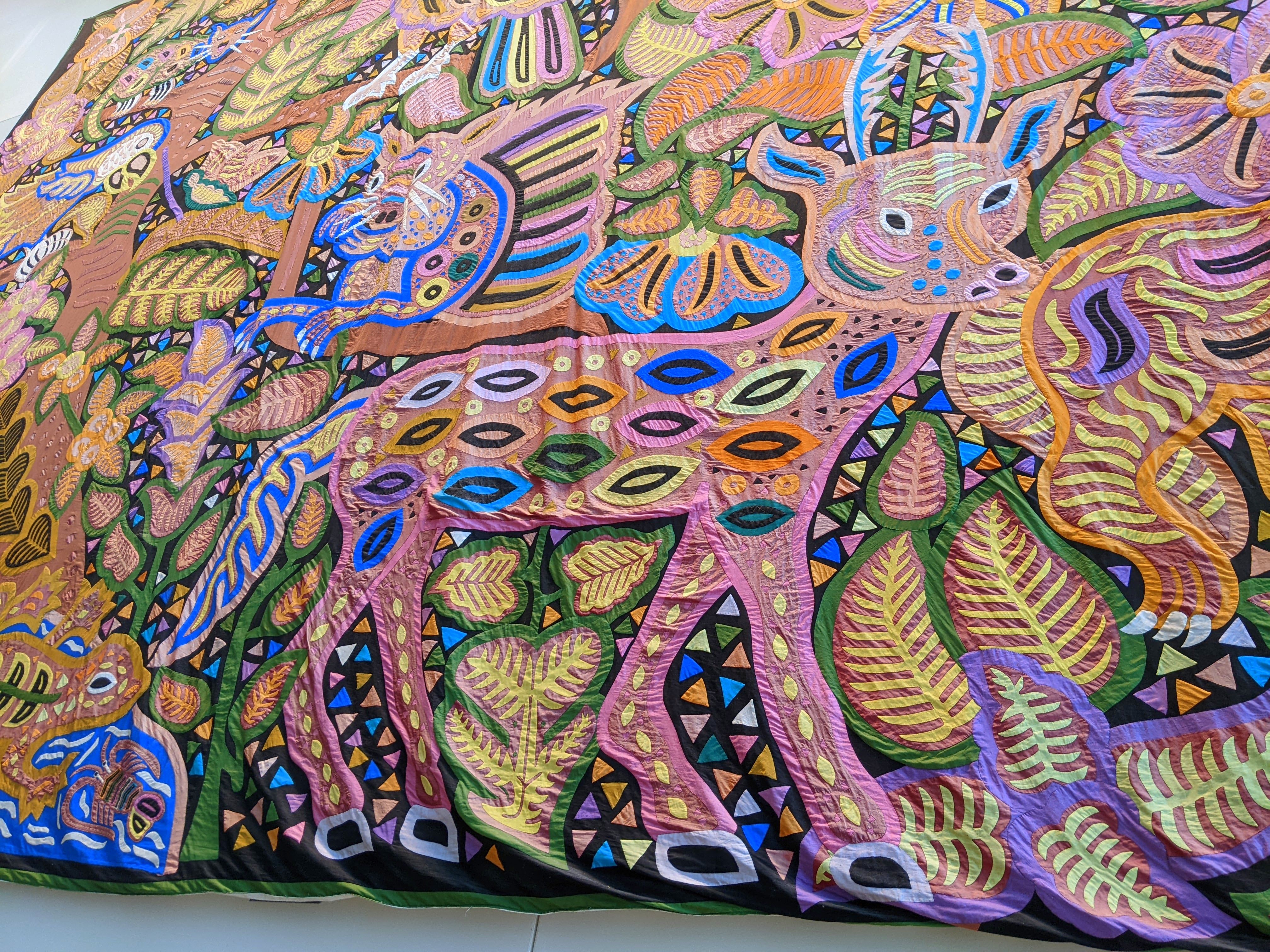
After spending some time with this iconic work, I entered the General Assembly lobby. What first caught my eye, on the right wall, was a monumental Mola Tapestry from Panama, made by unidentified Kuna women. (To learn about the art form, see my previous blog post from Lent 2022.)
Mola Tapestry by the Kuna people, 1993. Reverse appliqué tapestry, 190 × 284 in. General Assembly Building, United Nations Headquarters, New York. Gift from Panama. Photo: Victoria Emily Jones. [object record]
Molas are made using a reverse appliqué technique, in which several layers of multicolored cloth are sewn together and then parts of each layer are cut out to form the design. These textile panels are traditionally made on a smaller scale and sewn onto women’s blouses, but as outside interest in them grew, local artisans started making some to be displayed as wall hangings.
This one shows a colorful array of indigenous flora and fauna, including a toucan, owl, hummingbird, monkey, turtle, frog, squirrel, rabbit, deer, and wildcat.
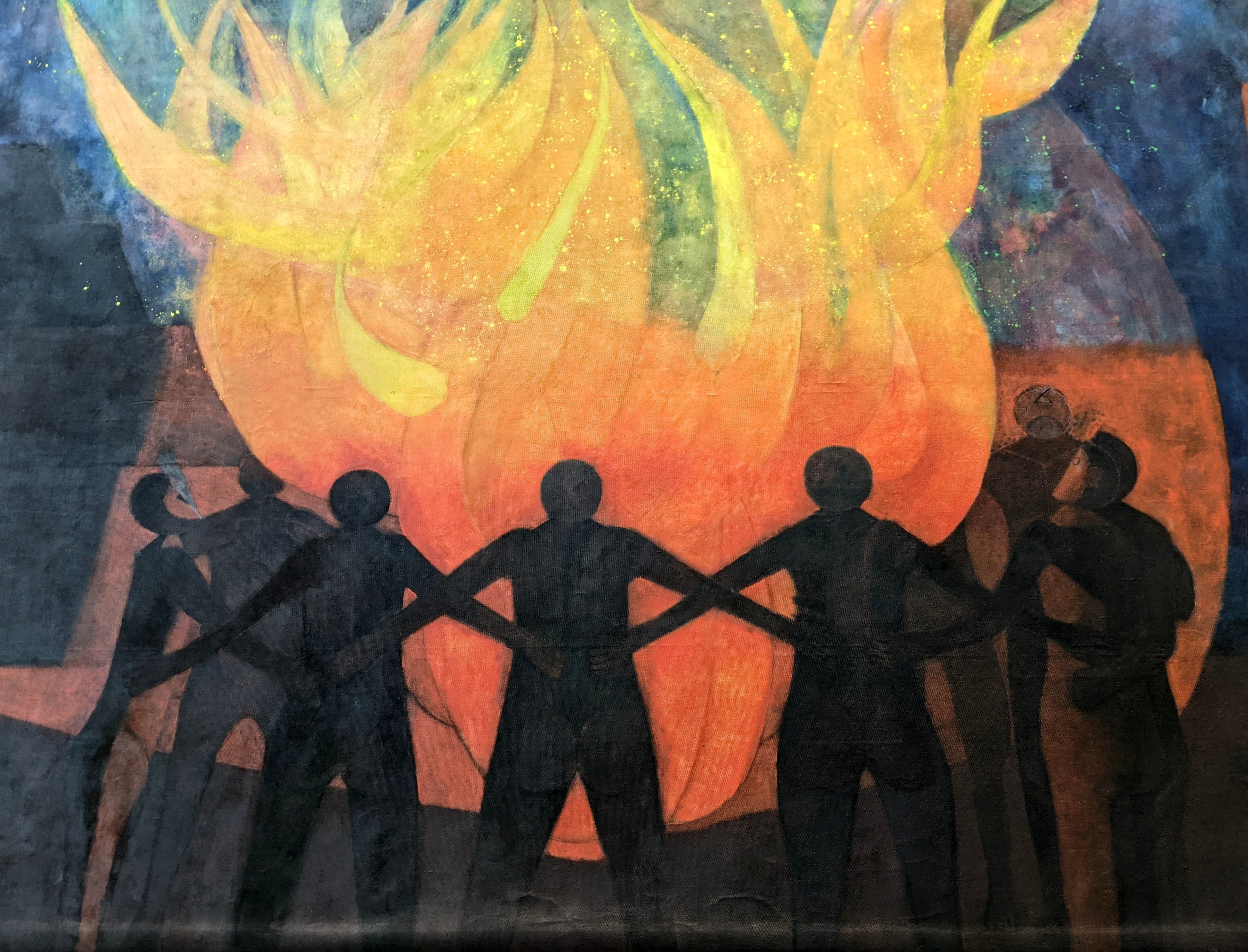
On the opposite wall is a nearly thirty-foot-long painting titled La Fraternidad (Brotherhood) by Mexican artist Rufino Tamayo [previously], which shows a group of people gathered around a fire with interlaced arms. The fire may represent enlightenment, knowledge and power, or the Divine Presence.
Rufino Tamayo (Mexican, 1899–1991), La Fraternidad (Brotherhood), 1968. Oil on canvas, 160 × 358 in. General Assembly Building, United Nations Headquarters, New York. Gift from Mexico, 1971. Photo: Victoria Emily Jones. [object record]
At the left is an ancient Aztec or Mayan pyramid, whereas the structure at the right is modern. Tamayo said this shows the span of time, from the ancient era into the present and future.
From 2009 to 2014 the painting was on display at the Mexican state legislature, after which it was restored and returned to the UN.
Situated in front is a replica of an ancient Greek sculpture depicting Poseidon of Artemision, god of the sea, in an active stance. His right hand would have originally wielded a trident, representing his power. At first I thought it an odd choice for the UN to display an apparently militant figure, as Poseidon used his trident as a weapon to fight Trojans, Titans, and others, and indeed here he seems poised to deliver a death blow. But after some rudimentary research, I found that Poseidon also created life-giving springs with the strike of his trident (think Moses striking the rock with his staff), and used it to calm turbulent waters. These ameliorating acts align with the UN’s mission and make the Poseidon sculpture a fitting addition to their collection.
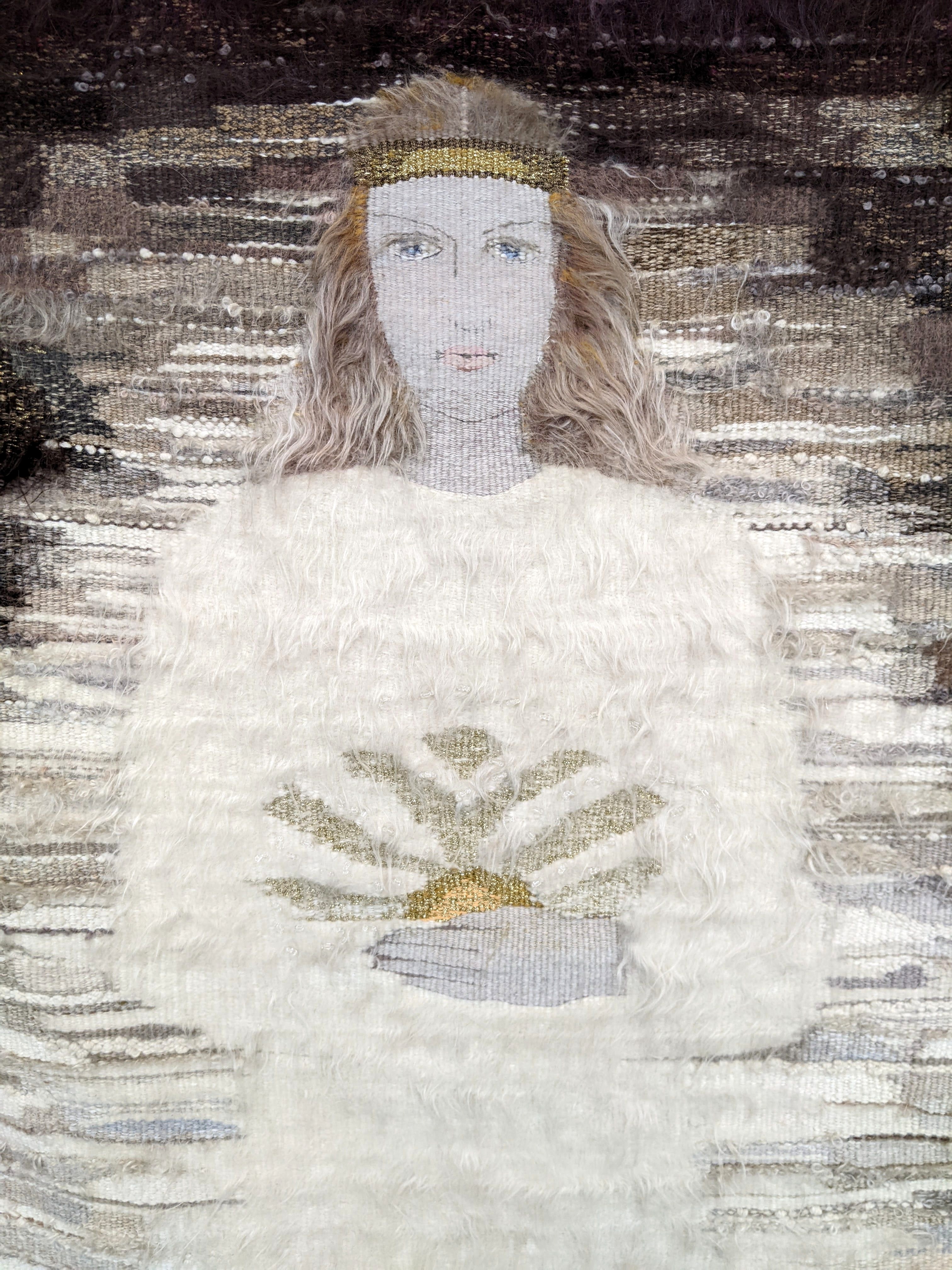
Also in the lobby is a wool tapestry from Latvia. Titled Hope, it’s by the well-known Latvian textile artist Edīte Pauls-Vīgnere.
Edīte Pauls-Vīgnere (Latvian, 1939–), Hope, 1994. Tapestry, 126 × 114 in. General Assembly Building, United Nations Headquarters, New York. Gift from Latvia. Photo: Victoria Emily Jones. [object record]
The female figure in the foreground is, I’m assuming, a personification of hope, dressed in a white gown and golden headband and holding the sun. She stands in front of the Freedom Monument in Riga, which shows Lady Liberty holding three gilded stars, symbolizing the three constitutional districts of Latvia.
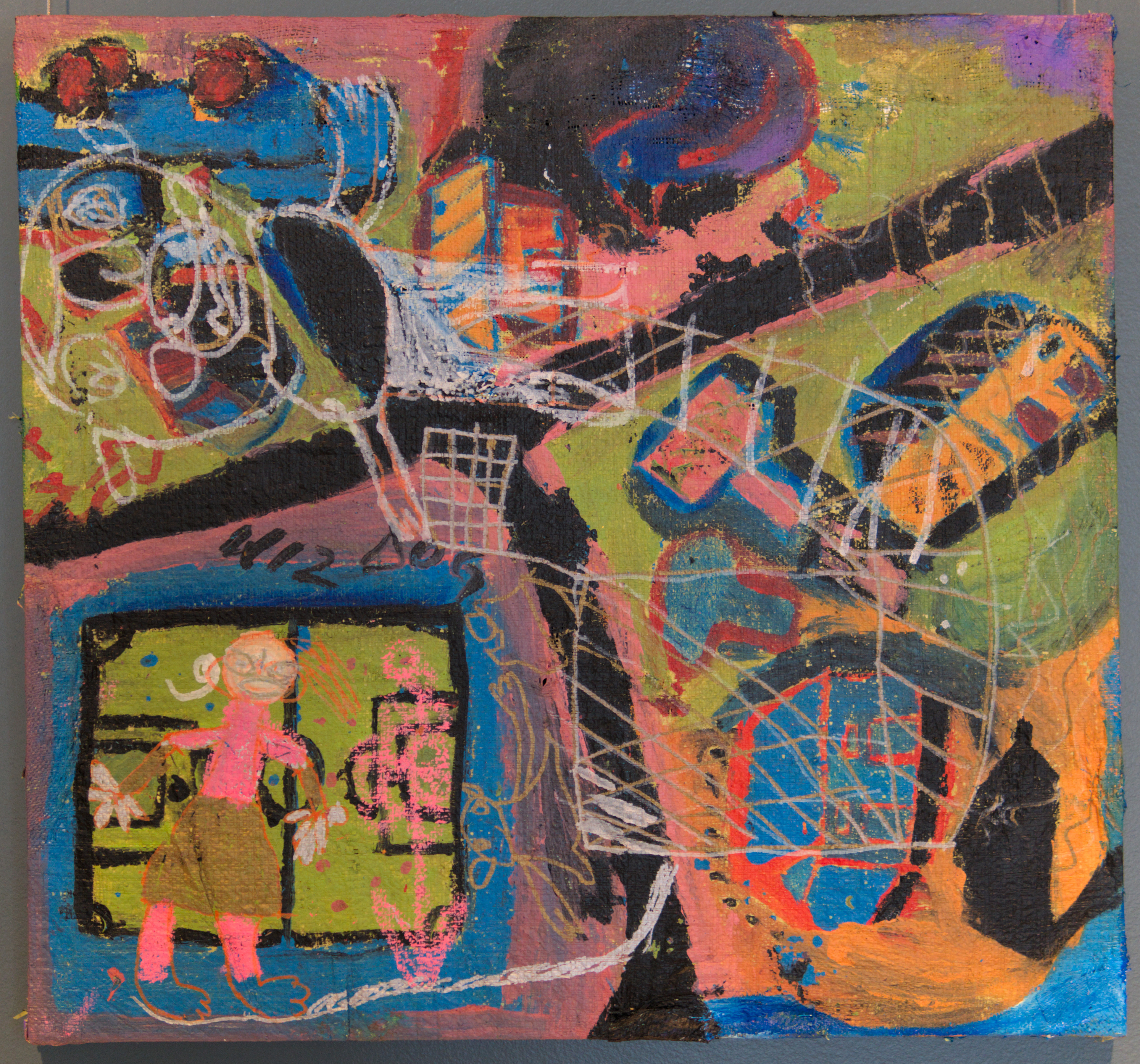
Deeper inside the lobby was a temporary exhibition, Interwoven: Refugee Murals Across Borders, organized jointly by UNHCR (the UN Refugee Agency) and Artolution. It opened on June 20, World Refugee Day, and will continue through July 19. The exhibition presents paintings by refugees and host communities in refugee camps, conflict zones, and crisis-affected communities across the world. These were created through a collaborative process in which the work circulated to different locations, with artists contributing additions at each stop. The end results show interwoven narratives of the diverse peoples forced to flee their homes. Themes include joy, lament, labor, empowerment, identity, and home.
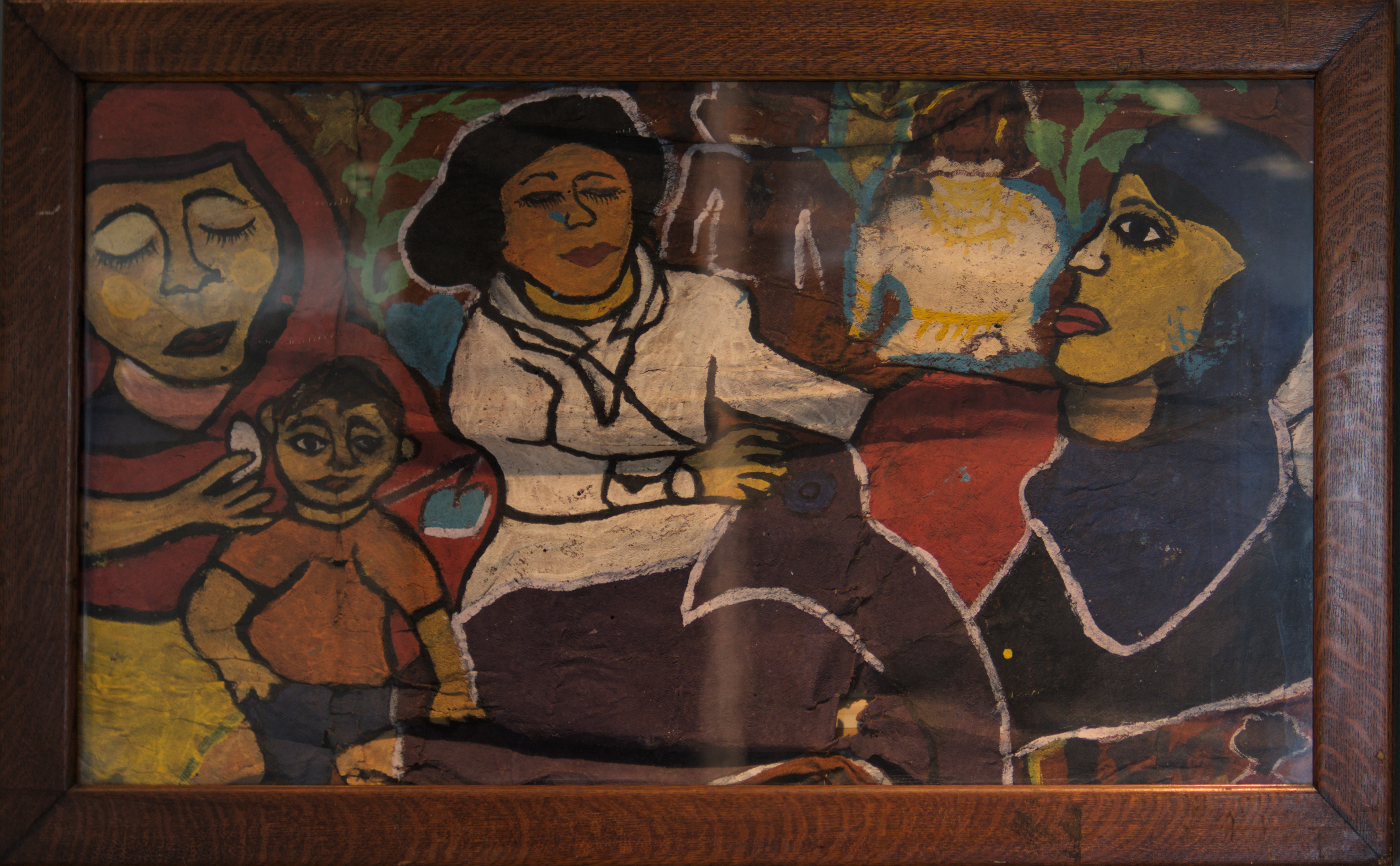
Made by about a dozen refugee girls and women from four countries, Fabric of Women’s Resilience began in Uganda with a small group of South Sudanese, who prepared the traditional bark cloth from the bark of a mutuba tree. This substrate then traveled to Bangladesh, where Rohingya women painted a pregnant woman lying on a bed while a female doctor presses a stethoscope to her belly, and on the left, a mother bathing her child. The artists said they wanted to encourage mothers to seek access to prenatal healthcare and to practice good hygiene with their babies.
Fabric of Women’s Resilience, a collaborative painting by approx. twelve Rohingya, Syrian, Afghan, and South Sudanese refugee women, 2018. Acrylic on bark cloth, 24 × 60 in. Photo: Victoria Emily Jones.
In Greece, the bark cloth traveled to Samos refugee camp, where one young Afghan woman, with the help of others, painted one of her traumatic childhood experiences: being married off at age twelve to an older man. This scene at the top is a bit crumpled in the frame, so it’s difficult to see, but the child bride is crying, and the man has a white beard.
The painting also went to Azraq refugee camp in Jordan, where Syrian women added a woman carrying a baby on her back while reading a book to show that women can be mothers and pursue an education. (This scene was at the extreme right but must have come off; view the full original painting on the exhibition webpage, fourth image down.) It ended its journey with a return to Uganda, where the South Sudanese women filled in the remaining spaces with plants, fish, and fruits.
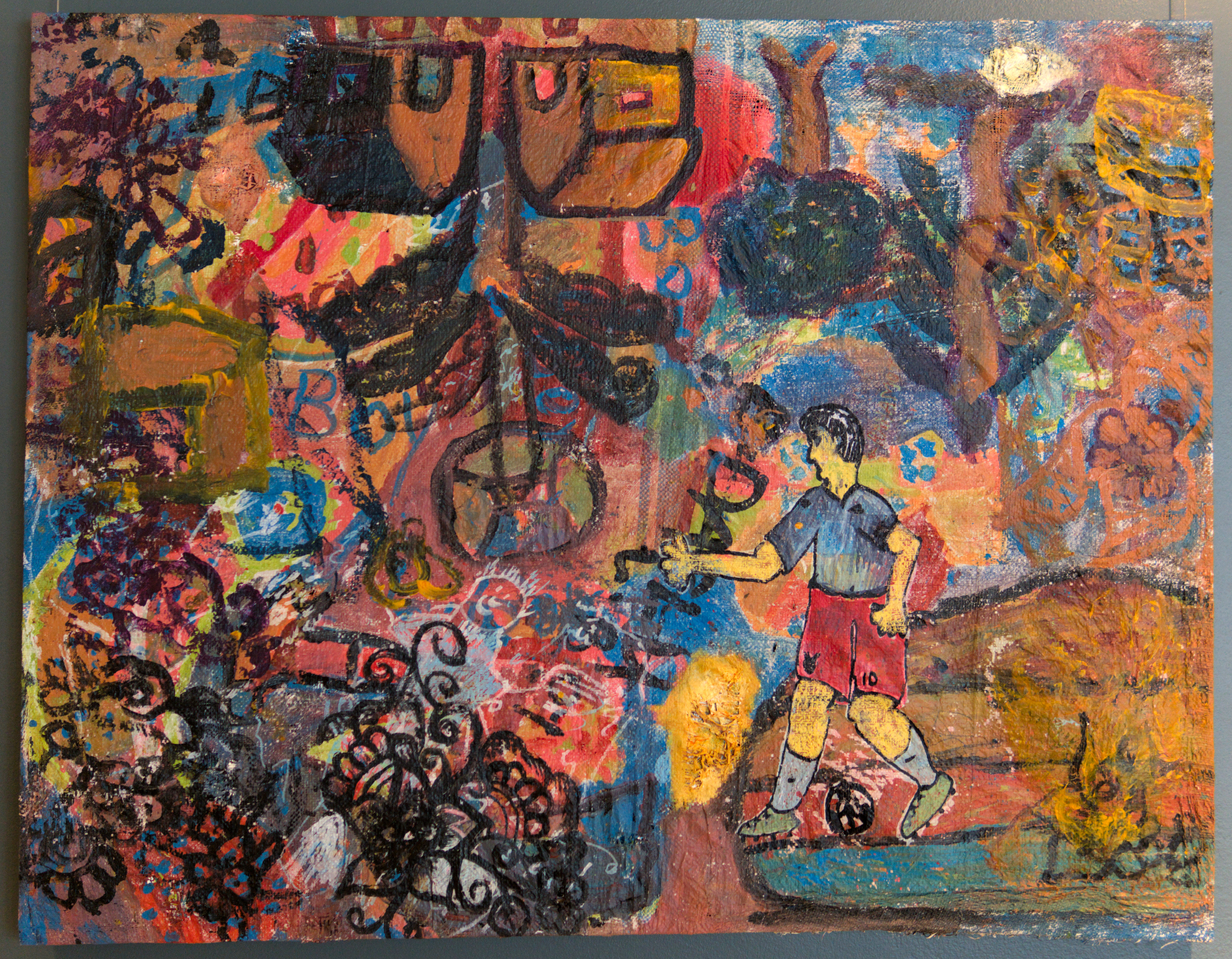
Other artworks include The Creature of Home and Play in the Midst of Chaos, painted on food distribution bags and as a collaboration between South Sudanese and Rohingya refugees, both children and adults.
The Creature of Home, which traveled to BidiBidi Refugee Settlement in Uganda and Balukhali Refugee Camp in Bangladesh, depicts chickens, a soccer field, memories of home, and tools needed to take care of the land.
The Creature of Home, a collaborative painting by South Sudanese refugees at BidiBidi Refugee Settlement, Uganda, and Rohingya refugees at Balukhali Refugee Camp, Bangladesh. Photo: Victoria Emily Jones.
Play in the Midst of Chaos, which traveled to BidiBidi Refugee Settlement in Uganda and Bhasan Char Island in Bangladesh, captures a sense of joy with its vivid colors and depiction of sports. It also highlights the importance of planting trees and taking climate action.
Play in the Midst of Chaos, a collaborative painting by South Sudanese refugees at BidiBidi Refugee Settlement, Uganda, and Rohingya refugees at Bhasan Char Island, Bangladesh. Photo: Victoria Emily Jones.
Seeing the Interwoven exhibition sent me down an internet rabbit trail of learning more about the co-organizer, Artolution, and the work they’re doing, which then impelled me to learn more about the refugee communities in which they’re active. Follow them on Instagram, Facebook, or Twitter. I also commend to you the Founder Spirit podcast interview with Artolution cofounder and public artist, educator, and humanitarian Max Frieder.
All the above artworks can be seen for free without an appointment. (However, note that the temporary exhibitions change throughout the year.) But to access the sculptures in the garden, which is kept locked, your only option is to pay $26 for the guided, forty-five-minute Garden Tour.
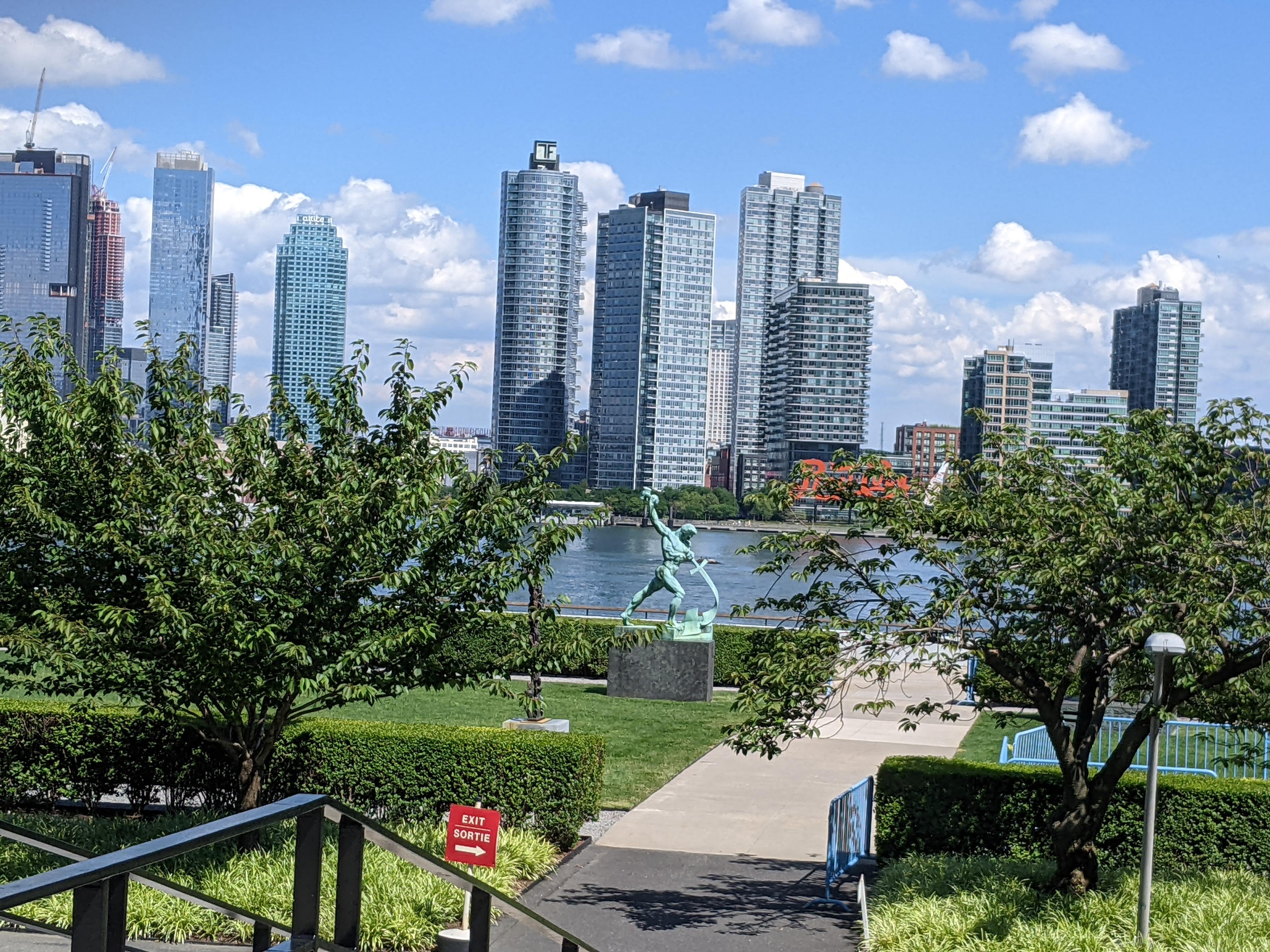
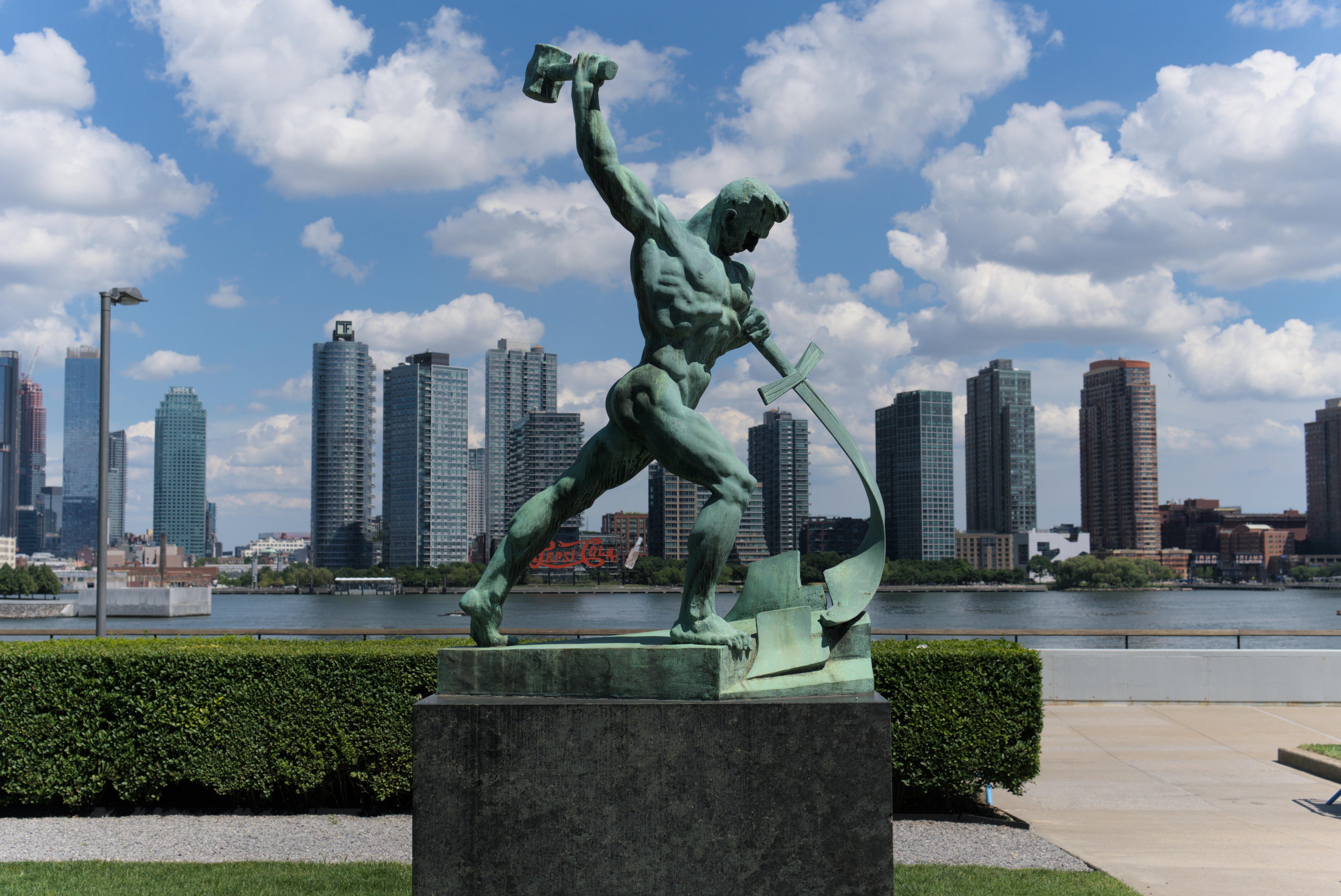
I had seen photos of the biblically inspired Let Us Beat Swords into Ploughshares and wanted to see it in person, so I paid up. It’s vaguely visible from the vantage of the free-access plaza outside the main entrance of the General Assembly Building.
But let’s move in closer.
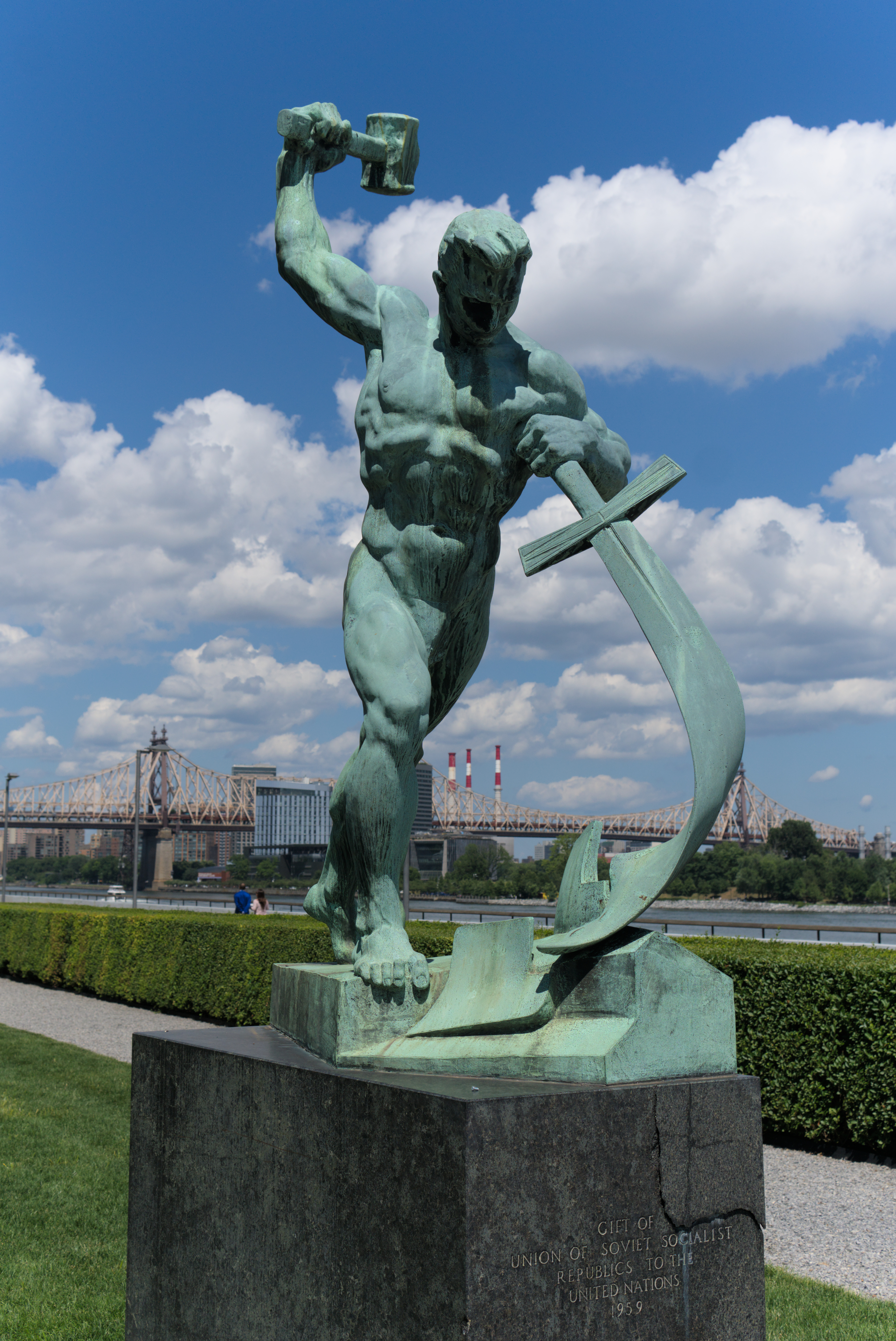
Yevgeny Vuchetich (Russian, 1908–1974), Let Us Beat Swords into Ploughshares, 1959. Cast bronze and granite pedestal, figure 111 × 76 × 35 in., pedestal 44 × 75 × 34 in. North Lawn, United Nations Headquarters, New York. Gift from the USSR. Photo: Victoria Emily Jones. [object record]
Gifted to the United Nations by the USSR in 1959, the bronze sculpture is by the Soviet artist Yevgeny (sometimes spelled “Evgeniy”) Vuchetich, who was of Russian, French, and Serbian heritage and lived most of his life in Russia. It shows a muscular man (modeled by Olympic wrestler Boris Gurevich) hammering a sword into a plow blade, used to cut furrows for planting crops. Representing the transformation of tools of death into tools of life, the imagery is taken from Isaiah 2:4 in the Hebrew Bible, in which the prophet proclaims that “in days to come,” people of all nations “shall beat their swords into plowshares and their spears into pruning hooks; nation shall not lift up sword against nation; neither shall they learn war any more.” The vision is that in the kingdom of God, instead of the land being littered with human blood and corpses, it will be cultivated and bring forth good food.
This scripture text is the basis of the African American spiritual “Down by the Riverside” [previously], whose refrain declares, “I ain’t gonna study war no more!” One of the commonly used verses is “I’m gonna beat my sword into a plow.” Here’s Michael Wright’s version:
And, from 1959, the Golden Gate Quartet’s, arranged by Orlandus Wilson:
Reflecting the song lyrics, Vuchetich’s sculpture is itself planted “down by the riverside”—the East River.
Vuchetich was one of the major figures of Soviet government–backed monumental sculpture, making his name from depictions of military heroes. So I find it a little odd that he was commissioned to make this peace sculpture that subverts the very militarism his other sculptures celebrate. One of his most famous pieces is The Motherland Calls; located at the top of Mamayev Kurgan hill overlooking the city formerly known as Stalingrad, it shows a female personification of Russia lifting high a sword in one hand and calling the Soviet people to battle with the other.
Look, many artists will take what work they can get, regardless of whether a commission matches their own ideology. I don’t claim to know what Vuchetich’s personal views were about war, violence, and empire.
Regardless of its disjunction with the artist’s larger oeuvre—and the uncomfortable fact that the donor’s successor state and caretaker of the sculpture, the Russian Federation, is persisting in an illegal and immoral war against its neighbor Ukraine—I really appreciate the theological imagination that Let Us Beat Swords into Ploughshares embodies, entreating us to apply our strength to constructive, not destructive, acts.
Nearby in the garden, not pictured in this article, is a literalization of the “swords into plowshares” principle. A recent gift from the Government of Colombia, Kusikawsay (Quechua for “peaceful and happy life”) is made of steel armaments melted and cast into the shape of a canoe, sailing upward. A donor representative said the sculpture for them symbolizes the end of an over-fifty-year armed conflict in their country. The idea is that the grotesque paraphernalia of war is metamorphosed into a benign watercraft that, in how it’s positioned, symbolizes humanity’s traveling into a lofty future.
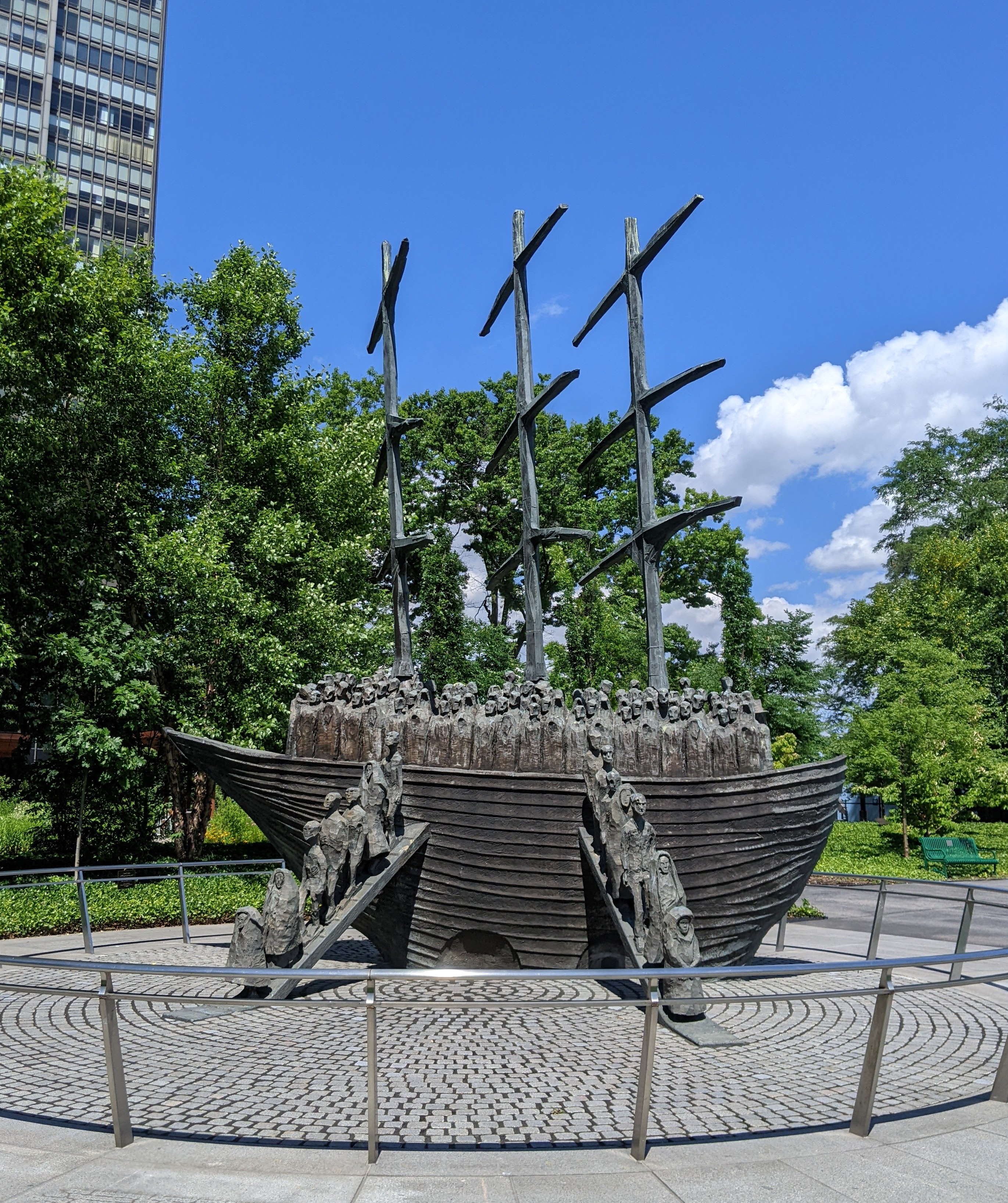
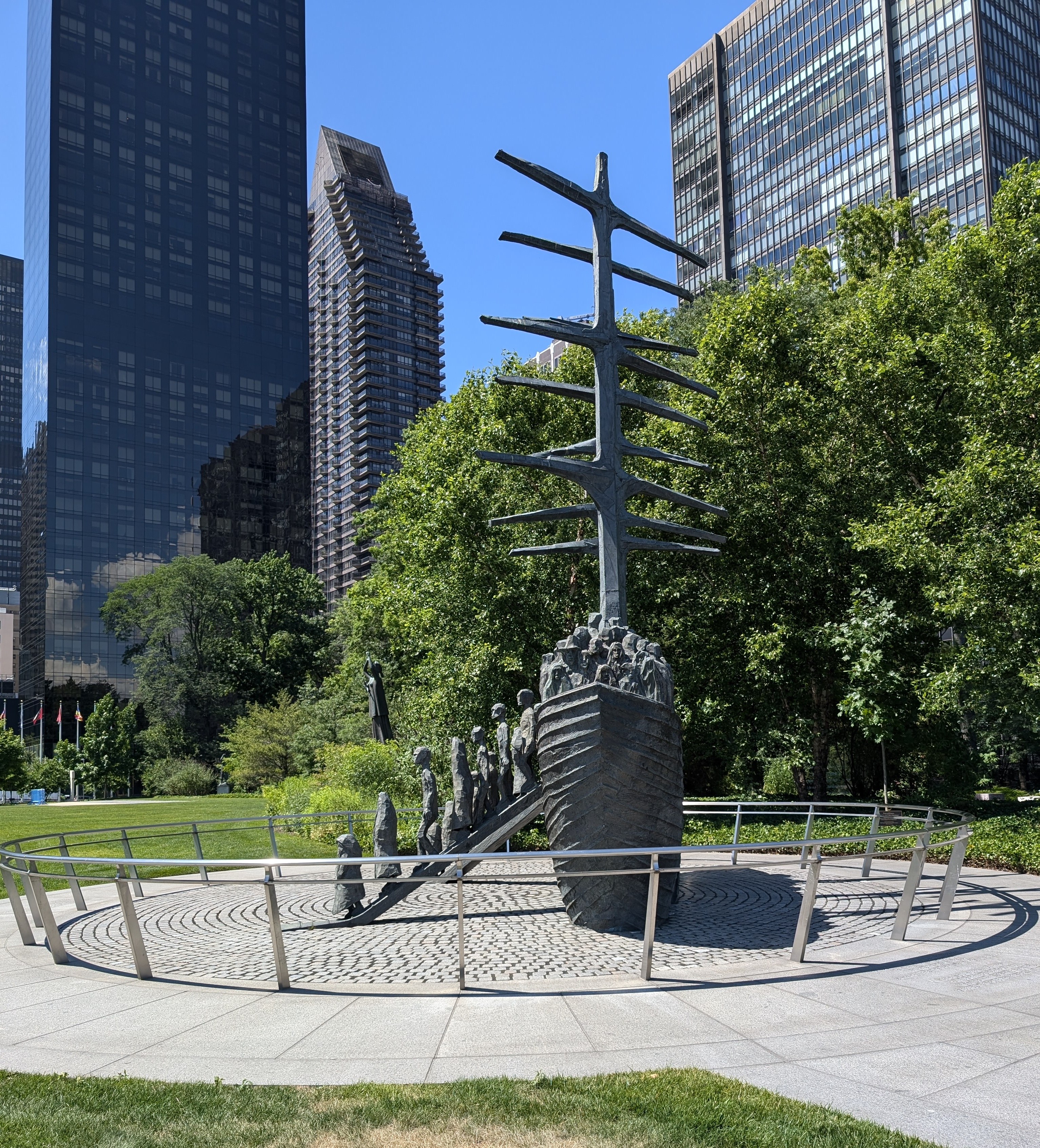
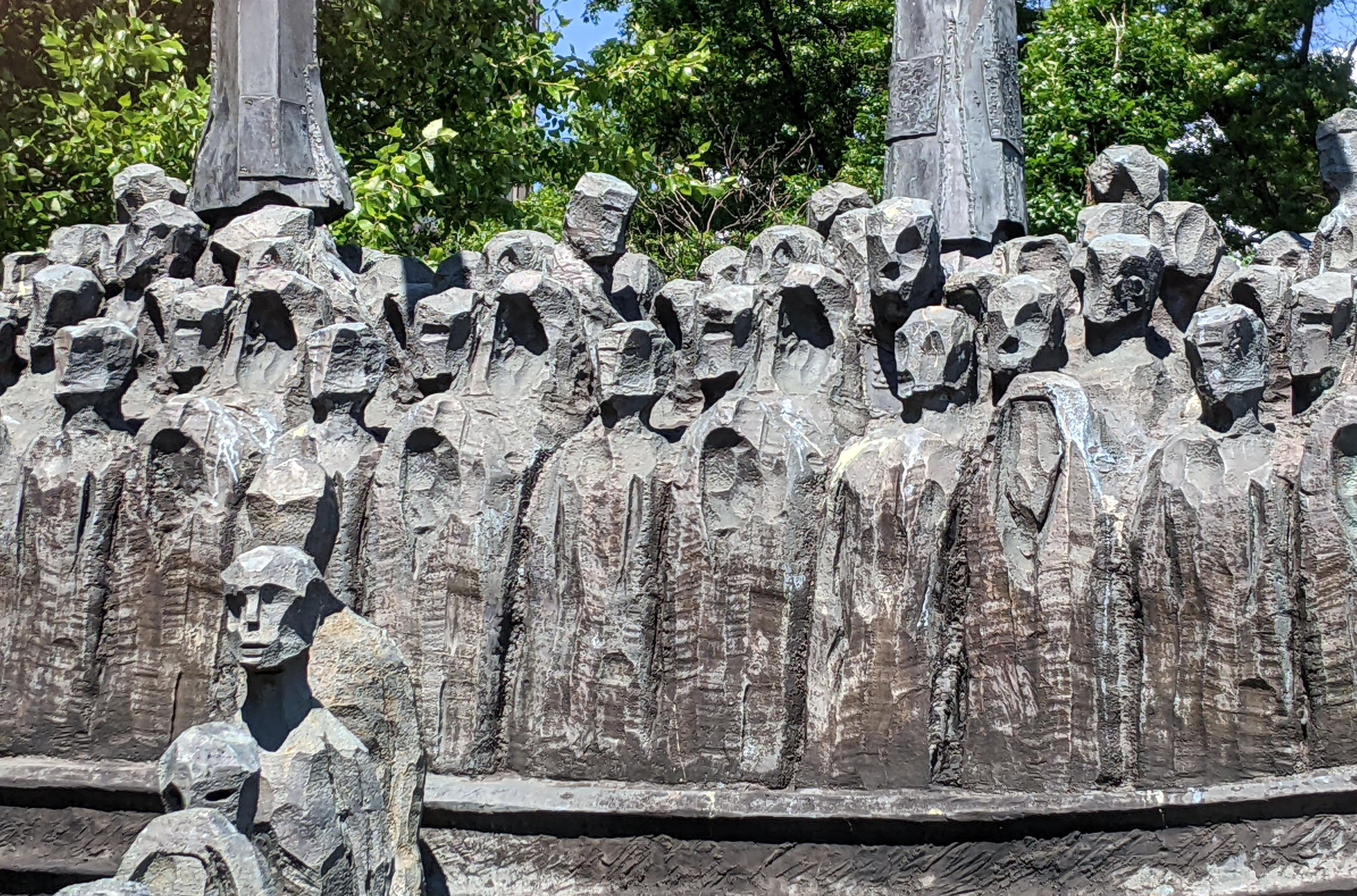
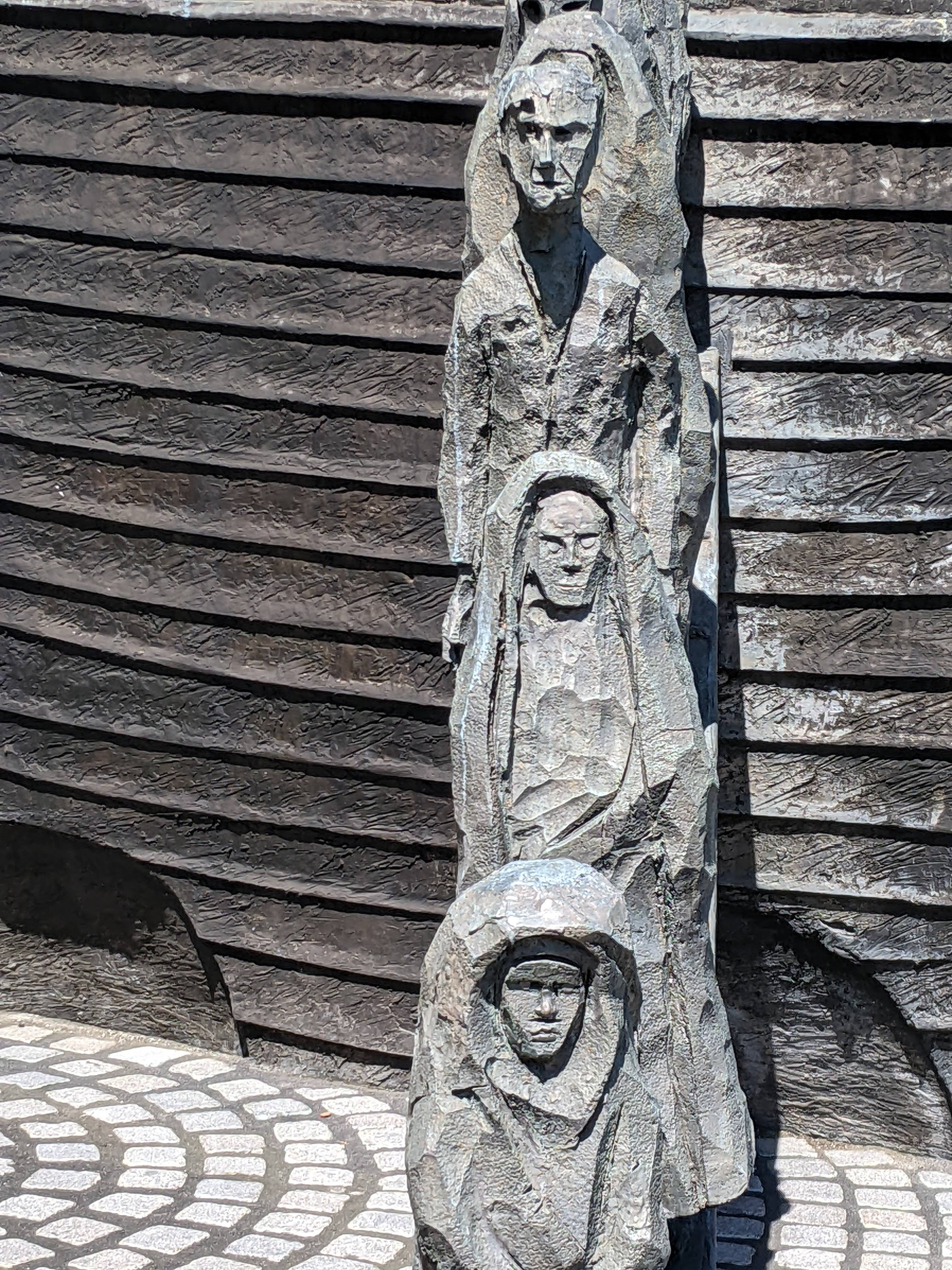
Another boat on the UNHQ’s North Lawn is Arrival by the Irish sculptor John Behan, which shows Irish immigrants disembarking into a new world. The sculpture was intended as a thank-you to the many nations that have received the Irish over the years, including Great Britain, the United States, Canada, Australia, Argentina, Chile, Mexico, New Zealand, and Brazil.
John Behan (Irish, 1938–), Arrival, 2000. Bronze, stainless steel on granite pavers, 26 × 23 ft. North Lawn, United Nations Headquarters, New York. Gift from Ireland. Photo: Victoria Emily Jones. [object record]
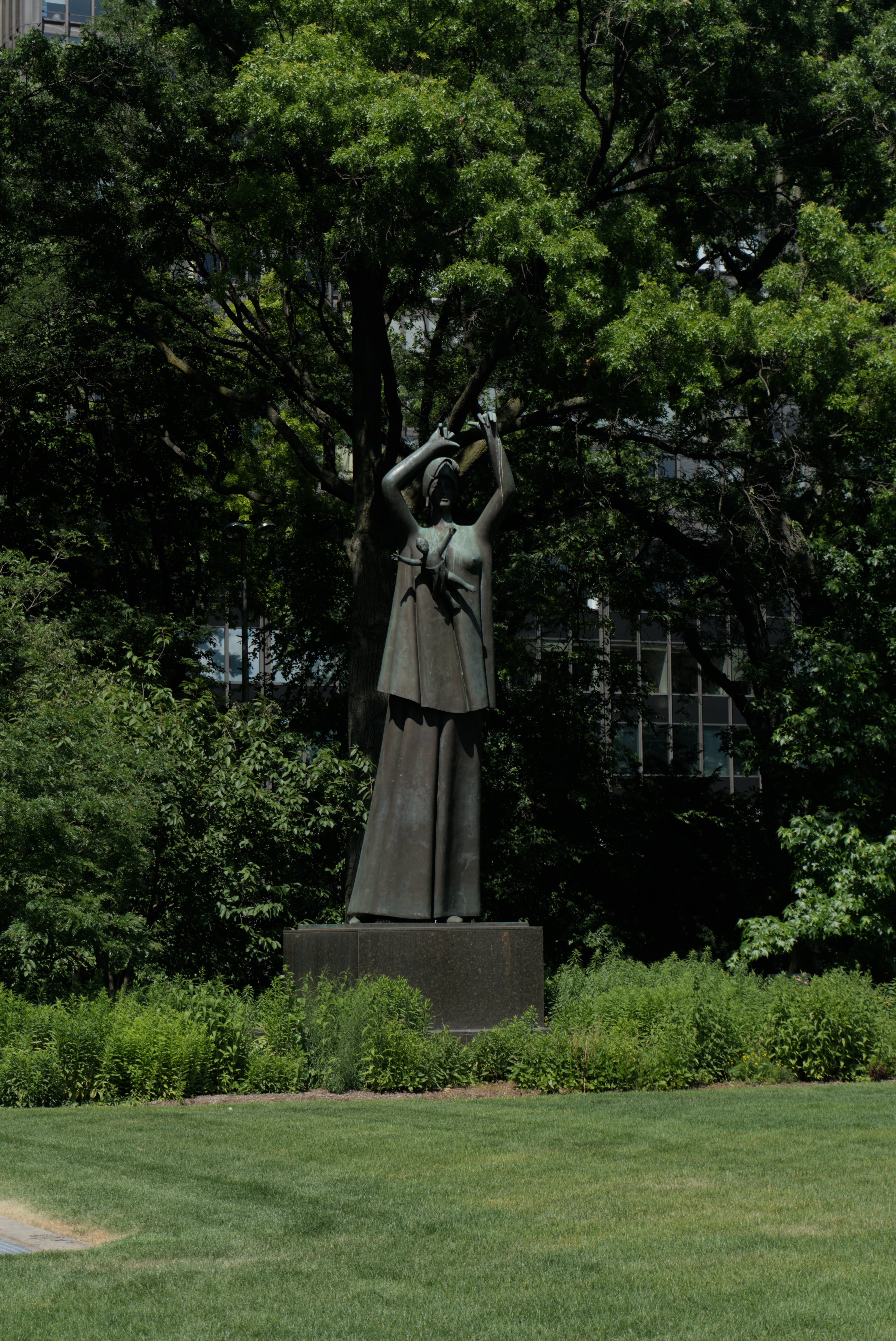
This piece wasn’t covered by the Garden Tour, nor was the colossal Mother and Child by the Italian artist Giacomo Manzù, which I spotted across the lawn and hurriedly snapped a distant photo of while scurrying to keep up with the group.
Giacomo Manzù (Italian, 1908–1991), Mother and Child, 1989. Bronze, 254 × 66 × 52 in. North Lawn, United Nations Headquarters, New York. Gift from Italy. Photo: Victoria Emily Jones. [object record]
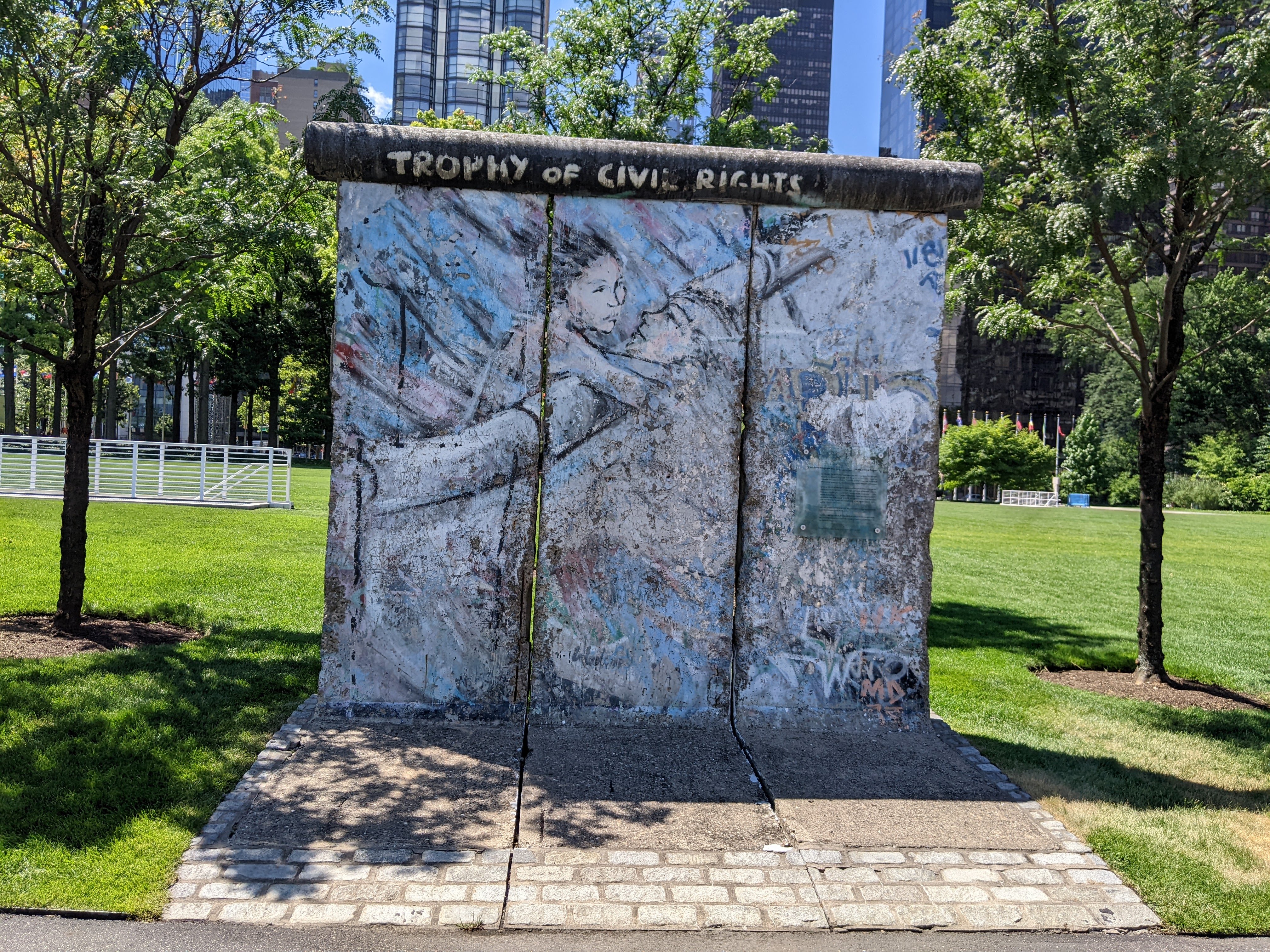
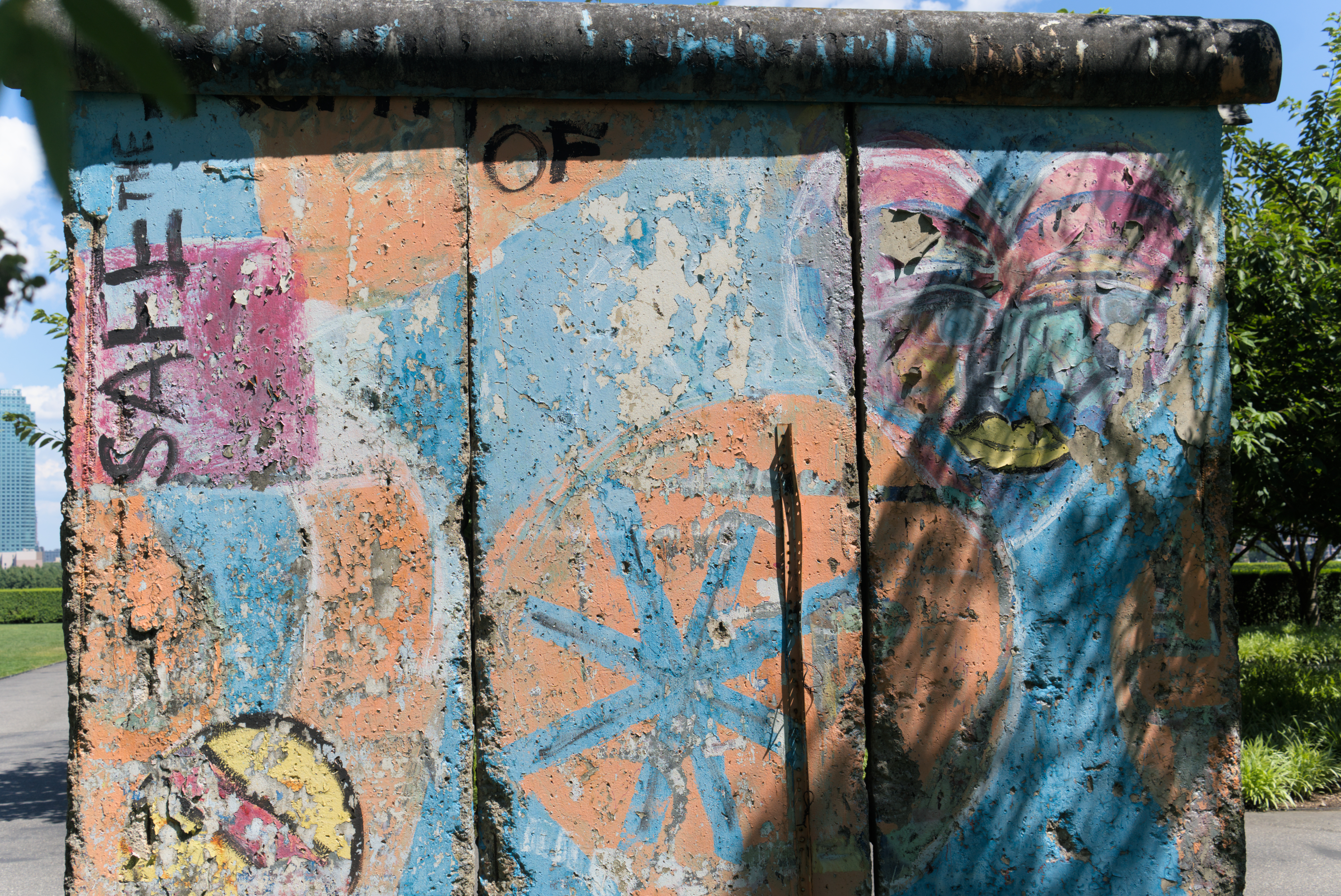
One of the pieces our guide did stop for and spend a good amount of time on was a fragment of the Berlin Wall gifted by Germany in 2002, after the wall came down in 1989. The ninety-six-mile-long barrier was erected in 1961 to divide the country into East (Communist) and West (Federal Republic), but a peaceful revolution in East Germany resulted in its fall and the country’s reunification as a federal republic, marking the end of the Cold War in Europe.
Kani Alavi (Iranian German, 1955–), Trophy of Civil Rights (Berlin Wall Fragment), ca. 1998. Precast reinforced concrete wall sections with paint, overall 84 × 114 in. North Lawn, United Nations Headquarters, New York. Gift from Germany. Photo: Victoria Emily Jones. [object record]
The front of this three-slab wall fragment (that is, the side visible from the paved path) bears a mural by Kani Alavi, an Iranian artist who moved to West Berlin in 1980, living in an apartment overlooking the formidable “Checkpoint Charlie.” Throughout the 1980s, artists painted images on the west side of the wall as a form of political commentary and resistance. The east side, however, was unpainted during the Cold War because it was so heavily guarded; attempted art interventionists probably would have been shot.
After the border opened on November 9, 1989, and demolition of the wall began, Alavi was a key organizer of what’s known as the East Side Gallery, inviting artists from Germany and around the world to paint murals on the east side of the wall, across a segment that would be deliberately left standing as a memorial. “Alavi helped transform the most visible symbol of the Iron Curtain into an enduring monument to the power of freedom,” Ryan Prior wrote for CNN. This open-air gallery is one of Berlin’s most visited attractions, featuring the work of at least 118 artists from twenty-one countries.
Alavi painted Trophy of Civil Rights (I’m not sure whether that inscription was his or just a remnant from another artist, but it’s become the mural’s de facto title) on a section of remaining wall sometime around 1998. “It is a representation of two people hugging over the wall, a dramatic situation of people trying to get close to each other,” he told NPR through a translator. “It shows how the people were separated. It shows how a culture was divided by a wall. That’s what happened, and that’s what I showed.”
The other side of the wall is painted with miscellaneous graffiti by anonymous artists.
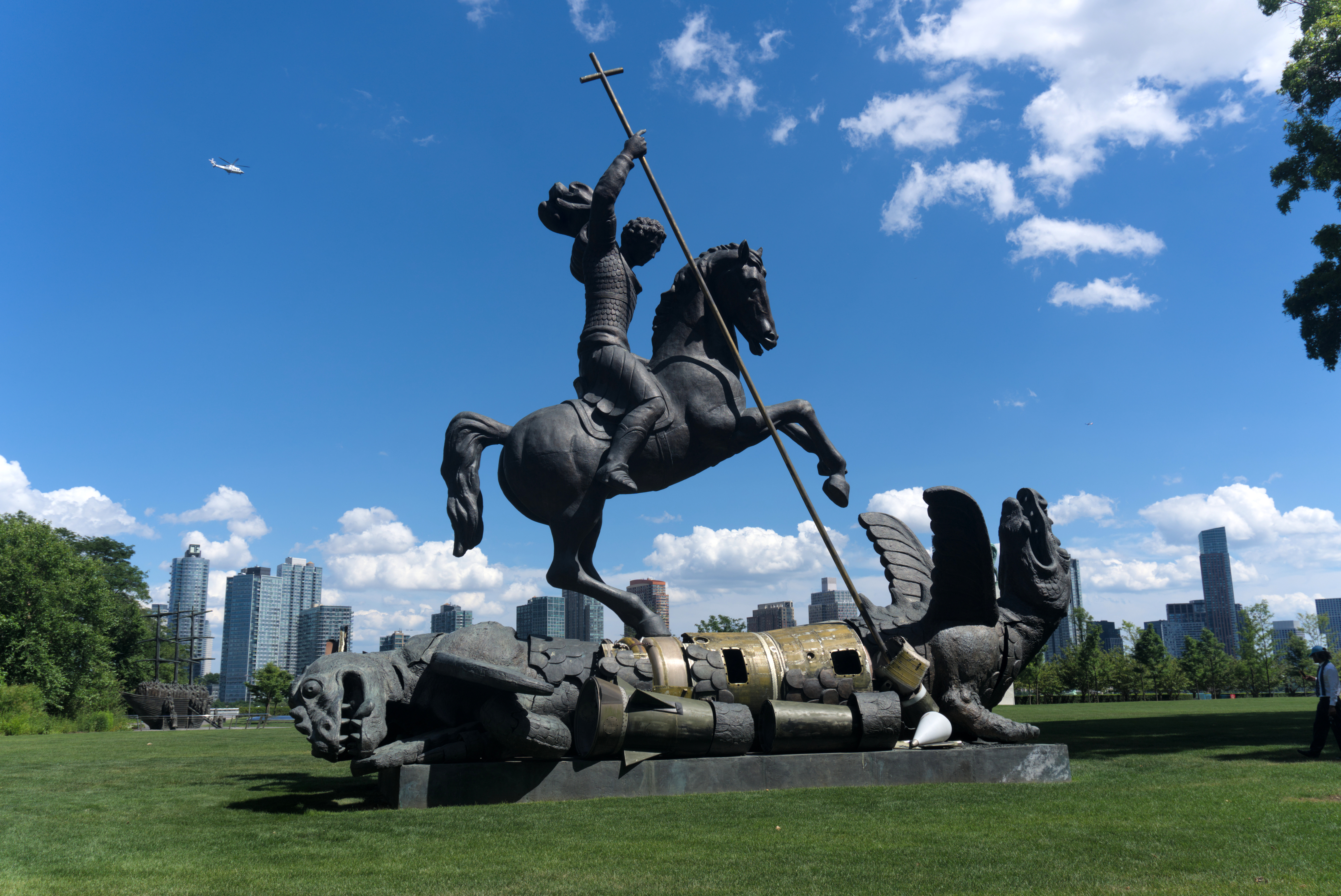
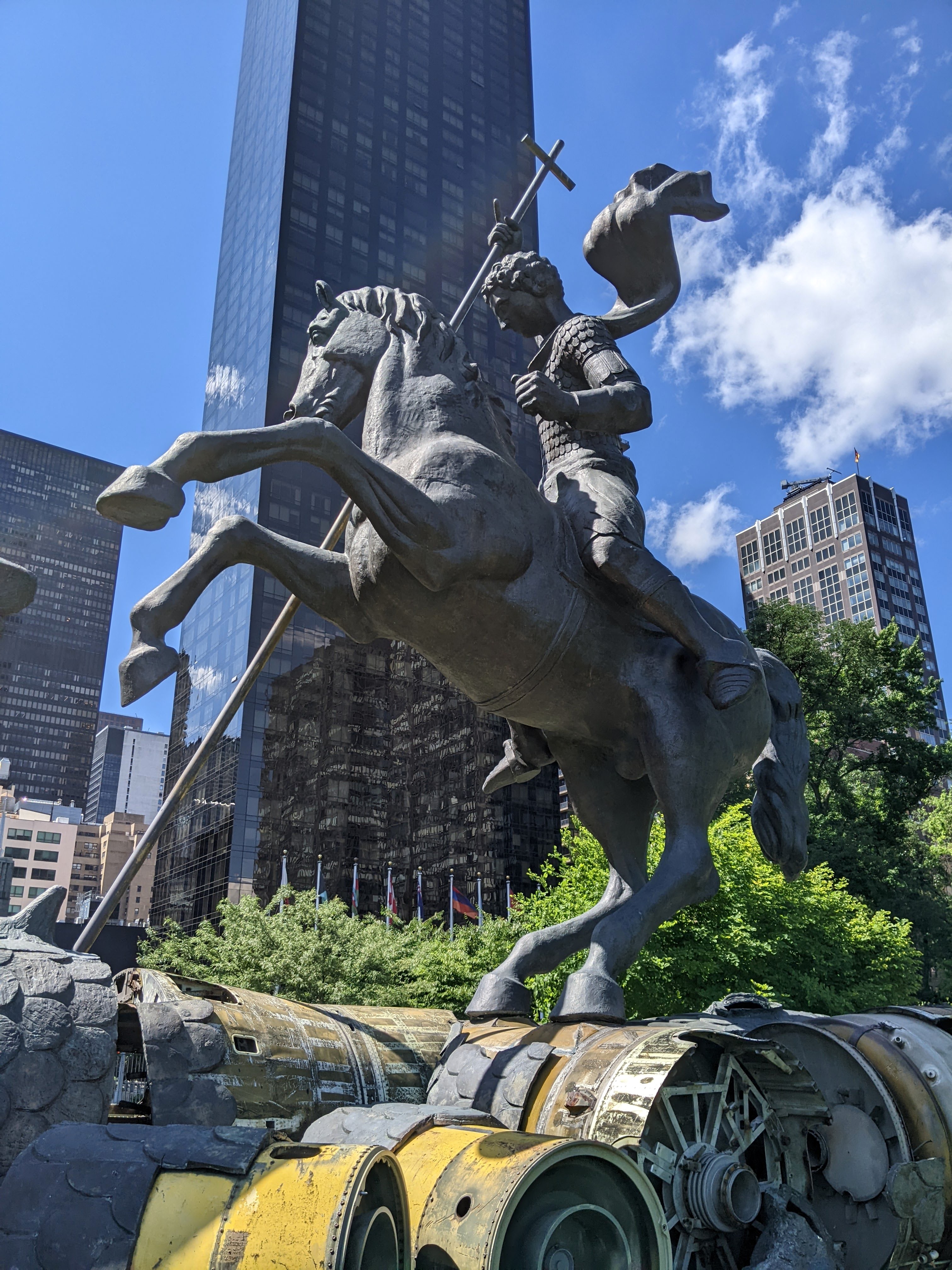
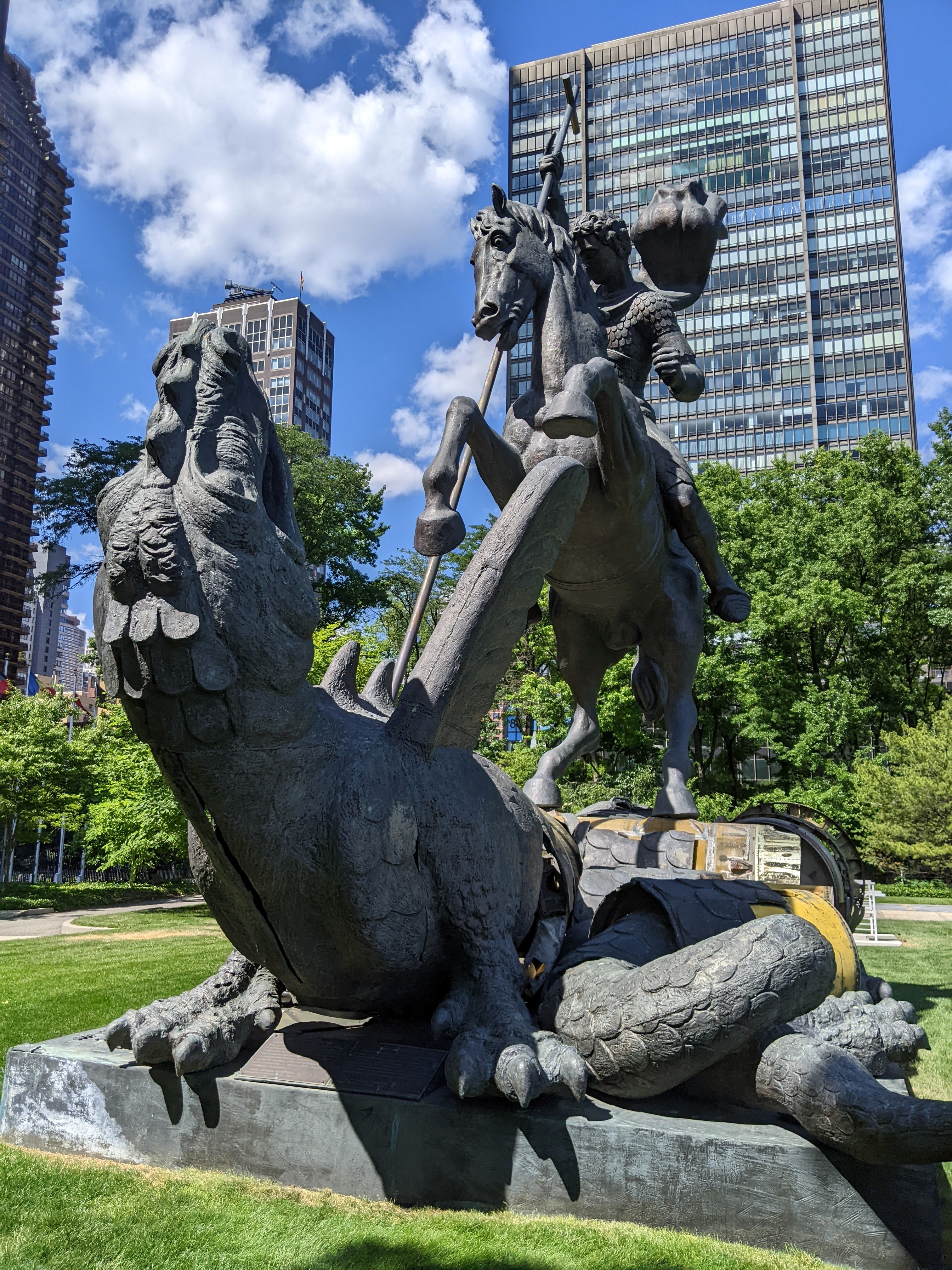
The largest sculpture on the North Lawn, standing at thirty-one feet tall and weighing forty tons, is Good Defeats Evil by the Georgian Russian sculptor Zurab Tsereteli. It depicts the Early Christian martyr-saint George, who was tortured and executed in 303 under the Diocletian persecution. Legends about him started developing in the sixth century and by the thirteenth century were widely circulated and embellished to include a tale of him slaying a dragon to save a Libyan princess whom the terrorized villagers had planned to sacrifice to it for appeasement.
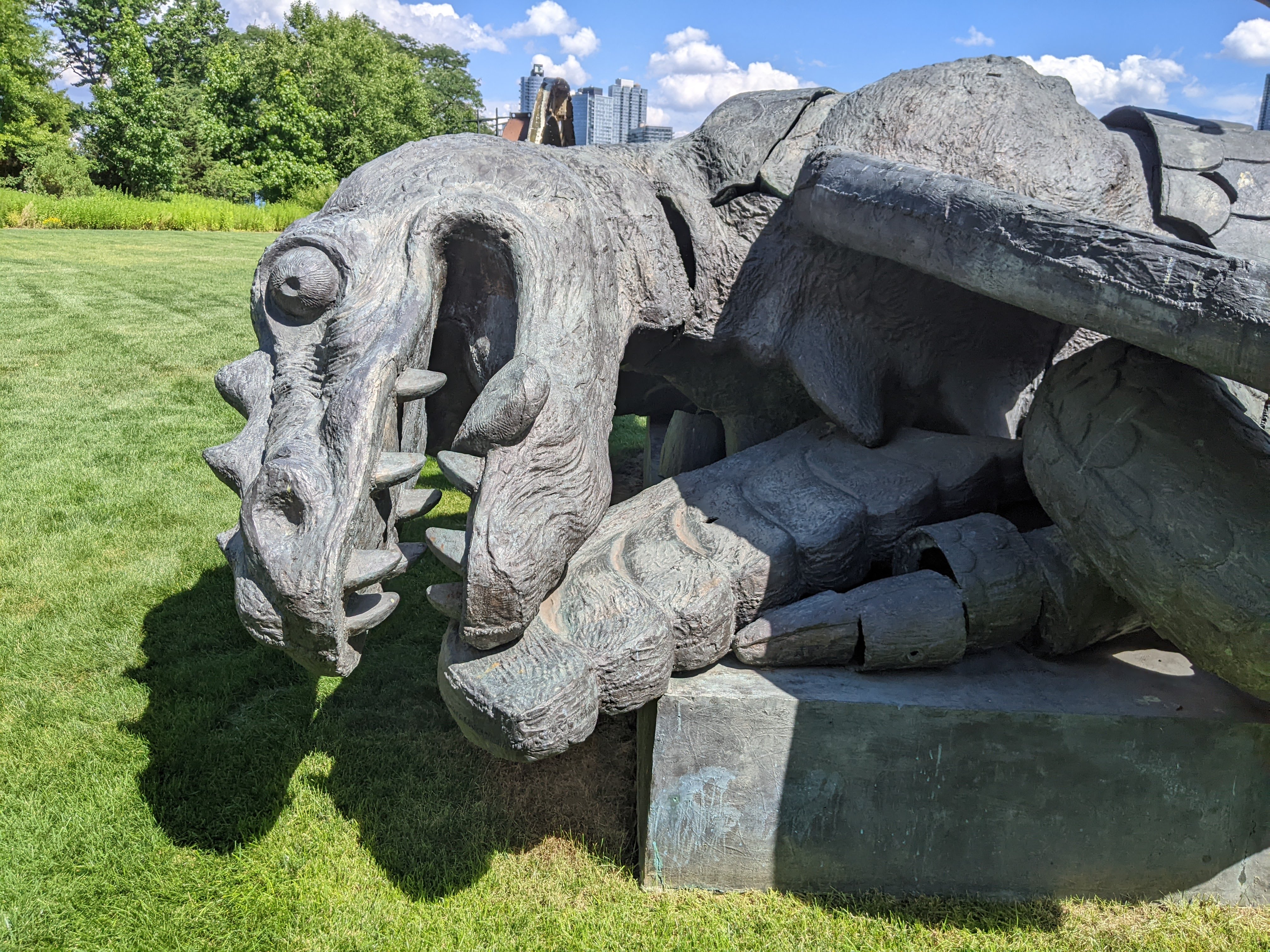
Zurab Tsereteli (Georgian Russian, 1934–), Good Defeats Evil, 1990. Cast bronze figure with dragon formed from sections of two destroyed nuclear missiles, 31 × 18 × 10 ft. North Lawn, United Nations Headquarters, New York. Gift from the USSR. Photo: Victoria Emily Jones. [object record]
(Side note: Saint George is not to be confused with Saint Michael the Archangel from the book of Revelation, who in Christian iconography is usually shown on foot [but occasionally on horseback], also slaying a dragon. The easiest way to tell the two saints apart is that Michael has wings, whereas George does not.)
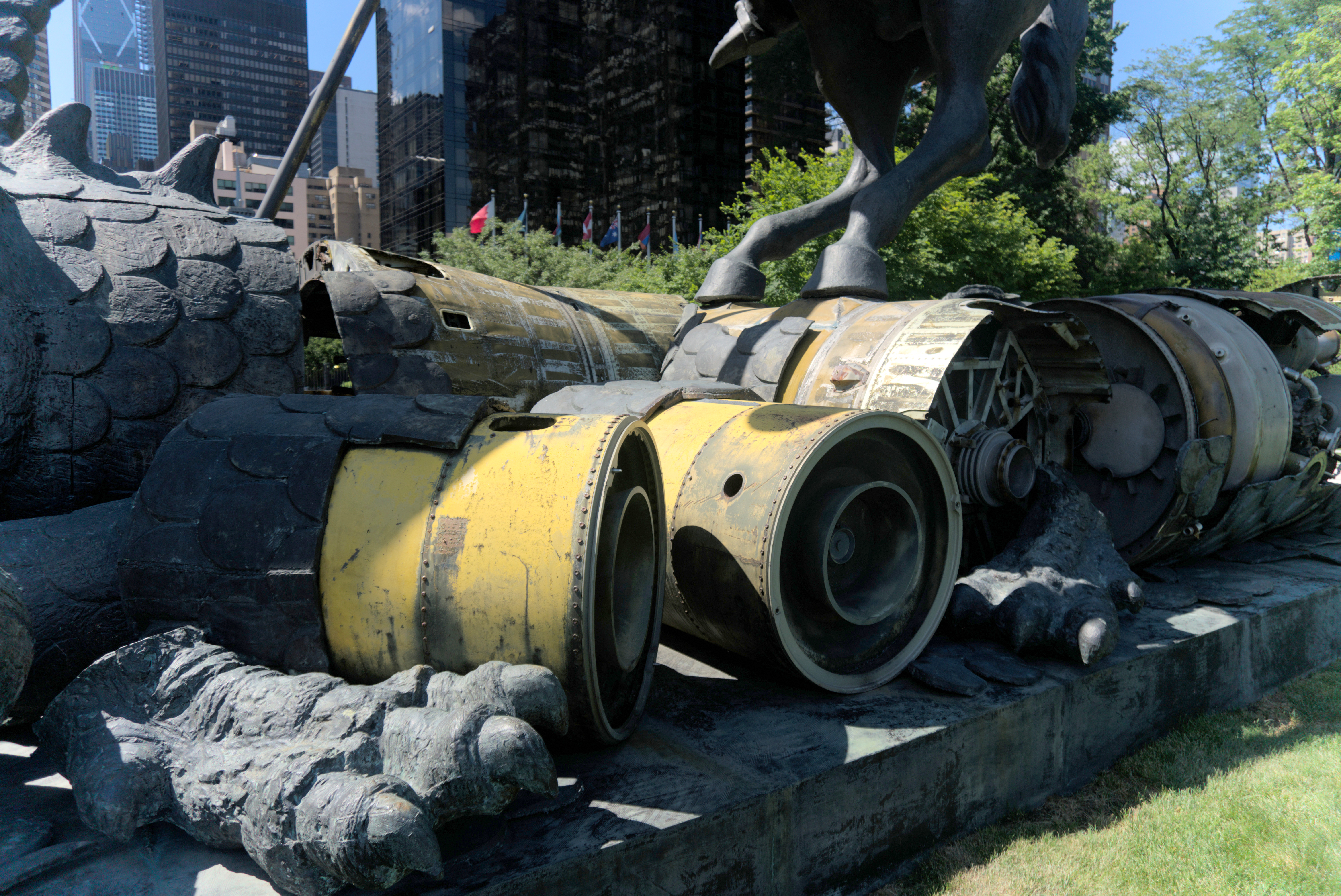
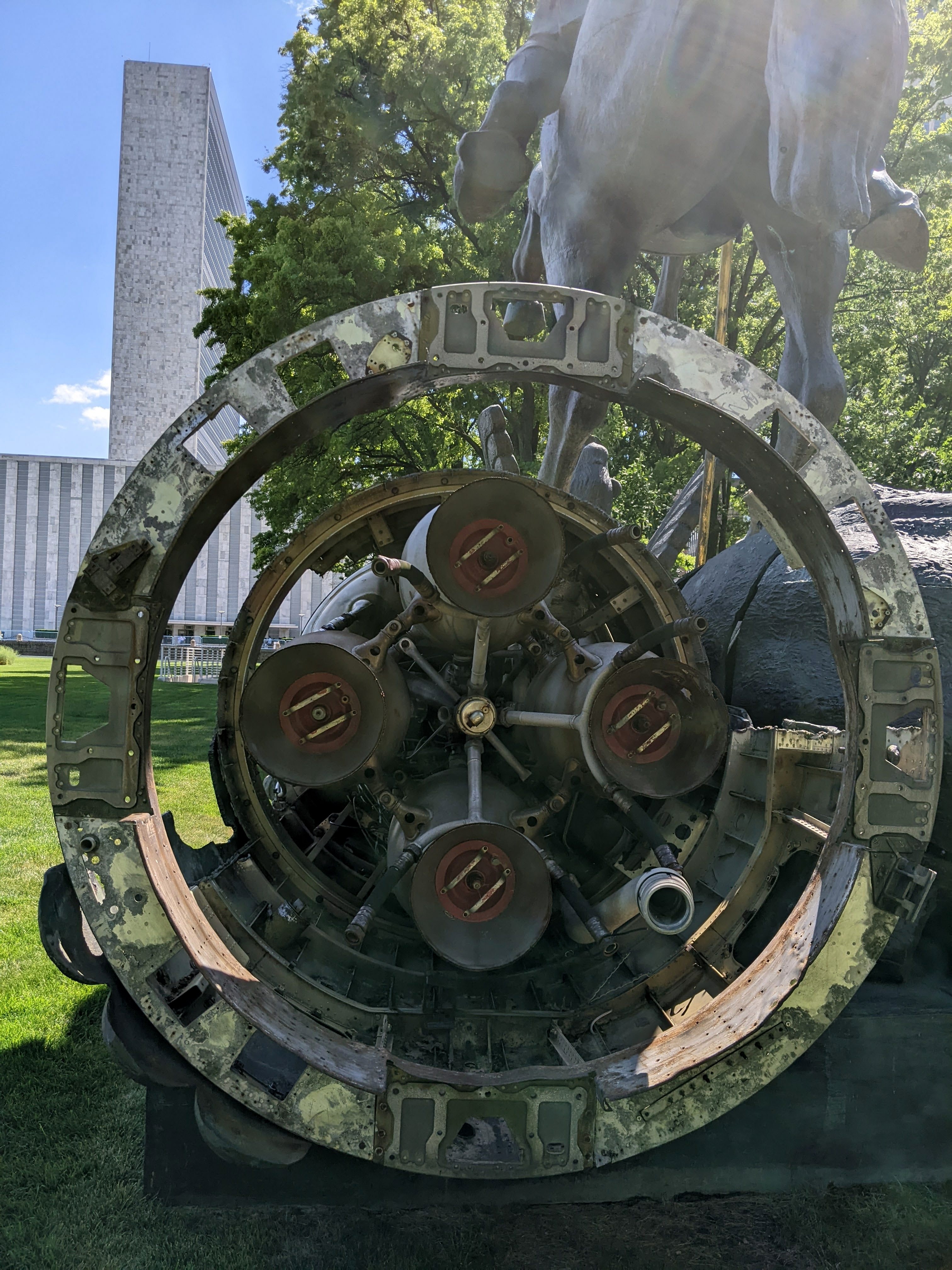
The most intriguing aspect of this sculpture is that the two-headed dragon is made up of sections of two destroyed nuclear missiles, making the piece a symbol of disarmament. According to the UN website, here
the dragon is not the mythological beast of early Christian tradition, but rather represents the vanquishing of nuclear war through the historic treaty between the Soviet Union and the United States [the Treaty on the Elimination of Intermediate-Range and Short-Range Nuclear Missiles, signed in 1987]. Created as a monument to peace, the sculpture is composed of parts of actual United States and Soviet missiles. Accordingly, the dragon is shown lying amid actual fragments of these weapons, the broken pieces of Soviet SS-20 and U.S. Pershing missiles.
The dragon’s two heads thus represent the world’s two largest nuclear arsenals during the Cold War: those of the Soviet Union and the United States.
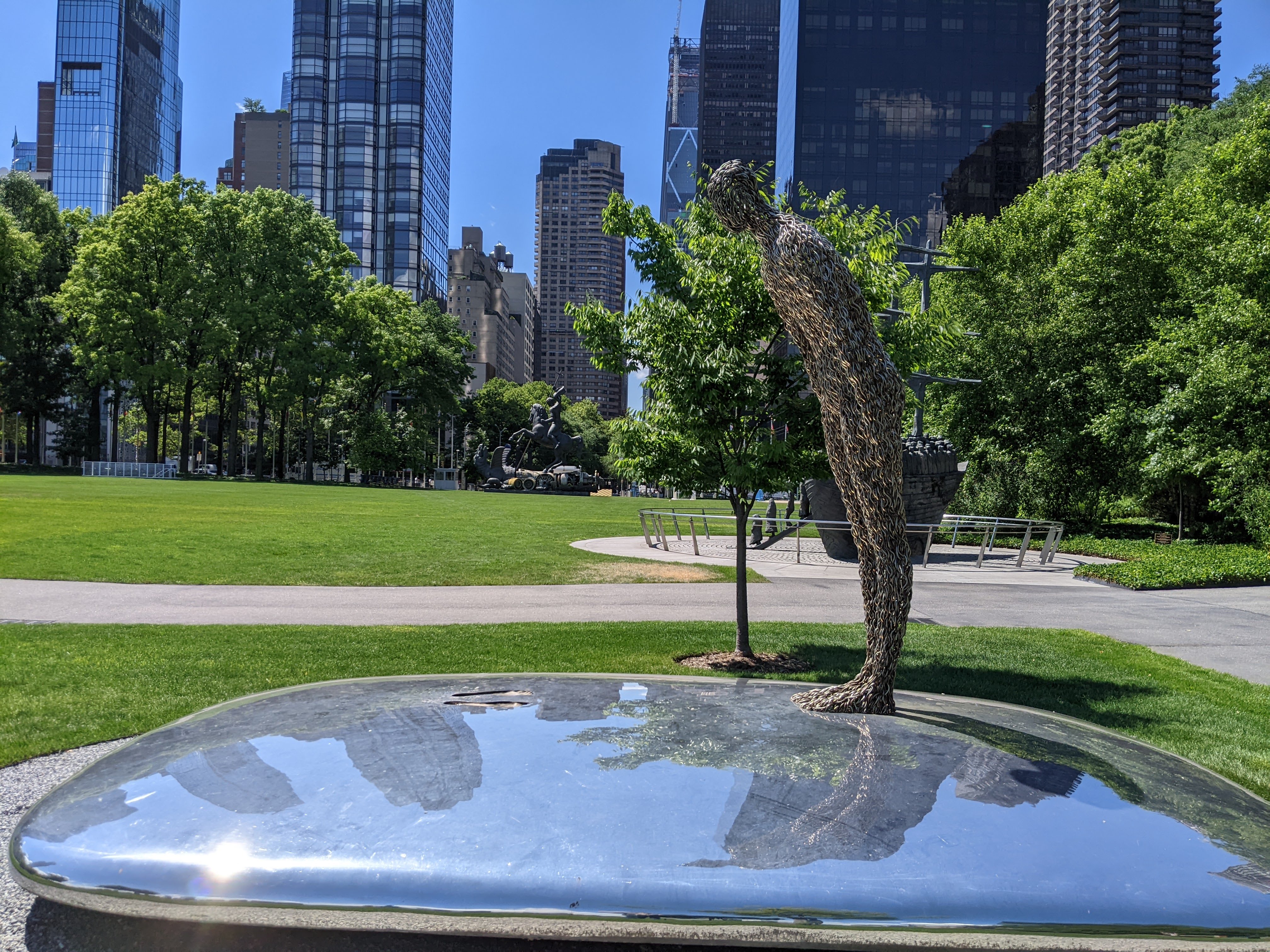
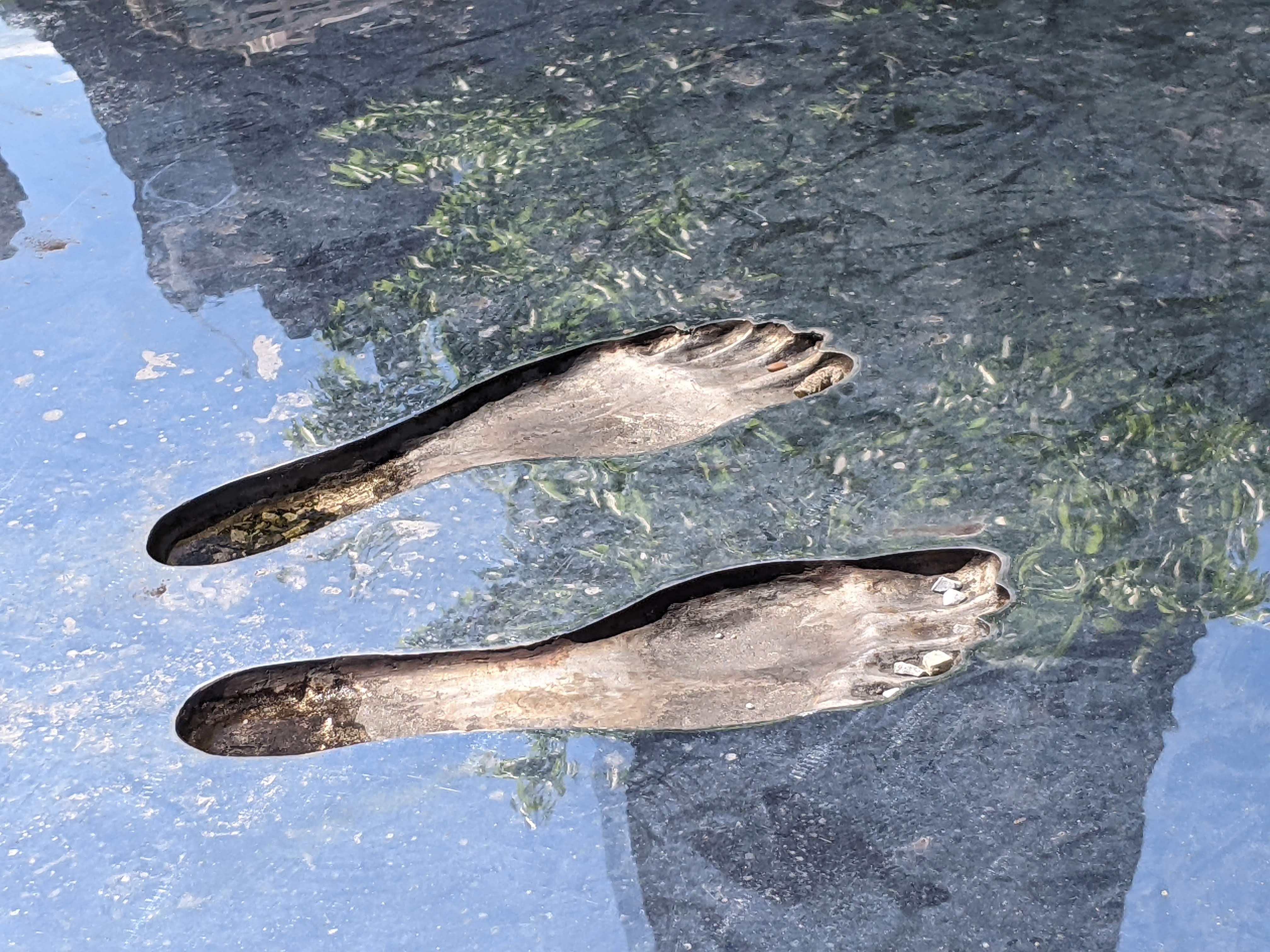
The last sculpture I’ll mention is Consciousnessby the Mongolian artist Ochirbold Ayurzana. It consists of a rounded, high-luster steel alloy floor plate on which stands a human figure, made of twisted metal strings, examining the footprints they’ve left on the planet. What mark will we make, for good or ill? The sculpture is dedicated to the historic adoption of two global developmental milestone documents: the UN 2030 Agenda for Sustainable Development and the Paris Agreement on Climate Change.
Ochirbold Ayurzana (Mongolian, 1976–), Consciousness, 2017. Steel, metal on pedestal, 110 × 196 × 125 in. North Lawn, United Nations Headquarters, New York. Gift from Mongolia. Photo: Victoria Emily Jones. [object record]
This is just a selection of the many artworks on view at the United Nations Headquarters in Manhattan. To view a full catalog, click here.
Garden Tours are offered every Wednesday at 2 p.m. from May through August, and Art Tours are offered every other Thursday at 1:15 p.m. year-round—or either one upon request. I’m grateful for their having accommodated me and my husband while we were in town!
I really wish the UN would allow visitors to move through the garden at their own speed, though, as the tour was so fast-paced that I hardly had time to take in a sculpture before we were made to move on to the next one. Approximately one to three minutes was apportioned for each work, which is hardly enough time to sit with the weight and history of some of these pieces. And I didn’t have time to change camera lenses for different types of shots. Because you have to be accompanied by a staff person, you are not allowed to linger behind when the group advances. Some leeway was given to me, but overall I felt rushed. Perhaps the pacing was anomalous because it was such a hot day—in the nineties—and the few shaded areas were prioritized.
Despite the swiftness, I really enjoyed the tour and experiencing and learning about the variety of sculptures and other art pieces from a variety of UN member countries, which celebrate peace, joy, and global unity and project a hopeful future.
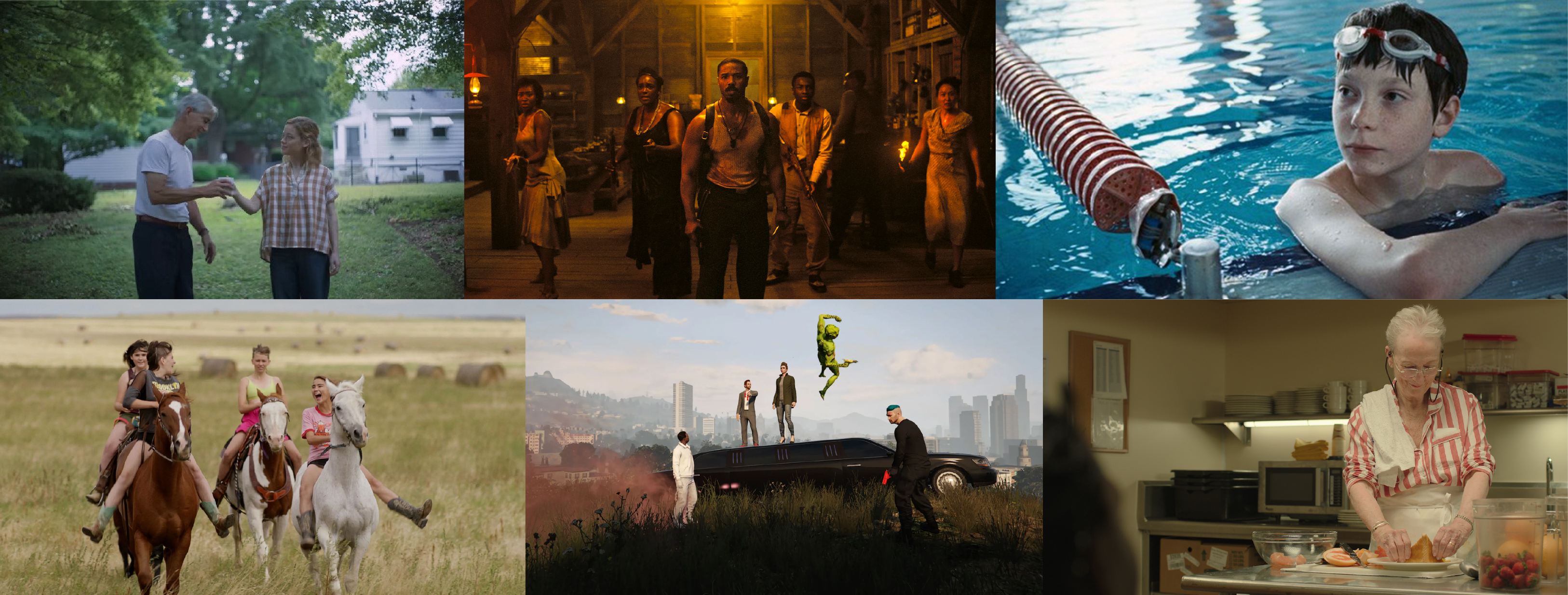
11. Oppenheimer, dir. Christopher Nolan. Based on the biography American Prometheus by Karl Bird and Martin J. Sherwin, Oppenheimer chronicles the role of nuclear physicist J. Robert Oppenheimer (Cillian Murphy) in developing the world’s first atomic bomb. Recruited by the US Army in 1942, Oppenheimer heads up the new Manhattan Project lab in Los Alamos, New Mexico, assembling a team of leading scientists. While some decline the invitation or, over the next few years, drop off the project for ethical reasons, Oppenheimer persists with the self-justification that if the US didn’t make the bomb, Germany would. The film grapples with moral responsibility and guilt when it comes to applying advanced scientific knowledge toward destructive ends.
12.The Holdovers, dir. Alexander Payne. It’s December 1970, and Angus Tully (Dominic Sessa) is looking forward to getting away from his New England boarding school for Christmas break, especially from his ornery classical studies teacher Paul Hunham (Paul Giamatti). But when his mom calls to say she and her new husband need some alone time, Angus is left under the begrudging care of Mr. Hunham for the holidays. Mary Lamb (Da’Vine Joy Randolph), the school cook whose son died earlier that year in Vietnam, also stays on campus to make meals. We learn about these three unlikely companions as they learn about one another and confront their griefs, anger, and disappointment. The Holdovers is a warm and charming film that’s destined to become a new Christmas classic.
Streaming on Peacock.
13. Godland, dir. Hlynur Pálmason. In this slow-burning mood piece set in the late nineteenth century, a young Lutheran priest named Lucas (Elliott Crosset Hove) is dispatched from his home country of Denmark to a remote part of Iceland to establish a church. Led by the gruff but spiritually curious local guide Ragnar (Ingvar Sigurðsson), Lucas treks through the country’s rugged wilderness. But the deeper he travels, the more his sense of purpose and morality falters. The film explores the physical and mental challenges of international mission work, opposing approaches to nature (as something to be dominated versus something to work with in humility), and the interlocking histories of two nations, one under the political control of the other.
A title card at the beginning of the film says Godland was inspired by seven wet-plate photographs found in a wooden box, the sole documentation of a Danish priest’s odyssey to the southeast coast. What an intriguing concept!, I thought: to invent a narrative out of this anonymous set of historical photos (a girl playfully posing on a horse, a nascent church congregation seated outside its new building, etc.), which are re-created throughout the film. It turns out there were no photos; the writer-director made that up. But the strength of the concept still stands. In addition to serving a religious vocation, Lucas is a photographer, and his journey is made all the more rigorous by his having to lug his heavy camera equipment over the terrain. He photographs what he values—and refuses to photograph what he doesn’t, which leads to a climactic altercation. The frames of the film have a 4:3 aspect ratio and rounded corners to further evoke vintage photography.
I found it hard to get a handle on Lucas’s character, as he seems so ill suited to pastoral ministry. He’s generally closed off, uncharitable (even spiteful), and easily annoyed, and he has a sense of superiority over Icelanders, refusing to learn their language and to recognize the glory of their land and culture. I think he starts off more optimistic and open, but when he suffers a loss and his feelings of isolation and frustration increase, he becomes a reluctant prophet, like Jonah. I read the muddy scene near the end as him finally acknowledging his guilt (Ragnar’s barking dog piercing his conscience), but others have interpreted it differently. If you watch it, I’m curious to know what you think.
Streaming on Kanopy.
14. The Eight Mountains, dir.Felix van Groeningen and Charlotte Vandermeersch: Adapted from the best-selling 2016 novel by Paolo Cognetti, The Eight Mountains is a tale of friendship and making peace with the past. Eleven-year-old Pietro meets Bruno one summer while vacationing in the Italian Alps with his family. Pietro’s dad, Giovanni (Filippo Timi), becomes a father figure for Bruno, whose own father neglects him. As a teen Pietro becomes estranged from his family while Bruno maintains a relationship with them. Pietro doesn’t return to Bruno’s village until some twenty years later, when he learns that his father has died. Pietro and Bruno (played by Luca Marinelli and Alessandro Borghi as adults) reconnect over restoring a dilapidated cabin that the father had always dreamed of living in. Over the next decade, the two support each other in their griefs and letting go: Pietro over the years he lost not knowing his father, and Bruno over the loss of the dairy farm that has been in his family for generations but that is no longer viable, and with it the loss of a simple, rural way of life in the mountains he loves.
It’s rare to see a film about male friendship that doesn’t involve war, crime, or drunken shenanigans or turn into a romance. The Eight Mountains shows us two men who are a caring presence in each other’s lives, whose getting together simply involves conversation, comfortable silences, and scenic hikes. It’s a quiet film with gorgeous cinematography.
15. Return to Seoul, dir. Davy Chou. Frédérique “Freddie” Benoît (Park Ji-Min), a twenty-five-year-old French woman who was adopted as a baby from South Korea, returns for the first time to her birth country and hesitantly decides to track down her biological parents. The film follows her over the course of eight years as she tries to find who she is and where she belongs.
Streaming on Amazon Prime.
16. A Thousand and One, dir. A. V. Rockwell. After getting released from prison, the devoted and determined Inez (Teyana Taylor) kidnaps her son, Terry (played at different ages by Aaron Kingsley Adetola, Aven Courtney, and Josiah Cross), from the foster care system and sets out to build a life for him in a Harlem that is rapidly changing through gentrification. Spanning 1994 to 2005, the film is about love that we choose and that chooses us. Taylor is phenomenal in the lead role.
Streaming on Amazon Prime.
17. R.M.N., dir. Cristian Mungiu. When three Sri Lankan migrant workers are hired by a bread factory in a Transylvanian town, paranoia and violence erupt. The locals boycott the bread and demand the “outsiders” leave—and this despite the town’s already multiethnic population, consisting of Romanians, Hungarians, Germans, and Roma. Writer-director Cristian Mungiu based the film on an actual incident of xenophobia in Ditrău, Romania, in January 2020, in which ethnic resentments led to a petition that pushed the Sri Lankans out. The Christmastime setting underscores the irony of the town’s hostile response to its new residents, as the Christmas story involves strangers seeking lodging and welcome to bring the Christ child into the world.
Streaming on AMC+.
18. American Fiction, dir. Cord Jefferson. Thelonious “Monk” Ellison (Jeffrey Wright) is shopping his novel to different publishers, but they’re not interested; they say it’s “not Black enough.” Frustrated by the industry’s platforming and profiting from stereotypes of Blackness, he decides to write a new novel so outrageous in its use of tired and offensive Black tropes that the gatekeepers will be forced to confront their ridiculousness. Turns out, My Pafology becomes a smash success. This film addresses through comedy our culture’s narrow expectations of what Black art and entertainment should be—what stories Black people should tell and in what kind of voice, or what issues Black writers and filmmakers should address in their work.
19. One Fine Morning, dir. Mia Hansen-Løve. Sandra (Léa Seydoux) is a young widowed woman caring for her eight-year-old daughter (Camille Leban Martins), her aging father (Pascal Greggory), and herself, while holding down a job as a translator in Paris. Too often in film, moms are flat characters, but I love how multidimensional Sandra is—how we see her balancing motherhood, daughterhood, and her professional and romantic lives. Neither perfect nor unforgivably flawed, she is just a normal mom dealing with normal stuff, and wow, is Seydoux endearing in the role. The scene in which she’s having to size down her dad’s personal library after moving him into a long-term care facility where his neurodegenerative disease can be monitored made me cry.
Streaming on Amazon Prime.
20.Flora and Son, dir. John Carney. From the director who brought us Once and Sing Street comes another well-made feel-good movie about the power of music. Flora (Eve Hewson), a single mom, is constantly at war with her delinquent fourteen-year-old, Max (Orén Kinlan). (I’m genuinely shocked by how they talk to each other!) To keep him out of trouble, she tries to find him a hobby, and when he rejects the guitar she salvaged from a dumpster, she decides to take up the instrument herself. When she learns that Max is into making electronica and rap, she helps him turn one of his songs into a music video, and he helps her write a song for the online class she’s taking. It’s a sweet movie about a mother and son finding a way to connect with each other through music.
I’ve seen over seventy films from 2023 (and there are still more I want to see!), and these are my top ten. My top eleven through twenty will be released this weekend in a separate post. Many are international, and what year to classify them as can be hazy; I go by the date on which the film was released in the US, which is when I have access to it.
If the film is streaming for free with a subscription service, I’ve noted that at the bottom of the entry. Otherwise, most are available for digital rental (Google Play is my preferred vendor), and a few are still in theaters. You might also see if your local library has any on DVD, as that’s how I watched several of these.
Please be aware that the following films have either PG-13 or R ratings, for various reasons. I don’t have a personal policy of “no x” or “no y” in the movies I watch, but if you do, please consult the MPAA rating descriptors or a more detailed content advisory before deciding whether to view the film.
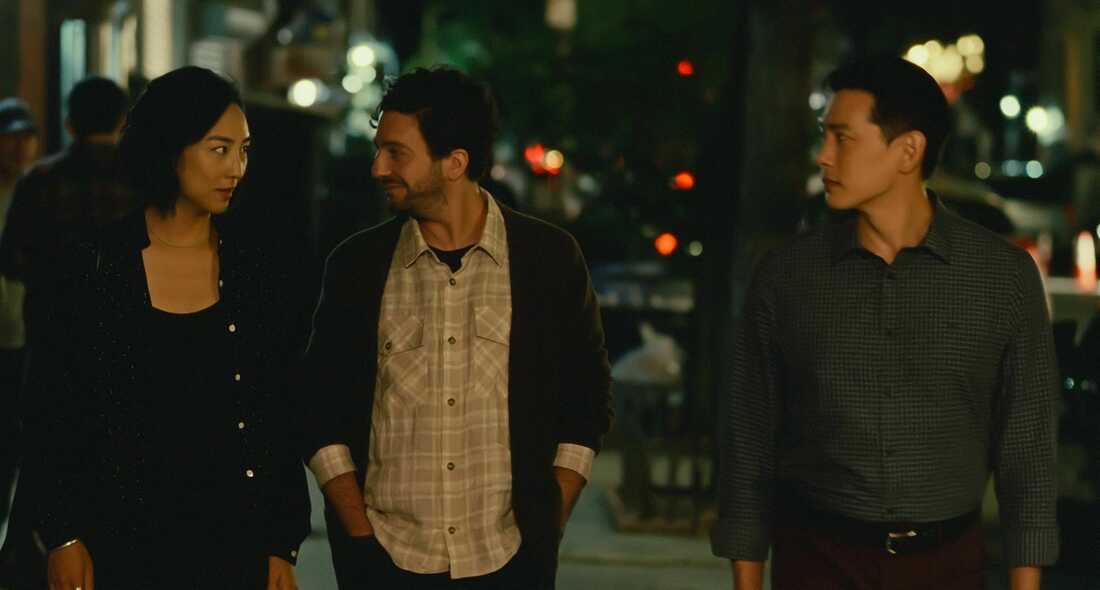
1. Past Lives, dir. Celine Song. Kind, gentle, and empathetic, this semiautobiographical indie drama by debut director Celine Song follows Na Young, or Nora (Greta Lee), over the course of twenty-four years, from her young adolescence in South Korea to her emigration to Canada and then the US. Act 1 introduces us to Nora’s childhood sweetheart, Hae Sung (Teo Yoo), whom she reconnects with virtually twelve years later in act 2, shortly before meeting and befriending a white American man named Arthur (John Magaro) at a writers’ retreat. After another twelve years of not interacting, Nora and Hae Sung find each other again in act 3 at age thirty-six, when the single Hae Sung visits Nora, who’s now married to Arthur, in New York.
What I love about this film is how it subverts all the tropes associated with the romantic triangle. The characters aren’t possessive, conniving, or competitive. There are no heroes or villains here. The film is about bonds of love and culture, and especially about what trust, support, constancy, maturity, and love look like in a marriage. In an interview on the DVD special features, Song says Past Lives is at its core a love story between Nora and Arthur. It’s also a story of navigating a bicultural identity—living between two worlds, mourning the piece of oneself that’s lost with the adoption of a new home country, and integrating elements of one’s “past life” into one’s new life, continuing to be shaped by both.
The opening scene and closing scene are perfect. Song’s skill as a storyteller, honed over her years as a successful playwright, really shines through in her screenplay.
2. The Zone of Interest, dir. Jonathan Glazer. This chilling Holocaust drama centers on a Nazi family living their dream life in the literal backyard of the Auschwitz concentration and death camp. Rudolf Höss (Christian Friedel)—who is an actual historical figure—is the commandant of the camp; having risen through the ranks, he seeks to provide his wife, Hedwig (Sandra Hüller), and their five children a comfortable and idyllic life. It’s a risky choice to tell this story from a German perspective, but Glazer and the two lead actors more than succeed. We never actually set foot inside the camp; most of the scenes happen within the confines of the villa or at the nearby river where the family goes on outings. Nor do we directly see any of the horrors; we see merely hints, like smoke rising from a crematorium chimney in the background. But even more, we hear these intimations: a train pulling into the station, a tussle, a chase, a barking dog, a gunshot, screaming. All of this happens just over the wall, while Hedwig tends to her flower garden or her son plays with toys in his bedroom. (Props to the sound designer, Johnnie Burn.)
What is so disturbing about the film is the banality of evil that it reveals. Rudolf isn’t the type of villain who sneers or snarls or has violent outbursts. He brings his kids kayaking and reads them bedtime stories; he sips coffee with his wife. He could be us. “I wanted to show that these were crimes committed by Mr. and Mrs. Smith at No. 26,” Glazer said. Sanitization is one of the themes explored—lots of scrubbing.
3. Four Daughters, dir. Kaouther Ben Hania. Blending documentary and fiction, this film tells the true story of a Tunisian Muslim mother—Olfa Hamrouni—and her four daughters, the elder two of whom became radicalized by ISIS as teenagers and ran away to Libya to engage in jihad. In 2016 Kaouther Ben Hania saw media segments of Olfa calling out local authorities for their indifference and inaction and knew she wanted to make a film about the disappearance, to understand how a tragedy like this can happen in a family. She originally wanted to do a straight documentary but soon realized it would be more powerful, and more feasible, to have Olfa and her younger daughters, Eya and Tayssir Chikhaoui (born in 2003 and 2005), reenact their memories onscreen. Because daughters Ghofrane and Rahma Chikhaoui are still absent, actors Ichrak Matar and Nour Karoui were hired to portray them, and actor Hind Sabri stepped into the mother role for the scenes that took too high an emotional toll on Olfa.
This method of storytelling better reveals the story’s complex layers, as the three women are both inside and outside the scenes. They’re telling the past, but they’re also questioning it. They’re reflecting on their motivations as they discuss their memories with each other and Ben Hania—many of them traumatic, but others warm or simply ordinary, as when they talk about their first periods! Olfa, the mother, is a particularly complex character, as she is fiercely protective of her daughters but also perpetuates on them some of the patriarchal oppression that she herself suffered. The film is about motherhood, sisterhood, zealotry, rebellion, and violence, and it has left a searing impression on me.
4. Anatomy of a Fall, dir. Justine Triet. In this courtroom drama set in the French Alps, Sandra (Sandra Hüller) is suspected of her husband Samuel’s (Samuel Theis) murder. As the police investigate and the prosecution launches its interrogations, they uncover details about Sandra and Samuel’s conflicted relationship, and the couple’s visually impaired eleven-year-old son, Daniel (Milo Machado Graner), is forced to testify. Hüller’s performance is riveting—she gets my vote for Best Actress of the Year.
5. Saint Omer, dir. Alice Diop. Another French courtroom drama, this one based on the real-life story of Fabienne Kabou. Laurence Coly (Guslagie Malanda), a Senegalese immigrant to France, is on trial in Saint-Omer for the murder of her fifteen-month-old daughter, Lili, an action she blames on sorcery. Intrigued by the case as potential source material for the novel she’s working on, Rama (Kayije Kagame), pregnant, travels from Paris to attend the trial. But when Laurence’s motives prove inscrutable and mental illness is put on the table, Rama begins to worry about her own ability to mother. The testimony dredges up emotions for Rama surrounding her troubled relationship with her mother—also a Senegalese immigrant, who appears, from the flashback sequences, to suffer from depression—and sharpens her sense of cultural alienation. Rama is an analogue for the filmmaker, Alice Diop, who, as a documentarian and expectant mother at the time, attended the Kabou trial, and it forced her to face her own difficult truths.
Streaming on Hulu.
6. Dream Scenario, dir. Kristoffer Borgli. Paul Matthews (Nicolas Cage) is an evolutionary biologist teaching at a small-town college and living a quiet life with his wife and two daughters, when out of nowhere, he starts appearing in the dreams of strangers around the world and becomes instantly famous. An absurd comedy with elements of horror, Dream Scenario satirizes the fickle nature of celebrity in today’s internet age, in which even the most unremarkable people can become an overnight sensation, and the adoration of fans can turn to hatred at the drop of a hat. I was laughing out loud a lot at this one—and cringing too!
7. Fremont, dir. Babak Jalali. Donya (Anaita Wali Zada) is a young Afghan immigrant working at a fortune cookie factory in the Bay Area of California. Formerly a translator for the US Army in Afghanistan, she is ostracized by many of her fellow Afghans as a traitor, and she struggles with loneliness. But the film has an uplifting tone; it’s about survival, hope, and connection. The first full-length feature by the Iranian British filmmaker Babak Jalali, it is in English, Dari, and Cantonese.
Streaming on MUBI.
8. Monster, dir. Kore-eda Hirokazu. When her eleven-year-old son, Minato (Soya Kurokawa), starts behaving strangely and she hears that a teacher hit him, Saori (Sakura Ando) demands answers from the school. The story is told in three parts, each from a different narrative perspective: first the mom’s, then the teacher’s, then the boy’s. The truth gradually emerges with each shift, and a stormy finale brings things to a close.
9. Plan 75, dir. Chie Hayakawa. In a near future, the Japanese government launches a voluntary but coercive program encouraging the nation’s elderly citizens to terminate their lives in order to nobly reduce the burden on society. Having been forced to retire from her job as a hotel maid after one of her coworker peers slips in a hotel shower, Michi (Chieko Baishô) is considering signing up. The film focuses on her but also develops side stories for two Plan 75 employees: a Filipino migrant whose daughter back home needs an operation, and a man whose estranged uncle becomes a client.
10. Killers of the Flower Moon, dir. Martin Scorsese. Based on the best-selling nonfiction book by David Grann about the serial murder of members of Osage Nation in the 1920s, Scorsese’s Killers of the Flower Moon depicts the criminal ugliness of white greed and laments a grave historical injustice. When the Osage discover oil on the reservation they’ve been displaced to in Oklahoma, they become very wealthy, and white men from the outside move in to try to steal that wealth. The white crime boss and master of deception William Hale (Robert De Niro)—the movie uses all the real names—has ingratiated himself with the Osage over decades and has secretly been carrying out a plan to gain control of Osage headrights by killing off inheritors.
The movie focuses on Hale’s nephew Ernest Burkhart (Leonardo DiCaprio), a simpleton whom Hale compels to marry the young Osage woman Mollie Kyle (Lily Gladstone) and further manipulates to manipulate others. The movie suggests that the love been Ernest and Mollie is genuine but complicated, and I didn’t quite grasp what bound them together (was it just physical attraction?) or how much either of them knew about what was going on (was Ernest really that naive? did Mollie never suspect him or his uncle of foul play earlier on?). But I was engrossed for the full three-and-a-half-hour runtime, all the way to the gutsy final scene of the radio play and the beautiful, defiant coda.
The Easter season is a time of hope. There still is fear, there still is a painful awareness of sinfulness, but there also is light breaking through. Something new is happening, something that goes beyond the changing moods of our life. We can be joyful or sad, optimistic or pessimistic, tranquil or angry, but the solid stream of God’s presence moves deeper than the small waves of our minds and hearts. Easter brings the awareness that God is present even when his presence is not directly noticed. Easter brings the good news that, although things seem to get worse in the world, the Evil One has already been overcome. Easter allows us to affirm that although God seems very distant and although we remain preoccupied with many little things, our Lord walks with us on the road and keeps explaining the Scriptures to us. Thus there are many rays of hope casting their light on our way through life.
—Henri Nouwen, A Cry for Mercy: Prayers from the Genesee (1981) [HT]
+++
TRAVELING EXHIBITION: Arte de Lágrimas: Refugee Artwork Project: Started in August 2014 by the Rev. Dr. Gregory Cuéllar and Nohemi Cuéllar, Arte de Lágrimas (Art of Tears) is a traveling art exhibit and archive that aims to create greater public awareness of the lived migratory journeys of asylum-seeking children and youth from Central America. The Cuéllars and other volunteers have visited respite centers in Texas border towns like McAllen, Brownsville, and Eagle Pass, distributing art supplies to migrant children who are waiting for buses to take them to their longer-term destination. They want to give these children the option to express themselves or process their journeys through an artistic outlet. Some of the children have chosen to donate their artworks to the volunteers, and it is these that constitute the Arte de Lágrimas collection, which is currently on display at Fuller Theological Seminary in Pasadena, California.
This Thursday, April 27, Fuller is holding a gallery reception at Travis Auditorium (180 N. Oakland Ave., Pasadena) from 6 to 9 p.m., which will include a presentation by Gregory Cuéllar as well as a panel discussion; RSVP here. Cuéllar, who teaches Old Testament at Austin Presbyterian Theological Seminary, is the author of Resacralizing the Other at the US-Mexico Border: A Borderland Hermeneutic (Routledge, 2020) and Voices of Marginality: Exile and Return in Second Isaiah 40–55 and the Mexican Immigrant Experience (Peter Lang, 2008).
If you can’t make it to the exhibition at Fuller, you can at least tour the Virtual Showroom that the Cuéllars developed, which hangs the images in a digital space that gives users the impression of being in a physical gallery.
+++
ARTICLE: “‘He Is Not Here’: A Choral Easter Season” by Mark Meynell: This Rabbit Room blog post is part of 5&1, a weekly series from 2021 in which British chaplain Mark Meynell shares five short pieces of classical music and one long piece, drawing attention to some of their musical elements. For Easter he selected a setting of Psalm 118:24 by Renaissance composer William Byrd; “O dulce lignum” (O Sweet Wood) from Ēriks Ešenvalds’s Passion and Resurrection (below); “Christus Vincit” by Sir James MacMillan; an anthem for Ascension Day by Gerald Finzi; an Easter hymn from an Italian opera by Pietro Mascagni (also below); and the fifth movement of Mahler’s famous Resurrection Symphony. I appreciate that he provides lyrics and translations!
+++
BLOG POST: “The Good Fridays of Our Eastertide Lives” by W. David O. Taylor, feat. Sam Wedelich: W. David O. Taylor, a theology professor at Fuller Theological Seminary, shares a visual interpretation of Matthew 28:8 by Sam Wedelich, at the time a member of Hope Chapel in Austin, where Taylor served as arts pastor. Wedelich’s collage shows how both fear and joy gripped the hearts of the two Marys on Easter morning, reflecting the complexities of our own often muddled-up feelings. Whether we’re skipping to the tune of “Hallelujah” this Easter or standing still, immobilized—or experiencing, like the Marys, some strange mixture of stances—the Risen Lord meets us, Taylor writes.
Sam Wedelich, With Fear and Great Joy, 2005. Collage.
This is an early piece by Wedelich, which she made when she was a college student. She has since become well established as an illustrator. Follow her on Instagram @samwedelich. I especially like the series of “patron saint” paintings she did in 2020. Two of them are available for sale as prints from her online shop: Patron Saint of Keep Going and Patron Saint of Listen.
SONG: “To Thessalonica” by John Davis: Dedicated to his father, who passed away last month, Nashville-based rock singer-songwriter John Davis’s new album, My Hope Is Found in a God Who Can Raise Up the Dead, includes an original musical adaptation of 1 Thessalonians 4:14–18: “This we declare to you by word from the Lord: We who are alive, who are left until the coming of the Lord, will not precede those who sleep in death. The Lord will descend with a cry of command; the voice of an archangel too. And with the sound of the trumpet of God, the dead in Christ will rise up first. The dead in Christ will rise up first. I know, I know, I know we’re gonna meet in the air. Yeah! The shout of command and the voice of the angel, the trumpet of God will declare. Yeah! I believe, I believe in, I believe, I believe in . . . My hope is found in a God who can raise up the dead, yeah! . . . My hope is found in a God who has raised up the dead. . . .” [HT: Crowdfunding Christian Music]
Update, 10/27/22: Two weeks after this article was published, Tokens Show rebranded and relaunched with a new name, No Small Endeavor; learn the inspiration behind the original title here, and the reason for the change here. Their mission remains the same but with a renewed commitment to greater diversity of guests, and their new tagline is “Exploring what it means to live a good life.” They also announced that starting in 2023, their radio show will be nationally syndicated.
“Public theology” is a term I’ve been seeing more and more—in people’s professional titles, in books, in taglines, etc. Public theology is theology that talks with and not just to society, write Sebastian Kim and Katie Day in their introduction to A Companion to Public Theology (2017); it ventures outside the ivory tower and the walls of the church, engaging issues of common interest to build the common good. It’s incarnational and touches all aspects of life, which means it’s interdisciplinary, addressing economics, politics, healthcare, criminal justice, the arts, and so on.
One media entity that does public theology really well is Tokens Media, which encompasses live events (Tokens Show), a podcast, a radio show, and online courses. Sponsored by Lipscomb University in Nashville with funding from the Lilly Endowment and the John Templeton Foundation, the shows are hosted and produced by Lee C. Camp, a professor of theology and ethics at Lipscomb.
Tokens Show blends music, theology, comedy, and social issues, bringing together a host of talent and thought from the local Nashville scene and the country at large for evenings of conversation and fun. See a trailer below, followed by a blurb from the Tokens press materials.
Called Nashville’s best variety show, our philosophical and theological events imagine a world governed by hospitality, graciousness, and joy; life marked by beauty, wonder, and truthfulness; and social conditions ordered by justice, mercy, and peace-making. We exhibit tokens of such a world in music-making, song-singing, and conversations about things that matter.
Unapologetically Christian but casting a wide net, Tokens Show spotlights poets, pastors, theologians, ethicists, historians, singer-songwriters, psychologists, journalists, politicians, activists, scientists, entrepreneurs, and other scholars and practitioners. Its long list of distinguished guests includes James Cone, Rachel Held Evans, Stanley Hauerwas, Miroslav Volf, Francis Collins, Jim Wallis, Tracy K. Smith, Keb’ Mo’, Christian Wiman, Naomi Shihab Nye, Walter Brueggemann, Amy-Jill Levine, Willie James Jennings, Pádraig Ó Tuama, Barbara Brown Taylor, Ricky Skaggs, Over the Rhine, and many more.
Tokens was launched in February 2008 as a quarterly event, generally held in Lipscomb’s Collins Alumni Auditorium, with its annual Thanksgiving show, a major bash, held at Nashville’s historic Ryman Auditorium since 2010. (This year’s is November 20—and I’ll be there! See more info at bottom of post.) The Tokens house band, the Most Outstanding Horeb Mountain Boys, consists of much-sought-after Nashville session players Byron House (upright bass), Pete Huttlinger (guitar), Aubrey Haynie (fiddle, mandolin), Chris Brown (drums), and Buddy Greene (harmonica, vocals), led by music director Jeff Taylor (piano, accordion).
Sojourners magazine praised Tokens Show for its substantive entertainment and overall playful tone:
If A Prairie Home Companion ever moved south and got religion—or at least went to divinity school—it might look a lot like TOKENS. While Camp and his cast deal with theology, they are after something bigger—glimpses of God’s action in the world . . . tokens of grace. . . . Camp knows the power of a pregnant pause, and how to switch from a song about environmental degradation to a radio skit without missing a beat. And the cast never seems to take itself too seriously.
One of Tokens Show’s regular segments is “Class and Grass,” where the house band plays a medley of classical music and bluegrass arranged by bandleader Jeff Taylor. For example, for Tokens’ 2019 Thanksgiving show, Taylor built a ruckus-raising medley around “Orange Blossom Special,” a fiddle tune from the 1930s named after a luxury passenger train of the same name, weaving in excerpts from Brahms’s Hungarian Dance No. 5, Bizet’s “Habanera,” Offenbach’s “Galop infernal,” and Rossini’s William Tell overture:
For their 2018 Thanksgiving show, they mashed up the Shaker hymn “Simple Gifts” with Aaron Copland’s Fanfare for the Common Man and “Did You Ever See the Devil, Uncle Joe?”:
“Für Elise and the Prophetic Imagination,” from “The Prophetic Ethic” show on June 6, 2014, features jazz, tango, and bluegrass variations on Beethoven’s famous, posthumously discovered bagatelle:
And the “Class and Grass” segment of Tokens’ April 13, 2010, show, “Back to Green,” combines a piano piece (anyone know what this is? Bach? Mozart?) and “Billy in the Lowground,” a popular fiddle tune among Kentucky musicians that has been known in Scotland for centuries:
Though several musical styles are represented on the Tokens stage—bluegrass, country, gospel, folk, blues, rock, classical—bluegrass predominates. Here’s a bluegrass version of the African American spiritual “My Lord Is a Rock in a Weary Land,” led by Buddy Greene:
And “Crying Holy Unto the Lord,” a song by Irene Amburgey that’s performed here by Bryan Sutton and Company:
One of the show’s past musical guests was Nefesh Mountain, a Jewish bluegrass band fronted by married couple Doni Zasloff and Eric Lindberg. Here they sing “Wayfaring Stranger” and “Esa Einai,” an original setting of Psalm 121:1 (“I lift my eyes to the mountains . . .”) in English and Hebrew.
Tokens Show also regularly features hymns, a significant part of Christian heritage, especially in the US. In the following video, Audrey Assad describes growing up in a Plymouth Brethren church that forbade the use of musical instruments but placed a high value on four-part a cappella singing. She then leads a vocal quartet in one of my favorite hymns, “Praise to the Lord, the Almighty” (the other singers are Michael Gungor, Buddy Greene, and Lee C. Camp):
Here’s an instrumental bluegrass hymn medley comprising “Where the Soul of Man Never Dies,” “Are You Washed in the Blood,” “Pass Me Not, O Gentle Savior,” and “Leaning on the Everlasting Arms”:
For some hymns, the audience is invited to sing along, as with “Pass Me Not, O Gentle Savior,” featuring soloist Jason Eskridge:
The show highlights new musical works as well, like singer-songwriter and upright bassist Scott Mulvahill’s “The Lord Is Coming”:
And Gungor’s “God and Country,” an antiwar anthem performed by Michael Gungor, Audrey Assad, and friends:
From their “Singing Down the Pain” show, I learned that the tune of Elvis’s “Love Me Tender” was taken from the American Civil War ballad “Aura Lee,” adopted by soldiers on both sides. I also learned about a historic music-sharing experience that happened outside Murfreesboro, Tennessee, on December 30, 1862, when, on the eve of a major military battle, Confederate and Union brass bands exchanged songs, Battle of the Bands–style, across enemy lines. Winding down, the Confederates started playing the familiar “Home, Sweet Home,” and the Union joined in, with soldiers from both North and South singing in unison their mutual longing for home.
Despite this bonding, the Battle of Stones River commenced early the next morning, resulting in 24,000 casualties.
As you can see from that video, Tokens Show is largely story-driven.
It occasionally features spoken-word pieces, as in their October 4, 2016, episode, “God Songs.” Leslie Garcia, one of Camp’s students at the time (now a digital product designer in New York), delivers a poetic reflection on the Latin American immigrant journey, drawing on her own family history. It opens, “My mother came to this country in the back of a pickup truck . . .”
Real-life questions and issues are met with the best of theological reflection at Tokens events, with Camp as emcee providing the connective tissue that links the various acts.
One thing I like about Tokens Show is how it recognizes the complexities of American Christianity’s past and present, painting neither as entirely good or entirely bad. It addresses some of the lamentable aspects of US and church history and culture, but it also speaks hope, confronting these realities with gospel truth so that we might humbly allow that truth to drive us to confession, action, and anticipation. And while it does acknowledge the ways in which sin has marked systems, it also celebrates those places within those systems where virtue or redemption can be found.
Tokens Show has a healthy relationship to tradition, which for them is a wellspring of creativity. In terms of music especially, Tokens showcases vibrant works from earlier eras but also, often, innovates on them or draws them into new contexts. In their theology, too, they adhere to the orthodox creeds while being open to what happens when those traditional tenets of belief are brought into so-called secular arenas of contemporary life, further unfolding their meaning. In the root sense of the words, Tokens is both conservative and progressive—conserving what’s worth conserving, leaving behind what’s not (such as cultural accretions that diminish the gospel), recovering and progressing toward the good, semper reformanda.
While some of the song selections may prompt nostalgia for some, Tokens Show is not all warm and cozy. There can be a bite and a challenge as we hear wrenching personal stories or encounter new facts. Tokens does not shy away from provocation for God’s sake. But it is to the show’s credit that the tone is never haranguing, always invitational.
The gospel calls us out of our bubbles and into the world. Our faith should have an impact on how we think about public issues and relate to others in the public square. Tokens Show models this kind of engagement.
During the COVID-19 pandemic, when live shows had to be shut down, Tokens launched a podcast, its first episode airing May 21, 2020. Its tagline is “Public theology. Human flourishing. The good life.” Even though live shows have resumed, the podcast continues to be active. I have enjoyed every single episode, but let me share just a few in particular:
>>“The Making of Biblical Womanhood: Beth Allison Barr,” June 3, 2021: Controversially, historian Beth Allison Barr defines “complementarianism,” the theological view that promotes male headship and female subordination, as “Christian patriarchy.” Hear her unpack that and other ideas from her book The Making of Biblical Womanhood: How the Subjugation of Women Became Gospel Truth in this episode. She offers a unique reading of 1 Corinthians 14 (bringing it into conversation with ancient Roman law codes); reminds us of the oft-neglected Romans 16 (which names a woman apostle and a woman deacon, among other early church leaders who were female, though several English translations obscure the fact); notes how the 1980s revival of the Arian heresy coincided with the explosion of “biblical womanhood”; and shares her and her husband’s personal connection to the topic in their ministerial life.
Shorter interviews of this nature also take place during the live shows, even though this blog article highlights the music.
You can subscribe to the Tokens podcast through the app of your choice, and episodes (audio only) are also posted on YouTube, though there’s a bit of a lag there. You can also find video excerpts from Tokens events on the Tokens YouTube channel.
Their annual Thanksgiving show this year is “No Small Endeavor”—Sunday, November 20, 7:30 p.m.,at Ryman Auditorium—with musical guest Johnnyswim, a husband-wife folk duo comprising Abner Ramirez and Amanda Sudano. As I mentioned, I’ll be going; I paid $137 for two tickets last week, including taxes and fees, and it looks like the house is already more than half-full. (There is also a $20 virtual option available, or a $47 virtual membership that gives you streaming access to four shows.) It will be my first Tokens Show and my first time in Nashville, and I’m making a long weekend of it with my husband. Let me know what we should do/see there, and if you have any tips on where to stay. We’re not country music fans, but bluegrass, gospel, blues, and folk—yes, please! We’re foodies too.
Besides catching one of Tokens’ live events, if you live in the Nashville area, you might also want to tune in to their radio show, which airs Sundays at 2 p.m. Central on WPLN Nashville Public Radio.