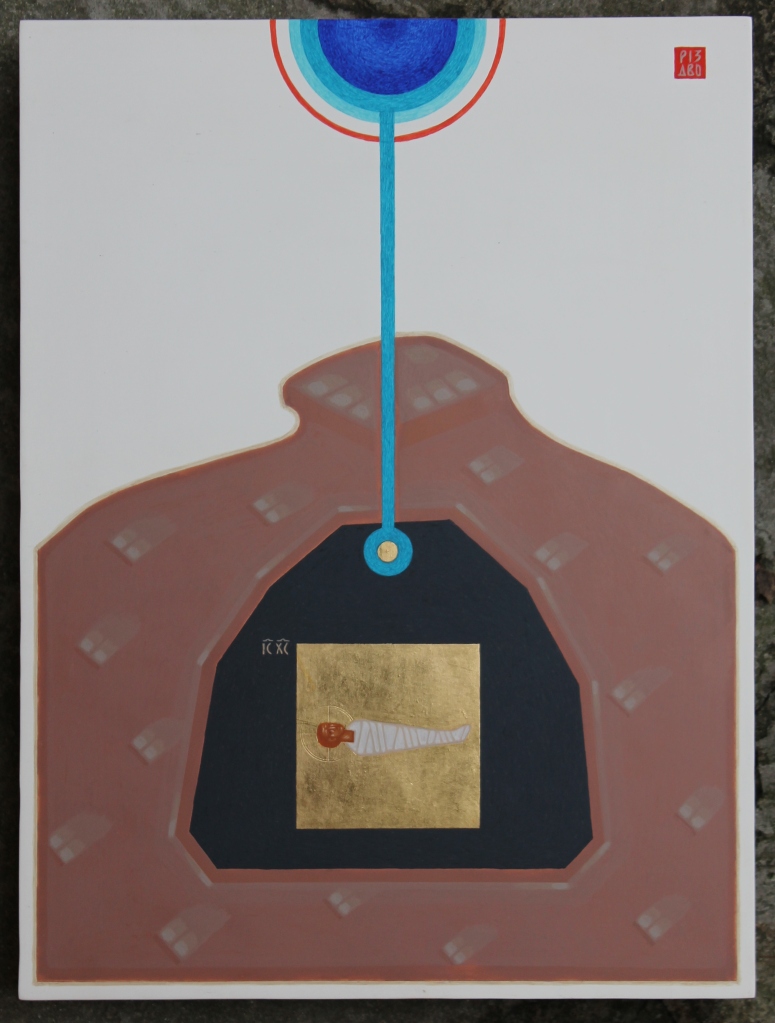
Danylo Movchan (Ukrainian, 1979–), Nativity, 2015. Egg tempera and gilding on board, 32 × 24 cm.
There has fallen on earth for a token A god too great for the sky. He has burst out of all things and broken The bounds of eternity: Into time and the terminal land He has strayed like a thief or a lover, For the wine of the world brims over, Its splendor is spilt on the sand.
Who is proud when the heavens are humble, Who mounts if the mountains fall, If the fixed stars topple and tumble And a deluge of love drowns all— Who rears up his head for a crown, Who holds up his will for a warrant, Who strives with the starry torrent, When all that is good goes down?
For in dread of such falling and failing The fallen angels fell Inverted in insolence, scaling The hanging mountain of hell: But unmeasured of plummet and rod Too deep for their sight to scan, Outrushing the fall of man Is the height of the fall of God.
Glory to God in the Lowest The spout of the stars in spate— Where the thunderbolt thinks to be slowest And the lightning fears to be late: As men dive for a sunken gem Pursuing, we hunt and hound it, The fallen star that has found it In the cavern of Bethlehem.
“Gloria in Profundis” (Latin for “Glory in the Depths”) by G. K. Chesterton is the fifth poem in the Ariel Poems series of pamphlets, published by Faber and Gwyer for the Christmas gift market from 1927 to 1931. It was reprinted in the posthumous Chesterton compilation The Spirit of Christmas: Stories, Poems, Essays(Dodd, Mead, 1985).
In anticipation of the liturgical season of Christmas, I’ve created an extensive playlist of hymns, carols, and spirituals—old and new—that celebrate God’s being born in human flesh. Listen to “Christmastide: An Art & Theology Playlist” on Spotify.
The narratives of Jesus’s birth that we find in the Gospels of Matthew and Luke include both bursts of joyful exuberance, as with the angelic choir above a field of sheep, and quieter, more contemplative moments, such as when Mary pondered “all these things” in her heart (Luke 2:19). Jesus was born into darkness, so the story also involves social stigma, deprivation, military occupation, political greed, infanticide, asylum seeking—and the twinge of a future cross. So while the overall tone of this playlist is one of merriment, it does not shy away from some of the decidedly unfestive aspects of the first Christmas. And yet that God, in love, made himself vulnerable to suffering is precisely what makes the incarnation so glorious. He is not distant from human pains and woes but, rather, right in the midst of them, having experienced them firsthand.
The song selections reflect my personal taste for indie folk and newgrass, so they include, for instance, the Oh Hellos, Sufjan Stevens, Wilder Adkins, Branches, Beta Radio, the Brilliance, Lowland Hum, Penny and Sparrow, the Lower Lights, the Walking Roots Band, Folk Hymnal, Steve Thorngate, Sam P. Bush, Found Wandering, Ordinary Time, and Garrett Viggers.
Gospel songs performed by artists like Mahalia Jackson, the Staples Singers, Isaac Cates, Mariah Carey, Whitney Houston, and Liz McComb also make an appearance, as do many African American spirituals, sung by Odetta, Harry Belafonte, Elizabeth Mitchell, and others. “Go Tell It on the Mountain” is the most widely known from that repertoire.
Also from America is the eighteenth-century carol “O Sight of Anguish” by Samson Occom, a Presbyterian minister and member of the Mohegan nation. New England roots musician Tim Eriksen sings it a cappella on Every Sound Below, but in this outdoor video he plays it on bajo sexto:
(Oh how I wish Ericksen’s marvelous Star in the East album were on Spotify, which features thirteen more songs in this vein!)
The Carols for a Cure album series, made up of contributions from Broadway casts, adds some theatricality. The cast of Nine, for example, sings “Los Peces en el Río,” a traditional Spanish carol in which Mary goes about her daily tasks—combing her tangled hair, washing Jesus’s diapers—as the fish in the river swim excitedly toward the newborn Savior. It’s sung by Antonio Banderas.
In addition to this and the twelfth-century “Friendly Beasts,” another song that focuses on the animal characters at the nativity is the punchy “A Stick, a Carrot, and a String” by mewithoutYou, which sounds like it belongs on the Juno soundtrack. It’s wonderfully quirky.
Of course the Christmas playlist includes tons of classics—“Joy to the World!,” “Angels We Have Heard on High,” “Silent Night,” and so on—multiple renditions, in fact. (It’s too hard to choose just one!) There’s an upbeat swing arrangement of “O Holy Night,” but there’s also a more subdued, ethereal arrangement by Katie Melua, and several more besides. It’s fun to see how different artists interpret the same song.
The Irish folk rock band Rend Collective gives us a raucous arrangement of “Ding Dong Merrily on High,” retaining some of the archaicisms in the original lyrics but rewriting verse 3. A competing team at One Way UK’s 2017 Puppet and Creative Ministry Festival in Rugby, Warwickshire, used this song as the basis of a super-entertaining puppet performance! This made me smile.
You may be wondering, “Where’s all the choral music?!” While I do enjoy that genre, especially at Christmas, I’ve decided to exclude such songs in this list (1) to prevent it from becoming too unwieldy and (2) because I have to do a lot more searching and comparison to find the best recordings.
(Update, April 2022: I’ve decided to add several dozen choral selections to the playlist! While I considered creating a separate list of Christmas choral music, I’ve decided that I prefer an integrated approach, which is also why I scattered such songs throughout, giving some stylistic variety to those who prefer to listen to the playlist in order. My hope is that those who don’t normally go seeking out this genre will be surprised to find pieces that resonate with them.)
Merry Christmas, friends! May you rejoice in Christ with exceeding great joy, he who “comes to make his blessings flow far as the curse is found.” Amen.
Bartolomé Esteban Murillo (Spanish, 1617–1682), The infant Christ asleep on the cross, ca. 1660–65. Oil on canvas, 24 4/5 × 34 3/5 in. (63 × 88 cm). Prado Museum, Madrid.
When, in the cavern darkness, Jesus
opened his small, bleating mouth (even before
his eyes widened to the supple world his
lungs had sighed into being), did he intuit
how hungrily the lungs gasp? Did he begin, then,
to love the way air sighs as it brushes in and out
through the portals of tissue to sustain
the tiny heart’s iambic beating? And how,
fueled by air, the dazzling blood tramps
the crossroads of the brain like donkey tracks,
corpuscles skittering to the earlobes and toenails?
Bottle of the breath of God, speaking in stories,
shouting across wild, obedient water, his voice
was stoppered only by inquisition, unfaith
and anguish. Did he know that he would,
in the end, leak all his blood, heave a final
groan and throw his breath,
oxygen for the world, back to its Source
before the next dark cave?
As the liturgical calendar was turning over into a new year this week, my husband Eric and I were at the tail end of a visit to India, staying with new friends Jyoti and Jane Sahi. Jyoti’s an artist, and Jane is a children’s educator, and together they live in the Christian village of Silvepura, north of Bangalore, where for years they ran, respectively, an art ashram and a school. It was a lot of fun getting to know them and their work, and discussing art, culture, theology, politics.
Before our flight departed in the wee hours of Sunday morning, the first day of Advent, Jane had set an oil lamp on the dinner table, decorated with flowers from the garden, and selected two poems for us to read aloud: an excerpt from the Gitanjali(Song Offerings) by Bengali poet Rabindranath Tagore [previously], and “Advent Calendar” by Rowan Williams. It was a meaningful welcoming in of the new season, and a beautiful blend of our hosts’ mixed cultural heritage: Indian and British.
All photos by Victoria Emily Jones
Gitanjali XLVby Rabindranath Tagore:
Have you not heard his silent steps? He comes, comes, ever comes.
Every moment and every age, every day and every night he comes, comes, ever comes.
Many a song have I sung in many a mood of mind, but all their notes have always proclaimed, “He comes, comes, ever comes.”
In the fragrant days of sunny April through the forest path he comes, comes, ever comes.
In the rainy gloom of July nights on the thundering chariot of clouds he comes, comes, ever comes.
In sorrow after sorrow it is his steps that press upon my heart, and it is the golden touch of his feet that makes my joy to shine.
“Advent Calendar”by Rowan Williams, published in After Silent Centuries (The Perpetua Press, 1994) and The Poems of Rowan Williams (The Perpetua Press, 2002; Carcanet Press, 2014):
He will come like last leaf’s fall.
One night when the November wind
has flayed the trees to bone, and earth
wakes choking on the mould,
the soft shroud’s folding.
He will come like frost.
One morning when the shrinking earth
opens on mist, to find itself
arrested in the net
of alien, sword-set beauty.
He will come like dark.
One evening when the bursting red
December sun draws up the sheet
and penny-masks its eye to yield
the star-snowed fields of sky.
He will come, will come,
will come like crying in the night,
like blood, like breaking,
as the earth writhes to toss him free.
He will come like child.
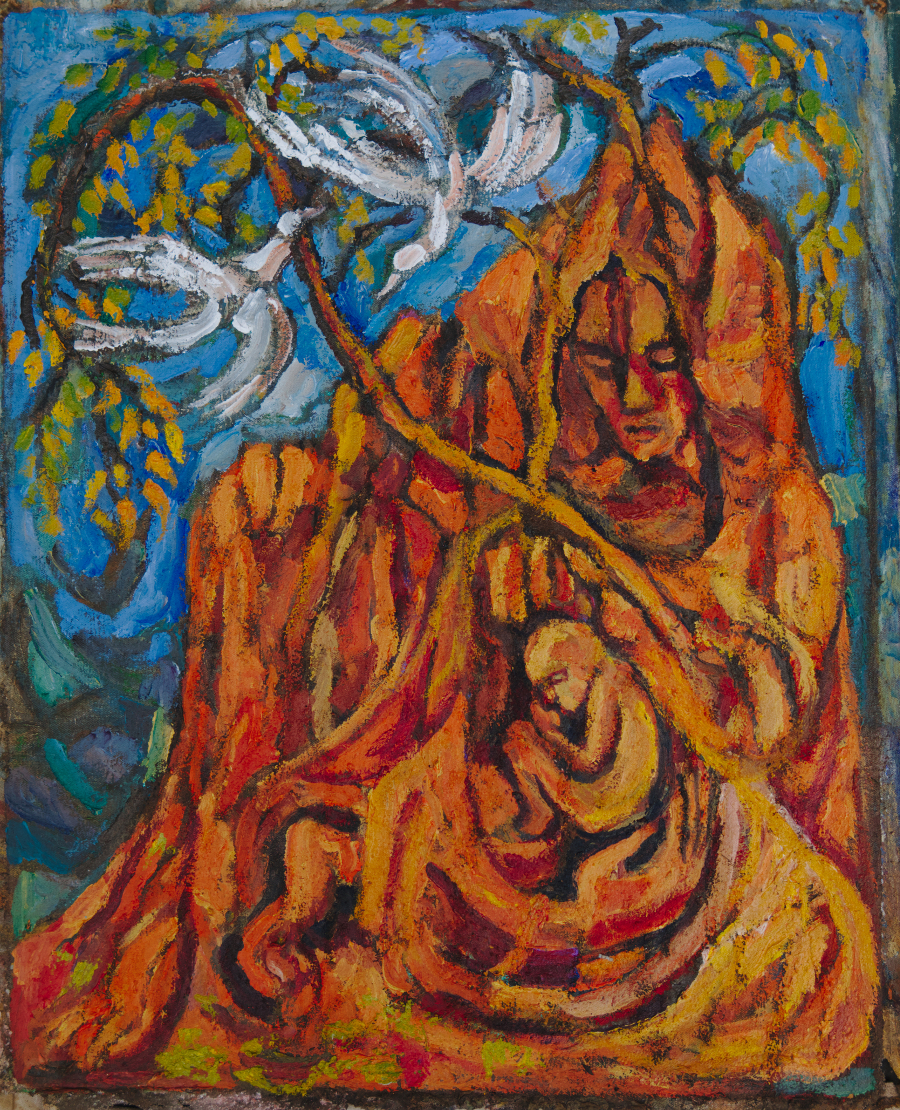
While I was at Jyoti’s, I bought three paintings of his. One of them is an Annunciation image that shows Mary in a termite mound, which are considered sacred in India—microcosms of the temple, sources of fertility, and containers of treasure. I saw these tall, hard, insect-built structures in many areas around Bangalore where I was traveling, including a few on Jyoti’s property. (Note that locals refer to termites misleadingly as “white ants,” so these are “anthills.”)
Jyoti Sahi (Indian, 1944–), Incarnation within the Anthill, 2019. Mixed media on canvas, 28 × 10 1/2 in. (71.1 × 26.7 cm). Collection of Victoria Emily Jones.
Anthill at Vishram in Silvepura with a Mary figure at the base, made of leaves and bark
According to Indian folklore, anthills are the ears of the earth, and Jyoti plays on that belief in his visualization of the moment of the Incarnation, of God’s becoming human in the person of Jesus. Mary’s womb is in the shape of an ear, which receives the Word of God. This Word is shown first at the top of the composition in the form of two hamsas (Sanskrit for “I am he,” or “I am that I am”), a mythical swan-like bird whose body resembles an AUM, the ancient threefold syllable, “the Sound that is believed to reverberate creatively through eternity,” Jyoti said. (“In the beginning was the Word . . .”)
Mary listens to the Word, becomes pregnant with the Word, which takes on flesh inside her. Christ, the primordial One, is implanted in the womb of the earth, of humanity—and a tree of life grows forth.
There’s a sixth-century hymn, known as the Akathist Hymn to the Theotokos (Mother of God), that celebrates Mary’s role as container of the Divine: “Hail! tabernacle of God and the Word. Hail! greater than the holy of holies. Hail! ark gilded by the Spirit. Hail! unfailing treasure-house of life.” Mary as temple, as holy of holies, as ark of the covenant, contains the world’s greatest Treasure: Jesus Christ, the Son of God.
You can hear Jyoti introduce the painting in the short video above, which is just a snippet of the footage Eric and I took while we were there. (More to come!)
As I traveled back home to the US with this rolled-up canvas last Sunday, I kept thinking about the words of the two poets I had just read—Tagore and Williams. I thought about how Christ came once “like child” but also how he “comes, comes, ever comes” even still today, “in sorrow after sorrow . . . press[ing] upon my heart . . . mak[ing] my joy to shine.”
Through the needle’s eye
the rich man came
squeezing through stars of razor light
that pared his body down to thread.
Gravity crushed his heart’s chime
and his breath that breathed out worlds
now flattened as fire between walls,
the impossible slit stripped him
admitting him
to stitch the human breach.
This poem was first published in What a Light Thing, This Stone (Sow’s Ear Press, 1999) and is used here by permission of the author.
My research interests have to do mainly with art’s theological potential and its ability to, as Walter Brueggemann puts it, “disclose” truths that are “closed” by prose. I love how it often surprises, and how it can make connections I would have never thought to make myself.
Suzanne Underwood Rhodes’s poem “Advent” demonstrates these values magnificently. Its topic is the Incarnation. But her mooring point is not John 1 or Luke 1–2 or Philippians 2 or any other scripture text traditionally associated with the doctrine. Instead she draws on the famous aphorism of Jesus that’s recorded in Matthew 19:24: “It is easier for a camel to go through the eye of a needle than for a rich person to enter the kingdom of God.”
In this Gospel interaction, Jesus is explaining how terribly difficult it is for wealthy people to enter heaven because they tend to cling tightly to their earthly wealth rather than to God; they let it make claims on them, and they trust in its promises, to the neglect of the claims and promises of God. While the needle saying, in context, pertains to human beings passing from earth to heaven, Rhodes turns it on its head to suggest the movement of God from heaven to earth. A seeming impossibility—infinity becoming finite, God becoming man. But “with God, all things are possible” (Matt. 19:26). To save us, he would give up all the riches of heaven, assuming the role of a servant and ultimately giving up his very life.
Rhodes uses harsh, uncomfortable words—“squeezing,” “razor,” “pared,” “crushed,” “flattened,” “stripped”—to convey a sense of compression into human flesh. God’s breath, once so powerful and expansive that it brought the universe into existence, is now, in the person of the Son, walled in by a rib cage and dependent on oxygen. His heart pumps actual blood. Thus pared down to thread, he slips through the needle “to stitch the human breach,” to repair what we have torn through our disobedience. Severed from God no longer, we are held together with him by Christ himself.
Musical composition: “As by Fire between Walls” by Joshua Stamper
The evocative imagery of this poem has inspired artists in other media to respond in kind. One of them is composer Joshua Stamper, who, commissioned in 2014 by City Church Philadelphia, wrote a four-and-a-half-minute experimental jazz piece for chamber orchestra titled “As by Fire between Walls.”
It starts with minor chords on the piano, floating around ethereally. Then a violin tremolo kicks in (suggestive of the “razor light”), and other sharp bowing techniques (“par[ing] his body down”). Then soulful, wordless vocals. Then a staccato rhythm played on the mellotron, and percussion. Brass too. It’s a wonderfully wrought piece of music, a soundscape of the Incarnation, inclining the ear back toward Rhodes’s words and the heart to the grand story of scripture.
Painting: Through the Needle’s Eye the Rich Man Came by Grace Carol Bomer
Suzanne Rhodes is a friend of visual artist Grace Carol Bomer’s, who has a studio practice in Asheville, North Carolina. In 1993, Bomer was invited by the Asheville Art Museum to exhibit eight of her paintings for a Christmas show. Through the Needle’s Eye the Rich Man Came, inspired by Rhodes’s “Advent,” is one of those eight.
Grace Carol Bomer (Canadian American, 1948–), Through the Needle’s Eye the Rich Man Came, 1993. Mixed media on torn canvas on wood, 48 × 48 in.
About it, Bomer says,
The Christ of Christmas is God incarnate, the focal point or fulcrum of history. To show this glorious Incarnation, I chose to paint a piercing V (fulcrum) of light rending cloth (canvas on wood). The torn canvas symbolizes the veil of the temple. . . .
It was my personal challenge to show in painting that Christ is God, Spirit and flesh, in a way that would not be trite and sentimental. The Renaissance nativities are infected with beautiful Platonic realism, suited for Christmas card sentimentality. I feel they do not adequately exalt the “mystery hidden for ages,” the Christ of power and glory. Jesus Christ is Spirit and flesh, Son of God and Son of Man. Reality is both “abstract” and “realistic.” So too, art must seek to find this mysterious balance in order to proclaim the gospel. Art totally divested of realism, like Abstract Expressionism, becomes meaningless. Art must proclaim creation, fall, and redemption. I would like the poetic nuances in my work to stimulate the imagination to “see” in the abstract painting the spiritual truths that cannot be painted realistically.
In this piece there are suggestions of blood on doorways, symbolizing a Passover fulfilled, as Christ pushes open the door separating God and man.
So this painting integrates the coming down with the at-one-ing that happens at the cross, the physical tear of the canvas alluding simultaneously to the “human breach” of Rhodes’s poem and the tearing of the temple veil, which symbolizes humanity’s reconciliation to God. Birth and death are wrapped up in a single image, as both are key to Christ’s salvation project.
See how a poet’s imagination and craft can unfold the beauty and wonder of a heady doctrine with such concision? In Literature: Structure, Sound, and Sense, Laurence Perrine defines poetry as “a kind of language that says more and says it more intensely than does ordinary language” (509). That’s just what Suzanne Underwood Rhodes does in “Advent.” And that intense language of hers has inspired works of musical and visual art that explore even further what it means that the Son of God, the “Rich Man” from heaven, constricted himself for our sakes, becoming impossibly small, taking up residence in a virgin’s dark womb, in humanity’s dark world, so that he could stitch back together our ruptured relationships with the Father and with one another.
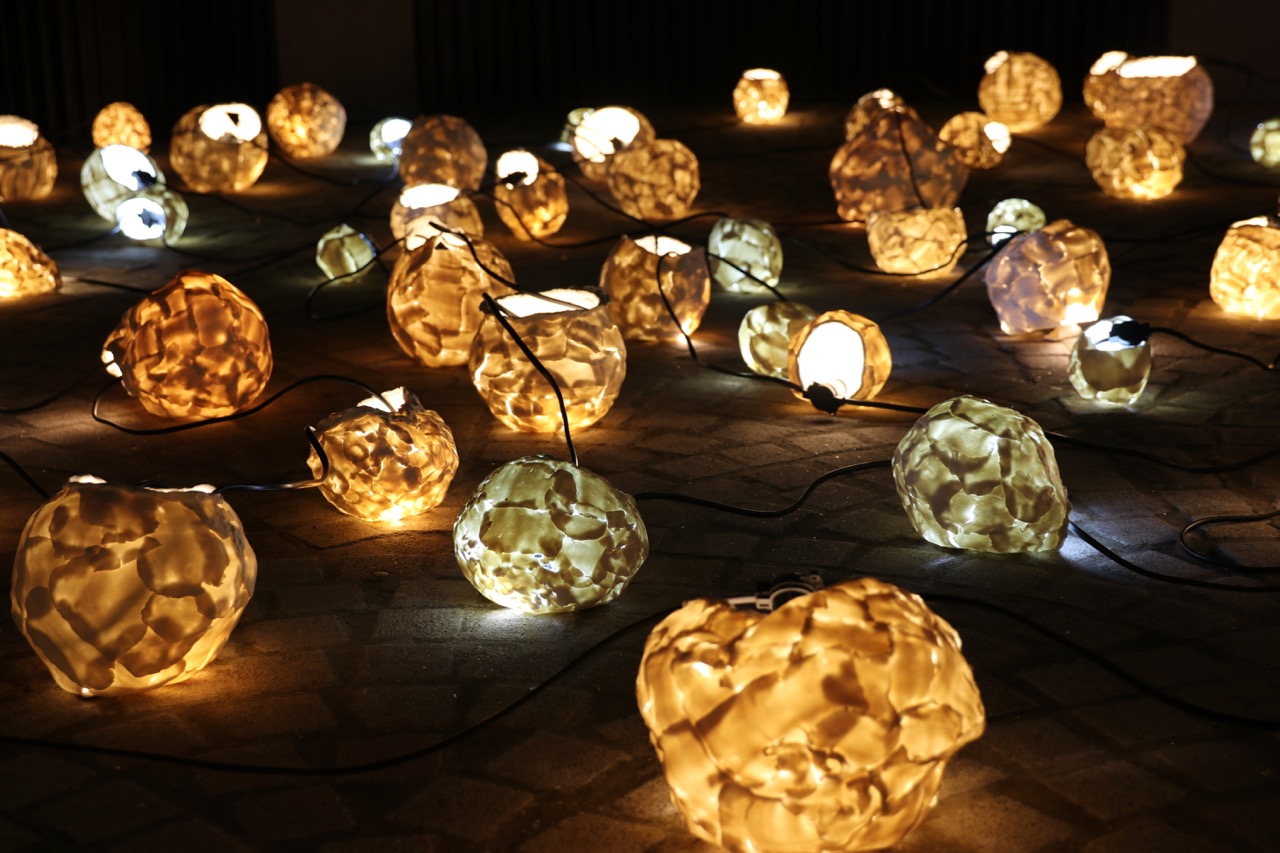
COMMUNITY ART PROJECT + INSTALLATION: Light the Well by Anna Sikorska: Last month artist Anna Sikorska led the congregation of St. Martin-in-the-Fields in creating a constellation of cracked, translucent porcelain globes, lit from within like lanterns and linked together—a visualization of Paul’s words in 2 Corinthians 4:6–12, about our hearts being clay jars whose fragility and brokenness enable the light of Christ to shine through all the more. Light the Well was installed at St. Martin’s on November 11, and since November 19 the individual lanterns have been selling for £10 a piece to benefit New Art Studio and Art Refuge UK, charities working with art therapy in the context of migration and displacement. Associate vicar Jonathan Evens delivered a beautiful reflection on this artwork and the scripture that inspired it, as well as a prayer and benediction, which you can read in full here.
I love it when churches use art not merely to decorate or prettify the building but to further the congregation’s engagement with scripture and to foster shared doing and seeing.
+++
SONGS:
“City of David” by the Gray Havens: The Gray Havens, a “narrative pop folk duo” from Nashville made up of married couple David and Licia Radford, released a new Christmas single on November 17—recorded on an iPhone! Listen to the song and watch some of their “making of” process in the video below. God the Father often gets overlooked during this season, so I like that the refrain reminds us that “the Father sent him [the Son] down.” [Purchase here]
“Human for Me” by Katy Kinard: Released last year on the album God of Fireflies, this song praises God for assuming full humanity—for not circumventing any frustrating or painful aspect of it. [Purchase here]
+++
GALLERY TALKS:
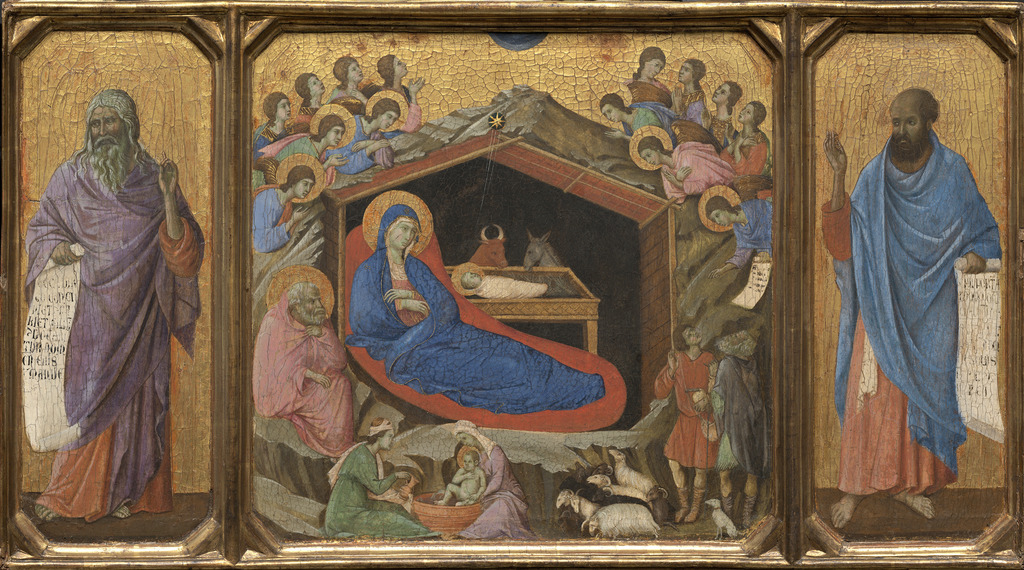
“The Christmas Story in Art” at the National Gallery, Washington, DC: Gallery lecturer David Gariff will lead a 75-minute discussion about paintings in the collection that depict the birth of Jesus, including one of my favorites, Duccio’s Nativity with the Prophets Isaiah and Ezekiel. (Click on the link to see a full list of works.) The event is free and geared to an adult audience. To participate, meet in the West Building Rotunda at 1 p.m. on December 9 or 10, or 2 p.m. on December 14, 18, 20, 21, or 22.
Duccio (Italian, ca. 1255–60–ca. 1318/19), The Nativity with the Prophets Isaiah and Ezekiel, 1308/1311. Tempera on single poplar panel, 48 × 86.8 × 7.9 cm (18 7/8 × 34 3/16 × 3 1/8 in.). National Gallery of Art, Washington, DC.
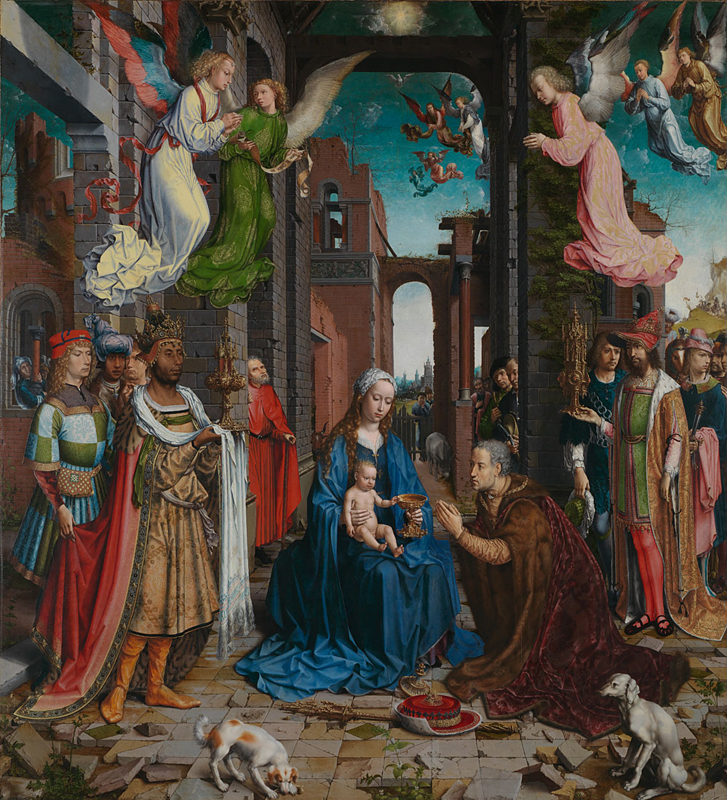
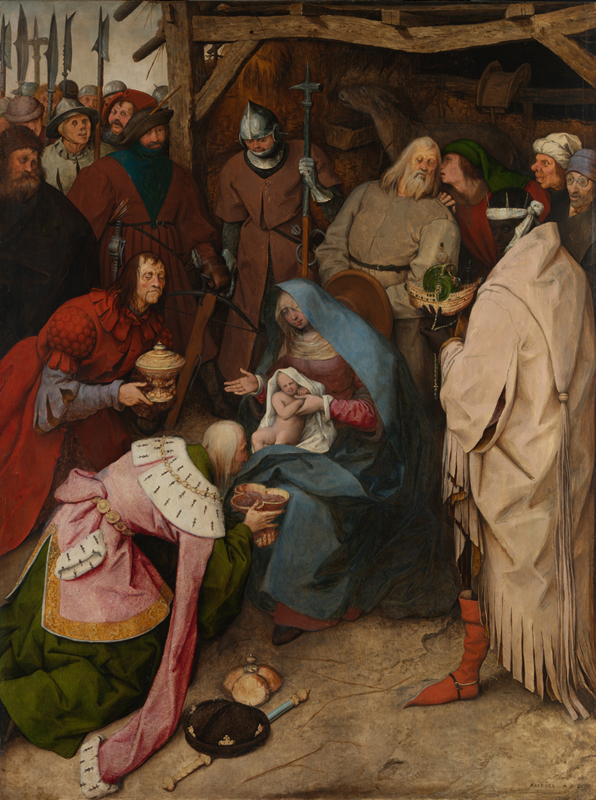
“Adoration of the Kings” Facebook Live tour at the National Gallery, London: Friday, December 15 at 9 a.m. GMT, director Gabriele Finaldi will be exploring Jan Gossaert and Pieter Bruegel the Elder’s paintings of the Adoration of the Magi. This “tour,” offered exclusively online, will be broadcast live on the Gallery’s Facebook page, and a replay version will be available on the channel afterward.
Jan Gossaert (Flemish, d. 1532), The Adoration of the Kings, 1510–15. Oil on oak, 179.8 × 163.2 cm. National Gallery, London.
Pieter Bruegel the Elder (Flemish, d. 1569), The Adoration of the Kings, 1564. Oil on oak, 112.1 × 83.9 cm. National Gallery, London.
+++
POEM: “Scale” by Chelsea Wagenaar: Chelsea and I went to the same small North Carolina church as kids, back when she was a Henderson and I a Hartz, so we share a heritage of learning Bible lessons from Butch the Dragon and competing annually in the Bean Bag Relay at the AWANA Olympics. Now she is an award-winning poet, a Lilly Fellow, a lecturer in Valparaiso University’s English department, and a mom!
Inspired by her pregnancy, the poem “Scale” is full of metaphors that revel in the wonders of prenatal life—the womb is a “winterplum sky,” the cluster of baby cells “untufted cotton,” the belly a “Lenten moon.” The central theme, which Chelsea cleverly plays around, is Psalm 139:16, a praise verse by King David: “Your eyes saw my unformed substance; in your book were written, every one of them, the days that were formed for me, when as yet there was none of them.”
Chelsea’s poem is especially appropriate for Advent, a season of pregnancy in which we position ourselves retrospectively with Mary, letting our hearts expand as we wait expectantly for that marvelous deliverance, the coming of the Christ child.
Shepherds, I sing you this winter’s night
Our Hope new-planted, the womb’d, the buried Seed:
For a strange Star has fallen, to blossom from a tomb,
And infinite Godhead circumscribed hangs helpless at the breast.
Now the cold airs are musical, and all the ways of the sky
Vivid with moving fires, above the hills where tread
The feet—how beautiful!—of them that publish peace.
The sacrifice, which is not made for them,
The angels comprehend, and bend to earth
Their worshipping way. Material kind Earth
Gives Him a Mother’s breast, and needful food.
A Love, shepherds, most poor,
And yet most royal, kings,
Begins this winter’s night;
But oh, cast forth, and with no proper place,
Out in the cold He lies!
This poem is published in Collected Poems 1943–1987 by John Heath-Stubbs (Carcanet Press, 1988) and is reprinted here by permission of David Higham Associates.
+++
John Heath-Stubbs (1918–2006) was an English poet, translator, critic, and anthologist whose lifelong fascination with world history and literature was borne out in his career. He translated poetry from Greek (Sappho, Anyte, Anacreon), Latin (Horace, Catullus), Persian (Hafiz, Omar Khayyam), Italian (Dante, Giacomo Leopardi), and French (Paul Verlaine) and wrote many verses of his own influenced by classical myths, including an Arthurian epic, Artorius.
Described by friends as a “devout” and “committed” Christian, Heath-Stubbs sometimes turned to the lives of Christ and the saints as subjects for his poetry, as in “‘Through the Dear Might of Him That Walk’d the Waves,’” “Dionysius the Areopagite” (on a pagan’s response to the eclipse during the Crucifixion), “Canticle of the Sun” (on the Resurrection), “Alexandria,” “Maria Aegyptiaca,” and “Virgin Martyrs,” to name a few. In his introduction to his Collected Poems, he wrote that he was interested in “the reaffirmation of orthodox religious themes in the poetry of TS Eliot and Charles Williams and others.”
Among other distinctions, Heath-Stubbs was awarded the Queen’s Gold Medal for Poetry in 1973 and in 1989 was appointed OBE (Officer of the Most Excellent Order of the British Empire). At his death, publications celebrated his style and influence:
“His distinctive achievement was to forge a modern pastoral out of unlikely sources, a style which can encompass Yeatsian symbolism and dry irony.”—Poetry Archive
His diction was conservative, but his lyricism was always modern.—The Telegraph
“His finest work is to be found in his huge output of shorter poems. In their technical mastery, wry wisdom and gloriously deceptive lightness, these place him in the company of W.H. Auden and Robert Graves, a major English poet of the 20th century.”—The Independent
Heath-Stubbs was nearly blind from age three, his eyesight progressively worsening until he lost it completely at age fifty-nine. But rather than regard his blindness as a disability, he regarded it as a gift. “As a poet, I have found that blindness actually tends to stimulate the imagination,” he said.
+++
First published in 1965, “For the Nativity” by John Heath-Stubbs is an ode to the infant Jesus—to him who is Hope, Seed, Star, and Love.
The first stanza is a loose paraphrase of the Annunciation to the Shepherds in Luke 2:10–13, in which an angel tells a group of Jewish night workers that Emmanuel, God-with-us, has been born. Heath-Stubbs uses horticultural imagery: Jesus was planted in Mary’s womb, and now he breaks through into air, blooming for all the world to see. Foreshadowing future events, the “tomb” refers not only to the cave he was born in but also to the cave he’d be buried in. He’d be seeded once again (in death), and again (in resurrection) he’d flower forth with new life. The fourth line embraces the paradox of the Incarnation: that infinite God became a finite human being; the omnipotent Creator, an impotent babe reliant on his mother’s milk. Continue reading ““For the Nativity” by John Heath-Stubbs + choral setting”→
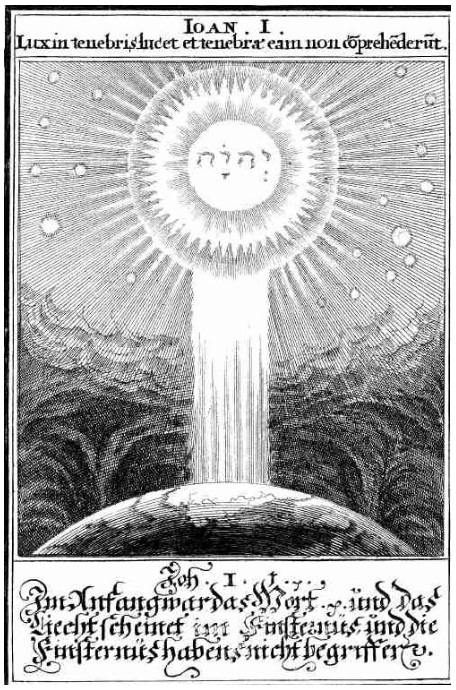
This year for Advent, my church has built into its liturgy a time for guided reflection on an art image—one per week—corresponding to one or more of the season’s themes. Today I led the congregation in looking at a seventeenth-century German engraving based on John 1. Here’s what I said (adapted from the Advent devotional I published this month):
Christoph Weigel (German, 1654–1725), Word, 1695. Engraving from Biblia ectypa: Bildnussen auss Heiliger Schrifft Alt und Neuen Testaments. Image courtesy of the Digital Image Archive, Pitts Theology Library, Candler School of Theology, Emory University, Atlanta, Georgia, USA.
This copperplate engraving is from a picture Bible by Christoph Weigel published in Augsburg in the late 1600s. The Bible consists entirely of engraved images—839 in all—with key scripture texts inscribed above and below, from Genesis to Revelation.
Looking at this one, you might think of the creation story—God speaking, “Let there be light.” You wouldn’t be wrong to make that association, but actually this engraving illustrates the first chapter of John’s Gospel: the eternal Word of God taking on flesh and entering human history, a doctrine we call the Incarnation. This is the big bang of the new creation. This is God once again hovering over the chaos and proclaiming, “Let there be light.” And there was Light. Because the Savior came, and is still coming.
The top inscription says in Latin, “In the beginning was the Word” (v. 1). And the German one below says, “The light shines in the darkness, but the darkness has not comprehended it” (v. 5).
In Weigel’s illustration, the name YHWH is surrounded by a blast of light that showers down to our dark earth in this magnificent glory-stream. Before this, Israel’s covenant God was mostly invisible and unapproachable, but now he reveals himself as man and Son, the second person of the Trinity, Jesus. He’s still Yahweh, but now he’s Yahweh brought low, to be seen and touched and engaged face-to-face.
This image emphasizes the cosmic nature of the Incarnation and reinforces the meaning of the Greek word for Jesus that John uses in his prologue: Logos, which our English Bibles translate as “Word” with a capital W. This term is a loaded one, used in most schools of Greek philosophy to designate the underlying principle of the universe, one that is rational, intelligent, and vivifying; other translations include “Mind,” “Power,” “Cause,” “Act,” “Ground,” “Reason,” “Structure,” or “Universal Bond.” Philosophers had been reinterpreting the concept of Logos for centuries, but John was the first to link it to the person of Christ.
Advent is a time for us to consider what it means for the Word of God, the Logos, to have a body and be among us.


.jpg)



 Art & Theology